Showing posts with label LeGuin. Show all posts

Tuesday, January 28, 2014

Microreview [book]: A Darkling Sea by James L. Cambias


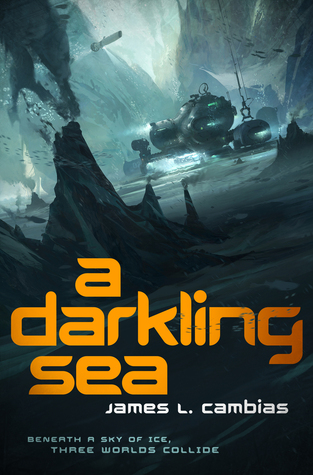
Item: Cambias, James L. A Darkling Sea [Tor, 2014]
File under: science fiction, anthopological.
Buy: Print or Download for Kindle.

At some point during the transition to adulthood, I realized that questions of behavior were more interesting to me than questions of, say, whether particles can break the speed of light. But I didn't turn my back on science fiction--rather, I came to see it as a medium for exploring how behavior might change if you alter some of the key variables. Like Heinlein said, a "Simon-pure" SF story (whatever that means) is one that adheres to the following:
  1. The conditions must be, in some respect, different from here-and-now, although the difference may lie only in an invention made in the course of the story. 
  2. The new conditions must be an essential part of the story. 
  3. The problem itself—the "plot"—must be a human problem. 
  4. The human problem must be one which is created by, or indispensably affected by, the new conditions. 
  5. [Paraphrased as: be internally consistent in all departures from accepted science.]
Though I'm not exactly a huge Heinlein fan, I've long felt an attraction to his framing of the genre. Over time, I grew a special appreciation for science fiction that explicitly tackled the modalities of behavior--whether psychological, sociological or otherwise. (This kind of social science fiction is often referred to as "soft" SF, a term ostensibly created to differentiate it from physical science-obsessed "hard" SF, but which, in a lot of usages, is also coated in gendered bullshit.) But what about when some of the principle actors are not human?

Questions of how sentient alien species might behave, and how we might interact with them, provide some of the more fruitful avenues for social science fictional exploration. Ursula LeGuin's Hainish novels are without a doubt the paradigmatic examples of the anthropological approach, but you can also count Ian M. Banks' The Player of Games, Octavia Butler's Xenogenesis series or basically anything involving the Prime Directive in the Star Trek universe as well.

A Darkling Sea is James Cambias' debut novel, but it is, in fact, an evolution of previously published short fiction, most notably the 2004 story "The Ocean of the Blind"--which readers may recognize as the first chapter of the novel. The book, following from the earlier story, revolves around a scienfitic mission to the moon Ilmatar, which orbits a gas giant in a distant star system. Ilmatar is a bit like Europa, in that it's covered by 5km of ice, underneath which lies a pitch-dark ocean heated (to the degree that it is heated) by vents funneling hot gases from beneath the crust.

Somehow, humans and the relatively more advanced Sholen come to realize that there are intelligent creatures living at the bottom of Ilmatar's oceans. The Ilmatarans are crustacean-like creatures with hard shells and pincers; they are understandably blind but have advanced sonar capabilities. They have produced complex physical and social structures, and have developed a form of literacy. They even have scholars!

The humans want to study the Ilmatarans, but the Sholen are deeply concerned about anything that smacks of interference in the Imatarans' "natural development." So they allow the humans to set up a single underwater habitat, but only on the condition that they take every possible measure to avoid direct interaction. Forced by technological inferiority and the continued domestic view of the Sholen as "those friendly paternal spacepeople," accept the conditions and set up shop. Unfortunately, a vainglorious scientist/media personality, Henri Kerelec, decides to break the rules and get up, close and personal with the Ilmatarans. Things don't go as planned. 

The Sholen get word of what's happened, and send a fact-finding mission to ascertain whether or not the humans can be trusted to continue their scientific endeavor without a repeat performance. But as it turns out, the Sholen are themselves mired in a complex political struggle between pragmatist-explorers, who largely share the human perspective and would like nothing more than to collaborate in their studies, and militant-isolationists, who see only disaster coming from inter-species interaction (including Sholen/human).

I won't spoil the book, but I will say that Cambias builds a remarkable conflict out of this--one that, really, has no "bad guys." Though there are certainly some "conflict entrepreneurs," to use a social science jargon term, you always get where they are coming from--even the most committed militants among the Sholen and humans. Rather, conflict arises from the failure to communicate effectively, and by the assumptions individuals bring into interaction--the meanings to our own actions that we assume others will understand, and the meanings we ascribe to the actions of others based on our own experiences and cultural practices.

There's a great scene were some humans utilize non-violent resistance tactics, assuming the Sholen will know what they are doing. But instead, the humans baffle the Sholen. After all, Sholen society is built around the concept of decision-making through consensus--affecting change from resistance and conflict are things they do not quite understand (yet are not resistant to). And this speaks to another strength of the book: its ability to convincingly portray three different--alien--modes of cognition, and making them all relatable without making them "too human."

A Darkling Sea also contains within it political theory of inter-species interaction, a reaction if you will, to the aforementioned Prime Directive. In Cambias' own words:

Did I mention I think the Star Trek "Prime Directive" is a stupid idea? I do. I know Gene Roddenberry wanted to get away from the raygun-toting empire-builders of the pulp science fiction era, but the idea of a rigid ban on any contact with "less advanced" civilizations is still foolish. It assumes that cultures without advanced technology are somehow naive or innocent, and that the process of leaving that low-tech life is a step down somehow -- a Fall from Eden. That's simply not true. When Commodore Perry sailed into Tokyo Bay, he brought change to Japan; incredible, neck-snappingly rapid change. But Japan remained Japan. Its people were no better or worse morally than before.

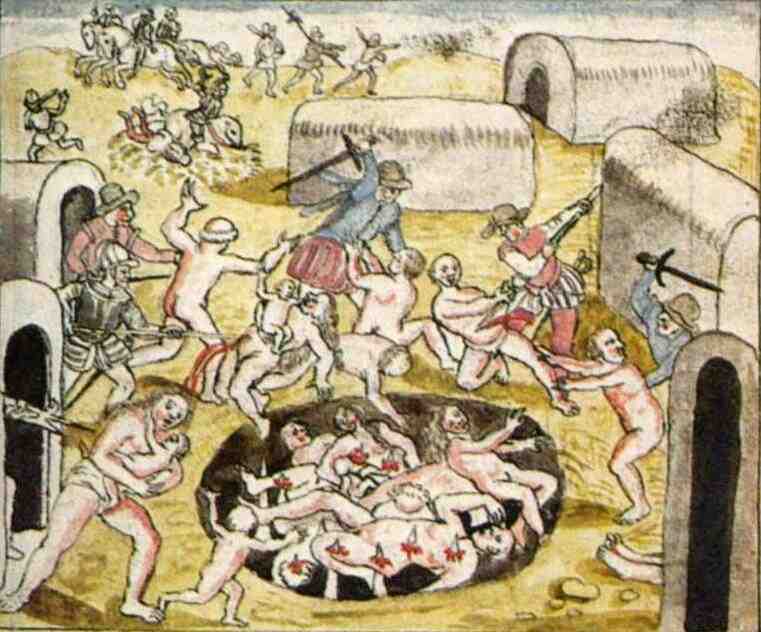
Taken at face value, this statement strikes me as problematic--after all, Japan might have emerged from the interaction with Commodore Perry (largely) unscathed, but at a high cost for its neighbors, who would be subjected to its violent industrial militarism for more than a half-century. And that's not even taking into account, say, those living in the Pre-Columbian Americas, few of whom could be described as emerging from their interactions with Europeans "no worse than before."

This...

...often led to this.
Nevertheless, there is a good point in there--that these interactions don't have to be negative, and can actually be mutually beneficial. I read A Darkling Sea as arguing for managed and responsible interaction between more and less technologically advanced groups, not open and unfettered interaction--let alone exploitation a la colonialism. Outside Henri, the humans are very cautious in their approach to the Ilmatarans, even after they abandon the restrictions imposed on them by the Sholen. My impression from the text is that it is the rigidity of the Prime Directive, and of the Sholen, that Cambias finds objectionable, not the underlying impulse. There's also a clear critique of fanaticism, in the sense that accommodation is repeatedly torpedoed by a relatively small number of "true believers" on each side.

Putting the !BIG IDEAS! aside for a minute, I'd also like to note that the book is very well-written. A Darkling Sea doesn't aspire to be a prose poem, but the prose is nevertheless much better than the average for the genre. The book is expertly paced, full of lively description that never ventures into the hellish realm of the infodump and kept me glued to it from the first to the last sentence. Cambias alternates human, Sholen and Ilmataran perspectives; he does so much more quickly that, say George R. R. Martin, but achieves the similar effect of making me want to skip ahead to the next perspective section for a particular character so I can see what happens right now. I also liked that the human future was suitably multicultural and multinational--not just America in Space.

Not the only future imaginable anymore.
The one major flaw I found in A Darkling Sea is the protagonist, Rob Freeman. He's just not that interesting--a sort of layabout "not-really-hero-ish-but-not-an-antihero" type who seems to accomplish a lot of what he accomplishes through dumb luck and never even seems that interested in what's going on around him. Like Yorick in Y: The Last Man. Thankfully the other characters, from the Ilmataran Broadtail (who has his own perspective sections) to the supporting character and director of the research colony, Dr. Sen, are much more well-rounded.

All in all, I'd highly recommend A Darkling Sea to anyone who wants to read a book that qualifies as "hard" SF but is more interested in the social scientific implications of space exploration and alien contact. Even if I didn't love or agree with everything contained within the book, I nevertheless found it to be challenging in all the ways SF can and should be challenging.

(Oh, and if you're interested in learning more about the world Cambias has created, check this out.]

The Math

Baseline Assessment: 8/10

Bonuses: +1 for the complex theorization on communication in interaction and conflict; +1 for the brilliantly realized alien perspectives.

Penalties: -1 for Rob Freeman, the "meh" protagonist.

Nerd Coefficient: 9/10. "Standout in its category."

Tuesday, June 25, 2013

Microreview [book]: Microreview [book]: The Unreal and the Real: Selected Stories of Ursula K. LeGuin, Vol. 2: Outer Space, Inner Lands

The Meat 

As I ranted at some length in my review of book one of this two-volume collection of LeGuin's short stories, anthologies are suspect for all sorts of reasons, and when I read this volume, I discovered yet another, one moreover that's a bit of a paradox: volume two is, more or less, consistently excellent in the quality of its stories. How is this paradoxically a problem with anthologies, you ask? Why, because volume one was considerably more uneven, with a few truly brilliant stories dimmed just a bit by those surrounding them (mediocrity by association?), while Outer Space, Inner Lands is (just?) very good from start to finish. In other words, volume two had moments of sheer brilliance which stood in sometimes stark relief to other rather ho-hum stories in the collection, whereas volume two has no ho-humitude...but also, arguably, no such stand-out moments either.

   On the other hand, it would be remiss of me to complain about the fact that volume two was so consistently good. And there are some stories I personally found more appealing than others. For instance, there was "Semley's Necklace," which LeGuin, in her forceful and witty introduction (which while an essay is in some ways really almost a short story in itself, and a good one at that) somewhat reluctantly concedes could be labeled 'science fantasy'. She's quite self-deprecating about it, essentially claiming she only wrote it because at the time she didn't yet know any better, but she was selling herself, and the entrancing Semley, way short with that assessment.
Artist's rendering of the eponymous ultra-valuable necklace
(one school of thought claims it may not be the original, however)
   "Semley's Necklace" shares a theme with several others in the collection, namely speculative explorations of the wrenching sense of temporal displacement, or to put it in more human terms, the loss of all those one loves, that would surely come with NAFAL (no, this isn't a clever amalgamation of Raphael Nadal's name, though it would be pretty cool if that caught on; it stands for "nearly as fast as light") travel. We've all seen Avatar, and we accept too readily—because Cameron, the King of the World, demands it—that it would be a simple matter to jump on a ship, get frozen, and spend the six years or whatever in a heartbeat, and we all think it's awesome because the people on the ship won't have aged hardly at all! LeGuin refocuses our attention on that dreadful gap in perception...suppose you left your parents or lover or cat or whatever back on Earth, and once your journey was complete, you spend a few years on the planet and head right back to Earth because you miss those loved ones you'd left behind. Bam! Dare to imagine all that would have happened in those twelve or fifteen or twenty years, and I think you'll see, as LeGuin certainly has, the wisdom in saying, as you depart, "We are dead, you and I"—for even if both you and your beloved still live at the end of that awful separation, what you were is dead, and you cannot ever hope to recover the shattered synchronization of your lives.

   LeGuin believes that the final two stories in the collection are the finest, but I remain unconvinced of that. They're not bad—none of these stories is less than very good—but "She Unnames Them" is merely cute, and "Sur", in particular, was of only mild interest. How she could choose their blandness over the fiery challenge of, say, "The Matter of Seggri" puzzles me. "Seggri" intrigues with its bold speculations about how a world might develop in which female human(oid)s outnumber males 16 to 1, and its wry lack of judgment, as though forcing all the men and women who read it to wonder with her, "Which world is better?" Ours, with today's growing hope of equality, not to mention deeply meaningful relationships between men and women, overshadowed by the dismally violent record of all human history, or theirs, with the (not necessarily?) terrible fate of the men balanced against their apparently more or less eternally peaceful society?

   Fans of Earthsea will be intoxicated by "The Rule of Names", about a certain critically important if minor—though by no means small-statured—character from the first book, and the socks of William James fans (if anyone cares about him anymore) will be blown clean off by "The Ones Who Walk Away from Omelas". I would count myself among the likely walkers, so to speak, but I freely admit such a utopia would be hard for almost anyone to reject.

   Ultimately, if there is one theme running through nearly all these stories, it is that of loss, its consequences and our painful efforts to recover, rebuild, remake ourselves.  And in a strange way, this theme felt more immediate to me, more 'real', in this volume, rather than in book one, where many of the stories are much more transparently about the 'real' world.  LeGuin herself, in the intro, playfully leaves it up to the reader to determine which book is which in this two-volume series called The Unreal and the Real...my TLDR answer is: this **** is Real!

**** = 'book', of course.


The Math


Baseline score: 7/10

Bonuses: +1 for being "all good", +1 for Selmey's tragic and incomprehensible journey and the shudders of tearful sympathy it induced in me

Penalties: -1 for LeGuin making it crystal clear she and I don't see eye to eye on her work, e.g., claiming that what are probably the two least interesting/challenging stories are her favorites


Nerd Coefficient: 8/10 Well and totally worth your time and attention

["8" is the new "great"! Check out an explanation of our utterly uninflated scores here.]

Monday, May 27, 2013

Microreview [book]: The Unreal and the Real: Selected Stories of Ursula K. LeGuin, Vol. One: Where on Earth

The Meat

As a general rule, I'm not fond of anthologies. Why raid the refrigerator for a bunch of different random stuff, all mixed together and all of which you've tasted already? Isn't it more satisfying to find something you've never had before, or choose just one thing you know you like and eat until you drop? Plus, if I wanted to listen to the greatest hits of a band, I could just go back to their previously released CDs, where each of those songs has certainly appeared; the thought of shelling out money for a 'new' album that's a mere collection of bits and pieces of other albums (especially if I already own them!) doesn't appeal to me at all. Who, exactly, is the target audience for anthologies? Avid LeGuin fans will have read most or all of these stories before and might feel cheated, whereas neophytes probably won't understand how these particular stories function and fit into her larger oeuvre (which is Pretentious-talk for "body of work"). Who, then, is left who might be able to appreciate the much-maligned anthology?

Me! I'm what you might call a lapsed, moderately avid fan of LeGuin, or more specifically, of her novels; when I was younger, I had little interest in short stories as a medium, and none at all in short stories about the "real world": in other words, any stories not overtly devoted to escapist science fiction or fantasy themes were dead to me. So whenever I heard about or saw another story in LeGuin's fictional but (usually) all too drearily real Orsinia or the like, my eyes glazed over and I reached reflexively for one of her more straightforward science fiction novels instead.

You've probably guessed that I really liked this volume of short stories, so you may well expect me, at this point, to say something like "what a fool I was—I wish I'd been open-minded enough to appreciate those stories years ago", but in fact, I don't regret how things turned out. It's sort of like the first time I tried to read Ulysses, mostly just to prove I could; turns out that's not a very good motivation for reading something. I hated it, and stopped reading almost immediately in disgust. But a few years passed, and then suddenly it just felt right to read it...that's pretty much what happened now, with my belated discovery of LeGuin's less science-fictiony stories.


Sure, like all anthologies it suffers from some unevenness in story quality; LeGuin has a tendency to write in a fascinating style, a hybrid of minimalism and just slightly pretentious pithiness; when the story can support that kind of emotional payload, it's powerful stuff, and doesn't feel pretentious at all, but in some cases, the stories weren't quite engaging enough. For example (from Brothers and Sisters, one of my least favorite stories of the collection): "Her sorrow boasted of itself. She rose to the occasion like a lark to the morning. His silence and her outcry meant the same thing: the unendurable made welcome. The younger son stood listening. They bore him down with their grief as large as life. Unconscious, heedless, broken like a piece of chalk, that body, his brother, bore him down with the weight of the flesh, and he wanted to run away, to save himself." Taken out of (or even in!) context, this strikes me as a bit overwrought.

What's so remarkable about LeGuin, though, is that this same style, in some cases, has real emotional power: she had me in tears, several times, with some of her finer stories. Real tears, mind you, necessitating a Kleenex and everything—when's the last time a book actually managed to move you to tears? Moreover, even though none of the stories are overtly S/F in nature, LeGuin does include some fascinating starting premises for several, including a town that magically relocates within Oregon from time to time ("Ether, OR"), and a type of technology that creates a visualization of another's conscious thought, which in her telling is being used, behind the Iron Curtain at least, to crush opposition even on the level of thought ("The Diary of the Rose", probably my favorite story of the entire volume); both stories are excellent, especially the latter, with its heart-rending examination of the rapport building between a doomed patient and a doctor powerless to intervene.

Indeed, LeGuin shines brightest when she's describing human relationships, especially those within a family; she's not as convincing when she discusses big sweeping ideas in a more abstract way. Her treatment of Soviet-era Eastern Europe, and especially the glorious, idealistic tearing down of the Iron Curtain in "Unlocking the Air", feels too simplistic, almost binary in its oppositions of soldiers and poets, guns and words, evil and good. Yet even within that very story, she delivers some passages, concerning the mother-daughter relationship in particular, as fine as anything in her work.

Long ago I eagerly devoured the Earthsea trilogy and most of LeGuin's anthropological S/F stuff, and only now have I reached the point where I could appreciate this volume, a good sampling of the rest of her work, which is quieter, with few explosions and whatnot but, instead, a great deal of ordinary life, in the Virginia Woolf sense. As such, this volume probably won't appeal to everyone; a good test to see if you're 'ready for it' would be to try reading the fourth Earthsea novel, Tehanu (assuming you've read the Earthsea trilogy already). If you throw it down in disgust, I recommend waiting a few years before you pick up this volume of stories; if, however, you find yourself appreciating at least some aspects of Tehanu, then you won't be disappointed by what these stories have to offer.
 
The Ultimate Litmus Test for LeGuin: if you don't hate Tehanu, you'll probably like Where on Earth!

The Math


Baseline score: 7/10

Bonuses: +1 for managing to wring tears out of this jaded cynic

Penalties: -1 for overwrought language and simplistic good vs. evil depictions of Eastern Europe


Nerd Coefficient: 7/10

[Don't think of this as a C- or something, because it's not; in fact, 7/10 is quite high for us. You can read about our scoring process here.]