Showing posts with label frankenstein. Show all posts

Tuesday, September 1, 2026

Book Review: Make Me A Monster by Kalynn Bayron

No sign of Frankenstein here

Book Review: Make Me A Monster by Kalynn Bayron - Lace and Dagger Books

Bayron has written a number of YA novels now and Make Me A Monster is the latest. Pitched as a retelling of Frankenstein it is, really, anything but that. Sure there are walking dead and lost love but that’s where the similarities end. 
 
The story ostensibly follows Meka a young women who doesn’t seem to study or attend school because she’s actually become qualified at preparing the dead for being buried. 
 
The premise is what captured me but this does not really deliver on that premise. A solidly written YA take on Frankenstein, worrying about hubris and horror and loneliness and creativity and power and gender imbalances and the difference between humanity and monstrousness would be epic. I would love to read that book.
 
Make Me A Monster is not that book. It does not tell that tale and what it does tell is clumsy and disappointing. For me YA comes in a variety of formats, not least very simplified sentence structure and world building all the way through to exceptional depth challenging material, brilliant worlds and full of emotional depth. As a person with two children who are just emerging from the age group this is targeting I’ve read my share of YA and there are some that are great and there are some that aren’t – which is just about normal. YA can come across as poorly written – indeed the quality of the prose is not one that people normally remark upon although I maintain that writing for a target audience such as young adults is a discipline all on its own that is extremely hard to get right. 
 
Bayron’s writing here is at the very simplistic end of the affair which is fine. What wasn’t fine was that she did not seem to know how mortuaries and funeral parlours worked, what the regulations in place are or even what conflicts of interest might be. The language was missing (I ended up looking at what people in this profession called dead bodies and it isn’t the word used in the book). 
 
Add to that a lack of depth to any of the characters and some really odd character decisions and I found myself worried from about a quarter of the way through that this wasn’t really going to end well. That solidified when the inciting incident didn’t arrive until I was solidly half way through the book. 
 
What Bayron absolutely did get right for me was her depiction of the impact of grief on a young person. We all respond differently to loss but the one in this book feels real, feels lived and that’s great even if it’s a choice that ends up impacting significantly on the pacing of the book (until it doesn’t). 
 
I think part of the problem here is that this was sold to me as a YA retelling of Frankenstein. It has none of that classic’s energy, its horror, its existential angst. Instead it’s a romance set in a funeral home where the dead don’t stay dead and, lo and behold, that includes people who are presented as alive at the start of the story. 
 
If it had been pitched as that I would still have picked it up but I wouldn’t have expected the fire and moral muscle of Frankenstein that are so lacking here. That’s only part of the problem for me though. Make Me A Monster lacks any narrative urgency, lacks any moral sensibility except to think through how one can avoid loss and grief and with no reflection on whether that’s a good or a bad desire it feels particularly one note. 
 
It’s a huge shame because this kind of setting could be fantastic if handled with an eye to deeper world building, a wider social setting (this world is so sparely populated it was hard to understand how so many dead bodies kept turning up to be prepared for their funerals) and a decent edit that expanded the second half of the book and condensed the first. This is irritating to reflect upon as a reviewer because part of my criticism here is that I wish it were a different book – notably the book promised on the back cover blurb. I maintain that a decent critic has to review a work on its own merits regardless of what they would have done. 
 
Unfortunately, as it’s probably clear by now, Make Me A Monster doesn’t work for me on its own strengths – its pacing is lacklustre, its story takes far too long to set out what it’s doing, the writing lacks nuance even given that it’s at the simplistic end of YA and the characters are painfully thin. 
 
If it’s Gothic, I want dreadful horror, faded luxury, lost loves and examinations of selfhood and being.  If it’s horror I want something that has body horror or frights or grotesquery. All these things are missing in Make Me A Monster which feels like it can’t ever commit to the horror elements genre. I spent more time thinking this was keener on being The Fault In Our Stars than a version of the dystopian science fiction romance horror that is Frankenstein.

--


The Math


Highlights:

  • The undead
  • Great portrayal of grief

Nerd coefficient:
 4/10, a disappointing YA horror romance that doesn't really land the premise.

Reference: Bayron, Kalynn, Make Me A Monster [Bloomsbury, 2025].

STEWART HOTSTON is an author of all kinds of science fiction and fantasy. He's also a keen Larper (he owns the UK Fest system, Curious Pastimes). He's a sometime physicist and currently a banker in the City of London. A Subjective Chaos, BSFA and BFA finalist he's also Chair of the British Science Fiction Association and Treasurer for the British Fantasy Society. He is on bluesky at: @stewarthotston.com.

Sunday, March 8, 2026

Film Review: The Bride!

A smart, visceral, unapologetic cry of rebellion

The rules of the game are ambiguous from the beginning. Speaking from beyond the grave, Mary Shelley addresses the audience directly, bored with the endless void of the afterlife where nothing ever happens, and frustrated at not having had enough time for telling the stories she still had in mind. This theme of a woman’s voice tragically silenced will reoccur through the film. What sets things in motion is Shelley’s impossible feat of self-necromancy, as if applying the forbidden arts of Victor Frankenstein to her own life’s spark to find a way back into the world of the living.

We’re brought to 1930s Chicago, with its blinding lights and its sordid dark corners, its charm and its promise and its disillusions. There Shelley has sensed a spirit that resonates with hers, another woman exhausted of playing appendage to a certain breed of men; and their joining, rather than a possession in the way we’re used to seeing in horror cinema, is a two-hour-long primal scream, a verborrheic burst of irrepressible wrath and ecstasy and dread and revulsion and despondency and grievance all at once. Through this new woman, whom death itself is powerless to silence, Shelley completes the story she confesses to us she’d been meaning to write for centuries: the tale of the Bride of Frankenstein.

A motif keeps playing on a loop across Western myths, a Freudian fixation we can’t seem to outgrow: in one iteration after another, the creation of Man is a worthy end in itself, but the creation of Woman has to satisfy an instrumental justification. When God builds Adam, it’s for his own sake (and my bifid usage of “his” here is fully intended), but when he builds Eve, it’s solely for Adam. So it goes with every artificial woman from Galatea to Alexa: she exists to be put in the service of someone else, to fulfill a function. Whereas Frankenstein’s creature’s curse is that no one is willing to love him, Frankenstein’s creature’s Bride’s curse is that her willingness to love is already assumed. That’s the whole point of her. Whatever she may want for herself isn’t part of the equation.

This Bride, however, won’t play along with the plan. After her death and reanimation, she may be a blank slate with no traces left of her former identity (and that’s exactly how Frankenstein’s Entitled Incel wants her), but she still has Mary Shelley whispering inside her head. Even more dangerously, she carries the names and stories of many other women that 1930s Chicago has killed. She’s bound to attract the wrong kind of attention soon.

The rules of the game are kept ambiguous. The setting of The Bride! never pretends to be our 1930s Chicago; it has the gangsters and the neon signs and the ubiquitous cigarette smoke, but it also has clandestine clubs with strobes and modern beats. It’s a world where Mary Shelley lived, wrote and died, but somehow Victor Frankenstein existed too, and his masterwork is known to other researchers of fringe science. So Shelley’s ghost is aware of us in the audience, and on top of that she can access a world where her fictional creation really happened, and there she reenacts Bride of Frankenstein (to the point of adopting its gimmick of casting the same actress as both Shelley and the Bride), with a stint under the false name Penelope, the name of a mythical character whose whole deal consisted in putting her life in pause for a man (and to further highlight the point, The Bride! features a real-life actress by the name of Penélope in the role of a woman who has been denied a career of her own).

To this erudite pile of allusions The Bride! adds a side wink toward the crime spree of Bonnie and Clyde plus explicit callbacks to the victim-turned-criminal-turned-revolutionary-symbol strain of social commentary that 2019’s incel hagiography Joker tripped over and fell on its face attempting—which has got to be a deliberate choice, given that writer/director Maggie Gyllenhaal once played a woman murdered by the Joker, and then took the Batman from that same film and cast him here as the 120-Year-Old Virgin. The Bride! juggles a dozen flaming daggers of intertextual connections and metafictional layers while tap-dancing backwards in high heels.

Movies have always loved monsters. So it’s only appropriate that this time, the monsters love movies. This version of Frankenstein’s creature is infatuated with a star of musical cinema who has conquered the devotion of the masses despite living with a physical deformity. It’s easy to see how the creature takes the actor as an aspirational symbol, even though the nature of this affection is not appreciated in return. In another of the film’s many tricks that blur the boundaries between levels of fictiveness, we see the creature and his Bride superimposed on the screen within the screen, replacing the protagonists of whatever movie they’re watching. They see a glamorous world of conventionally beautiful people and dare to see themselves in it. The Bride! couldn’t be more unsubtle in its plea to the audience: this story is about you. Try seeing yourself in it. Try letting its spirit possess you.

The Bride! is a movie about the power of movies, and about the trope of the instrumentalized woman, and about the injustice of being robbed of your voice and the exhilaration of seizing it back. It’s the protest against heartless callousness that Joker wished it were. It’s the anthem to unhinged feminine power that Cruella wished it were. It’s supremely uninterested in pleasing everyone. It dances to its own rhythm.

Nerd Coefficient: 8/10.

POSTED BY: Arturo Serrano, multiclass Trekkie/Whovian/Moonie/Miraculer, accumulating experience points for still more obsessions.

Thursday, November 13, 2025

Film Review: Frankenstein (2025)

Guillermo Del Toro masterfully crafts a visually stunning, moving adaptation of Frankenstein, full of body horror, epic vistas, and heavy-handed themes.

To start off (for those who are worried), Guillermo Del Toro's Frankenstein is definitely worth watching. I haven't read the novel since college, when I took a Literature of Horror course, but I won't bore everyone with a scene-by-scene comparison of how Del Toro's version strays from the original text — that's not what's important. What's important is how he's taken this story and made it his own. I saw in an interview that he's spent his entire life, apparently, aching to get this production off the ground. Doing it now, of course, means he's an absolute master of his craft, able to bring all of his considerable powers to bear in getting it done. 

First, let's talk about the mise en scene. Every single still from this film could be a painting, it's so lush and vibrant. You could easily go down a rabbit hole about color symbolism throughout the run time, but I think it's enough to say that nobody does the color red like Del Toro. The bookends of the movie take place in the arctic, and the glaring white and blues are simply divine. As an Arctic history lover, the attention to detail is superb — that's actually a real boat set we see. The Danish sailors are ice-rimed and visibly freezing, wearing Welsh wigs to keep warm. 


When it comes to the story of Frankenstein, everyone knows the drill: A deeply ambitious and cold man aims to create life, then is disgusted by his creation and abandons him. Del Toro's choice for Viktor Frankenstein is Oscar Isaac, and while I love Oscar Isaac in almost everything, I felt he was a deeply silly choice for this role. He's too charming, too attractive, too suave to play a monomanical scientist. With his pinstripe suit, wide lacy shirts, and cocked hat, he runs around Europe looking like Prince. He drinks milk constantly, which is a heavy-handed thematic bit about being a life-creator, etc. But instead of channeling a 19th-century Romantic archetype, I wish he had played like his engineer in Ex Machina — a cold, dispassionate creator of a similar form of artificial life, AI. It's clear that Victor has daddy issues, but Del Toro absolutely nails it out of the park when he cast Charles Dance — the epic Tywin Lannister — as his father. Victor can neither live up to his father nor provide paternal guidance to his own creation. Truly a pitiful man.

Now, let's talk about the Monster. For almost a century, the archetype has revolved around Boris Karloff's green-faced, bolt-necked, flat-top creature, and it's hard to shake that path. Del Toro opts for a more put-together monster, with no visible stitches or mismatched body parts. The creature that gets created is none other than Jacob Elordi, one of the most beautiful men working in Hollywood right now. After he is born, however, he runs around the tower in yellow hot pants and tan bandages, looking for all the world like Rocky from the Rocky Horror Picture Show. Here is a list of other characters/people he resembles: 
 
Gotye from the 2012 Somebody That I Used To Know music video


The Engineers from the Alien universe


All in all, Elordi does a good job of portraying a monster created from dead body parts who's rejected by his maker. His eyes are incredibly expressive, dark brown pools of wonder, fear, and hurt. The most striking examples in the movie of artificial life actually come from Frankenstein's early research. There's one scene in which he's lecturing to medical students, and he unveils a head, half a torso, and an arm attached to a piece of wood, reanimating it in a way that's truly frightening and otherworldly. Similarly, he encounters the splayed-out nervous system of a human on a board, and it makes you realize how we're all just hunks of meat protecting a bundle of nerves. It's how the universe experiences itself.

An interesting thing about this Creature that I guess I didn't pick up on in other adaptations is that he's not only insanely strong, but also immortal. That definitely adds to the untold misery of being an unwanted and rejected being. This also opens the door to moments of some pretty wild body horror. Each time, it's always by surprise, and it always made me wince, it was so graphic. The opening 8 minutes or so, you can barely breathe because of all the action — the Creature emerges from the Arctic tundra and absolutely lays waste to a ship full of Danish sailors, all black cape and mutilated skin and enraged fury as he shouts for Victor.

One thing that wasn't graphic throughout the movie was the horrible use of CGI in a few scenes, especially those in which the Creature encounters the wolves and rats. It takes you right out of the movie, and it's jarring because there's SUCH good use of practical effects elsewhere. You could take the CGI animals out entirely and the film loses absolutely nothing. It's a shame they're in there. 

When it comes to the sets, I had a curious sense of deja vu in the tower where Victor creates the creature. The stairway felt exactly like the one from Crimson Peak, while the laboratory was definitely giving Wicked in a good way.


There's an H.R. Geiger-meets-steampunk aesthetic that I really dig throughout every scene, though. I just wish I cared more about the Creature once we get his point of view. I've talked to several folks who said they felt deeply maternal toward him, which is completely the point! I just never bonded with him in the way that I think Del Toro wanted me to.  Frankenstein is not unlike the recent Nosferatu, I think, in that it manages to succeed in a visual and stylistic way, but somehow misses the mark on characterization and depth. 

Overall, I think this is a great piece of work from one of our best living directors. I just believe that I'm perhaps too uninterested in Victor and the Creature's strange relationship. Victor is just an asshole, and the Creature is unclear in his motivations toward Victor. I never really cared for either person throughout, and when they are in the same room, they just hurt each other. I think what the world really needs is an adaptation of Frankenstein written and directed by a woman. One that doesn't have such heavy-handed symbolism as "Victor drinks a lot of milk because he's a mother figure who creates life." That would do Mary Shelley proud, I think. Unlike ending the movie with a Lord Byron quote! You have an entire novel by Ms. Shelley filled with some of the most mind-bogglingly beautiful words and you picked another dude for the epigraph. Humbug.

Fortunately, Maggie Gyllenhaal's The Bride! comes out soon.

Unanswered questions:
  • Was the Victor-Elizabeth relationship supposed to be a romance? He seemed like he couldn't stand her, and not in a fun, enemies-to-lovers way
  • How did Victor manage to burn down the stone of the tower without managing to catch tons of paper on fire?
  • Is the Creature "born" into a mind that's the equivalent of a newborn? Or is it something more akin to a toddler? He can walk, say a few words, etc.
  • Does a 4-barreled blunderbuss really exist?
  • How did he sew together the Creature without any stitch marks?!!
  • Why does Mia Goth with eyebrows look like a) Cole Escola dressed as Bernadette Peters at the Tonys and also b) Lana Del Rey?
  • Is the cross-shaped platform on which the Creature reanimates supposed to look like Christ?

--

The Math

Nerd Coefficient: 7/10.

Highlights: Mia Goth both eyebrowless and eyebrowful playing Victor's mom and unrequited love interest; Christoph Waltz as a syphilitic patron of science dazzles in his few scenes; the incredible set design and loving attention to detail.

POSTED BY: Haley Zapal, NoaF contributor and lawyer-turned-copywriter living in Atlanta, Georgia. A co-host of Hugo Award-winning podcast Hugo, Girl!, she posts on Instagram as @cestlahaley. She loves nautical fiction, growing corn and giving them pun names like Timothee Chalamaize, and thinking about fried chicken.

Monday, June 3, 2024

First Contact: The Rocky Horror Picture Show

It's finally happened: the answer to my antici… pation

How many times a day do you think about the Roman Empire the queer subtext of Frankenstein? It's sad that so many people seem to spend their whole lives without once doing it. And it's so easy, almost banal, to notice the wealth of potential queer readings of the story of a cisgender man who usurps the female role of giving life; a man who has no problem with building another man, but recoils in terror when asked to build a woman; a man to whom, when he's promised a visitation on his wedding night, it doesn't occur that his wife is involved in the picture. Dr. Frankenstein's unnatural creation, a child who is already an adult, a creature begotten outside the boundaries of heterosexual intercourse, shatters by the fact of simply existing the taken-for-granted necessity of marriage, parenthood, inheritance, and the elaborate pantomime of Regency courtship. Popes have had an accurate instinct in choosing IVF as their nemesis: once artificiality is invited to the dance of procreation, the artificiality of our family models is instantly exposed.

Which is why something like The Rocky Horror Picture Show was sooner or later destined to exist. I like to imagine what would have been said during the pitch meeting:

"Sir, I have a new script for you."

"All right, let's hear it."

"It's about two young lovebirds who get lost in the road on a stormy night and knock at the door of an ominous-looking castle."

"I like where this is going."

"Turns out the castle is the home of a mad scientist."

"Promising so far. Go on."

"In fact, he's a barely disguised—or rather, barely dressed, exquisitely disguised homage to Dr. Frankenstein."

"Oh, my! What do the youngsters do?"

"They just kind of stand there while the mad scientist sings about transvestism."

"Wait, what does that have to do with the story of Dr. Frankenstein?"

"Well, the man he's building in the lab is a breathing, talking sex doll."

"Remind me, who's the target audience for this?"

"Plot twist: the previous model he built escapes his cage."

"Oh, my!"

"Don't worry. He just sings a song and is promptly hacked to death with a pickaxe."

"That escalated quickly."

"Later that night, the mad scientist sneaks around the castle to seduce his sweet, innocent guests. Each separately, then both."

"That sounds complicated."

"It's actually super easy. Barely an inconvenience."

"Did you test this with viewers?"

"Trust me, they'll adore it for decades."

When I came up with the idea of the First Contact project, I wondered at what moments in my life I could have encountered the movies I was putting in the schedule. Metropolis, for example, is one of the conceivable choices of an informal film club run every year by a friend in college, a chemistry major who was obsessed with classic cinema. But when would I have ever had the chance to discover The Rocky Horror Picture Show? Not on Colombian television, that's for sure; I remember the angry parent letters complaining that Ranma ½ was confusing the kids. In late night cinema? No way. My parents enforced a totalitarian curfew. In Catholic school? Unlikely. This movie would have given some of my ordained teachers a heart attack—but not without first giving them a boner.

I made very few queer friends at my hometown, a dangerously homophobic place it took me the first half of my twenties to successfully flee. But even after I learned of the existence of this movie, I wouldn't have been caught dead speaking of it. My brain was still on full alert, watching for the slightest slip of word or body language that could mark me as a target. To most people who knew me, I remained closeted until a month before my wedding. Anything I could have wanted to know from the extensive heritage of queer culture was right there, just one torrent file away, but I still needed to give myself permission to walk under the rain and knock that door.

The Rocky Horror Picture Show is probably the kind of shock treatment I could have used back then, a perfumed, silky glove slapping me in the face, an abrasive bite leaving marks of lipstick and stubble. I lived through times when the thing my oversanitized education needed was something like this story about a couple of proper, well-behaved, straight Christian youth going through a night of wild erotic liberation, first shown on theaters at the same time that Puritan America was being loudly invited to partake in a societal metamorphosis of ways of loving and ways of being, an invitation that continues to be rudely refused for no good reason.

Time to void my queer membership card: I have very little patience for musicals. Just not my thing. The first musical film I ever enjoyed was Happy Feet, because the queer subtext landed close to home for me. But I sense a certain something in The Rocky Horror Picture Show, in its playfully trashy aesthetic, its matter-of-fact subversion of nuptial rites, its unafraid, unashamed disdain for standards of decency. It is the kind of art that fulfills the noble task of comforting the disturbed and disturbing the comfortable.


POSTED BY: Arturo Serrano, multiclass Trekkie/Whovian/Moonie/Miraculer, accumulating experience points for still more obsessions.

Monday, February 12, 2024

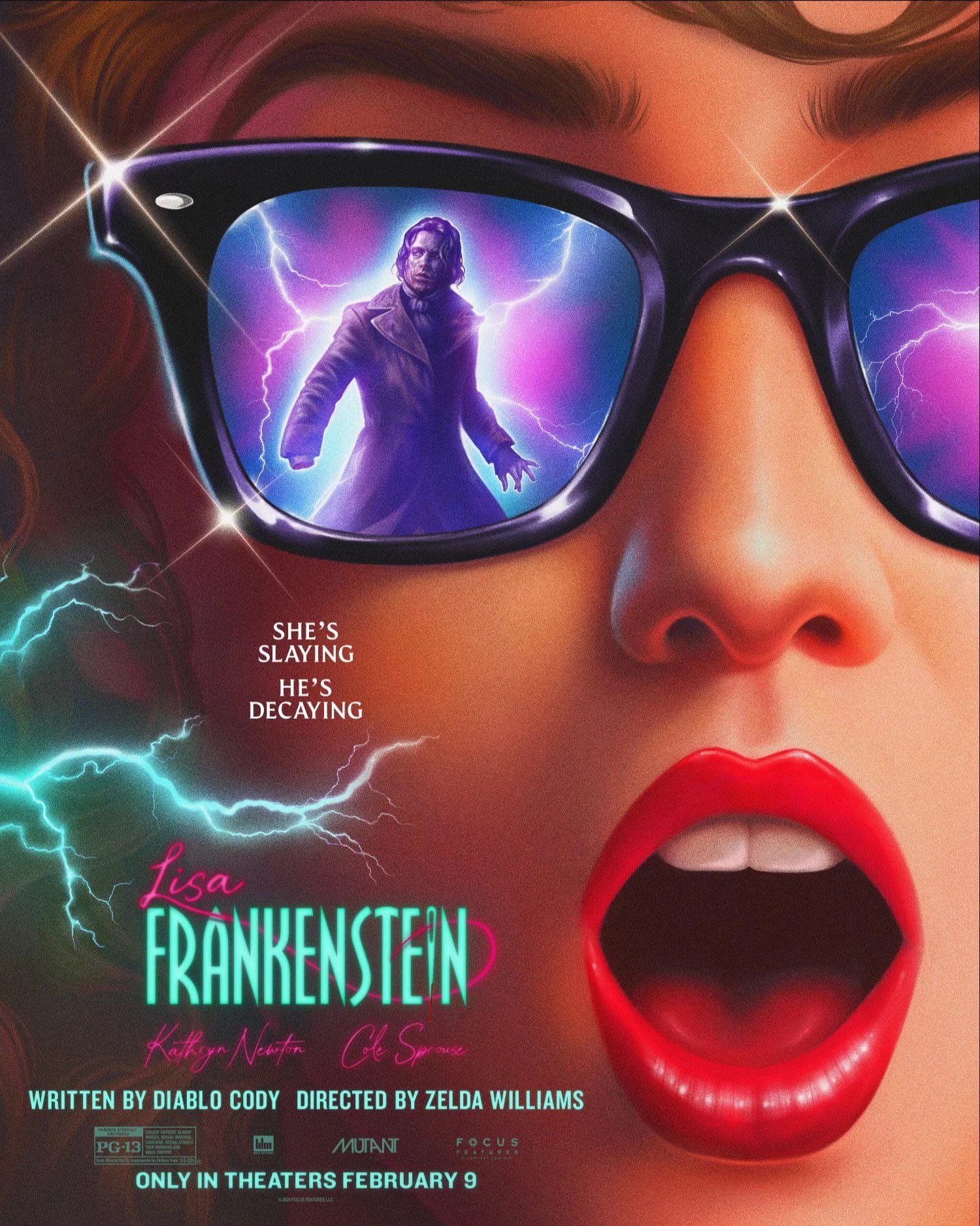
Review: Lisa Frankenstein

Journey back to the 80s with a black horror comedy "coming of rage" story featuring a script by Diablo Cody and an impressive retro vibe and soundtrack.


Diablo Cody, writer of Jennifer's Body, and Zelda Williams, director and daughter of Robin Williams, made a movie that I've been waiting 30 years for — a black comedy with a gothy female lead that's got a killer soundtrack and is an ode to 80s (and earlier) horror movies. 

Lisa Frankenstein — a stellar pun of a title that sets the scene and mood, all bright colors and crimped hair and pastel wallpaper — follows the adventures of the unfortuitously named Lisa Swallows, a high school senior in 1989 who's just... a bit odd.  A few years prior, Lisa's mother died in a freak slasher/home invasion attack, and her dad remarried soon after, blending families with another mother and daughter. Carla Gugino is perfectly cast as an aerobics-attired-clad, conservative 80s evil stepmom. 

Like her cinematic forebears Lydia Deetz and Veronica Sawyer, Lisa is herself strange and unusual. She loves The Cure, Universal horror movies, and spending time in the graveyard with a beautiful sculpture of a young man who died 200 years ago. 

The plot sparks into motion when a lightning bolt brings the dead young man back to life somehow (we're not really told how or why, but honestly, does it matter? Even Victor Frankenstein just used lightning and an old body, so check). He shows up at Lisa's house and their relationship begins in earnest. 

The Creature (played almost entirely silently by the wonderful Cole Sprouse of Riverdale fame) is missing a few parts — an ear, a hand, some genitalia. Together, he and Lisa start harvesting body parts from local town denizens to help get patched up. He's giving Billy Butcher vibes from Hocus Pocus, if we're being honest, and it works. 

Each time he gets a fresh new body part, a quick trip to Lisa's backyard tanning bed makes him just a bit more human and life-like. This neon-red 80s take on the doctor's slab from old Frankenstein movies made me laugh every time I saw it — this film has absolutely delightful visual gags and retro throwbacks that just work. There's a pun concerning Pabst beer and Pabst the director that is absolutely chef's kiss. 

There's not a terrible amount of plot, as this is a fairly short comedic romp that's somehow light-hearted but also simultaneously violent and funny.  It's a movie that I look forward to rewatching, and if I were still in high school, it would definitely become my personality for a few months.

If you liked similar movies in the 80s and 90s like Jawbreaker, Weird Science, Heathers, My Boyfriend's Back, But I'm a Cheerleader, or Beetlejuice, you'll probably get a kick out of Lisa Frankenstein.

--

The Math

Baseline Score: 8/10

Bonuses: Incredible needle drops(including a Pixies' song that's worth the price of admission), superb set design, and an authentic and successful 80s vibe.

POSTED BY: Haley Zapal, new NoaF contributor and lawyer-turned-copywriter living in Atlanta, Georgia. A co-host of Hugo Award-winning podcast Hugo, Girl!, she posts on Instagram as @cestlahaley. She loves nautical fiction, growing corn and giving them pun names like Timothee Chalamaize, and thinking about fried chicken.

Wednesday, January 31, 2024

Poor Things: on eating life with a big spoon

When an unstoppable id meets an immovable world

A brain extirpated from an unborn fetus and transplanted onto a dead adult's head sounds like the farthest thing from comedy. And yet Poor Things finds a way to turn this gruesome premise into an unapologetic exploration of the bodily experience, mishaps and all. Deliberately oblivious to the constraints of "polite society" (it's no coincidence that in her former life she had the same name as the famously horny Queen Victoria), this newly formed creature meets the world with inexhaustible wonder. Every sensation is new, every place is a delight, every new friend is interesting. Not only is it uncommon to see a Bildungsroman about a female protagonist; this protagonist is, in a twisted way, already a grown-up whose brutal honesty makes up for the maturity she supposedly lacks. The milestone life experiences that usually crush a part of us, leaving us slightly more jaded each time, only make her open up even more. She has nothing to disguise, so she can't be humiliated, and the unwise few who try to manipulate her with fear or shame end up swallowed, digested and excreted by her continuous hunger for more life, more learning, more freedom. The story places her in the well-trodden plot of finding herself, except she's never been lost. She's already comfortable in her own being; the only thing she's missing is a taste of everything.

There are, however, problematic sides to this characterization that aren't acknowledged in the story. With a baby's mind and an adult's appearance, she quickly falls into the trope of Born Sexy Yesterday, which is exactly what Victorian patriarchs want her to be: available, pliant, undemanding. This is what moves them to prey on her in the first place, although it's the same trait that allows her to more easily get rid of possessive lovers, because her sexual needs aren't tied to one specific person. She's happy to be taken, but not owned. The problem is the alteration to her humanity that it took to get her to that carefree state. It's hard to cheer for her erotic experimentation when one remembers that she's mentally a child who doesn't know she's a child. Poor Things wants to answer the question of what a woman's life could be if men's attempts to control her bounced off her without effect, but the device it chooses to employ for approaching that question results from extensive, violent male manipulation of a female body. A woman shouldn't have to literally lose her mind and identity in order to become her own person.

I'm not a woman, so I'm unqualified to declare whether Poor Things is feminist. Women who have reviewed this film have already delved into that topic, both mildly approvingly and very much not, and it's probably a good sign that varying answers are possible. Liberation shouldn't take only one form, and some flavors of liberation will be more appealing to some people, and others more to others. It may be too much to expect this single brain-transplanted creature to fix Victorian inequalities, but in each of her personal interactions, one can notice a growing desire to share her joy for life. The lover who kidnaps her thinks he's using her, he thinks he's a hedonist, he thinks he's free from social conventions, but he's unable to appreciate what she could teach him. She's the real hedonist, the real user, the really free, so of course she leaves him when he refuses to be as free as she is. The friend who teaches her about the pains of the world thinks he's breaking her, he thinks she needs a dose of reality, but she's the one who lives in reality. It doesn't even occur to him to do what he can to alleviate the suffering around him. She does try, and it doesn't matter that others predictably take advantage of her good intentions. This is not a character at whom you can yell "you ought to know better." She exists in a broken world, but the story is not about that broken world. The function of this plot point is to mirror Buddha's path toward enlightenment, which started when he left his pampered palace life and saw suffering for the first time.

You may have valid reasons to criticize this hypernarrow focus on one individual's personal progress, but it's a choice the film does consciously. Several shots are filmed literally with this extreme focus: the protagonist's singular perception dominates the angle from which you're allowed to see the story. We're shown a world with multicolor skies and air railways and impossibly tall towers, and it's an open question whether that's what the world is like or that's how it appears to her. Meeting the outside world for the first time is such a surreal experience for her that even the background landscape shines to the point of warping around her.

The structure of the film is similarly affected by the way she inhabits life. The plot is interrupted by big digressions that she takes to with natural ease, existing purely in the moment. She makes impulsive yet significant choices with no care for narrative momentum, sometimes forcing a scene to snap into an unrelated trajectory. What she wants and what she does is not interested in our expectations of how life should proceed, so it can be jarring to have to adjust to her journey's irregular pace, and that's the point. When we feel like Poor Things is failing to follow the established rules of filmmaking, it's the character seizing her fate in her hands and playing with it.

For all that she discovers and grows and moves past, she's still a child at heart, still motivated primarily by fun, still untainted by learned cruelty. And when she deals with a broken world by exposing her entire, unbreakable self, we may react with shock, or amusement, or pity, or concern, but in the end, we can't help harboring a little nagging bit of envy.


Nerd Coefficient: 7/10.

POSTED BY: Arturo Serrano, multiclass Trekkie/Whovian/Moonie/Miraculer, accumulating experience points for still more obsessions.

Friday, January 19, 2024

Novella Project: Eynhallow by Tim McGregor

The rare sidequel that finds the right question to answer

It's very hard to come up with a derivative work that adds something valuable to the original. No one asked for Han Solo's backstory, for example. To craft an expansion of an existing narrative, you need a good nose for the questions the text left hanging in the air. And even then, not every question will matter to readers or be able to make a sufficient case for itself.

Author Tim McGregor has found a worthy void to fill and created a great story of his own to put in that space. As you may recall, in chapters 19 and 20 of Frankenstein, the terrified doctor takes refuge in the Orkney islands to build a female mate for his lonely creation. For some reason, Mary Shelley included very little details about the location and the rhythm of its everyday life. But it would have been interesting to know more. How did the inhabitants of the islands feel about that mysterious stranger who took residence among them? Did Victor make any friends there? Any enemies? McGregor's new novella Eynhallow offers a gradually enrapturing answer to these questions Shelley didn't see fit to explore.

By giving a true-sounding voice to the unwitting neighbors whom Victor put in danger without a second thought, Eynhallow sets itself up not so much as a reimagining of the original novel and more as a missing chapter, one that makes the reader reevaluate Victor's evidently more self-serving account of the events. Life in the Orkneys is portrayed as harsh and precarious, and McGregor uses the arrival of a rich visitor as an opportunity to pry deeper into Victor's personality. The version of the doctor we get in Eynhallow is an oblivious manipulator who doesn't pause to recognize the exploitative dynamic he establishes with the locals. Far from the lonely genius of Romantic lore, he's a parasite who consumes people's time, possessions, and dignity. And that's before we even address his gravedigging habit.

Narrated with impressive believability in the voice of a housewife exhausted by the daily demands of subsistence work, the secret creation of an artificial person is filtered through the referents of Orcadian culture, equal halves influenced by tales of Celtic fair folk and Norse giants. We know what Frankenstein's creature is, but here the reader learns what the creature strikes common people as. Let's recall that the doctor never shared the steps of his method with the world; for the rest of humankind, his creature would exist at the other end of an insalvable epistemic gap, describable only in the vocabulary of myth.

Moreover, Eynhallow gives a bone-chilling answer to an urgent question that wasn't even spoken in the original text: if the doctor was trying to build a reanimated woman from dead parts, whose parts did he take? Who was that woman in her community, and how does her loss affect the people who knew her? By making intimate acquaintance with the victim of such macabre arts, we get a deeper glimpse into the corrupted soul of the man capable of using them on her.

Here the book boasts another advantage of not having Victor as the narrator: freed from clinical jargon, the process of being transformed into a walking corpse is described with sincere panic by an unforewarned lay observer. If you think it's scary to watch Bride of Frankenstein, imagine being her.

This short but memorable book goes beyond finding a hole in the story and inventing what could fit in there: it grows into its own rotten limbs and increases the tension until it escapes in a howl of fury, despair and confusion. Long after Victor has left the Orkneys and forgotten about their people, the consequences of his scientific profanation continue to haunt the place. For powerful men, their irreparable depredation of a defenseless community may be a minor episode beneath mention, but for those who have to endure it, it's the defining event of their history. Eynhallow not only provides an entertaining addition to a classic of literature, but also honors the lives ruined by progress pursued irresponsibly.


Nerd Coefficient: 9/10.

Reference: McGregor, Tim. Eynhallow [Raw Dog Screaming Press, 2024].

POSTED BY: Arturo Serrano, multiclass Trekkie/Whovian/Moonie/Miraculer, accumulating experience points for still more obsessions.

Tuesday, November 6, 2018

Frankenstein at 200: What Monstrosity Looks Like

One might have been forgiven, in 1966, for thinking, "Welp, that's the end of Frankenstein, right there." It was in that year, you see, that the world got Jesse James Meets Frankenstein's Daughter. In this, um, "movie," notorious outlaw Jesse James escapes down to Mexico, where the only doctor in town, and the inhabitant of the ancient castle in the village — you know, one of those great ancient, European-style castles that tiny Mexican villages are always known for — is Doctor Frankenstein's granddaughter. Not daughter, but that's the least of our worries. Jesse's traveling with his only surviving gang member, Hank, who's hurt. When Maria Frankenstein, the "doctor," sends Jesse out into the village to get medicine for Hank, she takes the opportunity to chop out Hank's brain, give him a new one, and turn him into a beefy kill-machine. Even when compared to its awful, awful companion film Billy the Kid Versus Dracula, produced by the same company in the same year, this movie is stunningly incompetent. Words simply fail.

If it were a piece of literature or a cultural icon any less durable than Mary Shelley's Frankenstein, it would have seemed like the gas tank was entirely empty at that point. The book was 150 years old, after all, and James Whale's iconic films were both over thirty years old, and had been followed by over a decade's worth of increasingly dubious sequels and spin-offs that saw Frankenstein's monster paired with several members of the Frankenstein family tree, the Wolfman a few times, Dracula, Abbott and Costello, and...at some point, who could even keep track? So when you've got fly-by-night, drive-in movie producers putting Frankenstein's heirs in the Old West, it would sure seem like the creative well was dry, and the world might have had its fill of Frankenstein movies.

And yet.

You may recall Harry Potter Daniel Radcliffe's recent turn in Victor Frankenstein. Or you might recall the stage play Frankenstein with Sherlock Holmes Benedict Cumberbatch and Johnny Lee Miller. Or, unfortunate soul, you may recall the film I, Frankenstein in which the creature gets caught up in the, um, ancient war between...*checks notes*...I guess gargoyles and demons? And there were in the 1990s Roger Corman's Frankenstein Unbound, which featured time travel, and Kenneth Branagh's Mary Shelley's Frankenstein, which featured Branagh and Academy Award-winning screen icon Robert DeNiro wrestling naked in some type of amniotic goo. The point is, if the world should one day tire of reincarnating Mary Shelley's creature, it will be a long, long time hence.

But Shelley's work has invited re-interpretation ever since its original publication 200 years ago — even by Shelley herself. The book first achieved prominence not upon its initial, anonymous publication, but upon its first adaptation to the stage, in 1823. The success of the stage play led to the publication of the second edition of the novel that same year, and the first time Mary Shelley was credited as the author. In 1831, Shelley herself radically altered the text, and published a new version of the book, which takes much of the blame for the events in the novel away from Victor Frankenstein and attributes it rather to fate. There is something primal in Shelley's story, something fundamental that has found continued resonance with the human spirit even through the seismic upheavals in culture, society, and technology that have taken place over the last two centuries.

Shelley's original version of the text carried this epigraph, taken from Milton's Paradise Lost:
Did I request thee, Maker, from my clay
To mould me Man, did I solicit thee
From darkness to promote me?
Guillermo del Toro has called Frankenstein the ultimate teenage novel, a book forever echoing familiar adolescent feelings like, "I didn't ask to be born," and "How can the people who gave me life not understand me at all?" That is an apt observation, and almost certainly contributes to the book's longevity. And it can't be ignored that Shelley wrote the novel when she was a teenager, herself. But baked into del Toro's observation is a perspective, and it is the Creature's. Del Toro's implicitly suggesting that the reader does and should identify with the Creature, and it is the "monster" who is the point-of-view character. I feel the same way, which is something I discussed in the first installment of this series.

But I also feel that the lessons of the novel, or the cautions and warnings baked into it, extend far beyond one's adolescence and are lessons we must continually re-examine and re-visit on a societal level, specifically because of the cultural and technological upheavals that have led from Shelley's youth to our present. We have accrued greater power over life and death than ever could have been imagined in even the most outlandish speculations of 1818. The casualties of World War I 100 years later could scarcely have been imagined, let alone the notion that organ transplants would one day become routine medical practice. The "horror" of Shelley's imaginings — pillaging corpses for their organs to put into another body — has now saved countless lives. And, unless I am consumed by flame and if I die with my driver's license on me, one day part of me will live on in someone else. Hopefully it's a good part...

As long as humankind is faced with the question of "Though we can do this thing, should we do this thing?" I believe Frankenstein will stay with us, constantly re-invented and re-imagined for our times and our contemporary struggles. And, sure, for crappy movies here and there that are just trying to get mileage from the name. But Mary Shelley seemed to believe that Victor Frankenstein was the guilty party, and his creation Frankenstein's first victim. That's how I read it, anyway, sitting here 200 years later. And that remains instructive. What are the ramifications of our decisions? Our technologies? Our innovations? What might the human cost be? What constitutes "acceptable losses" in the pursuit of knowledge?

But maybe none of this applies to you. I doubt it applies to me. I am neither a creator of technologies nor a wielder of great power. So the thing that I take away from Frankenstein, and the thing that maybe we all need to be reminded of more than anything else, is that those who are different from us are no less human, and we all, in fact, have an obligation to one another. This is not, I think, a lesson we will ever fully learn, and if we need Mary Shelley's Creature to remind us of this from time to time, then long may he live.

Published by Vance K — co-editor and cult film reviewer for nerds of a feather, flock together since 2012, songwriter, and longtime Franken-fan.

Tuesday, October 30, 2018

Frankenstein at 200: It's Alive

When I think of Frankenstein and The Bride of Frankenstein, I tend to think of them as a single, longer film that adapts the whole of Mary Shelley's source novel, although the two films were produced with some four years between them. And as indelible and enduring and influential as these films are, I have to wonder what kind of film we might have had if Colin Clive had not been crippled by alcoholism. This is selfish, certainly, to be handed a masterpiece and ask, "but what if...?"

Make no mistake: these two films are masterpieces. Masterpieces of horror, masterpieces of cinema. And they are masterpieces fitted together by a jigsaw of damaged human beings who continued the tradition, nearly 100 years on, of the outsider's love song that is Mary Shelley's Frankenstein, or the Modern Prometheus. And, believe it or not, here we are nearly 100 years later, looking back at these films. As I write this, the first film will soon be 88 years old. When I looked at the novel, I discussed some of the ways in which we are still wrestling with the themes that animated Shelley's 1818 work. When it comes to the films, though, the actual documents have less on the surface to do with ongoing human struggles of privilege, responsibility, accountability, and monstrosity, but many of those topics still roil under the surface of these films. What elevates the movies, in my mind, are the performances of Boris Karloff and Colin Clive under James Whale's direction.

Ernest Thesiger (L) and James Whale (R)
First, a quick look at the technical aspects of James Whale's direction. For an easy comparison, watch Tod Browning's Dracula and then Frankenstein. Browning's shots are almost all locked down, and treat the material like a stage play. This was common in the silent era, but directors began to innovate past it with moving cameras and using tracking shots to move through scenes in depth. But the advent of sound film set all that back again, due to the need to hide microphones in the scenes. You'd think from watching Dracula that directors might have still been limited in those ways, but Frankenstein gives the lie to that. There are gorgeous, subtle tracking shots, like the one that follows Henry Frankenstein and Fritz out of the graveyard shadows to the fresh earth they are going to dig up for body-harvesting purposes. And there are numerous extreme tracking shots. Some help convey the urgency of hunting for the creature in the Frankenstein home, shots that go through walls and from one room to the next to the next in single, unbroken takes. Another is the agonizingly long tracking shot that follows Maria's father at he carries her drowned body through the town as it prepares for a wedding feast and celebration.

Then, there are the performances. For all of the talk of "monster" and "creature," Boris Karloff does nothing but humanize the role he inhabits. There are the big moments, like when he reaches for the sun the first time he sees it — craving light in a metaphorical and literal sense — and the small, almost imperceptible moments, like when he pets Maria's small hand, marveling quietly at its perfection, in contrast to his own scarred hands. As lovely and engrossing as I find Karloff's performance in Frankenstein, it is in Bride of Frankenstein that he is permitted something not seen in any of the other Frankenstein films (Son of.., Ghost of..., House of...): he speaks. Karloff's wordlessness helps carry scenes like the famous moment in which he comes upon a hermit's hut in the forest, and two lonely souls find solace in each other's company (again, notice Whale's direction here in the slow dissolve out of the scene), but his joy at being able to begin making himself understood helps fully realize this character. Abnormal brain or no, this is a living being that simply wants to enjoy the company of others and not be tormented because of his appearance and the fears of others. I so connected with Karloff's performance in these moments that I wrote a song about it.

Boris Karloff and Colin Clive
 A decade before I did that, though, I wrote a different song inspired by Colin Clive's performance. There is a deep sadness in Clive's performance that has always struck me as conveying the weight of all that was lost in the gap between his ideas and their reality. The quest to stave off death, prolong life, and cure disease is certainly a noble one, although the introductions to both Frankenstein and Bride couch the doctor's obsession in terms of attempting to play God. I tend to think of this spoken moral more as a way to appease the censors of the time than the actual thrust of these films, but that could just be me. I find Clive's portrayal of Henry Frankenstein to be a deeply empathetic one, and the filmmakers have eliminated so much of what I find distasteful in the character of Victor Frankenstein from Shelley's novel. In the film, the doctor does not turn his back on his creation because of a shocking appearance, nor does he abdicate any responsibility toward it in favor of simply returning home to his former, aristocratic pursuits. Clive's Frankenstein agonizes over what to do with his creation, whether or not it can be taught, or helped, or made to understand. Yet his efforts are undercut by man's inhumanity to the other...first and notably by Fritz tormenting the creation with lit torches. Colin Clive's Frankenstein recognizes what Whale tells us implicitly in a lovely sequence of shots at the end of the first film, with Frankenstein and his creation looking at each other through the spinning mechanism of the windmill. Reflections of one another. Their fates bound together.

Clive's quiet intensity exists only in the first film, however. By 1935, the actor's alcoholism had purportedly advanced to such an extreme state that it isn't any wonder he spends most of The Bride of Frankenstein propped up in bed. He died less than two years later, at only the age of 37. As a result of Clive (and his character) being sidelined, much of the heavy lifting in the movie falls on the very odd shoulders of Doctor Pretorius, played by Ernest Thesiger. Pretorius is a deeply strange character, who I admit has grown on me, but it took a minute. What has not grown on me is the shriekingly hysterical performance of Una O'Connor. She was a longtime friend of James Whale, so I appreciate him giving her the work, but almost the first ten minutes of Bride revolve around her shrieking from one person to another about this and that. I'm reminded of the line in Ed Wood when Ed's financiers ask why he gave Tor Johnson all the lines, and Ed replies, "Lugosi's dead and Vampira won't talk. I had to give the lines to somebody." I cannot help but wonder what that film might have been with a more-active Frankenstein, but then, who knows? Maybe we would not have gotten the charming introduction featuring Elsa Lanchester as Mary Shelley herself, explaining that the story continued past the burning windmill. Who can say?

My favorite picture of Elsa Lanchester
One thing I must point out, however, is that the credits for Frankenstein read, in part, "Based on the novel by Mrs. Percy B. Shelley." This is abhorrent, even for 1931. To Whale's credit, as my wife pointed out, in Dr. Waldman's anatomy class at the university, which is shown near the beginning of the film, the students are both men and women, which had to be a conscious choice, and possibly one that somebody fought for. I can think of a number of other films with similar scenes (some of which I've reviewed for this site), and this is one of very few I can think of that features a co-ed science class.

In the end, I confess I enjoy the Universal Frankenstein movies, even those that came much later, and after a few other actors donned the flat head and neck bolts. I find Bela Lugosi very fun to watch as Ygor in both Son of Frankenstein and Ghost of Frankenstein, and enjoy spotting the same three or four actors cropping up in different roles throughout the series. But it's the first two films that created, cemented, and deserve the legacy of the Frankenstein tale. While shaving off some of the thematic elements that I think make the book resonate even today, they nevertheless provide a relatively faithful adaptation that succeeds on its own substantial merits.

Posted by Vance K — cult film reviewer and co-editor of nerds of a feather, flock together since 2012.

Friday, October 26, 2018

Microreview [Book]: Creatures: The Legacy of Frankenstein

A collection of varied stories that continue the story and the themes of Frankenstein to great effect.


Joining Vance in his celebration of Frankenstein at 200 this month, I'm looking today at a timely volume from Abaddon books, which explores the mythology two centuries on through a new set of stories edited by David Thomas Moore. Creatures: The Legacy of Frankenstein is a collection of five long novelettes and/or short novellas exploring the legacy of Victor Frankenstein and his creation through a series of shared universe stories, dealing with other creators in other situations, all of which circle the same themes of life, death, autonomy and monstrosity that the original text evokes so effectively.

For me, Creatures draws on some foundational English Literature experiences, as Frankenstein basically bookended my secondary school career. I didn't read the novel itself until my final year, as part of a term paper on Gothic fiction which pretty much my late teen aesthetic (Rebecca-from-Jane-Eyre meets a less experimental version of The Rules of Attraction, I guess), but I have stronger memories of performing parts of a dramatised version in first year. At the time, I was tall, awkward, and had just moved back to the UK from Australia with a deeply uncool hybrid accent. I'd also just started getting periods, and I have strong impressions of trying to work with classmates on this strange, tragic story while feeling crampy and sticky and wrong, as if my entire body was about to give itself away and condemn me to eternal embarrassment on top of all its other betrayals. That I associate this feeling -- which I assume was happening just as much during Maths and Science and History and all the other highlights of the English Year 7 curriculum -- with Frankenstein specifically is, I think, an indicator of how resonant the myth is even when filtered through age-appropriate dramatisations. I've never quite gotten over the tragedy of the creature, perhaps because at the time I encountered it, the feeling of wrongness felt all too real.

The stories in this volume proceed in chronological order, from the mid 19th century to a contemporary tale, and I believe that all five also feature the original creature somewhere in the story, although only in Tade Thompson's "Kaseem's Way" does he get to speak to the audience directly. The story alternates between the first person, epistolary narrative of the creature and the perspective of Kaseem, a Black boy from London who ends up becoming the ward of a scientist named Gull. Twelve years after meeting Gull, Kaseem is now deep into illegal scientific practices alongside Radha, another young scientist, when Gull's discovery of Victor Frankenstein's original notes leads to a replication of that experiment, drawing the attention of the creature and the authorities down on the pair. By placing Frankenstein's work into the hands of two young people of colour in 19th century London, Thompson's opening story immediately sets the myth in a more diverse context, playing on the power structures inherent in both the science fiction conceit and the real-world societies of the time to great effect. Neither Kaseem nor the creature ultimately come out well in this story, but the end has a fitting amount of rage to see them both off in style.

"The New Woman", by Rose Biggin, is a decadent, queer, female-driven story set in the last days of the 19th century, in a "bohemian assemblage" centred around Mrs Stella Moore. Into this company of artists has been brought a medical student, Christine Sparks, who has been experimenting on embalming corpses in formaldehyde, and her description of her work captures the imagination of another artist, Fran, who has been "sculpting" with dead creatures (think taxidermy, but with more glitter). It quickly transpires that Christine and Fran already know each other quite well, and that the next stage in their relationship will be a joint project to create a work of living art out of a corpse. Their creation, Eve, ends up being realised and impacting their relationship in ways that neither predicted. Of all the "creatures" in this volume, Eve ends up being the most well realised, and her journey from "living artwork" to a fully realised person, cognisant of the limitations of her state, is compelling and tragic. Unfortunately, that tragedy also ends up punishing its queer characters in favour of heteronormativity, which I can't quite forgive it for.

Of all the tales here, I felt Paul Meloy's "Reculver" had the least to bring in a speculative sense, although it deals interestingly with disability and wartime experience, drawing parallels between the myths that built up around those who fought, and the parallel mythology of those who, for whatever reason, didn't. Of all the stories, it leans most heavily on the motif of the outsider: its teenage protagonist, who had polio as a child and has been left with a bad leg, feels he does not fit in to his small seaside town, but it's not clear who among the remainder of the cast does. The protagonist's obsession with childhood crush Ann Bennett and the man she begins a relationship with, Geoffrey Dodd, forms a large part of the plot, as does the reaction of Ann's "shellshocked", violent father. Told in an almost slipstream style, with lots of odd dream sequences and narrative skips, the direct appearance of the Frankenstein myth in "Reculver" ends up feeling more minor than any of the other stories, and it was less successful with me as a result, although as a standalone it would still be a strong experience.

Emma Newman brings what, on the surface, feels like a classic Ashes to Ashes style period police procedural in "Made Monstrous", with a detective and his assistant dealing with a series of "mysterious" corpse thefts whose basic purpose won't come as a supririse to a reader coming to this story as part of a Frankenstein collection. However, as the title indicates, this is a story that plays particularly heavily on the "who is the monster" element of Frankenstein and there's an interesting subversion of Victor's original intent in how the mystery plays out. Detective McGregor is a compelling lead in all of this, and I have to note that this is the second time, after Carlos Moreno of After Atlas, that Newman has made me root strongly for a gruff male detective who represents the system but has also been deeply, irreversibly wounded by it. WPC Hannerty, despite a deeply unpromising introduction through McGregor's casual chauvinist lens, ends up being a great addition too, and the relationship between the two leads is one of the best parts of the story. Emma Newman's involvement in this collection was a major factor in my picking it up and I was far from disappointed with her contribution here.

And then there's "Love Thee Better", by Kaaron Warren. This story, frankly, terrified the hell out of me. Protagonist Nina, and her partner Declan, are gifted paid berths on a mysterious medically-inclined cruise ship run by her father's family friend, after an accident leaves accident at the building site he works on which ends up completely removing his arm. It quickly becomes clear that the main passengers are either waiting for limb donations or want to be donors; this is only the tip of the weird iceberg and there's very little hope of Declan or Nina getting out untouched. Worse, there's a sense of claustrophobia and fatalism among all of the passengers, Nina included - while there are hints that not everybody is on board with the captain's agenda, nobody does anything to stop themselves from falling prey to it. I find stories which feature utter complacency in the face of horror far more terrifying than reading a story where people are struggling against their fate, and the timelessness and lack of escape that the cruise setting brings only makes this worse. Of course, this is a Frankenstein story, so limb transplants are not the whole story, and the way the introduction of artificial life takes place here is just part of the tense, relentless escalation. I think this was an excellent story, but I felt sick for about an hour after finishing it, so there's no way I'm going back to check.

Put together, this is a very strong collection: what the stories as a whole lack in inter-relatedness and consistency, they make up for in terms of the sheer breadth of the Frankenstein experience that they cover between them. There's no simple moralities here, no clear answer to questions about scientific progress, life and death, revenge and forgiveness, or the condition of otherness which the original story deals with so successfully. Equally, with the possible exception of "Kaseem's Way", these are all stories that I think would work even for readers unfamiliar with the original: each stands alone, narratively speaking, and these are universal themes. Whether or not you're a fan of Shelley's 200-year-old masterpiece, Creatures is a worthy, varied anthology.

The Math

"Kaseem's Way" by Tade Thompson: 8/10 - smart and socially aware, with a strong sense of continuity from the original novel.

"The New Woman" by Rose Biggin: 7/10 - lush, unsettling queer aesthetic let down by the ending.

"Reculver" by Paul Meloy: 6/10 - effective as an exploration of otherness and belonging, not so much as a work of speculative fiction

"Made Monstrous" by Emma Newman: 8/10 - feels straightforward on the surface but has powerful hidden depths

"Love Thee Better" by Kaaron Warren: 7/10 - creepy as hell, which I guess is a good thing here?

Average: 7.2/10.

Bonus: +0.8 covers a wide range of thematic areas without detracting from the coherent whole.

Nerd Coefficient: 8/10.

POSTED BY: Adri is a semi-aquatic migratory mammal most often found in the UK. She has many opinions about SFF books, and is also partial to gaming, baking, interacting with dogs, and Asian-style karaoke. Find her on Twitter at @adrijjy.

Reference: Moore, David Thomas (ed). Creatures: The Legacy of Frankenstein [Abaddon Books, 2018]

Tuesday, October 23, 2018

Frankenstein at 200: Society Be Damned

Maybe a decade ago, I worked on the script for a TV movie about Frankenstein's monster that never made it out of development, for a studio that will not be named. The exec we were working with, the director and I, got nervous about how much latitude they might have if they took on the project, being unsure of exactly what intellectual property Universal owns when it comes to Frankenstein. So they asked me to make it *not* Frankenstein's monster. Same story, but just...not Frankenstein's monster. Somebody else's monster, maybe?

This was a challenge. I don't know exactly what Universal owns and doesn't own either, but certainly Mary Shelley's book has long since entered the public domain and filmmakers have experimented widely with adapting and re-working the story. Take, for instance, the long but partial list of film and stage adaptations over at Wikipedia. But I was given the task of subbing out Victor Frankenstein and his creation for...anything different.

Here's the thing about that: Mary Shelley's vision has become so utterly foundational in our shared sense of the fantastic that I didn't see a path forward except by looking back further than 1818, the year Shelley published her novel. How could I conjure a mythology that didn't set an audience on the defensive immediately with thoughts of, "They're just ripping off Frankenstein"? So I went backward, and looked at the idea of a golem made from mud or clay, and either an alchemist or rabbi having created it. These legends predate Shelley by sometimes hundreds of years, but the themes of many of these stories run in close parallel to those Shelley explored in Frankenstein.

It was not a perfect solution, and the movie never got made. If I ever revisit that project, though, you can bet I'm switching dude back to Frankenstein's monster, because I didn't fall in love with science fiction and horror because of Kabbalistic stories of mud men. I fell in love with those genres because of Mary Shelley's creation.

I cannot know what Mary Shelley was thinking or feeling when she wrote Frankenstein, or the Modern Prometheus, but my aim here is not to present a scholarly, comparative lit exploration of her book, now celebrating its 200th birthday. But this seemed like a great opportunity to revisit the book, which I hadn't read in a decade and a half, and celebrate what about it still speaks to me today.

* * *
If we think about Frankenstein as a classic tragedy, then clearly Victor Frankenstein is the tragic hero, but what would be his tragic flaw? The facile answer is "attempting to play God," but I don't think the text fully supports that. It's not his playing God that dooms him and his family, it's his abdication of responsibility. After he forges his creature from unknown materials, he has lots of opportunities to head off the tragic outcome that ultimately befalls him, but he always chooses a different way. So it might be abdication, a refusal to take responsibility for his actions, or it could simply be idleness. As the privileged son of a wealthy syndic, Victor Frankenstein never knew want or need, and simply did things as his whim took him. He went to university just because. He made a creature from cast-off bits and gave it life just because. He went back home and married his cousin just because. I am perhaps being uncharitable, but the point is that nothing much seemed of great import to Victor except his current idea of how to pass the time. This is a criticism, I feel, that Mary Shelley would have had with all of those who, like Victor, made up the upper strata of society at the end of the 18th century. And, possibly, with her husband Percy Shelley, upon whom she probably based much of Victor's personality and circumstances.

I am reminded of F. Scott Fitzgerald's final assessment of Tom and Daisy Buchanan in The Great Gatsby, where narrator Nick Carraway says of them:
I couldn't forgive him or like him, but I saw that what he had done was, to him, entirely justified. It was all very careless and confused. They were careless people, Tom and Daisy – they smashed up things and creatures and then retreated back into their money or their vast carelessness, or whatever it was that kept them together and let other people clean up the mess they had made.
By the time 19-year-old Mary Shelley attended the fabled summer getaway on Lake Geneva with Percy Shelley and Lord Byron — in the bizarre, inexplicably hostile summer of 1816 that had many across the globe fearing the end of the world — in which she came up with the idea for Frankenstein, she had already given birth twice. Her and Percy's first child had died after being born premature, and after the birth, Percy had left Mary and run off with another woman for a brief affair. I have to wonder how much Percy Shelley's abdication of responsibility toward his and Mary's sick child informed Victor's abdication of responsibility toward his "offspring." I have to believe it did influence Mary's depiction of, if not Shelley, those situated like him. How could it not?

In my reading, I see the creature as a sympathetic figure, and an innocent. His crimes — and he racks up a pretty healthy string of murders — are the culmination of a long, brutal lesson taught him over and over again by the human beings he encounters. I'm ascribing my own feelings regarding the creature to Mary Shelley's design, and I fully realize that my interpretation may not match her intent. But there are a couple of events that take place during the creature's long sojourn in the outbuilding behind the De Lacey cabin that I find fascinating. The first is the story of how De Lacey (the blind old man) and his two children came to live in that desolate cabin, and the other is the related story of Safie, Felix De Lacey's fiancee, who arrives unexpectedly.

As I discussed in the previous post, in Shelley's original construction, the creature hides away for months in this outbuilding, and learns not only language by watching the De Lacey family, but also history and poetry, including Milton's Paradise Lost, from which the book's epigraph comes ("Did I request thee, Maker, from my clay / To mould Me man? Did I solicit thee / From darkness to promote me?"). The creature believes the De Laceys to be the most gentle and admirable of all people — and truth be told, they may well be, which makes what Felix De Lacey does later doubly horrifying — and his opinion is reinforced when the reader learns the story of Safie, Felix's fiancee, which also reveals why the De Laceys live in such dire material circumstances.

The De Laceys, late of wealthy Parisian society, were acquainted with a certain Turkish merchant who was arrested, it is implied, wrongly. Out of an abundance of character and virtue, the De Laceys conspire to release the Turk from prison and secret him to safety. This is admirable stuff (the Creature is listening)! The Turk is so grateful, he promises his daughter Safie to Felix for a bride (and they love each other, so this is all a win-win). But the duplicitous Turk is lying, and actually intends to take Safie away with him after the De Laceys spring him from the hoosegow. Again, the Creature is listening. Self-sacrifice is met with duplicity. But eventually, after the De Laceys effect the Turkish merchant's escape from prison and safe passage from Paris, and after Safie is denied her return to Felix...after the De Laceys are found out and banished from France to a remote hovel in Germany, after all that, Safie shows up to be with her true love, Felix. So...true love wins? In the face of society? Maybe?

Here we leave the parameters of the De Lacey story and get into Safie's personal story. Here Mary Shelley does something that had to be uncommon in fiction from 1818, in that she gives a female character agency. Safie discovered her father's plans for her, and discourses at some length about the decision that she made not to return to her Turkish origins, which would have severely proscribed the type of life and agency she might possibly realize. It was hard for me, as a modern reader, to separate Safie's feelings about female agency from those of Mary Shelley. In Safie's story, we get possibly the clearest and most concise argument for women's equality to be found in the book. Though Safie's criticisms are couched in terms of religion ("the Arabs won't let women do...xyz..."), it's no stretch to see that the lives of European women in Shelley's time were almost as narrowly defined. If Mary Shelley stakes out a position on women's equality, in the tradition of her mother Mary Wollstonecraft, in Frankenstein it is through the micro-drama of Safie. It may or may not be stretching things to say that the Creature, when presented with the idea of fully human women being treated as "lesser than," saw in the struggle for women's equality the passion of his own heart.

This leads us to the sad resolution of the Creature's time as a silent observer of the De Lacey home. He has closely watched a family that treats the elderly/women/foreigners with dignity and respect. They are, no doubt, aberrant, as they might be in some circles today, but in the most admirable of ways. Yet, when he, with his monstrous appearance and proportion, presents himself to them, he is literally beaten, driven from the house, and the house is found so contaminated by his presence that the inhabitants never return.

So in the end, what is Mary Shelley saying about humankind? Nothing good, it would seem. Not only are those who are illegitimately lauded for their basic human competence (Victor Frankenstein) incapable of taking responsibility for their own foul-ups, but the most generous and magnanimous of people (the De Laceys) will violently reject those who are different from themselves. Regardless of circumstance, the status quo demands adherence. And people like the "Creature," or others who are similarly misunderstood, stand little chance of acceptance, regardless of the content of their character.

It is hard to argue with Mary Shelley, even today, that the comfortable, born-well-off individual can not simply do whatever he wants without consequence. Perhaps it is this enduring dynamic that makes the murderous Creature so relateable. Despite the characters in the book speaking in such hyperbolic praise of individuals who fundamentally reject taking responsibility for their own actions, there is, it seems, an implied subtext that resonates to this day — 200 years later — suggesting that those on the outside of this privilege, looking in, are forever playing a rigged game.

Posted by Vance K — cult film reviewer and co-editor of nerds of a feather, flock together since 2012, Emmy-winning producer, writer of two songs about Frankenstein, and author of at least one unproduced script inspired by it.