Showing posts with label Melinda Snodgrass. Show all posts

Friday, February 16, 2024

Microreview: The Thucydides Trap by Melinda Snodgrass

Bringing a close to the Imperials space opera saga with the greatest tests yet for the protagonists.


The Imperials saga, which started life at a traditional publisher before Melinda took the entire series to self publishing, is a decades-long look at the lives of its three main characters in a space opera future. Starting with The High Ground, where we first meet her characters Tracy, Mercedes and Beauregard, we follow their careers, lives, highs and lows in a quite literally feudal space empire. Years pass within the books, and between books as these characters live out their lives and face themselves, each other and the threads to the Solar League.

The Thucydides Trap brings that saga to a close.

At the beginning of the novel, some years has passed since the alien war in book four of the series, Currency of War. The war against the Necrophagos is over, thanks to Tracy’s heroism in leading the way with their first real victory. However, there is a breakaway set of systems to consider, planets are in ruin from the war, and oh yes, Tracy has found out the truth: the child and heir of Mercedes is, in fact, his own biological son from a tryst Mercedes and he had. Worse, as the child has grown up, it is becoming very clear to anyone who looks at Prince Cyprian and then at Tracy can see the resemblance. Triply so if you see just how little he looks like the Consort, his ostensibly biological father, Beauregard (aka Boho). It is only a matter of time before someone in the press puts cuckold’s horns on the Prince Consort. And given the previous four books and their entire lives, Tracy and Boho have been at each other’s throats...

This social conflict and drama is the heart of the book even as there is a master metaplot at work as well, and a strong pulling of the threads of the previous novels into a complete whole, by the methods of the last threat these characters must face in the series. Way back in the first two books, we get references to a mysterious sector of space that ships go into, and do not come out of again. It’s been used by the Solar League, secretly, as a way to get rid of people that has become rather problematic in the scheme of things. It now emerges, after the Necrophagos War, just what lurks in that sector, and how it is a threat not only to the humans, not only to the aliens they have conquered forcibly into the league, but to all life in the galaxy.

In addition to this, pulling again on the threads all the way back to the first book, we get the return of the “missing” species, we get the return of the alien Cara’ots, who disappeared a couple of books ago. It will be no surprise, given their biological science skills, that they were not so far away as all that, and have been secretly hiding and biding their time. Now that the Necrophagos are taken care of, the Cara’ots have a plan for humanity, and plans within plans.

This all sounds like a lot, and I can’t imagine even if you had the nerve, to try and jump into the series here. The time gaps between the books does mean that one theoretically could, and there is certainly enough reflection of the high points and important junctures of the series (and how they reflect on the current state of affairs) that someone could theoretically could make a go of it.

So I will speak in generalities about the saga itself, what I think Snodgrass is doing, and come to a decision as to what I think of the series as a whole from this point out. I want to start by interrogating the title of this last book, the “Thucydides Trap”. This is a phrase that has come into favor in certain political circles as of late. (and in fact the amazon page calls this a “A political space opera” - proof positive that Snodgrass knows what she is doing with this.).

https://en.wikipedia.org/wiki/Thucydides_Trap

So, if this novel is describing such a trap, who is Athens and who is Sparta in this universe? Clearly the Solar League is one of these two positions and the other, well, I can see it both ways. I can see the Solar League, ostensibly on top of the galaxy, as the Sparta (dominant) power fearing the restive challenges to its hegemony from the aliens under it’s foot, and other threats to it. There is another way to read this, though, and it seems to me that in truth, the Solar League itself is ‘Athens’, the rising power that is a threat, and must be managed and dealt with. I think this is the deeper and more accurate look at what is going on, with humanity as a whole. Just who the ‘Sparta’ is in this case, I will let the reader discover.

Moving down from the title into the politics of the series, Snodgrass proves the adage that science fiction is a mirror to our own world, and a way to discuss and describe our current world through the lens of fiction. The Solar League is a feudal space empire, with humans holding suzerainty over a number of conquered alien species (the Cara’ot, until their departure/disappearance was one of these). It is also highly patriarchal, with women in mostly domestic and submissive roles. Women are for making babies and taking care of the household. Only tragic circumstance (no sons) lead Mercedes father to name her the heir, and since all heirs have military training, further go down the rabbit hole of uncomfortable change and have her attend The High Ground in the first, titular book in the series, and kick off the entire saga.

Thus, Snodgrass provides commentary both subtle, and sometimes rather pointed, on the position of women in society, in relations between social classes based on money and power, as well as using the human-alien divide in order to cast a lens on race relations in our own world. Tracy, in particular, is her vehicle for showing that last, as he has, throughout the entire cycle, right through to this book, slowly become, to use the contemporary 2024 term, “woke” about aliens and their status and treatment in society. Given the dire nature of the threat facing the league in this last book, and the “we must all hang together or we will hang separately” theme of the novel, the Solar League really does need all of its members to pull together, or else.

As far as women in society, and the evolution of thinking in that, we look to Mercedes, of course, former Infanta and now the Empress herself. Her sisters, too, show signs of breaking away, however painfully and fitfully, from the roles they are assigned. Beatrice, for example, is a hard nosed career officer, now that that path has been blazoned by Merecedes. (Beatrice is, to my recollection, the only character who is even suggested not to be cis heterosexual, and it is a blink and you miss it moment at that). Carisa, though, by comparison, the youngest of the daughters of the former Emperor, is much more of a traditional mother and also traditionally put in the feudal role of her marriage being a political tool.

So as you can seeSnodgrass, for all that she is discussing the politics of these themes, has, throughout the series, been careful and very deliberate in showing that such social change is difficult, painful, and does not come without costs. The very patriarchal male FFH, the aristocracy of this feudal future space opera empire, definitely has a lot of soul searching to do to come to terms with any of this program, even when leavened by characters who do hew to roles. It will come to a surprise what character ultimately advocates for even greater social change that has been seen in the previous four books, and why they do so. I was somewhat disappointed that such changes and the groundwork for them is never really seen, only discussed as a possibility, and some of them came to pass after a jump ahead in time.

One of the things I’ve appreciated in this series about the Solar League is that Snodgrass has transferred the problems of racial relations to strictly human and alien relations, and has allowed the humans to get over themselves in terms of race within humanity. Tracy is fair complected man, pale skin and pale hair. A traditional looking hero in a mold that will be familiar to a fair swath of science fiction readers. Almost painfully a traditional looking hero and I suspect that was Snodgrass’ point. Mercedes and the royal family, though, are described as having skin that is “cafe au lait” in color. The entire space empire itself uses Spanish as its native tongue, and untranslated Spanish words are used throughout the series. It’s many hundreds of years, maybe more than a thousand, since humanity went to the stars, and the color of one’s skin, as long as you are human, means nothing in the Solar League.

If you are thinking as I am, clearly the model for all of this is Star Trek, but not quite The Next Generation, and more along the lines of the era of Enterprise and TOS. This should make absolute sense given Snodgrass’ writing for Star Trek (particularly The Measure of a Man for TNG). The Solar League is not the progressive Federation, but one can see, especially by the end of the series here in The Thucydides Trap, just how one might get from here to there. It is almost as if to say that the series is saying that humanity can get its act together, but it will be long, difficult, with backsliding, but we can do it. That is a very Star Trek outlook, and a good way to look at the series as a whole. The nature of the final adversary in the series, in this final volume, too, does feel like it walked out of a TOS episode. One could easily imagine Kirk, Spock and McCoy confronted with that threat and what they might do to solve it.

And like those episodes of Star Trek, for all of the politics, drama, soap opera (which is even lampshaded at one point) and social commentary and discussion, there is a lot of action and adventure in the series to be had as well. This novel feels more freighted on the political side of things but the author is trying to tie an entire series together, so I can more forgive her for it. And given the evolution in rank and career progression, these are not the young cadets of the first book, or the young officers of the second, et cetera. But still, there is action and adventure to be had, with a side order of “I’m too old for this” to show that Snodgrass wants us to be aware that her characters have indeed aged, and changed.

In all, the Imperials Saga is indeed a political space opera series, with a healthy dose of character development and change, action, and adventure, and a space opera future and world that is intensely interesting and engaging. The novel does end on a HEA, which makes me wonder--have I missed the romance beats of this series, or not read the coding for them in reading everything else? One day, I will get back to re-reading this series, and perhaps I will see what else I have missed in delving into the life stories of these characters.
 

--


The Math


Highlights:


- Fascinating future space opera world
- Engaging set of protagonists
- Crunchy politics and social commentary and discussion 
- Ignore the somewhat disconcerting self published covers and just go and read the series.

Reference: Snodgrass, Melinda,  The Thucydides Trap, [Prince of Cats Literary Productions, 2023]


POSTED BY: Paul Weimer. Ubiquitous in Shadow, but I’m just this guy, you know? @princejvstin.

Friday, July 8, 2022

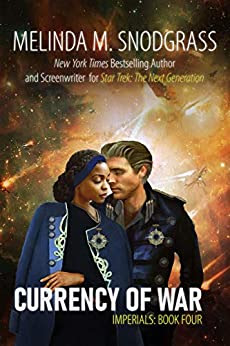
Microreview: Currency of War by Melinda M Snodgrass

Currency of War continues the twin stories of a Princess turned Empress, and the love of her life, the brilliant peasant turned Captain of a ship...in Spaaace.


Melinda Snodgrass’ Imperials saga, now in its fourth book, may sound like something out of a fantasy novel if looked at with an unfocused eye. Mercedes, a princess, the heir to a Emperor who has to deal with the fact that in his patriarchal society he only has daughters, sends his daughter to the fleet military academy that all highborn families send a child or two to.  Except, of course, that women, in this patriarchal society of the Emperor and the Five Hundred Families, have never gone to the High Ground before. Meanwhile, take someone from low in the social food chain, as far away from the Imperial family and nobility as you can get, and give him a scholarship to the High Ground based on his diligence and brilliance. Surrounded by the sons of nobles who look down at him as scum, he forges a friendship with the Infanta. More of course would be impossible, given their social situations. 


Over the course of the next two books, and decades in time, Tracy and Mercedes meet again and again in various roles, and go through trials and tribulations, Mercedes gains a Prince Consort, but their marriage turns sour. Tracy’s shipboard career is frustrated by those who can’t stand a peasant in their ranks.  Tracy and Mercedes meet again and again, and despite everything, an undeniable love is between them. Usually unspoken, but with enough fire that the two of them, even very distantly apart, and wrapped up with their own problems and issues, remembers and is connected to the other. It’s a SFF romance among the action and adventure that unlike many such in the genre, runs over a lifetime.


However, all this happens not in some fantasy kingdom, but rather in a future space empire, the Solar League, hundreds of years in the future†.  The latest book in this saga, the fourth, is Currency of War.


Currency of War picks up on the heels of The Hidden World, third in the series. The first three novels have had not only time jumps within the narrative itself, but between books in the series. From the end of The High Ground, the first in the series to the beginning of In Evil Times, second in the series, several years have taken place.  From the end of In Evil Times to The Hidden World there is an even bigger gap.  In each of these, Snodgrass does a great job in keeping us up with what our two protagonists have been doing in the intervening years. 


Between The Hidden World, though, and this newest book, The Currency of War, there is not much of a gap at all by comparison, only a couple of years. Given that the end of The Hidden World kicked off an interstellar invasion of the Empire, the next novel keeps much of what is happening “on screen” by picking up not too much later.  Tracy is caught up in the whirlwind of being back in the Imperial Service again, and Mercedes not only has to be an Empress in a strongly patriarchal society (and has dealt with one coup attempt already) but be one in wartime. 


The story of Currency of War, then is how these three individuals (let’s include Cullen, or “Boho”, the Prince Consort, since he gets a bunch of POV and they do form a triangle) handle the pressures of their positions as the war progresses. If the first book was a coming of age in an Imperial Academy, and the second was Life in the Service, and the third was The Burdens of age and career and unexpected positions, this fourth book is all about War. There are a lot of call backs and thread pulls from the first three novels (and for a bit I wondered if this was a book that was going to end the series--spoiler, it does NOT) to tell the story of an Interstellar War. Mercedes as a Empress and War leader. Boho, trying desperately for relevance and importance.  Tracy, thrust back into the Service again, and finding that some things are different--and many things for a non-noble (intitulado) are very much the same. Some of the tactics, themes and ideas raised in the first three novels come bearing fruit when war threatens the League.


Time, though, as mentioned above, and continuing is a real theme of this series, and I want to discuss it here in detail, because Snodgrass’ use of time in telling her stories, both on the macro level (the story of this Empire), and on the personal level (the stories of Tracy and Mercedes, and the other characters, too, like Cullen the Prince Consort). I mentioned above that the novels time jump within and between books, showing the lifetime, the progression of the characters, and the Solar League itself. The High Ground covers a relatively compact amount of time, their academy days, but as the novels go off to space and career and service, the time jumps between the books and even within the books (especially in The Currency of War) become highly noticeable. This is a saga rather than a snapshot, showing the evolution and development on a grand scale, drilled down to intimate moments. It reminds me of the movie Citizen Kane, where you can have an important key scene take up only a few moments of real time...and then seemingly within a sentence or two, jump ahead ten years.


 This novel helps give the novel authenticity in dealing with a space empire and the time it takes for things to happen and for things to be planned and executed. This third novel, which is all about an interstellar war, really brings that home. War plans and strategies, and the production of materiel take effort and especially time, and the novel doesn’t stint on the fact that with the League being rocked by this war, producing new ships and training new crews is not possible at the drop of a hat. We get and see planning for things  months in advance, and are carried along through some of that time period as well, as the Solar League slowly tries to get its act together without being overwhelmed by the enemy. It’s like a game of Stellaris where your main fleet has just been decimated and one of your planets wrecked--you can’t just create new ships out of nothing instantaneously and fix the planet with the click of a mouse. 


And yet, while time passes and things progress, the ghosts, haunts, and consequences of decisions and actions of the past come to haunt our three main characters. They are each the sum of the choices they have made throughout their lives and careers, and in wartime, some of those divisions, passions, rivalries, and yes, love, come through and are magnified. Even as being full of infidelity and the rival of our hero Tracy, for example, Boho for example comes across as a very complicated and conflicted character that at turns I wanted to sympathize with, and at other times, wished a bridge would drop on him.  Neither Mercedes nor Tracy either are saints, they are flawed human beings who love each other from afar, and they have made choices and decisions based on it that reverberate and inform the present. Having a saga that spans decades of characters lives, rather than short intense periods, gives Snodgrass a great opportunity to explore all this and she does not miss a beat or trick in doing so. 


For all of that, though, the alien threat itself feels a little like a black box, especially as we learn more about them and their threat is faced and countered. I was frankly a little disappointed; a private theory I had running through the book about the aliens and who and what they were did not pan out in the slightest, and in point of fact, the aliens and the threat themselves feels faceless. I think the way Snodgrass has set up these aliens and having them be so mysterious, unprecedented and strange, over the time period of the book, makes them a more abstract threat in the mind of the reader, a general heightening of the tension and a sword of Damocles over everyone, but one that is frustratingly not personalized. For that matter, for all of the excellent action beats we get in them facing the alien foe, it is the beats that are aside from the alien threat that have the juiciest and best material, because we care much more about the stakes and characters when within the culture than dealing with forces without it.


We don’t learn much if anything new about the society of the Solar League, although having alien POVs added to the main three continue the “ground levels aliens” point of view we got starting in the last book.  I do want to point out that the novel continues to show a fascinating potential, if aristocratic and patriarchal future among the stars. It is no coincidence that in this age when women’s autonomy is under threat, a future where women are trying to fight for their personal freedom in a strongly male dominated society feels rather resonant. This is something that the entire series has done from the get-go, and while some things have changed in several decades, in the timeline of the Solar League, it is chipping at a whole asteroid full of privilege.


Although you could theoretically start here in the series, it is a heck of an awkward place to do so, given that it falls so on the heels of the last book and really reading the last book gives insight to a key piece of knowledge that the reader should have, but two of the main characters decidedly do not. And the tension between the reader knowledge and characters knowledge helps really drive and stoke the drama of some key parts of the book. I’d recommend starting with The High Ground, first, but if space academy adventures are not your thing, then In Evil Times works as a better starting point, than here. This novel concludes but doesn’t really come to an end except for a wham moment, leaving, hopefully a book five to pick up the consequences of that moment, and hopefully, the entire series.


Read more about Melinda Snodgrass and her work in this Six Books interview I did with her.


†In truth, the Imperials saga backbone mentioned here would make for an interesting secondary world fantasy setup.

---

The Math

Baseline Assessment: 7/10

Bonuses: +1 for an excellent use of time and how things progress not with the snap of a button but with sustained effort and expenditure. No easy quick fix solutions

+1 for a great look at three very different characters and their sometimes very prickly relationships

Penalties: -1 For all of the theme of War, the aliens themselves take a back seat in development and interest to the intra Solar League conflicts and personalities.

 Nerd Coefficient: 8/10 

 POSTED BY: Paul Weimer. Ubiquitous in Shadow, but I’m just this guy, you know? @princejvstin.

Reference: Snodgrass, Melinda, Currency of War (The Imperials Book 4) Prince of Cats literary Productions 2021

Thursday, April 8, 2021

Microreview [book]: The Hidden World by Melinda M. Snodgrass

An enjoyable third volume in a series which engages through its long time skips and thoughtful worldbuilding


It’s been 14 years since the events of In Evil Times. Tracy Belamor, after falling on his sword to cover up some rather dark things that the Empire has done, now lives a new life under an assumed identity as a spaceship captain. Meantime, Princess Mercedes, The Infanta, still has no children of her own, her husband is unfaithful, and the life that she imagined has not come to any sort of fruition. Cold duty has won out over all other concerns.

Now, In The Hidden World, third in Melinda Snodgrass’  Imperials series, we see how those 14 years have shaped Tracy, and shaped Mercedes, not always for the better, as forces rising against the Empire from without, and within, threaten the existing order, and more importantly, threaten the lives of the characters.

It’s an interesting challenge to write a series with relatively large time jumps, where there are often drastic and irrevocable changes in the characters that have occurred off-screen. It takes a strong hand on character and plotting to handle a series in general, and keep everything on track so that a reader can get into the flow of a story. I have discussed in other reviews the perils, problems, challenges and opportunities of trying to keep readers on track on a series, especially complex ones with many characters, subplots and settings. There are any number of ways of handling this, from prologues and recaps to folding in recollections, memories, and other techniques to invoke events in the previous book or books.

The Imperials series by Melinda Snodgrass has an interesting variation on this problem as there is a five year time jump between the first and second book, and here, an even bigger time jump of 14 years between the second and third books. This helps reinforce and clarify that the Imperials novels are on a wider scale in personal terms than most space opera. Rather than taking place in some months, or a few years, the Imperials series takes place over the effective career lifetimes of its two protagonists, Tracy and Mercedes. 

What this means - and I didn’t recognize it in the second book, but now clearly see it in the third - is that the author has chosen to basically restart the series with every iteration, and layer in the backstory of the previous novels as needed. For Tracy this has been the easiest. The first novel, The High Ground, is the story of him at the titular Space Navy academy. In Evil Times, the second novel, sees him as a put upon junior officer in that self-same Space Navy, the events of the first novel informing the narrative, but not necessarily immediately pertinent. This third novel, The Hidden World, has Tracy as a captain of an independent ship, under another name, living a life that at first also seems to not have anything to do with his previous one. Or most definitely not at first (the first chapter doesn’t even identify him as Tracy at all!) . But like the second novel to the first, thematically, plotwise, and otherwise, the resonances in Tracy’s story comes through, even as his situation is “rebooted”

Mercedes has it somewhat tougher as a character because in this strongly patriarchal society, even as the Infanta, the heir to the Empire, she has a very circumscribed and more limited freedom of action and motion than Tracy does--and Tracy has far less money, power and influence. (In many ways, these patriarchal concerns are part of the POINT of the series). In the first novel, Mercedes is a cadet at the academy, just like Tracy. In the second novel, In Evil Times, she is also an officer in the Navy, gets married, and tries to walk a tightrope between being the Heir to the Empire, being a good wife, and being a good officer. The novel masterfully tries to show how someone can have a variety of roles and social and political positions within one person in a way that we generally don’t see much in our 21st century society, aside from, say, members of the British Royal Family on active duty in the army, but even then, their power as members of that Royal Family is about nil, unlike the much more empowered monarchy of the Empire. 

In this third novel, Mercedes is no longer in the Navy, and she is running the monarchy in a very real sense for her ailing and declining father, not that anyone really admits or says openly that is what she is doing. Her Naval days are seemingly behind her, her time is in the palace trying to keep the Empire together. Her marriage is a mostly loveless shell, her husband has affair after affair, and despite all of her efforts and hopes, she has not managed what is paramount in the strongly patriarchal society and a royal family to boot--she has not produced an heir. 

There is also an interesting flash backward with the title names, too. In Evil Times certainly reflects the events of its novel, but it also points toward the events of the first novel. And this new novel, The Hidden World? Sure, there is a Hidden World in this novel, and an interesting and intriguing mystery about it. However, we saw a Hidden World as a key and crucial bit of In Evil Times, a set piece that revealed a lot about Tracy and Mercedes alike that helped inform them as characters, reunite their individual plots, and helped set up the culminating action of the novel and the two characters divergent opinions and actions concerning.

This sort of overlapping of character beats, motifs, plot elements and strands of worldbuilding, is then, Snodgrass’ answer to the question for this series as to how to keep the reader engaged and knowledgeable about events, reward long readers of the series, and continue the balancing act of series fiction. It’s a testament to the author’s long experience with series and serial fiction formats that she has honed her skills in this regard.

So with all of that discursive discussion of series books out of the way, what do we have here in The Hidden World? For most of the novel, the vast majority of it in fact, we have two completely different narratives here at work. With Tracy running a small trading ship with some very extracurricular activities, his story is a story of found family, a tight group of humans and aliens working together, and a “street level” view of the Empire and how the relatively unempowered have to survive on, almost literally, scraps. It’s a throughline and plotline recognizable in forms such as Firefly, Farscape, and even the more recent Space Sweepers. Despite themselves, though, Tracy and his crew wind up getting caught into and part of larger and more serious events.

And that’s where Mercedes comes in. She is at the very heart and center of power for the Empire, an Empire which is ailing not only because of the health of her father, but because of the withdrawal of the genetically engineering Cara’ot aliens[1] at the end of the second novel, 14 years ago. This withdrawal has shaken humanity, and now there is a perhaps not unjustified fear (although blown out of all proportion) that the aliens are going to come  back with fire and vengeance. The last 14 years have very much a “War on terror” sort of vibe, and here we get a center seat to those decisions. And when a rebel pirate manages to capture Imperial soldiers and ships, Mercedes is faced with some very ugly choices to make. Choices that will, eventually, bring her back into contact with Tracy. 

There is a surprisingly strong third point of view of the novel in “Boho”, the consort to the Infanta, Mercedes. He is as much of a prat, if not more, than in the first two novels. He is openly cheating on his wife with any number of women on a regular basis and doesn’t seem to care that he is humiliating her thereby. It’s all about him and proving that he is still a strong man, a man who can father children, and he is all about the toxic patriarchal strands of this entire society wrapped up into a single character. And yet, for all of that, for all of him being who and what he is, and flirting with those who might seek to replace the Infanta (and her father), he does, kicking and screaming, perhaps, the right thing by the end. He shows interesting complexity, even as the novel makes clear that, in the end, he is still such a character to dislike and much more than for being a block for the star crossed Tracy-Mercedes interactions across this and the previous two novels. 

For all of the richness of the characters, their internal and external struggles, and interactions, rest assured, this novel is at its heart, space opera and knows when to bring the action beats. Although Tracy is cashiered out of the Orden de la Estrella, he is still at his heart someone trained at the High Ground, and knows when he has to be a big damn hero. Mercedes, too, comes out from behind her desk and has to get herself into the action herself. She might be a Rear Admiral but sometimes even Rear Admirals have to lead, even women in a strongly patriarchal society. Even Boho gets some screen time in this regard when things truly spiral out of control. Curse the author for making me respect and root for him. 

Hidden worlds, pirates, political scheming, and more fill the novel.The novel intercuts between the points of view effectively, and sometimes very much on the nose, to cut away from the action of one character or thread at a crucial moment, only to raise stakes and tension in the next point of view, and pass it on down the line. There is room and space for breathing, and surprisingly tender moments, but the ratchet effect most effectively pushes one to add a couple of extra minutes to a work lunch break to keep on reading.

The first novel ended with a graduation, the second novel with the withdrawal of the Cara’ot and the personal disgrace of Tracy. Here, by the end of the third novel, The Hidden World, the stakes and what occurs are even larger and more important to the fabric of the Empire and the individual characters. The author continues to build the story of the Empire through the story of its two main characters--the Infanta to the Empire, and a tailor’s son who has always dreamed of much more than inheriting his father’s shop.

The fourth novel is just out at the time of the writing, Currency of War (and my supposition about titles definitely holds given the events of this novel) and I look forward to reading more in the vein of the stories of Tracy and Mercedes.  And okay, maybe Boho too. 

[1] They are supremely interested and talented with genetics and genetic engineering of themselves, and others. Think like the Asari in Mass Effect , but without the sexualization.

---

The Math

Baseline Assessment: 7/10.

Bonuses: +1 for an excellent pair of protagonists with vivid story growth.

+1 for an excellent job in getting readers up to speed and comfortable with a third book in the series

Penalties: -1 I am frankly not a fan of the cover art of these reissued novels.

Nerd Coefficient: 8/10 well worth your time and attention

Posted by: Paul Weimer. Ubiquitous in Shadow, but I’m just this guy, you know? @princejvstin.

Wednesday, January 13, 2021

6 Books with Melinda Snodgrass


 Melinda M. Snodgrass studied opera at the Conservatory of Vienna, graduated from U.N.M. with a degree in history, and went on to Law School. After 3 years as a lawyer she realized she hated lawyers and turned to writing.

In 1988 she accepted a job on Star Trek: The Next Generation and began her Hollywood career where she has worked on staff on numerous shows and has written television pilots and feature films. Most recently working as an executive producer on Wild Cards for Universal Pictures.   

In the prose world she writes for and co-edits the shared world anthology series Wild Cards with George R. R. Martin. She has completed the fifth book in her five book Space Opera series Imperials and is working on a fourth novel in the Carolingian series. All of her books are being released on-line and in print-on-demand. Presently available -- This Case is Gonna Kill Me, The High Ground. In Evil Times and The Hidden World.

For fun she rides her dressage horses, plays video games and spends a lot of time in the gym. (Or she did before there was a pandemic).

Today she tells us about her 6 Books:


1. What book are you currently reading? 

Unconquerable Sun by Kate Elliott. I love Kate’s books.


2. What upcoming book are you really excited about?

The final volume of the Expanse series from James S.A. Corey, Leviathan Falls.


3. Is there a book you’re currently itching to read again? 

I think Emma Newman’s wonderful Split Worlds series. And right now in these lonely Covid times I rather want to read some Georgette Heyer. Like Have Spacesuit Will Travel by Heinlein, they are comfort reading for me.


4. How about a book you’ve changed your mind about – either positively or negatively?

That doesn’t happen to often, because if I find a book does not engage me I don’t generally finish reading it.

5. What’s one book, which you read as a child or a young adult, that has had a lasting influence on your writing?

That’s a tricky question. I loved the Lord of the Rings trilogy, but I suck at description, don’t enjoy writing it at all. A Princess of Mars was the first science fiction book I ever read when I was 7, but he wasn’t a great writer. Oddly, I think it was The Wind in the Willows. Particularly the chapter called The Piper at the Gates of Dawn. Every time I read it I get a lump in my throat.


6. And speaking of that, what’s your latest book, and why is it awesome?

My latest book is probably the upcoming book 4, The Currency of War, in my space opera the Imperials Saga. It will be available in February, and I’m really proud of that book. Actually I’m really proud of the entire series. It’s space opera, but with more focus on issues of politics, economics and second class status than it is about big space battles. There are a few of those, but they are of less interest to me then how societies in crises succeed or fail.


POSTED BY: Paul Weimer. Ubiquitous in Shadow, but I’m just this guy, you know? @princejvstin.

Friday, August 7, 2020

Microreview [book]: In Evil Times by Melinda Snodgrass

The second in the Imperials series puts both of the protagonists - the Heir to the Empire Mercedes, and lowborn would-be officer Tracy - through changes as they explore and struggle through their post High Ground space naval careers.


Thracius "Tracy" Belmanor has graduated from The High Ground and helped foil a plot. His reward is to get a ship posting, but not at the full rank he deserves, because that would disturb the social order for a lowborn person like himself to have it. Class and social prejudice plague him as he tries to make his way in the Imperial Navy, and finally come to blows when his sense of honor, justice and right are tested time and again by the realities of the Empire and what it is doing. And the feelings Tracy had for Mercedes, the unattainable Heir to the Empire, in the High Ground? Those have to be locked in a box, right?

In the meantime, Mercedes, the Infanta, has problems of her own. Her unprecedented attendance at The High Ground as a female cadet, and graduating, has led her to a posting on a ship. Even as she strives in her first postings, Mercedes has to juggle her career, her desire to prove herself in a military capacity so as to bolster her position as heir, the desires of her husband, Boho, and a growing problem within the Empire. The feelings for Tracy that she felt in the High Ground? Those have to be locked in a box, right?

These two stories twist, connect and intertwine in In Evil Times, sequel to The High Ground, by Melinda Snodgrass.

The world that Snodgrass creates continues to fascinate from the first novel, especially since we expand from the pressure cooker of the High Ground space station to see the Empire, on the ground, as it were, as well as in the depths of space. We get slices of society all around, from Mercedes’ center of Imperial power, to the very humble existence that Tracy’s father as a tailor has, to the life of military officers. We get a painted portrait of what this stratified, socially conscious world is like and how people fit into that system, resist that system and find themselves in trouble for opposing that system. We also get a better sense of how aliens, an oppressed stratum of society, fit and struggle in a human dominated Solar League. Aliens are very much third class citizens, and the consequences of that are explored in the book both from Tracy and Mercedes’ perspectives.

The plotting and action sequences of the book are another highlight of the book. There is significantly less action than in the previous novel since the rigors of an academy are replaced with a lot of time traveling to places on ships. There are some excellent set pieces, including a stand off on an alien planet, and a “closed room” firefight that show the author’s well honed skills at blocking and presenting these sequences in an entertaining and vivid way. More so, like the first novel, plotting the strands of the character, their careers, the events of the novel, is also top notch for the most part--although a strange and large time jump mid sequence did feel a bit discordant and took me briefly out of the story.

The heart of the book though are these two characters, Mercedes and Tracy. Melinda doesn’t make it easy for either of them in the social striations, strictions and structures they have to survive in. Lowborn commoner and the Heir to the Empire CAN’T work as a pairing, a realization  that is reinforced time and again in the narrative, and yet that relationship that cannot, should not work, and doesn’t come to fruition is an undercurrent and underpinning of a major strand of both of their characters. The countervailing strand, of duty, plays on both characters and leads them down what may well be opposing paths. The reverses and struggles, aspirations and hopes of both characters come through in all of their advances and setbacks, and the author writes characters to care about, to cheer on and to suffer their travails with. Both are vividly realized. The minor characters that the book details also come across as full blooded and dimensionally realized characters. I particularly felt for

The novel’s themes are even stronger than the previous mentioned worldbuilding, character, plotting and action sequences. We got a strong dose of the class differences and (in this day and age importantly in our own world) the class stratification of the society of the FFH, a society that makes in aristocratic terms a mirror to our own society’s issues and problems. This allows the author to explore issues of immigration, class conflict, social hierarchies and the difficulties of those who would challenge such systems, both those low and high in the social structure. It is these class conflicts and how the character, the internal strength, and weaknesses, of the characters really play out. The set-piece meeting of Tracy and Mercedes again at bringing a lost colony world into the Empire really brings this all home. Above and beyond the action beats, and the worldbuilding of the colony so at odds with the Empire itself, it is what both characters do there that forges them into their subsequent threads, and fateful decisions made by both Mercedes and Tracy alike. The master plotting from the author aligns the themes of the book and the internal character arcs of both Tracy and Mercedes, making for a rich reading experience.

One thing I have to say, though, and readers might shy away from the book and series thereby, is that this is an unpleasant social structure and universe in many ways, and Snodgrass is not shy about exploring that, to a fault. Xenophobia, violence and sexism (especially the role of women) are not great in the Solar League, and the novel is really up front about it, and hits the theme time and again. The aforementioned set piece on bringing a lost colony world into the Empire is deeply unpleasant on a number of levels given current politics and readers who don’t want contemporary politics reflected so strongly in their fiction may be turned off thereby.

Like most books mid-series, In Evil Times really isn’t designed to stand alone. While this book does, with the Lost Colony world, provide an opportunity for the author to explain a lot of the background that had to be inferred or taken from context in The High Ground (providing detail on how the Empire *got* that way), this really isn’t the place to start the story of these two characters. The book does summarize and call back to the first novel, especially in character beats and emotional arcs, but its a poor substitute, I think, for actually reading the first book, unless you really wanted to skip the academy setting in favor of these characters on space ships, making their way in interstellar actions, adventures and changes. It took me a while to get to this book following the High Ground, but I do not intend to make that mistake again to pick up the next book in the Imperials series. One nit: These books never seem to have had e-book versions, so I will have to rely on audio, as I did the first two books, in order to do so.

---
The Math

Baseline Assessment: 6/10

Bonuses: +1  strong pair of viewpoint characters with very strong character arcs, characters strong enough to cheer, cringe and root for.
+1 for excellent use of theme to explore contemporary social hierarchies in the form of her future aristocratic society.

Penalties: -1  Some of the themes of the book are almost too much in one’s face, especially in the Lost Colony world set piece.

Nerd Coefficient:  7/10  an enjoyable experience, but not without its flaws

Reference: Snodgrass, Melinda. In Evil Times, [2017, Titan Books]

POSTED BY: Paul Weimer. Ubiquitous in Shadow, but I’m just this guy, you know? @princejvstin.


Tuesday, August 2, 2016

New Books Spotlight

Welcome to another edition of the New Books Spotlight, where each month or so we curate a selection of 6 forthcoming books we find notable, interesting, and intriguing. It gives us the opportunity to shine a brief spotlight on some stuff we're itching to get our hands on.

What are you looking forward to? Anything you want to argue with us about? Is there something we should consider spotlighting in the future? Let us know in the comments!


Cover Art by Wes Youssi and Sammy Yuen, Design by Wes Youssi / M80 Design

Elliott, Kate. The Poisoned Blade [Little Brown, 2016]
Publisher's Blurb

In this thrilling sequel to World Fantasy Award finalist Kate Elliott's captivating young adult debut, a girl immersed in high-stakes competition holds the fate of a kingdom in her hands.

Now a Challenger, Jessamy is moving up the ranks of the Fives--the complex athletic contest favored by the lowliest Commoners and the loftiest Patrons alike. Pitted against far more formidable adversaries, success is Jes's only option, as her prize money is essential to keeping her hidden family alive. She leaps at the chance to tour the countryside and face more competitors, but then a fatal attack on her traveling party puts Jes at the center of the war that Lord Kalliarkos--the prince she still loves--is fighting against their country's enemies. With a sinister overlord watching her every move and Kal's life on the line, Jes must now become more than a Fives champion.... She must become a warrior.

Why We Want It: As is often the case with a second book in a series, we want it because the first book (Court of Fives) was fantastic. This is very much the case here. Anything new from Kate Elliott is a mini publishing event in its own right. Our own Charles reviewed Court of Fives earlier this year.


Cover Design by Wendy Chan

Jemisin, NK. The Obelisk Gate [Orbit, 2016]
Publisher's Blurb
Continuing the trilogy that began with the multi-award-nominated The Fifth Season
  • Shortlisted for the Hugo, Nebula, Audie, and Locus Awards 
  • The inaugural Wired.com book club book 
 This is the way the world ends, for the last time.

The season of endings grows darker, as civilization fades into the long cold night.

Essun -- once Damaya, once Syenite, now avenger -- has found shelter, but not her daughter. Instead there is Alabaster Tenring, destroyer of the world, with a request. But if Essun does what he asks, it would seal the fate of the Stillness forever.

Far away, her daughter Nassun is growing in power - and her choices will break the world.  
Why We Want It: Well, you've read my review of The Fifth Season, right? The Obelisk Gate is the follow up to my favorite novel published in 2015 and one which I appreciate more with each passing day. The Obelisk Gate is must read fantasy.


Cover Art by Michael Komarck

Martin, George R.R. (ed). Wild Cards: High Stakes [Tor, 2016]
Publisher's Blurb
Perfect for old fans and new readers alike, High Stakes (Wild Cards) delves deeper into the world of aces, jokers, and the hard-boiled men and women of the Fort Freak police precinct in a pulpy, page-turning novel of superheroics and Lovecraftian horror.

After the concluding events of Lowball, Officer Francis Black of Fort Freak, vigilante joker Marcus "The Infamous Black Tongue" Morgan, and ace thief Mollie "Tesseract" Steunenberg get stuck in Talas, Kyrgyzstan. There, the coldblooded Baba Yaga forces jokers into an illegal fighting ring, but her hidden agenda is much darker: her fighters' deaths serve to placate a vicious monster from another dimension. When the last line of defense against this world weakens, all hell breaks loose, literally....

The Committee in New York sends a team of aces to investigate. One by one, each falls victim to evil forces--including the dark impulses within themselves. Only the perseverance of the most unlikely of heroes has a chance of saving the world before utter chaos erupts on Earth.

Edited by #1 New York Times bestselling author George R. R. Martin, High Stakes features the writing talents of Melinda M. Snodgrass, John Jos. Miller, David Anthony Durham, Caroline Spector, Stephen Leigh, and Ian Tregillis.  
Why We Want It: Back in the days when Heroes was a thing on television, I remember one of the Wild Cards writers somewhat humorously remarking, "we did it first, and we did it better." Wild Cards would have made for one hell of a television show. As it stands, High Stakes is the twenty third volume of the long running series, but you certainly don't have to read all of them to appreciate just how good these books are or to understand what's going on. I certainly haven't (I've read perhaps half of the books so far). Recommend starting points are Book 18 (Inside Straight) and Book 20 (Fort Freak). Fort Freak is the first volume of this particular trilogy. I've been a fan of this series for a number of years now and always look forward to a new entry in the Wild Cards canon.


Cover Art by Tyler Jacobson

Tchaikovsky, Adrian. Spiderlight [Tor.com Publishing, 2016]
Publisher's Blurb
The Church of Armes of the Light has battled the forces of Darkness for as long as anyone can remember. The great prophecy has foretold that a band of misfits, led by a high priestess will defeat the Dark Lord Darvezian, armed with their wits, the blessing of the Light and an artifact stolen from the merciless Spider Queen.

Their journey will be long, hard and fraught with danger. Allies will become enemies; enemies will become allies. And the Dark Lord will be waiting, always waiting…

Spiderlight is an exhilarating fantasy quest from Adrian Tchaikovsky, the author of Guns at Dawn and the Shadows of the Apt series. 
Why We Want It: Novella length epic fantasy from an acclaimed author should be a pretty easy sell, right? Add in a giant spider and it may just be a story out of a terrible nightmare, and that's something we'd love to read. With the lights on. Because giant spiders.


Cover Design by Lauren Panepinto

Wagers, K.B. Behind the Throne [Orbit, 2016]
Publisher's Blurb
Hail Bristol has made a name for herself in the galaxy for everything except what she was born to do: rule the Indranan Empire.

When she is dragged back to her home planet to take her rightful place as the only remaining heir, she finds that trading her ship for a palace is her most dangerous move yet  
Why We Want It: Behind the Throne wasn't on my radar at all until some folks I'm friendly with on twitter started buzzing about it. Because I trust the source of the buzz, Behind the Throne has quickly shot up my reading list.


Cover Art by Paul Youll
Wexler, Django. The Guns of Empire [Roc, 2016]
Publisher's Blurb
As the “audacious and subversive”* Shadow Campaigns novels continue, the weather is growing warmer, but the frosty threat of Vordan’s enemies is only growing worse… 

As the roar of the guns subsides and the smoke of battle clears, the country of Vordan is offered a fragile peace… 

After their shattering defeats at the hands of brilliant General Janus bet Vhalnich, the opposing powers have called all sides to the negotiating table in hopes of securing an end to the war. Queen Raesinia of Vordan is anxious to see the return of peace, but Janus insists that any peace with the implacable Sworn Church of Elysium is doomed to fail. For their Priests of the Black, there can be no truce with heretics and demons they seek to destroy, and the war is to the death.

Soldiers Marcus d’Ivoire and Winter Ihernglass find themselves caught between their general and their queen. Now, each must decide which leader truly commands their loyalty—and what price they might pay for final victory.

And in the depths of Elysium, a malign force is rising—and defeating it might mean making sacrifices beyond anything they have ever imagined.  
Why We Want It: The G has been reading and loving Django Wexler's The Shadow Campaigns, giving high marks to the previous three volumes: The Thousand Names, The Shadow Throne, The Price of Valor. We expect he'll be all over this one.


POSTED BY: Joe Sherry - Writer / Editor at Adventures in Reading since 2004. Nerds of a Feather contributor since 2015, editor since 2016. Minnesotan.