Showing posts with label Aliette de Bodard. Show all posts

Wednesday, October 19, 2022

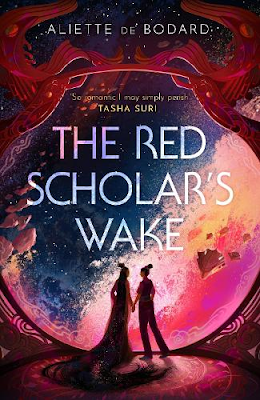
Microreview [book]: The Red Scholar's Wake by Aliette de Bodard

Lesbian Space Pirates! And so much more...


The modern SFF community sure loves a pithy one-line book description, especially when said description involves the word "space" or "in space". Tamsyn Muir's Gideon the Ninth was advertised as "Lesbian necromancers in space", Unconquerable Sun by Kate Elliott became "Genderbent Alexander the Great in space", and "Chilling Effect by Valerie Valdes somehow became "it has psychic space cats", despite said cats being a relatively minor part of a multi-layered space opera. In keeping with this trend, many people will probably have heard of The Red Scholar's Wake, Aliette de Bodard's first novel in the long-running Xuya universe of stories, via the description "Lesbian space pirates!" Perhaps, if the person giving you the pithy description has some more characters to spare in their tweet, they'll also add that one of those lesbians is a spaceship, but the big marketing draw is likely to involve some combination of three words, and three alone. Lesbian space pirates! What's not to love?

There's nothing wrong with snappy marketing, and in this case it's very accurate: The Red Scholar's Wake is indeed a sapphic romance, set in a spacefaring setting, and most of its characters are pirates. But no matter how intriguing, a three word summary can't tell you how much is going on beneath the surface of a particular book, and The Red Scholar's Wake has a lot going on beneath the surface. It packs a huge amount into its relatively short length, and expects readers to get on board with the worldbuilding of Xuya universe - already been firmly established in shorter fiction (for other long-ish tales, try The Tea Master and the Detective or On A Red Station, Drifting) pretty quickly. Worldbuilding details like bots and mindships are introduced quickly and with little direct explanation, and the book is also completely unapologetic in presenting a spacefaring society based on Vietnamese cultural norms, even representing linguistic elements not present in English like relationship-based pronoun use. It makes for a lush, intriguing world, one which requires attention readers unfamiliar with the setting, or its real world cultural precedents to grasp.

At the heart of this story is a romance between Xích Si, a tech-savvy scavenger who, at the book's opening, is captured by the Red Banner pirate fleet and is awaiting either death or a miserable indenture at their hands; and Rice Fish, a mindship (a sentient spaceship with a very human sense of identity and relationships) who has just been made a widow at the death of her spouse, the Red Scholar, in the same battle. Instead of sending Xích Si away to nameless servitude, Rice Fish recognises her technical ability and offers her a different route: become Rice Fish's new spouse, use her abilities to uncover who murdered the Red Scholar, and live out a life of relative comfort and protection on Rice Fish's decks. It's meant as a business exchange, and with no home to return to and no good alternative, Xích Si has little choice but to accept. Of course, as the two spend more time in each other's company, the genuine attraction between them becomes impossible to deny, and the two start to forge a bond which overcomes the the power dynamic between them, and their differing outlooks on life to become a marriage of love.


The dynamic between Xích Si and Rice Fish is great, and filled with just the right amount of complication: both have children (Rice Fish's much older than Xích Si's) who play different roles in the plot, and both Xích Si's experiences as a destitute scavenger and Rice Fish's loveless and unintentionally traumatic first marriage to the Red Scholar have left scars which both have to acknowledge might never heal. Because Rice Fish is a mindship, there's also an enjoyably alien element to how the two express their physical attraction to each other. Rice Fish has a suitably gorgeous (if otherworldly) human-shaped avatar which she projects as her "body" in interactions with other humans, and can also use to visit the pirate space station and the interior of other ships. But her real body is a spaceship, and that ship is full of sensors, imbued with its own heartbeat, and contains a "heartroom" where the story's most sensuous scene takes place. If you've read "In the Vanishers' Palace", you know de Bodard can make a steamy scene with a non-human partner work, and that talent is on full display again here. (For those who like to know either way how many sexy bits you're getting in your romance: one, and you can skip it and not lose any plot if that's your preference.)

But beyond the romance, The Red Scholar's Wake also shines both when it comes to the action packed mystery of unravelling the Red Scholar's death, and in the wider implications about piracy, freedom and emancipation which that plot entails. As leaders of the Red Banner, the Red Scholar and Rice Fish had built their marriage around trying to create an idealistic pirate society which offered freedom to those fleeing the controlling, corrupt empires to either side of their territory. But the realities of pirate society, which is built on raiding and killing ships in their territory and forcing survivors into indenture, fall far short of those ideals, and beyond Rice Fish's banner, the abuses of power by other pirate leaders demonstrate that they're not interested in the Red Banner's political mission in the first place. Even as Xích Si is tempted by the ease of her new lifestyle and what it would offer her daughter, and as she makes new friends among the Red Banner crews, she doesn't lose sight of the unsavoury aspects of the lifestyle and the death that it metes on others, including members of her own family. Towards the final third of the book, the ideological conflicts between the pirates and the empire they have fled from really take centre stage, and the way it plays out makes for one of the most satisfying confrontations of "noble outlaw" ideology that I've read in science fiction. And while the romance leaves Xích Si and Rice Fish in a satisfying position to begin their life together, there's plenty of uncertainty and tension left over with supporting characters which I'd love to see explored in future Xuya stories.

In short, while "Lesbian Space Pirates!" is a fine entry point for this book, The Red Scholar's Wake goes so much deeper and gets far weirder than any quickfire marketing statement could possibly capture. It won't take up much of your time on its own, but this is a great jumping-on point for the Xuya universe and if you enjoy this, there's a great deal of shorter fiction which you're going to love exploring as well. 

Reference: de Bodard, Aliette. The Red Scholar's Wake [Gollancz/JABberwocky Literary Agency, 2022]

Thursday, October 14, 2021

Adri and Joe Read the Hugos: Best Novelette


Adri: Time for our fourth category, which is Novelette!

Joe: Let’s do it! 


Should we just start with “Helicopter Story”? It takes up a lot of the oxygen in the category because there’s so much going on with “Helicopter Story” that isn’t really about the story, but is about how the story was published and initial knee-jerk responses to who Isabel Fall might be. Among those were concerns that the story itself was a giant troll job, in part because the original title of the story when Clarkesworld published it back in January 2020 invoked a meme used to attack transgender people (it’s still there as the first line of the story itself). “Helicopter Story” was taken down by Clarkesworld at the request of Fall due to harassment. 


I don’t know how much time we want to spend talking about the background of “Helicopter Story” without talking about the story, but I think the context is pretty important to at least note. I’m also a cisgender heterosexual man and I don’t know what I don’t know about how to frame that particular conversation beyond the barest details of what happened. 


“Helicopter Story” is also a much less provocative title than what it was originally published as, which for the sake of awards conversations may be the best call. But maybe I’m not the right person to say that, either. I did read the story when it was first published. 


Adri: It’s also important to acknowledge that this story, and the reactions to it, caused a lot of pain: to Fall herself, and to trans folk in the community. And it all absolutely sucks, and I’m really sorry. I don’t want to talk further about that, it’s not my place to talk about it, but I do want to talk about the story itself, because it’s on the Hugo ballot and to refuse to engage with Fall’s art would be a massive disservice to her and to everyone who voted for it.


So. This is the story of Barb, a helicopter pilot in a future US army where it is possible to psychologically alter people’s genders into neo-configurations that benefit the military. Barb identifies as an Apache attack helicopter, and her narration switches between her current mission, and how she, as a helicopter-identified person, experiences it; and a lot of musings on how gender can become a weaponised tool and what it means for the military - that hypermasculine institution that seems antithetical to any thought about gender beyond “manliness = good” - to have co-opted it in this way.


Between my first and second readings, I’d forgotten just how confrontational those latter aspects of the story are. Barb’s tone is often accusational, laying charges against the reader (and there are clear internal expecations about who that reader is) about how their experiences form a continuum with hers, no matter how distasteful we might find hers to be. Before she was an attack helicopter, Barb was a woman, and the way her current gender informs her take on femininity is particularly challenging to the reader. In other circumstances, I’d want to call this a surgical strike of a story, because I think it’s very targeted and deliberate in who it is addressed to (not me!) and the experiences it draws on. Obviously, its impact was not that of a surgical strike, and therein lies the rub. But in terms of craft, I think this is an excellent piece of writing and it deserves to be on the ballot on its own merits.


Joe: I agree. “Helicopter Story” is an impressive and notable story and is the sort of thing we should see recognized at the Hugo Awards. There have been a number of stories exploring gender and identity, and I don’t want to make any kind of sweeping statements about the particular uniqueness of “Helicopter Story” because I haven’t read nearly enough to speak with any sense of authority - but “Helicopter Story” is both very good and was significant because of the conversation around the story. 


As you said, some of the reactions of the story (and the story itself because of how it was positioned without context - see Neil Clarke’s editorial after pulling the story) caused a lot of pain and that should not at all be discounted. 


In terms of awards, the notoriety of “Helicopter Story” probably helped it break through - which is not to say that anyone from Fall to Clarkesworld to anyone else wanted the particular whiplash of a reaction that it received. But in the end it probably did help what is also a very good story to be remembered when it came to nominating for awards after a year of pandemic. 


I think that’s all that I’m going to say about or around “Helicopter Story” before I say something incredibly stupid or insensitive without intending to do so. It’s a very good story and it absolutely deserves its place on this ballot. 


Adri: Let’s move on! Funnily enough, there’s another novelette from the same issue of Clarkesworld here, which is “Monster” by Naomi Kritzer. This one is about a woman tracking down an old friend and former research partner in Guizhou, China, interspersed with stories of their earlier relationship. It doesn’t take long for red flags to start appearing over Andrew’s behaviour, and the way the story handles the past and present reveals is great. It was one of the stories on my nomination list and it’s fantastic to see it here.


Joe: I’m not sure I’ve read a story from Naomi Kritzer that I haven’t liked. “Monster” is no exception. Kritzer is just so smooth in her storytelling. You know where it’s going, this isn’t the sort of story that’s a huge surprise, but it’s moving. It’s good. It’s really good. 


Also good, and not at all a surprise to me is Sarah Pinsker’s “Two Truths and a Lie” which features exceptionally good description of cleaning the house of a hoarder (which honestly gives me the shivers to think about) and the mind fuckery of remembering and not remembering a really creepy and disturbing children’s television show that has more than a little tinge of the supernatural to it. 


The “Uncle Bob” show within the story has really strong echoes of something Stephen King would cook up and I mean that in the best possible way. I don’t think of Sarah Pinsker as a horror writer, and she’s not, but damn does she do a fantastic job of introducing a seeping horror with Uncle Bob. It’s not okay. 


Adri: With a title like that, it’s hardly surprising that “Two Truths and a Lie” messes around with the reliability of its narrator, and its story within a story narrator, and, well, the whole fabric of reality. Uncle Bob’s show isn’t the kind of horror I’d usually go for, but I can’t deny how creepy and effective the whole thing is. It perfectly captures that feeling of having an important childhood memory that, upon interrogation, starts to make less and less sense, and combined with all the other stuff going on here… well, it’s a good story.


I said in our short story conversation that - probably by an accident of ballot rather than any difference in the form -  short story and novelette have quite different vibes this year. There’s a lot of lightness and kindness and happy endings in short story, whereas in this category… well, we’re halfway through the ballot  and we haven’t gotten out of the grim horror woods yet, because oh look, Meg Elison’s “The Pill” is here too!


The Pill in “The Pill” is a miracle weight loss drug. People take it, they lose almost all of their fat cells within a matter of weeks (How? Well, the story goes into it so I won’t), and they then get to enjoy life with a body of the perfect size and fat distribution for all of their clothes, chairs and societal perception of health and sex appeal. The catch is that the Pill has a mortality rate: ten percent (double check) of people who take it die in the process of losing all their weight. The protagonist of the story doesn’t see the appeal, but her family all do, and as she deals with their individual decisions and increasing social pressure for fat people to take the pill, she finds her options increasingly restricted.


I have a lot that I could say about this story, and the different themes and conversations around fat that it twists and draws attention to as the story progresses. As a fat person with a lot of fat family members, those elements of the storytelling hit especially hard - in fact, in some ways identifying with a lot of the protagonist’s choices in The Pill was a drawback that threw off my appreciation of the story’s ending, where things took a turn faaar away from the relatable for me. Still, though, what Elison does in this story is make a chilling and utterly believable way in which a huge chunk of humanity might be persuaded to play Russian Roulette, all in the name of health and convenience promises that just don’t add up.


Joe: Novelette is a much harsher category than Short Story, and I do agree that it’s just happenstance that the two categories fell that way. The one in ten chance of death because of the pill is dark as hell and yet, I do think there’s a really good chance if such a pill really did exist that people would end up lining around the block for their chance to take one and some of them would be the same people yelling about how unsafe and untested the vaccinations are for the coronavirus because how else can you prove that you’re a real alpha of society if you don’t have that perfect body? I angrily digress.


The way Elison describes the societal pressure building as taking the pill becomes more and more commonplace felt really, well, real. In a way it reminds me of Sarah Pinsker’s second novel We Are Satellites, which is much more about technology and those get left behind for various reasons. The novel and novelette aren’t focused on the same thing, and “The Pill” is far more condensed, but the idea of damn the consequences because this is how you fit in and feel better about yourself - it makes a lot of sense. 


The ending of the story is a bit out there in relation to the rest of “The Pill” but I could make an argument, if needed, how it would / could fit into that same sort of world where being physically different is only valued as a commodity to the ultra rich and not as an actual person. It’s a stretch of an offshoot, but it definitely gave the ending a different feel from the rest of the story.


Moving on to Aliette de Bodard’s “The Inaccessibility of Heaven”, which is part of the Dominion of the Fallen series of novels and stories featuring the consequences of fallen angels on Earth (and usually Paris, but I’m not sure this one is set there). “The Inaccessibilty of Heaven” is dark and full of murder, which fits in quite nicely in this category. It’s a solid murder mystery where the pain of the Fall echoes through. 


Adri: I don’t think The Inaccessibility of Heaven is actually part of Dominion of the Fallen, but it has a lot of similar worldbuilding elements - both are about fallen angels! - and a lot of the same vibes. And de Bodard does those vibes really well, and the character dynamics in this are excellent. I actually nominated it, but it's fallen off my radar a bit while considering the full ballot compared to the other stories here. But it's a great gothic-y mystery with lots going on, so definitely happy to see it here.


Joe: To be fair, a novelette about fallen angels from a writer who has a series about fallen angels is suggestive of being part of that same series about fallen angels.


Adri: Says the Seanan McGuire fan! (Not a criticism - I just think there’s lots of ways for authors to do the same stuff differently).


Joe: I don’t know, I think Seanan keeps her series pretty distinct. One has faeries, the other has all the other mythical creatures. The others have plagues. Besides, if she writes a short story in a universe she’s featuring known characters from that universe. 


Wait - we’ll talk about Seanan McGuire later when we get to Best Series. Let’s talk about A.T. Greenblatt’s “Burn, or the Episodic Life of Sam Wells as a Super”, which is absolutely not a superhero story written by Seanan McGuire though I’d be willing to discuss how McGuire uses the concept of superheroes in her Velveteen series. 


It’s not that “Burn” is a light story because it’s not and there is all sorts of emotional pain to deal with, but it is lighter in comparison to the rest of this category. It’s not my favorite and that’s okay. 


Adri: I feel the same. “Burn” is the story of a character with superpowers in a world where they’re relatively common but frequently looked down upon, learning that it’s hard to find your place in the world when you’re prone to becoming a human torch and trying to fit in with a team of supers who are trying to maintain their own precarious reputations. The episodic format delivers exactly what it promises: snapshots of Sam joining the team (as admin staff), dealing with the ways, big and small, that his powers have changed him, working to become stronger and more in control of his gift, and hanging out in a nice bar. It’s a fun story, one about finding a place in a world where the consequences for mistakes are immense, but it’s further down the list for me.


Now that we’ve been through all that, what’s at the top of your list?


Joe: I don’t know if I have super strong feelings about the top of my Novelette ballot, but I’d say “Two Truths and a Lie”, “The Pill”, and “Monster” in no particular order. “Helicopter Story” is just off that trio, I think, though I make no promises about going back into my ballot and making changes. What about you?


Adri: I think I’m voting “Helicopter Story” first. It took me two readings and a lot of thinking to really understand what it’s trying to do, but the more I consider it, the more I appreciate the artistry in it. The history is hard to decouple from the art - it always is - but I really do think this stands as an excellent piece of work.


The other stories that are up in the top three for me are “The Pill” and “Monster”. I’m really glad that I got to read “The Pill” as part of this category, as its publication in a PM Press volume might have led me to miss it otherwise and it’s exactly the kind of gem I love reading award nominations for. And Naomi Kritzer just knows how to spin a tale, and “Monster” was already one of my favourites for the year.


Joe: I absolutely can’t argue “Helicopter Story” at all, I’m just a sucker for a Sarah Pinsker story. 


Adri: And with that, I think we’re done with our fourth category - see you next time for Best Series!


Thursday, March 11, 2021

Microreview [Book]: Fireheart Tiger by Aliette de Bodard

A novella with the warmth of a flame, without the pain that comes with it.

Fires can be a source of comfort, but its smoke can blind and disorient you. Scorched areas can be mistaken for places of safety if your surroundings aren't clear. The source of burning sensations might be you burning with passion or literally burning. Fireheart Tiger tackles the confusion of a conflagration, both in a literal and metaphorical sense. The story goes back to a fateful day in which flames left a mark on the protagonist, as they vacillate on whether it had lasting gratification or pain. Add in diplomacy between kingdoms on a scale comparable to epic fantasy tomes, and you have a clever novella that manages to be both intimate and grand, sometimes within the same sentence.

Fireheart Tiger takes place in a fantastical landscape, following Princess Thanh who is taken from her home country of Bình Hải as a royal hostage to the colossally powerful Ephteria.  One day, a fire spreads throughout the Ephterian palace, and Thanh escapes with the help of a stranger of whom no one else seemed to know exists. To complicate matters, Thanh had a love affair with the Eptherian princess, Eldris, before she returned home. Traumatic memories and fiery surroundings encompass Thanh for many years, until Eldris and her cohort Pharanea comes to Bình Hải for political negotiations. Sparks fly literally and figuratively.

This novella constantly shifts from plot point to plot point, that kept me on my toes without unmooring me into confusion. The craft involved with implementing poetic language that benefits the atmosphere, pacey scenes that never lose focus, and characters that I felt like I knew inside out by the story’s conclusion, deserves kudos. Mostly because the novella juggles a small, insulated cast of characters with subterfuges and violence that impact other kingdoms. Fireheart Tiger is like an expansive web that leaves the reader in the center of it, while also skillfully and pithily letting them know of all its disparate parts.

The characters in Fireheart Tiger encapsulate different elements of fire. There’s the dazzling elegance of Eldris.  The fireplace-like warmth of the mysterious Giang. The chaotic, vacillating attitude of Thanh, like they’re a windblown flame. And the severe, destructive force of Pharanea. It’s a wide gradient of personality types, which is perfect for conflict, and as you would expect, things become messy with glorious results.

If there’s one gripe I had about the book, it’s that the ending happened a little too quickly. But I give props to the book for making me think of that problem, because if it was unpleasant to read, I would find its brief conclusion to be a blessing. Despite the way it barreled through the conclusion, I liked where things ended up. Fireheart Tiger veils the reader until close to the end of the story, regarding certain characters’ motives and standings. Eventually, the smoke starts to clear, motives become concrete, and the reader finds out how things really are. I won’t spoil the reveals, but I will say that the ending was the book’s last of many showcases of its skill. When the smoke cleared, I didn’t see a ruinous disaster, but a carefully crafted tale that looked better, not worse, because of the fieriness that ignited the story and never relented.

 The Math

Baseline Score: 8/10

Bonuses: +1 For engaging me enough to read it in one sitting, completely losing track of time.

Negatives: -1 For a conclusion that left me wanting a little more.

Nerd Coefficient: 8/10

POSTED BY: Sean Dowie - Screenwriter, stand-up comedian, lover of all books that make him nod his head and say, "Neat!

De Bodard, Aliette. Fireheart Tiger [Tordotcom, 2021].

Wednesday, December 9, 2020

New Books Spotlight

Welcome to another edition of the New Books Spotlight, where each month or so we curate a selection of 6 new and forthcoming books we find notable, interesting, and intriguing. It gives us the opportunity to shine a brief spotlight on some stuff we're itching to get our hands on.

What are you looking forward to? Anything you want to argue with us about?


de Bodard, Aliette. Seven of Infinities [Subterranean]
Publisher's Description

Vân is a scholar from a poor background, eking out a living in the orbitals of the Scattered Pearls Belt as a tutor to a rich family, while hiding the illegal artificial mem-implant she manufactured as a student.

Sunless Woods is a mindship—and not just any mindship, but a notorious thief and a master of disguise. She’s come to the Belt to retire, but is drawn to Vân’s resolute integrity.

When a mysterious corpse is found in the quarters of Vân’s student, Vân and Sunless Woods find themselves following a trail of greed and murder that will lead them from teahouses and ascetic havens to the wreck of a mindship--and to the devastating secrets they’ve kept from each other.

Why We Want It: de Bodard's Xuya stories are consistently excellent and novella length is a sweet spot and always leaves us wanting more.


Drayden, Nicky. Escaping Exodus: Symbiosis [Harper Voyager]
Publisher's Description

The Compton Crook Award-winning author weaves her trademark blend of science fiction and dark humor in this dazzling story that continues the imaginative saga begun in Escaping Exodus, in which a society lives in the belly of a beast—and an entire civilization's survival depends on a pair of uneasy allies who must come together for one epic battle.

Nearly a thousand years removed from Earth, the remnants of humanity cling to existence inside giant, space faring creatures known as the Zenzee. Abused and exploited by humans for generations, these majestic animals nearly went extinct, but under the command of its newly minted ruler, Doka Kaleigh, life in the Parados I has flourished. Thanks to careful oversight and sacrifice by all of its crew, they are now on the brink of utopia, and yet Doka’s rivals feel threatened by that success.

The Senate allowed Doka to lead their people believing he’d fail spectacularly—a disaster that would cement the legitimacy of their long-standing matriarchy. Despite vocal opposition and blatant attacks on his authority, Doka has continued to handle his position with grace and intelligence; he knows a single misstep means disaster. When a cataclysmic event on another Zenzee world forces Doka and his people to accept thousands of refugees, a culture clash erupts, revealing secrets from the past that could endanger their future. For Doka, the stakes are bigger and more personal than ever before—and could cost him his reign and his heart.

He has fallen for the one woman he is forbidden to love: his wife, Seske. Doka and Seske must work closely together to sway the other Zenzee worlds to stop their cycles of destruction. But when they stumble upon a discovery that can transform their world, they know they must prepare to fight a battle where there can be no winners, only survivors.
Why We Want It: We love Nicky Drayden's novels around these parts. Each one is a wild ride as different from each other as can be. Escaping Exodus: Symbiosis is the first sequel from Drayden, following 2019's Escaping Exodus (Adri's review) and I loved that book at least as much as Adri, if not more.


Martin, George R.R. and Gardner Dozois. Songs of Love and Death [Saga]
Publisher's Description

From epic fantasy, post-apocalyptic America, to faerie-haunted rural fields in 18th-century England, to an intergalactic empire, join star-crossed lovers as they struggle against the forces of magic and fate.

A star-studded cross-genre anthology Songs of Love and Death features all-original tales from seventeen of the most prestigious names in romance, fantasy, and science fiction.
Why We Want It: Is this the last Gardner Dozois anthology? Regardless, even though I haven't read them all, I know that any anthology from GRRM and Gardner Dozois is a top notch anthology.


Robson, Justina (editor). Tales of Catt and Fisher [Solaris]
Publisher's Description

A brand-new collection of stand-alone stories featuring the return of two fan-favourite characters from the world of the critically acclaimed Redemption’s Blade and Salvation’s Fire novels.

Four new tales of Doctors Catt and Fisher…

Scholars, shopkeepers, collectors… aficionados. Obtainers of rare antiquities; relic hunters who can’t resist a lead, even when it takes them into terrible danger. There’s always an opportunity to be found amid the confusion, in the wake of the terrible Kinslayer War. There’s always a deal to be done, a tomb to open, a precious thing to… obtain.

From encounters with the monstrous Vathesk to exploring new worlds; from wielding great power to do great good, to unearthing dark things best left lost. If you need the experts, if you can find your way to their Cherivell shop, maybe you can hire Doctors Catt and Fisher.
Why We Want It: I've read the five volumes of Robson's Quantum Gravity, but I've only dipped my toes in the rest of her catalog. Somehow, up until the time I was putting together this article I was under the assumption that this was a collection of Robson's stories - but as you can see from the description above, it is not. With that said, I've been interested in the After the War world since it was announced so while I may not be dipping my toes into  more of Robson's fiction maybe this is the time to dip into After the War.


Vo, Nghi. When the Tiger Comes Down the Mountain [Tor.com Publishing]
Publisher's Description

"Dangerous, subtle, unexpected and familiar, angry and ferocious and hopeful. . . . The Empress of Salt and Fortune is a remarkable accomplishment of storytelling."—NPR

The cleric Chih finds themself and their companions at the mercy of a band of fierce tigers who ache with hunger. To stay alive until the mammoths can save them, Chih must unwind the intricate, layered story of the tiger and her scholar lover—a woman of courage, intelligence, and beauty—and discover how truth can survive becoming history.

Nghi Vo returns to the empire of Ahn and The Singing Hills Cycle in When the Tiger Came Down the Mountain, a mesmerizing, lush standalone follow-up to The Empress of Salt and Fortune.
Why We Want It: One of two books on this spotlight where I haven't read the preceding book, I've been excited to read The Empress of Salt and Fortune since it was first announced. 2020 has been a heck of a year and many of my reading goals and expectations have not quite come through - so my everlasting to-read pile is now one book deeper because the follow up to one of my more anticipated books of the year is naturally also highly anticipated.


Winter, Evan. The Fires of Vengeance [Orbit]
Publisher's Description

In order to reclaim her throne and save her people, an ousted queen must join forces with a young warrior in the second book of this”relentlessly gripping, brilliant” epic fantasy series from a breakout author (James Islington).

Tau and his Queen, desperate to delay the impending attack on the capital by the indigenous people of Xidda, craft a dangerous plan. If Tau succeeds, the Queen will have the time she needs to assemble her forces and launch an all out assault on her own capital city, where her sister is being propped up as the ‘true’ Queen of the Omehi.

If the city can be taken, if Tsiora can reclaim her throne, and if she can reunite her people then the Omehi have a chance to survive the onslaught.
Why We Want It: One of the most buzzed about books from 2019 which I haven't read is Evan Winter's The Rage of Dragons. I own it, I just still need to read the book. Regardless of that, this is shaping up to be an incredible fantasy series and the publication of the second volume should be all the inspiration I need to read the first. It's also the only book I haven't read off of my 2020 Summer Reading List.


POSTED BY: Joe Sherry - Co-editor of Nerds of a Feather, 4x Hugo Award Finalist for Best Fanzine. Minnesotan. He / Him.

Friday, July 24, 2020

Microreview [book]: Of Dragons, Feasts and Murders, a Dominion of the Fallen Story, by Aliette de Bodard

Of Dragons, Feasts and Murders, a Dominion of the Fallen Story is a delightful entry in the growing angelic apocalypse devastated Paris, focusing on a family holiday visit to the Dragon Kingdom by the heads of House Hawthorn.


Family visits with the In-laws during a major holiday can be awfully stressful. Ask the fallen angel Asmodeus, head of House Hawthorn. He is visiting the Dragon Kingdom underneath the Seine river, the birthplace of his husband Thuan, along with a delegation from his house for Lunar New Year. It’s a time of feasts, celebration, getting to know the in-law’s family. For Thuan it's a chance to see his home and family for the first time in a long time, and show off his husband to his family. It also appears to be a time for the pair of them to walk right into a murder plot, a murder plot that may well be more than it appears...

So Asmodeus and Thuan find out in Aliette de Bodard’s Of Dragons, Feasts and Murders, a Dominion of the Fallen Story.

A Dominion of the Fallen Story is a cause for celebration, and this story is no exception to that. Seeing Asmodeus and Thuan on Thuan’s home ground provides the writer as a writer and us as readers another view of the Underwater Kingdom of the Seine and just what pressure cooker of a complex and dangerous court produced the bookish Thuan in the first place. The insider/outsider perspective of the wedded couple returning, and using Thuan as our point of view, gives the story a delightful “Oh no, I am bringing my husband to see my family, I want them to love him as I do, and also keep him from going overboard when things go wrong.” . The strong point of view focus sticking to Thuan helps keep a good line through for the plot, as a murder that occurs right on their doorstep leads Asmodeus and Thuan into an ever more complex plot.

The story is nuanced in its basic premise. A fish out of water story at its heart, and the principals thrown into a murder investigation right off, the high concept of “A murder happens, and Thuan has to keep his husband from cutting a bloody swath to solve the problem, and yet the strictures of Dragon Kingdom society mean that creative approaches are needed” means that there are going to be funny culture clash and expectation smashing as you do put the oddest of couples (but they do care for each other deeply) into a situation where both of their talents are needed--and both of their cultural approaches and feelings are at time strong and useful, and also at other times, both are backfooted by who they are. A lesser story would just have it so that Asmodeus is constantly being restrained by his husband, And while the story does have some of that, the story also shows that Thuan, being constrained by propriety and society and expectations, doesn’t always have a solution to move forward, either. It’s a nice balancing act.

And most of all, it's funny and entertaining with great line by line dialogue and turns of phrase and situational comedy. At the time of this publication, of me reading this, and the writing of this review, the world faces a lot of stressful challenges. A short diverting time to see Thuan trying to keep Asmodeus from solving problems by causing bigger problems, and Asmodeus just trying to get through a sometimes outright hidebound society is played lightly, for humour, and it works.

Admittedly, this story doesn’t quite work if you haven’t read the Fallen novels. The character beats of Thuan and Asmodeus, especially, will fall flat if you haven’t read at least House of Sundering Flames. Like an intricate dessert of many parts, though, Aliette’s work just gets richer and better, the more stories and novels you read into it. Additional richness and complexity unfolds, but this is not an entry point into that richness.  I also fear those who have read the Fallen novels and fallen for the characters in that world might be disappointed that while we do have a delegation of people visiting the Dragon Kingdom for New Year, the focus is so strongly on Asmodeus and Thuan that they rest get short shrift, even when they briefly do appear. Given the author’s strength in writing characters, this feels like a bit of a missed opportunity.

Overall, however, readers who have enjoyed the previous novels and stories set in the verse will want to know--is this story up to the standards of the previous work. Will I enjoy it? To them, I can unequivocally say “Yes”. Go get it.

---

The Math

Baseline Assessment: 7/10

Bonuses: +1 for excellent dynamics between Thuan and Asmodeusr; +1 for excellent language, turn of phrase, and outright delightful and funny bits.

Penalties: -1 for underutilizing the other previously seen characters who are present in the delegation but barely rate a mention.

Nerd Coefficient: 8/10 well worth your time and attention


Reference:  De Bodard. Aliette . Of Dragons Feasts and Murders [ JABberwocky Literary Agency, Inc. , 2020]


Paul Weimer. Ubiquitous in Shadow, but I’m just this guy, you know? @princejvstin.

Tuesday, June 16, 2020

Summer Reading List 2020: Paul

While winter is for reading and trying to stay warm in the Great White North when the Ice Giants and the White Dragons roam the wastelands of Minnesota, summer is for getting out there and enjoying the all too brief warm weather. In this age of the Pandemic, however, the transitory nature of summer is even more poignant, since long trips for adventures are currently not in the cards. My journeys this year may well be almost exclusively  to places between the covers of books.

 So here, find a list of six of the books I am looking forward to getting to before Summer turns to Fall, and green shifts to hues of red, gold, and orange before a clattering change to brown.

On my 2019 list I read five out of the six books . And so on to 2020!


1. Prime Deceptions, Valerie Valdes.


Chilling Effect was a superb first novel of found family and space adventure, including Psychic cats, that had a deep and intense story that was belied by its fluffy cover. I am really interested in the newest adventure of Captain Eva Innocente and the found family crew of La Sirena Nigra.


2. Of Dragons, Feasts and Murders: A Dominion of the Fallen Story by Aliette de Bodard.

 Ever since the first Fallen novel, House of Shattered Wings, I have been #teamasmodeus, truly enjoying the antagonist that has stomped through all of the novels and stories De Bodard like a striding giant. In this latest tale, Thuan, Asmodeus’ Dragon husband, brings Asmodeus home for Lunar New Year. This is a family reunion I don’t want to miss.


3. Seven Devils, Laura Lam and Elizabeth May


Seven Devils is billed as a feminist space opera where seven resistance fighters are taking on the tyrannical  Tholoisian Empire. I am all aboard for a retelling of the classic formula of “Seven against Thebes”, except in Spaaace! Recasting classical history and mythology into Space seems to be a thing this year (c.f. Unconquerable Sun) so I am looking forward to seeing how Seven Devils tackles it.


4. Or What you Will, Jo Walton


Stories about self-aware characters who have knowledge of their own nature, and seeking to change it is a tricky metagenre to try and work on. But the author of works like Tooth and Claw, Among Others (a novel all about reading and the importance of reading and books) and the Just City trilogy is an author I trust to tell the story of a character idea seeking to transcend the mortality of his creator, and perhaps, her own as well.


5. Chaos Vector, Megan O’Keefe

I really enjoyed O’Keefe’s first  Soace Opera novel, Velocity Weapon, a twisty and complicated story grounded in the story of two siblings in a far future solar system, and an AI with a definite Agenda. Now with having released the AI and its ship, it looks like Sanda and Tomas are on the run, with a secret inside of Sanda’s head the reason why they are on the run. It sounds like more shenanigans, more twists, and more excellent space opera action beats.


6. Ashes of the Sun, Django Wexler

A story about building a new empire in the ruins of a fallen empire? Two siblings on opposite sides of a war? Mysterious magic and artifacts?  Crunchy Crunchy Worldbuilding? This start of a new series from Wexler sounds like it is pressing all of my favorite Epic Fantasy buttons. Wexler has just about gotten into my coveted autobuy list on the strength of his previous series. This new novel could catapult him into that status.


---

POSTED BY: Paul Weimer. Ubiquitous in Shadow, but I’m just this guy, you know? @princejvstin.

Tuesday, June 9, 2020

6 Books with Aliette de Bodard

Aliette de Bodard writes speculative fiction: she has won three Nebula Awards, a Locus Award and four British Science Fiction Association Awards, and was a double Hugo finalist for 2019 (Best Series and Best Novella). She is the author of the Dominion of the Fallen series, set in a turn-of-the-century Paris devastated by a magical war, which comprises The House of Shattered Wings, The House of Binding Thorns, and The House of Sundering Flames (July 2019, Gollancz/JABberwocky Literary Agency). Her short story collection Of Wars, and Memories, and Starlight is out from Subterranean Press. She lives in Paris. Visit https://www.aliettedebodard.com for more information


Today she shares her Six Books with Us

1. What book are you currently reading?

I'm currently doing comfort reads, which means I've embarked again on a reread of Alexandre Dumas The Count of Monte Cristo--Gothic quest for revenge is the best.


2. What upcoming book are you really excited about?

Kate Elliott's Unconquerable Sun¹, which is a huge space epic with a female version of Alexander the Great, fascinating and deep worldbuilding, and nailbiting action scenes. Also Perse (short for Persephone), the daughter of the House in charge of the secret police, is sheer delight: opinionated, resourceful, and very unimpressed by her own family.


3. Is there a book you’re currently itching to read again?

Every few years I reread the Terry Pratchett books from start to finish, and I really want to do that again this year. It's become a bittersweet tradition since he died, and I'm not sure I can bring myself to reread The Shepherd's Crown at all, but all the other ones are sure to bring me joy and much sense of wonder (and much sharp commentary on life).


4. How about a book you’ve changed your mind about – either positively or negatively?

I bounced off Dorothy Sayers pretty thoroughly as a child: I thought her books were hard to read and the characters hard to get to grips with. But then I rediscovered them as an adult, and they're so great! (also it's scary how young Lord Peter is, I always thought he was in his forties but it turns out he's 33!) I love the Lord Peter/Harriet Vane relationship, and I'm now struck by how witty and how well written they are, and how they capture the mood of the years between the war in a really evocative way.


5. What’s one book, which you read as a child or a young adult, that has had a lasting influence on your writing?

I think Ursula K Le Guin's A Wizard of Earthsea remains a major influence on me, especially its last scene when Ged finally realises that the shadow he has unleashed is his, and the darkness he thought was malice is also his malice--that moment of self-realisation had a huge impact on me.


6. And speaking of that, what’s your latest book, and why is it awesome?

My latest book is Of Dragons, Feasts and Murders. Dragon prince Thuan brings his brooding ruthless husband back to his childhood home in the imperial citadel: Thuan has braced himself for tense family reunions, but instead what they find is a corpse whose death they have to investigate.

It's Asian court drama meets High Gothic aka "husband and husband investigate a murder amidst court politics, and it looks like *family* is involved", aka "the diplomacy/MURDER pairing have to work together". There's kissing, sarcasm, and stabbing. I had a lot of fun writing it and putting together all my favourite tropes, and I hope you enjoy it too!


Thank you, Aliette!

---

POSTED BY: Paul Weimer. Ubiquitous in Shadow, but I’m just this guy, you know? @princejvstin.
.

Thursday, February 27, 2020

Questing in Shorts: February 2020


Since Thursday Morning Superhero went monthly, we've had a more flexible Thursday schedule here at Nerds of a Feather, and with that has come the potential for a new commitment for Questing in Shorts. Starting this month, I'm going to be putting out this column on the last Thursday of every month, so fans of the novelettes, the flash fics and of course the shortbois can set their schedules and come visit me then. That little piece of information aside, it's been a busy month with some great collections and new-to-me magazines, so let's dive straight in!

Of Wars, and Memories, and Starlight by Aliette de Bodard (Subterranean Press)


Aliette de Bodard's Subterranean press collection is as beautiful as you'd expect on the outside, with a Maurizio Manzieri cover and the standard level of Subterranean finishing. It's also an excellent collection that's largely comprised of pieces from the Best Series-nominated Xuya universe, which ranges from alternate history Earth stories in which the Western part of North America is colonised by China, and the Aztec empire of Mexica survives into the present day in a loose alliance with the power now called Xuya. The collection contains one piece from this Earthbound continuity "The Jaguar House, in Shadow", an intriguing political thriller which, along with the opening story "The Shipmaker", sets up the rest of the intergalactic political, cultural and technological traits of the Xuya universe very nicely. De Bodard's stories dealing with cultural clashes of some kind are highlights for me: from "The Waiting Stars", the tale of a young Dai Viet woman who has been taken from her family and raised in the Galactic Empire, to "Scattered Along the River of Heaven", a story of conflict and war and cultural revolution told two generations after the fact, de Bodard is quietly unflinching in her portrayals of displaced characters and their struggles to find connection with the different cultures they are surrounded by and yet, to some extent, alienated from. The absolute highlight on this front is "Immersion", a Nebula and Locus winning short story which alternates between Quy and another woman from the Rong people, both of whom wear Galactic (western culture)-made "Immersers" which allow them to communicate with Galactics but at the expense of their own culture and personhood. For Quy, who wears the Immerser briefly to help her family with business transactions, the experience is unpleasant but temporary; for the other narrator, it has become her permanent reality. The story's sense of isolation, and the various losses which the casual dominance of Galactic culture in this part of space has created, come around into a perfect, heartbreaking, circle by the end as the second narrator finds tentative connection in her isolating, but unique, understanding of both Rong and Galactic culture.

That's just a snapshot of what there is to enjoy here: "Three Cups of Grief, by Starlight", a triptych of loss and filial piety in a world where siblings can be spaceships, is always worth a read, and this is also the first time I've read fairytale retelling "Pearl" originally published in The Starlit Wood. Also present here are two stories from de Bodard's Dominion of the Fallen universe: unfortunately, I don't get on as well with this series, and so I skipped rereading "Children of Thorns, Children of Water" - though, as it's a Hugo finalist, you probably shouldn't. "Of Birthday, and Fungus, and Kindness", the second Dominion story, is also the longest in the collection and original to this collection: it's a bit of a difficult one to assess having only read the first book in the series, but I did find it a fun read, combining delicate political machinations in a post-apocalyptic Paris ruled by the houses of fallen angels with the slow and hilarious disaster of a highly persistent mushroom infestation. I'm still keeping my fingers crossed for a complete Xuya collection someday, but while we wait for that, this is an excellent start.

Nudibranch by Irenosen Okojie (Dialogue Books)


This collection is one where the situation and format in which I read it made a huge difference to my interpretation and enjoyment. Having originally picked this up as an ARC, I'd been fitting in stories here and there around my commute, but I was bouncing off most of them as my exhausted Tuesday-brain struggled to put together the weirdness and to switch from one story to the next (the formatting, which didn't have page breaks after each story, really didn't help with this) . Frustrated but not totally put off, I found the physical book in a bookshop, bought it, opened it back up at the beginning, and read it in one sitting at a coffee shop - with very different results. Of course, that's not to say that Nudibranch - a collection which takes its name from the group of vibrantly coloured, delightfully bizarre sea slugs - is not a weird book. From the adopted-son-turned-farmhand-turned-government-weapon of "Saudade Minus One (S  ̶  1 =)" to the eponymous backwards time traveller of "Daishuku" to the transdimensional tongue-protecting monks of "Filamo", Nudibranch is, by turns disjointed, disorienting and completely at home from everything to mundane slice-of-life flashes to high-concept time travel. While it starts with the very high concept flash piece "Logarithm" (which, alas, did nothing for me), and is quite definitely a literary fiction collection in its sensibilities, there's also a lot for fans of speculative fiction and shortform worldbuilding to enjoy here, with some lush writing to boot.

Two things seem to link Okojie's diverse set of protagonists. First, quite a few of them find themselves shifting from high concept slipstream weirdness into utterly mundane scenes of London life (I mean, who can't relate to turning into a giant human liquorice and then popping over to the Horniman Museum?) Second, and more interestingly, the characters of Nudibranch almost all come undone at the ends of their stories. Some of the moments are ambiguously metaphorical, like the protagonist at the end of "Cornotopia", who goes into an experimental treatment for post-trauma depression and ends, once the treatment apparently begins to work, by shrivelling up "like a carcass that had finally stopped tricking people into thinking it could breathe"; or a horror-like cutaway like "Point and Trill", a story which begins as the mundane tale of a struggling couple going on a night-time paintballing retreat, and then takes some very dark turns. Then there's the quite literal falling apart of the liquorice protagonist at the end of "Kookaburra Sweet" and the bizarre yet fitting sacrifice of the big-dreaming protagonist of "Mangata". Regardless of how it happens, what runs through this collection is the sense that these are people who, once their varied circumstances play out, then effectively come apart, exciting the stage in a variety of morbidly fascinating literary flourishes. It may sound a bit much, but I still managed to finish the collection in one sitting without feeling overwhelmed by morbidity, so its not nearly as grim as all that. In the end, I'm glad I persevered (and spent money on!) Nudibranch, a collection whose strongest images I suspect are going to stay with me for quite some time.

The Dark, January 2020 (Read Online)


Catching up with back issues of The Dark was part of my to-do list this month, and as you can see from the issue I've decided to review, I mostly got there. January's issue, as always, brings two original and two reprinted stories, with both of the originals dealing with abuse and highly problematic parent-child relationships. In Clare Madrigano's "Mother Love", a woman looks back on her relationship with her mother, a woman with "a hunger she couldn't control". Its a story that turns the heat up gradually, even as it effectively sets out its destination in its metaphorical opening paragraph; as we learn more about the narrator's childhood and what she went through, things gradually get more and more strange, until the eventual conclusion seems both utterly unhinged and, somehow, completely unsurprising. "Forwarded", by Steve Rasnic Tem, also has a protagonist - this time a man named Tom - looking back on his time living under his father's roof, as well as the terrors he inflicted in turn on his younger (now also grown) brother. Unlike "Mother Love", which remains purely in the psychological horror realm, "Forwarded" offers some speculative terror in the form of an old imaginary friend, who turns up at a rather inconvenient time to further complicate Tom's engagement with his past. While neither story takes its premise anywhere particularly imaginative, both offer challenging but compelling perspectives on their respective horrors.

The first reprint in the issue is a creepy delight (well, not literally a delight, this is a horror magazine after all) from Angela Slatter ("No Good Deed"), featuring a woman who wakes up in a rather unexpected location after her marriage to Adolphus, with only the voice of a dead woman to explain her circumstances and lead her to survival and justice. Perhaps my favourite in the issue, though, is the second reprint, "The Man at Table Nine" by Ray Cluley. Cluley's protagonist is Nicola, a Polish woman now working as a waitress in a restaurant somewhere in the UK. Already dealing with bigoted coworkers and thinly veiled threats about her job security, Nicola is further challenged when she is asked to serve a bizarre regular: a man who apparently owns the restaurant chain, and who orders food and drink but never appears to eat it. As Cluley's portrayal of the guest gets increasingly bizarre and the reader theories start to get discounted (he's not a vampire, you guys!) the story builds a mystery that begins to feel oddly unthreatening, given Nicola's wider circumstances. Its not until the story's closing lines where the hammer drops and I shout "no" in the middle of my office lunch table, to everyone else's bemusement. Well worth checking out
.
Three Crows Magazine, Issues 4 and 5 (read online)

Image: Three Crows Magazine Issue 4 Cover

Three Crows is getting quite a lot of attention due to their recent interview with Tamsyn Muir, which is well worth reading for reasons out of the scope of this column (they've done other great work on this front too - their interview with Marlon James is also excellent). What I'm here for, as always, is the fiction, and I'd been drawn to this magazine by the fact that it's based outside of the Anglosphere and I'm trying to diversify out of US and the occasional Canadian-based magazine.

There are seven stories across these two most recent issues, and the best of them are very good indeed. In Issue 5, my favourite was "Thistle Eşref" by Luke Frostick, a long story about a hunter, Eşref, whose attempts to hunt down the dragon that's been terrorising the Kingdom lead him on a quest that's rather more epic and bloody than he bargained for. The character voice and the pacing of this piece are brilliant, with a lighthearted tone and constant weary asides from its main character that make it feel like a folksy tale by the fireside. The issue's opening piece, "In Dark Corners and Neglected Places" by Joanna Parypinski, offers a similar folksy feel, starting as a storytelling session by a grandmother keeping her granddaughter entertained during her knitting, and then turning into something significantly more sinister. And in Issue 4, the standout story was the deeply uncomfortable "Knowing Your Type" by Eliza Chan. Narrated by a controlling racist misogynist looking for a "perfect" Asian wife, the story revolves around Manami, the young woman who is the subject of the narrator's attentions, but who quickly makes it clear that she has no intention of being the victim of this piece. As we start to understand what Manami is doing before her predator arrives at the relevant conclusions, the story unfolds brilliantly towards a grim, and yet totally deserved, conclusion.

Unfortunately, what held me back from loving some of these stories felt more like an editorial issue than anything else. Despite some great premises, a few of the stories here lack the polish of the other venues I've covered in this column to date, and where particular stories are attempting to lean into a particular voice or style, the near-misses can be a challenge to look past. The most challenging story for me in this regard was Stephen Couch's "In Cube Eight", a weird space opera where a spaceship crew and its AI all dope up on psychadelic substances in order to attempt contact with an alien species (who have apparently been appearing as "elves" to people tripping throughout the ages). The premise is novel, and the narrative voice gets close to an old-school Kerouac-type tone which, if pulled off, would make this a really intriguing mash-up of genre - but there's just too many sentences that land a little too heavily, and line breaks that don't quite feel like they're in the right place, for this story to really shine. Its not a problem that prevented me from enjoying Three Crows as a whole, but it is something that I hope greater resources and attention might fix in future issues.

The Future Fire, Issue 52 (read online)

Image: The Future Fire Magazine Issue 52 cover

The second new venue in this month's roundup is officially my first British short fiction magazine (but hopefully not the last!) I've been somehow following The Future Fire on Twitter without putting two and two together and realising it's publishing exactly the sort of fiction that I want to read: progressive, diverse and socially conscious.

I'm slowly catching up on their back issues from 2019, but I wanted to jump straight in with their most recent edition for column purposes. There's one flash piece and four short stories in the prose offering here, covering everything from slipstream musings on a difficult childhood ("Pleiades for a New Generation" by Kathryn Allan) to a matter-of-fact witch in a hard, frontier land outsmarting an upstart Reverend with the help of her "friendly" local river ("The Third Angel Poured" by Julie Reeser). There's also a wonderfully weird story presented in the original Spanish and in translation: "The Salt in Her Kiss" by Malena Salazar Macia, translated by Toshiya Kamei, deals with a woman attempting to overcome the many male powers controlling her life in order to reach the sea; when she gets there, Ligeia proceeds to have an... encounter... with a pair of mermaids that causes an unexpected, but fitting, metamorphosis. In case you're wondering what can possibly follow mermaid sex, the story that really stole my hear was Aurelia Gonzalez's "The Wasteland Review", the story of a woman surviving in a post-apocalyptic world who discovers a radio, on which the planet's possibly last podcast is still being broadcast by two people who also have no idea if anyone is left to listen. It's a heartbreaking story that doesn't offer any closure or answers to the situation of its three separated protagonists, but its notes of hope and connection against all odds resonated with me well after I reached the end.

POSTED BY: Adri, Nerds of a Feather co-editor, is a semi-aquatic migratory mammal most often found in the UK. She has many opinions about SFF books, and is also partial to gaming, baking, interacting with dogs, and Asian-style karaoke. Find her on Twitter at @adrijjy.