Familiar but well-paced plotting with a post-apocalyptic twist.
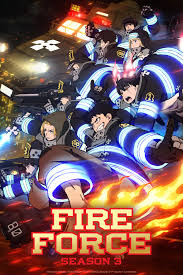
Without much fanfare or hype, stalwart anime Fire Force is ending its brief but enjoyable run with the airing of its third and final season. The highly bingeable series is wrapping up, making Fire Force a low commitment option for those who can tolerate its recurring fan-service humor and the vaguely familiar plotting. The show is a combination of likeable characters, disturbing themes, and relentless sarcasm and humor. That combination makes it uniquely enjoyable although the tropes and characterizations will feel familiar for fans of Naruto, Black Clover, or My Hero Academia.
Fire Force is set in a future, post-apocalyptic Earth, where small pockets of humanity have rebuilt themselves into modern communities after a great fire cataclysm destroyed the world. In the wake of the devastation, a religion arises which worships the fire god Sol and eventually a formal church is established to organize and lead society. Hundreds of years after the devastation, people have resumed normalcy except for fires that break out when a random individual spontaneously combusts. The Fire Force is a group of fire specialists divided into distinct squads and trained to respond to the devastation caused by a burning, but still sentient, human. The series follows a fire powered teen, Shinra who joins the rogue Squad 8 of the Fire Force. Shinra was orphaned when his mother and brother were killed in a mysterious fire. After surviving, he develops an involuntary, creepy, sharp-toothed grin and he now has fire-power through his feet all of which made him an outcast. He is called a devil and is frequently accused of killing his family. Shinra joins Squad 8 after finishing the Fire Force academy and is joined by his fellow classmate Arthur who also has superpowers. The series focuses on Shinra’s adaption to his quirky, new-found family at the 8th squadron and his determination to become a hero and to unravel the mystery of human combustion and the loss of his family. The show is filled with twists, betrayals, and lots of commentary on politics, science, religion, and faith.
The best thing about Fire Force is the fast-paced, filler-free pacing. Almost every episode is exciting, suspenseful, and emotionally engaging. The worst thing about Fire Force is the recurring fan-service objectification of women. In particular, there is a recurring gag about one of the antagonist-turned-ally characters who has a curse that makes her clothes fall off during battles as a way to distract opponents. It’s intended as comic relief for the stressful content of the show, but the show already has plenty of solid humor in other contexts. Shinra’s rival, super-powered Arthur is a teen who imagines himself to be a fictional knight. His delusions drive the power of a plasma sword he fights with. As such, the other characters are forced to humor his delusions in order to encourage his super-human strength in times of crisis. Arthur has an unexpected backstory that explains his delusions and his character is a variation of Zenitsu in Demon Slayer who fights best when he’s in a dream state. Squad 8 includes the unpowered but super-strong leader Obi, fire powered Hinawa, mega strong pyrotechnic Maki, the squad’s nun Iris, and unpowered but super smart engineer Vulcan and scientist Licht.
The vibe of Fire Force is similar to Black Clover with the competitive but ultimately supportive squads who gradually realize they are facing a larger organizational threat from a group of villains (the White-Clad) bent on destroying the world. The White-Clad villains in Fire Force are similar to the Eye of the Midnight Sun in Black Clover or the Akatsuki in Naruto. Fire Force also has the rivalry of Shinra and Arthur, which mimics Asta and Yuno in Black Clover and Naruto and Sasuke in Naruto. And all three series build on the trope of the outcast hero, political secrets, and morally gray areas.
Despite the retreading of these popular story elements, Fire Force distinguishes itself with stronger pacing over the course of the series. It also deals with thoughtful elements of religion and faith as well as compassion and cruelty. When an individual spontaneously combusts, they continue to live and suffer (sort of like a sentient zombie) even as their body burns. Each call the squad receives involves the torturous death of a loved one who remains conscious while burning alive. The squad has a nun in firefighter gear whose job is to pray for the soul’s release while the fire force team kills the person. Shinra’s home, the Tokyo Empire, is powered by a powerful generator known as Amaterasu. Over the course of the series the characters discover a disturbing secret about how the generator is powered. And Shinra learns some difficult truths about what happened during the fire that destroyed his family.
All of this intensity is heavily woven with ongoing moments of levity, surprising elements of diversity, character backstories that range from mundane to horrific, and plenty of introspection on what it means to be a hero in a place built on fire. The idyllic scenes of families at play or at work in the city mask the fact that much of the world is gone and the post-apocalyptic survivors must trust their leadership and the generator to maintain their sense of normalcy. As a result, the series asks difficult questions about faith, betrayal, and sacrifice. And, it does it in a compact three season run, which makes this under-loved anime a humorous but thoughtful adventure that won’t burn you out.
--
The Math
Nerd Coefficient: 7/10
Highlights:
POSTED BY: Ann Michelle Harris – Multitasking, fiction writing Trekkie currently dreaming of her next beach vacation.
--
The Math
Nerd Coefficient: 7/10
Highlights:
- A quirky mix of humor and tragedy
- Annoying fan service and revisited tropes
- Well-paced, filler free adventure
POSTED BY: Ann Michelle Harris – Multitasking, fiction writing Trekkie currently dreaming of her next beach vacation.

