Thursday, August 18, 2016

Thursday Morning Superhero

I feel that normalcy has returned to my life as my calendar is free and my kids are returning to school.  While my pull list is a short one this week, all three books are stellar and I remain a happy camper.


Pick of the Week:
Superf*ckers Forever #1 - Oh how I adore James Kochalka.  American Elf was an amazing experience and Johnny Boo has been a staple in my kids introduction to comics.  I've read some Superf*ckers back in the day and am delighted to see the classic humor unfold again in a new miniseries.  I giggled at the immature and ridiculous humor in this book and look forward to reading more.  The premise of the story is that Jack has lost his vagina and is concerned because he doesn't have a place to store his wieners.  This sets up the storyline for the remaining four issues in this miniseries from IDW.  You read that correctly.  This is definitely not for everyone, but for those that enjoy absurd and slightly rude humor than this will be right up your alley. This was such a pleasant surprise to see and I am hoping that more Johnny Boo is on the horizon as well.

The Rest:
Batman: Rebirth #5 - The showdown between Batman and Gotham did not disappoint.  The highlight was Alfred donning the cowl as Batman was a bit late to the party, but the fireworks occurred when the Justice League had to intervene.  It seems that Gotham and Gotham girl bought their powers on the black market and have a variety of powers that make them incredibly tough to stop.  The scenes where robin is trying to get information from Gotham Girl while Gotham is creating difficulties for the Justice league is a great juxtaposition and works well in this book.  Solid first arc for the new creative team and I look forward to seeing what is next.


Tales from the Darkside #3 - This series continues its bizarre path through the mind of Brian Newman and his evil twin, Big Winner.  Through a series of seizures, Brian seems to impact those around him and is attempting a surgery that will remove Big Winner from his brain.  This surgery involves a sort of chip implant and things don't seem to be going well.  I will admit that I don't fully understand everything that is happening in this series, but it reads like a Joe Hill and Gabriel Rodriguez series and I feel confident all will be revealed when this series is wrapped up in issue #4.  It feels comfortable to return to a horror series from these two.


POSTED BY MIKE N. aka Victor Domashev -- comic guy, proudly raising nerdy kids, and Nerds of a Feather contributor since 2012. 

Wednesday, August 17, 2016

Microreview [video game]: Batman - The Telltale Series Episode 1: Realm of Shadows by Telltale Games

The Batman Cometh


Reviewer's note: Hello! Welcome to the first part in our five-part series reviewing Batman - The Telltale Series, an episodic adventure game. This is the first episode and this review will be completely spoiler-free! However, subsequent episodes will necessitate some discussion of what came before, so they will be spoiler-free for the episode being reviewed but not necessarily for the previous episodes in the series. On with the review!

I love Batman. I've been a Batman fan since I was a kid, and a lot of it was propelled by Tim Burton's 1989 Batman movie. Ever since then, anything Batman has piqued my interest. There has been plenty of ups and downs for the Dark Knight, but we've been on a real good streak in the video game world since Batman: Arkham Asylum. Batman - The Telltale Series, though completely different in nature, continues that streak of quality Batman video games.

Batman - The Telltale Series is an episodic adventure game in the same form Telltale Games has been famous for for quite a while. Rather than picking up one of the many interpretations of Batman, such as the movies or Rocksteady Arkham series video games, Batman is a new take on the character. After Batman foils the theft of an encrypted data device from city hall, Bruce Wayne is caught in a political knife fight over his support of Harvey Dent's campaign for mayor. Bruce Wayne and Batman fight on two fronts to uncover who is behind some vicious attacks on the Wayne family legacy and who called for the city hall break-in.

If you've played any recent Telltale adventure games, particularly The Wolf Among Us, you know how this game is going to play. If you haven't, these are cinematic adventure games, where the bulk of your interaction comes through dialog choices. In Batman, you spend most of the game as Bruce Wayne, playing the politics game in Gotham City. Where nearly every other Batman game focuses on punching bad guys, Batman - The Telltale Series takes a refreshing break from the cowl to put some serious metaphorical knives at Bruce's back. There's a point in the early game where I made a choice as Bruce that was supportive of a friend of mine, but looked real bad in the public eye, and the game never let me forget it. It kept coming up, and I could try to explain it away as Bruce, but it wasn't something Batman could punch until it was solved. I liked that it held me to my actions, even if it felt a little overboard, because I made a big decision at a split second. Making you feel like you're in some control over the story is what Telltale Games does best, and Batman is no exception.

Being the first episode in a series, there's a lot of scenes establishing characters. Obviously, Thomas and Martha Wayne (Bruce's murdered parents) are plainly present, but Telltale manages to give some characters an alternative look. They're instantly familiar in many ways, but different enough to give one subtle reminder: what you think you know about Batman doesn't necessarily apply here. Familiar characters, familiar setting, but this is definitely Telltale's game and doesn't have to strictly adhere to comic book, or movie, or TV show, or video game Batman universes. Again, I love this because it's keeping me on my toes.

I've got two minor complaints about this first episode. The first is that the action is pretty fast (for an adventure game), and the button prompts aren't 100% clear when it came to directional movement. I learned quick that a prompt that looked like a clockwise half-circle moving right to left really just meant push left. It's a minor complaint, but I came off as a very rookie or drunken Batman in my first fight because I was trying to do too much to match the prompt when the actual input needed was much simpler. It's something I caught on to quickly, but it was an annoyance.

The other minor complaint is that the game didn't run great. I'm not running on brand new hardware, but my PC runs much more graphically intense games than this with fewer hitches. It's good looking, but it's still the simple mostly flat style many Telltale games have. I can't really explain why it didn't run better, and the hiccups were largely between scenes, but it was noticeable. Perhaps the console versions run better.

Batman - The Telltale Series Episode 1: Realm of Shadows is a mouthful, but it's easy to recommend to Batman fans and Telltale adventure game fans. Even if you don't fit within those tastes, the political and class machinations are already heating up in this first episode. It's a strong start and I'm very excited to see what comes next. This is what I expected from Telltale; a quality game taking characters I know and giving me an experience that doesn't feel like it's completely retreading well-worn territory.

The Math

Baseline Assessment: 7/10

Bonuses: +1 recognizable Batman characters now in a different universe from what we've seen before.

Penalties: -1 technical performance leaves something to be desired

Nerd Coefficient: 7/10 (an enjoyable experience, but not without its flaws)

***

POSTED BY: brian, sci-fi/fantasy/video game dork and contributor since 2014

Reference: Telltale Games. Batman - The Telltale Series Episode 1: Realm of Shadow [Telltale Games, 2016]

Snyderisms

Do you remember Iron Man? The first one? When we were all "Robert Downey Jr is still alive? Will he stay sober on set? Yeah, right, a good Marvel movie lololol." That turned out okay, didn't it?

Well, the DC Cinematic Universe, which had the MCU template to go off of, is off to something of less than a stellar start. Three entries in, and DC fanboys are trying to shut down Rotten Tomatoes (which is just an aggregator, you idiots) because all three are getting universally low reviews. There are certainly manifold reasons for this, but I want to talk about the biggest one (in my semi-humble opinion). It has to do with Zack Snyder, and while I fully realize that a ton of blame can and should be placed at WB and DC's door, I want to focus on where Snyder fails in basically all his films, because it has essentially crippled the DCU.

Simply put, Zack Snyder does not understand subtext. What he does do is make a very pretty movie that looks exactly like his source material brought to life.

I was equal parts excited and apprehensive, as I'm sure many were, about an adaptation of Watchmen. Which, as the excellent Honest Trailer points out, is an incredibly divisive film. It is, in my opinion, a beautiful film, with some excellent touches, such as the soundtrack. It lifts scenes directly from the comic. In fact, Snyder carried a copy of Watchmen with him at all times on set. This gave me loads of confidence in what he was doing. So why is it not beloved, when it adapted one of the best stories of all time?

Because Zack Snyder does not understand subtext. Watchmen is a deep, complex story that is about a lot more than just superheroes, while also being completely satirical. None of that made it into the film. It was pretty, sure, and was a decent action romp- but that's not going to cut it when you're adapting the best graphic novel of all time.

300 is garbage, so we're not even going to talk about that. I don't think I could have been more disappointed with a movie than I was with Sucker Punch- the previews looked amazing, the action, the depth of... the... story... was like jumping off a high dive into a kiddie pool. It had no depth whatsoever. Nothing about trauma, about rape culture, any actual exploration of the human condition. Even the actual action in the movie didn't live up to the glory the trailer presented.

Then comes the ostensible beginning of the DCU, Man of Steel, which was certainly better than Superman Returns by virtue of not being completely boring. Except...

I don't even like Superman all that much, but woof. I though he stood for 'truth, justice, and the American way', although, in fairness, the way America is these days, murder *is* the American way. But Supes offing his nemesis is not exactly what he's known for. There might be in-universe reasons for it (Zod *was* about to torch a family), but it's still out there. Add in the fact that Batman- whose express edict is to not kill- murders with abandon.

Which, hey, I don't care. I'm with Punisher, if we scoot over to the MCU for a bit. Daredevil and Batman are half-measures when it comes to stopping these baddies. Them dying isn't such a bad thing- in my opinion.

But it's not my opinion that counts. The idea behind Batman and Superman is that they represent the best in humanity, and no one has accused me of being that. Batman and Superman are supposed to have the ability to be forces for good without taking lives.

This is what made Nolan's Batman trilogy so good (well, 2/3rds good. DKR sucked) - he truly understood the character, not only of Batman, but also of Gordon, Dent and the Joker, and The Dark Knight was an exploration of that- not just a bunch of action set pieces and big moments. There is tremendous depth to Ledger's Joker, and this slow momentum building to the big moments. Him leaning out the window of the captured police cruiser, his plan in motion, having been executed to perfection and followed by the unwitting pawns of Batman and the police force, epitomizes the character.

Except, it doesn't, because he is gleefully mad and glad to let Batman kill him, taunting him to 'hit me', just to get Batman to break his code. That is the Joker- and that is Batman. The Snyder-verse Batman has no such conflict. Killing the Joker would be a matter of course, since he has no problem killing criminals. One of the central conflicts of the character just isn't there. It's what makes Moore's admittedly flawed Killing Joke so powerful- Batman finally crosses the line, so does the Joker win? That's a question, for as much as I enjoy Affleck's Batman and Leto's Joker, that will never- can never- be addressed in this universe, simply because it is not a question.

In the end, what is wrong with these films and Snyder's directing and influence is not the dour tone, or even the fact that the so-called Justice League is fine killing people out of hand, it is that there is nothing beneath, no depth to them, their motivations or their conflicts. A battle between these two powerful beings is undone by a name. It's simplistic and boring. The films leap from big moment to big moment, with nothing between with lower stakes- when every moment is big, none of them are.

This causes a ripple effect even to the films he has no hand in. Look at Suicide Squad. I think, like BvS, the movie we got in theaters is not the movie we were supposed to see. There are painfully obvious reshoots, done to add humor because BvS was too dark. Guess what, WB? Suicide Squad should have been dark. And guess who the executive producer of Suicide Squad was? YUP. So Snyder reacts to the perception that BvS wasn't light enough, and assumes that making Suicide Squad funnier will be the solution - not actually exploring what makes bad guys bad, or giving them anything, like, say, character development.

DC is stumbling out of the gate, hard, and it's not because the movies aren't funny, or pretty, or lack action. It's because they lack depth.

-DESR


Tuesday, August 16, 2016

Microreview [book]: Harry Potter and the Cursed Child by J. K. Rowling, John Tiffany, & Jack Thorne

a.k.a. Harry Potter and the Cursed Child Parts 1 & 2, Special Rehearsal Edition Script

a.k.a. Harry Potter and the Plot of Convenience

a.k.a. Harry Potter and His Lightning Shaped Plot Device


This review contains spoilers for Harry Potter and the Cursed Child, but if you haven’t read it yet don’t worry, you’re not missing much.

It is no secret that I am not a huge fan of what Rowling has been doing with the Potterverse, but after some soul searching, I decided to approach Harry Potter and the Cursed Child with an open mind and an open heart. Because, like nearly every other Harry Potter fan out there, I would love nothing more than another Harry Potter book. But as I’m sure you know by now, Cursed Child is not actually a book – it’s a script (to a two-part play that the vast majority of Harry Potter fans will never get to see) – and it was not actually written by J.K. Rowling, despite her name being plastered across the cover.

Surprisingly, the fact that Cursed Child is a script is likely its best feature. Good dialogue is very hard to write and Jack Thorne does a great job of advancing the plot solely through dialogue with small snippets of set direction throughout. Although, I found the overuse of the word ‘discombobulated’ off-putting, but perhaps discombobulated is a British-ism that this American isn't used to (English Scribbler?)... personally, I’d have gone with disoriented.

Harry Potter and the Cursed Child begins right where Deathly Hallows left off, with the (god awful) epilogue and the children of the original series characters heading off to Hogwarts. And here is where begins an entire play of nothing but cheap plot devices. For example, the children are all overly familiar with and fond of reiterating the events of the series proper, which is an unnecessary stating of the obvious, thank you very much. It begins with Rose Granger-Weasley telling Albus Severus Potter (ugh) that it is VERY important who you sit with on your first Hogwarts Express ride because that is how their parents all met. The two of them end up sitting with Scorpius Malfoy, Draco’s son, and in an obvious reversal of Sorcerer’s Stone, Albus decides to be friends with Scorpius (who is the opposite of his father at that age) and Rose un-approvingly leaves the compartment. As you might remember from the epilogue, prior to boarding the train Albus expresses concern that he’ll be sorted into Slytherin, and he is, which of course makes him a terrible human being and everyone hates him for it. Not really, but it is the source of much resentment throughout the story, as Albus spends most of it ala Harry in OOTP minus the moldy Voldy connection to excuse it all.

The story then jumps ahead to the students’ fifth year where the major plotline is an attempt to go back in time to save the life of Cedric Diggory, of all people. This is orchestrated by Voldemort’s daughter and yes, you read that right. Apparently Voldemort got it on with Belletrix in the back of his tour bus nine months before the Battle of Hogwarts. Anyway, the product of the Voldastrange ship apparently needs Albus and Scorpius to fulfil one of the most lame prophecies ever:

When spares are spared, when time is turned, when unseen children murder their fathers: then will the Dark Lord return

I mean, now we’re not even trying anymore.

Anyway the boys get their hands on the supposed last time-turner in existence, which Hermione hides in her book shelf using a series of crappy puzzles. Their first attempt to save Cedric results in an altered timeline where Ron and Hermione do not get together causing Hermione to become a shrew, ya know, as all women do when they don’t find a man. Wait a minute Cursed Child, I have something here for you…
Cursed Child is put in time out (see here for context)

The second attempt to save Cedric involves Albus and Scorpius blowing him up like a balloon which apparently humiliates Cedric to the point that he drops out of the Tri-Wizard Tournament and becomes Death Eater extraordinaire, resulting in an altered timeline where Voldemort reigns supreme.

‘But you mentioned Hermione!’ I can hear you saying. ‘What about Harry, Hermione, and Ron?’ Well, don’t tighten your nostalgia strings yet. The trio are now in their 40s, and despite having been married for like what, 20 years, Harry and Ginny still have zero chemistry. Ginny is sports editor at the Daily Prophet, Harry is the Head of Magical Law Enforcement (and not an Auror), Hermione is Minister of Magic of course, though she doesn’t really get much respect, and Ron is such a joke that he literally runs the joke shop but for some reason is never there and is always at the Ministry of Magic to conveniently be involved in all important conversations. Very rarely do any of these characters seem like their old selves which is either a lack of understanding or execution or both by the author.

When Albus disappears Harry’s scar starts hurting again and for some reason shows him exactly where Albus is. Rita Skeeter has published what seems to be The Goblet of Fire, which all of the kids have read front to back so they know exactly what to do and where to go to find Cedric. Dumbledore has a portrait in Harry’s office, because… actually I have no idea why he would have a portrait in the Head of Law Enforcement’s office, and so on with the cheap plot devices.

I could go on, but I won’t. The play is just not very good. The plot sucks and is not at all original. It doesn't take much imagination to give your beloved characters children and have those children basically relive the events of the original characters, and that is pretty much what is going on here. I know there were convenient plot devices in the series proper, but they were enveloped by extraordinary exposition, world building, and character development. It just doesn’t work here. I’m sure the production is very beautiful and well-acted, but I, like you, will probably never get to see it.

We can, however, thank Harry Potter and the Cursed Child for two excellent Potterverse revelations: 1) the Hogwarts Express trolley witch is a knife handed warden ninja warrior, and 2) even wizards have to worry about floo-ing while intoxicated.

Oh, and by the way, I have no idea who the ‘cursed child’ is supposed to be – Delphi (Voldy’s kid)? Albus? Scorpius? Theodore? 

After reading this it has become clear that we really don't need any more Harry Potter books. I agree that his story is over. But that doesn't mean we can't have more books in the Potterverse. In particular, I think Fantastic Beasts, with a well done (read: put some effort into it) American wizarding world could make a fantastic (pun not intended) series of novels.  Fanfictioners unite!

The Math

Baseline Assessment: 8/10 because it starts with Harry Potter and the..

Bonuses: +1 for being surprisingly easy to read for a script

Penalties: -2 for making Hermione miserable without a husband, -1 for Harry’s scar serving as a missing child beacon, -1 for completely devaluing Ron to the point where he serves no purpose except poor comic relief, -1 for not even trying to create unique new characters or plotlines, -1 for dropping the ball with the only potentially good new character of Scorpius who is mostly just lame jokes and self-proclaimed geekiness which is defined only by reading books, -2 for using the names Harry Potter and JK Rowling to promote this as the eighth Harry Potter story but producing nothing but lazy drivel

Nerd Coefficient: 1/10 - especially bad considering what it claims to be and for playing on fan emotions to make money because you know that’s why they published this crap.

-------
POSTED BY: Tia   forever Harry Potter fan and Nerds of a Feather contributor since 2014

Reference: Thorne, Jack. Harry Potter and the Cursed Child [Scholastic, 2016]

Monday, August 15, 2016

Microreview [book]: The Quality of Silence by Rosamund Lupton

Chilling or thrilling?
                                              
Rosamund Lupton has written two very well regarded mystery-suspense novels, including the slightly supernaturally-tinged and utterly absorbing Afterwards, and has now written a third—The Quality of Silence.  This novel takes place in the Arctic Circle and so automatically caught my interest (both extreme cold environments and submarines in literature/film are impossible for me to resist). But is the book worthy of its setting?

For the most part, yes. Lupton starts with an intriguing premise: an astrophysicist, Yasmin, heads to Alaska to visit her husband. Once there, she is told that he has died in a catastrophic accident. Yasmin refuses to believe he is dead and so she ventures into the Alaskan wilderness to find him. This premise alone is enough to build a suspenseful tale around, but what makes the story shine is the character of Ruby, Yasmin’s ten-year old daughter, who accompanies her mother into this treacherous territory.

Ruby, who has been deaf since birth, provides one of the voices of the novel—which is split between Ruby’s first-person narrator and a close third person narrator which lets the reader into Yasmin (and other characters’) thoughts. Ruby is obsessed with words: the power of them and the way she must live without the sound of them. Her sections read the best: she’s a smart and charming voice to follow. Some readers may find her voice too intelligent or precocious, but my guess is that those are readers who have never spent time with a ten-year old.

Lupton also succeeds in her setting through her descriptive work. I truly felt the cold and saw the darkness of this treacherous landscape. Where she is less successful is in the mystery itself. I was able to guess the twists and turns long before they were revealed. And while I don’t believe that the most important part of a mystery novel is actually the mystery part, I still do want to feel like an author is surprising me in some way. The reveals here are exactly what someone might expect, and are ones we’ve seen (perhaps under slightly different guises) in many a political thriller. The villain also, ultimately, is just not well written, fitting too easily into what a reader would expect. There is also some repetitiveness towards the end of the book that could easily have been edited out.

Ultimately, for mystery fans there is nothing new under the snow here. For fans of interesting narrators and a thoughtful examination of what we can hear when we pay attention with more than just our ears, though, this is a solid and often thrilling read.

The Math

Baseline Assessment: 6/10

Bonuses: +1 for some lovely descriptions of words themselves, +1 for snowy desolate landscapes
Penalties: -1 for expected twists, -1 for a too easy denouement

Nerd Coefficient: 7/10 “
an enjoyable experience, but not without its flaws"

Reference: Lutpon, Rosamund. The Quality of Silence [Little Brown, 2015]
***

POSTED BY: Chloe, speculative fiction fan in all forms, monster theorist, and Nerds of a Feather blogger since 2016.

Friday, August 12, 2016

THE MONTHLY ROUND - A Taster's Guide to Speculative Short Fiction, 07/2016

To me July is when summer turns brutal. The days start getting shorter even as they get hotter. The rain comes less frequently and when it arrives it's normally with thunder and lightning, storm and stress. For SFF, July normally represents something of a lull for me as publications close to submissions and get ready for the autumn.

This July, though, has also seen a surge in the smaller publications putting out amazing stories. Of the six stories in the Tasting Flight, a full four come from publications that aren't considered pro. It's a month of surprises, of transformations, of yearning for freedom. Like with the weather, July is for oppressive settings and limited options. It's for longing for the spring again, and dreading the winter.

So welcome, weary travelers on the SFF highways, and let me pour you some recommendations to take the edge off. I've got science fiction stories that imagine worlds both bleak and beautiful, fantasy tales that reveal the hidden magic of our own world or the distant dreams of a different universe. There's something for everyone, I hope, so sit back, relax, and tell me what sounds good.

Cheers!

Tasting Flight - July 2016 

"The Sound a Raven Makes" by Mathew Scaletta (GigaNotoSaurus)

What drink encapsulates not just a world rolling downhill thanks to climate change but the proper respect and horror for what has got to be one of the best uses of Sasquatches in SFF? Well, to me "The Sound a Raven Makes" by Mathew Scaletta is all Bacon Porter, smoky and dark and full of some wild and untamed magic that isn't exactly the most delicious thing in the world but which is certainly memorable. The story focuses on Ash, an aptly-named young man in a world that is burning, where the extremely wealthy hunt Sasquatches on an Alaskan island while Ash helps to render the meat into jerky. The story shows the magic of the natural world and way that it is commodified and exploited, the way that even those who care about it are made tools of its destruction. Ash is young and gay and only got the job because he's related to the owner of the jerky house. And supporting his partner, JB, means dealing with the harassment and the bullshit, means dealing with always smelling of dead Sasquatch. I love the way the story complicates family and privilege, how Ash must weigh the harm he causes to the people he protects to the fact that there isn't much he can do in the face of such loss and damage. The atmosphere of the story is oppressive and shows a yearning hunger for some escape. For some hope. For, if nothing else, a fire to light and clear away the last vestiges of the people and the institutions that have caused so much pain and destruction. It's about power and resistance in the face of death, about fear and about desolation. And for me it's got the taste of a bacon porter, meaty and deep and really rather sad. 

Art by Ben Baldwin
"Postcards from Natalie" by Carrie Laben (The Dark #14)

Some stories speak to me of travel and distance, of adventure and resistance and bitterness. And when they do, like with Carrie Laben's "Postcards from Natalie," I am reminded of a West Coast IPA, full of pale skies and cool breezes and a touch of bitterness that sinks and rises like a wave, or a soul. This story is told by Mandy, who has been left behind by her sister, Nat, thanks to an incredibly unpleasant home life. Nat packs up with her boyfriend and hits the road, sending postcards when she can. And Nat lives for those postcards, for the voice of her sister. The story has this sneaking feel to it, the situation almost normal for all the pain and loss it details. And that's the beauty of it, for me, that this is a story that isn't really unfamiliar. That Nat's story is one that happens and happens often, that reveals this gaping hole in the world, this place beneath what we can see and know. A place of nameless people. And the story makes cutting use of that through Mandy, by showing how she gets left behind, how everyone seems to leave her. And by showing what that means. The postcards are at the same time sentimental and sinister, the story touching and incredibly dark. And for all that darkness the story still manages to hold onto hope, to believe that things must change and that things will change. That nothing stays forgotten. And it gives Mandy, despite her powerlessness in the face of the injustice of the world, a chance to do something, to resist and rebel and take a stand with her sister. And is that sense of boldness and travel and hope that bring to mind a West Coast IPA, bitter but full of life. 

Art by Slimm Fabert
"Her Sacred Spirit Soars" by S. Qiouyi Lu (Strange Horizons)

There are times when stories capture what it means to be between—between cultures; between health and sickness, healing and cured; between human and bird. And "Her Sacred Spirit Soars" by S. Qiouyi Lu, to me, embodies that state of being between, and as such tastes like a Citrus IPA, bright and sweet with a zest for life and an undercurrent of stubborn resolve and lasting hurt. In the story, Meisun in a young woman participating in a study to help heal her after a traumatic event left her in a coma. The study, however, uses mythical birds to try and wake patients up, and the side effect is that part of the bird is imprinted on the human, so that they have to relearn their life, so that they have the memories of a bird taken from its how and separated from its partner, from the other half of itself. And I love how the story looks not just at love but also dependence and assistance and health. The two halves of the one bird depend on each other, cannot live without the other, and yet Meisun lives with only one inside her, knowing that her other half is gone. Only when she comes to befriend and then start to care for another patient does she being to feel what it means to depend on someone else, and in that bond she both gives and receives strength, so that through the budding relationship both people are more complete, more able to stand the stress and the pain of living. These are characters who have lost and who struggle with feelings they cannot control, with the stigma of it and the burden of it, who begin to find in each other a way forward. One that is full of grace and care and hope and longing. One that cannot undo the harm done but that can give the characters wings to fly again. And like a Citrus IPA the story takes two different things, human and bird, and two different people, Meisun and Yaulan, and finds the place where they meet, the place where they make each other better. 

"The Night Bazaar for Women Becoming Reptiles" by Rachael K. Jones (Beneath Ceaseless Skies #203)

For me, beer doesn't quite capture the sense of longing and need and transformation that I find in some stories. Which is why Rachael K. Jones' "The Night Bazaar for Women Becoming Reptiles" seems more like a wine to me, a Merlot, red and with a slight grittiness from the tannins but alive with a semi-sweet flavor, one reaching toward the dryness of the desert and all its possibilities. The story unfolds in Oasis, a city in a desert, a prison because no human who walks in can really walk out again. And Hester is a woman who wants to escape, who wants to be one of the women who eats the egg of a reptile and transforms, receives a body that can survive the sun and sand. Instead the magic doesn't seem to work for her, and she is stuck between day and night, neither giving her relief, neither actually allowing her to express her true self, though she's supposed to be able to. The city is a cage and the bars are the people she wants to care more about, her lovers and her family. It's a story that captures the stifling oppression of being different, of not finding fulfillment or happiness in the prescribed places of society, the roles she's expected to take. The ways in which the story complicates her desires and her situation are deep and fascinating. Everyone in the story is hiding pieces of themselves, so that in day or night they are wearing different masks but masks all the same, covering over the hurt and the yearning to escape. The world is vividly painted and vividly bleak, the transformation into a reptile compelling and rather disturbing. And like a Merlot the story bursts with flavors and color, the sweetness of desire and the lingering taste of sand and heat. 

Art by Likhain
"The Automatic Prime Ministers" by Kate Heartfield (Lackington's #10)

There is something to be said about a story that both rails against the injustices of a populist voting system and at the same time believes in the power of people. And as such "The Automatic Prime Ministers" by Kate Heartfield tastes like a Lager, what I would consider the drink of the common person, fresh and full of light, a cheer spreading from a dozen lips to a thousand, to a million, and on and on. And the story takes aim at the common person, showing a world with a political system that is based on computer analysis and prediction. That weighs what the most people want and seeks by that to cut out corruption and inequality. And yet in doing so the algorithms also fail. Fail because they are limited to a certain country. To a certain region. To thinking of the universe as us versus them. The story focuses on one world leader trying to steer not only her country but other nations away from following the algorithms, even though she was one of those who fought to put them in place. Because aliens showed up. Asking for help. And being hunted. And the increase in scope has changed the rules of the game. The algorithms assess risk and try to predict what's best, but only for the constituents of the nation. What happens to those outside? What happens to the most vulnerable when they are deemed a threat? The story asks some very difficult questions and imagines people who believe both in the power of democracy but also in the power to work outside of it, to open borders and to think more than nationally, even more than globally. And I love the politics of it and the humanness of it, caught between trying to give away our responsibility for death and tragedies and standing up to fight for what's right. Like a Lager it has a heady depth, one that you almost don't realize you're sinking into until the room is tilting and the world seems like it's full of possibilities. 

Art by Sandro Castelli
"Painted Grassy Mire" by Nicasio Andres Reed (Shimmer #32)

Stories have the power to take readers to a place—a time, a location, a culture, a perspective. And Nicasio Andres Reed's "Painted Grassy Mire" reveals a Louisiana that lives and breathes and tastes, I imagine, a bit like a Red Ale, sweet and thick and tinged just a bit like the shade of blood. Winnie takes center stage in the story, a young woman who might seem a bit out of place in a world dominated by men and gators and heat and sweat. And yet this is Winnie's world, where she was born, and in that it is a part of her as she is a part of it. The story looks at origin and inheritance, Winnie caught between the intentions of her father who sees her more as property than as person, and the very world around her, which seems to have its own ideas. When she begins to notice the gators around her village acting strangely, it's the start of an awakening. In some ways the story speaks to me of the harshness of place, this village of Filipino-Americans tucked away in Louisiana, almost a world to themselves. But I feel it's also about the respect for it, the willingness to become of a place, to give yourself to and let it change you. It's something that's special about Winnie, who is more of the swamp, of the gators. If it's a story of transformations then it's also a story about immigration and about generations, about how children change, about how sometimes parents don't change enough. And it's about trying to find a place to be, a place to belong, a place to proud and strong and beautiful. Plus the story makes me want to be friends with alligators, which is not something I ever thought would be possible. Like a Red Ale the story is sweet but also tinged with the red of violence and upheaval and struggle, a toothy grin in the face of the harshness of the world.

Shots:

"Love Out of Season" by Caroline M. Yoachim (Fantastic Stories of the Imagination #235)

Examining the space between people, the rifts that cannot be closed, this story tastes to me like a Guilty Smile, a mix of two and a half parts rum, 1 part brandy, triple sec, and lemon juice, and few drops of orange bitters. The story shows a narrator in a relationship with…well, a time traveler, I guess, a woman who has gone back to months before, who has become, essentially, only a memory. The narrator remembers arguments that she never had, remembers living with her partner, Sierra, but there's this distance between them, of time and of affection and of proximity. Sierra is consumed by her work, by her drive to unlock time, and in pursuing that has left a vital part of her relationship with the narrator suffer. Without the physical link between them, with only the voice of the past, the main character drifts, meets someone else, and… I love the way the story draws the complexity of this situation, never giving anyone any easy answer. The narrator argues with Sierra in the past, remembers the words they say but never has a chance to actually talk with her, to actually hear or be heard. They are literally living in different times and the way the story handles their feelings, the guilt and the longing and the hurt of it all, is incredibly done. Ultimately, it's about how some rifts cannot be closed or bridged, that some trips are one way that leave no one satisfied but cannot be reversed. Like a Guilty Smile, the story is a strong mix of elements that culminate in something bright and hopeful and very strong. 

Art by Wendy Xu
"War Profiteering" by M. Darusha Wehm (Mothership Zeta #4)

Full of the horrors of war and conflict glossed over by the slick styling of advertisement, this story is a Dirty Bomb, a mix of one part absinthe to three parts energy drink. It's a story framed as an ad for a device that can clean food of nanoparticles. Which on the surface seems pretty straight forward, for all that it builds a rather grim picture of a future where these particles are such a threat that the device is necessary. But as the ad continues in true full-page-spread fashion, the reality of the situation begins to sink in even more. And as the footnotes reveal key bits of information hidden in the fine print, the full scope of what is happening is revealed. And the story manages a nice mix of comedy and commentary, drawing a point on the human capacity to draw money out of blood. This is about conflict and about hiding loss of life and corruption and injustice in the footnotes, out of sight and largely out of mind. It's about the comfort that people have now with advertising, with capitalism, and how frightened people can be when there is something that strips that away, something that doesn't care for profit. The story plays with the roll that advertising has across conflicts, how something can be marketing to one group as a weapon and to someone else as a household appliance. The story manages to be funny, frightening, and spot on with its depiction of advertising in the age of sentient nanobots. And like a Dirty Bomb it's sweet but also strong enough to leave your head spinning from the implications. 

"Old Customs" by Rajiv Moté (Unlikely Story #12.5)

This story, told backwards in time as the layers of custom give way to history surrounding a holiday, seems to me like a Wicked Party, a layering of equal parts bourbon, Irish cream, and grenadine. The story starts in the present, or near enough, at a celebration of paint and sticks, one that brings in tourism, that seems to represent some part of cultural identity. The story of the celebration given by a sort of tour guide describes love and courtship, play and mock battle. But like the Disney versions of older fairy tales, this modern narrative only goes so deep. Peeling back the layers shows a history that's much different than the one described, one with elements of that later holiday but much, much darker implications. And I love how the story shows how history gets lost, how it gets appropriated and erased. How even revolutions and bloody justice can eventually become something completely divorced from its origins. And yet even then it shows how it tends to fade in part because that original meaning, that original necessity, fades as well. That as the system improves and the violence becomes less necessary to promote progress what remains is the trappings of violence, is the metaphor more than the literal act. And that as time passes even the metaphor is muddied and what people cling to is the pageantry and the ceremony, even when they don't even know why. Because it brings them together. Because it celebrates where they've been and where they come from. It's a story about holidays and the power of them, and the dark origins behind them. And so to me it's a Wicked Party, light on top but with a darkness buried below.

--

POSTED BY: Charles, avid reader, reviewer, and sometimes writer of speculative fiction. Contributor to Nerds of a Feather since 2014.

Thursday, August 11, 2016

Thursday Morning Superhero

It is official.  The convention season has caught up with me and I am not sure how much longer I can continue to immerse myself in my fandom.  I arrived home today from a road trip that brought me to Gen Con, for three days (I missed Sunday) of gaming bliss.  While this served as a distraction from my comic books, despite driving over 30 hours on this trip, I am bringing you an abbreviated recap of this week's comics.


Pick of the Week:
Old Man Logan #10 - When I learned that Jeff Lemire was penning this series, I didn't know what to think.  The original Old Man Logan is a classic and one of my favorite Wolverine stories, yet Lemire has managed to put his own spin on the series and it has been delightful.  Wolverine, still struggling to save his future family, is up against his greatest foe yet, General Sohei of the Silent Order.  This issue did an amazing job of bringing Logan's past and future together in a way Guy Ritchie would be proud.  The next issue is going to be an epic battle as Wolverine is determined to save his family no matter what the cost.  I love the emotion that Lemire has been able to evoke from Logan.  While he has always been emotional, I don't recall a story that has impacted me in the same way this one has.

The Rest:
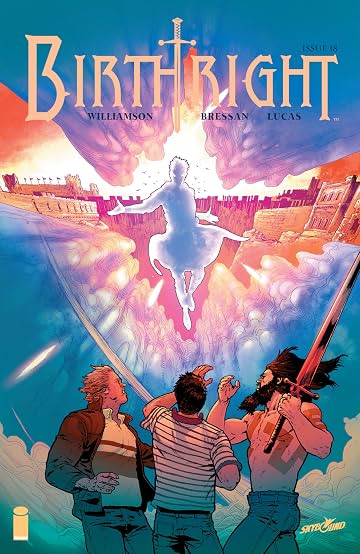
Birthright #18 - I am going to assume that we are nearing the end of this epic tale, as Mikey is getting closer to being free of the Nevermind that has possessed him since he returned to Earth from Terrenos.  This is the moment that readers have been clamoring and kudos for Brennan, Mikey's younger brother, for sticking by his side throughout this entire ordeal.  Despite the fantasy elements, Birthright is all about family and I hope we are closer to bringing this family together properly after it was all taken away in the first issue.  Really excited to see how things pan out in the next couple of issues.


Daredevil #10 - Charles Soule sets up an intriguing new Daredevil arc that has the man without fear and his sidekick, Blindspot, discovering what could be a new serial killer.  Soule has really done a nice job delivering a darker feel to Daredevil as others have before, and it has been working well.  While I'm not sold on Blindspot yet, it adds a nice element to see him mentor him on both the side of the law and the side of being a superhero.  In the issue, Blindspot is given an invitation that leads to a crime scene that includes a painting made entirely of blood, which Daredevil concludes is made up of at least 113 different people's blood, including his own.


Darth Vader #24 - This book has become increasingly frustrating to me as a reader.  There are aspects that I enjoy, and aspects that I really struggle with.  When we last saw Vader he was at the mercy of Cylo, who had a kill switch for his cybernetic suit.  This issue opens, which is supposed to be a demonstration of how powerful Vader is in the Force and how he can overcome this kill switch, but it was an awkward flashback that didn't feel impressive.  Despite this opening, the book concludes with Dr. Aphra showing up at the doorstep of the Emperor.  She is the only link to Vader and his crimes against the Empire, and things could get very interesting quickly.  I hate that I didn't really enjoy this issue and it makes me want to read the next one.


POSTED BY MIKE N. aka Victor Domashev -- comic guy, proudly raising nerdy kids, and Nerds of a Feather contributor since 2012.