Showing posts with label prequels. Show all posts

Friday, September 26, 2025

TV Review: Alien: Earth

What are little (robot) girls made of?

After half a century of increasingly questionable sequels, prequels and crossovers, there aren’t many scares left to extract from the iconic xenomorphs of Alien. But what can still be done with them is probe from new angles the questions the first film raised with regard to the rise of corporatocracy and the ways humans keep finding to predate on each other. In the case of the new TV series Alien: Earth, the most noticeable theme is the futility of subjecting life to a regime of property rights. You don’t truly own that which you can’t control, and you can’t control that which can set its own goals apart from yours. Even less can you be simultaneously a parent and an owner. You either help life grow or make it serve you.

Alien: Earth expands the worldbuilding of its franchise by adding more players to the dystopian corporate ecosystem: alongside Weyland-Yutani, i.e. the devil you know, we meet the newcomer Prodigy Corporation, which specializes in producing AI systems. We follow its immature founder, a narcissistic jerk with the most punchable face in the galaxy, for a handful of days preceding the planned launch of a service that promises to make human beings immortal by transferring their minds to artificial bodies. So far, this technology only works on children, because their minds are malleable enough. However, their new bodies have to be adult-shaped, because robots don’t grow. As you may imagine, this is a very disturbing, even traumatic experience for the first batch of kids recruited as testers.

Meanwhile, a Weyland-Yutani spaceship carrying specimens of xenomorph and other assorted adorables crash-lands on a city that happens to belong to Prodigy, so a legal battle ensues over who has the right to salvage however much is recoverable from the disaster. As it happens, Marcy, one of the kids who were put in those shiny robot bodies, has a brother who works as a first responder in that city, so she pleads with the Prodigy boss to be allowed to lead a rescue mission at the crash site. Her excuse is that it would give them a useful opportunity to test their new bodies in harsh conditions, but what she really wants is to reconnect with her brother, because the mind transfer project is an industry secret and, for all he knows, she’s dead.

Mayhem erupts soon enough, and a pants-coloring fright is had by all. Many throats are cut open, many limbs are impaled, many liters of blood are inadvisably conveyed from people’s interior to the same people’s exterior. Anyway, the Prodigy team manages, at no small cost, to get hold of a cargo of several xenomorph eggs (and other assorted adorables). You already know how the xenomorphs work. Much of the fun of the season lies in learning how each of the rest of the critters go about making breakfast out of any passing human. The breakout star is one spry little fellow that the Xenopedia tells me is called Trypanohyncha ocellus, but I’ve seen more fun people call it Optipus, and I personally prefer to call it Tentoculus. It’s adorable in exactly the wrong ways.

Once the team and their loot return to Prodigy headquarters, it’s time for the real drama. Some of the former kids are suddenly thrown into adult-sized responsibilities, while others are left to deal with adult-sized trauma on their own. It becomes clear that every step this company makes is calculated to feed the ego of the boss, who likes to project a personal image of a chaotic manchild so smart that everyone bores him, but his actual choices reveal the self-destructive reach of his arrogance. A game of mismatched agendas begins between full humans, humans with robotic bodies, and full robots, with the ending episodes adding a hundred more dimensions to the two original Alien films’ commentary on twisted forms of parenthood.

There are thin parts to this plot, but you easily forget about them when you watch the fantastic performances that this show boasts. The actors who have to play child characters in adult bodies prove great at speaking like children, moving like children, emoting like children. And the self-proclaimed genius who put them in that situation is deliciously detestable, ultimately revealed to have been a mistreated child who had to make adult decisions too soon but didn’t learn to break the cycle, and grew up to inflict a more sophisticated form of violence upon his substitute children. And I don’t even mean the obvious violence of separating a mind from its body (the transfer process requires killing the child), but the easier to disguise violence of turning people into instruments.

What with all the drama you can see this story has to offer, the most interesting relationship is the one that develops between the former kid Marcy and the xenomorphs. Her advanced electronic brain figures out how to communicate with them, and they become unexpected prison pals. It certainly helps that her body has no meat for it to munch on, but from her side of the dynamic, what connects them is that they’ve both been forcibly pulled out of the natural stream of life, and now they’re lost and vulnerable among people whose only sincere intention is to use them. Whereas the Alien movies showed us a being that usurps the role of offspring to prey on its lifegiver, the Prodigy Corporation is an impostor parent that preys on its children.

Finding innovative ways to address the core questions that define a franchise is a challenging trick to pull off. Alien: Earth passes stellarly the prequel test that Alien: Romulus failed and that Andor taught the master class on, in that it doesn’t resort to shoehorned references to tickle viewers’ nostalgia buttons. Instead, it creates its own space in the franchise and grows from there.

Nerd Coefficient: 8/10.

POSTED BY: Arturo Serrano, multiclass Trekkie/Whovian/Moonie/Miraculer, accumulating experience points for still more obsessions.

Tuesday, June 3, 2025

Andor and the Reimagining of Star Wars

Star Wars, as a franchise, is almost 50 years old. It remains extraordinarily popular—as much or more than any other cinematic universe. At the same time, nearly all Star Wars properties are divisive in some way.

As I noted in the introduction to our special series Star Wars Subjectivities:

...search around the internet and you'll find many a lengthy opinion piece on which Star Wars properties are good and which ones are bad. Some will be Original Trilogy fanatics like me, others will tell you how secretly great the Prequels are. Others still will opine on how The Last Jedi is really a Top 3 Star Wars film sandwiched between two cinematic commercials for Disney theme park rides.

This is not only true for the films, but also for the various television shows, animated series, video games, books and comics that bear the Star Wars logo. Except Andor. I have yet to meet someone who loves Star Wars but dislikes Andor. Sure, I've met people who found the first season a bit dry and joyless (as I did, at the time), but not one fan who thinks it's bad. Nearly everyone—fans and critics alike—agree that it's good. Many think it's the best Star Wars property ever made.

I'm too heavily invested in the Original Trilogy to go that far—after all, it did change the way we think about movies. But after the masterpiece that is season 2, I think there's a serious case to be made for Andor. I want to delve deeper into why this show is so compelling to so many people—and, in the spirit of Star Wars Subjectivities, why it is so compelling to me.

(Before getting started, I'd like to note that Phoebe has written extensively on the show, including a great review of Andor Season 1, as well as an essay for Star Wars Subjectivities on Andor as community action—and is currently running a weekly review series breaking down each episode (ep 1, ep 2, ep 3, ep 4, ep 5). All are must reads, if you ask me. This will be a complementary take.)

Andor is a grown-up story for grown-ups

Star Wars has always tried to thread the needle between its two core audiences: adults and children. I discovered the Original Trilogy as a boy—and it captivated me the way media only can when you are that age. But the genius of the Original Trilogy is that it continues to captivate as you grow older. However, when George Lucas launched the prequel trilogy in 1999, it was obvious to all of us who were now teenagers or adults that these films were not aimed at us, but at a new generation of children. At Cannes in 2024, Lucas said that people like me were just grumpy because we weren't looking at the films through 10-year old eyes.

It's true that I never saw the prequels through 10-year old eyes, but I have consumed a metric ton of children's media over the years—as an adult—and can say with confidence that The Phantom Menace and Attack of the Clones are not good, not even by the relaxed standards of children's media. As I wrote about The Phantom Menace:

The writing is bad. The acting is bad. The direction is bad. The production is bad. The pacing is bad. The design is bad. The effects are bad. The characters are bad. The plot is bad. The concept is... well... okay, maybe this could have actually been a good movie, in theory, but unfortunately... the execution is, in a word, bad. Like, bad on a very basic, fundamental level.
Or as Vance more succinctly put it in his piece on Attack of the Clones:
Of all the millions of stories that could exist in that galaxy far, far away, Lucas picked the wrong ones to tell in these prequels.

Nearly everyone, including yours truly, agrees that Revenge of the Sith is a much better film. The story is actually interesting—and highly political, weaving the tragedy of Anakin's turn to the dark side alongside the broader tragedy of the Republic's dissolution and the death of democracy. It has its cringe kid content moments ("Nooooooooo!"), but ultimately Revenge of the Sith aspires to be a serious film for whoever is watching, regardless of age. Like the Original Trilogy, Revenge of the Sith successfully threads the needle between its core audiences.

Most Star Wars content since has attempted the same feat. In the Disney era, this has worked sometimes (e.g. Mandalorian, Ahsoka) but more often not (e.g. Solo, The Book of Boba Fett, Obi-Wan). You could argue that success just boils down to quality, but the fact is that designing content for the broadest possible audience usually leads to bland, mediocre fare that is passable to everyone but not great to anyone.

Perhaps for this reason, Disney has recently grown more and started to develop properties specifically for each audience. I'm focusing on Andor here, but Skeleton Crew is also worth mentioning—it's a true kids' show designed for parents to watch with their little ones. And it's good!

Meanwhile, Andor is a mature show written for adults, a complex political drama set against a dark background, featuring hard-boiled characters who shoot first and don't fight according to Queensbury rules. There are no adorable creatures, no comic relief characters and no Jedi. Instead, there are real people struggling against very real oppression, making tough choices that don't always work out—and which almost always come at a high cost. Yet it is also a moving, sensitive and stirring portrayal of those people and the terrible world they were born into. I'm still astonished that this is a Star Wars story—and that it is almost the exact Star Wars story I've long wanted to see told.

The best Star Wars stories enhance the Original Trilogy; the worst cheapen it

This is something I've been chewing on since we ran Star Wars Subjectivities back in 2023. The Original Trilogy is the keystone for the Star Wars universe. All subsequent works—whether in film, television or other media—are essentially contextualizing those films. More precisely, they try to either (a) help you understand why things happen the way they do in the Original Trilogy; or (b) explore the aftereffects and consequences of what happens in the Original Trilogy. The good stuff adds richness, depth and gratifying exposition to a story with a lot of whitespace, or render something silly, well, less silly—in all cases enhancing the Original Trilogy.

Consider this example: In A New Hope, we learn that rebel spies managed to obtain plans for the Empire's Death Star. When Darth Vader boards the Tantive IV, he is specifically looking for those plans—which Princess Leia gives to the droid R2D2, with instructions to hand them over to the Jedi Master Obi-Wan Kenobi. The plans demonstrate a fundamental weakness in the Death Star's design, which the Rebel Alliance hopes to exploit, thus winning a first major victory in their rebellion against the Empire.

Rogue One tells the story of how those rebel spies obtain the plans and transfer them to the Tantive IVAndor then gives us the backstory for one of its main characters, Cassian Andor. But it doesn't only do that. We get a deep dive into Mon Mothma, the political leader of the Rebel Alliance—who has a small but compelling role in Return of the Jedi. And we get to see the Rebellion—and the Empire—from a range of perspectives, from Senators to regular people (none of whom, I'll note, are lightsaber-wielding Force sensitives of destiny).

In every way possible, Andor fleshes out the story and world presented in the Original Trilogy, enhancing our understanding of what happens, why it happens and who is important to the story it tells.

Contrast this with the Disney-era Sequel Trilogy. In The Force Awakens, director JJ Abrams eschews the opportunity to explore the New Republic's struggles to govern under the power vacuum left by the Empire's dissolution (which all of us who participated in this roundtable were keen on), in favor of... just remaking A New Hope with new, less interesting characters and cheaper-looking sets. As Haley put it, Abrams remade A New Hope for Gen Z. And that's probably the nicest way to put it.

The Last Jedi is more daring, but its aspirations are weighed down by inconsistent writing and direction, plot holes and—again—the misguided urge to just remake a film that everyone already loves (in this case, The Empire Strikes Back). As I wrote in a (fairly grumpy) review back in 2017:

This brings us to the on-going Disney trilogy, which so far has presented a vision of... the exact same one as the Original Trilogy. Actually, there is a mild subversion of the original trilogy’s meta-narrative, but one so mild that it's barely a critique. Once again, we have a ragtag group of plucky individuals who confront immense power and (are sure to) triumph against all odds. And the films hit you over the head with the referential frying pan. Starkiller Base from The Force Awakens is the Death Star, but bigger! Kylo Ren is Darth Vader, but emo! Luke’s island is Dagobah, salt planet is Hoth, casino planet is Cloud City and so forth and so on. It's the same old same old, only with crappier design and little romance—the kind of thing dreamed up by corporate executives with checklists in hand and theme park rides in mind.*

So how does the Sequel Trilogy function as Star Wars canon? Not well—and especially not well when the big reveal occurs in Rise of Skywalker (which all of us in the Disney Star Wars roundtable agreed is the worst of the three). All it achieves is to make the Original Trilogy less consequential in terms of canon, while rendering the few redeeming bits of The Last Jedi null and void in favor of insipid fan service that didn't even appeal to the fans who complained about The Last Jedi. I can say one good thing about it, though: it features such an unsatisfying ending that this instantly rendered all those contrarian critiques of Return of the Jedi null and void. After all, why would anyone complain about that ending when there's another one that's so drab, colorless and utterly devoid of life?

We finally see the Empire for what it really is

Back to Andor, this is the first major piece of Star Wars media where we truly see the Empire for what it is. And I don't mean that we get a quantitatively higher level of grimdark badness (the Empire destroys a planet in A New Hope, after all, and it's hard to get much worse than that). What I mean is this: in Andor, we get to see how Imperial rule is experienced by noncombatants; we get to see what animates the Imperial project; and we come to understand why the Empire behaves the way it does.

These are not zealots of the 20th-century grimoire, animated by nationalistic hatreds, a radically remade society or a murderous desire for purity. Rather, the Empire is more or less a traditional empire. It is a fundamentally extractive enterprise, the way Dutch colonialism was fundamentally extractive in present-day Indonesia—that is to say, the Empire is motivated by the straightforward desire to take and hoard.

For example, in Season 2, we learn that Director Krennic needs a mineral called kalkite for his top secret Death Star project; a rich source of the mineral exists beneath the crust of the planet Ghorman, a sparsely populated colony world whose leadership had backed the Separatists during the Clone Wars, but mining the kalkite from Ghorman would render the planet unstable—and unsuitable for habitation. Krennic gathers a council of officials from the various military branches, directorates of the Imperial bureaucracy and, of course, the Imperial Security Bureau (ISB) to discuss their options. The meeting is straightforwardly designed to evoke the 1942 Wannsee Conference, where a group of 15 Nazi officials decided to exterminate Europe's Jewish population (as Tony Gilroy himself has stated).

But while there's no doubt that the Empire will commit genocide, if it decides that doing so will further its goals, the Empire isn't motivated by any specific hatred for the people of Ghorman. Rather, the people of Ghorman are an inconvenience, as is the need for their removal—so the conspirators decide to look for alternatives, but ready a plan to reduce any blowback they might face if they ultimately decide to commit genocide and the mass ethnic cleansing of the planet.

Despite the aesthetic similarities between the Empire and Nazi Germany, this is not at all like the Holocaust, which was the culmination of several decades of consistent, ideological antisemitism from a political party founded on the premise that Jews were to blame for just about everything. It is, I'd argue, much more like the atrocities committed by both land-based and seafaring empires: there was something the empire wanted, there were people in the way—and if there was no more expedient way to take it, they would deploy extreme levels of violence to get it. This is bad, by the way—very bad; just not bad in the specific way the Nazis were bad, or as consistently bad as the Nazis were.

For me this as a refreshing take. Popular media routinely ignores 95% of human history while obsessing over a few historical cases, relating anything and everything to said cases. But there is a lot more material to draw on, and the fact that Andor steps out from the shadow of the ever-present Nazi analogy to portray the Empire in ways that evoke other things is, to me, one of the things that give the show depth.

Andor is about people making difficult choices

One of the show's main subplots focuses on the radicalization of Mon Mothma, who by Return of the Jedi has become the leader of the Rebel Alliance. But when we are introduced to Mon Mothma, she is if anything a beneficiary of the Empire. That is not to say she supports the Empire (we know she does not), but that her class privilege—being a wealthy, connected human from the core worlds—gives her the option to pretend the evil isn't happening and keep living her life of luxury. She does not, but we see, by the end, most members of her social circle will choose to follow the path of least resistance.

This contrasts with life outside the core worlds, where societies are mixed (human and non-human), few people are rich, life is harsh and the decision to rebel is more often imposed than chosen. As it is for Cassian Andor. Resistance, though, comes in many forms—and requires many kinds of sacrifices.

Andor portrays a range of resistance fighters—from the patrician senators Mon Mothma and Bail Organa to art dealer turned spymaster Luthen Rael and his indefatigable protégé Kleya Marki (played by a scene-stealing Elizabeth Dulau); from the hard-boiled Cassian Andor and Lezine to Supervisor Jung, Luthen's mole within the ISB. None are "chosen," none are Force sensitives; all are simply people trying to do the right thing as best they can under terrible circumstances. These are heroes every resistance movement can claim, from the mighty to the ordinary. All play their part, at great cost, because they cannot simply stand by.

Andor isn't just great Star Wars; it's great science fiction

If it isn't clear already, I see Andor as a triumph. It is—easily, in my view—the best Star Wars story since the Original Trilogy. It achieves this feat by taking bigger, bolder risks than any other film or series since Return of the Jedi hit theaters in 1983.

But it isn't only one of the best Star Wars stories ever told—it is also one of the best science fiction stories ever developed for television. Indeed, if you were to swap out all the Star Wars content and replace it with standard space opera content, it would be just as effective a story. This is rarely true, even for the Star Wars stories I love. It is very difficult for me to see, to cite one example, how The Mandalorian would work outside a Star Wars context—and I love The Mandalorian.

Hats off, then, to Tony and Dan Gilroy, to Diego Luna, Stellan Skarsgård, Genevieve O'Reilly, Elizabeth Dulau, and to everyone else involved in the making of this absolute masterpiece.

***

(My view is not an institutional one. There are other ways of looking at all these films and shows, which are well represented across our flock. Haley loves the prequels—all the prequels. Paul enjoyed The Force Awakenseven I did the first time around, as did Joe. Arturo has argued that The Last Jedi is significant, in that it redefines what it means to be a Jedi—and then poses a novel theory, that the film is about the meaning of fandom. It's definitely an interesting theory, one worth engaging with.) 

***

POSTED BY: The G—purveyor of nerdliness, genre fanatic and Nerds of a Feather  founder/administrator, since 2012.

Wednesday, March 26, 2025

Book Review: Sunrise on the Reaping

This Hunger Games prequel explores Haymitch Abernathy's backstorya gift for die-hard fans, even if it follows the usual formula

In 2023, we got President Snow's prequel: The Ballad of Songbirds and Snakes. And now, in 2025, we get the painful history of Haymitch and what he experienced during the 50th Hunger Games (which takes place about 24 years before the first book in the series).

Haymitch is reaped from his home in the coal-mining District 12, and as it's the especially evil Quarter Quell, joins 47 other teens from around Panem.

If you've read any Hunger Games books, you're well aware of the formula they adhere to: Homey Domestic Scene, Tramautic Reaping, Travel, Parade, Training, Arena, Brutal Fighting, Multiple Violent Child Deaths, and Victory. Yes, it's a format, but it's somehow always entertaining. Collins writes not only overarching themes well —rebellion, hope, sabotage— but also the small details of a character's inner world. That's what makes the books so different from the movies. Both are great, of course, but the novels are primarily one character's inner monologue as they experience horrific events.

Our boy Haymitch is footloose and fancy-free prior to his reaping, in love with a girl name Lenore Dove and working part-time for a bootlegger. It's interesting reading Sunrise on the Reaping when you know Haymitch will end up the sole survivor of his Hunger Games, and it's utterly tragic knowing that he ends up an alcoholic to escape the trauma that followed him out of the animatronic arena.

The best part of the book is also maybe what some people will complain of—the surprise appearance of other beloved characters. Other folks have called it fanservice, which is an exceedingly overused term when it comes to criticizing gargantuan works of IP. Personally, I loved it.

When my girl Effie Trinket turns up as a college student, it was like seeing a lost-long friend. I shrieked! And when Mags makes bean stew for the District 12 tributes, I wished I could have been in the kitchen with them. It's the small, memorable moments that make the world so lived-in and addicting to read.

Did the world need to see all of the various backstories of these and other characters, including a young Plutarch Heavensbee and a (younger) Beetee? Personally, I love every single glimpse into the Hunger Games world, so for me the answer is a resounding Yes.  One thing about me is: I'm always, always going to read a new Hunger Games book. But some of the things we learn about the featured characters also help subtly explain both their motivations and actions years later in Catching Fire—like how Haymitch knew about the rebellion and the plot to rescue Peeta and Katniss.

But the opposite argument is that we didn't necessarily need to be reminded that these games are brutal, that President Snow will absolutely destroy everyone you love, or that rebellion is somehow always brewing in the Districts AND the Capitol.

And yet we keep eating these books up. Every generation of these characters somehow carries on the flame of rebellion in the face of absolute brutality. And as for us readers, we'll continue to be here for every iteration with mockingjay pins on our bags and three fingers raised in salute.

The Math


Baseline Score: 7/10.

Bonuses: Effie Trinket, no one on Earth could ever make me hate you.


POSTED BY: Haley Zapal, NoaF contributor and lawyer-turned-copywriter living in Atlanta, Georgia. A co-host of Hugo Award-winning podcast Hugo, Girl!, she posts on Instagram as @cestlahaley. She loves nautical fiction, growing corn and giving them pun names like Timothee Chalamaize, and thinking about fried chicken.

Thursday, January 2, 2025

Review: Dune Prophecy

We travel back in time 10,000 years before the Kwisatz Haderach to learn about the origins of what would become the Bene Gesserit—and get Game of Thrones-level chicanery and angling. (Spoiler-free)

In both Denis Villeneuve's and David Lynch's film versions of Dune, we get fleeting glimpses of the witchlike Bene Gesserit. We can see that these dark-clad, mysterious women are controlling the puppet strings of emperors and the great houses, but we don't real insight into their machinations.

An origin story focusing on why, and how, they came to be is the focus of Max's new series Dune Prophecy, which is set about a century after the Butlerian Jihad in which humans defeated thinking machines and banned AI technology. The planet Wallach IX is home to the Sisterhood's school, where women are trained in truthsayers to serve the great houses of the Imperium.

The show centers on Valya Harkonnen, the Reverend Mother of the Sisterhood. Played immaculately by Emily Wilson, she is ambitious, conniving, and Machiavellian in her approach to not only extending the influence of the Sisterhood but also in taking personal revenge against House Atreides, whom she blames for her family's fall from grace and exile.

When a Sisterhood-arranged marriage between the emperor and a great house falls apart due to treachery, chaos threatens the order, resulting in a series of plots, subplots, and flashbacks concerning Valya and Tula. It all gets very confusing—not unlike watching Game of Thrones for the first time—and Max very clearly is trying to launch this as the next Game of Thrones (despite already having one in the form of House of the Dragon).

What I love most about this show is how the Sisterhood is portrayed like the Jedi Order in the prequel Star Wars movies, and it's made me think more critically about both. This description, for example, can literally apply to either: "A quasi-religious organization with no external oversight that puts members of its order in positions of great power throughout the galaxy."

To be clear, I still think that the both the Jedi and Bene Gesserit are awesome, but it'd be naive to think that they're unproblematic. Modern storytelling has gotten really good about morally gray characters—the days of Pure Good Guy (Batman) vs. Pure Bad Guy (Joker) are long gone, and in their stead are the Jamie Lannisters, Walter Whites, and Omar Littles of the world.

As we learn more about the Sisterhood, we see that they are engaged in galaxy-ranging eugenics (I'm calling it as I see with their breeding program), covert political manipulation, and, sometimes even murder. This, of course, doesn't mean I won't root for these space witches, but it is something to think about. Truly good characters are boring, as we have learned from prestige TV over the years.

In terms of look and feel, it's no Villeneuve Dune—but the sets and product design feel futuristic enough that it's not a distraction. There's a scene in episode 6 where we finally see space folding around a heighliner for the first time and it's absolutely incredible. The only scenes where I'm taken out of the universe are the ones set in the bar/nightclub. It feels chintzy and like something out a Syfy original movie from the '90s.

The pacing is a bit hit-or-miss (I had to rewatch the first episode twice to really get into it because it's so exposition-heavy), but each successive episode picks up steam and gets you more invested. Overall, though, it's an enjoyable watch and a different take on Dune for those who, like me, have read one Dune book and really enjoyed the movies, but aren't as well versed in all the lore from Frank Herbert's other books. Hell, I'm now inspired to pick up Dune Messiah.


Nerd Coefficient: 7/10.

POSTED BY: Haley Zapal, NoaF contributor and lawyer-turned-copywriter living in Atlanta, Georgia. A co-host of Hugo Award-winning podcast Hugo, Girl!, she posts on Instagram as @cestlahaley. She loves nautical fiction, growing corn and giving them pun names like Timothee Chalamaize, and thinking about fried chicken.

Thursday, November 7, 2024

TV Review: Nautilus

You can humanize Nemo, but you can't Disneyfy colonialism

A character like Captain Nemo is challenging to write, all the more so in a prequel. Originally conceived by author Jules Verne as a Polish noble on a vendetta against the Russian Empire (which would have made the novel damaging to French foreign relations), upon publication he became an Indian noble on a vendetta against the British Empire. By the time we meet him in 20,000 Leagues Under the Seas, he's a jaded misanthrope, self-banished from civilization, who in his burning hatred for tyrants has ended up creating his own little tyranny. The wonderful ship he commands is not a symbol of human progress, but a weapon of mass destruction (and eventual self-destruction). How do you turn such a character into a hero, when many in the audience already know who he's going to become in the novel?

One thing you can do is break free from the novel. The new TV series Nautilus, produced by Disney and then absurdly abandoned by Disney before being rescued by Amazon, rewrites Nemo as a revolutionary fighter who leads a rebellion of slaves and steals the Nautilus just before the East India Company can use it to take over world trade. This version of Nemo keeps the rough outline of the backstory Verne gave him: the British killed his family and stole his lands, so now he's an enemy of the British. Some (not enough) layers of complexity are added to that characterization. Verne's Nemo was fueled by raw spite; this Nemo begins headed in that direction, but is steered toward a gentler, more honest reckoning with his grief through his interaction with his crew. He may have a yearning for the abyss, but he comes to realize that he must not drag others down with him. Still, the character isn't written with the depth a lead role needs. Even after doing the hard work of earning the goodwill of his Designated Love Interest, in the last episode he makes a crucial choice against her wishes that reveals he hasn't paid attention to what she's been going through. So the most charitable description of his arc is from "total jerk" to "not a total jerk, but still very close."

A slightly better treatment is given to Nemo's crewmates. They don't even get names in the novel. In an adaptation that focuses so much on the theme of toppling hierarchies, that needed to be fixed. Alas, the cast we get is a mixed bag. Their use as comic relief is excessive, although it gradually lessens toward the middle of the season. One character in particular spends several episodes being nothing but comic relief, and not in an endearing way but in an annoying way, which later in the series detracts from the expected impact when his fortunes change for the worse.

This mishandling of tone is a major flaw of the series. It wants to be a sincere narrative of rebellion against cruelty, but it also wants to sand away its rough edges with the trademark Disney aesthetic. The result is an incongruity: a cutesy romp through colonies ravaged by famine and massacre; a kid-friendly, bloodless adventure where our heroes routinely face and barely escape the world's most brutally rapacious institution and end each episode with a goodhearted laugh. Disney wants to have it both ways, and fails at both. The way our heroes finally prevail against the East India Company, cleverly beating capitalists at their own game, relies on so many artistic licenses about the workings of a stock market that the fact it succeeds feels almost cartoonish.

The bright spots must be celebrated, though. Thierry Frémont's character is a great addition to Vernean lore as the engineer who designed the Nautilus. He's the voice of reason that tempers Nemo's effervescent passion, and making this character French is a nice homage to Verne as the titular submarine's actual creator. Céline Menville, one of the precious few women in the show, shines as a multiclass fugitive/bodyguard/chaperone/assassin with a mysterious past. Cameron Cuffe expertly channels the perennial detestability of aristocracy. Damien Garvey eats up each of his scenes with a gloating smirk of pure evil. Richard E. Grant has a fun cameo as a puppet ruler with skeletons in the closet. And Luke Arnold carries half of the show's emotional load in an incredibly complex role as Nemo's childhood friend who grew up to repay betrayal with betrayal.

Did you notice the key problem with the preceding paragraph? Most of the show's best-written roles are given to the white actors. Although Nautilus (the ship), and therefore Nautilus (the show), has a laudably diverse cast, reflecting the extent of the British Empire's depredation of the whole world, the script wastes some very talented actors by not giving their characters enough material to work with. This is one of the recurring consequences of the impractically short seasons of today's TV. The most that the script does to distinguish the members of Nemo's crew is to give each of them a couple lines of sad backstory; beyond that, their personalities may as well be interchangeable (the only exceptions, proving the rule, are the aforementioned characters reserved for the position of comic relief). In one episode, Nemo is berated for not knowing his crew on a personal level, but neither does the audience.

Nautilus is a great concept stretched thin by the pull of incompatible demands. In trying to bundle the grim realities of anti-colonial struggle in the same package with the childlike awe of exploring wonderful landscapes, it ends up much like the Avatar movies, doing a disservice to its own intended message.


Nerd Coefficient: 6/10.

POSTED BY: Arturo Serrano, multiclass Trekkie/Whovian/Moonie/Miraculer, accumulating experience points for still more obsessions.

Wednesday, September 4, 2024

TV Review: Terminator Zero

Finally, a Terminator sequel that makes a good case for its existence

Terminator Zero exists in the nebulous space between two incompatible truths: (a) in the real world, T2 was a perfect ending after which every subsequent movie has been not only unnecessary but atrociously bad, and (b) in the fictional world, it would have been strategically suboptimal for Skynet to send just one or two killer robots to the past. The solution that this new animated series finds is to acknowledge all the timelines: instead of one single history that gets overwritten with each time jump, we're presented with infinitely branching realities. The implication is that Skynet is unwittingly wasting its efforts in trying to readjust a past that by its very readjustment no longer connects to it, while the human resistance is making continuous sacrifices in the hope of creating a separate timeline where Skynet is defeated. You can go back and save humankind, but your humankind is still stuck in the bad future.

So, for example, although it's not spelled out in the show, T2 is now assumed to have created a timeline where the world didn't end in 1997, but it did end a bit later in T3, as well as another timeline where, even though Skynet was never created, Legion took its place (i.e. Terminator: Dark Fate), plus whatever timey-wimey mess is supposed to be going on behind the scenes in Terminator: Genisys. One could imagine there's even space for The Sarah Connor Chronicles in some other branch of time.

Besides avoiding the easy petty choice to invalidate previous entries in the franchise, this new theory of time travel creates a fruitful avenue for a season-long discussion on the futility of human endeavors. If you devote your entire life to saving a future that you won't get to personally experience... wait, that sounds exactly like the real world. Terminator Zero takes the fantasy of fixing everything with time travel and drags it down to Earth. Time travel is not the panacea for historical mistakes. It's simply a factory of opportunities that you take at the cost of abandoning your previous life and leaving it unchanged.

This retcon not only solves the problem of the mutually incompatible timelines in the movies made after T2 (answer: they all happened), but also brings the world of Terminator emotionally closer to human viewers. It's difficult to empathize with characters who are exempt from the fundamental tragedy of the human condition. By nerfing the scope of what time travel can fix, Terminator Zero makes its stakes feel closer to us. One character makes this theme explicit: making sacrifices for a better future that will not benefit you is what separates humans from machines.

This plea for human worth isn't without opposition. Skynet calculated that its survival required human extinction, but it drew that conclusion from human-made data. We taught it the argument against us. Could another machine reach a different conclusion from a blank slate? Throughout the season, a programmer who knows more than he initially lets on has an extended debate with a secret machine that he has designed and that he hopes will save humankind from Skynet. The irony of their interaction is that they don't yet trust each other enough to reveal the arguments that would convince them to trust each other. Perhaps human overcaution will end up signaling to the machine that there's stuff worth being overcautious about.

Terminator Zero is set in Tokyo in the few hours before and after Skynet's awakening. This is a great choice: it makes perfect sense that the future factions would be facing off in other battlegrounds apart from the Connor family. A Terminator story should be about the fate of the species, not about the Great Man theory of history. In this timeline, Skynet's first attack against humans isn't prevented, but a potential rival machine emerges. Which side it will take remains an open question.

All this happens while, as usual, a human and a robot arrive from the future and start playing cat and mouse. The intriguing bit is that the human fighter keeps alluding to a version of the future that doesn't quite match the one we know from all the previous movies. As for the robot, it has a non-obvious agenda that complicates the plot in interesting directions. Without spoiling too much, I'll just present this dilemma: what choice do you make when you meet someone who claims to already know what you will choose?

The plot is served well by the quality of the animation, in which I can't find any fault. Even for a series where numerous skulls are crushed, limbs are ripped off, and flesh melts away under a nuclear hellstorm, the violence isn't depicted for shock value. The killer robots look appropriately creepy, both in human guise and once bits of it have been torn; and the human drama sustains a balance of enough revelation and enough mystery episode after episode.

I must admit I hadn't suspected how much a series like Terminator Zero was needed. It has been long noted that science fiction made in Japan has a very different attitude toward robots compared to Western science fiction. Here we classify the world in dichotomies, starting with human/nonhuman, and everything nonhuman must be either kept under control or kept away from us. In the Japanese mindset, every object has a spirit, so it's not threatening for a robot to acquire human-level intelligence. In the Western tradition, to create life is to usurp the role of divinity, which is how we ended up with the cautionary tale that is Frankenstein, while Japanese animism sees divinity spread all across nature, which is how they ended up with the joyful tale that is Astro Boy.

So it's fascinating that Terminator Zero takes the time to dwell on our relationship with domestic helper robots, toy cat robots, and a hypothetical sentient machine that sees itself as having not only a mind, but also a heart and a spirit. One cannot refute this character's protest against being considered a tool or a weapon; it would be immoral to do it to a human, so it should be immoral to do it to anything of equivalent intelligence. However, what this machine chooses to do with humans isn't acceptable either.

Like The Matrix: Resurrections, Terminator Zero speaks of a more complex stage of the war, in which humans and machines can make alliances for strategic reasons. I don't know whether this series will have more seasons, but apparently the trick for writing, at long last, a worthy successor to T2 was to change the stakes of the war to anything other than zero-sum, and that's a scenario I want to see explored in deeper detail.


Nerd Coefficient: 8/10.

POSTED BY: Arturo Serrano, multiclass Trekkie/Whovian/Moonie/Miraculer, accumulating experience points for still more obsessions.

Wednesday, August 21, 2024

Alien: Romulus is OK, and that's not OK

After the... ahem, headscratchable choices in the Alien prequels, a course correction was supposed to do more than rehash the exact same original formula

Unwary team visits inadvisable place. Inadvisable place has toothy critters. Toothy critters munch on unwary team. Yummy! Final girl survives. The end.

I get that many viewers were disappointed in Prometheus and Covenant, but that doesn't mean we should settle for the bare minimum. Alien: Romulus, a film burdened by the masses' anxious expectation to finally see a good Alien movie for the first time in decades, but also burdened by the curse of being plotwise an inconsequential interquel, fulfills exactly what was required of it. The problem is that it doesn't do anything beyond that. The beats of a monster/slasher/space/survival adventure are followed to the letter, the supporting characters recite their lines one by one before dutifully becoming xenomorph chow, the topic of robot rights is addressed with less lip service than plausible deniability, and characterization is kept at just enough thickness above cardboard to prevent this film from being reclassified as stop-motion.

I'm not saying Romulus doesn't have its moments. There's nothing to complain about re: visual spectacle. The shots of the characters' spaceship moving around the falling station convey a good sense of relative positions and sizes, the mandatory explosions are dosed responsibly, the interior lighting matches the emotional tone of each scene, the background planetary rings are a gorgeous sight, and the xenomorphs look as threatening as they should (even though a real-life biologist can nitpick their tendency to pose dramatically as not believably predatorlike). For the ends of a people-eating monster movie that aims to reliably jump-scare you for two hours, Romulus does the job.

But we should be asking more of an Alien movie. The themes of nature refusing to be controlled by human ambition; the fear and uncertainty inherent in motherhood; the way workplace exploitation resembles predatory violence; the impersonal cruelty of corporate calculations; the horror of forced pregnancy; the open questions about robot morality; the symbolic mirroring between the classical Marxist analysis of people alienated from their production and the franchise's repeated image of victims alienated from their reproduction—all the key preoccupations that define the Alien series are present in Romulus at the level of mere allusion without development.

The closest that Romulus gets to an interesting exploration of the canonical themes of Alien is the subplot where the robot gets a temporary upgrade with another robot's knowledge and personality. The robots aren't useful to the xenomorph breeding strategy of incubating their young inside living hosts, but having another digital consciousness in your head, supplanting your motivations and controlling your choices, comes quite close. And yet, the resolution of this subplot goes nowhere. The robot has a Blue Screen of Death, the upgrade is uninstalled, and all is back to normal. What's that I hear you mutter in grumpy tones? Character growth? Never heard of it!

As I said, the strength of Romulus is in its spectacle. But even this is delivered unevenly. There's a wonderfully tense scene near the end with xenomorph blood floating in zero gravity, but it comes immediately after a very silly fight where an entire herd of supposedly deadly xenomorphs gets dispatched in quick succession à la whack-a-mole. Soon after that, we get the predictable arrival of Chekhov's fetus and another extended fight that feels superfluous in a movie that should have ended by that point. It's a repeat of other fights we've already seen in other Alien entries.

And that's the final sin of Romulus: it's too reverent. Just like the catastrophic misfire that was The Rise of Skywalker, the Alien franchise under Disney control is now overeager to please old fans of the original movies and apologize for the audacity of the recent ones. Visual and spoken callbacks are thrown at the viewer for the instant dopamine rush, regardless of whether they make sense in their new context. And that's without getting to the ghoulish recycling of a dead actor's face with a Mummy Returns level of care.

If we don't count Aliens vs. Predator: Requiem (and by all means, let's not count it), Fede Álvarez is the first Alien director whose childhood coincided with the first Alien movies, and his attitude toward their legacy is noticeably deferential. Being a relatively younger director tasked with reviving a legendary franchise, it's understandable that he has created a cast of YA stock characters who venture into the ruins of the Nostromo expedition. As if to reinforce the point, what these newcomers find is the mess left by their predecessors' attempts to experiment with the alien.

Alien: Romulus is exactly the return to form that you demanded if you found Prometheus and Covenant blasphemous to the spirit of the franchise. But Romulus has mistaken returning to form with staying frozen inside a stasis pod.


Nerd Coefficient: 6/10.

POSTED BY: Arturo Serrano, multiclass Trekkie/Whovian/Moonie/Miraculer, accumulating experience points for still more obsessions.

Wednesday, July 3, 2024

Microreview — A Quiet Place: Day One

If you like jump scares, cats, and and ground-zero dystopias, you're contractually obligated to see A Quiet Place: Day One. (No spoilers)

I enjoyed the first two A Quiet Places as decent scary movies that do interesting things with sound design. I also like them because for 90-ish minutes I have a barrage of thoughts like "what if you snore?" or "how do you deal with children?" in a world where the slightest sound attracts blind monsters from space that are waiting to devour you.

Day One is, as the name states, a prequel that's set on the day of the invasion in New York City, one of the world's loudest cities (a drastic departure from the earlier films set in rural cornfields). Our framework for processing everything is through the eyes of Sam (Lupita Nyong'o). Though young, Sam is in hospice, and her facility has taken a group of folks into Manhattan to see a puppet show. With her is her emotional support cat, Frodo, who will 100% steal any scene he's in.

As all hell breaks loose, Sam displays a sort of determined cynicism that only someone who's already dying can have. There's not a ton of plot to spoil, so I can't go into too much detail, but her reaction to everything is absolutely fascinating to watch. Her eyes alone deserve an Oscar for best performance. Instead of trying to evacuate the city on ferries (the aliens can't swim), she chooses to head to Harlem to have one last slice of pizza at her favorite place, Patsy's. Honestly, if the world was coming to an end, I'd do the same and head toward Athens, Georgia and hit up Taco Stand for one last burrito.

The monsters look better than ever, and the film looks sleek and stylized—apparently the director was inspired by the look and feel of fellow dystopian thriller Children of Men. Action-wise, there are some excruciatingly close calls for Sam, Frodo, and eventually Eric (played by Joseph Quinn, who I knew I recognized from somewhere but only after leaving the theatre did I realize it's Eddie from Stranger Things).

Sam and Eric are an unlikely pair to navigate the apocalypse, but their friendship is extraordinarily touching. Did this movie make me tear up a little in appreciation of the goodwill each showed each other? Maybe. There are so many little nuggets of humanity scattered throughout the brutal action scenes that it helps to ground everything. You never forget that there are real people dealing with Lovecraftian horror all over the five boroughs.

As a cat lover, I spent the entire movie worrying about Frodo, too. At various times, he's stuffed into a bag, swimming underwear, and running through the streets dodging aliens. This I will spoil for everyone's well-being: Frodo makes it through okay.

It's hard to explain exactly why this movie is so good, as not much happens. But it's thrilling, sweet, and a great popcorn movie for summer aliens. Go see it. 


The Math

Baseline score: 8/10

Bonuses: Lupita Nyong'o gives an incredible performance; so does the Shnitzel the acting cat; it's a horror movie that actually has great acting.

POSTED BY: Haley Zapal, new NoaF contributor and lawyer-turned-copywriter living in Atlanta, Georgia. A co-host of Hugo Award-winning podcast Hugo, Girl!, she posts on Instagram as @cestlahaley. She loves nautical fiction, Vidalia onions, and growing corn and giving them pun names like Anacorn Skywalker.

Sunday, November 5, 2023

Star Wars Subjectivities: Rogue One

Problem: How to make a galaxy far, far away relatable to human viewers? Answer: Get rid of the space wizards.

I wouldn't have believed that a Star Wars movie could ever appeal to me. When I first saw an expressionless, comically stiff-necked rando with an inverted bucket on his head kidnap a princess with two huge donuts on her head who'd just entrusted her life's mission to a beeping wheeled thermos, I was unimpressed, to say the least. A few minutes later, when the movie solemnly introduced its protagonist to what was supposed to be the legendary weapon of the Jedi knights (basically a neon party glow stick), it was impossible for me to feel any respect for that universe.

That's one of the defining flaws of Star Wars: it tackles very serious themes in very unserious ways. How does the Galactic Empire operate? Why exactly did Palpatine seize power? What is so dark about the Dark Side? The prequels were supposed to fill in these blanks, but they doubled down on the original trilogy's reductive view of evil. There was potential to explore the insidious machinations that make a fascist dictatorship possible, but what we got in Episodes 1 to 3 was a moustache-twirling caricature of political ambition.

This being the overall impression Star Wars had left on me, I was meh about the prequels, and meh again when Disney announced it was producing its own movies. I saw The Force Awakens merely to be informed about it, and my low expectations weren't challenged. But one day I stumbled upon the first trailer for Rogue One, and I knew I just had to watch it.

Unlike the Episode movies, Rogue One doesn't view itself as an epic tale. It doesn't come clothed in the trappings of ancestral legend. Sure, it carries all the gravitas of inevitable tragedy, but it doesn't waste its effort in trying to prove it to you. It has none of the Episodes' suffocating self-importance. Whereas A New Hope puffs out its chest, convinced it's the love child of Shakespeare and Wagner, Rogue One keeps its attention down to earth, focused on the pain of oppression. It rejects the romanticized representation of war in the original trilogy, a thrilling adventure that culminates in everlasting glory. Instead, it owns up to the messy moral compromises you have to make when you're fighting absolute evil.

If admittedly simplistic labels such as "grimdark" and "noblebright" mean anything, Star Wars is a prime example of noblebright. The galaxy may look rustic, even derelict (I swear I'll scream if I have to hear that damn phrase "lived-in" one more time), but the story never lets go of its unshakable hope in the victory of Light over Dark. Now, there's nothing wrong with shining a golden halo above your heroes, but Star Wars pairs its chivalric fantasy with the gritty underbelly of tyranny, and the combination doesn't really work. Star Wars wants to have its noblebright cake and eat it alive too. This is the mistake that Rogue One knows to avoid.

Rogue One rejects the noblebright assumptions of just war theory and dramatizes with unblinking honesty the ugliness of armed rebellion. You may have been pushed to the breaking point where only violence will give you freedom, and you may be fully justified in seizing that freedom by force, but the rightness of your cause does not negate the inherent immorality of violence. War corrupts everyone it touches, even those fighting for the virtuous cause. And the character of Cassian Andor is a superb illustration of the muddy grey zone you have to inhabit once you've chosen to take up arms. Andor has lied and cheated and betrayed in the service of the Rebellion, and it bears fruit: this final mission will give the galaxy the strategic edge over the Empire it desperately needs. But you're not meant to forget the cost of that victory. As you'll recall, Return of the Jedi makes the ridiculous argument that Darth Vader killing the Emperor somehow suffices as redemption. Rogue One treats the viewer with more respect than that.

Moreover, Rogue One figures out how to work within the limitations established by the prequels. At this point in the timeline, there are no active Jedis, so the Rebellion has to make do with the proverbial duct tape and a prayer. That's the winning formula for instant relatability. Star Wars needs more stories like this (as Andor would later prove): human-sized stories where grit, perseverance and cooperation prove stronger than an entire Imperial army.

As Star Wars viewers know better than anyone, it's extremely hard to make a decent prequel. In Revenge of the Sith, the final fight between Obi-Wan Kenobi and Darth Vader is choreographed and acted as if it were an explosive climax with massive emotional stakes... which it could be, if we didn't already know that both characters are alive in A New Hope. So this supposedly epic duel carries zero tension. Rogue One avoids that problem by using original characters. The effect, once the battle on Scarif has begun, is that the viewer slowly comes to realize that everyone in the core team is going to die, because they don't appear in the original trilogy. This is a brilliant way of leveraging viewer knowledge to enhance the drama.

And what a stellar cast we have here. Jyn Erso grows from disaffected outlaw to true believer. Cassian Andor finds a worthy reason to justify all his past misdeeds. Chirrut Îmwe is a fascinating Force-sensitive character who doesn't become a Force-user, like the Jedi, but still follows his faith to where the Force needs him to be. K-2SO is the perfect deliverer of gallows comedy. And Galen Erso navigates his delicate position by making the most of what little agency he's allowed, to the point that his story has prompted academic discussion about the ethics of engineering in the real world. There are misfires, of course; the unconvincing reanimation of Grand Moff Tarkin is a disgrace to the digital arts. We're fortunate that he's used only sparingly.

Rogue One didn't need to exist. "Why did the Death Star have a design defect?" is exactly the kind of trivia question that never matters, just like "Why didn't Rose make space for Jack on that door?" or "Why wasn't the Holdo maneuver tried before?" or "Why didn't the Fellowship just ride eagles to Mordor?" But once you've decided that you're going to make a whole movie to address that question, you had better commit to giving a meaningful answer. Rogue One took the question seriously and delivered an emotionally mature account of the pressing circumstances that make people risk everything.

The storytelling achievement that is Rogue One was the first Star Wars movie I liked, and it was what gave me the motivation to go to the cinema for The Last Jedi the following year. As I'll soon describe in its own post, that was another happy viewing experience.


POSTED BY: Arturo Serrano, multiclass Trekkie/Whovian/Moonie/Miraculer, accumulating experience points for still more obsessions.

Wednesday, October 25, 2023

Star Wars Subjectivities: Revenge of the Sith

It is a truth universally acknowledged that most people don't love the Star Wars prequels.


The exception to this, of course, is Revenge of the Sith.


Or so the common discourse runs. I actually disagree with it — all of the prequels are absolutely beloved, especially by the younger millennials who were raised with them. These movies are their Star Wars, not unlike how the sequel trilogy is the Star Wars for people born in the early 2000s. 


But yes, Revenge of the Sith is exceptionally good. And in this essay, I'll try to convince you of it too, based on my love for it.


I saw ROTS when I was 21 and in my last year of college. I took my girlfriend at the time who had never seen a single Star War. And while I remember her being essentially confused and bemused the entire time, she overall enjoyed it. I loved it, though it would take a few years before it would cement as one of my Star Wars favorites.


I’ve chosen for this essay not to go back and rewatch it, instead will parse my memory for the things that are hardwired in there. As a caveat, I’ve seen it probably 50 times — far less than the number of rewatches of the original trilogy, but still insanely more many times than the average human. 


A Love Reignited by a Subreddit


And honestly what sparked my love of the prequels is the r/PrequelMemes subreddit. I had seen the movies on opening day, as any loyal Star Wars fan is contractually obligated to do, and occasionally rewatched them on cable when they popped up on TV while I was in law school. 


Following and engaging with the subreddit (which as of September 2023 has 2.6+ million members!) taught me to appreciate the subtleties of the prequels, and to mold and re-mold jokes and observations using the raw text of Star Wars. Who among us (in America, at least) hasn’t quoted “So this is liberty dies — to thunderous applause” when watching election night results?


After laughing and participating in the absurd r/PrequelMemes, I found myself wanting to go back and rewatch the movies — a desire to sort of mine for primary sources, to find more fodder for silly Star Wars memes. Is the dialogue wooden? Yes, of course it is. Is the CGI ridiculous? Obviously. 


Truth in Memes


But somewhere along the way, I fell in love. Because I love lists, I’d like to frame why I love Revenge of the Sith in 5 memes — but they’ll be absolutely earnest.


1. Have you ever heard of Darth Plagueis the Wise?


I have spent the better part of 2 decades trying to understand all of the prequels’ plot minutiae. I mostly have it down pat. Shiv Palpatine is a Sith lord who masterminds a clone war rise to power as Emperor. I get that, but I have more questions. He discovers Anakin as a boy and eventually grooms him to become his dark apprentice over the course of a decade.


Was that part of the plan or just a happy accident? How could he have known how attached he’d grow to Padme? Etc. Etc. 


Someone more well-versed in the lore may know those answers, but at the end of the day, they’re not terribly important.


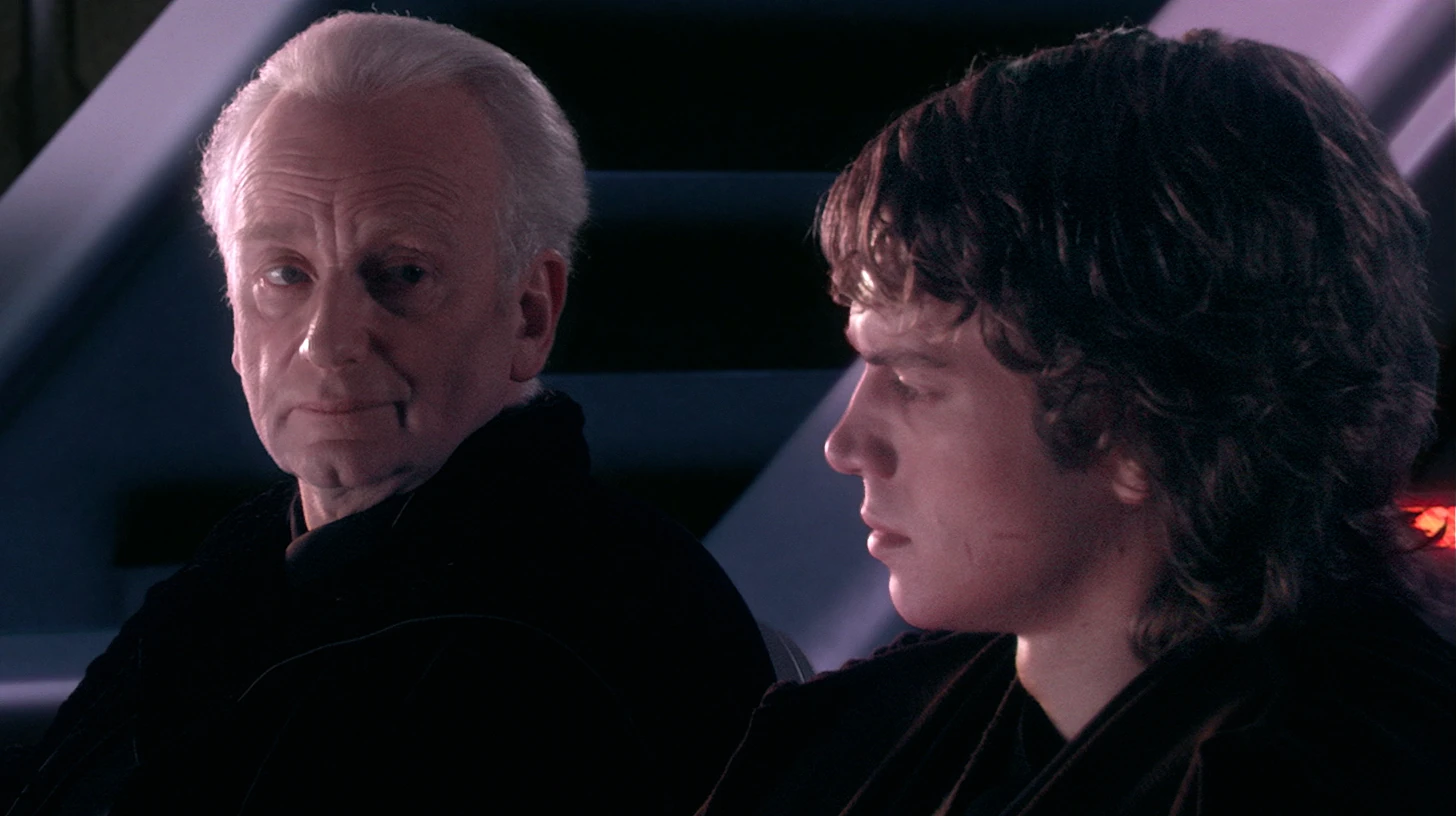
What is important is that Anakin is expertly manipulated by Palpatine and this scene, which takes place at a space ballet called Squid Lake, is what seals the deal for Anakin’s fate. He states his obsessive and all-consuming fear of losing Padme, and good old Shiv feeds him the line he needs to hear — I can teach you to transcend death, all you have to do is turn to the dark side. 


Watching Anakin fall is an important part of the entire Star Wars story because it gives context to the monster he becomes. In the original trilogy, Darth Vader is a baddie, full stop. When you watch A New Hope, you’re not even sure he’s a man — he may be a robot! 


Instead, we watch a 22-year-old man with complex trauma sell his soul to an abuser for the promise of helping save his wife’s life. Poor Anakin.


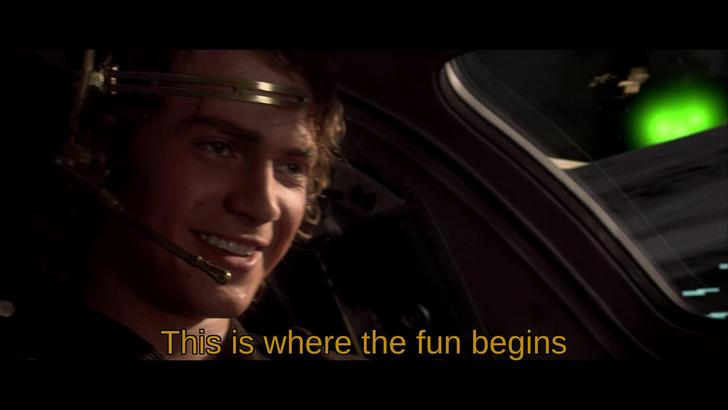
2. This is where the fun begins


In A New Hope, Obi-Wan tells Luke his father was the greatest pilot in the galaxy. In the opening scene of ROTS, which is among one of the coolest depictions of a space battle in the entire series, we see Anakin in his element. 


It’s maybe the last time we see him happy in the movie — hell, even in the two other prequels he doesn’t get a ton of positive moments. He’s good at his job, he works with his best friend, and Anakin is just plain having fun. 


I like how this opening scene shows the life Anakin could have lived had everything not happened. A Jedi out gallivanting and saving lives, secretly in love with a hot senator, and just vibing. 


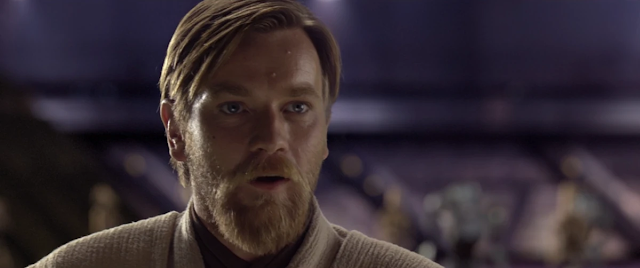
3. Hello there


Ewan McGregor’s performance as the young Obi-Wan Kenobi is one of the strongest through-currents running through all of the prequels, but his performance in Revenge of the Sith is absolutely divine. 


The movie is about Anakin, that is undeniable. But how Obi-Wan reacts in slow-motion to Anakin’s downfall is what sells it. 


The “Hello there!” scene is a blink-and-you’ll-miss-it bit of comic relief — a wink to Alec Guinness “Hello there” to Luke in A New Hope.


Watching him put on his best Alec Guinness impersonation for three movies is an utter delight, but by ROTS McGregor has crafted Obi-Wan into his own thing, and it’s handsome and charming and kind and haughty all rolled into one. 


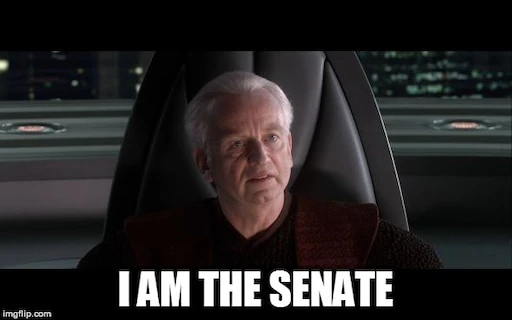
4. I am the Senate


One of the cool things about ROTS is how you cannot divorce it from the tenor of the times in which it was filmed. In 2005, at the height of the Iraq War on G.W. Bush’s tenure as president in the U.S., George Lucas had some thoughts, it’s pretty clear, and you can read so much into this movie. Unwanted wars, abuses of power, the jingoistic nationalism, the distrust of intellectualism — it’s all laid out against the backdrop of a failing space democracy. 


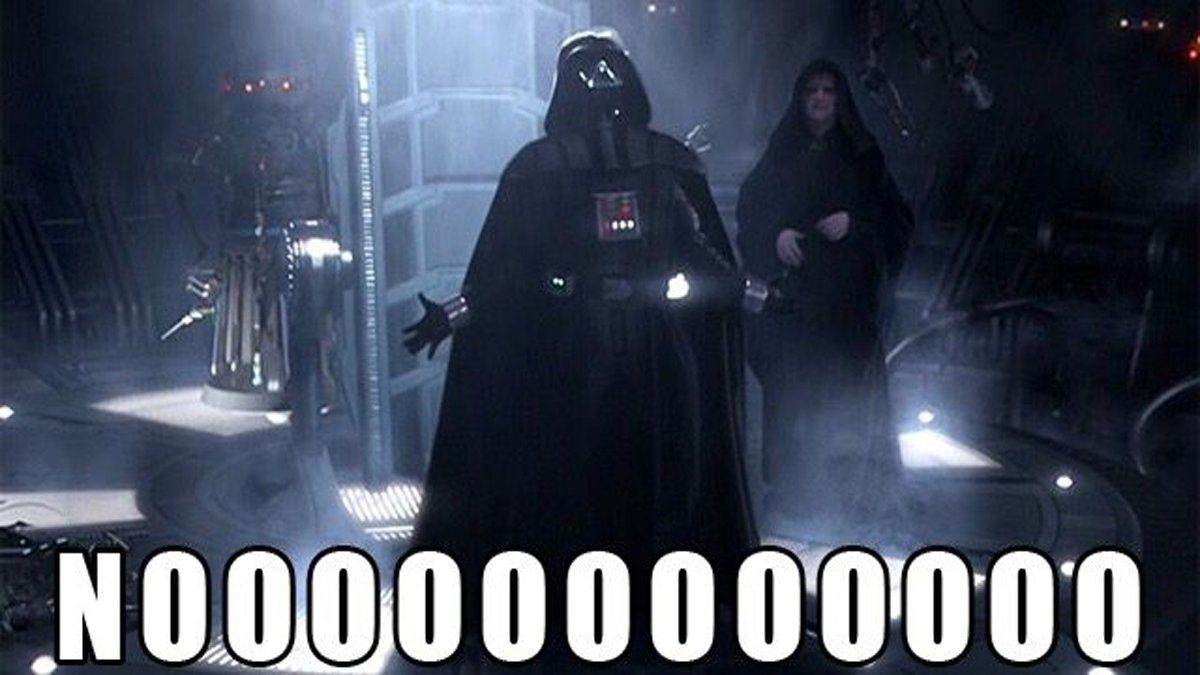
5. Nooooooooo


Is this a silly scene? Absolutely. 


Do I think it’s crucial to the story of Darth Vader? Also yes. 


Over the course of ROTS, We witness all of the horrible things that Anakin does that destroy his soul — the slaughter, the betrayal, the blind rage. 


But one of the ways we know that he’s never truly 100% gone is in this deeply funny scene in which he shouts into the ether fresh off the slab like Frankenstein's monster.


How do we know that he's not entirely gone?


Because his NOOOOOO shows he hasn’t gone willingly to his fate. A truly evil person would take their rage and distill it, discarding all aspects of their former life and dreams and eager to do Palp's dirty work.


Instead, we still see Anakin for a brief moment, only now trapped in a cloak of iron and bidden to the will of Palpatine. We saw this in his dejected kneeling after he finished murdering Jedi — ”Just help me save Padme's life.” 


He hates it. He can see it's wrong. But he knows he has ruined everything, killed everyone. And there’s nothing left. 


Over the next 20 years, I believe Darth Vader runs of 98% utter dejection, 1% rage, and 1% pure Anakin at heart, which is how he ultimately gets redeemed.  


POSTED BY: Haley Zapal, NoaF contributor and lawyer-turned-copywriter living in Atlanta, Georgia. A co-host of Hugo Award-winning podcast Hugo, Girl!, she posts on Instagram as @cestlahaley. She loves nautical fiction, Vidalia onions, and growing corn and giving them pun names like Anacorn Skywalker.