Showing posts with label pirates. Show all posts

Thursday, March 19, 2026

TV Review: One Piece Live Action – Season Two

Picking up the pace with more quirky characters, lots of fighting, and some tearjerker moments as Season 2 sails into the Grand Line.


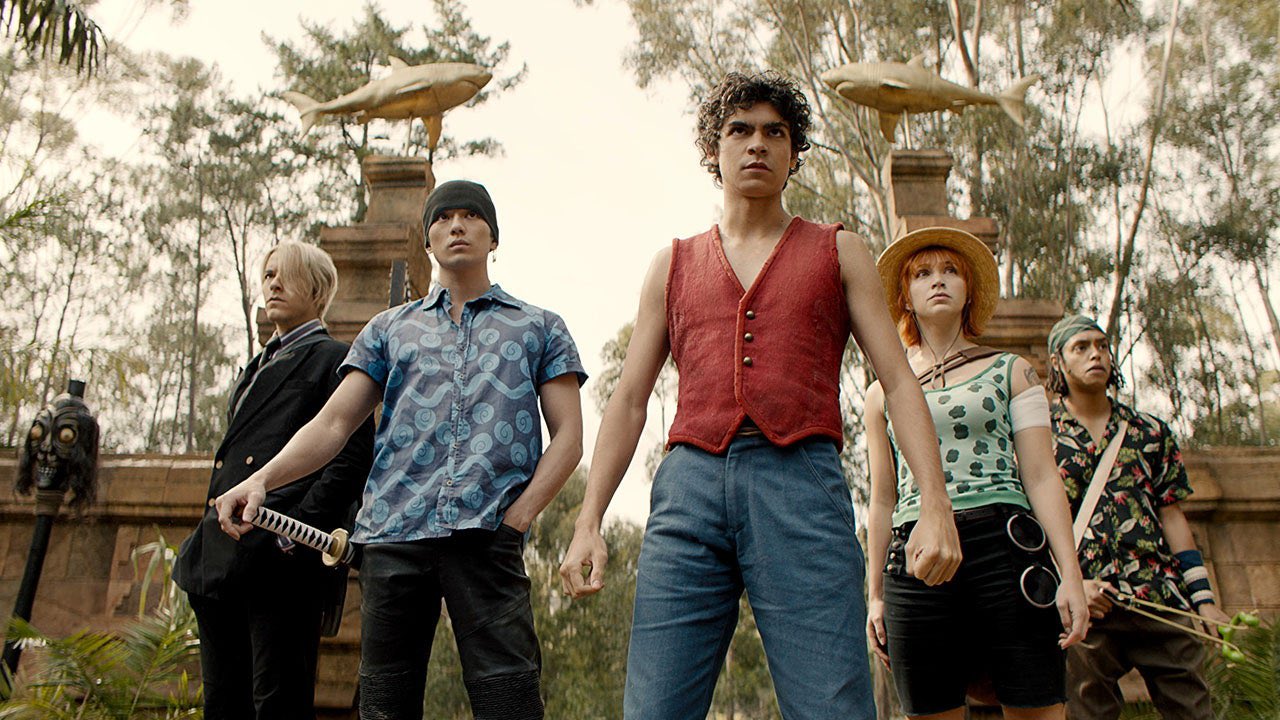
After a long wait, the second season of Netflix’s One Piece live action series has finally arrived. Season One of One Piece was a hit with a range of fans as it explored the adventures of a pirate boy and his ragtag crew. Due to the quirky nature of anime in general, it’s normally a challenge to bring those fantastical stories and characters to life in a live action format. Fortunately, Season One managed to navigate the source material’s wild visuals and storytelling to create a show that appealed to everyone from complete newcomers to superfans. The show has strong diversity in its characters and great character chemistry which draws the audience in. In Season One we met the five original Straw Hat crew members, one at a time, with pacing that allowed for poignant backstories and the development of strong character chemistry in the midst of some big adventures. In Season Two, the slower pace is gone, and the show dives right into a dizzying array of new, outlandish characters along with lots of fight scenes brought on by the busy new antagonist, Baroque Works. While the new adventures lack the wonder of the first season, the characters are still charming and the adventures are still entertaining, particularly for long time fans.

Summary: Luffy (IƱaki Godoy) is an enthusiastic adolescent boy in pursuit of his dream to become a pirate and to ultimately become the “king” of the pirates. To do this he must find a hidden treasure known as the One Piece. Luffy gradually assembles a rag-tag but loyal crew to join him on his hunt for the One Piece which is hidden in a dangerous place known as the Grand Line. Among his crew are Zoro (Mackenyu), a fierce and cynical swordfighter; Nami (Emily Rudd), a cartographer and navigator; Usopp (Jacob Romero), a shipbuilder with a knack for exaggeration; and Sanji (Taz Skylar), a suave chef who is talented at both cooking and fighting. Luffy calls his crew the Straw Hat Pirates in honor of the straw hat he wears. Season 2 begins with Luffy and his crew finally entering the Grand Line and realizing how much they underestimated its wild nature and complicated politics. The primary antagonist for the second season is an assassin agency known as Baroque Works whose oddball killers target Luffy and his crew. But things get more complicated when Luffy comes to the aid of Vivi, an undercover princess, and meets a shapeshifting reindeer named Chopper. 

While the first season did a good job of entertaining a wide range of viewers, Season Two seems more targeted to established fans. Many of the new villains appear with little introduction and the plot moves fast as new obstacles and new adventures arrive. But, as in the first season, we are helped out by explanatory signs that fly onto the screen when a new character is introduced. The design and presentation are different from the first season, but it’s still a helpful tool, especially if it’s been a while since you’ve consumed the anime and don’t immediately catch the characters’ outlandish visual cues. The new adventure brings to life episodes of the anime’s early story arcs including the amusing giants of Little Garden and the tragic oppressed kingdom of Drum Island. As the plot and the pirate ship move along, several of the show-stealing characters from the live action’s first season are left behind, or only have brief moments on screen, including pirate captain Buggy the Clown, the pure-hearted Koby, and the stern marine commander Garp.

Fortunately, Season Two adds appealing new characters with particularly good acting. Among the best are the determined Princess Vivi, played by Bridgerton’s Charithra Chandan, and the stalwart, guilt-ridden Drum Island soldier Dalton (Ty Keough), the ultimate green flag hero who finds his true strength. But the most fun arrivals are the sweet and much awaited, Tony Tony Chopper (Mikaela Hoover) and his gruff mentor Dr. Kureha (perfectly played by Katy Sagal). One Piece stands out in anime for its particularly fantastical characters in very outlandish costumes. The live action show does a good job of adapting the character designs, rather than just directly copying them, so they fit in a real-life setting. This is especially true for the adorable Chopper, an orphaned reindeer who gets turned into a human-reindeer hybrid after eating a magical devil fruit. Chopper is the kind of character who seems impossible to pull off in a live action but the show succeeds in making him believably real and endearing, rather than artificial and creepy. Like Golum in the Lord of the Rings movie, Chopper is presented via motion capture so the facial expressions are heartbreakingly engaging.

Some of the future main characters like Brook and Nico Robin appear briefly as set ups for future story arcs in future seasons. The main plot of Season Two is Baroque Works versus the Straw Hat Pirate. With so many Baroque Works agents the story focuses more on adventure and fights and less on the slow moments of character introspection that we saw in Season One. However, we do get some thoughtful and emotionally impactful intervals with the tragic stories of Chopper and his former mentor Dr. Hiruluk, and also with Dalton finding his voice and strength to deal with the despotic oppression of his people. There is even a rare quiet moment of Sanji recalling cooking for his sick mother when he was a child.

While Season Two doesn’t have the same magic of the first season, it is still a fun adventure that manages to capture some moments of emotional storytelling and manages to showcase some appealing new characters. The pacing is fast and the tale feels like it is over quickly, leaving viewers anticipating the next adventure in the Grand Line. But overall, long time fans will enjoy seeing more of the major characters come to life in this latest wild adventure.

--

The Math

Nerd Coefficient: 7/10

Highlights:
  • Faster pacing, more fighting
  • Appealing new characters
  • Emotional moments buried in the non-stop action
POSTED BY: Ann Michelle Harris – Multitasking, fiction writing Trekkie currently dreaming of her next beach vacation.

Wednesday, June 4, 2025

Realm of the Elderlings Project: The Liveship Traders Book 3: Ship of Destiny

A magnificent tapestry of genius, marred by an unfortunate dog turd in the corner

Cover art by Stephen Youll

Robin Hobb is rightly acknowledged to be a wizard of characterization, and I have seen many people opine that The Liveship Traders is the best entry in the Realm of the Elderlings series. I agree with both statements. I cannot stress enough how much I agree with these statements. In fact, I agree with them so hard that I'm not actually going to go into much depth about characterization per se here, because they have already been discussed by everyone else with an ounce of sense and taste. Instead I'll talk about two other elements of this fantastic book, by this fantastic author, the culmination of this fantastic series. To wit, I'm going to poke at what I think underlies her fantastic characterization, and then also dissect why That One Thing about this book feels like such a betrayal of the otherwise untainted fantasticness. Be warned: this will include discussions of rape.

But first, let's revel in what works. My argument here is that the characters in this book sing so sweetly because they're all scaffolded by a thematically consistent structure: deal-making.  It's in the title, actually: The Liveship Traders. These people, the inhabitants of Bingtown, live and die by trading. They founded their city on a deal with the Satrap of Jamaillia; their current troubles originate in the Satrap's decision to renege on that deal; and as we find out, the solution to their troubles requires making new deals. Everything is deals. And every deal, in this book, is centered around a tripartite choice:

You can preserve your life. You can preserve your dignity. Or you can preserve your identity. Which do you concede, and which do you protect? Not every deal allows you to preserve all three.

Everyone comes up against this choice, at one point or another. And the decisions they make as they negotiate their way through the story forms the foundation of their character.

Let us start with Malta Vestrit, who finally reaches the apex of her arc in this book. We have already seen her first steps in deal-making in Mad Ship, most notably her negotiation with Tintaglia, the dragon. In that deal, she agreed to help free Tintaglia from her buried cocoon in return for Tintaglia's help rescuing her father (Kyle Haven, ptooey). In other words, Malta's first bargain is a straightforward trade: survival for survival.

But as her development proceeds, her deals become more complex, making use of the full tripartite structure of values. In the aftermath of the earthquake that indirectly frees Tintaglia, Malta has been flung together with the deeply pathetic and incompetent Satrap of Jamaillia, Cosgo; and throughout this final book she must make deals of increasing complexity, all of which require compromises between survival, dignity, and identity. First, when she and Cosgo are picked up by some Chalcedeans, the stakes are small and personal: she must swallow her own dignity and hide her identity, pretending to be Cosgo's slave girl, because only by propping up his own dignity can she ensure his survival. And only if he survives, and is recognized as the Satrap, can he have the power to protect her, ensuring her own survival. Later, when Cosgo meets Captain Red, one of Kennit's pirates, Malta again takes the lead in bargaining, this time not just for personal survival, but to enlist the aid of the pirates to return Cosgo to his throne. Cosgo is fully ignorant of this calculus. He fumes, "'This is degrading! You would reduce my life and the fate of the throne to the squabbling of merchants... But what else should I expect from a Trader's daughter? Your whole life has been buying and selling." Malta, taking no shit from him, returns, "Merchants broker goods. Satraps and nobles broker power. You, noble Magnadon, deceive yourself if you believe there is a great difference in these mechanisms" (pg. 580-581). She is a Bingtowner through and through in this moment: She recognizes that everything can be negotiated, at all levels, from personal survival to the fate of nations. Indeed, when Cosgo eventually meets Kennit, it is Malta who leads the negotiations for a treaty between the Pirate Isles and Jamaillia proper. She is magnificent. All hail Queen Malta!

We get the same tripartite deal structure with non-human characters. Consider the sea serpents, who we know now are baby dragons, on a desperate quest for their old spawning grounds. They eventually find their way to the liveship Vivacia, who, recall, is now under the control of Kennit, and also has a dead dragon in her. The serpents make a deal with this dead dragon, who calls herself Bolt. Bolt agrees to lead the serpents to their spawning grounds, if they lend their strength to Bolt's ends—which, at the moment, involve serving Kennit. Sea serpent armies are useful things for pirates on a mission, after all. But the serpents are uncertain that Bolt will be able to follow through on her end of the bargain, because, as one serpent says, "To help us, she will have to beg help of the humans. While she insists she is all dragon, I do not think she can humble herself to do that" (pg. 456). In other words, the serpents will make a deal that concedes their dignity and identity for survival, but they are not certain that Bolt can do the same. Bolt is already dead; Bolt does not stand to gain survival, so the serpents doubt that she would concede her identity and dignity as she must do to uphold her promise. She has nothing to gain by this bargain.

This tripartite structure of bargaining becomes more complex in Serilla's character arc. When we first met her in Book 2, she'd been envisioning a future for herself in Bingtown, that magical city that she'd studied from afar for so long. However, en route to Bingtown, she disagrees with Cosgo, and Cosgo responds by withdrawing his protection from her. She suffers exactly the fate that Malta negotiates so skillfully to avoid: without Cosgo's protection, there's nothing to prevent the ship's captain from kidnapping her, an unprotected woman, and holding her as a sex slave. (The captain is from Chalced—the super-duper sexist slaving bad nation. Not to be too ethnically essentialist about it, but boy does Chalced suck.) It's rough, and it leaves a mark. Even after Serilla manages to escape the captain's power and scrape together some sort of power for herself as the voice of the Satrap in Bingtown, she is haunted by what she had to endure. Yes, she survived, but she survived because she prioritized survival, and in so doing gave up her identity and dignity.

The Serilla who escapes the Chalcedean captain is no longer that same accomplished scholar and respected voice in Jamaillia's government—and that loss explains a lot of what she does in her brief period in power in Bingtown. She bargains with the wrong people, and makes the wrong deals. Rather than seeking to find a path for the good of Bingtown as a whole, smoothing over the roiled waters of New Trader against Old Trader, Satrap loyalists against conniving Jamaillian traitors, she instead makes deals that protect her position and status as the voice of the Satrap. She has survived, and is now scrabbling to recover dignity—but at the expense of her identity. Or maybe not! Whether she was ever the expert on Bingtown matters that she fancied herself to be is an open question, but after the Chalcedean captain was through with her, she is emphatically not that person anymore. Her character arc is about how she can regain an identity for herself, renegotiate it, in light of what she endured.

Serilla's arc, as well as the importance of being willing to renegotiate one's identity, is mirrored by Bingtown as a whole. Bingtown's original foundation was a concession of dignity and survival against identity: they agreed to crushing fees and tariffs owed to Jamaillia, and died early deaths for generations, in order to build the Bingtown that we now have. There's a lovely moment early in the book featuring a meeting of the Town Council, when it seems that Bingtown's troubles are purely internal. Ronica Vestrit arrives early at the neglected Traders' Concourse, whose upkeep was traditionally the responsibility of Trader families. It's fallen into disrepair, but Ronica begins cleaning it, and slowly other Traders arrive and begin to help her. When the meeting begins, Serilla expects to control matters (insisting on her dignity), but the Traders themselves don't quite realize that, and their old habits emerge: consensus-seeking, self-governance, shared responsibilities. Bingtown's core identity asserts itself, despite Serilla's attempts at control.

So, naturally, in proper Hobbian fashion, things promptly get worse. A Chalcedean fleet, allied with the conspirators who kidnapped the Satrap and set off the whole mess in the first place, arrives to besiege their waters. In the same way that Serilla was held captive by the Chalcedean captain, so too is Bingtown now besieged by the Chalced fleet; and in the same way that Serilla had to concede identity and dignity for survival, so too must Bingtown consider what it will give up in the face of Chalced and the conspirators' challenge.

Roed Caern, an Old Trader who allies with Serilla, suggests that preserving the 'real' Bingtown, the heart of Bingtown's identity, means preserving the Old Traders and only the Old Traders. The New Traders are not Bingtown, he says. They don't live in Bingtown, they don't die in Bingtown, they don't pay the price in survival and dignity that 'real' Bingtowners pay. They live in Chalced, they are loyal to Chalced. They do not deserve to remain in Bingtown—especially not now when Chalced is the aggressor! And given what we, the readers, have seen of the prices that Old Traders have paid—the plagues, the deformities, the early deaths—and given what we've seen of how horrible Chalced is, this is a persusasive argument. Until, of course, you hear Roed's proposal: gather together the New Traders, force them to leave, and slaughter them all if they refuse.

It's easy to tell a story about remaining true to one's identity in the face of challenges, as Bingtown did when they cleaned the Trader's Concourse; but what makes Hobb's take so much subtler is how she pokes at the underside of that platitude: what is one's identity, truly? What does it mean to be true to it? What kinds of atrocities can be condoned in defense of it?

Later, Ronica pursues an alternate course. She meets with the rest of the groups that live in and around Bingtown: the Rain Wild Traders, the Three Ships Immigrants, the Tattooed (i.e. enslaved people from Chalced who have been imported by New Traders). She makes a different deal with them: if they rally together to defend Bingtown against Chalced and claim its independence, in return the new Bingtown will be kinder to them. Slavery will be truly outlawed, not just relabeled 'indentured servitude,' and they will be able to own land and build their own lives. This alliance is the opposite of Roed Caern's offer: concede the idea of 'traditional' Bingtown identity, and in turn its people—all its people—gain dignity and survival.

But this is Robin Hobb, remember. Such a lovely conclusion would be too easy, so instead we get a dragon. Tintaglia has very different ideas about human dignity and identity from these Bingtowners. Humans are naturally subservient to dragons, thinks Tintaglia. Of course they must praise her and serve her and acknowledge her as their overlord. But wait a moment, think the Bingtowners, dragons can do useful things like chasing Chalcedean warships away from Bingtown harbour. So the Bingtowners decide, in inimitable Bingtown fashion, to Make A Deal. And in this deal, we see them concede their dignity, bowing down before Tintaglia, in favor of survival. And their identity, so newly renegotiated, doesn't survive untouched either. Bingtown may claim independence from Jamaillia, but its self-governance will not be complete, because now humans live in a world of dragons, who will always claim mastery over them. It is a bit of a blow to this new city-state, but they are Bingtowners still; and Bingtowners negotiate. And so they bargain with Tintaglia, and in so doing, they illuminate the core part of Bingtown identity that has been preserved: they are traders. They make deals.

Do you see? Do you see how it all ties together? Everything is bargains, negotiations, about what is conceded and what is defended. It structures the plots; it structures the characters. It is a web of intricacy and brilliance.

And because it is so intricate and brilliant and consistent and structured, I must now take a moment to talk about Kennit. Specifically, Kennit's decision to rape Althea towards the end of the book.

What?

Why?

First, it was entirely gratuitous. You can just feel how every scene involving the rape, the lead-up, and the aftermath could easily be chopped out of the book entirely. It sits very uneasily on top of this otherwise tightly woven tapestry of the narrative. It's like a dog turd on the carpet. It doesn't match, and it makes everything around it gross.

But second, it's wildly out of character for Kennit. Everyone says so. Althea says, "He raped me," and they say, "Kennit? He would never!" Yes, this is a whole Believe Women plot point, and yes, there is a place for such plots in books. But not, I maintain, in this particular book. Because I myself do not believe Kennit would do such a thing. I saw him do it on the page, and still I thought, "Kennit? No! He would never." It goes against everything about his character that we've come to know so well throughout the book.

(Arguably) Worse, it undermines the effectiveness of the end of his character arc. His journey, the secrets of his childhood, his bond with Paragon, his identity as a Ludluck, leading up to his eventual death—all that could be incredibly moving and powerful: the complicated legacy of a complicated man who died a complicated death. His fantastic character arc, as we discover, turns out to be built around his own negotiation of the foundational tripartite bargain structure: his childhood identity is erased so that he can survive; and his adult identity is built around a ferocious defense of dignity, because his survival came at such a cost. Even his bond with Paragon is core to that, because Paragon preserved all that remains of his identity, in keeping him alive during his horrific abuses at the hands of Igrot the pirate. Kennit dies in Paragon's arms. How can this not bring tears to your eyes?

Well, the instant Kennit becomes a rapist, I no longer care about it. Any of it. All that character work, wasted. I look at it and think, "Huh, what an incredibly skillful revelation of his motivations and backstory. Gosh, I really wish I cared." But I don't. Rapists don't deserve that from me.

And I just don't understand why it's there in the first place! If the goal here was to make him a villain, rather than just an antagonist, we've already got thematically consistent hints that he's a bad dude. First, he negotiates in bad faith. He does not intend to keep his bargains with Malta. Leave aside all the piracy and killing of people; a man's clearly a villain if he negotiates in bad faith with a Bingtowner! And, more subtlely, in re-inventing himself, he does not renegotiate an authentic identity, but builds an entirely new one, while insisting that Paragon, the only clue to his old name, must be destroyed. That's not cool. You don't get to sidestep a whole third of the tripartite foundation of this book's thematic structure! And you definitely shouldn't be killing a liveship. In a trilogy called The Liveship Traders, a person who kills liveships and does not trade honestly is pretty clearly the villain. He does not need to be a rapist.

So: Kennit-the-rapist was a very unfortunate decision. It is so wildly unfortunate, and so clearly uncomfortable with everything else in the whole-ass trilogy, that I have decided in my head-canon that perhaps it's not Hobb's fault. Maybe the publishers didn't trust Hobb or her readers, and wanted to force her to shove in some gratuitous on-the-nose signal that Kennit is a villain, because heaven forbid a book written in the 90s not have a rape scene in it; and goodness knows we can't trust readers to pick up on who the villain is if we don't bonk them over the head with it. And it is out of the question for a book to have a complicated antagonist instead of a villain! Hence the rape. Thusly I have decided in my revisionist-head-history.

So I shall step around this turd on the carpet, and instead admire the colours, the pattern, the wool, and the complexity of the design that make up the rest of this book. The master-weaver Robin Hobb cannot be held responsible for the leavings of an incontinent dog.

Reference: Hobb, Robin. Ship of Destiny [Bantam, 2000].

CLARA COHEN lives in Scotland in a creaky old building with pipes for gas lighting still lurking under her floorboards. She is an experimental linguist by profession, and calligrapher and Islamic geometric artist by vocation. During figure skating season she does blather on a bit about figure skating. She is on Mastodon at wandering.shop/@ergative, and on Bluesky at https://bsky.app/profile/ergative-abs.bsky.social

Tuesday, May 6, 2025

Realm of the Elderlings Project, The Liveship Traders Book 2: Mad Ship

In which themes are thematic, brilliantly so

Cover art by Stephen Youll

One thing that Mad Ship does NOT do, in any possible way, is suffer from Book-2-itis. Instead, the plot thickens, and thematic resonances start flying thick and fast, in a way that your ninth grade English teacher tried so, so hard to make you recognize in Return of the Native or Hard Times or whatever piece of literature was being mistaught to you. Mr. Teagarten should have picked up some Robin Hobb if he wanted to make us see why recurring ideas and intertwining themes are so brilliant, but perhaps 850-page tomes is a bit of a big ask for a 14-year-old. (That said, I definitely was reading Robin Hobb in 9th grade.) Anyway, because I cannot discuss all 850 pages of this piece of magnificence in anything like justice, I've decided to talk about its recurring ideas and intertwining motifs. Or rather, a subset of them. The three I've selected are far from the only three, but they are the ones that made me stop and (literally!) take notes when they popped up. They are: the need to accept things you cannot change; the plot-thickening dangers of blind rescue; and the concept of personhood.

When last we left our Vestrits and pirates at the end of Ship of Magic, Kyle Haven (ptooey) had turned the liveship Vivacia into a slaver, and Kennit had captured her. In the sea battle that frees the enslaved captives, Kennit gets his leg chomped off by one of the ubiquitous sea serpents who always follow slave ships. (They do this because slave ships are deadly places, after all, the consequences of which deadliness get thrown overboard. Free lunch.)

Wintrow, with his unique position of both having been officially enslaved and also being the requisite family member whose presence is necessary for any liveship to sail, does not share the fate of the sailors who were complicit in the slave trade (i.e., serpent lunch). Instead, Kennit keeps him aboard Vivacia, and a fascinating kind of relationship triangle forms between the three of them. Kennit woos Vivacia with charm and respect and deference, exactly what she never got from Kyle Haven (ptooey), and never had the chance to receive from Althea. But Vivacia is a liveship, and needs to be with her family, and so she continues to reach out to Wintrow, who resents her presence but also feels an obligation to her. In a perfect world, Wintrow would give his allegiance to Kennit, so Vivacia would not feel torn between the two of them. Kennit knows this, and so alongside Vivacia, he also tries to woo Wintrow. In his logical conscious thinking, this wooing makes sense, a way of tying Vivacia more securely to his goals. But underneath that, Kennit sees in Wintrow the boy that he, Kennit, once was, the boy who was taken under the wing of a pirate and grew into the man he is now. For Kennit, that was salvation; and so in Kennit’s mind, he must do the same for Wintrow, as a duty to the boy he once was.

This triangle is one fertile ground to find the first theme: the struggle to accept (or refuse to accept) one’s fate. The point is first articulated by Etta, Kennit’s… lover? She identifies herself as Kennit’s whore, but it’s clear that her devotion and loyalty to him are strong and terrifying in ways that go far beyond sex worker and client. When she sees that Kennit wants Wintrow on his side, while Wintrow struggles to accept it, she takes matters into her hands. You can never return to the monastery, she tells him bluntly. That path is closed to you. You can either accept this life, and make what you can of it, or you can fight it and die pointlessly. One learns such things in a brothel, she says—but she says it without self-pity. She does not see herself as mistreated, though she undoubtedly has been. I do not think she could have developed such a violent loyalty to Kennit if she had known other types of real kindness. However, she has accepted her life, and works within its constraints to find purpose and strength. In her case, that purpose and strength usually leads to murderous protectiveness of Kennit’s interests. In Wintrow’s case, that purpose is to seek out the wisdom and ways of Sa, regardless of his proximity to any monastery.

This same lesson recurs with other characters. Kennit himself, struggling to adapt to life without a leg, must figure out how to be a one-legged pirate. And we see it again towards the end, as word of Vivacia’s capture finally makes it back to Bingtown, and Althea Vestrit and Brashen Trell mount an expedition to go after her. Such an expedition needs a ship, and the only ship is the titular mad ship, Paragon. Paragon is a liveship himself, but he has been beached for decades after a series of catastrophes at sea killed the family who sailed on him, left his face blinded from axe blows that destroyed the wizardwood of his eyes, and destroyed his logbooks—and with them his memories. And now Althea and Brashen and the Fool Amber are refitting him, preparing to sail in him, despite his madness and the risk that he might kill them as he seems to have killed his previous crews. In his moments of lucidity, he had accepted his fate to be a forgotten hulk, but he struggles to accept that he might have a part to play in the world once again.

Paragon also serves as a locus of the second theme: the idea of rescue, and the consequences thereof. We already saw it with Kennit: he rescues enslaved captives and reaps broadly positive consequences: acclaim, reputation, and, eventually, his dearest wish: a liveship of his own. But that liveship is going to be another link in a chain of consequences, because Bingtown will never let a pirate keep a liveship—hence Paragon’s refit, and Althea and Brashen’s mission. In Althea’s eyes, the rescue is aimed at recovering Vivacia (and maybe her nephew Wintrow). In Malta’s eyes, the rescue is for her father Kyle Haven (ptooey). And Malta has a unique opportunity to help, by means of indulging in a bit of rescue of her own. In the course of her magic-infused courtship with Reyn, the son of a prominent Rain Wilds trader family, she has become linked with the voice of a trapped dragon entombed in a buried log of wizardwood. This dragon haunts Malta’s dreams, demanding, threatening, begging for release. So Malta makes a deal: she will rescue the dragon if the dragon rescues her father. The consequences of that will have to wait for the third book.

But wait—a dragon, trapped in wizardwood? How did that happen?

The relationship between dragons and wizardwood brings us to our third theme, the one that I think is the truly brilliant revelation of this book, the discovery that both tarnishes and deepens the sense of wonder of liveships. Thus far, wizardwood has been seen as a rare, magical, magnificent substance that makes liveships into the glorious sentient creatures that they are. But in this book, we learn the whole truth: wizardwood is not mere wood, but instead a cocoon, formed when a sea serpent finishes its larval stage at sea, and returns up the Rain Wild River to hibernate and grow into a dragon. Historically the serpents were shepherded in this migration by the living dragons who guide them, and watched over in their transformation by the now-disappeared Elderlings who lived symbiotically with them. But centuries ago, the Elderling city by the dragons’ hibernation spot was buried in an earthquake, and the cocoons were blocked from the sun, unable to hatch. This is why dragons disappeared from the land; this is why they had to be built with Skill and sacrifice in the Farseer trilogy. The living dragons gradually died, and their successors were buried during the disaster, unable to hatch. For every liveship constructed from wizardwood, one of those cocoons was cut open, and the embryo dragon inside tossed away like trash. The magic and sentience that makes liveships what they are is in fact nothing more than the ghostly remnants of a dead dragon’s memories that the wizardwood absorbed from them. Liveships are dead before they ever quicken; and in their construction, an entire race of creatures was destroyed.

Can you imagine learning such a thing about yourself? To imagine yourself a living, thinking, sentient magical being, a liveship, who has a family, and memories, and agency in the world—only to learn that your entire existence is the consequence of a horrific genocide? That your ability to move and speak, to form memories, is not true life, but instead a simulacrum, a husk, a shell, an existence stolen from another being? Are you even a real person?

What does it mean, then, to be a person? In a way, this question has a kind of resonance with a lot of science fiction stories about the personhood of AI. In the framing of one of those tales—let's say, arbitrarily, Star Trek: The Next Generation’s “Measure of a Man”—a liveship’s identity, personality, agency, and sentience would unquestionably endow it with personhood. But what those stories lack is the horrifying cost of the liveships’ creation. To waken one, four lives must be given: the dragon, and then the three generations of family members whose deaths are needed to quicken the ship. Traditionally, those last three lives are given willingly, lovingly—but they don’t have to be. Paragon’s quickening happened prematurely, during the mysterious violent death that killed his crew and the last two generations of his family. In principle, a liveship could be wakened by taking a grandparent, parent, and child aboard and slitting their throats. Four people (including the dragon) must die to create this artificial person. Does that matter in determining personhood?

To the liveships it does. Or it can. Because under the right circumstances, they can gain direct access to the memories of the dead dragon whose husk was used to build them. When this happens, they realize—or perhaps decide?—that they are dead, that their lives as ships, as the person they had been, are false, a dishonor to the memory of what they might have been. They renounce their identity built from their liveship existence, but have nothing to replace it with other than the knowledge that their intended life as a dragon has been stolen from them. It is like a kind of madness, or a return to sanity. Or a shattering of delusions that is worse than madness. One finds oneself wondering if such a revelation is responsible for Paragon’s current state.

These three themes (acceptance, rescue, and personhood) wind together as sinuously as any sea serpent. Memory builds the personhood that defines the liveships, built from the bodies of dead dragons; but it also defines the sea serpents that follow behind the liveships, feasting on the bodies of dead humans—and, at times, the wizardwood of liveships too. Because the serpents’ memories are faulty. They have no adult dragons to guide them back to their nesting places, and so they stagnate, withering, losing themselves, forgetting their names. They cease to be people, and become instead beasts. Then toward the end, Wintrow comes across a trapped sea serpent, one which carries the memories that are necessary to keep the other serpents aware long enough for them to find their way back to the Rain Wild River. Being Wintrow, he naturally frees the trapped serpent (rescue again!), thus making it possible for these lost creatures to find a guide and make their way home before their identities are lost forever.

And finally, while I’m talking about what this book does so well, let me take a moment to discuss Malta. Remember Malta? The unspeakable brat? She begins her transformation in this book. The pivotal moment, as I see it, is on page 319, when she sneaks out to meet a suitor, the brother of one of her friends, named Cerwin. Certainly she goes about it in a very Malta-ish way. She flirted with Cerwin, and in her head she knows exactly how she wants Cerwin to behave. She wants him to be big and manly and passionate with her, to see her as a mistreated maiden sacrifice who must marry for the sake of her family’s welfare, while simultaneously calculating every facial expression, every gesture, every apparently unconscious movement. She presents herself as someone who needs rescuing, (rescue!), and presents an identity built upon lies (personhood!). Yet when Cerwin falls for her manipulations and asks how he can serve her, she does not ask for something selfish. She is smart: she asks him to persuade his father to come to a Bingtown Council Meeting to support her family’s agenda about slave trading and pirates. This is the moment when Malta stops thinking of herself, stops wallowing in frustration about what she cannot have. Instead, she accepts (accepts!) the hand that she is dealt and puts to use her wiles and manipulations and skills at bending people to her will.

Do you see? Do you see how it all intersects? And I’ve left so much out! And Book 3 has so much more! The more I write about this series, the more I am agog at this astonishing tapestry Hobb has woven. I’ll see you next month to talk about Book 3, Ship of Destiny.


Reference: Hobb, Robin. Mad Ship [Bantam, 1999].


CLARA COHEN lives in Scotland in a creaky old building with pipes for gas lighting still lurking under her floorboards. She is an experimental linguist by profession, and calligrapher and Islamic geometric artist by vocation. During figure skating season she does blather on a bit about figure skating. She is on Mastodon at wandering.shop/@ergative, and on Bluesky at https://bsky.app/profile/ergative-abs.bsky.social

Wednesday, April 2, 2025

Realm of the Elderlings Project, The Liveship Traders Book 1: Ship of Magic

Chonky epic fantasy at its absolute best

Cover art by Stephen Youll

Ah, at last we come to the Liveship Traders, which in my memory is the finest subseries within the whole Realm of the Elderlings saga. Where the Farseer trilogy excelled largely in depicting characters’ relationships – and, in my view, the tragedy of lost opportunities for connection – its actual character depictions themselves were a little shallow in places. Regal, in particular, was an awfully blandly evil villain. But no more here! In this book, we have a rich, churning cast of characters, each with their own goals, histories, motivations, and perspectives; and we have a much enlarged world, with sophisticated sociology and politics. And we’ve got magic talking ships. And sea serpents. And pirates. And monks. And society balls. And seafaring adventure and hidden beaches with mysterious oracle creatures and slaveship rebellions and lost buried cities and deadly magical artifacts that change your body and shorten your life and make you fabulously wealthy. It’s difficult to know where to start in praising this book.

Arbitrarily, I’ll start with the setting. This book is in the same world as the Farseer trilogy, but where that was focused in the far north, in the Six Duchies, this series is centered around Bingtown. And if the Six Duchies are decidedly medieval, Bingtown gives a lot more of a sense of colonial Philadelphia. It is a semi-independent city, sandwiched awkwardly between Jamaillia, its official sovereign power, and Chalced, that cruel, slaveholding nation mentioned occasionally in Farseer as a rapacious neighbour in the south. Bingtown sits at the mouth of the Rain Wild River, a deadly watercourse whose corrosive waters eat the hulls of ships that try to sail it, and whose proximity causes mutations and plagues and shortened lifespans. But up in the Rain Wilds there are ruins of cities of the Elderlings, full of magical artifacts and wondrous objects that bring fantastic prices in trade.

So the Bingtown Traders, historically, made a deal with the Satrap of Jamaillia: In return for braving the deadly Rain Wilds, they get exclusive access to the wealth that comes from it in trade (after, of course, paying their share to the Satrap). In the time since its founding, Bingtown has flourished, because the first traders discovered a key thing in the Rain Wilds, that makes navigating the Rain Wild River possible: wizardwood. It is the only type of wood that can withstand the corrosive river waters, and so people with ships made of wizardwood are the only people who can trade upriver. What’s more, after three generations of service, these ships, the titular liveships, become sentient: the figureheads become animated, and can move and speak with the memories of all the generations that their ship body has existed. This centrality of the Rain Wilds magic creates a fantastic cultural richness to Bingtown, whose population thus splits into the following subgroups:

1. The Rain Wild traders: those who have accepted the cost to body and life that comes from living far upriver, deep in the Rain Wilds, and are the primary source of the magical goods, including wizardwood, that underlie Bingtown’s wealth.

2. The Old Traders, those who made the original deal with the Satrap of Jamaillia, who live in Bingtown Proper, and serve as go-betweens, connecting the Rain Wild Traders with the rest of the world. Only Old Traders have liveships.

3. The Three Ships Immigrants, a secondary group of inhabitants of Bingtown. We know very little about their story, but occasional mentions suggest that they were refugees from somewhere, arriving in Bingtown poor but willing to work, and were accepted by the Old Traders. They are now integrated as a kind of commoner stock in Bingtown.

4. The New Traders, newer immigrants to Bingtown, who have been granted land grants by the Satrap in contravention of the original charter with the Old Trader families.

These last, the New Traders, are the source of some fantastic sociocultural tension. See, the original deal with the Satrap of Jamaillia was that there would be no new land grants offered to anyone else around the Rain Wild River. That was the exchange: The Rain Wild and Old Traders would take on the risks of making the Rain Wilds a prosperous trading city, and in return get exclusive access. The Trader council chose to welcome the Three Ships Immigrants (although not as equals); but they have not chosen to welcome the New Traders. The New Traders’ land grants violate the original charter that created Bingtown; and the New Traders themselves have not put in the sweat and pain and generations of mutations, early death, disease, and child mortality that the Rain Wild and New Traders have paid for the wealth they now enjoy.

And, worse still, the New Traders do not share Bingtown values. This is an striking source of tension to read with a modern eye. To a 21st-century Western reader, phrases like ‘They don’t share our values’ is code for something rather bigoted and horrible. But in this particular case, the values that are not shared include things like, ‘Bingtown does not allow slavery.’ By contrast, the New Traders are pretty ok with slavery. It’s forbidden in Jamaillia, but common in Chalced, and Bingtown sits rather awkwardly between those two nations. And because Bingtown has to eat, and farming is labour-intensive, and because Chalced is a valuable trading partner, slave labour starts looking like a pretty attractive option. They hide it in Bingtown under terms like ‘indentured servants’, but those indentured servants are all imported from the slave markets in Chalced, and they work for free, which is causing real economic unheaval among the Old Traders who are trying to make a living by the old ways. Some don't even try, and instead adopt these newer, cheaper, crueler methods.

Ahh, such a rich backdrop! So much more sophisticated than the Six Duchies, whose politics were really not much more complex than ‘Me want kingship oh no bad guys killing’. And because this cultural-political setting is so rich, it means that the characters have a thousand different ways to interact with the world.

So let's discuss the characters! They split into two groups. First, we’ve got the Vestrit family and their circle. Althea Vestrit is the  youngest daughter of an Old Trader family, and has always expected to inherit the command of the family liveship, Vivacia, who is on the cusp of sentience. Althea loves Vivacia with all her heart, and has spent her life on the ship since childhood. She understands the business inside and out, and is the logical choice to inherit the ship on her father’s death. But when her father dies, right at the start of the book, it turns out that he has left the ship not to her, but to her elder sister, with the understanding that her elder sister’s husband, Kyle Haven, will command Vivacia.

And that brings us to Kyle Haven. My god, Kyle Haven. What an astonishingly awful person. He is so brilliantly constructed to be just terrible. As I saw on the r/fantasy subreddit not too long ago, it is entirely reasonable to ask something like, ‘Who is the worst villain in all of fantasy, and why is it Kyle Haven?’ Except I don’t really want to call him a villain, because that dignifies him with some degree of scope and power that he doesn’t have. He’s just a small, evil, vicious, cruel, stupid man, who makes life terrible for everyone around him in ways that are pretty trivial on the broad scope of politics – changing the world is not in Kyle Haven’s scope – but catastrophic on the personal level. 

The first example of his vileness is his treatment of Althea. Not only does he insist on captaining Vivacia himself, he refuses to let Althea even sail with him on the ship – effectively banishing her from her home and a newly-sentient creature who is a combination of her child and her best friend. And then there is his son, Wintrow. Wintrow is a sensitive, intelligent, thoughtful boy, who has spent years as a novitiate at a monastery, in training to become a priest of Sa. He is happy there, in this life path which suits him down to the ground. But you can’t sail a liveship without a member of the family on board, and since Althea’s not present, Kyle decides that Wintrow will do the job. So he removes Wintrow from the monastery and forces him to become ship’s boy on Vivacia. Wintrow is too weak, too puny, too girly, thinks Kyle. This will toughen him up, thinks Kyle, and make him a man.

Oh, yes, because Kyle is also a raging sexist. It’s one of those Chalced values, along with condoning slavery, that are gaining traction in Bingtown. Wintrow is too weak and girly (when in fact he’s just gentle and thoughtful); and Althea is too masculine and coarse (when in fact she’s just experienced in sailing and trading).

The worst (as a person) and best (as a character) part of Kyle Haven is that he actually can make an entirely coherent case for his actions. It’s not convincing if you don’t share his values, but if you do, his behaviour makes perfect sense. Of all his faults, he is not a hypocrite. Observe: The Vestrit family’s finances are in dire straits; culture in Bingtown is shifting Chalcedwards, which makes powerful female matriarchs less common; Althea must marry someone wealthy, which will help; and Vivacia must make a lot of money trading. So it makes perfect sense, in his eyes, for Althea to focus on the womanly ways of marrying, and to leave managing the family business to him, a manly man. First order of business: Vivacia must carry the most profitable cargo possible. For Reasons, the Vestrits do not trade up the Rain Wild River, so what’s the next most profitable cargo?

Slaves.

Kyle Haven therefore turns a sentient liveship into a slaver.

He really is vile.

Contrast him, then, with the heart of the second group of characters, Kennit. Kennit is a pirate. If Kyle dreams too small to be a proper villain, Kennit is too --- something I can't articulate --- to be a villain either. He acts as an antagonist, but however much you might be pulling for Althea's success, it's really hard not to root for Kennit at the same time, even when their goals are opposed. He's a deeply charismatic character, not only to other people in the book, but also to readers.

Kennit's one dream is to become King of the Pirate Isles, an awkward series of channels and islands and reefs that stretch between Bingtown and Jamaillia. He is smart; he is charismatic; he is driven, and he is lucky. He is not a good man, but again and again his luck turns out in ways that make him seem virtuous. For example, one of Kennit’s goals is to command a liveship. But because he has not had three generations of family wealth to pour into paying for one legitimately, he must take one piratically. This is a bit of a tall order: liveships do not serve anyone but their family, and they are faster than any conventional ship, and impossible to catch in chase. Kennit’s first mate, Sorcor, thinks that it is not possible for Kennit to take a liveship, and because pirates have a degree of democracy in their hierarchies, Sorcor could make real trouble for Kennit if he does not support this endeavour. So they make a deal: Sorcor is a former slave. Sorcor hates slavery. For every liveship Kennit tries to take, they will also take a slaveship and free the enslaved captives on it. Capturing liveships is hard, but capturing slaveships is easy, and so they are successful at none of the former but quite a lot of the latter.

So now, through no desire of his own, Kennit becomes known as the pirate captain that frees slaves. The people love him. And wait, there's more! At one point, he dumps a load of freed captives in the nearest settlement – because he really does not have any use for these weakened drains on resources, as he sees them, and wants to get rid of them as soon as possible. But it turns out that these settlers were themselves captured and enslaved, and came from the same village as the new load on Kennit's ship. And so now Kennit not only frees slaves, but reunites families in the process.

If this book were just about Kennit, the success after success would become monotonous. But set against the inimitably Hobbian pattern of catastrophe after catastrophe striking the Vestrit family, it’s rather nice to take a break from Wintrow’s mistreatment and Althea’s frustrations and Bingtown’s decline, and see what it’s like for someone to enjoy success in a Robin Hobb book.

Can you see how these plot elements coming together? Kennit, Kyle, liveships, slavery? Anyway, they do. In a predictable turn of events, to be sure, but with a satisfying sense of inevitable doom finally being unleashed upon fucking Kyle Haven who fucking deserves it. (I don't usually love to hate baddies in my books, but something about Kyle is so completely hateful it's almost enjoyable.)

Finally, I can’t end without saying something about Malta Vestrit, Kyle Haven’s daughter. In the same way that Kyle himself is just awful, but brilliantly so, Malta is also just awful, in a 13-year-old way. She is going to have one of the best character arcs in all of fantasy, so take a moment to enjoy what an astonishing brat she is in this book.

There’s so much more here! There are the sea serpents! There’s Etta, there’s Davad, there’s Brashen. There’s AMBER! there’s so much more here that I could rave about! But my wordcount has already grown too high, so I must stop typing. Perhaps in the next book I will get to those folks. Or perhaps not! Because new revelations await there. This is chonky epic fantasy at its absolute best. 

--

References:

Hobb, Robin. Ship of Magic. [Bantam, 1998].

CLARA COHEN lives in Scotland in a creaky old building with pipes for gas lighting still lurking under her floorboards. She is an experimental linguist by profession, and calligrapher and Islamic geometric artist by vocation. During figure skating season she does blather on a bit about figure skating. She is on Mastodon at wandering.shop/@ergative, and on Bluesky at https://bsky.app/profile/ergative-abs.bsky.social


Thursday, November 7, 2024

TV Review: Nautilus

You can humanize Nemo, but you can't Disneyfy colonialism

A character like Captain Nemo is challenging to write, all the more so in a prequel. Originally conceived by author Jules Verne as a Polish noble on a vendetta against the Russian Empire (which would have made the novel damaging to French foreign relations), upon publication he became an Indian noble on a vendetta against the British Empire. By the time we meet him in 20,000 Leagues Under the Seas, he's a jaded misanthrope, self-banished from civilization, who in his burning hatred for tyrants has ended up creating his own little tyranny. The wonderful ship he commands is not a symbol of human progress, but a weapon of mass destruction (and eventual self-destruction). How do you turn such a character into a hero, when many in the audience already know who he's going to become in the novel?

One thing you can do is break free from the novel. The new TV series Nautilus, produced by Disney and then absurdly abandoned by Disney before being rescued by Amazon, rewrites Nemo as a revolutionary fighter who leads a rebellion of slaves and steals the Nautilus just before the East India Company can use it to take over world trade. This version of Nemo keeps the rough outline of the backstory Verne gave him: the British killed his family and stole his lands, so now he's an enemy of the British. Some (not enough) layers of complexity are added to that characterization. Verne's Nemo was fueled by raw spite; this Nemo begins headed in that direction, but is steered toward a gentler, more honest reckoning with his grief through his interaction with his crew. He may have a yearning for the abyss, but he comes to realize that he must not drag others down with him. Still, the character isn't written with the depth a lead role needs. Even after doing the hard work of earning the goodwill of his Designated Love Interest, in the last episode he makes a crucial choice against her wishes that reveals he hasn't paid attention to what she's been going through. So the most charitable description of his arc is from "total jerk" to "not a total jerk, but still very close."

A slightly better treatment is given to Nemo's crewmates. They don't even get names in the novel. In an adaptation that focuses so much on the theme of toppling hierarchies, that needed to be fixed. Alas, the cast we get is a mixed bag. Their use as comic relief is excessive, although it gradually lessens toward the middle of the season. One character in particular spends several episodes being nothing but comic relief, and not in an endearing way but in an annoying way, which later in the series detracts from the expected impact when his fortunes change for the worse.

This mishandling of tone is a major flaw of the series. It wants to be a sincere narrative of rebellion against cruelty, but it also wants to sand away its rough edges with the trademark Disney aesthetic. The result is an incongruity: a cutesy romp through colonies ravaged by famine and massacre; a kid-friendly, bloodless adventure where our heroes routinely face and barely escape the world's most brutally rapacious institution and end each episode with a goodhearted laugh. Disney wants to have it both ways, and fails at both. The way our heroes finally prevail against the East India Company, cleverly beating capitalists at their own game, relies on so many artistic licenses about the workings of a stock market that the fact it succeeds feels almost cartoonish.

The bright spots must be celebrated, though. Thierry FrƩmont's character is a great addition to Vernean lore as the engineer who designed the Nautilus. He's the voice of reason that tempers Nemo's effervescent passion, and making this character French is a nice homage to Verne as the titular submarine's actual creator. CƩline Menville, one of the precious few women in the show, shines as a multiclass fugitive/bodyguard/chaperone/assassin with a mysterious past. Cameron Cuffe expertly channels the perennial detestability of aristocracy. Damien Garvey eats up each of his scenes with a gloating smirk of pure evil. Richard E. Grant has a fun cameo as a puppet ruler with skeletons in the closet. And Luke Arnold carries half of the show's emotional load in an incredibly complex role as Nemo's childhood friend who grew up to repay betrayal with betrayal.

Did you notice the key problem with the preceding paragraph? Most of the show's best-written roles are given to the white actors. Although Nautilus (the ship), and therefore Nautilus (the show), has a laudably diverse cast, reflecting the extent of the British Empire's depredation of the whole world, the script wastes some very talented actors by not giving their characters enough material to work with. This is one of the recurring consequences of the impractically short seasons of today's TV. The most that the script does to distinguish the members of Nemo's crew is to give each of them a couple lines of sad backstory; beyond that, their personalities may as well be interchangeable (the only exceptions, proving the rule, are the aforementioned characters reserved for the position of comic relief). In one episode, Nemo is berated for not knowing his crew on a personal level, but neither does the audience.

Nautilus is a great concept stretched thin by the pull of incompatible demands. In trying to bundle the grim realities of anti-colonial struggle in the same package with the childlike awe of exploring wonderful landscapes, it ends up much like the Avatar movies, doing a disservice to its own intended message.


Nerd Coefficient: 6/10.

POSTED BY: Arturo Serrano, multiclass Trekkie/Whovian/Moonie/Miraculer, accumulating experience points for still more obsessions.

Thursday, February 22, 2024

Microreview: The Adventures of Amina Al-Sirafi, by Shannon Chakraborty

The gang is reunited to buckle some swashes, but they sure took their time getting to the good bits

The hook of S. A. Chakraborty’s newest offering ticks all my boxes: Piracy and magic and spirits and daevas? Ships and trade and 12th century Islamic world? A middle-aged mother who has Lived A Life is strong-armed out of her peaceful domestic retirement into taking One Last Job? Please and thank you, yes, may I have some more?

The story is told from the perspective of Amina Al-Sirafi, who made a name for herself in her youth as the most ruthless, terrifying pirate captain in the Arab world. Tales of her feats are known everywhere:  She is tall, fights like a man, has gold in her teeth and scars on her arm. She poisoned a feast during trade talks in order to rob the attendees; she stole horses from the emir of Hormuz. She robbed Chinese envoys of their cargo and stole their ship while they slept through it all, only to awake drifting in the sea on dinghies. She is not to be trifled with. 

 Or was not to be trifled with. Now, though, she just wants to be left alone to live quietly and raise her beloved daughter, secluded and hidden from the girl’s father, who is clearly bad news of some sort. (The exact badness of his news is kept an irritating secret from the reader, but not a terribly secret secret; I'd figured it out by page 49.) So when a wealthy woman whose daughter has been kidnapped comes to hire Amina to find the daughter, she knows exactly which pressure points to push to make Amina take the job: threaten her quiet retirement, and make it known where the fabled pirate captain now lives. Of course Amina takes the job---and since deep down she misses the old life, the excitement, the seafaring adventures, it’s not a complete catastrophe. One last job. One terrific pay-out. Then she’ll definitely absolutely retire for real. No fooling. Absotively posilutely. Forget that this is marketed as Book 1 of a trilogy. Just one last job, that's all.

From here the plot proceeds in two halves. In the first bit, Amina gets the gang back together. She must track down her old ship and her old crew and get them on board (hah) with her new endeavour. Friends must be sprung from prisons, ships must be stolen from soldiers, and poisoners and cartographers must be persuaded to give up their own comfortable retirements to help Amina find the kidnapped child.  Next, once the gang is all gathered, Amina and company set out to rescue the child. And since the child has been kidnapped by a collector of magical artifacts, with his own plans for how to use them to his advantage, things get real magical real fast.

This book delivers on all of its promises. I don’t think I’ve ever seen a book that provides so fully and completely everything that it promised on the tin. We have sea battles, heists, poisoners, and trips to the world of the Unseen where trees grow people as fruit and court finery includes cloaks of porcupine quills. We meet loyal friends, ambiguous former lovers, mysterious (sexy) strangers, teenage waifs with hidden depths, and a ship’s cat who is so bad at being a cat that it clearly is hiding some other secret. From the midpoint to the end, this book is a sterling example of the sort of historical Arab-centered fantasy that Chakraborty did so well in her previous Daevabad trilogy.

The problem is that in the first half, the Getting-The-Gang-Back-Together-Again half, I found myself chafing a bit, getting restless. Some of these relate to my own personal preferences in reading fantasy, but some of it reflects a slight clumsiness in execution.

I understand exactly what Chakraborty was doing in this bit. She has chosen a wonderful, underused (in western fantasy at least) setting for her story. The medieval Arab world is this delightful mishmash of cultures and languages and peoples, trades going east to China and India, south to Madagascar, north to the Mediterranean. The cities of Aden, of Socotra, Mombasa—these are wonderful, vibrant, exciting settings. By sailing from place to place to gather up her old comrades, Amina is taking the reader on a tour of this world, allowing us to visit the markets, run into the local governments, learn about the world that is so different from the more familiar knights-and-stone-castles of medieval Europe historical fantasy settings.

This approach also allows us to sink into the character histories some more. We learn about Amina’s previous exploits in the regions, we see her thinking about her youth, reflecting on what she has learned and what she wants from her future, having conversations about growing up and growing older with her former (and once-more) shipmates. Structurally, it is a very effective decision.

But, see, it’s boring. There’s only so much navel-gazing about responsibilities as a parent conflicting with one’s desire for adventure that I can take before I start wanting less talk and more plot. And this was a little bit over that line. Not a lot. But a little.

The other issue with this first half of the book is something that is really, really hard to get right, but which must be addressed in historical fantasy. And that is the importation of modern progressive values into a very, very different world. Slavery was a thing in the 12th century Middle East. Women didn’t have much freedom. Queer people and trans people existed, and did not always have an easy time of it. Previously, if such issues were addressed in a historical fantsy, they were folded into the worldview of the narrator and characters, because ‘historical accuracy’. More modern texts don’t accept the presumed worldview of a person ‘of the time’ so blithely, and so must find a way for their characters—who absolutely are ‘of the time’—to be people that won’t come across as despicable bigots to a modern reader.  

This is a hard task. It’s true that we often assume a sort of knee-jerk reactionary worldview in historical fantasy that isn’t actually all that historically accurate, but it’s also undeniable that a 12th century pirate captain is not going to be flying a rainbow flag and speaking the language of trans rights. There’s a balance to be struck. And Chakraborty works very, very hard to strike that balance. Amina knows about the practice of slavery and abhors it. She knows that some of her crewmates are gay, learns that one is trans, and accepts it easily. There’s nothing in Amina’s head that would, I think, offend the modern reader. Chakraborty makes sure of it. She’s very careful. I can tell. She’s doing her job. 

 And that’s the problem—not that Chakraborty’s doing her job, but that I can tell she’s doing her job. It doesn’t feel organic. It feels careful. It feels attentive. It feels like there were sensitivity readers consulted. It feels calculated.

In a way this criticism might be unfair. What else is Chakraborty supposed to do? Not consult sensitivity readers? Not acknowledge that slavery was a thing and queer and trans people existed in this setting? Make her heroine a bigot who accepts injustices unthinkingly? Of course not! But all the same, the seams of her process showed a bit more obviously in these bits than they did in the swashbuckling action, the descriptions of the world of the Unseen, the parry and thrust of the villains and heroes, the negotiations with the daevas. The bits that felt smooth and natural and engrossing and enchanting were all in the second half. The bits that felt laboured and slow were all in the first half. The half without magic.

--

Highlights

Nerd coefficient: 7/10, an enjoyable experience, but not without its flaws

  • Pirates

  • Medieval Arab world

  • Daevas

  • Modern worldviews in medieval minds

References:
  

Chakraborty, Shannon. The Adventures of Amina Al-Sirafi [Harper Voyager, 2023].

CLARA COHEN lives in Scotland in a creaky old building with pipes for gas lighting still lurking under her floorboards. She is an experimental linguist by profession, and calligrapher and Islamic geometric artist by vocation. During figure skating season she does blather on a bit about figure skating. She is on Mastodon at wandering.shop/@ergative.

Wednesday, September 6, 2023

Review: One Piece (Live Action)

A wild adventure that works for super-fans as well as newcomers seeking a break from the ordinary

One Piece is one of the traditional “Big 3” anime, along with Naruto and Bleach. Unlike Naruto, which leans heavily into intense character development, or Bleach, which deals with psychological and moral concepts, One Piece is more of an in-your-face anime with particularly bizarre characters and settings, as well as an irreverent attitude for just about everything. Eiichiro Oda’s One Piece manga has a record-breaking 500 million volumes in print. The anime adaptation began in 1999, and has over a thousand episodes and millions of loyal fans who can’t wait to see what will happen next in the twenty-four-year-old series. However, live action adaptations of anime (or any animated stories) are often difficult to execute because elements that work in animation often don’t translate well to live action. As a result, even hardcore fans of One Piece were unsure of what to expect from this new version of the story.

Fortunately, the One Piece live action series has managed to navigate the source material’s wild visuals and storytelling to create a show that will appeal to long-time fans as well as those with ambivalent feelings about the story and those who are completely new to it. Netflix’s adaptation of the One Piece manga is an ambitious and surreal journey through Oda’s world of wonder and mystery. Each storyline provides new takes on the classic journey of the iconic rubber pirate and his band of deadly misfits. A notable part of this show is the diversity of its characters, enhancing the feeling of immersion as the crew travels throughout the world. This is especially evident in the show’s main cast, which consists of actors from several different countries, all bringing their own style of acting to the show.

Summary: Luffy (IƱaki Godoy) is an enthusiastic adolescent boy in pursuit of his dream to become a pirate and to ultimately become the “king” of the pirates. To do this, he must find a hidden treasure known as the One Piece. The Marines are a multi-national government military force designed to maintain law and order. As such, they fight against, arrest, and execute pirates. Through various acts of kindness or heroism, Luffy gradually assembles a rag-tag but loyal crew to join him on his hunt for the One Piece, which is hidden in a dangerous place known as the Grand Line. Among his crew are Zoro (Mackenyu), a fierce and cynical swordfighter and former pirate hunter; Nami (Emily Rudd), a cartographer and navigator with a tragic past; Usopp (Jacob Romero), a shipbuilder with a knack for exaggeration; and Sanji (Taz Skylar), a suave chef who is talented at both cooking and fighting. Luffy calls his crew the Straw Hat Pirates in honor of the straw hat he wears—a gift from Luffy’s childhood mentor and protector, the pirate captain Shanks (Peter Gadiot). In his initial search for a map of the Grand Line, Luffy is opposed by fearsome Marine Vice-Admiral Garp (Vincent Regan), who has an unexpected connection to Luffy. He must also deal with the cruel pirate captain Arlong (McKinley Belcher, III) and bizarre pirate captain Buggy the Clown, fantastically played by Jeff Ward. Luffy is also befriended by Koby (Morgan Davies), a captive boy he rescues and who later joins the Marines.

Despite being a live action series, One Piece retains the fantastical elements from the anime and manga. Characters communicate through giant snail-phones (yes, actual giant snails). Luffy’s main superpower is his stretchy, rubber body acquired by eating a devil-fruit, which also steals his ability to survive in water (a bit of a problem for a career pirate). Buggy the Clown can pull off parts of his body and use them as weapons. The story’s main antagonist, Arlong, is a fishman with a sawfish face. The show leans into the fantastical characters while maintaining a dark undertone. This creates a balanced level of tension because the audience is never quite sure what will happen next—something that seems comic or campy may quickly turn violent or dark. Still, the show does tone down some of the over-the-top elements from the anime: Usopp has a normal face, Nami wears normal clothes (not bikini tops), Sanji is charming and flirtatious but not obnoxious. The least toned-down character is Luffy. IƱaki Godoy’s loud, childish, energetic portrayal of the main character is actually consistent with the source material, but is harder to pull off in a live action format.

Like Naruto in Naruto Shippuden, Luffy functions as the center around which other, more complex, characters orbit. He is the connecting point for Zoro, Nami, Usopp, and Sanji, all of whom have interesting backstories (played by five outstanding child actors) that lead them to join Luffy’s hunt for the One Piece. From cynical Zoro and Nami to lighthearted Usopp and Sanji, the characters take us on an adventure that feels like a journey through a grown-up version of The Wizard of Oz or The Neverending Story. ‘Grown-up’ is a key word because One Piece has significant elements of violence and oppression.

Long-time, hard core fans of One Piece should be aware that the live action series is based on the early episodes of the show and condenses or skips some storylines. After all, this is an adaptation. Many of the characters and stories are reimagined for the live action screen but still retain the spirit of the narrative.

The show emphasizes classic themes such as sacrifice, grief, and loyalty as seen in the backstories of the five main characters, each of whom has suffered a personal loss or has had someone make a profound sacrifice for them. The concept of morality is also explored through the different episodes. Nami is a cynical thief with a surprising motivation. Luffy explains that he is going to be a different kind of pirate from the violent marauders others have been. Idealistic Koby discovers the Marines have some very bad elements. Additionally, Koby’s relationship with the fierce Vice-Admiral Garp is contrasted with Luffy’s relationship to Garp as the show depicts the pressure of outside expectations versus individual determination. Koby also becomes a representative for the viewers, calling out absurdities that other characters take for granted.

Despite its flaws, the One Piece live action series will appeal to long-time fans or those who were unsure about the anime, as well as those who know nothing about Luffy and the Straw Hat Pirates. When you are ready for a break from the ordinary, One Piece may be just the wild adventure you need.

Nerd Coefficient: 8/10.

Highlights

• Wild visual effects and excellent acting

• Uneven delivery of both of the above

• Well done updates while maintaining the spirit of the source materials

• Works for both fans and newcomers

POSTED BY: Ann Michelle Harris (with help from Chris Jordan) – Multitasking, fiction writing Trekkie currently dreaming of her next beach vacation.

Tuesday, June 1, 2021

Microreview [book]: The Seaborn by Michael Livingston

A vivid audio-only fantasy world of Matriarchal sea explorers, pirates, and a mysterious looming airship-flying threat


Bela may not be salted, may not be a Shipmistress (Captain) herself just yet, but everyone knows who she is. Daughter of the most powerful woman in the isles alone would mark her as someone to watch, but Bela also has the cognomen Carnae (hero)  because, at a young age, she WAS a hero, saving a number of ships in harbor when the airship flying Windborn made their first, and a deadly, appearance over the skies of her home. Now, as second in command of the White Crow,  Bela is seeking to become salted, become a Shipmistress in her own right, which requires a trip to a mysterious, deserted island to get some rather special wood as a rite of passage.

In the meantime, Shae is also a second in command, but she is second in command to the Bone Pirate, the most feared pirate in the fair isles. Even piracy, though, is not what it used to be with the arrival of the Windborn in the skies, and so when the Windborn appear in the skies once again, Shae has a daring plan that will even the odds against the untouchable threat from above. But there are greater dangers still on the island of Mist Mahockie, and secrets, too, that will shake Pirates, Seaborn and Windborn alike. 

All of this, and more is in Michael Livingston’s audio-only fantasy novel, The Seaborn.

Livingston creates a rich and vivid world here with a lot to offer, and a canvas for adventure. The Seaborn are a Matriarchial society, where men are useful for strong backs, breeding, and not much else. It is women who lead, women who generally fight, women who command the ships and the world, and women who are the magic users (Evokers). There are some indications that among the Seaborn, men aren’t even really engaged in romantic entanglements with women, women seeking such things in the arms of other women. The aforementioned magic system is an elemental based one, with practitioners almost always focused on a single of the eastern classical elements. The magic using Seaborn contrast with the Windborn, who use airships, technology and absolutely despise magic. This could have been a facile “magic is bad, technology is good” in the hands of a lesser author, but the reasons why the Windborn and Seaborn have developed the way they do is part of the revelation of the novel.

The action and adventure beats of the novel are also a major highlight of the novel for me. Pre gunpowder age of sail action on the high seas, with elemental magicians means boarding actions, island exploration, “sword and crossbow” fights. It has a medieval feel in terms of the combat tech (and given Livingston’s day job and knowledge of medieval history, that is right in his wheelhouse) with sailing technology that is a little more age of sail. The Windborn, when they do appear on camera in the main timeframe (after an opening prologue) are a whole other kettle of fish altogether, and the author does a very good job in showing what the technologically inferior Seaborn have to deal with in facing down that foe. The writing all for this flows well into the ears of the listener, and like his previous novels, it is engagingly written.

Speaking of which, since  this is an audio-only production, additional word about the narrator and how the book sounds is in order here. The narrator is Elizabeth Evans, who does a very good job with bringing Bela, Shae and the other characters to life. There are plenty of action sequences in this sea borne fantasy, and the narration works well with the text to make it clear and exciting to listen to. In all, Evans was an excellent choice of narrator.

My major criticism of the novel has to do with the character of Illyra, Bela’s friend. The novel opens as them as a two-hander, the famous Bela and her almost Watsonian friend. Illyra, however, gets herself shuffled mostly offstage at about the same time that Shae appears as a viewpoint character, and while we get stuff from her point of view, it is, charitably put, not plot-relevant to this novel. It While Bela and Shae carry the main plot and get involved in things central to this novel, Illyra finds out a couple of things that the main plot does not reveal, but otherwise, charitably, once she is mostly offstage, her sections become fewer and feel a lot more perfunctory. I suspect that this might be more important in a subsequent novel, but within this novel, within this story, it doesn’t go far and doesn’t go anywhere. I think this offstaging could have been done better than it was handled here especially for readers who are only going to read *this* novel.

Overall, despite that major criticism, the audiobook has a lot to offer. Not a criticism per se, but my usual bias with fantasy novels that really can’t be addressed easily in an audio-only production: What I really would love is a couple of maps, of the central island in the novel, and of the Fair Isles in general. Livingston does a great job in bringing an audio-only production to life with good and clear writing, however, and I am interested in listening to more works set in this universe.

---

The Math

Baseline Score: 6/10

Bonuses: +1 Rich and inventive worldbuilding that is immersive and well through you.

Penalties: -1 Plot handling of a major character being shuffled offstage really could have been done better.

Nerd Coefficient: 6/10  still enjoyable, but the flaws are hard to ignore

POSTED BY: Paul Weimer. Ubiquitous in Shadow, but I’m just this guy, you know? @princejvstin.

Reference: Livingston, Michael, The Seaborn [Audible Originals, 2020] 

Friday, October 25, 2019

Microreview [book]: A Jewel Bright Sea by Claire O'Dell

A Jewel Bright Sea returns readers to the River of Souls universe first published by O’Dell under her given name, Beth Bernobich, in a story of magic, intrigue, and pirates.


Once upon a time, an author named Beth Bernobich came out with a trilogy of novels, starting with Passion Play, and a couple of short stories in the bargain. In her magic rich secondary world fantasy universe, Bernobich crafted a world in her River of Souls verse where souls reincarnate again and again, seeking each other (or stumbling into each other)  through lifetimes in a way that reminded me much like Katherine Kerr’s Deverry verse. The novels featured interesting and often thorny relationships between the reincarnated lovers, strongly drawn and empowered female characters

In a Jewel Bright Sea, under her Claire O’Dell name, Bernobich returns us to that world.

A Jewel Bright Sea brings us to the Eddalyon Archipelago. Lady VIljana, a Vrou noble in the Empire has journeyed from the heart of the Empire to these tropical islands, surrounded by a retinue of henchmen and guards, as befits her station. Exploring the ancient ruins here, maybe do some sketching, explore and see the edges of Empire--that’s what people with money and power do, don’t they?  Sounds like something that Marie Brennan’s Lady Trent or Jen Williams’ Lady Vincenza might do, right?

But it’s all a head fake. For you see, what almost none of even her retinue realizes is that the Lady Vrou is really Anna Zhdanov, a bonded woman to Lord Brun. And she is here in the tropical islands not for pleasure and mild adventure and spending more money than sense, but she is seeking Lord Aldo Sarresz. Lord Sarresz has pilfered a rather potent magical jewel, you see, and that magical jewels is greatly desired by the Emperor, by Lord Brun and others. And were Anna to get her hands on Sarresz and that jewel, Anna might yet gain her freedom. The fake outward trappings of freedom and adventure might be hers for real.

But, in borderland tropical archipelago islands, there are others who are very interested in Sarresz and his jewel, including more than one set of pirates. Multi Sided conflict, pirate adventure, a treasure hunt and searching for clues for what happened to Sarresz, and more importantly, what he has done with the magical jewel. The race, as it were, is on, and who can trust whom, and who else is carrying secrets besides Anna?

And thus a tale is told.

One doesn’t really need to read the prior series to appreciate this book. Setting it earlier in time than Ilse and Raul’s story and in a different part of the world means that the connections to the earlier novels are feature, and not needed, in order to enjoy what the author does here. Readers who have read the previous novels do have an advantage in guessing how some of the character beats might go especially in terms of the two principals. However, as in the original trilogy, the author’s key and core idea is one that she likes to examine, twist, change and use the idea of reincarnating souls as a strand within the major framework. The novel’s cover “codes” as romance but that is highly misleading. The romantic elements between the two characters is very much backgrounded for the vast majority of the novel. This is an epic fantasy that has romance as a strand and NOT a romance novel set in a fantasy world. The distinction is important, especially in terms of reader expectations of what the book offers.

What this book DOES offer is a rich worldbuilding focused on her magic, and extending into the tropical island setting, evocatively described and brought to life on the page.The author throws us into this world quickly and deeply, and it is an immersive experience.  I am not much of a tropics person, by perceived inclination and also just by lack of opportunity, but this is the kind of novel that made me want to get on a ship and go sailing through a subtropical set of islands, making ports, finding ancient ruins, capturing that experience of sun, surf, wind and sea.

With the brisk movement of action and plot, this is not a languid trip to the tropics, this is a “Catch the morning tide!” sort of adventure. The plot and action beats, with that magic are also good. There are a number of set piece battles and conflicts, with lots of swashbuckling action beats and a fast paced adventure. From magical battles to flashing blades in a port town, the novel keeps the reader turning pages.

 In her determination to find her quarry, Anna does not dilly dally, she can’t afford to. She has a prize to win and freedom to be grasped, after all. Similarly, Andreas is a driven and determined pirate captain, who has problems of his own and goals he wants to accomplish that slowly become clear as we learn his backstory.  That story and what drives him is as equally important to him and he is every inch the fascinating character that Anna is. Sometimes I think Anna and Andreas do throw the other characters into a bit of shade as far as their complexity and delineation by comparison..

My major complaint (besides that cover and the expectations problem) with the book is this. With a book that focuses on Pirates, in an archipelago that is on the edge of civilization, a wild place that the main characters are searching for the MacGuffin, a map is sorely missed here. And it would not only have been extremely useful in following and lining up the action, but it would have been really thematic to have a Portolan style chart in a novel where piracy and high seas action is on the menu.

The novel promises a sequel, The Empire’s Edge, which looks to have even more High Seas magic and strong character focused action potential. I for one am very eager to sail the high seas in O’Dell’s world once more.

---
The Math
Baseline Assessment 7/10

Bonuses : +1 for a very good central pair of characters
+1 for strong plotting and crackerjack action beats
+1 for interesting worldbuilding

Penalties : -1 for the lack of a map, to give a clearer sense of the geography, important in a book where those geographies are paramount.. -1 for a beautiful cover that does not entirely work with the novel.

Nerd Coefficient: 8/10. Well worth your time and attention

***
Reference:  O’Dell, Claire A Jewel Bright Sea, [Rebel Base Books,  2019]


POSTED BY: Paul Weimer. Ubiquitous in Shadow, but I’m just this guy, you know? @princejvstin.

Friday, November 22, 2013

Plants vs. Zombies 2: It's About Time


mobile fun for free!

Finally, the sequel to the wildly popular mobile favorite Plants vs. Zombies has come out. I think this solidifies PopCap as THE makers of the best mobile games available. Between Bejeweled, Peggle, and PvZ, they've made some of my favorite mobile titles and they definitely have more depth and better programming than 98% of the mobile games out there. While I've enjoyed Hill Climb Racer, Angry Birds, and Army of Darkness, no single developer has come up with as many quality games as PopCap. 

levels


There are three main levels in the game. The first is Ancient Egypt. Here the zombies are also mummies. If you're unfamiliar, you have to protect the home base, in this case a pyramid, from the oncoming undead. You choose the plants you're going to use in order to do so, then do your best to keep the mummy/zombies from making it into your pyramid to eat your brain. Each section has ten levels, starting with the Ancient Egyptian plane. Once you've completed the ten levels, you have to go back and win ten stars to move on to the next level, Pirate Bay, by re-playing enough of the first ten levels to win stars. Once you've collected ten stars, you can use a stargate to transport through time and space to the next plane and fight zombie pirates. 


The second level is Pirate Bay. As you can see, the zombies in this group of levels is made up of pirates (Didn't see that one coming, did you?). Unlike the previous levels, the planting grid isn't complete. There are planks that allow zombies to walk up to your plants. They also attack by swinging from ropes or being shot out of cannons across the water areas. They are easily repelled using something akin to jumping beans. These plants are shown here second to the bottom on the left with a cost of 50 sun points. They're very handy when repelling water-crossing enemies, but they quickly fall asleep after doing so and are extremely easy to eat. 


Finally, there's the Wild West group of levels. Along with upgraded plants that you earn along the way, these levels have train tracks that allow to you move a single, or sometimes multiple plants up and down the screen. This allows you to take care of different levels of zombie outlaws as they come along instead of being stuck in a single grid square watching those darn undead walk right past your three-headed pod shooter. This level also brings with it a new slew of enemies, including one old timer who clearly worked in a mine in his living years. This piece of maddening programming genius jumps the entire board, then returns to eat your precious plants from behind. I know he's why they created the two-headed plant, but the plant was  generally just so ineffective that I essentially chalked his kills up as a loss and shot the bastard from behind after he started to move back to their side of the board. 

the perfect segue


That's the perfect lead-in to discuss the various characters in this mobile masterpiece. First, we'll start with the plants. 

the plants


The plants are your friends. These are all that is stopping those blood-thirsty undead from chowing down on your medulla oblongata. Each has a special form of attack and their own advantages and disadvantages. They start out at a low price and you are able to open up more as you go along. For example, the first of the three plants above costs 150 sun points (you either collect these as they fall from the sky or make your own using sunflowers) and can punch zombies both in front and behind. However, he is limited to the single blocks on either side. The next plant fires boomerangs, or at least what appear to be boomerangs. It costs 175 sun points and doesn't pack much punch, but his attacks can reach enemies completely across the board. Finally, the coconut cannon is a whopping 400 sun points, but his attack will wipe just about anything it hits on the board. 


This next crop of plants was probably the most useful. The first is a fire breathing cousin of the venus flytrap. His fireballs spread three blocks wide and traveled two blocks ahead, giving his damaging flames a wide swath of destruction. The second is an artistic rendering of the pod shooters. These came in four forms. The first shoots a single pod, the second two, the third three, and the fourth fires a single pod in both directions, in front and behind. The third plant is obviously a corn cob. He fires a randomly selected piece of corn or pad of butter. The butter was particularly useful as it causes the zombies to pause for a brief moment until all of the butter has melted from their faces. It cost 100 sun points. The fire breather was 150. The pod shooters cost 100 points per pod, so the double-shooter cost 200, the triple shooter 300, and so forth. There are other plants available including a land mine and the aforementioned sunflower, but this gives you a general idea of what's out there. 

the zombies


Just like the plants, the zombies come in many forms. The first pictured above is the standard mummy, easy to kill and fairly slow on the approach. The one pictured next was the bane of my existence in the Ancient Egyptian levels. He uses his wand to suck up sun points as they fall from the sky or are created by your sunflowers. He starts sucking sun as soon as he steps on the board so it was necessary to have a long distance weapon like the pod shooter or corn cob to take him out quickly before he could steal too many of your precious sun points (which were used to buy more flowers). The next two come from the Pirate Bay level. The first wasn't so annoying on his own, but he was able to send out his pet parrot to eat your plants without so much as a "thank you." Again, it is useful to have a long distance plant to take this annoying fellow out as quickly as possible before his bird could do too much damage to the carefully constructed plant formation you have been creating. Although the punching plant (as I called it) is able to destroy the bird, not much else can stop it from chowing down on your sunflowers or other vital plant friends. Finally, there's the standard pirate zombie. He is the Pirate Bay equivalent to the first mummy. Slow and fairly weak, although when attacking in groups he and his cohorts could be quite annoying. 


The Wild West zombies presents its own set of issues, but I think Pirate Bay was probably my favorite level. At one point, cannons come out and fire midget zombies at your side of the map. Those little guys made the funniest noise and, although they were extremely annoying, they were also a source of never-ending laughter for yours truly. 

special gameplay


Not only were there the standard levels described above, but you could access special areas by collecting (or buying) keys. These would open up entirely new areas of the maps that had levels with specific requirements. For example, one level chooses which of the plants you could use by bringing them up a conveyer belt system on the left-hand side of the screen. You are normally allowed to pick six plants for each level, but in these special levels you had to take what you were given. Sometimes this proved to be quite useful, while others it gave the gamer a challenge that bordered on headache. 


The player moves from level to level via stargates. You can clearly see the star here that took you from Ancient Egypt to Pirate Bay. While I wouldn't exactly call it replay-ability, you were pretty much forced to go back and replay levels in order to earn stars and open the stargates. I found this mildly annoying at points because certain requirements were laid down before a level was begun. If you failed to meet these requirements (kill 15 zombies in 30 seconds or only use 12 plants), you failed to earn the subsequent star. While I don't necessarily care for linear games, being forced to go back and replay nearly every level in order to progress was a bit of an annoyance. If there was one drawback to the game, this was it. I would have preferred to have the game move in a linear fashion and offer bonuses for replaying certain levels. Don't get me wrong, you were richly rewarded for completing the levels while following the requirements. Still, forced replay isn't really my cup of tea. I like to have the option to replay a particularly fun level rather than being forced to do so in order to progress. However, it is what it is and I managed to amass enough stars to make it through all three levels without paying for the pleasure. 

closing arguments


PopCap has done it again. They managed to create a game that is fun for all ages, addictive, and original. If you are looking for the next gaming app to add to your handheld device or iPad, this is it. While they didn't really break any new ground as there are a plethora of tower defense games out there (the format seems to work well on controller-less devices), this is definitely one of the best. If you're as tired of Angry Birds as I am and Peggle is wearing thin after your thousandth hour, give this one a look. It's free both in the iTunes store and on Android phones, so you won't blow your load on a game that doesn't turn out to be all that you'd hoped. Instead, they operate on the much maligned pay-to-play system where the game is beatable without spending money, but there are plenty of opportunities for you to make it easier on yourself by dropping a buck or two on keys, stars, or special plants. I refuse to take part in this game structure for the most part, just on general principle. That said, there were lots of times I REALLY wanted to throw a few bucks at it in order to make the game easier. However, it isn't necessary to complete the game and you can play it successfully either way. All in all, Plants vs. Zombies 2: It's About Time was a joy to play and just challenging enough to keep me coming back. I highly recommend you give it a shot and see if it's up your alley. 

the math

Objective Score: 8/10

Bonuses: +1 for the leveling system that kept me coming back for more. It makes you want to keep playing to open up new and more powerful flowers with which to dispatch the undead.

Penalties: -1 for forced replay of completed levels. Once I've beaten a level I'm ready to move on. I don't want to have to go back and beat the same level again, this time with more stipulations on how I finish the task. 

Nerd Coefficient: 8/10. Well worth your time and attention.