Showing posts with label Ursula K. Le Guin. Show all posts

Tuesday, December 22, 2020

The Final Frontier: A Haunting

 Hi all, this is the third out of four essay installments for you at the end of the year. The idea of the frontier is so prominent in much of speculative literature that I wanted to get some thoughts down on it, though I'm limited in my perspective as a settler currently on the stolen land of the Paiute, the Shoshone and the Washoe tribes.


The Final Frontier: A Haunting

screen cap of the title for Star Trek featuring "Final Frontier"

Speculative fiction is the ideal providence for continuing and supporting American frontier mythology as the map never ends—there’s always another frontier to explore, whether that’s a new planet, a land across a fantastical ocean, a portal, or cyberspace. While classic speculative texts have recast the frontier and its progenitors the cowboy and the adventurer on various planets and fantastical lands, very little about the frontier has changed—including its racist, genocidal nature. From Star Trek’s “final frontier” to newly imagined gold rushes of alien ores, capitalizing off the frontier remains a US fantasy perfectly suited to colonizing the galaxy. Yet, particularly in contemporary speculative fiction, frontier mythos and acts of colonialism are not only being questioned but actively written against. This shift aligns with a shift in who writes speculative fiction. The genre’s recent past is dominated by white men who actively kept other people out of the genre (and continue to attempt to do so as suggested by Robert Silverberg’s yearly comments on the Hugo Awards or the occasional attempt at resurgence of the Sad Puppies). Even so, speculative fiction is taking a turn from this foundational past “discovering” new lands and dominating them to troubling these ideas on the page and thus, in the real world.

Some of the earliest speculative texts utilized the travelogue format or involved the hero leaving the real/known world to adventure to the fantasy/unknown world. This fascination with the frontier in speculative fiction can be traced to Darko Suvin’s initial explanation of the genre: “However, at the beginnings of a literature, the concern with a domestication of the amazing is very strong. Early tale-tellers relate amazing voyages into the next valley, where they found dog-headed people, also good rock salt which could be stolen or at worst bartered for. Their stories are a syncretic travelogue and voyage imaginaire, daydream and intelligence report. This implies a curiosity about the unknown beyond the next mountain range” (5). While a curiosity of the unknown doesn’t have to be a bad intuition, often these texts came with troubling depictions of the Indigenous people and the hero’s perceived right to rule and dominate these people, such as in Edgar Allan Poe’s The Narrative of Arthur Gordon Pym of Nantucket (1838) and Edgar Rice Burroughs’s A Princess of Mars (1912). The travelogue format provides an easy—even lazy—way to engage with what Suvin considers to be a foundational aspect of speculative literature, the novum (a variation of Ernest Bloch’s Novum). While Suvin refers to science fiction specifically, I would argue that the novum is also necessary to fantasy and other subgenres of speculative literature, as can be seen from his definitions of the novum. He writes: “SF is distinguished by the narrative dominance or hegemony of a fictional ‘novum’ (novelty, innovation) validated by cognitive logic” (63). As suggested by this definition, the novum can be achieved by introducing the presence of an “other.” Thus, the alien frontier story or travelogue becomes an ideal narrative format to present the novum. Even Suvin acknowledge this tendency: “The essential tension of SF is one between the readers, representing a certain number of types of Man of our times, and the encompassing and at least equipollent Unknown or Other introduced by the novum” (64). Yet, even in these early days, authors troubled these ideas of the frontier and the “other” that Suvin recognizes as a distinguishing factor of the genre, such as Of One Blood: Or, The Hidden Self (1902) by Pauline Hopkins or Herland (1915) by Charlotte Perkins Gilman. 

In Herland, Gilman sets up the traditional adventure story with three male characters intent on entirely dominating whatever civilization they find on the other side of an unnamed mountain range, especially after they learn it is “Woman Country” (Gilman 7). The narrator, Van, writes: “There was something attractive to a bunch of unattached young men in finding an undiscovered country of strictly Amazonian nature” (Gilman 7). Yet, the civilization they find on the other side is verging on utopia, and it is the three men that must change or leave. Indeed, each time the men try to express how civilized their American life is, the women undermine their ideas of progress and modernity. Van writes: “I had always been proud of my country, of course. Everyone is. Compared with the other lands and other races I knew, the United States of America had always seemed to me, speaking modestly, as good as the best of them. […] These women, without the slightest appearance of malice or satire, continually [brought] up points of discussion which we spent our best efforts in evading” (Gilman 63). For example, at first, the men are proud that the American response to poverty is “the best in the world,” but the women don’t know what poverty is because their civilization does not experience poverty as it does not grow beyond their means (Gilman 64). As the three men attempt to explain, their description of poverty and its impacts sound more and more horrible: “Jeff […] solemnly replied that, on the contrary, the poorer [American women] were, the more children they had” (Gilman 64). Throughout the novel, the women question foundational ideas such as poverty, government, religion, and relationships. While Van and Jeff are able to adjust and have equal relationships with their partners, Terry ultimately has them banished when he attempts to rape his partner after she refuses to have sex with him. He is thwarted as, just like in most other ways, the women are superior physically and through their communal bond, and they easily overpower him. Yet, Terry’s inability to live in partnership with the women and his desire to dominate them ultimately creates the tension for this utopian novel while repeatedly troubling ideas of US superiority. 

During the mid-1900s, the travelogue developed into fully imagined worlds in need of exploration, sometimes for resources or a new home for humanity. This development created dependence on colonial tropes and reinscribed frontier mythology. For example, in many speculative fiction stories of that era, colonies are assumed. In Philip K. Dick’s Do Androids Dream of Electronic Sheep? (1968), humans are emigrating to Mars. Similarly, in Isaac Asimov’s I, Robot (1950), humans are living on, mining, or exploring other planets. While one could argue that the robots present in both books present commentary on colonialism, the fact they are not awarded the status of human (even by the end of these stories), sets a worrisome precedent. Even in socially aware texts, colonies on other planets are not questioned or scrutinized, such as in The Dispossessed (1974) by Ursula K. Le Guin. The reader is very aware that her main character is a colonist on a moon, but if anything, his life as a colonizer is dismissed since the moon has few resources or living beings. Indeed, Helen Young identifies this pattern in her book Race and Popular Fantasy Literature (2018): “Fantasy creates worlds structured by imperialist nostalgia. For much of its history, the Fantasy genre has avoided engaging with imperialism and colonialism¬ in any critical way, as has most Western popular culture” (12). While she is speaking of fantasy, this critique can be applied to much of speculative literature. So many of the foundational speculative tropes are rooted in racism and colonialism that more than awareness is needed. Rather, we must rethink fundamental aspects of the genre. 

This issue of “imperialist nostalgia” is evident even in novels aware of the imperial project, such as Frank Herbert’s Dune (1965).  This novel mixes colonial expansion and monarchy with the common “gone native” plot, as Paul Atreides must hide among the Indigenous Fremen in order to survive the assassination of his royal line. The Atreides acquired the planet Dune for a natural resource called Spice, which can be turned into a drug. The drug is required for faster-than-light travel and is taken by the upper echelons of political influence. Even before the reader has met the Fremen, they are immediately fetishized, and Paul is positioned as a white savior through each chapter’s epigraphs: “A beginning is the time for taking the most delicate care that the balances are correct. […] To begin your study of the life of the Maud’Dib, then, take care that you first place him in his time. […] Do not be deceived by the fact that he was born on Caladan and lived his first fifteen years there. Arrakis, the planet known as Dune, is forever his place” (Herbert 3). While Paul’s Fremen name is used, textual clues suggest that Maud’Dib is the boy Paul, named in the first chapter’s opening line. Interestingly, Dune is often mentioned as an example of environmentally-aware speculative fiction, but without environmental justice and decolonial justice, how can this novel truly engage in environmental discourse? Helen Young writes: “Western societies fetishize and commodify indigenous cultures, but histories of invasion, dehumanization of native peoples and genocide are largely buried in modern popular culture” (114). Indeed, in Dune, Paul remains squarely at the center of the story as he is adopted by the Fremen and begins to fulfill their prophecies as he learns to live in the hostile environment. Rather than explore the history of colonization for a natural resource, Herbert instead focuses on how a teenaged boy becomes the leader of an Indigenous people, sending them on an intergalactic “jihad” (Herbert 476). Indeed, at the end of the novel, Paul says: “‘The Fremen are mine. […] What they receive shall be dispensed by Maud’Dib. It’ll begin with Stilgar [a Fremen leader] as Governor on [Dune], but that can wait” (Herbert 482). Indeed, he fulfills his role as a white savior by giving back the planet but only in ways that suit him—by making the nomadic Fremen conform to a Western-esque system of government even as he leads them into a war. Ultimately, Herbert remains hegemonic in his fetishization of the Indigenous Fremen and usage of the white savior plot. 
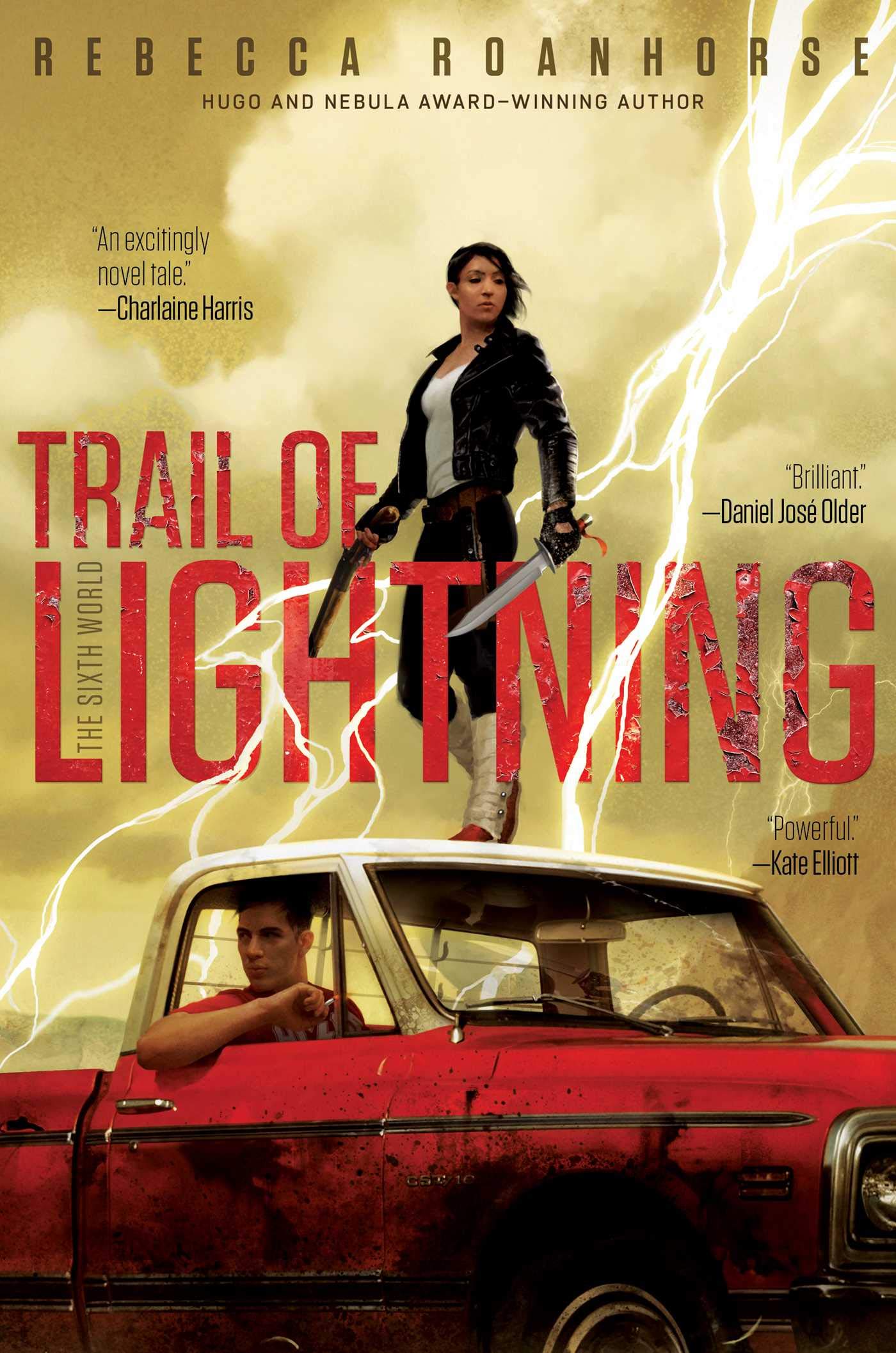
Cover of Trail of Lightning featuring Maggie standing on a truck with a knife
Even though the past of speculative fiction is founded in the frontier mythos and colonial tropes, contemporary speculative literature is actively troubling and questioning this past. Indeed, as the previous generation of largely white, male writers are becoming less active in the community, the trajectory of the speculative genre is shifting toward imagining more equitable futures. While there is much work still to be done, Helen Young acknowledges: “Fantasy—despite, or even perhaps because of, its long reception as a genre designed to ‘serve rather than subvert the dominant ideology’—has considerable power to dig up long-buried histories of colonisation and imperialism and to challenge the assumptions on which their power structures rely by offering new perspectives. This is so despite the ongoing legacy of colonialist ideology which permeates the genre” (114). Indeed, a cohort of authors have been actively publishing books that subvert such tropes: David Anthony Durham, N. K. Jemisin, Nnedi Okorafor, Sabrina Vourvoulias, Tananarive Due, China Miéville, Nalo Hopkinson, Stephen Graham Jones, Rebecca Roanhorse, Kai Ashante Wilson, Darcie Little Badger, Charlie Jane Anders, R. F. Kuang, Silvia Moreno-Garcia, Daniel José Older, and more. When thinking particularly about troubling the frontier and colonialism, Rebecca Roanhorse’s debut Trail of Lightning (2018) presents an interesting and fun example. While often cited as an urban fantasy, I’d argue that it’s more of a weird western—except Roanhorse banishes the figure of the white cowboy. Early on, she invokes the western genre: “Tse Bonito is still more Wild West frontier town than anything else. Bunch of cowboys and Indians, although everyone’s pretty much Diné. Last time I came through here looking for a Bad Man, I ended up in a shootout that felt more like OK Corral than a monster hunt” (Roanhorse 24). While invoking the western, Roanhorse reminds the reader that not all cowboys are white. In fact, in a slick worldbuilding move, Roanhorse easily disposes of the question of white colonists all together. 

Early in the novel, the main character, Maggie, reminisces about the recent history of the land. As the climate crisis worsened, a climate event flooded much of the US, an event the Diné called “Big Water.” This climate event prompted more resource grabs and the Energy Wars, so the Diné built a wall around their lands: “The head of the [Indian] Council, his name was Deschene, wrote some article for the Navajo Times that put the fear in people, especially after the Slaughter on the Plains. Navajo people weren’t safe anymore, he said. He invoked the specter of conquest, manifest destiny. And he wasn’t wrong. The Slaughter had ushered in a heyday of energy grabs” (23). While not everyone agrees with the Wall, Maggie later narrates: “I had forgotten that the Diné had already suffered their apocalypse over a century before. This wasn’t our end. This was our rebirth. […] And the Wall took on a life of its own. When the workmen came back the next morning, it was already fifty feet high. In the east, it grew as white shell. In the south, turquoise” (23). While much of the novel is fast-paced action sequences and monster hunting, the worldbuilding is rooted in anti-colonial discourse. 

I chose Roanhorse for this brief analysis not because her novel offers the best example of undermining colonialism and the frontier mythos but because her novel is not about that, at least, not entirely. Roanhorse’s novel is first and foremost an adventure and a fast-paced read. It’s not about Indigenous pain. Indeed, because of it being a speculative fiction novel rather than literary fiction, Roanhorse can remove white people to behind a wall. Just as earlier texts so easily dismissed Indigenous people, so Roanhorse imagines away white people. In other texts, Roanhorse has more directly engaged with the legacy of colonialism,  but I argue that part of moving forward is making sure that not every text that engages with colonialism does so through pain and suffering. While frontier mythos and colonialism are linked to speculative literature’s earliest texts and still haunts the genre today, contemporary writers are demonstrating that there is more to the genre than otherizing the unknown.


Works Cited

Gilman, Charlotte Perkins. Herland and Selected Stories. Signet Classic, 1992.

Herbert, Frank. Dune. Clinton Book Company, 1965.

Roanhorse, Rebecca. Trail of Lightning. Saga Press, 2018.

Suvin, Darko. Metamorphoses of Science Fiction: On the Poetics and History of a Literary Genre. Yale UP, 1979.

Young, Helen. Race and Popular Fantasy Literature: Habits of Whiteness. Routledge, 2018.


Phoebe Wagner is a PhD candidate at University of Nevada, Reno. When not writing or reading, she can be found kayaking at the nearest lake. Follow her at phoebe-wagner.com or on Twitter @pheebs_w.

Wednesday, July 8, 2020

Reading the Hugos: Related Work

Welcome back to Reading the Hugos. Today we continue our series on the 2020 finalists with a look at Related Work.
3.3.6: Best Related Work. Any work related to the field of science fiction, fantasy, or fandom, appearing for the first time during the previous calendar year or which has been substantially modified during the previous calendar year, and which is either non-fiction or, if fictional, is noteworthy primarily for aspects other than the fictional text, and which is not eligible in any other category
Related Work is a hodge podge of a catch-all category. It’s for work that is primarily non fiction and that is related to science fiction and fantasy, and which is not otherwise eligible elsewhere on the ballot. The history of the category will see critical works next to art books next to encyclopedias next to podcasts next to essays next to speeches next to documentaries next to websites. There may also be a single blog post competing and winning in the category. In this case of this year there is one memoir, two critical biographies, one documentary, another biography (though not a critical one like the other two) and an acceptance speech. Related Work is an interesting cross section of another side of the genre and another side of fandom.

  • Becoming Superman: My Journey from Poverty to Hollywood, by J. Michael Straczynski (Harper Voyager US)
  • Joanna Russ, by Gwyneth Jones (University of Illinois Press (Modern Masters of Science Fiction))
  • The Lady from the Black Lagoon: Hollywood Monsters and the Lost Legacy of Milicent Patrick, by Mallory O’Meara (Hanover Square)
  • The Pleasant Profession of Robert A. Heinlein, by Farah Mendlesohn (Unbound)
  • “2019 John W. Campbell Award Acceptance Speech”, by Jeannette Ng
  • Worlds of Ursula K. Le Guin, produced and directed by Arwen Curry

Photo Credit "naye" @unnaye https://twitter.com/unnaye/status/1163170453244010496/
2019 John W. Campbell Award Acceptance Speech: In 2012 an acceptance speech from the editors of The Drink Tank fanzine (Christopher Garcia and James Bacon) was a finalist for Best Dramatic Presentation, Short Form. Up against three episodes of Doctor Who and one of Community, it didn't win (the Neil Gaiman penned "The Doctor's Wife did). So, it's interesting that Jeannette Ng's Campbell Award acceptance speech was nominated as a Related Work this year - though it does fit somewhat better here than in Dramatic Presentation. The Drink Tank also would have fit better in that year's Related Work category, matched up against Seanan McGuire's Wicked Girls album and a season of the Writing Excuses podcast, but that isn't really here nor there.

Jeannette Ng won the John W. Campbell Award for Best New Writer last year and her speech was fiery, inflammatory, and absolutely perfect for the moment. You can read it or watch it if you need a refresher on what Ng said, but if you pay attention to the genre at all (if you're a reader of Nerds of a Feather and follow the Hugo Awards) you're probably already aware of it.

Ng's speech is important. It crystallized conversation within the genre that has been taking place for a number of years and was the final push that helped drive the change of the John W. Campbell Award for Best New Writer to the Astounding Award for Best New Writer. That was an important and necessary change that ever so gradually moves the field forward and Ng's acceptance speech was a significant part of that change (though not the whole).

It seems that honoring Ng's acceptance speech here is a recognition of what the speech did more than what the speech was. Ng's speech was passionate, but it was not necessarily the best piece of genre related work from last year. What Jeannette Ng's speech did, however, that was vital and likely merits its inclusion here.


The Pleasant Profession of Robert A. Heinlein: I wonder if I was more familiar with Heinlein's work if I would have appreciated this more. The Pleasant Profession of Robert A. Heinlein is a scholarly look at the works (and partially the life) of Heinlein. Farah Mendelsohn digs deep into Heinlein's work and examines his attitudes and beliefs as presented in the text - whether it is on guns or race or equality and the answers are more complex and surprising than a cursory understanding of Heinlein might suggest.

This is a major biography of one of the giants of the genre's history and it lives up to its billing. Unfortunately for me, I've only read Starship Troopers and Job and have no familiarity with any of Heinlein's short fiction - and that's left the The Pleasant Profession of Robert A. Heinlein to be a bit of a dry tome. On the other hand, Paul Weimer reviewed the biography last year and described it as an "essential volume of genre criticism", which is certainly true.


Worlds of Ursula K. Le Guin: I've joked with Adri the last couple of years about there always being another Ursula K. Le Guin work eligible for the ballot and there always will, whether it is a work you could reasonably consider being created by Le Guin or "simply" about her and her work. Worlds of Ursula K. Le Guin is this year's / last year's Le Guin.

Worlds of Ursula K. Le Guin also happens to be a rather excellent documentary and is engrossing from minute one to the end. I watched it back in August 2019, so my memories are a little fuzzy - but what I remember most clearly is that it was one of the best genre related documentaries I was likely to watch. It's a thoughtful film of a thoughtful writer and I won't be surprised if it wins this year - especially after Le Guin won Related Work in 2017, 2018, was a finalist in 2019 and her illustrated Earthsea book won for Art Book based on the illustrations of Charles Vess. It's the late resurgence of non-fiction Le Guin.


The Lady from the Black Lagoon: If you haven't paid much attention to the history of animation in the United States (or even if you have), you may not have heard of Milicent Patrick - one of the first female animators at Disney and the primary creature of The Creature from the Black Lagoon.

The Lady from the Black Lagoon has a dual narrative - the triumphs and drama of Patrick's life, as much as could be gleamed from limited records, and that of Mallory O'Meara's quest to discover what she could of Patrick's life. There's as much story in the discovery as there is in Milicent Patrick herself. As such, this is a less traditional biography but is an effective way to tell the story of a woman so central to monster movies and yet so erased. It seems that Milicent Patrick never quite shared the sense of loss for the career she could have had if only she had any real institutional support for her skill and her craft - but Mallory O'Meara conveys it all the same - it's a loss that occurs time and again in so many fields.


Joanna Russ: I can be a sucker for an accessible critical biography and that is exactly what Gwyneth Jones has delivered with this look at Joanna Russ. This is a deep dive into the work of Joanna Russ, not quite into her personal life and Jones examines the scope of Russ's career.

In her earlier review of this volume, Adri wrote "Jones's reading of The Female Man, in particular, was interesting in the way it presented a radically different lens than the one I had read the novel in, taking the different aspects of the Joanna personality as a reading of identity across time rather than dimensions. It's a reading which brings Russ into conflict with her own identity as an SFF writer and Jones doesn't hold back from the implications of that reading, tracing it throughout the rest of her work and noting where the seeds come in at earlier points. If, like me, you don't often approach literature from a strongly academic lens, some of this will probably be well in the realms of "well I'd never thought of it like that", but it never comes across as particularly prescriptive or inherently dismissive to other readings, so I was able to enjoy the different ways of thinking about the texts rather than feeling put in my place by them, as is always the risk with more academic takes."

I generally agree with Adri's take here, both in her wishes about more of Joanna Russ's conversations with other writers, as well the general appreciation of the breadth of this volume. It's exceptional.


Becoming Superman: For more than half of this book I came out of each chapter wanting to give J. Michael Straczynski a hug. If someone made a movie of his life and incorporated his childhood and then his family's backstory, it would be unbelievable. Straczynski's childhood is just about as bad as it can get, and yet each time a revelation about his family comes up - it gets even worse.

The good thing is that we know from the subtitle that this is his "journey from poverty to Hollywood" and we know as science fiction fans that he is the creator of Babylon Five, winner of two Hugo Awards and a finalist for two others. We know that he makes it out and he is successful. Becoming Superman is an incredible story and Straczynski keeps it engaging the entire time. He never shies away from the worst, but the worst never overpowers either - possibly because we know there is a better life ahead.


My Vote
1. Becoming Superman
2. Joanna Russ
3. The Lady of the Black Lagoon
4. Worlds of Ursula K. Le Guin
5. The Pleasant Profession of Robert A. Heinlein
6. 2019 John W. Campbell Acceptance Speech


POSTED BY: Joe Sherry - Co-editor of Nerds of a Feather, 4x Hugo Award Finalist for Best Fanzine. Minnesotan. He / Him.

Monday, November 25, 2019

The Hugo Initiative: Blogtable (1974, Best Short Story)

Adri: Welcome back to another installment of our Hugo short fiction retrospectives! We lost Paul to the Himalayas for this round but Joe and I are undeterred, and this time we’re moving ahead into the 1970s and specifically the short story category, with four interesting stories on the final list:
“The Ones Who Walk Away from Omelas”, Ursula K. Le Guin (New Dimensions #3)
“With Morning Comes Mistfall” George R. R. Martin (Analog, May 1973)
“Wings”, Vonda N. McIntyre (The Alien Condition)
“Construction Shack”, Clifford D. Simak (If, Jan-Feb 1973)
Joe: Going into the 1974 Hugo Awards, Clifford Simak was a 7 time Hugo Award finalist (with two wins, including the novel Way Station) and Ursula K. Le Guin was a 5 time Hugo Award finalist (also with two wins for The Left Hand of Darkness and The Word for World is Forest). George R.R. Martin and Vonda McIntyre were relative newcomers. “With Morning Comes Mistfall” was Martin’s first time on the Hugo ballot (he would go on to win the next year for his novella “A Song for Lya”), though he had also been a finalist for the John W. Campbell Award (now the Astounding Award) for Best New Writer in 1973. Vonda McIntyre was a two time finalist in 1974, winning for her novelette “Of Mist, and Grass, and Sand”, the precursor to Dreamsnake (1979, Best Novel).

1974’s Short Story was a blend of well established writers and exciting writers new to the field. Simak had been publishing for some forty years, Le Guin was at the height of her powers, while Martin and McIntyre were just starting out.

Adri: Agreed - and what’s interesting is that these are all authors who are known primarily, at least now, for novels rather than for short fiction (though of course all have written plenty of both). It’s definitely interesting to see the overlap of different eras, with George R. R. Martin and Vonda N. McIntyre entering for the first time and Simak and Le Guin being more established (though Simak’s career did start long before Le Guin’s!)

Joe: I’d like to start with Clifford Simak’s story “Construction Shack”, because the story is a bit of an outlier and in a way, it impacts how I think of the rest of the finalists and of the genre as a whole.

After years of puzzling over the differences between measurements made of Pluto and photographic evidence sent back from uncrewed probes, a crewed probe is sent to Pluto to investigate the distant planet. We could use the now outdated term “manned” when talking about “Construction Shack” as there is nary a woman to be seen in Simak’s story.

Upon arrival, the three astronauts (a chemist, engineer, and a geologist) discover that Pluto is even stranger than they had believed...


Even in 1974, “Construction Shack” feels like a throwback to an earlier time in science fiction. I’d believe you if you told me the story was published in 1953. The story just doesn’t come across as sophisticated or as modern as the other three stories on the ballot.

“Construction Shack” both benefits and suffers from the story being written before more information and more facts were known about the dwarf planet (heck, Pluto’s moon wasn’t even discovered until 1978) because Pluto being significantly lighter than estimated, being made out of steel, and functionally being the titular construction shack of the solar system just does NOT work today. It’s interesting enough, don’t get me wrong, but it severely dates the story in ways that makes it impossible to write today - similar to how stories of Venus being a steamy jungle world work as intentional throwbacks rather than truly modern stories now. Of course, a new story wouldn’t have to be Pluto. It could be anything. Pluto just adds a touch of “what if one of OUR planets wasn’t actually a planet?”, and that’s fun, as far as the story goes.

I am also slightly annoyed by the ending shout of what else the “bunglers” did that was found in the blueprints and what it might mean because Simak ends the story before that sort of reveal. I’m not the reader that needs everything spelled out, but the most fun bit of the story was the speculation that the whole solar system was manufactured and possibly manufactured poorly. Ending on the shout is a tease and a gimmick that comes across as older and more tired than other prominent stories of the 1970’s.

Adri: I don’t think that the “datedness” of the premise in a story like this is inherently a problem; while most of the time, reading about steamy jungle Venus or earth-but-red Mars tells you when a story was written, SF in space has such an ingrained element of the fantastic even when set in places that don’t challenge modern suspension of disbelief that having to accept a particular version of a solar system is fairly easy (see, for example, Catherynne M. Valente’s Radiance for a recent example). That said, this is an odd, shallow story, and not the type of fiction I expected to be reading from a 1974 shortlist. Simak’s prolific writing career spanned decades and this nomination comes towards the end, although he’ll win the 1981 Hugo (and Nebula and Locus) awards for one of his very last short stories. It’s therefore hard to see what exactly drew voters to this cursory-feeling space exploration story

Joe: Knowing what we do about the process, presumably a large enough contingent of Simak fans voted to get it on the ballot. It’s clearly out of step with the rest of the finalists.

Adri: The basic premise of Construction Shack is fun, but it’s hard not to imagine what the idea might achieve in different hands. We’re five years before the publication of Douglas Adams’ The Hitchhiker’s Guide to the Galaxy at this point, but here the “galaxy developed by sub-par bureaucrats and their contractors” bit gets very little time to shine, and when it does its hampered by the utter lack of personality in the narrative as a whole. The narrator- who gives his name, but the sentence that it was in was so boring that I forgot it and frankly don’t care to go back - is nothing more than a vehicle for plot, and his one defining trait (“useless geologist”) is left completely unexplored. The other two members of the crew also have extremely boring names (Orson and Tyler) and one defining characteristic (“a bit shouty when provoked”) between them.

Also, I’m not usually one to get into writing style and quality, but the switches between first, second and third person in a story this length are really jarring and add nothing to the story being told. It also uses the word “lostness” instead of “loss” which… I got nothing, people. In short, I don’t have anything good to say about this and I don’t even feel like the bad things I have to say are particularly interesting - so let’s move on!

Joe: Moving on!


Adri: “With Morning Comes Mistfall”, Martin’s debut Hugo appearance (I think this may even be pre Hugo losers’ party, but let’s not get into that...) concerns a journalist accompanying an expedition to a mostly-uncolonised planet finds himself in the middle of an ideological battle between Sanders, the owner of a mountaintop hotel which derives its attraction from the myth of "wraiths" living on the world, and Dubowski, the leader of the expedition, who is interested only in finding practical answers to the planet's mysteries. All of this takes place against a backdrop of otherworldly beauty, as the planet gets covered in mist at sunset that then gradually burns off during the day, and as well as the element of unsolved mystery there's also an attitude clash between Sanders and the narrator, who appreciate the natural beauty of the planet for what it is, and Dubowski's complete disinterest.

Joe: This was my second time reading George R. R. Martin’s “With Morning Comes Mistfall” and I rather like it. It’s a wistful story, not quite of the longing for a better or a different day, but more the wist of knowing that something you love and treasure is going to disappear.

Adri: I approve of the word “wist” in that sentence!

Joe: It’s also a story of the quiet war between a scientific fact that can be proved and the belief in something otherworldly, where it doesn’t quite matter if that something is true - it matters because of the belief, of the mystery and magic of something that could be true and it is that possibility that makes the exploration and the mystery meaningful. The behind the scenes of the story is the scientific expedition that’s going to take that magic and mystery away. The story itself is a series of conversations between a reporter and the owner of a resort who is angry that his way of life is going to disappear whether or not anything is found in the mists of his world.

Adri: While the personalities involved in these conversations feel somewhat two-dimensional, the overall result is a story which packs a lot of layers for what initially comes across as a straightforward set-up. Sanders and, increasingly, the narrator claim to appreciate the planet for the unanswered question of the wraiths, and are dismayed when Dubowski "definitively" resolves the issue by finding natural causes behind all of the sightings and disappearances which have taken place in the mist (the future, apparently, is free of random conspiracy theorists and spiritualists who keep believing and constructing their own evidence even in the fact of such facts), paving the way for mediocre capitalism to win out over the sublime. But the reader can't help noting that it's not the wraiths which the pair want to celebrate about the planet, but its spectacular scenery - the wraiths just serve as an excuse for people to visit, and even then the narrator's interest in the natural world appears to be unusual enough to draw Sanders to him as a potential kindred spirit. Then again, the fact that the spectacular scenery is literally composed of obfuscating mist means that it all fits well as an overall metaphor for things best left hidden. Also, the contrast between Simak's flat but serviceable blokes and the ones deployed here is very telling, with Morning Comes Mistfall coming off far better in the comparison.

Joe: Ignoring the cost of interplanetary travel, you’d think that a place as spectacular as Wraithworld would still get more visitors on general tourism - but maybe it really is just the hook of the wraiths that brought people and once that was gone from the general galactic consciousness - ghost tourism wasn’t enough to sustain the resort. I do think there were still conspiracy theorists and true believers, but sometimes that’s not enough.

“With Morning Comes Mistfall” is a lovely story, but I think that Vonda McIntyre’s “Wings” is closer to what I expected when we started on this category.


Adri:“Wings” is the story of two members of a winged species, one older and disabled, one younger and injured, and their relationship to each other in a world that has otherwise become empty. The "Keeper", who takes in and nurses the younger back to health, also has to deal with romantic and sexual thoughts about the "Youth" - and is unable to conceal this from his unconsenting charge. We find out fairly late in the story that this isn't because of the age gap, and the characters' species has an intergenerational mating pattern: during their youth, individuals take on a significantly older mate (and a binary sex), until the older dies; they then seek out a younger partner later in life. Instead, the Youth's rejection of the Keeper appears to stem from a taboo around disability, as well as a fear of not being able to leave and find out whether anything is left of the society they have both been separated from.

Wings is a slow, dreamlike story, which draws its strengths from the interactions between two very alien and yet relatable protagonists and their loneliness and unfulfilled needs even around each other - a story which I went straight back to reread to figure out if I'd really taken it all in.

Joe: I liked it. I wanted more from this story, whether it was a novelette, a novella, or just more set in this world. The setting is rich, though so quickly drawn. “Wings” deals with death and connection and mortality. It’s a science fiction story that reads as fantasy, or at least some light blending of the two.

Adri: You’re right that there's not much in the world itself, but what there is is something that could easily fill out stories way beyond these two specific characters - indeed, I understand that there’s at least one more story in this world, which I assume fleshes out the disappearance of the rest of the characters’ race a bit more.

It's interesting that you say it fits in with the time period, because I think this is the story I could most see being published today - its glimpse at epic worldbuilding through a short story lens would fit right in at Beneath Ceaseless Skies despite the slightly alien nature of the protagonists.

Joe: I can see that. I just happened to read the story very shortly after finishing “Construction Shack” and considering both stories in context of this category, “Wings” was refreshing in that it felt like it belonged and that the short fiction 1970’s were far more modern than the short fiction of the 1950’s - or even of 1968 when we discussed that year’s short story finalists. But you’re right, “Wings” does feel the most modern of all four.

Adri: My only niggle in this story is with the portrayal of disability, and of the inability to move as something to die for. It is somewhat called out in the story, as we see the Youth’s rejections of the Keeper, and the Keeper’s own negative self-identity, are shaped by his lack of flight in ways that the story implies are unfair and have negative impacts on the characters. However, the ending, and the emphasis on the cultural importance of what basically amounts to ritual suicide by flying into the sun (a metaphor that never gets old), is sort of portrayed as something that excuses the prejudice, and the characters basically overcome it by finding a way to commit ritual suicide together which I didn’t love. Its a story which draws tragedy from characters with disability not having a place, rather than allowing them to push to find a place together.

Finally, we come to the winner, and the story of this quartet that has probably had the most cultural resonance to date: Ursula K. Le Guin’s “The Ones Who Walk Away from Omelas”.


Joe: Though ostensibly describing a “Festival of Summer”, an unnamed narrator describes what he or she knows of the city of Omelas, a city that initially feels utopic but is revealed to have an underlying horror which permits the “utopia” to exist. Many of the initial details are vague, leaving the reader to fill in the blanks but to assume that what the reader imagines could be possible and that whatever it is, it is the best of all things - except that the driver of all of that goodness is the absolute isolation and degradation of a child.

The story is a thought experiment and a philosophical challenge.

I *may* have read this before, though if pushed I’d probably tell you that I have not. It’s familiar, but I’ve recently read N.K. Jemisin’s “The Ones Who Stay and Fight” and I’m sure I’ve read one or two others that play with Le Guin’s form, so it may be that I’ve read enough around Omelas that it’s imprinted on me. “The Ones Who Walk Away from Omelas” is somewhat of a foundational science fiction story at this point and it has shaped some of the genre around it.

Unsurprisingly, Omelas is an increasingly unpleasant story (as it should be) because it raises questions (and points a finger) at how easy it is to look away, to make excuses, and accept that our comfort in the aggregate is more important than a single individual. There are plenty of stories that use the idea of the importance of the group over that of the individual, but it’s so stark here.

Adri: Yes, it’s been a couple of years since I last read “The Ones Who Walk Away From Omelas” in its entirety, and it was interesting to revisit it in light of some of the recent stories that respond to it - as well as the Jemisin, I’m thinking of P.H. Lee’s “In The House By the Sea”, which interrogates what we will and won’t believe about the fate of the children themselves, and is also well worth a look. I think I appreciated it even more this time around, in the context of this particular category: the tone, the way the speculative city is set up and the role of the narrator in doing so, the constant needling at audience disbelief, all come together for a thought experiment that rises far above its simple utilitarian roots, hitting at the stories we tell ourselves about our societies and how they are organised and who needs, and deserves, dignity and comfort.

I could spend an entire essay picking apart the different elements here (given a time machine so I could make the time to write, of course), but for now I particularly want to draw attention to the last line of the story: “They seem to know where they are going, the ones who walk away from Omelas”. I think, given the differences between when this story was written and the moment we’re living now, its important to interrogate why the story focuses on individuals who opt out from a system, rather than trying to change it - but I was struck, on this readthrough, by the fact that these aren’t portrayed as people throwing in the towel to go and aimlessly wander the wilderness: they know where they’re going, and it doesn’t involve this particular system. Then again, I do feel much more sympathetic to the people and the mindset of Jemisin’s Um-Helat than I do to the ones who walk away from Omelas - even while it doesn’t change my opinion on how brilliant and important the story that sparked them both is.

Joe: “The Ones Who Walk Away from Omelas” is not a story I want to read all that often, but I’m not surprised that it won the Hugo. It’s a story with wide ranging importance that I think would have been evident when it was first published (it *did* win the Hugo). Interestingly, Omelas was not on the Nebula ballot, though the Martin and McIntyre stories were.

Adri: So, now we’ve read all four of 1974s short story ballot entries, what do you think should have won? Or rather, what would you have voted for?

Of the stories here, I think I liked the McIntyre most - its got a beautiful tone to it and offers a window into a very strange world that nevertheless makes sense within the story. However, for all the limitations of its thought experiment - and is just one thought experiment - I can’t fault the voters of 1974 for opting for The Ones Who Walk Away from Omelas. It’s a big idea story whose big idea is about ethics and anthropology and even about the nature of story itself, and it does what all the best Le Guin stories do by offering a deceptively simple outer layer to suck you into something much deeper and highly thought provoking.


At the other end of the spectrum, we have Simak, which didn’t do much for either of us, and which I can’t really understand being award worthy in any year, and a Martin story which is highly readable enjoyable, but probably isn’t going to stay with me. So my vote at Discon II (if I’d been alive and reading science fiction) would have gone to Le Guin, then McIntyre, then Martin, then Simak, with clear water between all four and possibly even No Award above Simak if I was feeling especially grumpy on ballot submission day.

Joe: I like the double layer of the question because it’s the push and pull between how I think I would have voted then compared to how I would vote today if these four stories were put in front of me.

I sort of wish we had a big disagreement here, but we don’t. “Wings” is the story I like best, but “The Ones Who Walk Away from Omelas” is the most important and I think that would have come across to me back in 1974 when I was negative five years old. The power and the depth of Omelas still very much resonates today, and it is a story that can spark conversation today.

I think my vote would have been tighter than yours, at least for Le Guin - McIntyre - Martin in that order, but it would be a distant fourth for Simak and like you, “Construction Shack”’s placement above No Award would depend entirely on my generosity when I mailed in my ballot.

I wish I could find something definitive about how the stories placed on the final ballot. ISFDB suggests it was Le Guin - Martin - Simak - McIntyre, but I don’t see a link to the actual voting details anywhere and that would be really nice to have for confirmation purposes.

Adri: Ah well, we shall have to agree to agree this time...

Regardless of my feelings about Construction Shack, I’m glad to have taken a look at this category: Wings was a great find, and With Morning Comes Mistfall was also an enjoyable look at an author who I’ve never previously read outside of (very very) longform. And the opportunity to reread “The Ones Who Walk Away from Omelas” was, if not exactly a pleasure, then a welcome engagement with a pretty masterful piece of writing.

Thanks as always for the chat.

Joe: Thank you!


Joe Sherry - Co-editor of Nerds of a Feather, 3x Hugo Award Finalist for Best Fanzine. Minnesotan

Adri is a semi-aquatic migratory mammal most often found in the UK. She has many opinions about SFF books, and is also partial to gaming, baking, interacting with dogs, and Asian-style karaoke. Find her on Twitter at @adrijjy. 

Wednesday, June 12, 2019

Reading the Hugos: Related Work

Welcome back to Reading the Hugos. Today we continue our series on the 2019 finalists with a look at Related Work.
3.3.6: Best Related Work. Any work related to the field of science fiction, fantasy, or fandom, appearing for the first time during the previous calendar year or which has been substantially modified during the previous calendar year, and which is either non-fiction or, if fictional, is noteworthy primarily for aspects other than the fictional text, and which is not eligible in any other category
Related Work is a bit of a catch-all category. It’s for work that is primarily non fiction and that is related to science fiction and fantasy, and which is not otherwise eligible elsewhere on the ballot. This is how you can have an encyclopedia compete against a folk album against a podcast against a collection of essays about movies (this was in 2012 when the Fancast category had not yet been created. That particular lineup of finalists can’t happen today. You may also note that albums and songs have been included in Dramatic Presentation – because the two Clipping albums in question are narrative driven whereas Seanan McGuire’s Wicked Girls was not.). There may also be a single blog post competing and winning in the category. Or a series of blog posts focusing on the women of Harry Potter. In the case of this year there is a four way biography, a series of interviews, a three part documentary, a collected essay series about the Hugo Awards, a recognition of the work done by a website, and the experience of bringing together Mexicanx fans and creators to Worldcon. Related Work is an interesting cross section of another side of the genre and another side of fandom.

Let’s take a look at the finalists.


Archive of Our Own, a project of the Organization for Transformative Works
Astounding: John W. Campbell, Isaac Asimov, Robert A. Heinlein, L. Ron Hubbard, and the Golden Age of Science Fiction, by Alec Nevala-Lee (Dey Street Books)
The Hobbit Duology (documentary in three parts), written and edited by Lindsay Ellis and Angelina Meehan (YouTube)
An Informal History of the Hugos: A Personal Look Back at the Hugo Awards, 1953-2000, by Jo Walton (Tor)
www.mexicanxinitiative.com: The Mexicanx Initiative Experience at Worldcon 76 (Julia Rios, Libia Brenda, Pablo Defendini, John Picacio)
Ursula K. Le Guin: Conversations on Writing, by Ursula K. Le Guin with David Naimon (Tin House Books)


Conversations on Writing: In an effort to have one more opportunity to honor Ursula K. Le Guin, it seems that the members of Worldcon will nominate anything with her name on it. Conversations on Writing is a more ancillary work to science fiction and fantasy (it occasionally mentions works of science fiction, but the real tie here is Le Guin herself), but I'm not sure this is one of the top "Related Works" of 2018.


The Hobbit Duology: Just like the Hobbit films were originally planned to be two movies before being stretched to three, this documentary from Lindsay Ellis and Angelina Meehan is likewise a three part feature - though at least here Ellis and Meehan have a more tightly constructed plan that anyone involved in the 2012-2014 movies. Has it only been five years?

I appreciated the dive into why the three Hobbit movies were so disappointing, but it was the further investigation into how the the films came to be split into three and the legal issues tied to the production and and the filming in New Zealand. I don't admire it as much as I do some of the other works on this ballot, but it is a worthy finalist.


Archive of Our Own: I was enthused to see Archive of Our Own on the Hugo Award ballot. Related Work can be a tricky category to figure out and there is a propensity to treat the Related Work as “best non-fiction book” with limited exceptions in most other years. I’ve had Archive of Our Own on my nominating ballot for the last several years because I believe it is important to honor, celebrate, and recognize the importance of AO3 in the genre community and the only place where that is possible within the framework of the Hugo Awards is in Related Work.

Archive of Our Own is known as a significant fan fiction site, a repository for a massive amount of fan writing. The AO3 contribution in the Voter's Packet is descriptive as to what AO3 is, but a page on AO3's website is much more comprehensive for the breadth of what they do. The fan writing and the fan fiction is an important part of the genre (though one that I do not directly participate in), but how the Organization for Transformative Works operates AO3 is key for the nomination. The ease of the new filtering and tagging systems, inclusiveness, and the overall breadth of the AO3 experience is part of why it is such an importance resource. .


The Mexicanx Initiative Experience: Before the Voter's Packet was released, I was curious how The Mexicanx Initiative could possibly be represented in consideration for the Hugo Award given that what we are honoring here is the experience of the 50 selected recipients attendance at Worldcon 76 in San Diego. It wasn't a book or a film or a story or a discrete work that didn't fit into a category. We're honoring an event, which is definitely related to the field of science fiction, fantasy, or fandom, and absolutely does not fit into any other category. I attended that Worldcon, at least of the periphery, but I was not part of the Experience and while I included it on my ballot, I wasn't sure how in what way I would be able to consider it for the actual Hugo Award.

There are two major pieces of work in the Voter's Packet. The first is the closest readers are going to come to getting to the heart of what the Experience was actually about and what it might have been like for the attendees, as well as the impact it is likely to have on the field as a whole - which is a Scrapbook. The Scrapbook is a series of interviews with the attendees, essays, recipes, and more. Reading through, I got more of the real community impact of the Experience and how important it was to the attendees. The other work included in the packet is an anthology of fiction from the Mexicanx Initiative attendees, but the real consideration here is the Scrapbook and the overall experience of the attendees.

The Mexicanx Initiative was a vital part of science fiction and fantasy fandom in 2018 and I hope it is something that we will be able to look back on as a landmark moment that moved and pushed fandom.


An Informal History of the Hugos: I was already familiar with the essays collected in An Informal History of the Hugos when the book was published last year. I followed Jo Walton's essays when she originally wrote as part of an essay series for Tor.com from 2010 to 2013 and not that I'm nostalgic for the good old days (such as they are), but dipping into this collection one essay at a time is likely a more productive way to read the essays instead of mainlining them right into your head - which is what I'm doing this time around.

If you're into the history of science fiction and fantasy, and especially of the Hugo Awards and conversations about how the finalists have held up over the years and what the members of Worldcon might have missed, this is the book for you. It is a delight, it has greatly expanded my reading list, and it has me contemplating a similar project of my own. That's the delight of An Informal History of the Hugos - it is a personal history of the Hugo Awards through the lens of a writer steeped in the history of the genre.


Astounding: The names John W. Campbell, Isaac Asimov, Robert A. Heinlein, and L. Ron Hubbard are names which loom large over the history of science fiction and fantasy, but for me, for the most part, they are just names. Legends. Oh, I've read my share of Asimov and the occasional Heinlein, but these are not the formative figures of my childhood, or of the early years of my introduction to the genre. Campbell is a name of genre legend helping to usher in the "Golden Age" of science fiction and Hubbard is known as the founder of scientology and for having his 1986 novel Black Genesis illegitimately gamed onto the Hugo Awards ballot the following year. But knowing the broad strokes of something is not knowing the story.

Alec Nevala-Lee puts Campbell at the center of the story of all four men in a well researched account that neither pulls punches or let's anyone off the hook. These were heady days in the explosion of science fiction and fantasy and these are towering figures in the genre's history. Astounding is a top notch biography, one of the class of the year.


My Vote
1. Astounding
2. An Informal History of the Hugos
3. The Mexicanx Initiative Experience
4. Archive of Our Own
5. The Hobbit Duology
6. Conversations on Writing


Our Previous Coverage
Novel
Novella
Novelette
Short Story


Joe Sherry - Co-editor of Nerds of a Feather, 3x Hugo Award Finalist for Best Fanzine. Minnesotan.

Friday, November 2, 2018

Feminist Futures: The Word for World is Forest


Dossier: Le Guin, Ursula K. The Word for World is Forest [Again Dangerous Visions, 1972; Berkley / Putnam, 1976] 

Filetype: Book

Executive Summary The Word for World is Forest’s story revolves around the revolt of the native population of an Earth colony, New Tahiti. New Tahiti is even more of a water world than Earth, landmasses on the world is restricted to islands and a sub continental sized landmass. The title of the novella reflects the fact that all of these islands, save the island that men have deforested and destroyed, have a forest ecology. In the Hainish verse of Le Guin, humans are not native even to Earth, and their progenitors, the Hain, seeded many worlds, including New Tahiti, with what we would call Terran like plants and animals, although evolution over the last couple of million years since that seeding has had its way on individual worlds. Thus, there are plants and animals which are close and familiar to human norms and then there are beings like the native Athsheans, who are hominids like humans, but are short, only a meter tall, and are green furred.  

Since Earth is an ecological wasteland, the primary function of the New Tahiti colony is as a logging colony to ship valuable wood back to Earth. Humans from Earth are rapidly destroying the native forest in their logging efforts, and not so incidentally, the health of the entire ecosphere. The future of the natives, even as slaves to the humans, is in serious doubt. The Athsheans are not technologically advanced, having only reached the iron age, and so they were easily cowed by firearms and high technology. They are used as indentured servants but are regarded as being lazy even in that.

The Athsheans, however,  finally revolt successfully against their colonial masters in an extremely bloody uprising that kills many of the humans, including all of the women. They then defang the humans of most of their superior weaponry and restrict them to a small area until the next interstellar ship can arrive and remove the survivors.

Feminist Future: As you can see, the feminist themes may be overshadowed by a first reading of the novella, and I missed them entirely when I first read the story. On a recent re-read however, I began to see how Le Guin explores it from each of the points of view we get.

For Davidson, we get a full thrusted 1950’s style of male protagonist striding across the page, with all the casual violence and misogyny that SF protagonists of that age are known for. He treats women dismissively, casually inflicts violence and suffering on the natives, has abhorrent views on men not as infected with toxic masculinity as himself, and a complete lack of sense of self awareness about any of this. Le Guin takes what would be the heroic led in many of the books she grew up with and shows the very questionable underpinnings of the psychology and nature of such a hero. 

For Lyubov, the scientist, we see a more nuanced view of women and their potential role in the colony, in society. He is shown in his own chapters as a typical man of the colony, even if Davidson mentally derides him in his mind as “effeminate”, further showing the slant and bias of Davidson’s point of view. Like any of the male colonists, he is very happy that there has been a new colony ship full of women, enjoys their company sexually but laments they are not entirely mature and forthright. He is the only human to really start to understand the Athshean pattern of governance and wishes, too late, that the colony ships had brought “a couple of grannies along” to better understand Athshean society.

Finally, there is our Athshean protagonist, Selver. It is from his semi-omniscient point of view that we get the major worldbuilding of the novel as regards to how the Athesheans see themselves, and how their societies actually work. Davidson and even Lyubov, for his sympathies for the native inhabitants, simply doesn’t see or know about. We find that the Athsheans, at least as far as the “Forty Lands”, it is women who run the cities and towns, men who go on trading and exploring journeys, Men have power and authority within the Men’s Lodges, but in the end, Selver is only listened to by women like Ebor Dendep because of his ability to dream, because he is taken to be a god. 

The ultimate fact of the inciting of the events of the novella, as revealed in the text, shows what Le Guin is doing here. The Athsheans are enslaved. Their forests are being cut down. They are physically abused by the Humans. There are intimations by Davidson and some of his like minded Humans that the Athsheans should simply be wiped out entirely,.It is ultimately, none of that that is the inciting incident that causes the Athsheans to rise up against the humans and reclaim their world. It is the fact that Selver’s wife was sexually assaulted by Davidson, and subsequently died, that caused Selver to start his result, that made his revolt happen. In the end, it is violence against women that was the bridge too far. 

This further shows that among other things, the novella is criticizing those earlier works that a character like Davidson would have been the hero in. Instead of a world where men are men and women be submissive to them, and reinforcing that toxic cultural norm, in the novella, Le Guin shows us that sort of world--and then shows us just how those sorts of assumptions look from the outside, from a society that does things very differently. 

Hope for the Future: The Word for World is Forest is ultimately a feminist critique of older styles of science fiction. It provides a way to show a science fictional future that ultimately breaks away from the harmful stereotypes and limited values of those earlier novels, and so doing proves the hope and idea that when Humanity heads to the stars, it will be with the chance of becoming better than we were. 

Legacy: The novella's polemic, strong, unyielding tone meant that it had an immediate impact on readers, especially since it was in the high profile Again, Dangerous Visions anthology edited by Harlan Ellison. It deservedly was nominated for and won a Hugo award. It's anti-colonial and ecological themes were likely the greater focus of readers at the time, given the Vietnam War, and the realization and maturation of the work into recognition for its gender and feminist ideals is something that has become a function of seeing it placed within the Hain-verse. 

In Retrospect: Is the novella as great or as groundbreaking as The Left Hand of Darkness or The Dispossessed? Perhaps not. Is it an important landmark of the Hainish cycle of stories and novels, a part of her exploration of gender, feminism and sexuality? Absolutely. In the midst of its more explored and obvious themes, Le Guin, even in the straitjacket of what is arguably a very polemic text about ecological devastation and destruction, finds room to also explore feminist themes and ideas that are a running theme of her work in general.


Analytics

For its time: 4/5
Read today: 4/5.
Wollstonecraft Meter: 8/10 

Monday, June 4, 2018

Summer Reading List 2018: Joe

There are many things in this life which I really, really like. Two of them are reading books and making lists. A third would be making lists about reading books. Strangely, I'm not sure if I want to read a book about making lists, so we'll just move right on from there, shall we?

It is something of a tradition here at Nerds of a Feather to post one's Summer Reading List. Now, since I've been adulting for quite a number of years, the concept of "summer" doesn't have quite the same cache for me as it might have two decades ago. I have to go to work in July much the same as I do in February. And while the summer does mean more trips up to the family cabin, now that I have a child, some of that time spent reading on a swing overlooking a lake with a beer in my hand is going to be spent playing with my children. This is not a bad thing.

With all of that said, I do rather enjoy making lists about books. Nerds of a Feather is a genre blog, so while I plan to continue to read more non fiction each year and I've been reading an increasing amount of non SFF fiction, I do still get through more than one hundred books each year, so what I'm going to highlight is some of the science fiction and fantasy I plan / hope to read this summer.

For those keeping score at home, I have read four of the six books I have listed in both 2016 and 2017. I have decided against listing those books here, even though I do plan / hope to read Kate Elliott's The Gathering Storm, Katharine Kerr's Days of Blood and Fire, and Roger Zelazny's Nine Princes in Amber.


1. Space Opera, by Catherynne M. Valente

Are there readers of this blog who don't know about Catherynne Valente's gonzo-awesome-Eurovision-in-Space novel? It hardly seems possible at this point because if you want to talk about a novel that has completely blown up in all the places I see online, that's it. Every time I see something more about Space Opera, the buzz inside my brain gets louder and louder to the point that in a year which does not have a new N. K. Jemisin novel (go read the Broken Earth trilogy), Space Opera has risen to become the Must Read novel of the year.


2. King Javan's Year, by Katherine Kurtz

It's been a year since I last wrote an entry in my Reading Deryni series (The Harrowing of Gwynedd). I am long overdue to revisit the Eleven Kingdoms. King Javan's Year was the first Deryni novel I read, which is one hell of a novel to start the series with. It was here I learned Kurtz would build up a novel of hope and then send it all crashing down in blood and horror. Perhaps because he was my introduction to this world, Javan has remained one of my favorite characters over the years. I can't say that I'm hesitant to read this because I know how it all shakes out because I included Camber the Heretic in my re-read and to paraphrase a point I made about that novel, George R. R. Martin doesn't have anything on Katherine Kurtz. I think it is rather that re-reading King Javan's Year means that my re-read is almost to an end and I don't have this foundational and formative novel to look forward to in the immediate future.


3. The Left Hand of Darkness, by Ursula K. Le Guin

Late last year I started to read Le Guin's Hainish novels and because it's the way I'm wired, I started with her earliest published volumes: Rocannon's World, Planet of Exile, City of Illusions. Now it's time to get to the heavy hitters of The Left Hand of Darkness and The Dispossessed, two novels which have loomed in and over my consciousness of science fiction for almost as long as I have known about science fiction as a genre with a history.  I have owned the copy of The Left Hand of Darkness sitting on a pile of books next to  my bed for far more years than I am comfortable admitting. It's well past time to remedy this.


4. Stretto, by L. Timmel Duchamp

I first read Duchamp's excellent novel Alanya to Alanya back in 2008 and worked my way through the Marq'ssan Cycle into July 2010 when I read the fourth volume, Blood of the Fruit. I can't say why I held off reading Stretto for these eight years, but I have. The Marq’ssan Cycle, as a whole, is a deeply feminist series of social and moral ideas played out in bold and clear strokes with characters actively conscious of motivation, identity, and theory. The ideas here are what is important. I may need a refresher on the series so far, but I'm ready to finish this one up.


5. Company Town, by Madeline Ashby

This first hit my radar back in 2016 (when it was published) and the word was that the book was damned fantastic. Far be it for me to complain that a novel I've never read seems to have been under-read and under-appreciated, but the sense that I have is that Company Town is both under-read and under-appreciated (though, fully appreciated by those who did read the novel). Company Town has been on my "to-read" list since before publication and it's time to move it up. 


6. A Shadow In Summer, by Daniel Abraham

These days Daniel Abraham is best known for being one half of the writing team behind The Expanse, James S.A. Corey. Back in 2006 he published his first epic fantasy novel, A Shadow in Summer. It received an immense amount of praise, if not the sales to follow. I bought the first two books in the series shortly after publication, but as happens all too often, never cracked the cover. Perhaps this summer is a good time to remedy that.


POSTED BY: Joe Sherry - Co-editor of Nerds of a Feather, 2017 & 2018 Hugo Award Finalist for Best Fanzine. Minnesotan. 

Friday, May 19, 2017

Microreview [book]: Crossroads of Canopy, by Thoraiya Dyer

If you haven’t read this yet, why on earth not? And if you have yet somehow didn’t like it, seriously: why on earth not?

Crossroads of Canopy: Book One in the Titan's Forest Trilogy by [Dyer, Thoraiya]
Dyer, Thoraiya. Crossroads of Canopy. Macmillan, 2017.

You can buy it here, and by the time you’re done reading this review, you’ll want to!

Despite being the target of polarizing reviews (some of which, I am convinced, are consciously or unconsciously motivated by dislike for precisely what makes it unique, namely the unconventional heroine), this story is awesome. Its awesomeness stems partly from its world-building (the unique forest world, consisting of the mysterious Floor, the savage Understory, and the elitist Canopy, with the people and creatures from each a strange and fascinating mix of familiar and alien traits) and partly, perhaps mostly, from its main character. Here’s why heroine Unar is the best female protagonist—and indeed, one of the best protagonists of any biological sex or gender—in years.

Her masculine-without-being-stereotypically-tomboyish femininity:

Unlike the squeaky clean, often virginal heroines of recent popular fantasy and sci fi literature (I’m looking at you, Bella Swan!), Unar has desires…and acts on them. In fact, her coming of age reminded me quite strongly of Tenar’s awakening in Ursula Le Guin’s immortal The Tombs of Atuan. I wonder if Unar’s name might have been inspired by that rather similar story of social and sexual repression, out of which, like two glorious butterflies, these two heroines irrepressibly burst? Unar is not a model of demure femininity; instead, she’s an interesting mix of feminine and (what we might identify as) prototypically masculine traits, especially her tremendous ambition and her hunger for power, qualities that stay-in-the-kitchen traditionalists would doubtless call ‘unfeminine’. Given men’s dismal track record of monopolizing power, controlling female sexuality and indulging their ambitions throughout history (both in the world of Canopy and our own), ‘unfeminine’ girl power doesn’t sound so bad to me.

Thanks for taking a giant dump on the Earthsea cycle, creators of this crappy 2004 miniseries!

Her moral ambiguity:

Generally, heroines are presented as always doing the right thing, so even when, e.g., Katniss Everdeen shoots a certain character in the Hunger Games trilogy, the reader certainly is not meant to question Katniss’s essential goodness. That is, female anti-heroes, true anti-hero(ine) protagonists (not just pure-hearted women forced by cruel circumstances to do bad things, or black-hearted ‘fallen woman’ villains) are very rare, as though even most authors can scarcely conceive of a woman anywhere in the ethical spectrum between the polar extremes of pure goodness and total evil. Unar, however, is decidedly a mixed bag, ethically, and as the reader continues to cheer her on, we too become complicit in some of her darker deeds. I’m not talking about when she’s being mind-controlled, her magic used against her will to harm others; that’s just standard victim stuff. I’m talking about when she does have control: often she acts bravely, and sometimes altruistically, but also occasionally acts out of pure selfishness. Gosh, this mass of contradictions almost sounds like a real person—a lot more than most fairytale heroines, to be sure!

Her overall awesomeness:

Unar is betrayed many times, in many forms, by family, friends and allies, but she is like a juggernaut—nothing can keep her down. She’s also almost unique, given her privileged position, in being quick to recognize the worth of people in a lower social class than her; she both uses their talents for her own ends and, sometimes, uses her own vast powers to help them. She is essentially the only person in her highly and literally stratified world that is able to travel between these distinct layers, combining the best parts of both Canopy and Understory. I can hardly wait until we get a sequel and she begins exploring the still dark and mysterious world of Floor!

The fact that there’s no ‘happily ever after’ in sight:

Usually, books about girls (or boys, for that matter) bring everything to a cathartic and suitably romantic conclusion; the heroine finds and wins the man of her dreams, etc., etc. But Unar has no such too-pat ending waiting for her. Even if no sequel is ever written (though that would be a terrible shame!), Unar’s story is complete in its incompleteness. The worth of a young woman, the sum total of her life, cannot be expressed in hetero(or homo)sexual union—nor is her value necessarily tied to her youth. This story emphasizes that, by focusing more on the life-cycle of the oppressed women of this fictional world, introducing not only Maidens, but also Mothers and Crones, and insisting we the readers take notice of their valuable contributions. Fittingly, at the end Unar finds herself decisively deprived—by her own actions—of the chance to settle down and enjoy a quiet, happy life, and given her morally questionable deeds, her inability to resume her old life, while in a sense a cruel fate, is not a surprising one. It’s only surprising if we the readers have been fed a diet of happily ever afters. I for one am looking forward to future stories about Unar’s fascinating exploits, as something tells me her story is far from over.

 The Math:


Objective Assessment: 6/10

Bonuses: +1 for making such a morally complex, endlessly fascinating heroine as Unar
                +1 for quite creative bout of world-building

Penalties: None!

Nerd coefficient: 8/10 “Totally sweet!”
  

See more about our scoring system (under which 8/10 is quite rare!) here.


This message brought to you by Zhaoyun, aficionado of fictional worlds and devotee of earth-shattering heroines like Unar, and reviewer for Nerds of a Feather since ancient times (2013).