Showing posts with label Joanna Russ. Show all posts

Wednesday, July 8, 2020

Reading the Hugos: Related Work

Welcome back to Reading the Hugos. Today we continue our series on the 2020 finalists with a look at Related Work.
3.3.6: Best Related Work. Any work related to the field of science fiction, fantasy, or fandom, appearing for the first time during the previous calendar year or which has been substantially modified during the previous calendar year, and which is either non-fiction or, if fictional, is noteworthy primarily for aspects other than the fictional text, and which is not eligible in any other category
Related Work is a hodge podge of a catch-all category. It’s for work that is primarily non fiction and that is related to science fiction and fantasy, and which is not otherwise eligible elsewhere on the ballot. The history of the category will see critical works next to art books next to encyclopedias next to podcasts next to essays next to speeches next to documentaries next to websites. There may also be a single blog post competing and winning in the category. In this case of this year there is one memoir, two critical biographies, one documentary, another biography (though not a critical one like the other two) and an acceptance speech. Related Work is an interesting cross section of another side of the genre and another side of fandom.

  • Becoming Superman: My Journey from Poverty to Hollywood, by J. Michael Straczynski (Harper Voyager US)
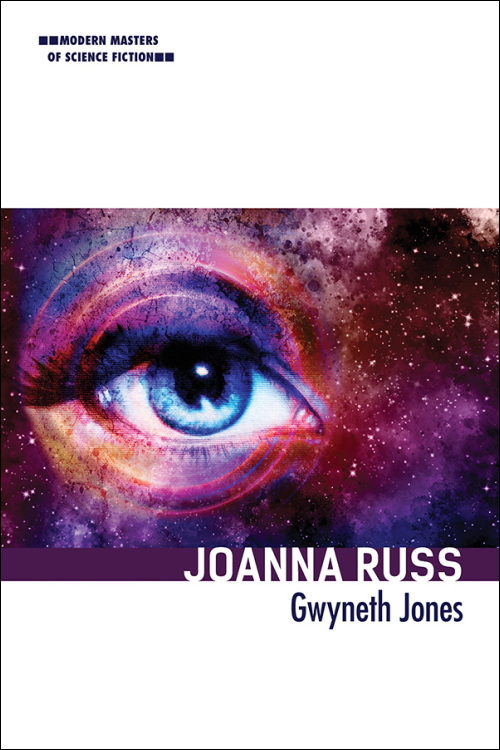
  • Joanna Russ, by Gwyneth Jones (University of Illinois Press (Modern Masters of Science Fiction))
  • The Lady from the Black Lagoon: Hollywood Monsters and the Lost Legacy of Milicent Patrick, by Mallory O’Meara (Hanover Square)
  • The Pleasant Profession of Robert A. Heinlein, by Farah Mendlesohn (Unbound)
  • “2019 John W. Campbell Award Acceptance Speech”, by Jeannette Ng
  • Worlds of Ursula K. Le Guin, produced and directed by Arwen Curry

Photo Credit "naye" @unnaye https://twitter.com/unnaye/status/1163170453244010496/
2019 John W. Campbell Award Acceptance Speech: In 2012 an acceptance speech from the editors of The Drink Tank fanzine (Christopher Garcia and James Bacon) was a finalist for Best Dramatic Presentation, Short Form. Up against three episodes of Doctor Who and one of Community, it didn't win (the Neil Gaiman penned "The Doctor's Wife did). So, it's interesting that Jeannette Ng's Campbell Award acceptance speech was nominated as a Related Work this year - though it does fit somewhat better here than in Dramatic Presentation. The Drink Tank also would have fit better in that year's Related Work category, matched up against Seanan McGuire's Wicked Girls album and a season of the Writing Excuses podcast, but that isn't really here nor there.

Jeannette Ng won the John W. Campbell Award for Best New Writer last year and her speech was fiery, inflammatory, and absolutely perfect for the moment. You can read it or watch it if you need a refresher on what Ng said, but if you pay attention to the genre at all (if you're a reader of Nerds of a Feather and follow the Hugo Awards) you're probably already aware of it.

Ng's speech is important. It crystallized conversation within the genre that has been taking place for a number of years and was the final push that helped drive the change of the John W. Campbell Award for Best New Writer to the Astounding Award for Best New Writer. That was an important and necessary change that ever so gradually moves the field forward and Ng's acceptance speech was a significant part of that change (though not the whole).

It seems that honoring Ng's acceptance speech here is a recognition of what the speech did more than what the speech was. Ng's speech was passionate, but it was not necessarily the best piece of genre related work from last year. What Jeannette Ng's speech did, however, that was vital and likely merits its inclusion here.


The Pleasant Profession of Robert A. Heinlein: I wonder if I was more familiar with Heinlein's work if I would have appreciated this more. The Pleasant Profession of Robert A. Heinlein is a scholarly look at the works (and partially the life) of Heinlein. Farah Mendelsohn digs deep into Heinlein's work and examines his attitudes and beliefs as presented in the text - whether it is on guns or race or equality and the answers are more complex and surprising than a cursory understanding of Heinlein might suggest.

This is a major biography of one of the giants of the genre's history and it lives up to its billing. Unfortunately for me, I've only read Starship Troopers and Job and have no familiarity with any of Heinlein's short fiction - and that's left the The Pleasant Profession of Robert A. Heinlein to be a bit of a dry tome. On the other hand, Paul Weimer reviewed the biography last year and described it as an "essential volume of genre criticism", which is certainly true.


Worlds of Ursula K. Le Guin: I've joked with Adri the last couple of years about there always being another Ursula K. Le Guin work eligible for the ballot and there always will, whether it is a work you could reasonably consider being created by Le Guin or "simply" about her and her work. Worlds of Ursula K. Le Guin is this year's / last year's Le Guin.

Worlds of Ursula K. Le Guin also happens to be a rather excellent documentary and is engrossing from minute one to the end. I watched it back in August 2019, so my memories are a little fuzzy - but what I remember most clearly is that it was one of the best genre related documentaries I was likely to watch. It's a thoughtful film of a thoughtful writer and I won't be surprised if it wins this year - especially after Le Guin won Related Work in 2017, 2018, was a finalist in 2019 and her illustrated Earthsea book won for Art Book based on the illustrations of Charles Vess. It's the late resurgence of non-fiction Le Guin.


The Lady from the Black Lagoon: If you haven't paid much attention to the history of animation in the United States (or even if you have), you may not have heard of Milicent Patrick - one of the first female animators at Disney and the primary creature of The Creature from the Black Lagoon.

The Lady from the Black Lagoon has a dual narrative - the triumphs and drama of Patrick's life, as much as could be gleamed from limited records, and that of Mallory O'Meara's quest to discover what she could of Patrick's life. There's as much story in the discovery as there is in Milicent Patrick herself. As such, this is a less traditional biography but is an effective way to tell the story of a woman so central to monster movies and yet so erased. It seems that Milicent Patrick never quite shared the sense of loss for the career she could have had if only she had any real institutional support for her skill and her craft - but Mallory O'Meara conveys it all the same - it's a loss that occurs time and again in so many fields.


Joanna Russ: I can be a sucker for an accessible critical biography and that is exactly what Gwyneth Jones has delivered with this look at Joanna Russ. This is a deep dive into the work of Joanna Russ, not quite into her personal life and Jones examines the scope of Russ's career.

In her earlier review of this volume, Adri wrote "Jones's reading of The Female Man, in particular, was interesting in the way it presented a radically different lens than the one I had read the novel in, taking the different aspects of the Joanna personality as a reading of identity across time rather than dimensions. It's a reading which brings Russ into conflict with her own identity as an SFF writer and Jones doesn't hold back from the implications of that reading, tracing it throughout the rest of her work and noting where the seeds come in at earlier points. If, like me, you don't often approach literature from a strongly academic lens, some of this will probably be well in the realms of "well I'd never thought of it like that", but it never comes across as particularly prescriptive or inherently dismissive to other readings, so I was able to enjoy the different ways of thinking about the texts rather than feeling put in my place by them, as is always the risk with more academic takes."

I generally agree with Adri's take here, both in her wishes about more of Joanna Russ's conversations with other writers, as well the general appreciation of the breadth of this volume. It's exceptional.


Becoming Superman: For more than half of this book I came out of each chapter wanting to give J. Michael Straczynski a hug. If someone made a movie of his life and incorporated his childhood and then his family's backstory, it would be unbelievable. Straczynski's childhood is just about as bad as it can get, and yet each time a revelation about his family comes up - it gets even worse.

The good thing is that we know from the subtitle that this is his "journey from poverty to Hollywood" and we know as science fiction fans that he is the creator of Babylon Five, winner of two Hugo Awards and a finalist for two others. We know that he makes it out and he is successful. Becoming Superman is an incredible story and Straczynski keeps it engaging the entire time. He never shies away from the worst, but the worst never overpowers either - possibly because we know there is a better life ahead.


My Vote
1. Becoming Superman
2. Joanna Russ
3. The Lady of the Black Lagoon
4. Worlds of Ursula K. Le Guin
5. The Pleasant Profession of Robert A. Heinlein
6. 2019 John W. Campbell Acceptance Speech


POSTED BY: Joe Sherry - Co-editor of Nerds of a Feather, 4x Hugo Award Finalist for Best Fanzine. Minnesotan. He / Him.

Tuesday, October 22, 2019

Nanoreviews [non-fiction]: Joanna Russ, New Worlds: Year Two

Image result for joanna russ gwyneth jones

Joanna Russ, by Gwyneth Jones

This academic biography, written by Gwyneth Jones, is one of the latest in the University of Illinois' Masters of Modern Science Fiction series on the works of prominent science fiction and fantasy writers - and the first of the series I've actually read. That means I don't have much to compare the particular style to, but I enjoyed the largely chronological deep dive into Russ' works, encompassing novels, short fiction and her extensive review work, much of which was unknown to me. In doing so, Jones charts - sympathetically but with an eye to contradictions and tensions within Russ' identity - her journey within science fiction, from a talented but not challenging fiction writer and a reviewer more likely to judge her female peers harshly while offering men a free pass for much worse books, to the explicitly feminist writing and stances which readers are more likely to associate with her today.

The focus here is very much on Russ' work and the highlights for me were reading the deep critiques of Russ' novels, particularly The Female Man and We Who Are About To (a work I tackled during Feminist Futures last year). Jones's reading of The Female Man, in particular, was interesting in the way it presented a radically different lens than the one I had read the novel in, taking the different aspects of the Joanna personality as a reading of identity across time rather than dimensions. It's a reading which brings Russ into conflict with her own identity as an SFF writer and Jones doesn't hold back from the implications of that reading, tracing it throughout the rest of her work and noting where the seeds come in at earlier points. If, like me, you don't often approach literature from a strongly academic lens, some of this will probably be well in the realms of "well I'd never thought of it like that", but it never comes across as particularly prescriptive or inherently dismissive to other readings, so I was able to enjoy the different ways of thinking about the texts rather than feeling put in my place by them, as is always the risk with more academic takes.

What I was missing from this - and, again, I'm not sure if this is me asking this book to be something it's not - was a greater elaboration of Russ 'relationships with others in the genre. There were some interesting gems of interaction here, notably the roundtable on "Women in Science Fiction" which took place over a period of years with other participants including Suzy Charnas, Samuel Delany, Ursula K. Le Guin, Vonda N. McIntyre, James Tiptree Jr and brought together by fanzine editor Jeffrey D. Smith, which gets a lot of attention - and which I'd love to learn more about! However, given the breadth of written correspondence which most writers were engaged in at the time, the lack of focus on how Russ was being received by her contemporaries - beyond those who were clearly afraid of what she represented, and its impact on her work - was an area I wish could have been incorporated more in the text.

All in all this is an interesting experience, if sometimes a little routine - collections of short stories are looked at together, followed by review periods, followed by the novels, in a chronological march that doesn't leave a lot of room for novelty. But despite the limitations of coverage and perhaps of the form, this is one to look out for, especially fans of Russ' work who want to read a more academic perspective on her writings, and I hope this is a contender for next year's Best Related Work Hugo.

Rating: 8/10

Image result for new worlds year two

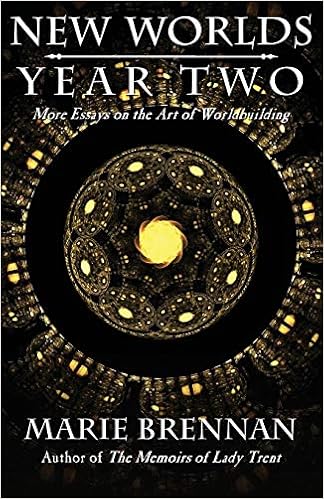
New Worlds, Year Two: More Essays on the Art of Worldbuilding by Marie Brennan

This collection was released at the two year mark of Marie Brennan's Patreon of the same name, which publishes an essay per week on topics of interest to speculative worldbuilding, challenging creators to think about aspects of their fantasy or science fiction worlds which might not have crossed their minds. While I'm not in a fiction writing stage of life myself, I enjoyed the first year of essays which incorporated everything from plate tectonics to cannibalism, and this second volume delivers  the same experience on a similarly broad range of topics.

The essays are grouped into thematic areas, slightly separately from the Patreon itself, reflecting the experience of reading in a book rather than as week by week essays. It works well, and there's an impressive minimum of overlap even in those essays with similar subjects - its generally clear when a series has actually been written and posted in sequence, but there's no obvious drawbacks or unintentional skipping around even when it hasn't. Essays are bite-sized, running a couple of thousand words, and unpick both the technological and societal elements of each area being covered. That means that, for example, the series on weapons and armour which makes up the first few essays first looks at both the possible weapons one could use to do some duels, and the societal concepts of masculinity and honour that go into the culture of duelling, before looking at the historical contexts of duels themselves. Its all done in a way which draws mostly on Brennan's own areas of relative expertise (she did most of the work for a PhD in Anthropology before becoming a full-time writer): Japan and Europe come up a lot, as do the Pacific Islands, but there's an acknowledgement that this is far from the full range of real-world examples. Immediately after reading, I was torn on the question of whether guest entries from experts with different geographical or subject areas of expertise would improve the reading experience (either on Patreon or in book form), but regardless of the answer I don't think it detracts from what New Worlds is, which is effectively a series of writing prompts that challenge worldbuilders to go away and do their own research, rather than offering a full range of examples.

As well as weapons and duelling, the Year Two collection covers beauty and body modifications, clothing, weddings and courtship, writing and literacy, the societal concept of time (briefly discussed in book 1 but the subject of multiple essays here), religions, and superstitions and the supernatural. As in the previous collection, it closes with four more "meta" essays on the concept of worldbuilding itself which cover a little more of the "how" of what speculative worldbuilders might do with the prompts covered here. There's plenty to talk about under each of these concepts and a nice mix of "foundational" (clothes) and more "niche" (honeymoons, incense, "the social economy of clothing") topics - there's no sense that Brennan is at all running low on ideas or struggling to find topics of general relevance to write about. Perhaps because of their genesis on Patreon, the style is chatty and often quite informal, and there's no pretence to academic rigour on the historical examples; there's no citations here, and a few points where the text outright states something like "I know I've read an example of thing X, but I don't remember what it was". It doesn't affect the book's ability to do what it says in the tin, however, and as thought provoking elements the veracity of the examples given here (none of which stray into territory that I would consider particularly controversial or open to misinterpretation) isn't really the point.

The elephant in the room when reading these in ebook is whether this format adds to the reading experience - and, honestly, I don't think that ebook or Patreon lets these essays shine to their fullest extent. Patreon's system, while it has a lot of strengths and is linked to a monetary system that allows authors like Brennan to do this kind of work in the first place, isn't inherently great for archiving posts and allowing users to search for old content, and ebooks are similarly much harder than physical books to flip through and search for things rather than reading cover to cover. Luckily, Book View Cafe also has you covered if you want New Worlds in physical format - and I suspect that for people who really want this for its intended purpose, that's the version that is most going to allow its content and usefulness to shine.

Rating: 7/10

POSTED BY: Adri is a semi-aquatic migratory mammal most often found in the UK. She has many opinions about SFF books, and is also partial to gaming, baking, interacting with dogs, and Asian-style karaoke. Find her on Twitter at @adrijjy.

Monday, July 29, 2019

New Books Spotlight

Welcome to another edition of the New Books Spotlight, where each month or so we curate a selection of 6 forthcoming books we find notable, interesting, and intriguing. It gives us the opportunity to shine a brief spotlight on some stuff we're itching to get our hands on.

What are you looking forward to? Anything you want to argue with us about? Is there something we should consider spotlighting in the future? Let us know in the comments!


Brennan, Marie. Turning Darkness into Light, by Marie Brennan [Tor]

Publisher’s Description
As the renowned granddaughter of Isabella Camherst (Lady Trent, of the riveting and daring Draconic adventure memoirs) Audrey Camherst has always known she, too, would want to make her scholarly mark upon a chosen field of study.

When Lord Gleinheigh recruits Audrey to decipher a series of ancient tablets holding the secrets of the ancient Draconean civilization, she has no idea that her research will plunge her into an intricate conspiracy, one meant to incite rebellion and invoke war. Alongside dearest childhood friend and fellow archeologist Kudshayn, must find proof of the conspiracy before it’s too late.
Why We Want It: Turning Darkness Into Light is a follow up to Marie Brennan’s Hugo Award finalist Memoirs of Lady Trent series featuring the granddaughter of Isabella Camhurst and that’s really all that I need to know about it. I’m overdue to finish the Lady Trent novels, but Turning Darkness Into Light is a must read when I do.


DiLouie, Craig. Our War [Orbit]

Publisher’s Description
A prescient and gripping novel of a second American civil war, and the children caught in the conflict, forced to fight. 

Our children are our soldiers. 

After his impeachment, the president of the United States refuses to leave office, and the country erupts into a fractured and violent war. Orphaned by the fighting and looking for a home, 10-year-old Hannah Miller joins a citizen militia in a besieged Indianapolis.

In the Free Women militia, Hannah finds a makeshift family. They’ll teach her how to survive. They’ll give her hope. And they’ll show her how to use a gun.

Hannah’s older brother, Alex, is a soldier too. But he’s loyal to other side, and has found his place in a militant group of fighters who see themselves as the last bastion of their America. By following their orders, Alex will soon make the ultimate decision behind the trigger.

On the battlefields of America, Hannah and Alex will risk everything for their country, but in the end they’ll fight for the only cause that truly matters – each other.
Why We Want It: Our War is a novel painfully reflecting some of America’s greatest fears – that a President once impeached will refuse to leave office and America descends once again into a Civil War. It’s a story that could be ripped from the headlines of five minutes from now. While I hope Craig DiLouie’s novel is not prescient, it looks to be a searing near future worst case scenario of a novel that I both can’t wait as well as slightly dread reading.


Jones, Gwyneth. Joanna Russ [University of Illinois Press]

Publisher’s Description
The creative original who helped open the door to feminist SF 

Experimental, strange, and unabashedly feminist, Joanna Russ's groundbreaking science fiction grew out of a belief that the genre was ideal for expressing radical thought. Her essays and criticism, meanwhile, helped shape the field and still exercise a powerful influence in both SF and feminist literary studies.

Award-winning author and critic Gwyneth Jones offers a new appraisal of Russ's work and ideas. After years working in male-dominated SF, Russ emerged in the late 1960s with Alyx, the uber-capable can-do heroine at the heart of Picnic on Paradise and other popular stories and books. Soon, Russ's fearless embrace of gender politics and life as an out lesbian made her a target for male outrage while feminist classics like The Female Man and The Two of Them took SF in innovative new directions. Jones also delves into Russ's longtime work as a critic of figures as diverse as Lovecraft and Cather, her foundational place in feminist fandom, important essays like "Amor Vincit Foeminam," and her career in academia.
Why We Want It: Part of The University of Illinois Press’s Modern Masters of Science Fiction Series, Gwyneth Jones’ look into the life and the work of Joanna Russ is essential for readers looking to get a bit deeper into one of science fiction’s most notable and important writers. I read Paul Kincaid’s commentary on Iain Banks from the same series when it made the Related Work ballot last year, which brought the Modern Masters of Science Fiction series to my attention. This may well be the single volume of the series so far (though I’ll be looking forward to forthcoming works on Ursula K. Le Guin and Roger Zelazny as well)


Kuang, R.F. The Dragon Republic [Harper Voyageur]

Publisher’s Description
Rin’s story continues in this acclaimed sequel to The Poppy War—an epic fantasy combining the history of twentieth-century China with a gripping world of gods and monsters 

The war is over.

The war has just begun.

Three times throughout its history, Nikan has fought for its survival in the bloody Poppy Wars. Though the third battle has just ended, shaman and warrior Rin cannot forget the atrocity she committed to save her people. Now she is on the run from her guilt, the opium addiction that holds her like a vise, and the murderous commands of the fiery Phoenix—the vengeful god who has blessed Rin with her fearsome power.

Though she does not want to live, she refuses to die until she avenges the traitorous Empress who betrayed Rin’s homeland to its enemies. Rin’s only hope is to join forces with the powerful Dragon Warlord, who plots to conquer Nikan, unseat the Empress, and create a new republic.

But the Empress and the Dragon Warlord are not what they seem. The more Rin witnesses, the more she fears her love for Nikan will force her to use the Phoenix’s deadly power once more.

Because there is nothing Rin won’t sacrifice to save her country . . . and exact her vengeance.
Why We Want It: The Poppy War was a revelation. A debut novel and one of the best of 2018 (it was on my Hugo ballot and was my runner up for the best novel I read last year), the novel deserved every bit of praise it received. In a year filled with major releases from some of my favorite authors, not to mention a surprise sequel to The Handmaid’s Tale, The Dragon Republic is one of the top two or three novels I’m looking for this year. The Poppy War was that good, and I have no doubt The Dragon Republic will live up to the promise of Kuang’s debut.


Modesitt, Jr., L.E. The Mage Fire War [Tor]

Publisher’s Description
L. E. Modesitt, Jr., continues his bestselling Saga of Recluce with The Mage-Fire War, the third book in a story arc which began with The Mongrel Mage and Outcasts of Order. 

Once again, prejudices against the use of chaos magic force Beltur and his companions to flee their refuge in Axalt. The rulers of nearby Montgren have offered them sanctuary and the opportunity to become the Councilors of the run-down and disintegrating town of Haven.

Montegren lacks any mages—white or black—making this seem like the perfect opportunity to start again.

However, Beltur and the others must reinstitute law and order, rebuild parts of the town, deal with brigands—and thwart an invading army.
Why We Want It: The Mage-Fire War is the 21st Recluce novel from L.E. Modesitt, Jr and the third to feature Beltur as a protagonist. If my math is correct, this is the first sequence to feature the same main character for three books. Otherwise, we’ve had a number of two book sequences. While offering few of the delights and discoveries of the earliest Recluce novels, the Beltur sequence has been solid fantasy fiction and Recluce is a series I will always come back to.


Moreno-Garcia, Silvia. Gods of Jade and Shadow [Del Rey]

Publisher’s Description
The Mayan god of death sends a young woman on a harrowing, life-changing journey in this dark, one-of-a-kind fairy tale inspired by Mexican folklore.

The Jazz Age is in full swing, but Casiopea Tun is too busy cleaning the floors of her wealthy grandfather’s house to listen to any fast tunes. Nevertheless, she dreams of a life far from her dusty small town in southern Mexico. A life she can call her own.

Yet this new life seems as distant as the stars, until the day she finds a curious wooden box in her grandfather’s room. She opens it—and accidentally frees the spirit of the Mayan god of death, who requests her help in recovering his throne from his treacherous brother. Failure will mean Casiopea’s demise, but success could make her dreams come true.

In the company of the strangely alluring god and armed with her wits, Casiopea begins an adventure that will take her on a cross-country odyssey from the jungles of Yucatán to the bright lights of Mexico City—and deep into the darkness of the Mayan underworld. 
Why We Want It: Each of Silvia Moreno-Garcia’s three previous novels have been stupendous and as different from each other as can be. It has come to the point that it doesn’t matter to me what the book is about as long as I know it was written by Silvia Moreno-Garcia. With that said, a novel featuring the released spirit of the Mayan God of Death seeking help to get his throne back? Yeah, I’m there for that, too.


POSTED BY: Joe Sherry - Co-editor of Nerds of a Feather, 3x Hugo Award Finalist for Best Fanzine. Minnesotan.

Tuesday, June 4, 2019

Summer Reading List 2019: Phoebe

Hello, fellow nerds! As I've mentioned a few times on here, I'm currently in a PhD program studying English literature with a focus on environmental and speculative writers. For those of you who have lived the PhD life, you probably have an idea of what's on my summer reading list: comps. While I'm not super close to taking my comprehensive exams (basically a test with a lot of timed writing and hundreds of required books), I'm going to start chipping away at the list:


Since I'm studying speculative writers, much of the reading, especially at this early stage, will be books I've just missed or haven't gotten to yet, like Dhalgren. Of course, no comps list would be complete without plenty of theory, so when I'm exhausted from all the academic language, I picked up the perfect remedy at a used book sale:


Yes, that is a shelf of much pulpy speculative, with some classics thrown in. I figured what could be better than to de-stress from reading about postmodernism than unicorns on an epic quest?

So, as I embark on my own quest to defeat the dark lord of comprehensive exams, here's a snippet of what I'll be reading this summer!


1. Dhalgren by Samuel R. Delany (1974)

A sci-fi classic that I have stared at on the shelf for years, now. Growing up, I was much more of a fantasy-reading kid, so I knew of Delany but never picked up his books, even when I went through a classic SF reading phase. Of course, a comprehensive list of American speculative literature wouldn't be complete without Dhalgren, and I'm excited to dive in.


2. Imaro by Charles R. Saunders (1981)

Another classic of speculative literature, though less read, I believe. I first became interested in Imaro as an early example of sword & sorcery and diversity in SF. Since I read and wrote about Marlon James' Black Leopard, Red Wolf, I've become more interested in the power of sword & sorcery as escapist decolonizing fiction. I'm excited for a romp and will probably use this novel as a short, fun read when I'm exhausted by the heavy hitters.


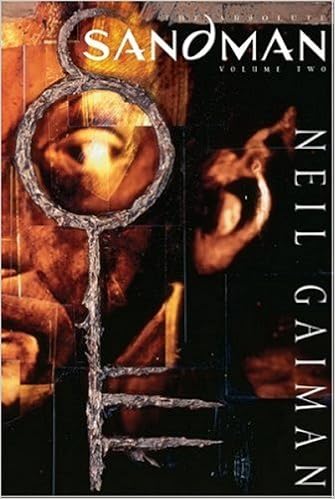
3. The Sandman: The Complete Series by Neil Gaiman (1997)

I've ready a lot of Neil Gaiman's other work, and he's one of my most influential authors as a young writer. I've paged through and read several volumes of Sandman, but I haven't sat down and poured over it. I have the four volume annotated editions, and look forward to following the Sandman into a dreamy extravaganza.


4. The Female Man by Joanna Russ (1975)

As I promised, lots of classics on this list. For a better write up than this tiny blurb, check out Vance's post right here at Nerds! When making my comprehensive exams reading list, there are certain books that one knows must be included if talking about American speculative writers. Of course, Russ is one of them. That being said, The Female Man is one of those texts that I've always heard about and referenced when discussing SF and feminism, but I haven't read it nor really know anything about it. But Vance's summary sounds pretty wild--time travel, alternate dimensions, assassins. I'm totally down for something like that being on my required reading list.


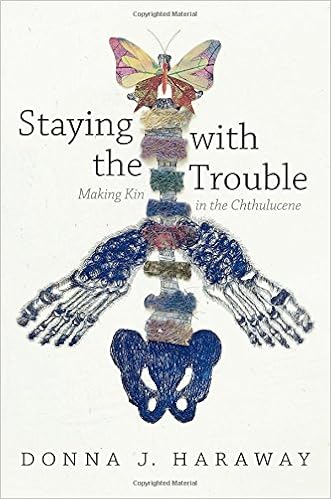
5. Staying with the Trouble: Making Kin in the Chthulucene by Donna Haraway (2016)

Haraway is known for her confusing, riddling academic language. This is an accurate depiction of her writing, though it is also kinda fun when you have words like "chthulucene" thrown around. The reason it my be of interest to readers of this blog is her inclusion of speculative writers like Ursula K. Le Guin and Octavia Butler. While she was known for her work in feminist theory (particularly the Cyborg Manifesto), this current book delves into eco-criticism, especially other-than-humans. I've flipped through this book, but don't normally make it more than a page at a time. This summer, though, I have hoped of writing an article titled "Tentacular Spectacular: Dungeons & Dragons as Embodiment of Nonhumanity," which would force me to read Haraway's book (as the title comes from one of her chapters) AND I'd get to write about my favorite D&D livestream The C-Team. Theory and D&D, no better pairing.


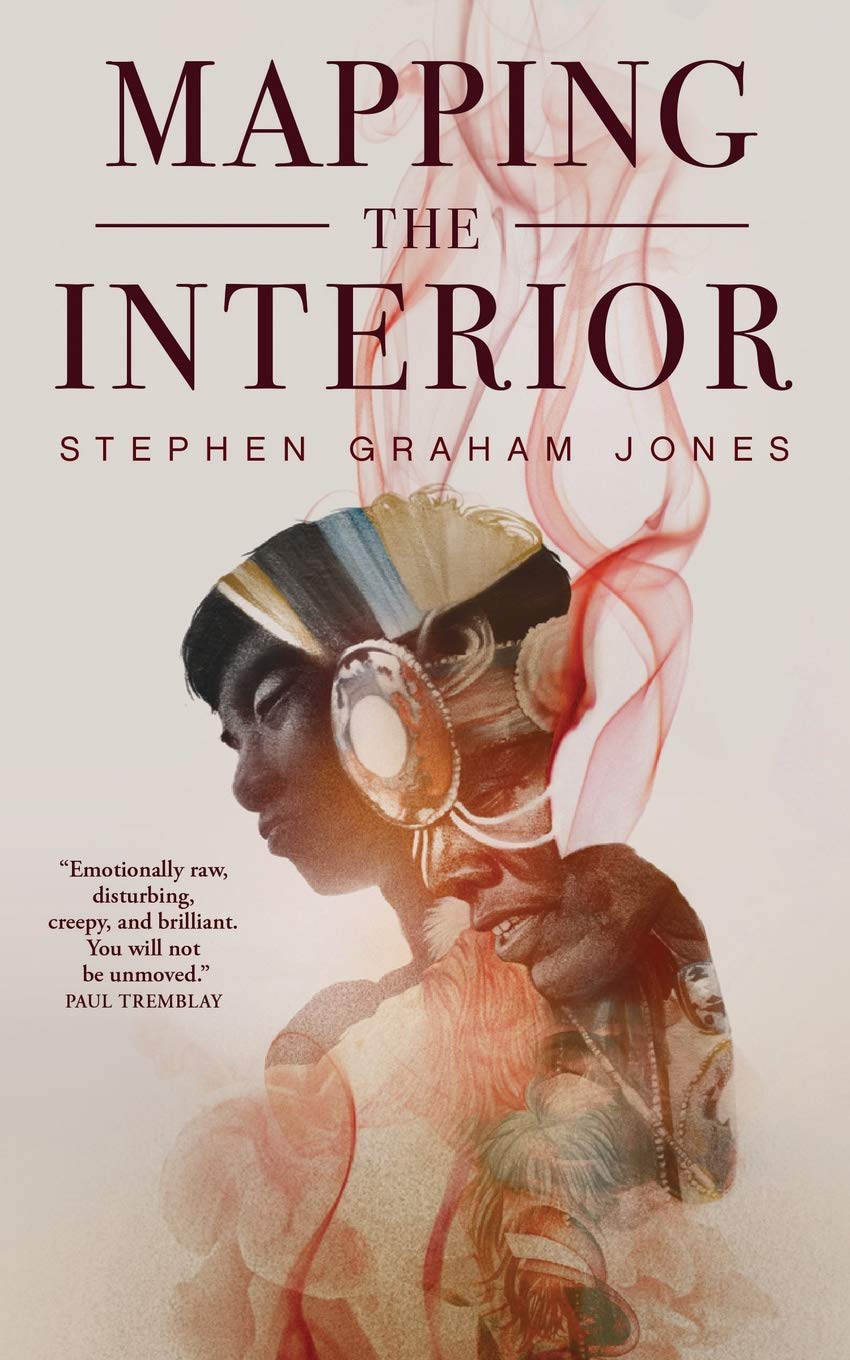
6. Mapping the Interior by Stephen Graham Jones (2017)

One of the more modern authors on my list, I've wanted to read Jones' work for quite awhile. I still hope to pick up Mongrels at some point (I'm a sucker for werewolf stories), but a horror story about mapping the interior of a house pushes so many buttons not only in speculative literature but also more broadly in the literary cannon. Additionally, it's a shorter read, which gives some nice balance to starting this list with Dhalgren. Overall, I've heard lots of good things about this novella and Jones' writing in general, so I'm happy to finally dive in!


Phoebe Wagner currently studies at University of Nevada: Reno. When not writing or reading, she can be found kayaking at the nearest lake. Follow her at phoebe-wagner.com or on Twitter @pheebs_w.

Monday, January 7, 2019

Feminist Futures: The Female Man


Dossier: Russ, Joanna. The Female Man [Bantam, 1975]

Filetype: Book

Executive Summary: Two women -- Joanna, a writer living in 1970s New York, and Jeannine, who lives in a parallel reality where the Great Depression never ended -- find their lives uprooted when Janet Evason, a time traveler from a future, all-female society called Whileaway, gathers them into her orbit.


Joanna is a staunch feminist and shows Janet around her world as the two women attempt to explain each's reality to the other. Jeannine is obsessed with the idea of marriage, and her mother's constant pressure doesn't help things. Jeannine is not enthusiastic about marriage, or her current best prospect, a guy named Cal, but the prospect of either getting married or remaining unmarried consumes most of her thoughts. After Janet collects Jeannine, the three women retreat to the home of a "typical family." This home is provided by the Wildings, and their daughter, Laura Rose, who begins exploring a sexual relationship with Janet.

Janet explains Whileaway's technologically advanced, but largely agrarian society, where all sexual relationships are homosexual, since a plague killed off all men many generations earlier. Children are conceived through a scientific process, and children only stay with their biological mothers for a few years before going away to school and then the series of work placements that will occupy the rest of their lives. Joanna and Jeannine are able to briefly visit Whileaway, and meet Janet's wife. 

In visiting Jeannine's milieu, Jeannine visits her family and goes on dates with several men, trying to imagine what a marriage to one of them might look like, and if it would be better than settling for Cal.

Ultimately, all three women find themselves transported to yet another reality, this time by Jael, an assassin from a dystopian future where the men and women are locked into a literal battle of the sexes. Jael takes the three women through her reality, assassinates a male leader, and reveals the technology that has allowed her to pull together these four versions of the same woman, but from different, parallel timelines.

Feminist Future: Jael suggests to Janet that there was no plague that wiped out the men of her timeline, but rather a literal battle like the one Jael is currently living through, and then the female survivors eradicated that narrative from their histories as Whileaway evolved from the resulting peace. Although Janet doesn't believe her, this suggests that the book is positing three possible futures: one in which the men and women continue on with women struggling to achieve equality and making small progress here and there, which extends from Joanna and Jeannine's presents; another in which, as women are ascendant in power, the men literally fight back against any further progress and the sexes are segregated; and finally, a future in which only one sex survives. The final scenario is the only peaceful one, although Whileaway is shown to have its own share of violence, however rare.

Hope for the Future: At the end of the book and after their stay with Jael, Joanna and Jeannine return to their timelines with a new sense of power and purpose. There is a stronger sense that they will not only advocate more strongly for themselves, but for other women, as well. There's no clear roadmap toward peaceful co-existence between men and women, but the sense that progress is possible is definitely there.

Legacy: This book is probably Russ' most influential work of fiction, where her book How to Suppress Women's Writing is likely her most heralded work of non-fiction. It takes the ideas of feminism and foregrounds them in a fairly didactic way, and confronts head-on many assumptions about ability and the place of women in society. It's interesting to think of this book in conversation with Herland (which Russ may or may not have had access to), because both are largely works of explication, where there isn't a whole lot of plot movement. In the same way that Charlotte Perkins Gilman wrote three men that were meant to capture three aspects of masculinity, Russ' four women are clearly archetypes of different aspects of the female experience, if not "femininity." 

It is a near-certainty that, for many female readers in 1975, this book was the first time they were able to see themselves in science fiction. From Joanna's ardent striving for equality in a world that isn't interested, to Janet's deft and capable discharge of her many different roles and jobs, to Jeannine's inner monologue and back-and-forth with her mother about what she was doing with her life, to the ferocity of spirit and desire to exact vengeance that Jael encapsulates, there are so many aspects of womanhood that Russ just comes out and addresses frankly and directly. In The Female Man, there's no way to hide behind the narrative or pretend, like so many of James Tiptree, Jr.'s readers did, that the subtext isn't really saying *that.*

In Retrospect: Stylistically, this book is a challenge. I don't know how critics have parsed it into which literary movements, but to me, the style is postmodern in the same way that the works of Donald Barthelme or some of Kurt Vonnegut's works are. In Vonnegut's Breakfast of Champions, there's a moment where he writes himself, the author, into the book as he attempts to deal with the repercussions of his mother's suicide, and in Timequake, he seemed to not really want to write the novel, so he largely wrote about writing the novel. Russ' work here pre-dates those books by at least a decade. She writes herself into the novel, and out of it. Her character Joanna is both her and not her. The writing is elliptical and tangential, and seems less concerned with narrative than emotional clarity. And there are a lot of emotions the Russ is attempting to work through. So certainly, the style of the telling will be a barrier to some readers, as even contemporary experimental novels are. 


The closest we really get to a propulsive narrative happens in the last third of the novel after Jael gathers the other three Js together. This is also the most problematic section of the book. I'm not the right person to have a discussion about intersectionality, but I will say that as a contemporary reader, Russ' characterizations of the marginalized within Jael's gender segregated society made me feel icky. Given what I've already said about the style of the novel, it can be hard to pin down exactly what I think Russ was saying at the time of the writing about non-conforming individuals, but it didn't feel great. I had a bigger problem with those passages than I did with Jael extolling the virtues of killing all men.

I think that in the end, The Female Man is a profound time capsule of a moment in which feminism was undergoing a radical shift toward the mainstream, and as a book that asks more questions than it gives answers, it's still an important read. As a guy, reading this book provides both an analytical and empathetic framework for understanding not just other works by female authors in a broader context, but it also offers a window into moving through the world as a woman. Conversations that Russ presents from a party, or an evening out, I know I've heard before, but they are so cringe-inducing, I can only hope I've never been one of the participants.  

The stylistic experiments are probably less engrossing than they were when they were new, but they help anchor the book in an emotional now that still resonates, almost fifty years after the book was first written.

Analytics

For its time: 5/5
Read today: 3.5/5.
Wollstonecraft Meter: 8.5/10


Published by Vance K — co-editor and cult film reviewer at nerds of a feather since 2012.

Wednesday, November 28, 2018

Feminist Futures: The Women Who Are About To...

Opting out of the patriarchy in Tiptree and Russ.


"This will never be found.
Who am I writing for, then?"

Following on from my essay last week about feminist separatism in SFF, I wanted to move on to look at two stories which rely on women "opting out" of patriarchy not on a separatist societal level, but on a destructive, individualistic one. These are "The Women Men Don't See", a novelette by James Tiptree Jr. (also known as Alice Sheldon), published in 1973; and We Who Are About To..., published in 1976 by Joanna Russ. Each story offers a different perspective and tone to what is ultimately the same question: what does it take to truly escape from patriarchy?

(Note: this is a spoiler-heavy essay which discusses themes and events all the way through both stories -- proceed at your own risk!)

I'm nowhere near well read enough to make authoritative sweeping statements like this, but I'm going to go for this one anyway: The Women Men Don't See must be one of the best and most timeless genre stories out there today, not to mention one of the most riffed-upon story titles (although, frankly, almost every title in the Her Smoke Rose Up Forever collection is excellent). It's a title that's hard not to link to Sheldon/Tiptree's own status maintaining a cis male cover identity in science fiction, while presenting as female in her daily life. That "The Women Men Don't See" manages to be a successful and readable-in-2018 story is even more impressive given that it contains an utterly insufferable male narrator, through whose flawed lens the real story is filtered.

Don Fenton is a man travelling through Central America on his way to a fishing spot in Belize (except, of course he isn't), when a change of plans puts him on a plane with a mother and daughter on their way to Chetumal. When the plane goes down, Don, pilot Esteban, and the two women - who we gradually learn are called Ruth and Althea Parsons - find themselves stuck in the jungle, and after taking a trip away from the plane wreckage for supplies, Don and Ruth find themselves even more isolated with each other. The mundane aspects of the story take what to Don - and therefore the reader - comes across as a complete left-field shift into the supernatural when a speedboat full of aliens comes to collect them. Ruth has made contact with these aliens, and has seen in them an escape from the patriarchal structures in which she and her daughter must operate.

Don Fenton's narration puts a filter of misogynistic, racist sleaze over nearly every event in the story. He is outright objectifying towards Captain Esteban, constantly referring to his Mayan heritage through odd remarks about appearance and discussion of outdated, stereotypical customs. Indeed, Esteban is probably sexualised more than either of the Parsons: although Don does get in an early opinion on Althea -- otherwise a largely absent player in the story -- and spends a fair bit of time thinking nasty things about Ruth while the two are stranded together. Within the novelette, Tiptree has limited space to bring nuance to the other characters, especially given the limitations of Don's viewpoint, and its only Ruth that really comes out as three dimensional, even while central mysteries around her actions remain. Ruth's conversation about the reality of women's lives is literally one of existence in the margins, where it is only possible for women (note, both of these stories are very binary) to operate in the cracks left behind by male power and violence. This position is perhaps a little lacking in intersectional nuance, given that Ruth is a white woman who has been able to raise a daughter alone with money left over to charter a plane in the Yucutan, but it's one that fits the story to great effect: you can almost feel Don winding up the smug retorts for a conversation about "women's lib", only to be shut down by a woman who completely fails to follow her side of the script.

What's most fascinating, and repulsive, about Fenton is that his narrative is told in past tense - he is telling us a story with the foreknowledge of what these women will do - and yet he is still incapable of centring them in the story, or of reevaluating their emotions in light of the information he gains at the end. At one point, after being stranded with Ruth Parsons for a day, he watches her gutting fish and marvels at her strength and resourcefulness, before literally dismissing it: "I blink away the fantasies and see a scared little woman in a mangrove swamp". Yet, it is this woman who defies Don (and his gun), makes contact with an alien species and leaves the planet and the patriarchy behind, an unthinkable act for the actual patriarch. It's a highly effective way to underline the point about coexistence, and I can only assume from the fact that this story didn't blow Sheldon/Tiptree's "cover" that it's a believable portrayal of a man by someone writing as a man, at least in the context of mid-70s science fiction.

While Tiptree's characters only crash in the Yucutan, Russ sends her castaways much further afield. The narrator of We Who Are About To... is a passenger on an automated spaceship that crashes, stranding eight passengers (five female, three male, the only demographic detail the book feels the need to aggregate) on an uncolonised planet with limited supplies and no hope of rescue in their lifetimes. The narrator is immediately fatalistic about the group's chances of survival, which rubs up against the optimistic colonising spirit of the rest of her compatriots. Within days, they are attempting to set up long-term plans for childbirth (discussing the ideal "rota" to ensure genetic diversity before even establishing safe food and water supplies) while she seeks the most painless, drug-assisted way to kill herself. Compounding the difficulties Russ' narrator has with her fellows are their quickly evolving relationships with each other: initially, a black woman called Nathalie emerges as leader, using her intelligence and willingness to get things done to assert authority; however, she quickly ends up in a violent altercation with Alan, the youngest and physically largest of the men, who takes issue with her telling him what to do. The narrator laments that "patriarchy is coming back, has returned (in fact) in two days", and there's a clear sense of building tension as the interactions within the camp start to strain.

Except, of course, this is a 100-page barely-novel, not a slow-burning social drama, and no sooner have these tensions been established than Russ' narrator's desire to die comfortable and alone is brought into sharp, fatal conflict with her fellow humans. Ironically, it's fatal for them first, not for her: after leaving with less than her share of resources to a nearby cave (travelling off on a "broomstick", no less), she is hunted back down by the remainder of the group, who try to punish her for her non-compliance. Despite the first person narration, we don't really get a sense of her emotional response to this; she not only kills the group who try to bring her back, but goes out of her way to shoot the last two women (an old, rich mother and her chronically ill, adoptive daughter) back at the camp as well. This takes place just over halfway through the book. The remaining half is her slow starvation, complete with hallucinations and meditations on her life and choices (though much remains obscured from the audience - in particular, we never learn what she means when she mentions she is "not exactly an amateur" at the "game" of dealing death). This makes for an unusually structured story, but one which allows for a great deal of depth to be given to the narrator's motives and thoughts as she processes what is happening to her, which come to a more personal climax towards the end of the book.

Taken purely from the perspective of the ends it achieves, Russ' narrator's violent rejection of her compatriots' survival plan is pointless: she herself notes the multifaceted absurdity of killing people who tried to kill her to stop her from dying, and her reasons for believing that the rest of them would have died as well are all too compelling. However, We Who Are About To... isn't about the narrator's choices, or even the outcomes of those choices, so much as the lengths she must go to in order to make them. Once she starts exploring that unwillingness to compromise, we also get hints at how this plays into her life before the spaceship, which one of her hallucinations characterises as "starving" in a parallel to her current end state. In the language of more recent media, the narrator is "non-compliant", and while it appears that her previous life in a technologically comfortable 21st century gave her the scope to live out her choices safely, its only in this hostile, isolated environment where "freedom" is truly possible - in what turns out to be the emptiest of victories. Its a choice Russ' narrator shares with Ruth Parsons, whose glimpses of past also hint at a life lived deliberately in the margins, out of the reach of male power.

And, while the stories end in very different ways, ultimately they share a simple message: if you're inside the patriarchy, life without its influence is literally unknowable, both to the characters and to us as readers. The experiences they share are somewhat limited in their speculative scope - centring relatively privileged, well resourced women who have had certain choices to get to the "point of no return" they end up at - and neither offer much in the way of hopeful progress. But both hold up very well today as vital, defining works from two of the most important voices in feminist science fiction from the 1970s, and are well worth looking up.


POSTED BY: Adri is a semi-aquatic migratory mammal most often found in the UK. She has many opinions about SFF books, and is also partial to gaming, baking, interacting with dogs, and Asian-style karaoke. Find her on Twitter at @adrijjy.