Showing posts with label Rebecca Roanhorse. Show all posts

Wednesday, May 3, 2023

Nanoreviews: Unraveller, The Mimicking of Known Successes, Tread of Angels

Unraveller by Frances Hardinge [Macmillan Children's (UK)/Amulet (US)]

Clara's review of Unraveller already covers most of what makes this book so great: Frances Hardinge always brings intriguing magic and thoughtful moral complexity to her particular brand of YA, and her latest is no exception. Set in a world where humans live alongside the otherworldy denizens of the Wilds, Unraveller focuses on Kellan, a boy from a community of weavers who has been cast out after gaining the uncontrollable ability to unravel both fabric and curses, and Nettle, a formerly cursed girl, as they travel the country of Raddith unravelling the various curses that its inhabitants have placed on each other - ranging from mildly inconvenient to the truly horrible. The curses themselves are gifted by the Little Brothers, spider-like fae inhabitants of Raddith who also take a keen interest in ensuring its technology doesn't develop too extensively. When someone is given a "curse egg", they have the ability to lay a curse on someone they feel has wronged them, but the punishment for even having a curse egg - let alone using it - is extremely steep, even before the emotional cost and stigmatisation for the curser is taken into account.

We follow Kellan and Nettle as they try to discover the source of a curse on Kellan, which appears to be making his abilities stronger and more unpredictable. Along the way, Hardinge sketches out the various impacts that living with this particular brand of otherworldly justice has had on Raddith's society, and what, if anything, can be repaired after a curse has come to pass. As tales of fae morality being imposed on humans go, this is a seriously good one, and Kellan and Nettle's mildly prickly friendship forms a wonderful core around which the rest of the narrative unfolds. If you haven't read any Hardinge before, this is a great place to start.

The Mimicking of Known Successes by Malka Older [Tor dot com Publishing, 2023]

It feels appropriate to be talking about this book (again, following one of my Nerds of a Feather colleagues, this time Arturo) at a point when many of the genre fans I know are grappling with the definitions and purpose of "cosy" fiction. Perhaps this will become an essay for another time, if this fan ever gets her proverbial shit together. The Mimicking of Known Successes, billed as cosy Holmesian fiction, divides much of its time between university campuses and windswept train platforms and comfy carriages, but perhaps not in the location you'd expect: this is the human settlement on Jupiter, to which the survivors of humanity fled after Earth became uninhabitable, with habitats floating in the, uh, clouds of our biggest planetary neighbour and connected by a planet-spanning train network. We follow Mossa, an investigator looking for a missing academic, and her ex-girlfriend and classical geographer Pleiti, who Mossa approaches to help with the investigation into her colleague. Together, the two uncover a deeper conspiracy surrounding this disappearance, with implications for Earth's future and the people who get to decide on it.

Part of the cosiness here is aesthetic: Older does a fantastic job of creating a colony that seems comfortable and interesting and dynamic, even as we see characters grapple with the historic loss of Earth and the limitations of their current home. The novella opens in a remote settlement at the end of the railway line which Mossa refers to as a "piece of grit", but it's a piece of grit with a surprisingly nice pub and pleasant residents, not some desperate, impoverished outpost. People are doing OK for themselves, and for each other, on Jupiter, even if some are more OK than others, and it makes for a very different atmosphere than the gritty "everyone is one step away from a cold, unpleasant death" aesthetic that pervades most colonisation stories.

Beyond that, though, The Mimicking of Known Successes provides a perfect mix of personal stakes with wider implications for humanity's future, with Pleiti and Mossa rekindling their relationship and grappling with what this case means for their respective careers while also piecing together the answer to the mystery, and its full stakes. At the heart of those stakes is the academic debate for Earth's future, which is introduced to us as an interdepartmental war between different geography disciplines (finally, geography gets the respect and centrality it deserves!), and effectively revolves whether recolonisation of Earth should take place with full understanding of Earth's former ecosystem and its recreation, or whether humanity should be trying to build something new and adjust as they go along. I would read an entire Mars Trilogy-style doorstopper featuring characters arguing about the ins and outs of terraforming along these lines, but here it's just one strand in a much shorter narrative. Moreover, it's inextricably tied to Pleiti's position as a classicist (the "understand everything first" position) working in an academic institution alongside colleagues who, for various reasons (such as "being men") do not give her views the respect she feels they deserve.

Mimicking of Known Successes has a great ending to its mystery and its romance, but it also leaves the door open for more stories in this world - which we are getting! I, for one, am very excited.


Tread of Angels by Rebecca Roanhorse [Saga (US)/Solaris (UK) 2022]

I haven't seen as much about this Weird Western as I'd expect given that it's Rebecca frickin' Roanhorse, but if you're looking for a diverting adventure into a frontier town of angels and demons (hey, "angels and demons" is a bingo square for Reddit's r/fantasy bingo this year!) you could do much worse than this novella. The setting here is a mining town where the ostracised "Fallen", descendants of rebel angels are put to work mining Divinity (created from the body of Abaddon, because what else would it be) under the watch of the virtuous "Elect". Celeste is a Fallen, but she has been raised by her Elect father and only recently reunited with her sister Mariel, who spent her childhood with the pair's mother. Now Celeste is trying to keep her head down, but when Mariel is accused of murdering one of the settlement's leaders, her sister is given just 24 hours to prove her innocent, aided only by her demon ex-lover Abraxas.

Standing between Celeste and her sister's freedom are an entire town's worth of deep secrets, not least those of her own sister, and most of the action here is about one woman coming up against an entire system which is stacked against her, not least because of the baked-in presumption of moral goodness in the angelic Elect (their leaders are literally called Virtues!) and the stigma against the Fallen. The adventure here is firmly in "satisfyingly tropey" territory, and while the end result is a story that didn't make a huge lasting impression on me, it's certainly an enjoyable read, with depths of worldbuilding that would lend themselves to further stories in this setting. 


POSTED BY: Adri Joy, Nerds of a Feather senior editor, dog owner, aspiring mermaid, having an increasingly weird time about her own biography

Wednesday, September 22, 2021

Adri and Joe Read the Hugos: Novel


Adri: Time for the second installment in our Hugo chats: and this time we’re moving on to novel. This year we’ve got books from a very all-star author list - five out of six already have at least one Hugo in the silverware cupboard - and an even split of sequels and new adventures. What are your thoughts?

Joe: And the one writer who doesn’t have a Hugo (Tamsyn Muir) was a Best Novel finalist last year for her debut novel, which isn’t too shabby either.

Similar to how I feel about Novella, this year’s Novel ballot is a fairly strong one and a reasonably varied list in terms of what sort of novel is nominated.

I listen to too many Academy Award focused podcasts (Oscar Season is almost as eternal as Hugo Season), so let’s blame that for what’s coming next, but I kind of want to talk about the narratives around the Best Novel Hugo Award finalists.

The City We Became
is N.K. Jemisin’s first novel after winning three Hugo Awards in as many years for her Broken Earth trilogy. One more win ties her with Robert A. Heinlein and Lois McMaster Bujold, and breaks her tie with Connie Willis and Vernor Vinge. That’s heady company to be in. Network Effect brings Murderbot to the Best Novel ballot for the first time and it’s really difficult to overlook the power of Murderbot (two wins for Novella, a finalist for Series this year). We also have Susanna Clarke’s first novel since winning a Hugo for Jonathan Strange and Mr. Norrell and that’s not something we can discount. Then again, don’t discount Mary Robinette Kowal for her follow up Lady Astronaut novel. The first book in that series won two years ago. That’s not to dismiss Tamsyn Muir and Rebecca Roanhorse because you absolutely cannot and should not dismiss Tamsyn Muir and Rebecca Roanhorse.

I know we don’t talk about books and the Hugos like we do movies, but given how good of a ballot we have this year and you noted that five of the six finalists are previous Hugo Winners and three of them have won this category before - a little Oscar talk is kind of fun.

Adri: It’s fun to mix up the punditry sometimes! As long as nobody thinks we’re taking ourselves TOO seriously. Also, compared to last year, which was quite a debut heavy ballot, it’s fun to see a field of returning champions and consistent favourites. I’m making a big effort to keep this sort of year-by-year fluctuation in mind, because I’m sure I said something melodramatic and overblown last year about debuts dominating the Hugo awards forever. I should not say things like that if I want people to believe I am in touch with reality.

Joe
: Hey, we all like the new and shiny books but I’m with you in wanting a solid mix depending on the makeup of a given year’s publishing.

Okay. I’d like to kick this off by talking about Network Effect, the first novel from Martha Wells to make the Hugo ballot. It’s Murderbot, and Murderbot seems to be everywhere these days, having twice won the Hugo Award for Best Novella and is now on the ballot for Best Series where I’m a little afraid it’ll steamroll the rest of the finalists there, though that’s a conversation for another day.

Adri: Murderbot! As a series, it’s lovely to see how it’s captured the hearts of the SFF community, and I think those novella wins were both well deserved. But Network Effect occupies an odd place in my heart right now: I loved it, I gave it 8/10 in review (Paul gave it a 9), I’m really excited for the way it changes Murderbot’s terms of engagement with humans and potentially takes the series into new territory (not that Fugitive Telemetry, the latest novella, does anything with that...) but when it came to pinning down my favourites for the year, it didn’t really come into the equation for me. As you say, we’ll have the series conversation later, but I’m more comfortable discussing Murderbot as an outstanding ongoing series than holding up any individual volume as a pinnacle of achievement at this point.

Joe: I’m notoriously inconsistent with my goodreads ratings, especially since it doesn’t let us give half stars. We both gave it 5 stars, but I’d say my star rating probably would come out to around 85% and then I rounded up. Not that it matters or you can gleam anything about how I use goodreads to do anything more than incessantly log everything I read.

The point is that I thought Network Effect was really good. It’s Murderbot. It’s fun, it’s delightful, and like you I didn’t have it on my nominating ballot. Network Effect is among the best of the year, it’s just not among the best of the best of my year. I think we’re talking about the same thing - despite the Nebula win and the potential Hugo steamroll that it may well do in this category, it’s just not as individually special as some of the other novels here.

Another novel I thought was excellent but not as much of a standout in this category is The Relentless Moon. I reviewed it last year, gave it an 8/10 (and a meaningless 5 stars on Goodreads). I noted, and please excuse me for quoting myself, that “this novel, like the two Lady Astronaut novels before it, is about striving towards excellence and truly building a better tomorrow even in the face of a devastating future. The Relentless Moon is hopeful science fiction, and that's something worth celebrating - especially when it's this good.”

Because we’ve talked around this for a while, I know you don’t agree.

Adri: Yeah, sadly I didn’t get on with The Relentless Moon at all (after actually liking The Calculating Stars quite a lot! And then The Fated Sky... much less), and I stopped reading halfway through. Like its predecessors, this book revolves around a nice white lady who battles sexism and is totally Aware of Systemic Injustice but still prone to using her extensive privilege to put herself over the top wherever she can. I know that’s certainly not the intended takeaway, and other people get very different things out of these books and I don’t want to diminish that, but they just don’t deliver what I want from a science fiction story like this. Even as a white woman reader, I can get wish fulfilment competence porn that works better for me elsewhere. Sorry, Nicole and Elma!

Joe: That’s a fair criticism which I can absolutely see, though that’s obviously not the way I read The Relentless Moon. It’s not my favorite of the three Lady Astronaut novels, but I thought it was delightful.

How I’m reading the novel (and granting my position of a relatively privileged white man) is that, given the timeframe in which it is set, a generally nice while lady who battles sexism but is aware of systemic injustice is a good thing. Yes, Elma and now Nicole, are relatively privileged to get into the American space program. It’s one of the foundational what ifs of the Lady Astronaut series. On the one hand the recognition of the systemic injustice can be a little heavy handed. On the other hand, there *is* a recognition of systemic injustice. That’s not something we get in every novel even one with the basic what ifs of Lady Astronaut and The Relentless Moon.

I’ll absolutely grant that the three Lady Astronaut series would fall more into the category of entry level science fiction - something which John Scalzi has made no bones about writing himself and being proud of. I’m not at all being dismissive - I think Mary Robinette Kowal is writing excellent science fiction and while The Relentless Moon doesn’t quite live up to The Calculating Stars and all of the wonder of that novel, I still find it generally delightful.

Adri: And, you know, here’s the other thing I need to recognise: I’m being very hard on The Relentless Moon, a book which tries to incorporate racial injustice but (for me) falls short. But two of my favourite books here don’t even try, and yet I still consider them favourites for what they DO focus on. So… I don’t know what I’m trying to say here, but I think it is that “opinions are hard”.

Joe: Moving on, I really don’t have anything to say about Piranesi. It’s not a book for me. I’m just happy it wasn’t 1000 pages long.

Adri: Funnily enough, Piranesi is one of my favourites (and, at the time of writing, it’s just won the Women’s Prize for Fiction). It’s so delightfully bizarre, with a really strong character voice, and I really appreciated both what it ended up explaining and what remained a weird mystery. I know other readers who didn’t enjoy the extent to which it pulled back the curtain on its own premise - there’s quite an extended epilogue - but I just thought it was really cool. Also, a very different book from Jonathan Strange and Mr Norrell, and definitely not one that could sustain 1,000 pages - which is fine!

The other book I have less to say on for now - although I really, really enjoyed it and am anticipating the sequel with delight - is Rebecca Roanhorse’s Black Sun. Epic fantasy doesn’t often make the ballot and I’m glad this one has, but at the same time it feels like we’ve only just started to scratch the surface of Roanhorse’s world - not to mention that ending cliffhanger! - and I hope I’m going to be more equipped to talk about this in a couple of years time when, hopefully, we get to see it on a Best Series ballot

Joe: I’m with you on Black Sun. It was quite good, gave us something new in epic fantasy. I love new perspectives, especially as well written as Black Sun was. But, perhaps moreso than some other first novels in a series, Black Sun feels less complete on its own - which would be a weird thing to say, except, as you noted, the cliffhanger ending.

But - if I contrast Black Sun with The City We Became, another novel that is setting up a series to come, Jemisin’s novel feels more complete while opening up the wider conflict than Black Sun does. The City We Became is more a “now what?” than a “oh shit what the hell?” - both are valid ways to end a novel and build anticipation but, for me, the way The City We Became ended is more satisfying.

It’s also solidly at the top of my ballot. I’ve read N.K. Jemisin’s short fiction since before she published her first novel, but The Fifth Season was the first novel length work I had read of hers. I do plan to go back and read her Dreamblood Duology and Inheritance Trilogy, just to get that out of the way. I have the omnibus editions taunting me. But, with that said, her Broken Earth novels were truly special and exceptional, which makes The City We Became all the more impressive because it’s something very different from that triple Hugo Award winning trilogy and there is no let down.

Adri: I love The Inheritance Cycle and really enjoyed the Dreamblood Duology as well, but Broken Earth was undoubtedly a level up for Jemisin and I think The City We Became maintains that level of quality. At the same time, it’s a book that gives me a bit of trouble, rankings-wise, because while I think it’s objectively an amazing concept and I loved the take on cosmic horror and urban fantasy (in the most literal possible sense), some of the core elements didn’t “click” with me as much, and I was left feeling more out of the loop on some of the worldbuilding elements than I wanted. I know Paul, as a New Yorker, had quite a different reading experience to me, so I think it's my Britishness (and my whiteness) standing in the way here. Anyway, objectively I think The City We Became is the start of another amazing series for Jemisin and it’d be a more than worthy winner. Plus, as you say, it feels much more like a whole thing in itself, even as there certainly is set-up for more books.

Joe: I wonder if that’s part of it for me as well. Pour one out for me with this admission in light of the novel, but I grew up on Staten Island until 8th Grade so there is a certain amount of familiarity with New York that doesn’t quite go away while still granting that I didn’t know the city as an adult or even as a teenager so my experience is necessarily different. But those elements that didn’t click for you? They very much worked for me.

We’ll get into discussing the top of our ballots in a moment, I think, but since I’ve already noted The City We Became as at the top of mine, we should probably move on to my number two - which is the final novel on the ballot and it’s an absolute stunner: Harrow the Ninth.

For all that Gideon the Ninth was filled with spit and elbows to the face and a seething sarcastic anger - Harrow the Ninth was an adjustment of a second novel. Tamsyn Muir flipped every expectation we might have had, subverted a few of them, and then continued to deliver a beautifully told story that was unlike anything we would have expected from her debut novel (as happens when expectations are flipped). It was brave as hell and it worked so, so well.


Adri
: I couldn’t agree more. Harrow the Ninth quite literally rewrites the rules that Gideon the Ninth established, and the fact that Muir pulls it off so well while also managing to put full-on Dad jokes in some of the tensest moments of the story is just so impressive. It also manages to be an outstanding book while largely doing without the biggest selling point of Gideon the Ninth: Gideon herself. I know that it’s quite a divisive book (if you didn’t like Gideon, you won’t like Harrow, and even if you did like Gideon it might not be what you want), but for me it was exactly my jam.

Joe: That is an excellent way to describe Harrow. I loved Gideon, but I was expecting Harrow to be Gideon x 2 and, well, spoilers, but Harrow was mostly Gideon x 0. The first few pages / chapters I was wondering what the heck was going on. I am amazed Tamsyn Muir pulled it off, but she absolutely did. Harrow the Ninth is the only novel that could conceivably overtake The City We Became at the top of my ballot.

Since I refuse to not talk about the top of my ballot, should we move on to talking about the tops of our ballots?

Adri: Totally. My top three this year are very hard to pick between: Harrow the Ninth, Piranesi and The City We Became all did very different things to me as a reader, and they're all right up there as the best of this year. The dilemma I have is, I think, a common one: do I go for the book I objectively think is the best, or do I go for the book I enjoyed the most (and I use the word "enjoy" very broadly here)? Most of the time, it's the thing that hit me hardest personally that goes on top of my ballot, and then everything else goes in what I feel is the best "objective" order. If I do that this year, Harrow the Ninth is the immediate winner. It's my first and so far only 10/10 rated book on Nerds of a Feather, it's a book of my heart, it's full of exactly the kind of nonsense shenanigans that I am a sucker for, and it has some great fanart on Twitter.

This year, though, I'm feeling more strongly than usual about my runners-up. Piranesi is just such a cool book, and I'd love to see Susanna Clarke come in after her long hiatus and walk off with another Hugo. And The City We Became... well, it's not a book that spoke to me as much personally, but it's N.K. Jemisin continuing at the top of her game after Broken Earth, and that needs to be recognised. With that in mind, I think I’m going to be switching up my voting criteria this year and going for an actual “best novel” rather than an “Adri’s favourite novel”. Which I’m sure people will tell me I should have been doing all along, but objectivity is a silly concept anyway.

Joe: I’m somewhere between “fuck objectivity” and “what is the best, anyway?”, but it’s a little bit more nuanced in my head than that might come across in an explanation so let’s see if I can work with that a bit.

There are novels that I dearly love (and I’m not going to name names) that I can comfortably say are among my favorites of the year but aren’t among the best. But once we get to the point that we’re thinking about the best of the year and we can recognize some sort of excellence beyond the pure joy a book brought us, I’m not sure there is such a thing as objectivity.

When I’m looking at the top of an awards ballot, or my completely subjective “best of the year” list, I’m trying to find the intersection of what I loved with what I think is best. I can admire the technical skill of Piranesi all I want and I recognize that you thought it was great, but I can’t say it’s “best” because, for me, it’s not.

The Hugo Awards are about celebrating the “best”, right? But it’s the best as voted on by a group of people pooling their opinions, ranking their choices, and coming up with what is closer to a consensus best. There is no consensus best. In my mind, The Fifth Season is the closest thing we have to what *I* think is a consensus best novel. The Fifth Season is an all time great novel and I think will hold up to the history of science fiction and fantasy. Even for that book, there’s not enough of a consensus that it is best. There are folks who ranked it 5 or 6 in 2016.

I’m sorry. I’m monologuing. The larger point I had is that there’s no wrong way to do this and if you shoot for the best + your favorite you’ll find a really nice balance between the two.

Adri: Agreed! And on that note, let’s salute this novel ballot one more time and then move on to our next category. Join us next time for a look at the Short Story finalists.


Joe Sherry - Co-editor of Nerds of a Feather, 5x Hugo Award Finalist for Best Fanzine. Minnesotan. He / Him

Adri, Nerds of a Feather co-editor, is a semi-aquatic migratory mammal most often found in the UK. She has many opinions about SFF books, and is also partial to gaming, baking, interacting with dogs, and Asian-style karaoke. Find her on Twitter at @adrijjy

Tuesday, December 22, 2020

The Final Frontier: A Haunting

 Hi all, this is the third out of four essay installments for you at the end of the year. The idea of the frontier is so prominent in much of speculative literature that I wanted to get some thoughts down on it, though I'm limited in my perspective as a settler currently on the stolen land of the Paiute, the Shoshone and the Washoe tribes.


The Final Frontier: A Haunting

screen cap of the title for Star Trek featuring "Final Frontier"

Speculative fiction is the ideal providence for continuing and supporting American frontier mythology as the map never ends—there’s always another frontier to explore, whether that’s a new planet, a land across a fantastical ocean, a portal, or cyberspace. While classic speculative texts have recast the frontier and its progenitors the cowboy and the adventurer on various planets and fantastical lands, very little about the frontier has changed—including its racist, genocidal nature. From Star Trek’s “final frontier” to newly imagined gold rushes of alien ores, capitalizing off the frontier remains a US fantasy perfectly suited to colonizing the galaxy. Yet, particularly in contemporary speculative fiction, frontier mythos and acts of colonialism are not only being questioned but actively written against. This shift aligns with a shift in who writes speculative fiction. The genre’s recent past is dominated by white men who actively kept other people out of the genre (and continue to attempt to do so as suggested by Robert Silverberg’s yearly comments on the Hugo Awards or the occasional attempt at resurgence of the Sad Puppies). Even so, speculative fiction is taking a turn from this foundational past “discovering” new lands and dominating them to troubling these ideas on the page and thus, in the real world.

Some of the earliest speculative texts utilized the travelogue format or involved the hero leaving the real/known world to adventure to the fantasy/unknown world. This fascination with the frontier in speculative fiction can be traced to Darko Suvin’s initial explanation of the genre: “However, at the beginnings of a literature, the concern with a domestication of the amazing is very strong. Early tale-tellers relate amazing voyages into the next valley, where they found dog-headed people, also good rock salt which could be stolen or at worst bartered for. Their stories are a syncretic travelogue and voyage imaginaire, daydream and intelligence report. This implies a curiosity about the unknown beyond the next mountain range” (5). While a curiosity of the unknown doesn’t have to be a bad intuition, often these texts came with troubling depictions of the Indigenous people and the hero’s perceived right to rule and dominate these people, such as in Edgar Allan Poe’s The Narrative of Arthur Gordon Pym of Nantucket (1838) and Edgar Rice Burroughs’s A Princess of Mars (1912). The travelogue format provides an easy—even lazy—way to engage with what Suvin considers to be a foundational aspect of speculative literature, the novum (a variation of Ernest Bloch’s Novum). While Suvin refers to science fiction specifically, I would argue that the novum is also necessary to fantasy and other subgenres of speculative literature, as can be seen from his definitions of the novum. He writes: “SF is distinguished by the narrative dominance or hegemony of a fictional ‘novum’ (novelty, innovation) validated by cognitive logic” (63). As suggested by this definition, the novum can be achieved by introducing the presence of an “other.” Thus, the alien frontier story or travelogue becomes an ideal narrative format to present the novum. Even Suvin acknowledge this tendency: “The essential tension of SF is one between the readers, representing a certain number of types of Man of our times, and the encompassing and at least equipollent Unknown or Other introduced by the novum” (64). Yet, even in these early days, authors troubled these ideas of the frontier and the “other” that Suvin recognizes as a distinguishing factor of the genre, such as Of One Blood: Or, The Hidden Self (1902) by Pauline Hopkins or Herland (1915) by Charlotte Perkins Gilman. 

In Herland, Gilman sets up the traditional adventure story with three male characters intent on entirely dominating whatever civilization they find on the other side of an unnamed mountain range, especially after they learn it is “Woman Country” (Gilman 7). The narrator, Van, writes: “There was something attractive to a bunch of unattached young men in finding an undiscovered country of strictly Amazonian nature” (Gilman 7). Yet, the civilization they find on the other side is verging on utopia, and it is the three men that must change or leave. Indeed, each time the men try to express how civilized their American life is, the women undermine their ideas of progress and modernity. Van writes: “I had always been proud of my country, of course. Everyone is. Compared with the other lands and other races I knew, the United States of America had always seemed to me, speaking modestly, as good as the best of them. […] These women, without the slightest appearance of malice or satire, continually [brought] up points of discussion which we spent our best efforts in evading” (Gilman 63). For example, at first, the men are proud that the American response to poverty is “the best in the world,” but the women don’t know what poverty is because their civilization does not experience poverty as it does not grow beyond their means (Gilman 64). As the three men attempt to explain, their description of poverty and its impacts sound more and more horrible: “Jeff […] solemnly replied that, on the contrary, the poorer [American women] were, the more children they had” (Gilman 64). Throughout the novel, the women question foundational ideas such as poverty, government, religion, and relationships. While Van and Jeff are able to adjust and have equal relationships with their partners, Terry ultimately has them banished when he attempts to rape his partner after she refuses to have sex with him. He is thwarted as, just like in most other ways, the women are superior physically and through their communal bond, and they easily overpower him. Yet, Terry’s inability to live in partnership with the women and his desire to dominate them ultimately creates the tension for this utopian novel while repeatedly troubling ideas of US superiority. 

During the mid-1900s, the travelogue developed into fully imagined worlds in need of exploration, sometimes for resources or a new home for humanity. This development created dependence on colonial tropes and reinscribed frontier mythology. For example, in many speculative fiction stories of that era, colonies are assumed. In Philip K. Dick’s Do Androids Dream of Electronic Sheep? (1968), humans are emigrating to Mars. Similarly, in Isaac Asimov’s I, Robot (1950), humans are living on, mining, or exploring other planets. While one could argue that the robots present in both books present commentary on colonialism, the fact they are not awarded the status of human (even by the end of these stories), sets a worrisome precedent. Even in socially aware texts, colonies on other planets are not questioned or scrutinized, such as in The Dispossessed (1974) by Ursula K. Le Guin. The reader is very aware that her main character is a colonist on a moon, but if anything, his life as a colonizer is dismissed since the moon has few resources or living beings. Indeed, Helen Young identifies this pattern in her book Race and Popular Fantasy Literature (2018): “Fantasy creates worlds structured by imperialist nostalgia. For much of its history, the Fantasy genre has avoided engaging with imperialism and colonialism¬ in any critical way, as has most Western popular culture” (12). While she is speaking of fantasy, this critique can be applied to much of speculative literature. So many of the foundational speculative tropes are rooted in racism and colonialism that more than awareness is needed. Rather, we must rethink fundamental aspects of the genre. 

This issue of “imperialist nostalgia” is evident even in novels aware of the imperial project, such as Frank Herbert’s Dune (1965).  This novel mixes colonial expansion and monarchy with the common “gone native” plot, as Paul Atreides must hide among the Indigenous Fremen in order to survive the assassination of his royal line. The Atreides acquired the planet Dune for a natural resource called Spice, which can be turned into a drug. The drug is required for faster-than-light travel and is taken by the upper echelons of political influence. Even before the reader has met the Fremen, they are immediately fetishized, and Paul is positioned as a white savior through each chapter’s epigraphs: “A beginning is the time for taking the most delicate care that the balances are correct. […] To begin your study of the life of the Maud’Dib, then, take care that you first place him in his time. […] Do not be deceived by the fact that he was born on Caladan and lived his first fifteen years there. Arrakis, the planet known as Dune, is forever his place” (Herbert 3). While Paul’s Fremen name is used, textual clues suggest that Maud’Dib is the boy Paul, named in the first chapter’s opening line. Interestingly, Dune is often mentioned as an example of environmentally-aware speculative fiction, but without environmental justice and decolonial justice, how can this novel truly engage in environmental discourse? Helen Young writes: “Western societies fetishize and commodify indigenous cultures, but histories of invasion, dehumanization of native peoples and genocide are largely buried in modern popular culture” (114). Indeed, in Dune, Paul remains squarely at the center of the story as he is adopted by the Fremen and begins to fulfill their prophecies as he learns to live in the hostile environment. Rather than explore the history of colonization for a natural resource, Herbert instead focuses on how a teenaged boy becomes the leader of an Indigenous people, sending them on an intergalactic “jihad” (Herbert 476). Indeed, at the end of the novel, Paul says: “‘The Fremen are mine. […] What they receive shall be dispensed by Maud’Dib. It’ll begin with Stilgar [a Fremen leader] as Governor on [Dune], but that can wait” (Herbert 482). Indeed, he fulfills his role as a white savior by giving back the planet but only in ways that suit him—by making the nomadic Fremen conform to a Western-esque system of government even as he leads them into a war. Ultimately, Herbert remains hegemonic in his fetishization of the Indigenous Fremen and usage of the white savior plot. 

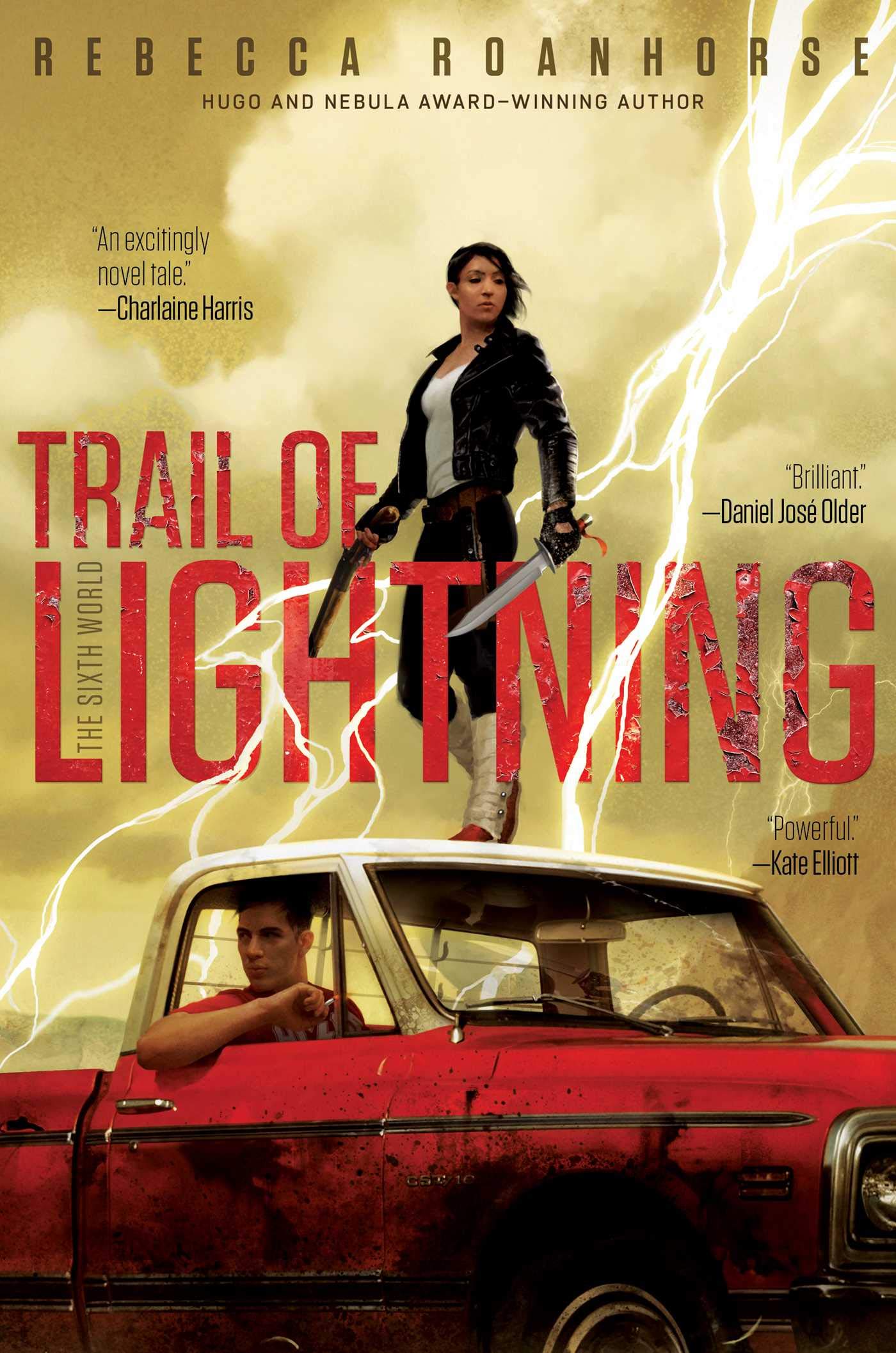
Cover of Trail of Lightning featuring Maggie standing on a truck with a knife
Even though the past of speculative fiction is founded in the frontier mythos and colonial tropes, contemporary speculative literature is actively troubling and questioning this past. Indeed, as the previous generation of largely white, male writers are becoming less active in the community, the trajectory of the speculative genre is shifting toward imagining more equitable futures. While there is much work still to be done, Helen Young acknowledges: “Fantasy—despite, or even perhaps because of, its long reception as a genre designed to ‘serve rather than subvert the dominant ideology’—has considerable power to dig up long-buried histories of colonisation and imperialism and to challenge the assumptions on which their power structures rely by offering new perspectives. This is so despite the ongoing legacy of colonialist ideology which permeates the genre” (114). Indeed, a cohort of authors have been actively publishing books that subvert such tropes: David Anthony Durham, N. K. Jemisin, Nnedi Okorafor, Sabrina Vourvoulias, Tananarive Due, China Miéville, Nalo Hopkinson, Stephen Graham Jones, Rebecca Roanhorse, Kai Ashante Wilson, Darcie Little Badger, Charlie Jane Anders, R. F. Kuang, Silvia Moreno-Garcia, Daniel José Older, and more. When thinking particularly about troubling the frontier and colonialism, Rebecca Roanhorse’s debut Trail of Lightning (2018) presents an interesting and fun example. While often cited as an urban fantasy, I’d argue that it’s more of a weird western—except Roanhorse banishes the figure of the white cowboy. Early on, she invokes the western genre: “Tse Bonito is still more Wild West frontier town than anything else. Bunch of cowboys and Indians, although everyone’s pretty much Diné. Last time I came through here looking for a Bad Man, I ended up in a shootout that felt more like OK Corral than a monster hunt” (Roanhorse 24). While invoking the western, Roanhorse reminds the reader that not all cowboys are white. In fact, in a slick worldbuilding move, Roanhorse easily disposes of the question of white colonists all together. 

Early in the novel, the main character, Maggie, reminisces about the recent history of the land. As the climate crisis worsened, a climate event flooded much of the US, an event the Diné called “Big Water.” This climate event prompted more resource grabs and the Energy Wars, so the Diné built a wall around their lands: “The head of the [Indian] Council, his name was Deschene, wrote some article for the Navajo Times that put the fear in people, especially after the Slaughter on the Plains. Navajo people weren’t safe anymore, he said. He invoked the specter of conquest, manifest destiny. And he wasn’t wrong. The Slaughter had ushered in a heyday of energy grabs” (23). While not everyone agrees with the Wall, Maggie later narrates: “I had forgotten that the Diné had already suffered their apocalypse over a century before. This wasn’t our end. This was our rebirth. […] And the Wall took on a life of its own. When the workmen came back the next morning, it was already fifty feet high. In the east, it grew as white shell. In the south, turquoise” (23). While much of the novel is fast-paced action sequences and monster hunting, the worldbuilding is rooted in anti-colonial discourse. 

I chose Roanhorse for this brief analysis not because her novel offers the best example of undermining colonialism and the frontier mythos but because her novel is not about that, at least, not entirely. Roanhorse’s novel is first and foremost an adventure and a fast-paced read. It’s not about Indigenous pain. Indeed, because of it being a speculative fiction novel rather than literary fiction, Roanhorse can remove white people to behind a wall. Just as earlier texts so easily dismissed Indigenous people, so Roanhorse imagines away white people. In other texts, Roanhorse has more directly engaged with the legacy of colonialism,  but I argue that part of moving forward is making sure that not every text that engages with colonialism does so through pain and suffering. While frontier mythos and colonialism are linked to speculative literature’s earliest texts and still haunts the genre today, contemporary writers are demonstrating that there is more to the genre than otherizing the unknown.


Works Cited

Gilman, Charlotte Perkins. Herland and Selected Stories. Signet Classic, 1992.

Herbert, Frank. Dune. Clinton Book Company, 1965.

Roanhorse, Rebecca. Trail of Lightning. Saga Press, 2018.

Suvin, Darko. Metamorphoses of Science Fiction: On the Poetics and History of a Literary Genre. Yale UP, 1979.

Young, Helen. Race and Popular Fantasy Literature: Habits of Whiteness. Routledge, 2018.


Phoebe Wagner is a PhD candidate at University of Nevada, Reno. When not writing or reading, she can be found kayaking at the nearest lake. Follow her at phoebe-wagner.com or on Twitter @pheebs_w.

Tuesday, November 17, 2020

Microreview [book]: Black Sun by Rebecca Roanhorse

A tapestry of worldbuilding inspired by a variety of pre-Contact cultures and societies in the Americas, with an interesting and striking trio of main characters


CW: Violence against children, suicide

It’s nearly the winter solstice on the continent of Meridian. In the city of Tova, it is even more an auspicious occasion for a society which watches the stars: for the first time in a long time, there will be a solar eclipse on the Winter Solstice. The Convergence is a time of possible change, when the doors of the world might open, and when long simmering tensions might explode.  

Young Serapio might be is destined to play a role in this eclipse, making it a Convergence like none other, if he could get there, across a great distance of ocean, in a very short period of time. And it's most certainly a Convergence like none other for Naranpa. Unlike every other member of the Priesthood, she is from the mean streets of Tova, having risen to Sun Priest rank right as this auspicious event is about to occur.  And then there is Xiala, of the mysterious Teek, challenged by society, an outsider, an exiled member of a mysterious mariner people. But she's also bound by the prospect of a handsome profit if she can get Serapio to his date with destiny in record time: a task perhaps even beyond a Teek captain. 

Their three stories are the center of Rebecca Roanhorse’s turn into epic fantasy, Black Sun.

Black Sun’s Meridian is a continent, a world, a set of peoples and cultures inspired by a variety of pre-Contact cultures and societies in the Americas. The Tovans at the heart of the action, with their canyon cities, are inspired by the Ancestral Pueblans of the American Southwest. The Teek seem to reflect the pre-Contact cultures of the Caribbean. Cuecola, origin of Serapio, has definite notes of Mesoamerican pre-Contact cultures. The richness of these cultures are on full display and there is a deep and abiding worldbuilding that happens over the course of the book. As Tova is the location of one of the main characters, and the destination of the other two, it gets the major focus of the worldbuilding and a view as to how its society works, from the heights of the Priesthood to the mean streets that Naranpa came from. Foods, clothing, methods of address, architecture, style, and the small touches are all brought to life and really immerse the reader into this unfamiliar landscape. This is part and parcel of what a lot of Epic Fantasy is geared for, and the author delivers. The novel and the author avoid an othering or exoticization of these elements (given Roanhorse’s background, extremely important nuance is on display) and it feels natural and strongly rendered.  And there is plenty of invention, including giant, ridden crows that remind me of the Justice Eagles from the work of Kate Elliott. And there are plenty of other surprises, too. Seeing some Ancestral Pueblan architecture on my recent trip just as I was reading this book really helped make the book resonate for me.

In this tapestry of worldbuilding, we get an interesting and striking trio of main characters, and secondary characters that reflect and make a rich character map of connections. For Serapio, this is mainly done in a serious of flashback scenes, showing how he came to be as he was as we see him on his journey to Tova. This is nicely aligned with how he interacts with the crew of Xiala’s ship, and how events on the ship eventually come to a climactic conclusion.  Xiala’s background and personality are mainly fleshed out on the ship, contrasting and comparing her to the rest of the crew, and exploring the differences how outsiders are seen, how they see themselves, and how prejudices can lead to tragic results fill her narrative.  Her brashness and boldness infuse her story, too. With Naranpa, we also get an outside narrative, but someone who has been in the higher echelons of society for so long that she has mostly put aside her past as being from the lower parts of society. We get to see how those higher echelons work, and how they rule, reign, scheme and plot, and more importantly, how do they really feel about an outsider like Naranpa. Behind these three characters, we also get Okoa, who is of the clan of Carrion Crow, also drawn back toward Tova as events unfold. In some ways he reminds me of Evan Winter’s Tau from Rage of Dragons. Young, pushed by events, and also by duty and a sense of self. He gets a little less play than the other main characters, but Roanhorse’s characterization comes through. 

The author does a great job at immersing a reader into the society, customs and mores of this world. There is a lot of invention here, and the basis for that invention is a set of cultures that many readers are not going to be familiar with. In epic fantasy, there is a shorthand involved in using cultures based on medieval Europe, because they are so familiar to the genre. A fantasy novel can use Kings and Queens, Dukes and Barons, use a Greco-Roman Pantheon, sketch in a scene from a Flanders-like market town, and the reader, having absorbed it as part of their general milieu or from countless fantasy novels and stories can absorb it on the go. The society of Black Sun is very different, and so the author has a lot more work to do for a reader without prior knowledge of the cultures it is based on, with little of that foundation to rely on. It is a testament to Roanhorse’s writing that she succeeds in this, in spades. Yes, it is a pretty deep fall into the plunge pool of the world, and I would not think this is a 101 epic fantasy novel in the slightest in that regard. Having the experience of the cues and the patterns to pick up and run with the worldbuilding is a key to success and full enjoyment of reading Black Sun. 

The major issue with the novel - and what might well cause a reader to pass on the book - is there in the first chapter. This chapter should come with a heavy content warning, because of permanent horrific violence done to a child and another character’s suicide. The novel usually isn’t that dark afterwards but it lays down a marker that this is often a harsh and unforgiving world. It frankly surprised me and it was a barrier, an obstacle for me. It didn’t nope me out of the novel but it is clearly not for every reader, and may be dangerous to those sensitive to the subject matter.

The other thing that the reader should know is that the novel ends on a cliffhanger, something that irks me as a reader in a first novel in a series. I do prefer having an off-ramp and while I am very invested enough to go to the next book, it is a weakness for a reader looking to read broadly but not deeply.

However, as a fantasy set beyond "The great wall of Europe", on a continent and culture based on pre-Contact societies in the New World? Black Sun delivers in spades and I am ready for the next volume in the series.

The Math

Baseline Score: 8/10

Bonuses: +1 for a strong and interesting set of main characters

+1 for fantasy that is wholly and completely beyond the Great Wall of Europe, expanding the boundaries of fantasy fiction.

Penalties: -1 The very dark matter in the first chapter may put off readers.

Nerd Coefficient: 9/10 very high quality/standout in its category

POSTED BY: Paul Weimer. Ubiquitous in Shadow, but I’m just this guy, you know? @princejvstin.

Reference: Roanhorse, Rebecca. Black Sun [Saga Press, 2020] 


Wednesday, September 30, 2020

New Books Spotlight

Welcome to another edition of the New Books Spotlight, where each month or so we curate a selection of 6 new and forthcoming books we find notable, interesting, and intriguing. It gives us the opportunity to shine a brief spotlight on some stuff we're itching to get our hands on.

What are you looking forward to? Anything you want to argue with us about?


Baker, A. Deborah. Over the Woodward Wall [Tor.com Publishing]
Publisher's Description
Writing as A. Deborah Baker, New York Times bestselling and award-winning author Seanan McGuire introduces readers to a world of talking trees and sarcastic owls, of dangerous mermaids and captivating queens in Over the Woodward Wall, an exceptional tale for readers who are young at heart.

If you trust her you’ll never make it home…


Avery is an exceptional child. Everything he does is precise, from the way he washes his face in the morning, to the way he completes his homework – without complaint, without fuss, without prompt.

Zib is also an exceptional child, because all children are, in their own way. But where everything Avery does and is can be measured, nothing Zib does can possibly be predicted, except for the fact that she can always be relied upon to be unpredictable.

They live on the same street.
They live in different worlds.

On an unplanned detour from home to school one morning, Avery and Zib find themselves climbing over a stone wall into the Up and Under – an impossible land filled with mystery, adventure and the strangest creatures.

And they must find themselves and each other if they are to also find their way out and back to their own lives.
Why We Want It: Over the Woodward Wall is Seanan McGuire's first middle grade novel and it's also a companion piece to her superb novel Middlegame (also a Hugo Award finalist novel and Locus Award winner). There's a novel within the novel of Middlegame that is referenced constantly and is critical to that story. Over the Woodward Wall is that novel, now fleshed out. A Deborah Baker is McGuire's second pseudonym (Mira Grant being the other) - but this one is also the name of the author within Middlegame, so it all ties together. Either way, anything new from Seanan McGuire is right at at the top of my list.


Bear, Elizabeth. Machine [Saga]
Publisher's Description
In this compelling and addictive novel set in the same universe as the critically acclaimed White Space series and perfect for fans of Karen Traviss and Ada Hoffman, a space station begins to unravel when a routine search and rescue mission returns after going dangerously awry.

Meet Doctor Jens.

She hasn’t had a decent cup of coffee in fifteen years. Her workday begins when she jumps out of perfectly good space ships and continues with developing treatments for sick alien species she’s never seen before. She loves her life. Even without the coffee.

But Dr. Jens is about to discover an astonishing mystery: two ships, one ancient and one new, locked in a deadly embrace. The crew is suffering from an unknown ailment and the shipmind is trapped in an inadequate body, much of her memory pared away.

Unfortunately, Dr. Jens can’t resist a mystery and she begins doing some digging. She has no idea that she’s about to discover horrifying and life-changing truths.
Why We Want It: Paul reviewed Ancestral Night last year for us last year (see his review) and had I read it in time to make either my Top Nine list or my Hugo ballot, it would have easily been on both lists. It is a spectacular space opera and one of the best published last year. Machine is the follow up in the same universe and that by itself would be enough to get me in the door. Elizabeth Bear has also long been one of my favorite authors and each new novel only affirms that, plus the blurb's comparison to Karin Traviss is an added bonus (Traviss's Wess'har Wars is an overlooked series)


McGuire, Seanan. Dying With Her Cheer Pants On [Subterranean]
Publisher's Description
Despite its humble origins, there is no more challenging or physically dangerous teen sport in the world than cheerleading. Cheerleaders are seriously injured and even killed at a higher rate than other high school sports. Their stunts are performed in skimpy uniforms without the benefit of proper safety equipment…and yet they love them, glittery eyeshadow, spirit bows, and all.

And then there are the Fighting Pumpkins, who take that injury rate as a challenge. Students of Johnson’s Crossing High School, they answer to a higher calling than the pyramid and the basket toss, pursuing the pep rally that is rising up against mysteries and monsters, kicking gods with the pointed toes of professional athletes chasing a collegiate career.

Meet Jude, half-vampire squad leader; Laurie, who can compel anyone to do as she asks; Heather, occasionally recreationally dead; Marti, strong enough to provide a foundation for any stunt; Colleen, who knows the rule book so well she may as well have written it; and Steph, who may or may not be the goddess of the harvest. The rest of the squad is ready to support them, and braced for the chaos of the big game, which may have a big body count. Prepare to jump high, yell loud, and look pretty with the Fighting Pumpkins, those glorious girls in the orange and green, whose high kicks could still be enough to save the world.

And if they’re not, it isn’t going to be for lack of trying.

Dying with Her Cheer Pants On includes three stories appearing for the first time anywhere: "Tryouts," "Trial by Fire," and "Compete Me."
Why We Want It: As a matter of practice we tend to spotlight only one selection from a given author so as to spread the light around - but this is my spotlight and I'm as excited for Dying With Her Cheer Pants on as I am for Over the Woodward Wall, just in very different ways. I've been working way through McGuire's back catalog including her stories, but this is the first I've heard of the Fighting Pumpkins. I need this in my life.


Roanhorse, Rebecca. Black Sun [Saga]
Publisher's Description
From the New York Times bestselling author of Star Wars: Resistance Reborn comes the first book in the Between Earth and Sky trilogy, inspired by the civilizations of the Pre-Columbian Americas and woven into a tale of celestial prophecies, political intrigue, and forbidden magic.

A god will return
When the earth and sky converge
Under the black sun


In the holy city of Tova, the winter solstice is usually a time for celebration and renewal, but this year it coincides with a solar eclipse, a rare celestial event proscribed by the Sun Priest as an unbalancing of the world.

Meanwhile, a ship launches from a distant city bound for Tova and set to arrive on the solstice. The captain of the ship, Xiala, is a disgraced Teek whose song can calm the waters around her as easily as it can warp a man’s mind. Her ship carries one passenger. Described as harmless, the passenger, Serapio, is a young man, blind, scarred, and cloaked in destiny. As Xiala well knows, when a man is described as harmless, he usually ends up being a villain.

Crafted with unforgettable characters, Rebecca Roanhorse has created an epic adventure exploring the decadence of power amidst the weight of history and the struggle of individuals swimming against the confines of society and their broken pasts in the most original series debut of the decade.
Why We Want It: The trend of epic fantasies moving farther and farther away from what was the "standard" of the European Middle Ages is a welcome one, which is why Rebecca Roanhorse's magical epic of the Americas before Columbus is so damned exciting. Her Sixth World novels were a breath of fresh air in urban fantasy (though that's not a sub genre I'm as well read in) and this is a bold new direction for epic fantasy - part of the changing of the genre. Also, it does have a stunning cover.


Robinson, Kim Stanley. The Ministry for the Future [Orbit]
Publisher's Description
From the visionary, New York Times bestselling author of New York 2140 comes a near-future novel that is a gripping exploration of climate change, technology, politics, and the human behaviors that drive these forces.

Established in 2025, the purpose of the new organization was simple: To advocate for the world's future generations and to protect all living creatures, present and future. It soon became known as the Ministry for the Future, and this is its story.

From legendary science fiction author Kim Stanley Robinson comes a vision of climate change unlike any ever imagined.

Told entirely through fictional eye-witness accounts, The Ministry For The Future is a masterpiece of the imagination, the story of how climate change will affect us all over the decades to come.

Its setting is not a desolate, post-apocalyptic world, but a future that is almost upon us - and in which we might just overcome the extraordinary challenges we face.

It is a novel both immediate and impactful, desperate and hopeful in equal measure, and it is one of the most powerful and original books on climate change ever written.
Why We Want It: I can't call myself a Robinson aficionado. He has been publishing novels since 1984 and I've only read his last two (New York 2140 and Red Moon), though I do own a small handful of his earlier novels that I swear I'll get to someday. Regardless of that, I appreciate the optimism that The Ministry for the Future offers that humanity might work together to solve the climate crisis (I write this in early September when the Environmental Protection Agency is doing the exact opposite of its name and mandate and allowing for greater pollution in the name of industry, so I can use a dose of optimism right now).


Vaughn, Carrie. Kitty's Mix Tape [Tachyon]
Publisher's Description
In the final installment of the bestselling Kitty Norville werewolf-DJ series, the paranormal escapades continue with Carrie Vaughn’s most captivating characters, including fan favorite characters like Rick the vampire and Jessi Hardin, paranormal detective, Kitty’s husband Ben, his cousin Cormac the bounty hunter, and the villainous Dux Bellorum.
Why We Want It: One of my greatest discoveries was winning an online contest that I don't remember entering and receiving copies of Kitty and the Midnight Hour and Kitty Goes to Washington in the mail. After giving them the side eye for no good reason, I started to read and Kitty Norville quickly became one of my favorite characters and I could not get enough of the series - and then it ended and Carrie Vaughn moved on. But wait! Here's a story collection and even though I've likely read at least half of the stories in it, there are two brand new Kitty stories! I'm here for this!
 

POSTED BY: Joe Sherry - Co-editor of Nerds of a Feather, 4x Hugo Award Finalist for Best Fanzine. Minnesotan. He / Him.

Monday, February 10, 2020

New Books Spotlight

Welcome to another edition of the New Books Spotlight, where each month or so we curate a selection of 6 new and forthcoming books we find notable, interesting, and intriguing. It gives us the opportunity to shine a brief spotlight on some stuff we're itching to get our hands on.

What are you looking forward to? Anything you want to argue with us about? Is there something we should consider spotlighting in the future? Let us know in the comments!


Hurley, Kameron. The Broken Heavens [Angry Robot]
Publisher's Description
The Tai Mora – invaders from a parallel universe – have vanquished their counterparts and assumed control of the world called Raisa. The Saiduan are wiped out. The Dhai nation has broken apart. The remaining countries are in chaos. While the Dhai retreat and regroup, led by the recklessly headstrong Lilia, the Tai Mora begin to unravel the mystery of how to use the ancient Dhai holy places to harness the power of the stars and cement their tyrannical rule for another two thousand years.

With more refugees from ravaged lands passing through the soft seams between worlds every day, time is running out for the Tai Mora and the last of the Dhai. Only one ruler, one nation, one world can survive. Who will be saved, and who will be sacrificed, when the heavens finally break?

Back with a vengeance – and fearless, unapologetic writing – Hurley’s visceral masterpiece finally reaches its world-shattering end… 
Why We Want It: Hurley stepped away from her Worldbreaker series to write and publish both The Stars Are Legion and The Light Brigade. Both are among the best novels of the last ten years and have served to whet the appetite for The Broken Heavens – though I’ll need a small refresher of what came before in the previous two books. This is Hurley’s return to straight up epic fantasy, though nothing Kameron Hurley does is straight up. The first two books were absolutely top notch and we can’t wait to see how Hurley concludes the series.


Kerr, Katharine. Sword of Fire [DAW]
Publisher's Description
This first novel of an epic fantasy trilogy reintroduces readers to the beloved and bestselling world of Deverry, blending magic, politics, and adventure in an unforgettable setting. 

The bards are the people’s voice–and their sword.

All over the kingdom of Deverry, the common people are demanding reform of the corrupt law courts. In Aberwyn, the situation catches fire when Gwerbret Ladoic, second in authority only to the High King, allows a bard to starve to death rather than hear their grievances.

Guildwoman Alyssa, a student at the local scholars’ collegium, and Lady Dovina, the gwerbret’s own daughter, know that evidence exists to overthrow the so-called traditional legal system, if they can only get it into the right hands. The powerful lords will kill anyone who threatens their privileges.

To retrieve the proof, Alyssa must make a dangerous journey that will either change her life forever–or end it. 
Why We Want It: The 16th Deverry novel and the first to be published in 11 years. I’m not sure where and how this fits into the timeline and the braided narrative of the first fifteen books of a series most thought was already complete. I’m only halfway through my first read through of the series (check out my Deverry Read: Part One, Part Two) and I am certainly not going to catch up before Sword of Fire is published, but this is a fantastic series and I am so glad there is going to be at least one more. I just need to confirm if there is a barrier to entry or if I am safe to pick up here while I continue with the series. Either way, major fantasy release right here!


Larkwood, A.K. The Unspoken Name [Tor]
Publisher's Description
A. K. Larkwood's The Unspoken Name is a stunning debut fantasy about an orc priestess turned wizard's assassin. 

What if you knew how and when you will die? 

Csorwe does—she will climb the mountain, enter the Shrine of the Unspoken, and gain the most honored title: sacrifice.

But on the day of her foretold death, a powerful mage offers her a new fate. Leave with him, and live. Turn away from her destiny and her god to become a thief, a spy, an assassin—the wizard's loyal sword. Topple an empire, and help him reclaim his seat of power.

But Csorwe will soon learn—gods remember, and if you live long enough, all debts come due. 
Why We Want It: Without knowing anything about the novel, The Unspoken Name has been one of the more buzzed about novels of early 2020.  Plus, check out Adri's review.


McGuire, Seanan. Imaginary Numbers [DAW]
Publisher's Description
The ninth book in the fast-paced InCryptid urban fantasy series returns to the mishaps of the Price family, eccentric cryptozoologists who safeguard the world of magical creatures living in secret among humans. 

Sarah Zellaby has always been in an interesting position. Adopted into the Price family at a young age, she’s never been able to escape the biological reality of her origins: she’s a cuckoo, a telepathic ambush predator closer akin to a parasitic wasp than a human being. Friend, cousin, mathematician; it’s never been enough to dispel the fear that one day, nature will win out over nurture, and everything will change.

Maybe that time has finally come.

After spending the last several years recuperating in Ohio with her adoptive parents, Sarah is ready to return to the world–and most importantly, to her cousin Artie, with whom she has been head-over-heels in love since childhood. But there are cuckoos everywhere, and when the question of her own survival is weighed against the survival of her family, Sarah’s choices all add up to one inescapable conclusion.

This is war. Cuckoo vs. Price, human vs. cryptid…and not all of them are going to walk away. 
Why We Want It: Since April 2018 I've read all eight previous Incryptid novels and, as is the case with all of McGuire's novels - they are absolutely delightful and fun and dangerous and straight up excellent. Imaginary Numbers focuses on Sarah Zellaby (the Price cousin and cuckoo / parasitic wasp) and that's a story I've been waiting for.


Polk, C.L. Stormsong [Tor.com Publishing]
Publisher's Description
After spinning an enthralling world in Witchmark, the winner of the World Fantasy Award for best novel that was praised as a “can't-miss debut” by Booklist, and as “thoroughly charming and deftly paced” by the New York Times, C. L. Polk continues the story in Stormsong. Magical cabals, otherworldly avengers, and impossible love affairs conspire to create a book that refuses to be put down. 

Dame Grace Hensley helped her brother Miles undo the atrocity that stained her nation, but now she has to deal with the consequences. With the power out in the dead of winter and an uncontrollable sequence of winter storms on the horizon, Aeland faces disaster. Grace has the vision to guide her parents to safety, but a hostile queen and a ring of rogue mages stand in the way of her plans. There's revolution in the air, and any spark could light the powder. What's worse, upstart photojournalist Avia Jessup draws ever closer to secrets that could topple the nation, and closer to Grace's heart.

Can Aeland be saved without bloodshed? Or will Kingston die in flames, and Grace along with it? 
Why We Want It: Witchmark was fantastic, the winner of the 2019 World Fantasy Award, and was a stunningly good story that I was curious how it might continue. Adri also had some things to say about it. Stormsong is an intriguing book for February.


Roanhorse, Rebecca. Race to the Sun [Rick Riordan]
Publisher's Description
Lately, seventh grader Nizhoni Begay has been able to detect monsters, like that man in the fancy suit who was in the bleachers at her basketball game. Turns out he’s Mr. Charles, her dad’s new boss at the oil and gas company, and he’s alarmingly interested in Nizhoni and her brother, Mac, their Navajo heritage, and the legend of the Hero Twins. Nizhoni knows he’s a threat, but her father won’t believe her. When Dad disappears the next day, leaving behind a message that says “Run!”, the siblings and Nizhoni’s best friend, Davery, are thrust into a rescue mission that can only be accomplished with the help of Diné Holy People, all disguised as quirky characters. Their aid will come at a price: the kids must pass a series of trials in which it seems like nature itself is out to kill them. If Nizhoni, Mac, and Davery can reach the House of the Sun, they will be outfitted with what they need to defeat the ancient monsters Mr. Charles has unleashed. But it will take more than weapons for Nizhoni to become the hero she was destined to be . . . Timeless themes such as the importance of family and respect for the land resonate in this funny, fast-paced, and exciting quest adventure set in the American Southwest. 
Why We Want It: New Rebecca Roanhorse! Roanhorse has been a fascinating writer to follow - from her first short story to her two Sixth World novels to Star Wars and now her first YA novel. I'm here for whatever she writes.


Joe Sherry - Co-editor of Nerds of a Feather, 3x Hugo Award Finalist for Best Fanzine. Minnesotan. He / Him.

Friday, November 1, 2019

New Books Spotlight

Welcome to another edition of the New Books Spotlight, where each month or so we curate a selection of 6 new and forthcoming books we find notable, interesting, and intriguing. It gives us the opportunity to shine a brief spotlight on some stuff we're itching to get our hands on.

What are you looking forward to? Anything you want to argue with us about? Is there something we should consider spotlighting in the future? Let us know in the comments!


Cornell, Paul. The Lights Go Out in Lychford [Tor.com Publishing]
Publisher's Description
Be careful what you wish for... 

Paul Cornell's The Lights Go Out in Lychford continues the award-nominated Witches of Lychford series, described by Seanan McGuire as "Beautifully written, perfectly cruel and ultimately kind." 

The borders of Lychford are crumbling. Other realities threaten to seep into the otherwise quiet village, and the resident wise woman is struggling to remain wise. The local magic shop owner and the local priest are having troubles of their own.

And a mysterious stranger is on hand to offer a solution to everyone's problems. No cost, no strings (she says).

But as everyone knows, free wishes from strangers rarely come without a price . . . 
Why We Want It: The first three novellas in Paul Cornell's Lychford were delightful and I'm thrilled to see a fourth.


Morgenstern, Erin. The Starless Sea [Random House]
Publisher's Description
From the New York Times bestselling author of The Night Circus, a timeless love story set in a secret underground world—a place of pirates, painters, lovers, liars, and ships that sail upon a starless sea. 

Zachary Ezra Rawlins is a graduate student in Vermont when he discovers a mysterious book hidden in the stacks. As he turns the pages, entranced by tales of lovelorn prisoners, key collectors, and nameless acolytes, he reads something strange: a story from his own childhood. Bewildered by this inexplicable book and desperate to make sense of how his own life came to be recorded, Zachary uncovers a series of clues—a bee, a key, and a sword—that lead him to a masquerade party in New York, to a secret club, and through a doorway to an ancient library hidden far below the surface of the earth.
What Zachary finds in this curious place is more than just a buried home for books and their guardians—it is a place of lost cities and seas, lovers who pass notes under doors and across time, and of stories whispered by the dead. Zachary learns of those who have sacrificed much to protect this realm, relinquishing their sight and their tongues to preserve this archive, and also of those who are intent on its destruction. Together with Mirabel, a fierce, pink-haired protector of the place, and Dorian, a handsome, barefoot man with shifting alliances, Zachary travels the twisting tunnels, darkened stairwells, crowded ballrooms, and sweetly soaked shores of this magical world, discovering his purpose—in both the mysterious book and in his own life. 
Why We Want It: The Night Circus was a fantastic debut and we were eager for another book from Erin Morgenstern. We didn't expect having to wait eight years, but we don't have to wait any longer. If The Starless Sea is even half as good as The Night Circus, we're in for a treat.


Roanhorse, Rebecca. Star Wars: Resistance Reborn [Del Rey]
Publisher's Description
In this pivotal prequel to Star Wars: The Rise of Skywalker, the heroes of the Resistance—Poe Dameron, General Leia Organa, Rey, and Finn—must fight back from the edge of oblivion.

The Resistance is in ruins. In the wake of their harrowing escape from Crait, what was once an army has been reduced to a handful of wounded heroes. Finn, Poe, Rey, Rose, Chewbacca, Leia Organa—their names are famous among the oppressed worlds they fight to liberate. But names can only get you so far, and Leia’s last desperate call for aid has gone unanswered.

From the jungles of Ryloth to the shipyards of Corellia, the shadow of the First Order looms large, and those with the bravery to face the darkness are scattered and isolated. If hope is to survive, the Resistance must journey throughout the galaxy, seeking out more leaders—including those who, in days gone by, helped a nascent rebellion topple an empire. Battles will be fought, alliances will be forged, and the Resistance will be reborn.
Why We Want It: Did you know that Rebecca Roanhorse was writing a Star Wars novel? I sure didn't! I've been behind on reading Star Wars novels ever since the Expanded Universe was scrapped and I just haven't managed to come back. Rebecca Roanhorse will get me back.


Roberson, Jennifer. Life and Limb [DAW]
Publisher's Description
A biker and a cowboy must stop the apocalypse in the first book of the Blood and Bone modern western fantasy series. 

His voice was rich, a much loved baritone, as he handed his seven-year-old grandson a gun. 

“It’s time we had a talk, you and I. You won’t remember it, but you need to know it, and one day, when it’s time, I’ll call it up in you. You’ll know who you are, and what you’re intended to do. You’ll be a soldier, boy. Sealed to it. Life and limb, blood and bone. Not a soldier like others are, for it’s not the kind of war most people fight on earth. But because we’re not ‘most people,’ you and I, it will be far more important. The fate of the world will hinge upon it.” 

Now no longer that wide-eyed child, Gabe is fresh out of prison, a leather-clad biker answering Grandaddy’s peremptory summons to, of all places, a cowboy bar in Northern Arizona. He is about to find out just how different he is from “most people”—and to meet the stranger with whom he will be sealed: life and limb, blood and bone, conscripted to fight an unholy war unlike any other.

For the greatest trick the devil ever pulled was convincing the world he didn’t exist.

When he does.

And Gabe, thrown into the unlikely company of a country-music-loving rodeo cowboy from West Texas, an ancient Celtic goddess of war, an African Orisha who sings volcanoes awake, a Chinese goddess of mercy, Nephilim, and Grigori, finds himself fighting a battle he was bred for, but wants no part of.
Why We Want It: I loved Roberson's Cheysuli novels, not to mention her collaboration with Kate Elliott and Melanie Rawn (The Golden Key), but after I bounced off of the first Karavans novels I've been looking for a new entry point back into Roberson. I think Life and Limb just might be it.


Solomon, Rivers. The Deep [Saga]
Publisher's Description
The water-breathing descendants of African slave women tossed overboard have built their own underwater society—and must reclaim the memories of their past to shape their future in this brilliantly imaginative novella inspired by the Hugo Award–nominated song “The Deep” from Daveed Diggs’s rap group clipping 

Yetu holds the memories for her people—water-dwelling descendants of pregnant African slave women thrown overboard by slave owners—who live idyllic lives in the deep. Their past, too traumatic to be remembered regularly, is forgotten by everyone, save one—the historian. This demanding role has been bestowed on Yetu.

Yetu remembers for everyone, and the memories, painful and wonderful, traumatic and terrible and miraculous, are destroying her. And so, she flees to the surface, escaping the memories, the expectations, and the responsibilities—and discovers a world her people left behind long ago.

Yetu will learn more than she ever expected to about her own past—and about the future of her people. If they are all to survive, they’ll need to reclaim the memories, reclaim their identity—and own who they really are.

Inspired by a song produced by the rap group Clipping for the This American Life episode “We Are In The Future,” The Deep is vividly original and uniquely affecting. 
Why We Want It: This is a major, important novella. After An Unkindness of Ghosts, whatever Rivers Solomon decided to write next was something to take notice of. Their adaptation of Clipping's Hugo Award finalist song has been at the top of our list as soon as it was announced and it lives up to the hype.


Watts, Peter. Peter Watts Is an Angry Sentient Tumor [Tachyon]
Publisher's Description
Which of the following is true?
  • Peter Watts is banned from the U.S. 
  • Watts almost died from flesh-eating bacteria. 
  • A schizophrenic man living in Watts’s backyard almost set the house on fire. 
  • Watts was raised by Baptists who really sucked at giving presents. 
  • Peter Watts said to read this book. Or else.
In these unpredictable essays and revenge fantasies, Peter Watts — Hugo Award-winning author, former marine biologist, and angry sentient tumor — is the savage dystopian optimist whom you can’t look away from. Even when you probably should. 
Why We Want It: The title. It's really just the title.


POSTED BY: Joe Sherry - Co-editor of Nerds of a Feather, 3x Hugo Award Finalist for Best Fanzine. Minnesotan.