Showing posts with label TV series. Show all posts

Monday, August 24, 2020

Paying a visit to Lovecraft Country


SFF television is quickly becoming more active in discussions around the politics of race.

A lot has been made out of the fact that a significant portion of the audience of HBO's new Watchmen had not heard a word about the single worst act of racial violence in American history until they saw the first minutes of the first episode. A gripping reminder, perhaps, of the indifference that the contemporary America feels about the more shady bits of its backstory.

Turns out that I was actually better informed than many of my fellow viewers because I had some cursory knowledge about what went down in Tulsa in 1921 – thanks not to my keen grasp of history but to another piece of SFF: the novel Lovecraft Country by Matt Ruff. The Greenwood massacre is something of a formative experience for important characters in both the newest interpretation Watchmen and Lovecraft Country, even though in the latter it is a more of a living memory for them as the story is set in 1950s.

I read the book a couple of years ago for Nerds of a feather, flock together and have since been waiting for the TV adaptation to materialize. Now that the first episode has been out for a week, I guess it's a good time to say a word or two about it. I'm obviously writing this without seeing eight tenths of the first season, so let's hope that the upcoming episodes won't render anything I say completely silly. Time will tell, for example, if we'll see the Tulsa events on screen at some point.

For television, Lovecraft Country was developed by Misha Green with people like Jordan Peele and J.J. Abrams as executive producers. Ruff's novel-looking collection of interconnected tales was initially a proposal for a TV series, so maybe the process should be called reverse engineering rather than adaptation. Whatever took place, it carefully preserved very much of the source material, at least judging by the first two episodes. Not counting one gender-swap and surname changes, every character seems like they are lifted straight from the book.

The story starts with the protagonist Atticus Freeman returning home to Chicago through states that are unfriendly for black people such as he, and running into vehicle trouble on the road. Now we meet him on a bus as opposed to his own car in the novel, but either way, getting where they are supposed to go is way easier for whites when the car breaks down.

The problem of traveling in Jim Crow America and staying safe is a central to the plot in many ways. Atticus's family is in the business of publishing a guidebook called The Safe Negro Travel Guide which lists the establishments in which black customers can expect to be welcome and stay alive. Even though it sounds like one, it is not a dark joke. Books like that really existed, and having Atticus's uncle George compile them in the story provides an economic solution for drawing the extended family in sticky situations and adventures.

So, the show is called Lovecraft Country. George and Atticus are huge fans of pulp literature and science fiction, including H.P. Lovecraft, and they get into a discussion about his works right in the first episode. There's remarkably little love for Lovecraft to go around these days, compared to just ten years ago. Even though his problematic batshit insane racist views were discussed here and there, Lovecraft was one of the absolute greats of fantastic horror.

For decades, nobody questioned the fact that a World Fantasy Award trophy that was a bust of the author who had written, for example, a poem titled "On the Creation of Niggers” describing a creature that was half-human and half-beast. When the bulby-eyed Lovecraft statue was finally retired in 2015, his most ardent admirers were so unhappy that they even returned the trophies they had previously won. As much Lovecraftiana is published as before, but the most memorable new works explicitly take aim at the racial attitudes of Lovecraft and his works. Victor LaValle's "Ballad of Black Tom" rewrote the "The Horror at Red Hook" from the viewpoint of a black protagonist, and other such works are making it hard to even think about Lovecraft without considering his politics.

In Lovecraft Country, all the Lovecraftian monstrosities are there to make a very specific political point. Indeed, Shoggoths are roaming the night and there are things with way too many eyes and tentacles (and consonants in their names), but evil-wise they are nothing compared to the darkness of Jim Crow. It's a good premise, even though it reduces the Lovecraftian to a gallery of slimy monsters, missing all the bleak lonely horror that I would actually consider Lovecraft's claim to fame. Beings from alien dimensions and the fact that there used to be towns where non-whites are killed if they don't leave before the sun sets are both terrifying.

One could argue that all the Lovecraftian elements are more or less window dressing and could be replaced with other horror lore just as easily. What is borrowed from Lovecraft are some names of horrific creatures, obsession about ancient magic books and assorted plot elements. What cemented his reputation and got him canonized is, I think, the cosmic horror and the feeling of being alone and in constant danger in a cold, brutal universe.

This is a feeling you don't get to experience with Lovecraft Country. Here, good triumphs, family takes care of each other and the atmosphere is cozy. That's probably as anti-Lovecraftian as it gets.

The novel is a happy book about awful stuff in which nobody is really going to get hurt. In the last pages, we leave the black cast laughing together when they have again defied all odds and made it out of their latest adventure in one piece. It's not yet certain that the show will be all like that. Actually, the second episode which just landed might suggest that the main characters can get hurt more seriously here, but the future episodes will tell what kind of Lovecraft Country we are going to be able to visit this time.

I'm sure that somewhere there are Lovecraft nerds itching to remark that the story isn't entirely accurate in all bibliographic details, and they're right. Lovecraft's vile poem mentioned earlier was never published and it had not yet been even discovered at the time when Atticus, his father and uncle George are discussing it in Lovecraft Country. Personally, I don't particularly care as it makes a better story this way, but it's a bit fast and loose here and there. In all honesty, I don't think that actual black science fiction fans in the 1950s would be as understanding as Atticus and George are about the undertones of Lovecraft's work. At times they feel more like stand-ins for contemporary SFF fans, but that's how it is. Lovecraft Country is entertainment and not a dissertation. 

SPACEFARING KITTEN, an extradimensional enthusiast of speculative fiction, comics, and general weirdness. Contributor since 2018. @spacefaringk

Monday, April 30, 2018

Microreview [TV}: Ash vs. Evil Deal (Series Finale)

"I'm Ashy Slashy's Daughter. Come Get Some!"

Three years ago, I wrote on this site of my worry that Ash vs. Evil Dead would be an ill-conceived resurrection (no pun intended, but...I'll...I'll allow it) of what was, for me, a transformative series of movies. After watching the first three episodes for my review back then, I found my fears to be unfounded. Season 1 of Ash vs. Evil Dead was a welcome, funny, and accomplished return to a world that I loved. It introduced new characters that seemed like they could be pretty cool, and it teased the possibility of an actual character arc in Ash Williams, who was almost by design a character that defied an arc.


Last week, Starz announced that Season 3, Episode 10, would be not only the Season 3 finale of the show, but the series finale, due to abysmal ratings. So, in the interest of avoiding spoilers, I find myself reviewing the entire series-that-was, rather than the specifics of the final episode. Part of me wonders at the ratings — the show is so damn good, why aren't people watching it?? — and part of me finds that par for the course. Evil Dead and its two sequels didn't take the world by storm on first release. It took years. Eventually, the cult following was so strong that I found myself attending roadshow screenings in small theaters with Bruce Campbell in attendance, where the audience was shouting every word of Evil Dead 2 or Army of Darkness at the screen, and you couldn't hear the movie at all. Then, a few years after that, there were enough legs on this cult project for Bruce Campbell to write a book (the fabulously entertaining If Chins Could Kill: Confessions of a B-Movie Actor).

Now we find ourselves a few years past even that. Bruce Campbell has written two more books. There was an Evil Dead remake. And there was Ash vs. Evil Dead. For years, fans asked Campbell and Sam Raimi for Evil Dead 4. Well, we got it, and it was really, really long. Three seasons of TV long. And it was glorious.

So, to recap...everything: after the events of Army of Darkness, Ash lived in relative harmony as a loudmouthed, deadbeat, big box store retail lifer with a pretty sweet trailer outside of town. But then he accidentally woke evil up by drunkenly reading from the Necronomicon to impress a lady-friend. Two of his co-workers, Pablo and Kelly, got swept up in the wake, and became Ash's partners in trying to quash the return of the Deadites. Meanwhile, Ruby (Lucy Lawless), an ancient demon herself, tracked the three of them to try to recover the book. There was a lot of fighting, and gallons...nay, hogsheads...of blood. So, so much blood. Then, in Season 2, they all kind of joined up, because there was an even bigger threat that faced them all, and Ruby became kind of an ally. Kind of. But that all ended at the end of Season 2, in an apocalyptic return to the Cabin that started it all, and Ash's return to his hometown, which never believed his crazy "demons from beyond" story, and thought Ash was a murderer (who they nicknamed Ashy Slashy). Season 3 introduced Brandy, the daughter Ash never knew he had, and saw the arrival of the Dark Ones, the ultimate baddies from the Necronomicon, and a return to Ruby being a malevolent thorn in Ash, et al's side.


That's right: Ash Williams gets a daughter (and a tank, see photos), and learns how to be a father. Can you imagine? And it's awesome. I felt like Kelly really got to shine in Season 2, and Season 3 wound up being more Pablo's story, but Pablo, Kelly, and Brandy are all amazing additions to this universe, and provided the key emotional anchor that an ongoing TV series requires, but the movies never had to worry about, thanks to their absurdity, over-the-top comedy-horror, and brief running times. Brandy was a very smart addition to Season 3. Kelly and Pablo had both more than proved their mettle, and had become accustomed to the daily, non-stop horror of battling Deadites. Seeing this madness anew through a new addition to the cast really helped re-contextualize the absolute absurdity of the violence of this show, and tied together the progression of "Ash learns to have friends / Ash has to confront his father / Ash has an actual family."

And now we've arrived at what is probably the actual end-of-the-road for Ash Williams and the Evil Dead universe, in its original form. Season 2 had maybe my favorite moments in the show — the episode "Morgue" is probably the single most fucked-up thing I have ever seen on TV, and the episode "Ashy Slashy," where Ash has to confront reality inside an asylum with a murderous puppet on his hand (yep) is both legitimately unnerving and wrenching (seriously). But Season 3 as a whole leaves little to be desired. It meshes with everything that has come before, it is of the same cloth as the films I came of age with and continue to revere, and pushes them into a satisfying, emotional context that just didn't seem possible coming out of Army of Darkness.

There is, in the last episode, however, the strong sense that the writers knew the score, and the series ends where they wanted it to land.

The Math

Baseline Assessment: 7/10 (if you're not a fan of Evil Dead and its universe, not much for you here, probably)

Bonuses: +3 for Kelly, Pablo, and Brandy; +1 for a solid reference to the Director's Cut ending of Army of Darkness

Penalties: -1 for the weird Knights of Sumeria, which seemed like episode filler and didn't pay off to a truly satisfying degree; -1 for a less-than-ideal resolution with the non-Ash characters

Nerd Coefficient: 9/10. It's better than we could've hoped for, and remained true to the spirit of the franchise throughout.

Posted by Vance K — cult film reviewer and co-editor of nerds of a feather since 2012, and one of the armies of people who have met Bruce Campbell on numerous occasions, and who he wouldn't remember from Adam.

Friday, April 27, 2018

Microreview [TV series]: Lost in Space (2018)

Even the gorgeous visuals can't save this turd.

Image result for lost in space 2018
Lost in Space (TV series). Netflix, April 2018.


I remember watching Apollo 13 as a child. I wasn’t impressed with the aesthetics, but recall thinking that while the cascade of near-fatal problems seemed a bit forced (at the time I had no idea it was based more or less closely on actual events!), the cast managed to pull it off and save the movie from the dustbin of (audiovisual) history. Sadly, Lost in Space suffers from the exact opposite issue. Watching it in Netflix’s vaunted 4K resolution—with HDR enabled, no less—the visuals are absolutely stunning. But what stunned me even more is how incredibly insipid the narrative was. In honor of this atrocious series, welcome to the first episode of “Can you come up with a better story than a seventh-grader?” (It goes without saying that the writers for this show would spectacularly fail that test!)
Image result for apollo 13 movie
Except the problem in Lost in Space is "bad writing" and there's no escaping it!

First of all, the series suffers greatly due to its pointless “problem of the week” feel in each episode. I will spoil nothing when I say that each episode confronts the Robinsons with a crisis even more gratuitous or improbable than the last one. I think the main failing of the writing is simply that they were (too) obviously starting from the desired end-point (usually some sort of emotional realization, etc.) and then just throwing darts at the wall until they hit upon some convenient problem that forces precisely that end result. I have dubbed this the “crisis ex machina” effect: the perfect problem at just the right time which forces the character(s) to feel their feelings, and attempts (unsuccessfully for this viewer, needless to say !) to push the audience into melodramatic identification with the doggone unfairness of it all—poor Robinsons!

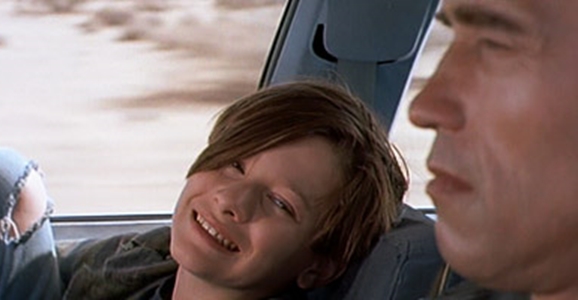
Just one example, sort of spoiler-free or at least spoiler-lite, will suffice to make this point. Once the robot (who despite the show’s gorgeous visuals looks quite ridiculous, as it is all too obviously a guy in a suit for 90% of the shots—shame on you, producers, for cutting corners on such a key visual design!) bonds with Will, the villain must engineer a scenario in which the boy not only initially tries to hide the robot but, after it alternates—in response to his express commands!—between saving and injuring the other humans, forces it to take a long walk off a short pier (all of this, of course, is done in full view of the only nominally hidden villain). Yeah, the robot, an incredibly advanced alien life form, is forced off a cliff by a 12-year old's whim, cause that makes sense. This is so the villain can attempt a reset and thereby get a chance to be the robot’s protectee. Since the writers obviously wanted to milk the melodrama of the shocking tables-have-turned moment when the villain comes out on top, they simply whipped up a bunch of crises, each more absurd than the last, which produce exactly that result. And I thought John Connor was annoying!
Image result for john connor annoying
By series' end, you'll want to slap Will Robinson a lot more than John Connor/Eddie Furlong, I can assure you!
The writers also made a halfhearted attempt to circumvent some of the obvious objections their hopelessly contrived story-line might provoke in the minds of viewers. Why don’t their various spacecraft just take off and go back to the mother ship? Apparently the writers had been watching Princess Bride and decided to manufacture a convenient methane-eating critter, seemingly stranding everyone on the planet for good. 
Image result for those are the shrieking eels
I.e., "convenient plot device to push us into the next lame crisis"
An alternate source of fuel is found? Don’t worry, the writers find a way to ruin that too, basically by manufacturing a stupid sense of looming crisis via the source’s precarious location plus seismic activity, and then forcing a character to make a one-versus-many decision in the midst of—because why not?—a brand-new threat, steam geysers! Yet another alternative fuel source is located in a later episode? Well, that won’t fill up 45 minutes, so better get some lame-looking bat thingies in there!

The cast is a bit uneven, too. While John and Maureen are well cast and as believable as anything/one else in this amateurish nonsense of a story, others left much to be desired. The villain, partly as a result of casting, was far from intimidating, but more than made up for that shortcoming by being absolutely no fun at all to watch. At times, this villain seemed to start poisonous rumors/hit people in the head just “to watch the world burn”, to quote Alfred, but lacked even the slightest glimmer of the Joker’s manic psychopathy.

But the worst casting choice/performance was definitely Will. In fact, at first, I thought the worst problem with the show was simply the mediocre actor they’d found to play him, because the kid’s performance managed to turn ostensibly the most innocent, likeable character into an infuriating nincompoop with an irritating habit of turning up his chin to look scared, turning up his chin to look brave, turning up his chin and scrunching up his eyes a little to look sad, and so on ad infinitum.
Image result for will robinson 2018
Look, the kid can also turn his chin up to look surprised/scared!

When the villain gets captured, not only does Will the rapscallion see fit to listen to the villain’s absolutely ridiculous let-me-out ploy, he obligingly frees said villain despite the ploy not even making sense. It can be paraphrased thus: “I know someone who could do that dangerous thing instead of your father, and you really don’t want him to leave you again, do you? Let me out right now (even though your father has literally already left!) and I totally won’t tie you up or anything!” Never have I so thoroughly rooted against the ‘good guy’ in a story before, and I initially blamed it all on the actor. But halfway through, I was forced to reevaluate. It’s the writers who should shoulder the responsibility for this hot mess. Sure, the actor may be unimpressive, but oh, the contrived nonsense they keep writing for him to stumble into—it’s enough to make one scream!

Near the end of the series, Will is in grievous danger with seemingly no hope left, and I suppose the audience was meant to stare helplessly at the screen, desperately wishing for the impossible to happen and for him to be rescued. I hope you, dear reader, won’t think less of me if I admit that I was entirely on the other side, praying fervently that the writers would finally have the courage to kill him off! I trust you won’t consider the series spoiled if I reveal that, to my everlasting sorrow, the annoying Robinson family will be stinking up our TVs with a second season if the cliffhanger ending is any indication. Would that they all hurled themselves off a cliff instead! 
Image result for off cliff meme
I was certainly ready to jump by the end...

TL, DR: this series suuuuuuucks. Give it a miss, and go back to the source: Swiss Family Robinson! (The title of the show should never have been Lost in Space, anyway—it should have been Space Family Robinson!)


The Math:


Objective assessment: 5/10

Bonuses: +2 for truly breathtaking visual aesthetics in crisp 4K+HDR

Penalties: too many to count, but I’ll try: -1 for Will being such an idiot, -1 for the crisis ex machina nonsense, -1 for absolutely terrible end-focused narrative writing, -1 for reducing Smith (the villain) to a mere poison-tongued rumor starter, etc., etc.

Nerd coefficient: 3/10 “Danger, potential viewer!”


[This score, while abysmal, isn’t quite as low as it might sound, since our scoring method is less bombastic than that of most reviewers; see here for details.]

This message was sent out into the furthest reaches of space by Zhaoyun, reviewer at Nerds of a Feather since 2013 and normally an easy grader for these sorts of projects but a stalwart enemy of sloppy writing any twelve-year-old could easily surpass! Seriously, are any of the writers actually 12?

Wednesday, March 14, 2018

Microreview [TV series]: The Frankenstein Chronicles


They’ve squared the circle! Sean Bean's character shuffles off his mortal coal…yet is alive again for Season Two?!?

Image result for frankenstein chronicles
Doesn't Sean Bean look vaguely surprised to be still alive? Him and me both!
Both seasons currently available on Netflix!


It’s one of the longest-running gags in show business: cast Sean Bean in your TV series and there is an extremely high chance his character will perish by the end of season one. If in a movie, he’ll probably die heroically, indeed motivationally, spurring the surviving heroes on to greater successes; in TV series, his specter looms over the remainder of the show, meaning everything that happens from then on occurs in the shadow of his sacrifice (since he is usually innocent of any wrongdoing but is executed/killed anyway). So when I finally watched The Frankenstein Chronicles, I knew to expect a gruesome end for Bean’s “John Marlott” at the end of season one. I don’t even feel the need to issue a spoiler alert so far, because Sean Bean’s near-inevitable death early in projects is a truth universally acknowledged.


But now I must give you fair warning for the major (if extremely easily predictable) spoiler ahead: not only was I not disappointed (he is hanged), the makers of The Frankenstein Chronicles managed to jolt me out of complacency. They altered the Sean Bean death formula in a unique way, providing a (sort of) plausible pretext to have their cake and kill him too! To speak plainly, Marlott truly does die, in public, after being framed, but he is pseudo-scientifically restored to life at the very end of season one. How marvelous that the makers managed to murder Marlott but maintain him as main character (and astonishing alliteration!). This feat is surely the great triumph of this TV series.
Image result for one does not simply survive
You said it, Sean Bean!

Sad to say, there aren’t many other triumphs in this ho-hum costume drama. Bean brings his customary gravitas and Sheffield brogue to the role of Marlott, and the makers did a reasonably good job in constructing the mise en scene, recreating a broadly believable atmosphere of early 19th century Britain, but the story itself is a bit slow, and the Forrest Gump-like obsession with having Marlott bump into all the luminaries of the day is tiresome. 
Image result for forrest gump meeting Nixon
It was dumb when Forrest Gump did it, and no better today...
I hear A&E, which handled the US broadcast of this British show, dubbed it “thrilling and terrifying” and yet overall, it was neither. Here’s a more accurate epithet: “more or less watchable despite the slow pace.” Yet despite this lukewarm endorsement, I must admit I’m hooked and will finish watching season two; any show which manages to retain Sean Bean into a second season is spellbinding!


The Math:


Objective assessment: 6/10

Bonuses: +2 for finding a (barely) plausible pretext for having Bean’s character survive execution (it’s like a Ned Stark do-over!)

Penalties: -1 for the plodding pace, -1 for the thoroughly irritating Forrest Gump effect

Nerd coefficient: 6/10 “still enjoyable, but the flaws are hard to ignore” for regular viewers, 8/10 for major Sean Bean fans


[For more info on our scoring system, see here.]

This snide review brought to you by Zhaoyun, ardent fan of Sean Bean’s on-screen death scenes as far back as Patriot Games and reviewer at Nerds of a Feather since 2013.