Showing posts with label Charles Stross. Show all posts

Friday, January 23, 2026

Book Review: The Regicide Report by Charlie Stross

 Regicide? Schmegicide!

UK Cover art: Creative Crush

Charlie Stross has been dealing in the bureaucracy of the Laundry since 2010 and this is likely the last of them, not just the fourteenth Laundry Files novel. At the risk of assuming not everyone reading this will have read the previous thirteen, the Laundry Files is what happens when you cross James Bond with Cosmic Horror if 007 was a mid-ranking civil servant in an underfunded post-colonial kinda way. Imagine if your doctor’s receptionist was in charge of the nation’s defence.


Stross has always captured the sense of sclerotic ‘computer says no’ horror that we’re all familiar with really well. And while the Laundry Files is definitely blackly humorous by design it’s also locked in on the horror elements too. That it’s reached fourteen in the series tells you just how popular it’s been. 


Having said that the series has most definitely come in two parts – the first being a focus on Bob, a talented agent masquerading as a bland man who carries the narration with a very dry sense of humour and a knowing resignation at how despairing hide bound bureaucracy can make you feel. 

Bob Howard carried the first nine of the series. After this events in the Laundry world meant we got a second mini-series called ‘The New Management’ which focused on different characters. 


Book 13 was a prequel of sorts and that brings us to this, The Regicide Report which is, by Stross’ own words, the last one. 


I cover the history because it’s been going a long time but also because it will be relevant to what I want to say both about The Regicide Report as a novel in its own right but as a book which shuts the door on a long running series. For the interests of disclosure I should say I loved the original run of nine books – they ended on a spectacular cliffhanger that hinted at bigger things to come, perhaps even truly cosmic stakes.


I then fell out of love with The New Management for a simple reason – it was too bleak for me. Perhaps it was the perils of creating a world in which the cultists won. It may also be that with Brexit and Trump were ascendent, it couldn't compete with the unfunny horrors of the real world where it’s not bureaucracy that’s the enemy but is, rather, a longed for but definitively departed relative.


The Regicide Report seeks to bring all of this together and tie up as many dangling threads as possible and it does so by refocusing on Bob. We learn in the first chapter that the entire book is written as a case report (which was the original framing device) but it tantalisingly leaves out any news except that Bob remains active and capable of writing a report. 


The story, ostensibly about an assassination attempt on Queen Elizabeth II, has more moving parts than a room sized computer from the 1970s and brings to a crescendo the long running arc of Case Nightmare Green – which asks what if a cosmic horror arrived and decided to make itself at home here in our world. 


Stross is a great writer but I think there are some significant problems with the novel. The issues I faced reading it fall under a couple of headings. The first is one common to many long running stories that come to an end – the plethora of plots, stories, characters and events that need to be referenced, kept in mind and managed as a narrative is concluded. In the case of The Regicide Report the story itself has a throughline but it’s inevitably confused by references to all manner of historic events that happen elsewhere. 


It's not a bad thing to be consistent; the book simply struggles under the weight of the previous thirteen novels and the world Stross has built. Because this series isn’t epic fantasy where the singular hero saves the world Stross gives himself a much tougher challenge – how to end a story which has had multiple main characters telling multiple stories. Stross does have a singular hero in this novel though – Bob Howard – and Bob is a superpower whose abilities are a little fuzzy because the plot requires him to be outmatched at critical moments. The weakness of plot armour is never more apparent than when you’re trying to manoeuvre people towards their final confrontation and when that confrontation comes at the end of book 14 it’s really challenging to get it right. 


Stross gets it right but within the context of trying to smash everything in that needs some commentary before you close the final page. As a result it’s a bit messy, bulging with side notes and moments that serve to answer questions not set up by the premise of the book but instead by the legacy of the series. I’m not sure there’s a better way to do it especially as I don’t think this was a planned ending that Stross has been working towards since day 1. 


The second challenge is more personal and it’s that after the ‘bad guys’ won earlier in the series and we entered the time of The New Management what had been a darkly humorous tale shifted into one of being absurdly dark and less funny as a result. That lack of humour in the face of horror meant the tone became much bleaker with no one able to ever, really, secure a win. The problem for me is that in the face of bleakness the absurdity runs the risk of doubling down on the hopelessness because erratic can veer into the nastily capricious pretty easily when we’re not allowed good things.


Stross appears to be aware of this, at least that’s my take on his writing, because the characters themselves wrestle with just this set of feelings and whether what they do means anything when the cosmic horror who also happens to be your boss is more heads on sticks fascist horror than well-meaning but monstrous patriarch. Coming as it does at a time when the world I live in seems as if it’s on the verge of existential disaster it makes it particularly tough to read about well-meaning people losing at every step along the way.


This need for absurdity to supplement humour feeds into my final challenge with the novel – the presence of characters from a set of horror movies from the 1970s. At first I thought it was a nod to these characters, who appear in a couple of movies that I saw when I was definitely too young. However, the characters from these movies are a central part of The Regicide Report even down to the point that Bob and his allies realise there were movies made about these characters who have now pitched up as real in the world of the Laundry Files. Yes it’s archly meta and yes it’s deeply absurd and yes the characters come from movies that were definitely humorous horror and so, on paper, fit in completely with the tone of the Laundry Files. 


But they don’t work. I see why they’re there – because the other major antagonists are, technically, on the same side as Bob and so apart from writing to HR he can’t do much about them. In other words, there’s a big gap for Bob where his agency should be that can only be filled by adding in an independent party who he can wrestle against and whose actions can bring into relief the actions of the bigger bads who Bob will eventually need to face. I think that’s why it doesn’t work for me. It could be refreshing, wry and smartly ironic to have these weirdos arrive from the 1970s to provide traction for Bob to progress the story. Instead they become this odd narrative lacuna that doesn’t build character or a sense of urgency but really represent busy work for the main characters until it’s time to end the story. 


All of this adds up to a novel that works in parts but which also struggles to find its way. It’s both tightly written (Stross always writes engagingly and the dryness of the text remains enjoyable both in tone and in structure) but far too busy at the same time. It’s that busyness which creates the narrative problems and it’s the world that Stross has built across the series which creates its structural problems. When you’ve established an all-powerful horror who’s penned in the heroes on every side it’s pretty tough to give anyone anything meaningful to do.


And so the Laundry Files end with everyone effectively neutered but still in the same places as they’ve been since book 9. With no one winning the only beneficiaries are the bad guys who remain in charge of the world and are free to serve their own needs. Bob presents this to us as the best possible outcome and, frankly, I look out the window and can’t help but feel a bit depressed at what that says about the world we face.

--

Highlights:

  • Bob Howard
  • Cults, Mana Batteries and cosmic horror

Nerd coefficient:
 5/10, a fine example of The Laundry Files and an adequate ending to the series but far too busy and a prisoner of its own narrative chains.

References: Stross, Charlie., The Regicide Report. [Orbit, 2026].

STEWART HOTSTON is an author of all kinds of science fiction and fantasy. He's also a keen Larper (he owns the UK Fest system, Curious Pastimes). He's a sometime physicist and currently a banker in the City of London. A Subjective Chaos and BFA finalist he's also Chair of the British Science Fiction Association and Treasurer for the British Fantasy Society. He is on bluesky at: @stewarthotston.com.

Friday, January 24, 2025

Book Review: A Conventional Boy by Charles Stross

Breaking out the D20s and introducing a Dungeon Master into the Laundry Files.


The ‘Satanic Panic’ that erupted in the early 1980s possibly has to have been lived through in order to be actually believed. Thousands of unsubstantiated accusations of ritual abuse and worse, best selling books, and much more. It was a moral panic of the first order and had no basis in reality. Swept up in this crusade (and I use that term carefully) was Dungeons and Dragons, which was identified by some of the proponents of the panic as leading to witchcraft, Satan worship, and more. Tom Hanks’ first starring role was in a movie that encouraged this point of view, Mazes and Monsters. In some ways the Satanic Panic’s echoes still exist to this day (hello, Pizzagate). The Satanic Panic shows the power of belief turned to poisonous and wrong ends.

This has everything to do with A Conventional Boy, the latest Laundry Files novel from Charles Stross.

With the Laundry Files universe and its titular focus and worry about magic, Elder Beings, and the like, you can see how the Satanic Panic of the 1980’s might wind up intersecting with their remit. Derek Reilly, an enthusiastic autistic D&D player (nay, a DM) gets swept up in the Panic and winds up at Camp Sunshine, the locale where the Laundry Files deprograms cultists. Thanks to a series of bureaucratic events, Derek never gets released. Decades pass. He becomes a “trusty”, even allowed to edit the camp newsletter, and to run his play by physical mail game. (But even so, paper and pencils and the like are highly restricted at Camp Sunshine and you can forget about computers or the Internet.) But when Derek finds out that a D&D convention is happening nearby, and that the Camp is being temporarily rehoused, he does the unthinkable, and decides to escape to attend it. Derek has been paying attention, and despite the enormous dangers in trying to leave Camp Sunshine, he manages it. But the convention he goes to has a dread danger all of its own, one that Derek is equipped to recognize, and possibly deal with. Roll for initiative, Derek...

And so lies a story.

The titular story is a love letter to Dungeons and Dragons, specifically its early AD&D incarnation. (Derek hasn’t been able to get later editions at Camp Sunshine, after all). So the book is replete with lots of nerdy references, in-jokes and the like about Dungeons and Dragons, the nature of the game, some shade thrown on various modules, and the like. For someone who grew up on the stuff, it's catnip and a lot of fun¹

Like me, for instance.

Having grown up playing Dungeons and Dragons under the Satanic Panic, and being a GM for play by email games for a long time, Derek and his plight also hit me in the feels rather hard. Mind you, there is an irony in the theme and how things play out that while Derek was scooped up accidentally and wrongly and kept in Camp Sunshine basically by accident (and Derek not knowing enough to challenge it), the theme and logline of the book is one that Derek doesn’t quite realize himself--that he does, in fact have magical power, in those dice that he carries along. Derek doesn’t admit to himself that he is doing magic, but we, the reader, can totally see how and what his dice do, magic wise. But it is not just his dice, because when he gets to his convention and we see just his D&D campaign and one-shot are like, it is a :blink blink: moment for those who have been following the entire series. It made me stop and think and then read carefully to the end to see if I really got what was going on here.

A scene at the end, however, made it clear what has happened and what is happening, but it does reinforce for me that this is a book that, conceptually, a reader new to the series could possibly start it here. There is enough here, and given Derek’s isolation, Stross clearly seems to be reaching for that sweet spot where someone could parachute into his massive 13 book series right here. I think the above :blink blink: moment might then be an invitation to read the rest of the series having started with this book. It’s a very tricky balancing act and I think he manages it partly, and it is somewhat of a disappointment to me (but an understandable one) is that A Conventional Boy is short. It’s not a meaty thick Laundry Files novel, but rather a novella. It thrives on that length, and really, for it to be longer would make it wear out its welcome. If you are trying to get people to try a big 13 book series, a shorter entry has its advantages, though, and that seems to be what Stross is going for, here. He’s tried this before, but A Conventional Boy feels like his latest, most forceful attempt to bring new readers to the series.

The format of the book, though, is not just the titular story. There are also two additional stories after A Conventional Boy, and they are “early” stories of the original series protagonist, Bob Howard. These stories don’t just pad out the book to a publishable length (or else this would just fall under the rubric of a novella) but also tie in thematically and parallel A Conventional Boy, even if Derek doesn’t show up in either of them.

In “Overtime”, we get to see Bob Howard on a night watch duty on Christmas Eve, where he winds up having to tangle with an extra dimensional entity taking advantage of the power of belief. This story also has the value of clarifying a bit the end of A Conventional Boy, and closes the loop on it (although to be clear, Derek does not appear in any way). And again, thematically, ties into the narrative of belief fueling magical power.

The final story in the volume, “Down on the Farm”, again finds Bob Howard (again, in a relatively early part of his timeline) going to a psychiatric institution for people with magical abilities. A message has been smuggled out and Bob, precisely because he is not magically strong (again, this is way before Bob becomes a badass), he is a safe person to go investigate doing there. This story, too, has counterpoint to A Conventional Boy in that they are dealing with magical or potentially magically dangerous people, in an enclosed bottled institution. What Bob faces there is really like a magical-amped Laundry Files version of One Flew Over The Cuckoo’s Nest, with some nasty secrets and some clever magical workings going on inside.

Taken all together, then, A Conventional Boy doesn’t hit the heights of some of the Laundry Files novels, but its character and his plight and nature definitely hit me on an emotional level. I had to ration out reading the book a bit as a result. I was not expecting such emotional resonance in a Laundry Files book, but it does go to show that the dice, once again, are in my favor when reading a Charles Stross novel.

--

Highlights: 

  • Book is actually the titular novella and two short stories. 

  • Possibly an entry point for those new to the series. 

  • If you lived through the Satanic Panic and know your Thac0, pick this one up.

Reference: Stross, Charles, A Conventional Boy, [Tordotcom, 2025].

POSTED BY: Paul Weimer. Ubiquitous in Shadow, but I’m just this guy, you know? @princejvstin

  1. Fun fact that you may not have known. Charles Stross is (via the Fiend Folio) the creator of several D&D monsters and races. Most famously these days, thanks to Baldur’s Gate III, Stross created the Githyanki. Stross does involve an incestuous cross reference, there are no Githyanki or any of his other monsters in this book. That might have been too much.

Wednesday, June 28, 2023

Review: Season of Skulls by Charles Stross

Completing the Eve Starkey trilogy, the sorceress finds that following the dictates of the New Management will lead her into a perilous trip back into the Ghost Roads lurking in her family home.

Over the first two novels of the Eve Starkey trilogy, Dead Lies Dreaming, and Quantum of Nightmares (the 10th and 11th books in the Laundry Files-verse), Stross gave us a view of life in England after the apocalypse from a perspective far removed from the titular Laundry Files organization. Eve and Imp Starkey, heirs to magical power and influence, over the first two novels dealt with Eve's boss, and the legacies of her boss, trying to escape the traps on several levels that Rupert has left his former assistant. Through these novels, we get introduced to a host of ideas, ranging from the mysterious Ghost Roads lurking in Eve's house, to the worst supermarket deli section ever committed to media

Now, in Season of Skulls, a capstone to this trilogy within the Laundry Files-verse, Eve must deal with the wishes of the New Management directly for the first time. And what they want is deceptively simple. They want the head of Rupert, who is not dead, but very much alive.

The problem is, to stop Rupert's latest schemes, Eve will have to reenter the Ghost Roads and face him and his plots in a 19th century England that never was, but could very well influence the present. And try and escape a geas that Rupert puts on Eve. Rupert is a planner and has been planning things for a very long time. He is totally a Leverage style Mastermind and Eve will have to gain allies and use all of her cunning and dare to stop him from...

--record scratch--

While the first two novels had a balance between Eve and Imp in terms of screen time and narrative, Season of Skulls is very much Eve's story. Fans of Imp and his little gang of supervillains are not going to find much traction here. On the other hand, this novel's much more precise focus on Eve and her travails  gives the author a chance to really develop her as a character.

The heart of the book, where most of the action takes place, is in the Ghost Roads first seen in Dead Lies Dreaming. Eve does not go to Whitechapel 1888 London in this venture into the Ghost Roads to stop Rupert and his schemes (and the whys and hows she chooses to go there and her gambits, are secrets for the reader to uncover (quaerendo invenietis!). But once she is there, Stross introduces a kaleidoscopic magical alternate version of 1816. Some of it is really clever on its own, with motifs and references and ideas taken from a variety of genre ideas and being mixed together wonderfully.

But the real piece of invention is The Village. Yes, THAT Village, the one with the big weather balloon and Patrick McGoohan trying to escape from a succession of Number Twos. What in the world is The Village doing in 1816? That WOULD be telling. Stross is a clear fan of the series and not only uses the setting, but also happily lifts dialogue and imagery from the series. (what the fantasy version of Rover is, in this Village is BRILLIANT and I want to steal it for a RPG scenario somewhere). Our Eve is of course dubbed Number Six.  As far as who Number Two is, much less Number One, the answers will not surprise the clever reader. But they are...

--record scratch--

And then there is the other mainline of this 1816 ghost road dreamverse, the Regency Romance portion. As longtime readers of the Laundry Files are well aware, Stross introduces a variety of subgenres and tropes into the various Laundry Files novels. It's a way to keep things fresh, its a way to allow him to write different books in the same universe, its a way to explore an ever more complicated and complex universe from a perspective far beyond the original concept of a IT nerd getting roped into facing Cosmic Horrors.

So the Laundry Files has had, by my reckoning, done spy novels in a couple of different flavors, vampires, superheroes and supervillains, corporate dystopia, and straight up Urban fantasy sorcery in the Eve Starkey books themselves. Here, in this Ghost Road 1816, Eve finds herself in a narrative, in a story, one she recognizes and has to fight the conventions of, and work with the conventions in order to stop Rupert.  I am not a heavy reader of Regency Romance, having read only one example of a pure Regency Romance book (and it is itself a deconstruction of some of the tropes), although I have read authors who have borrowed from those tropes before, notably Mary Robinette Kowal. Here, Eve's immersion into those tropes comes with her recognizing and commenting on the tropes all along the way, so that even the most casual of readers can recognize what is going on, with the meta-commentary running in Eve's head.

There are lots of fun references and ties to the other novels, including a return of one of my very favorite secondary characters in the entirety of the Laundry Files-verse, Persephone Hazard. Persephone is basically Stross' tribute to the character of Modesty Blaze. (Persephone's former code name was Bashful Incendiary (get it?)) and a potent sorceress with her own agenda that also made me think a bit of McGoohan's David Jones. In this novel, under the New Management, she has been given a title and no little responsibility under his dread Majesty. She's doing well, as well as anyone can in this new Britain, anyway.

In terms of worldbuilding, Stross has a lot of fun and expends a lot of energy on not only the 1816 Ghost Road-verse, but the whole concept in general. The idea was sort of there in the first novel and we get Eve, Imp and company delving into the dangers of that place. But aside from places to hide dread books, what GOOD is the Dream Road-verse? What can it be used for? Stross explores these ideas winningly here, and I was reminded in many ways of the work of Borges, and of William Gibson's The Peripheral, among others. Even if the realm that Eve and Rupert are contending with is not the "real world"  but does it have potential impact on the real world? Absolutely. It helps make what Eve and Imp have been doing as caretakers of the House (and their entrance to that world) all the more important and serious for the potential for mayhem and mischief if a sorcerer of power, such as Rupert, might get up a scheme to go into the past via the Dream Roads. What Rupert winds up trying to do, as mentioned as a Mastermind, makes him a well rounded villain, with quite a scheme up his head. A scheme that will not only involve Eve but also...

--record scratch--

There is also more background to the entire universe, that helps clear up the whole timeline of why The Magic Went Away and how The Magic Returned. With this volume, the sequence of events from about 1800 to the present is now very much clarified for those who really are curious about the grand arching history of the Laundry Files universe and how it got to be in the shape that it is in. 

Does the Eve Starkey Trilogy end with a HEA (Happily Ever After) for Eve, as is the convention for many Regency romances? Remember that in the end, this is Britain after the apocalypse under the New Management, and no one is ever truly in a secure situation. Eve does go through a lot in her face off against Rupert, and even if she doesn't get all that she wants, she gets what she, in the end, earns, and perhaps more so. While I initially found Imp and his gang of supervillains more interesting in the first novel, this third novel really does reinforce that this series of book is Eve's story, and ends it rather well. Even within the narrowed expectations of a long series such as The Laundry Files, Stross continues to try and innovate and explore subgenres and ideas and this novel, as the third in that trilogy, winningly accomplishes that.

Highlights:

  • Persephone Hazard is back!
  • Great use of a new subgenre to explore the Laundry Files-verse
  • Lots of clever worldbuilding
Nerd Coefficient: 9/10

Reference:
 Stross, Charles, Season of Skulls, [Tordotcom, 2023]

POSTED BY: Paul Weimer. Ubiquitous in Shadow, but I’m just this guy, you know? @princejvstin.

Thursday, February 24, 2022

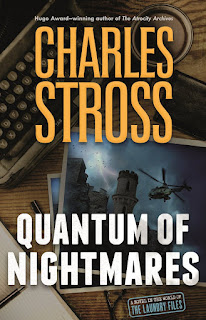
Microreview: Quantum of Nightmares by Charles Stross

Charles Stross’ Quantum of Nightmares continues the story started in Dead Lies Dreaming, as the fallout from the events of that book wraps up Eve, her brother Imp, and continues to show how life in Britain under the New Management is proceeding apace.


With a change in government, elsewhere as well as in Britain, especially a Britain adapting under an evolving Case Nightmare Rainbow¹ situation, the rise of widespread magic, there are going to be changes to society.  Speed cameras now sport skulls of those who break the law. Superheroes and Supervillains are real, although mental parasites from other worlds will eat their brains if they aren’t careful in the use of their powers. Locks and defenses now include magical wards as well as more mundane physical and electronic locks. And there are cults and societies who are seeking to use the new facts on the ground to bring their own patrons and powers to full flower.

Welcome back to Britain under the New Management of Nyarlahotep, in Quantum of Nightmares. Quantum of Nightmares is the second novel following Dead Lies Dreaming, a new entry point into the Laundry Files verse, and is overall the 11th book set in the series. This review is going to mention events in Dead Lies Dreaming, as a throughline of the novel does follow the consequences of that book. Caveat Lector!

At the end of Dead Lies Dreaming, things looked pretty good for siblings Eve and Imp. Eve is, was, the former assistant to a powerful billionaire lost in an alternate world that he himself had contracted Eve and company to find an important magical book. Eve can possibly just move into her boss’s shoes, since his style of management was “delegate to Eve”.  Eve is also a pretty talented sorceress. Imp has forgotten most of his training in magic they both received, he relies on his superpower of incredible persuasion.  Eve is trying to cement her own power in the wake of Rupert’s departure, but she soon finds that Rupert has snookered here. So she must deal with the fact that Rupert is, oddly enough, a real feudal lord of a tiny (fictional) island in the channel...called Skaro. She doesn’t find Daleks there, but what she does find and have to deal with is bad enough--cultists of an entity called The Mute Poet.  And they have a Plan.

Bringing in Imp means bringing in his team of supervillains and associated people, such as the superhero semi professional thief taker Wendy Deere, who is trying to build on the burgeoning relationship that she started at the end of Dead Lies Dreaming with one of Imp’s crew, the Deliverator Rebecca. Though I should know that  Imp’s crew, although crucial to connecting the various threads in multiple directions, get a little less focus individually in this book than in the first. 

The two other threads, and how they connect with this thread and storyline from Dead Lies Dreaming and how it all fits together in the end shows the skill and patience of the author in making this book come together. Even as there are a dozen books in the Laundry Files verse now, Stross is always trying new techniques, forms, motifs to alloy into his genre-aware and genre-referential style and writing.

One thread involves a branch of a grocery store chain, Flavrmart. Amy, the assistant to the head of HR, Jennifer, is much put upon by her boss and by events in the store. Jennifer is demoing and debuting a rather disturbing technique on the workers in the store, but it is the shenanigans of the meat printer technician that sets the ball rolling for Amy to find out just what Jennifer, the technician and others are up to. I’ve worked in a grocery store in my time, so the scenes here are painful, funny, and (for being set in the Laundry Files verse) still ran very true to me. 

The second thread is Mary Macandless. Ostensibly she has been hired to watch a set of children while their high flying parents are on vacation. But both sides are keeping secrets. The children’s parents are Superheroes, and the children themselves are manifesting rather alarming superpowers of their own. On the other side, Mary’s real goal is the kidnapping of the children, and she has a rather special handbag in her possession to help her. If you are thinking of a demented Mary Poppins at this point, you will be gratified that Stross leans into this, delightfully.  As you might expect, the planned kidnapping goes oh so very wrong, with a road trip across Britain that is perhaps the funniest part of the book, hands down. 

In general, though, although there is a lot of peril and a whole lot of things going oh so wrong, the overall tone of the book, like the previous book, Dead Lies Dreaming, is relatively light and fun. For all of the attempted (and succeeding) human sacrifices, cultists, things brought from other dimensions, and surprises I will leave you the reader to discover, it's all pitched on a page-turning addictively fun plane. The implications and the horror of some of the events are sneaked in through the sweetness of the deceptive surface candy shell of the way Stross is telling the story.  Given how, as I have mentioned before, Stross likes to have a variety of styles, its a way that keeps a twelve book series going strong.  

I wondered how The Laundry Files would do as a series and world once the original protagonist, Bob Howard was mostly gone from the scene (due to his power level as much as other things). Now that we’ve had a few novels without him, I can happily report that, yes, for me, the series and world and premise still work without Bob Howard at the center of events or even in the picture at all. 

I wouldn’t start here, even if Stross makes it clear what you need to know from Dead Lies Dreaming, especially as Eve learns just how screwed she is by what her former boss has set her up, but readers of that first book, a new entry point into the Laundry Files verse, will find lots to love. Just a word of advice, in the Britain of the New Management: Never, ever, come to the attention of the Black Pharaoh or those who scheme and work under him.

¹Given previous events in the series, a true Case Nightmare Green has been tempered and altered by a partial Case Nightmare Red of the refugee/invasion of the Alfar as described in the novel The Nightmare Stacks. Also, this novel (and a couple of previous ones) make it clear that things are still shaking out).


---

The Math

Baseline Assessment: 6/10.

Bonuses: +1 for a lot of well needed humor in this day and age

+1 for good playing out from the first novel in showing how what seemed like a settled situation just has led to Eve and Imp with new problems.

+1 For more interesting worldbuilding and showing how to keep calm and carry on in Case Nightmare Rainbow.

Penalties: -1 There is a lot in this novel, and sometimes a few characters and ideas sadly get short shrift. 

Nerd Coefficient: 8/10

Reference:  Stross, Charles  Quantum of Nightmares [Tor.com, 2022]

Paul Weimer. Ubiquitous in Shadow, but I’m just this guy, you know? @princejvstin.


Wednesday, August 4, 2021

Thinking about Invisible Sun and The Merchant Princes


And so concludes not only the Empire Games trilogy, but the larger Merchant Princes series. My thoughts and feelings about Invisible Sun are tied up in my complicated and conflicted feelings about the overall series. Invisible Sun isn't a book that stands on its own and I'm not sure the Empire Games trilogy can stand apart from the Merchant Princes. Actually, that's not entirely fair. I do think Charles Stross did a fairly good job resetting the narrative in Empire Games for those readers who did not come to it from a Merchant Princes background.

There is a LOT going on in Invisible Sun, almost too much. There is the plotline of Miriam Bergeson and her attempt to hold together a burgeoning democracy in an alternate timeline New York. Miriam was the lead of the six Merchant Princes novels, and is a more minor (but significant) character here. Her daughter is a semi unwilling spy from the United States in what would be our timeline, except for Washington getting nuked by world walkers from another timeline. Miriam's daughter Rita is also a world walker and is supposed to have infiltrated Miriam's administration on behalf of the United States, though Rita's ultimate loyalties seem to be in question. Then - connected to this, the scion of a deposed European dynasty from that alternate timeline is defecting to Miriam's nation (it's not Miriam's nation, but that works for a quick descriptor) and is on the run trying to make her way to Miriam via worldwalking and is on the run in Berlin with a bit of a plot to get her to where she needs to go. Yet more, and only semi connected to any of this - in an unrelated timeline but that is being used by the United States as a staging and research area, the Americans have somehow alerted an alien presence and there is some high tech destruction beyond the scope of what the Americans can image. Any one of these things, especially the tangential existential threat of the aliens, could be is own novel.


It doesn't quite hang together. When I wrote about Empire Games I noted that "the level of Stross's writing is actually beginning to rise to the level of his ideas" because with that was in contrast "the previous Merchant Princes novels where the writing was just barely serviceable enough to keep pace with how fascinating the creation of this world walking conflict was". The second novel in the trilogy, Dark State, did not quite live up to the promise of Empire Games. It's not that Dark State was bad, per se, it's just that much of the novel was too slow and I tend to only appreciate Stross's work when his narrative pace is closer to, let's say, breakneck.

So even if I am able to separate this novel from Stross's earlier Merchant Princes work, Invisible Sun doesn't quite hold up to be the novel I wanted it to be - which from that perspective seems entirely unfair if I mean that to be that I had any sort of real expectation for Invisible Sun. I didn't. The novel I wanted Invisible Sun to be was...well...good or at least engaging (which would be good enough). It gets back to most of my criticisms of Stross's work where I absolutely love the ideas behind his novels and tend to dislike the actual novels themselves.

But that's the thing - everything about Invisible Sun and the Empire Games trilogy and the Merchant Princes series is amazingly cool and exciting and some of the best science fiction concepts that I want more and more of - but when it's all put together that promise is never realized.

This is, of course, talking around Invisible Sun itself because I could talk about individual plot points and I do half hope that Stross does write more about that inter timeline war between humanity and the alien robot things, but he spent a reasonable amount of time near the end of the book covering enough of it that more might be superfluous. That, and I'm not really the guy to be asking for another novel from Charles Stross that I'm likely to be disappointed by.

But digging into a particular storyline and telling you why one does or does not work for me isn't so much about the storyline or a plot point, but about the execution.

I want to love this book and this series so much that I keep coming back to it. If Stross writes another in a related series, I'll probably read that too. I just need to remember to reset my expectations.


Joe Sherry - Co-editor of Nerds of a Feather, 5x Hugo Award Finalist for Best Fanzine. Minnesotan. He / Him

Friday, October 2, 2020

Microreview [book]: Dead Lies Dreaming by Charles Stross

Charles Stross’ Dead Lies Dreaming introduces us to new characters and a new look at his Laundry Files universe--showing us how supervillains, corporate types and others are living under the New Management.


How do you hook new readers into a long running series? And how do you keep things fresh for readers of that series, so you aren’t repeating yourself. And, if it is set in a version of our modern world, how do you continue what is by now an alternate history and make sense of things, and yet not seem completely divorced from where our world is, even if our world does not have magicians, supervillains, and Cosmic Horror entities. And how do you keep it fresh for yourself as a writer?

All of these issues come to the fore in Charles Stross’ Laundry Files universe. In his universe, Cosmic Entities do exist, higher maths can open up portals and contacts with them, and the world, by the increasing population and technology have been moving toward a Cosmic Horror singularity for quite some time. The Laundry Files main line of novels has followed a few characters, particularly Bob Howard, as events, and his own power, have progressed. Even within that line, Stross has introduced new POV characters, and new tweaks to the timeline (including a Fae invasion and vampires ) to provide new chances at entry points with new characters and places to catch up.

Now, with Dead Lies Dreaming, Stross goes further afield still, with a novel that breaks free of the Laundry espionage agency entirely, and providing us with a new set of characters trying to make their way in a Britain where the Black Pharaoh has been installed as the ruler (trust me, the alternatives were WORSE). We get to see a new view on Brtain from the perspective from other than the Laundry--from the perspective of people on the street, or at least not within the walls of a quasi spy agency. Not that our protagonists are ordinary, but they are much closer to average people than our previous characters. 

The center of our narrative are Imp (aka Jerm aka Jeremy Starkey) and his sister Evelyn. Imp wants to make movies, in particular an adaptation of Peter Pan, and he and his cadre act as supervillains to raise funds for that cause. Evelyn works for Rupert, a billionaire magnate with more fingers in pies than the normal person has fingers, and definitely has interest in the occult. In the time of the New Management, it is just prudent for a captain of money and finance to have diversified interests. Rupert directs Evelyn to obtain a Very Important Book by any means, and Evelyn sees a chance to hire her brother to aid in it. For, you see, the Book has more than a small tie to the two of them, and their family history. Does Rupert know that? Perhaps he does, but that just starts a blitz chess match across multiple boards to find the MacGuffin. It’s the Maltese Falcon with heavy doses of supervillains, ritual magic, set in the New Management modern Britain. And does Evelyn have powers or know magic? Well, she IS an accountant...

After the first few novels, which mainly kept Howard as a POV, Stross has really grown his gift of using points of view to illuminate and illustrate his story. The tight focus is a bit diluted by breaking out of the POV of x and y, but it also helps show the breadth and variety of the world. With the complexity of the plot, a jewel gear mechanism that in the end comes together spectacularly, the multiple points of view  help keep the reader appraised of all the moving pieces. On a ground level, few of the characters really are aware of how complicated events are in manipulating them and what they do, but we as a reader can watch the struggle for the MacGuffin unfold.  I particularly liked the point of vew from “The Bond” , another agent of Rupert’s that definitely is modeled on the Fleming character¹. .Focused to the point of inhumanity, he is the ticking clock that, once unleashed, propels the narrative and like any good heist story (and this is most definitely a Heist story, several heists in fact,  including at least one hidden one) , keeps the ticking clock of events rolling. It’s a classic and effective  template--set up the characters with slice of life incidents, put together the center heist story and let the characters and plot run.

There is a heck of a lot of worldbuilding needed for the novel, showing old readers how things have moved along while at at the same time providing new readers enough grounding to get a sense of just what life under the New Management is like. This starts in the very first sentence of the novel, which describes Imp witnessing a Santa being crucified by Elven warriors. This helps reassure previous readers of events of the series, and for new readers, makes it clear right away that this is not the Britain they know and love. The next few sentences and paragraph bolster that first sentence and show that this is what life under the New Management is like, and hooks the reader into the changed world from the get go. We get established how the Supervillain team led by Imp can and does do their thing in that first chapter, and we are off and running. I do think that Stross succeeds here as a new entry point for the series, you don’t have to go all the way back to the Atrocity Archive to get a sense of what life is like, now. For previous readers of the series, who have seen the superhero/villain novels and also the use of magic in other Laundry Files novels, this novel allows Stross to put both of them into the same conflicts, to see just how the various parts of his Singularity we have seen separately before play together.

In short, Dead Lies Dreaming is a very successful branch off of the Laundry Files universe into new characters and perspective, and giving us an update on just what life is like under the New Management. Combine both of those with an excellent heist plot and some very clever plotting and worldbuilding, and this latest in the Laundry Files verse was a treat to read. I fully intend to get the audio of this book upon release, for I find the audio experience of these books to be as rich as reading them. A re-read of this book via audio when long driving trips are practical again sounds like a winning idea to me. And perhaps to you.

¹ Longtime readers of the Laundry Files will note that this is not the first time Stross has engaged in Bond or spy tropes. The Bond doesn’t quite match up with those previous books, this is a new use of the character and archetype.

The Math

Baseline Assessment: 7/10.

Bonuses: +1 for a very successful switch to a new thread in the Laundry Files verse
+1 for excellent heist plotting.

Penalties: -1 A Britain under the New Management may not be the comfort read for 2020 you are looking for.

Nerd Coefficient: 8/10 well worth your time and attention

POSTED BY: Paul Weimer. Ubiquitous in Shadow, but I’m just this guy, you know?@princejvstin.

Reference: Stross, Charles. Dead Lies Dreaming [Tor, 2020]

Wednesday, July 3, 2019

Reading the Hugos: Series

There are a few Hugo Award categories for which I like to look up the actual category description in the WSFS Constitution. Best Series isn’t so much a weird category like Related Work, but it does have a particular set of requirements that cause it to operate differently than the other fiction categories. In general, a short story only has one shot at winning a Hugo – the year after it is published. The exception is when a shorter work is expanded into a longer work and is “substantially modified”. For example, “Beggars in Spain” (Nancy Kress) won a Hugo Award for Best Novella in 1992 and was a finalist for Best Novel in 1994. Best Series is a different animal altogether because long running series may have multiple opportunities at the ballot provided the new material meets the wordcount of an additional 240,000 words (and at least two new installments, but that part seems to be the easier to achieve).
3.3.5: A multi-Installment science fiction or fantasy story, unified by elements such as plot, characters, setting, and presentation, appearing in at least three (3) installments consisting in total of at least 240,000 words by the close of the previous calendar year, at least one (1) installment of which was published in the previous calendar year, and which has not previously won under 3.3.5.

3.3.5.1: Previous losing finalists in the Best Series category shall be eligible only upon the publication of at least two (2) additional installments consisting in total of at least 240,000 words after they qualified for their last appearance on the final ballot and by the close of the previous calendar year.
This is worth mentioning now because 2019 is the third year of the Best Series category and the second appearance of Seanan McGuire’s October Daye series because McGuire has published two additional novels (The Brightest Fell, Night and Silence) as well as some short fiction set in that universe. I wouldn’t be shocked to see McGuire’s InCryptid make a second appearance next year, and I also expect to see The Expanse to have its own second crack at the ballot, though with The Expanse I hope readers wait one more year for the ninth (and final?) volume to be published so that The Expanse can be considered as a completed work.

I’m curious what this says about the long term future and health of the category if we see some of the same series make repeat appearances. Of course, we can (and do) say the same thing about a number of “down the ballot” categories like Fanzine (we do appreciate being on the ballot for the third year in a row!), Semiprozine, and the Editor categories.

This doesn’t speak against any particular finalist on this or any other year. As you’ll see when you read through my commentary, October Daye is my pick for Best Series this year and may well be my pick if it doesn’t win this year and makes another appearance in two or three years. What is interesting to me is that the rules for Best Series allow for a really solid cross section of the sort of series work being published each year. There are completed trilogies, a very loose series of shorter stories, and ongoing series for which the author may not have a fixed end point in mind. I am very interested to see how Best Series may evolve in the coming years.

Before that evolution happens, though, let’s take a look at this year’s finalists for Best Series.


The Centenal Cycle, by Malka Older (Tor.com publishing)
The Laundry Files, by Charles Stross (most recently Tor.com publishing/Orbit)
Machineries of Empire, by Yoon Ha Lee (Solaris)
The October Daye Series, by Seanan McGuire (most recently DAW)
The Universe of Xuya, by Aliette de Bodard (most recently Subterranean Press)
Wayfarers, by Becky Chambers (Hodder & Stoughton / Harper Voyager)


The Laundry Files: I’m in an interesting position with The Laundry Files. I read the first two novels (The Atrocity Archives and The Jennifer Morgue) as they were published and generally enjoyed them, as I did the novellas published around that time. I had a copy of the third volume, The Fuller Memorandum, for a number of years and I could never quite muster up the interest to actually pick the book up and read it. I’m curious about the progression of the series, the shifting viewpoint character moving off of Bob Howard.

Charles Stross is a writer I’ve long struggled with. The works for which he is most recognized for in regards to the Hugo Awards (Accelerando, Saturn’s Children, Halting State) are also the works I bounce the hardest off of. The Laundry Files bridges the gap between his Merchant Princes series which I generally enjoy and the harder science fiction which I generally do not. Though I can’t speak to how the series evolves over the course of the nine main sequence novels, those first two novels did feature some of those stylistic choices which grate on me. When discussing cases or things of a military nature with codenames, we get CASE NIGHTMARE GREEN in all caps, which on its own is fine, but when coming up in a conversation about multiple missions we get pages laced with phrases in all capital letters. It’s a small thing, but it’s a small thing that makes me cringe as a reader. As a whole, The Laundry Files has story beats and ideas that I think are fascinating, but they are laced with aspects of Stross’s writing that I just don’t appreciate.

It is worth noting that two of Stross’s three Hugo Award wins have come from Laundry Files novellas (“The Concrete Jungle” and “Equoid”).


The Universe of Xuya: There is nothing on the ballot quite like Aliette de Bodard’s Xuya Universe, nor has there been in the relatively short three year existence of the Best Series category. The fiction of The Xuya Universe is an alternate history leading into an alternate future where Xuya (a significant Chinese colony in North America) and Dai Viet (Vietnam) are major players in interstellar colonization (what a gross simplification) and all of the Xuya stories are set within that Chinese and Vietnamese influenced universe. Xuya is comprised of a small number of novellas and a larger number of short stories, but unlike the other ongoing series on this year’s Hugo ballot, Xuya is telling discrete stories within a larger universe that doesn’t necessarily have any connections to each other than being part of that larger universe. Aliette de Bodard is building a past and future history of the world and the galaxy and these stories are the building blocks.

What that means is that there is much less of a sense of a unified story being told because this isn’t that sort of universe. The events of On a Red Station, Drifting have nothing to do with those of The Citadel of Weeping Pearls which have nothing to do with The Tea Master and the Detective, let alone the shorter stories. Some of those stories are available online for free, others are spread across magazines and anthologies – which does mean that a reader needs to be reading widely in the field (or actively following Aliette de Bodard) to have a chance at reading them all. A sampling of works were included in the Voter Packet. Individually, the stories have the high quality readers have come to expect from de Bodard. Taken together as the foundation for a wider universe alternate history / future, this is an impressive feat of worldbuilding. Taken as a “series” in comparison to the other “series” on the Hugo ballot, I’m not sure it stands up quite as well – but that may just be my personal bias for more tightly connected series speaking.


The Centenal Cycle: The idea of being hopeful about democracy and elections is refreshing and has only become more so since the publication of Infomocracy in 2016, but Malka Older presents a vision of a global “microdemocracy” with the world divided into “centenals”, groupings of approximately 100,000 people. Nations are (mostly) no longer a thing. There are still political parties, but many of them are global parties striving for the most centenals in order to gain a “super majority” for the world government. There is still corruption and shady dealings, but the idea of Information (think Google on steroids, and truly operating with “don’t be evil” as a core tenant) as a force for knowledge and election security is a welcome one. Of course, what Older introduces in Infomocracy gets subverted and suborned by the events of Null States and State Tectonics. As with anything presumably utopian, the question should always be “utopian for whom?” and it is worth interrogating if that utopia is built on the back of something else or what gets left out of that utopia, whether by choice or force.

Older plays with some of those ideas while still maintaining the hopeful aspect of microdemocracy and elections throughout the three volumes of the Centenal Cycle. Infomocracy was one of my favorite novels published in 2016, with the perfect melding of set up and execution. If all three novels hit me in just the same way as Infomocracy, this would be a nearly perfect trilogy. As it stands, I was disappointed with Null States. This may be more to do with my particular expectations going into Null States and Older told a much different story than I might have expected. Realistically, I should re-read the trilogy (and Null States in particular), but so much of what worked for me in Infomocracy was missing in Null States. Legitimately, the novel focuses on what happens in those regions which choose not to engage in microdemocracy and are left out of Information. State Tectonics brings the story back inside of Information, and considers whether Information and the current centenal system is perhaps only a step in a process towards a more equitable future and not the end goal itself. There are threats (both internal and external), conspiracies (likewise) and it is a thrilling look at one possible future of democracy.

Each volume of the Centenal Cycle is quite different from the others, but together they work to form a fairly coherent whole that in some ways is greater than the individual parts (as great as I found two of those parts). If nothing else, these novels offer hope in the echoes of a contemporary political arena that seems to offer none. Older offers a way forward, and that is something valuable and worth holding on to.


Machineries of Empire: Machineries of Empire is one of two completed series in this category (the other being The Centenal Cycle, of course) which both makes it easier and more difficult to consider in comparison to the other finalists because unlike previous years, the other four finalists are true ongoing / episodic series rather than a part of an unfinished whole (see The Expanse in 2017 and The Stormlight Archive in 2018). Also notable, each of the three novels comprising Machineries of Empire have been Hugo Award finalists for Best Novel.

What I find interesting is my reaction to Machineries of Empire in this category. Each of the three novels are superb, one of the best of their respective publications years. And yet…I don’t get the feeling that the novels truly coalesce into a whole series, though each novel is informed by the one before and it builds as does any series. It does build an overall story of Kel Cheris and Shuos Jedeo and the working against the calendrical system of the Hexarchate, but I wouldn’t recommend Machineries of Empire to someone as a series. I’d tell them to go read Ninefox Gambit right away because it’s awesome, though give it a bit of time to get your mind right reading it. All three novels are fantastic, and strangely it feels as loose of a series as Wayfarers.


Wayfarers:  One of the things I find interesting about the Wayfarers series is that, like Aliette de Bodard’s Xuya Universe, Becky Chambers is building a universe rather than building a particular story arc for characters. Seanan McGuire’s October Daye novels are focused on the character of October Daye, and while McGuire expands our understanding of that setting and of various backstories and relationships, the series moves Toby Daye forward. Becky Chambers does not do that, though we’re comparing a series of three novels so far to Seanan McGuire’s twelve October Daye novels. Things could change down the line and Chambers may well elect to return to the crew of the Wayfarer. Until then, each of the three (so far) Wayfarers novels features a different set of characters in a different part of that universe, though A Closed and Common Orbit spins off one character from The Long Way to a Small Angry Planet. Record of a Spaceborn Few, however, takes something only previously mentioned (The Exodus Fleet) and expands on that hint as a standalone story.

Chambers has been rightfully lauded for her positive science fiction. That’s not really a sub genre classification, but does get to the lighter tone of the novels and while Chambers is not attempting to tell a utopian story, the protagonists are generally good people trying to do their best and live decent lives. The Long Way to a Small, Angry Planet has been described as reminiscent of Firefly with perhaps less dickishness in the crew. The novel does have the feel of the show, only with yet more optimism. The other two novels tell very different sorts of stories, but the overall light touch of Becky Chambers is welcome and refreshing. Two of the three published novels in this series have been finalists for the Hugo Award for Best Novel (and I suspect The Long Way to a Small, Angry Planet would have been a finalist had it not been previously been self published and lost its eligibility window by the time it was published by Harper Voyager and gained wider visibility).


October Daye: When I read Seanan McGuire’s Rosemary and Rue in 2013 I was not impressed. It was fine, but something about it just wasn’t for me and I didn’t put anymore thought into the series except that McGuire was writing some really great books that I loved as Mira Grant (the Newsflesh novels) and under her own name (Every Heart a Doorway) and I thought maybe I should give October Daye another chance. The series was first a Hugo Award finalist for Best Series in 2017, the first year of the category, and that solidified my plan to make a serious push on the series (as did winning the first nine novels in a giveaway and having them sit on my shelf and taunt me). I was told that I needed to read at least the second, if not the third novel, because *then* the October Daye novels get really good and if I’m not hooked by that point, I might as well let them go. So, five years after reading the first book, I read A Local Habitation. Readers, I was hooked, though it took me *another* year to read An Artificial Night because I took a detour into McGuire’s excellent InCryptid novels when *they* made it onto the ballot for Best Series (and I love InCryptid dearly), but now I’m back, I’m in, and I’m going to read a lot of October Daye this year.

At this point, I’ve read through the first four novels of the series having recently finished Late Eclipses and I am here and I am ready. I find it interesting that Toby Daye is explicitly described as a “hero” in these novels, suggesting that it might almost be a formal role in faerie (her liege, Sylvester, noted that he was once a hero himself). Four novels into the series, McGuire seems to be exploring what it means to be a hero and what it costs. Toby’s job, her responsibility is to be a knight in Sylvester’s court, accomplishing tasks he sets for her. But “hero” is also a state of mind that has nothing to do with purity of body or necessarily being inherently special. Here, it is a driving desire to do the job, to save those who need saving no matter what the personal cost. October Daye isn’t a hero who rides in on a horse, and she seldom truly goes it alone to solve what needs solving, but she is a hero who almost recklessly risks herself. It’s what heroes do.

The October Daye novels are exactly the sort of thing the Best Series category can and should recognize. As good as they are, any individual novel in this series is extraordinarily unlikely to make the final ballot for Best Novel. The Hugo Awards tend not to recognize this sort of urban fantasy for Best Novel. The series as a whole, however, is where October Daye shines. The novels are fantastic and they build a world readers want to come back to time and time again without any slacking off on the part of Seanan McGuire. This is top notch fiction and I hope to see McGuire bring home the rocket for October Daye.


My Vote
1. October Daye
2. Wayfarers
3. Machineries of Empire
4. The Centenal Cycle
5. Universe of Xuya
6. The Laundry Files


Our Previous Coverage
Novel
Novella
Novelette
Short Story
Related Work
Graphic Story 
Professional and Fan Artist 


Joe Sherry - Co-editor of Nerds of a Feather, 3x Hugo Award Finalist for Best Fanzine. Minnesotan.

Monday, March 19, 2018

Microreview [book]: Dark State, by Charles Stross

Return to the multiverse.


My experience of reading Charles Stross is a persistent struggle between the quality of his ideas and my perception of the quality of his writing, which is to say that I seldom find that the writing lives up to the promise of the ideas. 

When I wrote about Empire Games (my review), I noted "the level of Stross's writing is actually beginning to rise to the level of his ideas" and that once Stross got the story rolling, nothing distracted from the cool ideas of the world walking between the worlds we've already known and the opening up of new worlds and the drama of the how the United States interacts with the world walkers from a parallel universe.

Dark State picks up almost immediately after the conclusion of Empire Games, and despite the increasingly breakneck pace of the second half of that novel, Dark State suffers from some of the same issues that Empire Games did. Stross spends at least a third of Dark State resetting the playing field and planting the seeds for where the rest of the novel and trilogy will go. That's fine, as far as narrative conventions go, but Stross is not at his best as a writer when working with a more deliberate pace.

The A and B stories of Dark State are probably first that of Rita, the daughter of Miriam Beckstein (from the original Merchant Princes series) who was given up for adoption as an infant, but who has an unlocked world walking trait and who was recruited by the United States government to both infiltrate and liaise with the alternate timeline which has the former Clan in a position of power; and second, that of Elizabeth Hanover, a princess of from that alternate timeline looking to escape a life with an arranged marriage and defect to the Clan led government in New London. I'm grossly simplifying the story lines, of course, and Stross develops each of them far beyond what I've given, but we know from Empire Games (and the Merchant Princes) that the United States will go farther and go darker in their plans to "protect the Homeland". That definitely is a factor here and it permeates almost everything in Dark State.

As with Empire Games, when Charles Stross decides he wants to move the story, the interesting stuff happens. I’m engaged as a reader, he’s not giving the reader much time to take a breath and he’s making stuff happen. It’s when he is in set up mode, we see the clunk. Dark State is not as acronym heavy as past Stross novels, though there are references to BLACK RAIN and such, but there are moments early in the novel which feel overly didactic. Those moments come across less as storytelling and more as just telling.

In ways that are completely typical for reading a Charles Stross novel, I can only say that I was less annoyed as the novel progressed – to the point that I only noticed very late in the novel that I was finally engrossed in the story being told. I don’t know that it was good, in whatever nebulous way I describe a good novel, but it was better than how Dark State began. This is nearly always the case with Charles Stross. Whether it is reengaging with his particular brand of flow or if it is just waiting for that moment he decides to stop revving the novel’s engine and punch the gas, I like the ride when he’s moving.

Dark State has left me far more conflicted about the new trilogy than Empire Games did. I’m not sure if it was the excitement of stepping back into Merchant Princes or if it was that Stross seemed to have leveled up a bit since he last stepped into this world, but Dark State does not quite live up to the promise of the previous novel. Readers are still left with plenty of interest in how Stross will wrap things up and interest in what new cool stuff he will introduce and tweak. The ideas in Dark State remain as fascinating and involving as ever. It’s just what he does with his ideas that do not measure up.


The Math

Baseline Assessment: 6/10

Bonuses: +1 the stuff in timeline four with the destroyed Earth through the portal adds an extra bit of intrigue to what might be going on with the other unexplored timelines.

Penalties: -1 clunk clunk clunk. 

Nerd Coefficient: 6/10, "still enjoyable, but the flaws are hard to ignore" See more about our scoring system here.


POSTED BY: Joe Sherry - Co-editor of Nerds of a Feather, 2017 Hugo Award Finalist for Best Fanzine. Writer / Editor of the mostly defunct Adventures in Reading since 2004. Minnesotan. 

Wednesday, February 14, 2018

New Books Spotlight

Welcome to another edition of the New Books Spotlight, where each month or so we curate a selection of 6 forthcoming books we find notable, interesting, and intriguing. It gives us the opportunity to shine a brief spotlight on some stuff we're itching to get our hands on.

What are you looking forward to? Anything you want to argue with us about? Is there something we should consider spotlighting in the future? Let us know in the comments!


Bacigalupi, Paolo, & Tobias S. Buckell. The Tangled Land [Saga Press]
Publisher's Description:
From award-winning and New York Times bestselling authors Paolo Bacigalupi and Tobias Buckell comes a fantasy novel told in four parts about a land crippled by the use of magic, and a tyrant who is trying to rebuild an empire—unless the people find a way to resist.

Khaim, The Blue City, is the last remaining city in a crumbled empire that overly relied upon magic until it became toxic. It is run by a tyrant known as The Jolly Mayor and his devious right hand, the last archmage in the world. Together they try to collect all the magic for themselves so they can control the citizens of the city. But when their decadence reaches new heights and begins to destroy the environment, the people stage an uprising to stop them.

In four interrelated parts, The Tangled Lands is an evocative and epic story of resistance and heroic sacrifice in the twisted remains surrounding the last great city of Khaim. Paolo Bacigalupi and Tobias Buckell have created a fantasy for our times about a decadent and rotting empire facing environmental collapse from within—and yet hope emerges from unlikely places with women warriors and alchemical solutions. 
Why We Want It: I've had copies of the linked novellas The Alchemist (Bacigalupi) and The Executioness (Buckell) on my shelf for a number of years without ever having cracked either cover for no good reason that I can understand. I've been a big fan of Buckell's work since discovering Crystal Rain ten years ago, so I'm always excited to see something with his name on the cover. The Tangled Land pulls together the two previously mentioned novellas with two additional ones to weave together a larger epic story. Now is the time to finally dive into this world.


Barnhill, Kelly. Dreadful Young Ladies and Other Stories [Algonquin]  
Publisher's Description:
A stunning new collection of short fictions for adult readers from the World Fantasy Award– and Newbery Medal–winning author of The Girl Who Drank the Moon.

From award-winning, New York Times bestselling author Kelly Barnhill comes a stunning first collection of acclaimed short fictions, teeming with uncanny characters whose stories unfold in worlds at once strikingly human and eerily original.

When Mrs. Sorensen’s husband dies, she rekindles a long-dormant love with an unsuitable mate in “Mrs. Sorensen and the Sasquatch.” In “Open the Door and the Light Pours Through,” a young man wrestles with grief and his sexuality in an exchange of letters with his faraway beloved. “Dreadful Young Ladies” demonstrates the strength and power—known and unknown—of the imagination. “The Insect and the Astronomer” upends expectations about good and bad, knowledge and ignorance, love and longing. The World Fantasy Award–winning novella The Unlicensed Magician introduces the secret, magical life of an invisible girl once left for dead.

By an author hailed as “a fantasist on the order of Neil Gaiman” (Minneapolis Star Tribune), the stories in Dreadful Young Ladies feature bold, reality-bending fantasy underscored by rich universal themes of love, death, jealousy, and hope.  
Why We Want It: We loved Kelly Barnhill's Newbery Medal winning novel The Girl Who Drank the Moon (my review) and pretty much everything else Barnhill has written. I nominated Barnhill's story "Mrs Sorensen and the Sasquatch" for the Hugo back in 2015, but alas, it did not make the final ballot. I've been enjoying her short fiction for years, so this collection will be a delight.  It also includes The Unlicensed Magician (my review), so if you haven't had the chance to discover Sparrow, The Junk Man, or Marla the Egg Woman yet, you're in for a treat.


Bujold, Lois McMaster. Penric's Fox [Subterranean Press]
Publisher's Description
With Penric's Fox, multiple-award-winner and bestselling author Lois McMaster Bujold returns to her World of the Five Gods, the setting of her acclaimed novels The Curse of Chalion, Paladin of Souls, and The Hallowed Hunt. Continuing the tale begun in the novellas “Penric’s Demon, “Penric and the Shaman,” and "Penric's Mission," Bujold’s newest installment of Penric and Desdemona’s tale is another must-read novella for her legion of fans.

Some eight months after the events of Penric and the Shaman, Learned Penric, sorcerer and scholar, travels to Easthome, the capital of the Weald. There he again meets his friends Shaman Inglis and Locator Oswyl. When the body of a sorceress is found in the woods, Oswyl draws him into another investigation; they must all work together to uncover a mystery mixing magic, murder and the strange realities of Temple demons. 
Why We Want It: At this point we don't have to say much more than "Lois McMaster Bujold" to get you to pick up a book, do we? Bujold's Penric novellas are bite sized delights and I'm quite looking forward to more.


Burke, Sue. Semiosis [Tor]  
Publisher's Description
Human survival hinges on an bizarre alliance in Semiosis, a character driven science fiction novel of first contact by debut author Sue Burke. 

Colonists from Earth wanted the perfect home, but they’ll have to survive on the one they found. They don’t realize another life form watches...and waits... Only mutual communication can forge an alliance with the planet's sentient species and prove that humans are more than tools. 
Why We Want It: I've long loved novels of colonies and discovery across generations.  Semiosis continues to pop up on our radar and as this is a generational novel of a human colony struggling to survive on another world, it's exactly the novel I'm looking for. Semiosis should be an impressive debut.


Stross, Charles. Dark State [Tor] 
Publisher's Description
Hugo Award-winning author Charlie Stross dives deep into the underbelly of paratime espionage, nuclear warfare, and state surveillance in this provocative techno-thriller set in The Merchant Princes multi-verse 

Dark State ups the ante on the already volatile situations laid out in the sleek techno-thriller Empire Games, the start to Stross' new story-line, and perfect entry point for new readers, in The Merchant Princes series.

In the near-future, the collision of two nuclear superpowers across timelines, one in the midst of a technological revolution and the other a hyper-police state, is imminent. In Commissioner Miriam Burgeson’s timeline, her top level agents run a high risk extraction of a major political player. Meanwhile, a sleeper cell activated in Rita's, the Commissioner's adopted daughter and newly-minted spy, timeline threatens to unravel everything.

With a penchant for intricate world-building and an uncanny ability to realize alternate history and technological speculation, Stross' writing will captivate any reader who's a fan hi-tech thrillers, inter-dimensional political intrigue, and espionage.  
Why We Want It: Empire Games (my review) was perhaps the strongest of Stross's parallel universe hopping Merchant Princes novels filled with political intrigue. I didn't love it without reservations, but I frequently find myself coming back and thinking about the details and how things fit together. I'm hoping for more of Dark State to be set in Miriam's timeline since Empire Games skimped on that a bit, but I've got this sitting on the nightstand next to my bed and I anticipating cracking this one open very soon.


Wexler, Django. The Infernal Battalion [Ace] 
Publisher's Description
Military might and arcane power clash in Django Wexler’s thrilling new Shadow Campaigns novel. 

The Beast, the ancient demon imprisoned beneath the fortress-city of Elysium for a thousand years, has been loosed on the world. It absorbs mind after mind, spreading like a plague through the north. The fell army it has raised threatens the heart of Vordan, and it is under the command of the Beast’s greatest prize: legendary general Janus bet Vhalnich.

As Queen Raesinia Orboan and soldiers Marcus D’Ivoire and Winter Ihernglass grapple with the aftermath of a hard-fought military campaign, they soon discover a betrayal they never could have foreseen. The news arrives like a thunderbolt: Janus has declared himself the rightful Emperor of Vordan. Chaos grips the city as officers and regiments are forced to declare for queen or emperor.

Raesinia must struggle to keep her country under control and risks becoming everything she fought against. Marcus must take the field against his old commander, a man who has seemed an unbeatable strategist. And as Winter recovers from her injuries and mourns her losses, she knows the demon she carries inside her might be the only thing standing between the Beast and the destruction of everything in its path…. 
Why We Want It: We here at Nerds of a Feather have long been fan of Django Wexler's Shadow Campaigns, especially The G, so you know we're looking forward to this fifth volume. 


POSTED BY: Joe Sherry - Co-editor of Nerds of a Feather, 2017 Hugo Award Finalist for Best Fanzine. Writer / Editor of the mostly defunct Adventures in Reading since 2004. Minnesotan.