Showing posts with label Laundry Files. Show all posts

Friday, January 24, 2025

Book Review: A Conventional Boy by Charles Stross

Breaking out the D20s and introducing a Dungeon Master into the Laundry Files.


The ‘Satanic Panic’ that erupted in the early 1980s possibly has to have been lived through in order to be actually believed. Thousands of unsubstantiated accusations of ritual abuse and worse, best selling books, and much more. It was a moral panic of the first order and had no basis in reality. Swept up in this crusade (and I use that term carefully) was Dungeons and Dragons, which was identified by some of the proponents of the panic as leading to witchcraft, Satan worship, and more. Tom Hanks’ first starring role was in a movie that encouraged this point of view, Mazes and Monsters. In some ways the Satanic Panic’s echoes still exist to this day (hello, Pizzagate). The Satanic Panic shows the power of belief turned to poisonous and wrong ends.

This has everything to do with A Conventional Boy, the latest Laundry Files novel from Charles Stross.

With the Laundry Files universe and its titular focus and worry about magic, Elder Beings, and the like, you can see how the Satanic Panic of the 1980’s might wind up intersecting with their remit. Derek Reilly, an enthusiastic autistic D&D player (nay, a DM) gets swept up in the Panic and winds up at Camp Sunshine, the locale where the Laundry Files deprograms cultists. Thanks to a series of bureaucratic events, Derek never gets released. Decades pass. He becomes a “trusty”, even allowed to edit the camp newsletter, and to run his play by physical mail game. (But even so, paper and pencils and the like are highly restricted at Camp Sunshine and you can forget about computers or the Internet.) But when Derek finds out that a D&D convention is happening nearby, and that the Camp is being temporarily rehoused, he does the unthinkable, and decides to escape to attend it. Derek has been paying attention, and despite the enormous dangers in trying to leave Camp Sunshine, he manages it. But the convention he goes to has a dread danger all of its own, one that Derek is equipped to recognize, and possibly deal with. Roll for initiative, Derek...

And so lies a story.

The titular story is a love letter to Dungeons and Dragons, specifically its early AD&D incarnation. (Derek hasn’t been able to get later editions at Camp Sunshine, after all). So the book is replete with lots of nerdy references, in-jokes and the like about Dungeons and Dragons, the nature of the game, some shade thrown on various modules, and the like. For someone who grew up on the stuff, it's catnip and a lot of fun¹

Like me, for instance.

Having grown up playing Dungeons and Dragons under the Satanic Panic, and being a GM for play by email games for a long time, Derek and his plight also hit me in the feels rather hard. Mind you, there is an irony in the theme and how things play out that while Derek was scooped up accidentally and wrongly and kept in Camp Sunshine basically by accident (and Derek not knowing enough to challenge it), the theme and logline of the book is one that Derek doesn’t quite realize himself--that he does, in fact have magical power, in those dice that he carries along. Derek doesn’t admit to himself that he is doing magic, but we, the reader, can totally see how and what his dice do, magic wise. But it is not just his dice, because when he gets to his convention and we see just his D&D campaign and one-shot are like, it is a :blink blink: moment for those who have been following the entire series. It made me stop and think and then read carefully to the end to see if I really got what was going on here.

A scene at the end, however, made it clear what has happened and what is happening, but it does reinforce for me that this is a book that, conceptually, a reader new to the series could possibly start it here. There is enough here, and given Derek’s isolation, Stross clearly seems to be reaching for that sweet spot where someone could parachute into his massive 13 book series right here. I think the above :blink blink: moment might then be an invitation to read the rest of the series having started with this book. It’s a very tricky balancing act and I think he manages it partly, and it is somewhat of a disappointment to me (but an understandable one) is that A Conventional Boy is short. It’s not a meaty thick Laundry Files novel, but rather a novella. It thrives on that length, and really, for it to be longer would make it wear out its welcome. If you are trying to get people to try a big 13 book series, a shorter entry has its advantages, though, and that seems to be what Stross is going for, here. He’s tried this before, but A Conventional Boy feels like his latest, most forceful attempt to bring new readers to the series.

The format of the book, though, is not just the titular story. There are also two additional stories after A Conventional Boy, and they are “early” stories of the original series protagonist, Bob Howard. These stories don’t just pad out the book to a publishable length (or else this would just fall under the rubric of a novella) but also tie in thematically and parallel A Conventional Boy, even if Derek doesn’t show up in either of them.

In “Overtime”, we get to see Bob Howard on a night watch duty on Christmas Eve, where he winds up having to tangle with an extra dimensional entity taking advantage of the power of belief. This story also has the value of clarifying a bit the end of A Conventional Boy, and closes the loop on it (although to be clear, Derek does not appear in any way). And again, thematically, ties into the narrative of belief fueling magical power.

The final story in the volume, “Down on the Farm”, again finds Bob Howard (again, in a relatively early part of his timeline) going to a psychiatric institution for people with magical abilities. A message has been smuggled out and Bob, precisely because he is not magically strong (again, this is way before Bob becomes a badass), he is a safe person to go investigate doing there. This story, too, has counterpoint to A Conventional Boy in that they are dealing with magical or potentially magically dangerous people, in an enclosed bottled institution. What Bob faces there is really like a magical-amped Laundry Files version of One Flew Over The Cuckoo’s Nest, with some nasty secrets and some clever magical workings going on inside.

Taken all together, then, A Conventional Boy doesn’t hit the heights of some of the Laundry Files novels, but its character and his plight and nature definitely hit me on an emotional level. I had to ration out reading the book a bit as a result. I was not expecting such emotional resonance in a Laundry Files book, but it does go to show that the dice, once again, are in my favor when reading a Charles Stross novel.

--

Highlights: 

  • Book is actually the titular novella and two short stories. 

  • Possibly an entry point for those new to the series. 

  • If you lived through the Satanic Panic and know your Thac0, pick this one up.

Reference: Stross, Charles, A Conventional Boy, [Tordotcom, 2025].

POSTED BY: Paul Weimer. Ubiquitous in Shadow, but I’m just this guy, you know? @princejvstin

  1. Fun fact that you may not have known. Charles Stross is (via the Fiend Folio) the creator of several D&D monsters and races. Most famously these days, thanks to Baldur’s Gate III, Stross created the Githyanki. Stross does involve an incestuous cross reference, there are no Githyanki or any of his other monsters in this book. That might have been too much.

Wednesday, June 28, 2023

Review: Season of Skulls by Charles Stross

Completing the Eve Starkey trilogy, the sorceress finds that following the dictates of the New Management will lead her into a perilous trip back into the Ghost Roads lurking in her family home.

Over the first two novels of the Eve Starkey trilogy, Dead Lies Dreaming, and Quantum of Nightmares (the 10th and 11th books in the Laundry Files-verse), Stross gave us a view of life in England after the apocalypse from a perspective far removed from the titular Laundry Files organization. Eve and Imp Starkey, heirs to magical power and influence, over the first two novels dealt with Eve's boss, and the legacies of her boss, trying to escape the traps on several levels that Rupert has left his former assistant. Through these novels, we get introduced to a host of ideas, ranging from the mysterious Ghost Roads lurking in Eve's house, to the worst supermarket deli section ever committed to media

Now, in Season of Skulls, a capstone to this trilogy within the Laundry Files-verse, Eve must deal with the wishes of the New Management directly for the first time. And what they want is deceptively simple. They want the head of Rupert, who is not dead, but very much alive.

The problem is, to stop Rupert's latest schemes, Eve will have to reenter the Ghost Roads and face him and his plots in a 19th century England that never was, but could very well influence the present. And try and escape a geas that Rupert puts on Eve. Rupert is a planner and has been planning things for a very long time. He is totally a Leverage style Mastermind and Eve will have to gain allies and use all of her cunning and dare to stop him from...

--record scratch--

While the first two novels had a balance between Eve and Imp in terms of screen time and narrative, Season of Skulls is very much Eve's story. Fans of Imp and his little gang of supervillains are not going to find much traction here. On the other hand, this novel's much more precise focus on Eve and her travails  gives the author a chance to really develop her as a character.

The heart of the book, where most of the action takes place, is in the Ghost Roads first seen in Dead Lies Dreaming. Eve does not go to Whitechapel 1888 London in this venture into the Ghost Roads to stop Rupert and his schemes (and the whys and hows she chooses to go there and her gambits, are secrets for the reader to uncover (quaerendo invenietis!). But once she is there, Stross introduces a kaleidoscopic magical alternate version of 1816. Some of it is really clever on its own, with motifs and references and ideas taken from a variety of genre ideas and being mixed together wonderfully.

But the real piece of invention is The Village. Yes, THAT Village, the one with the big weather balloon and Patrick McGoohan trying to escape from a succession of Number Twos. What in the world is The Village doing in 1816? That WOULD be telling. Stross is a clear fan of the series and not only uses the setting, but also happily lifts dialogue and imagery from the series. (what the fantasy version of Rover is, in this Village is BRILLIANT and I want to steal it for a RPG scenario somewhere). Our Eve is of course dubbed Number Six.  As far as who Number Two is, much less Number One, the answers will not surprise the clever reader. But they are...

--record scratch--

And then there is the other mainline of this 1816 ghost road dreamverse, the Regency Romance portion. As longtime readers of the Laundry Files are well aware, Stross introduces a variety of subgenres and tropes into the various Laundry Files novels. It's a way to keep things fresh, its a way to allow him to write different books in the same universe, its a way to explore an ever more complicated and complex universe from a perspective far beyond the original concept of a IT nerd getting roped into facing Cosmic Horrors.

So the Laundry Files has had, by my reckoning, done spy novels in a couple of different flavors, vampires, superheroes and supervillains, corporate dystopia, and straight up Urban fantasy sorcery in the Eve Starkey books themselves. Here, in this Ghost Road 1816, Eve finds herself in a narrative, in a story, one she recognizes and has to fight the conventions of, and work with the conventions in order to stop Rupert.  I am not a heavy reader of Regency Romance, having read only one example of a pure Regency Romance book (and it is itself a deconstruction of some of the tropes), although I have read authors who have borrowed from those tropes before, notably Mary Robinette Kowal. Here, Eve's immersion into those tropes comes with her recognizing and commenting on the tropes all along the way, so that even the most casual of readers can recognize what is going on, with the meta-commentary running in Eve's head.

There are lots of fun references and ties to the other novels, including a return of one of my very favorite secondary characters in the entirety of the Laundry Files-verse, Persephone Hazard. Persephone is basically Stross' tribute to the character of Modesty Blaze. (Persephone's former code name was Bashful Incendiary (get it?)) and a potent sorceress with her own agenda that also made me think a bit of McGoohan's David Jones. In this novel, under the New Management, she has been given a title and no little responsibility under his dread Majesty. She's doing well, as well as anyone can in this new Britain, anyway.

In terms of worldbuilding, Stross has a lot of fun and expends a lot of energy on not only the 1816 Ghost Road-verse, but the whole concept in general. The idea was sort of there in the first novel and we get Eve, Imp and company delving into the dangers of that place. But aside from places to hide dread books, what GOOD is the Dream Road-verse? What can it be used for? Stross explores these ideas winningly here, and I was reminded in many ways of the work of Borges, and of William Gibson's The Peripheral, among others. Even if the realm that Eve and Rupert are contending with is not the "real world"  but does it have potential impact on the real world? Absolutely. It helps make what Eve and Imp have been doing as caretakers of the House (and their entrance to that world) all the more important and serious for the potential for mayhem and mischief if a sorcerer of power, such as Rupert, might get up a scheme to go into the past via the Dream Roads. What Rupert winds up trying to do, as mentioned as a Mastermind, makes him a well rounded villain, with quite a scheme up his head. A scheme that will not only involve Eve but also...

--record scratch--

There is also more background to the entire universe, that helps clear up the whole timeline of why The Magic Went Away and how The Magic Returned. With this volume, the sequence of events from about 1800 to the present is now very much clarified for those who really are curious about the grand arching history of the Laundry Files universe and how it got to be in the shape that it is in. 

Does the Eve Starkey Trilogy end with a HEA (Happily Ever After) for Eve, as is the convention for many Regency romances? Remember that in the end, this is Britain after the apocalypse under the New Management, and no one is ever truly in a secure situation. Eve does go through a lot in her face off against Rupert, and even if she doesn't get all that she wants, she gets what she, in the end, earns, and perhaps more so. While I initially found Imp and his gang of supervillains more interesting in the first novel, this third novel really does reinforce that this series of book is Eve's story, and ends it rather well. Even within the narrowed expectations of a long series such as The Laundry Files, Stross continues to try and innovate and explore subgenres and ideas and this novel, as the third in that trilogy, winningly accomplishes that.

Highlights:

  • Persephone Hazard is back!
  • Great use of a new subgenre to explore the Laundry Files-verse
  • Lots of clever worldbuilding
Nerd Coefficient: 9/10

Reference:
 Stross, Charles, Season of Skulls, [Tordotcom, 2023]

POSTED BY: Paul Weimer. Ubiquitous in Shadow, but I’m just this guy, you know? @princejvstin.

Thursday, February 24, 2022

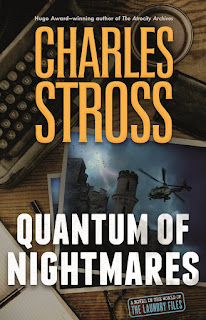
Microreview: Quantum of Nightmares by Charles Stross

Charles Stross’ Quantum of Nightmares continues the story started in Dead Lies Dreaming, as the fallout from the events of that book wraps up Eve, her brother Imp, and continues to show how life in Britain under the New Management is proceeding apace.


With a change in government, elsewhere as well as in Britain, especially a Britain adapting under an evolving Case Nightmare Rainbow¹ situation, the rise of widespread magic, there are going to be changes to society.  Speed cameras now sport skulls of those who break the law. Superheroes and Supervillains are real, although mental parasites from other worlds will eat their brains if they aren’t careful in the use of their powers. Locks and defenses now include magical wards as well as more mundane physical and electronic locks. And there are cults and societies who are seeking to use the new facts on the ground to bring their own patrons and powers to full flower.

Welcome back to Britain under the New Management of Nyarlahotep, in Quantum of Nightmares. Quantum of Nightmares is the second novel following Dead Lies Dreaming, a new entry point into the Laundry Files verse, and is overall the 11th book set in the series. This review is going to mention events in Dead Lies Dreaming, as a throughline of the novel does follow the consequences of that book. Caveat Lector!

At the end of Dead Lies Dreaming, things looked pretty good for siblings Eve and Imp. Eve is, was, the former assistant to a powerful billionaire lost in an alternate world that he himself had contracted Eve and company to find an important magical book. Eve can possibly just move into her boss’s shoes, since his style of management was “delegate to Eve”.  Eve is also a pretty talented sorceress. Imp has forgotten most of his training in magic they both received, he relies on his superpower of incredible persuasion.  Eve is trying to cement her own power in the wake of Rupert’s departure, but she soon finds that Rupert has snookered here. So she must deal with the fact that Rupert is, oddly enough, a real feudal lord of a tiny (fictional) island in the channel...called Skaro. She doesn’t find Daleks there, but what she does find and have to deal with is bad enough--cultists of an entity called The Mute Poet.  And they have a Plan.

Bringing in Imp means bringing in his team of supervillains and associated people, such as the superhero semi professional thief taker Wendy Deere, who is trying to build on the burgeoning relationship that she started at the end of Dead Lies Dreaming with one of Imp’s crew, the Deliverator Rebecca. Though I should know that  Imp’s crew, although crucial to connecting the various threads in multiple directions, get a little less focus individually in this book than in the first. 

The two other threads, and how they connect with this thread and storyline from Dead Lies Dreaming and how it all fits together in the end shows the skill and patience of the author in making this book come together. Even as there are a dozen books in the Laundry Files verse now, Stross is always trying new techniques, forms, motifs to alloy into his genre-aware and genre-referential style and writing.

One thread involves a branch of a grocery store chain, Flavrmart. Amy, the assistant to the head of HR, Jennifer, is much put upon by her boss and by events in the store. Jennifer is demoing and debuting a rather disturbing technique on the workers in the store, but it is the shenanigans of the meat printer technician that sets the ball rolling for Amy to find out just what Jennifer, the technician and others are up to. I’ve worked in a grocery store in my time, so the scenes here are painful, funny, and (for being set in the Laundry Files verse) still ran very true to me. 

The second thread is Mary Macandless. Ostensibly she has been hired to watch a set of children while their high flying parents are on vacation. But both sides are keeping secrets. The children’s parents are Superheroes, and the children themselves are manifesting rather alarming superpowers of their own. On the other side, Mary’s real goal is the kidnapping of the children, and she has a rather special handbag in her possession to help her. If you are thinking of a demented Mary Poppins at this point, you will be gratified that Stross leans into this, delightfully.  As you might expect, the planned kidnapping goes oh so very wrong, with a road trip across Britain that is perhaps the funniest part of the book, hands down. 

In general, though, although there is a lot of peril and a whole lot of things going oh so wrong, the overall tone of the book, like the previous book, Dead Lies Dreaming, is relatively light and fun. For all of the attempted (and succeeding) human sacrifices, cultists, things brought from other dimensions, and surprises I will leave you the reader to discover, it's all pitched on a page-turning addictively fun plane. The implications and the horror of some of the events are sneaked in through the sweetness of the deceptive surface candy shell of the way Stross is telling the story.  Given how, as I have mentioned before, Stross likes to have a variety of styles, its a way that keeps a twelve book series going strong.  

I wondered how The Laundry Files would do as a series and world once the original protagonist, Bob Howard was mostly gone from the scene (due to his power level as much as other things). Now that we’ve had a few novels without him, I can happily report that, yes, for me, the series and world and premise still work without Bob Howard at the center of events or even in the picture at all. 

I wouldn’t start here, even if Stross makes it clear what you need to know from Dead Lies Dreaming, especially as Eve learns just how screwed she is by what her former boss has set her up, but readers of that first book, a new entry point into the Laundry Files verse, will find lots to love. Just a word of advice, in the Britain of the New Management: Never, ever, come to the attention of the Black Pharaoh or those who scheme and work under him.

¹Given previous events in the series, a true Case Nightmare Green has been tempered and altered by a partial Case Nightmare Red of the refugee/invasion of the Alfar as described in the novel The Nightmare Stacks. Also, this novel (and a couple of previous ones) make it clear that things are still shaking out).


---

The Math

Baseline Assessment: 6/10.

Bonuses: +1 for a lot of well needed humor in this day and age

+1 for good playing out from the first novel in showing how what seemed like a settled situation just has led to Eve and Imp with new problems.

+1 For more interesting worldbuilding and showing how to keep calm and carry on in Case Nightmare Rainbow.

Penalties: -1 There is a lot in this novel, and sometimes a few characters and ideas sadly get short shrift. 

Nerd Coefficient: 8/10

Reference:  Stross, Charles  Quantum of Nightmares [Tor.com, 2022]

Paul Weimer. Ubiquitous in Shadow, but I’m just this guy, you know? @princejvstin.


Friday, October 2, 2020

Microreview [book]: Dead Lies Dreaming by Charles Stross

Charles Stross’ Dead Lies Dreaming introduces us to new characters and a new look at his Laundry Files universe--showing us how supervillains, corporate types and others are living under the New Management.


How do you hook new readers into a long running series? And how do you keep things fresh for readers of that series, so you aren’t repeating yourself. And, if it is set in a version of our modern world, how do you continue what is by now an alternate history and make sense of things, and yet not seem completely divorced from where our world is, even if our world does not have magicians, supervillains, and Cosmic Horror entities. And how do you keep it fresh for yourself as a writer?

All of these issues come to the fore in Charles Stross’ Laundry Files universe. In his universe, Cosmic Entities do exist, higher maths can open up portals and contacts with them, and the world, by the increasing population and technology have been moving toward a Cosmic Horror singularity for quite some time. The Laundry Files main line of novels has followed a few characters, particularly Bob Howard, as events, and his own power, have progressed. Even within that line, Stross has introduced new POV characters, and new tweaks to the timeline (including a Fae invasion and vampires ) to provide new chances at entry points with new characters and places to catch up.

Now, with Dead Lies Dreaming, Stross goes further afield still, with a novel that breaks free of the Laundry espionage agency entirely, and providing us with a new set of characters trying to make their way in a Britain where the Black Pharaoh has been installed as the ruler (trust me, the alternatives were WORSE). We get to see a new view on Brtain from the perspective from other than the Laundry--from the perspective of people on the street, or at least not within the walls of a quasi spy agency. Not that our protagonists are ordinary, but they are much closer to average people than our previous characters. 

The center of our narrative are Imp (aka Jerm aka Jeremy Starkey) and his sister Evelyn. Imp wants to make movies, in particular an adaptation of Peter Pan, and he and his cadre act as supervillains to raise funds for that cause. Evelyn works for Rupert, a billionaire magnate with more fingers in pies than the normal person has fingers, and definitely has interest in the occult. In the time of the New Management, it is just prudent for a captain of money and finance to have diversified interests. Rupert directs Evelyn to obtain a Very Important Book by any means, and Evelyn sees a chance to hire her brother to aid in it. For, you see, the Book has more than a small tie to the two of them, and their family history. Does Rupert know that? Perhaps he does, but that just starts a blitz chess match across multiple boards to find the MacGuffin. It’s the Maltese Falcon with heavy doses of supervillains, ritual magic, set in the New Management modern Britain. And does Evelyn have powers or know magic? Well, she IS an accountant...

After the first few novels, which mainly kept Howard as a POV, Stross has really grown his gift of using points of view to illuminate and illustrate his story. The tight focus is a bit diluted by breaking out of the POV of x and y, but it also helps show the breadth and variety of the world. With the complexity of the plot, a jewel gear mechanism that in the end comes together spectacularly, the multiple points of view  help keep the reader appraised of all the moving pieces. On a ground level, few of the characters really are aware of how complicated events are in manipulating them and what they do, but we as a reader can watch the struggle for the MacGuffin unfold.  I particularly liked the point of vew from “The Bond” , another agent of Rupert’s that definitely is modeled on the Fleming character¹. .Focused to the point of inhumanity, he is the ticking clock that, once unleashed, propels the narrative and like any good heist story (and this is most definitely a Heist story, several heists in fact,  including at least one hidden one) , keeps the ticking clock of events rolling. It’s a classic and effective  template--set up the characters with slice of life incidents, put together the center heist story and let the characters and plot run.

There is a heck of a lot of worldbuilding needed for the novel, showing old readers how things have moved along while at at the same time providing new readers enough grounding to get a sense of just what life under the New Management is like. This starts in the very first sentence of the novel, which describes Imp witnessing a Santa being crucified by Elven warriors. This helps reassure previous readers of events of the series, and for new readers, makes it clear right away that this is not the Britain they know and love. The next few sentences and paragraph bolster that first sentence and show that this is what life under the New Management is like, and hooks the reader into the changed world from the get go. We get established how the Supervillain team led by Imp can and does do their thing in that first chapter, and we are off and running. I do think that Stross succeeds here as a new entry point for the series, you don’t have to go all the way back to the Atrocity Archive to get a sense of what life is like, now. For previous readers of the series, who have seen the superhero/villain novels and also the use of magic in other Laundry Files novels, this novel allows Stross to put both of them into the same conflicts, to see just how the various parts of his Singularity we have seen separately before play together.

In short, Dead Lies Dreaming is a very successful branch off of the Laundry Files universe into new characters and perspective, and giving us an update on just what life is like under the New Management. Combine both of those with an excellent heist plot and some very clever plotting and worldbuilding, and this latest in the Laundry Files verse was a treat to read. I fully intend to get the audio of this book upon release, for I find the audio experience of these books to be as rich as reading them. A re-read of this book via audio when long driving trips are practical again sounds like a winning idea to me. And perhaps to you.

¹ Longtime readers of the Laundry Files will note that this is not the first time Stross has engaged in Bond or spy tropes. The Bond doesn’t quite match up with those previous books, this is a new use of the character and archetype.

The Math

Baseline Assessment: 7/10.

Bonuses: +1 for a very successful switch to a new thread in the Laundry Files verse
+1 for excellent heist plotting.

Penalties: -1 A Britain under the New Management may not be the comfort read for 2020 you are looking for.

Nerd Coefficient: 8/10 well worth your time and attention

POSTED BY: Paul Weimer. Ubiquitous in Shadow, but I’m just this guy, you know?@princejvstin.

Reference: Stross, Charles. Dead Lies Dreaming [Tor, 2020]

Monday, September 14, 2015

Microreview [book]: The Annihilation Score by Charles Stross

Not Quite a Symphony

When a long-running series makes significant changes to the noteworthy tropes of the series, is it really a continuation or more of a spin-off or sidestory? The Annihilation Score is not the first book in the Laundry Files series, but it is the first to feature Dr. Dominique (Mo) O'Brien as the protagonist, and she doesn't spend much of the story interacting with the Laundry proper. How does she, and the rest of the novel, stack up? Not favorably.

Following a disaster at the Laundry (a kind of government intelligence agency for supernatural horrors), Mo is dropped right into the middle of a new threat: CASE NIGHTMARE GREEN, a sudden increase in the number of people able to perform magic and leading to the ultimate destruction of Earth. However, these people don't realize that what they're doing is sorcery, and attribute it to superpowers, thus leading to an increase in superpowered vigilantism. After deftly stopping on such superpowered villain in a very public manner (very un-Laundry of Mo) with her possessed violin made of bone can devour demonic souls by being played (named by Mo "Lecter"), Mo is charged with assembling a superhero team and being a public face to draw attention away from the very secretive activities of the Laundry. However, Mo's admin team consists of a superpowered policeman, a vampire, and a mermaid. The vampire and mermaid have had previous relations with Bob, Mo's husband and protagonist of all prior Laundry books, and Mo's relationship with her husband is strained by the fact that he's inherited a great power that drives Lecter to try to compel Mo to kill him. And on top of all of this, the mysterious Dr. Freudstein appears to be a superpowered villain that Mo's agency has been formed to stop.

As with all Stross novels (at least those I've read), the story is deftly written, despite all of the moving parts. Just as impressive, there is not a lot of handwaving of the struggles that come with forming an agency that is designed to combat superpowered problems. However, in this case, the story could've used some more handwaving if it meant less words spent on meetings and bureaucratic drudgery and more time spent investigating the Freudstein menace and fighting bad guys. It almost seems like the story knows it spends too much time in meetings, as the question "why aren't you spending more time looking for Freudstein?" comes up in the novel. Yes, of course, the meetings and drudgery get stuff done, but it doesn't make for a good read. The cool stuff, the villains, the investigations, that stuff doesn't get near enough focus for all the time spent on meetings and relationships with characters that don't have a lot of meat to them. Overall, it's a story with some cool concepts (one of my favorite conundrums is whether or not superheroes are sorcerers!) that don't really pan out in the end, and leaves more than a few loose strings.

The Math

Baseline Assessment: 5/10

Bonuses: +1 Some sharp references to current events re: internet abuse bleeding into real life.

Penalties: -1 There are meetings. Lots of meetings. I hope you like Powerpoint.

Nerd Coefficient: 5/10 (problematic, but has redeeming qualities)

***

POSTED BY: brian, sci-fi/fantasy/video game dork and contributor since 2014

Reference: Stross, Charles. The Annihilation Score [Ace Books, 2015]