Showing posts with label Battlestar Galactica. Show all posts

Wednesday, April 10, 2019

Battlestar Galactica as a Human Rights Narrative

Hey all, I promise this will be my last longform essay for a bit. I've been aching to write about Battlestar Galactica since the first time I watched it. Below are some musings on the role of Edward James Olmos as actor and director on the show.

Battlestar Galactica as a Human Rights Narrative

In 2003, Ronald D. Moore rebooted the 1970s television series Battlestar Galactica with Edward James Olmos in the star role. Unlike the campy Star Wars-inspired original, post-9/11 politics directly motivated the reboot as Moore and the cast, particularly Olmos, sought to explore human rights through a violent division between human and nonhuman (Woerner). While one could criticize the show for being post-racial, the discussion is shifted to human rights as humanity and the human-looking robots called Cylons attempt genocide against each other. Space might seem borderless, but a key image from season one remains the border between human and Cylon planets, and destruction of that border sparks war. By delineating human and Clyon spaces with a border, the line also decides who is human, thus uniting popular culture studies and human rights through the explorative lens of science fiction. While the entire series is beyond the scope of this paper, I apply James Dawes’ human rights subgenre theory to a close analysis of Olmos’ directorial debut on the show, “Tigh Me Up, Tigh Me Down” (2004). The popular culture nature of the show might seem dichotomous to human rights theory, but the 2009 presentation by the showrunners and actors, including Olmos, at the UN to discuss human rights suggest the cultural importance of Battlestar Galactica (Woerner).

When the reboot first aired with a miniseries in 2003, Edward James Olmos had a storied career ranging from his Oscar-nominated performance in Stand and Deliver (1988) to a starring role in Miami Vice (1984-1990) to the cult classics Blade Runner (1982) and Selena (1997) (“Edward James Olmos”). While only a sliver of his long career, these performances seem dichotomous from the role he often discusses: Commander Adama. A seemingly unusual turn in Olmos’ career, the show represents one of the only shows from that era with a person of color in the leading role, let alone a Chicano actor. While shows like Lost, Desperate Housewives, House, ER, Grey’s Anatomy,  and the standard CSI and Law & Order dominated the small screen, only Ugly Betty (2006-2010) overlaps with Battlestar Galactica. Unlike Ugly Betty, the show did not focus on the Latino/a/x experience but demonstrated a post-racial attitude. That being said, Battlestar Galactica strived for diversity before diversity became mandated by millennial audiences and had near gender parity, attempts at queer representation, disability representation (though not by disabled actors), and an ensemble cast featuring enough diversity that white actors did not dominate the screen. All of this is not to dismiss the problematic representation in the show, particularly with which characters experience violent deaths and villain-as-disabled trope. Yet, the show represents a network television show actively engaging with not only diversity but post-9/11 thinking. Indeed, the United Nations’ Assistant Secretary-General for Policy Planning Robert Orr commented that “if [Battlestar Galactica] can get us thinking about [post-9/11 issues], then Amen, because it isn’t easy” (Woerner). Few shows on network television have as successfully demonstrated these commitments—and surely not on the Sci-Fi/SyFy channel, though The Magicians (2015-present) makes similar attempts. Current scholarship on Battlestar Galactica examines the show’s diversity and exploration of othernesss through the Cylons, but much of the scholarship focuses on the show’s connection to international relations. This paper argues that show represents an early presentation of human rights post-9/11 and creatively engages with what James Dawes’ calls “literature and human rights:” “[It] is not only a name for an academic subfield; it is a descriptor of increasingly deliberate institutional relationships and collaborations” (128). During the years that Dawes argues the field was solidifying (around 2007), Battlestar Galactica also explored these ideas on the small screen.  


While different season arcs develop and create complexity from 2003-2010, a singular concern on Battlestar Galactica remains survival. The opening miniseries shows the hatred between humans and Cylons as Cylons destroy the majority of the humanity with a nuclear holocaust. Less than fifty thousand people survive, including Commander Adama (Edward James Olmos), commanding the only remaining battlestar, a military ship. After the genocide, Commander Adama and his crew represent the remaining human military force and only protection against the Cylons’ military presence. A few civilian ships escape and form a fleet under Commander Adama and the new president of humanity, Laura Roslyn, who was sworn in because she was thirty-fourth in line as minister of education. This power imbalance between experience and lack thereof (and between civilian and military authority) creates much of the tension around Commander Adama’s character arc in the first thirteen episodes. In season one, two main conflicts dictate the arc: general survival after the nuclear destruction of humanity and uncovering the human-like Cylons in the fleet.

While popular culture has not always handled human rights issues with sensitivity, Battlestar Galactica’s season arcs align with the creation of James Dawes subgenre of human rights literature. Dawes describes the paradox of human rights literature: “That representations of atrocity are both ethical interventions and acts of voyeurism; that human rights work protects the dignity of the human by juridically restricting what counts as human; or that it grounds itself in the integrity of the unviolated body even as its theoretical dualism denigrates bodily experience” (130). Exploring atrocity through speculative fiction shortcuts some of these issues—particularly voyeurism—but creates another: does treating such human rights violations as science fiction or fantasy dissociate from the reality of these lived experiences? Perhaps speculative fiction works best in concert with other works of literature and scholarship but not in isolation. Indeed, speculative works allow for theories in addition to experiences to be translated to a popular audience through the lens of popular culture. It also allows for subversion across partisan lines. For example, in Battlestar Galactica a season-long arc dramatizes a new colony of humans occupied by the militarily superior Cylons. The humans respond with suicide bombers, and while some characters discouraged the action, one of the main characters (Adama’s best friend, Saul Tigh played by Michael Hogan) deems the suicide bombers necessary to drive away the Cylons. This arc not only critiques the US invasion and occupation of Iraq but also demonstrates how that occupation radicalizes people. Here lies the power of speculative stories—they can distill ideas into a popular framework. 

Notably, the show engages with both plot structures that Dawes describes in “The Novel of Human Rights:” the justice plot and the escape plot (137). The first half of the series demonstrates the justice plot: “In the justice plot, the central narrative is a narrative of return, of violation and its investigation, of the pull of past crime and attempts to repair it” (137). Especially in season one, investigation of who might be a Cylon, how the Cylons were able to destroy humanity, and how the Cylons are able to track the remaining humans creates much of the tension. In addition, revenge for the genocide of humanity also provides character motivation. During the second half of the show, as Cylons and humans intermingle and form partnerships (including the first Cylon-human child), the plot shifts to the second plot identified by Dawes, the escape plot: “In the escape plot, the central narrative is a narrative of departure, of accumulating, forward-pushing violations, of escape as opposed to repair” (137). Rather than looking backward and remembering their human cultures, humanity and Cylons alike search for a paradise-like planet, prophesized as the home world of human and Cylon: Earth. The focus becomes escape as life is no longer sustainable on the worn-out ships.    

Significantly, Edward James Olmos’ first turn as director on the show address the concern of who is human and who is Cylon in season one’s “Tigh Me Up, Tigh Me Down.” The A plot and B plot of the episode revolve around accusing multiple people of being Cylons. President Laura Roslyn believes Commander Adama is a Cylon after being lied to by another Cylon. Her fears are only supported by Adama’s strange behavior, which is caused by the random appearance of Ellen Tigh, his executive officer’s wife. Of course, due to her sudden appearance on a civilian ship, Adama fears Ellen could be a Cylon. A few minutes into the episode, President Roslyn approaches Commander Adama on his command deck, a space that he very much controls. As a Cylon detector has just been created, Roslyn asks Adama to have his blood checked first: “I completely agree [that people in sensitive positions should go first]. How about you? […] If you’re a Cylon, I’d like to know” (Olmos). This question immediately others him, and while the show attempts post-raciality, a powerful white woman asking an equally powerful Latino to prove himself—by extension, his humanity and loyalty—creates a tense scene that crosses into Dawes’ justice plot as finding the Cylons means exacting revenge not only for the genocide but the deaths that occurred since humanity has been forced to flee. If Adama were a Cylon, enacting justice against him would provide closure for the deaths that happened since humanity fled the genocide. These moments more clearly resonate with post-9/11 fear, but the fact they continue to resound over a decade later speak to how show tapped into a larger US-cultural fear.

In particular, Roslyn plays detective while trying to discover why Adama has seemed distracted over the past few days, thus aligning with Dawes’ theory again: “The justice plot looks to the detective novel” (137). Indeed, detective novels are a leitmotif throughout the show, particularly between Adama and Roslyn. She continues the investigation by asking her assistant to question his girlfriend (an officer on the battlestar) about Adama’s actions. She even brings in Saul Tigh, Adama’s best friend, for interrogation with her assistant, creating a low-key good cop/bad cop situation as she and her assistant question Tigh. The tension rises as Roslyn says: “I advise you right now to not say anything you would regret” (Olmos). The investigation continues to unravel as Tigh reveals his wife’s name, cluing Roslyn into Adama’s distracted behavior and making her suspicious that Tigh’s wife could be a Cylon.

While the episode could continue to develop the tension between Adama and Roslyn’s relationship evident throughout season one, the episode takes an unexpected turn to humor, which also undermines the justice plot. Due to the serious topics of the show, humor rarely appears. When the studio asked for “Tigh Me Up, Tigh Me Down” to represent a less serious turn on the show, Olmos disagreed with the choice but said: “Okay, but if you guys want humor, then I want to direct it” (ScreenRelish). The required use of humor inspired Olmos directorial debut on the show, and certain moments of humor in the episode are decidedly directorial through blocking, framing, and camera angles, particularly in central ensemble scene: a celebratory dinner and a confrontation over who could be a Cylon. The dinner scene consists of five characters: Saul Tigh and his newly recovered wife Ellen Tigh; Adama and Roslyn who both believe Ellen could be a Cylon; and Adama’s son Lee, a fighter pilot captain. Adama and Roslyn each attempt to ensnare a drunken Ellen in her words, such as when Adama says: “Any one of us could be a Cylon” (Olmos). Even though intoxicated, Ellen eventually catches on. A series of quick cuts provide close ups of each actor as they consider whether Ellen might be a Cylon, interrupted by Ellen shouting “Boo!” A wider shot shows the startled reactions as the moment of tension—in the room and for the viewer—is broken as there is no way this drunken, silly woman could be a master mind of evil. As Roslyn says later: “You actually think that woman is a Cylon?” (Olmos). Ellen’s actions end the dinner, though Adama, Roslyn, and Lee compare notes afterward, leading to another moment of humor. After watching Saul and Ellen drunkenly stumble out, almost falling in the corridor, Adama says: “Ellen used to encourage the worst instincts in this guy. Bring out the self-destructive streak in him” (Olmos). His son Lee responds: “Used to” (Olmos)? They stop cleaning up the dinner plates, pause for an extended beat staring into the middle distance, then resume cleaning. In a cathartic release with the characters, the audience can laugh about how ridiculous the drunken Ellen can act. This beat also enforces that Tigh, a recovering alcoholic, is in serious trouble with the return of his wife.

Battlestar Galactica rarely uses humor throughout an episode, so the turn to humor could possibly undermine the show, one reason Olmos wanted to direct the difficult—though memorable—episode. Similarly, the novels James Dawes explores as part of defining the human rights subgenre are not comedies but serious explorations of atrocity. While the episode’s humor is decidedly dark—questioning someone’s humanity, which would lead to their execution, is not typical dinner table talk—it demonstrates how such atrocity deeply changes people until even what is acceptable humor changes. Overall, Battlestar Galactica questions what becomes acceptable after genocide—torture, suicide bombers, mandated childbirth, martial law. Part of this questioning eventually leads to what becomes acceptable for survival, including relationships with Cylons. Through the popular culture medium of a speculative television show on the often derided Sci-Fi/SyFy channel, Battlestar Galactica ultimately works to erase the imagined line between what is arbitrarily defined as human or alien.


Works Cited

Dawes, James. “The Novel of Human Rights.” American Literature, Volume 88, Number 1, March 2016. DOI 10.1215/00029831-3453684.

“Edward James Olmos.” Internet Movie Database, imdb.com, https://www.imdb.com/name/nm0001579/#director. Accessed on March 10, 2019.

Olmos, Edward James. “Tigh Me Up, Tigh Me Down.” Battlestar Galactica, Season 1, Episode 9, Universal, 2004.

Woerner, Meredith. “The Night Battlestar Galactica Took Over The U.N.” io9, 2009, https://io9.gizmodo.com/the-night-battlestar-galactica-took-over-the-u-n-5173862. Accessed March 10, 2019.

Screenrelish. “Edward James Olmos: Humor on Battlestar Galactica - Fan Expo 2014.” YouTube, 2014, https://www.youtube.com/watch?v=nPnsw8_YU5w. Accessed March 10, 2019.

Phoebe Wagner currently studies at University of Nevada: Reno. When not writing or reading, she can be found kayaking at the nearest lake. Follow her at phoebe-wagner.com or on Twitter @pheebs_w.


Thursday, November 3, 2016

Thursday Morning Superhero

I had the good fortune to check out Alamo City Comic Con last weekend and I have to say I am impressed with the crowds this convention drew.  I got my wife a photo op with David Tennant and Billie Piper for our anniversary and was impressed with how Wolf Photography and the volunteers at ACCC ran things.  Thanks for a memorable Saturday!


Pick of the Week:
Nailbiter #26 - While it is a bit early for a holiday special, I am thrilled beyond words that my favorite horror series is back.  The dynamic of Charles Warren (the Nailbiter) and his former lover Shannon (the police officer currently holding him behind bars for kidnapping).  Their conversation really provides a great overview of the series and creates a nice jumping on point for new readers.  Warren is dealing with his own internal demons and seems like a good character despite the fact that he is truly a serial killer.  Detective Finch was derailed on his attempt to return to Portland and now finds himself in the same predicament that brought him to Buckaroo in the first place.  The only difference is that he is the one captured, not the one looking for his missing partner.  Joshua Williamson hints at potential new secrets to be revealed in the next issue and I sure hope we don't have to wait another month!

The Rest:
Southern Bastards #15 - It has been too long since my last trip to Craw County and things aren't looking good to Coach Boss.  After getting crushed by their rival on homecoming, the Running Rebs are looking to make the most out of their season.  The mayor's wife isn't shy about mixing things up in an attempt to get Coach Boss fired, but if he can find a way to win then his job is secure.  The seedy comic about high school football in the South is back and just as good as ever.  This quote from Coach Boss pretty much sums up the series in a nutshell.  After one of his "coaches" offers to hurt an opponent's star tight end before their game, he responds "I may be a murder and a gangster and a whole helluva lotta other fuckin' things.  But not on Friday nights.  Some things is Goddamn sacred, boy."

The Walking Dead #160 - Both sides are making strategic pushes as part 4 of The Whisperer War really brings the pain.  Both sides are going to suffer major losses and it isn't entirely clear who we can trust.  Lydia and Carl are bunking up (he is old in the comics!), but her mom was the leader of The Whisperers.  Negan seems to be helping, but he is someone you can truly never trust.  What is clear is that the loser of this one is going to be absolutely decimated.


Batman #10 - I really am giving the new Batman a go, but I just can't get into it.  It is my DC staple so I imagine I will continue to read it, but it just doesn't have the punch that it once did.  Batman is trying to free Psycho Pirate from Bane's stronghold on Santa Prisca.  His mantra is that he needs to get Psycho Pirate to save someone otherwise he is going to break Bane's back.  I nice throwback to when Bane actually broke Batman's back, but it did little to draw me into the story.  Hopefully when they return to Gotham things will pick back up.  Bane is also boring now that he is off the juice.


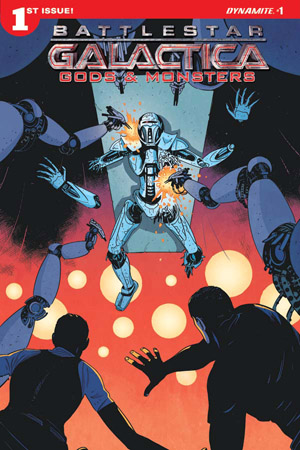
Battlestar Galactica: Gods and Monsters #1 - When I saw that Dynamite Comics was publishing a new Battlestar comic I got pretty excited.  I loved the revamped series (minus the ending) and have enjoyed some of the previous iterations of comics.  After reading this debut, which involves Gaius building a Cylon Centurion ala Dr. Frankenstein and his monster, I feel that it is probably time for Battlestar Galactica to take a long break.  The spin-off Caprica was a disaster, the movie "The Plan" was awful, and this series first issue did nothing to capture the magic of what made the series great.  If you want to revisit this world I highly suggest playing the board game, which is excellent and will make you feel as if you really are on the fleet and possibly a sleeper agent.

POSTED BY MIKE N. aka Victor Domashev -- comic guy, proudly raising nerdy kids, and Nerds of a Feather contributor since 2012. 


Monday, April 28, 2014

Best Sci-Fi TV of All Time Tournament - Results!

Ladies and gentlemen, here we are. You have voted by the thousands, and the results are in.

You have selected...bum-ba-ba-bum!...Firefly as the Greatest Sci-Fi TV Show of All Time!

I must confess, I'm confused. I really, really like Firefly. I may even love Firefly, and I will admit the Comic Con Firefly Reunion panel made me a little misty-eyed. but it ran for 14 frickin' episodes and a movie. I guess it really is how you use it...


So congratulations to Firefly and all you Browncoats out there who drummed up a tremendous response to every round of the voting (and managed to squeak Doctor Who). And let me say to Star Trek: The Next Generation that there's no shame in coming in second out of a strong 32-show field, especially when you totally flattened every other show you faced (including my pick, The Twilight Zone). So to you I will simply quote one of our site commenters, and say in closing "Shaka, when the walls fell."

TO VIEW THE PREVIOUS ROUNDS, CLICK HERE.

Tuesday, April 22, 2014

Best Sci-Fi TV of All Time Tournament Bracket (Final Round)

Guys, I have to admit I'm a little stunned. I did not see Picard and Riker unseating Kirk and Spock in the Classic side of the bracket and heading into the Finals. Sure, The Next Generation ran for much longer than Star Trek The Original Series, and sure the third and final season of Star Trek is a hot mess, but I figured if this was a popularity contest, the "logical" choice would be...well, no matter. You've spoken with your votes, and if I'm being honest, you probably made the right call about the better show. For the record, The Next Generation went gangbusters out of the gate, but Star Trek made a valiant comeback toward the end and ultimately, only 18 votes out of hundreds cast separated the two shows.

Firefly didn't surprise me this week, but I sure didn't have it getting past Doctor Who last week. Do I prefer Firefly? I do. But I'm only one man. One man with whom, in this case, thousands of people happily agree.

So here we are. The Finals. Will the scion of a long-established dynasty walk away with the crown? Or will the 14-episodes-and-a-movie upstart put another feather in the cap of Mr. Neil Young's line that it's better to burn out than to fade away? We'll soon see. Off you go!

To see the results of previous rounds, please click here.

Wednesday, April 16, 2014

Best Sci-Fi TV of All Time Tournament Bracket (Round of 4)

VOTING FOR THIS ROUND HAS CONCLUDED. TO VOTE IN THE FINALS, PLEASE CLICK HERE.

The Round of 8 was, without a doubt, the round with the most gnashing of teeth, and probably even tears, of any so far. For this was the round where Doctor Who faced off against Firefly.

Thousands of votes were cast (thank you, everybody), and ultimately, by only a half a percentage point, it was decided that Serenity would keep flying. (Insert wild celebration/screams of rage as you will).

Now in this Round of 4, you must face another impossible choice: Kirk & Spock vs. Picard & Riker. Is Star Trek: The Next Generation a better show than the one that begat all others, Star Trek? It's your call. But it is certain that an entry from the Star Trek franchise will face off against either Firefly or the Battlestar Galactica reboot in the Finals.

Some housekeeping: to see the results of previous rounds, click here. To review the utterly unscientific criteria used to delineate the Classic from Modern regions, check out the Round of 32 post. Many Reddit users pointed out that I had the order of the matches in the first round out-of-order, which I have consistently acknowledged, and apologize for once again. And for those of you who vitriolically demanded a larger image of the bracket, your wish has been granted.

Now, have fun, and on with the voting!

CLASSIC FINAL

MODERN FINAL

Check back next week for the Final Round!

Friday, April 11, 2014

Best Sci-Fi TV of All Time Tournament Bracket (Round of 8)

VOTING FOR THE ROUND OF 8 HAS ENDED. CLICK HERE TO VOTE ON THE NEXT ROUND.

The basketball tournaments have finished (congratulations, Connecticut men, women), but things are just heating up for us sci-fi nerds. We've reached the Round of 8 in the fan-voted poll of the Greatest Sci-Fi TV Show of All-Time. (Previous rounds here)

There are some tough matchups in these four games.* Will the Whohards and Fireflickians battle to the death to see which show is better? Or just stuff the ballot box? Star Trek: The Next Generation continued its blistering run through its region and beat my pick, The Twilight Zone, handily. I was surprised how brutally The X-Files crushed Lost (by almost 60 percentage points), but can it steamroll fan-darling Battlestar Galactica? Our top vote-getter in this round was Star Trek, but can it be upset by Twin Peaks, the little-engine-that-could who people said didn't even belong in this bracket?


All of these questions and more (or actually, just these questions) will be answered in a few days. So get voting!

CLASSIC NORTH
CLASSIC SOUTH
MODERN NORTH
MODERN SOUTH


*Reddit users once again pointed out that I goofed the order of the initial round's games. I get it, I get it. But there's not "Ctrl-Z" in life, sadly.

Thursday, April 3, 2014

Best Sci-Fi TV of All Time Tournament Bracket (Round of 16)

VOTING HAS CLOSED FOR THIS ROUND. CHECK OUT THE ROUND OF 8 HERE.

The NCAA Tournament is about to resume for the Final Four games, and the results are in for Round 1 of the Nerds of a Feather Greatest Sci-Fi TV Show of All Time Bracketology Extravaganza™. If you missed the first post, the tl/dr version is I made a list of 32 contemporary and classic sci-fi shows, and completely unscientifically lumped them into regions and seedings. Then, a lot of votes came in!

There were not a lot of surprises in the Round of 32, which makes me feel like I got the initial seeds somewhat correct. As Reddit pointed out, however, I constructed the bracket wrong, and Number 1 and Number 2 seeds should not have met until the Round of 8. That's my fault. Nevertheless, I like the matchups in this round, and feel like we're going to wind up in the right place eventually, wherever that may be. Here's where we stand now:

Some cool things about the Round of 32:
  • There were two upsets. Six-Seeded The Six Million Dollar Man reached out and bionically slapped The Prisoner, so it has to go back to the village, and The Fall Guy Lee Majors moves on. And Stargate SG-1, which maybe should've been seeded higher, took down Star Wars: The Clone Wars
  • The top vote-getter of all entries was Star Trek: The Next Generation, followed by Firefly.
  • Number Two seed Lost faced an unexpectedly tough challenge from Seven-Seeded Sliders, but most of the closest races were in the (4) vs (5) matchups.
  • Every show, even the Eight-Seeds, got multiple votes
So what's going to happen in the Round of 16? Will Star Trek: The Next Generation continue steamrolling the competition, even when the competition is The Twilight Zone? Can the speculative fiction Twin Peaks make a deep run in this sci-fi bracket where some say it doesn't belong? Can a battered Lost rally and challenge The X-Files? I sure don't know, but it's up to you guys. Vote below!

CLASSIC NORTH
CLASSIC SOUTH
MODERN NORTH
MODERN SOUTH

Sunday, March 30, 2014

Best Sci-Fi TV of All Time Tournament Bracket (Round of 32)

VOTING FOR THE ROUND OF 32 HAS ENDED. VOTE ON THE ROUND OF 16 HERE. 

For the second year, KPCC in Pasadena, California, has made a public radio bracket for NPR shows. Some of my favorite podcasts, like 99% Invisible and Radiolab are in it (and Radiolab might be cruising to victory), and that gave me an idea. What about a bracket for Sci-Fi TV Shows? When we put it to a vote, what would the fans decide is/was the greatest Sci-Fi TV Show of All Time?

What say we find out?

I've taken 32 shows, and grouped them into four regions, Classic North, Classic South, Modern North, and Modern South, with the four No. 1 seeds The Twilight Zone, Star Trek, Dr. Who, and The X-Files, respectively. The "modern" line was drawn somewhere around 1995, encompassing the last 20 years. It's all entirely unscientific, but hopefully fun. Participate by voting in the polls below, and every few days we'll tally the votes and the winners will advance to the next round. There's also a printable bracket so you can play along at home. Vote as often as you'd like. Painting the show's colors on your body is optional.

Let's go!


CLASSIC NORTH


CLASSIC SOUTH


MODERN NORTH


MODERN SOUTH


Happy bracketing! And if you start any office pools or anything, let us know. We'd love to hear about it.

Posted by Vance K - Cult film aficionado, unapologetic lover of terrible movies, and Nerds of a Feather contributor since 2012.

Thursday, May 16, 2013

Thursday Morning Superhero

Thursday is upon us so it is time for the latest installment of Thursday Morning Superhero.  This week felt a little slow in terms of titles that caught my eye, but the books I purchased from my LCS were definitely above par.  The twists and turns of Age of Ultron have impressed me thus far.  I am not usually one for big comic events, but have enjoyed this ride and don't know how they are going to write themselves out of the situation Wolverine and the Invisible Woman are in.  Dynamite launched a new Battlestar Galactica title based on the 70's television show that was a good read, Helheim may be my favorite new title, and The Dream Merchant from Image Comics had one of the best #1 issues of recent memories.  On to the comics!


Pick of the Week:
Helheim #3 - For me Helheim secured itself as another runaway hit from Cullen Bunn this week.  While I thoroughly enjoyed issue 1 (which just sold out its second printing) and 2, the growth that the pieced together hero Rikard showed in this issue took it to another level.  Bera raised Rikard from the dead and turned him into a Draugr, a raised from the dead killing machine.  He was supposed to kill the other witch, Groa, and anyone who sides with her.  Rikard, however, has no desire to kill any women or children and believes he was raised to protect his people.  Throw in the fact that his father does not like the abomination his son has become and wants to give him a proper death and the unlikely partner, the orphaned Kadlin, that Rikard has found, and you have a series that should provide interesting twists and turns in the upcoming issues.  Bunn has a knack for the supernatural and is displaying it in full force with Helheim.

The Rest:
The Dream Merchant #1 - This is a book that you should keep your eye on. Winslow is currently in a mental ward due to his dream that has been recurring every night since he was a child.  He is flying through a different world with an alien landscape and does not know the meaning.  In the action packed debut, Winslow is pursued by wraith-like beings and learns that he is the last human carrying the memory of how the world once was.  Very enjoyable title that is well written and easy on the eyes.

Age of Ultron #8 - Wolverine and the Invisible Woman are further investigated by the Defends led by Tony Stark.  Things are disrupted when Morgan Le Fay and her alien force invades and brings total havoc to the Defenders, putting them in a situation that is eerily similar to the fate Ultron had brought to Earth.  Once again the superheros are in a situation that seems impossible to navigate away from.  Should be interesting to see what happens next.

Battlestar Galactica #1 - This new Battlestar Galactica title, based on the 70's television series, was easy to get into, a fun read, and provided a nice twist to bring readers back.  Nothing terribly original or fascinating happened in this one, but I may be back for more depending on what I read.  Best part about the issue was the stunning variant cover from Chris Eliopoulous.