Thursday, May 12, 2022

Microreview [Book]: Kaikeyi by Vaishnavi Patel

A feminist exploration of the events leading up to the Ramayana attempts to do a few too many things and can't quite live up to its main character's promise.
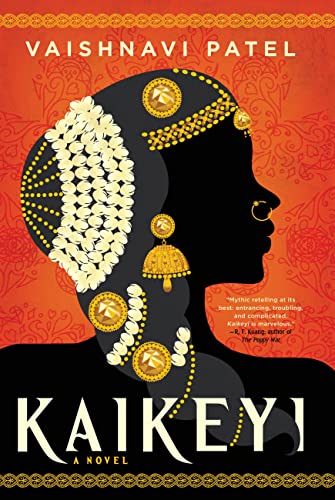
Cover art by Lisa Marie Pompilio

Kaikeyi tells the story of, well, Kaikeyi (shock twist), a wife of Rama’s father Dasharath, and her role before the events of the Ramayana. In the original tale, it is she who causes Rama to be exiled from Ayodhya for fourteen years, and her own son, Bharat to sit on the throne in his place, while the story follows Rama’s exploits accompanied by his other brother and his wife, Sita . Kaikeyi, however, begins much earlier, in the childhood of Kaikeyi herself, beginning with the exile of her mother, leaving her the sole woman in a family of men.

This is meant to be a deeply moving, sad childhood, of this poor girl surrounded by her brothers, and a father who does not care for female children, so leaves her to her own devices. Because the story is told from Kaikeyi’s perspective, we get a lot of her feelings of how terrible and unfair and awful it is, that she should be ignored as she is, and how horrible her life has been made. And at the beginning, that feels very genuine – the parts about the loss of her mother and her confusion at not being told why feel very real. But as the story progresses, we see Kaikeyi flourish with little supervision, learn the arts of war with her encouraging brother, and develop magical powers that allow her to manipulate those around her to get what she wants nearly all of the time. But while this is happening, the story still focusses on how sad her life is, rather at odds with the events as we see them described. At one point, a maid who has been close to Kaikeyi refuses a request, and highlights how others in the world have things much worse than the princess, and it looks like a moment that may actually get through to her, and that she’ll see that though she has her struggles, the lot of many of those around her makes her seem extremely privil- oh, nope, she regrets it for a bit but then continues on her merry way.

And it’s difficult to read and feel like this, because some of her struggles are entirely present and sympathetic – I can hardly say that I wouldn’t object to having no say about my life and marriage either. But so much of Kaikeyi’s life sits in contrast to the serving women she spends much of her time with, especially the maid Manthara, that it’s hard not to feel a touch of exasperation at her.

It doesn’t help that we spend a long, long time with young Kaikeyi doing… not a great deal besides being sad about life and training alone or with her brother. The book suffers from a serious issue of pacing, where around 2/3 of it feels like prologue, and so by the time we get to Ayodhya and Kaikeyi’s marriage to Dasharath, we’ve been sitting with her for what feels like an age.

It is only when we reach Ayodhya, however, that most of the real happenings of the book begin. We get to see Kaikeyi deprived of her relationships and the power they bring her in her native Kekaya, and the struggle with this lack of influence, only broken when her maid Manthara shakes her out of it, practically dragging her to the market. And after a few visits there, she begins to come back to herself, kickstarting her efforts to make friends with Dasharath’s other wives, and also to see that there exist women in the world less fortunate than herself. 

If this realisation had come earlier in the book, I think the entire tone of the novel would have been different for me. But because it feels like we have spent so, so long with young Kaikeyi, it’s very much a situation of too little, too late. Doubly so, because the initial realisation on her part is somewhat overshadowed by, in this part of the book, her going off to war with her husband and being great at charioteering, which wins her a role as a minister in his government.

Eventually, the thread of Kaikeyi’s championing the poor women picks up again, and she and the other wives do what seems to be genuine good for the women of Ayodhya. And this (finally) brings us to one of the central conflicts of the story – Kaikeyi and her assertion that women can exist equally to men in the world, and the faction of traditionalists in Ayodhya, alongside whom the young Rama numbers one.

But this conflict loses some of its weight because of the way we’ve got there. For all that the reader agrees with Kaikeyi (I hope), it seems often that her argument is less one of principal, and more one of self-interest – Kaikeyi enjoys having power, having influence, and the traditionalist faction threatens that. So even when Kaikeyi is in the right, I found myself struggle to be completely sympathetic to her.

That being said, the latter third of the book, with this conflict and a lot more action, is by far a much better story than much of what came before, to the extent of almost feeling like a different book. There’s a sudden explosion of turmoil, where all the various threads that have been floated around throughout the beginning of the story suddenly all become relevant and dramatic at once, and while it was enjoyable to read, it threw the stuff that came before into even worse contrast – why couldn’t it have been like this all along?

And I’ve barely even touched on the magic yet – but like the various other aspects of the story, the relevance of the magic Kaikeyi has to her life, and to the progression of the plot, waxes and wanes constantly. Sometimes it feels like a critical element that will make or break the entire story, and sometimes it feels almost an afterthought, not used in situations where it might have made sense to include it.

On the whole, there’s a simultaneous sense of too many ideas being put together in one book, so none of them get the time or development they deserve, while at the same time a very slow, ponderous start without much in the way of drive to get you through the buildup to what feels like the actual story at the end. It’s a shame, because a lot of the concept here is really appealing, and I feel like Kaikeyi as a character, and as an actor in the story of the Ramayana, has a lot to recommend her, and it’s just not really drawn out here. Despite living inside her head for the whole book, I felt kept very much at a distance to her actual thoughts, and this didn’t help my already limited sympathy for some of her struggles.

In many ways, Kaikeyi struggles with the same thing Madeleine Miller’s Circe does – taking an incredibly compelling character from myth, with a lot of scope for exploration… and then somehow managing to make her less compelling than she is in the source material. There’s a lot of promise, a lot of potential redemption of an antagonistic female figure demonised for wielding power… but then a lot of navel-gazing and self-absorption, rather than the drama the original myth might promise. Both I think are novels where in an effort to make the protagonist more sympathetic, more relatable, they’ve defanged them and lost what made them exciting in the first place.

That being said, the last third of the book was genuinely a fun read, and once I got there, it had the pace and the excitement that I really wanted to keep on going. If the whole thing had been like that… it still wouldn’t have been my favourite book of 2022, but it would have had a lot more to recommend it.

The Math

Baseline Assessment: 6/10 

Bonuses: +1 for taking controversial female figure of myth and attempting to retell from her perspective

Penalties: -1 for very self-involved main character and her somewhat inconsistent focus on the problems around her

Nerd Coefficient: 6/10

Reference:  Vaishnavi Patel, Kaikeyi [Redhook, 2022]

POSTED BY: Roseanna Pendlebury, the humble servant of a very loud cat. @chloroform_tea


Wednesday, May 11, 2022

'Doctor Strange 2' is visually delightful and narratively bland

The MCU is looking less and less like a continuous story, and more and more like a subscription plan you can never opt out of

Despite the refreshing shift in visual style brought into the MCU by director Sam Raimi, Doctor Strange in the Multiverse of Madness is far from the milestone it was expected to be. The ongoing saga of the Avengers was supposed to expand into a wealth of possibilities with the addition of alternate realities, character variants, and reclaimed franchises just acquired by Disney from Fox. But what this movie delivers is smaller than the sum of its parts.

Early announcements for Multiverse of Madness appeared to promise that the story would center on the character of Stephen Strange and the consequences of his reality-breaking spell in Spider-Man: No Way Home. Indeed, this seemed like the right moment to bring back the lingering threat of Mordo, the wizard-turned-wizard-hunter we met in the first Doctor Strange movie. This was turned into an even more enticing prospect by the limited series What If, which gave us a taste of what damage an unhinged Doctor Strange might do to the world if he succumbed to thirst for power. Instead, Multiverse of Madness can barely be called a Doctor Strange movie. The script and the camera treat him as if he were the protagonist, but he is never properly given an arc. With América Chávez as the only hero with a pivotal moment of choice to define her character, and Wanda Maximoff as the self-offing villain who learns the lesson of the day, Stephen may as well not have been in this movie. This is actually an origin story for the character of América Chávez, clumsily inserted in an overly long epilogue for WandaVision.

It's not really worth it to analyze this movie from the character of Stephen, who is only here to stand with a worried face while other characters recite exposition. Even the repeated question about his happiness is left unresolved, because it really doesn't matter. Even a half-hour of What If had more to say on the topic, and it pretty much exhausted its possibilities. So let's look at Wanda.

Since WandaVision aired, opinions on Wanda's character have been extremely divided: one side is ready to empathize and forgive, and the other side points out that her grief, while valid, does not give her a pass for hurting others. I'm in the second camp, as I detailed in my review last year: Wanda's traumatic past gives an explanation, but never a justification, for her actions. She is undeniably the villain of Westview, and now she's become the enemy to defeat. Contrary to the protestations of many on the internet, this is a natural evolution from where we left Wanda last time we saw her, and it is to the credit of Multiverse of Madness that it doesn't buy WandaVision's attempt to pretend that Wanda has learned and grown from her experience. So it might be argued that this movie is about the cost of pursuing an unreachable fantasy, but that was already done in WandaVision, or maybe it is about the cost of meddling with forces beyond human grasp, but that was already done in No Way Home. Both in theme and in actual things happening in the plot, this movie is a redundant and fully skippable entry in the MCU.

Spider-Man: No Way Home proposed the question of what is a responsible use of world-altering magic, but Multiverse of Madness is quick to throw that question at the feet of Wanda, not Stephen. Even when she offers to send him to a universe where he's reunited with his old lover, there's never a sense that he's susceptible to that temptation. This should have been the movie where Stephen has to reflect on his hubris, but what we get is vignettes from other versions of Stephen who have already gone down the path of dark magic and are only there to scare Stephen into staying on the good side. There's no real growth for him. There's no hard choice. He fulfills a role less important than that of a secondary character, and we're meant to believe this story is about him.

This hollowness at the core of the story makes the rest of the flaws more noticeable. There's no thematic statement in this movie that wasn't already clear from WandaVision, and whatever little gesture of maturity Wanda shows here shouldn't have needed an entire movie to develop. The actual function of this movie is to establish América Chávez as a key figure for some upcoming project where she will turn out to save the multiverse. This movie is not its own story. It's a two-hour-long teaser for Phase 4.

This habit of producing movies whose sole function is to promise future movies is becoming a vice in the MCU. The middle portion of Multiverse of Madness is bloated with alternate characters who only show up to earn five seconds of cheers and then die with no consequence to the story. To bring Patrick Stewart back as Charles Xavier, only to kill him in the most unceremonious manner, is already disappointing enough after Logan gave that character the perfect farewell, but on top of that misstep, the casting of John Krasinski as Mr. Fantastic is a transparent play to mass appeal. This movie is not conceived as a story with a statement to make about its characters or its themes. It is simply calculated to please.

In the people-pleasing department, it's at least commendable that Sam Raimi was allowed to dial up the colors of the otherwise boring look of the MCU. His use of fade transitions and close-ups between character beats adds a much-needed touch of uniqueness to the narrative. This feels like a movie that has a director behind it instead of an impersonal corporate machinery.

However, the visual inventiveness of Multiverse of Madness is not used to its full potential. We quickly jump through a dozen universes made of paint, made of comic book ink, made of flesh cubes, but for the most part we stick to only a couple universes that have a walkable New York and a recognizable set of characters. Again, these decisions follow the preestablished needs of Phase 4. Each of these movies has only so much space where they can expand before they risk deviating from whatever big narrative is being prepared behind the scenes. There's only a tiny chance to experiment, to ask hard questions, to challenge the audience. Multiverse of Madness had infinite places to go, but it's too afraid to wander off on its own way.


The Math

Baseline Assessment: 7/10

Bonuses: +3 for giving Raimi the creative freedom to leave his personal mark on the film.

Penalties: −1 for inconsequential cameos motivated purely by fan service, −1 for choosing the wrong protagonist to focus on, −1 for not taking the risk of sending the heroes to more visually bizarre universes, −1 for refusing to have an interesting point to make.

Nerd Coefficient: 6/10

POSTED BY: Arturo Serrano, multiclass Trekkie/Whovian/Moonie/Miraculer, accumulating experience points for still more obsessions.

Tuesday, May 10, 2022

Review: Ignyte Awards - Short Story Nominees

The Ignyte Awards (created by FIYAHCON to shine a light on the vibrancy and diversity of spec fic) are my favorite awards, and short fiction is probably my favorite thing. What better way to spend my time than reading through what I was sure were going to stories that fired on all cylinders? And boy, was my certainty validated. My thoughts on all these masterful, deservedly nominated stories are below.

Center of the Universe (Nadia Shammas) is centered, of sorts, on Abigail who’s in a simulation in which she’s a real human and everyone else is virtual. But the story is not a simple exercise in solipsism. There are simulated people who vie to be seen—to exist under her gaze. And that existence is eventually seized through drastic measures. It’s a unique and fluid premise in which solipsism exists but the narrator is in the periphery of it—a premise that could convolute and crumble from a lesser writer. This is a story that kept me captivated – gaze locked on its words – through its pain. But also, its beauty, its poetry, and the sympathetic struggle of attaining meaning. While reading, it quite easily became the center of my universe.

Delete Your First Memory For Free (Kel Coleman) showcases the bumps in the road that anxiety presents with a story that is antithetically smooth. When Devin and their friends use technology that takes away specific, non-vital memories, their relationships start to change. Kel Coleman writes with such vigor that their writing style smooths over a lot. Not so different from how the developing themes of the story smooths over some emotionally charged situations. Additionally, the nuances in the interpersonal interactions with just about every character were so rich and fully-formed. This is a vital story to many people whose small enemies can feel as cumbersome as their major ones. It might be so instructive and critical to someone, that the memory of reading it would be hard to extract.

If the Martians Have Magic (PDjèlí Clark) offers an engaging story, but most importantly, it offers a WORLD that felt lived in and thoroughly explored, all while telling a pacy story. Martians are widely persecuted by humans--pigeonholed negatively because of some bad seeds in the group. But there’s a way to save those who mean no harm, and the protagonist Minnette is going to try her best to fulfill it in a rollicking, entertaining fashion. Martians do have magic, and everyone who’s read anything PDjèlí Clark has written probably knows he has a lot of it, too.

The Fifth Horseman (Martin C. Cahill) starts with The Four Horseman of the Apocalypse after they’ve “apocalypized” the world. But they have a sibling that they don’t know too well—the fifth horseman. And that horseman has someone additional work to do. That work is described in beautiful, lyrical prose that shows off the beauty of the world – as ephemeral as it is – along with a sympathetic backstory for the fifth horseman. There’s a sense of distance with her due to her circumstances, but there’s also some warmth that’s beautifully paired with the writing style that finds the beauty in the world despite its cataclysmic situation. I really dug this. The potency of the story’s descriptions alone is damn near apocalyptic.

The Tale of Jaja and Canti (Tobi Ogundiran) bears a little similarity to Pinocchio, but its wooden boy’s journey veers in engagingly unexpected directions. The tone is like a fairy tale and the way its split into chapters enhances that feeling. It has a spare word count but is able to do so much without feeling rushed or choppy. And without spoiling anything, the story is bookended in a way that’s structurally ingenious. Like the other Ignyte nominees, this story is a banger.

POSTED BY: Sean Dowie - Screenwriter, stand-up comedian, lover of all books that make him nod his head and say, "Neat!"

Monday, May 9, 2022

'Star Trek: Picard' season 2 is aimless and inconsistent

Its examination of the neofascist dangers of the 2020s breaks down into pointless nostalgia and superficial psychoanalysis

Season 2 of Star Trek: Picard bites more than it can chew. In the span of ten episodes, it tries to explore xenophobia, eugenicism, the weight of self-blame, repressed trauma, the tragedy of finitude, the tension between open and closed societies, the human yearning for intimate connection, the fear of loneliness, the responsibilities that come with parenthood, immigration policy, the purpose of life in old age, the narcissism inherent to the search for a legacy, authoritarianism, temporal paradoxes, suicide, and the uncertainty about the turbulent direction of humankind in the 2020s. Unfortunately, the show doesn't manage to say anything insightful about any one of its myriad themes.

The season begins by proposing a knock on the door: the Borg, old enemies of the United Federation of Planets, all of a sudden ask to join it. However, Admiral Jean-Luc Picard chooses to self-destruct his ship before allowing his old tormentors a foot in the door. This encounter sets up the argument between inclusion and exclusion that will continue in later episodes, and it gains heightened resonance by virtue of the characters who participate in it: captain Ríos, a Latino who gives commands in Spanish; Seven of Nine, an ex-Borg who was given a second chance at humanity; Elnor, a refugee from a destroyed world; Agnes and Raffi, chronic loners; and Jean-Luc himself, a techno-organic creature whose existence was illegal in the Federation just months before. This crew is composed of identities that, either in the real world or in the show's setting, have at some point been rejected, ignored, and excluded. And this is the crew that chooses to reject the Borg's open hand. This is the crew that consciously chooses death instead of risking further openness. So it's fitting that this is the moment when cosmic trickster Q steps in and shows Jean-Luc the flipside of that mindset.

Even before the revelations in the season finale, the thought of welcoming the Borg into the Federation shouldn't have been off the table. Star Trek has an established tradition of dissolving enmities: we've seen Earth gladly cease hostilities with the Klingons, the Xindi, the Andorians, the Romulans, the Orions. The Federation grows stronger each time it makes rivals into allies.

Q creates an alternate timeline where the fascist Confederation has a darker way of dissolving enmities: the eradication of every species that is not humankind. This world's version of Jean-Luc Picard is a mass murderer who serves supremacist ideals and gleefully performs televised executions. This reality is everything Star Trek has always warned against, which is why it's disappointing that we only spend one episode there.

To be fair, Star Trek had already shown us several examples of galactic history gone wrong in the Mirror Universe. But there was always the implied relief that those horrific events didn't happen to us, didn't affect our history. Our history was meant to be the peaceful Federation. The choice in this season of Picard to have the bad future happen in our universe makes the dystopia feel much more threatening. The cruelty and hopelessness of the Mirror Universe can no longer be relegated elsewhere. The potential for endless horror is right here.

Literally right here: one of the most compelling plotting choices of this season is to set the point of divergence in the real world's present. It's Earth in the 2020s where the future is decided. It's you and me watching Picard. It's up to us to decide whether our future will be an egalitarian utopia or a fascist nightmare. However, the show doesn't do anything interesting with that enormous idea. Captain Ríos suffers a random teleport mishap that conveniently puts him in the crosshairs of ICE, but his ordeal through arrest and imprisonment has a perfunctory air to it. The subplot where Ríos is in danger of disappearing forever in immigration jail has an obvious thematic link to the kind of future our heroes are trying to prevent, but the episode occurs in isolation from the rest of the story. The draconian proceedings of US immigration policy feel like they should, but really aren't, related to the flow of historical events at the center of the plot. By turning the capture and rescue of Ríos into a side quest completely untethered from the main mission, the show missed its best chance for relevant commentary.

There's nothing wrong per se in a story having a large number of themes. The problem with season 2 of Picard is that those themes have little to do with one another, and sometimes lead to contradictory messages. For example: when we learn that the crucial event that must be preserved in today's Earth in order to avoid the dystopian future is the participation of a certain ancestor of Jean-Luc's in a space mission (making this the millionth story to fall for the Great Man myth of history), we meet Tallinn, an alien secret spy tasked with protecting said ancestor until she flies to space. In the final episode, Jean-Luc tries to prevent Tallinn from sacrificing herself to complete her mission (in fulfillment of an Unnecessarily Cryptic Prophecy), and Tallinn protests that her life is hers to risk, and Jean-Luc has no right to interfere with her choices. However, interfering with someone's life and even guiding their choices to keep them from risk is exactly what Tallinn has been doing to Jean-Luc's ancestor for years. The point made in this discussion comes too close to mirroring the evil future's implied stance that some deaths are more acceptable than others. Moreover, the thematic thread about Jean-Luc's need to stop holding himself responsible for everyone else conflicts with the thematic thread about our historical responsibility to protect the future. These two messages didn't have to clash, but they have that result in this particular intersection of plots.

This incoherence reocurrs in regard to Jean-Luc's inner conflict. Q points out that his choice to leave his personal past intact and not prevent a chain of events that resulted in his mother's suicide shows growth on Jean-Luc's part. However, serenely accepting a painful reality is the opposite of what our team of heroes have been trying to accomplish the entire season. If it's a valid ethical choice to alter the past so that billions of people won't live in misery, why is it praiseworthy of Jean-Luc to not save his mother and himself? Tallinn asserts that we don't get to choose what losses we have to bear, which is an argument worth considering, but it comes off as a weak argument when presented in the same story where the main mission is to fix a cosmic loss. With these conflicting positions, the season comes off as uncertain of what it wants us to care about.

The key issue Q hoped his old frenemy would dare to face turns out to be family trauma, but there's no causal or even symbolic connection between Jean-Luc's mother and Jean-Luc's 21st-century ancestor. Q effectively assigned Jean-Luc one mission while intending him to complete another, and the narrative disjointedness feels too big at times, like two separate plots competing for centrality. The scenes we spend dealing with his difficult memories come at the expense of his time travel mission, not in the service of it.

This failure to achieve cohesion is especially regrettable when it comes to Jean-Luc's personal growth. The moment Q's actions affect is the self-destruction of Jean-Luc's ship (i.e., a suicide); the moment he expects Jean-Luc to not affect is his mother's release from confinement, which allowed her to hang herself. By helping Jean-Luc relinquish his guilt for his mother's suicide, Q means to prevent Jean-Luc's own suicide. And yet again, the method of execution has no relation to the ultimate goal. The switch to a dystopian timeline is something entirely apart from Jean-Luc's personal problems, and Jean-Luc's reward for fixing the galaxy is a trip back to his time at the cost of Q's suicide, which muddles whatever statement Q was trying to make.

The other big threat in this season, the emergence of a new Borg Queen in the 2020s, feels similarly undercooked. The writers don't take advantage of the chance to present the dangers of absolute control and enforced conformity that the Borg symbolize as a mirror for the similar tendencies reemerging in our real world. What would it look like for the Borg to come in contact with a culture that has already experienced the Trump era? That would have been a fascinating change of perspective, because in Star Trek the Borg have always served as a contrast to the Federation, but this season suggests that we, the humans of Earth, have the potential in our nature to become the same type of heartless all-devouring conquerors that the Borg are. That obvious low-hanging fruit is inexplicably left untouched.

Another missed opportunity occurs during the Borg attack on the Picard mansion, where our heroes retreat to the tunnels beneath. Those tunnels fulfill a double role in the backstory: they're the place where the young Jean-Luc learned that his mother's mental health was deteriorating, and also the shelter where the French resistance hid from the German occupiers. That history presented a fertile narrative possibility in connecting a refuge in the mind to a refuge against fascism. But once again, the writers didn't do anything with a thematic resonance that was crying out to be used.

Finally, the whole Soong situation makes no sense. It's already beyond tiresome to have Brent Spiner be the only face of the Soong family, but his role in this season is another instance of the Great Man myth. The new Borg Queen describes the forking road thusly: will humankind go the way of Picard, or the way of Soong? It's an extremely narrow view of how history works, an oversimplification of ongoing cultural trends that the writers should have been more aware of if they were going to set the story in our present day.

Yes, humankind in the 2020s is very much at risk of becoming the opressive regime of the Confederation. But this season of Picard only uses our present day as set dressing. The resolution of the threat Q created has nothing to say about our current situation, and repeats the familiar mistake of making a huge societal problem hinge on the choices of one individual.

It's even more frustrating to watch the season finale of Picard on the same day that Strange New Worlds premiered. In this new entry in the franchise, captain Christopher Pike recounts the difficult journey that Earth had to go through before becoming a Star Trek utopia. Using real footage from the violent conflicts of the past couple of years, Pike reaffirms the established canon that says 21st-century Earth had a world war motivated by eugenics. That's the immediate future Star Trek is saying awaits us. So what should we glean from our heroes' success at preserving the timeline in Picard?

This season had good material to work with, but didn't make the effort to make the best use of it. The writers knew that the season's themes had great significance for our current times, but didn't develop them beyond the barest box ticking. And the details added to Jean-Luc's backstory overcomplicate a character we already had a clear feel for. This portion of Picard's story is more notable for what it wastes than for what it adds to the ongoing Star Trek saga.


The Math

Baseline Assessment: 5/10.

Bonuses: +2 for Kirsten Beyer, who seems to always elevate any script she has a hand in.

Penalties: −1 for too much empty fan service, −1 for a contrived resolution to Kore's journey, −1 because it's incongruous to devote so much attention to Jean-Luc's childhood without acknowledging his troubled relationship to his brother.

Nerd Coefficient: 4/10.

POSTED BY: Arturo Serrano, multiclass Trekkie/Whovian/Moonie/Miraculer, accumulating experience points for still more obsessions.

Friday, May 6, 2022

Review: The Memory Librarian and Other Stories of Dirty Computer

The story of Dirty Computer continues in five richly plotted scenarios set in a dystopian future

Taken as a whole, Janelle Monáe's Dirty Computer art project consists of a music album (nominated for the Grammys in two categories), a short film (nominated for a Hugo), and now, from Harper Voyager, a collection of short stories written in collaboration with other authors of color. This production is not connected to Monáe's previous Metropolis storyline, centered on the android Cindi Mayweather. Both the album and the film of Dirty Computer follow a different character, Jane 57821, as she escapes an oppressive future in the company of her lovers. This book serves as a window into exactly what horrific world Jane is escaping.

The introduction to the collection is a quick summary of the rise of a totalitarian regime, New Dawn, whose control over society was possible because "we accepted their offer that an eye in the sky might protect us from… ourselves." With the assurance of total visibility, an immediate problem emerged regarding privacy and deviancy, and the regime decided that "what they struggled to see, they began to deem not worthy of being seen—inconsistent, off standard. Began calling it dirty—unfit to be swallowed by their eyes."

In the backstory that this introduction presents, the new social category of the dirty started being applied to modes of thought and identity that did not fit the rigid standards of the regime. The stories that compose this collection explore various characters' struggle to reclaim, preserve, and even celebrate the dirty.

The titular story, The Memory Librarian, cowritten with Alaya Dawn Johnson, follows Seshet, a government employee whose job is to gather, catalog, inspect and, if necessary, redact memories routinely collected from the citizens of New Dawn. What she thought she knew about her position in society is challenged by an unexpected romance with Alethia, an underground dissident whose thirst for independence of mind forces her to face thorny questions of power and intimacy. How can you learn to respect your partner as an equal when you have the legal authority to manage their mind? Is full access to your partner's every thought enough for you to say you know them? Why is it so difficult to be vulnerable in front of someone you don't control? And what does it do to you when you're given the power to edit how people—even you—remember you?

In the story that follows, Nevermind, cowritten with Danny Lore, we meet our main heroine, Jane 57821, in hiding after having survived New Dawn's attempt to remove her most precious memories (as seen in the Dirty Computer short film), and now turned into the unofficial leader of an intentional community that inhabits a hotel in the desert where women can experiment with alternative forms of social organization. Free from New Dawn's monopoly on memory, the members of this breakaway community find comfort in a storytelling ritual where each participant contributes the bits that the other struggles to articulate. Against this joyful act of sharing stand the hunters of the regime, mutated humans for whom sharing feelings is physically painful. While New Dawn weaponizes memory as an assault on reason, the dissidents paradoxically wield emotional openness as a protective deterrent. This story draws from ongoing discussions in contemporary activism about the need for an ever-expanding scope of inclusiveness.

Then comes Timebox, cowritten with Eve L. Ewing, about Raven, a newly independent young woman with barely any time for all her daily obligations, who discovers that her apartment has a paranormal room where the flow of time is suspended relative to the outer world. Her chronic sense of deprivation clashes with her girlfriend's shallow performance of generosity when they set out to decide what to do with an infinite resource.

We are next treated to Save Changes, cowritten with Yohanca Delgado. This is a brilliantly multilayered exploration of the fantasy of fixing the past. On the surface, this story is about the social difficulties experienced by the family of a political prisoner, whose shaky mental state after being sentenced to memory revision is placed in symbolic parallel with her daughter's project of repairing clocks dating from before New Dawn. But on a deeper level, this story is about the heart-rending sacrifices people are willing to make for their loved ones under unbearable oppression. In a regime that lays claim to all facts, a blatant lie can be the most unpredictable tool of resistance.

The last story is Timebox Altar(ed), cowritten with Sheree Renée Thomas, an uplifting metaphor about the social power of media representation (and therefore, a metafictional statement of purpose for the book itself). In a plot of overgrown land with disused rail tracks and rusty fairground equipment, a small child whose mother was taken away by New Dawn reshapes the abandoned objects into something new, following an inborn urge toward the raw potential of artistic creation. In doing so, they produce a miracle. This event establishes a correspondence between the fictional artists inside the story and the real artists writing the story, as well as between the characters who are shown a vision of a brighter future and the readers who might feel similarly inspired by seeing themselves in that future. The link between memory and time—namely the metaphor of reclaiming memory as a form of time travel—extends further to Monáe's role as a musician. As the protagonist of this story wisely proclaims, music is fundamentally made of time. This notion invests the musical record (and, by extension, any work of art) with the properties of a time machine. To make art is to reclaim memory is to exert power over time. This theme brings the book full circle back to the Dirty Computer album as a ritual whose performance is meant to effect change in the material world, as a cry for a liberation whose realization is contained in its utterance.

In each of these stories, but most notably in the introduction, which Monáe wrote by herself, her talent as a songwriter shines. Her prose vibrates with the telltale cadences that tell you this was written by an artist intimately familiar with the music of language. It takes an experienced lyricist to produce sentences with such rich sonority that they all but demand to be sung, like "She missed the music of the hotel the moment she exited, even as the wind hit her face, just cool enough to mimic the feeling of misting water," and "So they stared at the gray obelisk in the distance, shuddered and turned away, running in the opposite direction, racing down a path, not caring where it would go."

This collection adds important details to the otherwise barebones worldbuilding Monáe had laid out in her album and film. The characters she and her collaborators have created for these stories feel profoundly, compellingly human, even as the conditions they have to endure threaten to rob them of their most human qualities. That's the most remarkable trait that these stories have in common: even in the absolute worst of circumstances, the characters we meet here are not broken. They abound in hope and kindness, and meet each new day with the bold refusal to become jaded. In the nightmarish future of Dirty Computer, marginalized communities still fight to create spaces for solidarity, safety, and pure joy.


The Math

Baseline Assessment: 8/10.

Bonuses: +2 for the intricate work of worldbuilding and characterization.

Penalties: −1 for sometimes relying on overused turns of phrase.

Nerd Coefficient: 9/10.

POSTED BY: Arturo Serrano, multiclass Trekkie/Whovian/Moonie/Miraculer, accumulating experience points for still more obsessions.

Reference: Monáe, Janelle. The Memory Librarian and Other Stories of Dirty Computer [Harper Voyager, 2022].

Wednesday, May 4, 2022

Thursday Morning Superhero: Free Cmio

FCBD Logo

We are rapidly approaching the first Saturday in May which means that it is almost Free Comic Book Day!  I will be celebrating in a new city and am curious how things are going to flow, but at the end of the day I am going to enjoy free comics and support my local comic book store.  Here are my most wanted books and to find a store near you click here.

Valiant FCBD Cover

Year of Valiant 2022 - I will admit that I have fallen behind on the Valiant universe and have been a bit underwhelmed by their foray into the movie theaters, but I feel it is time to revisit some amazing characters.  This book features original stories for Bloodshot, Archer and Armstrong and Ninjak. It is rated Teen so you may want to keep some younger eyes off of these titles.

Jonna and the Unpossible Monsters Cover

Jonna and the Unpossible Monsters - This is a reprint of a fantastic all-ages series that centers around Rainbow's quest for her missing sister, Jonna.  There are mysterious monsters that appeared right around the time of her disappearance who are now roaming all over.  Volume two came out recently and it is a great time to introduce this story to your younger readers.

Fuzzy Baseball Cover

Fuzzy Baseball - This book is a fantastic example about why I love Free Comic Book Day.  I don't know if I would normally explore a topic like this, but it has animals, baseball, ninjas and robots all in one title.  I enjoy all of those things and this is from John Steven Gurney who illustrated the Bailey School Kids books in addition to some other amazing titles. 

Avengers X-Men Cover

Avengers X-Men - Not to leave out any of the big studios, this title had me on board when I saw it included a story from Gerry Duggan.  It is the set-up for the big summer event, and while I am typically not too interested in the big events, they do manage to find their way to my shelves at home and I am entertained in the end.

10 Ton Stories Cover

10 Ton Tales - This book promises a modern day Gumby and Pokey, a story about a freed Genie and the people who attempt to enslave him once again in his oil lamp, and a prequel to an upcoming Foo Fighters autobiographical comic that features Dave Grohl between his time with Nirvana and before the Foo Fighters were formed.


There are so many other amazing books.  See the full line-up here, and consider buying something when you enjoy Free Comic Book day because the books are free for us, but not participating stores.  They foot the bill to allow us to enjoy the wonderful world of comics.

POSTED BY MIKE N. aka Victor Domashev -- comic guy, proudly raising nerdy kids, and Nerds of a Feather contributor since 2012.

Microreview [Book]: Home Is Not a Country by Safia Elhillo

A novel written in verse that is both economically and lyrically potent. 


A novel in verse isn’t bound by conventional formatting. Home Is Not a Country isn’t bound by a traditional definition of home. Just how the words on its pages shift and contort in forms that deliver the most impactfully economic messages, so does the protagonist’s sense of place, until the story's transformative structure and plot arrive at a location that dovetail nicely. Home Is Not a Country is a story that I couldn’t see working any better way than in verse. It’s streamlined enormously, often to its benefit. But on occasion it throws away subtlety for bluntness and plotting that feels conspicuously developed rather than fluid and invisible.

Nima is a teenager living in America. She's from an unnamed Arabic-speaking country in a post-9/11 world. Her father is dead, she wishes her mother was different, she wants to be more popular and feels like she can't because of her background. Everything bad that could be happening to her feels to her like it's happening. But then she starts seeing a figure who looks like her--a figure who evokes a sense of magic. The novel jumps between the past and present, arriving at a climax that changes Nima's outlook of both her history and her current values.

Safia Elhillo manages to be both lyrical and fluid in her writing--every sentence is expertly constructed. Whether it be Nima wrestling with her lack of father, her identity with both the positives that come with it as well as the baggage packaged with a post-9/11 America, and her friendship/struggles with Haitham. The writing steps up an extra level in the book's latter half, when the speculative elements are at the forefront. It's used to both raise the stakes and explore characterization in ways inaccessible from realism. Without spoiling, there is history that is uncovered and internal struggles that are fought in such an imaginatively incisive way that could only be brought about from fantasy. That imagination is undercut by a few characters who are key to the story but only feel remotely developed. They all had promising set-up, but by the time the story went into high gear, some characters felt only identifiable by a few markers rather than dimensioned personality.

Home Is Not a Country shows that in face of adversity, looking back with rose-colored, nostalgia glasses isn’t a viable way to survive. The hue might seem more comforting with them on, but if you take them off, you might find that colors that seemed disgusting to you at first glance are much more inspiring upon careful study. If thinking of the past goes down like water, the present is like a jagged pill that will do you good if you take the extra effort to swallow. In this novel, an effort is also needed to feel like you’re truly home. You might not be surrounded by your culture, have two parents taking care of you, or be the most popular person at school—but there is a way to maybe not live at ease but with pleasure. Home Is Not a Country beautifully conveys that and much more, making it a winner that I don't have to look hard at to admire.

 The Math:

Baseline Score: 7/10

Bonuses: +1 For brilliantly conceived speculative elements.
+1 For using the novel-in-verse structure beautifully.

Negatives: -1 For some plot points being a little too blunt.

Nerd Coefficient: 8/10

Elhillo, Safia. Home Is Not a Country [Make Me a World, 2021].

POSTED BY: Sean Dowie - Screenwriter, stand-up comedian, lover of all books that make him nod his head and say, "Neat!