Most of the myth retellings we have right now are bland.
There are several reasons for it, not least because most of them are retelling a relatively small subset of the stories from primarily one culture (Ancient Greece). Even the best, most interesting work that only plays in this small sandpit would run the risk of being overdone. And, in my opinion, most of what we're getting isn't anywhere near that best.
For one thing, the way many of them are adapted to modernity, in format, but critically in tone, does them a disservice. The originals have guts and teeth and claws, and they may not be the ones we want now, but they have them. But, unfortunately, the majority of the retellings take them out, make them... more palatable, but less substantial. Sometimes, this is in service of not spotlighting and lauding some of the truly awful things that were valorised in the past, which I can get behind, but sometimes... the originals actually have a better message, or a theme that remains relatable, even without it being above moral censure. Even when meant in the best possible way, some of the modern simplification erases the glorious complexity of the original - why make Achilles gay when you can accept that he could have sexual love for Patroclus, but also father a child on a woman, and neither of these things defined his identity in the ancient world. Isn't it more interesting to look at a world that viewed sexuality differently than to cut the edges off a figure from the past to make him fit a single, modern narrative? Or take any of the dangerous female figures of myth, for example, and Medea or Circe in particular. There is something to be said for leaving a powerful, dangerous, vengeful woman in a world hostile to femininity exactly as the nightmare to men that she is, rather than softening her for approachability. The Romans particularly had a deep-seated fear of the power of the virgin woman... so let that fear be palpable.
And then for another, a large proportion of the ones published and heavily marketed in recent memory are billed as "feminist retellings"... while having the blandest, most milquetoast version of feminism imaginable. In the year of our common era 2023, I submit it to you that "making a woman the protagonist" is not actually all that much of a feminist statement anymore. "What if it was told from a female perspective, so we can understand her suffering from her point of view?" I'm sorry babes but Ovid got there before you in *checks notes* the first century BCE. And then Euripides before him in the 5th century BCE. It is my genuine, considered opinion that about 75% of the modern feminist retellings do no better in their feminism than was achieved by either The Trojan Women or the Heroides, both of which centre the female experience of, respectively, the Trojan War or "being in any way associated with a hero of Greek or Roman myth", and the suffering that causes. And these are far from the only historical works that do exactly the same thing - wonder what the women felt in these stories that focus on men and their heroism, and dwell on the human cost. It was a common rhetorical training activity to ask students to argue the extent to which Helen was villain or victim in the Trojan War. Seeing these women as people, who lived and thought and felt and suffered... just isn't new.
And maybe stories don't need to all be new. Maybe sometimes we can reexamine something without having to do a radically different take on it. But given the intense saturation in the market at the moment for these stories... well, sure, it's allowed. But it's rather dull.
And finally, of course, we have the problem of who gets to tell those stories. If we look at the ones that get the big press, all the marketing and the buzz and the social media engagement, they are your Madeline Millers, your Natalie Hayneses. Both are good writers, for whom there is no criticism for their success. But there are notable absences - why are all these big ticket Greek myth retellings from white, anglophone women? Where's the variety?
If you saw any of the discussion around the recently announced Greek myth anthology Fit for the Gods, you will be well aware that there's a repeated issue around lack of Greek storytellers and perspectives being represented in these retellings. Fit for the Gods bills itself as a diverse anthology, and, on some metrics, it very much is, but it is also intensely US-centred in terms of its authors. In the same way, if we look at the truly big names in Greek myth retellings... who among them isn't British or American? Who is getting all that marketing push, except these women from the anglosphere? And far more than in Fit for the Gods, they are overwhelmingly white, cis, and straight. There's a tight noose around who gets to tell these stories, who gets promoted when telling these stories, and it's stifling out a lot of other voices, even the ones from Greece. From actual Greece.
Which feeds into exactly the same problem - we're getting the same stories retold and retold, by people from the same background, with the same perspectives on the same stories... and so we're not really getting anything new.
How many retellings are there, at the moment, of Hades and Persephone, but make it a love story? It's a lot. I've read (and disliked) several of them. This is not only a take that multiple people have done, but one that is, at its heart, intensely uncomfortable - we take a story of the rape of a young girl and decided, actually, it will be nicer and more fun to read if the dark and broody god is instead a softboi and will protect our beautiful little sheltered heroine from harm and/or her overbearing mother. How... how have we managed to go backwards from the original myth? And then do it to saturation? It's not feminist, it's not new, it's not interesting, most of them aren't good... so what exactly are they bringing to the table?
It's easy money and easy marketing, right? The great thing about these retellings, from a publishing and marketing perspective, is that you're selling people something they have a lot easier job of telling if they're going to like it, and so making them much more likely to buy it. "For fans of Madeline Miller" grand, done. Retell the same love story? If they know they like it, they'll buy more. Make them all occupy the same tone, the same perspectives, the same takes, make them safe and sanitised and bland, and they will be so very widely marketable and unobjectionable, but with a "feminist" tag to hide how truly unrevolutionary the content actually is.
What if we were braver? Or publishing were. What if, and bear with me on this one, we took our direction from elsewhere in fantasy, and looked to The Locked Tomb series for our inspiration. What if we decided we could handle stories full of messy, troubled, violent, scary and problematic people, just... being that. Stories open to interpretation and different readings. I was very lucky, a number of years ago, to read a book called Bright Air Black by David Vann, which does just that. It is a retelling of the story of Medea, and it does something that very few retellings have ever approached, for me - it let a figure from mythology be messy, and complex, and bad, and let her be the protagonist anyway, with not a single apology for her being exactly as she was. There is a great deal of power in that, and a power many of those feminist retellings are lacking, even though this was never marketed as such a thing.
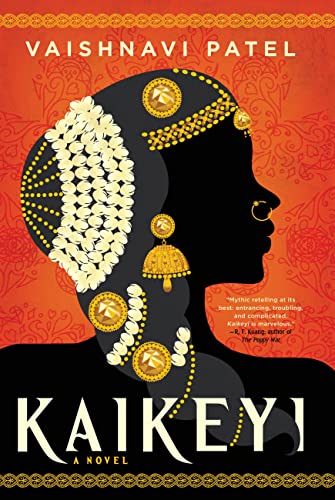
Or what if publishing didn't wait until the market was utterly swamped with all this same old same old before being sufficiently daring to dip a toe outside of its comfort zone. Because there are people writing things that aren't these same five myths or same three perspectives - look at Maya Deane's Wrath Goddess Sing, where we imagine Achilles as a trans woman? Or look at Kaikeyi by Vaishnavi Patel? Or Home Fire by Kamila Shamsie? Or Love in Colour by Bolu Babalola? Or Under my own Shadow by Elena Kotsile? What if we could have got those types of stories right from the start, getting the buzz and the marketing and the special editions and the bookseller events and the press coverage that a new Madeline Miller book gets? What if we let "diversity", however you want to articulate it, be there right from the start, and let us have genuinely diverse stories, different genres and emotions and responses to different stories, stepping outside of this same little paddling pool of only a fraction of the Greek myths, out into a wider world of so many mythological stories?
I'd be happier. I'd read more of them.
Because this is the thing - I've mostly stopped reading those big marketed myth retellings. I am, in many ways, the targetest of target markets for a Greek myth retelling. I'm a white, anglophone, middle class feminist with a degree in Classics who likes to read. Selling them to me should be the easiest thing in the world. So it's insulting, to think that these books that ought to appeal to me, that clearly are targeted at my demographic, assume that what I want is to read the same three things over and over again, to never be challenged, to never have to think, or learn. To never have to explore what feminism might be outside of the smallest, most isolated and privileged little sphere. To never care about myths that aren't the ones I grew up with. To never be willing to live with a character who engages my sympathy while also being morally... complicated.
Of course, there's always the answer of "why don't we just stop retelling these stories at all and read new stuff", which is a fair point. But there is something in the older stories that clearly pulls us in, and I don't think it's necessarily bad to be swayed by that. Antigone has been staged as a play across 2464 years because there is something in it that appeals to us still. It still tells a story that resonates, in the tension between duty to morality and the state, the debts we owe to family, how authority can become tyranny. These are still relevant themes. And they are made all the more so when someone like Inua Ellams turns it into a commentary on being Muslim in modern Britain. But I believe that those values comes in the reinterpretation, the shift into different perspectives, the examination of the same core themes in different settings, by different voices and people. And we don't get that unless we let those stories be told by those different people. And we miss out on so many of these stories that may be just as compelling if we constrain ourselves to such a limited corpus of sources.
We don't need those bland, limited retellings.
Instead, we should have more retellings where Circe is terrifying, Medea is cruel and vengeful, where Artemis destroys those who wrong her, where Hades is a kidnapper and Persephone has to figure out where she fits in the aftermath, where Athena walks a careful line, avoiding the attentions of e.g. Hephaestus, where Achilles can love Patroclus as cousin, as sword-brother, as lover all in one, but also have a son by a woman and there be no contradictions. Where Hera is both wronged and wrong. Where Clytemnestra is everything she is and needs no justifications. Write them loud and bold and complex, and trust that readers can find the value and the meaning in them, just as they have for the last three millennia. We should have retellings of myths that mean an anglophone audience might have to stop and listen to someone else's thoughts. We should be trusted to go and look things up, to be fascinated to learn more, and willing to not be pandered to on every page. We should live up to that trust. We should have retellings that let everyone have a voice.
They exist. They're just not being marketed. So maybe we should go find and read them, and embrace the wider, wilder world of myth. Maybe then they'll listen.
--
References:
Jenn Northington and S. Zainab Williams (editors), Fit for the Gods: Greek Mythology Reimagined, [Vintage, 2023]
Maya Deane, Wrath Goddess Sing, [William Morrow, 2022]
Vaishnavi Patel, Kaikeyi, [Little Brown Book Group, 2022]
Kamila Shamsie, Home Fire, [Bloomsbury, 2017]
Bolu Babalola, Love in Colour, [Headline Publishing Group, 2020]
Elena Kotsile, Under my Own Shadow in Orpheus + Eurydice Unbound, [air and nothingness press, 2022]
David Vann, Bright Air Black, [Cornerstone, 2017]
POSTED BY: Roseanna Pendlebury, the humble servant of a very loud cat. @chloroform_tea