Showing posts with label feminist retelling. Show all posts

Tuesday, June 9, 2026

Book Review: The Palace of Eros, by Caro de Robertis

On making Mount Olympus' foundations shake


I first discovered the work of Caro de Robertis (they/them) with their novel The Gods of Tango, which follows an immigrant from Italy’s new life in Buenos Aires in the early twentieth century, embracing that quintessential Argentinean dance and music, and transitioning gender in the process; I was interested because I am an amateur ballroom dancer and can dance the American bastardization of Tango reasonably well, but know vanishingly little of the original. Since then, I have read some of their other books, including Cantoras, a spellbinding, heartbreaking saga of lesbian life under the dictatorship in Uruguay, and The President and the Frog, an odd little novel that dips into the supernatural. But in their most recent novel they take the speculative plunge: The Palace of Eros could be considered another entry in the recent subgenre of feminist retellings of ancient myth (as my esteemed colleague on this blog Roseanna Pendlebury has deftly discussed the failings of said subgenre).

Unlike Pendlebury, I will admit to you that I am not the ideal audience for this novel, and in all likelihood not the ideal audience for de Robertis’ oeuvre in general. I am heterosexual, cisgender, and male, ethnically mixed between a smorgasbord of western Europe on the one hand and the Philippines on the other. I am autistic, with no romantic relationships in my life thus far. I have no cultural link with Latin America, but I speak Spanish reasonably well if not fluently. Nor am I particularly fluent in classical mythology. A more narrow-minded person may ask why I would read this book to begin with. I would first retort with the well-trod benefits of reading widely, of learning other perspectives, of opening your mind. I would then provide this quote from Jean-Paul Sartre’s introduction to Frantz Fanon’s The Wretched of the Earth:
“Europeans, you must open this book and enter into it. After a few steps in the darkness you will see strangers gathered around a fire; come close, and listen, for they are talking of the destiny they will mete out to your trading-centres and to the hired soldiers who defend them. They will see you, perhaps, but they will go on talking among themselves, without even lowering their voices. This indifference strikes home: their fathers, shadowy creatures, your creatures, were but dead souls; you it was who allowed them glimpses of light, to you only did they dare speak, and you did not bother to reply to such zombies. Their sons ignore you; a fire warms them and sheds light around them, and you have not lit it. Now, at a respectful distance, it is you who will feel furtive, nightbound and perished with cold. Turn and turn about; in these shadows from whence a new dawn will break, it is you who are the zombies.”
The novel is a queer reinterpretation of the story of Psyche and Eros. In this novel, the former is the youngest of three daughters of a farmer. She is said to be the most beautiful, and her father is intent on using that fact to marry her off to a man that could benefit him. She and her sisters are made to sit quietly in their living room as her father socializes with the men of her town. Later, she is displayed as a sculpture would be at an auction, gawked at, leered at, but never actually engaged with in any substantive form. She is objectified in the sense that she is reduced to the status of an object to be traded away, as something to be hopefully received by the suitors, and to be traded away for benefit by her father.

It is at this juncture that Aphrodite, goddess of love, takes note, and is disgusted that men find Psyche more beautiful than her. She sends her child, Eros, to make her fall in love with a monster. Note how I said ‘child,’ and not ‘son,’ as Eros is traditionally male in mythology. Here, Eros presents femme in most contexts but can shapeshift across the gender binary (including sex organs). Though a character whose gender expression is quite fluid, Eros is referred to with she/her pronouns throughout the novel, and that is what I will use here. She is an embodiment of sexual desire, as in classical mythology, but a more expansive, more liberatory, queerer form; she loves both men and women (expressing confusion when contemplating why her mother has only ever had sex with men). More piercingly, she asks why her crossing of the gender binary is so rankling to the other gods, as they change species with regularity. If a man can become a god, and a god can become a swan, surely a man can become a woman, and a woman become a man, so the logic goes, and it is a hard logic to argue with.

Much as in the original myths, Eros arranges to whisk Psyche away to a pleasant valley with an opulent palace filled with luxuries. There are sumptuous meals that are refilled every day, and supplies for art, and baths, and a very big bed. Every night, when Psyche goes to sleep, she is joined in the dark by a person she at first calls, for lack of a better term, her ‘husband,’ who makes her swear to never bring light into the room, leaving ‘him’ anonymous, and to never ask who ‘he’ is. The ‘husband’ is of course Eros, hiding her transgressions against the Olympian patriarchal order by roof and by anonymity. The two will only meet in the marriage bed, in pitch black. This raises two significant themes in the book.

Firstly: if the word ‘Eros’ appearing in the title wasn’t enough to clue you in, there is a lot of sex in this book. The lovemaking sessions between Eros and Psyche are emotionally tense and psychologically deep. Consider that Psyche’s sole exposure to any form of human sexuality beyond rumors of the mechanics involved in heterosexual intercourse is to be leered at as essentially a trophy, to later become the second-class partner in an unequal arrangement as she is ripped away from everything and everyone she loves (her sisters and her mother in particular) to be part of a man’s status game (there is very much a dynamic of ‘keeping up with the Joneses’ evident in the way the menfolk of her town behave). It is here that she gets to experience sex as a joyful thing, as something that she can take pleasure in. Eros clearly cares for her needs, and knows how to keep things exciting (the ability to change between male and female forms is used to great effect here). This is a very strongly embodied liberation: liberation not as an abstract concept, but as a thing that exists physically, on the skin and in the nervous system. At first, this appears to be eroticism without the shackles of patriarchy, without the weight of societal expectations, without the status-jockeying and the need to marry a man simply to have basic human needs met. At first.

If all of the above raises some thorny issues of consent in your mind, you have struck on the second theme I was mentioning. Eros has effectively kidnapped Psyche and, without explanation, given her everything she could ever want. Eros resolutely refuses to give any actual identifying information about herself to Psyche, and has made it clear that this cornucopia of gifts will only continue if Psyche agrees to her demands. At first, Psyche is happy to accede due to the novelty of the whole thing, but as time goes on she begins to grow bored with not having any company, and insulted by a lack of explanation. Psyche eventually begins to probe the boundaries of what Eros has allowed and finds answers, to Eros’ great displeasure.

This is the sort of thing that, if left unexamined, would be disturbing, but de Robertis is brave enough to tackle this issue head on. Eros has designed this arrangement to accomplish a number of things: to rescue Psyche from Aphrodite’s wrath, to explore the erotic opportunities of freely transcending the gender binary, and to hide this threat to the Olympian patriarchal order from the eyes of Zeus. Eros is herself deeply traumatized from the way her gender non-conformity has been persecuted, and empathizes deeply with Psyche. But as those with relative privilege so often do to those with less privilege, Eros treats Psyche not as an equal, but as a charity case, to be manipulated and prodded in the service of the former’s sense of self-preservation. In this arrangement, what little agency Psyche has is at Eros’ allowance (and there is some agency; Psyche is thrilled by the ability to engage in artistic expression in the palace, as she takes up painting with gusto). She is not treated as deserving the dignity of a clear answer to what’s going on, the dignity of real consent. What becomes so crushingly clear is that, in her attempt to escape patriarchal norms, she has recreated them in this palace, in this valley, allegedly away from it all. The great tragedy of the bulk of the book is seeing this logic play out; Eros and Psyche both are getting a crash-course education in breaking patriarchal norms, but, as Paulo Freire wrote in Pedagogy of the Oppressed, “The oppressed find in the oppressors their model of 'manhood,’” and that in face of education that is not liberatory, the oppressed will only seek to become the oppressor.

It is at this point I am going to spoil the ending because it is too rich in thematic content to leave unremarked upon. Those interested in the story should exercise caution.

Psyche ultimately storms out of the palace and tries to find her way home. Eros, distraught, is found out by the other Olympians and is now in deep trouble with them for breaking their rigid gender norms. More gods get involved, some of whom are on Psyche’s side, and eventually Psyche and Eros come to see each other again, Psyche having reclaimed a sense of dignity and Eros having reckoned fully with the implications of what she had done to Psyche. Eros asks Psyche if she wants to stay in the relationship, and after thinking about it, she says yes. Eros says she will find a way to marry Psyche, and turn her into a demigoddess. One way or another, she says, the Olympians will accept her, and this arrangement. The novel ends not long after.

This is an ending that feels narratively satisfying, but has implications that some may object to. One objection I consider is that this is an abuse victim choosing her abuser, and I was more than a little worried at first. But, thinking about it more thoroughly, I came around to the ending. The novel has made clear the nature of why Eros did what she did, not out of malice, but out of a limited imagination. I can see how Psyche herself could have come to that conclusion in regards to Eros, her mind being opened by her positive experiences within the palace - experiences which would lead her, later, to seeing the issues of the palace arrangement itself. She comes to understand how Eros came from a situation not unlike her own. She understands, then, how Eros came to act the way she did, and she can forgive. That’s what makes the most sense to me, anyway.

This ending, again, is narratively satisfying, but thinking about it more, I find that it has a lot of potentialities that are simply left alone. The idea of the Olympian gods having to recognize a same-sex marriage and a god/dess who jumps across the gender binary at will implies a titanic (no pun intended, but appreciated) shift in the cosmology of this version of Greece, and will doubtlessly resonate in the mortal realm. As an SFF reader and writer, and especially as an alternate history aficionado, I find that this is where de Robertis is most obviously a writer of literary fiction. I quote from a piece in Strange Horizons by Ada Palmer, which is my framework for this particular issue:
 “But one nearly-universal characteristic of contemporary mainstream literary fiction (as nearly-universal as technology is in SF or magic in fantasy) is a focus on a powerless character making an internal journey to come to terms with the world. It may be a journey of finding joy or finding despair, but the world is the challenge, and whether it's static or changing is despite the characters, not because of them. Lit fic thus does not teach any models of how the world changes or how history works, other than the powerlessness model of the individual being ground along by progress, like Charlie Chaplin trapped in the gears of Modern Times. In fact, when literary authors want to talk about characters changing the world, they reach for the tools of SFF or historical fiction, as in Atwood’s Handmaid’s Tale, Piercy’s Woman on the Edge of Time, Lessing’s Shikasta, Spufford’s Golden Hill, Piercy’s Gone to Soldiers, and Mantel’s Wolf Hall—all of these authors established themselves first as mainstream authors but used genre tools when they wanted to address the genre question of how the world changes.”
The story of Psyche and Eros as presented by de Robertis matches this conception of literary fiction, albeit in a slanted form. Psyche, clearly, has no way of changing the brutal patriarchal order she had the misfortune of being born in. Eros, though, is a bit trickier - she has divine power, but she is presented for most of the novel as being incapable of changing the gendered order of Olympus. This is why this ending was a bit unsatisfying as a work of speculative fiction, whereas for a literary novel it is just fine. The part of me that loves SFF that depicts societies undergoing great change, whether sprawling (like Kim Stanley Robinson’s New York 2140 - a book that was pivotal in my political development - or The Ministry for the Future, what Henry Farrell called the ‘apocalyptic systems thriller’) or smaller-scale, localized books like Sim Kern’s The Free People’s Village, found this to be a very abrupt sense of what the narrative’s sense of possibility - we’ve spent almost three hundred pages in a situation where the world must be endured, not changed, but now we have a way to potentially change it! That left me wanting more. Looking at this novel from an SFF perspective, Eros and Psyche are two characters who exemplify very well K. S. Villoso’s point about how worldbuilding and good characterization reinforce each other when writing speculative literature. De Robertis saw fit to let setting mold character, but not character to mold setting. I know literary authors aren’t usually in the habit of writing sequels in the way that SFF writers are, but I really, really wanted a sequel to this book where Eros and Psyche rip the ideological floorboards out from under Olympus and from classical Greece at large, and see what new world emerges.

I finished this book empathizing with Psyche’s desire for dignity, for personhood, as an autistic person of color aware that his government is targeting people like him. I do so, though, with the understanding that as a cisgender heterosexual man I am very much not the target audience, and that there are nuances to this story, and the way it is told, that I have simply missed. My privilege doubtlessly blinds me to things here. I wondered for a while if I were the right person to review this book, being so far removed from the people it’s really about. I can say that it is an engaging, intelligent novel that I enjoyed a lot. I came to the conclusion that I, as someone with the privilege of having a platform like Nerds of a Feather, should use it to amplify good books that wouldn’t get coverage elsewhere in the SFF ecosystem. Ultimately, I believe that if this review brings this book to someone who will benefit from it on a level much deeper than I would, it is worth it.

--  

Reference: de Robertis, Caro. The Palace of Eros [Primero Sueño Press, 2024]

POSTED BY: Alex Wallace, alternate history buff who reads more than is healthy

Monday, May 4, 2026

Book Review: I, Medusa

Young adult themes and adult tragedy mix in this innovative reimagining of an ancient tale


In Greek mythology, Medusa is a monstrous, powerful, and tragic figure. A beautiful priestess who was cursed by the goddess Athena after being assaulted by the sea god Poseidon, Medusa was transformed to have hair made of live snakes and was terrifying enough that people turned to stone if they looked at her. She was born from ancient Greek tales, but she also appears in modern films like Clash of the Titans or Percy Jackson. Even the dark comedy series Wednesday features Gorgons as a category of magical students (“stoners”) who keep their hair covered with cool hats to avoid turning classmates (temporarily) to stone. But we seldom get the backstory of this complicated character.

I, Medusa is a new origin story with Medusa reimagined as a Black adolescent in ancient times. The result is an intriguing exploration of exploitation and revenge, as well as symbolic reflections on modern day racism. The novel is a tragic coming-of-age story of a relatable, flawed girl who gradually learns how terrible the world can be. The story explores all of this without feeling morose or uniformly bleak. Instead, it offers a unique and unapologetic exploration of human frailty and societal complexity. 

Medusa, also know as Meddy, is the seventeen-year-old youngest daughter of two deposed but wealthy lower gods of the sea. She is raised in a posh but oppressive noble household on a secluded island with her loving older sisters Stheno and Euryale and her strict and sometimes cruel and abusive mother and father. Meddy is the only mortal member of the family and is tired of her isolated life on the island, especially since she knows the clock is ticking on her existence. She dreams of mapping her way to faraway adventures with her childhood friend, a household slave named Theo. Things change when her parents host a party for the sea creatures, nobles, and deities, in the hopes that their daughters will find wealthy suitors. Meddy gains the attention of Poseidon and, later, her rash and bold actions intervening against an abusive nobleman gain the attention of the goddess Athena. Athena invites Meddy to train as an acolyte at her temple far away in Athens. Meddy is delighted to finally see the world and she makes both friends and enemies among the other priestesses in training. However, Poseidon’s ongoing pursuit and seduction of Meddy lead to a series of unfortunate events that eventually cause her to get caught in the cruelty of the gods.

I, Medusa offers an exploration of human nature in all of its contradictory ways. The novel not only gives a sympathetic backstory for the famous character, but also offers an exploration of complexities of social relations and personal choices through its flawed, immature protagonist and the equally flawed peers and gods who surround her. The story is told in retrospect, beginning when Meddy is already a snake-haired killer who is using her powers to punish those who hurt young girls. As her past is revealed, Meddy emerges as a curious, headstrong young woman willing to take risks for what she believes in. She is raised as a proud noble, mindful of her rightful place in the world, even when others treat her with racist disrespect at Athena’s temple. However, Meddy is shown to be flawed as well. At times she is naïve, insensitive, and self-absorbed in a way that leads to repeated poor choices for the teenaged heroine. Although the novel is an adult story, it has young adult themes as we watch Meddy navigate parental pressures, peer quarrels, and her first crush on the sea god himself. This complexity adds intrigue to the narrative and makes it very much a page-turner that will leave readers both cheering in delight and shouting in frustration at the various twists and turns of the tragic adventure.

Meddy’s boldness is juxtaposed with her intense naïvete. A major plot element is that she seems to know nothing about sex. This seems unbelievable given the dynamics of her parents and presence of her immortal older sisters, and because she indirectly observes it in her own home with Poseidon and another person. However, her naïvete provides the basis for an important issue of consent that pulls together various ancient interpretations of the Medusa story. Meddy is not the only complicated character in the novel. With the exception of Poseidon, all of the characters are complex and well written. The goddess Athena is feminist, inspiring, and wise, and is supportive of Meddy’s bravery and boldness. However, Athena is also vindictive and hypocritical in her treatment of sexual assault against the women of her temple. Meddy’s sisters are loyal to her, even at the cost of their own wellbeing, but they are comfortable having slaves and are gradually indifferent to the slaves’ wellbeing. Their casual treatment of slavery is an ironic inclusion in the story. This is especially true since racism is explored in Meddy’s interactions with the acolytes at the temple who want to touch her hair and insult her qualifications to be there because her skin color is different. Meddy’s sisters love her deeply but they eventually employ cruelty as a form of physical and emotional defense. On the other hand, Meddy satisfyingly evolves through hardships from a naïve teen to feminist avenger as the story progresses.

Overall, I Medusa provides a lot to ponder in its various themes of misogyny, racism, family, and hypocrisy. This retelling of her backstory through the eyes of a young Black woman adds an intriguing interpretation of the ancient myth while adding real world symbolism to the story. With complex characters and painful tragedies, this origin story of Medusa is surprisingly and addictively entertaining.

Nerd Coefficient: 8/10.

Highlights:

  • A tragic take on a coming of age
  • Flawed characters
  • Real world reflections

POSTED BY: Ann Michelle Harris – Multitasking, fiction writing Trekkie currently dreaming of her next beach vacation.

Wednesday, January 17, 2024

Novella Project: They Shut Me Up by Tracy Fahey

Harmonising the silenced voices of historical women deemed too powerful, and those in the modern day side-lined for their age.


It is hardly a new angle, in 2024 (or 2023, when this book was published), to look at a female figure in history with a less than perfect reputation and ask - why was she portrayed this way? What was the angle? It is true that much of history was written by men, and female figures in it serve not as people but as exemplars, or sometimes cautionary tales. This is what happens when I woman has too much force of character, too much ambition. But if we look back on the last decade or more, we can see plenty of stories that seek to provide a voice to exactly those voiceless women, and find or create a narrative that asks what might have been going on underneath the propaganda. Greek myth retellings, for instance, are rife with these. And so, while the exercise has just as much merit as it always has, the shine has somewhat worn of it, and it's no longer quite the novelty, or the daring act of historical advocacy that it might once have been.

However... while this is very much one of the cornerstone's of Tracy Fahey's They Shut Me Up, in which a librarian undertakes a project to find the truth beneath the demonising myths of local figure Máire Rua (Red Mary), vilified in local legend as a bride of Satan and murderer of 25 husbands, it is not the only cornerstone. While attending to this narrative of a historical woman determined to fight for her home, children and selfhood, she also attends to the narrative of her narrator, Annie. Because Annie also has been silenced. She's just turning 50, a single woman, no children, and is finding herself increasingly sidelined, shamed and patronised by the people around her, mocked by younger women for still being childless and alone. Living in the shadow of a traditionally successful sister and an overbearing family, she finds herself closed down into a smaller and smaller box by a world uninterested in the struggles or even selfhood of women past the age of childbearing. Her doctor dismisses her issues as just the fussings of a menopausal lady, and her only solidarity is in a friend her own age. She feels trapped and dismissed, and in Máire Rua, sees something of an echo of her own struggles.

And these two voices are quite literally intertwined in the story, as Annie finds herself hearing words she hasn't spoken, urging her to be strong, to fight back, to live more boldly, and hearing the tale from the woman herself of the reality of Máire Rua's existence.

The two themes do, in fact, synergise incredibly well. While not always the same in their attitude and approach, there is a pleasing symmetry to the issues the two women experience. In some, the same dismissal echoing down the ages. In others, oppositional - where Máire was vilified for her brazenness and punished for refusing to back down, Annie is quiet, downtrodden by the world, and suffering for her silence. And by tying it to something else, by giving it that second angle of interest, Fahey has made the well-trodden ground of unfairly maligned historical woman into something new.

The story also veers gently into body-horror territory, though never making the full step, another choice that sits very well with the lingering unease of Máire's gruesome death in the background, another conscious echo in the modern narrative. While it never takes the full step into grimness, that constant undercurrent of the physical serves very well to underline both stories, and ties Annie's thoroughly into how much of her personal struggles link back to societal perceptions of a changing body. Her changing body.

It helps as well that Annie has a lovely, clear and authentic voice, that feels so realistically like being in someone's head, especially in her responses to the worries she faces through the story. Every response she has, my instinctive reaction was "yes, this is how someone would cope with that", and it bedded me ever deeper into her as a perspective, giving the narratorial voice such a sense of intimacy and sympathy. When she makes decisions that might, in the abstract, be described as foolish, they are always so well substantiated by her emotional state, her reasoning, her experiences, that it doesn't matter how foolish they are, they seem utterly believable. There are several passages watching her experience a possible health scare, and her unwillingness to go to the doctor about it, the lingering of her attention on the worst possible outcome supplied by a google search, that felt vividly real, making me want to put a hand on her shoulder in solidarity.

And so, for the most part, the story is a successful one. In structure, it feels like an expanded short story - a core concept of two intertwined lives that has been spun out a little to give it more depth, more texture, and made the richer for the time taken to absorb it gently and slowly.

But... there had to be a but... the ending doesn't quite line up with the message of the rest of the story. Where everything else builds so gently, so carefully, letting the thoughts and the themes simmer together and settle with the reader, the ending... somewhat comes out of nowhere. And the choice of resolution casts new light backwards on the rest of the story, requiring the reader to re-examine and wonder quite where this came from, and how it changes the context of the rest of things. It is an ending that for some, will be powerful, dramatic and uplifting. But for me, I found that it rather undermined the messaging that went before, tainting a story of historical female demonising with a complexity that does not serve the message at all. I closed the final page, and found my satisfaction turned to doubt and frustration, the thesis I had thought I understood undercut by what could feel like a cheap surprise, unforeshadowed and unsubstantiated.

I don't normally like to hedge, but I do feel this is an ending that will very much ride on the baggage the reader brings in with them, their own feelings about myth and magic and misogyny and the world that are unignorable when they relate in so closely to the conclusion of the story. For me, my own opinions about them made it less than perfect, too many downsides to make the complexity and surprise worthwhile. But, for others, whose experiences with these themes will be entirely different, I can so easily see how it is a great crescendo and a powerful reveal.

Alas, that was not me. And so this remains a book with great promise, beautiful characterisation, and a lovely combination of thematic resonances that snatched defeat from the jaws of victory at the very last. A worthwhile read, an interesting one, but not ultimately a satisfying one.

--

The Math

Highlights: extremely well-characterised and sympathetic narrator, interesting twist on the idea of retelling a historical story from a woman's perspective

Nerd Coefficient: 7/10

Reference: Tracy Fahey, They Shut Me Up, [PS Publishing 2023]

POSTED BY: Roseanna Pendlebury, the humble servant of a very loud cat. @chloroformtea.bsky.social

Thursday, June 8, 2023

Our Retellings are Dull - the Problem of the Modern Mythical Reimagining

Most of the myth retellings we have right now are bland.

There are several reasons for it, not least because most of them are retelling a relatively small subset of the stories from primarily one culture (Ancient Greece). Even the best, most interesting work that only plays in this small sandpit would run the risk of being overdone. And, in my opinion, most of what we're getting isn't anywhere near that best.

For one thing, the way many of them are adapted to modernity, in format, but critically in tone, does them a disservice. The originals have guts and teeth and claws, and they may not be the ones we want now, but they have them. But, unfortunately, the majority of the retellings take them out, make them... more palatable, but less substantial. Sometimes, this is in service of not spotlighting and lauding some of the truly awful things that were valorised in the past, which I can get behind, but sometimes... the originals actually have a better message, or a theme that remains relatable, even without it being above moral censure. Even when meant in the best possible way, some of the modern simplification erases the glorious complexity of the original - why make Achilles gay when you can accept that he could have sexual love for Patroclus, but also father a child on a woman, and neither of these things defined his identity in the ancient world. Isn't it more interesting to look at a world that viewed sexuality differently than to cut the edges off a figure from the past to make him fit a single, modern narrative? Or take any of the dangerous female figures of myth, for example, and Medea or Circe in particular. There is something to be said for leaving a powerful, dangerous, vengeful woman in a world hostile to femininity exactly as the nightmare to men that she is, rather than softening her for approachability. The Romans particularly had a deep-seated fear of the power of the virgin woman... so let that fear be palpable.

And then for another, a large proportion of the ones published and heavily marketed in recent memory are billed as "feminist retellings"... while having the blandest, most milquetoast version of feminism imaginable. In the year of our common era 2023, I submit it to you that "making a woman the protagonist" is not actually all that much of a feminist statement anymore. "What if it was told from a female perspective, so we can understand her suffering from her point of view?" I'm sorry babes but Ovid got there before you in *checks notes* the first century BCE. And then Euripides before him in the 5th century BCE. It is my genuine, considered opinion that about 75% of the modern feminist retellings do no better in their feminism than was achieved by either The Trojan Women or the Heroides, both of which centre the female experience of, respectively, the Trojan War or "being in any way associated with a hero of Greek or Roman myth", and the suffering that causes. And these are far from the only historical works that do exactly the same thing - wonder what the women felt in these stories that focus on men and their heroism, and dwell on the human cost. It was a common rhetorical training activity to ask students to argue the extent to which Helen was villain or victim in the Trojan War. Seeing these women as people, who lived and thought and felt and suffered... just isn't new. 

And maybe stories don't need to all be new. Maybe sometimes we can reexamine something without having to do a radically different take on it. But given the intense saturation in the market at the moment for these stories... well, sure, it's allowed. But it's rather dull.

And finally, of course, we have the problem of who gets to tell those stories. If we look at the ones that get the big press, all the marketing and the buzz and the social media engagement, they are your Madeline Millers, your Natalie Hayneses. Both are good writers, for whom there is no criticism for their success. But there are notable absences - why are all these big ticket Greek myth retellings from white, anglophone women? Where's the variety?

If you saw any of the discussion around the recently announced Greek myth anthology Fit for the Gods, you will be well aware that there's a repeated issue around lack of Greek storytellers and perspectives being represented in these retellings. Fit for the Gods bills itself as a diverse anthology, and, on some metrics, it very much is, but it is also intensely US-centred in terms of its authors. In the same way, if we look at the truly big names in Greek myth retellings... who among them isn't British or American? Who is getting all that marketing push, except these women from the anglosphere? And far more than in Fit for the Gods, they are overwhelmingly white, cis, and straight. There's a tight noose around who gets to tell these stories, who gets promoted when telling these stories, and it's stifling out a lot of other voices, even the ones from Greece. From actual Greece.

Which feeds into exactly the same problem - we're getting the same stories retold and retold, by people from the same background, with the same perspectives on the same stories... and so we're not really getting anything new. 

How many retellings are there, at the moment, of Hades and Persephone, but make it a love story? It's a lot. I've read (and disliked) several of them. This is not only a take that multiple people have done, but one that is, at its heart, intensely uncomfortable - we take a story of the rape of a young girl and decided, actually, it will be nicer and more fun to read if the dark and broody god is instead a softboi and will protect our beautiful little sheltered heroine from harm and/or her overbearing mother. How... how have we managed to go backwards from the original myth? And then do it to saturation? It's not feminist, it's not new, it's not interesting, most of them aren't good... so what exactly are they bringing to the table?

It's easy money and easy marketing, right? The great thing about these retellings, from a publishing and marketing perspective, is that you're selling people something they have a lot easier job of telling if they're going to like it, and so making them much more likely to buy it. "For fans of Madeline Miller" grand, done. Retell the same love story? If they know they like it, they'll buy more. Make them all occupy the same tone, the same perspectives, the same takes, make them safe and sanitised and bland, and they will be so very widely marketable and unobjectionable, but with a "feminist" tag to hide how truly unrevolutionary the content actually is.

What if we were braver? Or publishing were. What if, and bear with me on this one, we took our direction from elsewhere in fantasy, and looked to The Locked Tomb series for our inspiration. What if we decided we could handle stories full of messy, troubled, violent, scary and problematic people, just... being that. Stories open to interpretation and different readings. I was very lucky, a number of years ago, to read a book called Bright Air Black by David Vann, which does just that. It is a retelling of the story of Medea, and it does something that very few retellings have ever approached, for me - it let a figure from mythology be messy, and complex, and bad, and let her be the protagonist anyway, with not a single apology for her being exactly as she was. There is a great deal of power in that, and a power many of those feminist retellings are lacking, even though this was never marketed as such a thing.

Or what if publishing didn't wait until the market was utterly swamped with all this same old same old before being sufficiently daring to dip a toe outside of its comfort zone. Because there are people writing things that aren't these same five myths or same three perspectives - look at Maya Deane's Wrath Goddess Sing, where we imagine Achilles as a trans woman? Or look at Kaikeyi by Vaishnavi Patel? Or Home Fire by Kamila Shamsie? Or Love in Colour by Bolu Babalola? Or Under my own Shadow by Elena Kotsile?  What if we could have got those types of stories right from the start, getting the buzz and the marketing and the special editions and the bookseller events and the press coverage that a new Madeline Miller book gets? What if we let "diversity", however you want to articulate it, be there right from the start, and let us have genuinely diverse stories, different genres and emotions and responses to different stories, stepping outside of this same little paddling pool of only a fraction of the Greek myths, out into a wider world of so many mythological stories?

I'd be happier. I'd read more of them.

Because this is the thing - I've mostly stopped reading those big marketed myth retellings. I am, in many ways, the targetest of target markets for a Greek myth retelling. I'm a white, anglophone, middle class feminist with a degree in Classics who likes to read. Selling them to me should be the easiest thing in the world. So it's insulting, to think that these books that ought to appeal to me, that clearly are targeted at my demographic, assume that what I want is to read the same three things over and over again, to never be challenged, to never have to think, or learn. To never have to explore what feminism might be outside of the smallest, most isolated and privileged little sphere. To never care about myths that aren't the ones I grew up with. To never be willing to live with a character who engages my sympathy while also being morally... complicated.

Of course, there's always the answer of "why don't we just stop retelling these stories at all and read new stuff", which is a fair point. But there is something in the older stories that clearly pulls us in, and I don't think it's necessarily bad to be swayed by that. Antigone has been staged as a play across 2464 years because there is something in it that appeals to us still. It still tells a story that resonates, in the tension between duty to morality and the state, the debts we owe to family, how authority can become tyranny. These are still relevant themes. And they are made all the more so when someone like Inua Ellams turns it into a commentary on being Muslim in modern Britain. But I believe that those values comes in the reinterpretation, the shift into different perspectives, the examination of the same core themes in different settings, by different voices and people. And we don't get that unless we let those stories be told by those different people. And we miss out on so many of these stories that may be just as compelling if we constrain ourselves to such a limited corpus of sources.

We don't need those bland, limited retellings.

Instead, we should have more retellings where Circe is terrifying, Medea is cruel and vengeful, where Artemis destroys those who wrong her, where Hades is a kidnapper and Persephone has to figure out where she fits in the aftermath, where Athena walks a careful line, avoiding the attentions of e.g. Hephaestus, where Achilles can love Patroclus as cousin, as sword-brother, as lover all in one, but also have a son by a woman and there be no contradictions. Where Hera is both wronged and wrong. Where Clytemnestra is everything she is and needs no justifications. Write them loud and bold and complex, and trust that readers can find the value and the meaning in them, just as they have for the last three millennia. We should have retellings of myths that mean an anglophone audience might have to stop and listen to someone else's thoughts. We should be trusted to go and look things up, to be fascinated to learn more, and willing to not be pandered to on every page. We should live up to that trust. We should have retellings that let everyone have a voice.

They exist. They're just not being marketed. So maybe we should go find and read them, and embrace the wider, wilder world of myth. Maybe then they'll listen.

--

References:

Jenn Northington and S. Zainab Williams (editors), Fit for the Gods: Greek Mythology Reimagined, [Vintage, 2023]

Maya Deane, Wrath Goddess Sing, [William Morrow, 2022]

Vaishnavi Patel, Kaikeyi, [Little Brown Book Group, 2022]

Kamila Shamsie, Home Fire, [Bloomsbury, 2017]

Bolu Babalola, Love in Colour, [Headline Publishing Group, 2020]

Elena Kotsile, Under my Own Shadow in Orpheus + Eurydice Unbound, [air and nothingness press, 2022]

David Vann, Bright Air Black, [Cornerstone, 2017]

POSTED BY: Roseanna Pendlebury, the humble servant of a very loud cat. @chloroform_tea

Tuesday, August 9, 2022

Review: The Daughter of Doctor Moreau by Silvia Moreno-Garcia

A monumental classic of science fiction gets renewed for 21st-century readers

Is this novel a retelling, a remake, a reimagining, a reboot, a requel? I'd call it a reclaiming.

The original book that inspired it, The Island of Doctor Moreau by H. G. Wells, bears several hallmarks typical of Victorian adventure fiction: a properly educated Englishman ventures into the scary jungle and is quickly forced to dodge the infighting of the locals before he makes an eager return to modern civilization. In a new version of the story, The Daughter of Doctor Moreau, author Silvia Moreno-Garcia takes that premise and turns it on its head: no, when the white man sets foot in the tropic, the dangerous thing about that interaction is not the tropic; no, the locals are not aggressive by nature, but they won't take kindly to attempts at enslavement; and no, home sweet home is not only to be found in the drawing rooms of Europe.

The first chapter deliberately declares this shift in the place of enunciation, when one of Moreau's hybrids asks, "what does an Englishman know about managing anything here? There are no jungles in England."

It's now the locals who get to tell the story. Instead of using an outsider perspective that follows the white man as he enters the jungle and then runs for his life, this novel is told from the jungle, without the othering that so often occurs in adventure fiction written from Europe. Contra Wells, nature is not described with the tools of narrative estrangement, as an anomalous place, full of forbidden mysteries; here nature is simply home. The anomalous, menacing thing to fear is not the tropical heat of the wilderness, but the extremes of coldness that the civilized mind is capable of.

This decentering of the white gaze is a sorely needed change to the classic story. The Island of Doctor Moreau is one of the foundational works of science fiction, but it's also appallingly racist. In some passages, The Daughter of Doctor Moreau reads like an effort to correct what was wrong with the original by adding background information that Wells didn't include, but which stands out as essential when one compares both books. Where Island merely portrays the character of Montgomery as a bitter alcoholic, Daughter does the work of exploring why he's a bitter alcoholic and how his life story influences his atttitude and his actions. Where Island presents us a Doctor Moreau comfortably settled in the remote jungle where he has built a fully furnished laboratory by himself, Daughter questions how much he could have achieved without live-in servants and a rich sponsor. Where Island believes that the purpose of creating the animal/human hybrids can be pure scientific advancement, Daughter understands the potential for oppression and explicitly states that the hybrids are intended to serve as cheap subhuman workers. Where Island uses the hybrids as token monsters for the hero to flee from, Daughter demands empathy for the hybrids and makes them the protagonists of a moral tragedy.

Lastly, the most important alteration is the titular daughter. The original book is a boys' club; the only noteworthy female character is a panther hybrid who is only there to be feared and then killed. The film adaptations of the novel have expanded this character into a love interest for the hero. Moreno-Garcia rejects that cliché and populates the novel with women and girls who are central to the plot. The young lady Carlota Moreau is a spectacularly constructed character, pulsating with a fearless love of life and an innate sweetness that accentuates the horror of the events around her. By casting Doctor Moreau as the physician of his own daughter, the author turns him into a representation of male control over female bodies; by including the topic of her upcoming marriageability, the author also brings into the story the convolutedness of 19th-century Latin American classism.

Reclaiming the Western canon by giving it a feminist and/or anticolonial twist has become an established practice for roughly half a century. Christa Wolf and Pat Barker gave a voice to the women of the Iliad, as did Margaret Atwood and Madeline Miller for the Odyssey; Jean Rhys added an entire Caribbean backstory to Jane Eyre; David Henry Hwang brought queer poetic justice to Madame Butterfly; Valerie Martin put Doctor Jekyll under a working-class lens; Bharati Mukherjee made The Scarlet Letter unapologetically her own; Alice Randall cheerfully eviscerated Gone with the Wind; Juan Gabriel Vásquez corrected Nostromo's erasure of Colombia; Kamel Daoud humanized the victim of the remorseless murderer Mersault; and Nancy Springer gave Sherlock Holmes a sister.

Even Doctor Moreau has received this treatment in recent years: both Megan Shepherd and Theodora Goss have written novels that invent a daughter for him.

What Moreno-Garcia contributes to this tradition is the specificities of her Mexican heritage. The timeline she has chosen for her plot coincides with a real historical conflict between native populations and white settlers, a context she helpfully provides in an appendix. By narrating the experiments of Doctor Moreau in parallel with an uprising of indigenous communities against the encroachment perpetrated by Hispanic landowners (a conflict where the English became involved seeking commercial advantage), she places onto the story the weight of the entire historical baggage of the colonial system of racial hierarchy, which assigned legal rights based on ancestry, considered the natives as less than human, and aspired to "improve" indigenous blood by hybridizing it with European blood.

The other identifiable Mexican ingredient in this novel is the romance plot. Yes, this is a story of medical horror and wars of conquest and patriarchal abuse and modern slavery, but it's also a tragic romance story. Carlota falls in love, gets entangled in a love triangle, and suffers inevitable heartbreak with the impetuosity and the fierceness of the best Mexican telenovelas. This is another way Moreno-Garcia has transformed the original story into something wholly new and wholly hers.

The Daughter of Doctor Moreau does more than update a classic. It takes the themes and tropes of canonical English literature, from the period that perfected the novel form, and brings them down to earth in a setting outside the control of English characters and English norms. Instead of the superior attitude of those who proclaimed of anything that didn't fit their categories, "Here be dragons," we jump right into the places where the systems of domination clash against the human spirit. At last, we listen to the dragons.


Nerd Coefficient: 8/10.

POSTED BY: Arturo Serrano, multiclass Trekkie/Whovian/Moonie/Miraculer, accumulating experience points for still more obsessions.

Reference: Moreno-Garcia, Silvia. The Daughter of Doctor Moreau [Del Rey, 2022].

Thursday, May 12, 2022

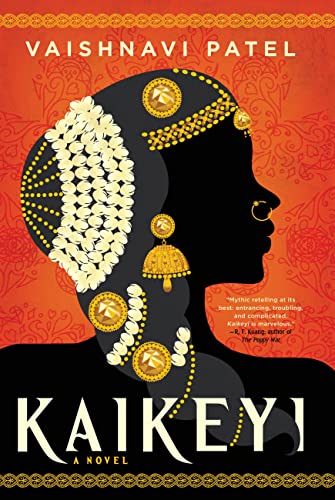
Microreview [Book]: Kaikeyi by Vaishnavi Patel

A feminist exploration of the events leading up to the Ramayana attempts to do a few too many things and can't quite live up to its main character's promise.

Cover art by Lisa Marie Pompilio

Kaikeyi tells the story of, well, Kaikeyi (shock twist), a wife of Rama’s father Dasharath, and her role before the events of the Ramayana. In the original tale, it is she who causes Rama to be exiled from Ayodhya for fourteen years, and her own son, Bharat to sit on the throne in his place, while the story follows Rama’s exploits accompanied by his other brother and his wife, Sita . Kaikeyi, however, begins much earlier, in the childhood of Kaikeyi herself, beginning with the exile of her mother, leaving her the sole woman in a family of men.

This is meant to be a deeply moving, sad childhood, of this poor girl surrounded by her brothers, and a father who does not care for female children, so leaves her to her own devices. Because the story is told from Kaikeyi’s perspective, we get a lot of her feelings of how terrible and unfair and awful it is, that she should be ignored as she is, and how horrible her life has been made. And at the beginning, that feels very genuine – the parts about the loss of her mother and her confusion at not being told why feel very real. But as the story progresses, we see Kaikeyi flourish with little supervision, learn the arts of war with her encouraging brother, and develop magical powers that allow her to manipulate those around her to get what she wants nearly all of the time. But while this is happening, the story still focusses on how sad her life is, rather at odds with the events as we see them described. At one point, a maid who has been close to Kaikeyi refuses a request, and highlights how others in the world have things much worse than the princess, and it looks like a moment that may actually get through to her, and that she’ll see that though she has her struggles, the lot of many of those around her makes her seem extremely privil- oh, nope, she regrets it for a bit but then continues on her merry way.

And it’s difficult to read and feel like this, because some of her struggles are entirely present and sympathetic – I can hardly say that I wouldn’t object to having no say about my life and marriage either. But so much of Kaikeyi’s life sits in contrast to the serving women she spends much of her time with, especially the maid Manthara, that it’s hard not to feel a touch of exasperation at her.

It doesn’t help that we spend a long, long time with young Kaikeyi doing… not a great deal besides being sad about life and training alone or with her brother. The book suffers from a serious issue of pacing, where around 2/3 of it feels like prologue, and so by the time we get to Ayodhya and Kaikeyi’s marriage to Dasharath, we’ve been sitting with her for what feels like an age.

It is only when we reach Ayodhya, however, that most of the real happenings of the book begin. We get to see Kaikeyi deprived of her relationships and the power they bring her in her native Kekaya, and the struggle with this lack of influence, only broken when her maid Manthara shakes her out of it, practically dragging her to the market. And after a few visits there, she begins to come back to herself, kickstarting her efforts to make friends with Dasharath’s other wives, and also to see that there exist women in the world less fortunate than herself. 

If this realisation had come earlier in the book, I think the entire tone of the novel would have been different for me. But because it feels like we have spent so, so long with young Kaikeyi, it’s very much a situation of too little, too late. Doubly so, because the initial realisation on her part is somewhat overshadowed by, in this part of the book, her going off to war with her husband and being great at charioteering, which wins her a role as a minister in his government.

Eventually, the thread of Kaikeyi’s championing the poor women picks up again, and she and the other wives do what seems to be genuine good for the women of Ayodhya. And this (finally) brings us to one of the central conflicts of the story – Kaikeyi and her assertion that women can exist equally to men in the world, and the faction of traditionalists in Ayodhya, alongside whom the young Rama numbers one.

But this conflict loses some of its weight because of the way we’ve got there. For all that the reader agrees with Kaikeyi (I hope), it seems often that her argument is less one of principal, and more one of self-interest – Kaikeyi enjoys having power, having influence, and the traditionalist faction threatens that. So even when Kaikeyi is in the right, I found myself struggle to be completely sympathetic to her.

That being said, the latter third of the book, with this conflict and a lot more action, is by far a much better story than much of what came before, to the extent of almost feeling like a different book. There’s a sudden explosion of turmoil, where all the various threads that have been floated around throughout the beginning of the story suddenly all become relevant and dramatic at once, and while it was enjoyable to read, it threw the stuff that came before into even worse contrast – why couldn’t it have been like this all along?

And I’ve barely even touched on the magic yet – but like the various other aspects of the story, the relevance of the magic Kaikeyi has to her life, and to the progression of the plot, waxes and wanes constantly. Sometimes it feels like a critical element that will make or break the entire story, and sometimes it feels almost an afterthought, not used in situations where it might have made sense to include it.

On the whole, there’s a simultaneous sense of too many ideas being put together in one book, so none of them get the time or development they deserve, while at the same time a very slow, ponderous start without much in the way of drive to get you through the buildup to what feels like the actual story at the end. It’s a shame, because a lot of the concept here is really appealing, and I feel like Kaikeyi as a character, and as an actor in the story of the Ramayana, has a lot to recommend her, and it’s just not really drawn out here. Despite living inside her head for the whole book, I felt kept very much at a distance to her actual thoughts, and this didn’t help my already limited sympathy for some of her struggles.

In many ways, Kaikeyi struggles with the same thing Madeleine Miller’s Circe does – taking an incredibly compelling character from myth, with a lot of scope for exploration… and then somehow managing to make her less compelling than she is in the source material. There’s a lot of promise, a lot of potential redemption of an antagonistic female figure demonised for wielding power… but then a lot of navel-gazing and self-absorption, rather than the drama the original myth might promise. Both I think are novels where in an effort to make the protagonist more sympathetic, more relatable, they’ve defanged them and lost what made them exciting in the first place.

That being said, the last third of the book was genuinely a fun read, and once I got there, it had the pace and the excitement that I really wanted to keep on going. If the whole thing had been like that… it still wouldn’t have been my favourite book of 2022, but it would have had a lot more to recommend it.

The Math

Baseline Assessment: 6/10 

Bonuses: +1 for taking controversial female figure of myth and attempting to retell from her perspective

Penalties: -1 for very self-involved main character and her somewhat inconsistent focus on the problems around her

Nerd Coefficient: 6/10

Reference:  Vaishnavi Patel, Kaikeyi [Redhook, 2022]

POSTED BY: Roseanna Pendlebury, the humble servant of a very loud cat. @chloroform_tea