Showing posts with label Strange Horizons. Show all posts

Thursday, February 9, 2023

Questing in Shorts: February 2023

The calendar might say 2023 already (how!?) but as far as my short fiction reading is concerned, it's still very much a time for 2022, with lots of things to catch up on and enjoy in advance of Hugo nominations. Let's dive straight into some of the fun stuff I've been reading over the past couple of weeks:

Escape Artists October - December 2022

I'm not a big audio listener, but since Escape Artists have started offering review e-books of the original fiction from the network's five audio fiction podcasts (Escape Pod, Podcastle, Pseudopod, Cast of Wonders and Catscast) I've been making the effort to both read and listen to stories, sometimes at the same time. For those just tuning in, I have two PSAs. First, these podcasts do a great mixture of both original and reprint fiction ("reprint" here usually meaning these are still the first audio versions of the stories), so unless you are specifically reading for awards consideration I don't recommend limiting yourself to their original fiction only. Serial audio versions of stories like Meg Elison's "The Pill" (on Escape Pod) and Caroline M. Yoachim's "Colours of the Immortal Palette" (Podcastle) are particularly worth your time.

Second, even if you're a mostly adult fiction reader, do not sleep on Cast of Wonders. This YA zine publishes some seriously powerful original stories covering the gamut of speculative fiction. Beverly Aarons' "Gone Red" (Episode 513) is a strong piece of dystopian fiction, taking what might in other hands have been a dated premise (city districts assigned colours based on inhabitants' moods, used by a universal surveillance algorithm to distribute resources) and using it to tell a timely story about how societies blame and dehumanise the poor for their own impoverishment. "A Full Set of Specials" by Marguerite Sheffer (Episode 512) tackles a similar subject from a very different angle, telling the story of a nail salon where a down-on-her-luck customer is given a free magical manicure, lifting her up just enough to allow her to break the cycles holding her back. And "The Cat of Lin Villa" by Megan Chee (516) is a delightful story about a cat who wants to hang out with their friends and also wants their friends to be happy - one of those being much more difficult than the other.

Elsewhere in the Escaposphere, you'll want to check out "A Shoreline of Oil And Infinity" by Renan Bernado (Escape Pod 863) for a story of separated siblings on a future polluted shore and "The Bone Pickers" by Kelsey Hutton (PodCastle 761) for an utterly grief infused tale of two indigenous women surviving in the wreckage of colonisation and environmental collapse. As a horror zine, you'd expect Pseudopod to deliver on its Halloween offerings and it totally does: there's "Trickin'" by Nicole Givens Kurtz (Pseudopod 835), which revels in the monstrous joy of its protagonist on Halloween night, and Alasdair Stuart's "The 2022 Halloween Parade" (Pseudopod 836), full of figures you won't recognise but who will nevertheless feel strangely, eerily familiar. Go forth and treat your ears!

FIYAH Issue 24: Horrors & Hauntings

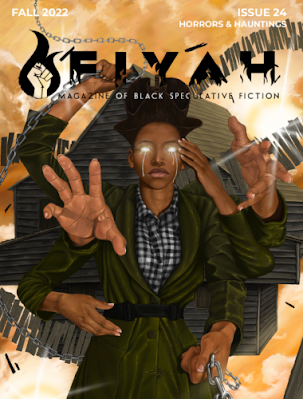
Continuing the belated Halloween Theme (it's nearly October!), FIYAH's 24th issue is long and it is good. "Girl Eats Girl" by Gnesis Villar kicks off with an emotionally charged sort-of friendship by two Black latinx teen girls trying to survive both their white town and the creatures living in the forest - which seem intent on changing at least one of them. Eden Royce is always a great name to see in a table of contents, and "Sugar Honey Iced Tea" is a fantastically creepy story about coming into work on a Saturday because the mediocre man who got promoted above you hasn't done his job properly. "Old Solomon's Eyes" features two plucky youths trying to negotiate with a demon who has taken up residence near their village, as the adults around them attempt less successful methods to deal with it. I love how this story plays with the morality of its characters, making both the inaction and the overreactions from various segments of the community seem damaging and the demon's perspective seem nearly sympathetic, while also coming down firmly on the side of "negotiating with demons is terrifying and tricky".

The final three stories all deal with family trauma in some way, like Tobi Ogirundan's story of two brothers and a terrifying childhood incident "In The Smile Place". "Chrysalis" by Aimee Campbell features a young person trying to break free of a family curse which has transformed their home into the lair of a spiderlike creature who claims each member of their family as its own as they come of age.  The horror here is claustrophobic and visceral, and it pairs compellingly with "Blooms of Sorrow" by Amanda Helms, in which a family garden becomes a hungry burial ground for all kinds of familial pain, from an abusive former husband to a daughter's struggle with untreated endometriosis. Both of these final stories offer some level of catharsis to their protagonists, which stops them from tipping over into pure hopelessness - so it's not all creepy doom and gloom. Read your FIYAH subscriptions, everyone.

Strange Horizons

I tend to read Strange Horizons fiction in no particular order, all at once, so the following are going to be from all over their 2022 publication list, but let's try some thematic association for this recommendation journey:

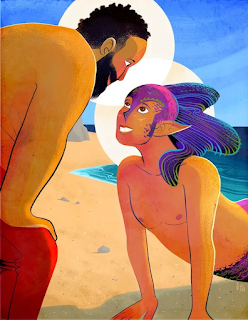
Artwork for "Intimacies"
by Dominique Ramsey
Start under the water, with "Intimacies" by Filip Hajdar Drnovšek Zorko, in which a hippocampus-merman and a widowed human overcome their respective cultural limitations and taboos to build an unusual family together. I love mer stories (pour one out for Mermaids Monthly, the best year-long magazine project a girl could hope for) and it's always nice when the differences in living circumstances are treated as something to be adapted to, rather than an insurmountable grounds for tragedy. Underwater tragedy is also great though, and the cyclical central tragedy of "Sister, Silkie, Siren, Shark" by Ariel Marken Jack is so painfully well-realised that it will probably make you scream into your hand. The story of a group of sisters who, like their mothers before them, are forced to give up their silike skins when they are sold to the men who come to their island, it traces out the things they are told at each stage of their lives to perpetuate a toxic cycle, and the moment at which they choose to break it.
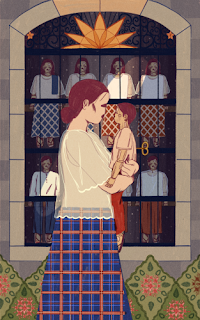
Artwork for "Clockwork Bayani"
(SEA special issue) by Gianne
Encarnacion


When you're finished crying from that depiction of matrilineal trauma, treat yourself to "Mother Hunger" by Mary Maxfield, which starts with a somewhat whimsical premise where daughters are assigned their mothers as teenagers and need to care for them until they get mothers of their own, and turns it into one long gut-wrench of a story about failures of care and community for a daughterless woman whose mother takes absolutely everything she can provide and more. After that, you'll probably be both hungry and in need of some lighter storytelling, so it'll be time to slip into the Southeast Asian issue with "Wok Hei St" by Guan Un, a heist where the steak could not be higher (because you're tossing it! in your wok! ...I'll get me coat). Stay in Southeast Asia to read... well, read all of it, but for the purposes of this recommendation journey, go with "Lay My Stomach On Your Scales" by Wen-yi Lee, with its story of teenage body awkwardness featuring a manananggal and the girl who has stolen her hands. Finally, finish off with another heartwarming spooky tale with "Embroidery of a Bird's Heart" by Nelly Geraldine García-Rosas, about a daughter whose ghostly grandmother comes over for lunch and guides her through a change of her own.

Questing Elsewhere

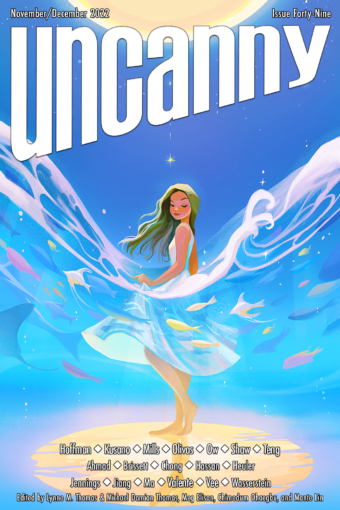
I'm tired of difficult stories about reproductive justice, because I'm tired of how much they hurt and how we still need them so badly. "Rabbit Test" by Samantha Mills (Uncanny Magazine Issue 49) hurts, and is badly needed, featuring the cyclical struggle for control over women's bodies with a focus on a future where intrusive surveillance is the norm. Make time for it.

While you're following the Strange Horizons recommendation trail above, you could take a left turn at Wok Hei St and go instead to Giganotosaurus' "Begging the Moon" by Eli Brown, the story of a woman sourcing ingredients for tom yam gung nam for a gang lord's birthday in a border city full of refugees and cut off from surrounding countries. It's thematically powerful, and making food the central driver adds a little touch of levity while bringing the city of Diyu to life.

Finally, I don't normally talk about the to-read pile in this column but two recent acquisitions demand to be mentioned. First, We're Here: The Best Queer Speculative Fiction 2021 (edited by Charles Payseur and L.D. Lewis) has a table of contents that easily lives up to its 2020 predecessor; starting with "The Captain and the Quartermaster", an outstanding and heartbreaking tale by 2020 co-editor C.L. Clark, is a great touch. Second, Song of the Mango and Other New Myths by Vida Cruz-Borja has a beautiful cover and a whole lot of stories I'm excited to dive into, alongside some of my existing favourites by the author (like the titular "Song of the Mango", which previously appeared in the "Beyond the Line of Tree" chapbook.

Will 2023 be a year of returning to more regular columns? I hope so! For now, happy reading and I'll see you when Hugo nominations open.


Tuesday, May 10, 2022

Review: Ignyte Awards - Short Story Nominees

The Ignyte Awards (created by FIYAHCON to shine a light on the vibrancy and diversity of spec fic) are my favorite awards, and short fiction is probably my favorite thing. What better way to spend my time than reading through what I was sure were going to stories that fired on all cylinders? And boy, was my certainty validated. My thoughts on all these masterful, deservedly nominated stories are below.

Center of the Universe (Nadia Shammas) is centered, of sorts, on Abigail who’s in a simulation in which she’s a real human and everyone else is virtual. But the story is not a simple exercise in solipsism. There are simulated people who vie to be seen—to exist under her gaze. And that existence is eventually seized through drastic measures. It’s a unique and fluid premise in which solipsism exists but the narrator is in the periphery of it—a premise that could convolute and crumble from a lesser writer. This is a story that kept me captivated – gaze locked on its words – through its pain. But also, its beauty, its poetry, and the sympathetic struggle of attaining meaning. While reading, it quite easily became the center of my universe.

Delete Your First Memory For Free (Kel Coleman) showcases the bumps in the road that anxiety presents with a story that is antithetically smooth. When Devin and their friends use technology that takes away specific, non-vital memories, their relationships start to change. Kel Coleman writes with such vigor that their writing style smooths over a lot. Not so different from how the developing themes of the story smooths over some emotionally charged situations. Additionally, the nuances in the interpersonal interactions with just about every character were so rich and fully-formed. This is a vital story to many people whose small enemies can feel as cumbersome as their major ones. It might be so instructive and critical to someone, that the memory of reading it would be hard to extract.

If the Martians Have Magic (P. Djèlí Clark) offers an engaging story, but most importantly, it offers a WORLD that felt lived in and thoroughly explored, all while telling a pacy story. Martians are widely persecuted by humans--pigeonholed negatively because of some bad seeds in the group. But there’s a way to save those who mean no harm, and the protagonist Minnette is going to try her best to fulfill it in a rollicking, entertaining fashion. Martians do have magic, and everyone who’s read anything P. Djèlí Clark has written probably knows he has a lot of it, too.

The Fifth Horseman (Martin C. Cahill) starts with The Four Horseman of the Apocalypse after they’ve “apocalypized” the world. But they have a sibling that they don’t know too well—the fifth horseman. And that horseman has someone additional work to do. That work is described in beautiful, lyrical prose that shows off the beauty of the world – as ephemeral as it is – along with a sympathetic backstory for the fifth horseman. There’s a sense of distance with her due to her circumstances, but there’s also some warmth that’s beautifully paired with the writing style that finds the beauty in the world despite its cataclysmic situation. I really dug this. The potency of the story’s descriptions alone is damn near apocalyptic.

The Tale of Jaja and Canti (Tobi Ogundiran) bears a little similarity to Pinocchio, but its wooden boy’s journey veers in engagingly unexpected directions. The tone is like a fairy tale and the way its split into chapters enhances that feeling. It has a spare word count but is able to do so much without feeling rushed or choppy. And without spoiling anything, the story is bookended in a way that’s structurally ingenious. Like the other Ignyte nominees, this story is a banger.

POSTED BY: Sean Dowie - Screenwriter, stand-up comedian, lover of all books that make him nod his head and say, "Neat!"

Thursday, January 27, 2022

Questing in Shorts, January 2022: Saturation Part 1

This month, I attempted to read all of the short fiction.


Well, no, not all of it all of it, but I decided to get as close as I could to reading all the back issues of the stuff I was subscribed to in 2021. As I didn't read much short fiction at all in the first six months of the year, and I don't tend to get through everything I'm subscribed to, this ended up being 205 stories across 42 issues of Beneath Ceaseless Skies, Augur, Strange Horizons, Apex, Giganotosaurus, Uncanny, Constelacion, Fantasy, Mermaids Monthly, The Future Fire, Fireside, FIYAH, and Anathema Magazine, and a bit of cheeky anthology reading on top.

As with any arbitrarily reading challenge, the first thing I have learned from this intense period of taking in new material is: reading is supposed to be fun, and anything that detracts from that fun by overloading you, causing anxiety or otherwise pulling you away from other priorities is actually not a very good idea. There are no medals for quantity of short stories read, and I can't even say I now feel "well read": what I choose to read is such a tiny proportion of the genre as a whole, and I know I'm missing gems from places like Escape Pod and Podcastle, stuff I've taken "out of rotation" like The Dark and Clarkesworld, all the print magazines I don't have time for, and a whole heap of venues I'm not familiar with at all. I physically can't do much more reading than I do right now, and so it is up to me to accept those gaps, just like I accept that there's plenty of novels that are, by all accounts, amazing, but which I never get to read, because time sucks.

The second thing I have learned is that I'm pretty happy with my "pull" list. I'm sad that Mermaids Monthly is not continuing, so that won't be on my 2022 list, but otherwise I feel like I'm getting a great balance of the stories that I like, told by new-to-me and favourite authors whose work I like being exposed to. I think I have a gap for a science fiction publication focused on big ideas by diverse authors (if you have recommendations, go hit me up on Twitter - Clarkesworld is an option but I want to explore alternatives first). More generally, I'm happy with my reading model of "subscribe to a few things and read most of what they put out", and I rarely find myself reading a story that I just don't like. Sure, I know there's a lot more out there that I'm missing, but... see point 1.

The third thing I have learned is that, WOW, there is a lot of great writing out there. Kind of... too many to write in a single column. So, this is going to be a two-parter! I'm going to cover stories from Apex, Augur and Strange Horizons here, and follow up next week with some of highlights from the Unfettered Hexes anthology, top stories from the rest of the publications I read, and probably a bit more navel gazing too.

Let's go:

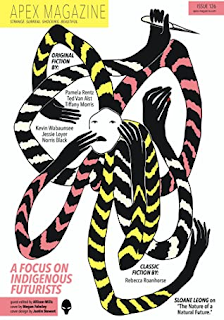
Apex Magazine, Issues 123 and 126


Apex Magazine wins this month's prize for making me cry too much, thanks to some powerful stories in Issue 123 and 126. Issue 123 has "Throw Rug", by Aurelius Raines II, which throws out one of the most powerful final lines I've ever come across: fitting, for a story about a scrawny Black boy taking up wrestling and learning to become a champion, despite the obstacles - including racism - thrown in his path. There's a riff on Samson and Delilah, a ton of exploration of race, masculinity, success and perseverence and a really interesting documentary framing that gives different characters - including the young wrestler himself - space to offer perspectives. The issue also contains "Mishpokhe and Ash" by Sydney Rossman-Reich, the story of a Hungarian Jewish family and the golem their daughter creates, trying to survive the influence of Nazi Germany over their country and create rules for survival in a world that is seeking only their destruction. And "This is the Moment, or One of Them" by Mari Ness really captures that "vaguely dystopian technology but make it wistful" vibe that Apex does so well, featuring someone using a time altering device to try and change past events around a former lover, working out which moment needs to change to keep them safe.

The Indigenous Futurism issue spans from luxury space station resorts with substandard working conditions, to Coyote shenanigans during a St Patrick's Day celebration, but the story that smacked me in the face most effectively was "Marked by Bears" by Jessie Loyer, a story about reparations by humans towards different intelligent animal groups after human society collapses. Somehow, Loyer balances the "red in tooth and claw" aspects of this new accord with some very human meditations on justice and balance. On the one hand, the actions that take place in the story feel monstrous, but on another... it works? Certainly one to read the content warnings for: but if you can handle it, it's thought provoking stuff.

A bonus mention here for "O2 Arena" by Oghenechovwe Donald Ekpeki, originally published in Galaxy's Edge and reprinted in Apex 129. Ekpeki's story (the 2 in "O2" should be subscript, and no, for Londoners, it's not about the Millennium Dome) provides a scathing dystopian future where the speculative elements only serve to underscore existing inequality. It's firmly grounded in Lagos, in a world where climate change has killed off phytoplankton and made the oxygen in the air unbreathable, forcing humanity to rely on filters and gas cylinders or, for the rich, comfortable climate-controlled sealed environments. Its protagonist is a student just about making things work on the edge of wealthy society, but his best friend's illness forces him to seek less savoury methods to put together the oxygen credits that will allow her to survive. While the first person narration occasionally becomes a little too perfect (I struggle on principle when male characters are able to see through patriarchy when their female friends can't, even though I know it does happen), on the whole it's a really powerful look at just how extractive capitalist society can become.

Augur Magazine, Year 4


I like that I can sit down and appreciate Augur's entire 2021 output in one dedicated afternoon. I would like this even more if they offered more reading options than just PDF: yes, this enables some interesting typesetting for a few of the stories ("In the Shadow of the Field" by Anastasia McCray uses it to great effect in issue 4.1), but I struggle to read on a computer screen and it would be nice to at least have the option to read more flexibly on an e-reader, you know?

But we're here to read stories, not whinge about file formats. Augur does a great range of diverse fiction with an emphasis on Canadian authors, and a lot of stories really capitalise on their sense of place, whether that's Canada or further afield. "African Meeting House" by Kate Foster (Issue 4.1) features two Black sisters who move back to their small town, and put the ghosts of their antecedents to rest in the house where they grew up, and the latter is a diaspora story in which a girl buying stuff from a convenience store gets told the story of a mango which turns out to be more relevant to her than she expects. In "The House at the End of the World" by Ashley Deng (Issue 4.1), protagonist Yi and her family have what they need to survive provided to them by their magical house, even as the world falls apart and starves around them: when she disobeys a directive to never go into the attic, Yi figures out the secret behind the house's generosity and her family's code when it comes to maintaining it (it's grim, but not gratuitously so, and I appreciate that.) I also really enjoyed the weird world and the meaty takes on power from L. Chan's "It Takes a Village" (Issue 4.2): in a world where the rich can create sentient dolls, a travelling magistrate with a reputation for dealing with doll-related cases is sent to the village where unwanted ones live to deal with a strange murder case.

Finally, let's talk about "Purgatory is High, Low and Inside me" by Emily Carrasco-Acosta (Issue 4.1), about Mariana, a young woman with diabetes who has to deal with being able to see ghosts when her blood sugar is too low or too high. It's a meditative story, one which delves into the feelings of its protagonist around her life and how precarious being chronically ill can feel, especially when that illness comes with such a weird direct link to death. We follow Mariana as she deals with her gift, and the relationship she builds with another woman, and when that turns out to be impermanent we feel the ache of that loss even as it changes Mariana's perspective on life into something, tentatively, for the better. Really good stuff.

Strange Horizons, May - December 2021

Art for All Us Ghosts: Johnny Anger

While I moan about having to read Augur in PDF, I must also lament not having had an ebook edition of Strange Horizons to read since last May, but this minor inconvenience was no match for my will to read good stories and I have therefore read some more things on my computer. Please send my medal soon, OK? (Also, because I read these in one big glut and did not take good notes of dates, the initial version of this post is not going to include dates - if you're not reading this sentence, it's because I've gone back and edited them in later.)

Anyway, it was fine, because it's Strange Horizons and Strange Horizons does some of the best stuff out there. Of particular note was their sexy interactive fiction special, Strange Lusts, featuring two hypertext games by Natalia Theodoridou and Anna Anthropy. "Pockets", a game about post apocalyptic survival centring a queer couple, is excellent, but "Heat from Fire" by Anna Anthropy is something else: a super steamy choose-your-own-tentacle adventure (I think the tentacles are optional but I did not feel the need to explore the no tentacle branch) featuring a trans witch alienated by her TERF-y coven and seeing comfort by summoning (and sexting) a very hot lady-shaped version of Asmodeus. It's sexy and it's also a really fantastic story about belonging and what gets treated as transgressive. Like all hypertext fictions, playing through more than once is encouraged.

Moving on from the sexy stuff, Kola Heyward Rotimi's "An Exploration of Nichole Otieno's Early Filmography" blew me away with its travelogue-as-academic-text framing and its take on colonialism and academia and how one studies something that resists the idea of permanence. I'm really into travelogue stories at the moment and this is really, really good. Also amazing? "The Constellations are Unrecognisable Here" by Andrew Joseph White, set on a medical spaceship that picks up survivors in decimated colonies in the aftermath of a galactic war. Amavon is a trans boy, trying to deal with the aftermath of terrible injuries and trauma as well as trying to convince his caseworker to approve top surgery; while travelling, he builds a relationship with Jenea, another trans survivor and burn victim, and the two end up affecting each other in an intense and not entirely healthy way. White's story tackles really difficult stuff in a light touch, generous way, and I found myself really rooting for both kids even as Amavon, in particular, makes some painful decisions. And there's some great anti-capitalist stories: "Thread Count", by Cynthia Gomez, is about a mysterious spate of deaths among the Fortune 500 rich list, in ways which turn out to be powerfully tied to the exploitation that made their fortunes. And then there's "All Us Ghosts" by B. Plade, whose protagonist Jules is a gig worker for a company that allows parents to invent and control all of their young adult children's social connections through virtual university. Jules divides his time between being every adult friend and girlfriend that rich kid Cam has ever had, dealing with his actual IRL crush on Cam, and campaigning for greater rights for the workers who have to take on this kind of labour; when the streams cross and Cam becomes involved in activism against the company, the gulf between the exploitation Cam perceives and the exploitation Jules has lived through throws the entire clusterfuck of a system into relief.

Also, I can't talk about Strange Horizons without talking about the highlights of its sister publication Samovar: the undisputed highlight of the two issues I read was "Ensign", by Soyeon Jeong, with its take on spacefaring indenture. The colonists of the planet where the story is set are bound to a deal made by their grandparents' generation, which says that they can choose whether to stay on the world, even as its infrastructure starts to crumble and life begins to get harder, or they can sign up to be relocated when the company that settled the planet needs them elsewhere: whether that be in the next week or in 40 years' time. Hajeong and Yuna are partners, but when it comes time for each of them to set their decision in stone by their 30th birthday, the gap between what each of them wants becomes an enormous strain on their family, and Hajeong, as the one who wants to stay behind, tries to live with her partner's inexplicable choice and the uncertainty it brings to their life together.

POSTED BY: Adri, Nerds of a Feather co-editor, is a semi-aquatic migratory mammal most often found in the UK. She has many opinions about SFF books, and is also partial to gaming, baking, interacting with dogs, and Asian-style karaoke. Find her on Twitter at @adrijjy


Thursday, June 24, 2021

Questing in Shorts June 2021: The Triumphant Return!

 Yes that's right, Questing in Shorts is BACK, bay-bee!

Put on your dancing shorts and boogie with me

It's been six months, during which time the subscription folder on my e-reader has been relentlessly filling itself up with enticing things. Sadly, since the start of the year my mind has mostly been elsewhere (and by elsewhere I mean "taking on the general capacity and aura of a mossy pond"). I had a few exceptions, mostly to catch up on 2020 stories from Omenana and FIYAH before Hugo nominations ended in March, but on the whole it's not been a good time for me and short fiction.

But! as of the start of this month, I've been feeling the short fiction itch again, and I've spent some time trying to come up with a system that will help me keep track of all the short fiction I read in a way that actually reflects the way I read short fiction (so, not sitting in front of a spreadsheet trying to type things in every ten minutes). After some thought, I decided to give in to the instinct that this was a problem that could only be solved with new stationery.

For once, though, new stationery really has been a gamechanger! Behold, Adri's first 2021 short fiction review notebook, courtesy of Whirling World on Etsy:


I decided to pick up a few pre-formatted review notebooks, but as they're set up for books I quickly realised that I'd need to change a lot of things to make this work for short stories. I printed out a set of form stickers to go in the middle of the page so I could quickly write in double the number of reviews, and wrote in the publication instead of a "finished date". I completely ignored the formatting of the TBR pages at the front to just put in a big ol' list of magazines (limited to things I have ebooks of, with apologies to Baffling Magazine and Omenana, both of which I read online - I needed to fix the folder backlog first!)

An incomplete list of things

I also gamified things for myself: after finishing a magazine, I rolled an eight-sided dice (because my e-reader shows eight documents per page) and read the corresponding magazine from the first page of the folder. This meant I mostly read things that I'd added more recently, but it kept me interested, and picking things randomly confirmed that I'm really happy with my current subscriptions: nothing ever came up that I was disappointed to have to read next.

And I filled this whole notebook! With 61 stories, from Apex Magazine, Strange Horizons, Giganotosaurus, Beneath Ceaseless Skies, Mermaids Monthly, The Future Fire and Anathema. The whims of the dice I didn't read any Uncanny or FIYAH despite having a couple of issues of each, nor did I get to the first issue of Constelacíon, so those are on the list for next time. but needless to say there's still plenty of stuff within these 61 stories to talk about...


Mermaids Monthly

A new publication to this column, Mermaids Monthly was set up by Julia Rios and Meg Frank with a simple, one-year mission: to publish content about mermaids. This month, I read their March, April and May issues, and I did indeed get a lot of delightful mermaid art, comics ("Fat Mermaid In: Wardrobe Malfunction" is a great piece from the May issue), poetry and of course short fiction, covering everything from surrealist slipstream to survivalist horror and everything in between.

A lot of Mermaids Monthly's content is flash fiction, which combines with the art and poetry to create a big, slippery mash-up blend of mermaid and siren myth where individual pieces feel subsumed into the whole experience. That's not to say that each piece doesn't stand on its own merits, of course - everything is really good! - but that Mermaids Monthly really benefits from being read as a single publication from start to finish, leaning into the thematic coherence and letting the different interpretations work together.

That said, there are some stand-outs, and as a longer-short fan it was longer stories that really caught my attention. In April, "A Minnow, Or Perhaps a Colossal Squid" by C.S.E. Cooney and Carlos Hernandez is a story about a magical world where debtors are transformed into fish while their debts are being repaid, and it alternates between Estrella, a caseworker charged with doing this magic, and a naturalist studying deep-sea sirens whose debts allow her to pursue her research in unexpected ways. The split perspective between Estrella's present on Mariposa, and the research notes of Ven. Damiana Cardosa y Fuentes, provides a great mix of worldbuilding and the sirens themselves are excellent (you'd expect no less from Mermaids Monthly, of course). In May, "The Incident at Veniaminov" is the story of an indigenous community visited by a cruise ship with a sinister agenda, in which Mathilda Zeller weaves together questions about identity with an action packed story (involving cannibalism) with excellent results.


Apex Magazine

Also new to my subscription folder is Apex Magazine, back off hiatus this year and publishing some magnificent things. I read issue 122 (March-April), which is full of stories that riff off of themes of survival, vengeance and memorialisation in one way or another. "Black Box of the Terraworms" was a weird highlight for me: the story of a strange terraforming intelligence as it battles the "gods" of a planet it is trying to make habitable to humans. The way the terraformer's objectives change as it takes on the perspective of the gods makes this a really interesting ride, combining a science fictional concept with a creation-myth story structure to brilliant effect. Elsewhere, I am a sucker for a documentary-style story and Sam Miller's "A Love that Burns Hot Enough to Last: Deleted Scenes from a Documentary" hit all my buttons in that regard, giving a range of testimonials about the life of Ti, a singer with the ability to channel magic through her songs. Ti's story - which, we know from the start, has a tragic ending - is offered up alongside the story of one of her fans, Brent, a closeted soldier who goes to one of her military concerts and is caught up in her magic. Brent's life, we learn, is changed for the better by being able to come out and build a life with his boyfriend as a result of their concert experiences; but Ti's magic can't alter the challenges of her own life and her own inability to follow her desires.

Finally, this issue of Apex includes an interactive piece by Sabrina Vourvoulias which is highly worth checking out. "Las Girlfriends Guide to Subversive Eating" is set in a magical version of Philadelphia, and offers up a fictional culinary tour of the city where food is not just a guide to the history and diversity of the city, but a way for migrants and activists to offer each other the magic they need to survive, be that through mushroom-based cuisine that can heal ailments, tamales woven with spells for keeping ICE away and paperwork rolling smoothly, or gardens which encourage younger generations to engage with the heritage of their ancestor's homelands. The formatting is fun, and the break-up of text between different pages means it doesn't feel hard on the eyes, and while the technology doesn't quite hit full intuitiveness every time (the lack of "back" buttons at the bottom of each food stop makes scrolling back up a bit of a faff) it's still a great vehicle for a powerful, engaging piece of urban fantasy.

Art by Sunmi for "The Chicken House"

Strange Horizons

Right as I started clearing my backlog, Strange Horizons dropped four months of ebooks on Patreon collecting their editions from February to May, and I ended up reading the entire set, including April's Samovar, the Palestinian special issue and the trans/nonbinary special issue. This is, quite simply, too much Strange Horizons to summarise in a couple of paragraphs, but if you're diving in on the recommendation of this column in particular, those special issues are where I'd start: the Palestine special issue brings 3 stories and 6 pieces of poetry as well as an excellent roundtable. "PALESTINE IS A FUTURISM: THE DREAM" is a brilliant piece of all-caps fury/joy riffing off capitalist exploitation and extractive industries and imagining something still strange and affected by their presence, but somehow newer and more pure. "Queer Arab Dictionary" is also an amazing piece, its stanzas looking at current and future language and envisioning how a gendered language might be reenvisioned or pushed beyond the binary. When it comes to short stories, I loved the deeply wry, satirical "A Day in the Life of Anmar 20X1" by Abdulla Moaswes, in which the future President of Palestine attempts to curate his dream palace, and his tenure's success, as his land literally constricts around him.

May's Trans special issue also has lots of good poetry (I liked "Luna" by Alexander Te Pohe), as well as some fun stories. "Women Want Me, Fish Fear Me" by Paris Green is the story of a sex worker in a world where many people have animal genes transferred into them to increase their potential for particular careers. Green's protagonist has had fish genes transferred, but remains multiply marginalised with no other options available. The story unfolds in snatches of perspective, centring on an interaction with one particular client, and while the nuances are beyond my critical capacity as a cis reader, the detail and atmosphere is extraordinary and makes this well worth the experience. "A Welling Up" by Natalia Theodoridou and "The Chicken House" by Jenny Fried are also excellent - I enjoyed the latter, in particular, for its trans take on the Baba Yaga myth.

Other highlights:

After a year off from subscribing, I'm rediscovering exactly why enjoy Beneath Ceaseless Skies' brand of "adventure fantasy". The story that took my breath away this time was "Concerto for Winds and Resistance" by Cara Masten DiGirolamo, which tells the story of a city under repressive rule from the perspective of four members of a wind orchestra and the curious, magical piece their new conductor puts in front of them. On the subject of favourite city stories, "The City, My Love" by Alexandra Seidel (The Future Fire 57) covers centuries or development and migration from the perspective of a city and the humans it loves within it

"Just Enough Rain", by P.H. Lee, is available on Giganotosaurus (it's their May story) and I loved its matter-of-fact religious exploration and its hilarious romance, and the mother-daughter relationship at its heart. I also want to mention "A Remembered Kind of Dream" by Rei Rosenquist, one of very few short stories from 2021 I read at the start of this year: it's a post-apocalyptic queer found family story that's got that perfect combination of biopunk and hopelessness and human grit and I'm glad it's stuck with me to make it into this column.

Finally, Anathema brings its usual blend of heartbreak and hope to Issue 12 after an issue off (though their December showcase is, of course, very much worth your time). This time, there's more of the latter than the former: "Cirque Mécanique" broke my heart most successfully, but "Lady Fortune" and "To Rise, Blown Open" put it together again.

From the Bookshelves:

My lack of short fiction reading has stretched to anthologies and collections, but I did finally get through Never Have I Ever by Isabel Yap, which is a showcase from an outstanding short fiction writer. The stories that draw on modern Filipino events and culture are my favourites: Asphalt, River, Mother, Child, the story of an afterlife where innocent victims of Duterte's war on drugs have found themselves stuck, is powerful and brilliant in its characters and the way it presents their journey, and "Have you heard the one about Anamaria Marquez" is a creepy take on schoolyard rumour. There's also a new novella in this collection: "A Spell for Foolish Hearts" is about a mostly-closeted witch who starts to fall in love with a beautiful man at his workplace, with adorable and very supernaturally satisfying results. I had high expectations for this collection and it certainly didn't disappoint, and I feel like I've left this collection with even more love for Isabel Yap's storytelling than I had before.


Posted by: Adri, Nerds of a Feather co-editor, is a semi-aquatic migratory mammal most often found in the UK. She has many opinions about SFF books, and is also partial to gaming, baking, interacting with dogs, and Asian-style karaoke. Find her on Twitter at @adrijjy

Thursday, February 4, 2021

Short Fiction Round Up: January 2021

Editor's note: Our second new contributor this week is Elisabeth R Moore, a writer who you may know as The Space Lesbian on Twitter and elsewhere! Elisabeth's profile will be landing next week but in the meantime we didn't want to keep you from her first set of short fiction recommendations for us:

Hello and welcome to my column covering short fiction! This month’s selection is inspired by all of the “Best of 2020” lists that December spawned, with me reviewing a story for the April 2020 issue of Clarkesworld, a September 2020 issue of EscapePod and the Autumn 2020 issue of Kaleidotrope. In terms of more recent fiction though, I loved Strange Horizon’s fiction this month - a strong start to the new year!

The Scholar of the Bamboo Flute by Aliette de Bodard (Silk and Steel)

The Scholar of the Bamboo Flute is a typical de Bodard story: the setting is a 19th Century Vietnamese-inspired fantasy school, the main character is a poor scholarship orphan and the love interest is -- it is later revealed -- a fantastical creature. At the heart of this story is a question every duelist must ask themself -- "what will I do to win?" In an elegant and deft twist on the familiar question, de Bodard explores what happens when the answer is "not that." The story builds slowly, but its final scene crashes over the reader like a metaphorical wave. While the romance itself lagged in the first part of the story, it came together beautifully in the end, offering a hopeful ending for both characters.


AirBody by Sameem Siddiqui (Clarkesworld)

In a near future where people can rent bodies remotely, a Karachi resident Meena Khan rents the body of Arsalan, a Washington DC resident. While Meena cooks, Arsalan grapples with his past as a member of Urdu diaspora, which ends up creating a wonderful camaraderie between him and Meena. Soon it becomes clear that this is not the story about one but two outcasts who are grappling with their position within their culture. Meena's and Arsalan’s one day together, inhabiting the same body, allows them to watch each other make the same kinds of mistakes. Both watch the other and think “this is not me,” even while they paradoxically are each other. The story is beautifully rendered, emotional, and a wonderfully sensuous read.


More than Simple Steel by Aimee Ogden (EscapePod)

A story about a pandemic that killed all the adults is a complicated thing to read in a pandemic that’s killing all of our grandparents. And yet Ogden pulls this story off with skill and style. A young boy named Micah lives with thirty other children in an abandoned school. When a newcomer with a baby and a gun shows up and threatens to ruin their home, how do they react? I loved this story; it was beautiful and heart-wrenching. It asked important questions about growing up, bravery, and how to be the person your family can be proud of. I cried at the end.


In The Garden of My Ancestors Statues by Marissa Lingen (Kaleidotrope)

Lingen’s signature style is stories that shine light in unexpected places. The mythical troll, usually the villain in the archetypal European fairy-tale, is rendered here as a tragic hero and an artistic outcast. In achingly simple language, Lingen evokes a fantasy setting in which trolls are being used and abuse by villagers -- hired for their amazing work in masonry, but then forced to work until sunrise so they turn into statues and don’t have to be paid. But the last of the trolls won’t stand for this, and hatches a daring plan. Kind and gentle, Lingen's prose always makes space for the outcast to shine.


Secrets of Kath by Fatima Taqvi (Strange Horizon)

Taqvi’s story about the wife of the village’s rich man, her son, and the local putliwallah is beautifully written. The trope of the storyteller -- in this case the puppeteer with the magic puppets -- who acts as the voice of the voiceless is used effectively and powerfully in this story. The opening paragraphs of the narrative are perfect: with deft and elegant strokes, Taqvi begins the story with the putliwallah entering the village, though the amorphous use of the first person plural implies early that this is a story of the collective, told through one man; not a lone hero’s undertaking. Throughout the story the pronoun play continues; the village’s rich man’s wife tells the story predominantly in the second person, watching her young son in the audience and addressing him repeatedly. And while I don’t want to spoil the ending, let me assure you: it’s perfect.

POSTED BY: Elisabeth R Moore is a writer, birder and grad student living in Germany. When she's not writing strange stories about scary plants, she can be found crocheting, hiking or biking. She tweets at @willowcabins.

Thursday, October 29, 2020

Questing in Shorts: October 2020

I had an unintentionally great month for reading shorter queer fiction in October, with a whole new publication of flash fiction delights and a great collection! And next month: Questing in Shorts goes ON TOUR.

Anathema: Spec from the Margins, Issue 11 (read online)

Five stories and two poems in this issue of Anathema, ranging from dark horror to hopeful near-future space travel to a Vietnamese fable-like story reminiscent of Beauty and the Beast. I loved them all, but a couple really stood out for me. I've been meaning to read Iona Datt Sharma's work for a very long time - Not for Use in Navigation is on my e-reader and everything - and I finally got to follow through on that with the opening story here, "Heard, Half-Heard, in the Stillness": the story of Ekta, a young Indian woman who has been training her entire life for an Indian space programme that has just had its funding pulled. The story deals with Ekta's complex emotions: her dreams have been crushed, and her new cousin-in-law is being awful about it, but it also means she can spend more time with a family and home she loves. Slice-of-life near-future space-age stories is quickly becoming one of my favourite short story subgenres, as this month's roundup can attest, and this is a great entry into my very small canon of stories I like.

My other highlight of the issue was "We Have Evacuated, Have a Good Day" by Jendayi Brooks-Flemister. In the face of an oncoming "Category 6" superstorm, a woman goes to Loris, the small town in which her elderly grandfather still lives, to try to evacuate him out of the storm's path: but he refuses to go, and she refuses to leave him, and so they live out the disaster and its aftermath in his home. The set-up of the story leads us to expect a tale of connection across the generations and the very different lives and values of the two characters, and we get that in some ways even as Brooks-Flemister completely subverts it in others, taking the potential for cathartic reconciliation and turning it into something that at first feels more real and then abruptly goes somewhere very unexpected. By the end we, like the protagonist, can't help but smile and accept the situation the story serves up: a weird and yet fitting end to an otherworldly disaster.

Baffling Magazine, Issue 1 (read online)

This is the first issue of a new online publication by Neon Hemlock Press, edited by Craig L. Gidney and dave ring, offering up a tasty collection of Queer Weird fiction from a quartet of great authors. It kicks off with an opener from Jewelle Gomez, author of The Gilda Stories - a groundbreaking 1991 novel about a Black lesbian vampire. Gomez's story, "Merida, Yucutan: 2060", is a near future tale with Gilda at the centre, pitching its hero into a world where pollution and degradation of the earth has pushed people into desperate circumstances, many of whom are choosing to abandon Earth for opportunities on other colonies. At the story's opening, Gilda is also choosing to leave, but its events give her pause to consider her responsibility to, and hopes for, the planet she is leaving behind. It's a story that didn't resonate with me as much as it might have if I'd read The Gilda Stories (it's on the TBR!), but even on its own it offers an intriguing vignette on the decision to stay and fight for a world, even when it has done such harm to your ancestors and to you.

"From The Deep" by Izzy Wasserstein is a spooky underwater story, starring an explorer descending into a maybe-supernatural extraterrestial ocean only to hear a song from a past connection which threatens to overwhelm her. "Cellars, Caskets and Closets" is a dense, lush prose poem in which the narrator brings to life a labyrinth of their own internal creation: at once a chase through a crumbling house and an exploration of coming out and the internal processes around it. Finally, "Velvet" by Nino Cipri is another flash piece about a boy living in a suburb with lots of deer, who has a nightmarish, slipstream-y encounter with a moulting stag. After my experiences with Cipri's collection, I'm always pleased to read a story by them, and while this is an understated one in some ways it rounds out this issue very nicely.

This first issue of Baffling was over all too quickly, but I was really impressed with how strong the publication's identity felt even in this short first hit. Gidney and ring clearly know what they are trying to achieve here, and I for one was highly baffled by it, so I think that all worked out well.

Everyone on the Moon is Essential Personnel by Julian K. Jarboe

With a title like that, there was no way I was going to let this collection pass me by, and it more than lived up to that initial expectation. Everyone on the Moon is Essential Personnel is a collection of flash fiction and longer pieces, most of which focus on the radical act of existing as a queer and neurodiverse person under capitalism. The first half of the collection breezed by, with pieces that drew me in through their narrative voice ("Self Care" has the most spectacular use of FRUSTRATED CAPITALISATION outside of an online teen journal), or imagery (The menstrual body horror of "Heavy Flow"). A longer fairytale piece, "Estranged Children of Storybook Houses", is about a changeling in a world where changelings are accepted as fact and theoretically supposed to be loved as part of their adoptive families. When its protagonist realises that her parents and brother will never accept her nature, she goes looking for the "original" human version of herself in fairyland, only to realise that she is not the perfect daughter that they're seeking either. It's a sweet but melancholy story that doesn't really come to any neat conclusions about belonging as a neurodiverse person in a family that fundamentally wishes you were different, but it does at least leave its protagonist in a quietly comfortable place by its end.

Most of the collection's second half is taken up by the original title story, a mosaic of a novella novella that draws together all of the themes of the collection into a quiet but deeply moving science fiction dystopia. Meandering between the lives of Sebastian and his sister Lara, with divergences into chat logs and, at one point, a poetic job application, the story builds up a town and a family which no longer fits into the capitalist dream, as people move underwater or out into space. Sebastian is trying to find a job after graduation, but keeps finding that everything he applies for or tries out doesn't want someone like him; Lara's story centres on her relationship with her mother and her difficult childhood, even as she tries to reconcile the elements of her own personality and needs that seem to mirror the things she likes the least about her parent. It's a strange, drift-y sort of story which I highly enjoyed: "Everyone On The Moon Is Essential Personnel" left me aching to see more of its characters and to perhaps see something in their lives go right.


Strange Horizons, May 2020

I never have an agenda for talking about older stories except that I don't read things on time, but I feel very pleased to be able to bring this May trio of stories from Strange Horizons into the column, as they are all excellent in different ways. "Have your #Hugot harvested at this Diwata-owned cafe" (online) is a story set in Quezon City,  Philippines, and takes the form of a fake long-form magazine feature about a newly opened restaurant by one of the city's magical residents, where human diners can have their heartbreak and emotions (I understand that #hugot, in modern Philippines internet-speak, is used to indicate that something pulls deep emotions out of you) taken out in the service of supernatural cuisine. It's a story that draws together mythology and modern political events, "interviewing" relatives of desaparecidos who disappeared during the Marcos regime or who were casualties of the current drug war. The effect is a narrative that weaves personal and national reckonings with tragedy, the perspective the Diwata herself offering a distancing lens that lets the reader explore what different responses say about humanity's ability to contextualise and move on.

"Martian Cinema" (online) is a delight of a story, one which brings that "undersupervised children discover a hidden world of magic in their own home" vibe to a story set in a Martian colony, where survival is precarious and resources have to be carefully managed. The undersupervised children of this story discover a picture of a unicorn in a cave, and use it to build increasingly elaborate stories using their makeshift "cinema". The antics of the children, and their progressively more fanciful ideas for their cinema and the ways they use the material around them to make it work, have that balance where it's never quite clear what is real, what is imagination and what's magic, and the story ends on a wistful note (involving adults being The Worst) that makes this clear this was a moment that will never be recaptured. May also brings "The DEATH/GRIP Challenge" (online) by Johnny Compton, a horror story revolving around radicalisation and a child trying to care for a parent who is going through psychological trauma well beyond her capacity to deal with.

The Future Fire, Issue 55 (Read Online)

The last issue of the year for The Future Fire has 5 stories, all of which deal in some form with identity and community, particularly family relationships. These range from the creepy, claustrophobic "Mijara's Freedom" by Eleanor Glewwe, in which a young woman recounts one of her childhood summers in her family home, whose strict otherworldly rules stifle her and her cousins and provoke acts of small rebellion. With all the curtains drawn and the threat of summer fires which it is claimed the government doesn't want them to see, Glewwe's story weaves a very tight family horror with a more broadly sinister, patriarchal aura to create a compelling story about escape (or, more specifically, being left behind). "We Will Become as Monsters" by Benjanun Sridaungkaew is also a highly atmospheric story, about a thief who finds a dying soldier on the edge of a mysterious labyrinth. Promised wealth, power and beautiful concubines if she takes the woman's gauntlet, the protagonist instead finds herself subjected to powerful magic and drawn into the heart of a general's quest to seek something at the labyrinth's centre. On the science fiction side, I really enjoyed the premise and execution of Jennifer R. Donohue's ‘Know They Will Die under the Salt of It’, in which people descended from those who survived a generations-ago spaceship crash watch the goings-on of the ship itself, now submerged in the ocean beyond free diving range, in which lights still sometimes appear and signs of life seem to be increasing.

I struggled more with the last two stories in the issue: "The Scaled Soul" by Rhianwen Phillips is a short piece that deals with a survivor of domestic abuse and male violence, who births a snake monster that saves her, then threatens her, then eventually offers to train her to look after herself. Perhaps I just wasn't in the mood for a story so centred around violence and victimisation, but I struggled to find the element of novelty or perspective shift in the story's closure that made the depictions here worth sitting through. And "The Good Hawks" by Danielle Jorgenson-Murray just didn't bring me on board with its uprooted, shapeshifting young protagonist early enough for me to really get invested in her journey and transformations. It might work better for me on a reread, though, so it's definitely worth checking out if slice-of-life shapeshifter narratives are up your street.

POSTED BY: Adri, Nerds of a Feather co-editor, is a semi-aquatic migratory mammal most often found in the UK. She has many opinions about SFF books, and is also partial to gaming, baking, interacting with dogs, and Asian-style karaoke. Find her on Twitter at @adrijjy


Monday, June 22, 2020

Interview: Strange Horizons


Congratulations to Strange Horizons for their Hugo nomination for Best Semiprozine!

Strange Horizons got it's start way back in 2000, and it's always been a home for fiction that pushes the envelope. With a specific focus on showcasing underrepresented and and global voices. Weekly issues contain a combination of short speculative fiction, poems, podcasts, non-fiction essays and reviews, roundtables and interviews.  The magazine has a massive and international staff of over 50 volunteers who do everything from reading slush to editing essays, podasts, and reviews, to purchasing poetry and artwork. 

In the last few years, Strange Horizons spun off a sister magazine - Samovar, which features translated speculative fiction.  Fiction and non-fiction published in Strange Horizons has gone on to win World Fantasy Awards, Sunburst awards, Sturgeon awards, and been nominated for countless Nebulas, Chelseas, BSFA awards, Rhyslings, and appeared in dozens of "Best of" anthologies. Authors, artists, and poets who appeared in Strange Horizons include Juliana Pinho, Grace Fong, Galen Dara, Cassandra Khaw, Rafeeat Ayilu, Mari Ness, Lavie Tidhar, Omar William Sow, Charles Payseur,  Kali de los Santos,  Shiv Ramdas, Marie Brennan, Ruthanna Emrys, and so many more.

With so much going on behind the scenes at Strange Horizons and their large staff, I requested a panel interview with a cross section of their staff.  This extended interview offers a glimpse behind the scenes of this massive operation.

I am pleased to introduce our panelists:

Anaea Lay - Anaea's short fiction has appeared in Diabolical Plots, Beneath Ceaseless Skies, Penumbra, Apex, Lightspeed, and elsewhere.  She is president of The Dream Foundry, an organization dedicating to bolstering and nurturing the careers of nascent professionals working with the speculative arts.  You can learn more about her at her website, anaealay.com.

Joyce Chng - Joyce lives in Singapore and writes urban fantasy, YA, and things inbetween, including the Starfang trilogy. Their short fiction has appeared in The Future Fire, Anathema, Kanstellation, Insignia, and elsewhere, and they co-edited The Sea is Ours:Tales of Steampunk Southeast Asia. You can learn more about Joyce by visiting their website,  A Wolf's Tale.

Dante Luiz - Dante is a Brazilian illustrator and comic artist. He is a two-time PRISM awards finalist, and his short comics have appeared in Screams Heard Round the World, Gothic Tales of Haunted Love, Wayward Sisters, Shout Out!, Built on Strange Ground, and elsewhere. You can learn more about Dante at his website, DanteLuiz.com.

Maureen Kincaid Speller - Maureen is an SFF reviewer for Vector, Interzone and Foundation, among other places. From her home in the UK she copy-edits and "enjoys" her cats' opinions on the timing of breakfast.  You can follow her on twitter at @maureenkspeller.

Romie Stott - Romie's poetry has appeared in inkscrawl, Dreams&Nightmares, Polu Texni, and Liminality and her non-fiction essays have appeared in The Toast and Atlas Obscura.  You can learn more about her artwork, poetry, music, and film making at her website, RomieSays.

Vanessa Rose Phin - Ness started as an articles editor at Strange Horizons in 2012, and is now the Editor in Chief.  Ve enjoys gaming,  editing, interviewing people, keeping green things alive, and being an extrovert in the morning. You can follow ve on twitter, @wordfey.

NOAF: Tell us a little about your role at Strange Horizons. How did you come to be involved with the magazine?

Anaea Lay: I'm the fiction podcast editor, which means I'm in charge of turning all the fiction from words on a screen into sounds in your ear. I got the job mostly by demanding that they invent it, then volunteering to fill the position. I'd been reading Strange Horizons since 2007 and it was, far and away, my favorite magazine. But after I changed jobs and my reading habits shifted, I was only getting short fiction via podcast, and Strange Horizons didn’t have one. I thought that was tragic and wanted to fix it. Julia Rios and Niall Harrison very kindly let me have my way.

Joyce Chng: I am a non-fictions/articles editor at Strange Horizons. I commission and solicit authors and writers for articles and columns. Nessa asked me if I wanted to sign up as an editor in 2016 and I said yes. I still remember the interview with Nessa and Niall (was a Sunday evening for me). And now here I am.

Dante Luiz: I'm one of the art directors together with Heather McDougal! I applied to the position after seeing she was searching for a new member for the art team, both because I'm a fan and reader of the magazine, and because I always wanted to work with other artists, being an illustrator myself.

Our job consists of commissioning artists that would match one of the stories of the month, and guide the process of creation, as well as sorting out submissions, creating covers and designing pins, among others.

Maureen Kincaid Speller: I'm part of the reviews department, along with Dan Hartland and Aishwarya Subramanian. We commission book and media reviews, do the structural and line editing in conjunction with our reviewers, and then do the final copy edits and galley the reviews before turning them over to the eagle-eyed proofreaders. We're also constantly on the lookout for things to review. We work very much as a team, but as Senior Reviews Editor, I tend to handle the admin (general correspondence, keeping in touch with publishers, soliciting review material, and organising the review assignments).

We all joined Strange Horizons as reviews editors in 2015, when Abigail Nussbaum retired from the role. It took three of us to fill her extremely capable shoes, and I still don't know how she managed it all on her own. Niall Harrison, who was then editor of SH, invited us to join the team, and I jumped at the chance. I knew Dan and Aisha online already (we have not met in real life as much as we would like to have done) and admired their writing very much so was delighted to have a chance to work with them. I was surprised and frankly very flattered to be asked to be Senior Reviews Editor.

However, my association with Strange Horizons goes back to around 2011 when I asked to become a reviewer, because I wanted to become involved with a project that not only understood fiction but also understood the importance of non-fiction, particularly critical non-fiction. I have never written fiction but I've been writing sf criticism for a long time and SH seemed to be a place I could be happy.

Romie Stott: I'm the poetry editor, alongside AJ Odasso. We both joined the magazine at the same time, based on an open call in 2012, although I took a few years off in the middle. We’ve been a two-person department for the last two years, but we've operated with three or four editors in the past and are in the process of transitioning back to that because it's valuable to have more institutional memory. The poetry editors trade off doing everything from slush reading through galleying, plus liaising with the podcasters, tracking contracts, following up on payments, and commissioning pieces for special issues.

Vanessa Rose Phin: I joined in July 2012 as an articles editor. I became senior articles editor a few years after that, then associate editor, then editor in chief in 2019. As EIC, I'm the lad of all loose ends, with a big-picture box much too large for my arms. Stereotypes of EIC dictatorship are laughable: this magazine is a collective. It runs like a solar system rather than a planet, with each department its own planetary habitat, its own way of doing things. Our staff is enormous for a zine of our size - over 60 - because it was the best way to strike a balance between volunteering and giving everyone the option to participate in as much or as little a capacity as they could. And it is international, covering almost all of the time zones of the world. With such a treasure of folks in the SH collective, my biggest job is to listen.

NOAF: How has Strange Horizons evolved over the years? Where do you see the magazine going in the next few years?

AL: It keeps growing and doing more, which is great to see and particularly great to be a part of. Our partnership with Samovar is the change that's happened during my tenure which excites me most. I see the magic of Strange Horizons as its ability to expose and nurture amazing, brilliant work that doesn't get the attention it should to larger audiences. Branching out into translation is a perfect demonstration of that.

In terms of thinking about the future and Strange Horizons, my expectation is this: We will be here, being true to what we are, and thriving. What that specifically means will depend on where the world is at that time. And I mean that both at the macro, "state of global affairs" level, but also where our conversations in the industry and community are. Where the conversations amongst our subcommunities are. One of the beautiful things about Strange Horizons is that it has room for all the subgroups of the larger spec fic community, and their internal conversations around art, aesthetics, politics, merit, value, respect, representation, all of it. It's messy, nuanced, and deeply human in the best way.

Anyway, wherever the world is, and our federated communities of humanity are, that's where Strange Horizons will be.

JC: Strange Horizons has grown a lot. I came in later but I have seen it grow by leaps and bounds within a few years. The collaborations and teamwork are amazing.

Where do I see the magazine going in the next few years? Strange Horizons is a science fiction magazine that is firmly rooted in the communication of the diversity in science fiction and sffnal communities. As Anaea has said, Strange Horizons has rooms for all the subgroups in the community. And it's how we navigate and negotiate all the pretty and messy bits . . . in the best possible way. I have read and witnessed conversations between diverse folk in a nuanced manner. And I feel that the world needs this perspective. Currently, the world is burning in more ways than ever . . .  and Strange Horizons is an example of us working together. And we need more working-togetherness.

DL: Without wanting to sound too corny with the pun, I think Strange Horizons will keep its role of expanding people's horizons regarding what they read and who they read. We are constantly bringing new writers from all backgrounds to the table, including people from other countries and cultures that many English-speaking readers might have never read otherwise.

Our special issues are good examples of that, from climate change to Nigeria, India and Brazil. I can speak for the later that we are very underrepresented in anglophone markets, and it brought a lot of joy to the national SFF community to see our work recognized by an international market and reaching a different kind of audience (a rare feat for Brazilians, as our production tends to be very niche even inside the country). This kind of thing is part of the very essence of the magazine, and I'm confident we will keep seeing more of the diversity and quality that have been championed so far.

MKS: Much of what I might say has already been expressed by my colleagues above, though I would particularly like to pick up Joyce's point about "the communication of the diversity in science fiction and sffnal communities". This is something we’ve worked hard at in the reviews department, inspired by other departments, trying to focus on work from smaller and non-traditional presses, marginalised groups, and so on. We've also tried to reflect that diversity within our amazing team of reviewers.

But I think too that Strange Horizons will take on an even more significant role in the next few years, as Anaea suggests, engaging with the state of the world through everything we publish. I like the fact that we are 'political', i.e. that we do engage with the global world, through things such as our climate crisis special. I feel we do that better than many other venues, and that there is a continuing need for such an approach.

RS: We've gotten larger since 2012 in a number of ways - more staff, the addition of special issues, the translation work through our offshoot Samovar, the launch of the podcasts, better payment to authors, and the growth of the fund drive. Recently, we added content warning tags and an accessibility editor. There have also been things that dropped off or shifted - more posts to social media and fewer to email lists, more reliance on Patreon and less on Amazon affiliate links.

A lot of our backend has been automated or systematized - a submissions manager instead of submissions copied and pasted to the body of an email sent to a Yahoo! group, Wordpress templates instead of hand-entering html. The latter has sometimes been frustrating for our department because we have to figure out how to trick the auto formatting into not cleaning up something deliberately weird. The subs manager also took some getting used to and I suspect contributed to the departure of at least one editor, although it's been invaluable for being able to jump in and cover each other when there have been life disasters (anything from somebody missing a flight and having battery power on a phone die to somebody needing surgery) and the other editor has been able to jump in and pull up the needed information without needing to wait for an email (or a bunch of emails) to be forwarded.

AJ and I are both still pretty grouchy about showing up on Slack regularly. I think it's a generational thing.

Artistically, I've seen us become more global in terms of both our fanbase and our contributors, and I expect that to continue.

In the poetry department specifically, between 2012 and now, went from being outliers to being the mainstream, while operating pretty much the same way throughout. In my early years at the magazine, I remember most of SF poetry outside of Strange Horizons (though not all) being either jokey parodic stuff or Tolkienish pot-medieval lays. (Take that with a grain of salt; my memory may be fallible here.) There were also a lot more horror magazines. It wasn't a super highbrow space - more pulpy. And then we were over here doing this other thing.

Either through our influence or as a coincidence, the type of poems we published started to get more traction in the genre community, maybe because online publishing started to take off, which opened the field up to a different kind of editor and a different kind of audience. At one point, at a similar time as the Sad Puppies drama at the Hugos, but I think a little earlier, we had some backlash where various poets accused us of having secret blacklists or being the PC police or I forget what else. Which wasn't true. We just liked different poems than some of the editors of some other magazines that folded, not to our joy.

That's years ago, though. Now, somewhat to my surprise, we're respectable enough to have some influence outside of the SF space, and we get submissions from famous poets who have won major literary awards, people whose names make me have to close my eyes for a second. This is probably partly because we pay pretty well for poetry and reply quickly, but I like to think it's because of our cutting-edge taste, and our occasional willingness to take wild risks with format and run poems that are games, poems that are comics, poems that transform before your eyes. (The luxury of being an electronic publication.)

Meanwhile, I now see poems in a lot of serious litmags where I think: yeah, we would have published that. Sometimes, rarely, it sends me into agonies similar to the classic "why are we shelving George Orwell in general fiction" spasm. We don’t want to stop being SF just because we're also lit, and we don't want to be a closed door to everyone but the same names you've seen everywhere else. We're also still the first publication of a lot of poets who are just starting out, and everyone in between. We're always looking for what comes next. We take being strange and being a horizon as our mandate.

VRP: I see Strange Horizons as staying astonishingly true to itself over its twenty-year tenure. It was originally created with the intent to open up publishing to new and marginalized voices, and it continues to do so. With Niall Harrison and later, Gautam Bhatia, I oversaw the transformation of the articles department from a passive receiver of pieces to a more active, journalistic department with a deeper sense of community engagement, chasing folks for their thoughts, making space for voices silenced at conferences. That launched our thematic focus in a nonfiction sense, which we later coordinated to a zine-wide affair with an international focus my team and I deeply believe in.

With the specific creation of Samovar under Niall's tenure, we moved from occasionally translating pieces to a sibling 'zine with that specific focus. The reviews team has carefully curated their pieces and expanded their net over countless trials and reviewer rotations; our art team has reached out to new and international artists. As someone with PTSD, I lobbied for content warnings until, lucky day, Natalia Theodoridou requested them for "The Birding", and we set to work - Catherine Krahe worked with the piece; I created our initial zinewide content warnings list and trained our first accessibility editor, Clark Seanor; and Will Ellwood, our only webmaster at the time, created the system we use. We had such a positive response from the community, it really underscored the reality that we do our best when we serve it. To that end, we've also worked to get marginalized editors access and experience and to support younger zines.

Looking back on my time at SH, a lot of our changes over time were about expanding our own horizons, and how apt is that? We've only become more ourselves with each step.

As for the future, I'd planned to get our team into anthologies and other such projects, but things are a bit different this year than any of us expected. I’'m looking at our fund drive this month and planning for the worst case scenario, not expansion. My goal is to help SH survive the economic contraction of 2020.

NOAF: What is your favorite thing about being involved with Strange Horizons?

AL: Without a doubt, 1000%, it's the authors. Every time somebody is excited about their work getting audio, I'm thrilled.

JC: My favourite thing about being involved with Strange Horizons? Commissioning articles from talented writers and authors, especially from POC and marginalised groups. And the teamwork between the departments and between editors is amazing!

DL: Match-making art with story, artist with writer. It's just magical to find someone from a completely different field that resonates so well with a story, and to help this connection happen. It makes me feel like an ancient patron of the arts, and it's very rewarding to pay the artists and show them that their work is appreciated.

MKS: Bringing new work to the attention of our readers, especially titles that might not have got attention in the mainstream SF press; discovering new authors as a result of review requests; and mainly, working with our reviewers – we put a lot of time and effort into editing the reviews and it is immensely rewarding to see a review transformed as a result of the dialogue with a reviewer. It's especially good to work with new reviewers, encouraging them to push the boundaries of their abilities as writers and critics.

RS: It's nice to feel like we've built a community, one that's a lot bigger than us, which we keep welcoming more people into.

VRP: My favorite thing about SH is the people. I've often said that people are candy. As an agoraphobe who has been shut inside at various times of my life, I do not take human interaction for granted, and I do not dismiss the Internet as a source of that contact. SH has always been online, never print: many of our volunteers, too, will have never met in person, living continents apart, and yet we change each other and our community across that invisible web. It includes our contributors from around the world, the people who have helped make our fund drives successful and cheer us on, the people who have volunteered with the zine - a large cohort by now - and the people inside, those lovely people in the zine itself, the ones I get to talk to and watch as they create art, words, connections. We can come together and debate a book, get a hug, or cheer a tentacle sticker (long story). They're my quirky online family.


NOAF: Why is short fiction important? For readers of science fiction and fantasy who say "I only read novels", or "I'm interested in short fiction, but I don't know where to start", what would you tell them?

AL: I'd say that "short fiction”" isn’t important so much as "fiction" is important, at all lengths. Some stories only need four thousand words to capture them fully; that doesn't make them less valuable or worthy than stories that need more space and time. Just because you can hold a story from beginning to end in a single reading session doesn't mean it isn't going to seep under your skin and stay with you for days or weeks or years. And sometimes the best way to make your point or share your insight is to have it strike like a thunderclap.

For the "I only read novels" crowd, I'd tell them that novels are my soft, squishy, happy place for fiction, too. The tactile weight of a novel in my hands is one of the purest physical pleasures I know. But fiction is like dessert: Elaborate layer cakes with fancy fillings might be your happy place, but that doesn't mean macarons aren't amazing.

As far as where to start, that really depends on you. I do short fiction entirely by audio at this point, so, obviously, I'm most familiar with places that have podcasts. Each of the shows done by the Escape Artists have a really good sense of who they are and what they do, and they cover a wide variety of subgenres across their shows. It's likely they have something that will hit your sweet spot. I'm also a big fan of Clarkesworld and their podcasts. When I wind up reading a short fiction story instead of listening to it, it's very likely to come from FIYAH or Fireside.

Honestly, though, if you're really at a loss, take a look at Charles Payseur's reviews at Quick Sip Reviews. He reads almost everything, and he's reliably good at reading. (By which I mean, he reviews the story on the page, not the one he imagines he read.) Even if you don't share his taste, it's a good spot to look for directions on where to go.

DL: Short fiction is the perfect media to make yourself familiar with new writers and to expand your vision of your favorite genre and learn about different experiences and realities without the commitment a novel requires. This alone can make a reader to fall in love with the style and message of writers they might never heard of in other cases.

Also, I second Anaea and recommend checking Charles Payseur's reviews at Quick Sip Reviews for a starting point: he summarizes really well the stories he reviews, and can be a good starting point to find something you might enjoy.

MKS: As the others have said, it's not so much that short fiction is special, more that some ideas are better explored at a shorter word length. Technically, I think it's a very different writing discipline to novel writing. Every word has to pull its weight in a way that I don't think is true for novels, or rather not in the same way.

And I'd third reading Charles Payseur's reviews to find out what’s good.

Having said all that, I'm going to subvert my answer by reminding everyone that Strange Horizons is not just about fiction. It has one of the strongest non-fiction departments of any magazine site, producing an amazing amount of material. Thoughtful, well-argued, usefully provocative articles and columns, as well as fascinating roundtable discussions (and I hear the reviews aren't bad, either).

RS: Our poems are the shortest short fiction. There are some speculative ideas where the idea itself is such a jolt that you don't really want to have it drawn out to book length, or even page length. You want it to tingle electrically on your skin as you walk around all day.

VRP: Short fiction is the laboratory of the genre. It is where authors take risks, where so many great ideas take their first steps. SFF created the framework with which we view ourselves in these times. Watch short fiction this upcoming year and I guarantee you'll see the embryo of how the world will be thinking about itself in the years to come.

NOAF: What will winning a Hugo award mean for you?

AL: When I started with Strange Horizons, several things were true that no longer are: we'd never been nominated for a Hugo, we'd never done audio of our fiction or poetry, and I couldn't conceive of ever wanting to stop doing the podcast. Now, we've been nominated every year I've been with the magazine (not because of me, this is a coincidence), we've podcast virtually all of our fiction and poetry for eight years, and it's really clear that Life Plans are headed in a direction incompatible with staying at my post. I don't have a solid time line on when I'll be retiring, but I've definitely transitioned from “"I'm here for the indefinite forever or until I'm fired," to, “If I'm still here in two years, something went wrong."

Looking at upcoming retirement from the magazine, and having lost the Hugo every year I've been here, I'd actually be pretty okay with not winning. "Strange Horizons is popular enough to get nominated for a Hugo every year, but too edgy to actually win," feels very, very on brand. I'm comfy with that.

On the other hand, "I helped create an entire department of the magazine, was one of the longest tenured staff while I was there, and lost the Hugo year after year, until we won and I retired," is also a really great story. It suits a narrative of showing up, being consistently awesome, and being an overnight success after years of work. That isn't very on brand, but it makes a great movie. Strange Horizons is still my favorite magazine on the market; I would definitely show up for our movie.


JC: To be honest, winning an Hugo award (as a team and for me personally) will be huge. Winning the award will be a testament to the hard working folks behind the scene. Folks who want to see and read discussion, dialogue and conversation from sffnal fans and writers. We all put in 100% (even more than that, I believe) in what we do and after eight years… shouldn’t we win the award, because we have done brilliant, amazing (again) and gorgeous work (we being the staff and all the writers, illustrators, podcasters, technical folk etc).

As for me personally, winning a Hugo will be enormous because 1) Southeast Asia has talent! And 2) it’s not often usual (if not, rare) to have a person from Southeast Asia winning a Hugo. So, if I win, it will be Southeast Asia (and Singapore) represent! And if I win, I hope this is also a signal for SEAsian folk to step up and sign up as fiction and non-fiction editors at SH. (we need more, please!)

DL: I'm not 100% sure about this, so please bear with me, but I might be the second Brazilian to ever appear between the Hugo's Finalists, after Ana Grilo and her amazing work at The Book Smugglers. If Strange Horizons wins, I'll be able to bring with my name a bit of the pride of our own SFF community that, as I said before, is often ignored.

We're only now starting to try our luck in English-speaking markets with authors like H. Pueyo, Sérgio Motta, Woody Dismukes and Clara Madrigano, along with a handful of others I might not know yet (I really recommend starting with our Brazil Special Issue, it's pretty cool and I had the pleasure to work with the amazing Juliana Pinho for the art). It would be a great honor to show fellow Brazilians and South Americans that yes, we can go there, and help each other along the way.

MKS: Finally winning a Hugo would be an amazing acknowledgement of the work done by the entire Strange Horizons editorial team, not to mention perhaps bringing our site to even wider attention.Strange Horizons has been nominated every year I've been an editor, and it would be lovely to finally hear our name being read out when the announcement of the winner is made, not to mention being a massive validation of the choices we've made as an editorial team to take this particular direction. But, as Anaea says, if we don't win, we can continue being 'too edgy to actually win' and I'm fine with that. It’s not like we'll be going away because we haven't won.

RS: I admit I like our long streak of being nominated but not winning. I like that we are beloved and reliable but slightly too comfortable for some people and slightly too weird for other people. The truth is, we don't have a singular vision. We are a massive volunteer org which makes decisions horizontally and often whimsically. We are like a magazine version of student council. We pick which editors' names go on the nomination each year pretty much at random, cyclically, because the Hugo ballot would have to have a whole page for just our names if you listed all of us. That's special. It's also necessarily ragtag and inconsistent.

The nomination means a lot to me, more than the win. (If we stopped being nominated, I'd be disappointed.) But of course if we do win a Hugo I am sure I will be smug and insufferable about it forever. FOREVER.

VRP: It's been 20 years of public support for an online zine everyone said wouldn't last. It's been eight Hugo nominations. I used to shrug and say hey, that's the work: blaze that trail, keep on going, don’t stop to look back at the pomp.

But I'd be lying if I said I didn't want it for them. I do. So much.

It's about being seen. People call us a U.S. magazine, and that phrase alone erases much of the staff and almost the entirety of our focus. People call us venerable, as if the folks in the zine weren't constantly changing out, turning over fresh ideas, pushing that edge. It goes back to the editors here - so much of our work is invisible alongside our faces, our lives, our identities. A Hugo would mean to me that the community recognized us for who we are, and throw the spotlight on the wonderful people with whom I work, acknowledging the 20 years in which we've shaped the genre with our arms wide open; not by being safe, but by being deliberately strange.

NOAF: Thank you for this wonderful panel interview!

POSTED BY: Andrea Johnson lives in Michigan with her husband and too many books. She can be found on twitter, @redhead5318 , where she posts about books, food, and assorted nerdery.