Showing posts with label Psychological Sci Fi. Show all posts

Tuesday, June 16, 2026

Comic Book Review: Absolute Martian Manhunter

Lean, green and cosmic in a way you've not seen before

Absolute Martian Manhunter by DC | Key Collector Comics
Illustration: Javier Rodriguez

I’ve not been a reader of comics featuring superheroes for the longest time, and certainly not DC or Marvel, but then my friend dropped a copy of Supergirl: Woman of Tomorrow on me, and the rest was, as they say, history.

Call it my own snobbishness at the idea of superheroes, my weariness of superheroes fighting for the status quo, or just a fear of how to get started with a medium that has more options than grains of sand on the beach. Anyway, I arrived at DC Comics only recently, and a friend recommended I start with the first collected volume of Absolute Martian Manhunter, written by Deniz Camp and illustrated by Javier Rodriguez. This volume covers issues 1-6. There’s a second coming in August 2026, which will take the story to the end of issue 12.

I’m delighted to say it was nothing like what I thought I was going to get. The artwork is really trippy, colourful, unexpected and full of emotion. The Martian Manhunter here isn’t the one you know from the Justice League, but a cosmic entity travelling by consciousness and protecting the emotions of the vulnerable from the physical disasters that unfold when we lose ourselves in fear or hate or despair.

This was interesting to me in a number of ways—by making this something that wasn’t about people in capes but about one of those same heroes appearing in an unexpected (to me) way, it gave me both a way back into these characters but also provided something novel, surprising and with a lot of room to do more than focus on a superhero to the exclusion of everyone else.

Absolute Martian Manhunter has the eponymous character inhabiting people to make themselves present on Earth, and they’re here investigating an imbalance in people’s psyches. This manifests itself as radicalisation—the kind that leads to riots and violence and hatred and death.

Yeah, it’s a little on the nose, but as a metaphor for examining what divides us and how you might overcome that, it’s a lovely little story.

This first volume is a complete arc, which felt great because it does a great job introducing this unusual take on the character, laying out his concerns but also introducing the human characters through whom MM is intervening in human affairs.

The main character, John Jones, is an FBI agent (one assumes pre-Kash Patel, given the Bureau’s competence in this comic) who starts to investigate how 24 people died in the same way but were killed by 24 different and unrelated perpetrators on the same night. Each attack appears carried out by a lone wolf—except, of course, they’re all done in the same way at the same time.

These baffling crimes are heinous and devastating, but also have an uncanny element to them which Jones can’t get his head around. That is until MM arrives in his head and turns his head upside down. Having a cosmic entity invade your consciousness will ruin your day, and Jones spends as much time trying to survive the arrival of MM in his psyche as he does investigating the how and why of these crimes.

This creates a tension in the story between Jones and MM that feels, if not quite a battle, then certainly a fraught journey of acceptance and challenge—especially around trauma and what we do with it even when we do want to talk about/process it.

Alongside this is the series antagonist, a White Martian who MM explains not as an actual White alien from Mars but as another cosmic power who seeks to destroy because that’s its fundamental nature. The White Martian is built of hate and corruption and violence, and to the extent it wants something rather than being a force of nature, these are the things it wants.

I found the political underpinnings of this interesting, suggesting that hate and violence and extremism are as much a viral meme (in the worst sense of “virus”) that eats its host alive regardless of the cost. In this sense there’s a peak transmission rate and infection rate that, ultimately, results in complete eradication, but this end point is of no concern, only the journey of violence and destruction.

AMM supposes that sometimes those who want to destroy have no other goal than destruction. In a world in which we constantly hear idiots telling everyone they’re “disrupters,” it’s hard not to see how such an approach finds so little resistance—because most of us are built to assume that people want something longer term—stability, peace, calm, predictability. When something comes along that wants none of these things and actively doesn’t care about negotiating, the future or how this all ends, well, our defences are pretty weak to that. AMM suggests there are ways of defeating such radicalisation and attacks, but they aren’t easy, and they’re not momentary ripostes but ways of being that require practice and vigilance.

Highlights:

  • Incredible colouring
  • Neatly done psychological story
  • Cosmic horrors

Nerd coefficient: 6/10, a really great take on a classic DC character.

Reference: Camp, Deniz, and Rodriguez, Javier. Absolute Martian Manhunter [DC Comics, 2026].

STEWART HOTSTON is an author of all kinds of science fiction and fantasy. He's also a keen Larper (he owns the UK Fest system, Curious Pastimes). He's a sometime physicist and currently a banker in the City of London. A Subjective Chaos, BSFA and BFA finalist, he's also Chair of the British Science Fiction Association and Treasurer for the British Fantasy Society. He is on bluesky at: @stewarthotston.com.

Thursday, December 26, 2024

On the gentle fantasy of Linoleum

A mindtrip to the Moon and back

You've seen this movie before: a moderately successful family man with a big house in a placid suburb realizes he's unhappy with his life, so he takes a sudden detour for a seemingly immature but actually deeply important self-exploration. His wife, a career woman hyperfocused on being taken seriously, finds his antics increasingly irritating, while their teenage daughter has begun an unusual friendship with the new neighbor, a sensitive boy with an authoritarian father. This situation will not end well.

You've seen this movie before. It's called American Beauty and it premiered in 1999. At first it was highly praised for its critique of hollow bourgeois aspirations, but over the years it has been reevaluated and criticized for its simplistic melodrama and its uncritical centering of the male perspective. And when Kevin Spacey's history of sexual misconduct was exposed, the movie turned radioactive. No one dares touch it. Which is a pity, because American Beauty, underneath all its creepiness and its self-serious attempts at edginess, did have a few valuable things to say about the search for happiness.

Enter the 2022 movie Linoleum. It was never advertised as a remake, but it so cleverly deconstructs the plot of American Beauty that it might as well have openly acknowledged the extent of its debt. Similarly set in the late 1990s, it proposes a more empathetic alternative to the earlier movie's cynicism. And from this point on I'm going to need to spoil the secrets of Linoleum.

Imagine if the plot of American Beauty were told by the protagonist of the 2005 movie Stay, and you'll get the gist of what Linoleum is doing behind the curtain. And that's the last warning before full spoilers.

The ending of Linoleum reveals that the husband, the husband's father, and the neighbor's son are symbolic incarnations of one single person, an old man with dementia whose memories are chaotically remixing themselves in his last moments. He's been telling himself a story where the events of his youth, his adulthood and his old age are reenacted by different characters at the same time. At the core of his jumbled memories is the night his real father tried to kill him and instead died in a crash.

What this does for Linoleum's intertextual relationship with American Beauty is expand the perspective we're being asked to consider. American Beauty is a very selfish story, one in which the husband's worldview provides the dominating voice that defines the terms in which the plot is meant to be understood. In Linoleum, the fact that the core characters are the same person means that their separate perspectives are equally significant. This is not only the story of a middle-aged man seeking to reignite his enjoyment of life, but also the story of a boy struggling to find his own path beyond his father's shadow, and the story of an old man who is losing the sense of who he is. These parallel looks at three stages of the same life story complete the theme that American Beauty could only portray at one moment: the chain of circumstances that feed our satisfactions and our regrets.

While the husband's chosen method of correcting the course of his life in American Beauty is to become a jerk and a sexual predator, in Linoleum the unhappy husband embarks on a more wholesome pursuit: he's going to build a rocket in his garage. He has always wanted to be an astronaut, and he can't let his better years go by without achieving that dream. Now, let's remember that this plot point is part of the deathbed hallucination, so it should be interpreted as a stand-in for whichever aspirations the actual protagonist may have had. Being an astronaut is the stereotypical dream of every child, and in the movie's narrative it's used to represent the yearning for personal self-realization. So the literal text of the story shows us a man building a rocket in his garage, but the meaning of the story is about daring to dream big, about aiming for the stars.

Another way Linoleum improves upon American Beauty is in the character of the wife. In the first movie, she's an obstacle in the husband's quest for meaning. We're meant to agree that he's right to despise her, because everything about her personality and her goals is fake. Clearly, this is a very male-centric way of writing a marriage in trouble. Linoleum opts for a more nuanced look. This husband (again, inside the badly remembered story) genuinely loves his wife, but they've gradually lost the capacity to respect each other's wants. There was a time when they dared to dream big, but the big things that were supposed to come to their lives never did, and now they feel stuck. The epiphany that begins the reparation of their relationship is the wife's refusal to live by someone else's expectations. The fact that she also turns out to be a multiple character in the hallucination gives her equal rank of thematic importance as the husband.

Live enough years and you'll become intimately familiar with regret, with the longing for the road not taken. The ending of American Beauty resolves this problem by offering its protagonist a terrible choice that he ultimately rejects. And at that moment his life is ready to end. Linoleum refrains from pretending that we're ever ready to end; it doesn't even try to resolve the problem of regret. What it does propose is that, from a broad perspective, regret is a matter of how we remember our lives. And if we end up remembering differently, we may find unexpected forms of contentment.


Nerd Coefficient: 8/10.

POSTED BY: Arturo Serrano, multiclass Trekkie/Whovian/Moonie/Miraculer, accumulating experience points for still more obsessions.

Thursday, December 19, 2024

Close your eyes and enter Dream Productions

Turns out you can give yourself an epiphany without being quite sure how you did it

Dreams aren't stories in the strict sense: they don't proceed from an authorial choice, don't follow an ordered causal progression, and don't express a deliberate stance on their theme. Only the most surreal category of stories would include the semi-random free association carnival our unconscious minds are capable of spitting out. But dreams do have some sort of secret logic, a symbolic language that is unique to each of us. Because they're generated from our own thoughts, they can never tell us something we don't already know. It's just that sometimes we need to be reminded of an obvious truth.

The world of Inside Out is the perfect venue for that kind of exploration. In the limited TV series Dream Productions, a school dance approaches, and our girl Riley is going through the messy balancing act between her childish whimsy and her drive toward maturity. Unsurprisingly, the forces inside her head are working full-time to process those complicated feelings. The surprising part is how neatly the dreams-as-stories metaphor corresponds to the inner conflict.

In the abstract mindspace of Inside Out, dreams are made in a movie studio with a limited repertoire of plots and an unlimited VFX budget. We meet scripwriters, actors, directors, stunt performers, camera operators—but let's not forget these homunculi are actually fragments of Riley's mind. The cutthroat rivalries and artistic disagreements that drive this series are meant to represent unconscious urges that are channeled into dream imagery. The question troubling Riley is whether she has enough social competence for teenage activities; she loves fun, but she's terrified of being perceived as uncool. Her mother's less-than-ideal choice of dress for the upcoming occasion triggers a whole week of disturbing nightmares she needs to sort out on her own.

What adds a level of meta awesomeness to this premise is that it lets us witness (albeit very indirectly) the creative process at Pixar. Since its foundation, the studio has been praised by its strong grasp of emotional stakes; when you go to the movies for a Pixar production, you know you're going to end up crying, and you're looking forward to it. You love how Pixar makes you cry. You love how it seems to understand you so well. That is the degree of insight that Riley's inner movie studio has about her.

The use of dreams as a catalyst for self-knowledge and growth will be immediately recognizable to viewers familiar with The Cell, Paprika or Inception. Where Dream Productions sets itself apart is in the argument that we can learn from our dreams even if we don't remember them. And here the connection between dreams and stories is especially relevant. Maybe you grew up watching Pixar movies, but do you remember everything that happens in them? What Pixar seems to be telling us in Dream Productions is that what matters in their stories isn't their plot, but the emotional imprint they leave upon us. What stories do for us is something deeper than provide models to follow or cautionary tales. They suggest ways of feeling we hadn't considered. They test our stated values. They teach us to be human.

As if that weren't enough substance, Dream Productions adds yet another meta level: the series is told as a mockumentary where Riley's homunculi talk to the camera. Who is supposed to be filming this and interviewing Riley's unconscious? Who are these characters addressing? Go figure. Like in Diego Velásquez's painting Las Meninas, you're invited to put yourself at the center of this piece of art. You're meant to participate as a character in the story, but the world of the story is a slice of you. You're watching yourself watch yourself.

And here Dream Productions finally reveals the ace up its sleeve. I won't spoil how this plays out, but if you connect the idea of dreams as an improvisational form of storytelling with the idea of deliberate introspection turning its gaze on itself, you'll probably guess what I'm talking about. As I've said a thousand times on this blog, the best stories are those about stories. And Dream Productions draws you into an infinite page of potential plot, the text of which comes from a pen your hand is holding.

That is the hidden lesson of every story about dreams: you need to become aware that you are their only author, and you have always been.


Nerd Coefficient: 7/10.

POSTED BY: Arturo Serrano, multiclass Trekkie/Whovian/Moonie/Miraculer, accumulating experience points for still more obsessions.

Tuesday, June 18, 2024

Review: Inside Out 2

More colors, more drama, same beats, same stakes

After successfully guiding a girl through her first identity crisis and her first complex emotions, Joy and her color-coded coworkers are now in charge of a teenager. And with growth comes even more complexity: not only is this teenager a lot more sensitive and volatile; newcomer Anxiety leads a whole new team of additional emotions that promise to make the next few years the rollercoaster all parents dread. What kind of person will she become? How will her conflicting impulses settle into a (hopefully) stable personality?

As it turns out, this time the inner journey is basically the same as last time. Her core emotions are shunted into her unconscious, they go on a tour of metaphoric locations inside the girl's mind, Joy learns that she's been following a counterproductive routine of suppressing all unpleasant thoughts, and the next step toward maturity consists of accepting a more multifaceted and adaptable identity. It seems that in the universe of Inside Out growing up means having to relearn the same lesson again and again.

Except for Joy, who strangely hasn't assimilated what she was supposed to have learned in the first movie. She's still nervously pushing away bad memories in order to steer the formation of a hyperoptimistic sense of self. She pays lip service to acknowledging the importance of Sadness in a healthy mind, but she has put herself in charge of selecting which thoughts are allowed to matter. Now that the girl they're guiding is a little older, a new module has appeared in her mind's headquarters: the self-image, which emerges from all the beliefs she holds. When Anxiety shows up to threaten the status quo, it's already highly anomalous on its own.

One of the traits of great storytelling is the mirroring of the large conflict and the inner conflict. The worldbuilding of Inside Out is uniquely equipped to make this correspondence literal. We watch our girl's increasingly ill-advised choices as Anxiety grabs more and more control over her. In a funny homage to 1984, there's even a scene where Anxiety has turned into a Big Brother figure with all-seeing tools to anticipate every disastrous scenario. This is fully realistic: if Anxiety takes over, we become its slaves. Our girl is well on her way to a panic attack by the time Anxiety has finished seizing the mind's headquarters.

The rest of the mind, alas, is not so imaginatively portrayed. The first movie explored at a leisurely pace the mechanisms of conceptualization, dreams, and memory processing; in the sequel, what we get is a literal treatment of brainstorming, the stream of consciousness, and the dark recesses where secrets hide. There's nothing to criticize as regards the technical side of digital animation, but nothing to marvel at either. It's perfectly adequate Pixar, but it doesn't bring any visual innovation.

What does land impressively is the subtext in the script. Joy has been so deliberate in pruning this mind's development that, were it not for the chaos of puberty, she'd easily lead our girl to a narcissistic personality disorder. After Anxiety's coup, however, she starts quickly building toward a dependent personality disorder. Both are based on a distorted, because incomplete, model of the self: Joy only wants to allow happy thoughts, while Anxiety is hyperfocused on winning approval. What the mind needs is neither of these single-party regimes. We need to let ourselves contain multitudes.

While the conflict is interesting, the resolution is too familiar. Just as Joy eventually agreed to stop trying to control everything, so does Anxiety. Last time, we learned that it's unhealthy to try to ignore Sadness. Now we learn that we also need just a teeny bit of Anxiety in our lives; as she explains at the start of the movie, her task is to anticipate and plan against disaster. The irony is that redirecting all mental resources to one single task also leads to disaster.

Inside Out 2 has the curious problem of presenting a simple conflict with an overcrowded cast. There are brief hints as to the role of Envy in fostering self-improvement, of Embarrassment in correcting course after mistakes, and of Ennui in cutting through unnecessary complications. The obstacle when attempting to expand this story is that there are only so many ways you can keep saying that it's unhealthy to let one emotion rule, that we need to open ourselves to the fullness of the human experience. Unfortunately, Pixar will have to keep finding ways of saying it, if one goes by Disney's plans for future productions. All right, it's time for some Anxiety. Let's tremble.


Nerd Coefficient: 7/10.

POSTED BY: Arturo Serrano, multiclass Trekkie/Whovian/Moonie/Miraculer, accumulating experience points for still more obsessions.

Wednesday, April 10, 2024

Review [TV]: Constellation

How do you keep living when you no longer recognize the world?

It was inevitable that the coronavirus quarantine would leave its mark on the Zeitgeist. After the first year of enforced isolation, none of us felt we were the same people anymore. We've had to learn to live with a peculiar form of always-on anxiety for which the earlier generation couldn't possibly have prepared us. One way to describe what this cultural shift feels like would be to say that, when we finally walked out of our houses and back into the world, the world looked new again, but not particularly inviting. Look in every continent, and things are going seriously wrong. The planet is cooking us alive, the drums of war are in deafening crescendo, and the economy seems obsessed with eliminating human workers altogether. This is not the world we signed up for. We'd like to file a complaint with management. Where's the exit button?

That's the kind of anxiety portrayed in the show Constellation.

Continuing the impressive trend in Apple TV+ for high-concept science fiction with deep questions and great quality of production, Constellation presents us with Jo Ericsson, a member of a research team at the International Space Station who survives a catastrophic collision with orbital debris but manages to make it to Earth in one piece, only to discover that the life she'd been hoping to return to isn't quite the way she remembers it. Her husband's personality feels off, her boss alludes to conversations she's sure she never had, her house has other furniture, one of her friends claims to have a different name, her car is the wrong color... something clearly isn't right. Spending a year in space can't have messed with her memories, can it? And her acquaintances likewise remark that she's not entirely the Jo they knew. From their perspective, it is they who live in the real world and Jo the one who's become unrecognizable.

The trope of the astronaut who returns to Earth as a changed person isn't new, of course, but the unique spin Constellation gives it is to bring us into that scenario through the astronaut's perspective. In this type of plot, usually told in the style of a conspiracy thriller, we're accustomed to following, for example, the astronaut's spouse during the process of first suspecting and then confirming that the person who came back to their home isn't the same person who left. In Constellation, it is Jo we're invited to empathize with as she struggles to decipher why what she thinks she knows about her daily life doesn't match the reality in front of her eyes.

This premise draws from two contemporary fads popular in online culture: the "Mandela effect," where very confused people, instead of admitting that their recollection of some simple historical fact was mistaken, prefer to convince themselves that they've somehow accidentally jumped into a minimally different universe; and "reality shifting," where people who are even more confused convince themselves that through vigorous meditation they can emigrate to a better universe where, for example, they can date Draco Malfoy (seriously). But it's hard to blame them. If you just look out the window, such desperate yearning to leave this universe is understandable, and has in fact been studied for a while. In ye olden times, when the first Avatar movie was released, numerous media outlets reported that viewers were suffering depression and even suicidal thoughts when they reflected upon the hard fact that this old, boring world could never live up to the impossibly beautiful forests of Pandora. This "Avatar syndrome" resurfaced recently with the release of the second Avatar movie. The common thread in these extreme (even pathological) forms of escapism is the socially accepted assessment that the real world is just... wrong.

Though unstated, this shared understanding lies at the foundation of the sense of unease and estrangement that pervades throughout the eight episodes of Constellation. Jo's nagging certainty that after a year in space she has landed in the wrong Earth leads to escalating confrontations with her family, her boss, her therapist, all the way up to government institutions. And here the plot begins to more closely resemble our post-quarantine malaise: Jo has difficulty reconnecting with her social circle, she doesn't know whether she can trust the medical advice she's hearing, communication with her daughter essentially has to restart from square one, and government authorities seem at a loss as to what to make of her situation. Every support system that should be there for her is incapable of helping. The void beyond our atmosphere can be a lonely place, but trying to have an ordinary life in a world that was fundamentally changed when you weren't looking is no less alienating.

One way Constellation expresses the growing instability in Jo's inner state is to place characters next to their reflection in mirrors, or their own shadows, or empty space. Some shots are arranged in such a way that an object in the set divides the frame exactly in half. Characters are frequently confronted with their alternate selves, with the road not taken, with the many ways the grass could be greener.

The plot spends just the right amount of runtime in exploring the technobabble behind the jumps between universes, but the point of the story isn't the quantum wavefunctions. As a story produced in the post-quarantine era, Constellation understands the one-of-a-kind worldwide trauma that has made us feel irreparably lost in our own homes. It's about the difficulty of resuming something that can resemble normality after an extended disconnect from each other. It's about the self-doubt that can sneak up on you when you're surrounded by radical disagreements about reality. And ultimately, it's about the possibility that opens when you're willing to maintain your bond with the people who matter to you even if they suddenly feel like strangers.


Nerd Coefficient: 8/10.

POSTED BY: Arturo Serrano, multiclass Trekkie/Whovian/Moonie/Miraculer, accumulating experience points for still more obsessions.

Thursday, March 14, 2024

What was the point of Dream Scenario?

This surreal dramedy doesn't so much reach a resolution as just stop. Maybe it's because it still hasn't ended

With a creative twist on the Kafkaesque dread of The Twilight Zone, yet fortunately without the cheap moralizing of Black Mirror, Norwegian writer/director Kristoffer Borgli's 2023 film Dream Scenario presents the bizarre case of Paul Matthews, a random guy who for whatever reason starts showing up in people's dreams. Not quite prepared for the stresses of overnight fame, Paul staggers his way through some innocent blunders and some less innocent ones until his life is toppled over and swept away by the unforgiving tide of public opinion.

It's hard to pinpoint exactly what it is that Dream Scenario is trying to satirize. The dialogues include painfully unsubtle lines about cancel culture, but if we take that interpretation at face value, the movie becomes a misfired barb at an unrealistic target. The reason why Paul becomes a hated figure is that people stop seeing him as a passive background character in their dreams and start having horrible nightmares where he commits brutal violence against them. In essence, he's assigned undeserved blame for purely imagined misdeeds. And here's where the presumed allegory for cancel culture fails, because if that's what the movie claims is happening in real life, that people are just making up traumatic events in order to smear bosses or teachers or intimate partners who didn't do anything, then we have a vile instrument of victim invalidation before us. However, watching this movie provides ample evidence that we're dealing with a clear-sighted, self-aware story, born from a mind far too sophisticated to resort to such banal role-reversal tactics. Something more complex is at play here.

The casting of Nicolas Cage in the lead role is a first clue. More than for any other Hollywood star at this time, Cage's public persona occupies a peculiar place, one where embarrassment can't reach him. He's inherently memeable, because you know you can seamlessly drop him into any ridiculous scene, in the confidence that he'll perform his part with utmost seriousness. This is how the people in Dream Scenario first perceive his character's unobtrusive presence in otherwise outlandish dreams.

But for the middle-aged college professor Paul Matthews played by Cage, that's not enough. He's simply there. He's at the blurred edge of public awareness, even if it's everyone's awareness. In a bitter blow of irony, he has achieved what every TikTok influencer desires: he's become the world's most recognized person through no merit of his own. But he wants more. He's even disappointed that the collective unconscious doesn't give him something exciting to do. So there's an undeniable element of ego in Paul's characterization, but I'd err on the side of seeing this as not really unhealthy. I've learned that I'm in the minority.

In online discussions about Dream Scenario, I find an almost uniform trend of unwarranted meanness. At IndieWire, critic David Ehrlich finds the character of Paul "pathetic and annoying." He strikes Cracked's Tim Grierson as "a massive putz." Writing for Digital Trends, Alex Welch labels him "a constantly grinning vessel of pure cringe." "Nebbishy to the ninth power" and "a fiercely memorable loser," says Justin Cheng at the Los Angeles Times. For Rory Doherty of Flicks, he's an "insecure narcissist" and a "needling braggart." And finally, Kyle Anderson of Nerdist describes him as "an a-hole who plays the victim."

And that reminds me of the public attitude that emerges in the second half of the movie, once Paul's presence in dreams shifts into that of a serial murderer. Paul becomes a public enemy because of atrocities that happen entirely inside people's heads and that he has no control over. His students vandalize his car, a stranger spits on his food, he's suspended from his job, his wife doesn't want him anywhere near her, and one wants to shout at all those people: What's wrong with you? Why are you making him responsible for what your own head invented? What did this man actually do to you?

I get the same feeling when I read press articles about Dream Scenario that go out of their way to point out how utterly unlikable Paul is to the reviewer. And now it's time for me to jump to conjectures. I think this is where Borgli set his trap: outside of the movie. The character of Paul is portrayed, both in the script and in Cage's acting choices, as socially inexpert, eager to be liked, with a number of badly concealed resentments under the surface. (I think there's much to be inferred from the fact that his children are unusually young for a man of his age, possibly suggesting he didn't find a wife until sometime in his 50s.) So we have someone who has a very comfortable life but can't enjoy it because he hasn't really connected with people. But critics have gone into full detail to state en masse how much they find Paul detestable and pitiful. And I'd like to say in response: This is a person who carries a burden of loneliness that still haunts him, and who is desperate to feel that he matters. Plus he doesn't even exist in real life. And you go on the internet to call him all sorts of ugly names. What did this man actually do to you?

To be clear, there are things to dislike about Paul. But they are to be seen in his actions, not in his person. I can understand if you find fault with his ill-advised choice to barge uninvited into a school auditorium full of people who hate him. I don't understand why you would mark his nervous speech habits as a deep personal failure.

But perhaps Borgli does understand it, and he deliberately created a character who doesn't hurt anyone but that he knew you would still despise. And the events of Dream Scenario seem to match my speculation: all the people who dream of Paul are effectively watching a Nicolas Cage movie. They only turn against him when they no longer like the character he's playing in their heads. This is not a story about woke mobs and cancel culture; this is a story about hate raids by trolls who agree on a defenseless enemy to pick on. Paul isn't mistreated because he's a bad person; he's mistreated because he meets totally arbitrary criteria for cringe.

To speculate a bit further, I guess this is why Dream Scenario feels so off near the end. It doesn't have a true ending because it's still happening. The collective hatred for the character of Paul Matthews lives on in professional reviews and forum discussions, even though, just like in the movie, all you're hating is an image of a person, not a real one. I suspect Borgli knew viewers would react in that way, and he set out to steer our perception of this character in order to replicate in us the behavior the movie merely dramatizes. That's the trap Borgli built, and even some who think seriously about movies for a living fell into it.


Nerd Coefficient: 7/10.

POSTED BY: Arturo Serrano, multiclass Trekkie/Whovian/Moonie/Miraculer, accumulating experience points for still more obsessions.

Wednesday, April 26, 2023

Review: 1899

A melodramatic feast for puzzle box fans

When Netflix announced it would not renew the mind-bending historical series 1899, disappointed voices rang out across the internet. The single-season status made some of us wonder if it would still be worth watching. However, if you are in the mood for a sci-fi mystery dressed up as a steampunk period drama, then 1899 might be just what you need—a show to fill the time until your next binge-worthy series comes along. From the producers of the television show Dark, we have another twisty, angsty, German puzzle box series.

At the turn of the twentieth century, the luxury steamship Kerberos sails from England on its way to New York. On board the transatlantic cruise ship is a diverse, international group of passengers, crew, and stowaways. The set design immediately evokes the Titanic, a luxurious but doomed period piece. But the opening scene of 1899 quickly lets viewers know they are headed deep into Twilight Zone territory. After some heady, off-camera narration about the largeness of the brain and the sky, the main character, Maura, a young British physician, is shown being dragged away and restrained in an asylum-like setting. A few moments later she is in her cabin on the Kerberos, and adjusts the sleeves of her elegant dress to cover the strap wounds on her wrists.

We get a quick overview of the other characters (the wealthy but unhappy passengers above deck and the oppressed and even more unhappy working-class passengers below deck). In addition to the protagonist Maura, we meet Eyk, the moody, grief-stricken German captain of the Kerberos, whose wife and children were killed in a fire. Other passengers include the wealthy and unhappily married French newlyweds Clemence and Lucien; fake brothers, playboy Angel (from Spain) and priest Ramiro (from Portugal); Ling Yi, a purported young geisha traveling with her older companion Yuk Je. The lower-deck passengers include the Danish siblings, pregnant Tove and brother Krester, their little sister Ada, and their overbearing parents. Additional key characters are Olek, a Polish worker who spends his days shoveling fuel for the steamship’s fire; and Jerome, a French soldier and stowaway with a connection to Lucien.

Several of the passengers and crew have a mysterious envelope which creates concern for them and which they hide from the others. Then the main plot gets going when the long-missing steamship Prometheus mysteriously reappears. Eyk, the emotionally tormented captain of the Kerberos, must decide whether to continue to America or go back to investigate the ghost ship. The longer they hover near the Prometheus, the more unexplained occurrences happen. Although 1899 is a series from the team behind the German series Dark, it is much more of a callback to Lost, with an ensemble cast trying to solve the mystery of their circumstances. Like Lost, 1899 is a puzzle you will never really solve but hope to have fun trying. But will you have fun trying? That depends on what you are in the mood for.

Also like Lost, 1899 has an appealingly diverse ensemble cast of characters, all with haunting, traumatic backstories that inform their current choices on the ship. Or so we think. On multiple levels, no one is who they seem to be. This is an important difference from Lost. In Lost, flashbacks revealed each person’s true character. In 1899 many of the flashbacks are unreliable red herrings. As the story progresses, the ship’s occupants experience both temporal and spatial shifts that make them question their sanity and the wisdom of staying near the Prometheus. Robotic beetles, portal-inducing pyramids, and mass suicides complicate things as life on the Kerberos becomes increasingly deadly.

1899 is best enjoyed with a willing suspension of disbelief, not just in the puzzling occurrences but also in the protagonists' extremely emotional behaviors. Without that willing suspension, viewers will find themselves frustrated by the repeated poor choices made by otherwise sensible characters. The main theme of the show is the power of the mind and the power of heightened emotions in determining our behavior. Secondary themes include classism, bigotry, extremism, oppression, love, and betrayal, and the universality of those themes across various cultures.

In terms of culture, the show’s characters are international and speak in eight different languages to each other onscreen. Watching this in its original format immerses the viewer in an environment where the lead characters often cannot understand each other’s words but manage to communicate in other ways. The effect is charming and intriguing but also a bit unbelievable, especially at moments of crisis. The English version dubs all the characters into English and creates a very different effect because the characters' difficulty in understanding each other disappears. Once the very big twist is revealed in the last episode, we are left with as many questions as we have answers.

1899 is entertaining for those who like character studies in an offbeat setting. Viewers looking for a point will find themselves frustrated. The show’s haunting opening song White Rabbit lets us know that ultimately none of this will make sense; you just have to enjoy (or endure) the ride.

--

Nerd Coefficient: 7/10

Highlights:

  • Fun dueling languages
  • Exhausting melodrama (and I am someone who loves melodrama)
  • A puzzle with so many red herrings
  • Binge-worthy

POSTED BY: Ann Michelle Harris – multitasking, fiction-writing Trekkie currently dreaming of her next beach vacation.

Monday, May 9, 2022

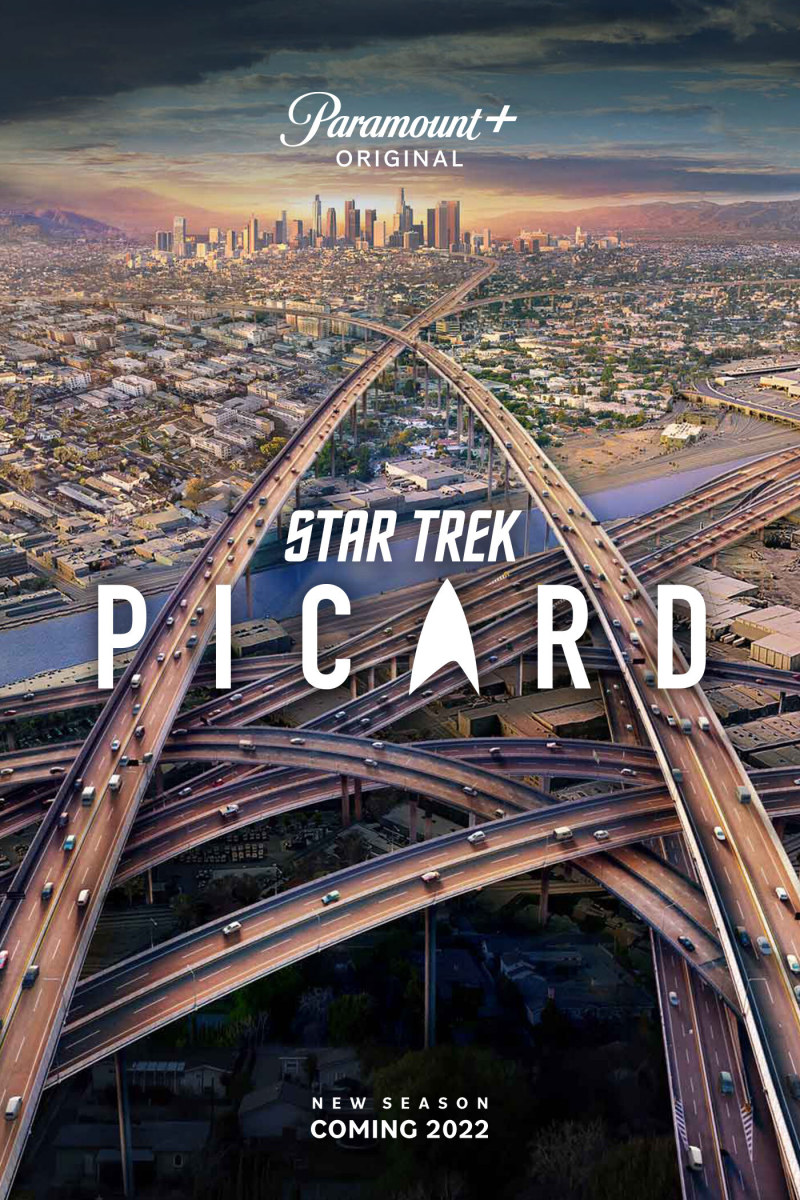
'Star Trek: Picard' season 2 is aimless and inconsistent

Its examination of the neofascist dangers of the 2020s breaks down into pointless nostalgia and superficial psychoanalysis

Season 2 of Star Trek: Picard bites more than it can chew. In the span of ten episodes, it tries to explore xenophobia, eugenicism, the weight of self-blame, repressed trauma, the tragedy of finitude, the tension between open and closed societies, the human yearning for intimate connection, the fear of loneliness, the responsibilities that come with parenthood, immigration policy, the purpose of life in old age, the narcissism inherent to the search for a legacy, authoritarianism, temporal paradoxes, suicide, and the uncertainty about the turbulent direction of humankind in the 2020s. Unfortunately, the show doesn't manage to say anything insightful about any one of its myriad themes.

The season begins by proposing a knock on the door: the Borg, old enemies of the United Federation of Planets, all of a sudden ask to join it. However, Admiral Jean-Luc Picard chooses to self-destruct his ship before allowing his old tormentors a foot in the door. This encounter sets up the argument between inclusion and exclusion that will continue in later episodes, and it gains heightened resonance by virtue of the characters who participate in it: captain Ríos, a Latino who gives commands in Spanish; Seven of Nine, an ex-Borg who was given a second chance at humanity; Elnor, a refugee from a destroyed world; Agnes and Raffi, chronic loners; and Jean-Luc himself, a techno-organic creature whose existence was illegal in the Federation just months before. This crew is composed of identities that, either in the real world or in the show's setting, have at some point been rejected, ignored, and excluded. And this is the crew that chooses to reject the Borg's open hand. This is the crew that consciously chooses death instead of risking further openness. So it's fitting that this is the moment when cosmic trickster Q steps in and shows Jean-Luc the flipside of that mindset.

Even before the revelations in the season finale, the thought of welcoming the Borg into the Federation shouldn't have been off the table. Star Trek has an established tradition of dissolving enmities: we've seen Earth gladly cease hostilities with the Klingons, the Xindi, the Andorians, the Romulans, the Orions. The Federation grows stronger each time it makes rivals into allies.

Q creates an alternate timeline where the fascist Confederation has a darker way of dissolving enmities: the eradication of every species that is not humankind. This world's version of Jean-Luc Picard is a mass murderer who serves supremacist ideals and gleefully performs televised executions. This reality is everything Star Trek has always warned against, which is why it's disappointing that we only spend one episode there.

To be fair, Star Trek had already shown us several examples of galactic history gone wrong in the Mirror Universe. But there was always the implied relief that those horrific events didn't happen to us, didn't affect our history. Our history was meant to be the peaceful Federation. The choice in this season of Picard to have the bad future happen in our universe makes the dystopia feel much more threatening. The cruelty and hopelessness of the Mirror Universe can no longer be relegated elsewhere. The potential for endless horror is right here.

Literally right here: one of the most compelling plotting choices of this season is to set the point of divergence in the real world's present. It's Earth in the 2020s where the future is decided. It's you and me watching Picard. It's up to us to decide whether our future will be an egalitarian utopia or a fascist nightmare. However, the show doesn't do anything interesting with that enormous idea. Captain Ríos suffers a random teleport mishap that conveniently puts him in the crosshairs of ICE, but his ordeal through arrest and imprisonment has a perfunctory air to it. The subplot where Ríos is in danger of disappearing forever in immigration jail has an obvious thematic link to the kind of future our heroes are trying to prevent, but the episode occurs in isolation from the rest of the story. The draconian proceedings of US immigration policy feel like they should, but really aren't, related to the flow of historical events at the center of the plot. By turning the capture and rescue of Ríos into a side quest completely untethered from the main mission, the show missed its best chance for relevant commentary.

There's nothing wrong per se in a story having a large number of themes. The problem with season 2 of Picard is that those themes have little to do with one another, and sometimes lead to contradictory messages. For example: when we learn that the crucial event that must be preserved in today's Earth in order to avoid the dystopian future is the participation of a certain ancestor of Jean-Luc's in a space mission (making this the millionth story to fall for the Great Man myth of history), we meet Tallinn, an alien secret spy tasked with protecting said ancestor until she flies to space. In the final episode, Jean-Luc tries to prevent Tallinn from sacrificing herself to complete her mission (in fulfillment of an Unnecessarily Cryptic Prophecy), and Tallinn protests that her life is hers to risk, and Jean-Luc has no right to interfere with her choices. However, interfering with someone's life and even guiding their choices to keep them from risk is exactly what Tallinn has been doing to Jean-Luc's ancestor for years. The point made in this discussion comes too close to mirroring the evil future's implied stance that some deaths are more acceptable than others. Moreover, the thematic thread about Jean-Luc's need to stop holding himself responsible for everyone else conflicts with the thematic thread about our historical responsibility to protect the future. These two messages didn't have to clash, but they have that result in this particular intersection of plots.

This incoherence reocurrs in regard to Jean-Luc's inner conflict. Q points out that his choice to leave his personal past intact and not prevent a chain of events that resulted in his mother's suicide shows growth on Jean-Luc's part. However, serenely accepting a painful reality is the opposite of what our team of heroes have been trying to accomplish the entire season. If it's a valid ethical choice to alter the past so that billions of people won't live in misery, why is it praiseworthy of Jean-Luc to not save his mother and himself? Tallinn asserts that we don't get to choose what losses we have to bear, which is an argument worth considering, but it comes off as a weak argument when presented in the same story where the main mission is to fix a cosmic loss. With these conflicting positions, the season comes off as uncertain of what it wants us to care about.

The key issue Q hoped his old frenemy would dare to face turns out to be family trauma, but there's no causal or even symbolic connection between Jean-Luc's mother and Jean-Luc's 21st-century ancestor. Q effectively assigned Jean-Luc one mission while intending him to complete another, and the narrative disjointedness feels too big at times, like two separate plots competing for centrality. The scenes we spend dealing with his difficult memories come at the expense of his time travel mission, not in the service of it.

This failure to achieve cohesion is especially regrettable when it comes to Jean-Luc's personal growth. The moment Q's actions affect is the self-destruction of Jean-Luc's ship (i.e., a suicide); the moment he expects Jean-Luc to not affect is his mother's release from confinement, which allowed her to hang herself. By helping Jean-Luc relinquish his guilt for his mother's suicide, Q means to prevent Jean-Luc's own suicide. And yet again, the method of execution has no relation to the ultimate goal. The switch to a dystopian timeline is something entirely apart from Jean-Luc's personal problems, and Jean-Luc's reward for fixing the galaxy is a trip back to his time at the cost of Q's suicide, which muddles whatever statement Q was trying to make.

The other big threat in this season, the emergence of a new Borg Queen in the 2020s, feels similarly undercooked. The writers don't take advantage of the chance to present the dangers of absolute control and enforced conformity that the Borg symbolize as a mirror for the similar tendencies reemerging in our real world. What would it look like for the Borg to come in contact with a culture that has already experienced the Trump era? That would have been a fascinating change of perspective, because in Star Trek the Borg have always served as a contrast to the Federation, but this season suggests that we, the humans of Earth, have the potential in our nature to become the same type of heartless all-devouring conquerors that the Borg are. That obvious low-hanging fruit is inexplicably left untouched.

Another missed opportunity occurs during the Borg attack on the Picard mansion, where our heroes retreat to the tunnels beneath. Those tunnels fulfill a double role in the backstory: they're the place where the young Jean-Luc learned that his mother's mental health was deteriorating, and also the shelter where the French resistance hid from the German occupiers. That history presented a fertile narrative possibility in connecting a refuge in the mind to a refuge against fascism. But once again, the writers didn't do anything with a thematic resonance that was crying out to be used.

Finally, the whole Soong situation makes no sense. It's already beyond tiresome to have Brent Spiner be the only face of the Soong family, but his role in this season is another instance of the Great Man myth. The new Borg Queen describes the forking road thusly: will humankind go the way of Picard, or the way of Soong? It's an extremely narrow view of how history works, an oversimplification of ongoing cultural trends that the writers should have been more aware of if they were going to set the story in our present day.

Yes, humankind in the 2020s is very much at risk of becoming the opressive regime of the Confederation. But this season of Picard only uses our present day as set dressing. The resolution of the threat Q created has nothing to say about our current situation, and repeats the familiar mistake of making a huge societal problem hinge on the choices of one individual.

It's even more frustrating to watch the season finale of Picard on the same day that Strange New Worlds premiered. In this new entry in the franchise, captain Christopher Pike recounts the difficult journey that Earth had to go through before becoming a Star Trek utopia. Using real footage from the violent conflicts of the past couple of years, Pike reaffirms the established canon that says 21st-century Earth had a world war motivated by eugenics. That's the immediate future Star Trek is saying awaits us. So what should we glean from our heroes' success at preserving the timeline in Picard?

This season had good material to work with, but didn't make the effort to make the best use of it. The writers knew that the season's themes had great significance for our current times, but didn't develop them beyond the barest box ticking. And the details added to Jean-Luc's backstory overcomplicate a character we already had a clear feel for. This portion of Picard's story is more notable for what it wastes than for what it adds to the ongoing Star Trek saga.


The Math

Baseline Assessment: 5/10.

Bonuses: +2 for Kirsten Beyer, who seems to always elevate any script she has a hand in.

Penalties: −1 for too much empty fan service, −1 for a contrived resolution to Kore's journey, −1 because it's incongruous to devote so much attention to Jean-Luc's childhood without acknowledging his troubled relationship to his brother.

Nerd Coefficient: 4/10.

POSTED BY: Arturo Serrano, multiclass Trekkie/Whovian/Moonie/Miraculer, accumulating experience points for still more obsessions.

Friday, September 3, 2021

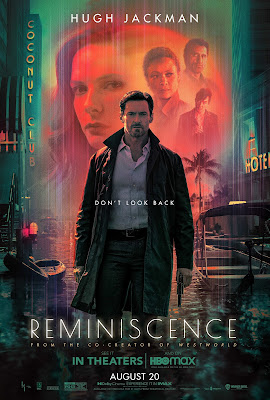
In Reminiscence, nostalgia is a sweet poison

There are layers of warning in the movie's mantra, "it's us who haunt the past"

It is a cruel irony that the way Reminiscence will be remembered will probably focus on the accusation that it redoes earlier movies. Yes, it brings to mind Total Recall and The Cell. Yes, one of its producers is the writer of Memento. Yes, it draws from decades of noir detective tradition. But Reminiscence uses these callbacks with a very deliberate intention. It's not just about "hey, do you remember when that other movie played with memory?" or "do you remember when that other movie had a jaded detective trying to save his girlfriend?" or "let me remind you of all these movies that also had global warming." It's more about "be careful with how you budget your attention, because bigger things are happening than you currently bother to look at."

In the future shown in Reminiscence, the seas have risen and swallowed coastal cities around the world. Via shady real estate tactics, the super rich have retreated to high ground while the rest are left to sink or swim in flooded slums. International war has come and gone, and what remains is a hopeless people whose main form of entertainment is to close their eyes in a water tank and relive their best memories.

This choice of worldbuilding throws a punch you don't see coming: it's literally set in our future, but its inhabitants don't believe there's a future. They'd rather retreat to a better time, which from their position would correspond to our time. But if we take an honest look at ourselves, we have to admit we're guilty of the same vice. The most heated discussion happening right now in 21st century media revolves around our unhealthy obsession with revisiting the media of our childhood. What Reminiscence invites you to do is to see the problem from the other end of the equation. It's difficult to grasp the corrosive effect of nostalgia until you see the people of the future do it to you.

Dreaming of an idealized past while the world breaks down around you is almost a too perfect metaphor for life during a pandemic. But the movie includes a few twists that make the viewer rethink what the metaphor is saying. The machine that extracts memories turns them into movies that can be watched, replayed, and rewound at leisure. Instead of the uniquely personal aggregation of sensations that we understand as memories, they're treated as already edited and polished for public viewing.

The rules of memory travel make it clear that focusing on the past too much can render you permanently stuck, incapable of perceiving the present. This can be read as a way of representing the risks of untreated PTSD flashbacks, which fits the plot on the most literal level because many of its lead characters are war veterans, but the fact that it can also be read as a symbolic mirror for our media consumption habits raises a necessary question to complete the analogy: is our nostalgic binge caused by collective trauma, by a real present that is too painful to experience directly?

We are a generation statistically predicted to have a worse economic future than our parents. The effects of global warming are all around us while our elected leaders sit on their hands. Rabid nationalism is showing its ugly head on the open, and inequality is only growing more obscene. No wonder we're exhausted all the time. No wonder many of us feel we've had too much of reality. No wonder we spend our days tuning in to reruns of Friends and getting mad when Star Wars dares attempt something different. We take refuge in comforting memories because life is just too much, but that doesn't stop life from going on, and awful things are going on while we complete our binge rewatch.

This is why it's no accident that Reminiscence interweaves its personal-level drama with a larger plot about societal unrest brewing beneath the surface. As the protagonist chases clues, trying to make sense of a lost love he refuses to let go, we follow him across the semisubmerged ruins of what used to be Miami. The former luxury destination for young vacationers has become a dilapidated abode of climate refugees. The Sunshine State has switched to a nocturnal work schedule because the heat of the day is unlivable. Only the 1% get to make plans for their descendants. In Reminiscence, the future is closed off by design.

The ending has our hero expose the corruption of a rich landowner family, and thus we get brief glimpses of an imminent revolution, but we don't see how it ends. This is a protagonist who doesn't believe in happy endings, and the destination he chooses for his journey is a loop reel of his life's greatest hits. But it's not obvious that the movie as a whole shares this stance. It's precisely by the hero's refusal to let go of the past that he ends up unmasking a conspiracy of lies and giving his community the push to fight back against evildoers. But he shares no part in the reward for his obsession. He's the hero of the story, but he's not a model that the movie offers for us to follow. He's a perpetually doomed Orpheus, always descending into hell to rescue his Eurydice, always paying for the sin of looking back. How the rest of society rearranges itself into a better shape is left for us to imagine.

A recurrent motif in this movie is the need to choose where to end a story before it gets too sad. That's the protagonist's excuse for his final choice of permanent disconnection from the world. But ending a story in the middle won't do if we are to build a future. The advice to end a story at the middle is seductive, but poisonous. We are at the middle of our historic trajectory, and the worst thing we could do is stop right where we are. Even if we were to agree that all endings are sad, the answer cannot be to refuse to let our journey continue. If all endings are sad, the answer is to continue for as long as we have strength to go on. This is the alternate road that our hero fails to see, and that's his curse. But the future he lives in is only a possibility, one of many, when seen from where we stand. The rest of us still have the option to take our eyes out of our cozy recollections, look forward, and take a less horrible road.

The Math

Baseline Assessment: 7/10

Bonuses: +1 for the gust of fresh air that is the visual language of brutal violence viewed through the lens of a female director, +1 for Thandiwe Newton's acting, +1 for some shining gems of dialogue ("people like us don't fall in love [...] love is the thing we climb to").

Penalties: −1 for incomplete worldbuilding, −1 for relying too much on voiceover exposition, −1 for too many neat plot coincidences, −1 for ending the social side of the story in the middle.

Nerd Coefficient: 6/10

POSTED BY: Arturo Serrano, multiclass Trekkie/Whovian/Moonie/Miraculer, accumulating experience points for still more obsessions.

Tuesday, March 9, 2021

WandaVision could have been the greatest thing to ever happen to TV

Just like its titular protagonist, WandaVision had incalculable creative potential it didn't know what to do with

What did we just see?

What strange creation burst onto our screens?

It was an erudite metafictional work that played with the rules of television language and blended its formal limitations into meaningful parts of its content in ways that would have delighted Marshall McLuhan.

It was a deconstruction of television's role as the most effective vehicle by which Western culture codifies and reproduces its normative expectations of the bourgeois family.

It was a celebration of the ritual of sitting in front of television as a family-building experience.

It was the finally legally viable, much-theorized, long-awaited, first official link between the Marvel Cinematic Universe and the X-Men.

It was an allegory of Gnostic mysticism.

It was a deep exploration of the psychology of trauma, crafted by taking abstract notions of bereavement, idealization, nostalgia, fantasizing, denial and derealization, and making them tangible elements that could be legibly used as pieces of emotional narration.

It was a captivating display of Elizabeth Olsen's full acting range.

It was all geekdom could talk about for two months.

It was but an intermediate chapter in a larger, unending franchise it was designed to segue into.

It was a missed opportunity.

But what is the MCU, if not missed opportunities persevering?


Part 1

Which witch watchers are real witch watchers?


Since the release of WandaVision's first episode, its viewers aligned into two factions: one, composed of dedicated fans, deeply versed in comics lore, experienced in hunting Easter eggs, avid for all-explaining theories, and enthusiastically supportive of the Marvel narrative formula; and another, taken from the wider general population, less equipped to catch the references (and less inclined to look for them), not so invested in controversies over canon, and attracted to the show mostly by the curiosity that any experimental piece of storytelling was bound to generate. Both groups had their own reasons to love WandaVision, as well as their own reasons to become disillusioned with it.

The first group could barely contain their excitement. Were we going to see Mephisto on screen? Or maybe Chthon? Or Immortus? How about Wonder Man? Is this Nightmare's doing? Or the High Evolutionary's? Is the rabbit Nicholas Scratch? Will Monica Rambeau's engineer friend turn out to be Reed Richards? Could Dottie secretly be Moonglow? Or is she Morgan le Fay? Will Ultron make a comeback? Are we finally getting mutants? Who is the secret cameo? TELL ME!!!!!!!!!!

(My favorite theory was that intergalactic TV producer Mojo was the big villain. Oh, well.)

This group had no patience for the playful sitcom setting of the show's first episodes: they demanded answers. Some of them earned their moment of internet fame for complaining that they couldn't watch all nine episodes in one sitting, which sparked plenty of discussion on how Netflix has spoiled us and how Disney knows exactly how to manage hype for maximum effect (see: the weekly release schedule of The Mandalorian, which fans were OK with). Members of this group didn't come to WandaVision for the small personal moments, or the symbolism, or the homage to television history, or the visual artistry. The experience they were hungry for was the completion of a jigsaw puzzle: where WandaVision fit in the bigger narrative of the MCU, which other productions it was paving the way for, which storylines from the comics were going to be adapted, which favorite villains were due for an appearance.

These viewers got very upset with WandaVision's style.

The second faction may have included many Marvel fans as well, but these were more varied. Older viewers with a fondness for classic sitcoms, Disney+ subscribers raised on princess tales, Marvel newcomers who never had money for comic books, film buffs fascinated by non-conventional formats, students of communication science, grief counselors, anyone, really. This group didn't much care for the hidden MCU references; they watched WandaVision for the ways in which it rewrote the rulebook of audiovisual storytelling.

This second group didn't mind the sitcom scenes. That was the part they liked best.

The curious effect of this divide is that each faction enjoyed WandaVision for exactly the same elements that irritated the other faction. To hear their criticism, the show had both too much family drama and too little, too much flashy superheroing and too little.

Sometimes, that kind of disagreement can degenerate into an argument on who is qualified to comment. No one is immune to this kind of narcissism; I must confess a little piece of me dies every time someone talks of Mission: Impossible as if it had been invented by Tom Cruise. To me, that's not Mission: Impossible. To me, it's Jim Phelps and the self-destructing laser discs. But I also know there are fans for whom it's Dan Briggs and the self-destructing tapes. So I have to recognize I don't own the stories I love, and if Mission: Impossible means Tom Cruise and life-threatening stunts to you, have fun.

Comic book fans need to remember this. The process of adaptation implies bringing a story before a different type of audience, and no one has the right to ask to vet your credentials before you can give an opinion on a piece of art that you have experienced. Some comic collectors aren't particularly into cinema, and some moviegoers don't frequent comic bookstores; that's fine. But Marvel Studios has tried too hard to appeal to both extremes of a divide that need not exist. You shouldn't have to have read any Marvel comics before discussing a Marvel movie, but if you have, that only gives you some context, not any higher expert status. If you're a media studies professor, that gives you sharper analytic tools, but not exclusive authority.

As for me, I'm a television addict. WandaVision gave me and my tribe exactly what we wanted.


Part 2

American dream

The United States can be infuriatingly self-centered. It tends to take for granted that its culture is the sum of human culture, that its worries are the sum of human worries, that its fate is the sum of human fate. Such unquestioned assumptions can have a corrosive effect if you're growing up in the Third World and getting your ideas about life from a nonstop diet of American media.

Those of us born and raised outside the US know far more about it than the US cares to know about us. Indiana Jones and the Temple of Doom is a dearly beloved classic that insults India in appalling ways you don't get until you listen to actual Indians. Romancing the Stone has been praised as an exemplary case of scriptwriting, but its botched representation of Colombia should consign it to the trash bin.

And still, we on the outside can tell exactly which parts of The West Wing are realistic and which are impossible wish fulfillment. But that takes years of consuming and processing lots of other shows and movies and news pieces and novels. You don't get a full sense of Japanese society from watching only high school anime. And you don't get the US if all you've seen of it is the sanitized wholesomeness of sitcoms.

That's the stunted stage where Wanda Maximoff remains stuck. In her case, the laborious process by which every child develops their cultural competence was interrupted by violence. She had her brother's company as a valuable anchor, but her understanding of friendship and loyalty was warped by Hydra's indoctrination, and her understanding of romance was forged by I Dream of Jeannie. Of course, millions of Americans grew up with I Dream of Jeannie and didn't model their own lives after a suburban fantasy, but young Wanda had no other referents to learn from. Her country was at war. There was not a normal society to welcome her after the loss of her parents. All she could use to build her personality on was fiction—a heavily distorted form of it. It's unlikely that she ever watched The Americans, but when she tried to have a normal married life in the suburbs, she was putting on an act.

I can empathize with her situation. I wasn't born in Sokovia, but I was born in Colombia; I know a thing or two about growing up in a society where nothing works and the few times you see people treat each other with kindness occur between laugh tracks. To the average American, the sitcom says, Look at these clueless fools bumbling their way through life; aren't they hilarious? To the exhausted inhabitant of a poor country that is falling apart, it says, Look at these happy faces in their enormous houses; don't you wish that were you?

In comic books, ersatz versions of Eastern Europe (Sokovia, Latveria, along with Kasnia on the opposite aisle of the bookstore) have served as convenient settings to depict the unwashed Other in contrast to the Free World without getting in too much trouble with actual history. When the Soviet Union collapsed, the likes of Sokovia acquired a new usefulness as unstable hellholes where you could write war plot after war plot with no end in sight. It would be worthwhile to study what the generations raised on these hypermilitaristic stories think of daily life in Third World countries.

(I'm sure the results would be illuminating. I know what you think of Colombia.)

So we have here a double-edged distortion, a see-through funhouse mirror: what American cultural productions tell the rest of the world about the US, and what the US tells itself about the rest of the world.

WandaVision explores the character of Wanda as a war survivor, as a war criminal, as a bride, as a widow, as a daughter, as a mother, as a superheroine, as a supervillain, as a cosmic force and as an abuser, but before doing all that, it has to explore Wanda as a fan, as a consumer of pop culture. Do Sokovians produce their own movies? We'll never know. Wanda sure didn't watch any. Whatever lessons she absorbed about her potential in adult life came from a culture that had no interest in her.


Part 3

Riot girl

It's possible that movie studios never find the right way to tell the Dark Phoenix Saga. It's a peculiar kind of storyline that doesn't fit well with the core message of the X-Men, which is that people should only be feared for what they do, not what they are. The case of Jean Grey illustrates that it's dicey to label someone as a world-ending threat; once you cross that line, as the comic writers did when they chose to make her literally blow up a planet, it's pointless to apply empathy. You're either a character or a monster. If you can't be reasoned with, you have to be eliminated. This is the poisonous line of thinking that conspiracy theories love to feed on.

It's too easy to dehumanize the superhuman and derail the entire message of a story. The archetype-defining tale of female power that is Sailor Moon treated the world-ending warrior that is Sailor Saturn with more humanity than any Marvel production has treated the Phoenix-possessed Jean Grey. The key difference is the authorial choice to have the powerful woman not be in full control of herself. This approach resonates with the sexist history of psychiatry, which used to attribute every problem in a woman's life to a misplaced uterus. If she can't govern herself, the reasoning goes, it's someone's job to step in and do it for her.

This failure mode for social relations is the main conflict of Captain Marvel. That was a peculiar sort of hero's journey, mainly because it didn't follow the standard form of the hero's journey. It focused on the ways powerful women are feared and therefore manipulated to act against their own interests. In this modified heroine's journey, the victory condition is not to strive to acquire new power, but to know yourself and realize the power your already have.

As the ancient Gnostics would put it, salvation comes by knowledge.

Or as the Mahayana school of Buddhism put it, enlightenment comes by realizing that you are already enlightened.

(More on this below.)

WandaVision adds a twist to this story format (one that we also saw in Dark Phoenix): the manipulation of a powerful woman by another powerful woman. Toward the end of the series, the more experienced witch Agatha Harkness expresses her astonishment at Wanda's natural talent. Creating the fantasy world of Westview should be beyond the abilities of someone who hasn't heard the basics of magic theory. After some more probing, Agatha concludes that Wanda fits the profile of a foretold destroyer: the Scarlet Witch, who according to legend is invested with the chaotic power of raw creation. Now, creation in itself doesn't sound like a bad thing. Two-thirds of the world worship a creator, and some of the more traditional (and overused) portrayals of womanhood celebrate the symbolic attributes of fertility in its potential for creation and renewal. But Agatha is alluding to something more fundamental: the primordial horror of rewriting reality. Much like the Phoenix, the Scarlet Witch is a force of the universe.

We're familiar with that notion. In the real world, many ancient myths mention a protean being of eternal chaos that had to be defeated before an orderly world could be made. Crucially, this monster was often female. To those of us committed to full equality of rights, it feels strange to think that there's anything scary about female power. But it's not hard to explain how so many civilizations could have gotten that idea. Do you remember what I said above about Americans thinking that they set the standard for culture? Other forms of privilege work the same way. In this case, it's men thinking that we set the standard for authority.

Superhero stories have been helping, very gradually, to normalize the portrayal of powerful women as role models instead of as ticking bombs. The problem for the MCU is that rewriting reality is kind of a done thing, now that Thanos has come and gone. The character of Wanda risks entering the Dragon Ball spiral of escalating power levels until there's nothing left to throw at our heroes that can seriously challenge them and still make for a compelling story. The Dark Phoenix Saga was reportedly conceived to prevent Jean Grey from slipping into that dead end. However, it's a plot that has been told in so many cartoons and movies that Jean Grey has become a tragic figure, doomed to become the Phoenix in every adaptation where she appears.

Not because of ancient prophecy, but because of established Marvel lore (and corporate acquisition, and popular demand), Wanda was always doomed to become the Scarlet Witch.

In the comics, the Scarlet Witch is called a Nexus being, a fulcrum point where all universes converge. Since we already know Wanda's next adventure in the movies will be a thing called the Multiverse of Madness, we can assume her Nexus status will come into play. But if the writers are not careful with how they handle ever rising threats, this superpowered character could turn into something that's even more dangerous to a fictional setting: a boring one.


Part 4

A syncretic creation myth

In the short story The Library of Babel by Argentinean writer Jorge Luis Borges, the universe is described as a hivelike lattice that stores printed volumes with all possible combinations of the alphabet, which necessarily means it contains all stories (including a copy of The Library of Babel). It also has all versions with typos and all forms of meaningless gibberish, with no combination less valid than another, because it’s always possible that “dhcmrlchtdj” happens to mean something in an undiscovered language.

So, the universe is a beehive. And its cells have every variation on every possible story, such that even nonsense has a meaning that doesn’t depend on your understanding.

Now you can see why I was pumped up by the reveal that Wanda's world, built from stories, had a hexagonal shape. Add a mysterious beekeeper to the show, and I'm sold.

The idea that we live in a world of fiction has been explored far more extensively in Asian media than over here. We are heirs of Aristotle, who taught that things are what they are. But in cultures influenced by Vedic literature, the doctrine called Maya holds that we live under a perceptual illusion, and the true nature of reality is kept hidden from us. In the West, Gnosticism preached something along those lines, but after it was defeated by Christianity, writers basically forgot that Plato had ever mentioned a cave. There's the occasional oddity, such as Pedro Calderón de la Barca's stage play Life Is a Dream, but for the most part, no one took Descartes' deceiving demon seriously and Western narratives very rarely explored this idea until The Matrix catapulted it into mass popularity. The Jumanji franchise has recently stepped into the conversation about characters from the real world thrown into a hellscape of pixels, but in Japan, isekai is a well-established genre with a vast tradition.

The Gnostic version of Jumanji (now there's a sentence you didn't expect to meet in your life) goes like this: human beings suffer because this world is broken. It's the defective work of the Demiurge, an imperfect being who, while overcome by passions, unwittingly made a world of falsehood in a clumsy attempt to imitate the ideal world. What we perceive as solid matter is an evil substance, at war with the pure realm of thought. In the Cerinthian tradition, the Demiurge itself is not evil; it doesn't even understand its own nature or power. Where all Gnostics agree is that this state of affairs cannot be fixed. The only solution to our suffering is to be released from the prison of falsehood so we can return to where we came from.

In WandaVision, the enmity between matter and thought is made literal in the dual character of Vision. Both versions of him proceed from the Mind Stone, but now they are split and opposed. As a final showdown in a superhero blockbuster, we certainly didn't expect a disembodied mind and a mindless body to debug the wording of a programming instruction via thought experiment from Ancient Greece, but that choice of tactic is such a Vision thing to do that we'd do well to pause and consider the ideas presented in the discussion.

Against the physical form of Vision stands the idea of Vision. But it's not a pure Platonic idea: it's one mediated by Wanda's psychic state. The idea of Vision can only exist through Wanda's thoughts, and he vanishes if he steps outside of her constructed mindscape. In a beautiful touch from the writers, this character is a literal embodiment of the common metaphor of responding to the death of a loved one by keeping their memory alive.

On the other hand, we have Vision's original material body, rearranged into something other than its prior self. This occurs, in fact, to any matter that enters Westview: it is altered in its external attributes, but not in its essential nature.

Matter and thought, both being the same thing. A zombie and a ghost, both being the same person. The command to destroy Vision is an urge toward self-annihilation; but the Vision has already been destroyed. What exists now is and is not Vision.

We need a way out of the trap of duality.

In the Indian philosophical system of Advaita Vedanta, the opposition between essential thought and essential matter is rejected as illusory, and the way to dissolve this error and realize the interconnectedness of reality is by reasoned introspection. That which is empirically real and that which is conceived as real are replaced by that which is real in an absolute sense. There never was an opposition.

So Vision reasons with himself, and that brings his liberation.


Part 5

Do your homework

Everyone who loves television (or narrative theory in general), even if they're not Marvel fans, should watch WandaVision. They should. Period. And it’s an enormous pity that such a fantastic production is all but inapproachable for those who haven’t watched a couple dozen movies beforehand. WandaVision can be immensely rewarding at times, but it depends on a lot of assumed knowledge. You need to have seen Age of Ultron to even know who the protagonist is, but she doesn’t get a proper dramatic arc until Civil War, whose plot you won’t follow if you haven’t seen Winter Soldier, which requires knowledge of The First Avenger. And still that won’t suffice. Her romance with Vision doesn’t emerge until Infinity War, which you won’t understand without first going through the whole lot of Homecoming, Ragnarok, Guardians of the Galaxy, Black Panther and Doctor Strange. Finally, Wanda’s story of traumatic loss is not complete without Endgame, but this one revisits scenes from The Avengers and The Dark World, so you also need to check those; and even then, Endgame makes no sense without Captain Marvel and Ant-Man and the Wasp.

*takes deep breath*

And I still haven’t gotten to the huge deal that is the casting of Evan Peters as Wanda’s pretend brother, which will mean nothing to you unless you’ve seen Days of Future Past (plus a short conversation in Apocalypse), but to understand Days of Future Past, you need to have seen First Class and The Last Stand (plus the post-credits scene of The Wolverine), but the plot of The Last Stand is a direct continuation of the first two X-Men films; and to even begin to make sense of why I’m bringing up a completely separate franchise into the conversation, you need to be acquainted with the legal entanglements that spread Marvel characters across different film studios, as well as with Disney’s shopping spree of intellectual properties.

(I probably wouldn't even have been interested in the X-Men movies if the national broadcasting networks of my country hadn't decided to buy the 90s animated show.)

I thank all the gods that these movies don’t also expect me to cross-check the piles of books where these characters first appeared. I'm told I'm better off this way, because Wanda's timeline in the comics is a hopeless mess of retcons, but my point remains: WandaVision is definitely not for the casual viewer. I'm sure there are hundreds of little jokes I missed because I never watched the old sitcoms that inspired its first episodes. I enjoyed the show all the same, but I have to admit how many years of movie plot it relies on. The mass of previous knowledge that Marvel productions are starting to demand of the audience is reaching concerning proportions. Those most devoted among the fans will be happy to complete all the required reading in preparation for each new film, but something worth analyzing is happening to pop culture.

In centuries past, it used to be the case that you couldn't hope to be thought of as a cultured person unless you knew your Homer and your Herodotus and your Cicero and your Seneca and whichever other authors became influential enough to make it into the canon. It was even possible to read everything worth reading in one lifetime. But of course, human beings kept writing, and creating new classics, and revising the canon, and making the task of getting your artistic education more and more complicated. You can't fully enjoy the Divine Comedy if you don't know who Virgil was. Don Quixote is best appreciated in comparison to the medieval tales it parodies. The typical inhabitant of the West knows that the Bible has influenced literature, but most people not raised in English have no idea of the gigantic legacy of the King James Version.

With the passage of time, the amount of media consumption that you need to have accumulated in order to be capable of more media consumption threatens to, well, consume all the time you have available. It's not just that the box office is saturated with sequels and remakes; it's that our current culture is a self-sustaining web of references and responses and winks to the audience and knowing allusions that creates an entry barrier for the uninitiated. Even the most original of 2020's big productions, Tenet, is emotionally unreadable without some familiarity with the established conventions of the spy thriller genre and the variations on the femme fatale trope that have been developed and reworked over decades of cinema (and to follow the worldbuilding, you must have the laws of thermodynamics fresh in your head).

Since Marvel Studios has sucked all the oxygen from pop culture to the point that it has basically become the pop culture, it can afford to not care that it's creating a hyper-niche of insider knowledge. For many fans, this will be a point of pride. But WandaVision doesn't behave as a piece of cheap entertainment for the masses. Its production draws from a staggering level of expertise and demands a comparable wealth of media literacy that alienated its own followers.

No one's asking Marvel to make art film. No one seriously thinks Marvel plans, or aspires, or needs to make art film. Scorsese has a solid point in that regard. But this time they made the tiniest motion in that direction, and it immediately enraged the binge watchers and the plot decoders. WandaVision proved that Marvel is capable of a more ambitious, more thoughtful type of story. But the studio has to have realized that it can't commit all the way it if wants to keep punching bad guys in spandex.

So, something like WandaVision will probably not be attempted again. Marvel knows what the fans want, and that is its curse.


Part 6

In Sokovia, television watches you

 
One-and-a-half decades of ridiculous revenue have given Marvel Studios an acute sense of what we expect and what we are likely to find enjoyable. At every step, WandaVision holds the reins of the relationship with its viewers. It knows it can get away with a moderately risky bet on metatextual allusions with vintage aesthetics and laugh tracks, because most of us will eat it up gladly. With an (almost) inconditionally loyal fanbase, why not try the hardest sell of all: a story about stories?

It is, of course, not a new concept. The trend toward obsessive self-referencing has been snowballing for a while now. The film version of Bewitched is a magic comedy about the production of magic comedies. Inception is a heist thriller about the production of heist thrillers. The Cabin in the Woods is a voyeuristic gorefest about the production of voyeuristic gorefests. The Last Jedi is an epic myth about the production of epic myths. And so on.

WandaVision is their proud descendant, but it’s more. It aspires to a greater sophistication, to not only revisit and dissect the clichés of television shows, but to reflect on the medium as a whole. By this point, the producers know how we overanalyze and dissect and theorize and obsess over every frame of every episode, and they have learned to anticipate our reactions, to account for our jumping to conclusions, to participate in the game with us. WandaVision is fully aware of the manner in which it is watched, and turns that relationship into part of its own narration.

Producers and viewers have grown too smart for each other. We know their tricks, and they know we know them, and we know they know us, and with each iteration it gets harder and harder to make something surprising, or just interesting for that matter, under such unrelenting scrutiny.

This web of mutual expectations resulted in WandaVision including a ton of red herrings that weren't related to any part of the plot; their function was to tantalize the portion of the viewers who were more familiar with the comic books. Speculation mushroomed across the internet with wild theories that proved to be all wrong. That they were wrong was not the point. That Marvel got you to spread the word was the point. Your obsession keeps the machine running.

There is now a generation that has grown up watching the MCU the way Wanda grew up watching sitcoms. Is WandaVision a warning? Is Marvel telling viewers to avoid going the way of Don Quixote and trying to live their lives as superpowered defenders of the universe clad in plot armor? There's no way Marvel produced an extended meditation on the psychological effect of pop culture without at some point reflecting on the psychological effect of their own creations as part of the pop culture. Decades from now, someone is going to write a metafictional analysis of what it did to us to live through the age when superheroes were everywhere. Maybe Marvel is anticipating that response and using WandaVision to tell us how they prefer to be remembered. It's not like Marvel hasn't already had issues with comic book readers mistaking their stories for guidelines and hurting people's lives in the process (*cough* Punisher *cough*).

By all means, watch superhero movies. They are part of the noble tradition of science fiction, which has earned its full memberhip in the ancient art of storytelling.

And watch WandaVision. Let it blow your mind. But don't lose your head.


Part 7

Avengers: Metagame

WandaVision may be about a mutant witch and a dead robot who somehow have children, but it's also a defiant answer to those who complain that Marvel is feeding us empty calories. For many fans, WandaVision may be their first exposure to metafictional techniques that have been known and studied for decades but now linger as rarely remembered curiosities and deserve to be brought back into the mainstream consciousness.

After Daffy Duck had a fight with his animator in the short Duck Amuck, I don't remember seeing a more powerful metafictional moment on screen than Vision shouting in frustration through the end credits of the sitcom he's trapped in. This acknowledgment of extradiegetic elements to drag them inside the story was a common trick in classic cartoons, such as an opera singer pulling a hair that was supposedly stuck on the projector in Magical Maestro or a fugitive running past the edge of the film in Dumb-Hounded.

(Animation director Tex Avery was the absolute master of demolishing the fourth wall, and his oeuvre will sate the hunger of WandaVision fans who've been left eager for more. Content warning for racial stereotypes.)

The Road Runner show took this blurring of the medium in an inward direction, with its repeated gag of Wile E. Coyote painting an extension of the road onto a wall and the Road Runner seamlessly stepping into that painted road because he, too, is a painted creation.

We may sing the praises of WandaVision for employing these techniques, but it obviously didn't invent them. What does make WandaVision unique is the incredibly complex way the metafiction relates to its theme relates to its format relates to its main cast relates to its worldbuilding relates to our cultural moment. We won't be able to watch sitcoms the same way again.

Worse, we won't be able to watch Duck Amuck the same way again. From any fictional character's standpoint, the tiniest rewrites have to look like moments of cosmic horror, glimpses of a force beyond all comprehension, the cruel whims of a sadistic torturer. We all remember that time Cow and Chicken discovered that the reason why they could only see their parents' legs was because that was all that existed of them. Now imagine Samantha in Bewitched having to accept a different man in her house who claims to be the husband she remembers. Imagine Lisa Simpson recalling her meeting with Bill Clinton more years ago than she's old. Imagine Malcolm's family struggling to not notice the troubled son who speaks manic monologues into the air. Imagine Daffy Duck watching sunflower petals sprout from his face.

People who live inside the TV lead oppressively absurd lives, and it's all your fault.

Just like cyberpunk should have ended with The Matrix, it's hard to say anything new in horror after The Cabin in the Woods. At long last, the monster is you. Yes, you. Ask your SimCity avatars if you don't believe me.

Black Mirror: Bandersnatch went for this angle, but its attempt to cast the viewer as the creative monster was limited by the choices put on the screen menus by the actual author of the episode. WandaVision uses the same terrified gaze and turns it toward itself: the editable world is controlled from within, with Wanda as executive producer, set designer, head writer, casting director, continuity supervisor and star of the show. No self-insert fanfic, no performative Instagram feed, no postmodern autofiction novel will ever top Wanda's total reinvention of her life.

(Yes, I know WandaVision is made by Marvel Studios. I'm talking about the WandaVision show that exists inside the WandaVision show, and it's wonderful, albeit slightly unnerving, that I have to add this disclaimer.)


Part 8

Lucid dreaming as therapy

The logic of sitcoms is that time never advances, which is why Lisa Simpson has sat in second grade for 32 years. There’s an appeal to this. Wanda has been losing loved ones and fighting world-ending threats her whole life; anyone in her position would jump at the chance to escape into make-believe. A perpetual present where time is no longer a concern seems the perfect subconscious release for a traumatized woman who lost the war to save the universe because her enemy had control over time. Wanda's foray as auteur of her own show is a convenient excuse to not have to move beyond the denial stage of grief.

Let's forget for a moment the capturing of a whole town. There's a version of this where Wanda's magical outburst could have extended only up to the walls of her house, letting her retreat into her fantasy without affecting anyone else. Would you have blamed her? Who among us didn't, as a child, wish to live inside the TV? I, for one, always knew I wanted to be friends with Captain Planet. Wanda's idea of protagonism is just somewhat more elaborate: a self-imposed Truman Show set in the fake Good Place by way of holodeck malfunction.

However, life does not work like a story. It does not have a showrunner with an arc in mind for you. Intriguing factoids are not clues leading to upcoming revelations; interpersonal conflict is not exciting; pivotal events do not carry inherent symbolism; accidents are not poetic justice. You can't rewind and edit the parts that disagree with you, and we're all grateful that you can't write off annoying characters if they lack charismatic appeal. Stories do need to resemble life to some degree to be understandable, but they have their own rules that have nothing to do with life. I'm not a fan of horror by any means, but I know that people who enjoy horror enjoy it precisely because they know it's not the way life works, so it lets them experience intense mental states without getting into actual danger. This ability to separate fact from fiction is crucial to humans. Much of the real world plainly makes no sense, and part of functioning capably as a mature person involves learning to allow life to make no sense. If there are protagonists at all, they only have power to push events for a few years and then retire to the history books. You're statistically unlikely to be one.

The refusal to come to terms with our insignificance is so incompatible with daily life in society that it's been recognized as clinically anomalous since the time Don Quixote was published. These days, we have a more specialized vocabulary to identify a range of psychological delusions. In Truman syndrome, for example, the patient is convinced that they're being filmed 24/7, that they're expected to perform an interesting life for countless unseen viewers, and that some hired producer is guiding the plot. In histrionic personality disorder, social behavior is exaggerated to appear more intense, more memorable, more picture-perfect. Derealization-depersonalization disorder makes the patient experience their own actions as if they were happening to somebody else and they were watching themselves from a third-person omniscient point of view. If you believe you're in a story, you need help. In Westview, everyone is screaming for help inside their hearts.

As serious as these conditions are, the perception of the world as artificial has seeped into common parlance. All through 2020, the Year of Suck, the world's favorite coping mechanism was to blame the "writers" of our show for the unbelievability of the increasingly horrific events we read in the news. What this joke shares with delusion disorders is the need to make sense of randomness. This frustration must be even heavier if you have reason to believe you can control the randomness. The constant thread through Wanda's life has been the chasm between her superhuman power and her inability to control the bad events that keep happening around her. When you have witnessed the violent deaths of your parents and your brother and your boyfriend (twice!), you may reach a very fragile mental state. You may develop a strong need to hold on to the belief that behind the absurdity of the world there must exist some ultimate meaning.

In the psychological conditions I described, that meaning is imagined to exist behind a fourth wall. Who is more delusional: Malcolm, who speaks to an audience no one else can see, or Dora the Explorer, who sincerely thinks she can hear you reply?

Unfortunately, WandaVision didn't handle well the resolution of Wanda's fantasy. She refused at first the unmistakable evidence that her neighbors were in pain, and by the time she let her worldbuilding spell expire, there are no signs that she grew as a person or learned to cope with her losses or felt any responsibility toward the town she took over.

There must be a T-shirt somewhere that says "I survived the Westview anomaly and all I got were these cool new superpowers."


Part 9

What did we learn today?

WandaVision's moral argument drops the ball badly. Perhaps in an overcorrection away from the "fear the powerful woman" trope, it makes every implausible effort to save Wanda from her deserved status as the villain of the show. The script wants to frame her relinquishing of control as a concession she makes to the town instead of her obvious obligation to innocents she enslaved. Monica even says the nonsensical line, "They’ll never know what you sacrificed for them," and I want the neighbors to yell back, "Thanks for nothing!" All of Wanda's losses happened before Westview, and she can recreate her memory of Vision at any time. She didn't make a sacrifice for her neighbors; she was forced to admit that they were victims. In the Unintended but Still Questionable Acts of Mind Control for Purposes of Boyfriend Resurrection department, WandaVision fares worse than Wonder Woman 1984.

To make Wanda look less bad, the show makes strange comparisons that require the rest of the villains to make choices that are just silly. S.W.O.R.D. director Tyler Hayward stops behaving like a competent adult after the Hex grows in size, and Agatha is reduced to explaining the plot to the audience and presenting a rather vague threat to our protagonist.

Indeed, what makes Agatha bad? Next to Wanda, she comes off as pretty tame. Let's see: she killed a puppy, and... captured fake Pietro, who might already have been one of Wanda's victims anyway, and... read the wrong books? Her magic absorbs attacks and drains her enemies, but that appears to be an intrinsic property, not a choice, so we should only judge her for what she plans to do with the skill, not for having it.

What she plans to do is take Wanda's powers. OK, that sounds kind of bad. But if the chaos magic of the Scarlet Witch is inherently dangerous, does it matter who has it? The script flatly avoids the question of whether anyone should have such immense power (and you know you're in trouble when Batman v. Superman handles a theme more honestly than your story), opting for the regressive stance that power should be kept in the hands of the one who was born with it (and it explicitly goes out of its way to point out that Wanda was born with it). Agatha may call Wanda "undeserving" to flatter herself, but the truth is that no one is worthy of having world-ending magic. The show doesn't present a strong case for why Wanda should get to keep that power other than the need to treat her as the heroine.

However, I must be fair here and judge Wanda by the same standard I just applied to Agatha. As overpowered as Wanda is, she doesn't plan to end the world. (And to be extra fair, we don't know for a fact that Agatha plans to end the world.) The conflict would have been more interesting if Agatha's concern for the world had been sincere instead of a fig leaf for her envy. After all, the obvious solution to "Wanda has a magical nuke she doesn't know how to control" is "Well, teach her, duh." But, unlike in the comics, this version of Agatha is not here to teach Wanda. She's here to kill puppies and cackle menacingly, and she's out of puppies to kill. If WandaVision wanted to use a villain who was truly worried about people having too much magic, it shouldn't have used Agatha; it should have used Mordo.

So let me talk about Sailor Moon for a minute.

In the live-action show Pretty Guardian Sailor Moon, the plot of the original manga is followed more or less faithfully, with enough variations to make it worth checking out. To be sure, it's cornier than the state of Iowa, but the beautiful thing about Sailor Moon productions is that they're made without one drop of cynicism. The live-action version adds plenty of original twists, the best of which is Usagi's reaction to the death of her boyfriend and reincarnated consort Endymion. Whenever she gets too upset, the spirit of her previous life takes over and she becomes an uncaring force of destruction. At the end of the series, fully possessed by grief, she transforms Earth into a lifeless wasteland because, as she explains, she doesn't need a world that doesn't have Endymion.

(Don't you worry. As always happens in Sailor Moon, everything is fixed as soon as Usagi remembers she has an everything-fixing gemstone.)

I bring this up because this unstoppable apocalypse of sorrow is the picture Agatha wants to paint of Wanda, but the plot doesn't support that interpretation. When Wanda learns of the pain that the Hex is causing, she agrees that her neighbors must be freed. Wanda is not a dangerous person. She has dangerous tools, which is entirely another ethical question, and WandaVision is not consistently aware of the difference. All the harm she caused was involuntary. From a consequentialist perspective, that doesn't matter; she still owes each inhabitant of Westview an apology (and a check to pay for therapy). But if we add considerations of moral agency, she's not a standard villain, but an antivillain, a character whose good intentions lead to the wrong choice.

Science fiction writer Ben Bova defends the use of antivillains with the argument that no one actually wants to be bad, so the classical villain who not only does evil but essentially is evil is not an accurate representation of how human beings work.

Socrates would have agreed.

In the dialogues Protagoras and Euthydemus, Socrates introduced the position that today's philosophers call moral intellectualism, which holds that all we need in order to make the right choice is to learn which choice is right. This is so because everyone naturally wants to be good (take that, Calvinists). According to moral intellectualism, as soon as we know what's good, we will automatically do good things.

However, this reasoning smells... incomplete. Aristotle identified what was missing: if you explain wrongdoing as the product of ignorance, you remove the burden of responsibility. Wanda's circumstances provide an explanation, but in no way an absolution, for her actions. Too often in the real world, emotional abusers wield the excuse of having had an involuntary outburst to evade responsibility for hurting others. This is the scenario Aristotle warned about. If we don't give real people a pass for being jerks while upset, we should expect better from our idealized heroes.


Part 10

Social distancing

Not only are the inhabitants of Westview trapped in a TV setting: Marvel Studios is trapped in TV, because we’re all trapped in our homes and can't go to the movies. Of course, the show was conceived and produced before the coronavirus quarantine, but circumstances in the real world have given this story additional symbolic impact. (That's the fun of literary criticism: EVERYTHING gives context.) As a cosmic being, Wanda is much bigger than the world she’s created for herself, in the same manner that the MCU is bigger than Disney+, and the central question throughout the series is whether she (and the MCU, and the rest of us) can, or will, get out.

For over a year now, we've been compelled to treat our homes as the sum total of our world. Maybe we can leave the house to take a walk. Forget about leaving the neighborhood. Because we need to make sense of randomness, and our way of doing it is to compare life to stories, our ongoing confinement has frequently been compared in the press to the plot of the novel The Plague by French existentialist Albert Camus.

I find that comparison unnecessarily gloomy. But if we insist on dragging French existentialism into a dicussion about what it's like to watch WandaVision during a global pandemic, let me recommend a more topical title.

In Jean-Paul Sartre's stage play No Exit, hell is described as an ordinary room with regular people. The protagonists can barely stand each other's company, and they say all the time that they want to leave, but when one of them finally finds a way out, he just can't go. He has unfinished business with his fellow damned souls. He wants them to validate his existence, to grant him the role of a man so he can be one.

Existentialist philosophy has much to say about the problem of mistakenly believing we are the roles our situation assigns to us. When a goverment bureaucrat denies you what is obviously fair because some regulation demands otherwise, they're not acting as a human being. They're acting as their social role. Sam the Sheepdog doesn't punch Ralph the Wolf because he personally dislikes him; in fact, they share a pleasant teatime outside of office hours. But when they go back to the workplace, whoever occupies the position "Sheepdog" has the function of punching whoever occupies the position "Wolf." The setting, and not their personal preferences, dictates which actions are and aren't possible.

That's the psychological torment of living in Westview and being forced to play a role instead of having your life, but that's also the everyday experience of any stratified society where the roles must be followed regardless of their usefulness. During the Trump era, the position "Patient" stood in a specific relationship with respect to the position "Associate Director for Communication at the Centers for Disease Control and Prevention," which in turn stood in a specific relationship with respect to the position "Head of State." When the latter of those roles has the function of telling the second one what to tell the first one, and that first one has the function of relying on the other two for basic survival, you readily notice that human well-being hinges on something that transcends how obediently the roles are played.

The very usage of the word "role" demonstrates yet another way in which narrative thinking distorts our ability to describe the world. It makes us judge each other by what categories they fit in, instead of what they actually do. In fan culture, the position "Comic Book Collector" has claimed certain functions with respect to the position "Casual Viewer" that are not stipulated in any law of society. In the most vicious corners of the internet, made-up roles like "Fake Fan" and "Newbie" are abusively assigned to people perceived to fall outside of the stratified order. Well, this Newbie says that Wanda is not the heroine of WandaVision. Her actions indisputably condemn her. She's only given the role of heroine by the writers of the show, and we're expected not to notice when she fails to play it.

(Fun trivia: the original French title of No Exit is Huis Clos, which literally means "closed door," but is also a technical term referring to legal procedures carried out in private. In English, the equivalent expression is the Latin phrase in camera, which literally means "in a room," but which acquires an interesting resonance when one considers that all the violations of privacy in the hell that is Westview happen on camera.)

Now that the plague runs free around the world and we've become deadly to each other, one can reluctantly agree with Sartre when he says that hell is other people. In Westview, that other people who make up hell live inside your head.


Part 11

Stay tuned

As long as we can't leave our homes, theaters will have to wait. But Marvel can't. The post-credits tease of the WandaVision finale promises the return of Monica Rambeau in future productions, and lest anyone miss the message, this scene is set in a movie theater, reassuring the audience that this visit to TV land was temporary and we'll all be swarming back into cinemas soon enough. I don't see how Marvel expects us to do that, what with things the way they are, but at the end of the day, Marvel is a corporation. Compared to Disney+ subscriptions, the box office is where you make the big money, and Marvel has already suffered through a whole year without releasing any films. So you can expect 2021 and possibly 2022 to deliver a fire hose of new content. As the MCU is fond of saying, the Scarlet Witch will return.

More than the moral confusion, this is what ultimately breaks the charm of WandaVision. It was never going to be allowed to be its own thing, as much as it deserved the chance. That corporate choice makes perfect sense as a corporate choice, but it leaves a disappointing taste. The faction of fans who live for the fights and the explosions will have The Falcon and the Winter Soldier, while those of us who saw ourselves reflected in Wanda's emotional struggle will head elsewhere (or rewatch WandaVision as a yearly ritual).

This leads back to what I was saying earlier about Marvel's sense of where it fits in the culture and what kind of stories it's interested in telling. While all this is happening, Paramount+ is planning a rainbow of Star Trek productions targeted at all kinds of audiences. This can work because the Star Trek setting is explicitly built on openness and diversity. It has plenty of room for drama and comedy and mystery and adventure and romance and whatever else the producers wish to add. The MCU doesn't feel like it can accommodate so much. Marvel has found its One Weird Trick, which has so far proved spectacularly profitable and endlessly reusable, and I wonder when fans will get tired of always getting more of the same.

WandaVision uses established narrative devices that date back decades, but it's very much not more of the same. In its first episodes, it was something glorious. It was cheerful and bittersweet and intriguing and moving and silly and profound and funny and smart and awesome. It started losing all that when it gradually drew us out of the fantasy and made it just another part of the MCU. By the end, it was flashy and energetic and epic, but it was no longer one of a kind. Now we have a much stronger Scarlet Witch who will surely have bigger adventures from now on, but in the process, we lost something precious.

Then again, my favorite Marvel movie is Doctor Strange, so what do I know.

For those of us who fell in love with the weirdness of this experiment, there's some hope in the upcoming Doctor Strange in the Multiverse of Madness, and probably also in Spider-Man: No Way Home, where the Scarlet Witch is supposed to have an influence or even show up. (I'm using this tentative language because the marketing strategy for No Way Home has been designed as Schrödinger's Press Release to counteract Tom Holland's adorkable habit of spoiling his movies, so we can't yet make any claims about who's going to be in this one.)

We can hope. We'll say hello again.


Part 12

There's no pleasing everyone

I've been harboring the not very original suspicion that utopia and dystopia are the same genre. If you look at any utopian narrative, you'll find that some sector of society is unhappy with the system. Conversely, in any dystopia, there'll be some sector of society for whom the system works nicely. It's impossible to create a social structure that will satisfy 100% of the population. Social life is made of disagreement, so any regime that aims to serve everyone will look broken to someone. Utopia and dystopia are the same.

In Westview, Wanda draws from the idealized dramatizations of the American middle class to create a perfect world where she can have it all. As fake Pietro remarked, everyone has a home and a job, and when compared to what the real Westview looked like, you've got to admit Wanda did one hell of a redecoration—the operative word being "hell." People who really lived through the eras represented in sitcoms can tell you all about the maddening slowness of progress in civil rights and the continued erosion of workers' purchasing power relative to productivity. Truly, America Was Never All That Great.

Nostalgia for an imagined idyllic country is one symptom of a larger problem: the refusal to accept change. This is made obvious both inside the screen of WandaVision and out here among the people who discuss comic book adaptations. In the age of the Sonic redraw and the Snyder Cut, fans have developed a hypertrophied sense of entitlement that needs to be toned down. The obsession with comic-accurate adaptations stems from a misplaced overvaluation of the way stories used to be told.

And here's where I have to utter a little blasphemy: there's no such thing as "comic-accurate." It's simply not possible. The nature of adaptation requires countless creative decisions that complement and reinterpret the source material. The only things that can be comic-accurate are the original comics—and even they are continuously subjected to new readings. Everything else is another creation, and the movies are under zero obligation to follow what the comics did. More importantly, the comic does not have a privileged position as the definitive version of a story. Sailor Moon Crystal worked hard to be 100% comic-accurate, and the result was a mechanical plot without a soul. WandaVision is not House of M, and that's fine. Fans need to learn from Vision and accept that the reconstructed shape of a story can be as true as the parts that rest in a museum, accumulating rot.

When Agatha takes Wanda on a tour through her formative memories, we see her watching an episode of Malcolm in the Middle where the father tries to build a canopy outside the house and it falls on his head. Vision asks whether the aesthetic impact of the scene lies on the grievous injury. Wanda, more aware of the conventions of slapstick comedy, points out that the nature of the setting doesn't allow for grievous injury. The same notion reverberates through her experiences in Westview and might be valuable for the rest of us (especially entitled fans who get angry when their favorite theories are disproved): even if what you have constructed falls to pieces, it won't kill you.

Life is not that kind of show.


The Math

Baseline Assessment: 9/10 It created its own category, where it reigns alone. Nothing compares. Nothing ever will.

Bonuses: +1 for a relatable handling of difficult emotional topics, +2 for inventiveness, and +2 for the amazing work of period faithfulness, down to the way of moving the camera and framing the shots.

Penalties: −2 for consistently choosing the least exciting explanation for each mystery, −3 for failing to give Wanda consequences for the harm she caused, and −3 because it introduced a fascinating concept only to abandon it for the demands of the franchise.

Nerd Coefficient: 6/10 Its need to connect to an established continuity put too many roadblocks before the brilliant places it could have gone.

POSTED BY: Arturo Serrano, multiclass Trekkie/Whovian/Moonie, accumulating experience points for still more obsessions.