Showing posts with label FIYAH. Show all posts

Thursday, July 25, 2024

The Ignyte Award Shortlist 2024 - Selected Discussions


The Ignyte Awards have just announced their much anticipated 2024 shortlist, and it is, as ever, a fantastic set of nominees (not that we're biased from last year or anything). There's a huge amount to dig into here, but I'm going to focus on the categories where I've read some or all of the finalists, and so feel like I have something significant to say - this is no shade on the rest, and I have no doubt they're all brilliant, but as someone who doesn't read, for example, middle grade, I'm not sure my uninformed opinion helps anyone.

If you're interested in the full shortlist, you can of course find it here.

But for now, here are the run downs in some selected categories, along with some initial thoughts:

First up, we have Outstanding Novel: Adult

Honestly, this is just an out and out banger of a shortlist. At this point in the awards season, it would be weirder to see a novel shortlist without Vajra Chandrasekera's (excellent) The Saint of Bright Doors, about which many words have already been said across the internet (and previously here by Adri). It's great. This is, I believe, its eighth nomination.

Of the rest, I have read both To Shape a Dragon's Breath, which is a fantastic and fresh approach to the classic magical school trope, with some wonderful characters and captivating worldbuilding, and The Water Outlaws (Paul's has review here), which feels like a pure distillation of a martial arts film into a book, with a clear love on the page for the intricacies of action sequence and the physical. Both are books with a very clear individuality to their storytelling - you could open a page and immediately know it wasn't any other book - and those distinct voices to the prose make both stand out in the memory.

For the remaining two, though I have not read We Are The Crisis (Phoebe's review here) , I have read No Gods, No Monsters (Adri's review here), to which it is the sequel. If it is anything like as good as its predecessor? Well, there's a reason I have just now gone and ordered a copy. No Gods, No Monsters was utterly gripping, beautifully structured and just generally captivating the whole way through as it explores a vividly realised take on an urban fantasy world where magical creatures exist, in all the complexity that would truly mean, alongside some much more real-world concerns. Which leaves Shigidi and the Brass Head of Obalufon by Wole Talabi. This one I have not read at all, but the plot - a nightmare god and a sort-of succubus are tasked with one last job to allow them to leave the Orisha Spirit Company... the catch? It's stealing back an artefact from the British Museum - is instantly interesting. If it's anything like his previous short story, "A Dream of Electric Mothers", the prose will be pretty top tier too.

On the whole, this is a really strong and varied shortlist, and one I'm going to really struggle voting in.

Next up, Outstanding Novella

For speculative works ranging from 17,500-39,999 words

The first thing that strikes me about this shortlist is that two of my favourite small presses are getting some rep - Off-Time Jive by A.Z. Louise is one of Neon Hemlock's 2023 offering, and we've got two entries from Stelliform. Green Fuse Burning by Tiffany Morris got a review in our novella project earlier this year from Phoebe, and they likewise covered Sordidez by E.G. Condé back last September. Both, quite rightly, glowing reviews for fundamentally interesting novellas, both of which tackle climate change, colonisation and family in ways that really grab the heart as well as the mind.

While I've not read Off-Time Jive yet, in my experience so far, Neon Hemlock simply do not miss, and this has been sat in my queue to read for a while now - the combination of magic, detectives and yearning promised here are hard to resist.

Which leaves us with the two Tordotcom offerings. Tor, in their various forms, have been dominating the novella ballots in awards across the board, and while it's great to see their hegemony being broken a little, I am also forced to admit that there's a reason they've been raking them in - they really do put out some good stuff.

The Lies of the Ajungo by Moses Ose Utomi manages to capture the mythical tone of an authentic fable, without compromising the human heart at the centre of the story. I absolutely consumed it in reading, and was really struck by how well it tackled its themes of empire, propaganda and control in so small a space.

The Mimicking of Known Successes by Malka Older, by contrast, was an absolute snack of a book - the sort of thing that soothes the soul and warms the heart, and can be consumed in a single, hungry sitting. A Holmesian murder mystery with a gentle, tentative and touching romance as two old friends rekindle their relationship, it could not be tonally further from the others, and yet no less compelling for it.

And onto Outstanding Novelette

for speculative works ranging from 7,500-17,499 words

Short fiction is great for the space it has to play around with ideas, contexts and perspectives, and so I'm really glad to see Renan Bernado's A Short Biography of a Conscious Chair here, because it's exactly the sort of cool, strange thing I love to see recognised on shortlists.

It's also a place to let ideas and settings sing, without the need to be tied too tightly to a full-length plot, and its in that creation of a fully realised backdrop that Imagine: Purple-Haired Girl Shooting Down the Moon really sings - in brief strokes and deftness showing us a corner of a world that stands in for the whole.

Or maybe it's a space to play out emotion, as C L Polk does in Ivy, Angelica, Bay, weaving together themes of family, legacy and personhood to create something that touches the heart and moves the feelings in the life of a neighbourhood witch in the aftermath of the death of her mother, finding a small girl who may go on to be her daughter and successor.

In those three, we get a real feeling for the span of what novelettes can do, and so I can only imagine the remaining two on the shortlist, Spell for Grief and Longing by Eboni J. Dunbar and Zhuangzi’s Dream by Cao Baiyu, translated by Stella Jiayue Zhu, take us on similar journeys. I'm particularly pleased to see the latter here, because SFF really needs to get in on translated fiction.

Then we come to Outstanding Short Story

for speculative works ranging from 2,000-7,499 words

Oluwatomiwa Ajeigbe gives us some stunning prose in A Witch's Transition in the City of Ghosts - a thing I yearn for in all my stories, and am often disappointed to find wanting. But not here. The story has a dreamlike quality at times, but it is in the moments focussing on the love of the protagonist for the forest spirit that the craft is really on show, and there are some scenes beautifully told that linger in the mind long after finishing reading.

Thomas Ha's Window Boy also has that quality, although achieved far more through lingering creepiness than touching the heart. It focusses in on the small scale, on the experience in a short time of a single person, and yet gives us so much beyond that in the background, almost without noticing.

Tantie Merle and the Farmhand 4200 by R.S.A. Garcia is funny. We don't get enough funny in our short SFF - and where else is such a good place for it as this? There is a simple joy to a story of a robot trying to outsmart a belligerent goat, but it's told with such a clear narrative voice, and with such well-articulated underlying sadness, that it is easy to be charmed even as you're amused. And it never strays into schmaltz, even as it manages sweet, which is a difficult line to tread.

Kemi Ashing-Giwa's Thin Ice may be only 2110 words, but it manages to cram into a short space a powerful punch of themes, feeling a vibes that makes it feel weightier than the space it takes up. Why bother with plot when you can achieve so much more with a set of vignettes, each slowly adding to the feeling of the story, like a mosaic novel's shorter cousin.

Cynthia Gomez's Lips Like Sugar is apparently a funny and raunchy bisexual vampire urban fantasy tale, and as soon as I can get my hands on it, I will be reading it.

This is a shortlist full of things distilled to their perfect essence, crafted to brilliance, just as short stories shine best at being.

Next it's The Critics Award

for reviews and analysis of the field of speculative literature

This is one close to our hearts, and not for our own win last year, but for the rare joy of seeing an award that celebrates criticism in all its forms. Every single nominee is an absolute standout, and if you can spend some time to seek out their words and opinions, your experience of SFF will be the richer for it.

It is particularly good to see critics here who do occupy a wider variety of spaces and media, whether it's writing in magazines, podcasting, tiktok or instagram, and it's great to see those being treated with equal weight, when a lot of the genre struggles to recognise audio-visual media particularly. I think this is genuinely the first time I've seen someone with a tiktok as their main platform like bookbaddiebri make it onto a shortlist like this, and I am so entirely here for it. There are so many brilliant reviewers like bri on tiktok, and their craft deserves the same respect as the more traditional media.


Then we're onto The Ember Award

for unsung contributions to genre

And here likewise, it's a banger of a list. Sheree Renée Thomas could have a whole essay just on her work. You may remember her for her collaboration with Janelle Monáe on The Memory Librarian? Her work on Black Panther? Her co-editing of Africa Risen, which gave us a plethora of top tier short fiction in 2022, perhaps? Editors are often the underappreciated part of the genre, their work hidden behind the authors, and it is always great to see them appreciated

DaVaun Sanders, as executive editor for FIYAH, deserves nothing less than our great respect. FIYAH is such a brilliant magazine, an endless source of fantastic short fiction, we can only salute those who make it happen, and doubly so when they manage it alongside publishing middle grade fantasy.

I haven't spoken about the middle grade category of the awards, because it's not a category I read in, so the sum total of my appreciation for every entry would be "that sounds cool", but I do note that there are two finalists in the Ember whose work includes children's fiction, the second being Kwame Mbalia. Where YA has its own spaces in SFF, though not the full appreciation it deserves among more traditional readers, middle grade is even less in the spotlight, and so it's great to see authors from that category being recognised here.

I'm only aware of Kate Elliott and A. C. Wise through their novels - particularly Unconquerable Sun and Wendy, Darling respectively - so I'm looking forward to dipping more into their work prompted by their inclusion on this shortlist. And hey, what is a good shortlist for if not bringing to light those whose work needs more appreciation?

And finally The Community Award

for Outstanding Efforts in Service of Inclusion and Equitable Practice in Genre

Khōréō is a stunner of a magazine, and one whose stories I always look forward to reading. They have a great team who do great work and they absolutely deserve all the love. A story that appeared in a 2022 issue - This Excessive Use of Pickled Foods by Leora Spitzer - still sticks with me two years later for the way it evokes the most personal of memories through taste, even while placing the story off in the space future. It was this that prompted me to start subscribing to them, and every issue since has only confirmed this as a great decision.

Sarah Gailey's Stone Soup likewise uses the medium of food to tell stories, varying widely across spectra of time, space and emotion through the different authors and how they each choose to tell their stories through their recipes. Favourites that have stuck with me include Naseem Jamnia's Khoresht-e Bademjoon and Shing Yin Khor's Congee, but there are so many different moods and modes here, as well as Gailey's own thoughtful sections, that there's something that would appeal to everyone. I very much enjoy getting each entry showing up in my inbox as they're released, and wondering what it will be this time.

I spoke above about the need for a place and respect for translated fiction, and so it is great to see Samovar, a quarterly special edition of the great Strange Horizons that focuses on translated speculative works here, getting exactly that, especially as they showcase the translators alongside the original authors, another unsung and overlooked but critical piece in the larger puzzle of the SFF space.

As above, a great awards shortlist gives you new things to discover, and I'll be diving into some of the podcasts at Awesome Black media imminently. I have likewise from this learned about the great work Voodoonauts do in creating a space for Black SFF writers. With one of their alumni appearing on the novelette shortlist right here, clearly what they're doing is amazing.

---

And that's our run through. It isn't every category and every nominee, but what I know about the ones I have encountered tells me that the rest can only be fantastic. 

Voting is open now, and you can do so via the link here up until August 31st, 2024 at 11:59PM EDT, and while you're there, dip into the other categories, explore the finalists and their work, and make sure to support one of the best awards in the SFF space at the moment.

POSTED BY: Roseanna Pendlebury, the humble servant of a very loud cat. @chloroformtea.bsky.social

Monday, October 23, 2023

Nerds of a Feather is an Ignyte Award Winner!

On Saturday, the SFF world had a double bill of award winner announcements of the Hugos and the Ignytes, and we are utterly delighted, grateful, shocked and amazed to be able to say that we were one of them, winning the 2023 Ignyte Critics Award.

Given the strength of nominees in the category, where we were alongside Aigner Loren Wilson, Bogi Takács, Christina Orlando and Nerds of a Feather contributor emeritus Charles Payseur, this feels absolutely phenomenal to say. It hasn't entirely sunk in. Every single one of them is amazing, and we were already extremely grateful to be in their company. To win? Just something else.

It is especially dear to our hearts to win an award from the Ignytes, knowing as we do how much good and critical work they, and FIYAH are doing in SFFH, shining a light on work from marginalised creators who might otherwise be overlooked. To put it in their own words, "to celebrate the vibrancy and diversity of the current and future landscapes of science fiction, fantasy, and horror by recognizing incredible feats in storytelling and outstanding efforts toward inclusivity of the genre". That we might be considered, by their jurors and the voters, to be worthy of this? We cannot emphasise our gratitude enough, as well as our intent to continue to do our part to work towards crafting out the inclusive, diverse and wonderful genre space they seek to create.

As ever, it is critical to acknowledge that a fanzine is a machine of many parts. For the work that comprised our offering in 2022, we have the following names to thank and celebrate:

Paul Weimer
Arturo Serrano
Adri Joy
Joe Sherry
Roseanna Pendlebury
Elizabeth Fitzgerald
Joe DelFranco
Phoebe Wagner
Mike Newhouse-Bailey
Sean Dowie
Dean E.S. Richard
The G
Vance Kotrla

Every one of them contributed towards us being what we are and what we do, from book, film and comic reviews, to deep-dives on video games, to surgically critical essays, to social media engagement, to interviews, to extremely discursive discussion posts of the important books of the moment, coming together to make a whole that, we hope, we believe, does its best to provide insightful, thoughtful and meaningful critique of a broad swathe of the SFFH space. All of us love the genres we write about, and are a part of this wonderful community of reviewers, fans and creators, and our work in Nerds of a Feather is (a part of - many of our contributors are talented and multifaceted) our contribution back to the eternal conversation of that fandom.

We also want to highlight our new batch of 2023 inductees - Alex Wallace, Ann Michelle Harris, Chris Garcia, Clara Cohen and Haley Zapal (whom we also congratulate on her Hugo win as a part of the Hugo, Girl! podcast), who have been a huge part of what we've put together this year. We couldn't do it without you.

In lieu of thanking every single partner, cat, dog, parent, child, sibling, friend, colleague or rival-with-suspiciously-romantic-chemistry that we all have cheering us on behind the scenes, which would no doubt take us to at least novelette post length gratitude, I will end with once again simply reiterating our thanks, to the Ignyte jury, to the voters, and to our readers. We are honoured, and we are grateful, and we are absolutely over the moon. Thank you.

Friday, May 26, 2023

Nerds of a Feather is an Ignyte finalist for the Critics Award!


On Wednesday evening, Nerds of a Feather was nominated for the Ignyte Awards, in the Critics Award category “for reviews and analysis of the field of speculative literature.” To say we are thrilled would be a heck of an understatement.

Our fellow nominees for the category ―Aigner Loren Wilson, Bogi Takács, Christina Orlando and Nerds of a Feather contributor emeritus Charles Payseur― are all fantastic, talented people, and it’s an absolute pleasure to be named alongside them here, not to mention the phenomenal work on display in the rest of the awards.

It means a great deal to us to be recognised for the work we do at Nerds of a Feather to dissect and discuss SFF media, a vehicle of human expression we care deeply about. It’s a cluster of genres we all love, and part of that love is being able to engage in criticism of it ―sometimes in both senses― and so to be recognised for those efforts absolutely reinforces our commitment to keep on doing it. Critics ―and criticism in general― are such a key part of the media landscape, and of the relationship between fan and content, that to have a critics award specifically called out within the Ignyte Awards makes it all the more special to us to be included in this fine company.

The prestige of the Ignyte Awards fills us with a paradoxical blend of pride and humility. We’re proud of our writers and of the stellar job they do in exploring their passions and sharing them with the rest of the internet. And we’re humbled by the crucial mission of Ignyte (and FIYAH) in lifting up the marginalized voices of geekdom, a cause to which we wholeheartedly wish to keep contributing.

Of course, this is something that can’t be laid at the feet of any single member of our flock. It is of note that, for the second time in the four years of the Ignyte Awards, the Critics category nominates a collective. With our many diverging perspectives and tastes, we have managed to become, truly, nerds of a feather. This nomination spans the combined work of everyone who wrote and thought and analysed and critiqued for us, whether in books, films, games, tv, comics or any other medium, across 2022:

Paul Weimer
Arturo Serrano
Adri Joy 
Joe Sherry
Roseanna Pendlebury
Elizabeth Fitzgerald
Joe del Franco
Phoebe Wagner
Mike Newhouse-Bailey
Sean Dowie
Dean E.S. Richard
The G
Vance Kotrla

So from all of us to the Ignyte nomination panel: thank you! And to all of our fellow nominees, within our category and across the rest of the awards: congratulations and good luck!

Thursday, February 9, 2023

Questing in Shorts: February 2023

The calendar might say 2023 already (how!?) but as far as my short fiction reading is concerned, it's still very much a time for 2022, with lots of things to catch up on and enjoy in advance of Hugo nominations. Let's dive straight into some of the fun stuff I've been reading over the past couple of weeks:

Escape Artists October - December 2022

I'm not a big audio listener, but since Escape Artists have started offering review e-books of the original fiction from the network's five audio fiction podcasts (Escape Pod, Podcastle, Pseudopod, Cast of Wonders and Catscast) I've been making the effort to both read and listen to stories, sometimes at the same time. For those just tuning in, I have two PSAs. First, these podcasts do a great mixture of both original and reprint fiction ("reprint" here usually meaning these are still the first audio versions of the stories), so unless you are specifically reading for awards consideration I don't recommend limiting yourself to their original fiction only. Serial audio versions of stories like Meg Elison's "The Pill" (on Escape Pod) and Caroline M. Yoachim's "Colours of the Immortal Palette" (Podcastle) are particularly worth your time.

Second, even if you're a mostly adult fiction reader, do not sleep on Cast of Wonders. This YA zine publishes some seriously powerful original stories covering the gamut of speculative fiction. Beverly Aarons' "Gone Red" (Episode 513) is a strong piece of dystopian fiction, taking what might in other hands have been a dated premise (city districts assigned colours based on inhabitants' moods, used by a universal surveillance algorithm to distribute resources) and using it to tell a timely story about how societies blame and dehumanise the poor for their own impoverishment. "A Full Set of Specials" by Marguerite Sheffer (Episode 512) tackles a similar subject from a very different angle, telling the story of a nail salon where a down-on-her-luck customer is given a free magical manicure, lifting her up just enough to allow her to break the cycles holding her back. And "The Cat of Lin Villa" by Megan Chee (516) is a delightful story about a cat who wants to hang out with their friends and also wants their friends to be happy - one of those being much more difficult than the other.

Elsewhere in the Escaposphere, you'll want to check out "A Shoreline of Oil And Infinity" by Renan Bernado (Escape Pod 863) for a story of separated siblings on a future polluted shore and "The Bone Pickers" by Kelsey Hutton (PodCastle 761) for an utterly grief infused tale of two indigenous women surviving in the wreckage of colonisation and environmental collapse. As a horror zine, you'd expect Pseudopod to deliver on its Halloween offerings and it totally does: there's "Trickin'" by Nicole Givens Kurtz (Pseudopod 835), which revels in the monstrous joy of its protagonist on Halloween night, and Alasdair Stuart's "The 2022 Halloween Parade" (Pseudopod 836), full of figures you won't recognise but who will nevertheless feel strangely, eerily familiar. Go forth and treat your ears!

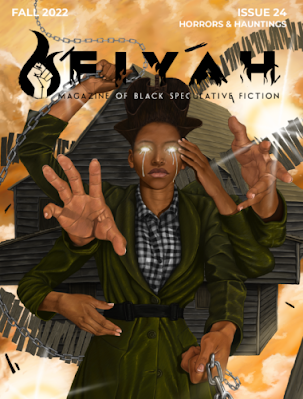
FIYAH Issue 24: Horrors & Hauntings

Continuing the belated Halloween Theme (it's nearly October!), FIYAH's 24th issue is long and it is good. "Girl Eats Girl" by Gnesis Villar kicks off with an emotionally charged sort-of friendship by two Black latinx teen girls trying to survive both their white town and the creatures living in the forest - which seem intent on changing at least one of them. Eden Royce is always a great name to see in a table of contents, and "Sugar Honey Iced Tea" is a fantastically creepy story about coming into work on a Saturday because the mediocre man who got promoted above you hasn't done his job properly. "Old Solomon's Eyes" features two plucky youths trying to negotiate with a demon who has taken up residence near their village, as the adults around them attempt less successful methods to deal with it. I love how this story plays with the morality of its characters, making both the inaction and the overreactions from various segments of the community seem damaging and the demon's perspective seem nearly sympathetic, while also coming down firmly on the side of "negotiating with demons is terrifying and tricky".

The final three stories all deal with family trauma in some way, like Tobi Ogirundan's story of two brothers and a terrifying childhood incident "In The Smile Place". "Chrysalis" by Aimee Campbell features a young person trying to break free of a family curse which has transformed their home into the lair of a spiderlike creature who claims each member of their family as its own as they come of age.  The horror here is claustrophobic and visceral, and it pairs compellingly with "Blooms of Sorrow" by Amanda Helms, in which a family garden becomes a hungry burial ground for all kinds of familial pain, from an abusive former husband to a daughter's struggle with untreated endometriosis. Both of these final stories offer some level of catharsis to their protagonists, which stops them from tipping over into pure hopelessness - so it's not all creepy doom and gloom. Read your FIYAH subscriptions, everyone.

Strange Horizons

I tend to read Strange Horizons fiction in no particular order, all at once, so the following are going to be from all over their 2022 publication list, but let's try some thematic association for this recommendation journey:

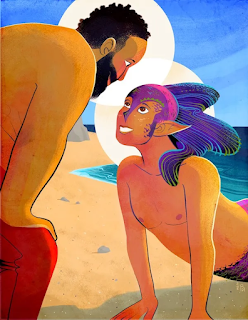
Artwork for "Intimacies"
by Dominique Ramsey
Start under the water, with "Intimacies" by Filip Hajdar Drnovšek Zorko, in which a hippocampus-merman and a widowed human overcome their respective cultural limitations and taboos to build an unusual family together. I love mer stories (pour one out for Mermaids Monthly, the best year-long magazine project a girl could hope for) and it's always nice when the differences in living circumstances are treated as something to be adapted to, rather than an insurmountable grounds for tragedy. Underwater tragedy is also great though, and the cyclical central tragedy of "Sister, Silkie, Siren, Shark" by Ariel Marken Jack is so painfully well-realised that it will probably make you scream into your hand. The story of a group of sisters who, like their mothers before them, are forced to give up their silike skins when they are sold to the men who come to their island, it traces out the things they are told at each stage of their lives to perpetuate a toxic cycle, and the moment at which they choose to break it.
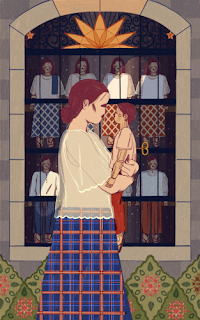
Artwork for "Clockwork Bayani"
(SEA special issue) by Gianne
Encarnacion


When you're finished crying from that depiction of matrilineal trauma, treat yourself to "Mother Hunger" by Mary Maxfield, which starts with a somewhat whimsical premise where daughters are assigned their mothers as teenagers and need to care for them until they get mothers of their own, and turns it into one long gut-wrench of a story about failures of care and community for a daughterless woman whose mother takes absolutely everything she can provide and more. After that, you'll probably be both hungry and in need of some lighter storytelling, so it'll be time to slip into the Southeast Asian issue with "Wok Hei St" by Guan Un, a heist where the steak could not be higher (because you're tossing it! in your wok! ...I'll get me coat). Stay in Southeast Asia to read... well, read all of it, but for the purposes of this recommendation journey, go with "Lay My Stomach On Your Scales" by Wen-yi Lee, with its story of teenage body awkwardness featuring a manananggal and the girl who has stolen her hands. Finally, finish off with another heartwarming spooky tale with "Embroidery of a Bird's Heart" by Nelly Geraldine García-Rosas, about a daughter whose ghostly grandmother comes over for lunch and guides her through a change of her own.

Questing Elsewhere

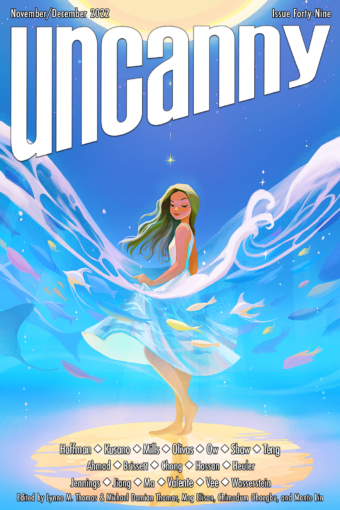
I'm tired of difficult stories about reproductive justice, because I'm tired of how much they hurt and how we still need them so badly. "Rabbit Test" by Samantha Mills (Uncanny Magazine Issue 49) hurts, and is badly needed, featuring the cyclical struggle for control over women's bodies with a focus on a future where intrusive surveillance is the norm. Make time for it.

While you're following the Strange Horizons recommendation trail above, you could take a left turn at Wok Hei St and go instead to Giganotosaurus' "Begging the Moon" by Eli Brown, the story of a woman sourcing ingredients for tom yam gung nam for a gang lord's birthday in a border city full of refugees and cut off from surrounding countries. It's thematically powerful, and making food the central driver adds a little touch of levity while bringing the city of Diyu to life.

Finally, I don't normally talk about the to-read pile in this column but two recent acquisitions demand to be mentioned. First, We're Here: The Best Queer Speculative Fiction 2021 (edited by Charles Payseur and L.D. Lewis) has a table of contents that easily lives up to its 2020 predecessor; starting with "The Captain and the Quartermaster", an outstanding and heartbreaking tale by 2020 co-editor C.L. Clark, is a great touch. Second, Song of the Mango and Other New Myths by Vida Cruz-Borja has a beautiful cover and a whole lot of stories I'm excited to dive into, alongside some of my existing favourites by the author (like the titular "Song of the Mango", which previously appeared in the "Beyond the Line of Tree" chapbook.

Will 2023 be a year of returning to more regular columns? I hope so! For now, happy reading and I'll see you when Hugo nominations open.


Tuesday, May 10, 2022

Review: Ignyte Awards - Short Story Nominees

The Ignyte Awards (created by FIYAHCON to shine a light on the vibrancy and diversity of spec fic) are my favorite awards, and short fiction is probably my favorite thing. What better way to spend my time than reading through what I was sure were going to stories that fired on all cylinders? And boy, was my certainty validated. My thoughts on all these masterful, deservedly nominated stories are below.

Center of the Universe (Nadia Shammas) is centered, of sorts, on Abigail who’s in a simulation in which she’s a real human and everyone else is virtual. But the story is not a simple exercise in solipsism. There are simulated people who vie to be seen—to exist under her gaze. And that existence is eventually seized through drastic measures. It’s a unique and fluid premise in which solipsism exists but the narrator is in the periphery of it—a premise that could convolute and crumble from a lesser writer. This is a story that kept me captivated – gaze locked on its words – through its pain. But also, its beauty, its poetry, and the sympathetic struggle of attaining meaning. While reading, it quite easily became the center of my universe.

Delete Your First Memory For Free (Kel Coleman) showcases the bumps in the road that anxiety presents with a story that is antithetically smooth. When Devin and their friends use technology that takes away specific, non-vital memories, their relationships start to change. Kel Coleman writes with such vigor that their writing style smooths over a lot. Not so different from how the developing themes of the story smooths over some emotionally charged situations. Additionally, the nuances in the interpersonal interactions with just about every character were so rich and fully-formed. This is a vital story to many people whose small enemies can feel as cumbersome as their major ones. It might be so instructive and critical to someone, that the memory of reading it would be hard to extract.

If the Martians Have Magic (PDjèlí Clark) offers an engaging story, but most importantly, it offers a WORLD that felt lived in and thoroughly explored, all while telling a pacy story. Martians are widely persecuted by humans--pigeonholed negatively because of some bad seeds in the group. But there’s a way to save those who mean no harm, and the protagonist Minnette is going to try her best to fulfill it in a rollicking, entertaining fashion. Martians do have magic, and everyone who’s read anything PDjèlí Clark has written probably knows he has a lot of it, too.

The Fifth Horseman (Martin C. Cahill) starts with The Four Horseman of the Apocalypse after they’ve “apocalypized” the world. But they have a sibling that they don’t know too well—the fifth horseman. And that horseman has someone additional work to do. That work is described in beautiful, lyrical prose that shows off the beauty of the world – as ephemeral as it is – along with a sympathetic backstory for the fifth horseman. There’s a sense of distance with her due to her circumstances, but there’s also some warmth that’s beautifully paired with the writing style that finds the beauty in the world despite its cataclysmic situation. I really dug this. The potency of the story’s descriptions alone is damn near apocalyptic.

The Tale of Jaja and Canti (Tobi Ogundiran) bears a little similarity to Pinocchio, but its wooden boy’s journey veers in engagingly unexpected directions. The tone is like a fairy tale and the way its split into chapters enhances that feeling. It has a spare word count but is able to do so much without feeling rushed or choppy. And without spoiling anything, the story is bookended in a way that’s structurally ingenious. Like the other Ignyte nominees, this story is a banger.

POSTED BY: Sean Dowie - Screenwriter, stand-up comedian, lover of all books that make him nod his head and say, "Neat!"

Monday, May 2, 2022

Questing in Shorts: Spring 2022

Hello and welcome to another edition of Questing in Shorts, the sometimes-monthly SFF short fiction roundup where Adri (that's me) recommends some of her favourite recent reads!

The last couple of months have been quiet for me on the short fiction front, as I've been catching up on longer reading after a big burst in January. But the past two weeks have been good to me, reading-wise, and I sure have some stories to tell you about! Let's get to it:


Fantasy Magazine, Issues 75 - 78 (January - April)

There are some really experimental flash fiction pieces across recent issues of Fantasy Magazine, and I'm left with not much to say beyond "that was cool" about a lot of them. "isio" by Martins Deep in Issue 78 is kind of poetry, but also not, and it riffs off a night of stargazing to create some really interesting imagery about childhood wonder and the mundanity of real life. My notes for "I have reached into the quantum baskets" by Marie H. Lewis (Issue 77) read, in their entirety, "Hades + Persephone but weird quantum shit" and I don't feel I can improve on that (it's good!). "Collecting Ynes" by Lisa M. Bradley (Issue 77) is also firmly in the weird but good category, and I just don't know what to say about "The Mirror Test" by Moses Ose Utomi (Issue 75), which tells the story of a pet dog being forced to take a bath in a way that makes you go "sure, that's an interesting speculative take on the subject". I like the vibes of weird flash, but I struggle to put review words down for it (for the same reason as I very rarely review poetry), so thank you to Fantasy Magazine for the opportunity to expand my skillset!

I'm on more solid reviewer ground with the short stories, and there's some great stuff here. "Slow Communication" by Dominique Dickey (Issue 76) is the story of Darla, who inherits a conversation with a Leviathan: an ancient, slow moving being that speaks once per generation to the women of her family, and allows them to ask one question to move their discussion along. Darla is under pressure to perform because of this lineage and the importance of her one question, but she's also under pressure to conform and maintain this line of women despite being genderqueer and desperate to assert her own identity. It's a great premise, solidly executed, and I really enjoyed watching Darla's journey. It's paired with "Cousins Season" by S. Fambul, a much darker story about family expectations and the labour we perform for our relatives even when it veers into exploitation.

A big recommendation also for "Christopher Mills, Return to Sender" by Isabel J. Kim, a very slice-of-life-y story about a teenage boy, murdered on prom night, who is brought back by his (now much older) twin sister so she can bring about justice for his murder. Christopher has become a demon and gone to hell, because he died in rage and pain, and what makes the story so fascinating is how his narration brings to life all the misery and unfairness and big feelings of dying a teenager and the circumstances of his murder, while portraying Christopher himself as relatively emotionless after his death. The challenging but satisfying resolution rounds off a great story.


Amazon Original Stories: Trespass Collection and Black Stars Collection

Despite having a Kindle e-reader, I very rarely buy things directly from the Kindle store and so it took a while for me to notice that Amazon has had two short story "collections" out in the last year: The Trespass Collection, out February 2022, features six animal-focused horror and fantasy stories, while the Black Stars collection from August 2021 features six science fiction stories from Black authors. The stories are packaged individually, but are free if you have a Prime subscription (guilty), so I read two thirds of them over the last week.

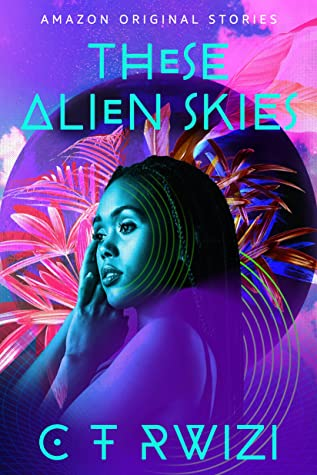
Both collections have great authors attached, and the fiction almost entirely lives up to expectations: in Black Stars, the only dud I've read so far is Chimamanda Ngozi Adichie's The Visit, which features a surface level matriarchy/patriarchy reversal that doesn't bring anything new to the table beyond "what if male oppression meant wanking was banned!" Fortunately, the other stories here felt a lot more thoughtful. I enjoyed 2043 (A Merman I should Turn to Be) by Nisi Shawl despite feeling there were layers of the story that I didn't quite understand, and C.T. Rwizi's These Alien Skies is a story about space exploration, connections, and grief which packs a ton of great concepts into its short length. And We Travel the Spaceways by Victor LaValle blew me away from concept to characterisation to execution. We follow Grimace, a homeless protagonist in New York City, as he tries to carry out a mission given to him by the empty drink cans he carries around. Grimace's narration is idiosyncratic but clear, his motivations as a "Signalman" always explained to us, even as the reader can see how unhinged his behaviour must seem from the outside; as he comes into contact with Kim, a trans sex worker who becomes Grimace's partner-in-crime, we begin to see how the world he inhabits might be part of something bigger. I loved it.

Highlights of Trespass include Carmen Maria Machado's academic-paper-as-story Bloody Summer, about a town in Pennsylvania with a tragic past and a higher-than-usual number of tiger related clapping rhymes (are they related? yes); Tochi Onyebuchi's epistolary missionary story, A Righteous Man (featuring hyenas and colonial reckoning), and the weird-in-the-best-possible-way The Backbone of the World by Stephen Graham Jones, in which a Blackfeet woman tries to deal with a prairie dog infestation outside her trailer. Instead of a warren of prairie dogs, though, she ends up dealing with a warren of time travel, grief, vengeance and alien horrors, at turns terrifying and touching. Bonus shout out to Horizon: Forbidden West, which taught me last month what a prairie dog looks like so I could imagine it properly.

In short, if you're still plugged in to the Amazon ecosystem, I recommend checking these collections out: the fact that they come individually packaged also makes them a great way to jump into short fiction without committing to a whole magazine or anthology (and they come with blurbs, so you know exactly what you're getting). I can't wait to catch up on the stories I haven't read yet.

Questing Elsewhere

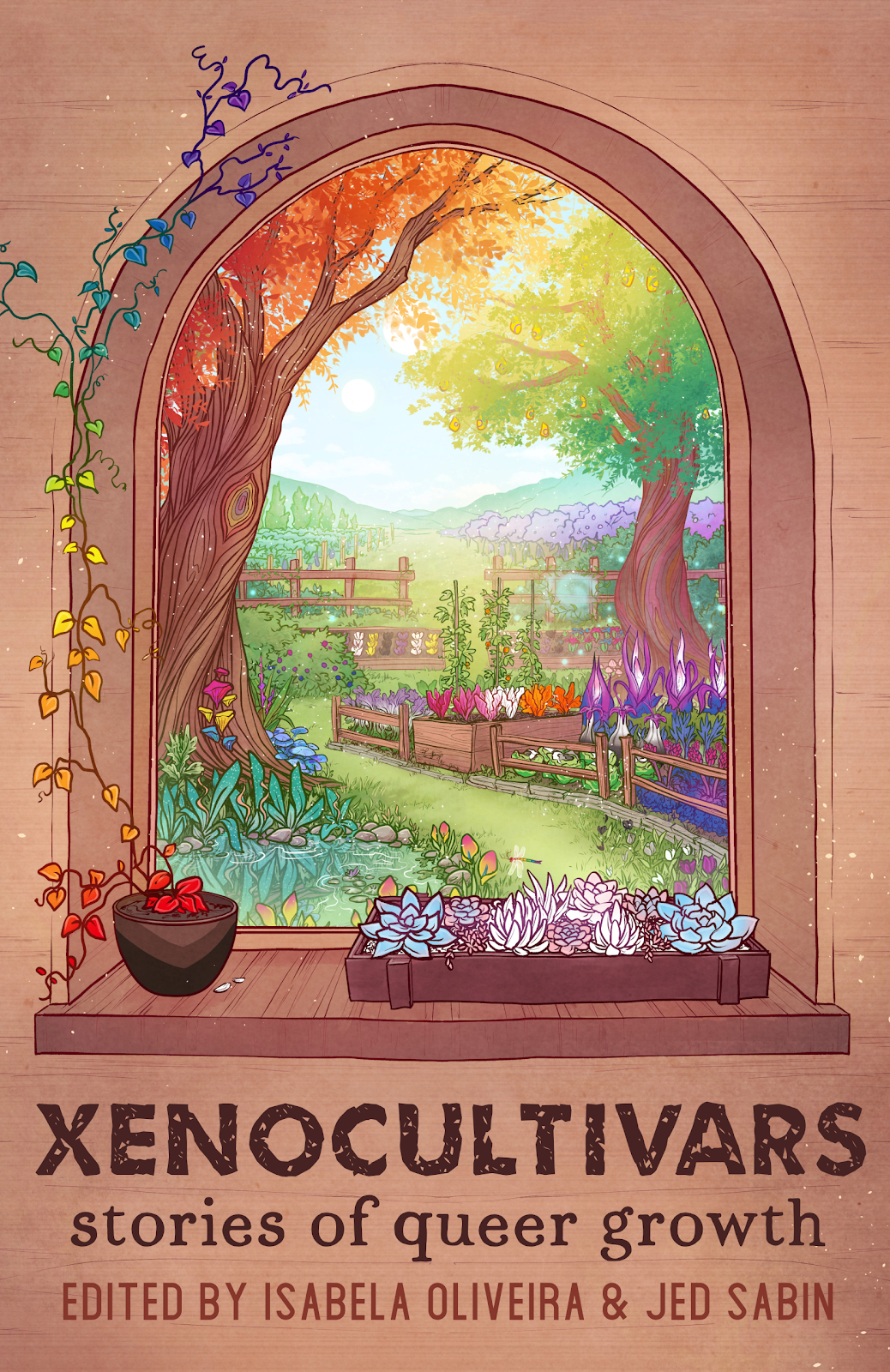
Xenocultivars: Stories of Queer Growth, edited by Isabela Oliveira and Jed Sabin, is a solid collection, the kind that hangs together so well around its theme that it becomes quite hard to highlight individual stories that stand out. As of today, I'd point to the metafictional ingritue of P.H. Lee's "This Story is called 'The Transformation of Things'", Jennifer Lee Rossman's witchy fairytale riff "The Princess and the P. Sativum", and the researcher-student relationship in Hanna A. Nirav's "Reclaiming Our Roots", but ask me another time and I'd probably pick three completely different stories to tell you about. It's worth checking out It Gets Even Better, the previous anthology by Speculatively Queer, as they're doing consistently good work.

Beneath Ceaseless Skies' science fantasy issues are always worth a look, and issue 349 has a great line-up: Jason Sanford's "Blood Grains Scream in Memories" is the conclusion to their sequence of Blood Grains stories (published annually in previous BCS science fantasy issues!), pitting his assembled caravan of protagonists against the overwhelmingly powerful adversary intent on wiping them out in a world dominated by nanotech which kills most humans who stay in one place for too long, in service of environmental protection. It's not the place to start with this universe (that would be "Blood Grains Speak Through Memories") but it's great to see this sequence come to a satisfying end. Yoon Ha Lee's "Bonsai Spaceships" is also excellent (it does what it says on the tin, with a plucky young apprentice protagonist leading the show), and "Rich Growth" by Aliya Whiteley is a beautiful story of death, growth and gemflowers.

Finally, in FIYAH 21, I had a great time with "From Earth to Io, With Love" by Adelehin Ijasan, in which a man teleporting across the solar system for work gets caught up in a nightmare-inducing system glitch which exposes the grim realities of the technology. Ijasan's tone is light and wry throughout the horrors being narrated, which really drives home the capitalist bureaucracy Idris finds himself in.

Adri (she/her), Nerds of a Feather co-editor, is a semi-aquatic migratory mammal most often found in the UK. She has many opinions about SFF books, and is also partial to gaming, baking, interacting with dogs, and Asian-style karaoke. Find her on Twitter at @adrijjy

Friday, July 30, 2021

Questing in Shorts, July 2021: Lovely Weather for Shorts

 Ahoy, fellow readers! Welcome to July’s Questing in Shorts, where I round up another month in short fiction reading and tell you all about the things I enjoyed (or sometimes didn’t). This month, I’m filling short fiction notebook number 2, which is this beautiful purple number with a whippet on the cover:


Notebook number 2 is a little beaten up from coming to my brother’s wedding (it also has an "items to pick up from the house” list written in the back) and unlike last month, I didn’t manage to fill an entire book in a few intense days of short fiction. But I’m over halfway through filling it, and the magazine folder is looking less intimidating than it has in the past, so that’s all good.

Besides the notebook, the other news is that I’m once again a judge for the British Fantasy Awards this year, and this time I’m judging in the Magazines and Periodicals category! Most of the finalists involve short fiction in some form and there’s a mix of venues I’m familiar with and those that are new to me, so I’m really looking forward to exploring what all of them have to offer.

Fantasy Magazine


Let’s kick off with a new-to-me publication! Fantasy Magazine was kind enough to send me their July issue, with a quartet of stories whose unifying theme seems to be “a bit spooky”. Lulu Khadim’s “A Softness of the Heart” is a sweet ghost story about Louise, a girl who lives with one aunt and is advised by the ghost of another. I love a cosy matter-of-fact ghost story and this one delivers a family story with just enough interpersonal prickles to make its resolution satisfying. “There Will Be A Question and Answer Period After Your Inevitable Demise” by Marika Bailey reimagines the afterlife of an archetypal hero, putting the classical portrait of masculine prowess on a conference call where he must hear from the “monstrous” women who suffered as a result of his deeds.

My favourite story of the issue is “I Would”, by Benjamin C. Kinney, a great piece of secondary world fantasy from the perspective of a seer imprisoned by a bandit queen. As the seer navigates possible futures with two visiting women, who themselves are trying to escape her captor, she has to work out what is possible and what she – as someone used to thinking of herself as powerless – needs to do to make it happen (and maybe to end up kissing one of them at the end). The diverging future paths are a great device, one which really captures the feeling of someone trapped and desperately seeking their only path towards freedom.

FIYAH


Issue 19 of FIYAH is "Sound and Color", and within that theme lies five quite different, vibrant stories. I almost wish I’d covered this one last month because then I could have remarked upon how excited I was to come across “Lungs” by Lily Watson so soon after reading “Concerto for Winds and Resistance” by Cara Masten DiGirolamo, which I covered in June's roundup. Where DiGirolamo’s piece uses an orchestra to tell a broader story (and drops the curtain as soon as the first “real” note is played), Watson’s really focuses on bringing to life the magic of collective music, its string group overcoming the challenge of the piece before them (and their own hierarchies) to bring a God to life. Evocative stuff.

This issue also has "Meditations on Sun-Ra’s Bassim" by Yah Yah Scholfield: I loved Scholfield’s last story with FIYAH and this one is just as excellent, a one-sided epistolatory narrative from a space traveller to her sister back on the planet where they grew up. Even though we only get one sister’s voice, the story evokes such a rich family bond between its two leads, full of snarky affection and yearning for connection both across physical distance and the experiential gap of their very different lives. The story’s journey goes super well with the other two – significantly more tense – journeys in this issue: “Morning”, by Diane Russell, features a girl and the clone of her sister sent on a hopeless mission in a failing space colony, with all the pain points that suggests, and Where the Sky Becomes Milk by Jamie McGhee is a backwards story of a boy trying to find his way home through a difficult sequence of locations, the purpose of his journey unfolding as we get closer to its beginning. And to round off the issue, L.A. Knight’s story offers a great speculative take on disability, work and escapism, with a disabled jobseeker who fails to find work that will appropriately accommodate them - until approached by the supernatural entity responsible for creating portals to other worlds.

Podcastle


Not only did I read some stories with my eyeballs this month, but I also listened to two of them via the magic of the podcast! Both "Three For Hers" by Filip Hajdar Drnovšek Zorko and "Pull" by Leah Ning are original to Podcastle, and both offered very different listening experiences. The latter is a quietly tragic slice of life story about an old man caring for his ill, superpowered wife (I’m pretty sure she is supposed to be a siren?) who can “pull” people around her into doing things and also into dreamscapes and memories – a dangerous thing to happen when implied dementia is taking away the shape of those memories. Three for Hers is a highly atmospheric fairytale-like story, about a woman in an occupied land who goes to work for a vicious, abusive Margrave who insists that nobody around him show emotions. Vida’s experiences in the Margrave’s services, and her quest for revenge, all come to a very satisfying conclusion. As you’d expect, the narration is excellent too.

Other Highlights

Two longer stories from other publications really grabbed my attention. The first is Kuemo of the Masks by Naomi Libicki, in Giganotosaurus. A troupe of players are captured by bandits and pushed to put on a show, using the special, magical masks that the protagonist’s mother had left her for just such a dangerous occasion. Of course, neither the masks – which represent archetypal deity figures whose stories are told in the plays – nor the bandits are who they seem, and everything takes a real turn once the story ends up in the underworld. The narrative voice – and the implied story-within-a-story structure, which we only get clarity on at the end – are both great in this one.

In Beneath Ceaseless Skies, The Witness Bruska Lai by Aaron Perry (issue 333) grabbed and held my attention through a dense, high-context mystery in a world where all dead and future royalty live in a single palace, designed so they can keep separate but simultaneous spaces through the different ages. Perry not only sets up a very weird story setting in a straightforward, reasonable way, but also creates a mystery – that of a missing Princess – that only makes sense with the context of that worldbuilding. It’s brain bendy, but it works brilliantly, and I loved the imagery of the complex, colour-coded palace and its supposedly genius inhabitants.

Two stories in Uncanny Magazine Issue 40 stood out for me: "Unseelie Brothers, Ltd." By Fran Wilde, which has outstanding worldbuilding and some very imaginative sartorial creations all in the context of a fae dress shop whose dresses are beloved by high society regardless of price; and "Heart Shine" by Shveta Thakarar, whose overlooked protagonist gets a firefly prince to remind her of her own worth. Both hit me directly in the feels and have some wonderful character relationships to watch out for.

Finally, I resubscribed to Fireside Magazine this month after a couple of years away, and July was a really intriguing point to restart with its quartet of mostly-future dystopian concepts riffing on inequality and injustice and how our societies shape the value of human beings. There’s an intriguing set-up and a very satisfying payoff in Ann LeBlanc’s Across the River, my heart, my memory, a story of stolen sentient organs, and Forest Thing is a creepy look at academia and environmental catastrophe, told through the eyes of a Black student ostracised by her peers and suffering the effects of living in a poisoned environment – though, again, the payoff is one of satisfaction and belongong rather than lingering on body horror. I’m intrigued to see what August brings.


Thursday, April 30, 2020

Questing in Shorts: April 2020

Happy Thursday, friends! April has been a month of ups and downs but I'm tentatively celebrating the return of my reading mojo to, if not normal, then at least to an acceptable pandemic level. I've been a little low on magazines this month, but I do have a full length round-up for you and I'm once again making the resolution to give my full-to-bursting Kindle magazine folder some love in the next month.
The Hidden Girl and Other Stories by Ken Liu (Head of Zeus, 2020)

Ken Liu's fantasy series and translation work are both very familiar to me, but I've experienced less of his short fiction - so when the opportunity arose to own this super colourful collection (seriously, my copy is an orange hardcover with purple sprayed edges - it doesn't get more delightfully clashy than that) it was not in my power to resist. What I got was a wide-ranging collection with an interesting focus on the development of artificial consciousness and how humans might look at the singularity from both sides of the technological divide: what we gain from technological advancement, and what we might leave behind. Stories from the nested tales of interplanetary adaptation of "Ghost Days", to the slow decaying heartbreak of "Staying Behind" to the surprising time dilation of "Seven Birthdays" deal with migration and intergenerational communication, giving both older and younger generations things to offer to each other even when the characters themselves don't realise it. A couple of interesting shared universes (or maybe one big shared universe?) offer continuity within the middle part of the collection: in particular, the trilogy of "The Gods Will Not Be Chained", "The Gods Will Not Be Slain" and "The Gods Have Not Died In Vain" tell the single story of a girl who has lost her technological genius father, only to rediscover him via an emoji-heavy chat programme, once again looking at communication across a gulf but in a very different way to the classic "parent child" dynamic. There's also an apparently shared conception of the singularity which offers a very human, understandable sense of what it might be like to be a consciousness that no longer lives in the human world. I'm not sure I'm ready to live in a fourteen-dimensional hypercube myself, but Liu's vision of our possible technological future makes it feel like something tangible and lived in, rather than acting as the death of all we currently hold valuable.

There are some fantasy stories here as well, including an excerpt from the final book in the Dandelion Dynasty trilogy (a satisfyingly standalone piece, but I'm now even more impatient for 2021), the intriguing "Grey Rabbit, Crimson Mare, Coal Leopard" about a trio of shapeshifters, and the title story, "The Hidden Girl", in which the youngest of three sisters raised as assassins decides, on her first mission, to save her target and defeat her siblings instead. All in all, this is exactly the level of accomplishment I'd expect from Liu, and I'm already making plans to hunt down his first collection and stuff that into my eyeballs someday as well.

Giganotosaurus: February, March, April 2020


Three stories over three months for the dinosaur semiprozine: February brings "Thin Red Jellies" by Lina Rather, the story of a near future where it is possible to save and reimplant a human's consciousness after their death, either in an artificial body or compartmentalised into the brain of another person. When Amy's girlfriend Jess dies in a car accident, she offers her brain as a stopgap, but the long-term solution for two young women without good health insurance in a future USA is further out of reach than they thought. It's a story which deals with intrusion: the challenges faced by both women as they adjust to life and communication in one body, the accommodations and sacrifices each has to make for the other, and the horrifying assumptions which a privatised health system and the companies which own it make about workers' autonomy and quality of life. Rather doesn't pull punches about what this does to Jess and Amy's relatively new relationship, and the story's abrupt ending doesn't offer much in the way of catharsis but it does underscore the inescapable nature of their situation.

March's story, by ZZ Claybourne, is "The Air in My House Tastes Like Sugar", a very atmospheric piece about nomadic witches : very atmospheric story about a family of nomadic witches whose youngest member, Amnandi, is trying to overcome the loneliness of her situation. And April gives us "A Wild Patience" by Gwynne Garfinkle, a story that literally had me grinning from ear-to-ear in the first twenty percent once I realised what was going on. In a town where a large number of men have always had perfect, home-making wives, things start to get a bit... messy... when the doctor dies, and Gretchen and Jessica suddenly find their Mom is more interested in reading the poetry of Adrienne Rich and discussing self-actualisation with the other mothers than fulfilling her role. Turns out, there's a semi-secret robot-wife cult in town, and neither the mothers themselves nor their daughters and the other women around them are interested in keeping the mens' dirty little secret. What I enjoyed most about this story was the focus on Gretchen and Jessica's wellbeing and the caring, if different, relationship they build with their Mom once her secret is revealed; every attempt at the men in the story to reclaim authority and project threat is laughed off and non-violently swatted down, leaving the misogynists of the story looking ridiculous and exposed as their "perfect" lives cease to be.

Summoned to Destiny Ed. Julie Czerneda (Fitzhenry & Whiteside, 2004)


I've had this cute looking older anthology on my physical TBR for a while, having picked it up as an impulse buy in Forbidden Planet back in the days when in-person book browsing was a thing. It finally called to me last week, and I discovered a fun fantasy collection of shorts that deal in some way with coming of age or call to action moments for their various protagonists, from magical awakenings to bardic apprenticeships to rituals of power. That focus on the call to action lends itself a little bit to a "the end of the story is where the novel would begin" sequence, and while none of the stories explicitly end with "they smiled: there was so much work to do" - my least favourite story ending ever - it felt like a close thing. But there's a great range of worldbuilding (especially when it comes to developing the sacred) and character development here which overcomes the sense of reading a series of prologues, and makes this an intriguing collection in its own right.

The story I enjoyed most is by far the longest in the anthology: "The Colors of Augustine" by Michelle West (Michelle Sagara). This is the story of Joseph, an orphaned boy in a world where some people are able to paint visions of the future, who discovers he is talented but whose colourblindness (and implied neurodivergence) makes use of that talent challenging without the constant help of his friend Caroline. When both are picked up for an apprenticeship by another member of the Augustine Painters (and a former orphan himself) they are thrown into a world with a mixture of magical and mundane threats, and pushed into service to try and avert danger to the King while also staying alive themselves and protecting Caroline from a predatory Count who has his eyes on her. Unlike many of the other stories, which focus on a single unique young person finding their way into life-changing situations, West's story explicitly focuses on the relationship between Joseph and Caroline and the way that they support each other to shape the future together. While it's Joseph who is more outwardly "special", Caroline's role in the story and in his success, and her own independent strengths, are treated with constant respect by other sympathetic characters and by the narrative itself.


FIYAH Literary Magazine Issue 14


No novelette in this quarter's unthemed issue of FIYAH, but four interesting short stories that range from epic fantasy to cyber thriller via a pair of urban speculative stories that straddle each side of the science/magic divide. On the fantasy side, Tobi Ogundiran's "Guardian of the Gods" packs a great deal of adventure into its short length, telling the story of Ashâke, an acolyte who has been left behind by her classmates because she can't hear the gods. When she learns the forbidden truth behind the place she's been brought up, Ashâke has a crisis of faith and returns to right the wrongs she feels has been done to her - only to find out the truth isn't nearly so straightforward. I could happily read a full novel set in this world, and the same goes for the issue's other fantasy story, "Your Rover is Here" by LP Kindred, which offers a high-action magical altercation in an urban fantasy world where bigotry and economic inequality looks much the same as it does in our own. The 2,000 words of this story do an amazing job of sketching a world with various types of magic, political structures at play, and putting an interesting character at the heart of it all.

On the science fictional side, "A Terminal Kind of Love" by Veronica Henry is the story of a tech genius who is in the process of divorcing her unfaithful husband, who unfortunately also happens to take away the company they helped build together. When Athena tries to get her revenge, it winds up not working exactly to plan and brings their problems to a head in an unexpected way. While the prose in this one is a little "explain-y", the emotional weight of the situation is well handled and I liked the touches of Freetown in the setting. "Uniform" by Errick Nunnally rounds out this quartet with another deeply emotional story, this one about a Marine veteran who was turned into a mechanised soldier following fatal injuries, and who is now attempting to find his place in a world where he is regarded as a killing machine. The story turns from a touching slice of life moment to an unexpected opportunity for heroism, and while the ending feels a little neat, it still allows the protagonist a moment of choice and recognition which allows it to be earned and for some of the themes of the story to be laid to rest.

Bonus Round: Prose and Politics


Over the past couple of months, I've read some interesting works that combine fiction and non-fiction in different ways. Europa28, edited by Edited by Sophie Hughes & Sarah Cleave from Comma Press, incorporates fiction that ranged from dreamy slipstream to continental personifications to mythical retellings within a set of mostly non fiction essays, all written by women from different countries in Europe. It's a tricky book to review in this context, as none of the fiction entries really stand up on their own as stories; what makes them interesting is how they juxtapose with the memoirs and analyses of other parts of the collection to build up a patchwork of perspectives that coalesce into a snapshot of a complex, fractured continent grappling with ghosts of the past and the inequalities of today. It may just be the cynical former EU intern in me, but the project of creating shared European cultural identity can be prone to simplifications that are cringey at best, and enormously problematic and neo-colonialist at worst. Europa28 does occasionally veer into cringe (the story "In Human Form", about an entity coming to Earth to learn about what it is to be "Europe", and the extended metaphor of "Europe as a house" gave me the feeling most persistently) but it's more than balanced out by the nuance in many of the more geographically focused pieces, and I particularly appreciated works from Eastern European perspectives which are less regularly heard in English-language conversations.

I've also made some progress on my resolution to read more of PM Press' Outspoken Authors series, a series of short collections or novellas which combine fiction, non fiction and an interview from a particular author, often highlighting work that hasn't been collected elsewhere. Nisi Shawl's Talk Like A Man is one such collection and one of the series' more recent titles, bringing together a handful of short stories, a long essay on the relationship between science fiction and religion through the lens of Shawl's practice of Ifa, a West African religion, and a long, wide-ranging interview with series editor Terry Bisson. The setup here is more "traditional" with non-fiction coming after the fiction, but there's still a sense of getting to know an author over the course of the collection that feels qualitatively different somehow from reading a normal collection, despite the shorter length. The highlight of the fiction pieces here was "Walk Like a Man", a story that combines a gritty, aggressive version of female adolescence with a cyberpunky aesthetic exploring reality, relationships and belonging.

Posted by: Adri, Nerds of a Feather co-editor, is a semi-aquatic migratory mammal most often found in the UK. She has many opinions about SFF books, and is also partial to gaming, baking, interacting with dogs, and Asian-style karaoke. Find her on Twitter at @adrijjy.