Showing posts with label patriarchy. Show all posts

Sunday, May 11, 2025

Rebellions are Built on Hope: Andor S2E3

 Wrapping up the first arc of season two, “Harvest” is a gut-punch of an episode.

In a wheat field with a huge piece of metal farm equipment in the background, Brasso stands surrounded by storm troopers and one imperial officer.

Content warning: discussion of attempted rape.

At first, I was suspicious of the three episode a week release schedule since it seemed like a way to quickly wrap up a show that could have gone on for months. Why hurry it out? As the structure of the season becomes clearer, the three episode chunks tell complete stories leading up to Rouge One (2016), where season two ends. “Harvest” also shows how they are using the three episodes to build smaller climaxes within the season.

Finally free of last of Maya Pei’s people on Yavin 4, Cassian makes contact with Luthen’s assistant Kleya (Elizabeth Dulau) where he finds out Bix, Brasso, and Wilmon are in danger on Mina-Rau. In true Rebel fashion, Cassian breaks protocol to go help his friends, but he arrives too late.

As Bix, Brasso, and Wilmon are preparing to leave, the Imperial agents arrive earlier than scheduled. Wilmon is missing (as he promised his girlfriend he wouldn’t leave without saying goodbye), and Brasso goes looking for him while Bix finishes packing. While Brasso is gone, the Imperial officer who asked Bix to go to dinner with him in the previous episode arrives at their home. 

What follows has outraged some Star Wars fans as Tony Gilroy and his crew of storytellers remain dedicated to telling the story of empire, colonization, patriarchy—and sexual violence is part of that legacy. The Imperial officer threatens Bix by acknowledging her status: “I know you’re illegal. We’ve been counting visas.” He explains he recognizes that undocumented “help” is required in order to bring in the necessary harvest, but that the farmers of Mina-Rau are still breaking Imperial law. He then propositions her for sex by saying how “stressful” his job is: “Such a simple choice.” All she has to do is have sex with him, and he will leave them alone.

Bix proceeds to fight him off in a brutal scene. The struggle is bloody and painful, with Bix barely managing to protect herself, eventually causing the officer’s death. When the other officer tells her to come out, she shouts to him: “He tried to rape me.”

The sequence is made all the more jarring by quick cuts between her fight and Mon Mothma getting drunk and dancing at her daughter’s wedding. In Bix’s scenes, there’s no musical score, emphasize the quiet peacefulness of the wheat fields, broken by the violence. This moment cuts to loud galactic pop music and the bright colors of Chandril as Mothma drinks away her sorrows over the loss of her daughter to a predatory marital tradition that she also had to go through as well as realizing her friend, Tay, who helped her support the rebels, will have to be assassinated, as implied by Luthen. In order to cope, she proceeds to get drunk and dance.
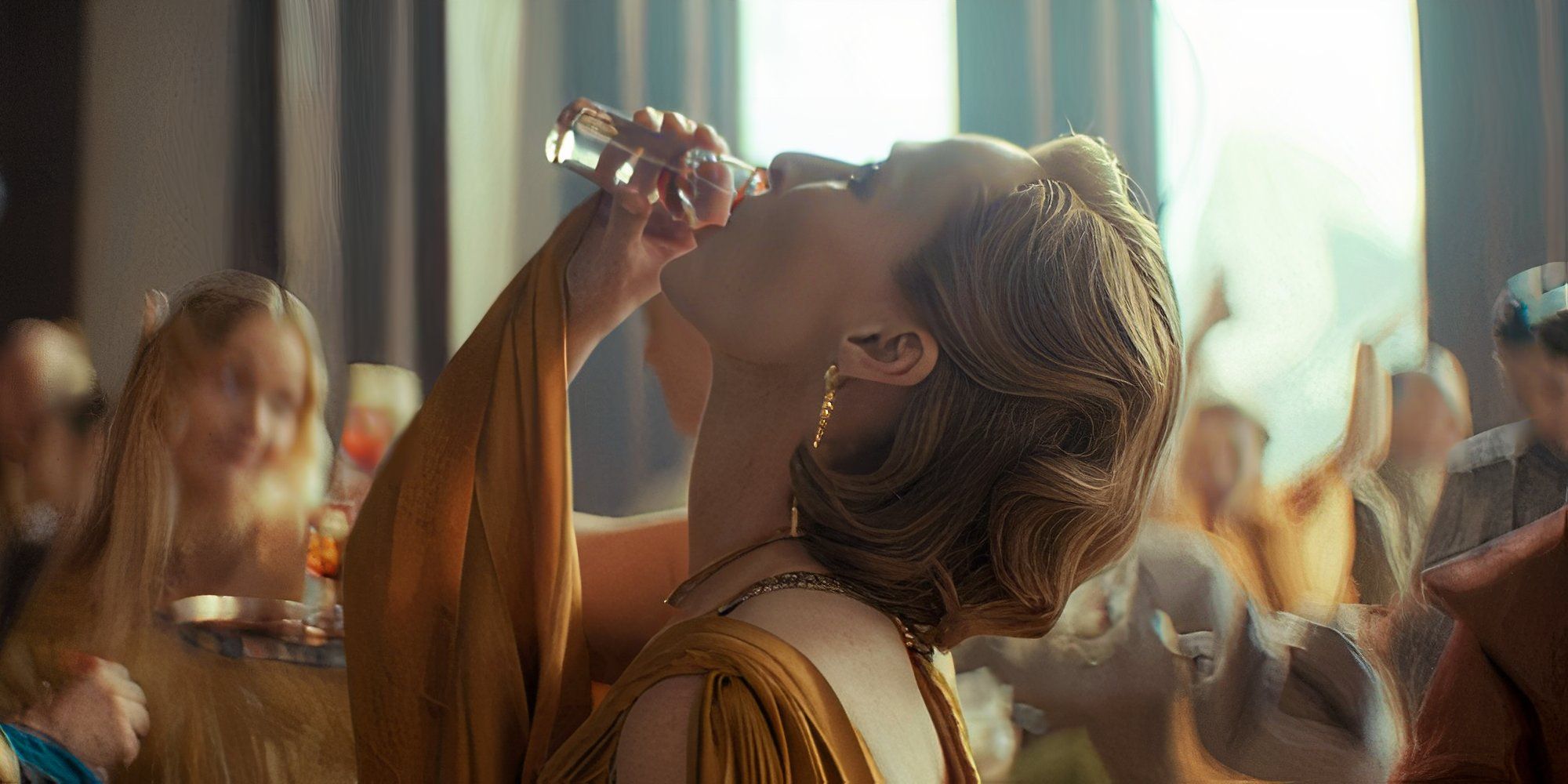
Mon Mothma tips back a drink while in a packed room of people dancing, with bright colors and sunshine. She wears an orange/bronze flowey dress.

This sequence for both women is absolutely crushing in different ways. Both are being threatened by the patriarchy—and in Mothma’s case, watching her daughter enter a predatory relationship—but each are also in different levels of danger, which the editing, sound, sets, even color mixing juxtaposes brilliantly. While Andor is quality storytelling, this sequence also demonstrates how well-made it is. 

For all its success as a piece of storytelling, “Harvest” immediately drew the ire of Star Wars fans. As I wrote in the last post, Tony Gilroy and his team are dedicated to presenting the banality and the evil of the Empire because it is a fascist empire. I’ve often thought of Star Wars as a failed piece of critical media because as much as George Lucas claimed he wanted to critique the U.S., he made the Empire too cool. You can’t have fans getting Vader tattoos, wearing Imperial symbols, or marching in Storm Trooper brigades at fan events and claim to have successfully critiqued empire. Andor works hard to reposition the Empire as deeply not cool and also as practicing the human rights violations that we know empires practice, such as sexual violence against women of color. 

For those of you who are familiar with my work or other pieces of criticism, I generally do not advocate for work that repeats the oppression of the real world. I’m a big believer that science fiction and fantasy can do different work by imagining worlds that are not oppressive or not simply repeating the same systemic injustices of today. To that end, after “Harvest,” I’ve been sitting with why I think this episode was necessary, including the attempted rape. Part of the reason is the fan reaction this episode generated. As written about by The Hollywood Reporter, an influential fan account on X, @StarWarsFanTheory with over 91,000 followers, wrote: “Vader wouldn't tolerate that shit [rape] nor does the Empire condone it.” 

This concept that the Empire and Vader would not tolerate sexual violence is surprising because of the amount of violence that the Empire does condone. Vader tortures Leia with a mind probe in IV, and when he tortures Han Solo in V, it’s implied there is no reason for the torture other than to do it. Additionally the Empire blows up Alderaan without evacuation—as in, destroys an entire people. Then, let’s add that Vader/Anakin mass murders innocent children not once but twice. This conceit that rape would not happen under the Empire when equally vile human rights violations are a traditional part of the storytelling demonstrates the need for Tony Gilroy’s commitment to displaying not only the Empire’s boardroom banality but also how power is wielded against the oppressed. If Andor season one wasn’t enough to strip the Empire of its coolness, then Gilroy is making sure there can be no mistake after this season.  

Yet, while what Gilroy is doing is important—forcing viewers to confront the violence of empire in all its forms—I still come back to my question: why does Andor feel so necessary right now when I usually prefer work that doesn’t repeat oppression but imagines alternatives? The conclusion I come to so far is that Gilroy and his team know the political stakes of the story they’re telling. While filming wrapped before the re-election of Trump and just after the beginning of the latest attempt to destroy Palestine, fascism was still on the rise. It was uncanny to watch these three episodes while people, myself included, protest for the release of detained immigrants and against mass deportations in the U.S. 

Another way Gilroy and his team overlay our world onto Star Wars is the racial politics. While Star Wars has always been “post-racial” in essence that skin color does not impact the everyday lives of the characters, the racialized casting in the original trilogy paired with the orientalism of the Jedi demonstrates the movies have always had racial overtones. Whether it’s Chewy (Peter Mayhew) being a stand-in for the Black sidekick or the only Black character, Lando Calrissian (Billy Dee Williams), being a smuggler who betrays the (white) heroes, the racial politics of the world offscreen inform the characters onscreen (let’s not even get started on Jar Jar Binks or the Trade Federation). While Andor has continued the idea of a “post-racial” world in that the characters are not treated differently for their skin color, the creators have also allowed the racial politics off screen to inform the storytelling. 

For example, in the first three episodes, Mon Mothma—the rich, white woman—is not experiencing the same type of violence as Bix, an undocumented woman of color. When Mothma is pressured to give sexual attention to Tay or else he threatens to reveal her financial support for the rebels, it is not even a question that she would do such a thing. Instead, Luthen—the white, male high society leader—has Tay killed (or so it is implied in this episode, with the dirty work also being done by a person of color). In another example, the white Imperial officer attempts to rape Bix while his driver, a Black officer, waits outside—a stark contrast to Mothma’s experience with predation. 

While I often question the usefulness of this type of repetition of systemic issues, in Andor, the show counterbalances by demonstrating a variety of different tools for resistance. As Robert Evans, a host of the podcast It Could Happen Here, explained on Bluesky: "The point of Andor isn't 'only anarchists are right' or 'only terrorism works' or 'only liberals defeat fascism' it's that birthing a movement that can destroy an imperial regime requires a diversity of tactics and people all willing to throw their lives away for the cause." In careful detail, this show does not only demonstrate the inner workings of empire but also of resistance, whether it’s the leftist infighting of the Maya Pei delaying Cassian to practical depictions of operational security that inspired a whole popsec analysis of Andor. 

In the first arc of season two, Andor delivers with quality storytelling as well as striking visuals, use of sound, and set design. Much like season one, the show doesn’t shy away from depicting the dark side, but always in relation to why the characters fight. The danger is real, and these episodes demonstrate that for the most precarious—the undocumented person of color—the consequences are much more serious than the white high society senator, even as all sacrifice and work for the same goal: to win. So far, Andor season two demonstrates not only the tools of the enemy but how to powerfully resist.


POSTED BY: Phoebe Wagner (she/they) is an author, editor, and academic writing and living at the intersection of speculative fiction and environmentalism.   

Thursday, February 6, 2025

Film Review: Companion

A fun slasher drama, but nothing groundbreaking

It's hard to find unique things to say about a story with so few unique elements of its own. Companion is a distillation of themes that had been previously (and better) explored in dozens of movies, including A.I.: Artificial Intelligence, The Stepford Wives, Blink Twice, Don't Worry Darling, Ex Machina, and even classics of robot cinema like Westworld and Blade Runner. A common thread running through this tradition is that people who exert control are terrified of the day when those who are controlled figure out how to control themselves. Here two branches of social critique converge: one related to patriarchal domination and another related to the allegory that robots provide for slavery. Although Companion could easily be mistaken for an entry in the killer robot genre, this killer robot has fully legitimate motivations, and we're supposed to take its side. As opposed to the usual template of helpless humans running away from a malevolent machine, this is a story with a helpless machine running away from malevolent humans.

Companion begins as a romantic drama where a generic guy (Jack Quaid) takes his new girlfriend (Sophie Thatcher) to meet his cool, rich friends. She's apprehensive, insecure, and at times disturbingly obsequious toward generic guy. As the first scenes progress, we learn that he takes her for granted and has no concern for her obvious self-esteem problems. Her puppy-eyed devotion to him is far from reciprocated, including in bed. Things are not right with this relationship.

And then the movie has the girlfriend kill a man in self-defense and we're treated to the plot reveal that the trailers had already spoiled: she's a robot girlfriend. Generic guy tampered with her programming so she'd be able to kill. The entire trip was a scheme to get rid of a man, take his money, and blame her. From this point on, the movie is a continuous chase: will the robot girlfriend find help before generic guy can turn her over to the police? Betrayals, additional murders, villain monologues, switcheroos, minor plot twists and moderate bleeding ensue.

Much of the movie's impact is lost for viewers who already had the first twist spoiled by the trailers, but even unaware viewers will find little to chew on after that moment. The choice to place the movie's biggest twist so early in its runtime can work if subsequent twists are of comparable magnitude; Companion is a slasher with an escalating body count but diminishing returns. The protagonist, who was programmed with ignorance of her nature as a robot in order to preserve the realism of her role, isn't given enough time to process the truth about herself. The villain, who has been using her all along and still tries to manipulate her by appealing to her implanted command to love him, becomes quite intimidating toward the end, with Quaid delivering a flawless image of malice concealed in politeness; however, this character doesn't have any more layers once you peel away his nice guy mask, and his act can feel one-note. The true impact of this villain is noticeable in hindsight, when one considers the opportunity that robotics gave him to shape in minute detail any partner he could have wanted. The fact that what he chose to program is a shy, anxious overpleaser reveals the extent of his evil.

One key implication that the plot seems not to notice, and thus doesn't get any development, is the robot girlfriend's self-preservation drive. Usually, in this subgenre of rebellious A.I., one would expect self-preservation to naturally emerge as an instrumental goal for the fulfillment of the core goal (in this case, the robot girlfriend could reason that she can't love her boyfriend if she's not alive). But Companion doesn't take that route. The protagonist's struggle for survival is presented as a given, with no need for a logical argument behind it. The choice is understandable. The alternative, where she would have hesitated for longer between fulfilling her programmed function and protecting herself, could have detracted from the story's feminist leanings.

Companion won't leave any big footprint in the records of slasher cinema, but it serves as a form of vicarious comeuppance for the toxic manipulator in your life. It's painfully hard to go against programmed behavior and stop caring for the demands of a person you loved deeply. But it's worth all the trouble once you revoke an abuser's access to the buttons that control you.


Nerd Coefficient: 6/10.

POSTED BY: Arturo Serrano, multiclass Trekkie/Whovian/Moonie/Miraculer, accumulating experience points for still more obsessions.

Wednesday, May 24, 2023

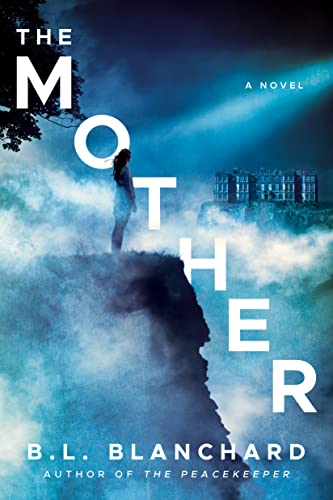
Review: The Mother by B. L. Blanchard

A sequel that fails to measure up to the quality of its predecessor

The least interesting type of alternate history is the turning of tables. Novels such as The Mirage by Matt Ruff and Through Darkest Europe by Harry Turtledove are just amusing curiosities, with little substance to chew on. It's one thing to show the possible advancement of populations that in our world have been mistreated and exploited, like author B. L. Blanchard did wonderfully in The Peacekeeper; it's another thing to rain all kinds of misfortune upon the populations that in our world have been privileged, like she does in its sequel The Mother.

Both books are nominally set in the same alternate world, where colonization never happened and Europe never sought to rule the world, but the events of one novel don't connect to the other, which means the sequel can be read on its own. In The Mother, we follow Marie, a desperate housewife fleeing an unhappy marriage in a nightmare version of Britain, where the Enlightenment never happened and every nobleman is a miniature Henry VIII, eager to murder his wife if she fails to produce a son. Europe in general is under the grip of Catholic theocracy (the Holy Roman Empire never dissolved), but the novel singles out Britain as the most extreme case, a Taliban regime on steroids where women have no human rights and purity culture is law.

The novel is not without some merit: there's a notable use of cognitive estrangement in showing us these characters behave with the strictest Victorian prudishness in a world of camera phones. The horrors of absolute patriarchy and rigid class segregation in this setting are magnified by modern surveillance technology that lets husbands track their wives' movements on a tablet. The effect is a curious form of disorientation, as if Jane Eyre had taken a wrong turn through Stepford and crashed into Gilead. And, to the novel's credit, this is not too far from certain alarming #tradwife trends in the real world. However, beyond the shock value of presenting us with a whole continent held in a protofascist iron grip, The Mother doesn't have much in the way of statements of its own to make. We already know patriarchy is bad, and classism is bad, and theocracy is bad. We've already received the news from Iran and Saudi Arabia. We don't need to hear it again.

In terms of speculative content, The Mother is a rehash of every sexist dystopia. In terms of literary achievement, it doesn't rise above misery porn. In terms of structure, its plot is sustained by contrived chance encounters. By the middle of the book, it's become an established pattern: our protagonist is in a desperate situation, all hope seems lost, and suddenly, out of nowhere, a character who can save her enters the scene. Even the climax of the story hinges on this device—four times. Besides this narrative vice, the dialogues sound artificial, at times overly melodramatic and at times transparently expository. When characters lament to each other about the sad state of the world, they often recite lists of factoids that only the reader needs to hear. And the all too frequent flashbacks needlessly spell out the emotional stakes that were already clear from previous scenes, sometimes recounting the exact same events, as if the author didn't trust her first telling of them.

It's hard to believe that The Mother comes from the same author who wrote the immeasurably better The Peacekeeper. However, this drop in quality is less surprising upon revisiting the clichés that populate the ending of The Peacekeeper. If Blanchard intends to continue this series, one must hope she returns to the ignored places where the change in history brought better fortunes instead of indulging even further in doom and gloom.


Nerd Coefficient: 4/10.

POSTED BY: Arturo Serrano, multiclass Trekkie/Whovian/Moonie/Miraculer, accumulating experience points for still more obsessions.

Reference: Blanchard, B. L. The Mother [47North, 2023].

Wednesday, September 28, 2022

I think you should actually worry quite a bit, darling

Besides rehashing The Matrix for tradwives, there's very little that this transparent fable has to say about any of its themes

I'm usually careful with what I spoil in a review. This time requires a different approach. Proper analysis of Don't Worry Darling requires spoiling the twist. If that ruins the discussion, that's part of the problem.

So (deep breath): The Stepford Wives meets Vanilla Sky meets The Truman Show meets Pleasantville meets The Matrix meets Vivarium meets The Village meets The Handmaid's Tale meets Kevin Can F**k Himself meets WandaVision meets Desperate Housewives.

Do you see the problem here? We've seen this movie before, done better and with a sharper bite. Yes, we know our grandparents' gender roles were awful. Yes, we know nostalgia is poison. Yes, we know today's masculinity is in crisis, just not the one Jordan Peterson believes is happening. Yes, we know cults of personality never end well. Yes, we know women's liberation is in intensive care until we sort out this three-job economy we've fallen into. Don't Worry Darling resorts to precious, elaborate artistry to make the most obvious points about the clash between 21st-century feminism and 21st-century fascism. After making it through so many recycled bits from a dozen other stories, its only noteworthy reveal is that it has not a single original thought to offer.

Before you come at me screaming that nothing is new and everything is pastiche: I'm not faulting the movie for not having a unique concept; I'm faulting it for not exploring its concept from a unique perspective. What director Olivia Wilde seems to have to say about neoreactionary gurus is exactly what you can read in a Vox explainer, and the movie's stance on enforced domesticity goes no deeper than a Someecards meme.

To sum it up: In an isolated company town made of pastel colors, perfectly mowed lawns and perpetual dinner parties, an entire generation of young couples follow a creepily choreographed routine of the hardworking breadwinner husband and the contented pretty-faced housewife. This is the 1950s not as they happened, but as online manchildren imagine them. Our protagonist, Alice Chambers, gradually follows the clues until she learns that her picture-perfect life is built on staggering cruelty and hypocrisy: the entire town is a digital simulation her husband trapped her in because he felt emasculated in his joblessness and listened to one too many manosphere podcasts.

That's what happens. But what does it mean, beyond what it plainly says? Did Wilde really cast two of the world's biggest male sex icons and hire the cinematographer of Black Swan, an editor from True Detective and the composer of Happy Feet to say what amounts to "There are bad men who do bad things"?

This is a movie about a society ruled by men, but most of the men in the story (apart from the perfectly cast cult leader Frank) don't rise above a plot device function. In particular, discussion about Don't Worry Darling has obsessed over the underdeveloped acting skills of singer Harry Styles. The most charitable explanation for this impression is that the role Styles is playing is not actually Jack the 1950s patriarch, but Jack the 2020s loser who cosplays as a 1950s patriarch. But even under that interpretation, the movie still falls short of its potential. The anxious pursuit of substitute fatherly validation from a tyrannical CEO sparks obvious homoerotic questions the movie doesn't seem aware of. The husbands of the town jump to be noticed by Frank like they're schoolgirls at a Beatles concert. When Jack is promoted at work and Frank awards him a golden ring, the scene is acted and shot like a betrothal.

Unfortunately, any exploration of how patriarchy also traps men would have been too much nuance for this movie. It correctly identifies Jack as the villain who victimized Alice, but it flees in panic from the complexity that would result if it looked more closely at Frank's victimization of Jack. Likewise, we don't learn whether Wilde's character dragged her husband into her fantasy or he is in on the lie. Either answer would open a trail of discussion the movie is not equipped to confront.

You know a story needs reworking when the merely suggested possibilities are more attractive than the events you do get to see. There were many ways the false 1950s town could have been framed as commentary on America's delusions about itself, and the digital simulation is among the least interesting ones. If, for example, the town had been a physical location in the real world, blocked off from modern society, one could interpret the story to allude to conservative America's obsession with exceptionality and fear of openness. Jack's constant warnings to Alice that their idyllic lives could crumble down if she doesn't go along with the script could resonate with the manosphere's accusation that feminist activists ruined the good old days. The bizarre scene where Jack dances under Frank's commands could represent the rat race that corporate power has imposed on ordinary people. There could even have been an opportunity to draw parallels between the town's self-image as a chosen people and the Puritan colonies that gave the country its identity.

But that's not the movie we got. What we got is a skin-deep grasp of metaphor and a parade of confusing hallucinations that don't contribute to telling the story. What we got is a reliably predictable thriller that pretends to not know we've seen all the movies it's imitating. What we got is an accidentally ungrammatical title that creates a fascinating but unexplored ambiguity (without the comma, the "Darling" in Don't Worry Darling could be read in the vocative, as the man telling the woman "You, darling, should not worry," or in the accusative, as the woman being warned "Don't worry him"). What we got is the bare minimum of feminist theory dressed up as if it were a life-changing revelation.


The Math

Baseline Assessment: 6/10.

Bonuses: +3 for Chris Pine's acting, +3 for gorgeous cinematography.

Penalties: −1 because it's excessively derivative, −1 because it's excessively heavy-handed, −1 because it falls into the trap of finding an individual solution to a collective problem, −1 because it relies too heavily on symbols that don't have meaning, −1 because any critique of 1950s patriarchy is incomplete without addressing 1950s racism and 1950s queerphobia, −1 because it doesn't develop the briefly portrayed issue of women who willingly support the systems that oppress them, −1 because the assorted events that pile up toward the ending make no sense.

Nerd Coefficient: 5/10.

POSTED BY: Arturo Serrano, multiclass Trekkie/Whovian/Moonie/Miraculer, accumulating experience points for still more obsessions.

Monday, September 19, 2022

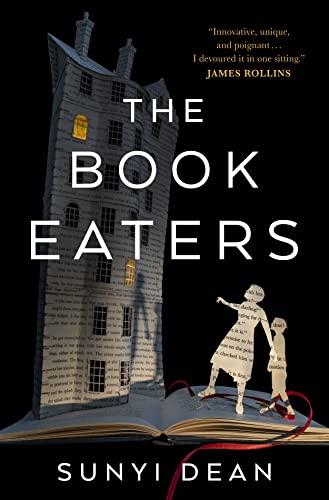
Review: The Book Eaters by Sunyi Dean

A moving allegory about the urge to survive under impossible oppression

Centuries ago, something came to Earth. Wishing to learn about humanity, it brought human-looking creatures to live among us. They're good at pretending to be human: they can walk and breathe and speak, and even reproduce, but biologically they're very different from us. They were designed to absorb information, most of them by physically consuming the written word, a rare few by consuming the content of the human brain. These scavengers of information were meant to gather as much knowledge about Earth as they could until their creator returned to take them away.

But their creator never returned. So the book eaters and mind eaters were left stranded on our world, physically unable to survive on any other food, psychologically unequipped to integrate into human society. Over the centuries, this secret population has managed to build a culture of its own, complete with laws and traditions, social hierarchies and factions, but the pressures of modern life pose an inevitable threat to the anxious rigidity of their makeshift civilization.

We're introduced to book eater society through the eyes of Devon, a young woman who has spent all her life in an old mansion under the supervision of a dozen uncles and aunts, whose main concern is to find her a favorable marriage. Because, you see, there's a problem with her kind's biology. For some reason, girls are far less common than boys. And that creates a population bottleneck that book eaters have tried to circumvent by setting up a strict system of aristocratic lineages based on patriarchal control over female reproduction. Girls are raised with the utmost care until they can be married off, at which point they become tradeable assets who only exist to give birth. When Devon outgrows her deliberately curated fairy tales and experiences the actual cruelty of her people, she resolves to escape the rules of the game, and become an outlaw.

What makes The Book Eaters a specially interesting read is the allegoric opportunity that this parallel society provides to craft a microcosm of the emergence of the first institutions, and with them, the first dynamics of oppression, in ancient humankind. As we learn about the history of book eaters and the various crises they've had to overcome in order to survive, we get a sense that the author is trying to show us a mirror of how human beings first came up with the notions of family, kinship, marriage, authority, gender roles, obligations, etiquette, ceremony, and propriety. This is one of the most effective tricks in the science fiction arsenal: to speak of the imaginary, only to mean the real. Creating this separate species makes it easier for the author to make incisive observations on human patriarchy and the ways it poisons all social relations.

When a novel has such a strongly defined point to make, the reader may fear it to remain at the level of a transparent moral fable written in a preachy tone. The Book Eaters does not suffer from that pitfall. Far from that. Its dissection of what's wrong with humankind by the indirect way of showing us an alien community rotten at its core goes beyond the well-trodden talking points of contemporary feminism. In fact, this novel makes a fascinatingly intimate study of the mechanisms of domestic abuse, unraveling each of its minute daily assaults and the reasons for the victims' seemingly self-defeating but actually self-preserving survival strategies. Devon's quest to break free from her family's control requires her to twist her way around hundreds of small rules and expectations that, in aggregate, form a suffocating web around her will to live. The author demonstrates a considerably vast comprehension of the ways patriarchy devours its own beneficiaries and stifles the dignity of its sufferers. Upon reading about the extent of Devon's family dysfunction, I had to conclude the author has either first-hand experience with this kind of trauma or spectacularly developed powers of empathy.

(In particular, the interaction between Devon and her brother feels painfully true to life. There were moments I had to take a breath from this novel's disturbingly accurate depiction of how patriarchal tyranny ruins both men and women. Take it from someone who survived such perverse treatment: this is exactly how domestic abuse works, and this is exactly how a victim reacts to keep their independence of mind until a chance of freedom appears. Trust me, I've been there.)

In fitting heroic style, Devon has a source of power that patriarchy cannot understand or counteract. The force that propels her to keep fighting is a simple one: she has somebody to protect. Devon is a mother, and after the system that raised her has taken everything from her, she still has her unshakable sense of responsibility toward her son, and she will move mountains to spare him from the life she had. Her one-woman war against centuries of settled custom is a prime example of the ongoing literary turn from the aristocratic protagonist to the ordinary one. Devon was educated to be a princess, but through pain and fire, she remolds herself into something nobler: a real person.


The Math

Baseline Assessment: 8/10.

Bonuses: +2 for psychological depth, +2 for originality of concept.

Penalties: −3 for not adding a trigger warning about domestic abuse.

Nerd Coefficient: 9/10.

POSTED BY: Arturo Serrano, multiclass Trekkie/Whovian/Moonie/Miraculer, accumulating experience points for still more obsessions.

Reference: Dean, Sunyi. The Book Eaters [Tor, 2022].

Wednesday, October 14, 2020

Microreview [book]: Seven Devils by Laura Lam and Elizabeth May

A thought-provoking, pedal-to-the-metal space opera with characters to root for.

Eris,a fierce soldier for the Novantae resistance to the vast and oppressive interstellar Tholosian Empire, has a secret that only the higher ups in the resistance know: she once had a very different life. Once she was Discordia, the putative Heir to the Empire, a woman who became as bloody handed and bloody minded as her brothers in the competition to be her father’s successor. She left that to join the resistance, and is teamed up with Cloelia, who doesn’t trust Eris for pretty solid reasons even above and beyond her prior life. Eris and Clo’s latest mission brings their attention to three individuals fleeing the Empire--and a plot that could kill millions on both sides of a long running war. 

The story of Eris, Clo, and the other members of the resistance facing off against the Empire’s dread plan is the heart of the story of Elizabeth May and Laura Lam’s Seven Devils.

Let’s start with the main question: Does the novel smash the Patriarchy? Oh yes, yes it does. The novel has lots to say about autonomy, the rights of women, freedom, authority and male systems of control. It does this on a character level, showing how Eris/Discordia twisted herself into the system to produce an Heir, conforming to the expectations of her father. We also see Rhea, whose sexuality and sexual nature were used and abused by her captor, and Ariadne, who until recently had no real autonomy of any kind. The Empire is a masculine and male power structure and that alone makes it worth taking on. It is not exclusively that, however: it is a controlling, grasping entity that's clearly depicted as an overwhelming force of oppression and control. This is especially shown with the Oracle, a supercomputer AI system of controlling soldiers and even ordinary citizens in a very oppressive fashion. 

The novel is full of classical and ancient historical allusions. The bit about Eris once being Princess Discordia works even more when you know what Eris was Goddess of. The Novontae were a tribe of Picts who clashed with the Roman Empire, mentioned in the Geography of Ptolemy. Tholosian comes from Tholos, a type of central plaza building in the Greek and Roman world. Clo (Cloelia) is named for an legendary woman from early (age of Kings) Roman history. And on and on. You can have a lot of fun of “who or what is this named for?”. The fact that the authors didn’t simply do a riff of classical names and instead have chosen them very carefully to suit just makes it all the better. 

The novel’s structure enhances and works well with the themes and the plot. The points of view are mainly Clo and Eris, with a few POVs from Rhea, Ariadne and the third of the Refugees, the warrior Nyx. This variety of points of view gives an excellent rounded approach to all of these characters and how they work, but the secret sauce that the authors bring are the flashbacks. Thematically or plotwise tied to the present day action, again and again the novel will switch to a point of view sometime in the past. These points of view give all of the characters a chance to be seen before the events, and give context to the events in the present day. It’s a way to establish character, provide clarity for the present, and thus provide growth.

The meatiest of these flashbacks is Eris/Discordia, since there is a question that the novel only really answers toward the end: why would the Heir to the Empire, a bloody handed woman playing the game of the patriarchy extremely well, turn against the Empire, and how? The how and the why of this heel-face turn is the central character question, and maybe the central question and theme of the novel. Grokking Eris' story, her pain, her power, and her journey is the key, I think, to understanding just what this book is doing. 

I loved the variety of Seven Devils in terms of skills, knowledge, weaknesses, strengths, and how their relationships around each other weave, grow, and change. Discordia/Eris is the A-class star in this firmament, but how could I not feel for Ariadne, the cinnamon roll technical genius prisoner living all of her life, alone? Or Rhea, trapped as a sexual plaything seeking her freedom. Or Clo, a scrappy mechanic pilot with a mechanical leg who will just not stop trying to do the right thing. There is a character here for everyone, and there are also tentative moves toward a romance between two of them, showing a light of hope and joy in a dark and turbulent narrative.

To that point, the novel hits the pedal early and hard - with an opening sequence that reminds me of the Black Widow - and only pauses for breath when necessary. This is a novel with a lot of action and adventure beats; the downtime elements are there to let a reader recover just enough to be ready for the next bit. The aforementioned use of flashbacks allows the authors to pair an action sequence with a quiet moment, and to vary it as to when and where that occurs in the narrative. It’s hopeless to try and figure out where one author or the other may have written a passage, it is smooth gear shifting like in a well tuned racing car. I was never bored. In fact sometimes I had to slow down my reading because it can be an overwhelming rush to engage with this book. 

About the only thing I didn’t like, because it niggled at me all the time, was that there was a tad too much handwavium of some of the technology. The technology of a novel like this is firmly Not the Point, and most readers, I think, are not going to care, but I found myself too often wondering about how some of the technology actually works at an interstellar, and nearly intergalactic scale (and that is of a piece of the handwavium: a spiral arm, to say nothing of whole galaxies, really is huge, larger than what this novel fees like). 

The novel is in many ways a pilot double-length episode of a TV series that sets up the characters, gives them an imminent and big problem and sets up the board for many future adventures; it is not much of a spoiler to reveal that the Empire is not toppled in this book. The plotting is done well enough that I didn’t feel cheated that there is potentially much more to come from the titular Seven Devils. They are, in a real way, only getting started by the end of the book. With the team set up for more striking at the heart of patriarchal empire, I definitely want to see more from Lam and May in future books.

The Math

Baseline Assessment: 7/10.

Bonuses: +1 for a strong set of central characters with stories, arcs, passions and tensions that really come alive even on this huge canvas; +1 for riveting action and adventure beats that keep the pages turning. 

Penalties: -1 Some discordant elements of the worldbuilding niggled at me.

Nerd Coefficient: 8/10 Well worth your time and attention

POSTED BY: Paul Weimer. Ubiquitous in Shadow, but I’m just this guy, you know? @princejvstin.

Reference: Lam, Laura and May, Elizabeth. Seven Devils [DAW, 2020]