Showing posts with label the empire. Show all posts

Sunday, June 1, 2025

Rebellions Are Built on Hope: Andor S2E5

 Disaster is around every corner for Cassian and his comrades
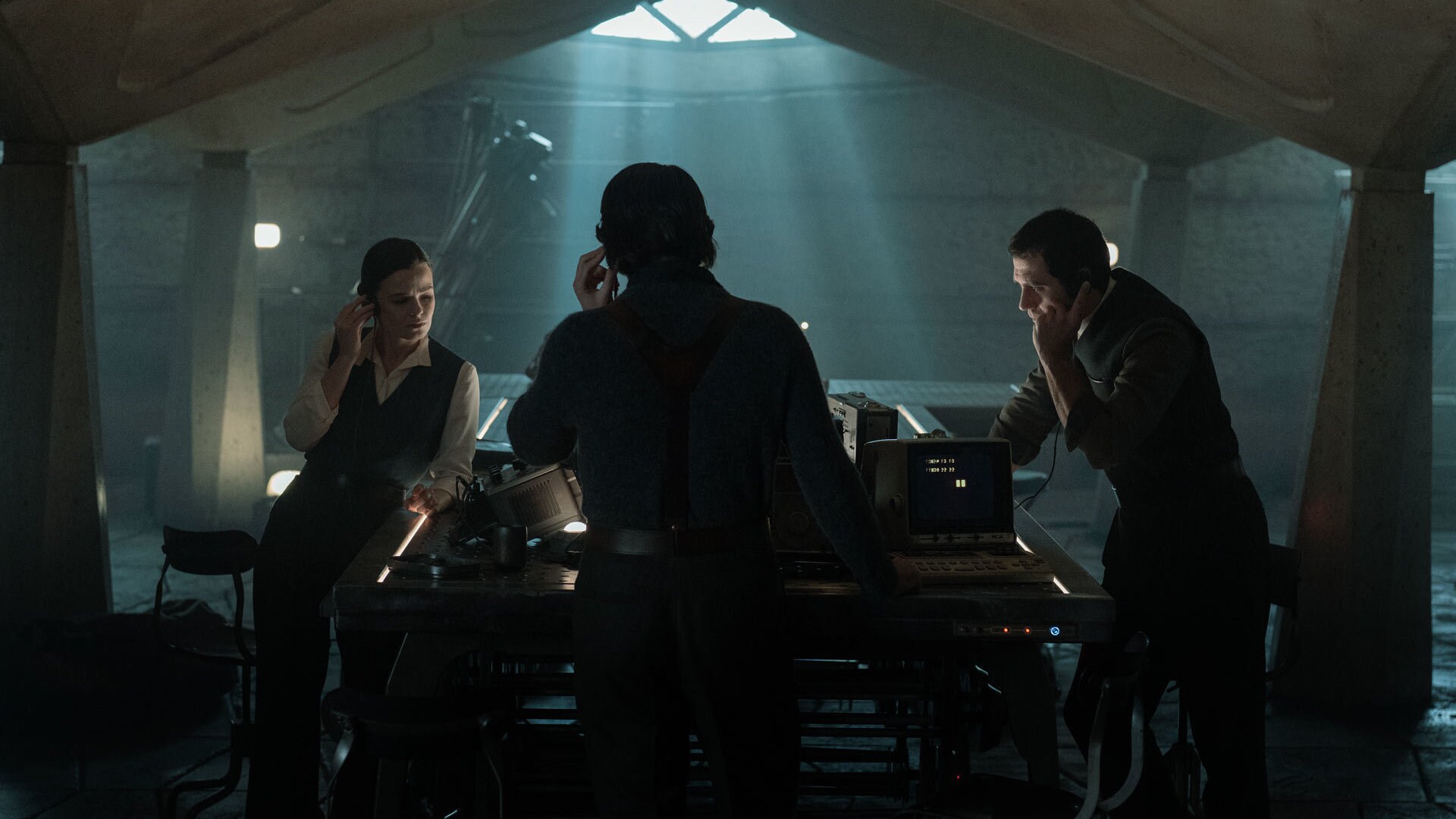
In a shadowy room, three people stand around a table and use a listening device.

In episode four, “I Have Friends Everywhere,” Cassian goes off to Ghorman undercover as a fashion designer while Syril plays double agent with the Ghorman Front. Meanwhile, Wilmon is working with Saw Gerrera (Forest Whitaker) as an engineer to help him steal fuel, his position becoming more precarious as Saw considers killing him. Luthen and Kleya are also in trouble as they realize one of their listening devices is in danger of being found, and they must extract it at a party that will include high-ranking Imperial officers.

In the middle episode of this arc primarily focused on Ghorman, we get to see what makes Cassian one of Luthen’s prized agents as he goes undercover as an excited, young fashion designer on a rite-of-passage trip to the famous Ghorman, but in reality, he’s assessing the Ghorman Front for Luthen. Diego Luna’s acting brilliance is on full display as Cassian turns on and off his cover character and uses the disarming personality of Varian Skye to encourage information from the bellhop, for instance, who was present at the Tarkan Massacre as a youth and recounts the experience of people filling the square outside the hotel’s windows: “We thought there was safety in numbers.” Even as the square filled with people, including children, Tarkan still landed his ship, massacring the protestors.

This moment is a theme of the episode in some ways—a naiveté about the Empire and what lengths they will go to. This idea is repeated when the leader of the Ghorman Front, Carro Rylanz, still can’t accept that what is happening to Ghorman is being done purposefully, and even suggests to Syril: “Many of us believe the Emperor has no idea what’s being done on his behalf.” Again, showrunner Tony Gilroy and his team hit on a real feeling under occupation, especially for someone like Carro Rylanz, a wealthy business owner and politician. He cannot accept that the pain being caused is by design.

In the last episode, viewers were primed to see the Ghorman Front as inexperienced as they welcomed Syril into their group a little too quickly, which is confirmed by Cassian. In a wonderfully acted scene, he sits in a café in character as Varian Skye, and Carro’s daughter Enza (Alaïs Lawson) walks up to him, welcoming him to the Ghorman, and invites herself to sit. Once some other people nearby leave, Cassian breaks character and says she just risked everyone she loves on the assumption that he is who he says he is, pointing out her inexperience and hurry. He says, “People die rushing.” To which she responds, “It’s hard to be patient when your world is falling apart.”

I’ve already seen people posting about the power of this line, but almost nobody has pointed to Cassian’s line, which is the more important concept. In moments of struggle, there’s a great surge of energy, which we are seeing right now in the U.S. and in different parts of the world, and often, this new burst of energy is from the inexperienced. With this new energy also comes urgency over the issue that inspired people to get involved, but without listening to those who have been doing the work, that urgency can be dangerous, whether it’s breaking security protocols or trying to do too much and causing burnout. In Cassian’s case, there are operational security concerns if the Ghorman Front is captured, that could lead back to Luthen and the Axis network. Cassian ultimately discourages them from their plan to attack transports carrying weapons to the armory they believe is being built in town, because it would endanger the group, which prompts the leader Carro to say, “You’re not much of a revolutionary, are you?” Cassian agrees, and in some ways, it’s true. He’s not their version of what they want out of revolution, which is Ghorman safe. Cassian has a longer and larger battle in mind. Ghorman may be part of that, but currently, their goals do not align.

This discussion of revolution contrasts with one of the great monologues of the show. Much like in season one, Gilroy and his team still manage to seamlessly work in monologues or speeches that are beautifully written and manage to stick in my head, whether it’s Nemik’s speech (“Freedom is a pure idea…”) or, in this episode, Saw Guerra’s story about becoming addicted to huffing fuel fumes.
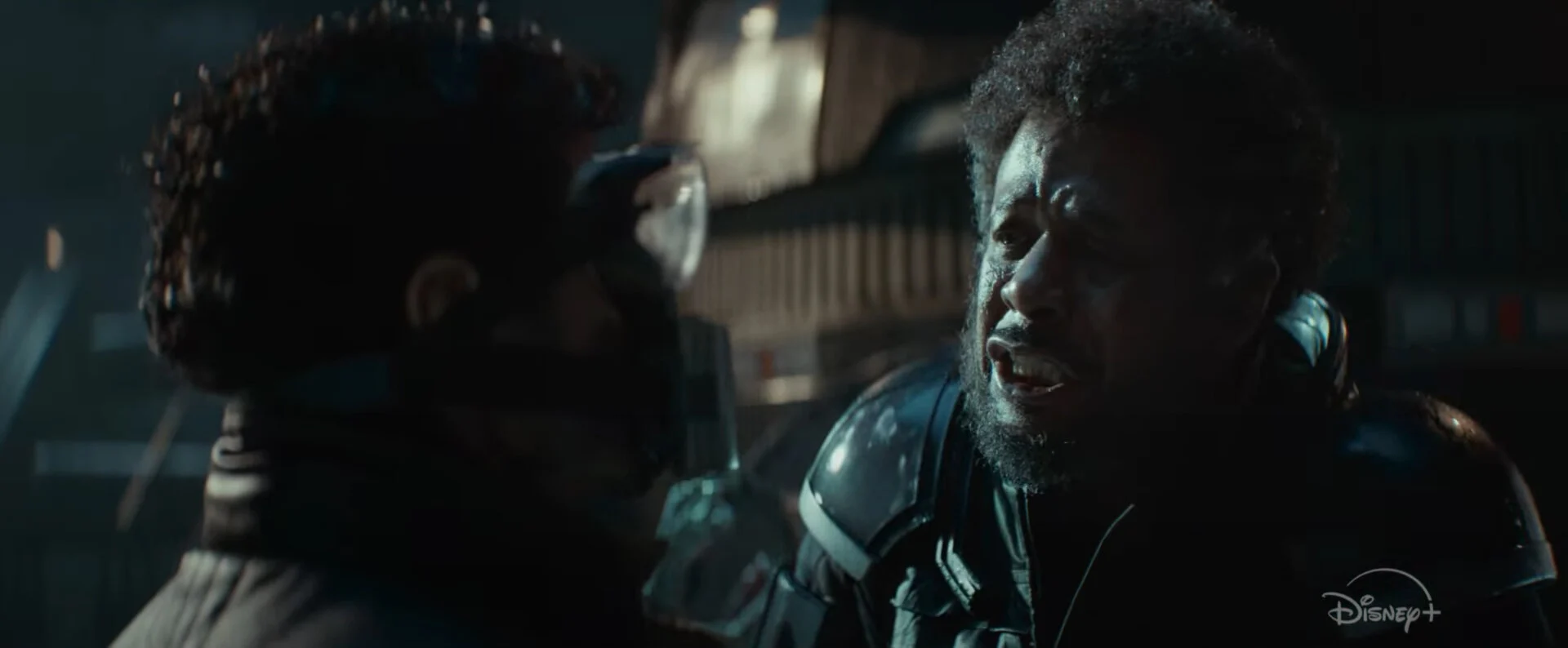
Saw and Wilmon at night. Wilmon wears protective gear while Saw speaks to him.

During this arc, we have an extended look at Saw Guerra and his loyal band. While in contrast with the carefully quaffed Luthen, Saw’s band is intensely loyal to the point they don’t blink when he kills an Imperial spy in their midst and provides proof of his treachery. At first, Wilmon seems offput by their intensity, but he still helps them steal fuel, even if he is being threatened to some degree.

The device used to steal the fuel takes intense concentration to run, and while Wilmon is sweating over the variations, Saw waits, monologuing in the background about his childhood, when he was forced to work a labor camp. Wilmon, wearing protective equipment, successfully opens up the pipeline, and when the fuel fumes smoke out, Saw breathes them in, to Wilmon’s horror, which prompts Saw to say one of the most memorable lines of the show: “Revolution is not for the sane.”

Saw goes on to say that he essentially knows and believes that he will die trying to overthrow the Empire, and that sense of being alive in this moment, ready to burn for the revolution, is vital. In his own way, Luthen expressed a similar sentiment earlier in the episode when trying to encourage Bix, saying he would win or die trying. For Luthen and Saw, and their followers, they know the revolution extends beyond their lifetimes. This sense of scale and purpose is what the Ghorman Front lacks. For them, this is a blip, a disturbance they are fighting against so they can go back to their normal lives. They cannot see that, as long as the Empire stands, there will never be a normal for Ghorman.

POSTED BY: Phoebe Wagner (she/they) is an author, editor, and academic writing and living at the intersection of speculative fiction and environmentalism.

Monday, May 19, 2025

Rebellions Are Built on Hope: Andor S2E4

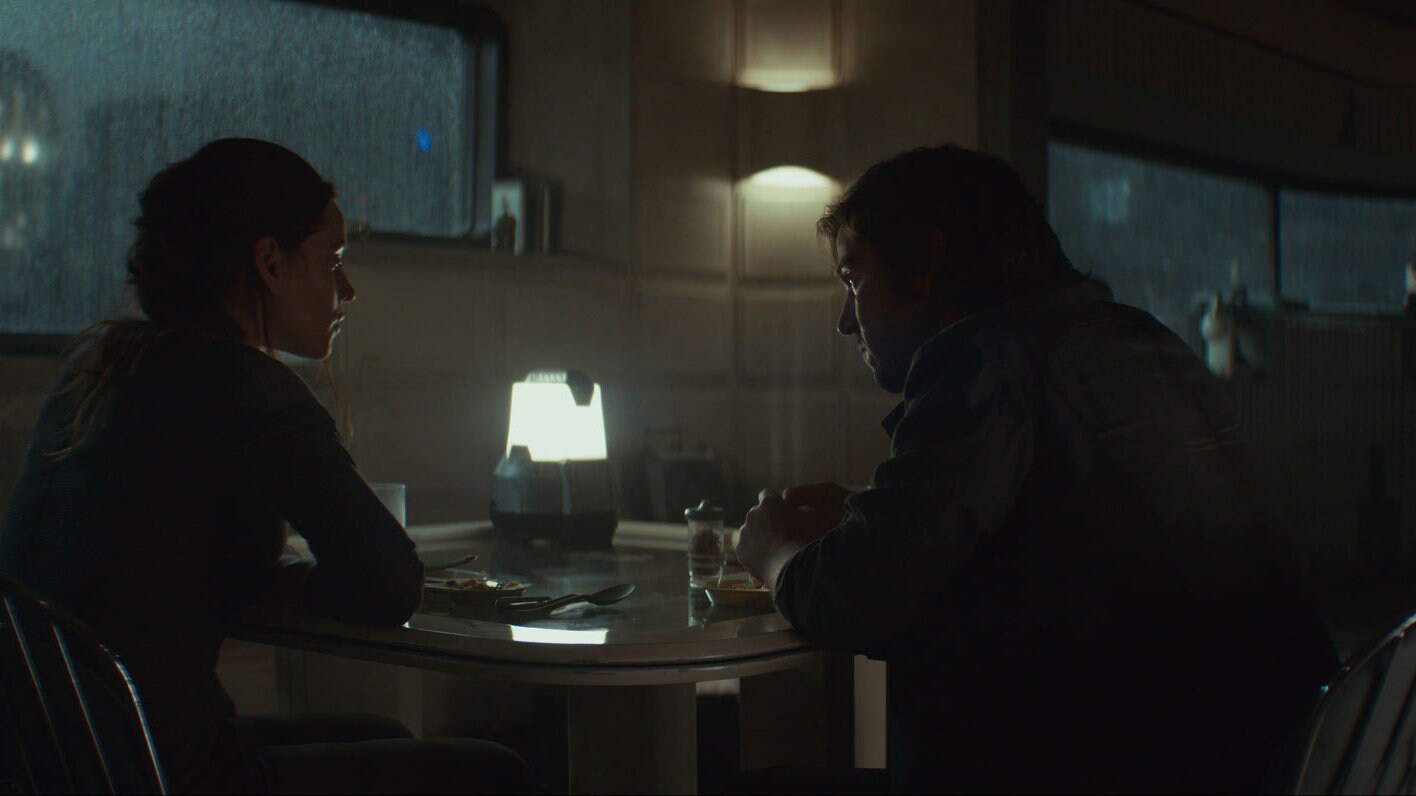
A year after the trauma of Min-Rau, Cassian and Bix have uneasy peace on Coruscant

Angled from the back, Bix sits at a table to the left and Cassian sits next to her. The colors are dark and brooding, with a stormy window behind them.

Andor has always had a heavy pour of spy thriller in it, part of which I’ve attributed to showrunner Tony Gilroy’s earlier work on the Jason Bourne franchise. In “Ever Been to Ghorman?”, the spy genre is in full swing as Cassian and Syril Karn both go undercover on Ghorman.

Cassian is hesitant to leave Bix as they’ve started to relax a little in Coruscant, where the density of the city keeps them safe. Even so, Cassian doesn’t let his guard down, avoiding areas with cameras since his face is known and growing frustrated when Bix returns to a bodega she frequented a month ago. As Bix says, trying to ease his tension, today “the mission is shopping.”

While Cassian’s struggles are outward, placing stress on his relationship with Bix, hers are internal. She can’t sleep, and the episode opens with her stalking through their apartment with a drawn blaster, following the ghost of her torturer from season 1. The trauma of being tortured by the Empire at the hands of Dedra Meero still haunts Bix. In this dream, her torturer confronts her about Cassian killing a young imperial pilot on their last mission.

When Bix can’t let it go, she accuses Cassian of making the choice to kill the young pilot because he’d seen her face, but Cassian insists it was necessary because he worked for the Empire. This moment is in nice juxtaposition to episode 1, where a low-level worker assists Cassian in stealing the TIE fighter. She accidentally looks at his face and apologizes because she was told not to, but he says it’s all right, and they have an uplifting moment of connection as they both risk their lives for a nascent resistance. In that case, with a supportive, vetted person, Cassian was willing to break the rules, but he has no tolerance for anyone supporting the Empire—which we see throughout the series as the body count rises.

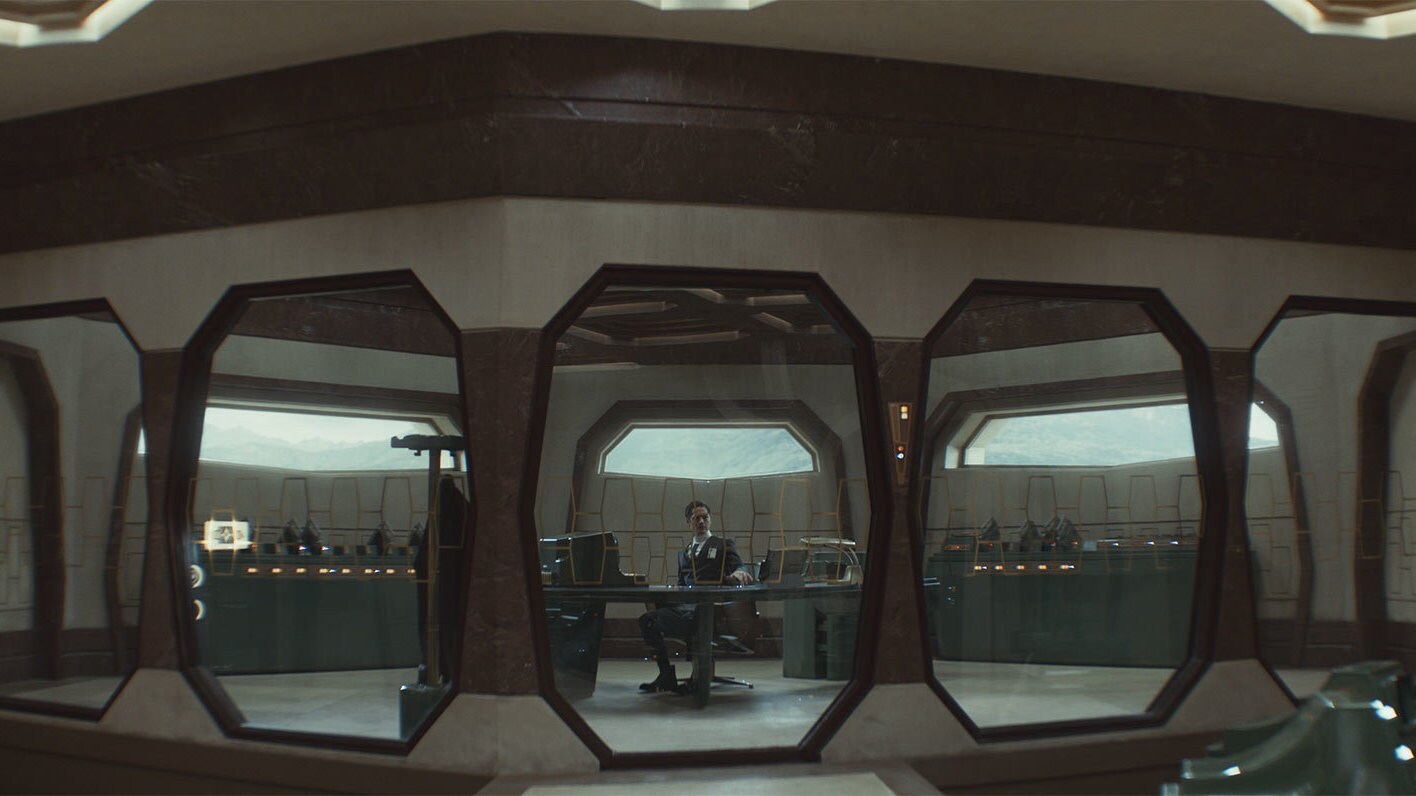
Syril sits in his windowed office. The shot centers him in one of those windows. The interior is brown and dull.

Meanwhile, Syril is living his dream by working under his girlfriend, Dedra Meero, for the Imperial Security Bureau (ISB). In the last post, I know I didn’t touch on one of the best scenes between Syril and Dedra, but I’ll come back to the dinner scene with his mother when I talk about Syril’s character as a whole in episode 9. For now, Syril is playing spy and living the life. He’s been moved to the capital city of Ghorman, Palmo, where he works in an Imperial office overlooking the square where the Tarkin Massacre occurred. Every day, a small group of protestors call out against the Empire’s presence in building something—perhaps an armory—that will shadow the square.

Syril is cast as the sympathetic Imperial worker and plays his role when video-calling with his mother, Eedy Karn (with an amazingly cringey performance by Kathryn Hunter). She’s been overtaken by the propaganda machine utilized by the Empire to turn public opinion against the Ghor, and Syril tells her to watch something other than Imperial television (in a conversation all too familiar to most of us). The Ghorman Front—the relatively inexperienced and untested resistance on Ghorman—is listening in. They demonstrate their naivete by inviting Syril to a townhall and quickly bringing him into their group, even introducing them to their leader, the public-facing city councilor, Carro Rylanz (Richard Sammel).

While important to the plot, the townhall is also a beautiful feat of worldbuilding. As discussed by Reactor Magazine, the Ghor conlang sounds distinctly French, and primary speakers were played by French actors. Before I knew about the effort that went into the conlang, I was struck by how fluidly the actors spoke the language. It felt natural in a way conlang doesn’t always come across, especially during emotional scenes—and the townhall certainly has a lot of emotion as people yell at the council and make rude gestures, leading Lezine (Thierry Godard and my favorite Ghorman) to interrupt the meeting with his comments. The gestures, such as tapping the chest in addition to applause, are what add a lived-in feeling to this world and make the Ghor feel like a fully developed culture.

Of course, the connection to the French resistance during World War II is obvious, but like all of Andor’s historical storytelling beats, the series never becomes an allegory or parable. Instead, the Ghorman Front is a demonstration of early mistakes by those new to resistance, as they trust Syril too quickly, which we know will lead to the eventual destruction of Ghorman for kalkite to build the Death Star.

While some of the general conversation around the show is that the pacing isn’t as strong as the first season—or just too slow generally—I’ll take that for a depth of worldbuilding that not only develops the plot but deepens the show’s commitment to anti-imperialism and to demonstrating how anti-fascist action works. In many interviews, Tony Gilroy, as well as the cast, has talked about the level of detail that has gone into the show, whether it’s the quality of the costumes or the hand ritual from this episode that Bix and Cassian conducted. In an episode heavy with interpersonal conflict between Bix and Cassian, this moment of tender ritual is deeply moving and shows their dedication to each other. As Adria Arjona told The Hollywood Reporter: “But Diego slowly started doing this thing with his hand, and then I just followed in a way. It was really beautiful, and it was a moment of connection between two actors. […] It was so simple, but it had so much depth to it in the making of it and even the performing of it.”

I’ll take these moments of worldbuilding—from the space bodega to hand ritual—over a blaster fight any day, especially when such moments demonstrate the importance of relationships in the face of fascism. As critic and writer from France, John Berger, said about tenderness: “[Tenderness] is almost a defiant act of freedom.”


POSTED BY: Phoebe Wagner (she/they) is an author, editor, and academic writing and living at the intersection of speculative fiction and environmentalism.
Sunday, May 11, 2025

Rebellions are Built on Hope: Andor S2E3

 Wrapping up the first arc of season two, “Harvest” is a gut-punch of an episode.

In a wheat field with a huge piece of metal farm equipment in the background, Brasso stands surrounded by storm troopers and one imperial officer.

Content warning: discussion of attempted rape.

At first, I was suspicious of the three episode a week release schedule since it seemed like a way to quickly wrap up a show that could have gone on for months. Why hurry it out? As the structure of the season becomes clearer, the three episode chunks tell complete stories leading up to Rouge One (2016), where season two ends. “Harvest” also shows how they are using the three episodes to build smaller climaxes within the season.

Finally free of last of Maya Pei’s people on Yavin 4, Cassian makes contact with Luthen’s assistant Kleya (Elizabeth Dulau) where he finds out Bix, Brasso, and Wilmon are in danger on Mina-Rau. In true Rebel fashion, Cassian breaks protocol to go help his friends, but he arrives too late.

As Bix, Brasso, and Wilmon are preparing to leave, the Imperial agents arrive earlier than scheduled. Wilmon is missing (as he promised his girlfriend he wouldn’t leave without saying goodbye), and Brasso goes looking for him while Bix finishes packing. While Brasso is gone, the Imperial officer who asked Bix to go to dinner with him in the previous episode arrives at their home. 

What follows has outraged some Star Wars fans as Tony Gilroy and his crew of storytellers remain dedicated to telling the story of empire, colonization, patriarchy—and sexual violence is part of that legacy. The Imperial officer threatens Bix by acknowledging her status: “I know you’re illegal. We’ve been counting visas.” He explains he recognizes that undocumented “help” is required in order to bring in the necessary harvest, but that the farmers of Mina-Rau are still breaking Imperial law. He then propositions her for sex by saying how “stressful” his job is: “Such a simple choice.” All she has to do is have sex with him, and he will leave them alone.

Bix proceeds to fight him off in a brutal scene. The struggle is bloody and painful, with Bix barely managing to protect herself, eventually causing the officer’s death. When the other officer tells her to come out, she shouts to him: “He tried to rape me.”

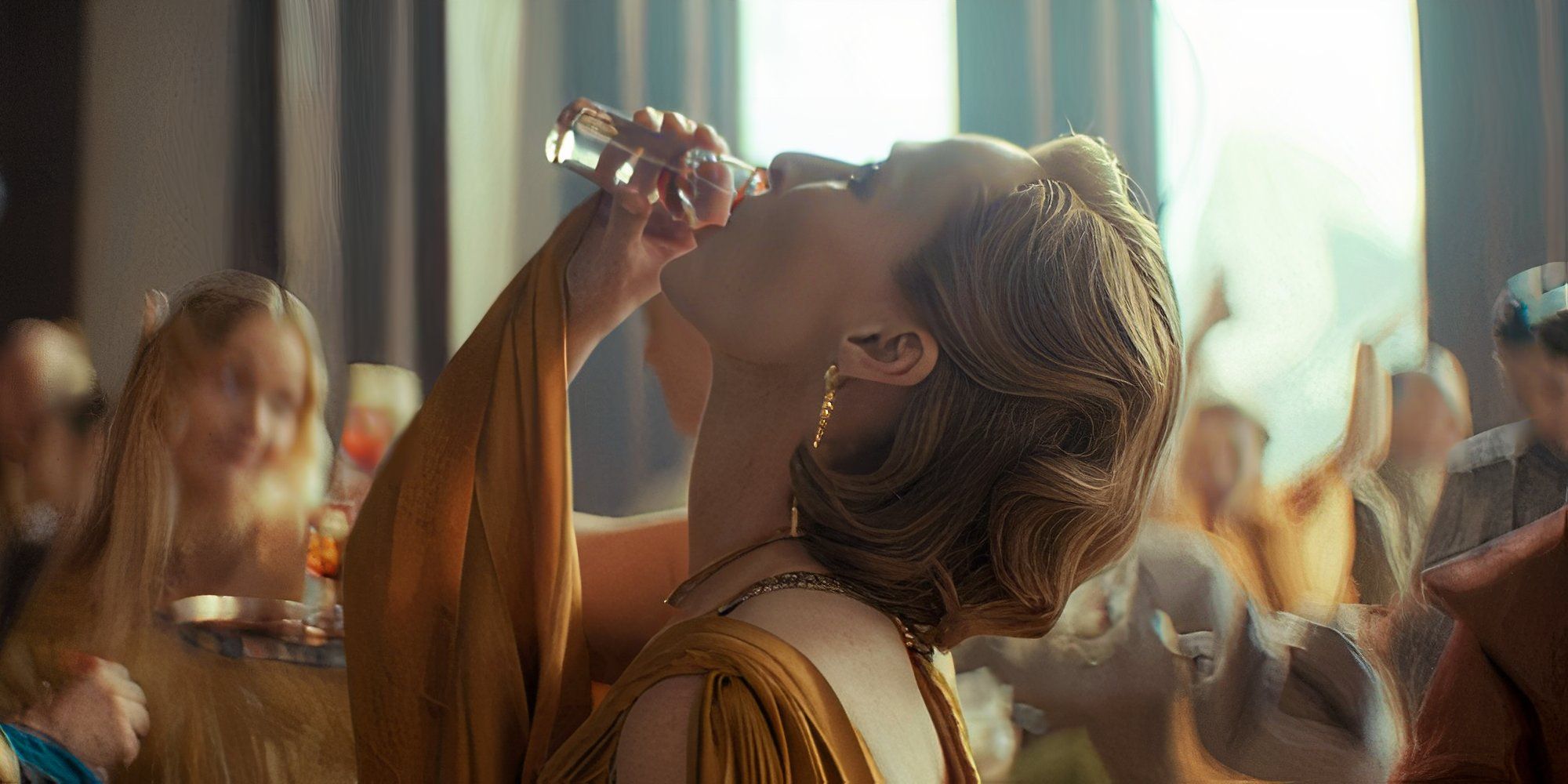
The sequence is made all the more jarring by quick cuts between her fight and Mon Mothma getting drunk and dancing at her daughter’s wedding. In Bix’s scenes, there’s no musical score, emphasize the quiet peacefulness of the wheat fields, broken by the violence. This moment cuts to loud galactic pop music and the bright colors of Chandril as Mothma drinks away her sorrows over the loss of her daughter to a predatory marital tradition that she also had to go through as well as realizing her friend, Tay, who helped her support the rebels, will have to be assassinated, as implied by Luthen. In order to cope, she proceeds to get drunk and dance.

Mon Mothma tips back a drink while in a packed room of people dancing, with bright colors and sunshine. She wears an orange/bronze flowey dress.

This sequence for both women is absolutely crushing in different ways. Both are being threatened by the patriarchy—and in Mothma’s case, watching her daughter enter a predatory relationship—but each are also in different levels of danger, which the editing, sound, sets, even color mixing juxtaposes brilliantly. While Andor is quality storytelling, this sequence also demonstrates how well-made it is. 

For all its success as a piece of storytelling, “Harvest” immediately drew the ire of Star Wars fans. As I wrote in the last post, Tony Gilroy and his team are dedicated to presenting the banality and the evil of the Empire because it is a fascist empire. I’ve often thought of Star Wars as a failed piece of critical media because as much as George Lucas claimed he wanted to critique the U.S., he made the Empire too cool. You can’t have fans getting Vader tattoos, wearing Imperial symbols, or marching in Storm Trooper brigades at fan events and claim to have successfully critiqued empire. Andor works hard to reposition the Empire as deeply not cool and also as practicing the human rights violations that we know empires practice, such as sexual violence against women of color. 

For those of you who are familiar with my work or other pieces of criticism, I generally do not advocate for work that repeats the oppression of the real world. I’m a big believer that science fiction and fantasy can do different work by imagining worlds that are not oppressive or not simply repeating the same systemic injustices of today. To that end, after “Harvest,” I’ve been sitting with why I think this episode was necessary, including the attempted rape. Part of the reason is the fan reaction this episode generated. As written about by The Hollywood Reporter, an influential fan account on X, @StarWarsFanTheory with over 91,000 followers, wrote: “Vader wouldn't tolerate that shit [rape] nor does the Empire condone it.” 

This concept that the Empire and Vader would not tolerate sexual violence is surprising because of the amount of violence that the Empire does condone. Vader tortures Leia with a mind probe in IV, and when he tortures Han Solo in V, it’s implied there is no reason for the torture other than to do it. Additionally the Empire blows up Alderaan without evacuation—as in, destroys an entire people. Then, let’s add that Vader/Anakin mass murders innocent children not once but twice. This conceit that rape would not happen under the Empire when equally vile human rights violations are a traditional part of the storytelling demonstrates the need for Tony Gilroy’s commitment to displaying not only the Empire’s boardroom banality but also how power is wielded against the oppressed. If Andor season one wasn’t enough to strip the Empire of its coolness, then Gilroy is making sure there can be no mistake after this season.  

Yet, while what Gilroy is doing is important—forcing viewers to confront the violence of empire in all its forms—I still come back to my question: why does Andor feel so necessary right now when I usually prefer work that doesn’t repeat oppression but imagines alternatives? The conclusion I come to so far is that Gilroy and his team know the political stakes of the story they’re telling. While filming wrapped before the re-election of Trump and just after the beginning of the latest attempt to destroy Palestine, fascism was still on the rise. It was uncanny to watch these three episodes while people, myself included, protest for the release of detained immigrants and against mass deportations in the U.S. 

Another way Gilroy and his team overlay our world onto Star Wars is the racial politics. While Star Wars has always been “post-racial” in essence that skin color does not impact the everyday lives of the characters, the racialized casting in the original trilogy paired with the orientalism of the Jedi demonstrates the movies have always had racial overtones. Whether it’s Chewy (Peter Mayhew) being a stand-in for the Black sidekick or the only Black character, Lando Calrissian (Billy Dee Williams), being a smuggler who betrays the (white) heroes, the racial politics of the world offscreen inform the characters onscreen (let’s not even get started on Jar Jar Binks or the Trade Federation). While Andor has continued the idea of a “post-racial” world in that the characters are not treated differently for their skin color, the creators have also allowed the racial politics off screen to inform the storytelling. 

For example, in the first three episodes, Mon Mothma—the rich, white woman—is not experiencing the same type of violence as Bix, an undocumented woman of color. When Mothma is pressured to give sexual attention to Tay or else he threatens to reveal her financial support for the rebels, it is not even a question that she would do such a thing. Instead, Luthen—the white, male high society leader—has Tay killed (or so it is implied in this episode, with the dirty work also being done by a person of color). In another example, the white Imperial officer attempts to rape Bix while his driver, a Black officer, waits outside—a stark contrast to Mothma’s experience with predation. 

While I often question the usefulness of this type of repetition of systemic issues, in Andor, the show counterbalances by demonstrating a variety of different tools for resistance. As Robert Evans, a host of the podcast It Could Happen Here, explained on Bluesky: "The point of Andor isn't 'only anarchists are right' or 'only terrorism works' or 'only liberals defeat fascism' it's that birthing a movement that can destroy an imperial regime requires a diversity of tactics and people all willing to throw their lives away for the cause." In careful detail, this show does not only demonstrate the inner workings of empire but also of resistance, whether it’s the leftist infighting of the Maya Pei delaying Cassian to practical depictions of operational security that inspired a whole popsec analysis of Andor. 

In the first arc of season two, Andor delivers with quality storytelling as well as striking visuals, use of sound, and set design. Much like season one, the show doesn’t shy away from depicting the dark side, but always in relation to why the characters fight. The danger is real, and these episodes demonstrate that for the most precarious—the undocumented person of color—the consequences are much more serious than the white high society senator, even as all sacrifice and work for the same goal: to win. So far, Andor season two demonstrates not only the tools of the enemy but how to powerfully resist.


POSTED BY: Phoebe Wagner (she/they) is an author, editor, and academic writing and living at the intersection of speculative fiction and environmentalism.   

Monday, May 5, 2025

Rebellions are Built on Hope: Andor S2E2

In “Sagrona Teema,” the separation of class and who is endangered during the rebellion becomes clear

Mon Mothma, Cassian Andor, and Inspector Krennic pose from the waist up in front of a Coruscant cityscape.

While episode 1 of Andor season 2 sets the foundation for various problems, episode 2 explicitly demonstrates who is at risk when taking direct action against the Empire—the undocumented, the worker, the person of color. Following in the footsteps of season 1, this season not only continues to examine how a galactic empire would function but also turns a critical eye to how the opposition to empire functions. In these first three episodes, culminating with “Harvest” (more in my next post), a clear critique of leftist opposition rises.

This critical look comes from the juxtaposition of Mon Mothma on Chandrila with Bix on Mina-Rau. In season 1, I appreciated Genevieve O’Reilly’s portrayal of Mothma, but this season, she’s truly hit her stride as she hosts a three-day wedding for her daughter. Long shots show her talking with guests before slipping into her role as a funder of the rebellion all while navigating the guilt of her teenage daughter being wed to a stranger, which Mothma agreed to in order to help Luthen.

One of the guests is Tay Kolma (Ben Miles), who Mothma worked with in season 1 in order to hide some financial blemishes as she funnels money to Luthen and the rebellion. At first, Tay seemed totally dedicated to the cause—and with a bit of a crush on Mothma, possibly. Now, his wife has divorced him, and he seems to have soured with Mothma—or at least think he deserves more attention, however that might be interpreted.

This lavish party is juxtaposed with Brasso, Bix, and Wilmon on Mina-Rau, where the Empire has arrived to audit the farming groups, including arresting undocumented farm workers. In solidarity with his workers, the grain farmer tries to help Brasso and the others figure out how to escape Imperial detection in hopes of furthering the rebellion’s mission.

While Mothma may have to deal with Tay’s indelicate advances for more attention, Bix finds herself cornered by an Imperial officer asking her out on a date. Even though she claims her husband will be returning to the planet soon, that doesn’t seem to deter the officer. As an undocumented, migrant worker, Bix’s position is far more dangerous than Mothma’s. The interweaving of the stories of these two women both working for the rebellion reflect the often real-world implications of who is most endangered during times of protest and revolt. While Mothma stands to lose much, her precarity does not represent the same risk that Bix, an undocumented woman of color, is taking.

While I often find myself caught up in the plot and minute political commentary of Andor, this first arc also has beautiful visual storytelling. Mon Mothma’s home filled with lavishly dressed guests is bright and decadent in color and saturation compared to Brasso, Bix, and Wilmon’s current home, where the shots are less saturated, the skies grayer, and the uniformity of wheat dulls the view. Both storylines are full of life as well as secrecy. Where Brasso, Bix, and Wilmon have lovers, friends, and community, some of who know about their illicit activity, Mothma finds herself alienated while surrounded by people.

These two communal storylines further juxtapose with one of my favorite aspects of Andor: showrunner Tony Gilroy’s continued dedication to making the Empire less cool. In this episode, it’s revealed that Dedra Meero is living with Syril Karn (played by Kyle Soller). While their relationship is hinted as a possibility at the end of season 1, I was still surprised to see them living together. In her totally white and devoid of character apartment, she and Syril reunite after her work trip to learn about the Ghorman plan. It is the most awkward and purposefully cringe interaction of the show.

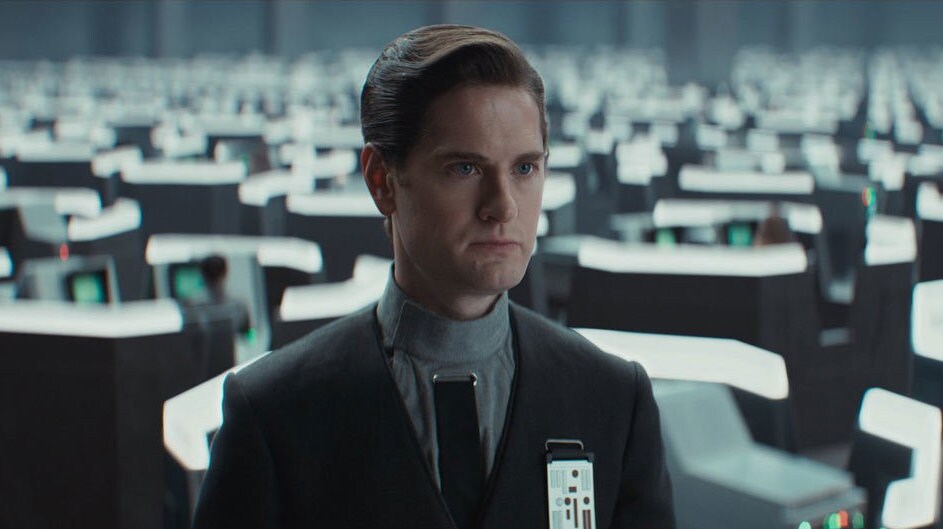
Syril Karn in a room filled with people working at futuristic computer stations. Shown from the shoulders up in his black uniform.

In my next post about the third episode, “Harvest,” I’ll write more about the importance of portraying the Empire as an empire, but for now, I was reminded when watching this episode of a video essay, “Fascists will waste your time” by Thought Slime, which reiterates again and again that we need to remember that fascists are, simply, evil losers. I’ve always struggled with how “cool” the Empire appears in much of Star Wars, even while doing evil acts, and Andor was one of the first Star Wars properties to directly confront this idea—at least that I was aware of. I appreciate the continued dedication to this task. Dedra and Syril having a relationship does not detract from how socially broken, awkward, and fascist they are. They have little to no social awareness in addition to being cruel.

The final important plot point in “Sagrona Teema” involves Cassian, who is able to escape the Maya Pei rebels. Their continued infighting and silly arguments have delayed him considerably, which feels especially scary while his friends are facing down the Empire on Mina-Rau. We do get one final hint that the Maya Pei band are going to be important as Cassian finally managed to steal back his ship and fly away—right over the towers of Yavin 4.

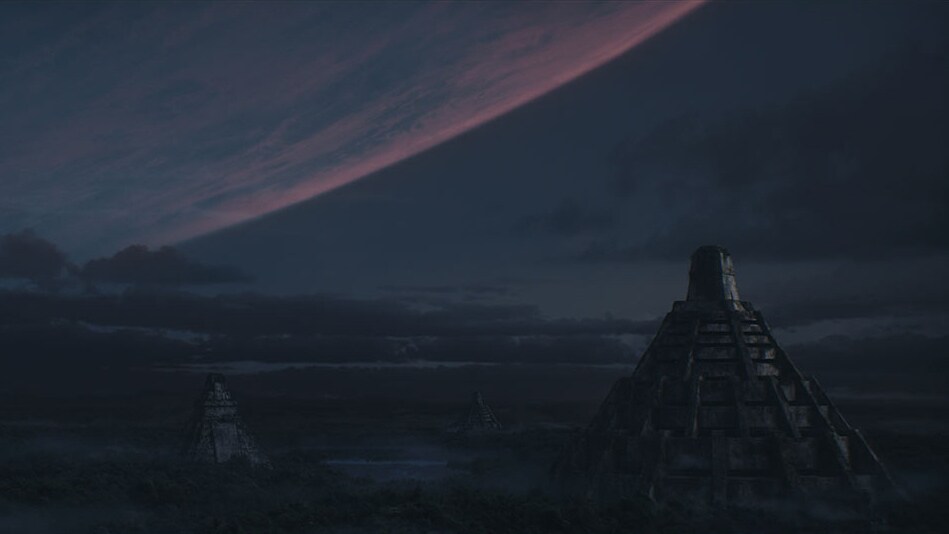
A planet in sunset hues is in the sky while the iconic towers of Yavin 4 rise from a green jungle at dusk.


POSTED BY: Phoebe Wagner (she/they) is an author, editor, and academic writing and living at the intersection of speculative fiction and environmentalism.
Tuesday, December 8, 2015

Heirs to the Inquisition

Are you excited for The Force Awakens? Of course you are! You are a human being, on planet Earth, so you're excited. (This is the part where I say, there are probably no spoilers in this, but if you are trying to go in totally blind, uh, spoiler warning).

One of the things I have heard/seen commented on is that, just like in Episode IV, the Force, the Jedi and now the entire Galactic Civil War are basically just myths and/or entirely forgotten. How can that happen? How, in the 30 years between III and IV, can the Jedi be forgotten? And the same span of time after VI, can that whole war be forgotten?

This brings about one of the things I love about Star Wars (the original trilogy, because, you know... the prequels suck). In the entire trilogy, the entire narration only shows us locations on the periphery of civilization. Never mind that the EU and video games and the prequels fetishize them- there is no reason, as a normal being in the Star Wars universe, you would have any reason to go to these planets. They are the Topeka, Kansas of Star Wars. So if you lived in any real population center, you probably won't hear about what went down on Hoth, Cloud City or Tatooine.


via Rolling Stone
But clearly the Empire had a stranglehold on government- the senate was disbanded in the first five minutes of A New Hope, and the, you know, blew up Alderaan, which people certainly would have heard about- but that is exactly what the Empire wanted, and why people would have forgotten the Jedi.

Because as we never see the real civilization of Star Wars, we never see the government of the Empire in operation. But we do know how they keep the 'local star systems in line', as Tarkin put it- through fear. And as soon as Palpatine took full control, it's a sure bet that he began a campaign of fear- and as a Sith, his chief concern would be to scare people out of any memory of the Jedi.

This would hardly be without precedent- think of the various tyrannies throughout history. Ever heard of the Tribunal of the Holy Office of the Inquisition? It's the fancy, official title for what we call the Spanish Inquisition. And that was just the Spanish Inquisition- it was a continuation of the Medieval Inquisition, and the inquisition was a large undertaking. Its purpose was to maintain the orthodoxy of the Catholic church.

Their objective was to control information, and they controlled it through torture and fear. Did it work? From Wikipedia:
According to actual records the Spanish Inquisition was widely hailed as the best run, most humane court in Europe.
Which may have had some truth to it, but that makes it much more depressing since burning supposed heretics alive was sort of their thing. The Inquisition is far from alone in history, in its object or its methods.

And in an obvious nod to those real events of history, the group of individuals tasked with wiping out the last of the Jedi in Rebels are called Inquisitorius. So we can infer a lot about the Empire, its methods and its objectives.
via Wookiepedia

So how do the Jedi vanish into myth in the space of a few decades? By just that- by fear, by fear- those who mention them, wish for the good old days, speak out- we don't have to wonder how the Empire would deal with such ones. And pretty soon, the average person is in the habit of never speaking of the Jedi, then after a while, maybe they start to wonder if the Jedi were ever real.

But what about Episode VII? How is an entire war forgotten? That seems like it would be memorable, right? And the First Order doesn't seem in a position to scare everyone into line. Plus, Rey has been scampering about the wreckage of a massive battle.

But that battle happened before she was born. So maybe what we see in the trailer is simply her own incredulity, coming from spending her whole life on a backwater planet, instead of a larger campaign of fear. This- to me- seems the more likely, since Kylo and his Knights of Ren seem more interested in spreading Vader's Dark Gospel rather than keeping it secret.

So it seems the First Order will follow in the same pattern as its predecessor, and so many other tyrants and despots in history- attempting to rule through fear and strangle the information and truth the average citizen has access to.

The sad part is that this is not solely the province of fiction.

-DESR