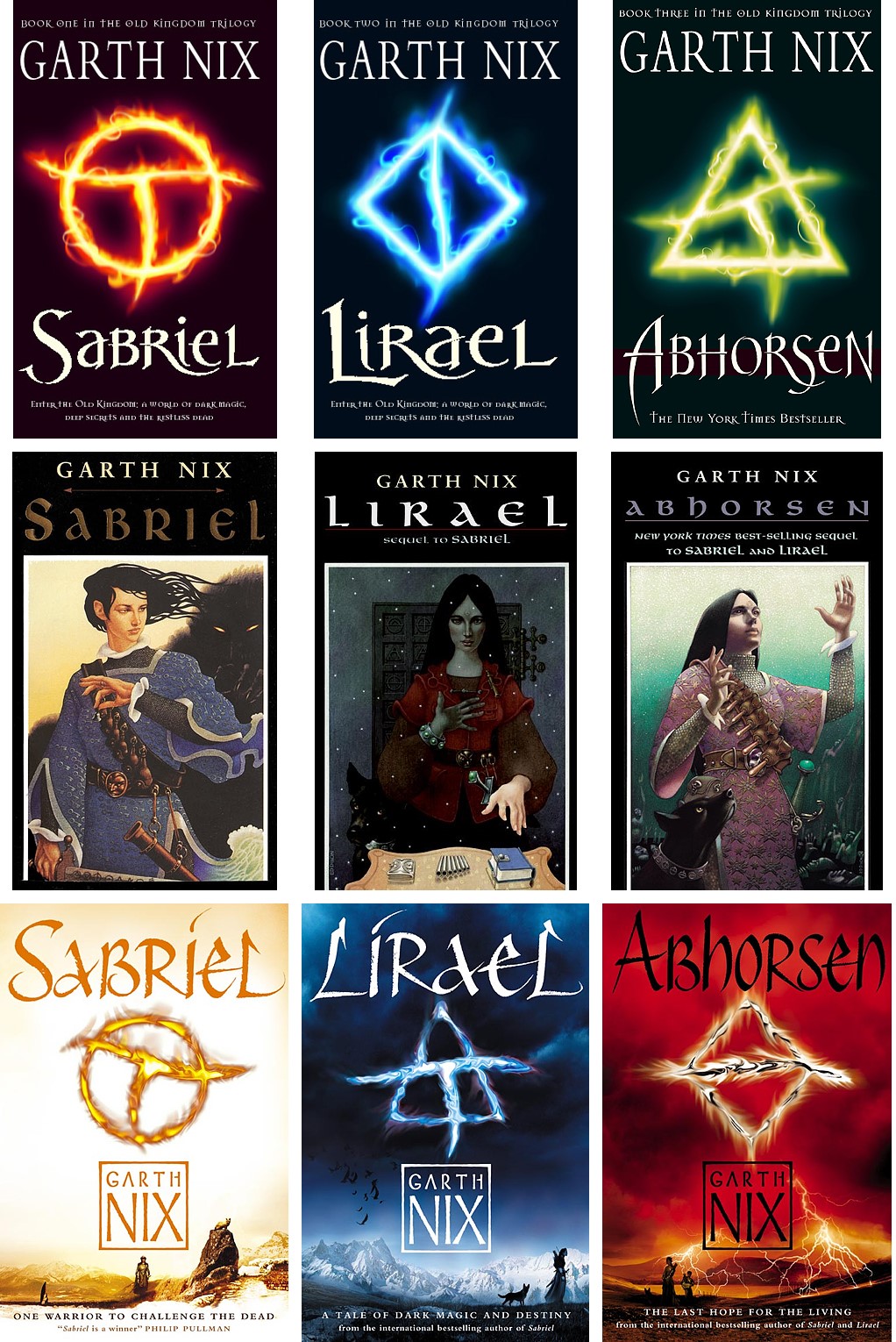
First published 27 years ago, the Old Kingdom series by Garth Nix was a big part of many people’s childhoods, but does it still hold up to a reading in 2023? Elizabeth and Roseanna look back at the original three books of Sabriel, Lirael and Abhorsen, and reflect on how their opinions of the series have changed, and how they’ve stayed the same.
Sabriel follows a young woman as she leaves school and heads back across the Wall into her mysterious home country, after finding out that something has happened to her father. Who happened to be a necromancer, and has been teaching her to follow in his footsteps - not to raise the dead, as most necromancers do, but to lay them to their final rest. Her journey into the Old Kingdom will reveal to her how little she knows of her craft, the charter magic of her homeland, her father and her heritage, and will test her resolve as she faces an evil far greater than she anticipated.
Roseanna: I first read Sabriel when I would have been about 12 - it came out in Australia in the 90s, but didn’t make it to the UK until 2002 - and I was exactly the right age to fall completely in love with it. There’s a strong memory that still sits with me of some book-selling group coming into my school with a pile of various delights, and of me seeing the UK hardback edition, which was bright white, with an extremely fancy clear plastic dust jacket with a gold illustration on and thinking to myself “ooooooh”. The series was also one of the first I remember reading with female characters I genuinely liked and thought were well done, ones that seemed heroic and exciting and like people whose adventures I wanted to follow. That it was set in a gorgeous world with an interesting magic system was absolutely a bonus, but it was the characters that really did it for me the first time around, and who kept bringing me back to the series over and again.
Elizabeth: Honestly, I’m not sure I can remember exactly how I first came across the series – it seems almost by osmosis. Certainly, I’d read it by 2004 when I started studying Creative Writing at the same university as Garth Nix, where he was something of a hometown hero. Although I was in my early twenties, the mix of adventure and magic drew me in and kept me hooked. I’m not much of a rereader (there are always so many new books!) so the details have faded over the years. But the Abhorsen’s bells remain etched clearly in my memory.
Roseanna: One of the things that really stuck with me after reading the series for the first time was the magic system - particularly the bells. It’s one of the best examples I remember reading as a child of a magic system that manages to be neat, easily comprehensible and fully integrated into the world-building. The bells aren’t just bells, the Abhorsen isn’t just a person, they’re all woven into other parts of the Old Kingdom, and this only gets deepened and deepened as the series goes on - the more we learn, the more we understand how things fit together. And part of how well that worked was the little rhymes that explained parts of it - even years after I first read the books I could recite you segments of them, because they were catchy and exactly the sort of thing that would be taught to children, or memory rhymes, or other bits and bobs - the world-building works in the how, as well as the what, and I love that it captured child-my imagination.
Elizabeth: I love what you said about the bells not being just bells. Not only does each one have a particular purpose – a particular kind of magic it’s used for – but even a personality. Some are serious, others mischievous, and all worthy of caution. They even correspond to a particular Precinct of Death and the way that precinct manifests: whether the river of death comes in tidal waves or looks calm but has hidden potholes.
In addition to mnemonic rhymes, the lore of the world offers a visual language in its heraldry: the silver key of the Abhorsen, the gold tower of the King, the silver trowel of the Wallmakers. We know our heroes by their colours.
That visual language is less well defined when it comes to the magic itself, but is no less evocative for allowing the readers to picture their own Charter Marks.
Roseanna: And the Charter Marks are such a neat part of how the world is visualised - not least because they’re everywhere. Magic isn’t distant and ethereal in the story as we see it. Important places and objects are spelled, and to those who have been baptised with a Charter Mark are able to see, and read in what they see, the magic in the world around them. It means that our characters – and especially Lirael in the second book, who is a skilled Charter Mage working in a library full of peculiar, old and magical objects – connect us to the lore of the world simply by looking around.
I love too that this is tied into how the books are presented. The British editions I had as a child were bold, plain hardcovers with a single charter mark each on the cover, while the paperbacks that came after had smaller marks printed all over them in clear gloss, so they were invisible until they caught the light - just as we are told of the marks in the story. For twelve year old me, that felt utterly magical… and still does to my somewhat older self now.
But the magic isn’t just the written symbols - there are links to all sorts of other elements, many of which are older, more folkloric, and so while we learn about one part, the other parts – especially around the Free Magic side of things, or the wardings and bindings – feel already familiar.
Elizabeth: Part of this is because Nix draws on existing folklore to create the Old Kingdom and its magic. For example, when Lirael is researching how to banish a powerful Free Magic creature, the book she finds tells her to use “...an ensorcelled sword or a rowan wand, charged with the first circle of seven marks for binding the elements…” Rowan has long been popular in European folklore for holding protective properties, and rowan growing by stone circles – echoed by the Charter Stones of the Old Kingdom – was believed to be the most potent. This weaving together of old folklore with the unique elements of the world grants it a solid foundation and that feeling of strange familiarity.
It’s also an element of world-building that points to the strong influence of English children’s literature. After all, this is European folklore, European plants, not Australian like the author. While this is a common trend among Australian fantasy, it is by no means a foregone conclusion. For example, Cecilia Dart-Thornton’s Bitterbynde Trilogy (the first book of which was published in the same year as Lirael) subtly weaves in Australian flora and fauna into the background of a tale strongly influenced by English fairy lore. Much more recently, Sam Hawke’s Poison Wars books eschews our world entirely in favour of making up plants and poisons from whole cloth.
In the Old Kingdom Trilogy, we get rowan and Charter Stones. Across the Wall in Ancelstierre, we get boarding schools, bobbed hair and firearms. Although Sabriel isn’t strictly a portal fantasy, the story functions in much the same way. In rereading it, I felt like I had stepped into a world adjacent to the Chronicles of Narnia… although one with rather stronger representation of women.
Roseanna: And this is one of the things that really drew me to the stories as a child - Sabriel herself, despite being young, and often afraid or out of her depth, was the first protagonist I remember reading in a “proper” book who was both female and fighty, and she’s written with a depth and reality that really sells it, rather than just being the pattern of a 90s female action hero, who has to be all machismo and “one of the boys” to fit in. Especially with her all-girls-school, jolly-hockey-sticks background, she feels grounded in a realistic idea of a young woman on a journey, albeit one who has been learning to do necromancy since she was very young and taking fighting arts classes at school.
It isn’t just Sabriel herself though - Lirael too manages a great balance of competence, inner strength and doubt, as well as being the first representation of depression I recall reading. She’s not strong in the same way as Sabriel; her fighting skills aren’t at all her focus. But she’s compelling, willing to go out and achieve what needs achieving, and brave confronting dangers those around her find difficult to face.
What they both contrast beautifully is the men around them too. It seems to be something of a theme in Nix’s work to write competent women who, for all their turmoil, get the job done, alongside men with strong emotional focuses who, for whatever reason, are unwilling or unable to solve the problems of the story alone, or struggle to live up to the roles set out for them. For Sabriel, it’s Touchstone, a man out of time being overcome by guilt over his past actions, to the point of sometimes being unable to act at all. For Lirael, it’s Sam, the man who is supposed to be learning necromancy to follow in his mother’s footsteps, but fears the dead, the bells and Death itself right into his bones. Neither man is weak, both of them are brave at points in the plot and very good at their areas of expertise, but neither have the driving determination and ability to just Get On with things that their female counterparts have. This holds true even among the side characters - the whole series is peopled with various no-nonsense women who just get on with things, including an entire glacier of matriarchal seers.
This isn’t even restricted to just the human women - Lirael’s Disreputable Dog companion epitomises the exact same attitude in her oft-repeated statement of “it’s better to be doing” whenever any of the characters get a little too mopey for her liking.
Elizabeth: Contrast this with Mogget, arguably the most memorable of Nix’s animal companions. This powerful and somewhat malevolent spirit has been forced to take the shape of a white cat for so long that he has taken on many of the traits of that form. The contrast here is not like that between the female and the male characters of the book; Mogget does not by any means have a strong emotional focus and would be perfectly happy to Get Things Done, if this meant burning them to the ground. Instead, he contrasts the Disreputable Dog’s drive to action with pure laziness. For the most part, he rides around in the backpack of his companion and rarely takes initiative, responding only to commands and providing snarky comments.
Actually, that’s not entirely accurate. Mogget does have a driving focus on eating fish.
While Mogget may be the most well-remembered animal companion of not just the Old Kingdom Trilogy, but Nix’s oeuvre, the Disreputable Dog is particularly significant for being the first of Nix’s many canine companions. His middle-grade fantasy adventure Frogkisser! springs to mind. This story has a pack of canine advisers to the royal family. They're presided over by a matriarch, and one of the younger dogs serves as a companion to the main character on her adventures.
Nix’s adult works are less likely to feature canine companions, but are not entirely devoid. For example, his 2006 story “Dog Soldier”, published in Jim Baen’s Universe. In the story, a military engineer on the front of a space war receives a package from R&D containing a robot with the mind of a dog.
However, while canine companions are more prevalent in Nix’s work for younger audiences, one does not need to be young to appreciate them – or, indeed, the themes of the Old Kingdom Trilogy.
Roseanna: Absolutely. And this was something that was particularly obvious to me coming back to reread as an adult - there’s a strong theme in both Sabriel and Lirael of the death of one’s childhood and childhood dreams, and moving past them to becoming the person you’ll be as an adult, which hits really hard in a way it didn’t when I first read them. In many ways, some of the themes become more appropriate to someone reading them looking back, rather than forward, as you have the experiences to really appreciate how well those emotions have been put across on the page. Unsurprisingly for books that centre the experience of death, however fantastically, they are often unflinching in dealing with hard topics in ways that make them both appropriate for a young audience while still poignant to older readers. The darkness and emotionality never overwhelms the more fun aspects of the stories, but neither are they trivialised and sidelined.
There is a sadness running through so many of the characters’ stories - Touchstone, trapped out of time and away from everyone he ever knew and loved, forced to reckon with the worst of his own experiences alone, at least at first; Sabriel, facing the death of her father right on the cusp of her potential adult opportunity to join him in her homeland; Lirael, constantly reckoning with the idea that she may never achieve the one thing that her family seem to think is worth being, and the loneliness of never being part of the community that surrounds her. There is depression, suicidal ideation and a lot of really sensitively handled big topics that I think just become better and better when you come back to them.
And for me, they are at the heart of what makes these somewhat timelessly good stories. They have a solid emotional core that rewards new perspectives from the reader, and in many ways feels sufficiently universal to be able to touch something in everyone, even if it may not be quite the same something.
Elizabeth: I think you’re right about there being something here for everyone. Even if the reader is not taken in by Lirael’s teenage angst – or her desperate and genuine need for belonging that is so relatable – there’s Sabriel repeating (and, arguably, making worse) her father’s mistakes in raising her own children.
It may have been the magic and adventure that enchanted us as young readers, but the themes hold wisdom that will have us coming back all our lives.