Showing posts with label adventure. Show all posts

Thursday, April 2, 2026

Video Game Review: Cocoon by Geometric Interactive

A world within a world within a world...


You may or may not have heard of Matryoshka dolls, those stackable dolls that can be nested within one another. What Geometric Interactive did with Cocoon was take that concept and turn it into an adventure puzzler, but instead of dolls, you stack worlds. That’s right, worlds (or, levels represented as worlds, to be more precise). Hard to imagine, but bear with me here.


Part of Cocoon’s beauty is its simplicity. You use the left stick to maneuver and the X button (on PlayStation) for everything else. That’s it. Want to pick something up? X. Want to activate something? Hold X. In doing this, Cocoon begins with no tutorial. You start the game and get to work. But what are we doing exactly?


Cocoon
is a clever adventure/puzzle game, novel in its approach. The protagonist is a little bug with wings exploring a weird set of worlds. It uses orbs to activate different events and solve puzzle mechanics to discover more about the universe. These orbs, when placed on a proper pedestal, can be accessed, a level within a level. The puzzles range from rudimentary to moderate. There were a few times I found myself stuck on a puzzle for more than a few minutes, and those were the moments where the game shone. They made me consider the game, the world, and the mechanics. I’d overcomplicate the solution and find myself running around with orbs for no reason, putting them everywhere and anywhere I could. When it clicked, the game was satisfying, and using the stacking mechanic set the game apart.


Besides the stacking, the game continues to introduce new mechanics throughout its short runtime. By keeping the game brief (maybe five hours), the game stays fresh, pushing the player forward. The new mechanics themselves are not anything earth-shattering, but within the evolution of the game’s progress, they help to maintain curiosity. Once you advance past a puzzle, the game locks off any unnecessary areas so you don’t waste time unnecessarily backtracking. That Geometric Interactive thought of the player in this regard is a significant treat. Even the music, which is serviceable for the needs of the game, tells the player when they’re on the right track to solving the next puzzle.


The worlds themselves are intriguing, if typical. A sci-fi desert world, a world with shifting phases of matter, and a biological world that looks like the anatomical innards of some creature comprise the main playable areas. The brilliance comes into play when you hop between these worlds to move forward, sometimes using one world to activate puzzles in another. Difficult to explain until you see it in action. Cocoon’s puzzles become even more enjoyable toward the end when the player has to juggle multiple orbs and moving components to proceed.


My primary issue boils down to the lack of narrative depth each of these worlds provides. Besides paring down the complexity, the game also completely shuns any sort of narrative above the base-level gameplay and discovery. As I mentioned, you play as an insect exploring the world. But why should I care? What is the purpose? Is this some kind of rite of passage for this insect’s species? The closest thing the game has to lore exists in the “side content”. Small puzzles in not so hidden areas that allow you to release a trapped entity. But there is no information about them, why they were trapped, or how freeing them impacts the world as a whole. It’s just something else to do, and doesn’t provide any challenge.

I am uncertain whether this was the intent of the developer. The game doesn’t provide any true challenge, and is interesting enough to keep you hooked through the gameplay and environment alone. Sure, backtracking can sometimes be a bore, but overall the game moves at a steady pace. There is no story here to intrigue, but there’s also not enough challenge to make someone quit. Is this the perfect balance for an adventure/puzzle game that does not want to include any story elements? Honestly, I think it is.

Depth does not guarantee fun. Sometimes maintaining someone’s interest for a short time is enough. Cocoon does just that. It’s a game that doesn’t impose. It doesn’t ask too much of the player and, in return, it provides an enjoyable experience that allows its novelty to pull you through to the end. Would I have liked more story? Sure. Was it necessary? Not at all. In fact, when I think of the term palate cleanser (regarding video games), Cocoon is an apt example. I may not come back to Geometric Interactive's darling in the future, but I still think it’s worth a play through. For those seeking a game that won’t eat all of your time, something a little different without too much of a challenge, an intriguing (if not deep) world, and some clever puzzles, Cocoon is a perfect fit.


--

The Math

Objective Assessment: 7.5/10

Bonus: +1 for world stacking mechanic. +1 for staying fresh.

Penalties: -1 for no lore. -1 for over simplicity at times.

Nerd Coefficient: 7.5/10

Posted by: Joe DelFranco - Fiction writer and lover of most things video games. On most days you can find him writing at his favorite spot in the little state of Rhode Island.

Tuesday, February 10, 2026

Film Microreview: Cold Storage

If exploding zombies are your thing…

Cold Storage is the latest iteration of the fad for fungus zombies, which seem to be still in vogue. This time, they’re the result of a medical experiment that was once aboard Skylab and everyone forgot about until it escaped an oxygen tank that fell on Australia. In an extended prologue, we witness the disaster that happened two decades ago when a comically understaffed team of experts went to contain the mutated organism and lost one member in the most gruesome way. This is the type of fungus that takes over the nervous system and compels the victim to seek a location for optimal dissemination. That’s scary enough, but on top of that, the infection ends up blowing up your guts all around you. The movie delights in showing the many ways this can deform a cadaver.

Another member of that ill-fated team, played by Liam Neeson, suffers an unspecified back injury that conveniently keeps him out of the main action in the present, when the military building that kept the last sample of the zombie fungus (now decommissioned and repainted as a self-storage facility) has a minor electrical mishap with catastrophic cascading effects: a freezer malfunctions, the fungus starts growing again, it breaks containment, and it climbs up the food chain until it becomes a problem for humans. Liam Neeson is dragged back from retirement to save the day again, but he spends most of the movie traveling to the site of the crisis, and most of the rest of the movie lying on the floor because his broken back can’t handle gunfire recoil. Why do you even hire Liam Neeson to not let him do Liam Neeson stuff escapes me.

Instead, our heroes are Joe Keery, fresh from saving the world in Stranger Things, and horror veteran Georgina Campbell, whose character is very tired of running from monsters and just wants to hide and wait. These two stumble into the whole world-ending menace because they’re bored and decide to investigate a weird noise in the self-storage facility where they work the night shift, and discover the alarm that was triggered by the broken freezing system. Meanwhile, the fungus has already spread to the local fauna, and when the shambling victims cross paths with our heroes, it’s time for them to run for their lives.

It helps that they have more plot armor than Bugs Bunny. The fungus zombies repeatedly ooze, spittle, burst open and projectile-vomit their gooey innards right next to our heroes, and somehow not one drop of infected material splashes onto them. When you consider that this fungus has been shown to be able to penetrate cement and metal, the protagonists’ eventual survival can only be explained because their names are on the poster and aren’t allowed to die. So the gore quota is met by an array of secondary characters established as unpleasant enough for it to be OK to enjoy watching them suffer the most spectacularly messy deaths. This movie has a lot of fun with zombie makeup, and even more fun with throwing zombie guts at every surface.

Cold Storage is the kind of supremely silly flick that demands out loud that you switch off your brain. There’s no point in pausing to question the multiple instances of military bureaucratic dysfunction that it must have taken for this plot to happen. Don’t expect any implied reflection on the problem of badly maintained public infrastructure or the irresponsibility of storing hazardous materials near civilian areas (one character has a small atom bomb hidden in a house with children, and it’s treated as a nonissue). Just sit and savor the spectacle of a screen smeared with squishy rotten organs. Hey, the world is ending anyway, right?

Nerd Coefficient: 4/10.

POSTED BY: Arturo Serrano, multiclass Trekkie/Whovian/Moonie/Miraculer, accumulating experience points for still more obsessions.

Tuesday, January 13, 2026

Review: Stranger Things Season 5 Volume II & Finale

The Duffer brothers stick the landing, bringing a close to nine years of epic storytelling

Volume II of the Stranger Things final season dropped on Christmas day, and when we last left our heroes, we discovered that Will could tap into the hive mind and hijack its powersWill the sorcerer, indeed! I've now watched these episodes twice,  and simultaneously so much and so little happens in them. The vibe is a little different from Volume I, as somehow there's even more exposition to get through. Rather than go through the plot, I thought I'd go through what really works, and why the epilogue to episode 8 was fantastic.

What works

Discovering what the Upside Down really is

After discovering some of Dr. Brenner's notebooks in the Upside Down version of Hawkins Lab, Dustin pieces together that everything they thought was wrong. The Upside Down is actually a wormhole to  Dimension X, the place Vecna was transported to by El. It was sort of a Chekhov's Wormhole, though, as the crew had discussed wormholes in Mr. Clarke's science class years before. We still don't learn exactly why the Upside Down is the way it is, all decaying matter and dark skies, but ultimately that's less important than just knowing it was never the ultimate bad place. It's just a tunnel to another dimension. On the other side of the gooey, fleshy wall surrounding the Upside Down is sheer space, as noted by Steve's BMW getting sucked into it and vanishing into the galaxy.

Bringing Mr. Clarke into the crew

Everyone's favorite science teacher is recruited to help build a telemetry device so they can locate Dustin and company, and watching him finally join was absolutely heartwarming. Without him, the kids never would have succeeded in the prior seasons, and his reward is getting to witness all the insane things that have led to this point. It's a very sweet payoff, and he adds a lot to the team. Also, I love that Mr. Clarke is always sleeping with a different member of the Hawkins High School staff. 

Karen "Walk 'Em Down" Wheeler proves she's a badass once again

Still recovering from vicious demogorgon slash wounds in the hospital, Karen saves the day yet again when Lucas, Robyn, and Vicki are cornered by demodogs. After ripping her IV out, she deftly places oxygen tanks into huge commercial dryers, triggering an explosion that takes them all out. Moms in '80s movies are rarely given such agency, and watching her stagger down to the basement to take care of the kids is truly epic. In the epilogue, we see a fully recovered Karen at the kids' graduation, her huge scars visible but worn proudly on display in a V-neck dress.

The epic Mindflayer kaiju battle

When the team finally makes it to Dimension X, they're set to face off against the corporeal forms of the Mindflayer and Vecna. A lot of folks online complained that the battle was too short, but the team literally spent 5 seasons getting to this point. I thought it was awesome, as it actually felt like watching a D&D game in real time, from Steve and Dustin stabbing the Mindflayer's belly to Nancy leading them into the trap where Robin and Lucas and Will could rain down fire from above. Also, Joyce getting to hack off Vecna's head with an axe was a gift she truly deserved. I don't think anyone suffered more than her throughout every season, given her constant panic and stress.

Being the first TV show to license Prince's music

The two needle drops of "When Doves Cry" and "Purple Rain" were not only incredibly appropriate, the Duffer brothers somehow managed to convince Prince's estate that their show was worth granting the green lightno doubt because of the viral success that seemed all but promised. Having the record literally be the detonation devices for the destruction of the Upside Down is a fantastic choice, and El and Mike's final conversation set to "Purple Rain" is absolutely heartbreaking.

Why I choose to believe El is alive

A lot has been said about El's fate, but I think the Duffer brothers did it exactly right. By leaving El's death open to a different interpretation—namely, that she survived thanks to one final illusion by Kaliit gives everybody what they need. Some people are fine with a final sacrifice by a hero, while others (like myself) can choose to believe Mike's ending, that she escaped and is living far away, safe. I choose to believe she's still alive because it's what her character deserves, and at heart, I'm an optimist. But more importantly, I like that we, as the audience, get to choose our ending. It's like D&D itself! I personally don't need a ton of deaths to make a finale more meaningful.

What didn't work for me

There are too many characters

By season 5, we're dealing with upwards of a dozen folks that we have to check in on (somewhat) equally, and that starts to make things cumbersome. I wouldn't trade Robin and Steve for the world, but the subplot of Nancy and Jonathan's relationship was given way too much screen time for a duo that most folks couldn't care less about. (There's a reason no one was buying the Jonathan Byers Funko-Pop.) Will's coming out scene, meant to be a vulnerable and tender moment for his immediate family and ride-or-ride friends, ends up giving his speech to a room full of people, including his science teacher, his friend's girlfriend he's never met, and Murray, everyone's favorite mean weirdo.

The Marvelification of Stranger Things

Season 1 of Stranger Things was the little show that could, made by an unknown duo of brothers with a super small budget. As the fame of the show grew, so did its budget, and by season 5, we had something that felt visually and thematically more like X-Men or The Avengers. Superpowers, excessive CGI, different dimensionsit all feels a little too much. The grandiose nature of the final season, for the most part, felt light on the nostalgia (the show's bread and butter) and heavy on the special effects. To put it another way: light on the bowl cuts and heavy on the white-out eyes of Will Byers. Vecna is the big bad in Stranger Things, but his motivations aren't entirely clear to me. He was abused, clearly, but he feels more like a Thanos than anything else, unfortunately. By giving him such a broad impetus, I think the show really missed out on a meaningful villain.

Too much plot, too little room to breathe

A product of both the extraneous characters and the Marvelification is the fact that the plot was fairly thudding. In Volume II, nearly every other scene sees characters grabbing objects and telling us the plot, "Imagine this record is Will, and this one's Holly." Everything felt jam-packed, with no room for characters to just be. It's more than just a sense of urgency, though, because it felt like something was missing. I read that most of the episodes went through some pretty extensive scene-cutting, and I think it's definitely apparent. The only time characters really have heart-to-hearts is when they're on the way to a battle. Maybe it's because the show finally lost a bit of the childlike wonder that made it so special, because the kids are all in their 20s now.

Overall

Season 5 is definitely worth watching, and I think it's a fitting conclusion to the near-decade-long run of the show. It suffers from the issues I mentioned (and more), but if you really loved the characters and the story, I think the ending pays off. When I looked up after the epic battle in the finale and saw that there were still 45 minutes left, I wondered if there was going to be another stand-off with Dr. Kay and her army.

Instead, I thoroughly enjoyed the slow, thoughtful ending and watching our kids graduate. The scene of everyone putting up their D&D books on the shelf was heart-wrenching as they literally were closing the book on their childhoods.

Show endings are hard, because not every show knows at the outset how long it's going to last. While not perfect, the Stranger Things finale sticks the landing and leaves the viewer with a tale well told and a happy ending. And that's all we can really ask for.

Nerd Coefficient: 7/10.

POSTED BY: Haley Zapal, NoaF contributor and lawyer-turned-copywriter living in Atlanta, Georgia. A co-host of Hugo Award-winning podcast Hugo, Girl!, she posts on Instagram as @cestlahaley. She loves nautical fiction, growing corn and giving them pun names like Timothee Chalamaize, and thinking about fried chicken.

Monday, January 12, 2026

Film Microreview: Anaconda (2025)

The Ouroboros of sequelitis eats its tail

Because every last bit of IP must be undusted for quick profit, this time we have a movie that just doesn’t bother pretending it’s about something more than squeezing another IP, and in the process successfully denounces itself. This “spiritual sequel” to 1997’s Anaconda both acknowledges that the original was ridiculously over the top and strives to beat it by being a hundred times more ridiculously over the top. It’s an impossible beast: a remake that is about how absurd it would be to film that remake. But it doesn’t have a commentary to make on its premise; this is no Charlie Kaufman’s Adaptation. Its gimmick consists in pointing at itself and smirking at the audience: Hey, isn’t it silly that Hollywood keeps remaking everything? Ha ha. Joke’s on all of us for buying the tickets.

Anaconda doesn’t try to comment on the tension inherent in its assignment, on the dual task of telling a story that is about its own inadequacy for telling that story. It doesn’t take the example of its worthier predecessors, like 2005’s Bewitched, a metafictional comedy about rebooting Bewitched, or 2021’s The Matrix: Resurrections, a neat rebuke to the executives who forced it into existence and simultaneously a beautiful case for its own existence. The whole point of the new Anaconda is that there would be no point in a new Anaconda, and when it goes ahead and does it anyway, it doesn’t know how to justify itself.

The in-universe excuse for the reboot is that two childhood friends who always dreamed of making horror movies have a midlife crisis and suddenly decide to fly to the Amazon jungle and film a new Anaconda before they get too old to try things. Not the worst of premises, but it feels strange to watch Jack Black, of all people, play the responsible, mature half of the duo, while the magically ageless Paul Rudd is simply impossible to believe as an unemployable D-lister. These two characters have been stung by the nostalgia bug, and constantly reminisce about their school days, when they made zero-budget films for the pure love of the craft. But their inclination for artistic purity doesn’t extend beyond their lines; the actual plot devotes a lot of attention to who owns the legal rights to remake Anaconda.

(Curiously, the new Anaconda is so disconnected from the plot of the original that you wouldn’t need those rights in order to film this one. It’s the kind of mildly tangential allusion The Asylum gets away with selling all the time.)

Much like the self-serving abomination that was Space Jam 2, the new Anaconda takes care to remind viewers again and again that it’s a Sony property. Accordingly, the defining ethical question that propels the plot is whether you respect Sony’s property. The other themes alluded to in the script (illegal gold mining, cruelty toward animals, substance abuse disorders, the pursuit of happiness) are secondary to the sacred status of corporate ownership rights.

Barely tolerable as a buddy comedy, toothless as a horror thriller, self-defeating as a metafictional exercise, the movie we get feels like something captured by its titular monster: a regurgitated, half-digested lump that is hard to ignore but much harder to look at.

Nerd Coefficient: 3/10.

POSTED BY: Arturo Serrano, multiclass Trekkie/Whovian/Moonie/Miraculer, accumulating experience points for still more obsessions.

Friday, December 19, 2025

TV Review: The Legend of Lara Croft, Season 2

The gods watch over humans, but who watches the watchers?

Previously on The Legend of Lara Croft, we saw Lara learn to stop trying to save the world on her own and rely more on her allies. In season 2, we see her take that lesson to an unreasonable extreme and rely too quickly on a stranger who is obviously wearing a blinking neon sign that says, “Villain of the Season.”

This new antagonist, a rich entrepreneur named Mila, describes herself as being in the business of saving the world. To most people, that lofty goal takes the form of selling a new form of plastic that degrades more quickly. But in secret, she’s behind a series of thefts of religious relics, because her idea of saving the world is amassing enough supernatural power to press Delete and Reboot on reality. That’s why she’s collecting the Dragon Balls—sorry, the Infinity Gems—sorry, the Orisha Masks: with the magic of all the Yoruba gods, she’ll become an uncontested force to deal with.

This plot sets for itself a very unstable tightrope to walk. Lara is still the star of the show, so she has to be the one to try to stop Mila from remaking the world. However, as a rich white Brit, she’s a distasteful choice of hero to save Yoruba relics from misuse. Even though the script takes care to have her eschew her late father’s less respectable methods, it still has to avoid portraying her as so ethical that she might come off as a white savior of Yoruba culture.

So the show’s solution is to have its main charater arc happen to someone other than Lara. This time there’s no personal lesson for her to figure out, so she cedes the moral spotlight to a new character: the human incarnation of Eshu, one of the Yoruba gods. At some point in the past, he had a moment of weakness and failed to protect his followers from a colonial invasion, and since then he’s lost his self-confidence and self-respect. On one hand, this is a compelling backstory for a character to deal with. On the other hand, it detracts from the thrill of the season’s climax, because Eshu happens to possess exactly the repertoire of divine superpowers that can immediately stop Mila, so a whole season’s worth of tragic losses could have been avoided if only he’d heard the requisite pep talk a bit sooner. That’s the core weakness of this plot: Eshu could have saved the day any time he chose to. All that was stopping him was low morale.

Because the focus moves away from Lara’s choices, this season doesn’t animate its action scenes in the style of a videogame like the first season did. Lara can’t be the hero in this story, because that would be horrendously problematic, so the role she fulfills is as a catalyst for Eshu’s return to heroism. It’s nice that she shares with him all the personal growth she acquired in the first season, although it feels strange that a god would need that kind of lesson.

In a way, the plot of this season resembles the plot of Eternals: someone is hunting down the gods in the present day, when they’re more or less retired after centuries of watching over humans, and the question implicit in the call to action is whether the human world deserves to be saved. Whereas the first season had humans debating whether divine powers could be trusted, now it’s the gods who debate whether humans can be trusted. That’s a neat way to carry a theme full circle.

One last, welcome addition to the show is the character of Fig, a professional assassin who works for Mila and ends up occupying a niche as Lara’s equal in martial arts. At every exotic location our protagonists visit, Lara has a fight with Fig that tests both of them in skill, strategy and endurance. It’s an exciting tension to follow, and apparently a thread that will be extended into a future season. So  even after searching for treasure in sunk ships, mounting a village’s defense with meteorite armor against modern guns, evading a shark in bloodied waters, and making it alive out of a crumbling Viking fort, there’s still much more to tell in The Legend of Lara Croft.

Nerd Coefficient: 6/10.

POSTED BY: Arturo Serrano, multiclass Trekkie/Whovian/Moonie/Miraculer, accumulating experience points for still more obsessions.

Thursday, December 18, 2025

TV Review: The Legend of Lara Croft, Season 1

For what does it profit you to raid all the tombs and forfeit your soul?

With the tiniest lip service to the ethical problems related to tomb raiding, the Netflix animated series The Legend of Lara Croft asks what that kind of life does to a person. Usually, in a Tomb Raider videogame, you’re mostly worried about the right timing of an acrobatic stunt and about the remaining number of bullets in a shotgun when angry dobermans come barking at you. In the show, it’s a given that Lara will succeed at everything, because she’s just that awesome, so the stakes become personal: is tomb raiding a worthy pursuit when it can get your friends killed, when it can attract the worst kind of enemies, when it can become an easy substitute for processing difficult emotions?

The adventure for the first season is nothing exceptional: it’s a globe-trotting quest to collect all the Dragon Balls—sorry, the Infinity Gems—sorry, the Peril Stones before the bad guy does, because if one individual accumulates that much power—I’m sure you’ve fallen asleep by now. For the most part, the adventure is an excuse to boast gorgeously drawn scenery from every corner of the world, including Mesoamerican jungles, Mongolian steppes, Chinese rivers and French catacombs. The quality of the landscape drawing is one of the high points of the show.

Also, it’s fascinating to watch the flow of a videogame narrative play out in television. In every episode, Lara has to solve a puzzle rigged with traps, or fulfill a side quest to find some lost children before the villagers will help her, or jump between areas of a room in a precise sequence, or frantically run around a dinosaur to shoot it dead before it eats her. Some of these sequences are animated to have the “camera” follow Lara’s movements just as if they were happening in the game, and that’s a nice degree of attention to detail.

But what really makes the story interesting is Lara’s inner journey. At the start of the series, one of her traveling companions is killed, and she spends subsequent episodes processing her guilt and learning the difference between protecting her loved ones from the ugliest bits of tomb raiding and pushing them away for fear of losing them. She’s incredibly lucky to have the excellent friends she has, because their support stays unwavering through her worst tantrums. She eventually comes to realize that choosing the tomb raiding lifestyle is something she needs to do for reasons that matter to her, instead of doing it out of loyalty to dead mentors. In particular, she needs to learn to not use her adventures to distract herself from her grief and anger, because that’s the same mistake that the villain makes in his own quest for revenge, so he serves as a dark mirror of what she could become.

So, in between climbing cliffs and dodging bullets and deciphering clues and wrestling crocodiles and sneaking in secret lairs, she has valuable conversations with her allies that help her grow beyond her learned coping style. The messy feelings she harbors about the burden of the Croft name get resolved elegantly when she decides that she doesn’t have to follow the template of how her father defined the Croft legacy: the name belongs to her now, and she gets to define it in her terms.

I don’t know whether the Holy Grail of a good videogame adaptation has been found yet, but The Legend of Lara Croft clears the bar of not sucking. There’s enough dungeoneering for those who like dungeoneering, enough drama for those who like drama, and enough comedy for those who like comedy. Tomorrow we’ll see whether season 2 can stay the course.

Nerd Coefficient: 6/10.

POSTED BY: Arturo Serrano, multiclass Trekkie/Whovian/Moonie/Miraculer, accumulating experience points for still more obsessions.

Wednesday, November 26, 2025

Film Review: Wicked: For Good

Pragmatism versus idealism in the emotional conclusion of the hit musical


Those who have seen the long-running stage musical Wicked already know that the second half of the performance takes a dark turn as the story moves from bold empowerment to anger and tragedy. While Wicked, Part 1 explores the relationships of the witches of Oz during their time in school, the second part of the story undermines the original plot elements of the classic film, The Wizard of Oz. The result is an emotionally stressful story that will have you reaching for your tissues. Wicked: For Good picks up with an angry and disillusioned Elphaba (Cynthia Erivo) trying to expose the corrupt Oz government while trying to free the newly oppressed talking animals. Meanwhile Glinda (Ariana Grande) accepts her figurehead role at the hands of the evil Madame Morrible (Michelle Yeoh) while still worrying over Elphaba’s safety and pining for Prince Fiyero (Jonathan Bailey) who remains devoted to Elphaba. After the death of their father, Elphaba’s sister Nessarose (Marissa Bode) becomes the governor of Munchkinland. But her obsession over her former classmate Boq (Ethan Slater) (who only loves Glinda) turns her into an oppressive and toxic tyrant to the Munchkins and to Boq in particular. Meanwhile, the arrival a little girl from Kansas creates a catalyst for the final confrontations in the story.

It’s hard to top a musical production as entertaining as Wicked, Part 1. The film did a great job of addressing themes of bigotry, social gaslighting, hypocrisy, and oppression. But, the messaging was subtle and cleverly woven into addictive show tunes and big dance numbers. The enemies to friends dynamic between Elphaba and Glinda was funny and endearing, and ultimately led to an entertaining ensemble dynamic with their friends Fiyero, Boq, and Elphaba’s sister Nessarose. However, in For Good, the amusing love polygon from the first film takes a grim turn as Nessarose obsesses over Boq to the point of imprisoning him, Boq pines for Glinda to point of bitterness, Glinda fixates on Fiyero to the point of a forced engagement, and Fiyero longs for Elphaba to the point of endangering his life and his humanity. 

In Wicked: For Good, the societal and philosophical commentary is more direct, the set design is darker, and the songs are definitely sadder. The combined weight of this removes any subtle irony and makes the film more directly angry, rather than quietly critical. The more serious tone is underscored by solid performances by Jeff Goldblum as the comfortably deceiving Wizard who flippantly justifies everything from fraud to oppression to murder. Additionally, Marissa Bode’s Nessarose is excellent as she shifts from adorable pining to a physically toxic control of Boq.

The grim visuals of the film stand out as an extension of the anger of the characters and the toxic nature of the new Oz society. However, the film intentionally balances the dark themes of the source material against an apparent need for a PG rating. As a result, several intense moments where key characters meet their demise, are diluted or given minimal screen time. Additionally, the Tin Man aesthetic was a little disappointing as it remained mostly aligned with the traditional film version rather than opting for something a little edgier or interesting for the big screen. Given the grim tone, it would have been nice to see something a bit more creatively gothic as the character descends into anger and bitterness.

The two main villains, Madame Morrible and the Wizard, dominate the fates of the characters, but they do so without much introspection or depth. Instead, the real villains are the residents of Oz who openly accept the injustices around them and readily swallow the lies from their leaders without debate or question. That seems to be the real message of the film: the manipulation or gullibility of the masses. As the film tells us, truth is what everyone agrees on, not what really exists. The Wizard is highly symbolic as a great, unrepentant con-artist who notes that once people buy into a lie, they will irrationally choose to cling to it, even when it’s been clearly disproved and shown to be toxic.

The other key theme is the idea of pragmatism versus idealism. Glinda and Elphaba both agree that the oppression of the talking animals is wrong and that the Wizard’s deception is wrong, but they still take very different paths. Glinda accepts a position in the oppressive Oz administration and uses it to her advantage, admitting she has an addiction to adoration. Elphaba is headstrong and repeatedly directly attacks the Wizard and Madame Morrible, but with failed results that paint her more and more as a villain. She, initially, lacks the subtlety to be strategic and Glinda, initially, lacks the resolve to be ethical. Fortunately, as the film’s title implies, the two opposites influence each other and result in a change in both of them, for good. As expected, the performance of the song “For Good” by Cynthia Erivo and Ariana Grande is the showstopper moment of the film that will have viewers reaching for tissues in the best possible way. 

Wicked: For Good is a grim change from the tone of the first film but ultimately leaves audiences with a sense of hopefulness. Elphaba shows that her core value is her love for Oz and her desire to see it be the best version of itself. As the film tells us, in this second part of the story, we may not be changed for the better, but hopefully you will feel changed for good. The hard themes of For Good may be a bit heavy handed, rather than introspective, but the pay off is worth it for a solid ending that will leave you cheering, even if things aren’t as perfect as we wish they would be.

--

Highlights:
  • Grim tone and visuals
  • Heavy handed but relatable themes
  • Showstopping moment defines the film

Nerd Coefficient: 7/10

POSTED BY: Ann Michelle Harris – Multitasking, fiction writing Trekkie currently dreaming of her next beach vacation.

Thursday, November 20, 2025

Anime Review: 7th Time Loop

There's a little bit of everything in this compact time loop/romance/action/adventure

Anime series usually fall into distinct categories: shonen adventure, romance, magic and fantasy, portal adventure, etc. Seventh Time Loop is a fun, compact story that offers a little bit of all the things viewers might want from an anime. Its full title is: The Seventh Time Loop: The Villainess Lives a Carefree Life Married to Her Worst Enemy. Although it seems to tell the complete story, the title is intentionally misleading. The protagonist Rishe is not a villain, and her life in her seventh time loop is not at all carefree.

Rishe is a young noblewoman forced into an engagement to her kingdom’s arrogant prince. When false rumors paint Rishe as a villain, the prince denounces her and publicly cancels the engagement. Rishe takes the opportunity to flee and start life anew in an unexpected trade. However, she is eventually killed and reborn into the same moment of the original engagement being broken. In the style of Russian Doll, Groundhog Day, or Source Code, Rishe restarts her life with all the knowledge she amassed from her prior incarnations. In each time loop, Rishe has extended time to build skills, find practical mentors, create friendships, and learn about the world before she dies. Through her various incarnations she learns, with the help of others, to be a maid, a merchant, an herbalist, an academic scientist, a soldier, and other practical tasks, and she becomes stronger and smarter after each life.

In each time loop Rishe’s death is, directly or indirectly, brought about by Arnold, the cruel prince of a neighboring kingdom whose warmongering brings, in various forms, destruction to Rishe. However, in her seventh reincarnation, Rishe has had enough of her fate being controlled by both princes. She tells off her fiancé and jumps from a balcony to escape. She is intercepted by the same prince Arnold, who stabbed her to death when she was a soldier in her last life. Arnold is powerful, sharp-tongued, and stoic, but intrigued by Rishe’s fierce, unladylike behavior. Fascinated, he immediately proposes to her. With several caveats, Rishe decides to accept in the hopes that a closer relationship to her six-time killer may give her insight into him and possibly help her bring peace to the realms.

In many romance anime stories, the protagonist is shy, unpopular, or otherwise insecure, and is constantly dazzled or flustered by the other stronger/more popular/richer person’s attention. In Seventh Time Loop we don’t have that sort of unbalanced dynamic. Rishe is smart, physically strong, and very clever. Arnold is the same. Arnold is confident, although stoic, and he knows Rishe is no ordinary princess. Intellectually, Rishe has the upper hand, since she has relived this existence six times. The cat-and-mouse dynamic is reminiscent of the always entertaining The Apothecary Diaries but without the mystery elements. Both characters call each other out when they detect deception or manipulation.

However, the slow-burn, enemies-to-lovers romance takes a back seat to explorations of a range of issues, including class oppression, the role of women, using commerce to help build economic stability, and the unending cost of war. Since Rishe has lived life as everything from a scullery maid to a royal to a merchant to a soldier to an academic, she has insight into options other than war and oppression. But these are the options Arnold feels compelled towards. In each episode she uses one of her past experiences to redirect Arnold.

In addition to Rishe’s time looping, we also get insight into Arnold’s backstory, including how his abusive father shaped his bitter personality and led to a toxic relationship with his troubled younger brother. The story also introduces likeable side characters from various aspects of Rishe’s reincarnations. For those who like action and adventure, there is plenty of sword fighting, palace intrigue, war flashbacks, family drama, and political upheaval. For those who like romance, there is plenty of witty parlor banter (in the vibe of Queen Charlotte), ballroom scenes, and swoon-worthy moments between our bold heroine and her morally gray fiancé. The writers do a good job of painting Prince Arnold as a complex and problematic but still potentially redeemable character. In the vibe of Bon Appetit, Your Majesty, the time travel premise provides a perfect device for subtly redirecting a tyrant.

For fans of The Apothecary Diaries, this is an ideal short series to tide you over until the next season finally drops. But, the storytelling is more linear and direct, and lacks mystery elements or extended moments of introspection. The overall tone and animation style is much more simplistic. And the historical setting means there will be plenty of troubling content to wrestle with without resolution because of the short length of the series. However, despite these limitations, Seventh Time Loop packs a lot of entertainment, social commentary, humor, and adventure into twelve very bingeable episodes. With optimistic, brightly colored animation, and a pragmatic point of view, the series provides balanced storytelling with just enough adventure, moral depth, romance, and humor to keep you satisfied.

Nerd Coefficient: 8/10.

Highlights:

  • Slow burn, time travel romance
  • Clever exploration of social issues
  • Compact, linear storytelling

POSTED BY: Ann Michelle Harris – Multitasking, fiction writing Trekkie currently dreaming of her next beach vacation.

Wednesday, April 2, 2025

Film Review: Snow White

A mix of promising moments and distracting production choices.


Long before Disney Princesses were a corporate trademark, fans flocked to Disney’s fairy tale adaptations on the big screen. Over the decades viewers enjoyed the musical adventures, often with a strong, girl-power protagonist and likeable allies who triumph over cruelty to find happiness. But, of all of the Disney princess films, the 1937 Snow White and the Seven Dwarves was the hardest for me to connect to. That adaptation of the classic Grimms’ fairy tale was the oldest in the catalogue and the story was iconic in its simplicity. Later versions of the tale were more intense in their explanation of the desperate princess on the run from a murderous queen. The first season of the television series Once Upon a Time, gave us the fugitive princess Snow White as a fierce, smart-mouthed archer who has an enemies-to-lovers adventure with a rogue prince she sarcastically nicknames “Charming.” Snow White and the Huntsman offered a dramatic and complicated relationship between the two lead characters. But if you have interpretations like Snow White and the Huntsman or Once Upon a Time in mind, the 2025 live action film is nothing like those. The newest version of Snow White takes us all the way back to 1937, complete with the iconic blue and yellow poufy dress and kid-friendly, music-filled storytelling.

In a happy kingdom, a benevolent king and queen have a daughter born during a snowstorm. They name her Snow White in honor of her surviving the storm. The king remarries when his wife dies and Snow White’s cruel stepmother (Gal Gadot) takes control of the kingdom when the king disappears. The evil queen hoards food (unclear why) and orders the kingdom’s farmers to be her soldiers. Surprisingly, they fall in line and become very dedicated to their new jobs as oppression enforcers. Meanwhile, Snow White (Rachel Zegler) is kept inside the palace and forced to work scrubbing floors, etc. This continues for years and she becomes isolated from what’s happening in the kingdom. The queen has a magic talking mirror which she consults to confirm that she is the fairest person of them all. One day Snow White catches a thief, Jonathan (Andrew Burnap), stealing potatoes from the palace, allegedly to feed starving people in the woods. Snow White scolds him for stealing but when he inevitably gets caught, she unsuccessfully appeals to the queen for leniency. Around the same time, the queen gets the bad news that Snow White is now fairer than the queen. The queen sends a guard to kill the princess and Snow White ends up having to run for her life. She is sheltered by seven miners a/k/a “the seven dwarves” from the original film. Snow White decides to team up with her new roommates and with Jonathan and his band of bandits as they all figure out how to win the kingdom back from the queen. 

The 2025 film is not trying to be new or clever and will be more enjoyable if you calibrate your expectations accordingly. However, despite the simplistic set up and the decidedly grade school vibes, the film has several promising moments. Rachel Zegler’s portrayal is appealingly earnest and her singing voice is gorgeous and perfect for the film’s childlike mood. The film has a relatable central theme of oppression versus kindness. The magic mirror uses a double meaning for the word “fair” noting that Snow White is more than pretty, but is just and fair-minded, unlike the queen. It’s a fun element of symbolism and moral commentary. Additionally, Snow White’s interactions with “Dopey” are sweet as she supports him in moving from being a victim of bullying to finding his voice. The idea of finding your voice to stand up to oppression is an overall theme in the story. It’s fun that Snow White’s name refers to overcoming the cold snow rather than aspiring to be like it. If you are in the mood for allegory, the film does a nice job of weaving in uplifting concepts throughout.

Unfortunately, the promising moments are undercut by other story elements. The new film gives us a Snow White who has slightly more self-determination than the original film but who always reins it in before she gets too fierce. Her love interest Jonathan (not a prince) is a quirky combination of Han Solo, Rapunzel’s Flynn Ryder, and a comic version of Robin Hood but with a rom-com vibe that seems a bit too flippant in dire situations. The evil queen is visually striking but is, more or less, two dimensional with no personal backstory or substantive motivation. The opening narration sums her up by simply stating, “She was evil.” And apparently that’s all we need to know. But, most distracting, were the non-stop CGI effects, not only of the forest animals but also of the seven miners who take in Snow White. Despite being a live action film, the seven characters are creepily cartoonish with distorted, giant faces. The fun of a live action adaptation is to see the characters as real people not merely three dimensional cartoons. All of these elements lead to a mix of promising moments and distracting production choices. 

Overall, Snow White will appeal to very young viewers but the film’s reluctance to flesh out the characters, literally and figuratively, may leave more mature viewers wanting something a bit more real.

--

The Math   

Nerd Coefficient: 6/10

Highlights:
  • Appealing lead actress
  • Distracting CGI
  • Simplistic storytelling

POSTED BY: Ann Michelle Harris – Multitasking, fiction-writing Trekkie currently dreaming of her next beach vacation.

Wednesday, December 4, 2024

Film Review: Moana 2

Sequelitis strikes back

The first shot of Moana 2 focuses on a hermit crab switching to a new shell. The metaphor is clear: you're about to watch a story about leaving your comfort zone and searching for a bigger home. After our heroine taught her people to sail again in her first movie, she now has to solve the reason for their isolation: a storm god, afraid of the heights humans can reach with cooperation, has sunk an island that served as meeting point for all the navigation routes. (How there can be an unskippable crossroads in open sea isn't addressed.) One of Moana's ancestors, a legendary leader, already tried to find the lost island and failed. If the scattered sea peoples don't reconnect, they'll die out in a few generations. Moana needs to gather a crew and her demigod friend Maui to raise the sunken island before…

Before what? What, exactly, is the threat here?

This is one of the most noticeable problems with the writing of Moana 2: an adventure story needs a sense of looming danger, and the one presented here unfolds on a scale of centuries. Moana could relax, train more sailors, recruit a bigger crew, and, you know, travel directly to the other islands instead of looking for a vanished one where nobody lives anyway. This artificial urgency may be an effect of translating into cinema what originally was intended to be a full season of TV. The first Moana movie had ticking-time-bomb stakes and a straightforward structure. This one shoves a massive, epic conflict between gods and mortals within a tight, crowded space.

Another of the consequences of turning a TV series into a movie is the loss of development for the supporting cast. Moana and Maui are joined by a shipbuilding engineer, a craftsman who records stories in woven cloth, and an old farmer whose unique contribution to the team is promised but not delivered. Whatever arcs they were going to have are reduced to learning to work together. These character concepts deserved more depth than they get.

While the animation effort was well spent in designing breathtaking landscapes and cool monsters, imagination seems to have been in short supply when it came to drawing people. Either that, or the shift to movie format reduced the available time for artists to devote the necessary care to each scene's emotional delivery. This movie is rated for kids, but you could play a drinking game for every time Moana makes this exact face:

To be fair, the plot makes valuable points about the civilizational dangers of isolationism and the advantages of intercultural competence. The character who weaves cloth can point the team to an important subquest thanks to an ability to read pictorial narratives. Moana realizes she's on the right track toward finding the other sea peoples because she unearthes a piece of ancient ceramic, which in the context of Pacific Islander culture, where most objects for everyday use are crafted from perishable plant materials, is a huge deal.

However, these achievements in storytelling get lost in the rhythm of events. Probably as another result of the change in format, this movie is left with a very strange pacing. The pivotal downer that ends the second act doesn't get enough time to breathe before it's overshadowed by a tonally dissonant song. A fascinating secondary antagonist gets a great costume and a banger song, but the hidden complexities of this character end up swept under the rug. In the climax scene, Maui suffers a major calamity that is almost immediately reversed. Moana 2 speeds through its beats as if ticking off a checklist, and the excitement that ought to linger after our heroine's daring adventures wears off as quickly as every other emotional moment in the story.

To complete the perfect storm against this movie, there's a live-action Moana planned for 2026, a convergence of Disney's frantic remake spree accelerating to an unsustainable pace and The Rock's meticulously curated self-mythologizing campaign reaching critical fission mass. The timing is inauspicious: the mid-credits scene of Moana 2 is an obvious tease for a sequel that may or may not matter under the shadow of the remake. I bet it's going to be hard for Disney to properly care for both projects at the same time, and it's conceivably going to be harder to do for viewers. The impression left by Moana 2 is that the studio didn't have a solid idea of what to do with it, and instead of committing to a TV series that could overlap with the remake, preferred to release it in one go just to get it over with.


Nerd Coefficient: 6/10.

POSTED BY: Arturo Serrano, multiclass Trekkie/Whovian/Moonie/Miraculer, accumulating experience points for still more obsessions.

Monday, December 2, 2024

Anime Review: Dandadan

Strange but addictive storytelling wrapped in stunning animation

Dandadan debuted with much hype and anticipation this year and has quickly become one of the most talked-about fall anime. With its addictive opening song and quirky, opposites-attract friendship vibe, Dandadan’s strange upbeat feel draws viewers in. But underneath is a strange tale of sexual assault, angry demons, and dysfunctional relationships. The show combines the vibrant, violent demon-fighting of Jujutsu Kaisen with the tortured, shapeshifting, slow-burn, romance/friendship (?) of Fruits Basket. In the end, it’s hard to know what to make of this anime debut. But, since it’s based on a manga, we know much more is yet to come.

Summary: Orphaned high schooler Momo is raised by her ghost-aware grandma. As a result, Momo has a deep awareness of the occult, although she tries to avoid it. She is also obsessed with movie star Ken Takakura. The first episode opens with Momo breaking up with her obnoxious, older boyfriend, whom she only dated because his tough guy attitude reminded her of her beloved movie star. Later, she intercepts a group of students tormenting a quiet, nerdy boy at school. She discovers that the boy’s name is also Ken Takakura. Momo and Ken become embroiled in a debate about the existence of aliens versus the existence of ghosts and agree to a dangerous bet. Momo sends Ken alone to a haunted area and Ken sends Momo alone to an abandoned hospital allegedly frequented by aliens. What could go wrong? It doesn’t take long before Momo gets kidnapped by aliens who take most of her clothes and threaten to assault her. Meanwhile, Ken gets a beatdown from a demon ghost who steals an essential sexual body part. The aliens’ attack on Momo releases her latent psychic abilities, and Ken’s demon possession leaves him with intense powers and, ultimately, an alter ego demon personality. Momo’s youthful grandmother helps the teens after they escape from both the aliens and the demon and then embark on a quest to get all of Ken’s body parts back. Eventually they connect with a popular girl, Aira, who, in a tragic episode, has her own supernatural experience and unlocking of power. From the opening sequence, we know there will be another person joining their crew.

I will admit I had mixed feelings about this anime despite the enthusiastic recommendations. The animation, character design, and music are all top notch and highly engaging. However, the plot, particularly of the opening episode, was problematic. A high school girl is dragged into a sexual assault situation by creepy alien men and the entire scene is played for laughs or at least flippantly. It was troubling and distasteful enough for me to want to stop watching. And the boy (also a minor) having his body parts stripped from him by an old woman was likewise distasteful. The other element that’s vaguely annoying is the constant potty humor. It’s meant to fit the farcical vibe, but ultimately feels distracting. There are many anime that deal with tough subjects or lean into low humor. Dandadan stands out in the way the disturbing content is merged into brightly colored, murderous teen angst.

Fortunately, the more you watch, the more the pieces fit together. It took a few episodes for me to realize the theme of sexual assault and violence against women was intentional. The demon who assaults Ken is nicknamed Turbo Granny. She is monstrous, hideous, violent, and vulgar. However, we later find out she was an assault victim, and she haunts areas where other girls were assaulted and murdered. The vibes are similar to Jujutsu Kaisen with its themes of sorrow leading to rage then leading to demon creation. In a later episode, we meet another victim whose unimaginable loss leads to a monstrous transformation. In that particular episode, the animation style changes, gradually becoming more realistic and dreamlike at times. Stunning moments like that make the show worth watching despite the juvenile hijinks happening elsewhere.

In addition to the quirky plot, Dandadan has two memorable protagonists. Momo is loud, bossy, and opinionated. She dominates the show with both personality and screen time. She refuses to call Ken by his real name, and instead gives him the nickname Okarun. Still, Ken is the more interesting character. Despite having strong opinions, he is insecure, soft-spoken, and passive, and he is the complete opposite of the tough guy movie star who shares his name. He has little backstory so far, and we don’t really see his parents or his home. However, when he becomes cursed, his demon form is powerful, cynical, and disinterested, while still being reluctantly heroic. The character design of Ken’s demon form is intense, and the animation is intriguing and addictive. And it brings a nice bit of irony to the story. I find myself feeling almost relieved when he finally transforms in each episode. Another intriguing character is Momo’s grandmother, who looks almost as young as Momo. She is gruff and cynical, and is obviously hiding a lot of information from the two protagonists. The story initially feels limited with the sole focus on Momo and Ken rather than a more traditional anime ensemble cast. However, the opening sequences foreshadow the others who will expand the story to more of a team adventure.

Dandadan is quirky, irreverent, and exhausting at times, but the core story provides a good payoff and the animation is stunning. If you can get past the strange plot elements and the weird combination of very adult and very juvenile content, Dandadan can be a good weekly fix of unique storytelling.


Nerd Coefficient: 7/10.

Highlights:

  • Stunning animation
  • Weird, flippant treatment of adult themes
  • Quirky, innovative storytelling

POSTED BY: Ann Michelle Harris – Multitasking, fiction writing Trekkie currently dreaming of her next beach vacation.

Wednesday, September 4, 2024

Anime Review: My Hero Academia Season 7

As the popular manga ends its ten year run, the anime moves toward the long awaited final conflicts


After years of adventures, My Hero Academia is now moving towards its conclusion. The bestselling manga on which the anime is based officially finished its ten-year run in August, 2024. As a result, the ending of the anime series is not far behind. The popular show with its fantastical character design and likeable, ensemble cast of young heroes-in-training has grown from a predictable kids adventure to a gritty exploration of cruelty and the human psyche. Season 6 gave fans a grim battleground between the villains and heroes, played out while the disenchanted population became unsure of who to trust. Season 7 continues the dramatic departure from the optimistic vibe of the early seasons, but the story has pivoted from nihilism to the long awaited final conflicts.

My Hero Academia is the story of a future version of Earth, where most humans have some variation of special powers (quirks). Those with extraordinary superpowers are sent to academies to be trained as licensed superheroes. The protagonist Izuku Midoriya (aka Deku) is one of the few children who has no power (quirk) although he idolizes the number one hero, All-Might, and dreams of being a hero to fight the violent supervillains who plague the country. After a dangerous act of bravery Izuku is secretly gifted with a transferable superpower by All-Might who can no longer maintain it due to a critical injury. The series follows idealistic, cheerful Izuku as he enrolls in the top hero academy where he trains and struggles to control the enormous and dangerous power he’s been gifted. The show’s large ensemble cast includes the students’ cynical teacher Aizawa; kind and cheerful Uraraka, a girl with anti-gravity powers; superfast Lida; brooding fire and ice powered Shoto; and loudmouth, explosive Bakugo who is Izuku’s childhood frenemy. Izuku, Bakugo, and Shoto eventually become the top heroes among the students.

Over the course of the series, Bakugo has the strongest character arc, progressing from a self-absorbed bully to a humorous loudmouth anti-hero, to a true hero in season 7, willing to sacrifice himself for others. Conversely, in the prior season, Izuku devolves from optimistic teammate to a depressed loner, watching his world crumble as the villains seek the secret power he’s been given. However, Season 7 sees his return to heroic form while giving other characters a chance to have their moment in the spotlight. Shoto remains the most tragic of the three leads. He continues his efforts to overcome his abusive upbringing at the hands of his hero father Endeavor. Regret, atonement, forgiveness, and resentment are major themes this season. Endeavor’s jealousy towards All Might led to his attempts to genetically engineer Shoto as the perfect offspring to surpass his rival. As the youngest of four siblings Shoto has the half fire, half ice powers his father had been seeking but Shoto had to endure violence from his abusive father and from his emotionally damaged mother who physically scarred him by pouring boiling water on him. With the demise of All Might, Endeavor finds himself as the number one hero, and must now lead the other heroes. However, the thing he always wanted has become a bitter victory in the light of the destruction of his country and the irreparable damage to his family. He seeks atonement for his past cruelty but, in a departure from the usual anime trope, his three sons, in their different ways, continue to despise him. Endeavor’s abusive past is publicly revealed by his estranged son Dabi in Season 6 but in Season 7 it is up to Shoto to deal with the fallout by fighting his older brother.

The low point of Season 7, so far, is the story’s treatment of Star and Stripe, the super strong American hero who defies her government and travels to Japan in an ill-fated attempt to help her mentor All Might. Her arrival brings some much needed girl-power to the conflict and even adds a little diversity with her supportive team of military fighters who are unequivocally loyal to her. Star and Stipe is such a great set up, only to break our hearts.

Another disappointing element in Season 7 is the continued flat presentation of the primary villain All For One. His only personality depth is his emotional attachment to his deceased younger brother. Like Aang in Avatar the Last Airbender, Izuku has psychic access to the prior holders of All Might’s power including the original vessel Yoichi who is the beloved younger brother of All For One. All For One’s consistent obsession with his little brother adds unexpected and disturbing poignancy to his otherwise two-dimensionally brutal villain persona. On the other hand, Tomura, the boy whose body kills any person he touches, has become the ultimate sad villain backstory. As the successor vessel for All For One, he kills a lot of people. But Izuku senses that Tomura is a child crying for rescue. Izuku’s observation of this in Season 6 and Season 7 teases the potential for a redemption arc, especially since Tomura in Season 7 is primarily being controlled by All For One.

Season 7 also has a surprising discussion of bigotry and the disparate experiences within an oppressed group as the story focuses on the experiences of heteromorph heroes including two of the student heroes.

Over the course of the series, My Hero Academia has progressed from a simple hero versus villain adventure to a thoughtful introspection on the power of inner demons. Starting in the middle of Season 3, the show pivoted from generic to intriguing with the Bakugo abduction story arc. Since then, it has changed in tone, becoming more grim and psychologically intense. Those who have completed the manga will already know how things will turn out for the heroes. But, for the rest of the viewers, Season 7 continues the gradual evolution of emotionally mature characters as they approach the story’s final conflict. The show has progressed through playfulness, suffering, bleakness, and renewal as it moves towards the big finish. Hopefully, it will be worth the wait.

--

The Math

Nerd Coefficient: 7/10

Highlights:
  • Maturing leads progress from introspection to resolution
  • Disappointing plot decisions with some characters
  • Slowly building to the big final conflict

POSTED BY: Ann Michelle Harris – Multitasking, fiction writing Trekkie currently dreaming of her next beach vacation.

Thursday, September 14, 2023

Game Review: Outer Wilds

Developing bad habits around black holes and other fun adventures.


Though Outer Wilds is not the big space exploration game on the scene today, it is nonetheless an indie title of note that recently caught my attention. Released in early 2019, Outer Wilds has made a name for itself as the premier title from studio Mobius Digital, published by the narrative-centric indie publisher Annapurna Interactive. Outer Wilds is a spacefaring adventure that puts the player at the center of a mystery in a small solar system. With only twenty-two minutes until the sun explodes, the player is stuck in a repeated loop to discover what’s going on and why.

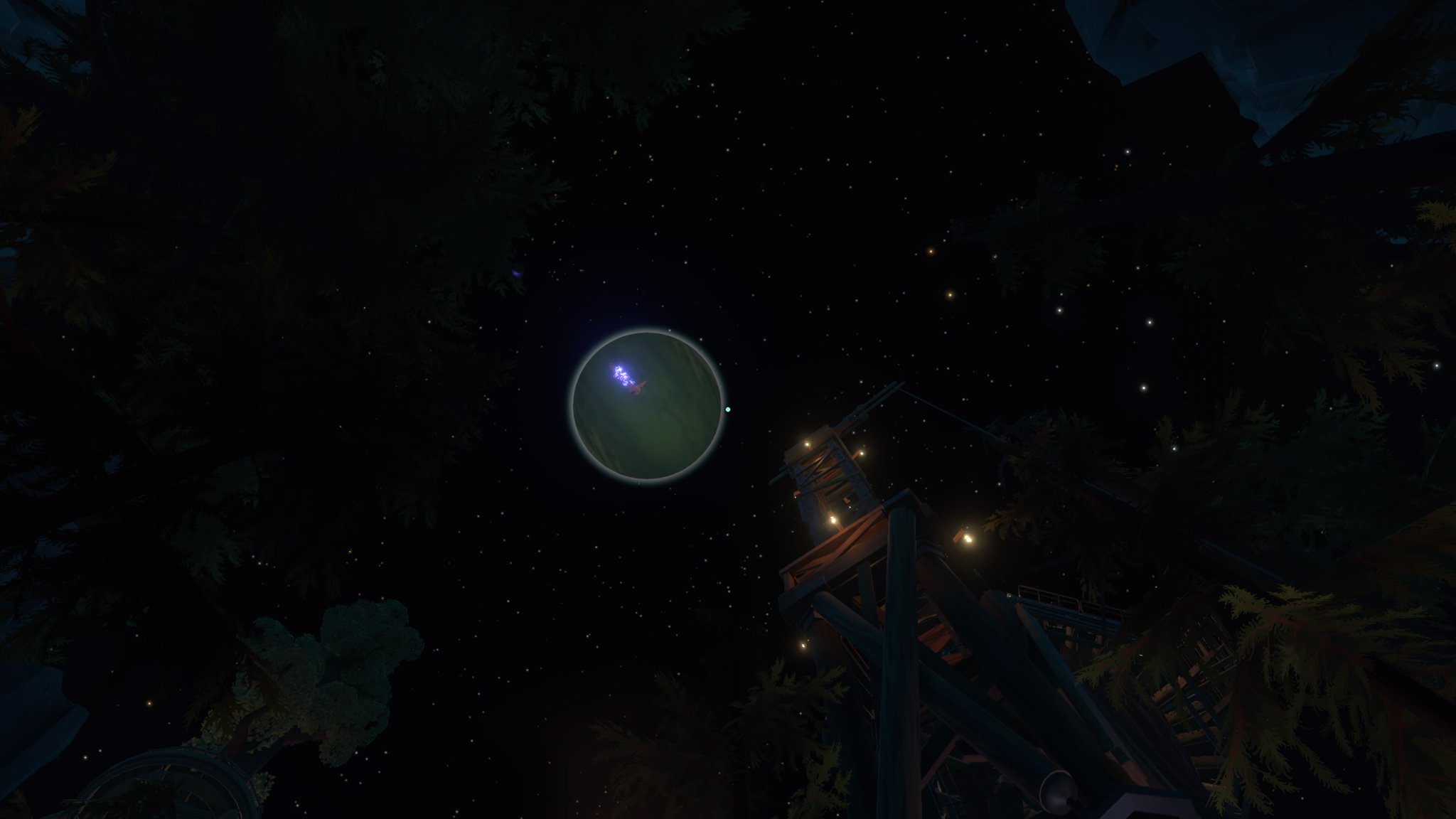
As you take your first gasping breath on Timber Hearth, you see the gas giant—Giant’s Deep far above, hovering in space. You notice a small purple explosion propel a piece of something out into space. If you play this game prepare to see this scene a lot, as this is how every time loop starts. It ends when the player dies, either self-inflicted or by the explosion of the sun. But somewhere in between is where the magic happens. The game draws some inspiration from rogue-likes, forcing you to use the knowledge of the world to advance further in each subsequent loop. With an untraditional approach to storytelling, Outer Wilds cements itself as an inspiration for developers to take risks, even at the expense of traditional rewards and potential player enjoyment.


Outer Wilds walks an interesting line, at times I was enamored with the exploration and discovery, at others I was completely frustrated with the mechanics and lack of rewards. I would sometimes go multiple loops without finding anything of note to record in my ship’s log (the only thing that gets saved between loops). There were times I found myself putting the game down for days due to poor in-game time management options and a lack of meaningful advances. Some discoveries—necessary for advancement—I found completely by accident at a very specific time within a time loop. It made me wonder if I would have found said thing otherwise.

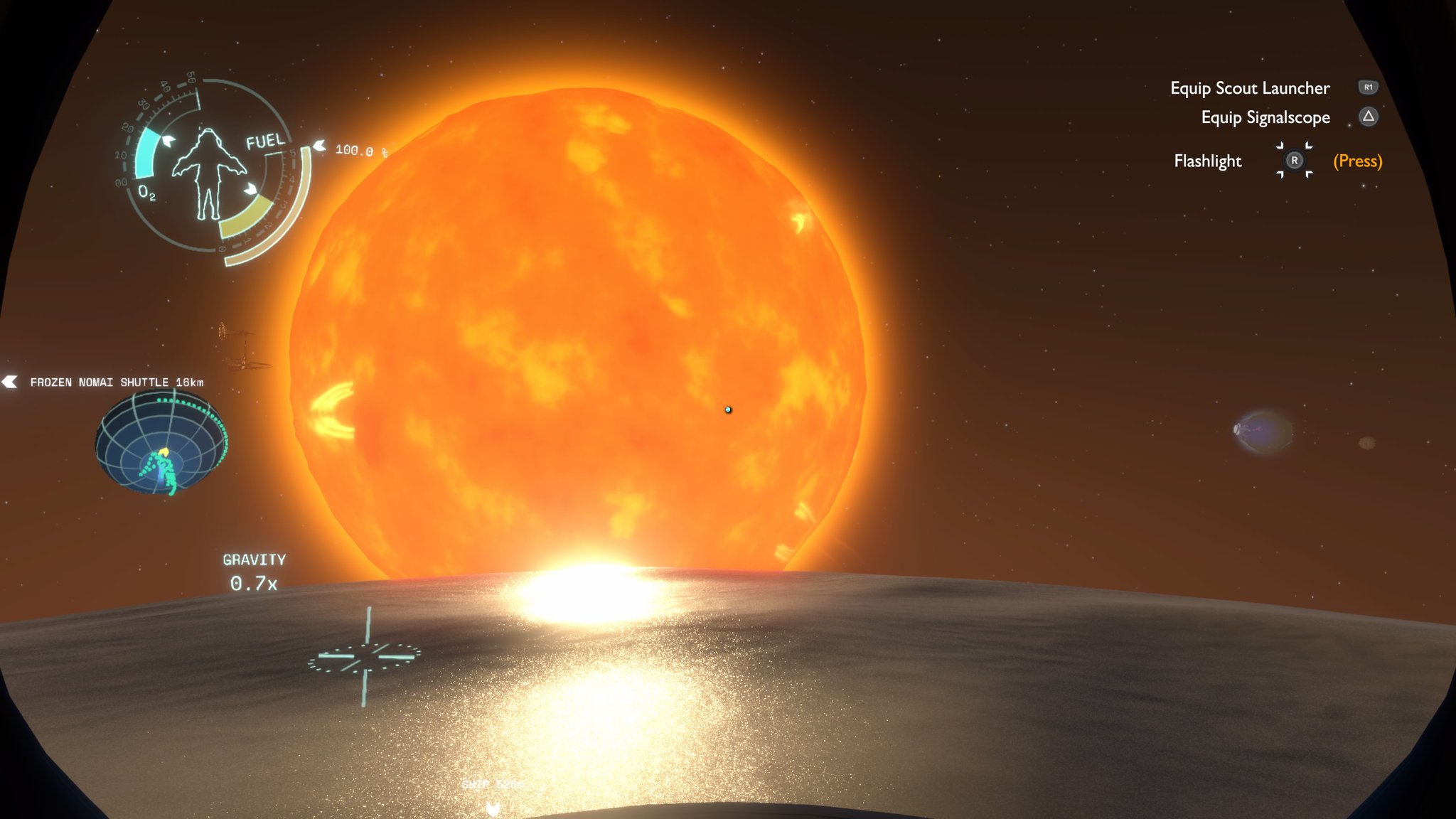
Some puzzles feel clever and rewarding while others are simply frustrating. Once I learned to play around with the time within a loop, things became more clear. But then I was subject to the terrible waiting system and unfortunate control scheme that hampered the game for me. Outer Wilds is meant to be a spacefaring game, but it isn't a sim. So why are the controls so wonky? By trying to fight with acceleration, gravity, inertia, etc., I lose some of the enjoyment of exploration. And good luck with using auto-pilot, sometimes it flies you directly into the sun or allows your ship to be sucked into the gravitation pull of another planet. After finding myself stranded in space a dozen times, the waiting game became old quite quickly.

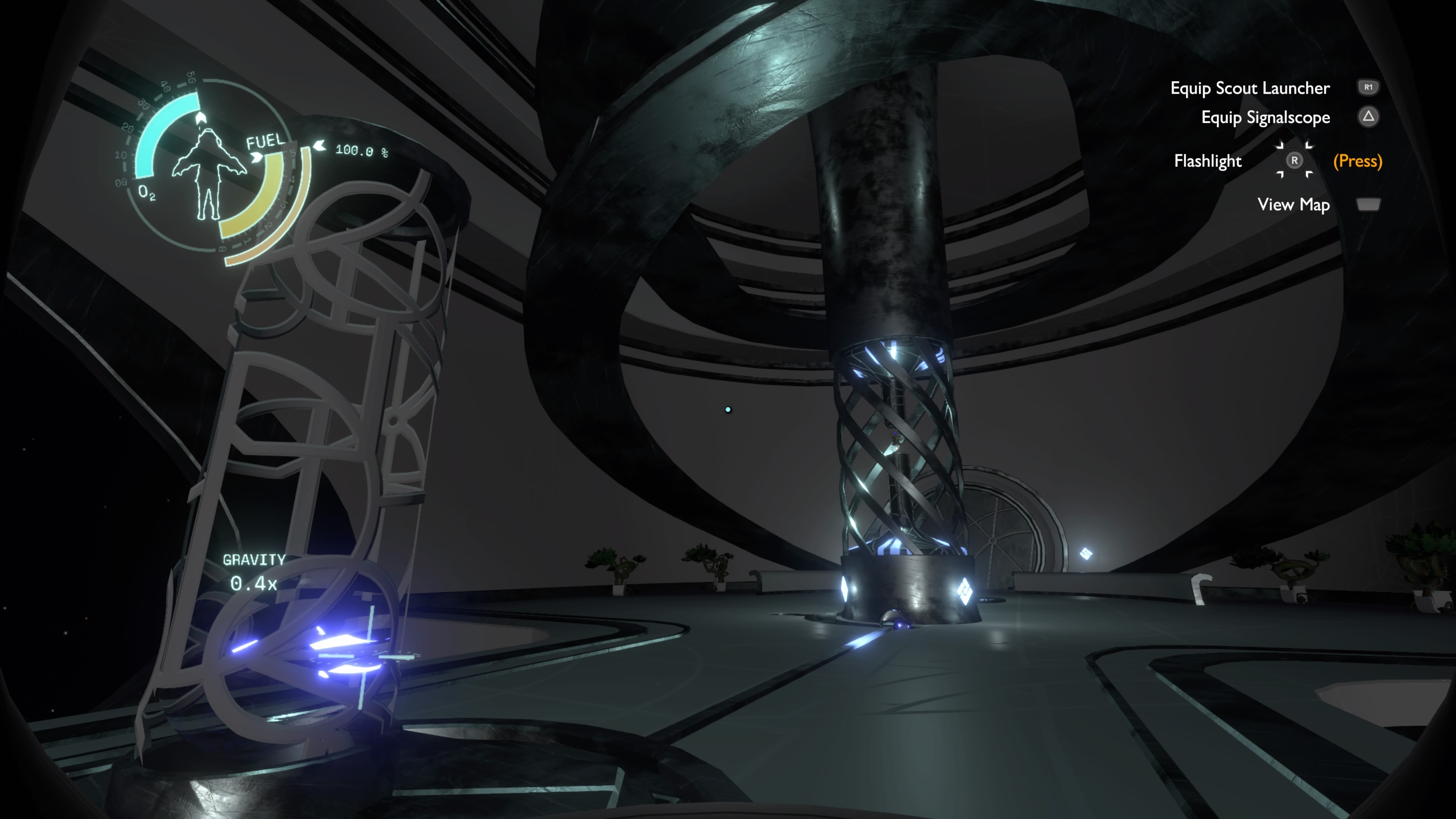
Despite the sometimes cumbersome controls and unpleasant waiting I had to endure, Outer Wilds exudes significant charm. From the unique planets to the Outer Wilds Venture tune that hums in your head even once you’ve exited the game, the game has many memorable traits. Discovering the unique properties of each planet was a delight. A black hole in the middle of a hollow planet? Count me in (except for when I fell into it for the twentieth time). Each body in the solar system—whether it be a moon, planet, or comet—has some sort of history attached to it, and stumbling upon something can be quite satisfying. More so if it was difficult to reach. The Nomai space predecessors left quite a bit of information behind, but it’s the sweet, human-like recorded interactions that made me smile. Little nuggets like these are scattered all over the solar system.

Outer Wilds is an odd paradox, it feels huge due to its nature as a space exploration game, but at the same time creates a coziness within its confines. Some places are mostly barren, while others have tons to explore, but at any point, you can equip your singalscope and listen to a fellow member of the Outer Wilds Venture play the theme song on their chosen instrument. So even after getting sucked into a black hole and getting thrown into deep space, you can find the music thousands of kilometers away and you’ll never feel alone.


It was difficult to decide how Outer Wilds made me feel as a whole. I don’t normally put a game down never to pick it back up, but there were moments where I considered doing just that. There were also times that I stayed up late into the night trying to discover more hidden messages from the Nomai. Though I found some frustrations with the game, when the credits rolled I was satisfied with the final message and many of the decisions that the developers over at Mobius Digital implemented. Outer Wilds takes many risks, and while some don’t pay off, the ones that do make this a venture worth taking. The game may not be perfect, but it is memorable. I recommend it to anyone who likes space travel and discovery sprinkled with a little charm. Just try not to get stuck in outer space too often.


The Math

Objective Assessment: 8/10

Bonus: +1 for unique storytelling method. +1 for satisfying space discoveries.

Penalties: -1 for wonky controls that don't ever feel great. -1 for poor waiting options. -1 for progression/reward imbalances.

Nerd Coefficient: 7/10

Posted by: Joe DelFranco - Fiction writer and lover of most things video games. On most days you can find him writing at his favorite spot in the little state of Rhode Island.