Showing posts with label Disney princess. Show all posts

Wednesday, April 2, 2025

Film Review: Snow White

A mix of promising moments and distracting production choices.


Long before Disney Princesses were a corporate trademark, fans flocked to Disney’s fairy tale adaptations on the big screen. Over the decades viewers enjoyed the musical adventures, often with a strong, girl-power protagonist and likeable allies who triumph over cruelty to find happiness. But, of all of the Disney princess films, the 1937 Snow White and the Seven Dwarves was the hardest for me to connect to. That adaptation of the classic Grimms’ fairy tale was the oldest in the catalogue and the story was iconic in its simplicity. Later versions of the tale were more intense in their explanation of the desperate princess on the run from a murderous queen. The first season of the television series Once Upon a Time, gave us the fugitive princess Snow White as a fierce, smart-mouthed archer who has an enemies-to-lovers adventure with a rogue prince she sarcastically nicknames “Charming.” Snow White and the Huntsman offered a dramatic and complicated relationship between the two lead characters. But if you have interpretations like Snow White and the Huntsman or Once Upon a Time in mind, the 2025 live action film is nothing like those. The newest version of Snow White takes us all the way back to 1937, complete with the iconic blue and yellow poufy dress and kid-friendly, music-filled storytelling.

In a happy kingdom, a benevolent king and queen have a daughter born during a snowstorm. They name her Snow White in honor of her surviving the storm. The king remarries when his wife dies and Snow White’s cruel stepmother (Gal Gadot) takes control of the kingdom when the king disappears. The evil queen hoards food (unclear why) and orders the kingdom’s farmers to be her soldiers. Surprisingly, they fall in line and become very dedicated to their new jobs as oppression enforcers. Meanwhile, Snow White (Rachel Zegler) is kept inside the palace and forced to work scrubbing floors, etc. This continues for years and she becomes isolated from what’s happening in the kingdom. The queen has a magic talking mirror which she consults to confirm that she is the fairest person of them all. One day Snow White catches a thief, Jonathan (Andrew Burnap), stealing potatoes from the palace, allegedly to feed starving people in the woods. Snow White scolds him for stealing but when he inevitably gets caught, she unsuccessfully appeals to the queen for leniency. Around the same time, the queen gets the bad news that Snow White is now fairer than the queen. The queen sends a guard to kill the princess and Snow White ends up having to run for her life. She is sheltered by seven miners a/k/a “the seven dwarves” from the original film. Snow White decides to team up with her new roommates and with Jonathan and his band of bandits as they all figure out how to win the kingdom back from the queen. 

The 2025 film is not trying to be new or clever and will be more enjoyable if you calibrate your expectations accordingly. However, despite the simplistic set up and the decidedly grade school vibes, the film has several promising moments. Rachel Zegler’s portrayal is appealingly earnest and her singing voice is gorgeous and perfect for the film’s childlike mood. The film has a relatable central theme of oppression versus kindness. The magic mirror uses a double meaning for the word “fair” noting that Snow White is more than pretty, but is just and fair-minded, unlike the queen. It’s a fun element of symbolism and moral commentary. Additionally, Snow White’s interactions with “Dopey” are sweet as she supports him in moving from being a victim of bullying to finding his voice. The idea of finding your voice to stand up to oppression is an overall theme in the story. It’s fun that Snow White’s name refers to overcoming the cold snow rather than aspiring to be like it. If you are in the mood for allegory, the film does a nice job of weaving in uplifting concepts throughout.

Unfortunately, the promising moments are undercut by other story elements. The new film gives us a Snow White who has slightly more self-determination than the original film but who always reins it in before she gets too fierce. Her love interest Jonathan (not a prince) is a quirky combination of Han Solo, Rapunzel’s Flynn Ryder, and a comic version of Robin Hood but with a rom-com vibe that seems a bit too flippant in dire situations. The evil queen is visually striking but is, more or less, two dimensional with no personal backstory or substantive motivation. The opening narration sums her up by simply stating, “She was evil.” And apparently that’s all we need to know. But, most distracting, were the non-stop CGI effects, not only of the forest animals but also of the seven miners who take in Snow White. Despite being a live action film, the seven characters are creepily cartoonish with distorted, giant faces. The fun of a live action adaptation is to see the characters as real people not merely three dimensional cartoons. All of these elements lead to a mix of promising moments and distracting production choices. 

Overall, Snow White will appeal to very young viewers but the film’s reluctance to flesh out the characters, literally and figuratively, may leave more mature viewers wanting something a bit more real.

--

The Math   

Nerd Coefficient: 6/10

Highlights:
  • Appealing lead actress
  • Distracting CGI
  • Simplistic storytelling

POSTED BY: Ann Michelle Harris – Multitasking, fiction-writing Trekkie currently dreaming of her next beach vacation.

Monday, June 5, 2023

Review: The Little Mermaid

Modern twists make The Little Mermaid succeed in this latest retelling of the classic tale


I first saw the original Disney’s The Little Mermaid in theaters at a time when my adult life was just beginning, full of stress and challenges. The Little Mermaid was the break we needed in grad school and my friends and I loved it. Unlike other animated fairy tales in existence at the time, this princess did the rescuing and she chased her own destiny. I enjoyed the angsty, girl-power, romantic energy wrapped up with a hard-earned happy ending. Later, I came across a hardback collection of Hans Christian Andersen's fairy tales and eagerly flipped to the story of The Little Mermaid. The original story was, to say the least, very different from my beloved Disney version. It was upsetting, sad, and lacked a happy ending. Life is full of surprises, and thankfully fairy tales can go in a lot of different directions. Now, decades later, after career, marriage, children, and hundreds of viewings, seeing the 2023 live action film version of The Little Mermaid is a full circle moment for me.

The premise of the 2023 The Little Mermaid is very similar to the animated version. So if you are unfamiliar with the story, beware of spoilers. Ariel is the youngest of several mermaid daughters of the Sea King Triton (Javier Bardem), ruler of the Mer-people—half-fish, half-humans who inhabit the underwater realm around the world. Ariel’s mother was killed by humans, so Triton sees them as cruel, dangerous, and generally to be avoided. But Ariel is not so sure. In true oppositional-defiant form, she collects human items from shipwrecks and tries (with mixed success) to learn about the human world on her own. Meanwhile, in a nearby island kingdom, Eric is a young man raised as a prince in the royal household but drawn to everyday life and adventure. This includes life onboard a ship where he works alongside other sailors, much to the dismay of Prime Minister Grimsby (Art Malik) and Eric’s mother Queen Selina (Noma Dumezweni). Eric wants to help his country’s struggling economy through science and exploration. Like Ariel, he has a private storehouse of treasured items he has collected from other places. Both Eric and Ariel feel misunderstood by their parents. The meet-cute happens when Ariel swims up to the surface to check out fireworks from a passing ship carrying Eric, but a sudden storm quickly destroys the ship and tosses the unconscious prince into the ocean. Ariel saves him, bringing him to the surface; however, she is forced to leave him behind on the shore as other humans approach. The sea witch Ursula convinces Ariel to trade her voice in exchange for a brief chance to be human so Ariel can both reunite with Eric and explore the human world. If he kisses her before sunset on the third day of her humanity, she will remain human. If not, her soul will belong to Ursula forever.

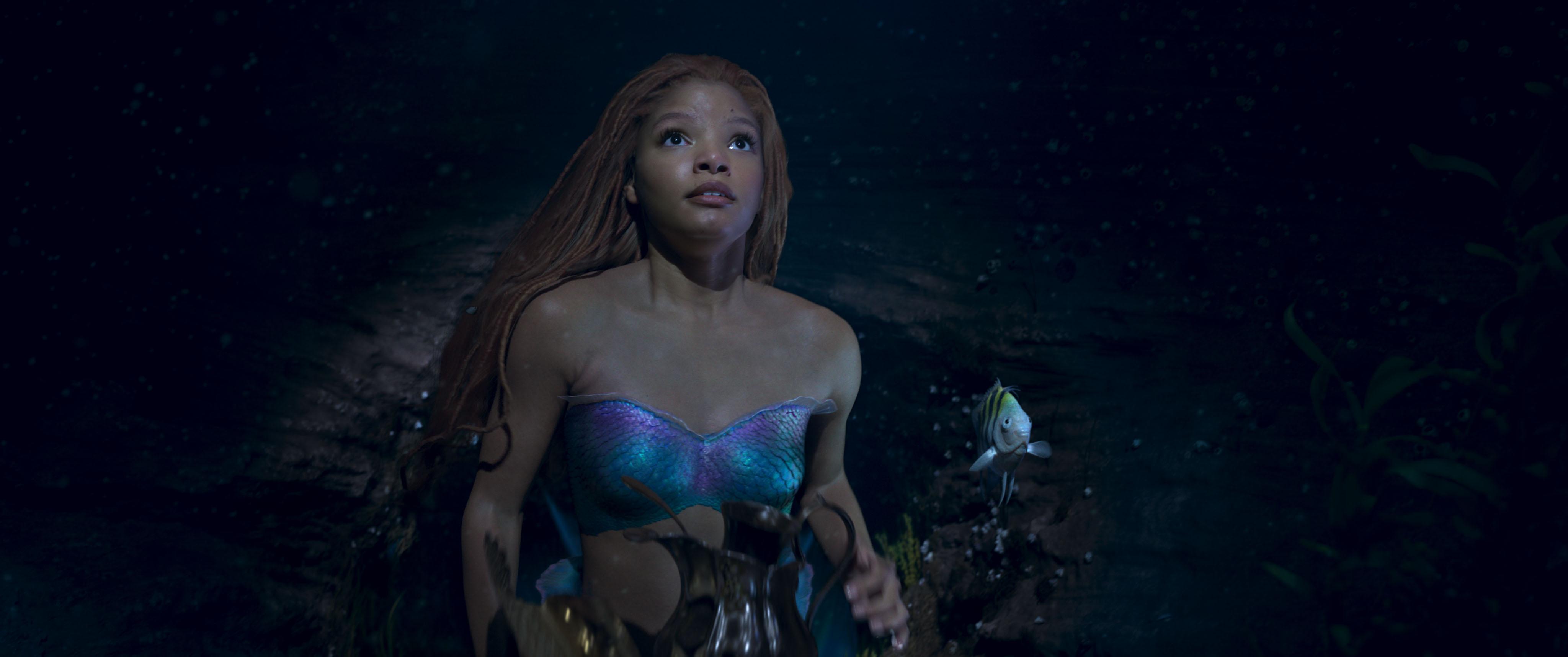
The visual effects for The Little Mermaid are beautiful, including the opening dive down into the foamy sea, which is breathtaking. But the film truly succeeds due to appealing performances from the lead actors. Halle Bailey is perfection as Ariel. She balances youthful wonder and defiant confidence with a tiny bit of actual respect and mindfulness of the dangers of the world. That slightly more restrained exuberance gives this mermaid the complexity needed to carry a live action film. Jonah Hauer-King delivers an endearing performance as the conflicted prince with a tragic backstory. He manages to be authentically sweet and nerdy as well as strong and heroic. Art Malik elevates the character of Grimsby to a leader and mentor. Melissa McCarthy slays as Ursula. She is wickedly sarcastic and manipulative until the final climactic battle scene. Then her visual effects go a little wonky and become distracting. More on that later.

How does the live action film compare to the 1989 animated film? I rewatched the animated version after seeing the live action film. The 1989 version still holds up pretty well: the songs are fantastic and the plot is engaging with its star-crossed, headstrong teens, culture clash, and big climactic fight scenes. However, adapting an animation to live action means changes. Some elements that work in cartoon form will not translate well to real life. Overall, compared to the original, this is an excellent adaptation. It closely tracks the animated film’s plot and retains its key showstopper songs. But it is a strong film in its own right, even for a non-Disney princess loving audience.

Here are some of the differences: Instead of hanging out at the palace, Ariel’s ethnically diverse sisters each patrol a different sea across the world and reunite periodically to report to Triton. I am sure this will have major spin-off potential but, in the film, the sisters remain mostly silent, which is a disappointment. Apparently Ariel’s territory is the Caribbean Sea because the live action film has a more distinctively Caribbean vibe. Eric’s home is a small island kingdom whose residents have British and Caribbean accents and the marketplace scene is very tropical. Watch for Jodi Benson (the original Ariel voice actor) in a funny cameo with Halle Bailey during this scene.

There are also three major backstory details in the new film which add depth to the story: 1) Ariel’s mother was killed by humans, hence Triton’s bitterness towards them; 2) Eric was shipwrecked as a baby and rescued by the queen, who adopted him into the royal household, hence her fear of her son spending time on long sea voyages; 3) Ursula is Triton’s sister—this is such a fun twist but it is never really explored. Not doing more with the family drama was a missed opportunity for the story.

Another general difference occurs when Ariel agrees to trade her voice for her humanity but Ursula secretly wipes Ariel’s memory of the need for the kiss. As a result, Ariel and Eric are just getting to know each other, she has no sense of urgency, and she is just as interested in his culture as in him. A lyrical difference occurs in the song, “Poor Unfortunate Souls.” The words are slightly changed so that Ursula’s original comments on society’s sexism are cut, because apparently that society isn’t sexist anymore—or maybe the film fears the sarcasm will be lost on modern audiences. The song “Kiss the Girl” also has a few adjustments, modernizing some of the lyrics with an emphasis on consent.

Overall, most of the new tweaks are fun ways to add complexity to the story. Despite those improvements, there are a few things that did not work for me in this film. And they are mostly, to my great surprise, related to visual effects. I’m generally not a fan of cute talking animals or objects—even in animation—but in a live action film, the effect can be especially strange. The visuals of live action Sebastian (grumpy crab/royal advisor, voiced by Daveed Diggs) and live action Scuttle (silly seagull friend, voiced by Awkwafina) were okay, but the effects for live action Flounder (Ariel’s tropical fish bestie) were very odd, leaning heavily into a weirdly realistic/uncanny valley effect rather than the more fantastical designs of Ariel’s other two animal friends. Jacob Tremblay did a good job with the dialogue, but the fish visuals were just off and a bit unsettling. (I would have converted him to a merboy friend instead of a strange looking talking fish.)

The other weird visual was the giant Ursula monster in the climactic battle scene. As in the animated version, Ursula angrily grows to enormous heights in her final battle with Ariel and Eric. In the live action version, giant-sized Ursula’s head seems slightly out of proportion with her tentacled body, and the facial expressions don’t have the intensity needed for that last big scene. However, most of the visual effects in the film are gorgeous, making the smaller visual issues surprising because, well, this is Disney.

My other few quibbles about the film have to do with small plot points. Ariel’s mother was killed by humans, but Ariel and her sisters never discuss the tragedy or how it changed their family. Even one or two lines might have added some emotional heft to the story without becoming too upsetting. Another minor annoyance occurs in the scene where Ariel gets to drive a horse-drawn wagon near the village marketplace. In the animated version, Eric gives her the reins and she drives aggressively but with surprising competence—at one point successfully jumping over a chasm while Eric comically ducks under the seat in fear, and after they land safely on the other side, he leans back with his hands behind his head, indicating that he trusts her. In the live action film, Ariel takes the reins and smashes into multiple fruit vendors, creating a mess as they careen along. For some reason, chaotic driving or riding appears to be a requirement in some fantasy films, but in this story it is very out of character for Ariel. Although she is new to life on land, this is a princess who fulfills serious duties, she saved Eric, and she loves elements of human culture—they are sacred to her. I’m not sure why we needed this destruction.

Overall, I loved The Little Mermaid. Halle Bailey’s beautiful facial expressions and astonishing voice captures the heart of the story in all of the classic songs. Watching her belt out “Part of Your World” made me teary and nostalgic. Despite being a kid-friendly movie, the entire cast was both strong and authentic, especially in the second act, when Ariel is unable to speak but delivers powerful emotional energy in each scene. The updated adventure was addictive, leaving me wanting more. And, given the number of loose threads in this story, hopefully we will get more.


Nerd Coefficient: 8/10

Highlights:
  • Sweet story
  • Plot holes
  • Strong acting
  • Mostly gorgeous visuals outshining some surprisingly weird effects
POSTED BY: Ann Michelle Harris – multitasking, fiction writing Trekkie currently dreaming of her next beach vacation.

Tuesday, May 5, 2015

Disney, Maleficent, and Shifting Paradigms


I think its safe to say that even without its extensive list of subsidiaries, Disney pretty much rules the fantasy kidverse. While the earlier films are arguably racist and sexist, Disney has recently started incorporating more and more diverse characters. With films like Aladdin, Pocahontas, and Mulan, this diversity of characters was probably the result of the stories they chose to tell rather than the characters they chose to tell them with, but the characters at least tended to be appropriate to their setting. This is especially relevant given the level of global diversity of Disney’s films.

Image Credit: theantilove

This global and more so now racial diversity is commendable, but since such a heavy portion of their audience is young girls, it is especially important to combat the rampant sexism present not just throughout Disney, but all mass media. Disney, it seems, is starting to do just this. Either they are taking responsibility for the influence they have over the world’s youth, or they see a market for the ‘strong female character’ and are capitalizing on it. Unfortunately its probably the latter, but nonetheless.

I have written briefly about Frozen and the message it sends to young viewers, and I recently noticed this trend continuing with Maleficent. If you haven’t seen the film, I must admit it's not super entertaining for adults, but it does have stellar visual effects, gnarly fairy wings, and a boss dragon. Maleficent is one of those ‘the story you thought you knew’ films that are the hot trend right now but in my opinion were way overdone before they even began. The film also capitalizes on the current trend in fantasy of personifying and de-villainizing the villain. It tells the story of Sleeping Beauty through the character Maleficent, the 'evil' fairy that curses the princess Aurora to prick her finger on a spindle on her 16th birthday and fall into a deep sleep, only to be awakened by true love’s kiss.

But let's backtrack a little and discover why Maleficent is so angry. Turns out, she was a close companion of Aurora’s father Stefan before he was king. But overcome with ambition for the throne, Stefan tricks Maleficent, drugs her, and cuts off her fairy wings, robbing her of the ability to fly. Picking up what they're putting down here? It has been confirmed that this scene is an allegory for rape. Maleficent was seduced, drugged, and mutilated and a significant, proud, and identifiable part of her self was taken away against her will. She's hurt, she's horrified, and she's pissed and I don't blame her. But now she becomes another powerful female character whose story is defined by sexual violence and that annoys me. The previous link mentions this scene is important for justifying Maleficent's actions to the audience. Okay, but I think there are many other ways of doing that. They could have has Stefan attack her home or burn her forest, for example. It doesn't always have to be rape. I digress.

After the curse is placed on his daughter, Stefan sends the princess to live under the protection of the ‘good’ fairies and has all spindles in the kingdom destroyed, as you may remember from the original tale. But here, Maleficent is ever present, watching over the growing princess and often secretly keeping her out of harm's way since the ‘good’ fairies are rather neglectful. Eventually, we can see that Maleficent regrets her decision to blindly curse an innocent child and that over the years she has grown to care for her greatly. Finally, with doomsday approaching, the two meet and Aurora calls Maleficent her fairly godmother and Maleficent encourages Aurora to come live with her in the fairy forest. Maleficent attempts to revoke her curse but is unable to. Somewhere in here Aurora meets a prince named Philip and they are immediately smitten with each other.

Okay, spoilers friends…


Spindle. Prick. Sleep.

Maleficent sneaks Philip in to see the sleeping Aurora, hoping that he can save her. The good fairies find him and try to make him kiss the princess and very notably, Philip expresses that he's not really comfortable with that since she's unconscious and all (high-five Philip!). Eventually though he succumbs to peer pressure and plants a wet one on Aurora, but nothing happens.

Crying and apologetic, Maleficent pledges to watch over Aurora's sleeping form forever and kisses her on the forehead and, yup, that was it, Aurora wakes up. Same basic theme from Frozen: true love doesn't have to come in the form of a boy or conventional love interest, there are many layers to love and family, etc.

I think this is an important move because it shows that Frozen was not an isolated incident and that perhaps Disney is beginning to implement a shift it its princess paradigm. A much needed shift in the Disney princess paradigm, mind you. The fact that ‘Disney Princess’ is an official term and Cinderella wedding dresses are a thing, attests to the influence this image has over young girls. I don’t think I need to do much convincing to get this point across.


Maleficent was written by Linda Woolverton, the first woman to ever write an animated feature for Disney (Beauty and the Beast). In fact, the only other official Disney Princess film to not have a male screenwriter was Frozen, which was written and co-directed by Jennifer Lee. Both Pocahontas and Brave had female writers on the team, but Brave's creator Brenda Chapman has publicly denounced the "blatantly sexist" "makeover" Disney imposed on her character Merida. It begs the question, is this inkling of a paradigm shift we see with Frozen and Maleficent Disney's doing, or is it the result of women finally getting the pen and some semblance of control over the final product?

One final thought...

A few months ago, mediaite reported on a Fox News guest claiming that Frozen “empowers women by tearing down men” and that “Hollywood in general has often sent the message that men are stupid [and] in the way.” Of course I had my harrumph at this and a chuckle at mediaite’s statement:

“Rumors that men are the heroes of the vast majority cultural products and have been since the dawn of narrative went unconfirmed at press time.”

Even though claims such as those made by said Fox News guest are (in my opinion) not relevant at this time given the context, she (yes she) is not alone in making them. In fact, such notions are akin to some controversies plaguing fandom recently. We must be careful not to legitimize these claims. In Maleficent for example, Philip does seem quite useless. In fact, he serves no purpose in the plot except to NOT save Aurora. Right now though we need the Philips in order to show the status quo and how it is being challenged. But when things start to change, we must be sure not to objectify or stereotype characters of any gender, race, etc, (regardless of prior standards) and thus create new types of inequality.


"Whoever fights monsters should see to it that in the process he does not become a monster."
--Friedrich Nietzsche
-------
POSTED BY: Tia  

P.S. Fingers crossed for Moana