Showing posts with label Fairy Tales. Show all posts

Wednesday, April 2, 2025

Film Review: Snow White

A mix of promising moments and distracting production choices.


Long before Disney Princesses were a corporate trademark, fans flocked to Disney’s fairy tale adaptations on the big screen. Over the decades viewers enjoyed the musical adventures, often with a strong, girl-power protagonist and likeable allies who triumph over cruelty to find happiness. But, of all of the Disney princess films, the 1937 Snow White and the Seven Dwarves was the hardest for me to connect to. That adaptation of the classic Grimms’ fairy tale was the oldest in the catalogue and the story was iconic in its simplicity. Later versions of the tale were more intense in their explanation of the desperate princess on the run from a murderous queen. The first season of the television series Once Upon a Time, gave us the fugitive princess Snow White as a fierce, smart-mouthed archer who has an enemies-to-lovers adventure with a rogue prince she sarcastically nicknames “Charming.” Snow White and the Huntsman offered a dramatic and complicated relationship between the two lead characters. But if you have interpretations like Snow White and the Huntsman or Once Upon a Time in mind, the 2025 live action film is nothing like those. The newest version of Snow White takes us all the way back to 1937, complete with the iconic blue and yellow poufy dress and kid-friendly, music-filled storytelling.

In a happy kingdom, a benevolent king and queen have a daughter born during a snowstorm. They name her Snow White in honor of her surviving the storm. The king remarries when his wife dies and Snow White’s cruel stepmother (Gal Gadot) takes control of the kingdom when the king disappears. The evil queen hoards food (unclear why) and orders the kingdom’s farmers to be her soldiers. Surprisingly, they fall in line and become very dedicated to their new jobs as oppression enforcers. Meanwhile, Snow White (Rachel Zegler) is kept inside the palace and forced to work scrubbing floors, etc. This continues for years and she becomes isolated from what’s happening in the kingdom. The queen has a magic talking mirror which she consults to confirm that she is the fairest person of them all. One day Snow White catches a thief, Jonathan (Andrew Burnap), stealing potatoes from the palace, allegedly to feed starving people in the woods. Snow White scolds him for stealing but when he inevitably gets caught, she unsuccessfully appeals to the queen for leniency. Around the same time, the queen gets the bad news that Snow White is now fairer than the queen. The queen sends a guard to kill the princess and Snow White ends up having to run for her life. She is sheltered by seven miners a/k/a “the seven dwarves” from the original film. Snow White decides to team up with her new roommates and with Jonathan and his band of bandits as they all figure out how to win the kingdom back from the queen. 

The 2025 film is not trying to be new or clever and will be more enjoyable if you calibrate your expectations accordingly. However, despite the simplistic set up and the decidedly grade school vibes, the film has several promising moments. Rachel Zegler’s portrayal is appealingly earnest and her singing voice is gorgeous and perfect for the film’s childlike mood. The film has a relatable central theme of oppression versus kindness. The magic mirror uses a double meaning for the word “fair” noting that Snow White is more than pretty, but is just and fair-minded, unlike the queen. It’s a fun element of symbolism and moral commentary. Additionally, Snow White’s interactions with “Dopey” are sweet as she supports him in moving from being a victim of bullying to finding his voice. The idea of finding your voice to stand up to oppression is an overall theme in the story. It’s fun that Snow White’s name refers to overcoming the cold snow rather than aspiring to be like it. If you are in the mood for allegory, the film does a nice job of weaving in uplifting concepts throughout.

Unfortunately, the promising moments are undercut by other story elements. The new film gives us a Snow White who has slightly more self-determination than the original film but who always reins it in before she gets too fierce. Her love interest Jonathan (not a prince) is a quirky combination of Han Solo, Rapunzel’s Flynn Ryder, and a comic version of Robin Hood but with a rom-com vibe that seems a bit too flippant in dire situations. The evil queen is visually striking but is, more or less, two dimensional with no personal backstory or substantive motivation. The opening narration sums her up by simply stating, “She was evil.” And apparently that’s all we need to know. But, most distracting, were the non-stop CGI effects, not only of the forest animals but also of the seven miners who take in Snow White. Despite being a live action film, the seven characters are creepily cartoonish with distorted, giant faces. The fun of a live action adaptation is to see the characters as real people not merely three dimensional cartoons. All of these elements lead to a mix of promising moments and distracting production choices. 

Overall, Snow White will appeal to very young viewers but the film’s reluctance to flesh out the characters, literally and figuratively, may leave more mature viewers wanting something a bit more real.

--

The Math   

Nerd Coefficient: 6/10

Highlights:
  • Appealing lead actress
  • Distracting CGI
  • Simplistic storytelling

POSTED BY: Ann Michelle Harris – Multitasking, fiction-writing Trekkie currently dreaming of her next beach vacation.

Tuesday, August 20, 2024

Book Review: A Sorceress Comes to Call by T. Kingfisher

 A familiar, soothing balm for the soul (if the soul doesn't mind the odd bit of murder thrown in for good measure).

In every story I have read by T. Kingfisher, there is a character of a certain... well, character. She is invariably female, often older, not always the protagonist, and has about her a particular spirit that is immediately discerned - when you meet her, you know her in a heartbeat. Her situation, her backstory, her motivations may change book to book, but her fundamental substance is entirely similar, and if you had them all meet up in some sort of extra-narrative liminal space, they'd all get on like a house on fire and probably organise a trans-universe insurrection so nobody gets imperilled for the plot anymore.

In case it wasn't obvious, I love her, this character. I don't think I'd keep reading the books if I didn't, because she's so integral to all of them. But she is ubiquitous and... well... isn't this a problem? Doesn't that mean the books get a bit samey?

Which is what I want to talk about here, in regards to A Sorceress Comes to Call, T. Kingfisher's latest novel. But first, the boring bit - I should at least tell you what the book is about before I go on a wild tangent about her wider canon. The story follows two women, one, Cordelia, fourteen years old and desperately alone, abused and isolated by her mother; the other, Hester, middle aged and comfortable, living a wealthy life in the manor house of her loving if daft bachelor brother. They come into contact when Cordelia's mother, basically a professional mistress, decided that Hester's brother Samuel is a prime target for marriage and a comfortable life, from which she can set Cordelia up for success and her own advantageous betrothal. No one else in the story, save the hapless Samuel, wants this to happen and does their level best to thwart it at every turn, in spite of the quite present danger. Because Evangeline is a sorceress, and a powerful one at that, who can hold someone prisoner in their own body, turning them to her will while they watch, powerless.

It is a story about power and powerlessness, and suffering, and surviving. It's about helping those in need, recognising cruelty in the world, and the lengths people will go to in harming those around them when they get in the way of their wants and desires. And it focuses very intently on the experience of being the victim of that, using the titular sorcery to emphasise it for anyone at the back who may not have been listening the first time.

So yep, it's a jolly one...

Except, it's T. Kingfisher, so actually it kind of is, despite the murders, mutilations and intense emotional and physical abuse. 

And this is what we come back to in the familiarity of a T. Kingfisher fairytale story, and its likewise familiar characters. The moment we meet Hester, this book's designated no-nonsense woman, we know it's all going to be, approximately, ok in the end. She, like her many brethren (sistren?), is so solidly practical, so absolutely sensible, that she acts as anathema to all the crazy shit going on around her. Sure, someone's been stabbed in a melodramatic fashion, but Hester is going to be reasonable about it all. Stolid, even. It's hard to maintain horror in the face of such down-to-earth pragmatism as The Character always has.

And for me, this is the crux of what T. Kingfisher does so well in her fairytale-retelling-style books in particular - she uses the sense of the familiar, and the intensely mundane, as a contrast to the darkness and grimness that goes with certain types of story, butting up against horror as they do. I would not call them cosy fiction, because they are nothing of the sort, full of, variously, moulds and murderers and abusers. But there is comfort there nonetheless. If anything, the darkness allows the creation of the comfort because it gives The Character something to stand in contrast against - she is a source of security because she exists in opposition to the fantastical (and less fantastical) evils of the world. She says "no more", and rolls up her sleeves and tells them to get lost because she has stuff to be getting on with thankyouverymuch.

But, to come back to our question earlier, doesn't this risk them all running together and feeling samey? Yes. It absolutely does. And, sometimes, they rather do. I am reasonably sure I have mixed up some of what happens in Nettle and Bone, Thornhedge and The Seventh Bride, now that I've put them down and read other things in between. It's what has held me back from nominating those books for something like a Hugo Award - they hold themselves back from the greatest heights of memorable and thrilling and engaging and [insert positive adjectives here to suit], because they set themselves up, and set up the reader, to fit so neatly into so many expectations. But, on the flip side, they do what they do with that comfort and those expectations so incredibly well, that I will never stop seeking them out to read. The ceiling may be a little low, but the bar is very high and so very, very consistent. You know, when you pick one up, that you will receive the experience you expect, and enjoy it, be pulled along by it, be unable to put it down. Often, that is all I want.

For this particular installment, I think it also exists right at the top of the "fairytale retellings" tier of T. Kingfisher works, ahead of Nettle and Bone pretty clearly. The way it uses the magic within the setting to talk about abuse and manipulation is done extremely well, and the two viewpoint characters offer excellent foils for one another, without totally outshining the relatively large cast of secondary characters. There are genuinely chucklesome moments, some really quite horrifying imagery, unexpected geese and a slightly nonsense strategem to solve a problem. It is intensely well-crafted within the space it has set up for itself, even as that space constrains it.

If it has any flaw aside from that, it's perhaps its slightly dated attitude to men - one I am predominantly used to encountering amongst women Of A Certain Age. Most (not all, but most) of the men in the story are slightly daft, hapless but well-meaning lumps who must be directed around the plot by the competent women who hold little official power but clearly actually do everything because those silly men, couldn't possible organise anything could they? Got to let them think they're in charge, poor dears, but we'd be lost if they were actually doing the planning. On the face of it, of course, this is a mildly droll inversion of patriarchy, right? Haha hoho, isn't it funny that the women are actually the competent ones? But as soon as you examine it any more closely than that, it starts to feel a little... off. The implications that one can spin out of its assumptions aren't pleasant, and it has the same lumping-together-ness that is half of the problem of the good ol' fashioned misogyny, tying one's usefulness as a person to innate characteristics of sex. It's something I observe in people the age of... let's say my mother and upwards, and ends up being what traps them into endless life admin and the mothering of the grown ass men around them, while also being rather insulting and infantilising to the perfectly competent men who then aren't being trusted to boil and egg or put away their own socks.

But at the same time, I know, in real life, women who are like this, to a greater or lesser extent, and they are also women I am rather fond of, in spite of it all. They are women who have had to be competent in that way, because of the men who likely merited the inception of the attitude they have held onto. They just haven't quite seen that it's not everyone around them anymore. T. Kingfisher alone is not responsible for the state of shifting feminist attitudes to men, and I'd be rather unfair to pin that on her and her alone. It's just a little niggle, a vibe I see in the world and sigh a little inside to replicated in characters of whom I am also rather fond.

And so I can overlook it, for the sake of reliable comforts of the rest of the story, done with the characteristic wryness and dryness that makes her narrative voice an eternal delight. All the characters speak with their own voices (even if their accents, so to speak, are the same as the characters of her other works), and have enough about them to feel real and realised, and with genuine relationships binding them to each other, of friendship and more. The setting doesn't get anymore time than it needs, but enough to feel like a world this story and these people absolutely could exist within. All in all, it's very well put together, and retains the heart, the down-to-earth-despite-the-literal-magic core that I hope for and expect whenever I pick up one of T. Kingfisher's books. I will absolutely be rereading this in the future, on a day when I need something soothing for the soul, but with some real darkness in it to make the comfort all the more present.

--

The Math

Highlights: the usual no-nonsense T. Kingfisher older woman character we know and love; funny and distinctive tone of voice to narrative and dialogue; well explored themes of abuse and manipulation

Nerd Coefficient: 8/10

Reference: T. Kingfisher, A Sorceress Comes to Call [Titan Books, 2024].

POSTED BY: Roseanna Pendlebury, the humble servant of a very loud cat. @chloroformtea.bsky.social

Thursday, June 20, 2024

First Contact: Labyrinth

A puppet-filled, dream fantasy journey

Despite its enduring popularity, I had never seen the classic 1986 film Labyrinth until this week. I should have identified with a bookish, dreamy, fantasy-obsessed, teen girl protagonist. I have enjoyed, or at least consumed, many similar fantasy films from that time period. But the truth is, missing Labyrinth was not an accident. I deliberately skipped the film over the years because something about the vibe seemed a bit too juvenile. This is likely because of the large volume of bouncy, grotesque puppets in the trailers for the film. Now, before you send letters, please know that I live in Atlanta, home to the Center for Puppetry Arts. I loved The Neverending Story, The Princess Bride, and, of course, Star Wars: A New Hope—all of which had varying degrees of puppet-based fantasy. I was raised watching Sesame Street, which I loved, and watching The Muppet Show, which I tolerated just fine. But the film that broke me was The Dark Crystal, which, I admit, I did not enjoy. For me, The Dark Crystal amounted to too many creepy-style puppets and not enough plot. So I always feared Labyrinth would be too close to that vibe despite the plucky YA heroine and the presence of superstar David Bowie in a leading role.

I watched Labyrinth on a nighttime flight from LAX to Atlanta. The sleepy, small screen environment with dim lighting and the hum of cold air was a perfect setting for the dreamy, psychological journey of a self-absorbed teen feeling disquieted and generally irritated with the discomforts of her life. The film does a great job of efficiently delivering a lot of backstory for the protagonist Sarah in a few seconds, then it dives right into the plot. The story goes as follows: [minimum spoilers] Sarah (Jennifer Connelly) is a bored suburban teen, living with her dad, his new-ish wife, and Sarah’s toddler half-brother, Toby. It’s initially unclear whether Sarah’s mother is divorced/absent or deceased, but by the ending scene, it seems to be the latter. Sarah enjoys acting out a scene from a fairy tale about a princess who confronts a goblin king who has stolen a child. She is a sixteen-year-old cosplaying before cosplaying was cool. Her make-believe moment is interrupted when she remembers she is scheduled to babysit her baby brother while her parents go out on a date. Stuck with the crying toddler, she holds the child to comfort him, then, in frustration, verbally wishes him to be taken away by the goblin king from her storybook. The child disappears, and a frantic Sarah is told by the goblin king, Jareth (David Bowie), that the child is now his. To get Toby back, she has to navigate a massive labyrinth to reach the goblin king’s castle and rescue her brother. In the labyrinth she encounters various creatures who are variably grotesque or adorable, kind or dangerous, annoying or wise, and who are mostly in the form of puppet creatures. In particular, she meets grumpy goblin frenemy Hoggle, idealistic dog-like Didymus, and loveable fuzzy giant Ludo. On her journey, she learns the value of friendship (of course), the dangers of assumptions, and a new understanding that life isn’t fair as she is forced to stop whining and grow up.

First impressions: Jennifer Connelly is intensely, perfectly, young and dreamlike in the role of Sarah. She looks like a 1980s Snow White, and her dialogue and voice inflection are artificially fairy tale-like. It’s almost borderline annoying. But Sarah is actually the archetype of the unhappy teen searching for something more. In contrast to her sweet appearance, she hates her brother enough to wish him dead, straight out of the gate. The initial scene of her holding her crying brother was stressful for me to watch. There is no child abuse, but the intensity of her anger hovers over the moment in a way that worried me. Ironically, she is bitterly angry because she has to babysit for one night, although she concedes that she literally had nothing else to do. She’s not missing prom, her senior art show, or even a date with friends. Sarah is angry because babysitting Toby has interrupted her fantasy playacting. It’s clear that there are larger issues of grief and discomfort, as well as impatience with the mundaneness of ordinary life compared with the allure of fairy tales.

As she journeys through the labyrinth, Sarah periodically meets Jareth, who repeatedly encourages her to forget the search for the child and just enjoy her fantasy life. Sarah shows her growing maturity by refusing to give up. Sarah also encounters lots of the aforementioned goblins and other fantastical creatures who both help and hinder her in her classic journey story. The story overtly references The Wizard of Oz and Where the Wild Things Are (Sarah has copies of the books in her bedroom), but it also contains clear references to Peter Pan and Alice in Wonderland.

As a classic journey story, I felt I knew where the plot was heading, and I was mostly right. However, there were a few story elements which surprised me. Sarah’s frenemy Hoggle sprays poison to individually kill fairies (sentient, humanoid). Sarah initially finds this horrifying, but then rolls with the fairy killing after one of them bites her finger. She ignores the rest of his poisoning and enlists Hoggle’s help to find the entrance to the labyrinth. Sarah’s pivot from sentimental to pragmatic was a little startling. Labyrinth is a dreamscape, so I guess philosophical concepts of life and death are primarily symbolic. Secondly, David Bowie is perfectly cast as the goblin king Jareth. He is naturally quirky, chaotically elegant, but creepily enamored with Sarah. Additionally, there is a dreamlike scene of a masked ball with elegantly dressed humans dancing together, including Sarah and Jareth. Despite my fears about creepy puppet creatures, the attractive humans at the masked ball felt even more creepy and disturbing. That emotional irony was an artistic high point for me in the film. Another visual highlight was the room of dimension-defying steps where Jareth, Sarah, and Toby all navigate multi-directional, freeform stairs in an Escher-inspired, Inception-style scene.

In Labyrinth, Sarah is repeatedly accused of taking things for granted. I initially assumed this meant she did not appreciate the things she had (her comfortable lifestyle and relative freedom). But she is actually being reminded of the dangers of making assumptions about people and about life. During setbacks, she repeatedly complains “that’s not fair,” and eventually Jareth sarcastically tells her, “You say that so often. I wonder what your basis of comparison is.” It’s a great line. He is effectively telling her to grow up and face reality, a still timely lesson about the unfairness of life even while acknowledging the validity of the search for justice. In the same way, in a final scene, Sarah’s labyrinth friends remind her that they will still be there when she needs an escape. Labyrinth confirms the importance of living in the real world while also acknowledging the value of play, fantasy, and imagination. Hopefully, that is a life lesson that we can all agree on.


Highlights:

  • Classic journey coming of age film
  • So many puppets
  • Timeless dreamscape

POSTED BY: Ann Michelle Harris – Multitasking, fiction writing Trekkie currently dreaming of her next beach vacation.

Monday, February 26, 2024

Review: The Butcher of the Forest by Premee Mohamed

 A creepy fairytale story with its eye on more than the just magic, mystery and missing children.


When the cover of a book has animals with their skulls out on it, I feel like the audience is probably well-primed for the kinda gross - or at the very least rather unsettling - events that are about to unfold. Because - spoilers - this is not a story about a happy fun man who has a meat-and-sundries shop in an enchanting woodland paradise. These woods are creepy. So do go into it with that in mind.

That being said, Mohamed has managed to do the thing I always appreciate when authors do - she's stayed on the near side of the horror line - it's going to leave you feeling a bit ill at ease, but it never fully breaks out into the full on scary, the "guess it's time for the nightmares", actually horror-horror. And, because I am a great coward to the very depths of my soul, this is perfect for me. I want some horrible skull-creatures, I want nastiness... but only up to a point. The Butcher of the Forest takes me a fair way towards the edge of that line, but never threatens to step across it.

What it does do is give us a very good fairytale feeling story of a journey into a wood that might also be another wood, in another place, or no place at all, inhabited by creatures that aren't totally within the human scope of understanding, at least in the traditional sense. Unless you're Veris, our protagonist. Veris went into the wood a long time ago to fetch back a child that had disappeared there, something no one else had managed to do, because Veris Knows things. Not big, grand magics, but just enough to give her the wisdom and sense to get in and get out with what she came for. Much good though it may have done her. Now, many years later, she's been asked - well, not exactly asked but we'll come back to that - to go and do it all again, to fetch back another two children lost to the dangers of the North Forest, a Forest no one in the village goes into, and in which any lost children are simply considered dead. The North Forest is not to be messed with.

But when the two children lost in there are the children of the Tyrant? The Tyrant who knows you successfully made that trip once before? Well, sometimes heroism isn't a choice you get to make for yourself. Sometimes someone has decided your heroics are their due, and there's not much you can really do about that.

Which brings us to the core of what's so good about The Butcher of the Forest as a story - it's a story that understands the place a person may be forced to occupy, in the sort of world that so many fantasy stories like to draw on. Because Veris lives in a village - a land - occupied by the Tyrant. His name isn't ironic. And through her musings on her own past, and the events of the story as we witness them, we see a much better appreciation of what that might mean than I have come to expect of pseudo-medieval fantasy. Not so much in the understanding that social hierarchies exist, which is often covered perfectly well, but in the understanding of the layerings of explicit and implicit in the power dynamics that fuel them, and critically, in the legacy of what it took to get the world to that place.

Veris remembers the war that brought the Tyrant to power here. Veris remembers the cost - especially to her personally. The cost to her family and her body. Mohamed is perfectly blunt in what that conquest will have meant, and keeps on meaning, in the family that is a woman in her forties, her aunt in her 70s and her grandfather pushing 100 forming a household together, with the obvious gaping wounds of missing family members. And so, when Veris is picked up with some lack of courtesy at an inhospitable hours and pushed to her knees before the tyrant, there is no question of dramatic resistance. This power is a power to be suffered through and survived, if you can. It asks too much but you have to obey nonetheless.

Seeing that just written plainly on the page, in every act and choice of the heroine was just... kinda powerful. And just as grim as any horrible skull creature the woods had to offer.

And it gets better, because the children Veris is being sent in to rescue are the Tyrant's own. This man who has done such harm to her people, who threatens her family so she'll do this thing for him that no one else has done. A lot of the story has an undercurrent to it of Veris' torn emotions - her hatred of this man, her knowledge of what he has done... against the as-yet innocent of his children. They may well grow up to be their own monsters, they may well already be being shaped into them, but as yet... as yet? They're innocent. They are not the owners of their father's crimes. But they are part of the system as it is. They are its inheritors. They are an intrinsic part of a system that is anything but innocent itself. There is nothing but complexity to their place in relation to Veris in this world.

So it is this constant musing on that tension that underlies the whole of Veris' story in this book. She finds herself caught between the poles of resentment and understanding, as well as the past and the present, as her trip into the dangerous lands inside the North Forest naturally summon memories of her last trip.

The narrative threads through these moments of the past delicately, with a measured pace, so it takes much of the story to fully understand the story that came before, and its full significance. The moment when every piece finally clicks into place does not feel like a revelation, merely a moment of satisfied understanding, because those foundations have been so carefully built as we went the whole way along.

But this tension, this satisfying weaving of opposing points, would not work nearly so well were not Veris such a good character to infest the point of view of. She's already a rare thing in being a heroine in her 40s - I do love to see a fully adult women still being allowed to be the focus of a story - but she's also just someone with a relatable pragmatism, as well as a realistic backstory, in that she truly feels like she has one. There are not many pages for this story to unfold across, but Mohamed dedicates enough page space within them to give Veris the very real sense of being a whole person, a person with a life that has happened before this, and for whom that past has real effects, writ both large and small, on how she interacts with the present. It feels relevant to her words, her actions, her choices throughout, and makes her feel so beautifully realised, especially alongside her pragmatism, her wisdom to know which are the battles she cannot fight and must resign herself to suffer through. There's a weariness to those decisions, the sense of a big sigh just being held back, that does a great deal of work in making me like her.

Is she a heroine though? It's a question I came away from finishing this wondering, and not to Veris' detriment. But it is simply that, unlike so many stories, she has ended up in this role through no agency of her own. It's a story that has happened to her, even as she is the one suffering it. Does that make her more the heroine than in stories where the protagonist's chose their battles? Or less? I don't know. But that lingering pondering... that too is a joy of the book.

Which leads me onto the ending... which I won't spoil. But I can say, without spoilers, that when you get there, you realise quite what the scope of this story is, and that, in one framing, it could merely be the prelude to another, different story. I kind of hope that story never gets written though. I enjoy that this exists as that prelude, and that there's a big wide gulf of potentiality hovering around the ending at what the "and then?" could be. It is forever left as an exercise of the reader to wonder and to dream it. Mohamed has left us a framework, and we can find our own answers within it, if we want to spend the time doing so (I certainly have).

All in all, The Butcher of the Forest is a wonderful novella that gives us a great (creepy - did I mention creepy?) story, but with a real meat of thoughtfulness under the skin, that sometimes peeps through the gaping wounds to give us a glimpse of what lies beneath. It's got the nastiness that fairytales often have, as well as a very offhand, pragmatic approach to magic that is unwilling to explain it because it simply does not need an explanation. When the horrible skull creature is coming after you, you don't have time to wonder exactly how it works, after all. The wondering is saved for the important things - how fucked up the world is under the bootheel of a tyrant, and the lingering horrors of one's own existence. Just how I like it.

--

The Math

Highlights: over 40s women allowed to have adventures (even if they don't personally want them), political musings, creepy horrible skull creatures

Nerd Coefficient: 8/10

Reference: Premee Mohamed, The Butcher of the Forest, [Tor 2024]

POSTED BY: Roseanna Pendlebury, the humble servant of a very loud cat. @chloroformtea.bsky.social

Thursday, December 7, 2023

Remember Wish? Yes, that happened this year

The worst possible way to celebrate Disney's 100th anniversary was to release a movie as unimaginative as this

From a studio that is so starved of new ideas that it's decided to recycle all its back catalogue, now comes an even more cynical distillation of that formula: take all the typical Disney tropes and glue them together into the Disney-est movie possible. The ne plus Disney of cinema. The ur-Disney. Put all the princesses of this franchise in a blender, strain the mush through a colander, add half a pound of evil sorcerer and half a pound of wish-granting stars, whip it vigorously with the yolks of sixteen dozen hundred Easter eggs, mix thoroughly for the duration of a generic power ballad, sprinkle with every talking animal in every fantasy movie ever, apply an unhealthily viscous layer of treacle, and you'll get the unpalatable, half-baked nothingburger that is Wish.

Once upon a time, Disney fantasy movies used to be an Event. Such timeless achievements as Snow White and Cinderella and The Little Mermaid and Frozen incontestably defined their respective generations. But the magic has run out. It's been barely weeks since the release of Wish in theaters, and it has failed to leave any lasting impression. It's hard to imagine today's kids beginning a habit of rewatching Wish for the next several decades of their lives, the way their parents grew up endlessly rewatching their Disney classic of choice. Wish is not only a disappointing movie, but a mediocre way of celebrating the studio's centennary. After a long legacy of highs and lows that nonetheless survived and came up with new tricks to reinvent itself and often led the way for the entire tradition of animated cinema, Disney seems to have once again fallen into a crisis of creativity. We're living through one of those recurring tragic periods during which Disney productions can't possibly become classics.

It's a pity, because there are a few good qualities to highlight in Wish. The hand-drawn appearance of the backgrounds is stunningly gorgeous, evocative of old fantasy book illustrations. Unfortunately, the art style used for the characters is too simplistic, a cast of basic 3D models indistinguishable from the same basic 3D models you get from less über-wealthy studios. The result is that the viewer's attention is continuously attracted more to the background of a scene than to the characters doing the action, which is the opposite of the effect you want to create in an animated movie. It costs extra mental load to try to follow what the heroine is doing when the viewer is too distracted by how much better drawn the wall behind her looks.

In terms of plot, the forced familiarity crosses the line of bothersome and falls right into insulting territory. Wish tries to replicate the Pixar Theory by inventing painfully shoehorned backstories for several recognizable elements of earlier Disney movies, but none of those moments contributes to the actual telling of the story. And when considered on its own, apart from the innumerable links to what we'll apparently have to start calling the Disney Cinematic Universe, the plot of Wish is filled with absurdity. We have a magocracy where the king forbids anyone but himself from practicing magic, but he only uses his magic to capriciously grant one inconsequential wish every month. The price for the kingdom's protection is that everyone must forget what their wish was. Why the founder of this transparently dystopian regime wasn't guillotined before he completed even one year on the throne is never explained.

The collective uselessness of a populace is the necessary subtext of every savior story, but Wish doesn't bother trying to hide it. The evil of the king's hoarding of magical gifts and tampering with the people's memories is so bleedingly obvious that our heroine figures it out within minutes of talking to him, but the viewer is supposed to believe that in decades of unopposed rule she's been the first to raise any objection. By adopting a Great (Wo)Man Theory of History, Wish squanders the abundant symbolic potential of a setting where citizens effectively delegate their will to a head of government who is then charged with executing the will entrusted to him. The movie's inexplicably underutilized metaphor for representative democracy could have been further developed into a plot with urgent relevance to its historic moment. We are in the middle of an existential crisis for democratic systems, instigated by unaccountable strongmen with brazenfaced authoritarian aspirations. With a more consistent script, Wish could have had the perfect opportunity to introduce children to the principle of the consent of the governed, which wouldn't really be an unprecedented move for Disney if you remember how Zootopia and Elemental talked about racial prejudice and Tangled and Encanto talked about family abuse.

Instead of relying on human effort, our heroine depends on a magical star whose influence makes animals talk and sing. In other words, Wish is arguing that the way out of this dystopia is the Disneyfication of the world. That's a bleak position, especially coming from a movie that dedicates two whole songs to the "we are all made of the same stardust" ethos, but it's fully consistent with Disney's goals of total cultural phagocytosis. Much in the vein of other nostalgitic embarrassments like Space Jam: A New Legacy, Ghostbusters: Afterlife and Jurassic World: Dominion, Wish is not a movie that tells a story. It's a self-congratulatory pat in the back by a studio that is too afraid to venture outside the tried and true. If all that Disney has to show for itself as the culmination of a century of artistic evolution is a timid rehash of past glories, the studio's going to need to pray to a star if it intends to keep making history for another century.


Nerd Coefficient: 5/10.


POSTED BY: Arturo Serrano, multiclass Trekkie/Whovian/Moonie/Miraculer, accumulating experience points for still more obsessions.

Friday, October 13, 2023

Nanoreview: The Little Red Wolf by Amélie Fléchais

A small change to the tale makes all the difference

You know how it goes: there's a curious child, a worried mother, a meal to deliver to a frail grandmother. An errand through the forest. A chat with a stranger. And menace lurking. Except this time the curious child is the wolf, and the stranger in the forest is the girl, and the crux of the story is the mystery about who is more of a menace to whom.

But what does it all mean? The traditional versions of Little Red Riding Hood have given rise to all sorts of interpretations: a didactic fable about obeying your elders, a remnant of matriarchal initiation rites, a summarized model of heliolatrous cosmology, a Freudian dream of death and reemergence, an allegory of sexual assault. Amélie Fléchais, in her retelling The Little Red Wolf, recently translated into English by Jeremy Melloul, chooses to focus on the most salient theme that this story has always presented to young readers: the fear of untamed nature.

When the wolf loses his way in the forest and meets the little girl, she regales him with a song about the origin of the enmity between the hunter and the wolves. But the wolves remember a different song, one that completes the story and makes you want to reread the book and catch the visual clues that were there all along.

The illustrations fulfill this role outstandingly. "Show, don't tell" has always been a dubious rule, but if there's any art form where it would be wiser to follow it, it's graphic novels. In The Little Red Wolf, the text is precise and just sufficient, while the images are evocative of a deeper plot underneath what's said. The secrets hidden in the forest are heightened by ironic contrast with the gentle choice of palette. Both wolf and human faces eschew anatomic accuracy and go for pure emotion. With his huge eyes and tiny snout, the little wolf is a harmless creature that just wants to see everything the world has; with his overgrown beard and haughty expression, the hunter is a force of nature more fearsome than any beast.

Upon reading the promotional blurb, The Little Red Wolf might sound like your average fairy tale reversal. However, when the full backstory is revealed, the picture that emerges is more complex than just a switching of roles. Each party in this human-wolf conflict holds a portion of the truth, and few readings are more stimulating to the young mind than a tale told through conflicting versions none of which can be ignored. When you figure out that the reason this forest has a hunter of wolves is the same reason this wolf wears a red cape, your understanding of the plot goes full circle, and with that richer perspective, you'll want to go through the experience again.


Nerd Coefficient: 7/10.

POSTED BY: Arturo Serrano, multiclass Trekkie/Whovian/Moonie/Miraculer, accumulating experience points for still more obsessions.

Reference: Fléchais, Amélie and Melloul, Jeremy [translator]. The Little Red Wolf [Oni Press, 2023].

Monday, July 31, 2023

Review: Thornhedge by T. Kingfisher

A retelling of sleeping beauty that flips the original on its head.

T. Kingfisher has several modes in which she operates (I'm a big fan of "mocking paladins (affectionate)", though less keen on "horror, genuinely horrifying" because I am coward), and one of those is "fairytale retelling, but make it dark, vaguely feminist and contains at least one aggressively practical woman". Unsurprisingly, Thornhedge is an entry into that latter category.

I mean this as no insult at all, but you know what you're getting into when you start a T. Kingfisher novel. Maybe not in terms of the plot beats or events, nor the interpretation of the source material if it's a retelling, but in the tone. She has a very, very distinctive voice in which she tells her stories, and opening a new book from her is like greeting an old friend, because as soon as they open their mouth/you read the words on the page, you're back in a familiar, comforting place, even if they're telling you about their new partner you've never heard of, or the job you didn't know they had. In her own afterword to Thornhedge, Kingfisher protests that this book is sweet, despite it being filled with death and biting and curses - which... I agree, though it's not the word I'd use. I'd say "friendly" instead. Or "welcoming", perhaps. No matter how gruesome the murders, how many corpses are made to dance and how many demon chickens there are, a T. Kingfisher story is always a welcoming one, where the narrative voice is clear, and comforting and on your side while you watch the terrible things happen. In this, Thornhedge is entirely like her other fantasy works, and particularly her fairytale interpretations, like Bryony and Roses or Nettle and Bone. I think this is a wonderful thing, especially for an author with an extensive catalogue of work not in a single series or unified world. Once you know you like that voice - which, if it wasn't already clear, I very much do - you can dip your toe into anything in the back-catalogue that takes your fancy and know that, regardless of whether the plot is to your taste or the paladins sufficiently attractive and guilt-ridden, there will be something there, constantly, throughout the reading experience, that will make you happy. It reduces the risk inherent to picking up something new.

It then obviously helps if the story, characters and so on are well-constructed and enjoyable, but luckily she's got that covered too.

Thornhedge is a retelling of the sleeping beauty story, but one that asks "what if the briars, the sleep and the centuries of magic weren't to keep people out, but the sleeper in?". Our viewpoint character isn't the sleeper, but instead the godmother who put her into this position, who, through a mixture of flashback and present time slowly shares with us and a knight errant the series of events that led to her solitary vigil of a tower and a tangled hedge of thorns.

Because it is a solitary vigil, this is, primarily, a novella of few characters. We of course have our protagonist, Toadling, but outside of her, the time we spend with other characters, in memory and in present narration, is relatively brief, and most of them suffer a little for it. The minor exception is Halim, the knight errant, who manages to be endearing to the reader in almost no time at all, just as he is to Toadling. But even he could perhaps have done with some more space and time. We know a little of him, and we are charmed by him, but he lacks the depth many of Kingfisher's secondary characters achieve in other works, simply because he lacks the space to encompass it. Even Toadling is done a little dirty by this, and does not get the impact for instance Bryony does in Bryony and Roses. That being said, what we do get is incredibly sweet and wholesome, while never straying into the saccharine, so it's more a problem of wanting more, than an issue of what we actually get.

The balance between the flashbacks and the present time is very crisply managed, without feeling artificial, and the pacing is well balanced, so we come to the intersection of backstory and story at a very natural point. It never feels like we're being force-fed context and exposition, rather this is just how Toadling is thinking about her predicament. She's intensely inward looking - unsurprisingly, given her solitary situation - which makes it all the easier to achieve, but even so, it's nicely managed to give us those morsels of backstory sufficiently spaced out as to feel worth each wait to get to them.

There's also a pleasing brutality to the world - as is true of many of her books. It never feels gratuitous, like some of the Game of Thrones style attempts at historical "realism" that stray into torture-porn, but rather emblematic of a pragmatism that feels well situated in the period the story is from. Likewise, her fairies are deeply alien things, who do not behave, speak or feel as humans do, and this comes with a cruelty that links them into many of the traditional fairy stories. And yet, it always gets looped back to some essential piece of them, or their nature or their setting in the book, so it never feels forced. They are what they are, and that can sometimes be cruel, but it's never there simply for the sake of it.

And, as ever, there are some really cracking occasional lines dropped in without any warning - "thorns die from the inside out, like priests" hit me out of absolutely nowhere and I was thoroughly unprepared for it, and now it's stuck in my head, likely for the rest of the week. Some of this impact comes from the fact that, for the most part, she's not a prose-forward kind of author, so when you get those little snippets of gold (to horrendously mix some metaphors), they stand out all the greater. Or rather, to borrow Max Gladstone's phrasing, her work is primarily aerodynamic (though with its own, very distinctive style), but this means when it's got a little wing or spoiler or something that affects the flow, it's all the more distinctive for it. 

I'll stop brutalising analogies now, I promise. 

In any case, all in all, it's nice - more than nice, it's a very enjoyable read with some interesting and thoughtful choices about worldbuilding - and very much worth the time spent reading it, but it's not going to set the world on fire or be thrust into the awards limelight. Luckily not all books need to be that - it's a book for the fun of reading, one that you'll blitz through the first time, then put aside, and maybe come back to a few years later when you need something cosy and cheering. And those are just as important as the ones that break your heart or change the way you see the world entirely. Sometimes you need the downtime, the calm and the comfort, to leave you able to appreciate the bright and the brittle and the brilliant. And this is exactly that, done beautifully.

--

The Math

Highlights: lovable characters, enjoyable subversion of the fairytale tropes, fairies that are inhuman in all the right ways

Nerd Coefficient: 7/10

Reference: T. Kingfisher, Thornhedge, [Tor, 2023]

POSTED BY: Roseanna Pendlebury, the humble servant of a very loud cat. @chloroform_tea

Monday, June 5, 2023

Review: The Little Mermaid

Modern twists make The Little Mermaid succeed in this latest retelling of the classic tale


I first saw the original Disney’s The Little Mermaid in theaters at a time when my adult life was just beginning, full of stress and challenges. The Little Mermaid was the break we needed in grad school and my friends and I loved it. Unlike other animated fairy tales in existence at the time, this princess did the rescuing and she chased her own destiny. I enjoyed the angsty, girl-power, romantic energy wrapped up with a hard-earned happy ending. Later, I came across a hardback collection of Hans Christian Andersen's fairy tales and eagerly flipped to the story of The Little Mermaid. The original story was, to say the least, very different from my beloved Disney version. It was upsetting, sad, and lacked a happy ending. Life is full of surprises, and thankfully fairy tales can go in a lot of different directions. Now, decades later, after career, marriage, children, and hundreds of viewings, seeing the 2023 live action film version of The Little Mermaid is a full circle moment for me.

The premise of the 2023 The Little Mermaid is very similar to the animated version. So if you are unfamiliar with the story, beware of spoilers. Ariel is the youngest of several mermaid daughters of the Sea King Triton (Javier Bardem), ruler of the Mer-people—half-fish, half-humans who inhabit the underwater realm around the world. Ariel’s mother was killed by humans, so Triton sees them as cruel, dangerous, and generally to be avoided. But Ariel is not so sure. In true oppositional-defiant form, she collects human items from shipwrecks and tries (with mixed success) to learn about the human world on her own. Meanwhile, in a nearby island kingdom, Eric is a young man raised as a prince in the royal household but drawn to everyday life and adventure. This includes life onboard a ship where he works alongside other sailors, much to the dismay of Prime Minister Grimsby (Art Malik) and Eric’s mother Queen Selina (Noma Dumezweni). Eric wants to help his country’s struggling economy through science and exploration. Like Ariel, he has a private storehouse of treasured items he has collected from other places. Both Eric and Ariel feel misunderstood by their parents. The meet-cute happens when Ariel swims up to the surface to check out fireworks from a passing ship carrying Eric, but a sudden storm quickly destroys the ship and tosses the unconscious prince into the ocean. Ariel saves him, bringing him to the surface; however, she is forced to leave him behind on the shore as other humans approach. The sea witch Ursula convinces Ariel to trade her voice in exchange for a brief chance to be human so Ariel can both reunite with Eric and explore the human world. If he kisses her before sunset on the third day of her humanity, she will remain human. If not, her soul will belong to Ursula forever.

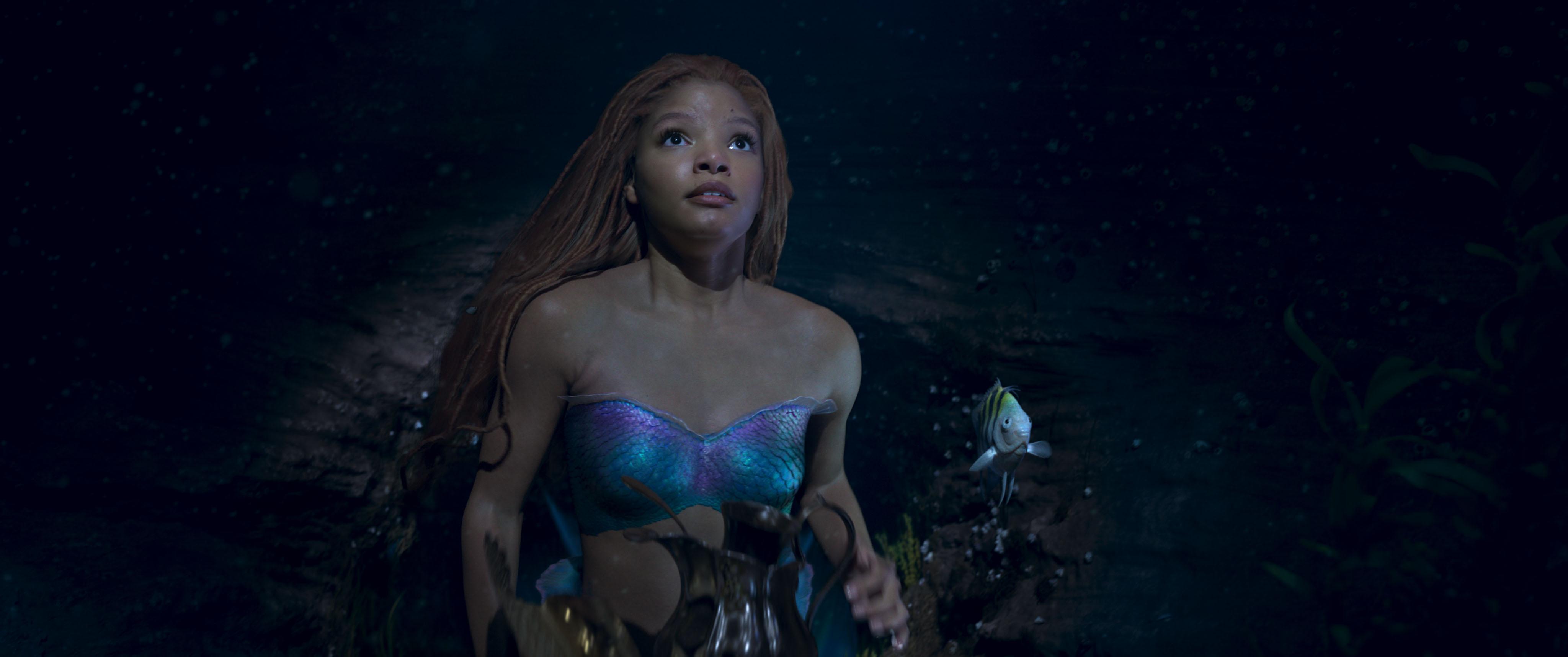
The visual effects for The Little Mermaid are beautiful, including the opening dive down into the foamy sea, which is breathtaking. But the film truly succeeds due to appealing performances from the lead actors. Halle Bailey is perfection as Ariel. She balances youthful wonder and defiant confidence with a tiny bit of actual respect and mindfulness of the dangers of the world. That slightly more restrained exuberance gives this mermaid the complexity needed to carry a live action film. Jonah Hauer-King delivers an endearing performance as the conflicted prince with a tragic backstory. He manages to be authentically sweet and nerdy as well as strong and heroic. Art Malik elevates the character of Grimsby to a leader and mentor. Melissa McCarthy slays as Ursula. She is wickedly sarcastic and manipulative until the final climactic battle scene. Then her visual effects go a little wonky and become distracting. More on that later.

How does the live action film compare to the 1989 animated film? I rewatched the animated version after seeing the live action film. The 1989 version still holds up pretty well: the songs are fantastic and the plot is engaging with its star-crossed, headstrong teens, culture clash, and big climactic fight scenes. However, adapting an animation to live action means changes. Some elements that work in cartoon form will not translate well to real life. Overall, compared to the original, this is an excellent adaptation. It closely tracks the animated film’s plot and retains its key showstopper songs. But it is a strong film in its own right, even for a non-Disney princess loving audience.

Here are some of the differences: Instead of hanging out at the palace, Ariel’s ethnically diverse sisters each patrol a different sea across the world and reunite periodically to report to Triton. I am sure this will have major spin-off potential but, in the film, the sisters remain mostly silent, which is a disappointment. Apparently Ariel’s territory is the Caribbean Sea because the live action film has a more distinctively Caribbean vibe. Eric’s home is a small island kingdom whose residents have British and Caribbean accents and the marketplace scene is very tropical. Watch for Jodi Benson (the original Ariel voice actor) in a funny cameo with Halle Bailey during this scene.

There are also three major backstory details in the new film which add depth to the story: 1) Ariel’s mother was killed by humans, hence Triton’s bitterness towards them; 2) Eric was shipwrecked as a baby and rescued by the queen, who adopted him into the royal household, hence her fear of her son spending time on long sea voyages; 3) Ursula is Triton’s sister—this is such a fun twist but it is never really explored. Not doing more with the family drama was a missed opportunity for the story.

Another general difference occurs when Ariel agrees to trade her voice for her humanity but Ursula secretly wipes Ariel’s memory of the need for the kiss. As a result, Ariel and Eric are just getting to know each other, she has no sense of urgency, and she is just as interested in his culture as in him. A lyrical difference occurs in the song, “Poor Unfortunate Souls.” The words are slightly changed so that Ursula’s original comments on society’s sexism are cut, because apparently that society isn’t sexist anymore—or maybe the film fears the sarcasm will be lost on modern audiences. The song “Kiss the Girl” also has a few adjustments, modernizing some of the lyrics with an emphasis on consent.

Overall, most of the new tweaks are fun ways to add complexity to the story. Despite those improvements, there are a few things that did not work for me in this film. And they are mostly, to my great surprise, related to visual effects. I’m generally not a fan of cute talking animals or objects—even in animation—but in a live action film, the effect can be especially strange. The visuals of live action Sebastian (grumpy crab/royal advisor, voiced by Daveed Diggs) and live action Scuttle (silly seagull friend, voiced by Awkwafina) were okay, but the effects for live action Flounder (Ariel’s tropical fish bestie) were very odd, leaning heavily into a weirdly realistic/uncanny valley effect rather than the more fantastical designs of Ariel’s other two animal friends. Jacob Tremblay did a good job with the dialogue, but the fish visuals were just off and a bit unsettling. (I would have converted him to a merboy friend instead of a strange looking talking fish.)

The other weird visual was the giant Ursula monster in the climactic battle scene. As in the animated version, Ursula angrily grows to enormous heights in her final battle with Ariel and Eric. In the live action version, giant-sized Ursula’s head seems slightly out of proportion with her tentacled body, and the facial expressions don’t have the intensity needed for that last big scene. However, most of the visual effects in the film are gorgeous, making the smaller visual issues surprising because, well, this is Disney.

My other few quibbles about the film have to do with small plot points. Ariel’s mother was killed by humans, but Ariel and her sisters never discuss the tragedy or how it changed their family. Even one or two lines might have added some emotional heft to the story without becoming too upsetting. Another minor annoyance occurs in the scene where Ariel gets to drive a horse-drawn wagon near the village marketplace. In the animated version, Eric gives her the reins and she drives aggressively but with surprising competence—at one point successfully jumping over a chasm while Eric comically ducks under the seat in fear, and after they land safely on the other side, he leans back with his hands behind his head, indicating that he trusts her. In the live action film, Ariel takes the reins and smashes into multiple fruit vendors, creating a mess as they careen along. For some reason, chaotic driving or riding appears to be a requirement in some fantasy films, but in this story it is very out of character for Ariel. Although she is new to life on land, this is a princess who fulfills serious duties, she saved Eric, and she loves elements of human culture—they are sacred to her. I’m not sure why we needed this destruction.

Overall, I loved The Little Mermaid. Halle Bailey’s beautiful facial expressions and astonishing voice captures the heart of the story in all of the classic songs. Watching her belt out “Part of Your World” made me teary and nostalgic. Despite being a kid-friendly movie, the entire cast was both strong and authentic, especially in the second act, when Ariel is unable to speak but delivers powerful emotional energy in each scene. The updated adventure was addictive, leaving me wanting more. And, given the number of loose threads in this story, hopefully we will get more.


Nerd Coefficient: 8/10

Highlights:
  • Sweet story
  • Plot holes
  • Strong acting
  • Mostly gorgeous visuals outshining some surprisingly weird effects
POSTED BY: Ann Michelle Harris – multitasking, fiction writing Trekkie currently dreaming of her next beach vacation.

Tuesday, May 2, 2023

This version of Peter Pan & Wendy goes straight for the symbolism

Think happy thoughts

The tale of Peter Pan has been adapted so many times that it has even had space for a totally forgettable prequel, a plainly atrocious sequel, and a teen romance remake. At some point it was going to be Disney's turn to revisit this story. So far, Disney has been happy with intentional mediocrity when producing live-action copies from its catalog of animated classics, but their new Peter Pan & Wendy is something else. Like the best adaptations, it's most interesting where it's not faithful.

You know this story. You've watched and rewatched it to the point you can quote it. It was read to you as you were getting ready to sleep, and you will read it to your children. But if we imagined that something new could be said with these characters, if they still had more story to offer us, what would they say? In this version, it turns out that Captain Hook has a deeper, more complex past that sets him as Peter's dark mirror image. It's not too difficult to add this layer to the character; Hook's relationship to Peter has always been one of exact contrasts. Whereas Peter is the immature male archetype that only lives for pleasure, Hook is the jaded male archetype that is incapable of pleasure. Both run away from life, both dread the passing of time, for dramatically opposed reasons. Here the theatrical tradition of casting the same actor to play both Hook and Wendy's father is abandoned, because Peter's enmity with Hook is not treated as a Freudian murder-of-the-father-figure fantasy. Instead, Hook is something more interesting to consider: he's the man Peter is terrified of turning into.

Peter Pan has the rare quality of being a fairy tale created in the 20th century, when the world had already seen diesel engines and electric light bulbs and the Suez Canal and heart surgery and Morse code over radio waves, but still within the timeframe when no one had heard of mustard gas, transistors, lasers, plastics, antibiotics, and nuclear fission. It was a transitional period, the last time anyone could conceive of a viable British Empire. Neverland is the last fantasyland that British children would know just before all fantasies were shattered. British children would go on to discover others; there would come Middle Earth, and Narnia, and Discworld, and (ugh) Hogwarts, but those places are colored by the bloodshed of the 20th century in a way that Neverland is not. Much like Peter himself, Neverland is in a suspended state, spared from time and its ugliness. With its cheerful pirates and grateful Natives, it's the last place where the British Empire could keep thinking of itself as innocent.

In that timeless bliss of ignorance, Peter and Hook turn from discrete individuals into symbolic forces. As tends to occur in the great hero/villain pairs, they made each other into who they are: it was Peter who cut off Hook's hand, and it was Hook who chose to bring his pirates on a lifelong hunt for Peter. Fittingly for two archetypes defined by their relationship to pleasure, the duel where Hook loses his hand can be read as an allegory for castration, with the hook being a malformed phallic substitute capable only of pain.

None of these ideas is new. Critical analyses of the psychological subtext of Peter Pan have repeatedly described their dynamic as almost constituting one dual character, as foreshadowed in the early scenes where Peter tries to chase and subdue his shadow self. What makes this movie unique in that regard is its willingness to openly explore that subtext. In the scenes where Peter and Hook discuss the hurt they still feel over their past connection, one can imagine either of them as talking to himself across time. If the two halves are not reintegrated, they will remain stuck in their endless battle, doomed to live as unfinished facsimiles of masculinity.

As a character who refuses to grow up, Peter is difficult to write for. In modern Western storytelling we expect the hero to learn and evolve. But Peter is a character type like those of Greek tragedy: when we meet him, he already is who he'll always be, and his flaws drive the events even more than his conscious choices. This movie finds a clever solution to the problem: as in the original text, Peter declines to settle in the real world to live with real parents, but once back in Neverland, he sets for himself a new mission that may challenge his self-image and even pull him out of his stubborn infantile ways.

The changes made to the story are not as drastic as one may suppose. They draw from what was already present in the text and extrapolate from reasonable conjectures critics have made for decades. Perhaps it could be argued that making all these ideas explicit flattens the content of the story and leaves little for the viewer's mind to chew on, but the visual symbolism makes up for what is lost in abstract depth. (One great example is the hideout where Peter lives with the Lost Boys, a cavern that Wendy enters in a shot deliberately filmed like a descent to the underworld, which unifies the themes of Peter's unconfessed longing for a mother with the hideout serving as a substitute womb.)

The counterpart to the choice of giving Peter an opportunity to grow at the end of the story is the choice to make Wendy a coequal protagonist. In her case, the moment of growth comes sooner: she realizes that ceasing to grow would be a form of death, so instead she gives herself the power to choose her future. The rest of her journey consists in trying to teach Peter that the same path is open to him.

There's a curious irony in a remake that presents such a strong case against staying anchored in the past. It may be a sign that Disney is finally learning to retell its classics in an innovative manner. If so, that's a happy thought to keep your spirits lifted.


Nerd Coefficient: 7/10.

POSTED BY: Arturo Serrano, multiclass Trekkie/Whovian/Moonie/Miraculer, accumulating experience points for still more obsessions.

Monday, May 1, 2023

Review: The Salt Grows Heavy by Cassandra Khaw

 A deeply bizarre and grisly love story about freedom and choice. And an alarming amount of murder.

My initial response to finishing this novella was "what the fuck did I just read?", and I stand by that assessment... but in a positive way. It's a deeply peculiar book, and one that's somewhat hard to describe when dragged outside the confines of the story.

It's a reimagining of the little mermaid, but... after the story...

A mermaid and a plague doctor go on a journey, both haunted by the darkness of their pasts...

What if the really important part of the little mermaid was the murderous revenge she got on the entire kingdom...?

Creepy woodland child-cults are never a good sign! Do not trust them, even if you're functionally immortal...

All of these are perfectly reasonable ways of talking about the story. Essentially, we meet up with a mermaid after her offspring have devoured the kingdom of the prince who married her in her revenge, when a mysterious plague doctor sort of kind of invites her to come with them, wherever they're headed to, seemingly unphased by the total carnage she's caused. On their way to wherever they're going, they come across a group of children hunting one of their number in the woods, a chance encounter that leads down a dark and bloody path to the plague doctor's history, and the mermaid's future.

But even this does not give a true sense of what the story is, because it's one of those stories which simply refuses to be confined to its plot. It's not about what happens, but how. And the how is vividly, lusciously, darkly, incredibly gorily, sumptuously and intensely overwrittenly, in the best possible way. It is a story I devoured, simply and precisely because the prose was delicious.

It goes in hard right from the first paragraph, which includes:

I pause. In the penumbra, the fading dusk gorgeted by coral and gold, you could be forgiven for mistaking the ruined house a ribcage, the roof its tent of ragged skin. The foundation, at a careless look, could pass for bones, the door for a mouth, the chimney a finger crooked at the sky, or at a wife who would not be a saviour.

And if anything, it only goes in harder as the story goes on.

This is the core of this novella's appeal in my opinion - if you like that level of intricate prose construction (and don't mind the grisly nature of the story), you will probably enjoy it immensely. If, however, you don't, or prose just isn't an interest or priority for you, this might be one that passes you by.

What's interesting about that, at least for me, is that I tend to prefer my stories to be character driven. And this isn't, really. We see a lot of the characters, but they are often opaque to each other and to us. We see through the mermaid's eyes, hear her thoughts, and yet even then she is remote and cold. Which is by design - she's meant to be alien, a creature living in our world but not of it, born of the chilly abyss of the sea, and hungry and uncaring and vengeful from it. So we see her, we spend the time growing to know her very well, and yet she remains cut off from us emotionally, by her very being. Where the prose is overwritten, the emotions are understated, the stuff of hints and shared looks leading to shared understanding, left for the reader to parse or not.

And as we progress through the story, it becomes clear how deliberate this is.

Because while it isn't all of what the story is, or is about, some of it is the story of someone who has been stripped of agency, of personhood, and who has exacted her revenge, but is still living with the legacy of what was done to her by a man who wanted to own her. Who told stories about her that misled the world about her nature. Who cut out of her tongue so she couldn't tell her own stories to counter them. So the fact that our access to her is at arm's reach feels especially fitting. We will know her as she wants us to know her, and no more, because she deserves that choice now.

We know the plague doctor, at least at first, at an even further remove. They speak little, and their emotional responses are something of a mystery to the mermaid, and so they are to us, through her interpretation. And while we never really get a deep sense of them through their words and perspective, we do begin to see the plague doctor as a deeply emotional person through their actions. It is more their story than the mermaid's, really, though it is told through her eyes.

But the two go together, as both of them are people who had their choices taken away from them, and were made into something else by people who had the power to do what they liked. Where the mermaid responds to this with bloody vengeance, the plague doctor has chosen kindness and healing, at least for now. What they feel about the mermaid's choices remains hidden to us, behind their mask and the mermaid's incomprehension of human feeling.

And so at its core, it's a story of two people who've suffered the greatest of injustices against their persons, and how they choose to live beyond that, how they respond to it, and how they relate to each other in the wake of their shared and different experiences. Because whatever emotion there is or is not in how we see them each through the mermaid's eyes, what there plainly is is fellowship, right from the start, and that link is such an appealing one, such a lovely one, that it keeps you invested through all the grisly body horror that comes with it.

I'm normally too much of a wuss for this kind of darkness, but in this, I didn't mind it. The writing transforms it into something beautiful at key moments, and the core dynamic between the two main characters makes it worthwhile even when it isn't beautiful. It makes a very strange, dark story, all told, but one whose wonder lies in that strangeness. It ends up with the feel of some old, dark fairy tale we don't tell anymore, where nothing is explained, a lot of people get murdered, and if there's any moral at all, it's not a gentle one. But sometimes those are exactly what you want, and this does it brilliantly.

--

The Math

Highlights: beautiful, intricate, grisly prose; unapologetically brutal protagonist

Nerd Coefficient: 8/10

Reference: Cassandra Khaw, The Salt Grows Heavy, [Titan Books, 2023]

POSTED BY: Roseanna Pendlebury, the humble servant of a very loud cat. @chloroform_tea

Thursday, December 29, 2022

Microreview[Novel]: Juniper & Thorn by Ava Reid

 A dark reimagining of a fairytale that tries to show the real impact living in a folktale might have on those who experience it.

Cover illustration: Darling Clementine

Content warnings: discussion of sexual assault, child abuse, antisemitism and eating disorder

At what point does darkness in a book become less about realism, or stakes, or a sense of danger, and more about having all the horrible things simply for their own sakes? This is the question I am left with most pressingly after finishing Juniper & Thorn.

It's a retelling of The Juniper Tree - though a rather loose one, drawing on broader themes rather than necessarily any specifics, and filling gaps or making changes to suit the novel format. And indeed, not only is it doing that, but it attempts to interrogate the strictures and the form of the fairytale as it goes along. The protagonist is very aware of what genre of story she's in, and what that might mean for her and those around her. We follow Marlinchen, youngest of three daughters of the last wizard in Oblya, a city sprung up from the steppe, obliterating the magic that lingered there before. She and her sisters live with their cruel and cursed father, trying to get by without sparking his rages and scrape together a living with the few customers he considers worthwhile seeing. He hates the city and the modern world, and will not let them out into it for fear of what might happen to them, but the girls long for freedom and, of course, sneak out. At the ballet, Marlinchen sees a beautiful dancer with whom she is smitten, and everything begins to spiral out from there. We watch as Marlinchen begins to develop her taste for rebellion and escape, and exactly what she has to grapple with at home to reach for what she wants in life.

In the broad strokes, it definitely has that fairytale feel - three daughters, cruel father, a mother that was turned into a bird years before - but the difference lies in the detail. Fairytales, by their nature, don't tend to delve into the psychological reality of living with a cruel, controlling man in a world that is rapidly leaving him behind. But in Juniper & Thorn, Ava Reid does exactly that. As the book goes on, we see more and more of exactly what Marlinchen has grown up with. She starts the book seemingly just a mousey waif, but as we see through her eyes and her memories, it becomes much darker and more twisted. We learn about the abuses she suffered as a child from her father and from others that he knew about but didn't stop, some of it sexual in nature. But what we learn most is how she actually sees the world, and how it feels to be the third daughter in the sort of fairytale where the eldest is the pretty one and the middle is the clever one, and the youngest is simply the youngest.

And it's pretty grim. It's a world of being told she's not as pretty as her sisters. That she's plain, stupid, simple, ugly, fat, useless, and being ignored and pushed around. And because Juniper & Thorn is dedicated to showing what this might actually do to a person, we see how much she hates her own body and face, how much she's internalised the idea that her sisters are pretty and she is not. We see her forcing herself to throw up her food after eating so she can be thinner. We see her completely unable to comprehend that someone might find her attractive, let alone someone she think is as ludicrously beautiful as Sevas, the book's ballet star love interest.

Sevas is someone else whose insecurities and hardships are laid bare for us to see. While beautiful, he's also shown early in the narrative using alcohol as a coping mechanism, and then soon after to be controlled and abused both physically and verbally by his "handler" Derkach. While he knows he's beautiful know, he is obsessed with the idea that by thirty, he'll be too old and ugly for the ballet and thus worthless, and so he throws his life away in the now because what's the point of hanging onto it? We don't see the story through his eyes - we are very securely rooted in Marlinchen's perspective - but even with only what he tells her, we see the cruelty and harshness of being who he is in the fairytale (and also not-fairytale) world.

And it's an... odd world. Because you have the fantastical and the mundane lying so close side by side, with the wizard and his family representing the "Old World" from before the city came, there is a constant disjoint between people and ideas moving between the house and the rest of the world. We have penny presses and phrenology and day workers in factories alongside a wizard whose wife was turned into a bird and who has an old god satyr living in his garden. And no attempt is made to reconcile these two. If anything, the contrast is the point, because the contrast is the conflict - the magical and mundane worlds, at least to the wizard's eyes, are irreconcilable, and the presence and growth of the city is an active detriment to magic and those who practice it. Marlinchen has grown up with this worldview, and it is part of why her life is so restricted, to keep her away from the evil, encroaching, destructive, immoral city and all its problems and horrors.

Which brings us to one of the potential issues with the book. Marlinchen's father Zmiy is profligate with his hatreds; nearly anyone involved in or related to the city is likely to be the subject of his ire. However, because the world is one that is a thinly veiled copy of some aspects of our own, this brings up some slightly iffy points. The story itself is set in a fantasy Russia-esque place - we have references to the tsar, and the steppes that existed before the city encroached - but the city of Oblya is home to others as well. There are Ionik people mentioned at several points, clearly an analogue to the Greeks, but the group that comes up most often is the Yehuli, who are equally clearly an analogue for Jewish people. The problem comes with the fact that we only ever see the Yehuli talked about in the book by those who hate or distrust them. Zmiy hates them, and accuses them of all sorts of vices. But it isn't just him - Sevas is Yehuli, and his handler Derkach takes every opportunity to remind him that he is "only" a Yehuli boy pulled from the slums. A character who comes up at several points is a phrenologist, who is noted to have discussed how the Yehuli have prominent areas of their anatomy associated with capitalism which gives them an "advantage" at it, such that the leaders of the city have had to legislate to prevent them using this unfairly. None of the characters who espouse these views are people we are meant to like or trust, but at the same time, we see almost nothing of the Yehuli from the mouth of someone positive or even neutral towards them, let alone a Yehuli themself. Even Sevas only touches on being Yehuli briefly when talking about his mother. It is not so much that I wanted the story to erase the obvious historical antisemitism that is being evoked here - it was real, constant and pervasive and that obviously deserves its own page time - but when we had a Yehuli character so prominent, it seems a shame to have only the opinions of those who hate him on the page, never his own, especially when so many of those hatreds are so caricaturedly ugly. It would have been nice to have a little of his own experience of himself or his people, as a brief glimmer of contrast against all the bigotry.

But then again, it's not a book concerned with having nice things or happiness. Which is somewhat the other of its problems. On the one hand, that it shows the grim psychological reality of living with an abuser, and the mental toll it might take on someone to have lived that life, is to be praised. Fairytales and their retellings so often gloss over the nastiness, surprisingly so when many of the stories upon which they're based contain murders, cannibalism, gruesome transformations and more. But we're expected to believe that Hansel and Gretel cope fine after pushing the witch into the oven, because to deal with anything otherwise isn't the point of the story. And so it feels worthwhile to have one that explores this aspect of things, especially given that the tale it draws inspiration from is so dark, as a much needed point of contrast to many of the other versions that exist. 

However. The darkness in the story is so unrelenting and particularly some of the descriptions of it so lingering, so closely described, that there are, at times, moments where you feel that we've stepped out of simply exploring the emotional impact of fairytale happenings, and instead are maybe just here for the darkness for its own sake. There are repeated motifs, including one based on a character's trauma from preteen years of someone touching her inappropriately, particularly on her nipples. We see flashbacks of that scene multiple times, and there follows a recurring theme of her imagining nipples - her own and other people's - being chopped off with garden clippers. That the scene focuses so much on this image, especially the feeling of his hand on her skin, how it looked, could easily either be a testament to its lingering impact on her, or something less wholesome. When taken with so many other scenes in the book - which is generally quite concerned with the physical and bodily reactions to events - it is easy to be uncertain. Which way it goes is likely an individual decision for the reader.

My final criticism is one that can be laid at the feet of many books. Juniper & Thorn is described in many places as a feminist retelling, but in truth, I don't know that it is one. It is a retelling that centres a female experience, and one in which the female experience is an oppressive one, but beyond that? I'm not sure. Especially given the predominance of female perspectives in fairytale retellings, simply putting a woman in the front seat doesn't feel sufficient for a feminist label.

On the whole, Juniper & Thorn is a book of ambiguity. Much of what it does could land, or could utterly fail for any given reader just based on their particular take on it, their background and their own experiences. If it has a failing for me, it is that the doubt exists at all. And while I found some parts of it refreshingly original, others strayed too much into darkness that felt like it served neither character development nor plot, and simply existed to be able to say just how dark a book it was. That being said, it definitely earns the distinction of being quite unlike most other fairytale retellings, and that it attempts at several points a critique of the genre is definitely a plus. The moments of awareness by Marlinchen of being in a story, and what that means for her, were particularly interesting, and if anything could have been developed further into something more concrete. But they weren't, and in the end, while it distinguishes itself from the rest of the genre, the problems it has while doing so ultimately hold it back from truly excelling.

--

The Math

Baseline Assessment: 7/10

Bonuses: 

Penalties: -1 the grimness gets very, very overwhelming

Nerd Coefficient: 6/10

Reference:  Ava Reid, Juniper & Thorn [Del Rey, 2022]

POSTED BY: Roseanna Pendlebury, the humble servant of a very loud cat. @chloroform_tea


Monday, December 26, 2022

'Puss in Boots: The Last Wish' comes to terms with death

Existential anguish has never been this funny

Your favorite fearless hero is back, and he's going through a crisis. After eight feline lifetimes cultivating fame and glory as a daring bandit/swashbuckler/adventurer, Puss in Boots is suddenly confronted with the hard reality of death. He's down to just one life, and for the first time, he's terrified.

Puss in Boots: The Last Wish is a surprising entry in the Shrek franchise. After the end of a century of fantasy dominated by Disney, the first Shrek's acerbic irony made it feel fresh—even if it soon became its own type of stale. Fortunately, The Last Wish doesn't follow that formula. Snark and detachment are thrown out the window (and good riddance!), because this is a movie about death, and to deal with death, you can't do less than open sincerity. With commendable transparency, the movie shows us a hero confronted with his vulnerability, stripped of the pretense that his popularity can keep saving him. The invincible monster slayer is finally afraid, and that makes him feel more real.

Of course, the fact that you're making a movie that takes its theme seriously doesn't mean you can't also make a gut-burstingly funny movie. And here too, the writing deviates from Shrek's juvenile style. The Last Wish goes through the usual repertoire of slapstick violence, but at key moments, it uses its comedy to enhance the point it's making. Unusually for this franchise, in this movie the jokes do a big part of the telling of the story.

In the first act, once our protagonist has been forced to acknowledge his mortality and admit that his hedonistic lifestyle was nothing more than a denial mechanism, his first choice is to hide in a cat shelter. Everything is provided for him: he has a roof, abundant food, warm mittens. But, as he soon realizes, that's no life worthy of the name. The answer to the dread of mortality cannot be to give up agency and let all your choices be made for you. In a joke that tells more than it seems on the first hearing, he's forced to stop using the human toilet and promptly shown the litter box. His line at that moment is, "So this is where dignity goes to die."

Dignity is the key idea here. When we're faced with our state of cosmic abandonment, we may feel what Søren Kierkegaard called the dizziness of freedom, and owning it takes a degree of moral fortitude we're not usually taught to build. When Puss in Boots retreats to the cat shelter, he's taking one of the easy ways out: the abdication of choice. But you cannot cease to make your own choices without also ceasing to respect yourself. The prohibition of using the human toilet can be read as a snapshot of a bigger truth: if you renounce responsibility for your life, you're also renouncing your humanity. An ideal place where you don't have to make any effort is not a place suitable for humans. The safe, comforting refuge will not satisfy you.

This takes us to another key theme of the movie: satisfaction. The writers made the perfect choice of villains for this story: Goldilocks and Jack Horner, archetypes of perpetual insatisfaction. Goldilocks has enough, but she always finds something to criticize. Jack Horner has everything, but he's always greedy for more. Both represent anomalous strategies for coping with the irresolvable insatisfaction of finite life. And both fall into the same mistake when they decide to chase after the wishing star. For Puss in Boots, this is an attempt to replace mundane hedonism with transcendent hedonism—to pray to the heavens for more chances. But it's not a solution: there's no magical fix that will make everything just right. The problem is not that you haven't found your wishing star. Goldilocks is unsatisfied because she has impossible standards. Jack Horner is unsatisfied because he's never needed to make an effort. Puss in Boots is unsatisfied because he can no longer keep telling himself that he'll always have more time. The three of them are looking for the wrong remedy to a nonexistent problem.

I call it nonexistent because the finitude of life is not a new calamity that suddenly befell us; it is the way reality is. It is the normal. It is what is. As existentialist philosophers pointed out, mortality only becomes a problem if we delude ourselves into thinking we can change it. Try as you might, you can't outrun the icy hand of death.

In his essay Summer in Algiers, Albert Camus spoke about the finitude of human life in these terms: "if there is a sin against life, it lies perhaps less in despairing of it than in hoping for another life and evading the implacable grandeur of the one we have." Our protagonist's quest to regain his nine lives with a miracle is a Quixotic impossible, a desperate last recourse to regain the ability to delude himself. But having his gaze fixed on a star has distracted him from the mundane beauty he already has. He has allowed his legend to supplant his facticity, and now he's unhappy because he can't live up to an idealized self-image that he knows is false.

A brilliant way Puss in Boots: The Last Wish integrates existentialism into humor for children is in the device of the map to the star. Each character sees a different map, with a different emotional tone. This is an effective way of symbolizing how, even if we have similar ideals of happiness, the road to get there is unique to each of us.

What our hero learns at the end of his personal journey is that the quest for perfect satisfaction cannot be completed in a finite world. Death only stops being an adversary when you stop trying to deny it. That's the key to contentment when all you have is one life. And that's how you speak to children about death: with the maturity and honesty that the topic demands.


The Math

Baseline Assessment: 7/10.

Bonuses: +1 because we should celebrate every time a story targeted at children is unafraid to talk openly about death, +1 for the beautiful art style, designed with a resemblance to expressionist brushstrokes that enhance the emotion of each battle by making it feel intensely personal.

Nerd Coefficient: 9/10.

POSTED BY: Arturo Serrano, multiclass Trekkie/Whovian/Moonie/Miraculer, accumulating experience points for still more obsessions.

Reference: Camus, Albert; Kennedy, Ellen Conroy [Translator]. Lyrical and Critical Essays [Vintage Books, 1970].