Showing posts with label William Gibson. Show all posts

Monday, April 17, 2017

DYSTOPIAN VISIONS: Writing a Way Out


When thinking about dystopia recently for an essay (which can be read here), our conversation raised the question of whether writers have responsibility in how they depict dystopia and apocalypse. Is dystopian writing a “warning system?” The question intrigued me, as both a reader of and a writer of dystopian fiction, I wanted to think about it deeper. I also wanted to take the question to some writers who tackle dystopia. So I sought out some of the most interesting emerging SFF writers I know, and then barraged them with a series of questions, which they were all considerate enough to answer in deeply thoughtful ways. The writers I talked to were Kate Dollarhyde (SFF writer and co-editor in chief of Strange Horizons), Brontë Wieland (SFF writer and co-editor of the solar punk anthology Sunvault), Phoebe Wagner (SFF Writer and co-editor of the solar punk anthology Sunvault), and Tony Quick (SFF writer).

The first question I asked tackled the question head on. It was a question I struggle with (as I work on revising a dystopic sci-fi novel that tries to be hopeful): where is the line drawn between being didactic (a quality I hate when I read it) and being honest about what people have done to themselves and others? I also have some pretty hard drawn lines when it comes to responsibility in terms of horror: violence should never be depicted for strictly entertainment purposes for example (y’all should hear my very long rant against the torture-porn genre).

What responsibilities do we, as writers, have in depicting dystopia and apocalypse? Should we spend as much time considering the socially conscious aspects of our work as much as the narrative aspects?

KD: I believe writers have a responsibility to reflect an experiential truth in their stories, whether real or imagined. The reality we depict is, I think, a combination of the dystopia or apocalypse the writer is working with and the social reality of their point of view characters.
If a writer's apocalypse is one based in climate collapse, for example, the resonance of the depiction of that event or its aftermath depends so much on the position—both physically and socially—of the protagonist. A rich white man in post-water California and a working class Cuban woman in post-coastline Florida will experience wildly divergent realities, both valid as points of narrative inquiry, informed as much by their social position as by the lack or abundance of water in their particular setting. The reader might not have any experience with climate collapse, but they know what it's like to inhabit a social reality, and one well-crafted will only make more relevant and vital the narrative.
All of that is a roundabout way of saying that if a writer is considering the narrative aspects of their work, they should by necessity be considering the socially conscious aspects of their work. Calamity fiction is about the collapse and radical restructuring of social order. It's my opinion that the writer can't really have a coherent dystopic narrative that leans hard on one and not the other.

BW: I believe that our responsibility is to create depictions of the world as we see it, as we feel it, as we want it to be, and as we believe it may become. Often the issues facing us feel incalculable and insurmountable, and that’s where I believe dystopia has its roots: those moments when the world is overwhelmingly shitty and we begin to believe there’s no other path than something so dark. In that way, yes, I think we are responsible for telling these stories, for depicting the world how it presents itself to us.
The narrative and social aspects of our stories are inseparable, and we should always consider the impact our writing will have.


TQ: I want to be careful about assigning any specific “responsibility” to authors because I’m afraid litmus tests can be limiting. The dystopian and apocalyptic subgenres includes grim, somber novels in the vein of Cormac McCarthy’s The Road or José Saramago’s Blindness but also includes chaotic carnivals such as Kurt Vonnegut’s absurdist novel Cat’s Cradle or the psychedelic dreamscapes of J.G. Ballard’s novels The Unlimited Dream Company and The Drowned World. We’re standing under a wide umbrella here. We should definitely give serious thought to the socio-political underpinnings of our works but contemporary fiction shouldn’t be a soapbox. The contemporary audience becomes defensive and closed off once they sense unpolished propaganda. As artists, we’re challenged with hitching our larger societal concerns to plots featuring smaller, intimate narratives our audience can relate with. Fiction challenges us to show readers the ramifications of our society’s slow decline and turn statistics into stories.

PW: That's the balance isn't it--which comes first, social issues or narrative? How does one balance those ideas? I don't know. I'm always fighting with being preachy. Dystopia seems to do that well, though. Mad Max: Fury Road always comes to mind when thinking of social consciousness and narrative. While there are differing opinions on Fury Road, I loved the film for its high-octane moments balanced with critiques on everything from gender, human trafficking, capitalism, big oil, environmental issues--the list goes on. I personally believe writers have a responsibility in all their work. If I'm reading a dystopia and they aren't taking into consideration that yes, while rape or torture or INSERT AWFUL THING HERE might happen in an apocalypse, the writer must consider how those ideas will impact the reader. If the writer is casually using the horror of an apocalypse landscape just for its shock value without considering the social implications, I won't keep reading. Conversely, a dystopia offers a canvas to explore the dark side of humanity, which if done ethically and with empathy can be an enlightening experience.     


The next question I asked went back directly to something Philippe had asked me in the previous essay: is the technical accuracy of these depictions important? Again, it’s a question that I struggle with in terms of my own writing. My thought is that good science-fiction should be able to see the steps of how we got to the point depicted, even if those steps are not directly spelled out on the page.

 How much realism (in terms of how the dystopia/apocalypse comes about, but also the fallout of it) is needed in a dystopic depiction? Why? 

KD: I think the writer only needs so much reality as is required to make a dystopia feel truthful to the reader. The rub there is that every reader has a different threshold for what feels true based on their own social reality and how similar to or divergent from the social reality of the point of view character they are.
Reality is, I think, an argument the writer makes to the reader. A woman living in the United States today might not need much of an argument—that is, injection of reality—to find The Handmaid's Tale convincing; Atwood can take her dystopia to extremes of plausibility because her audience doesn't need much help to follow her there. But a cisgender progressive man might take more convincing. (Incidentally, I think that's why Atwood's MaddAdam trilogy has such broad appeal—everyone who lives under capitalism recognizes bits of their life in that dystopia.) You could, I think, make a similar argument for white people in general and Butler's Parable of the Sower. Could things really get that bad? To convince a reader who might ask that question, who might doubt, the writer needs a more exhaustive argument.
So, in short, I believe the level of realism required in a dystopic narrative is answered in who the author is writing for.

BW: For me, a dystopia is most effective when I can see clearly how it was once related to the world we live in. In the sense that I want the dystopias I read to be believable extensions of the society they stem from, I think writers should take great care to connect to a world their readers understand. In apocalypse narratives, I think there is greater leeway in the origin of the disaster event, but I still need to feel the way that the apocalypse informs and impacts our idea of the present and its trajectory.

TQ: Realism is subjective. When I read 20th century fiction, I’m  constantly reminded how alien the stories seem in our present day context. Look, I was born in the 20th century but when I read about these characters whose misunderstandings could be cleared up with a text message or read plots that would be resolved with a high speed internet connection and a search engine, I wonder if I have more in common with the science fiction protagonist who navigates a society transformed by new, disruptive technologies. Beyond that, social media has revolutionized how much insight and communication we have with people outside our immediate orbit. We are learning via Facebook and Twitter and comments sections across the internet that many of us don’t share the same reality.
But despite the age of “alternative facts” that dawn’s orange on the horizon, we all should be able to agree that our actions have concrete consequences. Chloe, I think you hit the bull’s eye with the word “fallout.” More important than adhering to an imaginary consensus of realism, we should aim to provide the audience with a sense the character’s actions matter. By proxy, the audience may come to believe their actions have an impact and maybe we can avoid the hammer’s fall. Maybe.

PW: I see that decision as belonging to the writer. Dystopia/apocalypse settings can fall under any of the three major genre branches (fantasy, science fiction, and horror) in my opinion, so the level of realism depends on what the reader needs in order to believe the story. As a reader and writer, I do need realism when it comes to the characters' reactions to the landscape. The environment needs to influence them. If the environment isn't impacting the characters, then why write a dystopia at all?

Finally, I asked the question that gets to the root of all good writing. Why do you do what you do? Why is this important to you? Dystopia is important to me because it shows a path not to take, a warning. It also shows that we do go on, despite all of this, we go on. Dystopia to me has always been a hopeful genre, because it shows we keep trying.

Why do you choose to write about dystopias?

KD: For me, dystopia's appeal lives in the braiding of hope and hopelessness.
Every person's present day—from 50,000 years ago to right now—is all fucked up. Our societies teeter always on the edge of ruin. Our individual lives teeter always on the edge of death. One person in the right place needs only to make one wrong choice to send us careening over the edge of oblivion. Someone launches a nuke. Someone mows me down in a crosswalk. Dystopias reflect that reality, that ever-present possibility of the end of everything. Dystopias say your hopelessness is not insane. You are not alone in being afraid.
But dystopias are not a nihilistic surrender to the uncaring smackdown of the universe, because hope is as much baked in to their narrative structures as hopelessness. A successful dystopic narrative is to me at least in part a promise: we can fuck everything up and still make it out alive. Even The Road, the most relentlessly depressing apocalypse story I've read, ends with hope. Not hope that everything will be as it was, or that everything will be okay, or that we won't lose everything that matters to us along the way, but that it's possible to keep going.

BW: When I write dystopia, what’s on my mind is usually a single action or behavior or sight that has struck me as unexpectedly and scarily oppressive. Often, it’s an everyday occurrence that presents itself in a new light, or it’s something I haven’t stopped to think about before, and I try to see the extension of the action and its consequences. Where will we go if we never stop to consider the ways we behave and let ourselves be influenced? That’s the question I try to answer in writing dystopia.

TQ: There’s this quote by William Gibson I keep coming back to time and again: “Nobody can know the real future. And novels set in imaginary futures are necessarily about the moment in which they are written.” Despite my tendency to draw dark futures, I’m actually optimistic about humanity’s chances of survival. We are a stubborn species who have harnessed nature to the point that survivalist tales are our entertainment rather than, you know, our daily lives. Whether we continue on as tribes of neo-cavemen scattered across a bombed out landscape, as space-faring refugees colonizing the solar system, or genetically altered shades of ourselves retrofitted to fit our new environment, we are not going down as a species without a fight.
I’m concerned about our immediate present and near future, what ways we might maim ourselves on our road to that future and how we might rise above ourselves. Recently, one of my advisers expressed his exhaustion with the sheer pessimism of post-apocalyptic science fiction and a desire to see a return of optimism in the genre. There’s something to be said for this: writers can lean heavy on diagnosing society’s issues and genre’s unique capacity to imagine alternatives allows our fiction to do more. But that said, I don’t see dystopia and apocalyptic settings as a popular, waning trend but instead a subgenre that speaks to a wartime generation raised on Y2K scares, 9/11 fallout, 2012 Mayan calendar predictions, random acts of domestic and foreign terrorism, 24-hour doomsday prophets, and seismic societal changes all streaming to us live. Why are we surprised the generation who has been told “the end is nigh” since we were knee high write about futures where those predictions bear fruit?
Our contemporary society has a number of pressing issues: institutional racism, indoctrinated sexism, homophobia, xenophobia, class inequality, violations of rights, and so on. No one science fiction writer could ever tackle all these issues with depth and sincerity: we need an army. Science fiction is a useful tool for indirectly interrogating how society is organized without limiting ourselves to what “is possible” and “isn’t possible.” Those who are most impacted by society’s problems and are only now gaining a foothold from which we can speak aren’t ready to abandon the dystopian genre when it’s so useful to portraying shades of our unacknowledged reality.

PW: I write about dystopias as a way to explore the near future, a future which seems to be coming closer and closer. What happens when humanity is pushed to the end of existence? What breaks down, what survives? Now, working backwards from those depictions, how can I as an individual work to stop that degradation of society? For me, dystopias aren't fun an games but a way to explore big problems--climate change, the collapse of capitalism, gender, human and nonhuman relationships. If my dystopia isn't dealing with social issues, I usually avoid the setting. There's enough depressing literature out there, I'm not interested in adding to it unless some good might come from it.  

So dystopia creators and consumers, what are your thoughts on these questions (and the thoughts on them here)? I’d love to hear other voices on this, commenting here or discussing on Twitter (@PintsNCupcakes and @nerds_feather). You can also tag in any of the lovely writers above (Kate is @keightdee, Tony is @tonyquickpov, Bronte is @beezyal, and Phoebe is @pheebs_w).


Wednesday, March 22, 2017

DYSTOPIAN VISIONS Guest Post: Ian Sales, "The Road to Dystopia"

Today we welcome Ian Sales with a guest essay for Dystopian Visions! Sales is the author of the award-winning Apollo Quartet (see our glowing reviews of this must-read series: here, here, here and here), and founder of the SF Mistressworks blog. He can be found online at iansales.com and tweets as @ian_sales. 


The Road to Dystopia

There is a famous road paved with good intentions, but it is a very different sort of path which leads the way a dystopian future. We know the signs, we’ve seen them before--if we’re not old enough to remember them, then we’ve studied them in the classroom. Yet people these days seem all too happy to treat those warning signs lightly. And I have to wonder:

How much of that is science fiction’s fault?

True, there are several well-known cautionary tales - Orwell’s Nineteen Eighty-Four is the obvious ur-text, but there’s also Zamyatin’s We, Karp’s One (though its concept of dystopia seems clearly aimed at a subset of US readers), Burgess’s A Clockwork Orange... none of which, of course, were published as science fiction, although they have been claimed by the genre. But there are also plentiful dystopian novels that were published as SF--Fahrenheit 451, The Space Merchants, Stand on Zanzibar, High-Rise… and, more recently and much more widely-known, The Hunger Games trilogy, which was published as YA but is widely recognised as science fiction.

No, I don’t think science fiction’s exploration of dystopian presents and futures has been instrumental in bringing on twenty-first century dystopia, but the genre as a whole does bear some small responsibility for our comfort with what we should be deeply uncomfortable with…

Three science fiction novels spring to mind as examples, published in 2011, 2013 and 2014. One was by a highly-regarded genre writer, who has spent the last twenty years writing fiction not actually published as science fiction. Another was written by a successful British author of space operas. The earliest of the three is also a space opera, the first in a series of, to date, six novels, which was adapted for television in 2014.

In each novel, there is one small, almost throwaway, element - a piece of background, a minor plot point, something which is either not needed or could have been achieved by other means – relevant to this piece.

In the first novel, the one published in 2014, a means of communicating with the relatively recent past has been discovered early in the twenty-second century. However, the act of communication, as in Schrödinger’s thought experiment, creates a new timeline which cannot lead to the communicator’s future. And so a “hobby” has grown up around this, with people of the twenty-second century using their more advanced knowledge and technology to interfere in the iterations of the early twenty-first century they generate. In a throwaway line in the novel, a character mentions one person who creates alternate twenty-first centuries with the sole intention of testing weapons technology, forcing the world of each past into a global war, so that he might harvest the fruits of its desperate technological struggle for survival. What the novel fails to point out, however, is that this “hobby” is playing with the lives of six billion plus people in every single one of the alternate worlds, often to fatal ends.

The plot of the earliest of the three novels revolves around an alien virus discovered on a moon of one of the gas giants. An executive of a powerful corporation is keen to learn the actual effects of this virus, and has decided that laboratory tests can tell him only so much. So he hires a group of mercenaries, seizes control of an asteroid community with a population of 1.5 million people, introduces the virus and seals the asteroid. In other words, the executive consigns 1.5 million people to death, a particularly horrible and gruesome death, in an effort to find something which might prove profitable.

In the third sf novel, published between the two mentioned above, a young woman’s peculiar origin is important in a billionaire’s plan to regain his former political position. But he can’t simply ask the young woman to help, as she has an important public role to play in her culture. He must kidnap her. And in order to hide her disappearance his agents crash a spaceship into the ocean, causing a tsunami which kills tens of millions of people.

The three books are: The Peripheral by William Gibson, published in 2014, Leviathan Wakes by James SA Corey, published in 2011, and Marauder by Gary Gibson, published in 2013.

Since its beginnings, science fiction has exhibited a blithe disregard for the characters who people its stories, outside those of the central cast of heroes, anti-heroes, villains, love interests, etc. Frank Herbert’s Dune from 1965, for instance, describes how Paul Muad’Dib launches a jihad across the galaxy which kills billions. EE ‘Doc’ Smith’s Second Stage Lensman, originally serialised in 1941, opens with a space battle between a fleet of over one million giant warships and an equal number of “mobile planets”…

Manipulating scale to evoke sense of wonder is one thing, but the lack of affect with which science fiction stories and novels massacre vast numbers of people, for whatever narrative reason, is more astonishing. There is no commentary on the morality of such actions. And very rarely any discussion of the effect on the victims and survivors. Such consequence-free deployment of mega-violence not only desensitises the reader to large numbers of deaths, but it also normalises the thinking which results in those atrocities.

Because these are atrocities. Some might be acts of war, dialled up to unrealistic levels in order to tickle the reader’s sense of the dramatic, but many of them are not. The authorial lack of empathy for those millions and billions is breathtaking. True, they are fictional people, they never existed, they are not real. Indeed, they’re likely not even named characters, just part of the background, like buildings or the landscape…

There are even fictional worlds which can only exist because atrocities such as the above were committed before the story began: dystopias. Dystopias do not happen overnight. War, a fascist or theocratic regime, epidemic, climate crash… something at some point slaughtered or enslaved huge swathes of the population, and this is considered simply “world-building”. Science fiction is more concerned with the costs of dystopia on those living within it - and the genre can play an important role in that respect, although waiting for the right special snowflake to come along and save the the day is not it - than it is the events which led to it. And if the latter are discussed, it’s with a sense of inevitability - who can stop the Bomb from falling, after all - that the narrative fails to address. In most dystopian novels, the dystopia is presented as a fait accompli. It is not worth commenting on how it could have been prevented because the lesson of the narrative is either accommodation or overthrow. And the latter, while much more dramatic, is almost certainly going to lead yet more mega-violence. Often to no good effect.

No discussion of dystopian fiction would be complete without mention of a work which discusses the costs incurred on the road to dystopia. Unhappily, I can’t think of a single science-fictional example. Science fiction is not interested in “works in progress”, or protean futures, only in applecarts which can be upset or re-righted. But then a setting is little more than a backdrop against which the protagonist can be shown under the brightest of lights. Who would want to read a book in which the hero’s impact was not immediate but might take decades or centuries to manifest?

In the name of world-building, in the name of drama, science fiction has created stories where millions or billions are slaughtered on the flimsiest of pretexts (to be honest, I can’t actually think of a single acceptable pretext), or where villains have a single setting: psychopath. The more such stories readers see, the more readers become inured to these sorts of actions. But that’s not what fiction is for, and certainly not what science fiction is for.

Someone once said dystopian fiction plays an important role because it shows the privileged what the lives of the unprivileged are like. And yet so little published dystopian fiction actually meets that description. Science fiction has spent over a century reinforcing the prejudices of its readers, and all the while it has claimed to be “challenging their horizons”. It is an astonishing sleight of hand.

Not, of course, that science fiction is unique in popular culture in doing so.

However, science fiction at least has the advantage of an active community of creators and consumers. So instead of telling stories of genocide and mega-violence and psychopathic villains, throw a little empathy into the mix. When writing war stories, show the cost on all involved, not just the hero. Don’t escalate the violence while blithely ignoring the morality.

Let’s all be responsible about what we read and write, because it does matter.

Wednesday, March 18, 2015

CYBERPUNK REVISITED: Johnny Mnemonic


Dossier – Longo, Robert. Johnny Mnemonic (1995).


Filetype – film (of sorts).

File under – cyberpunk derivative (but also proto-cyberpunk, as it was based on the eponymous 1981 short story by Cyberpunk doyen William Gibson, predating even Neuromancer).

Summary – An utterly unappealing drone stuffs info into his head and then spends the rest of the movie trying to get it out, enlisting the aid of everyone from a bright-eyed street samurai to a bunch of squatters to a smarty-pants dolphin in his quest to not die. Arrayed against him are the Yakuza and their unstoppable secret weapon, Dolph Lundgren. (It all sounded ridiculous back in 1995, and it still does today.)

High-tech – cool ideas like 'wetware' brain datajacks and storage capacity (of a mind-blowing 160 GB, slightly bigger than my crappy smart phone's!) and monofilament whips and virtual reality gloves and visors and so forth are present, but depicted in what passed for mediocre special effects in the mid-90s, making it all feel (and look) like a goofy Shadowrun session gone wrong.
  
Low-life – Director Robert Longo (whose film career didn't exactly blossom after this little gem) does deserve points for the mise en scene (consistent with his 'real' job as a sculptor and painter), as the film was shot mostly at night, and is filled with establishing shots which nicely illustrate just how crappy everyone's life is who is stuck near the garbage heaps of cities like Newark (an analysis which is perhaps true in the real world of 2015!) compared to suit-clad bourgeois stooge Johnny. But the Lo-Teks, a bunch of idiot luddites with a ton of crappy weapons and a combination magic dolphin/microwave emitter, failed to win me over; I was rooting for the Yakuza throughout, since at least they had style.

Dark times – It's standard dystopian fare—mega-corps rule the world, and unless you work for one of them (in which case you're a mega-villain by definition), chances are you're a grimy "Lo-Tek" resistance fighter/casualty living in a literal dump, which is what the world apparently turns into if corporations are allowed to seek profits (anti-capitalist ravings that no one took seriously in 1995, or doubtless more than twelve people would have gone to see it). The film adds the wrinkle of a disease, the Black Shakes, which is brought on by exposure to the now-ubiquitous electronics of the world, but that's silly and in any case everything is reduced to the simplest and most Manichean moral terms imaginable: either a character is a Good Guy (one of the Lo-Teks, or Johnny himself, or 'Jane', etc.) or irremediably Evil (bright-eyed monofilament whip wielding Yakuza assassin, Dolph Lundgren's bizarre Preacher guy, Ralfi). The only character to show any moral complexity is the Yakuza/Pharmakom exec played by, that's right, comedian and gritty crime film director Kitano Takeshi, though his change of heart is stupid and merely involves transforming from Evil into Good.

Legacy – Johnny was without a doubt one of the most high-profile (and high-budget) film adaptations of a cyberpunk story in the 1990s. On the other hand, given its mediocre subject matter and less than mediocre execution, it got exactly the critical and box office reception that it deserved. 

In retrospect – One feels slimy echoes of Michael Crichton's histrionic Rising Sun here. Johnny was made in the mid-nineties, when social anxiety about the impending 'takeover' of the U.S. by Japan wasn't yet recognized to be totally ridiculous. It was a time when people could apparently imagine a dystopian future where soulless Japanese pharmaceutical executives would join forces with heartless Yakuza to crush the world in their iron grip. In fact, I thought that aspect of the story was pretty silly way back when I first saw the film, twenty years (!) ago, and it hasn't aged well.
           
Johnny also suffers from anti-technological fears of ubiquitous electronics that strike the viewer in 2015 as breathtakingly naive. Is there a crippling neurological disorder just around the corner, caused by all our electronic stuff? If so...how come radio waves (i.e., TV, etc.) and all other forms of 'harmful' electronic radiation have consistently (even back in 1995, in fact!) been shown to be utterly without negative effect? You want to know which modern invention is one of the most harmful to human health? The x-ray—which was invented like a gazillion years ago. But even the x-ray isn't so bad, or at least that's what I tell myself when the dentist smilingly zaps me for another one of those stupid panoramic images that nobody uses for anything, bathing my entire skull in short-wave radiation...

I guess what I'm saying is that the most dystopian parts of Johnny are also the weakest parts of the story. The Japanese have not conquered the world (or, if they have, they did a lot better job hiding that fact than the Yakuza thugs do in the movie!), and no terrifying Black Shakes has arisen to doom the most technocratic of us. Incidentally, I've heard the main plot of the film, which concerns said Black Shakes and a certain megacorp too selfish to release its cure, was the most infuriating change from story to film, and alienated many Gibson fans from Johnny. Having never read the story, I didn't need any such fancy justification—Keanu Reeves (it was pretty much his epic "I want ROOM SERVICE!" rant that nailed the coffin shut on Johnny for me) did it for me free of charge. Except for the price of the movie ticket, now that I think about it—curses! You may have won that round back in 1995, Reeves, but the film also delivered your career a nearly lethal blow; I'd call it even.

So there you have it, folks. Johnny failed to win over audiences back in 1995, when its vision of the faraway year of 2021 probably sounded marginally less absurd; it doesn't have a prayer of winning anyone over now! Not all of its problems stem from harmful changes to the original story in the process of film adaptation, however; some of the most ludicrous ideas are right there in Gibson's original vision of the future, like heroin-addicted uber-dolphins. Actually, the film made a small improvement—it eliminated the dolphin's chemical dependency sub-plot, judging it (correctly) to be stupid and irrelevant. No, Gibson: in the future, drug problems won't be so severe they've begun extending to other species, and dolphins can't microwave Dolph Lundgren!


Analytics


For its time: 2/5.
Viewed today: 1/5.
Cybercoefficient: 3/10.


Zhaoyun, no prophet of the future, can nonetheless spot ridiculous predictions and Manichean ethics when they crop up, and since 2013 has been taking great pleasure here at Nerds of a Feather in eviscerating books and films that spew forth such drivel.

Wednesday, February 18, 2015

CYBERPUNK REVISITED: Neuromancer by William Gibson


Dossier: Gibson, William. Neuromancer (Ace, 1984).

Filetype: Book.


File Under: Cyberpunk. 


Executive Summary: Case used to be a console jockey and data-thief. Until, that is, he tried to steal from his employer. When their agents caught up with him, they injected a mycotoxin into his bloodstream--making it impossible for Case to access the virtual dataspace known as “the Matrix.” Out of work and suicidal, Case makes ends meet as a smalltime hustler in the Japanese port city of Chiba, where he fences goods for other lowdown expatriates, half hoping someoneone might take a shot at him and put him out of his misery.

Only, one day a street samurai named Molly Millions tracks Case down so her ex-SpecOps boss Armitage can make him an offer he can’t refuse--a procedure that will counteract the mycotoxin. The only thing Case has to do is steal a ROM from a protected data library, one that contains the “ghost” of his former mentor, Dixie Flatline--at which point the real mission begins. Case, Flatline, Molly and the sociopath/holographic illusionist Peter Riviera must break into one of the most heavily protected data libraries in existence--located in the orbital headquarters of business clan Tessier-Ashpool--and free the artificial intelligence known as Wintermute.

High-Tech: The operative technologies in Neuromancer are cybernetic, with the most distinctive pertaining to how the cybernetically enhanced interface with “cyberspace,” a virtualized datafield not unlike an internet you could navigate by proxy, as if physically present. Individual “jockeys” access “the Matrix” (the name for the actual datafield, as opposed to its virtualization) by “jacking in” to a “deck,” such as the ubiquitous Ono-Sendai Cyberspace 7--which is to say, plugging a cord into a neural implant on the side of the head and connecting it to the deck. Jockeys largely enter cyberspace for profit--sneaking past corporate “ICE” (i.e. security programs) to obtain data illicitly.
 

“Microsofts” are another form of cybernetic enhancement, small microchips inserted behind the ear that grant the wearer tangible skills in the physical world, such as mastery of language. These don’t play a huge role in Neuromancer, but are instead an element of worldbuilding. Gibson also largely predicted the rise of reality television with “simstim,” recorded experiences in which the user experiences a full array of sensory information recorded by the actor.

Though cyberpunk is primarily known as an earthbound style of science fiction, much of Neuromancer actually takes place offworld, meaning that space ships and orbital habitats play a far greater role than one might assume. And, of course, one of the novel's central preoccupations concerns the nature and ambiguities of artificial intelligence and how created sentience might interact with its progenitors. 

Low-Life: The future envisioned in Neuromancer is one of unimpeded urbanization, to the point where the stretch of coast linking New York to Atlanta is now simply referred to as “the Sprawl.” These, and other, urban environs are decidedly rough-and-tumble, marked by overcrowding, rampant criminality and an extremely thin state presence. The well-to-do, as it happens, are not only gated away from the masses, but reside offworld in lush, fully-appointed orbital habitats.

In the novel’s opening section we meet Case, the former jockey turned small-time fence and hustler, in the dangerous and expatriate-heavy port section of Chiba, Japan--giving the novel a decidedly neonoir flavor. As action moves offworld, the sociological lens shifts to the capital classes, much as Chandler’s novels do when action brings Marlowe to the wealthy enclave of Bay City, and with a similar air of rot and decadence. 

Dark Times: Private armies, ascension of unaccountable corporations, movement of capital offworld and near invisibility of the state all feature, coalescing to give Neuromancer a distinctly dystopian feel. Crucially, though, there is no central authoritarian actor, like Big Brother in 1984, but rather a series of rapacious, competing interests, few of which are informed by any sense of obligation to community or “the greater good.” The chaotic nature of the system, however, creates space for individuals to “use the system against the system,” or perhaps more accurately, “use the tools of the system to carve out some safe space for themselves.”

Legacy: Neuromancer is the single most important work of cyberpunk ever written, likely the most important work of science fiction published in the 1980s, and may even be one of the five or ten most influential science fiction novels ever written. Simply put, it’s one of those books that changed pretty much everything that came after it.


In Retrospect: There are reminders of Neuromancer’s age littered throughout its text. People smoke a lot of cigarettes, networks are accessed with plugs and wires and there is not a single cell phone to be found, smart or otherwise. And the whole “future is Japanese” thing, a reflection of the early 1980s zeitgeist, seems quaint today (considering Japan’s ongoing, multidecade recession and the concurrent ascendance of China to economic superpower status). But these moments aside, it’s amazing how well Neuromancer holds up. The book still feels amply futuristic, and though Gibson’s prose improves as his career progresses, the writing is remarkably thick with allusion and metaphor, yet still quite readable--lending Neuromancer an exhilarating, experimental feel that recalls the best of the New Wave.

From 2015, of course, the opening Chiba section reads like an encyclopedia of cyberpunk tropes that have long since passed into cliche--which is incredible to think about, given how many were shown first light here (or developed from Gibson’s earlier short fiction). But it also strikes me that this section is pretty much all I remember from my first read some twenty-plus years ago. The offworld sequence, which takes up the most real estate, isn’t at all what one thinks of when the term “archetypal cyberpunk” springs to mind, and that’s a major reason Neuromancer can stand the test of time. It’s not a one-note symphony, but a complex, variegated and deeply insightful novel that by and large lives up to its reputation.

However, I will note that the plot doesn’t really make a whole lot of sense when you really think about it--half the characters, for example, are basically superfluous. But that didn’t detract from my enjoyment of the book. Actually, as far as I’m concerned, Neuromancer is less about the destination as the ride--a magnificent tour of Gibson’s exotic yet familiar and (in many if not all ways) still deeply plausible vision of the future.
 

Analytics

For its time: 5/5
Read today: 5/5
Cybercoefficient: 10/10

Tuesday, December 9, 2014

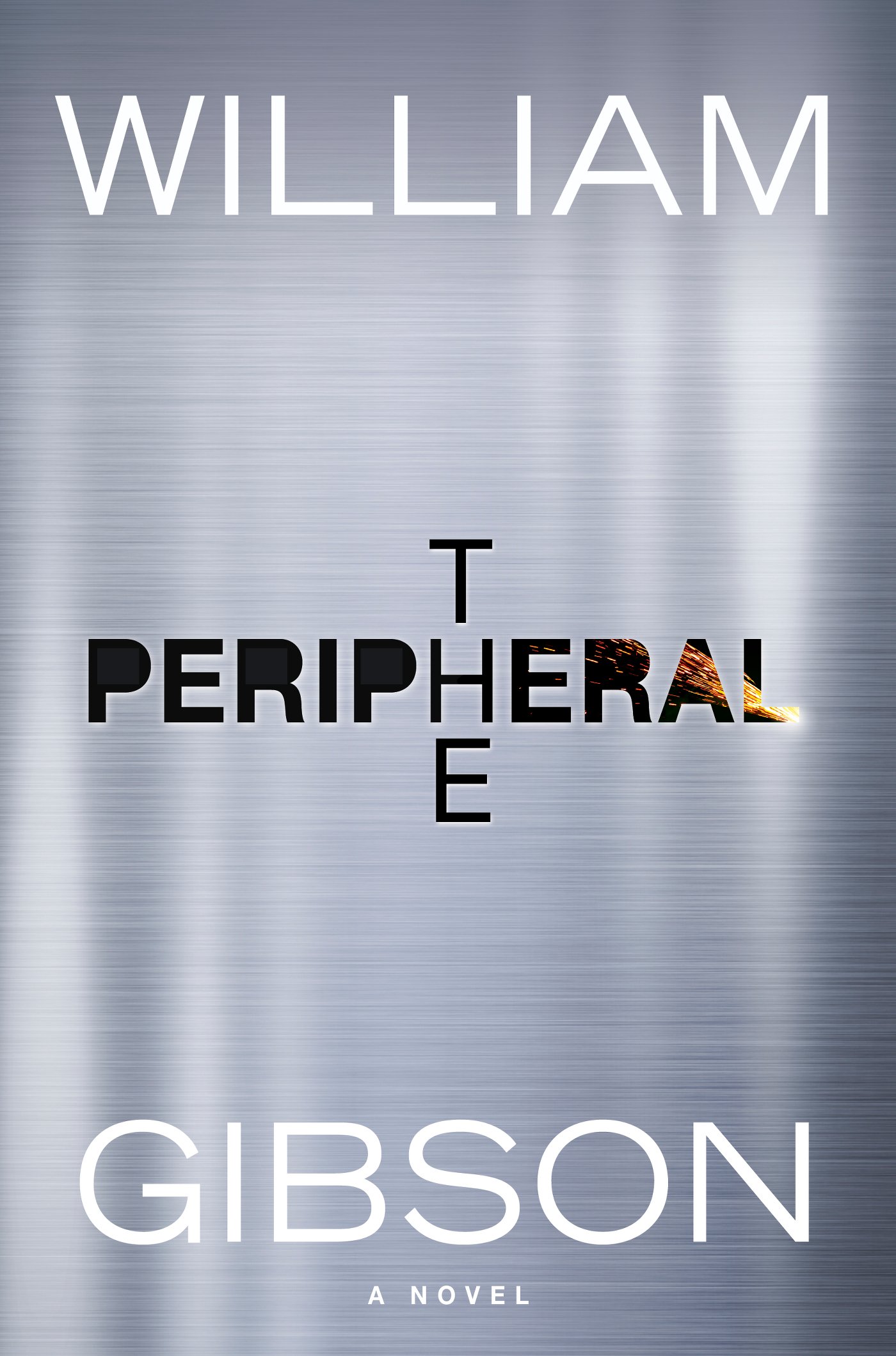
Microreview [book]: The Peripheral by William Gibson

Visions of the future, near and far.


Warning: some spoilers

The Peripheral marks Gibson's much heralded return to science fiction (after a decade-plus of publishing thrillers). Yet those expecting a more narrow return to the "hard" near-futurism of his cyberpunk novels will be in for a surprise.

The Peripheral takes place on two dimensional planes (or nodes on a divergent timeline) separated by about half a century and by a cataclysmic event known as "the Jackpot." In the temporally foregrounded narrative, English publicist Wilf Netherton works for/is sleeping with performance artist Daedra West. But when a public stunt ends with West massacring a off-shore colony of posthumans, whomever pays Netherton's bills (and it is never clear who that is, even to Netherton) decides to cut ties. Before doing so, Netherton gives West a parting gift--a "polt" he himself received from friend, erstwhile patron and Russian oligarch Lev Zubov (a member of the "klept" that not-so-secretly runs things in the future). Lev is a "stub hobbyist," that is, a person of endless means who has discovered, through a mysterious server, a way to interact with the past. Once interaction commences, though, the timelines separate. Daedra, growing bored of the "polt," gives it to her sister Aelita.

In the stub, Burton Fisher--a veteran of of the USMC's crack Haptic Recon Force--gets paid to play a game, which requires him to keep drone paparazzi away from Aelita West (though he doesn't know that's what it is). But he wants to go upstate so he can mix it up with Luke 4:5 (an evolution of the Westboro Baptist Church) when it tries to protest a military funeral. He leaves his sister Flynne to play the game for him. Only Flynne sees a murder--one that seems too real and horrible to be part of a game. And then people start trying to kill her for what she saw. Realizing what's going on, Netherton and his patrons--under the direction of the seemingly ageless and enigmatic Detective Lowbeer--hatch a plot to bring Flynne into their world, via one of the eponymous "peripherals"--artificial bodies that can be controlled remotely--so she can identify Aelita's killer--before it's too late.

As dense as that sounds, it's really only the tip of the iceberg. But reveal anymore, and I'd be spoiling the book, so I won't go there. Needless to say, The Peripheral is a dense, sinewy mess--but the kind that begs interpretation. As such, it feels closer to the literary specfic of Pynchon, Mitchell or Murakami than Sterling, Cadigan or young Gibson.

In other respects, the book is quintessentially Gibsonian. The world of the stub does not resemble the urban hellscapes of his Sprawl Trilogy, but is more extrapolation of the rural dyspotias portrayed in the television shows Justified or True Detective, albeit with added drones and 3D printers--communities ravaged by economic decay, public corruption, widespread drug addiction and the endless foreign wars that disproportionately draw from the young and poor. But the effect is similarly disquieting, because it feels close and, at times, crushingly inevitable. This has always been one of the things that's attracted me to Gibson's fiction; whether science fictional or mimetic, he always seems to have a handle on where things are and where they are headed in the immediate future. Maybe not exactly, but enough to pose uncomfortable questions without suggesting easy or convenient answers.

The foregrounded timeline, by contrast, is distinctly post-singularity. While I'm not opposed to post-singularity fiction in principle, I think Paul Kincaid said it best:

If the singularity means everything coming at us so fast that it is incomprehensible, then the author feels no need to comprehend. The author is as much outside the world as the reader is. The story, therefore, is left to stand or fall not by the sense of a lived future (because we are left feeling that even the author hasn’t lived in it in her imagination) but by how much strangeness can be thrown into the mix. In effect, the stories are not meant to make sense, because the incomprehensibility of the future to the reader is the whole point of the exercise. And in this, both reader and author are excluded from the story.

The foregrounded narrative is certainly inventive, with good characters--Netherton, Lowbeer and others; it nevertheless felt remote and cold to me, and as such, a bit tedious in comparison with Flynne's neo-Appalachia. 

Problematically, the incomprehensibility of this post-singularity future also conspires to produce a series of deus ex machina solutions to problems that emerge in the stub. Need resources? Watch Lev's "quants" manipulate the local economy (or rather, be told that they have done so). Someone trying to kill you? Have Lowbeer "send" over some more advanced weaponry. Flynne and Burton are extremely capable, but most of the time things are just done for them. This struck me as a waste of good characterization.

The Peripheral also suffers from an issue I've noted in a lot of books lately, namely, too many characters and not enough character development. In fact most of the secondary characters are either interchangeable or unnecessary, while a few that really could have used more development are as thin as reeds. Is this part of the literary zeitgeist? If so, I hope it goes away. So too the reliance on talking about things that are happening, rather than actually showing them happen.
 
Stylistically, though, The Peripheral dazzles. Counter-intuitively, perhaps, this is where felt the strongest connection to Neuromancer. Where, say, All Tomorrow's Parties gently immerses the reader in its near-future world, The Peripheral (like Neuromancer) throws you to into a deep end of speculative technology and the history, cultures and vernaculars of the future zeitgeist. No one does this like Gibson, and the uncompromising approach does ultimately pay off. However, the first 100 pages or were a slog. As such, some initially enthusiastic readers are bound to give up, as I contemplated doing at several points. All I can say is that it does get much easier to read once these things sink in, though, and I'm quite glad I saw it through.

In the end, The Peripheral isn't quite on Neuromancer's level, and it's most certainly an acquired taste, but it is still on balance a smart, sophisticated and--yes--literary genre novel that is, I think, ultimately worth braving, if only to see where Gibson's thinking about the future has taken him. On the other hand, it never quite strikes the nerve it threatens to, and in the end that's a shame.


The Math

Baseline Assessment: 8/10

Bonuses: +1 for nobody does futurespeak like Gibson; +1 for this shit is real complex, yo.

Penalties: -1 for all the talking about about things happening when they could just be happening; -1 for oh please no more gods in the machine; -1 for underutilized strong characters amid a preponderance of weak characters.

Nerd Coefficient: 7/10. "A mostly enjoyable experience."  

***

POSTED BY: The G--purveyor of nerdliness, genre fanatic and Nerds of a
Feather founder/administrator (2012).