Showing posts with label Lara Elena Donnelly. Show all posts

Thursday, July 23, 2026

Series Review: The Amberlough Dossier, by Lara Elena Donnelly

A clear-eyed, relevant exploration of the tragic humanity of flawed people, flawed countries, and how impotence does not excuse wrongdoing

I picked up Amberlough, the first of Lara Elena Donnelly’s rich, thoughtful, and distressingly still-relevant trilogy of politics and style, because of the style alone. ‘Ooh,’ I thought, ‘Moulin-rouge-flavoured nightclubs with art-nouveau style, queer flamboyance, and a 1930s-bohemianism! Sounds like fantastic fun! Sign me up!’

And it was fantastic. The absinthe flowed, the nightclub performers danced and bantered and exuded fae-like glamours over their bewitched spectators. What is more, Amberlough city has a functional streetcar system, further adding to its already stratospheric base level of extreme sexiness. But was this series fun? Not really. Because fucking fascism always has to ruin everything.

This series is beautifully constructed in three parts: the fascist take-over, the resistance, and the aftermath. But where other writers might turn this into an inspiring, rah-rah tale of the RISING TO THE CHALLENGE and RESTORATION OF JUSTICE and EVERYMAN HEROES WILL TRIUMPH AGAINST EVIL THROUGH THE POWER OF COLLECTIVE ACTION, this series is decidedly more restrained. Everything is complicated. Everyone is complicated. There is hope for a better future, yes, but the flaws and constraints and uncountable opportunities to make the wrong choice temper that hope in a way that feels both realistic and depressingly relevant.

The story revolves around an interconnected ensemble of key players, who expand and contract in number throughout the series. In Book 1, Amberlough, we have Aristide Makricosta, a wildly popular, glamorous, (ageing) nightclub performer, who has, through a series of disagreeable compromises, entirely remade himself from a country boy of dubious ethnicity to the ne plus ultra of Amberlough nightlife. Cyril DePaul is a government agent who is simultaneously sleeping with Aristide and investigating him (not very effectively) for drug smuggling. Needless to say, this relationship necessitates a certain divide between work life and personal life. Finally, we have Cordelia Lehane, a stripper who works with Aristide at the nightclub. 

When the story begins, the nation of Gedda ---  a loose confederation of different regions, much like the UK --- is preparing for an election in which the governing party, a regionalist faction that favours backing off to let each region govern itself, is facing off against the rapidly strengthening One State Party or OSP. The OSP stands not only for a unified government, but a unified people, a unified culture, a unified ethnicity, a unified morality. People like Aristide, who work the wrong jobs, love the wrong type of people, and walk around with the wrong skin colour and shape of nose, face a rough future if the Ospies take over. And the Ospies have a good chance of it: When Cyril is sent to investigate the possibility of election fraud, they lose no time in finding his weak points and manipulating him to aid their efforts in rising to power.

In Book 2, Armistice, the action shifts to a different country of Porachis. Porachis has a subcontinental flavour, but it’s a subcontinent where British colonialism didn’t happen, and where Bollywood, not Hollywood, defines the international standard of film studio glamour. There, Cyril’s sister, Lilian DePaul, is working in the Geddan diplomatic office. Like Cyril, she is serving the Ospies, and like Cyril, they are enforcing her compliance --- in her case, by threatening her son. Yet Lilian is hardly a downtrodden victim here. She is very good at her job, highly respected in Porachis, and maintains access to her family’s inherited wealth. She may not like the Ospies, but she is doing well under their rule. Aristide, too, is making the best of matters. He has fled Gedda to land on his feet in the Porachin film industry, where he gains international acclaim and spends his time sleeping with handsome men much younger than him, drinking too much, and generally living the life of glorious public dissipation that often betokens internal emptiness and despair. Only Cordelia is suffering under Ospie rule, and only Cordelia has been doing anything about it.

In Book 3, Amnesty, the Ospies are gone, and Cordelia is a hero. Hooray! But that doesn’t mean everything is all right again. Are the heroes of the resistance the right people to lead a country once they’ve overthrown the government? Aristide and Lilian have returned home to Amberlough --- but how can you pick up the threads of your old life, when you and your home and all the people you once knew and loved have changed so much? And how can you build a future when the misdeeds of the past --- arms-dealing, drug-smuggling, collaboration with the enemy --- are brought into the open for some long-delayed justice? What value is there in justice, if it cannot bring back the dead, and serves only to hurt the living?

These books are profoundly melancholy, because they identify so precisely all the complications inherent in a story that a simpler book would present as a rousing, heartening, rallying cry to resist oppression and build a better world. Cyril and Lilian’s collaboration with the Ospies seems utterly unforgivable from the outside, the weak actions of weak people (especially Cyril --- oh, especially Cyril!) but when we see the story from inside their heads, it’s brutally clear why they act as they do. Aristide’s collapse into dissipation and despair is distressing --- but what would you do if you had clawed your way from the dregs of society into a moment of glittering triumph, only to have everything you’d built, and everyone you loved, ripped away from under you?

The set dressing of this story --- Art Deco Europe --- gives the rise of the Ospies a classic Nazi odour. But the book has more universal applicability than that. The publication dates (2017, 2018, and 2019) makes one suspect that a great deal of this series was inspired by living through the rise of the far right and the first Trump administration (although the parallels break down a bit now, during the second Trump administration, largely because the Ospies have much less interest in destroying science and medicine and general government function than MAGA). The agitations of regions wanting to break away from the central government give Brexit referendum vibes, or Scottish or Catalan independence. The complex relationships between certain regions within Gedda and other countries outside Gedda have a distinct whiff of Northern Ireland. And that’s not even leaving Europe! The reality is that every complex society will have its agitators against central authority, and authoritarian assholes are always lurking, eager to assume control. The central themes of this series, the flawed actors, the flawed governments, the flawed cultures, the flawed movements, are not specific to one point of time. They are universally, tragically, perpetually relevant. 

And what is worse, it remains unclear how much power any individual actually has to change anything. Would the Ospies still have come to power if Cyril hadn’t been coerced to aid them? Probably! Would there have been a resistance to bring them down if Cordelia hadn’t gotten involved? Maybe! Will Lilian be able to affect the form of the new government once the Ospies are gone? Who knows? This series is full of sympathetic, flawed humans, committing tragically understandable misdeeds, with no guarantee that anything they do matters. It is bleak. It is grim. It is complicated.

And yet: there is hope. The Ospies come to power, but they can be overthrown, and although we don’t know if Amberlough will find its way to a just future --- with or without Lilian’s involvement --- there is a path in that direction. People and society are complicated. The world of Amberlough is complicated. But so is ours; and it is a comfort to see these complications acknowledged on the page, without losing sight of the possibility of hope. 

--

The Math

Nerd coefficient: 9/10, very high quality/standout in its category

Highlights:

  • Complex people, complex setting, complex themes
  • Glamour and style
  • Melancholy
  • Streetcars 

References:  

Donnelly, Lara Elena. Amberlough. [Tor 2017].

Donnelly, Lara Elena. Armistice. [Tor 2018].

Donnelly, Lara Elena. Amnesty. [Tor 2019].

CLARA COHEN lives in Scotland in a creaky old building with pipes for gas lighting still lurking under her floorboards. She is an experimental linguist by profession, and calligrapher and Islamic geometric artist by vocation. During figure skating season she does blather on a bit about figure skating. She is on Mastodon at wandering.shop/@ergative or on Bluesky at https://bsky.app/profile/ergative-abs.bsky.social.

Tuesday, July 29, 2025

Book Review: No Such Thing As Duty by Lara Elena Donnelly

A blend of the historical and the speculative to linger on the concept of duty in a grim and everchanging world.


The viewpoint character of Lara Elena Donnelly's novella No Such Thing As Duty is William Somerset Maugham. You might have heard of him. An English writer who penned plays, short stories and novels, I certainly had, but knew very little about him beyond that briefest of bios. Nor did I until after I had finished writing my first draft of this review - a deliberate choice, wanting to preserve the experience of the story as a narrative-object, to linger in its tension and ambiguities, without collapsing them down with the intrusion of reality until I had at least captured the rough sense of my feelings in the amber of prose.

Because there are two No Such Thing As Dutys - the first is the one read by someone who knows Maugham's bibliography, the facts of his life and the reality, date and manner of his death. This is a version one must expect of any book which features historical facts, in any form. There is always someone who knows everything, especially when the subject is a famous author. The second is my experience.

At the start of the book, we meet Maugham arriving in a Romania in which he is certain he will die (and glad of it rather than being a Scottish sanatorium). He is suffering from tuberculosis, dizzy with fever and coughing up blood, but seemingly determined to do his duty before succumbing to the inevitable. Already, a branching point of the two experiences of the story. For me, this is tension - does he die in Romania? I don't know. He seems wearily certain of it, a spectre that looms over the story, that intrudes every time he coughs up blood into a handkerchief or a scarf conveniently dark to hide the stain. Arriving as a spy in wartime, he reports in to receive such mission as he might be needed for, following on from his promising activities with less promising outcomes in other fronts of the conflict. But he soon realises his mission, such as it is, seems more of a sop, a bone thrown to make him feel useful rather than something vitally necessary.

And thus, the central conflict of the book. The duty he's doing - to King and Country, as he says - what kind of duty is it, if it is this pity mission? He leaves behind a daughter he cares about and a wife he'd rather avoid, coming to die far away, and if it's not for duty, then what is it for? Are they not also a duty?

But he's there, and the mission is in front of him, and he's dying, so do it he does. And through the course of it, he meets two other key figures. One a man, Walter, seemingly walled off from any sense of duty - seemingly - and another a woman, Mme. Popescu, whose husband died of a duty he didn't even need to do. Three angles on the same problem, though mired firmly in Maugham's. The glimpses of the other two do however serve to colour and explore his, through the lens of his introspection.

And this - his self-critical, thoughtful, writerly narrative voice - is one of the most successful things about a roundly successful novella. I'm not familiar with Maugham's work in reality - another branch point, does his narrative voice sound like actual Maugham's - but I found myself quickly invested in the version of him that exists in Donnelly's. There's an analytical bent to the way he talks about the people around him, a distance that he himself names as he talks to other characters, and a slight rigidity to the prose that does nod back to the time at which the story is set, without overegging the historicity. But it's not just that. He is constantly dwelling on his imminent death (ironic or simply foreshadowing?), the effect that will have on his family, whether being here is the right thing to do, and if he even truly is doing his duty at all. He also dwells on two lost loves and one growing one, because all good things come in threes.

As with the three angles on duties, the three loves all inform one another, shaping how we see Maugham as much as how he sees himself. There's Sue, the woman he wishes he'd married but whom he lost to the man who got her pregnant (and married her out of - yes, there's duty again). There's Gerald, the outgoing soldier he knew in the Pacific, whose strengths shored up Maugham's weaknesses, and whose flaws could be forgiven, and critically who knew, as Maugham knows, when and how to keep hidden from society's eyes what it doesn't want to see. And then the present one, Walter - the man who walls himself off from duty, who refuses to hide himself as Maugham knows he must.

Intersections, wherever you look. Maugham - with his stutter, his orphan status and French early years already an outcast, clinging on to rigid propriety as close as his interpretation of duty. Walter flouting both but charming him in, while also being his mission, a part of his own duty and bound up in the death of Popescu's husband.

All of which leads to wondering about the reality of Maugham's duty - the clue is, indeed, in the title - but whether it's self-imposed too. All around him, people take the rules of society less seriously than he does, whether they be his British handler, the locals, Walter or Mme. Popescu. He dwells on how it was his duty to marry Syrie, the wife he's avoiding, after he got her pregnant. But was it truly? Was it a duty he could have avoided if he wanted to? Did he want to? Will he die in service to this thing that may never even really have been asked of him at all?

That tension and uncertainty about his death is why I resolved not to find out his biographical details until I had settled my thoughts. Because the poignancy of not knowing felt so delicious, and fed in so beautifully to the ethical crisis he was suffering through, that I wanted to treasure it as a lucky gift I chanced to have in reading it.

However, around half to two thirds through the novella, Donnelly introduces a speculative element which complicates things further. Obviously, there were no vampires involved in World War I. And so, however closely the narrative up to this point may (or may not) have married up to the real history and biography, here it diverges. The two experiences of the book briefly coalesce. But only briefly.

In my opinion, vampires are at their best when they are both truly dangerous and also, despite and because of the danger, sexy. In No Such Thing as Duty, the sexiness of the vampirism (and while a little understated, by god is Donnelly's vampire sexy) is corralled in by the physical - blood and bites and hands and tongues - just as the rest of the story is wedded to Maugham's own physicality, of his breath and cough and bleeding, his fever constantly waxing and waning, the scratch of fabric on skin, his enjoyment of food and drink. Donnelly revels in the sensation of drinks particularly, the haze of brandy and heat of coffee, and temperature more broadly - feverish burns and the cool touch of snow. And again, the lingering prophecy of Maugham's death informs this. We read his body in its frailty and potential failure; the vampirism marries that imminent death up with sex but also with the potentiality of death's forestalling.

And so, the two readings once again diverge and split even further. Is the intrusion of the fantastical about to change the facts, and a reader who knows whether Maugham will die about to be surprised by a change, or have their knowledge come to fruition, but its method shifted? And then, again, me, caught up only in the tension of the story itself. Vampires throw a spanner into the works of the greatest inevitability, and so add an extra layer of narrative uncertainty.

Right up to the end, Donnelly preserves that ambiguity. The story ends with implication rather than closure, a situation that made me very glad for my lack of knowledge, but one that, precisely because of the speculative elements, likewise imposes that ambiguity even on a reader who does know, because while the question of "if" might have been settled for them, there still lives a vast expanse of "how" and "why".

And so, ultimately, it doesn't matter if you know the facts or not. The story uses vampirism to crack open the vault of possibility, and ensure that the available endings are uncertain for any reader. I looked up the facts, and learnt that not only did Maugham live into his nineties, far beyond the scope of the life he sees as doomed in the story, but that even the foundation of the story rests on a branch untaken - the Scottish sanatorium the book's Maugham is glad to avoid was the path of reality. A reader who knew his biography was already wrong-footed, because it never cleaved to that reality in the first place. That break from the known path already introduced the potential for change, and the story could become one of the doomed path the real man didn't take.

No Such Thing As Duty wields its ambiguities and potentialities like a scalpel, all the while holding them in delicious contrast to the bitter realities of the physical and the flesh. By using a real historical figure and divorcing him from his reality, Donnelly ties her story to real anchors - there are hints and nods to real, biographical facts seeded throughout - without closing off the opportunities for tension, and the scope of possible endings. The fantastical element is also the most grounding one, the sections in which Maugham is being fed on being some of the most intimately real ones, where much of the rest of the story comes filtered through his particular lens of perception, held at a distance, or made hazy by illness. Only in contact with the unreal does the story fully rear up into feeling quite present. She leaves her questions open - this is not a story with an answer to its moral questions, any more than it is one to set a firm hand on the conclusion of its plot - and the work is all the better for it. It is a beautiful, brilliant book, with exquisitely understated prose and a skilfully managed viewpoint, and one that exemplifies what a good novella can do, or be, by using all its tools, figures and ideas all intersect and coalesce into a gorgeous mess of feeling and thought.

--

The Math

Highlights: Sexy but understated but sexy vampirism, triangulating around the concept of duty, well-crafted introspective viewpoint

Nerd Coefficient: 9/10

Reference: Lara Elena Donnelly, No Such Thing As Duty [Neon Hemlock, 2025]. 

POSTED BY: Roseanna Pendlebury, the humble servant of a very loud cat. @chloroformtea.bsky.social

Thursday, January 20, 2022

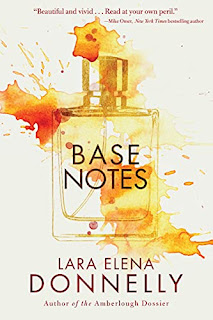
Microreview [book]: Base Notes, by Lara Elena Donnelly

Lara Elena Donnelly’s Base Notes takes the author's penchant for strongly realized characters and settings and turns them loose in an underground world of a parfumier who carries a very deadly secret as to the power and success of his product.


Vic is a parfumier like no other. He truly has a nose for scents, and a honed natural talent for crafting and making scents come to life. Some of his creations, however, those for a specific clientele, are extremely special, for they can evoke for a wearer, and a specific wearer at that, a full sensorial memory of a time and event. To make those scents however, requires raw materials of a sort that requires Vic to be something more than a parfumier: a murderer.  Now, as a powerful and rich former client asks Vic for an even more complicated creation, the garrote around Vic and his business, and his secrets, slowly tightens.


Vic’s story is told in Lara Elena Donnelly’s Base Notes.


Readers of Donnelly’s Amberlough novels have come to expect strong and vivid characterization, and deep and vivid language in evoking a sense of place for them to inhabit. Readers who are looking for spare, clean, “invisible” prose are readers who, I find, don’t take to Donnelly’s vividly imagined worlds. Her word choice, structure and style are immediately visible on the page. For readers who want that immersion into language and want to engage with it, I am happy to report that her talents from the Amberlough Dossier are on full display here.  Here, though, the author goes for a memoir, a memory, a recollection by our narrator, the author, Vic. 


In this way, Base Notes keeps that high sensory writing and marries it to a very personal first person perspective. Given Vic’s profession as a parfumier, it means that the book is full of olfactory, smell based sensory data first and foremost. In a world and genre where sight is a primary sense, hearing perhaps secondary and other senses often get short shrift by writers, a book where we are immersed in this main character’s mind and perceptions means that smell is as important as any other sense in how Vic perceives a scene, and the author’s skill translates to that page wonderfully. This is a book that immerses you in every scene that Vic inhabits, and scent is the first and primary sense that the author uses to do that. 


Vic himself is a fascinating character, for being a horrible human being. The author runs a really thin tightrope here. We spend every moment of the book in Vic’s head, so how do you make a preternaturally good parfumier, who is also a remorseless murderer, into a character that we can understand, even sympathize with, and then watch with horror as the inexorable results of his actions drive him past his own (already messed up) boundaries and beyond even the moral event horizons that were already sociopathic into worse territory?  It’s difficult. The sensory detail does help. Being immersed into Vic’s world and only gently being told of how he gets his special perfumes done helps. We also see Vic himself fumbling through a relationship of sorts, as events bring him into the circles of Giovanni, his barber, and Jane and Beau, a couple whom he forges a friendship with, and in the case of Jane, something more. We feel his pain and anguish as he himself tries to work out being, for lack of a better word, human with them. The story of his relationship with his former mentor, Jonathan (Vic is bisexual, it should be noted) is one that slowly emerges from its base notes as the story unfolds, and part of the mystery of the story is just how that relationship went so very wrong--and how it formed the Vic Fowler of today. 


The plot, then, you will not be surprised is strongly character-focused, setting up the main character in an ever tightening situation, and every step of Vic’s descent (not that he was a good man at all when the novel starts) is inexorable and inevitable. I guessed early on once all the main characters on stage how things were going to go, but it is the how and the why and the clockwork beats that kept me turning pages. This is not a novel of redemption of a terrible person, and while the author humanizes Vic at first, as things turn darker and darker, the window of sympathizing with Vic turns to horror and for me, a turning away from sympathizing with him. It’s a high wire tightrope act--make it clear that Vic is a terrible person, early on, really get into his head and make us understand him, understand his boundaries and his circumscribed world. And then when we see him transgress those, when events inexorably force him to cross the boundary of an ever shrinking circle of action, then for me, it then becomes a fascination to see how and why it will end. 


What this means is, that, like any SFF novel, but in harsh and strong relief, that this is not the novel for everyone, or for every moment. (If I personally was in one of my low periods, this novel would not have worked for me at all). This is a novel about a parfumier so singularly minded on his craft, so driven that he has not only have committed murder in the past, not only have the apparatus to deal with such murderers, but coerces others into such a life as well. 


Beyond the sensory and story of Vic, the novel does not lean heavily on theme, but theme definitely drives the narrative. This is a novel that looks at modern “late stage capitalism” and how it drives Vic, and how Vic uses the drive to manipulate and move others. The phrase “Eat the rich” does get invoked here.  Mind, Vic is a terrible person who does terrible things, and drives and manipulates and offers openings to other people to do terrible things. But, you can see the social forces goading and driving him, and other, to consider those acts. And more than consider the acts. Vic’s own rather terrible living situation encapsulates the problems of housing in America today, for example.


If such a protagonist as Vic and a story is something you might find favor with reading, Base Notes is a story that can enthrall you with its writing. Although the story is very different, there is a movie that I kept mentally flashing back to as I read this book, and that is Perfume: The Story of a Murderer. Some of the aspects are similar (strange ways of getting scents, preternatural senses, a science fictional element) but the story is very different in how it plays out that it can be thought of as a companion piece rather than aping it. Or, to use the tools of the book and movie themselves, there are elements in the “Scents” of both the movie and the book that have familiarity, but the resulting perfumes are different and do different things, but close enough that those who enjoy one will definitely enjoy the other. 


The Math

Baseline Assessment: 6/10

Bonuses : +1 for a very vivid and immersively written sensory experience of the first focused on smell that is rara avis. 

+1 for tight and inexorable plotting and a story that slowly constricts around the main character and drives him to an inexorability that keeps you turning pages.

Penalties: -1 This is a novel whose main character and his actions are *definitely* not for all readers. Caveat Lector!

Nerd Coefficient: 7/10 

 POSTED BY: Paul Weimer. Ubiquitous in Shadow, but I’m just this guy, you know? @princejvstin.

Reference: Donnelly, Lara Elena. Base Notes [Thomas and Mercer, 2022]

Monday, April 1, 2019

New Books Spotlight

Welcome to another edition of the New Books Spotlight, where each month or so we curate a selection of 6 forthcoming books we find notable, interesting, and intriguing. It gives us the opportunity to shine a brief spotlight on some stuff we're itching to get our hands on.

What are you looking forward to? Anything you want to argue with us about? Is there something we should consider spotlighting in the future? Let us know in the comments!


Beukes, Lauren. Motherland [Mulholland]
Publisher's Description
This is America, but not like you know it. Years after the decimation of the male population by a super-virus, the country has refashioned itself with new laws, new customs, and new methods of shame and punishment. Now, hiding a living and healthy male is one of the gravest offenses, rivaled only by the murder of a man. 
Cole is a mother on the run, guilty of both crimes, and desperate to find a safe life for her adolescent boy Miles. 
As the two drift throughout the transformed states of the West, they hide Miles’ identity while evading a mysterious, powerful man bent on justice. From a commune in the Rockies to a high security laboratory in the redwoods of northern California, the two tensely negotiate an existence on the fringes of a new America. Cole’s goal for her son and herself is escape, a family in South Africa, a slim chance at a better life. Mother and child see their chance, at last, in the wanderings and secret goals of a cult–if only Cole can keep Miles’ true self hidden, and as long as they can stay one step ahead of an ex-boyfriend from hell. 
A brilliant blend of psychological suspense, American noir, and trenchant science fiction, MOTHERLAND is the story that Lauren Beukes’ myriad fans have been waiting for. 
Why We Want It: One thing I am continually drawn to in literature is dystopia and feminist dystopia. Beukes has already built a reputation of excellence. The Shining Girls and Broken Monsters were exceptional and I am ready for the Beukes' next novel.


Donnelly, Lara Elena. Amnesty [Tor]
Publisher's Description
Donnelly’s Amnesty completes the Nebula and LAMBDA Award-nominated Amberlough Dossier glam spy thriller trilogy that Publishers Weekly describes as "Impressive...as heartbreaking as it is satisfying.” (starred review) 
In Amberlough City, out of the ASHES of revolution, a TRAITOR returns, a political CAMPAIGN comes to a roaring head, and the people demand JUSTICE for crimes past. 
As a nation struggles to rebuild, who can escape retribution?

Amnesty is a smart, decadent, heart-pounding conclusion to Lara Elena Donnelly’s widely-praised glam spy trilogy that will have readers enthralled until the very end. 
Why We Want It: Amberlough was an exciting debut and Armistice was an excellent continuation of that story, though perhaps not the one I expected. Donnelly's art deco infused espionage thrillers set during the rise of an empire with strong Nazi overtones permeating everything, is outstanding and, not to continue to quote the publisher's description, legitimately heartbreaking. I want to see how this all ends.


Glass, Jenna. The Women's War [Del Rey]
Publisher's Description
In a feminist fantasy epic, a revolutionary spell gives women the ability to control their own fertility—with consequences that rock their patriarchal society to its core. 
“A compulsive read, riveting characters, life-or-death stakes . . . a smashing book!”—Tamora Pierce
When a nobleman’s first duty is to produce a male heir, women are treated like possessions and bargaining chips. But as the aftereffects of a world-altering spell ripple out physically and culturally, women at last have a bargaining chip of their own. And two women in particular find themselves at the liberating crossroads of change. 
Alys is the widowed mother of two adolescent children, and the disinherited daughter of a king. Her existence has been carefully regulated, but now she discovers a fierce talent not only for politics but also for magic—once deemed solely the domain of men. Meanwhile, in a neighboring kingdom, young Ellin finds herself unexpectedly on the throne after the sudden death of her grandfather the king and everyone else who stood ahead of her in the line of succession. Conventional wisdom holds that she will marry quickly, then quietly surrender the throne to her new husband. Only, Ellin has other ideas. 
The tensions building in the two kingdoms grow abruptly worse when a caravan of exiled women and their escort of disgraced soldiers stumble upon a new source of magic in what was once uninhabitable desert. This new and revolutionary magic—which only women can wield—might well tear down what is left of the patriarchy. The men who currently hold power will do anything to retain it. But what force in the world can stand against the courage and resolution of generations of women who have tasted freedom for the very first time? 
Why We Want It: I'm down for a feminist epic fantasy. I've seen reviews discussing how it feels like more of an 1980's feminist epic fantasy that doesn't quite reach the heights of those novels, but I still want to check this one out.


Gloss, Molly. The Dazzle of Day [Saga]
Publisher's Description
Leaving a dilapidated Earth behind, Quakers across the globe pool funds and resources as they select colonists to send to a newly discovered planet to start life anew in this “miraculous fusion of…science fiction with unsparing realism and keen psychology” (Ursula K. Le Guin). 
In this “carefully conceived and deeply affecting” (The New York Times) novel, award-winning author Molly Gloss turns her attention to the frontiers of the future. A group of Quakers band together to abandon the ailing Earth, and travel to a settle a whole new world. The Dazzle of Day is their story. 
“The Dazzle of Day is a heartbreakingly good book...a rare dream of a book, passionate and lyric. The Dazzle of Day allows us to see our own world, our own present, more profoundly” (San Jose Mercury News). 
Why We Want It: The Dazzle of Day is part of Saga's republication of three of Gloss's novels and is the only one I had previously read. I mentioned it as part of a list of mostly overlooked novels and I'm glad that this re-release should give The Dazzle of Day and Molly Gloss some extra attention. This one is really good.


Newman, Emma. Atlas Alone [Ace]
Publisher's Description
Hugo Award winner Emma Newman returns to the captivating Planetfall universe with a novel about vengeance and the lengths to which one will go to save the future of humanity.
Six months after she left, Dee is struggling to manage her rage toward the people who ordered the nuclear strike that destroyed Earth. She’s trying to find those responsible, but she’s not getting very far alone.
A dedicated gamer, Dee is endeavoring to discover a mersive good enough to enable her to escape her trauma. When she is approached by a designer who asks her to play test his new game, she hopes it will be what she needs—but it isn’t like any mersive she’s played before. When a man suddenly dies in the real world, she realizes that at the same time in the game, she killed a character who bears a striking resemblance to the dead man—a man she discovers was one of those responsible for the death of millions on Earth.
Disturbed, but thinking it must be a coincidence, Dee continues the hunt for information. But when she finds out the plans for the future colony, she realizes that to save what is left of humanity, she might have to do something that risks what remains of her own. 
Why We Want It: Emma Newman's Planetfall was excellent and I've heard nothing but praise for Before Mars and After Atlas (which I haven't read), but I had access to an advanced copy of Atlas Alone. As good as Planetfall was (and it was plenty good), Atlas Alone is Newman raising the bar, leveling up, and telling a story that I did not want to put down. Having a cursory knowledge of the larger Planetfall universe is helpful, but unnecessary. Look for this. Read it when you find.


Roanhorse, Rebecca. Storm of Locusts [Saga]
Publisher's Description
Kai and Caleb Goodacre have been kidnapped just as rumors of a cult sweeping across the reservation leads Maggie and Hastiin to investigate an outpost, and what they find there will challenge everything they’ve come to know in this action-packed sequel to Trail of Lightning. 
It’s been four weeks since the bloody showdown at Black Mesa, and Maggie Hoskie, Diné monster hunter, is trying to make the best of things. Only her latest bounty hunt has gone sideways, she’s lost her only friend, Kai Arviso, and she’s somehow found herself responsible for a girl with a strange clan power.
 Then the Goodacre twins show up at Maggie’s door with the news that Kai and the youngest Goodacre, Caleb, have fallen in with a mysterious cult, led by a figure out of Navajo legend called the White Locust. The Goodacres are convinced that Kai’s a true believer, but Maggie suspects there’s more to Kai’s new faith than meets the eye. She vows to track down the White Locust, then rescue Kai and make things right between them.
Her search leads her beyond the Walls of Dinétah and straight into the horrors of the Big Water world outside. With the aid of a motley collection of allies, Maggie must battle body harvesters, newborn casino gods and, ultimately, the White Locust himself. But the cult leader is nothing like she suspected, and Kai might not need rescuing after all. When the full scope of the White Locust’s plans are revealed, Maggie’s burgeoning trust in her friends, and herself, will be pushed to the breaking point, and not everyone will survive. 
Why We Want It: Paul said Trail of Lightning was pretty great and I completely agree. If Roanhorse had not already won all of the awards for her story "Welcome to Your Authentic Indian Experience" (including the Campbell for Best New Writer), Trail of Lightning would be the announcement of a major new voice. It still is, and it is also confirmation that Roanhorse is as good as everyone thought she was, and she can do it at novel length. Storm of Locusts is Roanhorse's follow up novel and it is sure to be a must read.


POSTED BY: Joe Sherry - Co-editor of Nerds of a Feather, 2017 & 2018 Hugo Award Finalist for Best Fanzine. Minnesotan.

Tuesday, May 15, 2018

6 Books with Lara Elena Donnelly

Photo Credit: Ruby Katigbak

Lara Elena Donnelly is the author of the vintage-glam spy thriller Amberlough and it’s forthcoming sequels Armistice and Amnesty (Tor). Lara’s other work has appeared in venues including Strange Horizons, Escape Pod, Nightmare, and Uncanny. 

Today she shares her 6 books with us...


1. What book are you currently reading?

Right now I’m reading The Sky Is Yours, by Chandler Klang Smith. It’s weird and gorgeous and depraved, and unlike much other fantasy I’ve encountered. It reminds me a little of David Edison’s The Waking Engine. I heard her read from it at the KGB Fantastic Fiction series in March, opposite Kelly Robson. There was a blizzard that day, so the book vendor hadn’t been able to make it to the reading. She had two of her own author copies to sell, and you’d better believe I bought one immediately.

I’m also reading The Bone Clocks, finally. I’ve read my David Mitchell all out of order. But wow, that man can make stories.


2. What upcoming book you are really excited about? 

I’m really excited for L.X. Beckett’s as-yet-unpublished novel, set in the same world as their upcoming novella “Freezing Rain, a Chance of Falling,” forthcoming from Fantasy & Science Fiction magazine. I got to beta-read it, and it’s a wonderful sci-fi solarpunkish thriller about politics, virtual reality, the singularity, and bouncing back from climate change that also deals very frankly but tenderly with trauma and mental illness.

I’m also looking forward to Blackfish City by Sam J. Miller and Social Creature by Tara Isabella Burton. Tara is one of those writers who moves between genres and styles with breathtaking ease; she’s painfully intelligent, but also glamorous, over the top, and delightfully bonkers, so I imagine her book will be all of these things and more. And with Sam, I know anything he writes is going to be heartbreaking, brutal, and totally original.


3. Is there a book you're currently itching to re-read?

I read The Goldfinch by Donna Tartt last summer, and it was so huge and I tore through it so fast, I’m sure there’s a lot of gorgeous, painful stuff I missed. The plot grabbed me so hard and roared along at such a pace, I didn’t have as much time as I might have liked to appreciate the prose and characterization. I’d also like to reread Wolf Hall, because wow. Just wow. Let me bask in that genius again.


4. How about a book you've changed your mind about over time--either positively or negatively? 

When I first tried to read Claire Messud’s The Emperor’s Children, I got about two chapters in, and I kept thinking, “I should like this book, but it is just not clicking with me.”

That was while I was living in Louisville, Kentucky, and in my early twenties. I tried it again once I’d moved to New York, had my heart broken, and landed pretty firmly in my late twenties (looking back at that sentence, it makes my life sound like a terrible literary cliché). Since The Emperor’s Children is a book about late-twenties, early-thirty somethings trying to claw their way through the difficulty that is New York, struggling with friendships and relationships that aren’t what they seemed on the surface, all of the sudden something in it clicked with me and I devoured the book in three days.


5. What's one book, which you read as a child or young adult, that has had a lasting influence on your writing?

The Voyage of the Basset, by James C. Christensen, Alan Dean Foster, and Renwick St. James, in which a Victorian professor and his daughters take a sea voyage perpendicular to Darwin’s trip on the Beagle, delving not into hard science but into myth, magic, and the imagination. As a kid I was obsessed with mythologies of all types, and also entranced by Christensen’s opulent, richly-detailed paintings. As an adult, the deeper metaphors of the story have stuck with me. I have a tattoo now, in Christensen’s handwriting, of the Basset’s motto: Credendo Vides, which means “By Believing, One Sees.”


6. And speaking of that, what's *your* latest book, and why is it awesome?

Armistice, the second book in the Amberlough Dossier, is packed full of twisted, tangled relationships. Sure, there are glamorous film shoots, clandestine meetings, and international arms deals aplenty, but the characters, and how they relate to one another, are my favorite part of this book. There’s a diplomat who’s illegitimate son is being held as collateral. There’s her ex-lover, the father of her child, struggling against the dictates of a society that has thwarted every one of his desires. There are people struggling with grief, anger, fear, and guilt. It’s a book about what happens once you’ve failed, and the strength it takes to try again.


POSTED BY: Joe Sherry - Co-editor of Nerds of a Feather, 2017 & 2018 Hugo Award Finalist for Best Fanzine. Writer / Editor of the mostly defunct Adventures in Reading since 2004. Minnesotan.

Tuesday, May 1, 2018

New Books Spotlight

Welcome to another edition of the New Books Spotlight, where each month or so we curate a selection of 6 forthcoming books we find notable, interesting, and intriguing. It gives us the opportunity to shine a brief spotlight on some stuff we're itching to get our hands on.

What are you looking forward to? Anything you want to argue with us about? Is there something we should consider spotlighting in the future? Let us know in the comments!


Bennis, Robyn. By Fire Above [Tor]
Publisher's Description
By Fire Above is the rip-roaring new adventure in Robyn Bennis's Signal Airship military fantasy series that Patricia Briggs hails as “full of sass and terrific characters.” 

"All's fair in love and war," according to airship captain Josette Dupre, until her hometown of Durum becomes occupied by the enemy and her mother a prisoner of war. Then it becomes, "Nothing's fair except bombing those Vins to high hell."

Before she can rescue her town, however, Josette must maneuver her way through the nest of overstuffed vipers that make up Garnia's military and royal leaders in order to drum up support. The foppish and mostly tolerated Mistral crew member Lord Bernat steps in to advise her, along with his very attractive older brother.

Between noble scheming, under-trained recruits, and supply shortages, Josette and the crew of the Mistral figure out a way to return to Durum—only to discover that when the homefront turns into the frontlines, things are more dangerous than they seem. 
Why We Want It: Shana said The Guns Above was "pure flintlock awesomeness" and we completely agree. The other thing Shana noted was that "The Guns Above reads like the first episode in a series you wish you could binge watch all weekend" and as such, we're super excited for By Fire Above. The first book was so much damned fun that we can't wait for the second. Luckily, we don't have to wait much longer.


Donnelly, Lara Elena. Armistice [Tor]
Publisher's Description
Armistice returns to Donnelly’s ravishing 1930s Art Deco-tinged fantasy world of the Nebula Award-nominated Amberlough with a decadent, tumultuous mixture of sex, politics, and spies 

“A hefty novel full of fascinating characters exploring oversized topics such as sexuality, music, culture, fascism, nationalism, class wars, revolution and love.” —Shelf Awareness 

In a tropical country where shadowy political affairs lurk behind the scenes of its glamorous film industry, three people maneuver inside a high stakes game of statecraft and espionage:

Lillian, a reluctant diplomat serving a fascist nation,

Aristide, an expatriate film director running from lost love and a criminal past,

—and Cordelia, a former cabaret stripper turned legendary revolutionary.

Each one harbors dangerous knowledge that can upturn a nation. When their fates collide, machinations are put into play, unexpected alliances are built, and long-held secrets are exposed. Everything is barreling towards an international revolt...and only the wiliest ones will be prepared for what comes next. 
Why We Want It: Donnelly attempted to rip my heart straight from my chest with Amberlough and I was not ready for that book to end, though it did so perfectly. If you haven't read Amberlough yet, go now. If you have, you know why I need this book in my life,


Feist, Raymond E. King of Ashes [Harper Voyager]
Publisher's Description
The first volume in legendary master and New York Times bestselling author Raymond E. Feist’s epic heroic fantasy series, The Firemane Saga—an electrifying tale of two young men whose choices will determine a world’s destiny.

For centuries, the five greatest kingdoms of North and South Tembria, twin continents on the world of Garn, have coexisted in peace. But the balance of power is destroyed when four of the kingdoms violate an ancient covenant and betray the fifth: Ithrace, the Kingdom of Flames, ruled by Steveren Langene, known as "the Firemane" for his brilliant red hair. As war engulfs the world, Ithrace is destroyed and the Greater Realms of Tembria are thrust into a dangerous struggle for supremacy. 
Why We Want It: "The storm has broken." Those were the first words to Magician, the novel that put Raymond Feist on the fantasy map. I've long used "Pug" as one of my online handles bag in the halcyon days of message boards. I read and re-read those early novels of Riftwar so much the covers tattered and fell off. I may have been far less enchanted with the series by the end, but there's still a little bit of magic in the idea of the first novel in a new series by one of my favorite fantasists from when I was a teenager. I don't know if i have full and proper hope, but I want to believe.


Griffith, Nicola. So Lucky [FSG Originals]
Publisher's Description
From the author of Hild, a fierce and urgent autobiographical novel about a woman facing down a formidable foe

So Lucky is the sharp, surprising new novel by Nicola Griffith—the profoundly personal and emphatically political story of a confident woman forced to confront an unnerving new reality when in the space of a single week her wife leaves her and she is diagnosed with multiple sclerosis.

Mara Tagarelli is, professionally, the head of a multimillion-dollar AIDS foundation; personally, she is a committed martial artist. But her life has turned inside out like a sock. She can’t rely on family, her body is letting her down, and friends and colleagues are turning away—they treat her like a victim. She needs to break that narrative: build her own community, learn new strengths, and fight. But what do you do when you find out that the story you’ve been told, the story you’ve told yourself, is not true? How can you fight if you can’t trust your body? Who can you rely on if those around you don’t have your best interests at heart, and the systems designed to help do more harm than good? Mara makes a decision and acts, but her actions unleash monsters aimed squarely at the heart of her new community.

This is fiction from the front lines, incandescent and urgent, a narrative juggernaut that rips through sentiment to expose the savagery of America’s treatment of the disabled and chronically ill. But So Lucky also blazes with hope and a ferocious love of self, of the life that becomes possible when we stop believing lies. 
Why We Want It: I'm at the point that I'm going to read any novel written by Nicola Griffith. Whether it is Ammonite, Slow River, or Hild, Griffith has more than earned an automatic spot on my reading list. But, So Lucky appears to be a vital, powerful novel that demand to be read.


King, Stephen. The Outsider [Scribner]
Publisher's Description
An unspeakable crime. A confounding investigation. At a time when the King brand has never been stronger, he has delivered one of his most unsettling and compulsively readable stories.

An eleven-year-old boy’s violated corpse is found in a town park. Eyewitnesses and fingerprints point unmistakably to one of Flint City’s most popular citizens. He is Terry Maitland, Little League coach, English teacher, husband, and father of two girls. Detective Ralph Anderson, whose son Maitland once coached, orders a quick and very public arrest. Maitland has an alibi, but Anderson and the district attorney soon add DNA evidence to go with the fingerprints and witnesses. Their case seems ironclad.

As the investigation expands and horrifying answers begin to emerge, King’s propulsive story kicks into high gear, generating strong tension and almost unbearable suspense. Terry Maitland seems like a nice guy, but is he wearing another face? When the answer comes, it will shock you as only Stephen King can. 
Why We Want It: New Stephen King. Though, as a father, I have a harder time reading certain things that I used to have no trouble with and the description here has me a little concerned.


McClellan, Brian. Wrath of Empire [Orbit]
Publisher's Description
The country is in turmoil. With the capital city occupied, half a million refugees are on the march, looking for safety on the frontier, accompanied by Lady Flint’s soldiers. But escaping war is never easy, and soon the battle may find them, whether they are prepared or not.

Back in the capital, Michel Bravis smuggles even more refugees out of the city. But internal forces are working against him. With enemies on all sides, Michel may be forced to find help with the very occupiers he’s trying to undermine.

Meanwhile, Ben Styke is building his own army. He and his mad lancers are gathering every able body they can find and searching for an ancient artifact that may have the power to turn the tides of war in their favor. But what they find may not be what they’re looking for. 
Why We Want It: I'm still one novel behind, but I loved McClellan's Powder Mage trilogy and I'm excited to see where he goes with this follow up series. I just need to read Sins of Empire first. I'm going to get right back into this series once I make some progress with my Hugo Award reading, but more Powder Mage is exactly what I want.


POSTED BY: Joe Sherry - Co-editor of Nerds of a Feather, 2017 & 2018 Hugo Award Finalist for Best Fanzine. Writer / Editor of the mostly defunct Adventures in Reading since 2004. Minnesotan. 

Tuesday, January 2, 2018

Top Nine Books Published in 2017

Some people do a top ten list, others do a top eleven (insert your Spinal Tap joke here), yet others may only do five. My list is 9 books long. Why? Partly to be a little bit different and partly because I want the tenth spot on my list to be reserved for that really great book which I simply did not get the chance to read during 2017. That really great book may also be something I have only heard whispers about and I may not discover for several more years. Whatever that tenth great book is, I’m holding a spot for it on my list.

Also, there is no doubt that this list, like every other list out there is built entirely on the combination of the books I've actually read with my own prejudices, taste, preferences, and the choices I made when selecting books to read across the breadth of 2017. That's really what we're saying when we say we've put together a list of the "Best Books of the Year". It's the best we've read, the best we can remember, the best based on what we appreciate in speculative fiction. One of the other best books I've read this year is Alison McGhee's latest novel Never Coming Back, but this is a speculative fiction blog focusing on more nerdy endeavors, so for the sake of theme I'll limit this list to science fiction, fantasy, and everything in between and around the edges. With that said, I adore Alison McGhee's fiction and

This Top Nine List is more or less in order.  The top slot is a complete lock, but ask me tomorrow and some titles may shift around a bit.  Whichever order the list is in, these are the nine novels published in 2017 which I feel were the strongest titles of the year.


1. The Stone Sky, by N.K. Jemisin (Orbit): From my review "The Stone Sky caps off a stunning epic fantasy trilogy, one which began with the threaded narrative of three orogenes and concludes with the story of a woman and daughter finally coming back together. If you think there's going to be a truly happy ending, you haven't been paying attention. That's not the story N. K. Jemisin is telling here. The Stone Sky weaves deep personal drama and trauma with the overarching racial commentary that underpinned the entire trilogy.

The Broken Earth is a monumental achievement in fantasy fiction. The Stone Sky is the culmination of the best fantasy trilogy written today and that might be an understatement." It is not simply the best fantasy or speculative fiction novel of the year, it is the best novel I read in all of 2017.


2. Assassin's Fate, by Robin Hobb (Del Rey): If this is the last time Robin Hobb invites readers into the Realm of the Elderlings, Assassin's Fate is a fitting and wrenching end to the series and of the story of FitzChivalry Farseer. The writing of Robin Hobb and Assassin's Fate is beautiful and painful and aching and rippling with pain, but sprinkled with moments of pure grace. (my nanoreview)


3. The Stars Are Legion, by Kameron Hurley (Saga): As I wrote in my review of The Stars Are Legion, instead of "just focusing on all the cool and nasty stuff Kameron Hurley uses to build her novel, we should also discuss just how kick ass The Stars Are Legion is. Hurley has packed The Stars Are Legion with action, space battles, invasion, the exploration of worlds, betrayal, murder, adventure, and pretty much everything you might want out of a novel. I suppose I can't realistically claim that it i everything you want, but it's definitely everything I want."


4. Into the Drowning Deep, by Mira Grant (Orbit): A terrifyingly good novel which will completely change how readers think about mermaids. Forget Disney, forget the cutesy fairy tales, Mira Grant reinvents (or restores) mermaids to their rightful and frightful place as horrifying terrors of the sea. Into the Drowning Deep is compulsively readable and is perhaps the best novel Grant has written thus far. (my nanoreview)


5. City of Miracles, by Robert Jackson Bennett (Broadway): "Oh, this is so good. With each novel of The Divine Cities, Robert Jackson Bennett raises the bar - to the point that going into City of Miracles I was nervous. Yes, it was well established that Bennett is a fantastic writer, but could he hold that level of excellence for one more novel and truly stick the landing. He does, and then some. He opens the novel with Shara's murder and nothing about what follows is expected. All of it is great. All three of the Divine Cities novels were excellent. City of Miracles is outstanding and a near perfect ending to the series. My only regret is that this closes the book on the series." (my nanoreview)


6. The Power, by Naomi Alderman (Little, Brown): Alderman's novel flips the world's power structure and examines some of the asburdity (and evil) that can be done when one gender has an overwhelming amount of political and social power. Alderman does this by having women develop (or re-develop) the ability to conduct electricity and shock others. It puts the power literally in the hands of women and then pushes that concept out on a global scale. One of the ideas I found fascinating was the framing device of the novel, which looks at this book as historical fiction with the idea of how it is being used as subversive literature in a world where women have always had the power. The Power is intense and, well, powerful. It is excellent and compelling.


7. Amberlough, by Lara Elena Donnelly (Tor): I somehow managed to never review Amberlough, which is a bit of a shame because it was spectacular. Part political thriller, part spy thriller, part Cabaret, part callback to early 1930's Berlin, Amberlough is doing a lot of heavy lifting in a compact package. Donnelly's Amberlough is a smooth, charming, and brutally compelling novel that is near the top of the class of 2017.


8. Gluttony Bay, by Matt Wallace (Tor.com Publising): Come for the madcap gonzo writing, stay for the wrenching emotion. Regular Nerds of a Feather readers with any degree of perception will recognize just how much I love Matt Wallace's Sin du Jour novellas. Gluttony Bay is the penultimate tale and it is the best of the series so far. (my review)


9. Six Wakes, by Mur Lafferty (Orbit) - A locked room murder mystery with clones, in space. It's a hell of a concept that Mur Lafferty more than pulls off. She absolutely nails it. Six Wakes is a novel you just don't want to put down. (Shana's review)


***


As I mentioned in the introduction, for as many books as I read in a year, there is always something amazing that I missed and that I just didn't have time to get to. Or, as plugged in as I try to be, that I just haven't heard of (or heard enough about). As much as I wanted to, I did not read The Stone in the Skull (Elizabeth Bear), Oathbringer (Brandon Sanderson), An Unkindness of Ghosts (Rivers Solomon), and Barbary Station (R.E. Stearns). The list of highly recommend and presumably stellar novels that I just didn't get to read this year is long and distinguished. That's the reason for the tenth spot on the list. 

Also it is worth noting the seven books that just missed the list but were in serious contention: The Murders of Molly Southborne (Tade Thompson), The Wanderers (Meg Howry), The Collapsing Empire (John Scalzi), Phantom Pains (Mishell Baker), Winter Tide (Ruthanna Emrys), The Last Good Man (Linda Nagata), An Unkindness of Magicians (Kat Howard)


POSTED BY: Joe Sherry - Co-editor of Nerds of a Feather, 2017 Hugo Award Finalist for Best Fanzine. Writer / Editor of the mostly defunct Adventures in Reading since 2004. Minnesotan.

Tuesday, February 7, 2017

New Books Spotlight

Welcome to another edition of the New Books Spotlight, where each month or so we curate a selection of 6 forthcoming books we find notable, interesting, and intriguing. It gives us the opportunity to shine a brief spotlight on some stuff we're itching to get our hands on.

What are you looking forward to? Anything you want to argue with us about? Is there something we should consider spotlighting in the future? Let us know in the comments!


Beaulieu, Bradley P. With Blood Upon the Sand [DAW, 2017]

Publisher's Description:
With Blood Upon the Sand is the second book in the Song of Shattered Sands epic fantasy trilogy.

Çeda, now a Blade Maiden in service to the kings of Sharakhai, trains as one of their elite warriors, gleaning secrets even as they send her on covert missions to further their rule. She knows the dark history of the asirim—that hundreds of years ago they were enslaved to the kings against their will—but when she bonds with them as a Maiden, chaining them to her, she feels their pain as if her own. They hunger for release, they demand it, but with the power of the gods compelling them, they find their chains unbreakable.

Çeda could become the champion they’ve been waiting for, but the need to tread carefully has never been greater. After their recent defeat at the hands of the rebel Moonless Host, the kings are hungry for blood, scouring the city in their ruthless quest for revenge. Çeda’s friend Emre and his new allies in the Moonless Host hope to take advantage of the unrest in Sharakhai, despite the danger of opposing the kings and their god-given powers, and the Maidens and their deadly ebon blades.

When Çeda and Emre are drawn into a plot of the blood mage Hamzakiir, they learn a devastating secret that may very well shatter the power of the hated kings. But it may all be undone if Çeda cannot learn to navigate the shifting tides of power in Sharakhai and control the growing anger of the asirim that threatens to overwhelm her…
Why We Want It: Twelve Kings of Sharakhai was a very well received epic fantasy and we can't wait to see what Beaulieu does next. It looks fantastic.


Chambers, Becky. A Closed and Common Orbit [Harper Voyager, 2017]

Publisher's Description:
Embark on an exciting, adventurous, and dangerous journey through the galaxy with the motley crew of the spaceship Wayfarer in this fun and heart-warming space opera—the sequel to the acclaimed The Long Way to a Small, Angry Planet.

Lovelace was once merely a ship’s artificial intelligence. When she wakes up in a new body, following a total system shut-down and reboot, she has no memory of what came before. As Lovelace learns to negotiate the universe and discover who she is, she makes friends with Pepper, an excitable engineer, who’s determined to help her learn and grow.

Together, Pepper and Lovey will discover that no matter how vast space is, two people can fill it together.

The Long Way to a Small, Angry Planet introduced readers to the incredible world of Rosemary Harper, a young woman with a restless soul and secrets to keep. When she joined the crew of the Wayfarer, an intergalactic ship, she got more than she bargained for—and learned to live with, and love, her rag-tag collection of crewmates.

A Closed and Common Orbit is the stand-alone sequel to that beloved debut novel, and is perfect for fans of Firefly, Joss Whedon, Mass Effect, and Star Wars. 
Why We Want It: A Long Way to a Small, Angry Planet was a delightful novel and we can't wait to see what else Chambers has in store for us. More, please!


Donnelly, Lara Elena. Amberlough [Tor, 2017]

Publisher's Description:
Welcome to Amberlough City, the illustrious but corrupt cosmopolitan beacon of Gedda. The radical One State Party—nicknamed the Ospies—is gaining popular support to unite Gedda’s four municipal governments under an ironclad, socially-conservative vision.
Not everyone agrees with the Ospies’ philosophy, including master spy Cyril DePaul and his lover Aristide Makricosta, smuggler and emcee at the popular Bumble Bee Cabaret. When Cyril’s cover is blown on a mission, however, he must become a turncoat in exchange for his life. Returning to Amberlough under the Ospies’ watchful eye, Cyril enters a complex game of deception. One of his concerns is safeguarding Aristide, who refuses to let anyone—the crooked city police or the homophobic Ospies—dictate his life.

Enter streetwise Cordelia Lehane, top dancer at the Bee and Aristide’s runner, who could be the key to Cyril’s plans—if she can be trusted. As the twinkling lights of nightclub marquees yield to the rising flames of a fascist revolution, these three will struggle to survive using whatever means—and people—necessary. Including each other.
Why We Want It: Any novel with Victo Ngai's cover is something I'd want to read. This is art I'd love to have on my wall and while we don't read books because of the cover art, but this art is selling me. So is the idea of John LeCarre meets Cabaret with fantasy.


Robinson, Kim Stanley. New York 2140 [Orbit, 2017]

Publisher's Description:
A new vision of the future from Kim Stanley Robinson, the New York Times bestselling author of science fiction masterworks such as the Mars trilogy, 2312, and Aurora.

The waters rose, submerging New York City.

But the residents adapted and it remained the bustling, vibrant metropolis it had always been. Though changed forever.

Every street became a canal. Every skyscraper an island.

Through the eyes of the varied inhabitants of one building Kim Stanley Robinson shows us how one of our great cities will change with the rising tides. And how we too will change. 
Why We Want It: One of my favorite science fiction novels of the last ten years is Stephen Baxter's Flood (see review) and New York 2140 appears to scratch some of that same itch of global catasatrophe and global flooding, which is my not at all guilty reading pleasure. If Kim Stanley Robsinson's novel can hit any of what I so loved in Baxter's novel, I expect this could be one of my favorite novels of the year.


Schwab, V.E. A Conjuring of Light [Tor, 2017]

Publisher's Description:
Londons fall and kingdoms rise while darkness sweeps the Maresh Empire—and the fraught balance of magic blossoms into dangerous territory while heroes and foes struggle alike. The direct sequel to A Gathering of Shadows, and the final book in the Shades of Magic epic fantasy series, A Conjuring of Light sees Schwab reach a thrilling culmination concerning the fate of beloved protagonists—and old enemies. 
Why We Want It: We loved A Darker Shade of Magic (see review) and while we don't have a review to link to for A Gathering of Shadows, let's just say that we're super exited for A Conjuring of Light.


Wallace, Matt. Idle Ingredients [Tor.com Publishing, 2017]

Publisher's Description:
Catering for a charismatic motivational speaker, the staff of the Sin du Jour catering agency find themselves incapacitated by a force from within their ranks. A smile and a promise is all it took.

And for some reason, only the men are affected. It’s going to take cunning, guile and a significant amount of violence to resolve.

Another day of cupcakes and evil with your favorite demonic caterers. 
Why We Want It: Faithful readers of this blog know how much I love Matt Wallace's Sin du Jour novella series and readers who paid attention to yesterday's review also know how much I loved Idle Ingredients. It's friggin fantastic, y'all.


POSTED BY: Joe Sherry - Writer / Editor at Adventures in Reading since 2004. Nerds of a Feather contributor since 2015, editor since 2016. Minnesotan.