Thursday, May 15, 2025

Film Review: A Minecraft Movie

Getting squared away for the chicken jockey


From eighth grade to freshman year of college I was an avid Minecraft player. I still associate the word ‘hoe’ with the farming implement far more than its current meaning of sex worker specifically because of all the hours I spent building overly convoluted wheat farms as well as automated beef farms using netherrack as a gigantic grill. I was also a fan of monumental architecture and scheming against my friends and having labyrinthine politics that irritated my sister. As such, A Minecraft Movie was a homecoming for me, like seeing an old friend for the first time in a decade.

I admit I went into the theater wanting to see some chaos, the flying popcorn and the live chicken in the theater. The worst of what I saw was some teenagers yelling along to the memetic lines, about Steve and chicken jockeys, but nothing truly anarchic (or physically harmful, as befell one showing in Rhode Island). But it did feel right, being in a movie such as this with younger folks (as of writing I am 28, not the flower of youth but not decrepit either), looking upon this bonanza with the eyes of children in all their ability to see the newness and excitement in everything.

A Minecraft Movie is not high cinema, but nobody expected it to be. It is very colorful, filled with jokes that are allusions to the game or to memes or are otherwise very goofy, and very, very quippy. It has two actors who are clearly what the studio is hoping will draw in viewers not familiar with the game. It is filled to the brim with CGI, as was inevitable given the nature of what it is adapting. It has a frankly forgettable villain, as well as side characters who are never really given the time to really shine like those of Jack Black and Jason Momoa do. There are moments designed to go viral, as they have.

But despite all of that I can’t call this movie a bad one. The end result is legitimately very funny; I guffawed several times, such as when Jason Momoa takes a look at the world of MineCraft and declares that the party is now in Wyoming (the town in the real world where these characters are from is in Idaho - making it the second time in recent memory a video game adaptation has selected a town in that region of the United States to introduce the real world to the game, following Green Hills, Montana, in the recent Sonic the Hedgehog movies). The action scenes take advantage of the setting, and make it thrilling. The setting itself is rendered lushly, a blocky world nevertheless inhabited. It is a movie that, despite all the cubes, feels plausible within its particular constraints.

In terms of the nitty-gritty thematic aspects, there is one throughline that I find to be very interesting. Much of this movie is about escape; everyone in this movie is fleeing something, usually in Idaho. Steve, Jack Black’s rendition of the original player character in the game, is fleeing the drudgery of white collar life. Jason Momoa’s character is escaping the implosion of his career and the loss of his livelihood. The two children who serve as surrogates for the young audience are escaping the loss of their mother, and the last of the humans is escaping the drudgery of the gig economy. Like many movies involving portals to other worlds, the film’s narrative ultimately endorses returning to the real world, to stop avoiding your problems and to make something of your life.

This was the basic plot of Jumanji: Welcome to the Jungle, and many other movies like it. This acquires a new valence, however, when you consider that the film is of course based on an escapist video game. For me, and for many other people like me, that world of cubes was a welcome escape from reality. As Ursula K. Le Guin famously said (and as been quoted endlessly thereafter):

“Fantasy is escapist, and that is its glory. If a soldier is imprisoned by the enemy, don’t we consider it his duty to escape?. . .If we value the freedom of mind and soul, if we’re partisans of liberty, then it’s our plain duty to escape, and to take as many people with us as we can!”

Speaking as someone who came to Minecraft during a period of my life when my health, my sanity, and my dignity were being sacrificed on the altar of good grades and college admissions and with a walloping dose of tiger parenting to boot, I can’t help but feel a little bit betrayed here. Lord knows that many people, younger and older, have found a place to escape in that land of blocks, to be heroes or artists or simply have a place to see their friends. That is something good, something admirable, something fortunate to have existed, and I don’t like this idea that escapism must be rejected wholesale. It reeks of the glorified overwork and burnout of LinkedIn, the ‘hustle culture’ which is ultimately self-immolation.

Furthermore there is a certain implication here, a very capitalist implication at that, that bases human worth on productivity. What about the people who, for one reason or another, cannot accomplish great things in the real world, or only can at great cost. What does this philosophy say about the impoverished or the time-impoverished, the disabled, or the people who, for one reason or another, cannot be bent into tools for productivity? This philosophy would condemn them for going to a place, if only on a hard drive, where they can find contentment and actualization. It is a message with the ethos of a labor camp, and it has irritated me in every film I have seen it in.

Can we blame the kid who is mocked at his school for wanting to escape? Can we blame the woman whose every waking moment is sacrificed to the gig economy? The message, digging down into it (no pun intended) is a very puritan one, a sense that idle hands are the devil’s work. But they’re not doing nothing in the land of blocks; they are building, creating, bonding. That is what human beings are supposed to do, evolutionarily, not grinding away to make other people richer. As much as this film tries to make this message sound like hardheaded realism, it only ever makes the real world sound like a panopticon. The truth is, not everyone can succeed if they put their mind to it, and that is the ultimate fallacy of the film’s ending.

A Minecraft Movie ends up feeling like it loves the aesthetic of the game and the emotions evoked by the game, but not the purpose of playing the game. This is in opposition to the recent Jumanji movies, which deeply understood the human desire for escape. Here, I think it wasn’t so much a conscious decision to do so as much as it was bolting on the expected ending and calling it a day. It wasn’t something I noticed in the theater, but after ruminating on it afterward. The movie itself is entertaining on a surface level, but breaking it down the whole thing feels cynical in a way most blockbusters don’t.

--

POSTED BY: Alex Wallace, alternate history buff who reads more than is healthy.

Wednesday, May 14, 2025

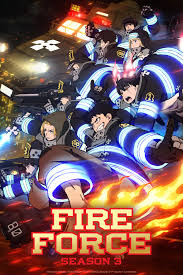
Anime Review: Fire Force

Familiar but well-paced plotting with a post-apocalyptic twist.


Without much fanfare or hype, stalwart anime Fire Force is ending its brief but enjoyable run with the airing of its third and final season. The highly bingeable series is wrapping up, making Fire Force a low commitment option for those who can tolerate its recurring fan-service humor and the vaguely familiar plotting. The show is a combination of likeable characters, disturbing themes, and relentless sarcasm and humor. That combination makes it uniquely enjoyable although the tropes and characterizations will feel familiar for fans of Naruto, Black Clover, or My Hero Academia

Fire Force is set in a future, post-apocalyptic Earth, where small pockets of humanity have rebuilt themselves into modern communities after a great fire cataclysm destroyed the world. In the wake of the devastation, a religion arises which worships the fire god Sol and eventually a formal church is established to organize and lead society. Hundreds of years after the devastation, people have resumed normalcy except for fires that break out when a random individual spontaneously combusts. The Fire Force is a group of fire specialists divided into distinct squads and trained to respond to the devastation caused by a burning, but still sentient, human. The series follows a fire powered teen, Shinra who joins the rogue Squad 8 of the Fire Force. Shinra was orphaned when his mother and brother were killed in a mysterious fire. After surviving, he develops an involuntary, creepy, sharp-toothed grin and he now has fire-power through his feet all of which made him an outcast. He is called a devil and is frequently accused of killing his family. Shinra joins Squad 8 after finishing the Fire Force academy and is joined by his fellow classmate Arthur who also has superpowers. The series focuses on Shinra’s adaption to his quirky, new-found family at the 8th squadron and his determination to become a hero and to unravel the mystery of human combustion and the loss of his family. The show is filled with twists, betrayals, and lots of commentary on politics, science, religion, and faith. 

The best thing about Fire Force is the fast-paced, filler-free pacing. Almost every episode is exciting, suspenseful, and emotionally engaging. The worst thing about Fire Force is the recurring fan-service objectification of women. In particular, there is a recurring gag about one of the antagonist-turned-ally characters who has a curse that makes her clothes fall off during battles as a way to distract opponents. It’s intended as comic relief for the stressful content of the show, but the show already has plenty of solid humor in other contexts. Shinra’s rival, super-powered Arthur is a teen who imagines himself to be a fictional knight. His delusions drive the power of a plasma sword he fights with. As such, the other characters are forced to humor his delusions in order to encourage his super-human strength in times of crisis. Arthur has an unexpected backstory that explains his delusions and his character is a variation of Zenitsu in Demon Slayer who fights best when he’s in a dream state. Squad 8 includes the unpowered but super-strong leader Obi, fire powered Hinawa, mega strong pyrotechnic Maki, the squad’s nun Iris, and unpowered but super smart engineer Vulcan and scientist Licht. 

The vibe of Fire Force is similar to Black Clover with the competitive but ultimately supportive squads who gradually realize they are facing a larger organizational threat from a group of villains (the White-Clad) bent on destroying the world. The White-Clad villains in Fire Force are similar to the Eye of the Midnight Sun in Black Clover or the Akatsuki in Naruto. Fire Force also has the rivalry of Shinra and Arthur, which mimics Asta and Yuno in Black Clover and Naruto and Sasuke in Naruto. And all three series build on the trope of the outcast hero, political secrets, and morally gray areas. 

Despite the retreading of these popular story elements, Fire Force distinguishes itself with stronger pacing over the course of the series. It also deals with thoughtful elements of religion and faith as well as compassion and cruelty. When an individual spontaneously combusts, they continue to live and suffer (sort of like a sentient zombie) even as their body burns. Each call the squad receives involves the torturous death of a loved one who remains conscious while burning alive. The squad has a nun in firefighter gear whose job is to pray for the soul’s release while the fire force team kills the person. Shinra’s home, the Tokyo Empire, is powered by a powerful generator known as Amaterasu. Over the course of the series the characters discover a disturbing secret about how the generator is powered. And Shinra learns some difficult truths about what happened during the fire that destroyed his family. 

All of this intensity is heavily woven with ongoing moments of levity, surprising elements of diversity, character backstories that range from mundane to horrific, and plenty of introspection on what it means to be a hero in a place built on fire. The idyllic scenes of families at play or at work in the city mask the fact that much of the world is gone and the post-apocalyptic survivors must trust their leadership and the generator to maintain their sense of normalcy. As a result, the series asks difficult questions about faith, betrayal, and sacrifice. And, it does it in a compact three season run, which makes this under-loved anime a humorous but thoughtful adventure that won’t burn you out.

--

The Math

Nerd Coefficient: 7/10

Highlights:
  • A quirky mix of humor and tragedy
  • Annoying fan service and revisited tropes
  • Well-paced, filler free adventure

POSTED BY: Ann Michelle Harris – Multitasking, fiction writing Trekkie currently dreaming of her next beach vacation.

Tuesday, May 13, 2025

Interview with Author Emily Tesh

Emily Tesh is a UK-based author of science fiction and fantasy. Her debut novel, Some Desperate Glory, won the Hugo Award for Best Novel. Tesh is also a winner of the Astounding Award, and the author of the World Fantasy Award-winning Greenhollow duology.


Emily Tesh photo by Olav Rokne

Today we have an interview with her about her novel The Incandescent out on May 13th, 2025. 

1. For those readers not familiar with you, please introduce yourself.

I’m Emily Tesh, I live in the UK, and I’m an award-winning author of speculative fiction. I can’t be more specific than ‘speculative’ because what I actually write is all over the genre shop. My first books were a pair of romantic historical fantasy novellas, the Greenhollow Duology; the first one, Silver in the Wood, won a World Fantasy Award. Then I wrote a high-speed action-packed space opera about fascist indoctrination for my debut novel—Some Desperate Glory. That one won a Hugo. And my latest book is something completely different again. 

2. We’re here to talk about The Incandescent, please give us a brief overview of the book for our readers.

My latest book, The Incandescent, is about being a teacher of magic in a posh boarding school beset by demons. It’s not quite urban fantasy—I’ve been calling it Home Counties fantasy. It’s set in a fancy school in Buckinghamshire, which is not a real place, but recognisably a cousin of several real places. My American editor read the first act and told me that American readers would probably experience this book as pure fantasy. It’s not. It’s the most meticulously true-to-life book I’ve ever written. Parts of it are semi-autobiography. I had tremendous fun writing it. 

3. After your wildly successful award winning SF novel Some Desperate Glory, what drew you back to writing fantasy again?

I never really left writing fantasy. Science fiction is a useful shorthand for a certain set of concerns within genre fiction, but I see it as primarily an aesthetic—particularly in the corner of science fiction I was playing with, which is space opera. I am interested in the aesthetic worlds of genre fiction. I often see readers and writers talking about originality—as in, what original worldbuilding, what an original concept—but I don’t find originality interesting at all. Any idiot can have a new idea. What I do find compelling is the subgeneric worlds that people are drawn back to again and again, with minute variations: here’s a ravaged landscape, with wizards and monsters lurking in it, and your destiny somewhere on the far side. Here’s nineteenth-century England as refracted through the lens of Georgette Heyer, populated almost exclusively by brooding dukes. Here’s galactic civilisation, don’t worry too much about how the spaceships work. And, of course, here’s magic school.

The thing that interests me about these collective generic worlds is their unoriginality. They belong to genre fiction as a whole. (Can I use the word megatext? These are the aesthetic worlds of the megatext!) Writers of SFF can use them or refuse them, but we cannot escape them. Terry Pratchett put it well when he described the role of Tolkien in fantasy fiction as rather like Mount Fuji in Japanese art: always there in the background, or if you refuse to put it there, that’s a choice with meaning too. I also find this a useful way as well to distinguish between genre speculative fiction and literary speculative fiction—the literary end of the SFF pool is mostly less interested in these shared aesthetic worlds.

This is all a rather long-winded way to say that I finished writing a space opera and decided to write magical school next, and to me this was no more surprising than going from historical romance to space opera. You say what you have to say and move on. Each of these aesthetic worlds is its own conversation and its own set of interests. To me the concerns of contemporary space opera are empire, violence, and complicity. Magical school is about privilege, merit, and hierarchy. 

4. You’ve described The Incandescent as “ a book about money and education and status symbols, about loving your career, about demons, about magic, about fantasy school - but most of all about how 'school' is always a kind of fantasy” and I would love to unpack that further.

a. There are a lot of magic fantasy school novels and stories, but nearly all of them use the students as some of, often all of the point of view characters. What prompted you to make Doctor Walden as your point of view character for the vast majority of the book?

Well, I was tired of reading books about school written by people who don’t know anything about school! This is the torment of any reader with a specialist area of knowledge. My partner, a barrister, cannot watch courtroom dramas without picking apart every error of law and procedure. I spent a decade as a schoolteacher and now I am irritating about safeguarding policies.

Of course, students make a very natural entry point to a story set in a school. Most people have been students in a school at some point in their lives, so there’s some personal experience to draw on for the structure and sensory experience of that life. And it’s an easy exposition shortcut: you need these characters to know something? Give them a lesson about it! There are the built-in tensions associated with hierarchy, secrecy, rebellion: the adults have all the power and you have none, so the adults must not find out what you are doing, or you will be punished... this is simple fodder for plot incidents. But above all, the student—the young adult—is the natural focus of a bildungsroman. Discover the world, discover your own identity, discover your own power to change the world… this story has been told many times and it is a classic for a reason.

A teacher’s experience of school is completely different to the experience of a student, in a way I find tremendously funny. On the one hand, here are human beings in the most volatile and emotional stage of their lives, having high-stakes experiences that will shape them forever. When a teenager tells you this is the worst day of my life! it is entirely possible that they are completely serious and literally correct. They haven’t had that many days yet. So there they are! And then there’s you, standing next to these bundles of drama and emotion and meaning. And you’re at work. This is a normal day for you. You’re just getting on with your job and drinking tea. You become a background character in the bildungsroman drama unfolding all around you: one adult, and twenty to thirty protagonists per classroom.

And it’s very natural, if you’ve never been that adult, not to think much about who your teachers are or what they do when they aren’t being a background character in your life. Much of the work in a teaching job happens outside the classroom and a solid chunk of it is totally invisible to most students. But I have noticed that in a lot of magic school stories, the adults are not doing their jobs. They do the visible-to-students bit—they show up, provide educational exposition, scold the protagonists for misbehaviour (this is usually unjust, protagonists generally being right about everything), and perhaps provide some support to our hero if they’re the nice kind of teacher—but despite this, nearly all of them should be fired for catastrophic failures in safeguarding. In a school where the adult staff are fulfilling their moral, professional, and legal responsibilities, it should be totally impossible for any child to have any kind of fantasy adventure.

So I thought of that. And then I thought of Dr Walden, whose job as Director of Magic at Chetwood School boils down to ‘prevent six hundred children from having fantasy adventures.’ I think that if teenagers could really do magic, you would absolutely need someone whose full-time job was to write risk assessments and banish demons and develop lesson plans for arcane safety classes. You’d need to ward the vape detectors in the school toilets and confiscate possessed mobile phones. You would need codes of sorcerous conduct. You would need annual magical incident training. You would need policies.

In short, you would need all the things which are missing from a student-eye version of a school story. Those contain only what the students experience, and student experience is the tip of a large institutional iceberg. 

b. Chetwood School is a location and setting for the novel that really makes the school and its buildings characters of its own, from Walden’s office next to the engines, to the student dormitories. What were your influences and inspirations in building up the campus?

Chetwood doesn’t exist. But a lot of schools like it do. A friend of mine was a boarder at Wells Cathedral School, the oldest school in England—it was founded in 909 AD. The school is so old that it is inextricably intertwined with the city of Wells. There’s no such thing as a campus when your whole town is a campus. I borrowed bits of Chetwood’s architecture from there. I also stole things from the University of Cambridge, where I was an undergraduate—especially the giant Brutalist dormitory, which is based on the first-year student accommodation which you could only access by cutting through a beautiful mediaeval quadrangle. That mishmash of monumental mediaeval architecture with later brick and concrete buildings in varying levels of ugliness feels like the essence of an ancient educational institution to me. When I was a teenager I did a summer course in Ancient Greek hosted at Bryanston School in Dorset—a splendidly hideous Victorian monster of a building—and I stole that one too. And the secondary school I went to years ago was mostly housed in a horrid 1970s concrete block, which grew like a kind of oblong fungus out of the remnants of a stately home that once belonged to a duke. (Schools, hotels and conference centres tend to be the final fate of these former stately homes, which are enormously expensive to run and mostly lack real historical interest.) While I was there, they broke ground for a new building. They spent a lot of money on it. It looked like someone had taken approximately three floors of an architecturally adventurous office block from London’s financial district and dumped it next to the netball courts. I imagine it’s horribly dated by now.

Chetwood borrows pieces of all of these. One of my favourite parts of the book is the map, created by Virginia Allyn, showing how the ancient and modern fabric of the school are intertwined. The architecture of a school both shapes and reflects the institution. This is the thread that runs through all my work across different SFF subgenres. I am interested in how people create environments and are in turn created by them. 

c. Unlike a lot of magical school books, you take pains to make it clear that the school teaches all subjects, not just magical disciplines, but it's unusual enough that I noticed it. Why do it that way?

This was part of my general annoyance with magical school stories! If your imaginary school only teaches magic, then what, exactly, do you think school is for? Is a child who has learned magic and nothing else ready to function as an adult? Are they stuck doing only magic-adjacent careers forever because they haven’t done even the most basic qualifications in anything else? How did you avoid getting your school dinged by the inspectors on the grounds that it isn’t following the national curriculum? And hey, have these children done any relationship and sex education?

But really I think the magic-only curriculum is a sign of a common misunderstanding of education—so common that you hear it from high-level politicians sometimes—the idea that education is the same thing as training. This supposes that school exists to train you in how to do a specific set of things in preparation for your real life. Perhaps it will train you in sciences and mathematics, and then you will become an engineer. Perhaps it will train you in languages and you will become a diplomat. Everything you do in school must have a use and a purpose, otherwise it is—horror of horrors—a waste of time; and worse, a waste of money. So naturally a magical school should focus on training you in how to be a magician.

But schools don’t exist to train children for careers. Schools exist to transform children into educated people. Dr Walden gets the utilitarian question at one point in the book—what would we use this for?—when her students are doing a particularly difficult and esoteric piece of academic magic. And the answer, the real answer, is: we are using it right now, to turn you into the kind of person who is undaunted by complex, high-stakes brain work. The point of education is not to train you in a particular set of skills, but to give you the habits of mind which make it possible to acquire almost any skill. These are also the habits of mind which help a person become an informed, capable, and proactive citizen of the world. In short, the students at Chetwood do science and maths and English and history and modern languages along with their magic lessons, because Chetwood is—as closely as I could make it—a real and serious school, attempting to provide its students with an actual education.

There’s a cynical answer I can give alongside this idealistic one. Chetwood is a posh school. It’s a private boarding school and it costs a lot of money. And the purpose of fancy schools like this is not just to provide an education, but also to act as an investment. The school says: pay us and we will supply your children with the cultural capital they need to become members of the elite. So if Chetwood wants to attract the kind of parents who can pay fifty thousand pounds a year, it needs to supply a similar education to other schools which also cost fifty thousand pounds a year. That means a broad liberal education, heavy on the academics, noticeably light on practicalities, and carefully tailored so that every child has covered at least the minimum requirements for applying to Oxford or Cambridge.

Magic is an extra. This is education as a route to power, and you don’t need magic to be powerful. 

d. Some of my favorite parts of the book were the visits to the demonic realm and what we see there. What were your touchstones in designing the demonic otherworld?

The demonic realm is imagined as a parallel universe which overlaps the mundane world. At Chetwood School, it looks like Chetwood School—but the demonic version of Chetwood reflects not just the school as is but also the school as it has been. All the history of the place exists at once in this realm which is outside ordinary time. So Walden can see pre-Reformation stained glass in the fourteenth-century chapel, or a long lost kitchen garden from a farmhouse that no longer exists. She also encounters the memories of people who have been part of the institution over its long history—the memories, and sometimes the ghosts.

This is a frightfully unsubtle metaphor, of course. An institution is not just its contemporary incarnation but also the sum of all its previous forms. I nearly wrote all its previous selves there, which is fair enough, because Chetwood School is really one of the major characters in this book. But previous selves are a core question haunting Dr Walden, whose own past identities exist in Chetwood’s history as child, student, and terrible failure. The demonic realm presents an opportunity to encounter the past as it haunts the present. 

5. A terrible movie I have an affection for has a bit of controversial wisdom from a minor walk-on role character, that everything in life after school is just school in a different name and guise. Given the path that Doctor Walden takes and the structure of the book, I’d like your thoughts on the parallels between Walden’s life as Doctor of Magic versus that of her students (or just students in general in Chetwood) and the theme of the fantastic otherworldly nature of school as an overarching theme of the novel.

[I actually feel like I can’t answer this one without just doing a sparknotes analytical summary of the book. Short version: yeah! That’s it! that’s the book! Nikki is Walden! Charlie is Will, who is Mark, who is Walden! Old Faithful is the Phoenix is also Walden! And life is learning and learning and learning, forever.] 

6. The magic in this book, being a discipline and systematized, is very different than the much more pastoral magic in The Greenhollow Duology. What were the challenges and opportunities in creating a much more outwardly rigorous and formalized magic system for the novel?

I always knew that Walden’s approach to magic was an academic one. Rather than try to design an entire academic discipline from scratch—this struck me as doomed, as it generally takes scholars several centuries to create an academic discipline, and the goal of this book was always meticulous realism—I took some academic strands that already exist and made them magical. First, ‘magic’ could mean an enormous number of things, so I divided it into three arbitrary categories—rather as students who wish to learn about the world around them must study three categories of science. So magic in The Incandescent is broadly divided into Instantiation (doing magic with stuff), Evocation (doing magic yourself), and Invocation (doing magic with demons). Or, as I thought of them, Danger Design and Technology, Danger Sports, and Danger Latin.

I spent by far the most time thinking about Invocation, since that’s Dr Walden’s discipline. The part I borrowed from my own time as a Latin teacher was the focus on meticulous systems of rules worked out by someone else. But at the same time, magic is a way of comprehending and acting on the world around you, and I felt that in the modern world it would be almost impossible to avoid treating it as a branch of the sciences. In thinking about academic science, I ran again into the tension between scholarship for its own sake and scholarship as means to an end. Dr Walden is a very good scholar who has chosen a career where her skill as a magician is less important than her ability to manage a roomful of teenagers. I was interested in the hows and whys of that decision—especially thinking of science teachers I have known, many of whom took substantial paycuts to work in education. To be a decent teacher you need a good degree and social skills, and a person with a good STEM degree and social skills has a lot of higher-status and better-paid options open to them than the classroom.

So I would say I was less interested in creating a rigorous and formal magic system than in the consequences of such a system. If it were possible to predictably summon gigantic and deadly demons, how quickly would the academic discipline of demon-summoning become a servant to military technology? Who would be doing this research and why would they agree to do it? How would children learn about it, and what would be the results of teaching basic demon-summoning to children? If any human being can reach for terrible power at any time, how do you deal with the outcome?

Any actual rigour or formality in the book is an artful illusion. I am not capable of inventing the science of magic from scratch, even if I wanted to. To study science is to investigate the truth according to a particular epistemological understanding of what truth is and how it can be determined. Fictional, magical science is intentionally unreal; it uses the trappings of scientific truth as an aesthetic signal about how we should understand the role of magic in a fantastical world. So the scientific magic that Dr Walden does is an aesthetic creation—with some elements borrowed from life, and the rest pure smoke and mirrors.

(That was a lot of words to say that I think ‘hard’ magic systems are a bit silly and I do not exempt my own book from this opinion.) 

7. Given that this novel is in dialogue with mundane British school novels (of which I am not terribly read) as well as the fantastic ones I have read, I was wondering about any more thoughts about how your book fits into the English School Story Tradition.

One early reader told me: this isn’t dark academia, it’s a school story! And I think that reading is completely correct. My original manuscript has the title as ‘The Incandescent: A School Story’, and I am still a little sad that my publisher didn’t let me get away with this for the final version. The school story is a staple of English children’s literature. The ur-example is Tom Brown’s School Days by Tom Hughes, a semi-autobiography based on the author’s own days at Rugby School. It was published in 1857, over a century and a half ago, and it is not widely read now, but it was very influential in its time—so much so that adults have been inflicting school stories on children ever since. As a child I read widely in the genre, especially Enid Blyton’s Malory Towers books, first published in 1947—already nearly a century after Tom Brown. Of course, authors like Enid Blyton and Angela Brazil were not playing the classic school story straight. They took the traditional themes thought suitable and inspiring for young men—friendship, honour, and loyalty in a single-sex peer group—and applied them to girls’ schools. At the time Tom Hughes and his imitators were writing, girls’ boarding schools barely existed. So these 1940s books are already a subversive feminist remix of a children’s literary tradition, albeit in a way that is almost invisible to contemporary readers. Blyton seems very dated to us.

The genre is so old that it has been reworked, remixed, parodied, played straight again, and crossed over with plenty of other literary traditions. George MacDonald Fraser’s Flashman series takes the schoolboy bully villain from Tom Brown’s School Days and follows his horrifyingly successful career as colonial military hero, Victorian success story, and serial rapist. Fraser has a very clear-eyed view of the way the nineteenth-century English boys’ boarding school served to create the British Empire’s officers and administrators. Flashman is also a pointedly cynical take on a certain kind of popular serialised military history fiction—a dark Sharpe, perhaps. Meanwhile an early John le Carré sends his spy protagonist George Smiley back to school to invesigate a murder among the staff, mixing the tradition of autobiographical school setting with the worlds of crime and spy fiction. So these are adult reflections on the school story, set in the adult world. As well as these, quite naturally, you get the school story crossed with another great staple of British children’s literature—the fantasy novel. It’s a natural fit: hence Jill Murphy’s wildly successful 1974 novel The Worst Witch (first of a popular eight-book series, filmed multiple times since the 1980s, much beloved and still in print), or Diana Wynne Jones’ rather more disturbing 1982 take on a school full of magic, Witch Week.

So The Incandescent is doing nothing new when it looks at school with adult eyes, and any SFF reader can think of plenty of examples of magical school from a student perspective. I think the core of the school story is that the school has to be a major character—and, furthermore, that the school has to be a composite character: membership of the institution is what defines the individual characters, and the behaviour of those characters is what defines the institution. I was interested in writing about Chetwood School as institution, in its stability and endurance over the centuries—in how places change or remain changeless, and in how human beings change or remain changeless within them. 

8. Finally, what’s next for you? After a well deserved Hugo win (again, congratulations) and now a really interesting take on the magical school subgenre, what are you working on next?

I have described the book I am currently working on variously as ‘the kissing book’, ‘the one with sad immortals’, and ‘undead transgender Patrochilles Minecraft’. I have yet to figure out an official pitch but I think that just about covers the vibe.

Thank you, Emily!


POSTED BY: Paul Weimer. Ubiquitous in Shadow, but I’m just this guy, you know? @princejvstin

Sunday, May 11, 2025

Rebellions are Built on Hope: Andor S2E3

 Wrapping up the first arc of season two, “Harvest” is a gut-punch of an episode.

In a wheat field with a huge piece of metal farm equipment in the background, Brasso stands surrounded by storm troopers and one imperial officer.

Content warning: discussion of attempted rape.

At first, I was suspicious of the three episode a week release schedule since it seemed like a way to quickly wrap up a show that could have gone on for months. Why hurry it out? As the structure of the season becomes clearer, the three episode chunks tell complete stories leading up to Rouge One (2016), where season two ends. “Harvest” also shows how they are using the three episodes to build smaller climaxes within the season.

Finally free of last of Maya Pei’s people on Yavin 4, Cassian makes contact with Luthen’s assistant Kleya (Elizabeth Dulau) where he finds out Bix, Brasso, and Wilmon are in danger on Mina-Rau. In true Rebel fashion, Cassian breaks protocol to go help his friends, but he arrives too late.

As Bix, Brasso, and Wilmon are preparing to leave, the Imperial agents arrive earlier than scheduled. Wilmon is missing (as he promised his girlfriend he wouldn’t leave without saying goodbye), and Brasso goes looking for him while Bix finishes packing. While Brasso is gone, the Imperial officer who asked Bix to go to dinner with him in the previous episode arrives at their home. 

What follows has outraged some Star Wars fans as Tony Gilroy and his crew of storytellers remain dedicated to telling the story of empire, colonization, patriarchy—and sexual violence is part of that legacy. The Imperial officer threatens Bix by acknowledging her status: “I know you’re illegal. We’ve been counting visas.” He explains he recognizes that undocumented “help” is required in order to bring in the necessary harvest, but that the farmers of Mina-Rau are still breaking Imperial law. He then propositions her for sex by saying how “stressful” his job is: “Such a simple choice.” All she has to do is have sex with him, and he will leave them alone.

Bix proceeds to fight him off in a brutal scene. The struggle is bloody and painful, with Bix barely managing to protect herself, eventually causing the officer’s death. When the other officer tells her to come out, she shouts to him: “He tried to rape me.”

The sequence is made all the more jarring by quick cuts between her fight and Mon Mothma getting drunk and dancing at her daughter’s wedding. In Bix’s scenes, there’s no musical score, emphasize the quiet peacefulness of the wheat fields, broken by the violence. This moment cuts to loud galactic pop music and the bright colors of Chandril as Mothma drinks away her sorrows over the loss of her daughter to a predatory marital tradition that she also had to go through as well as realizing her friend, Tay, who helped her support the rebels, will have to be assassinated, as implied by Luthen. In order to cope, she proceeds to get drunk and dance.

Mon Mothma tips back a drink while in a packed room of people dancing, with bright colors and sunshine. She wears an orange/bronze flowey dress.

This sequence for both women is absolutely crushing in different ways. Both are being threatened by the patriarchy—and in Mothma’s case, watching her daughter enter a predatory relationship—but each are also in different levels of danger, which the editing, sound, sets, even color mixing juxtaposes brilliantly. While Andor is quality storytelling, this sequence also demonstrates how well-made it is. 

For all its success as a piece of storytelling, “Harvest” immediately drew the ire of Star Wars fans. As I wrote in the last post, Tony Gilroy and his team are dedicated to presenting the banality and the evil of the Empire because it is a fascist empire. I’ve often thought of Star Wars as a failed piece of critical media because as much as George Lucas claimed he wanted to critique the U.S., he made the Empire too cool. You can’t have fans getting Vader tattoos, wearing Imperial symbols, or marching in Storm Trooper brigades at fan events and claim to have successfully critiqued empire. Andor works hard to reposition the Empire as deeply not cool and also as practicing the human rights violations that we know empires practice, such as sexual violence against women of color. 

For those of you who are familiar with my work or other pieces of criticism, I generally do not advocate for work that repeats the oppression of the real world. I’m a big believer that science fiction and fantasy can do different work by imagining worlds that are not oppressive or not simply repeating the same systemic injustices of today. To that end, after “Harvest,” I’ve been sitting with why I think this episode was necessary, including the attempted rape. Part of the reason is the fan reaction this episode generated. As written about by The Hollywood Reporter, an influential fan account on X, @StarWarsFanTheory with over 91,000 followers, wrote: “Vader wouldn't tolerate that shit [rape] nor does the Empire condone it.” 

This concept that the Empire and Vader would not tolerate sexual violence is surprising because of the amount of violence that the Empire does condone. Vader tortures Leia with a mind probe in IV, and when he tortures Han Solo in V, it’s implied there is no reason for the torture other than to do it. Additionally the Empire blows up Alderaan without evacuation—as in, destroys an entire people. Then, let’s add that Vader/Anakin mass murders innocent children not once but twice. This conceit that rape would not happen under the Empire when equally vile human rights violations are a traditional part of the storytelling demonstrates the need for Tony Gilroy’s commitment to displaying not only the Empire’s boardroom banality but also how power is wielded against the oppressed. If Andor season one wasn’t enough to strip the Empire of its coolness, then Gilroy is making sure there can be no mistake after this season.  

Yet, while what Gilroy is doing is important—forcing viewers to confront the violence of empire in all its forms—I still come back to my question: why does Andor feel so necessary right now when I usually prefer work that doesn’t repeat oppression but imagines alternatives? The conclusion I come to so far is that Gilroy and his team know the political stakes of the story they’re telling. While filming wrapped before the re-election of Trump and just after the beginning of the latest attempt to destroy Palestine, fascism was still on the rise. It was uncanny to watch these three episodes while people, myself included, protest for the release of detained immigrants and against mass deportations in the U.S. 

Another way Gilroy and his team overlay our world onto Star Wars is the racial politics. While Star Wars has always been “post-racial” in essence that skin color does not impact the everyday lives of the characters, the racialized casting in the original trilogy paired with the orientalism of the Jedi demonstrates the movies have always had racial overtones. Whether it’s Chewy (Peter Mayhew) being a stand-in for the Black sidekick or the only Black character, Lando Calrissian (Billy Dee Williams), being a smuggler who betrays the (white) heroes, the racial politics of the world offscreen inform the characters onscreen (let’s not even get started on Jar Jar Binks or the Trade Federation). While Andor has continued the idea of a “post-racial” world in that the characters are not treated differently for their skin color, the creators have also allowed the racial politics off screen to inform the storytelling. 

For example, in the first three episodes, Mon Mothma—the rich, white woman—is not experiencing the same type of violence as Bix, an undocumented woman of color. When Mothma is pressured to give sexual attention to Tay or else he threatens to reveal her financial support for the rebels, it is not even a question that she would do such a thing. Instead, Luthen—the white, male high society leader—has Tay killed (or so it is implied in this episode, with the dirty work also being done by a person of color). In another example, the white Imperial officer attempts to rape Bix while his driver, a Black officer, waits outside—a stark contrast to Mothma’s experience with predation. 

While I often question the usefulness of this type of repetition of systemic issues, in Andor, the show counterbalances by demonstrating a variety of different tools for resistance. As Robert Evans, a host of the podcast It Could Happen Here, explained on Bluesky: "The point of Andor isn't 'only anarchists are right' or 'only terrorism works' or 'only liberals defeat fascism' it's that birthing a movement that can destroy an imperial regime requires a diversity of tactics and people all willing to throw their lives away for the cause." In careful detail, this show does not only demonstrate the inner workings of empire but also of resistance, whether it’s the leftist infighting of the Maya Pei delaying Cassian to practical depictions of operational security that inspired a whole popsec analysis of Andor. 

In the first arc of season two, Andor delivers with quality storytelling as well as striking visuals, use of sound, and set design. Much like season one, the show doesn’t shy away from depicting the dark side, but always in relation to why the characters fight. The danger is real, and these episodes demonstrate that for the most precarious—the undocumented person of color—the consequences are much more serious than the white high society senator, even as all sacrifice and work for the same goal: to win. So far, Andor season two demonstrates not only the tools of the enemy but how to powerfully resist.


POSTED BY: Phoebe Wagner (she/they) is an author, editor, and academic writing and living at the intersection of speculative fiction and environmentalism.   

Friday, May 9, 2025

Documentary Review: Don't Die

On Bryan Johnson's obsessive quest to bring science fiction to real life

Cards on the table: I fully agree that death is bad. Zero stars, don't recommend. I'll be among the cheering crowd if medical technology somehow succeeds at solving all diseases and making it possible for us to live thousands or millions of years—emphasis on if. So far I've found no reasons to expect that über-rich tech bro Bryan Johnson will succeed at outrunning his own body and unlocking the secret to immortality. The current state of scientific progress simply isn't there yet. However, his Netflix infomercial documentary Don't Die, which you shouldn't for a second believe isn't part of his meticulously curated regimen of 24/7 self-branding, does something more interesting than expositing on the state of the art of the study of aging. Where he aimed at portraying himself as a bold pioneer opening up the next frontier of human history, what actually comes off is a tragic character study whose inadvertent revelations reach beyond the power of his obvious control over the narrative.

That's right, people: I'm taking the message from the enemy of death and applying Death of the Author to it. Irony engines, engage!

You can easily guess my verdict on Don't Die by the fact that it presents itself as a true story from real life but this is a science fiction blog. Johnson's self-imposed mission to eliminate death is, in the most literal sense, science fiction: his goal is unfeasible in this century, no matter how vehemently he persists in preaching the gospel of eternal youth. It's been a while since fellow anti-death prophet Raymond Kurzweil made one of his eyebrow-raising predictions about extending human life to infinity by digital means, and until actual results are shown, we should remain no less skeptical of Bryan Johnson's promise to achieve the same by chemical means. (And no, his massive abs don't count as "results." At a decade older, Jason Statham looks just as ripped and far less stressed.) We won't know for certain whether those numbers on the chart of Johnson's biomarkers mean something until he enters actual old age.

While we wait for the big news, he's hard to tell apart from other enthusiasts of extreme body modification, such as Henry Damon, Michel Praddo, or Dennis Avner, whom I don't recommend you look up. However, those guys tend to describe their transformations in terms of artistic self-expression. Despite his habit of posing half-nude for Instagram, Bryan Johnson doesn't appear to be motivated by an aesthetic ideal, or at least doesn't claim to be. His grueling routine of over a hundred pills, brutal weightlifting, sessions of artificial light, a set of diet restrictions that can only be described as sadistic, and the occasional injection of plasma from his son (because why try to live forever if you can't go full vampire) don't add up to an enjoyable life. The documentary even recognizes the incongruity of spending so much of his waking hours working so hard to buy himself more days of life... which he ends up not living because he's too busy trying not to die. If this were a form of artistic self-expression, its message would be legible as a cry for help. Could Johnson be staging an elaborate performance project, a vociferous statement on the commercialization of healthcare and the fundamental inequality that lets him fly outside of US jurisdiction to receive super-illegal genetic therapies for a sum that could buy years' worth of deworming pills for Third World kids? Or is he instead the world's worst case of orthorexia? Is he like French artist Orlan, who uses her own body as the shapeable material of her work, or is he like Chinese emperor Qin Shi Huang, who spent his old age desperately seeking an alchemist who could brew the elixir of eternal life?

Regardless of whatever useful scientific advance may eventually result from this, the one thing that is clear about Johnson is that he's a businessman, and he's learned very well how to sell his product. At the start of the documentary, the camera quickly scans over a long list of the blood tests he takes regularly, conspicuously stopping at the exact position where his testosterone levels would appear right in the center of the frame. In a later scene, text on the screen summarizes his progress according to various medical parameters, the unmissable last of which is the quality of his erections. Johnson knows exactly the demographic of insecure young men that his message is likely to attract. He ought to know; he's been there.

Johnson lets us glimpse bits of his psychology when he starts recounting his youth in the Mormon church, his way too early marriage, his first business successes and the soul-draining rhythm of nonstop work that it took to become a multimillionaire. He describes a period of suicidal depression around his 30s, when he realized that he didn't know in what direction he wanted to go with his life. He did end up leaving the Mormon church, but he seems to have never noticed how the particularly twisted Mormon version of patriarchal expectations must have contributed to his mental breakdown. Like many people with depression, he correctly identified that he shouldn't listen when his mind was telling him that he had to die. Unlike probably everyone else with depression, he took that insight too far, and decided to stop listening to his mind about anything. When he describes how he built an inflexible algorithm that makes all life decisions for him, his evident relief is hard to empathize with. It's like hearing Victor Frankenstein tell the happy story of how all his worries went away after he gave himself a lobotomy.

The way Johnson puts it, "Removing my mind has been the best thing I've ever done in my life." Such an admission comes from a man who claims to be working to help people stop behaving self-destructively, a profoundly troubled man who hears his son tell him during casual conversation that he's disconnected from his own emotions and still doesn't get the hint. That fateful step of surrendering his agency to impersonal laws, of ceasing to make his own choices (which for all purposes is equivalent to ceasing to be a person) is the key to the whole puzzle. Johnson developed his self-hatred to its logical conclusion: in the contest against natural death, his winning move was to snatch its victim first. Time can no longer annihilate him, not because he hardened his body against all harm, but because he preemptively severed that body from consciousness before nature could do it. That's how he finally ensured that he won't die: by the standards of humanism, he has already committed suicide.

POSTED BY: Arturo Serrano, multiclass Trekkie/Whovian/Moonie/Miraculer, accumulating experience points for still more obsessions.

Thursday, May 8, 2025

TV Review: The Eternaut

The end of the world feels different when it's the Third World that's affected

A pioneering work of Argentinean science fiction, The Eternaut is a serialized comic strip published during the late 1950s and endowed later with a prophetic aura when its author, Héctor Germán Oesterheld, was kidnapped by his country's far-right dictatorship because of the political content of his stories and his participation in an armed resistance group linked to Liberation Theology. Just like what happened with his four daughters and sons-in-law, Oesterheld was never seen again. His legacy as a writer, however, has prevailed and risen to the status of legend.

After decades of frustrated attempts, The Eternaut has finally been given the live-action treatment, in the form of a Netflix series whose first season has just been released, while a second one is on its way. It tells the story of a group of middle-aged Porteños suddenly caught in the middle of an anomalous climatic event that, while devastating on its own, is only the prelude to a much bigger threat: an invasion of Earth by mind-controlling aliens. The source material also contains elements of time travel and multiverse travel, but the show's first season only gives very indirect hints of those plot points, preferring to start on a firm grounding by focusing the story on ordinary people's Herculean efforts to stay alive, stay together, and cling to hope.

Oesterheld wrote his masterpiece during the early period of the Cold War, when the terrifying prospect of nuclear fallout and nuclear winter was just entering the public consciousness, but his version of it is much more dramatic: the mysterious snowfall that opens the narration kills instantly with the slightest touch. That's the reason for the iconic image of the protagonist wearing a diving mask that used to appear on the covers of The Eternaut's collected editions. It's also an example of the story's aesthetic, distinguished by the creative use of common tools repurposed to deal with a world-ending catastrophe. The choice to follow characters with no specialized expertise or ties to the centers of power also sets The Eternaut apart from the tone that has become usual in the apocalypse disaster genre.

Because the process of adaptation inevitably recontextualizes every story, the TV version of The Eternaut doesn't evoke the fears associated with the Atomic Age that were so relevant to the comic's first readers. Instead, the imagery of snow in the middle of summer brings to mind the nightmare predictions about global climate change; the dread of stepping outside, the masses of dead bodies and the ubiquitousness of protective gear dig into the unhealed wounds we still carry from the coronavirus quarantine; and the scenes of social disintegration and the downfall of modern civilization carry painful echoes from the violent protests that shook Argentina as a result of the collapse of its economy at the turn of the century.

Maybe the choice to postpone all the time travel and multiverse travel until a later season was made to carefully steer the show's reception by today's viewers, who are yet to recover from Marvel exhaustion. This frees up much-needed space for the story to explore its large cast, which the production team has described as a collective hero as opposed to Hollywood's individualist bent. Much of the runtime is used in portraying the complicated evolution of personal relationships put under a strain that no amount of decades of closeness can prepare anyone for. Lifelong friendships are tested by the primal struggle for survival, and viewers can identify moments in the story when a survival strategy based on competition is pitted against one based on cooperation. Some pillage and some share; some swindle and some trust; some would sacrifice others for any reason and some would sacrifice anything for others. It's a truism of scriptwriting that true character is revealed at moments of crisis; in The Eternaut, a persistent state of crisis spreads everywhere and in doing so lays bare the spirit of a whole community.

Also, the tension is skillfully handled with a steady series of escalations: at first, the characters' sense of urgency is about staying indoors and not touching the deadly snow; next, about finding survivors without attracting the notice of hostile neighbors; next, about avoiding capture by the alien monsters that overrun the city; and finally, about thwarting the mind control conspiracy that might bring about the defeat of humankind. For us watching in Latin America, it's an added bonus that the action involves characters whose outlook on life and sensibilities are closer to ours. We've always watched the end of the world happen in New York or London, and such locations may as well be Mars to us. Bringing The Eternaut to worldwide streaming is one more step in the march of the ongoing Rainbow Age of science fiction, one of whose main features is what I like to call opening up the future to the rest of the planet. It's no small thing that this time, for a change, the heroes defending Earth speak Spanish and listen to tango.

Nerd Coefficient: 8/10.

POSTED BY: Arturo Serrano, multiclass Trekkie/Whovian/Moonie/Miraculer, accumulating experience points for still more obsessions.