Wednesday, July 17, 2013

Microreview [book]: A Kingdom Besieged, by Raymond E. Feist

Or, How the Mighty Have Fallen


The Meat


We've all had the experience—some book or movie a younger version of ourselves encountered long ago, some nerdy pleasure forever wrapped in the soft glow of our childhood, inseparable from the sense of wonder with the world we felt so strongly in those days.  For me, one such movie was Willow, a story my rational mind could recognize, even at the time, as a trite rip-off of Lord of the Rings but one with which I emotionally felt permanently bonded (Madmartigan, objectively, is way cooler than Aragorn, after all).  Among books, the series of Midkemia (and Kelewan) novels written by Raymond E. Feist holds that special place in my heart.  What a magical origin story in Magician! What exciting later adventures awaited Pug and Tomas! I treasured these books so much as a child that in a weird way they almost became part of my identity.

And that's why, when I read Feist's most recent Midkemia novel, or as I like to think of it, The Book Which Shall Not Be Named, I found myself in the midst of a full-blown, cold-sweats, can't-fall-asleep-out-of-terror, existential crisis.  How can he who created something so amazing just a couple decades ago be the very same entity who vomited up 400 pages of drivel in 2011? Have the pod people seized control of his body, forcing his listless hands and dead, lifeless eyes to keep working in a cruel parody of the craft of writing?

How Madmartigan looked after reading A Kingdom Besieged


I imagine how I felt, on reading You Know What, would be akin to the bitter disappointment an avid basketball fan, having seen Michael Jordan in his glorious prime, might feel if he saw Jordan totter onto the court as an octogenarian and wheeze out a few half-hearted layups.  It's not mere horror—it's almost a personal betrayal, since if Feist (or Jordan) is capable of such an awful performance now, the signs of his badness must have been there in his earlier efforts too, right? Which means I must have been an idiot as a child to admire his writing style and world-building skills!  But perhaps I have it the wrong way around: Feist really is—or rather, was—capable of greatness, and simply has fallen on hard times creatively, stylistically, structurally, etc.  After all, barring the alien mind control theory, the same Ridley Scott who spawned the infuriatingly incoherent Prometheus and the appalling Robin Hood also managed Alien and Blade Runner in better times. 

And just like Scott's early versus recent work, Feist's books, old and new, all have much the same elements (powerful heroes of various skill sets—Pug the magician, Jimmy the Hand or descendants as thief/spy, Condoin guys as leaders, etc., pitted against demonic multiworld/dimensional threats) which, in a clever configuration, can produce a masterpiece like Magician (or Alien)...but in a slapdash arrangement fizzle out as Talon of the Silver Hawk (or Prometheus).  The once-great author/auteur, in his befuddled mind, uses all the same pieces, but has lost the ability to put the puzzle together, and now lacks the creativity to go beyond the world he made years ago and dream new dreams.

Weep for Feist—how far he has fallen! How sloppy his writing has become, how formulaic his plots, how uninteresting his characters. My theory? Blame video games. He stopped writing full-time so he could help create several games based on the Midkemia world(s), notably Betrayal at Krondor (excellent) among many others (most of which were utterly forgettable/bad). Unsurprising, given this context, that he a) devotes far less time to the craft of writing new novels, b) creatively he's permanently stuck in Midkemia revisiting old characters and their far less interesting children and grandchildren, etc., and c) has written less a novel and more a novelization of a game concept: generic characters no reader would identify with who are exposed to a range of uninspired role playing-esque encounters.  One can almost hear the dice tumbling...and d) to make matters still worse, he's suffering from RJS (Robert Jordan Syndrome): this entire book feels like mere build-up for the next book. But I read it to the end--why, you ask? It's not unlike when you're outside taking a walk and suddenly you get hit by a meteorite: you see the edges of the ghastly wound it's left and you try to look away, but even though you know it's just going to freak you out, you have to look down at that horror, because you have to know how bad the damage is...

TL, DR: This book is horrible. Shame on you, Raymond Feist, for cashing in on Midkemia once again, and thereby cheapening what Midkemia used to be.  But most of all, shame on me, who keeps reading your books out of nostalgic loyalty to your once-great legacy.


The Math

Objective Quality: 3/10

Bonuses: I award you no bonuses...and may God have mercy on your soul

Penalties: -1 for returning yet again to Midkemia and making it suck, -1 for shattering my childhood illusions with a combination of terrible, formulaic writing, recycled plots and characters, and RJS

Nerd Coefficient: 1/10 Crime against humanity (and disillusioned former lovers of Midkemia in particular)

[This book enjoys the dubious distinction of being one of the only books, if not the only one, given such a low score by Nerds of a Feather.  For an explanation of why 1/10 is such a rare score, see here.] 

Tuesday, July 16, 2013

Microreview [book]: Harlan Ellison's 7 Against Chaos

Ellison, Harlan and Paul Chadwick. Harlan Ellison's 7 Against Chaos [DC, 2013].
Harlan Ellison's 7 Against Chaos

The Meat

There is a really neat idea inside of Harlan Ellison's 7 Against Chaos regrettably surrounded by a bunch of really tired ideas. When I first heard about the project, I thought it was cool that at age 78 legendary sci-fi writer and dean of salty internet ranting Harlan Ellison was trying something new and venturing into graphic novels. But it becomes clear on page one that "trying something new" might not be what's actually going on here.

It never seems like Ellison actually wrote a graphic novel. I'm not sure what he did write - whether it was a novel, a short story, a detailed outline, or something else - but it is evident that he created a prose document and handed it over to the artist to adapt into a graphic novel. So page one panel one shows a pair of scarred hands gripping the metal railing of a mining elevator, and we have two blocks of text, too, which read "Scarred hands grip the scarred railing." There's much too much of this kind of redundancy throughout, where somebody wanted to hold onto Ellison's prose at the expense of the reading experience of a graphic novel.

As for the story itself, we learn that in the time when the action takes place, computers have not only achieved intelligence, but also the ability to predict the future. These Crisis Computers have predicted the end of the world, and now a mysterious guy in a robe is zipping around the solar system gathering up a cast of weirdos to stop the predicted catastrophe from coming true. It's The Magnificent Seven in space, and The Magnificent Seven was just The Seven Samurai in the Old West, so we're on at least the third iteration of this idea now. Ellison has not improved it, so while the ultimate reveal of what is threatening the world's existence is actually novel and thought-provoking, getting there doesn't offer very many surprises.

The Math

Objective Quality: 5/10

Bonuses: +1 for art by Paul Chadwick that gives the book a nice old-school comics vibe throughout; +1 for the reveal of what the team of misfits has to confront and stop

Penalties: -1 for a familiar plot simply dropped into a new setting; -1 for a cast of largely forgettable characters

Nerd Coefficient: 5/10. Equal parts good and bad.

[See explanation of our non-inflated scores here.]

Monday, July 15, 2013

AiIP: Support Your Local Bookstore (even if you buy digitally)


Last month, I reviewed Planks by S.C. Harrison, and the tagline for the book fits this post- surely we have done more good than we will do evil- fits this post nicely. Before I dig into what I mean by that, let me give you a little background.

If you've been following my musing in this space for any amount of time, you know that I am frequently vexed by- I will try to say this politely- a significant lack of quality from the self-publishing community. This is to say, un- or poorly edited works, cover art that is only art in the loosest sense and generally stories that are just plain bad. I won't rehash my first post here, aside from saying this is due to a lack of traditional gatekeepers (which I have also touched on).

But, on the plus side, there are a lot of fine works out there, including a lot of unique stuff that traditional publishers would be unwilling to take a chance on. This, I feel (and I'm sure you agree), is a good thing. Amazon was the first to really make this a viable option, and certainly remains the mainstay for self-publishers.

This is where the opening quote comes into play- how much good has Amazon done? Obviously ebooks were inevitable- no one will even bother to debate that, not even the most hardened I-only-wanna-read-physical-books traditionalist. But the harm is obvious- indie bookstores are the most glaring case. Many have adapted (I've mentioned my local hangout, Village Books, several times as a case-in-point of a bookstore that has adapted). But Amazon certainly hasn't done them any favors.

Compare that to Kobo (if you're Canadian, you are already rolling your eyes- "catch up, Dean, we've been using them for years"), who really goes out of their way to work, even in a small way, dollar-wise, with indie bookstores. They make themselves much more open and accessible to authors and publishers than Amazon does.

Why does this matter, to you as a reader or even to the authors?  For one thing, I see a lot of authors buying into the Amazon-or-nothing thinking. Amazon has anointed Hugh Howey as the king of self-publishing for his Wool series, including his comments in such places as their GoodReads acquisition press release, wherein he compares Amazon to 'the cool guy next door marrying your mom'. And look at the comments on that post- people follow him because he's Mister Self Publishing Success Story (and good for him). But why at the exclusion of everything else? What possible benefit does that have for the author, the reader or the literary community?

Nook is, for all intents and purposes, dead (and B&N probably not far behind). Kobo is on the rise, and certainly has my support over Amazon at this point. This article is spot-on for authors- why are we even linking to Amazon at all (if you click one link in this post, click that one)? Bookstores provide a lot more value to the community than simply being a place to buy books. They should get the support of authors and readers alike.

Odds & Ends:

 Speaking of the literary community, I did a reading the other day with S.C. Barrus at his Kickstarter launch party. He is funding for his upcoming Steampunk novel, Discovering Aberration. It is equal parts adventure and witty.

Joining us was Zachary Bonelli, who has written a really cool series called Voyage, with some elements of Sliders, what with all manner of alternate Earths. I enjoyed what he read, and am digging into the rest now.

Prime books now has a digital imprint, called Masque Books. E.C. Tobler has her Rings of Anubis series coming out through them, and I am about halfway through the first book, Gold & Glass, and if you enjoy steampunk adventure, you'll like this (I am not really much of a steampunk guy, so don't ask me why it's in here twice now).

I took last week off from blogging, but interviewed both E.C. Tobler and S.C. Barrus on my blog, so if you want to know more about them & their work, head over there.

In conclusion, my own book, 3024AD: Short Stories Series One is $2.99 for the month of July, so if you don't have it yet, now is the time to grab it! It's out for Kindle, Kobo and Nook

Friday, July 12, 2013

Portal 2


puzzle perfection

It's a bit slow for games this time of year, so I've decided to look back on one of the best titles of this generation, Valve's Portal 2. As many of you may remember, Portal was part of the Orange Box, a collection of five games from Valve including Team Fortress 2, Half-Life 2, Half Life 2: Episode One, and Half-Life 2 Episode Two, along with the aforementioned Portal. 


Portal was a short 2-3 hour trial at a puzzle game that the good people at Valve had been tinkering with and decided to include in the "Best deal in gaming of this generation." It received many unexpected game of the year awards. In order to complete the puzzles, you were tasked with using a "portal gun" to reach the exit of each room by using the gun and the environment to bypass a series of obstacles and reach the next puzzle. The portal gun shoots a blue portal and an orange portal. When you walk through one, you exit the other. Simple, right? Where it gets more complicated is when you have to use things like momentum to complete the puzzle. If you jump from 40 feet up into a portal, you come out with the same momentum with which you entered. It was a cute yet challenging game with a classic credit track (hit play below).


the full monty


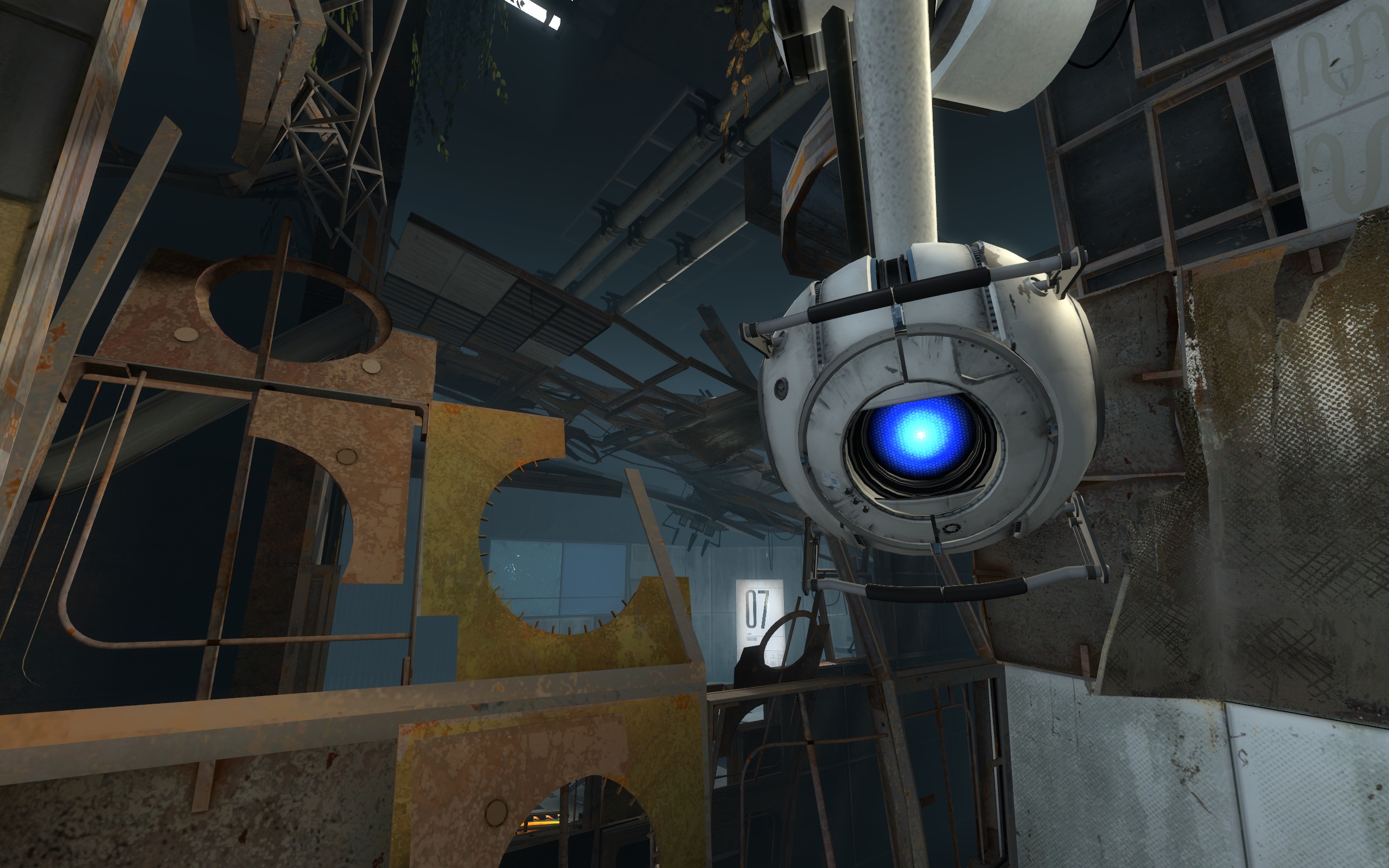
Portal 2 was described by the programmers as their real intention with Portal. It's a full 10+ hours of gameplay that continues within the universe begun in Portal. In the first iteration, you are facing a female testing program named GLaDOS (Gladys). Those of you who have been around computers as long as I have will get the reference to the DOS programming language, an early way to run computers. In the second Portal, you face GLaDOS again, but you have a small round robot on your side named Wheatley. Some of the best humor in the game comes from this little British bugger, oddly reminiscent of Ricky Gervais, who can't seem to do anything right.


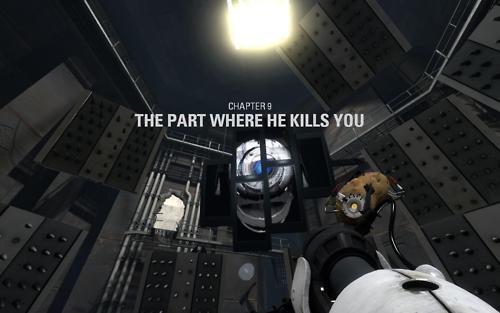
Since this game came out in 2011, I'm going to assume that you've either already played it or don't intend to, so spoilers are open for business. After disabling all of GLaDOS' defense mechanisms including the turrets and neurotoxins, you replace GLaDOS with Wheatley, fully expecting the (up-until-now) friendly robot to help you escape the testing facility. Instead, the little brat goes mad with power, places GLaDOS into a potato, and throws you both down an elevator shaft. The rest of the game is made up of you and GLaDOS making your way through old testing facilities that date back to the 50s in order to finally return and face Wheatley in the hopes that GLaDOS will keep her word this time and free you.


As you progress through the older tests, you are joined by narrator J. K. Simmons who voices the CEO of Aperture Science. Fans of the Half-Life series will recognize the company as the one that brought about the subjugation of mankind, but that's a story for another game. In this one, Aperture has already collapsed and you're working your way through their old testing chambers, along with GLaDOS the potato.


The older testing chambers were perfect. They felt like a throwback compared to those in Portal 1 and the early levels of this game. The surrounding environment and Simmons' narration serve to complete the illusion that you are, indeed, back in Aperture's old 1950s test chambers. It takes some doing, but you eventually thwart Wheatley's attempts to kill you and return to the chamber where he is housed. Using corrupt software, you prompt a second core replacement (the first being the replacement of GLaDOS with Wheatley).


However, Wheatley has booby trapped the process and the change of cores brings the entire structure down around you. Only by shooting a portal at the moon are you able to drag the little traitor into space and remove him from the testing facility. GLaDOS grabs you at the last second as Wheatley is dragged through the portal and onto the moon. Luckily for you, GLaDOS has realized that testing you is a useless endeavor and she decides to release you. The game ends as you walk alone into a corn field, accompanied only by your companion cube.

why is it so good?


This is the seventh-best game on the Xbox 360, according to Metacritic.com, with a total score of 95. I think that one of the reasons this game received such high marks is its difference from the norm. Although you carry a gun, it's hardly the AR-15 from Call of Duty, or even the Covenant pistol from Halo. The purpose of this gun isn't to kill, but rather for navigation around massive puzzle rooms. The portal gun is used to manipulate lasers, light bridges, turrets, companion cubes, and most of all, yourself. 


This unique take on the "shooter," along with Valve's high-quality writing and seemingly never-ending wit, make this game stand out among its peers. It is a game that simply must be played if you haven't gotten around to it, yet. I had as much or more fun playing it through a second time as I did the first. It was a joy to play, and while I enjoy a nice FPS, none of them bring that sense of childhood wonder that comes with Portal. They also don't have the "Aha!" moments that Portal does when you finally figure out a puzzle. Although it has its fair share of anger-inducing portions where you just can't figure out what you're supposed to do next, the payoff is made even greater by the struggle to complete each test. If you haven't tried Portal or Portal 2 yet, pick up the Orange Box for twenty bucks. It is easily the most bang for your buck of this generation, and you might just discover a new favorite games as I did. 

the math

Objective score: 9/10

Penalties: -1 for making me want to throw my controller on occasion. As mentioned before, most of these moments were followed shortly by an "Aha!' epiphany that made it worth while, but a few levels took just a bit too long to reach this point of understanding. 

Bonuses: +1 for the quality writing. As regular readers will know, I prefer a story-driven game to one that survives only through explosions and non-stop action. This is a single piece of an entire sci-fi universe (including Half-Life and Team Fortress) that take place in Aperture Science's dystopian "science project gone horribly wrong" universe. Once you've played the Half-Life series, this will feel like a spin-off. However, it is entirely capable of standing on its own. That is mostly due to the quality writing. Keep it up, Valve!

Nerd coefficient: 9/10. Very high quality. Standout in its category. 

Thursday, July 11, 2013

Thursday Morning Superhero

San Diego Comic Con is only one week away and you can already feel the anxiety and the excitement.  It seems like the off-site events are getting bigger and bigger each year and with the complete takeover of Petco Park this year is setting a new standard.  The Nerd HQ, Walking Dead Escape, and others are taking over the ballpark as rabid fans compete for swag.  I am really looking forward to immersing myself once again among the thousands, but before I can make my annual trip to San Diego we have some books to check out.


Pick of the Week:
The Walking Dead #112 - The fact that Robert Kirkman is able to keep this book fresh after over 100 issues is a testament to the power of this series and the success it has had.  In the last issue Negan surprised the survivors with a visit while Rick was out gathering supplies before attempting the overthrow.  When Rick discovers that Negan is in his territory early and has killed one of his men he is ready to deliver the final blow to Negan.  The twists and turns that have been an integral part of this title for 112 issues will always keep me coming back for more.  Can't wait for the 10th anniversary panel at Comic Con!

The Rest:
Hawkeye #12 - After the lighthearted adventures of pizza dog, we are treating to a moving story about Clint and his brother Barney.  I can't think of another book that feels as real as this title.  Simple and powerful issue that highlights why this book should win an Eisner. Matt Fraction's writing and ability to portray Hawkeye as real person and capture so much real emotion on the page of a comic book is astounding.

Batman #22 - Scott Snyder has really stepped up his game with Zero Year.  In part 2 of the new arc, Batman becomes aware of the corruption of Wayne Enterprise and just how far of a reach the Red Hood has.  The Red Hood is always steps ahead of the Dark Knight and the rumblings of the Riddler are quite enjoyable.  Loved the end of the issue, but the highlight was the creative use of a game board panel on a conversation between Bruce Wayne and Edward Nygma.

Daredevil #28 - Mark Waid's run on Daredevil continues to impress.  In an issue devoid of action, Matt Murdock is reunited with a foe from his childhood who needs legal help.  Murdock agrees to take the case and is now entangled in a new web involving the Sons of the Serpent, a racist hate group.  Add that to Foggy's cancer and things aren't looking too good for the man with no fear.

Helheim #5 - Cullen Bunn's latest title continues to deliver the goods.  The fear the witches feel in this issue is clear as they prepare to deal with the wrath of the Draugr.  Rickard's father maintains his relationship with his former son, the Draugr, knowing that once the witches are defeated he must kill the beast that was formally his son.

Wednesday, July 10, 2013

3024AD Giveaway WINNERS

Congratulations to John Rogers and Jon Hackler, our giveaway winners!


Thanks as well to everyone else who entered the contest!

Microreview [book]: The Revisionists

Mullen, Thomas. The Revisionists [Mulholland, 2013]


The Meat

I appreciate being treated like an adult. An author who writes a book for adults, I appreciate that. I don’t need her holding my hand as I read, explaining everything to me along the way. And I don’t need a story wrapped up for me in a nice, neat little package. I can deal with ambiguity. I'm an adult, more or less.

“The new normal.” Given the nature of my research—in my other life, the one where I get paid, barely—I read a lot about the War on Terror. This trite expression, “the new normal"—and its even more reprehensible cousin, “Nine-eleven changed everything”—signaled the depths of the changes the world was undergoing, supposedly. Threat levels, chatter, gut-thinking: as in most things, the experts who assured us of this new normal were wrong. The Bush Years, with its alternating hysteria and militarism, was a moment in history ushering in, rather haphazardly, something far more nefarious, the Obama Administration. This is the new normal. No menacing plots, no color coded threat levels. The terrorist is no longer the garish, omnipresent fiend intent on destroying us. He simply is. The new normal is not hysteria following every vague threat, but rather a constant reality, one that hardly merits attention. The War on Terror, no longer named as such, as finally come into its own.

Oh yes, the review.

I’ll just come out and write it: I really liked The Revisionists. A deeply political novel with very little politicking, the book is critical without preaching, a commentary on the War on Terror, driven nevertheless by an actual plot. Zed is an agent with the Department of Historical Integrity. His job is simple: He must ensure that the tragedy of history remains tragic—that atrocities, massacres, genocides happen the way they’re supposed to happen. Otherwise, the “Perfect Present” that is the distant future will not be. "Hags," archaic and anachronistic agents driven by the old superstitions—religion, nation, race—threaten the Perfect Present through their time-travelling revisionism. i.e. killing Hitler so there’s no Holocaust. Zed is sent to today’s Washington D.C. to ensure that something called “the Great Conflagration” occurs as it is supposed to occur.

In The Revisionists, Thomas Mullen weaves this sci-fi-esque plot into a more grounded—and perhaps more familiar, though maybe not—reality of government spying, a persistent “war” lurking somewhere just out of sight, a war fought by misguided youth and mercenary contractors. Caught up in Zed’s mission is Tasha, a lawyer haunted by her own compromises and the death of her soldier brother; Leo, a former CIA agent whose frontline assignment against terrorism taught him quite a bit, but not enough; and Sari, a young Indonesian girl “working for”—or rather enslaved by—a Korean diplomat and his deeply damaged wife.

First off, the book is a good read. I usually begin tuning out from a book around page 230. I didn’t start flipping forward to see how many pages remained until 370—with only 65 pages ahead of me. This, perhaps more than anything, is all that matters in terms of a review.

Mullen deserves some points for one thing in particular: his nonwhite cast of characters. Only Leo is white. But this never feels like an afterthought, akin to their style of dress or taste in music. Rather, the characters’ ethnicity is used as a means for commenting on our racial obsessions and paranoia—particular when Zed encounters white people whose whiteness is always surprising. Like the book’s commentary on terrorism, security, privacy, etc., Mullen’s explorations into race are never inorganic, never preachy. And, more importantly, commentary never holds up the plot.

The book doesn’t really end, not in a way that will satisfy our penchant for formula, for “resolution” of which the real world appears to be in short supply. Mullen treats his readers like adults who live in that real world, who can handle ambiguity, for whom walking away from a novel with questions isn’t a bad thing, but an indication of a good work of art. I’m not really sure how the book ended, and I am entirely unsure whether some of the characters are who they claimed to be, or perhaps believed themselves to be. And that’s a very, very good thing.


There’s more, but I have dinner plans. Read the book. You’ll feel like you learned something. What it is, I’m not entirely sure.

The Math
Objective score: 8/10

Bonuses: +1 for acknowledging that not everyone is white

Penalties: None

Nerd coefficient: 9/10