Hopefully
you have enjoyed the Adventures in Indie Publishing posts the last
couple months. We’re all excited to see that column grow and expand our
coverage of indie publishing. So if you have a self- or indie-published
book, we’d love to read it. We kindly ask, though, that you follow the
submission guidelines below:
Send an email nerdsfeather.indiesubs@gmail.comwith the subject: INDIE BOOK [your book name] by [your name]. In the body, please include:
What genre/sub-genre your book falls under (the more specific, the better)
A one-paragraph synopsis of your book
A one-paragraph (ish) bio about you
Your publisher, if you have one
Any links to your author site, book site and/or publishing company (not links to other reviews, social media, etc)
If possible, please attach a copy of your book in mobi format.
A
word of caution, however, before you send that email: There are a lot
of books out there, and we are sure you’re super proud of yours- you
should be. We know how much effort goes into creating a work of art,
with experience across several mediums. However, our goal is to
emphasize those independent authors and publishers producing work on par
with offerings from traditional publishers. So, please, make sure your book
is indistinguishable from something you would see anywhere else before
you send it to us. This includes editing, cover art, formatting, story-
everything.
We
will do our best to acknowledge as many submissions as possible.
However, due to sheer volume, we cannot guarantee coverage for any given
work submitted. If we choose to cover your book, we’ll contact you
again and let you know.
My family has been battling the flu this week in a losing effort so I will be presenting a truncated version of Thursday Morning Superhero. Strangely enough, I have turned to Death Note in my time of sickness and have been enjoyed revisiting the struggle between Light and L. Oddly appropriate to how I am feeling, I enjoyed the conclusion of Death of the Family and the latest installment of Walking Dead. Here is hoping to getting over this flu and returning to full strength next week.
Pick of the Week: Batman #17 - Scott Snyder really knows how to build the anticipation and suspense through his writing and the combination of the gnarly art work from Greg Capullo has led to some of the most terrifying panels in recent memory. There is plenty of shock and horror in this issue, and one most unfortunate two-headed cat. Not sure what Mr. Snyder has against animals, but what I do know is that conclusion to this arc did not disappoint. While not quite as good as Court of Owls, Death of the Family is still well worth your time and money.
Runner Up: Morning Glories #24 - Having just done a reread of issues #1-23, I was quite excited about the latest issue from Nick Spencer. With each issue a little more is revealed about Morning Glories Academy but so much is still unknown. In the latest issue we really get to learn about Ike and his relationship with his father Abraham (who he has stabbed to death and is currently being held hostage at the academy). I have a feeling that what caused Ike to kill his father the first time (being left out of his will after being promised a lot as a kid) was meant to protect Ike from the horrors of Morning Glory Academy. We will have to keep reading to find out. I can't wait for the end of Season 1, as they call it, and more is revealed.
Walking Dead #107 - This was an odd, but very successful issue. It opened with a lot of tense moments and you felt that things could boil over very quickly, but things calmed down very quickly, Negan acted reasonable, and Rick and his crew are staying par for the course. Despite the gesture of returning Carl to Rick, he is still hellbent on taking down Negan and with his crew now having the ability to manufacture bullets they may have the upper hand. I can't wait to meet Ezekiel and I think this comic used the word "fuck" more than any other comic in the history of the universe.
I want Star Trek Into Darkness to be good. I thought the 2009 reboot was everything Hollywood does best, and I hope the follow-up lives up to the expectations set by Star Trek. But alas, for every Spider-Man 2 there's a Matrix Reloaded or, God help us, Speed 2: Cruise Control. I am sadly unenthusiastic about the Into Darkness trailers, but hoping to be surprised. Lacking any real insight into what's happening, I'll do my impression of ESPN and run some numbers.
Bear with me, folks. We're going down the rabbit hole...
The Creatives - 5.67
J.J. Abrams is currently hailed as some kind of directing demi-god, which is weird, because he's only directed three movies that have been released, which I would assign an average nerd co-efficient of only 6.3 (Mission: Impossible 3 = 5, Star Trek = 9, Super 8 = 5).
Make enough great TV shows, kids, and you too can awkwardly remake E.T.
Alex Kurtzman and Roberto Orci -- stalwarts from the Abrams cast of regulars -- have some impressive sci-fi credentials, but some equally deadly ones. By my count, these two have written seven produced feature films in the last eight years. God bless them, anybody who can do that in Hollywood deserves a reverent doff of the cap. But to my taste, they only have one standout accomplishment (Star Trek), and their other films include the Michael Bay extravaganzas The Island, Transformers, and Transformers: Revenge of the Fallen, as well as Cowboys and Aliens and The Legend of Zorro. We'll say they clock in at a generous 5.
Number of Recycled Tropes in the Trailer - 3
We don't know who the villain is, but the Internet believes him to be either Khan (TOS episode Space Seed and Star Trek II: The Wrath of Khan) or Gary Mitchell (TOS re-shot pilot Where No Man Has Gone Before). While he's probably neither, he is clearly some type of superhuman bent on mass destruction. Not only is this a familiar trope from the old timeline, but it's the plot of pretty much each of the first four or five episodes of The Original Series. It's a little long-in-the-tooth already, even without knowing who he is. Also, the Enterprise appears to be destroyed in the Super Bowl ad. This was not only a pivotal moment in Star Trek III: The Search for Spock, but also in my childhood. I'm unlikely to suffer the same way again at seeing the ol' girl go down in flaming bits a second time. And finally, there's a quick shot in the trailer of Kirk kneeling down, pressing his hand up against some glass enclosure, with someone else inside of it pressing his hand back against Kirk's. This is probably Spock, and is clearly evocative of Spock's unforgettable death scene in Star Trek II: The Wrath of Khan. I am equally unlikely to feel much at going through the same motions again. Even if new Spock is inside there.
It literally takes them 15 minutes to go from the space dock to the Enterprise. Fifteen. Literally.
The Odds of Evens - 5
It is a widely accepted belief that all of the odd-numbered movies in the original Kirk-and-Spock series of films kinda sucked. Some of them a lot. But in 2009, Abrams, Kurtzman, and Orci altered the timeline. In so doing, there's a 50/50 chance that they also altered the natural order of sequel suckage. On this new, different timeline where Kirk never knew his father, it is entirely possible that the even-numbered films are destined to suck, no matter what.
The Odds of Lightning Striking Twice - Not Good
We have the same creative team returning for this film, which Francis Coppola and Mario Puzo made work for The Godfather and The Godfather, Part II, but otherwise has a pretty poor track record. Sam Raimi avoided this pattern twice, by either adding or changing writers between both The Evil Dead and Evil Dead II and Spider-Man and Spider-Man II. George Lucas did it between Star Wars and The Empire Strikes Back. You know who stayed the course, though? The Wachowskis. On the Matrix sequels.
So in my totally haphazard and unscientific analysis, this gives me a coefficient, even throwing out the lightning thing, of only 4.55. That means there's a 55% chance that the new Star Trek movie will kinda suck. Hey, I'm rooting against that being the case, but the numbers are in...kind of.
Daniel Abraham is a good writer. I know this because I've read the first two installments of his epic fantasy series The Dagger & the Coin, and found muchto recommend in his intimate, character-based approach to fantasy, as well as his "crisp, engaging prose." The Dragon's Path in particular struck me as a standout in a genre filled with bad writing and the endless revisiting of tropes, types and cliches. So it was with great anticipation that I started Leviathan Wakes, a space opera collaboration between Abraham and Ty Franck, who I understand is George R.R. Martin's assistant. The book came highly recommended, and was in fact nominated for the Hugo Award for Best Novel in 2012. It even has a quote from Martin himself on the cover, announcing the book as "kickass Space Opera...the way it ought to be written." Sounds promising, right?
Leviathan Wakes begins with a mystery. The Scopuli is a cargo ship hauling water to the residents of the Asteroid Belt, who make their homes in hollowed out asteroids artificially made to spin (and thus produce gravity). We are given the impression that this is a smokescreen, though what the "real" mission might be isn't clear. The ship is attacked and boarded by mysterious, well-armed assailants, who take the crew off the ship and leave it floating. Someone manages to set off a beacon, which attracts the attention of another water hauler, the Canterbury. Following custom and protocol, which requires captains to aid ships in distress, the Canterbury investigates. In the process it is attacked by the same assailants, and only a small away team, led by XO James Holden, survives. Holden finds proof that it was an ambush. With all signs pointing to Martian involvement, he broadcasts his discovery--setting off a war between the very powerful Mars and the plucky, scrappy, underfunded Belters.
Meanwhile, one Detective Miller is given the task of finding Julie Mao, a member of the Scopuli's missing crew. Miller works for an Earth-based corporation that does security on Belt station Ceres, and has to deal with the fallout from Holden's revelation. As he gets deeper into Mao's story, though, he begins to uncover a horrible conspiracy at work. He makes common cause with Holden and his crew, who now pilot the high-tech warship Rocinante, and together they try to save the solar system from oblivion.
First, the Good
The novel has its strengths. Abraham and Franck have built a plausible, believable "world" that does not depend on violating the laws of physics. They dwell on the effects of differential gravity--both between habitats and on various points of space voyage--to great effect, and in such a way that makes you realize how it's missing from most Space Opera. And if you are itching for a briskly-paced space adventure, then Leviathan Wakes can certainly scratch that for you.
I wish I could end the review there, because I genuinely like Abraham as a writer and respect what he's doing in fantasy. I know less about Franck, but given his background I have to assume he's got some good books in him too. Unfortunately, something went wrong with this particular novel.
The Bad Part 1: Characters
Holden is a grumpy-yet-caring Captain who is very righteous and idealistic but really cares most about his crew. Sound familiar? If you watched Firefly, then it should, because he's basically Malcolm Reynolds minus the roguish charm and melancholy backstory. His crew even bears an odd resemblance to the crew of the Firefly. There's Amos, a big, dumb weapons guy who talks all unedumacated (a la Jayne); and then there's Alex, a likable, easy breezy pilot (a la Wash). Zoe and Kaylee get fused into the person of plain'-talkin', uber-competent and loyal XO/grease monkey Naomi. But did I mention that Holden and Naomi's dialogue is a virtual facsimile of dialogue between Malcolm and Zoe? Because it is. They're in love, and that's different, but unfortunately it's not an improvement over the social dynamics on the Firefly. A summary of their courtship:
HOLDEN: I love you.
NAOMI: You sleep with so many people. How do I know you really care about me, and aren't just trying to get in my pants?
HOLDEN: I want to have sex with you.
NAOMI: I thought you'd never ask!
And then there's Miller, the grizzled veteran cop with a sadsack personal life and a drinking problem. I know this guy, right? Oh yeah, I remember now: he's the guy from virtually every police procedural ever written.
Of course I'm used to the endless rehashing of personality types in crime fiction, but at least hack crime fiction authors get that these details are background to the investigation at hand, and that we don't read the Nth Michael Connelly or Henning Mankell novel because Harry Bosch has dating trouble or Kurt Wallander has socialization issues. That's why successful hack crime fiction authors give us the grizzle and the sadsack personal shit in small doses spread out over a lot of books. In Leviathan Wakes it comes hard and heavy--so much so that, by the middle of the book, I was actively rooting for Miller's death.
The Bad Part 2: World-Building
Abraham and Franck do get traction from exploring the various social prejudices that would inevitably emerge from the different life styles among open-aired Earth, domed Mars and tunneled habitats in the Belt; the physical differences that would come from growing up under different gravitational circumstances; and the power differential among the three major players. But, in the moral framing of these socio-political power relations, there's an unfortunate overreliance on the tropes of libertarian SF.
Note to libertarians: I have nothing against libertarian SF in theory. I can not only read fiction that comes from a political perspective other than my own, I can even enjoy it. As it happens, my all-time favorite SF novel is considered a classic example of libertarian SF. Another from the same list is relatively sympathetic to anarcho-synicalism, which is basically the libertarianism of the left. And for the record, I'm pretty sure Abraham and Franck don't subscribe to political libertarianism (given that there's little trace of it in Abraham's other writings, and he's described himself as "a liberal, and considerably left of President Obama on many, many issues").
So what's the libertarianism doing in Leviathan Wakes and why is it problematic? To answer the first question, I'd guess it's a product of the attempt to write "old school solar Space Opera," and the fact that the classics of the genre are positively swimming in the stuff. And--to be fair--since Leviathan Wakes is the first installment in a multi-volume series, this could be a setup for subversion or deconstruction later on. That's pretty much what Scalzi did to Heinlein in the Old Man's War books, so I won't discount the possibility here.
Nevertheless, its deployment in Leviathan Wakes leaves much to be desired. Earth and Mars are highly centralized and bureaucratized states where large corporations dependent on public funds shape policy to their sociopathic will. The Belt, by contrast, is a loose conglomeration of scrappy, independent-minded pioneers sick of being overtaxed and overregulated. Though there are some early attempts at moral grayscaling (the Outer Planets Alliance (OPA), for example, first appears to us as an ideologically-blinded radical group), these are abandoned midway for a more Bova/Niven-esque dynamic where Belters appear as archetypal "rugged individualist of the American West" to be contrasted with the nefarious "East Coast Warshington insiders" of the inner planets. These ideal types are deeply problematic in their real world historical-cultural context, but in Leviathan Wakes there's never much doubt as to who we should root for, especially when every single sympathetic Earther or Martian is just a freedom-lovin' Belter at heart.
This intersects with another issue I had with Leviathan Wakes: the inexorable, undeniable Americanness of the future it presents. I've criticized the "America in Space" trope before, and am unfortunately forced to do it again. I did like that family names reflect a more global sensibility, and there's an attempt early on to present a Belter lingo that mashes up English with German, Chinese and a few other languages, but it's peripheral to the story and pretty much abandoned halfway through the book. For the most part, people in Leviathan Wakes speak like Americans, act like Americans, have American-style military and political institutions, possess American sensibilities and share American cultural mores. The political conflict described above can even be boiled to "good America" versus "bad America." I understand political allegory, but I would have liked to see a more imaginative construction of the future.
America in Space
Last Words
My final criticism is a bit nitpicky, but it's something I have to mention anyways. In Leviathan Wakes, the main characters are primarily referred to by their last names: Holden and Miller. Yet pretty much everyone else goes by their first name--even the head of the OPA, who also happens to be a former Colonel in the UNN (Earth) military. Do they call him Col. Johnson? No. How about Mr. Johnson? Nope. Okay, how about just Johnson? You'd be wrong again, because he's exclusively referred to as "Fred." Yes, that's right: Fred. But if he's Fred, why the fuck is Miller Miller? Surely you can see how I found this distracting.
And that sort of sums it up for me. Though there were things I enjoyed about Leviathan Wakes, its problems were just too distracting. Whether it's a "kickass" Space Opera or not is something for individual readers to figure out for themselves, according to their own definitions of kickassery. Whether it's Space Opera "the way it ought to be written," though, is another story. I think highly of Abraham as a writer, and see potential in Franck, but this particular book did not meet expectations.
The Math
Baseline Assessment: 5/10
Bonuses: +1 for consistently interesting use of gravity as a limitation on human agency.
Penalties: -1 for stock characters I recognized too easily from elsewhere; -1 for libertarian America in Space vs. bureaucratic America in Space
Nerd Coefficient: 4/10. "Problematic, but has redeeming qualities."
I didn’t love Community right off the bat. I watched the first few episodes, concluding that given the show’s cast it was a missed opportunity. Friends insisted I give the show a second chance, friends who’ve never steered me wrong. So, when season two rolled around, I watched a few episodes. Now, gimmickry and parody drove the show. I liked it less. Much less.
I spent last year abroad. Prior to leaving, a friend of mine lent me the first two seasons on DVD. While I was in Belfast during the spring, I watched episode one again. Within a week, I had watched all three seasons. By the time I left Belfast for Spain a month later, I had watched all three seasons three time. I was hooked.
Thursday was therefore a big night for me.
I was disappointed. Simple as that. I didn’t want to be. I wanted to love this episode. But I didn’t. I laughed a couple of times and genuinely enjoyed the episode's conclusion. But I was disappointed. And here's why.
The heart of Community -- or any sitcom, really -- are the characters. This is why I’ve enjoyed the show in the past. And this is part of the reason why the season premier was so disappointing. Relatively little time was spent on the characters. Jeff and the Dean got a lot of airtime, as did Abed -- though he didn’t do much with it. (Or maybe he did too much. See below.) There was something about Annie and Shirely pulling a prank that was largely pointless. And what the hell is going on with Troy and Britta? I don’t know either, because they had all of three minutes screen time.
In general, I don’t really care what happens to these characters. I just enjoy watching them interact like a bunch of sociopaths. But we had little of that this week. Instead we got the parodies of our beloved characters from Abed’s “happy place,” a sitcom in Abed's head where stock characters replace the protagonists -- and, brilliantly, Fred Willard taking on the role of Pierce. This might have worked later on in the season. But it’s been a long time -- a very long time -- since we have seen these people. And Abed’s depictions of them did not suffice.
One of the reasons I initially bowed out of Community was its gimmickry. After repeat viewings I came to admire and enjoy Harmon’s use of genre formulas. Sure these were gimmicks, but they were usually good gimmicks. This week’s “show-inside-a-show” device, however, felt tired. It was as if the new team was trying so hard to emulate Harmon that they settled on a formula far too obvious for the show's creator.
I feel like I should be charitable here. I don’t want to lay the blame at the feet of the new showrunners, David Guarscio and Moses Port. But, there were three gimmicks on this week’s episode. The sitcom in Abed’s head, Greendale Babies, and the Hunger Games. It’s almost as if they couldn’t help themselves, that they wanted so badly to impress us, to earn our trust. Perhaps they were desperate to earn our trust.
So, three gimmicks.
I truly hope that this heavy-handed gimmickry is just one-off event, a misstep by a new team guilty of trying too hard to deliver a season opening spectacular. Maybe they’ll come back more subtly -- yes, I realize I used the term “subtle” in a review of Community. I have no particular allegiance to Dan Harmon. I’d like nothing more than another awesome season, hopefully an awesome final season.
The Math
Objective Score: 4/10
Bonuses: +1 for it being a new episode of Community;+1 to be charitable
Penalties: -1 for three gimmicks, all of which fell flat
Let me start by saying the original Bionic Commando was one of the games I played most on the 8-bit Nintendo. The only game I finished more than it to this day is probably Super Mario Brothers, the third being Mega Man, which I plan to review in an upcoming post. When I had an hour free to play a game, I beat Mario. When I had four hours free, I beat Bionic Commando. Mega Man could be difficult and wasn't the guaranteed win that I had in Mario and Bionic Commando (I'm looking at you, Gutsman!). To say I spent a good portion of my younger years on the original would be an understatement. I honestly don't want to know how much time I spent playing Bionic Commando because the results would likely be both shocking and a bit depressing.
The designers made it a priority to stick as much as possible to the original look and feel of the game without having it actually look 8-bit. With that mission, they overwhelmingly succeeded.
What's New?
While the designers stuck to the original in most areas, there are some new additions. The main upgrades are in the music and graphics. It has a new soundtrack that takes advantage of current console capabilities while staying true to the music from the original. The melodies and themes are identical, just produced using modern synthesizers. As a huge devotee of the classic, the soundtrack made me feel right at home.
The graphics were also completely re-done. Again, the developers took full advantage of the capabilities of the modern console and Rearmed really looks fantastic. Although it's technically a 2D side scrolling game, it appears much more three dimensional than the original. Even though you can only travel on the X-axis, everything from Nathan Spencer (you) to the environments and buildings have more of a 3D look than the 8-bit version.
If you remember, or even if you don't, there were particular zones in which your pilot would drop you on the map to partake in the game's action. The red zones on the map are controlled by the Federation (the good guys), also known as the FSA. The white zones are enemy areas controlled by the Empire (the bad guys) where fighting and boss battles take place. Challenge zones were added to the game's neutral areas to give them more of a raison d'etre, as it were. They were pretty bland in the first version so these areas were added in order to give you something else to do while there. They involve timed challenges where you navigate different areas using your bionic arm. Enemies aren't involved. It's all about using your arm to get around and avoid spikes and other dangers. I didn't do all of these for the sake of time, but the ones I did were fairly entertaining. You get a grade and some extra points out of successful, timely completion.
Another addition is the ability to play cooperatively with a friend. Unfortunately I don't know anyone that bought Bionic Commando Rearmed so I wasn't able to partake in this addition, but it's something I would have really enjoyed.
So What's the Downside?
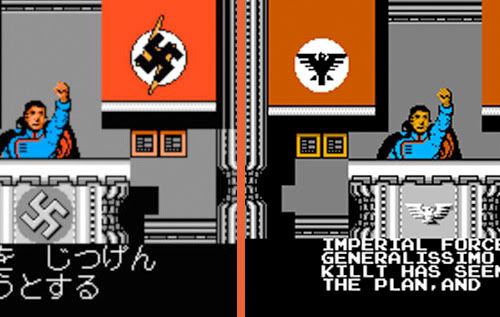
One glaring omission is the purposeful removal of all Nazi references. The Japanese version of the game included them, but they were taken out for western audiences as pictured above. As you may recall, Project Albatross was the name for the Empire's plan to re-animate Adolf Hitler. Your job is to stop them and save missing FSA agent "Super Joe". However, the final boss still has an uncanny resemblance to history's greatest monster and he is referred to as "The Leader", a direct English translation of Der Fuhrer. Even so, I hate to see classics cleaned up for the sake of political correctness. Besides, if it could pass in the 80s, why is it faux pas today?
Summary
While this game doesn't really hold up against today's best selling games with regard to graphics, the gameplay is just as sharp as Modern Warfare or Skyrim. Playing this re-boot of a Nintendo classic brought back some great memories. For fans of the original that are looking for a trip down memory lane, I can't recommend this more highly. It doesn't break any new ground, but it wasn't supposed to. Bionic Commando Rearmed is just a modernized version of the 1980s classic made for those of us who didn't hang on to our 8-bit systems and cartridges for three decades. If you're looking for the next Modern Warfare, you should probably try Battlefield instead. For those of you that are as old as I am and actually owned an 8-bit Nintendo when they were the height of technology, Bionic Commando Rearmed provides a fun gaming experience paired with soothing reminiscence and nostalgia. If you loved the original, you'll love this one, too.
The Math
Objective score: 8/10
Bonuses: +1 for holding true to a bona fide video game classic.
Penalties: -1 for caving to PC pressure and removing the Nazi references.
Nerd Coefficient: 8/10. Well worth your time and attention.
Read about our scoring system, in which average is a 5/10 here.
This essay started out as piece on violence in video games, and a direct response to Brad's excellent mediation on the topic in the wake of the Sandy Hook massacre. Then a rather remarkable piece of literary criticism came my way, as it does from time to time, and it was a revelation of sorts. So if you haven't read E. M. Edwards' review of Prince of Thorns by Mark Lawrence yet, you really should. It's long, and covers a lot of ground, but it's required reading for anyone who is serious about fantasy fiction. There's a lot of meat in Edwards' review--he touches topics as diverse as racism, misogyny, gaming and much else. All of these are worthy topics all by themselves, but I'm going to focus my thoughts primarily on a single question: what's the purpose of all the violence and cruelty in the art we consume, and specifically in fantasy fiction? When is it acceptable and when is it not? [Disclaimer: I have not read Prince of Thorns from start to finish. I did read a free preview of the ebook, and decided that it wasn't my cup of tea. But I also don't feel qualified to judge it in its entirety without having read it in its entirety. So keep in mind that when I talk about it or about Edwards' review, it's solely in the context of broad discussion of violence in fantasy fiction. If I'm either unfair to or too forgiving of this specific book, then it's a function of my not having read it from start to finish. If you have read it, and have strong opinions on it, you are welcome to tell me what you think I should know...I'm always up for a respectful exchange of ideas.]
Grimdark
The term "grimdark" comes from the tagline for tabletop game Warhammer 40k, which states: "In the grim darkness of the far future, there is only war." Grimdark has a specific meaning within the Warhammer 40k universe:
Grimdark consists of two components. One, grim. This is the nature of the people of the world. In 40K, most people are desperate for survival. They’re neutral in the same way a squat city in Mumbai is neutral; they will do whatever it takes to survive another day in a raging shithole. Most of the people in power are either psychotic, sociopathic, megalomaniacal, or greedy beyond sanity. Oftentimes, more than one. The more powerful they are, the more massive their character flaws and the collateral damage of their mistakes....The Good people are antiheroes at best, where the ends almost justify the means, and the villains are horrific beyond belief. Dark is how much the world itself sucks, and here it is very much suck. The universe is a cold and uncaring place that is so hostile to life it is insane that it even exists let alone thrives, and it will grind you into oblivion without ever noticing you were there. If you do manage to get the attention fo the world, it will only crush you much harder, slower, and more painfully.
Grimdark settings have small heroes who achieve little, vast villains who are often genuinely unstoppable and who always win in the end, and no matter how hard or how well you fight, the uncaring galaxy will never know your name or record your deeds. The greatest good you can accomplish will be undone in days, and often leave things worse than had you tried to do your worst, and when you do your worst, the consequences are cruel beyond belief and very nearly permanent.
Being grimdark can be taken to extremes; depending on your own personal tolerances for grim darkness, there is a point at which it becomes more ridiculous than anything else because everything is unfeasibly terrible all the time. This is an accusation often levelled at Warhammer itself, and leads some to rail against "Grimdark" as a whole, decrying the concept as ridiculous attempts at edginess (typically by teenagers), and using the expression to refer solely to such over-the-top settings in a pejorative manner.
The Grimdark Turn in Fantasy
Over in the small world of fantasy fiction, grimdark is taken very seriously. The grimdark turn is usually traced back to George R. R. Martin, whose A Song of Ice and Fire novels are notable, among other things, for their unflinching portrayal of violence and depravity in a medieval second-world setting. His characters are not "evil" because they are supernatural embodiments of everything that is terrible, but precisely because they are humans with a modicum of power in an essentially violent and cruel social setting. And they are rarely just "evil" either, but rather flawed individuals shaped by circumstances, who are capable of kind deeds as well as evil ones.
Yet Martin's world looks restrained in comparison with those envisioned by some of his followers. Depending on how you envision the lineage (and indeed if you think GRRM is the progenitor, rather than, say, Glen Cook), one could imagine a pattern of escalation to Steven Erickson and Joe Abercrombie (Level 2), and from there to R. Scott Bakker and Richard Morgan (Level 3), and from there to Mark Lawrence (Level 4)--each, it might seem to an outside observer, outgrimming and outdarking his predecessors.
Fans of the style often cite its cynicism "realism" as a primary selling point. As one blogger writes about Abercrombie:
This is character realism at its finest. There’s Jezal, a pompous young nobleman who goes through a journey of self-discovery, only to return to his former shallow, selfish ways when given the opportunity to become king at the end of the series. He is somewhat changed by his experiences, and he thinks about things a little differently. But he’s still Jezal; the entire point of Abercrombie’s books is that people are all people, and that they don’t usually change much for the better. Another example: his character Logen, a subversion of the archetypal noble warrior, attempts to make himself a better man and escape his violent past, only to sink right back into his comfortable role when he returns to his homeland. One of my favorite lines comes in the final installment, when Logen is told by an enemy: “Do you know what’s worse than a villain? A villain who thinks he’s a hero. A man like that, there’s nothing he won’t do, and he’ll always find himself an excuse.” Bleak, yes, but superb in terms of realism.
The world is a brutal one, and sadly reflects the brutality of our own history. Soldiers, and others, commit atrocities in the wake of battle. There’s torture, rape and subtler forms of horror. Some passages can be hard to read, to be honest. But these elements are necessary, I think, to establish the world. These are the things that happen during war, even in our modern world, and to omit them would be to present a world in half-measures. And once again, that brutal reality causes us to examine our own thoughts and feelings. Despite much of fantasy being labeled as escapist fiction, Martin’s series isn’t.
I’m not saying that the books are perfect -- there are issues of race, and gender -- but I believe that what Martin’s attempting to do, and mostly succeeding with, is admirable. His approach not only helps to reset the boundaries of what epic fantasy can do, but what good fiction can do. I’d like to see future epic fantasy writers push those boundaries even further, shake up our expectations even more. I find the prospect exciting.
The Rebellion
There has been plenty of pushback against the grimdark turn in fantasy--not only its violence, but also the racism, sexism, homophobia and other unpalatable things that can get mixed in there. Arthur B's review of Richard Morgan's The Steel Remains details some of the more egregious problems of this approach:
Unfortunately, the book’s take on homophobia is complicated by the fact that Morgan has chosen to join the grittiness arms race which is plaguing fantasy at the moment. George RR Martin started it when he dropped copies of A Game of Thrones on Amazon and Waterstones, but in the absence of any Grittiness Non-Proliferation Treaty all the fantasy authors are doing it - Joe Abercrombie,Scott Lynch, Steve Erikson, even Bioware have joined the family of gritty-capable fantasy producers. It’s far too easy for any tinpot third-rate fantasy author to create a fantasy novel infused with enriched grittiness (achieved by throwing lots of rape and blood and shit into an otherwise standard fantasy novel), and the United Nations is completely powerless to act. (The worst grittiness of all is Neutron Grittiness, which wounds particular characters or groups in a novel with grit but leaves others standing, as seen in JV Jones’ work.)
In this case, Morgan seems determined to take the grittiness as far as it can go, to the point where it ends up turning into self-parody. The religion thing is one of those aspects, as is the whole "society is shit and will always be shit and also people are shit, fuck people" angle. The homophobia gets caught up in it. On one end of the spectrum are touching and well-observed scenes between Ringil and his family, in which the awkwardness between him and his parents says everything. At the other end of the day is a bit where Ringil more or less takes a day off sleuthing - remember, he’s supposed to be chasing his kidnapped cousin - in order to mope about the place where his first boyfriend was horribly executed and his father made him watch the whole thing. In between there’s a plethora of horrendous incidents; I think the straw which broke the camel’s back is the bit where Ringil remembers being gang-raped at a boys’ private school, where all the kids take turns gang-raping each other as part of being hazed, which is so over-the-top (and so keen on playing into all the silliest stereotypes about private school hazing) that I just stopped taking it seriously.
These are the kinds of things justified as "realistic" for a second-world medieval setting. Fantasy author (and GRRM protege) Daniel Abraham, though, pours cold water on this notion:
So there’s this argument about epic fantasy that keeps coming up, and it makes me uncomfortable every time I see it. Usually it goes something like this: a beloved novel or series set in a world with kings and knight and dragons – that is to say one set in an imaginary medieval Europe – is analyzed and found somehow wanting. Not enough strong women, too many white people, too much sexual violence. As the debate fires up, one of the defenders of book or series makes some variation of the argument that fantasy that has the set dressings of medieval Europe is better if it also has medieval social norms. Or, at a lower diction, “But the Middle Ages really were sexist/racist/filled with sexual violence.”
The idea that the race, gender, or sexual roles of a given work of secondary world, quasi-medieval fantasy were dictated by history doesn’t work on any level. First, history has an almost unimaginably rich set of examples to pull from. Second, there are a wide variety of secondary world faux-medieval fantasies that don’t reach for historical accuracy and which would be served poorly by the attempt. And third, even in the works where the standard is applied, it’s only applied to specific, cherry-picked facets of the fantasy culture and the real world.
At its heart, the argument that the Middle Ages were “really like that” misunderstands what epic fantasy is by treating it as though it was in conversation with actual history. It isn’t. It’s in conversation with the epic fantasy that came before it. George RR Martin (who, in the interest of full disclosure, is a friend and sometimes-collaborator of mine) has drawn a great deal from the incidents of real history, but he hasn’t written a work of historical fiction. What gives his work its power isn’t historical accuracy, but the subversion of genre expectations and a deeply-felt sorrow that infuses almost every scene. JRR Tolkien drew his inspiration not from medieval history but from medieval romances, and the Lord of the Rings isn’t remembered for what it said about an imaginary 1300s, but what it said about (and to) a real 1950s. And 2010s. The roots of epic fantasy aren’t with King William II. They’re with King Arthur, and so they’re timeless. Historical accuracy isn’t what we come here for.
First and Second Category Grimdark
If "historical accuracy" isn't the ultimate point of grimdark, then that begs the question: what is? As someone who has read a lot of dark fiction and consumed a lot of grim art over the years, I see two distinct purposes of grimdark--and by "purpose" I mean both the author's goal and the degree to which the author achieves that goal. In the first three novels of A Song of Ice and Fire orSapkowki's Witcherbooks (or going beyond fantasy, in Iain M. Banks' relentlessly bleak Use of Weapons), violence and cruelty exist primarily to create urgency and conflict for complex characters.
For these first category practitioners, the grim and the dark exist as a means to an end. We are repulsed and terrified by the horrible things within these books, not titillated by them. If we come to understand the origins of a given characters inner grim darkness, then it's presented as tragic. We do not revel in these failings. And even if they are not "historically accurate," per se, we may recognize in them parallels to historical or present day horrors. Ideally, presenting this material in such a way helps us confront these things, or at the least, confront the fact that they do exist and shouldn't be ignored.
In the second category, though, the grim and the dark are the ends in and of themselves. Violence, though it may have some tenuous connection to broader themes or issues, exists primarily to push the envelope and to shock, titillate and excite (usually male) audience. This isn't new and isn't native to fantasy fiction. In the late 1980s and early 1990s, there was a similar grimdark arms race in the world of independent film. There was Henry: A Portrait of a Serial Killer, which is pretty self explanatory; and there was Tie Me Up! Tie Me Down!--a film about a woman who falls in love with her violent, psychopathic kidnapper (seriously). Oh, and let's not forget The Cook, The Thief, His Wife and Her Lover, which pretty much maxes out all the available grim skill and dark attribute ratings with this lovely narrative:
Under her husband's nose, Georgina carries on an affair with Michael with the help of the restaurant staff. Ultimately Spica learns of the affair, forcing Georgina to hide out at Michael's bookshop. Borst sends food to Georgina through his young employee, a boy soprano who sings while working. Spica tortures the boy before finding the bookstore's location written in a book the boy is carrying. Spica's men storm Michael's bookshop while Georgina is visiting the boy in hospital, and torture him to death by force-feeding him pages from his books. Georgina discovers his body when she returns. Overcome with rage and grief, she begs Borst to cook Michael's body, and he eventually complies. Together with all the people that Spica wronged throughout the film, Georgina confronts her husband at the restaurant and forces him to eat a mouthful of Michael's cooked body. Spica complies, gagging, before Georgina shoots him in the head.
A second, contemporaneous example comes from the literary fiction world: think American Psychoor pretty much anything by Martin Amis during the 1980s. Level 4 practitioner Will Self's 1993 novel My Idea of Fun even begins with the narrator decapitating a tramp and then graphically defiling the headless corpse. As Entertainment Weekly put it:
In the ''hero'' of Fun, Ian Wharton, Will Self combines the tastes of a Jeffrey Dahmer, the exuberance of a Pee-wee Herman, and the wordplay of a brilliantly nasty teenager.
This characterization relates directly to Edwards' review of Prince of Thorns, and specifically to the link he he sees between the novel and a distinctly adolescent gamer culture. As per Edwards:
Indeed, if I was left with a clear sense of what Prince of Thorns is about, it is about Playing the Game. And our point of reference to the game and its players, is the implausibly young and bloodthirsty eponymous Prince. Who is in it to win it. Whatever "it" actually is, remains less clear. Is it the well treaded game of thrones? The game of war? Or just a mashup of fantasy and post-apocolyptic MORGs? You may take your pick. In the end, it hardly matters. Whatever its origins, Prince of Thorns is in effect a prose fantasy role-playing game.
But, Edwards argues, the book isn't so much a metaphor for gaming as informed by a distinctly adolescent and male gamer morality:
My overriding impression of the novel was that it was strongly related at its core to the awfulness we have seen in the genre and gaming communities, such as demonstrated at Bioware, with the harassment of games writer Jennifer Hepler. In other words, that Prince of Thorns is afflicted by either a lack of authorial awareness of its faults or plagued by a certain type of lazy writing that lets institutionalized prejudices and tropes exist within it unchallenged. Tropes which are hostile to women, dismissive of diversity, and prone to stirring up anger among fans at any encroachment, real or imaginary, into their zone of privilege.
Because while the author claims it only has rape in "0.06%" of the book, it is certainly front heavy with it. And a general dismissiveness towards women stalks its pages. Very gamey. Quite a stench. Not like a well hung pheasant, but as in gamers who post rape threats and sexual slurs on forum message boards or leave behind verbal excrement in the comments of female reviewers of genre books. The kind that shout at women for not enjoying playing their games, even if they enjoy writing them and being paid for it. And even if that's some troll's manufactured lie. The kind some of whom I suspect, enjoy playing characters who are stone cold, emotionally crippled killers who look an awful lot like Prince Honorous Jorg Ancrath.
As someone who hasn't read the full book, it's difficult for me to assess the validity of material critical of it, and others have suggested that the extreme violence of Prince of Thorns is intellectually justified. As per Aidan Moher:
[Jorg] begins as a reprehensible bandit, torching a village and acting like a villain for little-to-no reason other than that he’s angry, young and enjoys the mayhem. (And to allow Lawrence to establish the essence of his character) But as the novel progresses and Lawrence delves into the past of the young prince through a series of flashbacks, the reasons for his actions and his shattered psyche become more clear and, almost without realizing it, the reader begins to see Jorg not as a sociopath without hope, but a boy damaged by a traumatic childhood experience that once forced him to become the demon he hated so as not to be overcome by the fear, anxiety and anger that fills him. By the end of the novel, Lawrence has taken the little shithead to great depths and his actions are explored thoroughly. Prince of Thorns is a dark novel and often hard to read, but by the end it’s not dark for the sake of shock value, or dark simply to allow Lawrence to explore some sick part of his soul; rather, it’s dark because exploring those lightless depths is central to the core themes of Jorg’s story.
Beyond the Arms Race
Yet even this positive review acknowledges that the grim darkness of the book skirts the limits of what a reader can and will handle. And thus it's important to note that, generally speaking, grimdark movements in art essentially follow a parabolic arc: rising, peaking and then collapsing once it becomes clear that most consumers haven't stayed on board for the whole ride. Or, to put it another way, there's a limit to the appeal of darker! grimmer! faster! harder! And this limit applies to both consumers and producers.
All the usual caveats about generalizing from a single example apply, but check this out. Requires Only That You Hate once called out Joe Abercrombie for a scene in which a lesbian character is threatened with repeated marital rape. In her words:
Now do I believe Joe Abercrombie in real life endorses the rape of lesbians? Well nope, fucking duh. But in his rush to masturbate to his own gritty grim darkness he’s contributing to a narrative where women–and gay women especially–must suffer. If they aren’t angsting they are being raped, blackmailed into marital rape, or being punished in some way because oh my god she doesn’t want cock and we can’t have that, can we? Lesbians must be put in their places most of all for the crime of not wanting sex with men. It’s a damaging narrative. It’s a bloody fucking awful narrative that reinforces a greater trend and which, moreover, is something Abercrombie will never be hurt by. I’ve no idea if he is straight but he’s very certainly a man, which makes this about a thousand times more repulsive and disgusting than the worst M/M rape fetishization can ever hope to be.
Where I think I failed pretty badly is that Terez is really not a good character. She’s one-noted, shrill, icy, bitchy, and just doesn’t come across as a particularly convincing or well-rounded real person. It stretches credibility that she wouldn’t behave more cannily and carefully in this situation. That’s shoddy writing by any standard, but worse yet it plays into a really ugly stereotype of shrill man-hating (possibly quite thick) lesbian, and that badly undermines any attempt to do something interesting with this situation. If Terez is a much more convincing, multi-faceted, less stereotyped character with an authentic voice and a more believable motivation I’m sure many people would still have their problems with this scene but from my point of view at least it would be much improved. The Wire I think is a very good example because the reason it (for me at least) succeeds so well in its depiction of black criminals is that it makes each individual a powerful portrayal with their own voices and motivations. It doesn’t help at all that the female characters in the First Law ain’t that great across the board, really. Ferro is the only female point of view and for various reasons probably outside the scope of this particular thread I think I could have done a whole lot better with her too. I actually think the other (almost) rape in the series, in the second book, is worse, because it’s handled more or less completely disposably and the female character in that case, Cathil, is still more absent of personality than Terez and pretty much exists to elicit certain responses in the men. Which is kind of sexist writing 101, sadly. There’s also a rather ugly pattern, so obvious to me now that I can hardly believe I failed to notice it at the time, of pretty much all the central female characters having been the victims of abuse of one kind or another. I suppose you could say a fair few of the central male characters have been as well but that’s pretty weak sauce as a defence.
So in conclusion I’d say rape shouldn’t be off limits, lesbians shouldn’t be off limits, but shitty, lazy, ham-fisted writing is never a good idea. Especially in dealing with a rightly sensitive issue like rape. You might think the avoiding of shitty writing should be an obvious lesson for a writer. All I can say is, you’d be surprised how difficult it is in practice…
Abercrombie's response demonstrates, in clear terms, the difference between category one and category two grimdark. Darkness has its place in fantasy fiction, and can infuse a book or series with immediacy and power, but it only works if horror is presented as horrible, and if it serves some greater purpose. Abercrombie mentions The Wire--a television program that features a lot of violence, but in which violence serves to help viewers understand the blight of American urban centers and the agency of those who live in them. We don't enjoy the violence, but we are compelled by it to face certain realities that we might otherwise be able to ignore.
As violence shifts from backdrop to main event, though, the immediacy and power dissolves into something superficial and crass. I can fully accept grim darkness in art when it does something more profound than just say "here is some shit. I've smeared it on the walls for you. Enjoy." But if I can think of no good reason for graphic violence to be included in a text, or can think of the reason but the benefit provided to the story is outweighed by the cost (as Abercrombie concedes is the case in the scene discussed above), then I've been left with shit-smeared walls and little else to speak of. Take torture, for example: do we really need another graphic flaying scene? What do we gain from it? And in a world where torture is real, does it ultimately draw needed attention to the issue or is it just there to scrape the bottom of the cheap thrills barrel?
Or rape. Can we just stop with all the explicit, gratuitous and artistically/intellectually pointless rape scenes in fantasy fiction? Rape happens, and it shouldn't be off-limits for authors, but it shouldn't be treated as a go-to way to wow the readership with your "edginess." As reported in the NYTimes not long ago, as many as 1 in 5 American women report experiencing sexual assault--and those numbers may be even higher in other parts of the world. Explicit, gratuitous and artistically/intellectually pointless rape scenes don't make your book "edgy," they make it triggery.
The effect of this is cumulative, and there's a point beyond which repulsion intersects with fatigue from all the attempts to repulse, the moment when the race to grimmydarksville reveals itself as little more than a peculiarly tedious form of sadism, or a peculiarly sadistic form of tedium. Or both.