Wednesday, March 9, 2022

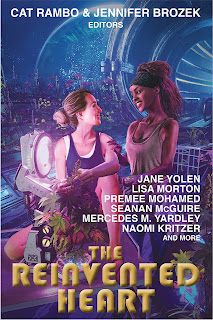
Microreview [Book]: The Reinvented Heart: Tales of Futuristic Relationships, edited by Cat Rambo and Jennifer Brozek

The Reinvented Heart: Tales of Futuristic Relationships is a collection of short stories by female and non-binary authors, focussed on imagining how relationships might look in the future, and how technology, social change and a wider span of time and difference between people might change those relationships (or not).

The theme for this collection is absolutely spot on, and while I liked, disliked and was indifferent by turns to some of the stories, I nevertheless finished the collection feeling glad that it was a theme being written about. Characters and relationships – in all their complex, messy glory – are by far my favourite thing in reading fiction, and so to have that spotlight focussed on them here, and specifically how they might change as the world, technology and the people in it change, was a gorgeous choice. It’s also a collection where the stories rove widely in their variety, and yet they do all stay extremely true to that uniting theme. And it’s not like we didn’t see stories with glimpses of interesting future tech or distant worlds or all the other good stuff of SF… it just all took a bit of a back seat to seeing how people have changed because of those changing contexts. And, of course, how they’ve stayed the same.

The editors/authors have also done a great job in providing a really interesting variety in what counts as a “relationship”. It’s not all romantic, and the ones that are push at the edges of what counts as romance. Near the beginning, for instance, Seanan McGuire explores the - necessarily and disturbingly intimate - love of a host and an intelligent symbiotic fungus, in what is by far the story that has stuck with me the hardest from the collection. It’s an intensely creepy read, with clearly a lot of her Mira Grant hat on, and one that left me doing a bit of a shudder of horror when I finished it and moved onto the next.

But we also see the relationship of a man and the young spaceship that can talk to him from within his brain; the slowly improving relationship of a woman with herself and her life as she moves asexually through a world obsessed with lust; the fond relationship of a woman and her inherited, genetically reincarnated cat. All are vividly emotional, all are different, but all absolutely centre and showcase a little snippet of feeling for someone or something, and how the changing world might have affected that. 

Conversely, some stories show that those relationships haven't or wouldn't change at all - we see fond partners still loving one another despite hardship and lovers struggling to relate while going through difficult times, and while the nature of the hardships may have changed, the very human feelings at the core of it haven't at all.

The collection also plays around with form, including not just short stories (and one a little longer), but also several poems. “They: A Grammar Lesson” by Jane Yolen is what opens the book, and is a short and lovely statement of purpose. There are several others, scattered through the sections, and they felt like a moment of rest and peace in between more immersive stories, a time to catch your breath and pause, rather than bombing through at the highest possible speed and maybe, by doing that, missing some details. There’s also one story in the format of an interstellar horoscope broadcast, and another in an adapting AI questionnaire for an automated matchmaking service. The stories are told not just in prose, and not just in human voices, but truly trying to look out into the scope of personal interaction that might exist in the future.

If it has any problem, the only one I can really find to talk about is hardly the worst to have. In most short story collections, there will be at least one story I love, several I like, some I dislike, and maybe one I hate. The Reinvented Heart has the last three, but there is no single, standout story that spoke to me, or grabbed me, or has lingered in fondness in my memory. There isn’t one story I’ll look back on in a year and remember, or the one I’m rushing to tell other people to read. There are plenty I enjoyed – if anything, I’d say my average rating of them was probably higher than most collections – but there’s nothing that really sang out and said “yes, me, I am the reason you read this book”. And this does probably mean that, as time passes, this won’t be the book that really sticks with me from 2022.

But I’m not sure that matters. My predominant feeling as I read the stories here was of fleeting glimpses of moments in longer relationships, little windows into bigger stories, that I saw flit past and then fade away. The experience was a very pleasant one, and the joy was to some extent in the transitory nature of the experience. I don’t need to remember them in intricate detail, but I know I’ll remember having read them fondly.

The Math

Baseline Assessment: 7/10

Bonuses: +1 for genuine breadth and depth of relationships on show

Penalties: -1 for putting by far the creepiest story right at the start and so nearly stopping me reading it entirely because I’m a wuss

Nerd Coefficient: 7/10 an enjoyable experience, but not without its flaws

Reference: The Reinvented Heart: Tales of Futuristic Relationships, Cat Rambo and Jennifer Brozek (ed.), [CAEZIK SF & Fantasy, 2022]

POSTED BY: Roseanna Pendlebury, the humble servant of a very loud cat. @chloroform_tea


Tuesday, March 8, 2022

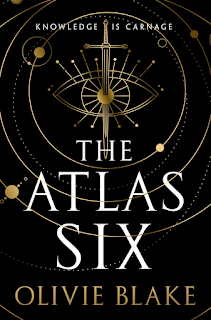
Microreview [book]: The Atlas Six by Olivie Blake

Juicy, compelling dark academia with all the backstabbing you can eat

I am reliably informed, every time I see any official marketing for The Atlas Six, that it is a Tiktok sensation: an originally indie published dark academia fantasy which gathered a huge viral audience and is now receiving a traditionally published debut with all of the bells and whistles that entails. As a non Tiktok user and a crumbly old thirty-something, this marketing isn't exactly aimed at me, and my prior experiences with dark academia (both the books and the educational experience) have been mixed, to say the least. On checking out The Atlas Six, I have discovered two things to definitely be true: one, I definitely don't care for this genre full of rude, overconfident and/or anxious prodigy characters in unnecessarily toxic but ~pretty environments; and two, The Atlas Six is a very compelling book despite that. So I guess I have a new favourite series in a least favourite subgenre now. Wonderful!

The premise of The Atlas Six - which it wastes no time in setting up - is that every decade, six highly talented young adults are selected for a two year... graduate-scheme-slash-cult-initiation in the Alexandrian Society, the heirs of the Library of Alexandria and a whole bunch of other lost and hidden research. At the end of their first year, five will progress to the second year of induction, and those who become full members will join an elite group full of wealthy, prestigious individuals who exert disproportionate influence over the world's powerful institutions. The Society, led by Atlas Blakely, taps six new mages (hereafter "the kids", because although they are in fact all adults they come across as super young to this crumbly old thirty-something) with various powers and personality problems. There's Libby and Nico, who have just graduated co-valedictorian from the same magic school, with the same speciality over physical objects, and detest each other to the point where they just can't leave each other alone. Reina exerts control over plants, but she hates her natural talent and prefers to pursue historical study instead. Parisa is a telepath who uses her abilities and her sex appeal to stay on top; Callum is a manipulative empath who alters the world around him to give himself the easiest ride possible; and Tristan is a big whiny baby who can see through illusions and possibly through the entire fabric of reality. (But not through the lies of the people manipulating him! Poor Tristan.) All six have grown up in a world where magic is a rare, generally hereditary ability, but it's also known to the wider population even if magical individuals have different career paths and circles open to them. We don't get much in the way of worldbuilding for the broader magical society, or much to go on when it comes to relationships between magical and non magical folks, but The Atlas Six does enough to set itself up and make its characters feel like they have come from a real, living world.

Stuffed into a house with no directions beyond "enjoy learning, kids!", the six start to unpack the mysteries behind the Alexandria Society. An attack on their first night by a whole host of enemies who were accidentally-on-purpose allowed to breach the wards that supposedly keep it safe - because it's not a dark academia unless your school is indifferent to your death - underlines both the society's precarious position and some of the darker elements of the kids' talents. What follows includes (in descending order of importance) scheming, backstabbing, tenuous alliances and study partnerships, conversations where characters tell each other about their magic in more or less flowery metaphors, enjoyable but transactional sex, dreamwalking with half-mer best friends, life-altering sex, holidays, and actual magical study where the characters (mostly Nico and Libby, who are the only two straight out of university who apparently still remember how to study) get to push the boundaries of reality. In all seriousness, there's a significant difference in how each character uses their magic to influence their lives, and while it kind of itches to see Parisa and Callum's abilities benefit them as they try to figure shit out and survive potential elimination while other characters get less of a chance to shine, the magic really works alongside the rest of the characterisation. By the end, the only member of the six who ends up genuinely shortchanged is Reina, who doesn't get a personal arc or come to any new understanding about her powers, and whose standoffishness leaves her disconnected from the balance of power around the rest of the five. Nico and Libby's connection to each other also hampers their interconnectedness with other characters at points, and they're the only characters who maintain significant relationships outside the Society, but Libby in particular gets opportunities to connect in sometimes very unexpected ways.

To say too much about the plot beyond the set up would veer quickly into spoiler territory, but I should note that the way things develop make its characters pretty reactive most of the time, and there's long stretches where they don't have much to do beyond discuss new information and wait for the right time to act on it. The elimination mystery - which ostensibly takes up most of the characters' time - is not so much a mystery as a "who is going to lose this game of high stakes musical chairs", and while that's an interesting topic for a reader to speculate on, it doesn't lend itself to clues or opportunities for someone to piece things together before the end arrives. Instead, it's the mystery of what, exactly, The Alexandrian Society represents and what the kids haven't been told that starts to get really juicy. As the characters come to terms with the implications of joining the Alexandria Society and the danger it poses to them, and weigh that against their own ambitions and self-confidence, everything builds up to a conclusion that contains both predictable elements and at least one surprising reversal. And, because this is YA-adjacent publishing in 2022, we leave things on an enormous cliffhanger, with new enemies gearing up to take on the kids who remain in the Alexandria Society after the dust settles. Which is a problem, because I was simultaneously absolutely done with these horrible people and also would really like to know what happens to them, and apparently I have to put up with two more books to do that.

Anyway. even if you read it with a constant inner monologue of "why are you like this, stop being mean for five seconds and talk to each other", The Atlas Six is full of tension and characterisation that makes it a compelling adventure, even if I can't recommend "reading in a subgenre you dislike" as a leisure activity. And for everyone on board with the dark academia train (or looking to find out more), this book is a ride you're totally going to want to take. 

POSTED BY: Adri, Nerds of a Feather co-editor, is a semi-aquatic migratory mammal most often found in the UK. She has many opinions about SFF books, and is also partial to gaming, baking, interacting with dogs, and Asian-style karaoke. Find her on Twitter at @adrijjy

Reference: Blake, Olivie. The Atlas Six [Tor 2022]

Monday, March 7, 2022

Microreview [book]: The Kaiju Preservation Society, by John Scalzi

Jurassic Park by way of John Scalzi.


If you’ve ever wondered what it would have looked like if John Scalzi wrote Jurassic Park instead of Michael Chrichton, you don’t have to wonder any longer because that’s the best comparison I’m going to come up with for The Kaiju Preservation Society. The only thing we don’t have (yet) is Richard Attenborough kindly reciting his iconic lines over sweeping camera shots showing the scope of what this new world looks like while the music swells and soars.

Very briefly, Jamie is a delivery driver after losing a much higher paying job, and after one particular delivery to a former acquaintance ends up receiving an offer to work for an “Animal Rights Organization” that needs extra grunt labor at the last minute and Jamie takes the job which turns out to be in a very remote location with no contact with the outside world for months. Everything about the context of the offer is incredibly sketchy but the money is transformatively good and jobs are becoming scarce.

That Animal Rights Organization happens to operate on an alternate Earth where giant monsters roam the land and everything on the planet is designed to kill a human - or it would be so designed if this was a world humanity was native to. The Kaiju Preservation Society is exactly that, an organization built around the preservation and conservation of these giant creatures that are not native to our world but can sometimes cross over. That’s where KPS comes in - both to respond, but also to prevent.

We’re pulled along the story of The Kaiju Preservation Society by new recruit Jamie and the other new recruits on their team - because everything is new to them there is opportunity to have natural info dumps for the reader and it works. Everything is discovery and the sense of wonder is enormous. I can’t wait for the movie version of The Kaiju Preservation Society (it’s been optioned for television, which means maybe sometime in the next ten years and maybe not). I can almost see the sweeping introduction of a lush, verdant world as Jamie and company get that moment of whoa.

I went a bit overboard last year watching kaiju movies. I didn’t expect the obsession, but there it was just waiting for me. I watched 30 Godzilla movies, another 3 Kong movies, and this year is fixing to have more of those giant monsters. What I’m saying, though, is that The Kaiju Preservation Society is hitting me right in the sweet spot just when I am most set up to appreciate it. It is a FUN book and, frankly, after two years into a pandemic that is not relenting - I absolutely needed this book. The Kaiju Preservation Society has all of the big monster goodness that readers could ask for and it is chock full of the goodness we’ve come to expect from John Scalzi.

It’s hard to really figure out how to consider a book in the context of others when you’re not quite the same person you were some fifteen years ago when you first discovered a particular author - John Scalzi in this instance. Thinking back to Old Man’s War, that novel became an absolutely iconic science fiction novel that set up this idea of SCALZI as a writer and really defined more than a decade of expectations.

If I have the story correct, Scalzi once sold a novel with the elevator pitch of “Man solves diplomatic crisis through action scenes and snappy dialogue” and minus the diplomatic crisis, that’s generally been a hallmark of his fiction. The Kaiju Preservation Society is not Old Man’s War, nor is it The Android’s Dream or The Collapsing Empire - it’s a different sort of novel, but it also has those hallmarks of classic and top notch Scalzi. There is plenty of snappy dialogue and legitimate laugh out loud moments mixed into discovery and adventure.

The Kaiju Preservation Society moves fast and is just the damned delight that I needed this year.


Joe Sherry - Co-editor of Nerds of a Feather, Hugo Award Winner. Minnesotan. He / Him

Friday, March 4, 2022

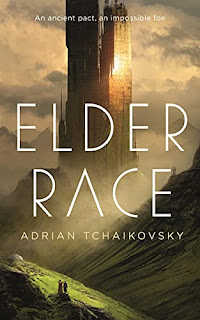
Microreview [book]: Elder Race by Adrian Tchaikovsky

An anthropologist and a queen's daughter team up to battle an impossible demon.

Lynesse has a problem. As the fourth daughter of a Queen, she’s not the heir, she’s not of high responsibility, even if she feels it herself.  When a threat to a nearby kingdom appears to involve demons, she knows what to do--to call upon Nyrgoth the local ancient sorcerer for help. Her family has a long ago pact with the sorcerer, and while getting to his ancient tower is difficult to reach, she is going to do it.

The problem? This is a colony world, there is no magic, no demons. Nyrgoth is actually Nyr, an anthropologist (second class!) who has been studying this world for a very long time, using periods of stasis to pass the decades, the centuries. He interfered a couple of generations before, dealing with a remnant of high technology gone wild and feral. But when Lynesse awakens him to deal with this own problem, Nyr has to battle not only a “demon” but his own also personal one.

Elder Race is a novella from Adrian Tchaikovsky.

The boundary space between science fiction and fantasy is something that the author has explored in a number of works. Most notably and recently, and also in novella format, The Expert System’s novellas are science fiction stories with the tropes and feel of fantasy. Here, though, in The Elder Race, we get a fantasy story that is based in a more realistic science fiction vein, in a potential future, on a future colony world. This is a very different novella in that, in the prior novella, the assumption is that colonists need to be utterly protected from the biosphere of a colony world (a la Kim Stanley Robinson’s Aurora). Here, the default assumption is softer, that humans could live in another world’s biosphere without utter disaster. 

Voice and point of view really account for how this novella works as well as it does. The novella switches between two points of view, a first person point of view with Nyrgoth, aka Nyr Illim Tevich, and a third person point of view with Lynesse Fourth Daughter. Although the novella is devoted to Gene Wofle and his story “Trip, Trap”, it is Jack Vance, from the choice of the name of the heroine to the science fantasy elements blending together that I found parallels and hooks just as much. 

In Lynesse we get that medieval, fantastic point of view, where Nyrgoth is a sorcerer, magic is real, and the infestation in the forest is, obviously, a demon. The novella is sparing in its details, and so the society we get is well described, but not in “phat fantasy” terms. This is a society clearly where the women are the heroines, where things are shaded and lined up that it is they who are the default for such things, rather than men. It’s not a matriarchy by any means, there are other male characters than Nyr (who is an exception, because Sorcerer), but it is the exact opposite of too many fantasy stories where it is assumed that men characters are the default heroes. By genderflipping it, Tchaikovsky shows the lazy default up for what it is.

On the other side of the equation, we have Nyr. Nyr has the scientific viewpoint, he’s studying this society, should not be getting involved (but he did make a long ago promise that Lynesse is calling on), and of course magic and demons don’t exist. Also, he carefully is trying to deal with some nasty brain depressive brain chemistry in the process. There is a definite sense of frustration if not outright futility in him and his work. He may well be, he realizes, the last of his civilization. Even as he files and sends off reports, there are no answers in return. It’s a lonely life, and that goes to his depressive brain chemistry, for certain. But the scientific viewpoint does provide a nice parallax in trying to figure out what is “really” going on. 

This tension of switching from these points of view gives us a good entree into the world, and shows us things from both points of view. The author is clever in choosing when to break from one POV to the other, often leaving us to have to figure out and interpret for ourselves what something “really means” (this especially works when we see Lynesse interpreting Nyr’s actions and words. This sort of game really reaches its apotheosis when we get a “split screen” of Nyr explaining his and his civilization’s history to Lynesse and her companion, Esha.  We get Nyr’s own words, in his language, and we also get the translation of those words into terms and the language that Lynesse understands. It’s a masterful way for the author to show just how similarly, and how differently, too, these points of view can interpret history. 

As far as the “demon” itself, the revelation of what it is, and how Nyrgoth and Lynesse must deal with it, is part of the point and the joy of the novella, and I will leave it for the reader to discover. The Gene Wolfe story “Trip, Trap” gives a clue...but Tchaikovsky takes his own tack, and his own approach, and it works quite well indeed. I think if I had to point to a fault, it is that the story is almost a little too condensed for its own good, there is plenty more room here to have expanded this story (not extend it, mind, the ending works rather well). Novellas can be tricky things, sometimes they are a short story that “just grew” and sometimes a novel cut down to size. This feels like it could have been a short novel, but I think at least a little more fleshing out of the world (which leaves a lot for the reader to piece together, maybe a bit too much) would have worked better. But I can see how too much in Nyr’s point of view might have not been a positive, and it is the balance between those two that makes the novella work.  

---

The Math

Baseline Assessment: 7/10

Bonuses: +1 for good use of voice and point of view to tell a story from two very different perspectives, richly rewarding the reader. 

+1 for exploring the boundaries of science fantasy interestingly and engagingly

Penalties: -1 The length is a bit frustrating, there is more that could have been written to flesh out the world, some things are *too* sketched in.

Nerd Coefficient: 8/10 

 POSTED BY: Paul Weimer. Ubiquitous in Shadow, but I’m just this guy, you know? @princejvstin.

Reference: Tchaikovsky, Adrian. Elder Race, [Tor dot com Publishing, 2021]

Wednesday, March 2, 2022

Thursday Morning Superhero

The first Thursday of the month is here and that brings us another installment of Thursday Morning Superhero.  Life is hectic on my end as I am moving to a new state in two weeks!  I have already identified my new comic book store and the timing couldn't be better.

I live about 30-45 minutes away from my preferred comic book store depending on traffic and don't get to go as much as I would prefer.  As someone who has moved around more than I would prefer and someone who used to read a lot of comic books in the dark as my kids fell asleep, ComiXology has been a tremendous asset.  When Amazon bought ComiXology a few years back, I was worried, but things continued pretty normal for the most part and I was a happy digital comic book reader.  My son and I love ComiXology Unlimited as it has granted us access to more comics and manga that we would have not read otherwise.

It saddens me to say that with the recent update of the platform I am going to have to cancel my subscription.  I have spent a lot of money on digital comics over the years and will still read those books, but with a move to a smaller town I am going to focus on buying exclusively physical books. 

Prior to making the changes of a full Amazon integration, ComiXology did not consult with readers or publishers.  In an attempt to provide a single Amazon-style interface, the old ComiXology site was taken down and fans felt the impact immediately.  The site was difficult to navigate and some people couldn't access all of the books in their library or the new releases.  In addition, swaths of old articles and comic book reviews had their links impacted and no longer accessible.  The process of trying to update this to prevent readers from clicking dead links is an onerous task that, if I did link to ComiXology, I won't be updating.

With the announcement of Epic Games acquiring Bandcamp yesterday, I am always a bit cautious when a large company acquires a smaller one.  So far things have been good with their acquisition of Mediatonic and the Fall Guys franchise, but all seemed well with ComiXology until an unexpected change that nobody outside of Amazon was looking for.

POSTED BY MIKE N. aka Victor Domashev -- comic guy, proudly raising nerdy kids, and Nerds of a Feather contributor since 2012.

Nanoreviews: Goliath, All the Horses of Iceland, The Ones We're Meant to Find

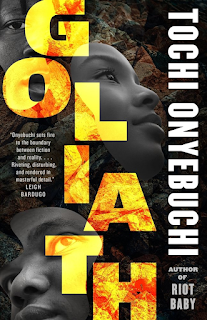
Goliath by Tochi Onyebuchi [Tordotcom Publishing, 2022]

Let's not mess around here: Goliath is one of the most impressive works of science fiction I've ever read. Tochi Onyebuchi's novel bills itself as "a primal biblical epic flung into the future", and it certainly delivers on that sense of both scale and mythology: a mosaic novel set in New Haven, Connecticut, centred on the lives of those left on a radioactive, oxygen deprived Earth by a space colonisation movement that was only ever accessible to the elite, the shifting dynamics as some of the spacefarers begin to return, and the damage that this gentrification causes to communities who have only ever tried to build a safe, comfortable life for themselves. Within that broad framework, Onyebuchi populates his narrative with a range of perspectives and characters, taking us through a meticulous, non-linear journey through their lives and concerns. At the heart of it are two groups, given equally sympathetic portrayals despite their very different positions. There's the young gay couple, Jonathan and David, who are returning from space and whose perspectives are portrayed as sympathetically as any others, albeit with an eye to showing how much their perspectives differ from those already living in the neighbourhood that they consider a blank slate opportunity (in the opening paragraph, Jonathan talks about the warnings he receives about "gangs" who populate Earth, before dismissing them in favour of his enthusiasm for the "shadow country" that is his vision of the planet). And then there's Linc, Bishop and their crew of demolitionists, whose job is to tear down houses (using a very cool bit of futuristic technology with potential for grim malfunctions that are quickly demonstrated) and then stack the bricks left behind so that they can be transported to the colonies. It's through the eyes of Linc and his buddies that we really come to grips with the extent to which the world has been broken, and the inescapably racist dynamics of who suffers from it. The group's banter swings from wild second-hand stories about former house parties to furious deconstructions of their political reality, and it's their reactions which sets the tone for the rest of the novel's politics.

There's no grand showdown or dramatic set pieces in Goliath: Jonathan and David's lives briefly intersect with Bishop, but not in any way that changes the course of the future history we are watching. Instead, Goliath just concerns itself with setting out that history: built, as the acknowledgements demonstrate, from a deep understanding of the dynamics of our recent past and extrapolating them into an era of space travel. The result is a very particular kind of novel: one which demands a lot of attention while reading and isn't in the business of giving instant narrative gratification, but which takes a sledgehammer to a lot of genre assumptions about near future science fiction, including how the sexy, exciting bits of those future get distributed and whose stories we consider worth telling because of that. I expect I'll be evaluating every book set in this narrative space against Goliath for the rest of my days, and I can't think of any better sign of quality than that.

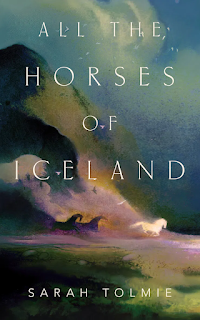
All the Horses of Iceland by Sarah Tolmie [Tordotcom Publishing, 2022]

From a speculative future history to a speculative history-history, Sarah Tolmie's new Tor dot com novella tells the story of Eyvind of Eyri, an 8th century Icelandic trader who travels through central Asia and into Mongolia to bring a herd of horses back to his homeland, including a mare whose supernatural origins have a far-ranging impact on the future of Icelandic horse genes. Except, the story isn't really about Icelandic horse breeding, so let's set all of that aside until it gets explained in the epilogue. It's Eyvind's story, and there is also a really cool horse. Right. 

Immediate bonus points must be awarded for the fact that I'm in a real mood for travelogue stories at the moment, and Tolmie's is a great example of the form, with Eyvind chronicling the adventure with his fellow travellers - most of whom are from the historic trading empire of Khazaria, through which Eyvind travels on his way to Mongolia - and the customs and concerns of the places he passes through, especially during his time in Mongolia where he successfully barters for his herd of horses and takes on responsibility for a white mare who everyone else claims not to see. Tolmie has a fantastic literary style, switching between language that reflects the myth being created here and the supernatural origins of Eyvind's mare, and more down-to-earth descriptions of the journey itself. 

Because it's a travelogue, the challenges along the way end up being very episodic - and, in fact, there's not much in the way of external challenge here at all, beyond a sequence towards the end (where, it turns out, having a supernatural mare comes in very handy). Instead, the tension is built up through watching a man travelling far beyond the boundaries of his own world to do something new, and the way the novella's mythmaking turns that novelty into something of foundational importance for his people. This is a short and delightful read, and well worth a look.

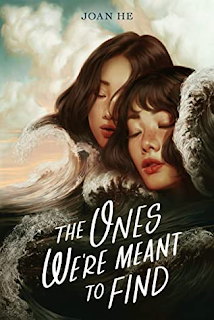
The Ones We're Meant to Find by Joan He [Roaring Brook Press, 2021]

It feels a bit unfair covering another near future climate change-y book in the same review set as Goliath - and it definitely felt a bit unfair to read this after having my expectations affected by Goliath -  but Joan He's young adult science fiction sets out to do quite different things with its story, and it very solidly achieves those aims. The Ones We're Meant to Find tells two intertwining stories about sisters who are heavily implied (but not outright stated) to be looking for each other: there's Cee, who has been trapped alone on a desert island for three years, with amnesia clouding everything about her former life except the fact that she needs to escape and find her sister Kay; and then there's Kasey Mizuhara, who lives in a carefully designed eco-city designed to protect humanity from natural disasters while minimising their carbon output to the smallest possible amount, and is searching for her sister Celia who went missing at sea three months ago. 

As Cee struggles with survival, Kasey pushes against her own limitations and restrictions to retrace her sister's steps and understand why she chose to leave on a journey that everyone else assumes would have killed her. Along the way, resonances start to appear between the two stories: names turn up in Kasey's city which Cee independently uses to name things on her island, even as the circumstances that each is living under seem to get further and further apart. Frankly, for a long time I was ready to give up on Kasey and Cee's worlds ever colliding, and things with Cee get particularly slow and annoying at points (although she does get to meet a nice boy, who also has amnesia, and this is not baffling at all). But it does come together, and it's a reveal that's worth waiting for: one which contextualises and builds off both characters' struggles and personalities, and it leaves us with a powerful dilemma to work through at its closure. While it has its ups and downs, The Ones We're Meant to Find was ultimately a story I'm glad I spent time on.


Adri, Nerds of a Feather co-editor, is a semi-aquatic migratory mammal most often found in the UK. She has many opinions about SFF books, and is also partial to gaming, baking, interacting with dogs, and Asian-style karaoke. Find her on Twitter at @adrijjy

Tuesday, March 1, 2022

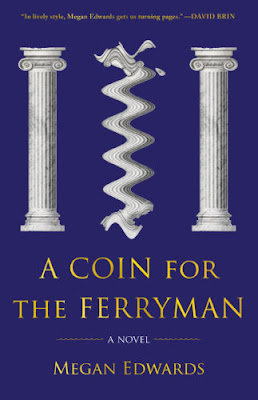
Microreview: A Coin for the Ferryman by Megan Edwards

A time travel experiment gone wrong turns quickly into a breakneck chase thriller and an intimate character study

Man, time travel is going to be a headache for archaeologists.

Cassandra Fleury, casino waitress and amateur classicist, stumbles upon the job offer of her life when a friend of a friend of a friend is in urgent need of a new hire for a top secret science project. Required qualifications: a pretty face and fluent Latin. Cover story: helping date relics from antiquity. The actual mission: teleporting Julius Caesar from the instant just before his death, and interviewing him to collect fresh data on the less known areas of his life and his time.

Author Megan Edwards has previously published a memoir, a romance novel, and two murder mystery thrillers. A Coin for the Ferryman is her first dip into science fiction, and it provides exactly the kind of cross-fertilization that the genre needs every once in a while. This is a fun time travel adventure, but also a profoundly empathetic tale of responsibility, a humanist look at the tragic vagaries of cause and effect, and a sharp analysis of the ethical dilemmas of anthropological research.

Ideally, when you design an experiment, you take care to control all the variables. You strive to keep your subject within clearly defined parameters so you can gather the data you came for. But such degree of control is iffy when you're studying human beings. There have been decades of discussion among anthropologists about the proper methodological design that must be used to preserve at all times the due respect for the dignity of the subjects under research. In the case of A Coin for the Ferryman, the scientists ought to have known that they had no hope of maintaining control of their experiment when their experiment happened to be a man trained to command legions.

Moreover, the instant you invent time travel, you become an accomplice to all the crimes of history. The choice to not intervene in every known murder that has ever happened is morally equivalent to the choice to contribute to their occurrence. But so many threads of causality lead to the present, so many tiny changes sustain this moment that an equally strong case can be made for the need to leave the past intact. Both sides of this discussion are explored in the novel, and at no moment does it pretend that it's easy. To preserve history, the scientists have to return Caesar to the Ides of March. Literally billions of human fates hinge on keeping that moment the way it happened. But to knowingly send him to his death is akin to joining the mob of his stabbers.

As the days pass, and Caesar learns more about our world, the goals of the experiment become increasingly harder to stick to. However, the complications that start adding up and threaten to break the story never slip out of the author's grasp. Her experience with crime fiction comes in handy in the meticulous way the pieces of the plot are arranged: even when an earlier scene that is set later in time has already explained a key event, the moment of the reveal still lands with a punch. Lines of dialogue, physical objects, places on the map, moments in history: every detail fits in place with clockwork precision. Part of the pleasure of reading A Coin for the Ferryman lies in marveling at the care with which the whole is composed of seemingly incompatible parts. Every decent time travel mystery hides a twist that suddenly makes everything resolve into coherence, and this novel achieves the task with impeccable plot logic. It does not matter in the least that you can see it coming: it's the manner of execution that does the trick.

However, the author has too much understanding of human nature to fall into the temptation of making events seem inevitable. Choice is the key component of every turning point. History is not made of predictable, mechanical motions, but of the jumps in the human heart. That was true in Caesar's time as it is in ours. The novel is chock-full of flashbacks, which in most other genres might be wearisome, but in time travel are actually commonplace. The author uses these scenes to highlight the importance of tiny changes that lead to huge effects. In the past of every major character there was a moment that seemed inconsequential yet proved to leave an irreversible mark. The novel seems to be saying that, just as you cannot hope to control history, you cannot hope to control an individual destiny. That sentiment may sound shocking to modern sensibilities, but it's in line with the classical view of fate that prevailed in Caesar's time.

The mission to send Caesar back to his time is resolved in a way that Edwards narrates with extensive detail. A conventional action adventure might opt for a faster pace, but Edwards wants to direct your attention to the fragility of plans and the ease with which our best intentions can get derailed. Mistakes await at every moment of choice. However, this is not a fatalist story. It's trying to say something far more sophisticated than "science is hard" and "people are tricky." The mistakes made by the scientists stem from their unquestioned, culturally conditioned assumptions about Caesar's behavior, and Caesar makes the same kind of mistakes when trying to understand our world. In epistemology, this failure of communication is known as illusion of transparency, and the phenomenon that causes it is called inferential distance. Edwards isn't just replaying the fish-out-of-water trope; she's making a serious effort to illustrate why it happens, how it distorts the practice of the social sciences, and how fatally dangerous it is to believe you know more than you do.

Caesar himself is, of course, the high point of this book. I'm no expert on the classics, but I found this version of Caesar a solid one, and I'm sure those with more knowledge will find plenty to savor in the way Edwards has created a believable human being from the fragments that have survived over the centuries. Part of the joy of science fiction is to make the unfamiliar feel close. In this Edwards excels.

The plot of A Coin for the Ferryman is a dream come true for fans of Roman history, but it's much more. It's an effortlessly readable novel for fans of literary fiction, an erudite thought experiment for fans of anthropology, a pointed satire of office politics for fans of academia, and a welcome addition to the canon for fans of time travel.


The Math

Baseline Assessment: 7/10.

Bonuses: +1 for making great use of the type of subplot juggling that writing crime thrillers trains you for, +1 for the skill with which even the clearly predictable plot points still feel like surprises when they arrive, +2 because science fiction books written by authors coming from other genres can easily make the mistake of trying too hard to prove their nerd credentials by spending dozens of pages on explaining the technical details of how the machine works, but this one wisely keeps the attention away from the science lecture and aimed straight at what the consequences of the science mean to the characters.

Penalties: −1 because the characters not connected to the time travel experiment suspend their disbelief about Caesar's presence in our time a bit too readily, −2 for rather excessive adoration heaped by everyone at Caesar's character.

Nerd Coefficient: 8/10.

POSTED BY: Arturo Serrano, multiclass Trekkie/Whovian/Moonie/Miraculer, accumulating experience points for still more obsessions.

Reference: Edwards, Megan. A Coin for the Ferryman [Imbrifex Books, 2022].