Thursday, March 9, 2017

Thursday Morning Superhero

Before jumping into this week's issues (an all-Marvel edition!) I wanted to wish my fellow nerds good luck this weekend for those attempting to secure badges for San Diego Comic Con.  While not as scary as general registration, this Saturday's visit to the virtual waiting room is for returning attendees only.   Make sure you have all of your groups information and may the odds be ever in your favor!


Pick of the Week:
The Unbeatable Squirrel Girl #18 - If you are looking for a good spot to jump on this series I highly recommend doing so with this issue.  Squirrel Girl, after enjoying the new functionality of her new suit, decides to help out a couple of her superhero friends.  She invites them over to meet Melissa Morbeck, the woman who recently revamped her own suit and added the power of flight.  Apparently Ms. Morbeck isn't quite the good guy she claimed to be and we are now setting up for a battle of animals.  Squirrel Girl and her, well, squirrels versus Ms. Mobeck and her microchipped beasts! Ryan North does a great job interjecting humor into this series that benefits from not taking itself too seriously.  It is a joy to read and one that would make a great gateway comic and bring new fans over to this medium.   I still owe my buddy Jeff for encouraging me to hop on this bandwagon.

The Rest:
Old Man Logan #19 - Jeff Lemire's run on this series continues to surprise and this issue was thrilling from start to finish.  Logan is breaking into a super prison attempting to free someone that is kept on the "Black Level", a part of the prison where the baddies that are associated with the supernatural and the occult.  It seems that, despite all of the death and loss that occurred in the wastelands, feels that he owes it to Hulk's child to return and ensure his safety.  After trying a collection of individuals who might be able to help him, he has nowhere else to turn.  I have a bad feeling about this.


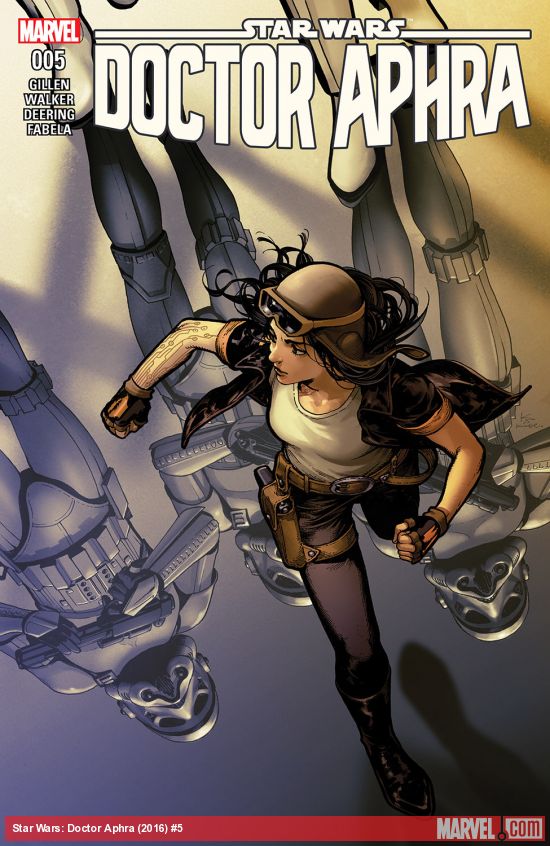
Doctor Aphra #5 - In what remains my favorite of the current Star Wars spin-offs, Aphra and her dad have reached the citadel of the Ordu Aspectu, an ancient Jedi order of a very mysterious nature.  Unfortunately they are followed, and must overcome the mysteries of the citadel in addition to Imperial forces in an attempt to reach the core and the Immortal Rur.  What I really like about this series is that it has a very Indiana Jones and Tomb Raider feel to it, but with all of the excitement and lore that we associate with Star Wars.  There is something satisfying about learning about the Ordu Aspectu through the lens of an archaeologist.  I cannot recommend this series enough.


Man-Thing #1 - When I heard that R.L. Stine was going to pen a series for Marvel, I was quite curious to check it out.  While I was never a big Stine reader, my son has absolutely poured through his Goosebumps series and I was hoping that this might be a series we enjoy together.  After reading the first issue, I am not sure it is age appropriate for him or a series that I will continue to read.  I plan on giving the second issue a whirl and Stine spent a decent amount of time setting up the origin of Man-Thing.  I am not sold of the premise of Man-Thing trying to make a career in the moving pictures, I will give Stine the benefit of the doubt and see how things develop.


POSTED BY MIKE N. aka Victor Domashev -- comic guy, proudly raising nerdy kids, and Nerds of a Feather contributor since 2012. 


Wednesday, March 8, 2017

DYSTOPIAN VISIONS Guest Post: Paul Kincaid, "Can't Get There from Here"

Dystopian Visions is excited to welcome noted SF/F critic Paul Kincaid, with a guest post on the relationship between dystopia and utopia. Paul Kincaid is the author of two collections of essays and reviews, What It Is We Do When We Read Science Fiction and Call and Response, and he is currently working on a book about Iain M. Banks. He has received the Thomas Clareson Award from the SFRA and the BSFA Non-Fiction Award.


In Four Voyages, published in 1507, Amerigo Vespucci reported that, on one of his voyages to the New World, he had left 24 men at a fort on Cape Frio. One of those men, Raphael Hythloday, set out from Cape Frio on a journey south through various curious and unknown countries, until he reached an island separated from the mainland by a man-made canal. This island was a realm called Utopia, after its founder, King Utopus. Raphael spent some time in a country that seemed to him most excellent in its organisation, until, after a few years, he reluctantly decided it was time to return to Europe. There, in July 1515 in Antwerp, he was introduced by the noted scholar Peter Giles to a visiting Englishman who was taking a break from a diplomatic mission. This Englishman, Thomas More, spent time talking with Raphael about his journeys and afterwards wrote it up in a book he called Utopia.

There had been perfect places before, of course. Heaven was the most widely known, the aspiration towards which all Christians (which at the time was assumed to mean all Europeans) yearned. But there were more secular versions, places like Hy Brasil or the Land of Cockaigne, places in which rivers flowed with wine, in which meats and fine food hung plentifully from the trees. A version of Cockaigne became the Big Rock Candy Mountain, known to American hoboes of the Great Depression. They were places of sensual pleasure and repletion, lands marked out by being the diametric opposite of the hard life of famine and disease that was the daily lot of those who dreamed of these places. And they knew they were dreams, they knew they were forever out of reach, that was part of the attraction.

What marked Utopia out from these fantasies of plenty was that it could be reached, and reached in two ways. Reached physically: there was a long, arduous but supposedly practicable journey that could get you from here to there. It was a journey beyond the abilities and wishes of most people, but the idea was established that perfection did not exist only in dreams or upon death, but here in the everyday world we all inhabited. And it could be reached structurally: this perfection was not the province of god or of fairies or some supernatural inversion of the natural world, this perfection was achieved by rational men. If a safe, secure, happy existence could be achieved by sensible human organisation in Utopia, then sensible, rational men could achieve the same here.

Thomas More had been born in a time of war, and had been raised amid the fears and disruptions caused by that war. When he was seven years old he was part of the crowd watching as the new king, Henry VII, rode into London fresh from his victory at Bosworth. At that point, within his short lifetime, two Kings of England had died violent deaths. For More, therefore, perfection was always equated with order. After the disorder of war, the order of peace was desirable; and within any society, order was what brought happiness. He went to his death because Henry VIII’s repudiation of the Catholic Church was, to More, a repudiation of the natural and proper order of society. Unsurprisingly, therefore, More’s perfect society was an ordered society, modelled at least in part on monastical life.

But this was the Renaissance. Printed books, the rediscovery of ancient scholarship either rescued from the fall of Constantinople or found lost amid the stacks of monastery libraries, new technologies, all contributed to the rapid spread of ideas. Utopia was printed and reprinted at an incredible rate, mostly in Latin but also in a multitude of other languages, it was read by scholars the length and breadth of Europe, its ideas were discussed, taken up, developed. Utopia entered the language. And writers across Europe produced their own utopias, restructured to reflect their own ideas of perfection or notions of rationality. In an age of religious turmoil – Luther nailed up his 95 theses the year after Utopia was first published and thus ushered in nearly two centuries of almost constant religious wars – there were religious utopias (The City of the Sun by Thomas Campanella); in an age of scientific observation and experiment, there were scientific utopias (New Atlantis by Francis Bacon); in an age beset by plague there were medical utopias (A Godly Regiment against the Fever Pestilence by William Bullein); in an age of agricultural reform there were utopias advocating for precisely such reforms (Macaria by Gabriel Plattes).

Utopia was, to this extent at least, a flexible thing, its character ever changing. As the religious conflicts of the 16th and 17th centuries began to change in character around the middle of the 17th century, becoming more political, so utopias became political. There were, of course, fictional political utopias, as in Oceana by James Harrington, but more and more works of overt political philosophy were taking on a utopian aspect, from Thomas Floyd’s The Picture of a Perfit Commonwealth to Gerard Winstanley’s The Law of Freedom in a Platform. The dominant form that utopian writing would now take was political, influencing in particular those writers calling for radical or revolutionary change, from Thomas Hobbes to Karl Marx.

By this time, fiction was becoming less studiedly utopian. Utopias shifted away from unexplored corners of our own world to the moon (The Man in the Moone by Francis Godwin), to a parallel Earth accessible at the poles (The Blazing World by Margaret Cavendish), into a future in which the Jews have recognised the true nature of Christ thus signalling the Second Coming (Nova Solyma by Samuel Gott). But inevitably the nature of these other locations, or the means of getting there, became more interesting to both writer and reader than the utopian situation found on arrival. As the Abbé Raguet observed in 1702, utopias are inherently static because having achieved perfection there is no change either possible or desirable, and hence utopias are boring. Utopias would, of course, continue to be written throughout the 18th and 19th centuries and well into the 20th century, but few writers solved the problem of boredom. Indeed, most of these utopias were polemical in nature, advocating for a particular cause, and these writers weren’t particularly interested in solving the problem of boredom since they felt that the cause was of more than sufficient interest for anyone.

***

But almost as soon as there were utopias heralding the achievement of rational humanity, there were anti-utopias that celebrated irrationality. One of the earliest of these anti-utopias, and therefore a work that can be said to provide a template for the form, was Mundus Alter et Idem (Another World and Yet the Same) by Bishop Joseph Hall. Published in 1605, it took its protagonist through the grotesque lands of Terra Australis: Crapulia, a land of gross physical indulgence; Viraginia, ruled by unruly women; Moronia, where the institutions of the Catholic Church are imitated; and Lavernia, a land of thieves.

More’s original Utopia had been intended, at least in part, as satire, but in fact the form was not well suited to satire. An ideal society can be held us as a contrast to the disorder of quotidian existence, but it is not so easy to shape it into a weapon attacking that disorder. To that end, the absurd and grotesque caricature of the anti-utopia is a far more effective mode for satire. Thus the great satires of the 18th century, such as Jonathan Swift’s Gulliver’s Travels and “A Modest Proposal”, were anti-utopian in character.

Utopias continued to be written, of course, usually to advocate for some particular ideal. For instance, the rise of feminist and suffragist movements towards the end of the 19th century produced a rash of stories about female-run societies that were invariable utopian in character, such as Legions of the Dawn by “Allan Reeth” and Herland by Charlotte Perkins Gilman. Similarly, the varieties of socialist thought that arose during the latter part of the 19th century each produced their own notions of utopia, from William Morris’s bucolic News from Nowhere to Edward Bellamy’s Looking Backward, a work that was so successful that it spawned hundreds of Bellamy Clubs to discuss the utopian ideas it contained. But though forward looking in their aspirations, these were all old fashioned in their approach, and despite the few that have survived (Gilman, Morris, Bellamy) the vast majority of the utopias written at this time sank without trace. Meanwhile anti-utopias continued to be deployed satirically, though their excess grotesquerie tended to detach them from reality and from their utopian wellspring.

***

It wasn’t until the early years of the 20th century that utopian fiction was given a new lease of life. In fact there were two changes that happened just a few years apart, one was a reinvention of straightforward utopian fiction, and the other was a remaking of the anti-utopia into something very different, the dystopia. Both these changes stem, I think, from an encounter with the modern, both the literary modernism of Henry James and Virginia Woolf and their confreres, and the technological modernism that wrought devastating changes upon war and politics.

I should point out that if the reinvention of utopia seems to come largely from literary modernism, it was not without an acute awareness of the effects of war and politics on the modern world. And if the emergence of the dystopia seems to emerge out of the horrors of warfare and totalitarianism, the influence of literary modernism can still be traced through its course.

Let me first and briefly look at the emergence of the modern utopia, before turning to spend a little longer considering the creation of the dystopia.

The reinvention of utopian fiction at the beginning of the 20th century is down to one man: H.G. Wells. A decade before his famous split with Henry James, Wells was a close friend of James, Joseph Conrad, Ford Maddox Ford and other writers intimately involved with the new literary movements of the age. He was an advocate of Darwinian ideas of evolution, as filtered through his one-time tutor, T.H. Huxley, and therefore believed that all things change. Similarly, the ideas of Freud, which had already informed the fiction of his circle of friends, suggested notions of impermanence. Thus, although Wells was a utopian, the utopia he envisaged could not be the static and absolute structure it had been in previous centuries. Much of his fiction had utopian overtones, but his first major work on the theme was the novel A Modern Utopia in which he began to explore the idea that utopia was not a place, not a destination, but a process. The ideal, the perfect state, is almost certainly unattainable, but utopia is the process of striving towards that ideal.

The horrors of the First World War, the mechanised warfare he had already partly foreseen in “The Land Ironclads” and The War in the Air, and the rise of totalitarianism, all fed into the mix from which any future utopia must grow. But again and again throughout the rest of his career Wells would return to the image of utopia as process rather than achievement. It was there in fiction such as The Shape of Things to Come as much as it was in his non-fiction, such as his advocacy for the League of Nations.

More importantly, all subsequent utopian fictions, up to and including more ambiguous works like Ursula K. Le Guin’s The Dispossessed or Samuel R. Delany’s Triton, reflect the idea that utopia is not a final achievement, but a process of trial and error, a striving towards a goal that is forever retreating from us.

***

But although utopia was reinvigorated by this new sense of movement, by the notion that utopia was not an unchanging monolith about which all the author could ever do was provide a guided tour, but rather something fluid and changeable into which plot and story could be woven, utopia in the 20th century was still overshadowed by its upstart twin, the dystopia.

If dystopia emerged from the horror of modern war and the threat of totalitarianism, then we first have to consider its absence.

The first modern war was the American Civil War, which saw mass slaughter on an industrial scale. In one day at Antietam, more Americans were killed in battle than in all future wars up to and including D-Day combined. There was trench warfare, there were battling ironclads, there was the precursor of the machine gun; yet the Civil War produced no dystopian fiction. Why this might be is not altogether clear, but my feeling is that America was not philosophically prepared for the patterns of thought that produced dystopias. What underlies most dystopias is the idea of an authoritarian body – the state, the military, a corporation – conspiring to rob the individual of rights, of identity or of worth. But in America at the time of the Civil War transcendentalism still held sway, a philosophy that proclaimed the inherent goodness of people and of nature, and that the institution could not long stand in majesty over the self-reliance of the individual. The popular response to the Civil War, therefore, was largely sentimental: shock at the scale of the slaughter, mourning for the individuals lost, a rash of ghost stories in which those individuals returned. But though the war was seen as an aberration in the natural goodness of the world, there was no perception of the state as a giant machine crushing the individual.

Five years after the end of the Civil War another war in Europe produced another shock to the system. The Franco-Prussian War, and the events of the Paris Commune that followed it, changed the world order. The unification of Germany under the imperial rule of Prussia ushered a new military power onto the world stage, threatening the existing Great Powers of Britain, France and Russia that had maintained the peace in Europe since the defeat of Napoleon. And the German Kaiser was portrayed as exactly the sort of autocrat whose inhuman monstrosity spelled doom for the individual. Allied propaganda during the First World War, which showed German soldiers bayonetting babies, for instance, made Germany out to be the soul-crushing military machine typically found in dystopias. Yet, again, there were no dystopias.

This case is actually more subtle and more interesting than the American Civil War, because what German unification did result in was a mass of invasion stories, typified by George T. Chesney’s The Battle of Dorking. Such stories remained immensely popular right up to the First World War (When William Came by Saki appeared in November 1913). And their popularity was not confined to Britain; variations on the invasion story appeared in France, America (where the threat was sometimes of British invasion), and even in Germany. Such stories are not strictly speaking dystopias, though they might be considered precursors to dystopias, or at least to that branch of dystopia in which Hitler won the Second World War. What they are, rather, is propaganda, a sustained call for increased military spending, for compulsory military service, for rearmament, or for any other plan the author might have to increase readiness for a war that would in time come to seem inevitable. As such they play a small but not insignificant part in the arms race that characterised the years leading up to the First World War.

Such invasion stories fed directly into both science fiction and spy fiction; The War of the Worlds by H.G. Wells and The Riddle of the Sands by Erskine Childers both emerged from and in response to the invasion story. Their part in the development of the dystopia is less immediate and less overt.
Two further events were needed for the emergence of the dystopia: the First World War and the Russian Revolution.

The First World War destroyed faith in a way that the American Civil War did not. Yes, there was an explosion in spiritualism immediately after the war, a hunger for contact with the dead, but this was not a spiritual renewal. Every family in Britain, France, Germany and much of the rest of Europe had been directly affected by the war. So many men were killed that the old social order could not be restored. The First World War put women into the workforce, and gave them the vote; it ended the power of the landed gentry, since there was no longer the workforce available to sustain their estates; it generated discontent with the political system that had resulted in the war, and hence gave rise other political forces, notably fascism and communism. The breakup of the Austro-Hungarian and the Ottoman Empires brought disorder and unrest to Central Europe and the Middle East, storing up conflicts that would not be long in emerging. In the immediate aftermath of the war there was an economic boom that made the 1920s into a decade-long party; but the economic consequences of the war festered long and resulted in the collapse of the 1930s.

The First World War was not an aberration in the natural world order, it was an evil, a moral, political and social wrong, and someone had to be to blame. Everyone laid the blame on a different group: Jews or bankers, governments or the people, aristocrats or hidden conspiracies. How the blame was apportioned didn’t matter, what mattered was that people were now able to think in terms of powerful secretive cabals running the world according to some hidden agenda, while you and I and everyone else was simply a cog in their machine. When you remember that this image found direct expression in such dystopian films as Charlie Chaplin’s Modern Times and Fritz Lang’s Metropolis it is clear that somewhere in the aftermath of the war and the revolution the impression had arisen that the worth of the working man had been devalued by those in power. They had been fed into the machine of war, and now they were being fed into the machine of industry.


Anti-utopias had used grotesque images to poke fun at the world, but now the world itself had become grotesque and it was not fun any more. The response, perhaps the only possible response, was to transform the anti-utopia into a form that reflected the sense of helplessness in the face of the horrors unleashed by the modern world.

***

The second and more immediate trigger of dystopias was the Russian Revolution, out of which emerged the first significant dystopia: We by Yevgeny Zamiatin. The Revolution was itself a response to the chaos of the First World War, but the nobility of its stated aims, equality for all, was belied by its use of civil war and terror. Moreover, it did not take long before it was apparent that equality was to be achieved not by elevating the individual, but by crushing individuality into a dull uniformity. This is reflected in Zamiatin’s novel, in which the protagonist, a number not a name, is subjected to constant state surveillance, and when the power of love generates some individuality in him it is forcibly removed by the greater power of the state.

That We was the model for all future dystopias is almost literally the case. When the manuscript was smuggled out of the Soviet Union and published in the West, one of the first reviews of the book was written by George Orwell. And he, of course, re-used the plot of We in his own dystopian novel about the power of the state to crush the individual, Nineteen Eighty-Four. Echoes of We resurface also in the great American dystopia of the same period, One by David Karp.

The all-powerful state was not necessarily communist, of course. Another version of the soul-crushing faceless state is encountered, for instance, in Franz Kafka’s The Trial, which perhaps stands as a hybrid between dystopia and absurdist anti-utopia. Nevertheless, the all-powerful and dehumanising state, characterised in Orwell’s terms as a boot stamping on a human face forever, did tend to reflect a fear of and antipathy towards communism in many of the dystopias from the middle years of the 20th century. Later, in the same way that utopian fiction came to serve as a platform for particular ideas and movements, so dystopias were adapted for specific causes, the feminist dystopia of Margaret Atwood’s The Handmaid’s Tale, for instance. Even so, the model adopted by these later dystopias is recogniseably the same one we have found in We and Nineteen Eighty-Four, so I tend to identify them as part of the same branch of dystopia.

In contrast there is another branch of dystopian literature that started to appear a little later. The Soviet Union established a totalitarian regime of the left, one that Western governments , particularly after the Second World War, viewed with alarm. It was a world order that, if it got its way, would be all-encompassing and leave the individual no way out of its Kafkaesque coils. So this branch of dystopia tended to emphasise the helplessness of the individual in the face of the all-powerful institution. But for a while the more successful totalitarian regimes in Europe were on the right: the fascists in Italy, the Nazis in Germany, the falangists in Spain. And since the atrocities of Nazi Germany in particular were more quickly and more widely known than the Gulags of the Soviet Union, this generated its own form of dystopian fiction.

The earliest of these fascist dystopias appeared even before the Second World War, perhaps the most notable of them being Swastika Night by Katherine Burdekin (originally published as by Murray Constantine). While Western governments had identified the Soviet Union as an enemy state from the moment of its inception, those same governments were still trying to appease Nazi Germany, despite Germany’s aggression, Hitler’s violent rhetoric and his overt anti-semitic attacks. In common with a number of other anti-fascist dystopias that appeared in the late-1930s, however, Swastika Night argued that Nazi Germany could not be normalised by taking Hitler at his word when he spoke of a thousand-year Reich. This dystopian state is shown to be ruthless, violent, vile in its treatment of women and minorities, but it is also shown to be crumbling from within due to its own contradictions.
Some of the communist dystopias and their ilk, such as Nineteen Eighty-Four and The Handmaid’s Tale, include suggestions that the regime within the body of the novel has subsequently collapsed. But that collapse happens outside the timespan covered by the novel; within that focus the regime is invariably monolithic, unchallenged and unchallengeable. The stories tell us about the tragedy of the individual caught within this trap; and the stories are invariably tragedies, for the individual there is no escape. The fascist dystopias, on the other hand, tend to concentrate on the fragility of the state, and though the individual caught up in it may go through torments, there is always the prospect of redemption, renewal, escape.

This distinct path in dystopian fiction became more obvious after the Second World War, when Nazi Germany had in fact been defeated, and fascist dystopias transmogrified into a form of alternate history in which Hitler won. The known interest of the Nazi High Command in the supernatural has allowed authors to make extravagant rituals central to their dystopias, the hunting of humans in The Sound of His Horn by Sarban, the terrifying Christmas ritual played out in “Weinachtsabend” by Keith Roberts, so that here an element of absurdist anti-utopia creeps back into the dystopia.

In the main what we take away from this branch of dystopian literature is how easily the Second World War might have turned out otherwise, or (in “Weinachtsabend” or in Farthing by Jo Walton) how readily British politicians would have accepted Nazi rule. But no matter how cruel and authoritarian the regime might be, it is patently not the monolith we encounter in the communist dystopias. And where there is fragility there is an opportunity for the hero, who is often portrayed as that symbol of integrity a detective, as in Farthing, SS-GB by Len Deighton, or Fatherland by Robert Harris, to uncover the secret that could bring down the whole regime, or at least rescue one person from the horrors.

***

What I am proposing, therefore, is that since dystopia emerged early in the 20th century as a counter-argument to utopia, two main strands of dystopian literature have developed. There are, undoubtedly, other individual dystopias that do not fit fully or easily into either of these patterns, but for now I think that the two strands I have identified are dominant.

In the one that I have characterised as “communist dystopia” the focus is upon the tragedy of the helpless individual in the face of an all-powerful entity. This entity may be, and usually is, a government, though it could as easily be a corporation, as in The Circle by Dave Eggers. Generally, though not always, there is no way out for the individual, to be an individual is to be a victim in the face of what the modern world has wrought.


The other strand, which I have characterised as “fascist dystopia”, offers the hope of heroism, the chance of escape, because what we see here is that the institution is never as all-powerful as it pretends to be. The very brutality of the regime is liable to be exaggerated simply because it is disguising a fatal flaw, as for instance in Azanian Bridges by Nick Wood, and those who survive the brutality, or find a way to circumvent it, may also find a way to exploit the weakness. Inevitably, as dystopian scenarios have been adopted for Young Adult fiction such as The Hunger Games by Suzanne Collins, it is this strand of dystopia that has been chosen, because it allows the focus to be not on the horrors of the regime but on the heroism of those who find a way to subvert or escape it. Where, in communist dystopias, to be an individual is to be hopeless, in fascist dystopias, and particularly in the YA variants on the theme, to be an individual is to represent hope.

Tuesday, March 7, 2017

Microreview [Movie]: Get Out

Get Out and see this one....
                                                 
In Jordan Peele’s new film, Get Out, the horror beating below the surface is that of the long history of racism and violence against African-American bodies. Near the mid-point of the film, there is an eerie “bingo” scene that calls back into history in one of the most quietly unsettling moments of the film. What Peele has made isn’t just a conventional horror movie, though it is that and an excellent one, it’s a horror film that does exactly what great horror should do: it peers closely at something that happens every day and through the heightening of it sheds light on those everyday horrors.

The film stars Daniel Kaluuya (who is excellent—doing a lot of work through subtle facial expression shifts) as Chris, a photographer, who is going to meet his girlfriend’s (played by Allison Williams, also excellent) parents (Catherine Keener and Bradley Whitford, who are also both terrific) for the first time. He’s nervous because she hasn’t told her parents that he’s black. Essentially, this could be played as a contemporary Guess Who’s Coming to Dinner. But, what Peele does is heighten every emotion and for the first two-thirds of the film, it is a tense and strange glimpse that feels like it could fall into horror or into just a slightly tonally elevated drama. Now, let me say this, this movie is tense as fuck. From the opening to the end, I never felt my body relax (my muscles in fact were so tensed that I had a headache after watching the movie). There are, yes, some jump scares throughout, but those are surface level frights. The tension, though, comes from how just on the edge of real everything is. As audience member’s, we can immediately empathize with Chris—who isn’t sure what level of badness he’s gotten himself into, is this normal behavior and he’s being paranoid or is everything as weird as he thinks it is?

When violence finally comes in the film, and be warned that it does come, it feels almost cathartic after the build-up to it. This catharsis might even be part of Peele’s point. I think it would be easy to argue that the film’s climax, which descends into outright horror film territory is almost unnecessary in the film—which has built itself in such a well-constructed way. But, I’d argue against this, by using the trappings of the horror genre, Peele is both subverting them and also making the audience think about violence in a way that most horror films don’t achieve.

If there’s one element that works slightly less, it’s the side story of Chris’s best friend (played by Lilrel Howery), a suspicious TSA agent who is dog-sitting for Chris and also offering him warnings. However, while this storyline feels tonally out of place, the humor is needed and the character acts as an audience surrogate—voicing the warnings that many of us might be thinking as watch the film.

Finally, I’d be remiss not to mention two other elements of the film: one, it is beautifully filmed and paced. Every shot builds onto the previous one, with again the exception of the side-story. The other element to note is that despite the tension, this is also a deeply engaging film. I usually judge a film on how many times I want to check my watch. While watching Get Out, I felt that we’d reached the climax of the film, but thought we’d only been watching for like 45 minutes. But, it was the climax of a movie that runs around 1:40. I don’t remember a recent film, where I was this oblivious to time passing.

If you’re a fan of horror, go see this film because it’s scary and fun and smart. If you’re a fan of films just in general, go see it because it’s extremely well done. Peele has done what great horror and great movies should do: placed something horrific out where everyone can see it.

The Math

Baseline Assessment: 9/10

Bonuses: +1 for the acting, +1 for the soundtrack, +1 for being an excellent horror movie (which is too rare)

Penalties: -1 for making me so tense that I got a headache (I mean this shows how well done it is, but I'm bitter), -1 for the friend's story-line not quite working as well

Nerd Coefficient: 10/10 


***

POSTED BY: Chloe, speculative fiction fan in all forms, monster theorist, and Nerds of a Feather blogger since 2016.

Monday, March 6, 2017

DYSTOPIAN VISIONS: The Player of Games by Iain M. Banks


Dossier: Banks, Iain M. The Player of Games [Macmillan, 1988]

Filetype: Book.

File Under: Statist dystopia.

Executive Summary: The Player of Games centers on Jernau Morat Gurgeh, a champion game player who has grown bored with his life of leisure. Enter Special Circumstances, one of the Culture's two clandestine services. Through some dirty tricks, SC manages to recruit Gurgeh for a mission to the Empire of Azad, a highly stratified and oppressive society where social and political power are determined by a grand competition, also called Azad. Thus Gurgeh's mission is to win the game, seize power and dismantle the Empire's brutal dystopia.  


Dystopian Visions: There are two forms of stratification in Azad. The first is a gender-based caste system, in which the "apex" sex rules over the males and females, each of whom are essentially slaves. Social and political standing among the apexes is then determined by performance in the game of Azad, which takes place once every six years. The game itself, however, is rigged to give advantage to those players who most ruthlessly embody the predatory values of the ruling elite. Thus the institution of the game itself facilities that entrenchment and replication of Azad's brutally oppressive state system.    


Utopian Undercurrents: Banks juxtaposes dystopian Azad to the utopian Culture, where there are no hierarchies, castes or even strict genders. Without scarcity or hoarding, individuals are free to pursue lives of leisure; and they can even change their biological sex through self-regulated chemical processes. 


Level of Hell: Fifth. Azad is a pretty miserable place for all except the elite of the elite. 

Legacy: The Player of Games didn't exactly light up the field of science fiction when it first came out, but people who read it certainly recognized it for what it was: a rich, complex and deeply political  masterpiece of space opera. Over time its reputation has grown alongside that of its author.

In Retrospect: It is in this novel, far more than any other in the series, where Banks articulates the Culture as a post-scarcity utopia. This is achieved, primarily, by juxtaposing its creature comforts with the dystopia of Azad, whose social cleavages and axes of stratification are in essence amplifications of our own. In this sense, The Player of Games owes a debt to Ursula LeGuin's The Dispossessed, which also presents a form of techno-anarchism as alternative to the embedded inequalities of the class-stratified society. One could also argue that Azad and the Culture each embody one contrasting element of "civilization" in Huxley's Brave New World: the cruelties of eugenic stratification in Azad, and the postscarcity leisure society in the Culture. 


Like each of its predecessors, The Player of Games draws its power by looking past the binary of utopianism-by subtraction. Utopian though it may be, when the Culture is faced with a society it views as inferior, it has no compunction about interfering, even if that means destroying Azad's culture and replacing it with its own. One notes that this is also the moral basis of liberal interventionism, which Banks often opposed in real life. Thus, a conundrum--should we laud the Culture for dismantling an oppressive system, or castigate it for infringing on the sovereignty of a less-developed society? What's ultimately fascinating to me about The Player of Games, and indeed about the Culture series as a whole, is how Banks elides the neat, tidy answers--leaving the reader both sympathetic to and deeply uncomfortable with how the Culture acts on its "superiority." 


Analytics

For its time: 5/5
Read today: 5/5.
Oppressometer Readout: 10/10.


[Note: this dossier has been adapted from an earlier microreview.]

Sunday, March 5, 2017

DYSTOPIAN VISIONS: Brave New World by Aldous Huxley


Dossier: Huxley, Aldous. Brave New World [Chatto & Windus, 1932]

Filetype: Book.

File Under: Statist dystopia.

Executive Summary: Civilization is a wonderful place to live, if you have little imagination or sense of self. But clearly not everyone fits that bill--antisocial Bernard Marx, contemplative Helmholtz Watson and romantic  Lenina Crowne, for example. Bored with games, drugs and casual sex, Bernard convinces Lenina to accompany him on a vacation to the Savage Reservation--a New Mexican pueblo that has not been incorporated into Civilization, and which is instead preserved as a model of the "savage past," so tourists from Civilization can gawk at its inhabitants and marvel at how terrible their lives are. 


While on the reservation, Bernard and Lenina meet John Savage, who is the son of Bernard's boss and a "civilized" woman who his boss abandoned on the reservation once he found out she was pregnant with his child. John is an outcast in Native American society who quotes Shakespeare incessantly (having learned to read from the Bard's completed works). Sensing an opportunity to oust his boss, who has it out for him, Bernard decides to bring John back with him to London. 

John quickly becomes a sensation, which in turn makes Bernard a sensation. But after John's mother's dies from an overdose of the euphoric/tranquilic drug soma, and a failed attempt to embody the Shakespearean ideal of unrequited love (to the decidedly amorous Lenina), he begins to lash out at the suffocating, banal milieu of Civilization--threatening to bring Bernard, Helmholtz and Lenina with him.

Dystopian Visions: 
This is not a dystopia for democracy's precarious moments, but for those times when comfort leads to complacency. Indeed, the creature comforts of the elite alphas and betas are underwritten by manual labor by lower castes, whose intelligence is deliberately stunted (in the laboratories where they are grown) by chemical intervention. The state conditions its subjects through "hypnopaedic suggestion," behavior-altering platitudes piped in during sleep hours ad nauseum.  It discourages intimate relationships that are more than sexual, and forbids exposure to art, literature, religion, science and history. And it further controls potential dissent by providing a euphoric, mood-altering drug, soma, for any and all situations in which individuals might confront trauma or discomfort. This is Foucault's panopticon: an all-seeing, all-controlling structure that relies on covert mechanisms of control in order to exert the least amount of pressure possible to ensure the maximum amount of compliance. 

Utopian Undercurrents: Brave New World, more than any of its peers, is a conscious and overt subversion of utopia. In fact, his "civilization" is presented as utopia--a society where there is no scarcity, precarity or violence, boundless leisure time, access to mood-altering pharmaceuticals and an extended life span. It is, in other words, a well-regulated playground. It is in fact supposed to appear, superficially at least, like something HG Wells would cook up and label the ideal society. 


Level of Hell: First. As far as dystopias go, this one is fairly livable. There's little to no violence and people are, generally, doing things they enjoy. 

Legacy: Brave New World was a sensation upon publication, and is second only to 1984 in terms of recognizability and reputation. Yet the future it imagines--serene and utterly vapid--has never captured the imagination quite like Orwell's neo-Stalinist nightmare. That's too bad, as Brave New World is arguably the more complex and perceptive book.

In Retrospect: Brave New World occasionally shows its age in a bad way (for example, when using cringeworthy racial terms like "Octaroon"). Otherwise, it's incredible how well the book holds up. The imagined future still feels entirely plausible, and Huxley has essentially prefigured many elements of modern societies today--from  prevailing anti-intellectualism and
ignorance of history, to our obsession with escapist gaming and widespread prescription drug addiction. Huxley also prefigures Foucault's notion of the panoptic society, perhaps because both were reading Bentham. 

I had also forgotten how funny it is--absurdist, in many respects, and so designed to expose the absurdity of utopia. And in that pursuit, it succeeds marvelously. Brave New World can, and possibly should, be read as satire. 

Though Brave New World is too early on the dystopia timeline to be a commentary on the notion of dystopia, to the degree that it is on the notion of utopia, it nevertheless has some interesting points to make on that front. As I was reading, it struck me that Civilization seems durable in a way Zamyatin's or Orwell's dystopias do not. To cite the real world examples Zamyatin and Orwell drew inspiration from, Nazi Germany was not durable because it was also genocidal and megalomaniacal, while Stalinism was not durable because it was murderous, paranoid and unlivable. Huxley's Civilization, on the other hand, is something people can buy into precisely because it's just so damned comfortable. It's thus surprising to me that more authors have not taken up this theory of statist dystopia


Analytics

For its time: 5/5
Read today: 4/5.
Oppressometer Readout: 9/10.


Friday, March 3, 2017

Microreview [video game]: Deus Ex: Mankind Divided by Eidos Montreal

Classy Warfare

 
We've reached the fourth entry in the 17 year old series, and we've seen two games followed by two prequel games. The series famously started with the approach "all conspiracy theories are real", but the most recent entries, Human Revolution and Mankind Divided, have skewed away from the most outlandish conspiracies and closer to cyberpunk influences. Still conspiracy is at the center of the theme, and they're beginning to run out of steam with Mankind Divided.

You are once again Adam Jensen, mechanically augmented ex-cop, ex head of security for an augmentation manufacturer, now Interpol agent. You're based in Prague after The Incident, in which most augmented people lost control of themselves and attacked others until their controlling entity was stopped by Jensen. The world is now deeply divided into pro-augmentation and anti-augmentation, with a UN vote removing rights for augmented people coming soon. From this stage, Jensen must investigate the bombing of a subway station that is blamed on pro-aug extremists.

Mankind Divided takes the "any approach to a problem works" philosophy all the way through. If you're sneaky, there's cover to hide behind and venting ducts to crawl through everywhere. Are you shooty? Get your guns out, there's plenty to shoot. Want to hack computers and talk your way out of problems? That works! Lethal, nonlethal, silent, noisy, it all works. An amazing amount of work went into this game to give you the ability to play it as you like.

This is also reflected in Prague itself. By the end, you'll feel like you know the city because every neighborhood and location is well detailed and obviously lived-in. The amount of detail in the levels and thought that went into the gameplay really reflects the love the developers have for the game.

One of the hallmarks of Deus Ex is a globe-hopping plot. That doesn't exist here, but it's not necessarily a detriment. You'll spend almost all of your time in Prague. Again, Prague is so well fleshed-out that it's not Dragon Age 2 situation, but I did absolutely get worn out seeing the same subway train loading screen.

With so much attention given to the gameplay and the city, the conspiracy and the plot as a whole are fairly weak. It tells a very simple story with a lot of the more compelling elements taking place as side missions. It's got one beat (augs vs. non-augs) that it hits over and over. It's not a new beat, as this conflict has been at least touched on by all previous Deus Ex games, and that's a big disappointment. It also suffers from feeling under developed. It's not a short game by any means, but it feels like it ends just as it's picking up. The ending also obviously leads into the next game. This is a real bummer because it seems that the studio is moving on to Marvel games in the near future.

On a not-unrelated note, I would be remiss if I did not mention the presence of expendable microtransactions in this single player game. You can pay real cash for in-game cash or praxis points, the ability development currency. It is utterly unnecessary as I found no need for any more praxis points or cash to support my personal playstyle, but you could make the game a lot easier on yourself with straight cash. And, like currency in the game, once you use it, it's gone. It's not like you're buying yourself a permanently larger chest of cash for every playthrough. You spend your cash and your praxis points and they're gone. It doesn't detract from the game because the game is clearly balanced and designed to be played without external influence, but that just highlights how utterly unnecessary the microtransactions are.

With the future of the series in doubt, this isn't exactly the note that I wanted to see it go out on. Mankind Divided is fun and open-ended in ways that many games can't get close to, but it's hampered by a thin story in a series that used to get high marks for complex storytelling. I don't think Deus Ex is dead by any means, but Mankind Divided makes the case for spending more time on the Marvel games that are sure to bring in piles of money with less effort necessary to impress. Deus Ex: Mankind Divided is a good game that should have been great.

The Math

Baseline Assessment: 8/10

Bonuses: +1 truly a "play as you like" game

Penalties: -2 weak main plot for a plot-heavy series, -1 spending a ton of time criss-crossing Prague can get a little tiring

Nerd Coefficient: 6/10 (still enjoyable, but the flaws are hard to ignore)

***

POSTED BY: brian, sci-fi/fantasy/video game dork and contributor since 2014

Reference: Eidos Montreal. Deus Ex: Mankind Divided [Square Enix, 2016] 

New Books Spotlight

Welcome to another edition of the New Books Spotlight, where each month or so we curate a selection of 6 forthcoming books we find notable, interesting, and intriguing. It gives us the opportunity to shine a brief spotlight on some stuff we're itching to get our hands on.

What are you looking forward to? Anything you want to argue with us about? Is there something we should consider spotlighting in the future? Let us know in the comments!


Cornell, Paul. Chalk [Tor.com, 2017]

Publisher's Description:
Andrew Waggoner has always hung around with his fellow losers at school, desperately hoping each day that the school bullies — led by Drake — will pass him by in search of other prey. But one day they force him into the woods, and the bullying escalates into something more; something unforgivable; something unthinkable.

Broken, both physically and emotionally, something dies in Waggoner, and something else is born in its place.

In the hills of the West Country a chalk horse stands vigil over a site of ancient power, and there Waggoner finds in himself a reflection of rage and vengeance, a power and persona to topple those who would bring him low.

Why we want it: I have been hearing about this book everywhere and I can't wait to dig in. I am a huge fan of horror and this looks to be a truly great read.


Fujii, Taiyo. Orbital Cloud [Haikasoru, 2017]

Publisher's Description:
The global war on terror has a new front—the very edge of outer space.

In the year 2020, Kazumi Kimura, proprietor of shooting star forecast website Meteor News, notices some orbiting space debris moving suspiciously. Rumors spread online that the debris is actually an orbital weapon targeting the International Space Station. Halfway across the world, at NORAD, Staff Sergeant Darryl Freeman begins his investigation of the debris. At the same time, billionaire entrepreneur Ronnie Smark and his journalist daughter prepare to check into an orbital hotel as part of a stunt promoting private space tourism. Then Kazumi receives highly sensitive information from a source claiming to be an Iranian scientist. And so begins an unprecedented international battle against space-based terror that will soon involve the Japan Aerospace Exploration Agency, NORAD, and the CIA.

 Why we want it: I am always intrigued by what Haikasoru are putting out and have never been disappointed yet. This latest science fiction thriller looks to be another hit.


Baker, Mishell. Phantom Pains [Saga Press, 2017]

Publisher's Description:
Four months ago, Millie left the Arcadia Project after losing her partner Teo to the lethal magic of an Unseelie fey countess. Now, in a final visit to the scene of the crime, Millie and her former boss Caryl encounter Teo’s tormented ghost. But there’s one problem: according to Caryl, ghosts don’t exist.

Millie has a new life, a stressful job, and no time to get pulled back into the Project, but she agrees to tell her side of the ghost story to the agents from the Project’s National Headquarters. During her visit though, tragedy strikes when one of the agents is gruesomely murdered in a way only Caryl could have achieved. Millie knows Caryl is innocent, but the only way to save her from the Project’s severe, off-the-books justice is to find the mysterious culprits that can only be seen when they want to be seen. Millie must solve the mystery not only to save Caryl, but also to foil an insidious, arcane terrorist plot that would leave two worlds in ruins.
 Why we want it: The first book in this series, Borderline, was one of my absolute favorites from 2016. I will probably re-read it (something I rarely do) before tackling this gem. I have been looking forward to this book since I finished the first one over a year ago. It has been a long wait but I know it will have been worth it.


North, Claire. The End of the Day [Redhook, 2017]

Publisher's Description:
At the end of the day, Death visits everyone. Right before that, Charlie does.

You might meet him in a hospital, in a warzone, or at the scene of a traffic accident.

Then again, you might meet him at the North Pole - he gets everywhere, our Charlie.

Would you shake him by the hand, take the gift he offers, or would you pay no attention to the words he says?
 Why we want it: Claire North is an author constantly recommended to me by countless fellow readers. I've every book she's written on my shelves and am looking forward to adding this one.


Neuvel, Sylvain. Waking Gods [Del Ray, 2017]

Publisher's Description:
As a child, Rose Franklin made an astonishing discovery: a giant metallic hand, buried deep within the earth. As an adult, she’s dedicated her brilliant scientific career to solving the mystery that began that fateful day: Why was a titanic robot of unknown origin buried in pieces around the world? Years of investigation have produced intriguing answers—and even more perplexing questions. But the truth is closer than ever before when a second robot, more massive than the first, materializes and lashes out with deadly force.

Now humankind faces a nightmare invasion scenario made real, as more colossal machines touch down across the globe. But Rose and her team at the Earth Defense Corps refuse to surrender. They can turn the tide if they can unlock the last secrets of an advanced alien technology. The greatest weapon humanity wields is knowledge in a do-or-die battle to inherit the Earth . . . and maybe even the stars.
 Why we want it: When I was packing up for a move I made sure to leave out the book Sleeping Giants, the first book in this series. I want to be able to read these back-to-back after hearing so many amazing things about the first one.


Murad, Mahvesh and Jared Shurin, eds. The Djinn Falls in Love and Other Stories [Solaris, 2017]

Publisher's Description:
Imagine a world filled with fierce, fiery beings, hiding in our shadows, in our dreams, under our skins. Eavesdropping and exploring; savaging our bodies, saving our souls. They are monsters, saviours, victims, childhood friends.

Some have called them genies: these are the Djinn. And they are everywhere. On street corners, behind the wheel of a taxi, in the chorus, between the pages of books. Every language has a word for them. Every culture knows their traditions. Every religion, every history has them hiding in their dark places. There is no part of the world that does not know them.

They are the Djinn. They are among us.

With stories from: Neil Gaiman, Nnedi Okorafor, Amal El-Mohtar, Catherine King, Claire North,  E.J. Swift, Hermes (trans. Robin Moger), Jamal Mahjoub, James Smythe, J.Y. Yang, Kamila Shamsie, Kirsty Logan, K.J. Parker, Kuzhali Manickavel, Maria Dahvana Headley, Monica Byrne, Saad Hossein, Sami Shah, Sophia Al-Maria and Usman Malik.
 Why we want it: I am obsessed with short fiction and was incredibly excited when I first learned about this collection last year. With an A-list ToC sure to bring some of the best short fiction published this year, this collection is not to be missed.