Wednesday, December 21, 2022

Review: Three Miles Down by Harry Turtledove

This latest novel from the master of alternate history is part amusing, part terrifying, and mostly frustrating

Let's begin with the events that are part of real life:

On March 8, 1968, the Soviet submarine K-129 sank with 98 crew members in the middle of the North Pacific. The Soviet Navy made several attempts to find it, without success. In August of the same year, the American submarine Halibut located the site of the wreck and took photographs of it. As a result, President Nixon authorized a secret CIA mission to bring the submarine to the United States in order to seize its nuclear weapons and cryptography manuals. For that purpose, a specially modified ship, the Hughes Glomar Explorer, was built to resemble a drilling ship, but it actually carried an extendable claw that would grab the K-129 and pull it up to the surface. In 1974, the ship was sent to the Pacific, while businessman Howard Hughes, under CIA instructions, gave the press the cover story that the operation was merely about mining manganese in the ocean floor. As it turned out, the hull of the submarine was broken and only a small part of it could be recovered. To this day, the exact location of the wreck and what was found in it are classified information. In fact, the heated controversy that erupted when the operation was made publicly known led the CIA to invent its trademark "can neither confirm nor deny" response.

And here's where alternate history writer Harry Turtledove inserts the fictional hook: What if the K-129 was sunk by aliens? What if the CIA mission wasn't so much interested in finding the submarine as in getting to the crashed spaceship before the Soviets did? And what would such a technological treasure trove in American hands mean for the course of the Cold War?

Turtledove's novel Three Miles Down is advertised as a first contact story, but, at the risk of spoiling the last sentence of the last chapter, I must warn the reader that that description depends on a generous definition of "contact." The bulk of the novel is concerned with a fictional marine biologist/aspiring science fiction writer, Jerry Stieglitz, who is suddenly recruited to participate in the submarine recovery mission as a junior scientific advisor. Although his rank in the mission is rather low, he becomes instrumental in figuring out the secrets of the alien spaceship and designing protocols for first contact.

However, what little we get of actual "contact" isn't enough to compensate for the interminable political discussions that fill the book. In real life, the secret mission coincided with the final weeks of the Watergate crisis, and Turtledove takes advantage of every available chance to tell the reader what each character thinks of Nixon. A disconnect in worldviews quickly becomes evident: Jerry is the poster image of the '70s liberal hippie, but his positions sound jarringly retrograde to the 21st-century reader. During his preparation for first contact, he reflects on human history and concludes that "The settlement of the New World seemed about as close to contact with aliens as people had ever really come."

Yikes.

Three Miles Down is written in a longwinded style, pausing on each step of each small movement to describe it in full, painstaking, laborious, minutiose, detail. Even the simple action of staying in place gets the circumlocutionary transmogrification: instead of writing "The ship kept its position," Turtledove writes "She got there and she stayed there and nowhere else." This habit gets even more irritating when added to the book's penchant for the unprompted digression. Two characters may be discussing the structural stability of a piece of machinery, and if the reader blinks, they'll have switched to movie awards for adaptations of conspiracy theory literature. Another conversation starts with the bodies of dead sailors found under the sea and somehow swerves to fun facts on genre fiction market trends.

With a more compelling protagonist, these authorial quirks might be more palatable. However, Jerry Stieglitz is not easy to get used to. He thinks almost entirely in terms of pop culture references that he's always proud to assume other people don't know. Too often, he jumps to think of a science fiction story he's read so he can compare it with the situation he's in, which only contributes tiny moments of flavor to the novel at the cost of hearing Turtledove discreetly coughing in the background, pointing at his personal library. Whenever Jerry has an original idea, the rest of the characters congratulate him on having the unconventional creativity of a science fiction writer, which, in a book written by a science fiction writer, can't help but sound cringeworthily self-serving. And when he's not thinking of science fiction, his mind goes to a less savory place: at one point he looks at the spaceship "with an avidity he hadn't known since the very first time he opened a Playboy to the centerfold." Between making off-color remarks about women, coming up with private inside jokes about everything, and playing petty power games with his fiancée, Jerry comes off as a status-obsessed patriarch wannabe.

More than the narration of an adventure, Three Miles Down can be taken as a portrait of a pivotal era in Cold War tensions, in gender relations, and in the science fiction scene. There's almost as much plot dedicated to Jerry's newlywed domestic hurdles as to his dip into international spy secrets. The big promised moment is delayed for so long that the story comes very close to not even counting as alternate history. The reader who expects to see how alien contact will change the world will be sorely disappointed by this book. Its actual focus is on how alien contact changes one guy. If you can stomach the guy's personality, then you'll find something to enjoy here.


The Math

Baseline Assessment: 6/10.

Bonuses: +1 for a rigorous handling of its timeline.

Penalties: −1 for outdated gender politics, −1 because the ending leaves the reader feeling cheated.

Nerd Coefficient: 5/10.

POSTED BY: Arturo Serrano, multiclass Trekkie/Whovian/Moonie/Miraculer, accumulating experience points for still more obsessions.

Reference: Turtledove, Harry. Three Miles Down [Tor, 2022].

Tuesday, December 20, 2022

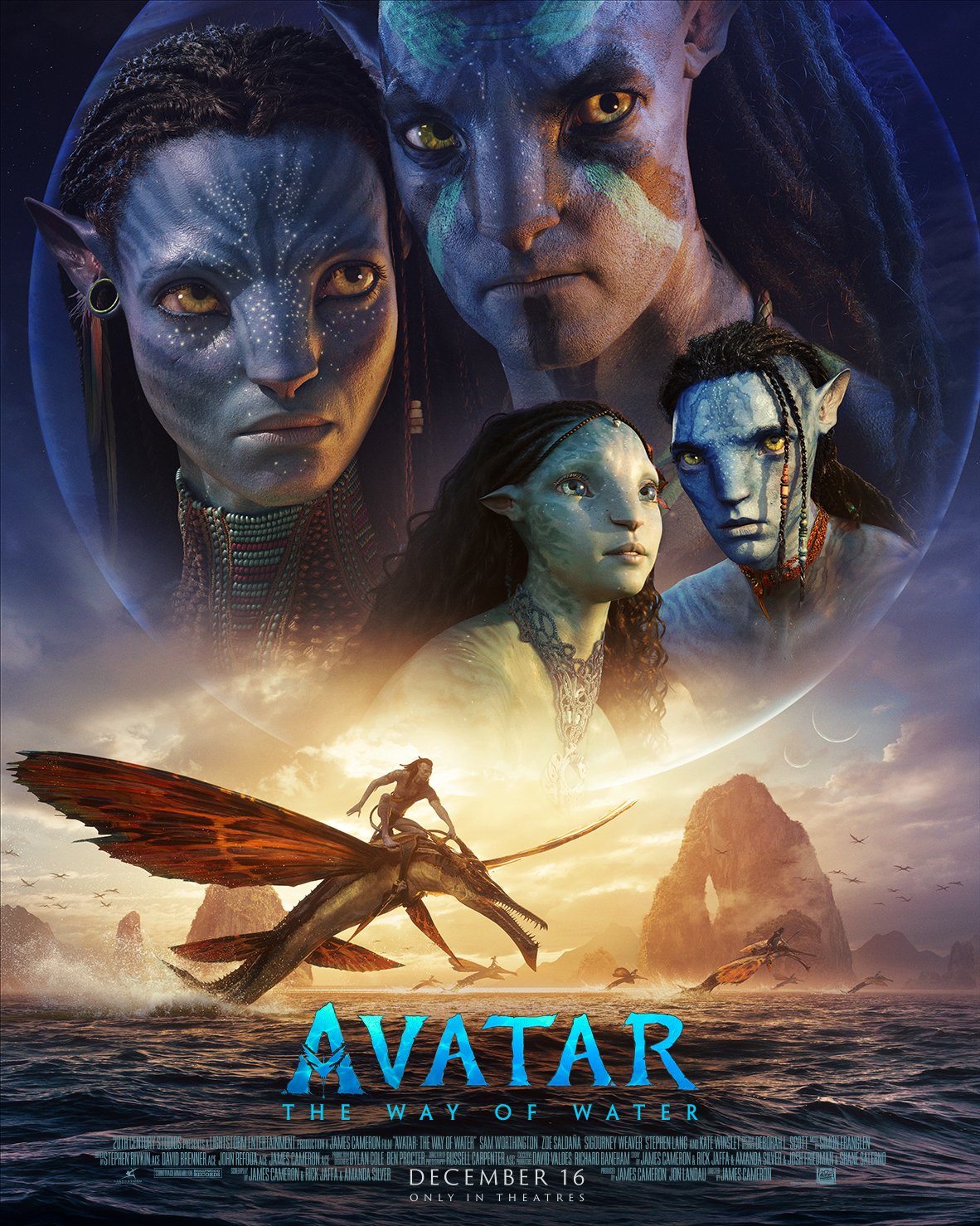
Avatar: the way of self-indulgence

James Cameron's new toys are pretty and shiny, but do they mean anything?

Back in 2009, it seemed like the first Avatar film would set the standard for visual effects for decades to come. It was a completely unexpected technical masterpiece that wowed audiences with hyperrealistic landscapes capable of lulling the mind away from the embarrassing flatness of the characters and the story.

Look at us now, jaded and benumbed by four Avengers, one Gemini Man and three Hobbits. We're in an era when digital magic doesn't impress the way it used to. The sequel Avatar: The Way of Water is doubtlessly gorgeous, with lifelike beasts that look solid and tangible, and edge-on shots of 3D ocean surfaces that make the viewer sway in the chair with the waves. But moviemaking isn't just composing beautiful frames. Despite all the trailblazing technical innovation created expressly for this film, the three hours of Avatar: The Way of Water end up feeling like a three-meal course made entirely of plain water.

We return to the exomoon Pandora, where humans continue to exploit natural resources with no respect for the native population. It's been roughly 15 years since the events of the first Avatar, and our human-reincarnated-into-alien protagonist Jake Sully is now a family man. But the greedy humans are back with a vengeance, and Jake has to flee with his family to avoid bringing any further destruction to the natives. And here we have the first eyebrow-raising choice in this film: the implication that 15 years of Jake integrating into an alien ecosystem and culture to raise four kids of another species doesn't seem worthy of telling, and only when humans reenter the scene do we get to continue the story. For all the lip service that this franchise professes to respecting indigenous communities, it's, at the least, noteworthy that director James Cameron only tells the parts of this community's story in which their colonizers get involved.

Once the basic conflict is established (emphasis on basic), the rest of the movie is an extended theme park ride followed by an admittedly good battle sequence. Avatar: The Way of Water repeats numerous plot beats from the original, dropping our focus character into an unfamiliar environment where he needs to learn the rules of survival, earn the trust of the locals, and fight to defend his new home. We hear the same vaguely New-Agey platitudes about interconnectedness and the cycle of life, we're told again that the whole world functions as a hive intelligence, we watch yet another predatory expedition to destroy a natural beauty for (literally) astronomical profit, and we're left with the same simplistic message: nature good, humans bad.

Worse still, this repetition of preachy talking points occurs without the already minimal character development of the first Avatar. Four alien teenagers are introduced with the single personality trait of "they're teenagers." The lead duo are reduced to the most commonplace clichés of married couples in movies, with a Jake who has confused martial discipline with parenting, and a Neytiri who only reacts to events by making concerned faces but leaves no footprint on the plot. The return of archnemesis Colonel Quaritch might suggest a thematic statement about the damaging effect of human intervention (mirrored in Jake's clumsy attempt to raise his alien kids by introducing them to all the bad parenting techniques of Earth), but that's not what Cameron is interested in exploring. We're here to gasp at picture-perfect fish, not to reflect on the mistakes of humankind.

Even when the dialogue alludes to the ecological problems back on Earth, that crucial piece of context isn't afforded the prominence it should have. Colonel Quaritch's personal vendetta against the Sully family feels absurdly small compared to the actual problem of the entire human species planning to move to Pandora permanently. A plot development that raises the stakes of the main conflict in exactly the way a sequel is supposed to doesn't get more than a throwaway line that Cameron evidently doesn't intend to address until a future movie. The same frustrating approach is used with the character of Kiri, the only truly interesting addition to the story, who spends the length of the movie carrying a neon sign that flashes "I'll matter later."

If Cameron gets his way, we'll have three more entries in this franchise. The problem with multiple sequels in the Age of Marvel is that directors have forgotten that films are not, and should not try to be, TV episodes. Avatar: The Way of Water would have been a serviceable filler episode in a streaming show, with its temporary change of setting, a self-contained chase subplot, and just enough links to the larger arc. But as the standalone movie it should have been expected to be, it's drowned in blue pixels that enchant the eye but have very little of substance to say.


The Math

Baseline Assessment: 6/10.

Bonuses: +100 for once again pushing forward the quality of visual effects in cinema.

Penalties: −100 for having only the faintest, digitally rendered shadow of a plot, a theme, or actual characters.

Nerd Coefficient: 6/10.

POSTED BY: Arturo Serrano, multiclass Trekkie/Whovian/Moonie/Miraculer, accumulating experience points for still more obsessions.

Sunday, December 18, 2022

6 Books with Chloe N Clark


AUTHOR IMAGE CREDIT: Brian Ramos, Chloe at Giant's Causeway

 Chloe N. Clark is the author of Collective Gravities (and NPR and Brooklyn Rail pick for Best Books of 2020), Escaping the Body, and more. She is a founding co-EIC of Cotton Xenomorph, a former contributor to NOAF, and the current writer of a column about limited edition Oreos (forgive her). Find her at www.chloenclark.com

Today she tells us about her Six Books:

1. What book are you currently reading?

What book am I not currently reading might be a better question. Sigh. I tend to read a non-fiction and fiction book simultaneously, because I like to never be at peace. So, the two on the tip-top of my pile currently are Eating to Extinction--which is both very great in terms of learning about food systems and how they are affected by humans, and also very depressing for the very same reasons--and I'm just about to start Dr. No by Percival Everett. I will read literally anything by Everett, and truly believe he should be taught in every lit class.


2. What upcoming book are you really excited about?

There are SO many. But the fact that Victor LaValle has a new book next year simply fills me with joy. I also want to shout out new books by the amazing Juan Martinez and a debut book by John Manuel Arias who we were lucky enough to publish a story by in Cotton Xenomorph.


3. Is there a book you’re currently itching to re-read?

I'm a compulsive re-reader. I have some books that I've reread dozens of times, and will still pick up again when I have the chance. But, I have been particularly longing to dive back into Colson Whitehead's Zone One--a zombie novel that is perfectly human and heartbreaking.


4.  A book that you love and wish that you yourself had written.

I always think that books, at least ones I love, had to have been written by the authors that they were written by. There's some spark of a books soul that is deeply entwined with the person that wrote it. That being said I very much would love to capture the feel of Stephen King's The Body in a book that's written for adults who were once children like me. I love The Body, it's one of my absolute favorite reads, but I can't find myself inside it necessarily and I'd like to be able to write a version that does.


5. What’s one book, which you read as a child or a young adult, that has had a lasting influence on your writing?

Really anything by Diana Wynne Jones. DWJ's stories greatly impacted me as a young reader, and are still ones I return to today. She had such a way of making her characters feel deeply human--flawed and funny and perfect--while also having empathy for even the characters given the least amount of time. If I had to pick just one, then Fire and Hemlock which is one of those deep soul books for me. DWJ had such a firm grasp on what it was to be a child, a young adult, to have imagination. And she was funny! 


6. And speaking of that, what’s your latest book, and why is it awesome?

My forthcoming story collection, Patterns of Orbit, is a multi-genre leap across galaxies filled with stories about forests and demons, the deepest parts of the ocean, alien plants in outer space, SPACE MUSHROOMS, basketball, pie, and more. I hope it's awesome, because I tried to fit the world inside it. 


Thank you, Chloe!

POSTED BY: Paul Weimer. Ubiquitous in Shadow, but I’m just this guy, you know? @princejvstin.

Thursday, December 15, 2022

Microreview: Map and Territory by A.M. Tuomala

A.M. Tuomala’s picaresque Map and Territory presents a pair of mismatched protagonists, who must learn to survive together as they journey across a landscape devastated by an apocalypse.


Meet Rukha. She’s a mapmaker and a cartographer, and is engaged in that art when disaster strikes the nearby city of Sharis. She quickly starts to realize the scale of the problem is greater than a tidal wave flooding one city, and determines she needs to get home and find out how her family, her home, is faring. She needs to, in other words, map out, chart out the scale of the problem and get to familiar ground.


Meet Eshu. He’s an up and coming wizard, and he is caught in the horns of this disaster, just as Rukha is. Unlike Rukha, he has a direct way to get back to where he needs to go, via the Mirrorlands, a realm accessed by specially crafted mirrors that acts as a hyperspace to connect distant parts of the world. But the Mirrorlands themselves are affected by this disaster and so getting home will be much harder than just stepping through a mirror.


Their story, as they seek to return back to their homes, and loved ones, and lives, is the matter of A.M. Tuomala’s Map and Territory.


This is a novel rich in a diverse, queernorm and interesting secondary world. The nature of the problem and having a wizard and a mapmaker as main characters means that we get to cross a lot of ground and see the variety of what has happened, and how people are adapting, changing, surviving and dealing with their local problems. This really defines and works on the picaresque model of fiction. The loose overarching plot is for both Eshu and Rukha to get to their respective homes but it’s a long and perilous journey, full of wonders and dangers along the way. From a mysterious god of death to a desperate populace trying to escape a doomed city by airship to a travel across lush jungles, Eshu and Rukha, and thus the reader, get immersed in a lot of richly detailed locations.


A lot of that richness goes to culture as well. Use-names are extremely important in this world and society, and so for most of the book, Rukha takes on the name Fern. There is symbolic practicality to this (in a world where wizards and names are a thing). That is just the beginning as we see customs, foods, ideas, other forms of address, forms of relationships (diverse and queer throughout) and get a rich sensory detail of it all as we travel across the world with Fern and Eshu. There is something comforting in following the two, even through misadventure and falling in the wake of a catastrophe (which is not cozy, mind you).


I particularly and really liked her depiction of the Mirrorlands as a place of impressions and where geography and finding things was less a matter of accurate precision and much more of an experiential and experienced thing. While at first this might seem to be striking directly at the core of Rukha and her abilities, this is also a plot and worldbuilding point later in the novel as well, showing a deft sense of craft in picking up worldbuilding laid down earlier and turning it into plot and features later on.


Indeed, a lot of the novel works on that. The name Map and Territory goes to the well worn phrase “the map is not the territory” and indeed, as we learn in this work, they most definitely do not. This is not a facile story of a cartographer who “learns better”, mind, it is rather a story of two people who learn new skills and new ways of living in the wake of an apocalypse that changes everything for them, and the world.


But in them learning new skills and new ways, there is some lovely geekery here that I really enjoyed. As a cartographer and a mapmaker with a keen eye for geology and the terrain. Rukha/Fern feels like a protagonist made specifically for me. She feels like a lovely corrective to so many fantasy novels and stories where the geology, the shape of the world and the maps that show that world do not make sense in any sort of way. Sure, Rukha has to deal with a world changed in the wake of a magical aftermath, but she still understands the rocks and bones of the world (to quote my friend the author Gillian Pollack) very well indeed. That geekery comes out onto the page.


In a more fantastical vein, Eshu goes in for geekery of more scholarly and magical vein. It is from him that we get a lot of the magical knowledge and worldbuilding that goes along with that. He is our point man on mirrors, and magic, and looking toward what happened and why to the world. He provides us with a lot of the capital of the magic systems, and for being a wizard more interested in books than anything, also has the most prevalent and stickiest of the social webs of our two protagonists as well. This is a clever and interesting inversion of tropes.


I am going to give this book some high praise. The wandering adventures of this duo, across a fantasy landscape, having adventures, getting into trouble, finding what has happened to the world, is reminiscent to me of the best of this genre of picaresque fantasy, in the tradition of Jack Vance. A cartographer and a wizard wandering across a landscape, running into Gods, demons, strange creatures, disasters, and differing human cultures is definitely in the Vancian tradition. And it is definitely my sort of jam.


This is the kind of novel, though, being that sort of affair, where we reach a resolution point (and an extreme clever subversion of the final conflict), we don’t have all the questions answered, not everything is resolved. There are some moves toward explanation and resolution but in the end the reader is left to wonder if a couple of the theories proposed by Fern and Eshu are actually correct in as what happened, why it happened and what can be done. To reveal what this theory is, is beyond the scope of this review and I leave it for the reader to uncover and discover.


In the end though, the sense of wonder and mystery infuses this work and provides a counternarrative to the type of fantasy that explains every detail of the magic system and how magic works (which also is in this very book in trying to explain Mirror Magic and runic magic). That sense of magical wonder is a definite feature and abiding theme of Map and Territory, and as a reader, I think you will find much to find favor with, here.


A.M. Tuomala’s picaresque Map and Territory follows the footsteps of the best traditions of secondary world fantasy travel narratives like that of Jack Vance, C.J. Cherryh, and K V Johansen. With a pair of well drawn, queernorm characters to guide us and be our entry point, Map and Territory is a riveting journey across a diverse and interesting fantasy landscape that is suffering a mysterious, multi sided cataclysm. Tuomala's work makes us consider who and what is important in the wake of disaster, change and trouble, and what we can each do when confronted by seemingly insurmountable problems larger than ourselves.

The Math


Baseline Assessment: 7/10


Bonuses: +1 for a strong and interesting worldbuilding


+1 for the wondrous of the picaresque style, executed well


Penalties: -1 A couple of shifts of point of view are not quite as effective as they might be.


Nerd Coefficient: 8/10


Reference: Tuomala, A.M Map and Territory [Candlemark and Gleam, 2022]

POSTED BY: Paul Weimer. Ubiquitous in Shadow, but I’m just this guy, you know? @princejvstin.

Maybe there's a parallel timeline where 'The Peripheral' hit the mark

It's a shame that a series with so many interesting ideas didn't try to go farther with them

Amazon Studios TV series The Peripheral, an adaptation of William Gibson's 2014 novel, has come up with an original angle on the overstretched "metaphor for class inequality" trope. In this story, scientists from the late 22nd century create alternate possible pasts where they can run unsanctioned experiments on live humans with cosmic impunity. Those other timelines are not seen as having real moral value, but in one of them lives our protagonist, Flynne, an experienced gamer who stumbles upon these secrets after beta-testing a new VR headset, and who is determined to defend her and her world's inherent right to exist.

This is an amplified echo of the cry of protest you can hear from exoticized peoples: Your Vacation Is My Home. Or, in The Peripheral, something more like Your Disposable Petri Dish Is My Spacetime Continuum. Such a concept sounds like it could spark lengthy discussions about the colonial practices still embedded in scientific research, the ethical loopholes of the gig economy, the rights of counterfactual agents, the mutual responsibilities between generations, and the still unsolved safety issues with brain-computer interfaces.

Unfortunately, the show doesn't meet the high expectations set by its premise. A research institute officially known as The Research Institute and a cleptocracy of mafia bosses collectively known as the Klept are the first signs that The Peripheral devoted only the barest of efforts to worldbuilding. Our near future, as shown in a small town in the southern US, looks almost like the present, with the changes established mostly in dialogue: stratospheric medicine prices, a vaguely mentioned Texan war, ubiquitous 3D printing, far superior video game graphics. With the supporting characters, the show follows the opposite approach: they are established implicitly, with minimal exposition, and the viewer doesn't connect who works for whom and who is whose childhood friend until well into the season. The mental bandwidth expended in keeping track of the scant clues about these characters detracts from the viewer's ability to follow the plot.

In the scenes set in the 22nd century, these deficiencies are multiplied: three separate factions are described but not properly introduced until the halfway point, and Flynne, who should serve as our eyes into that society, is persistently kept in the dark about how it works.

Worse problems afflict the visual style of the 22nd century. We only get to see future London as a vague skyline that blends impossibly cyclopean statues with incompletely rendered ruins, or as deliberately secluded side streets that look like the production team only had access to a small number of set designs. It's true that this society is recovering from multiple catastrophes that killed a huge portion of the world's population, but it's inevitable to get a sense of artifice from the continued recourse to the same few sets and the same few immensely powerful characters without ever learning how ordinary life proceeds for the average human.

The conflict between the near future and the not so near future is hindered by unnecessary mystery. Flynne only discovers what the villain wants from her in the last episode, and then almost by chance. Until then it's hard to get invested in the stakes of her fight, because the show insists on delaying as much as possible the moment of letting the viewer know what every faction wants. The lead characters of this future act as if they were facing an imminent crisis of utmost urgency, but then they spend interminable scenes sitting for tea to exchange barbs about their respective leverage and strategic weak points, and it's no longer believable that there's anything actually being fought over.

The Peripheral suffers gravely from this intentional slowness. Each episode spends too much time in revealing too little at a time, and the way the final two episodes resolve all the plotlines may as well have occurred just after the pilot, if only these characters stopped walking around, looking menacing and launching indirect taunts. This ungenerous pacing, combined with the barely-there London of the future, deals a near-fatal blow to the viewer's suspension of disbelief. It's no wonder that the villains managed to convince Flynne that she was playing a video game instead of visiting a physical place, because this supposedly broken and polluted London looks too small and too fake to take seriously.

There's no word yet on whether Amazon will produce a second season of The Peripheral, but if it comes to pass, the producers should ask for a higher VFX budget or larger outdoor sets, and stop being smugly mysterious just for the sake of being smugly mysterious. The viewer is supposed to be given a reason to care, and this first season relied too much on hidden agendas kept hidden too long for the resolution to have the impact it should.


The Math

Baseline Assessment: 6/10.

Bonuses: +1 for showing a realistic brother/sister relationship rich in complexity and disparate perspectives, +3 for T'Nia Miller's wonderful acting.

Penalties: −1 for the criminal underutilization of Alexandra Billings, −1 for having a tad too many extraneous subplots, −3 for the whiplash of following too slow a beginning and middle with too rushed an ending.

Nerd Coefficient: 5/10.

POSTED BY: Arturo Serrano, multiclass Trekkie/Whovian/Moonie/Miraculer, accumulating experience points for still more obsessions.

Wednesday, December 14, 2022

Microreview [book]: Daughters of the Storm by Kim Wilkins

Daughters of the Storm is an epic fantasy that centres women and allows them the space to be flawed.

Australia has a long history of female authors of fantasy; we've been known to look confused when claims are made that there hasn't been women writing fantasy until recently. One of the reasons for this is Sara Douglass. A pioneer of Australian fantasy, she beat George R.R. Martin to the punch, with her debut novel Battleaxe released a year before A Song of Ice and Fire. Her epic fantasies were an international success at a time when breaking into the US market was all but unheard of. To quote the Aurealis Awards:

Sara Douglass was the flagship author of the HarperVoyager Australian line, which launched the careers of many of our most popular writers, and paved the way for the vibrant and diverse speculative fiction scene Australia has today. Sara’s contribution to the state of speculative fiction in Australia cannot be underestimated...

After she died in 2011, and with permission from her estate, the Sara Douglass Book Series Award was established in conjunction with the Aurealis Awards. The inaugural award was presented in 2016 and is given only once every three years.

The 2021 award was presented earlier this year to Kim Wilkins for the Blood and Gold series. The first book in the series is Daughters of the Storm, and is a fitting successor to Sara Douglass.

When the king of Thyrsland falls into a coma, his five daughters gather at his side to investigate the cause and determine the fate of the kingdom. This is a character-driven epic fantasy told in close third person. I actually tripped over the perspective in the prologue because at first it seemed to me to be coming from the king. It turned out to actually be coming from his wife, the step-mother of the five princesses. This seemed to me to be pretty appropriate for the book, which centres women in a traditionally male-dominated genre.

It's a story that tends somewhat towards the grimdark. Each of the daughters has a very distinct character with definite flaws. While I tend to prefer my characters to be more likeable, I appreciated that they were given the space to be unlikeable and in a variety of ways. With so many female characters present, there's no danger of them needing to be the sole representative (or one of very few) of their gender; they get to be well-rounded people.

Bluebell is the eldest daughter and heir apparent. She's the sister most likely to be voted the Strong Female Protagonist: a fearsome warrior and commander, rumoured to be unkillable, and deeply devoted to her father. However, she's not much of a people person (even if she has her moments), coming across as a bit of a bully, and not always the brightest of sparks.

I admit it took me a bit to adjust to Bluebell as a warrior's name. In addition to undermining expected masculine norms, I suspect there's an aspect of playing with the Victorian language of flowers. According to Jessica Roux in Floriography, bluebells represent humility and faithfulness. While Bluebell is very faithful to her father (at least so far), humility is not exactly one of her key traits.

Likewise, rose represents love. As the second of the sisters, and perhaps the most beautiful, Rose was married off to the ruler of the neighbouring kingdom. Her affair with the king's nephew threatens to jeopardise an already fragile peace. While her desire to follow her heart is most certainly sympathetic to a modern audience -- along with her desire to be treated as more than just a womb -- her tendency to want what she can't have casts a shadow over her love.

I found Ash to be perhaps the most sympathetic of the sisters. In training as a counsellor of the common faith, she finds her gifts of magic and precognisence stronger than the order finds acceptable... and growing stronger daily. When she receives a mental message from Bluebell regarding the state of their father, she flees for home, haunted by a premonition of her own death. Even as she slowly embraces her powers, her priorities remain muddled, torn between loyalties.

The twins Ivy and Willow are rather younger than their siblings. Ivy is thoroughly spoiled and boy-crazy, quickly developing a crush on Heath, Rose's secret paramour. Willow has much more backbone, tending to take after her sister Bluebell. However, she's a convert to the foreign Trimartyr religion and views her sisters as heathens, encouraged by the voices of the angels she apparently hears. This analogue of Christianity is not portrayed in a particularly flattering light... but perhaps no worse than any of the other religions at play in the world.

For the most part, the story alternates between the perspectives of the sisters. However, we do get a token male perspective from Wylm, their step-brother. This perspective is necessary because he functions as an antagonist, and one who is often deceitful and acting alone. Thus we are able to see the true extent of his cowardice.

With so many threads to juggle, the pacing can be a bit slow in places. This is particularly the case towards the middle.

The setting seems heavily inspired by Viking-age England. There are small, feuding kingdoms plagued by raiders from the sea. A new, patriarchal religion is rising up against the old, more nature-focused warrior gods. Magic is part of the world view, which accepts (to varying degrees) the existence of elemental spirits and that a brain fever may instead be the effects of elf-shot. It even manifests in the language, where there are no bedrooms, only bowers.

As might be expected, given the genre, the story comes with some content warnings, including violence, sexual assault, and human and animal death.

While it's most definitely not my cup of tea, I nevertheless felt it was doing some interesting things and well deserving of the award it received.


The Math

Baseline Assessment: 8/10

Bonuses: +1 for the variety of female characters, +1 for balancing flaws with understandable motivations

Penalties: -1 for occasional slow pacing

Nerd Coefficient: 9/10


POSTED BY: Elizabeth Fitzgerald, a writer, binge reader, tabletop gamer & tea addict. @elizabeth_fitz@wandering.shop


References

Wilkins, Kim. Daughters of the Storm [MIRA, 2014]

Roux, Jessica. Floriography [Andrews McMeel Publishing, 2020]


Tuesday, December 13, 2022

A tale of two Pinocchios

Pinocchio is the perfect story to illustrate this felicitous contrast between the soulless and the alive, the feigned and the sincere, the automatic and the intentional


Cultural critic Walter Benjamin would have had a field day studying Disney's remake binge. In his immensely influential essay The Work of Art in the Age of Mechanical Reproduction, he wrote about the way mass industrial techniques have modified the social function of art and made it depend on a new set of assumptions: whereas unique creations used to be made to be appreciated personally in a fixed location, and their value resided in existing precisely where they did, infinitely repeatable copies are made to be exhibited to everyone, and their value resides in being readily accessible anywhere.

Let me try to give a more vivid description of Benjamin's argument: It is a materially different experience to buy a plane ticket, land in Saint Petersburg, take a cab to the Hermitage Museum, walk to the collection of Italian Sculpture of the 15th-20th-Centuries, and stand before Pietro Ceccardo Staggi's marble sculpture Pygmalion and Galatea, versus typing the museum's URL on your browser and searching for a digital image of the same statue. In both scenarios you're experiencing the same geometrical shapes, colors, proportions and subject matter. If you had the real statue in front of you, you wouldn't be allowed to touch it anyway, so what's the difference between both modes of seeing? The difference is what Benjamin called the "aura" of the work of art. When you go to the trouble of visiting the real statue, you experience it on its terms, not yours. In Benjamin's words, there is no replica of presence. Whether we want it or not, we endow the original object with a set of cultural meanings that the most faithful copy doesn't remotely deserve.

(To be fair, this whole discussion relies on Western categories of art theory. Eastern art uses completely different notions of authorship, authenticity and reproduction.)

By sheer chance, acclaimed Mexican director Guillermo del Toro has just released on Netflix his personal artistic take on the tale of Pinocchio almost at the same time as Disney+ launched… whatever their remake is trying to be. We have here an opportunity to analyze the process of copying, remaking, recreating, and reimagining. The fact that this story happens to be about an imitation of humanity that ends up reclaiming an authentic humanity is the marvelous cherry on top.

Let's go back to Staggi's statue Pygmalion and Galatea for a moment. This sculpture represents simultaneously a culmination and a transgression of the act of representing. The myth of Pygmalion and Galatea is about an artist who creates a copy of the human shape, only for the copy to miraculously become alive. This motif of the representation that assumes the reality of the thing represented has permeated literature from Adam, the man made of earth, to Frankenstein's creature, the man made of men. It's important to keep this symbolic tradition in mind before engaging in a discussion about Pinocchio (the puppet that represents a child), Pinocchio (the Disney movie that represents the puppet), Pinocchio (the Disney movie that repeats the Disney movie) and "Pinocchio" (the literary archetype that has been copied so many times in speculative fiction).

What allows this analysis to move fluidly into and out of the diegetic level is the fact that not only is Pinocchio the movie a work of art; Pinocchio the character himself is also a work of art, an exceptionally precious work of art that thinks and speaks and thus can be asked directly about its meaning. Notably, Disney's new Pinocchio aspires to occupy obediently the position of Gepetto's dead son, while Netflix's Pinocchio embarks on an epic battle for his dignity and autonomy.

It's no coincidence that, being a puppet, Pinocchio's most common job in all adaptations is as an actor, a living representation of an imagined person. Nor is it a coincidence that Pinocchio's defining character flaw is lying, that is, the misrepresentation of reality. Pinocchio is a walking and talking lie that fools no one, a nonhuman entity that mimics humanity. While the 1940 animated movie is one of Disney's most beloved productions, the 2022 remake is, just like its protagonist, a lifeless thing, born of hubris instead of love, made only to evoke the nostalgic memory of an unrepeatable original.

If this remake didn't exist, Del Toro's Pinocchio would still be a masterpiece. But in the context of a media landscape where both versions can be watched in the same season, a big part of the discussion shifts toward how evidently and indisputably inferior Disney's remake is. It follows the 1940 movie so faithfully that it has nothing of its own to say on its topic. Its reason for existing is not to communicate an artist's inner being, but to add to a list of collectible trinkets. Gus Van Sant's widely ridiculed recreation of Psycho is a more interesting and thought-provoking cultural artifact than Disney's automated self-cannibalization.

One of the most salient ways one can begin to perceive the differences between all these Pinocchio adaptations is by paying attention at the way their respective names are marketed. The 1940 version was Walt Disney (the human being)'s Pinocchio. The 2022 remake is Walt Disney (the company)'s Pinocchio. On the Netflix catalog, Del Toro's version is explicitly named Guillermo del Toro's Pinocchio. These naming choices are the first indication of the fundamental difference that exists between art created with an unmistakable human touch and art created by corporate mandate.

What makes the human touch special isn't even its uniqueness; it's enough that it has intentionality. Argentinean writer Jorge Luis Borges wrote a short story called Pierre Menard, Author of the Quixote, where he proposes that a different writer, in a different era, who spontaneously produced a text perfectly identical to Don Quixote would nonetheless be producing a different piece of art, because the context of creation and the context of reception are factors in the production of meaning. So let's look at the context of 2022. Disney's remake of Pinocchio comes to light in the nascent era of art produced by algorithm, the extreme state of the removal of the human subject from the process of artistic expression. This impersonal form of creation works by butchering thousands of previous creations into tiny pieces and recombining the parts into unexpected and not always logical compositions. It has an air of necromancy to ask a bot to cook up a realistic photograph of Napoleon shaking hands with Bugs Bunny in the style of Picasso's Blue Period. It's a recipe made of dead ingredients, all flavor and no substance.

This is also the era of blockchain art, art that doesn't exist to be enjoyed but to be traded. It's the era of hideous bored apes that don't demand appreciation for themselves but for their owner. It's the type of art that is only capable of expressing the amount of money it cost to acquire it.

Art with an impersonal motive is not a new threat. Italian educator Maria Montessori thought that children develop best when the learning environment accomodates their interests and capabilities. This is the complete opposite of the pedagogical method that prevailed in her time, a hyperpatriotic militarism that was more interested in making soldiers than citizens. Montessori denounced Mussolini's government for wanting to shape Italian youths by what she called "brutal molds." The choice of wording is polysemic: a mold is a tool of artistic creation, but also a tool of the industrial assembly line. The fascist project was to craft a nation of identical copies of an idealized man, representations instead of authentic subjects. Benjamin's essay criticized the mechanical copying of art, but Mussolini had already envisioned the mechanical copying of the human being.

This is what makes it so fascinating that Del Toro's Pinocchio is set during World War II. Fascism needs puppets, but Pinocchio is a puppet without strings, a free soul that cannot be controlled. He resists the reduction of his right to exist to his utility to the state; rebels against the corruption of his art by fascist propaganda; and ultimately rejects the us/them mentality at the root of every war. In his last heroic act, by willingly accepting human mortality, he emerges victorious over the worst of fascist horrors: a life where each individual death is trivial.

It's especially significant that this Pinocchio adds a subplot about a youth military camp exactly at the point in the story where a more conventional adaptation would insert the trip to Pleasure Island. In Pleasure Island, the most disobedient children lose all control and end up losing their humanity. This version of the tale inverts the moral message: here the most obedient children are controlled to the point that they lose their humanity. Where the original Pinocchio was a simple moralist fable about the dangers of rebellion, this adaptation is a more mature argument for the need of rebellion. This is the type of daring resignification that art needs from time to time to stay relevant, and that Disney would never dare try with its sacrosanct classics.

In his Pinocchio, Del Toro creates a child that would have made Montessori proud. He's innocent, literally born yesterday, but he meets the world with an undefeatable enthusiasm, with a sincere awe for the gift of being alive, and that spark of pure joy keeps burning under the cruelest circumstances. In contrast, Disney's remake gives us a Pinocchio without an identity, a nondescript tabula rasa waiting to be given a role to play. In the Disney movie, he's never his own person, following the brutal mold of brand integration to the point of doing a three-point superhero landing that should win a Golden Raspberry for cringe. In the Netflix movie, his first interaction with society is to question why an immobile statue of Jesus (another miraculous son of a carpenter) gets more respect than the living and breathing child he obviously is.

This is a Pinocchio (and a Pinocchio) with a beating heart. It's not afraid to show us the degree of despair that pushed Gepetto to the absurd task of building an artificial child, a fantastically shot scene that hits with the emotional punches of Astro Boy and Frankenstein. No portion of this suffering is hidden from the audience. There's nothing wrong with admitting that grief is painful, and war is painful, and loneliness is painful, and life is painful. The raw honesty with which the movie begins earns it an amount of goodwill that outweighs the artificiality of its medium. Over on the Disney side, Gepetto quickly forgets about his dead son by saying, "No more of these sad thoughts, huh? Time for some happiness," a quintessentially Disney attitude if ever I heard one.

Remember Pygmalion and Galatea? I neglected to mention one detail. The statue shown in the Hermitage Museum of Saint Petersburg is not an original. It's based on the earlier sculpture on the same topic made by Étienne Maurice Falconet and currently kept at the Walters Art Museum in Baltimore. But the version in Saint Petersburg is available for public viewing, while the one in Baltimore is (as of today) not. If you visit the website of the Hermitage Museum and search for Pygmalion and Galatea, you'll be seeing an image (the photograph) of an image (the statue) of an image (the earlier statue) of an image (the written myth) of an image (Galatea the statue) of an image (an idealized woman). And yet, the photograph still manages to convey the same sentiment of fascination and devotion as the first recitation of the myth centuries ago.

Guillermo del Toro has created a 21st-century classic, a Pinocchio imbued with a distinct artistic vision, a moral standpoint, a visual language of its own, a fully-developed protagonist, a complete worldview. The Walt Disney Company has created a souvenir shop copy of a revered classic, an item in an accounting spreadsheet, a cynical act of nostalgia bait with less moving power than a sixth-hand reproduction of someone who never lived.


Nerd Coefficient: 3/10 and 9/10. I hope I don't need to clarify which is which.

POSTED BY: Arturo Serrano, multiclass Trekkie/Whovian/Moonie/Miraculer, accumulating experience points for still more obsessions.