A
poignant exploration of racism and appeasement wrapped in sarcastic, quirky, rom-com
magic.
A “magical
negro” is a sarcastic artistic term used to describe an inspirational Black
side character whose sole purpose is to inspire, comfort, and motivate the
story’s protagonist. Although they frequently appear in speculative films and
television, they don’t typically have actual magical powers. “Magical” is a
sarcastic reference to their ability to help the (not-Black) protagonist find
motivation to work through their emotional obstacles. It’s sort of like a
mentor but often with more of a folksy / self-deprecating vibe. I won’t list
specific films or shows but, if you think for a second, you can probably remember a
few examples. The trope of the "magical" Black person is not bad per se, but it
becomes exhausting when it’s repeatedly used, especially as a way to give lip
service to diversity while keeping diverse characters in background roles and
out of leading roles.
The
American Society of Magical Negroes parodies
this literary and film trope by creating an actual organization of people who problem
solve anxiety-causing issues for white people in the real world. If you are
expecting some kind of Black version of Hogwarts or Shadowhunter Academy, prepare to be
disappointed. The film is a sarcastic deep dive into society’s underlying class
systems. It’s much more of a companion film to social commentary stories like American
Fiction and Origin than to fantasy pieces like Harry Potter
or Shadowhunters. There is some magic on screen but not much. The fantastical
moments are meant to be a brief, humorous backdrop, not a primary plot device.
In the
film, Aren (Justice Smith) is an extremely polite, young Black man and a
struggling visual artist. After a disappointing art show he encounters a drunk
woman at night who hands him her purse, causing the woman’s two male friends to
accuse Aren of stealing it. Aren is understandably fearful of what will happen
next. A kindly older Black man, Roger (David Alan Grier), appears and magically
transfers the purse back to the woman. Roger then engages in charming, folksy
banter about the delicious food at a nearby restaurant. This de-escalates the
situation and the two men who were previously threatening Aren become friendly
and leave happily with the woman. Roger then invites Aren to join a society of
people who use folksy banter make white people feel more comfortable, then they
pivot to inspirational cliches to inspire them. By doing this they help make
the world a safer place for people of color. According to Roger, without this
surreptitious placating behavior, the violence against Black people will escalate in America.
Obviously
there is a lot to unpack in this premise. Aren is led through secret door in an
unassuming shop and finds himself in a meeting room of Black people who have
been granted minor magical powers in exchange for taking on assignments to be
supportive advisors to stressed, non-Black people. Aren has some understandable
hesitation about the mission statement (and even the name) of the group but
ultimately (due to his dwindling finances) accepts a job inspiring a self-absorbed
young man, Jason (Drew Tarver), at a tech company. With Aren’s help, Jason progresses
at the firm at the cost of Aren’s own career hopes and at the cost of Aren’s
love interest Lizzie (An-Li Bogan). Introverted Aren initially enjoys the
opportunity to be accepted in his new workplace and to help Jason. But Aren grows to resent his
artificially subservient role. Additionally, despite her superior work performance,
Lizzie finds herself cut out of opportunities because Jason’s louder persona is
confused with talent by their bosses. The story has some additional interesting
context: Aren is biracial (partly white); Lizzie is a person of color; and, although
Jason is self-absorbed, he is not a true villain. In addition to the scenes of Aren’s
adventures, we also see snippets of the other Society members working in
various timelines and locations, inspiring leading characters. Each scenario references a famous classic film with the “magical negro” trope.
As you can
imagine, this film is not for everyone. The title may mislead some into
thinking it’s a high fantasy—it’s not. Although the Society members can time
travel, teleport, and blink objects into existence, magic is a minor part of
the story. On the other hand, the interactions of Aren and Lizzie make the film
feel substantially like a rom-com. But the trope of the misguided romantic
triangle (between Jason, Lizzie, and Aren) is not the true message. The real story is
about race and classism (and later sexism). The theme of the supportive, inspiring
colleague quickly shifts to the more troubling concept of appeasement by those in
the minority towards those who are in power in society. These uncomfortable, underlying
themes will resonate with anyone who has felt like an outsider in a space that
should equally belong to them. After several mildly humorous and ironic
moments, we have a climactic scene where Aren decides to tell Jason the truth
about his feelings of fear and erasure. It’s not a universal monologue on all
types of racism but rather a specific niche of oppression felt by some people
of color in some societal spaces. It rages against both the appeaser and the
oppressor.
The ultimate
messaging is sharp and meaningful but it may get lost in the rom-com hijinks. Like
The Book of Clarence, the story is weighed down by an overload of conflicting
film elements. However, for those who can relate to Aren’s dilemma of standing up for himself in a society that will then see him as threatening or alien, the film
will truly hit home. The American Society of Magical Negroes is a good
companion piece for other recent films on race, such as American Fiction,
Origin,and The Book of Clarence. For those who connect with
the story, the film will provide a lot to ponder and hopefully create a
starting point for meaningful discussions on Black roles in film and in real
life.
Nerd Coefficient: 7/10
Highlights:
·A poignant exploration of racism and appeasement
·Conflicting thematic elements
·Heavy,
biting sarcasm that may elude some viewers
POSTED BY: Ann Michelle Harris – Multitasking, fiction
writing Trekkie currently dreaming of her next beach vacation.
We don't really address electoral politics on this site, but certainly a couple of elections in the United Kingdom and United States have touched on an ongoing discussion within genre circles — that of increasing diversity and the response to it.
There are so, so many reasons why genre fiction, movies, comics are great. As much as going to a made-up world can be an escape (and it certainly can be!) from the one we live in — which is often scary and confusing, hurtful and unfair — genre stories, regardless of medium, can be an invaluable lens through which to look at and understand our own, real world and our lives in it. For me, Slaughterhouse-Five, about a man who comes "unstuck in time," forever changed the way I exist in the world.
But beyond that, it can give us a community. Fandoms built around genres, or shows, or movies have given people real and virtual communities around the world. If you're a guy who's terrified of letting anyone in your small town know you like My Little Pony, you can commune with people across the country who are just as passionate about it as you are, and won't judge you for digging it. I can tell you that, for me, lining up in a queue that stretched down the block and around the corner to see Bubba Ho-Tep let me know that I may be weird, but I was not alone in wanting to see a movie where old Elvis fights an ancient mummy who sucks souls out of retirees' butts. And this site, and our team of multi-national writers, only exists because we all geek out over genre stories, comics, games, what-have-you.
Speculative fiction can give us community, and it can give us a voice. If you have a story to tell, I want to affirm that it matters. It may not be good...I mean, you might not be a very good storyteller. Most people aren't. But that doesn't mean your story doesn't matter. Are you struggling with your identity? Tell your story. Are you excited by things that blow up? Tell your story. Do you feel like you don't fit in? Tell your story. Do you feel like your way of life is disappearing and you don't know what the future looks like? Tell your story. Are you scared? Tell your story. Because you are not alone in any of those things, and if you put your characters in a spaceship, or on another planet, or give them a magic staff, we'll read that shit. And other people who want to write the same kind of stuff will be your beta readers and give you notes for no other reason than we are nerds of a feather.
And finally, these stories can give us hope. There's a lot of dystopian sci-fi and grimdark fantasy, and that all has its place. But there is also the aspirational. There is Star Trek and there are visions of worlds and lands and times that have solved the problems we are still grappling with. These stories can give us visions of better worlds that we can strive to make ours look like. And that's not nothing.
A lot of people are worried right now. I'm worried. I feel like I'm outside, looking in at something I don't understand at all. But I'm a nerd, and that means I've got experience with this feeling. It's different this time, I won't pretend it isn't, but I know that I'm not alone, and you are not alone, and we may not be able to protect each other all the time, but we can embrace each other, and that's not nothing, either.
Besides, if "normal" is what we've seen in these elections, give me different.
Posted by Vance K, cult film reviewer and co-editor of nerds of a feather, flock together since 2012. Folk singer and Emmy award-winning producer.
Here’s how it works: an editoral, opinion piece, or critical essay written by an external blogger, critic, journalist, or creative person is presented by a regular contributor to nerds of a feather, flock together; it is then answered by other regular 'nerds of a feather, flock together' contributors. Crucially, each respondent will also respond to each preceding respondent. This time around, for a change of pace we use a new collection, not another article, as our jumping-off point. This episode's cast o' characters:
Vance K (Respondent #1)
Vance is the co-editor and usually cult-film reviewer for ‘nerds of a feather, flock together.’ He records loud folk songs under the name Sci-Fi Romance, and writes and directs things for a living.
Charles Payseur (Respondent #2)
Charles is an avid reader, reviewer, and writer of speculative fiction and poetry. Most of his time and energy goes into maintaining Quick Sip Reviews and being a general nuisance on Twitter as @ClowderofTwo. He's contributed to Nerds of a Feather since 2014.
The G (Respondent #3)
The G is founder and co-editor of 'nerds of a feather, flock together.' In his spare time, he makes synthwave music. Find him on twitter @nerds_feather.
EPISODE 5: In which three nerds tackle the battle over the direction of today's sci-fi and fantasy with the help of some historical perspective
This month, The Comic Book Legal Defense Fund published a new collection called She Changed Comics (link here), which profiles 60 female comics creators from the dawn of the medium until the present day. Coming out as the book does in the current social atmosphere, telling the long story of the impact a marginalized group of creators had on a medium and the ways in which their voices helped shape and re-define the kinds of stories that are told and the ways in which they are told has tremendous resonance for the present day. With the Hugo Awards embroiled in a years-long struggle between individuals with different views of what science fiction and fantasy should look like now and in the future, and the raging inferno of the 2016 U.S. presidential campaign and one candidate's appeal to reject out-of-control political correctness, this is a conversation that has huge ramifications both inside and outside of genre circles.
Vance K
I reject the notion of "the good old days."
I think that pretty much any period of history people can point at and say "those were the good old days," either socially or in media like comic books or elsewhere, can be pointed to by another group of people who could say "those were the darkest days of my life." Like Louis C.K. said, time travel only works if you're white. If you're a black time traveler, you can't really go back to any time before 1980.
The gifted short story author James Tiptree Jr. counted Isaac Asimov, Arthur C. Clarke, Philip K. Dick, Robert Heinlein, and other fixtures in the sci-fi pantheon as contemporaries. But James Tiptree Jr. was in actuality Alice Bradley Sheldon, and she had to use a male pseudonym because publishers wouldn't even consider science fiction written by women. Sheldon was a fantastic writer, and another of her contemporaries, Shirley Jackson, remains one of my favorite authors. But there were undoubtedly female writers who were just as gifted and yet were never published. Or budding writers who were told that girls didn't write that kind of thing...or write at all. And selfishly, as a fan, I'm really sad about the stories that stayed in those pens and that I'll never get to read.
But I get it — I understand the pull of that kind of "good old days" thinking. Somewhere, usually in childhood, something struck sparks in that place in our hearts lined with kindling, and we chase after that feeling for the rest of our lives. That's normal. Back in May, NPR did an interview with former Republican presidential candidate Pat Buchanan where he said that he wanted "an America like the country I grew up in, which was a pretty good country." It was a pretty good country for him, I'm sure, and one in which he felt safe and protected. But take a look at the pictures by Swiss photographer Robert Frank, who crisscrossed the United States in the 1950s and documented what he saw. Collected in his book The Americans, which was brutally panned at the time, shows a much less rosy picture of the "idyllic" 1950s, where "everybody" lived in nice suburban homes and respected their elders and lived like Leave it to Beaver.
For me, what it comes down to is "Who gets to tell their story?" The 1950s zeitgeist prized homogeneity; that's why the houses all looked the same, and there were rigid social roles that people were expected to keep up or else. I was talking to an old police lieutenant a few weeks ago, and he told me that when he started with his force about thirty years ago, the guys with as many years on then as he has now all started working in the 50s, and they went to so, so, so many suicide calls. And I think that's because it takes an unreal toll on someone to pretend to be something they're not. It's only now that we're beginning to crack the lid on that box and get a glimmer of all the ways people and their experiences can be different, and all the ways that they've had to contort over the years to pretend they were just like everybody else. The people that looked the same, acted the same, thought the same, they were the ones that got to tell their stories. But that left a lot of voices out.
People like Nalo Hopkinson and N.K. Jemisin, who are writing some of the most compelling SF/F today, they didn't get to tell their stories then. But now they can. And it's still an uphill climb for too, too many people, but as a reader, my experience of the world has always been broadened and enriched by what I've read. I feel like getting to hear stories from more and different voices helps scrub away some of my ignorance of the world and its many, many facets, and I feel like that's a gift. So I for one am excited that we can read Raina Telgemeier's and Marjane Satrapi's comics, despite people who want to silence them. I think a broader understanding of the world and the people in it is only to our benefit, and I'm personally excited about the broader direction that genre fiction seems to be heading.
Charles Payseur
I come to the discussion about the "State of SFF" from a strange place. Well, not really. I come to the discussion from a place that a great, great many people do. From the outside. Not because I haven't been a fan of SFF my entire life. I have. Not because I don't participate in SFF fandom. I do. Not because I don't create SFF. I am a SFF fiction writer, a SFF poet, and a SFF reviewer and nonfiction writer. That said, I do not come to this discussion from within SFF. Despite my participation in SFF and my engagement with it, I hold very little power in SFF. And when I talk about SFF, when I write it and when I read it, I'm doing so from the outside looking in. Because I do not get to define what SFF is. Because I do not get to choose what SFF gets published. Because at times I cannot even pay to have access to the stories that I want to read, much less get paid for the stories I want to tell.
I am queer. I write SFF romance and erotica and poetry as well as more "mainstream" stories. I argue that the SFF canon needs to be thrown out the window. I hate institutional genre distinction and segregation. I somewhat recently read Melissa Scott's Trouble and Her Friends for the first time. I love how that novel shows what difference can do within groups of people. In the novel, Trouble is part of a group of queer hackers who find themselves hated by the larger hacker community because they are "political." Political meaning because they are queer and because they cannot separate their queerness from their hacking. Likewise, the most pervasive complaints I hear when people talk about the "State of SFF" (and the state of the country, the world, and probably beyond) is the terror of political correctness. But what does it mean to be political? Are you political if you vote? Well, not for the swaths of the country that talk about political correctness like it's some new form of terrorism. They can just vote. Is it being passionate about something, about SFF? Again, not for those who bemoan the SJWs in their SFF. They can just be passionate. So then, being "political" has nothing to do with what you do. It has to do with who you are.
And let me say this. Political correctness, as some call it, hurts no one. It does the opposite of hurt people. The only claim I have seen as to the harm done by political correctness is that it stops certain stories from being written. That people are, essentially, censored. People tell me I get worked up about things, which I suppose is a big step up from being told I'm hysterical. Because calling someone hysterical is a threat. It pulls from a history where a man could have a woman institutionalized for being too political. Too passionate. It's a reminder of that, a sort of wistful "back in the good old days" sort of thing. Ah, back in the good old days when slavery was legal, when women could not own property, when being queer was a crime. Evoking the good old days before we got all uppity and politically correct is a threat. Maybe you don't hear it when the words leave your mouth. But you can be damn sure that other people do.
But sorry, back to censorship. Back to the evils of political correctness. Back to the "State of SFF." Those stories, those victims of the PC police…they should not be written. Stopping them, far from being the greatest crime of humanity, is actually a good being done. Just like someone deciding not to tell a racist joke because it "might not go over well" is a good thing. Not engaging in "locker room talk" is a good thing. Not writing stories that will hurt people, that perpetuate the continued oppression, exploitation, and violence against marginalized groups…is a good fucking thing. The "real victims" are not those who suddenly have to consider their words. The real victims, as always, are the people being murdered for who they are. Are the people being reminded at every turn that they should be grateful for being alive and so should be quiet. Should stop being so political.
What is the state of SFF? It needs work. It needs to sit down and examine its past, present, and future. To see the good there, yes, definitely. To recognize the harm, though, as well. And to do something about it. People are already engaged in so much amazing work toward just that. Un-erasing those who have been pushed out of the SFF narrative, just as this work seems to be seeking to un-erase the women instrumental to comic book history. Crafting new and affirming and incredibly imaginative stories. Holding people responsible for their words and actions. Creating a field, a fandom, and a profession that I aspire to be a part of. And if that bothers you—if you weep for the stories that might not be told because we're "too politically correct" but don't weep for the stories that were not told because we were and are too racist, misogynist, ableist, queerphobic, and otherwisely terrible…then you are part of the problem.
The G
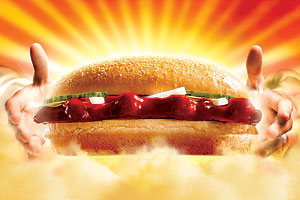
Around the time I took driver’s ed, Wendy’s introduced a new burger called the Cheddar Melt, which featured grilled onions, cheese sauce and mayo. Since there was a Wendy’s right by the driver’s ed school, I basically ate that thing every day for a week. And to sixteen-year-old me, the cheddar melt was pretty much the best thing ever invented, even if it was actually just an industrially produced meat patty smothered in an unnaturally liquefied substance with a passing resemblance to cheese. Oh, and it wasn’t even original; McDonald’s had made the same exact burger famous a decade prior. And people ten years older than me remember it in pretty much the same terms.
You may be wondering what this has to do with anything, but check it: the way we remember the science fiction and fantasy of our youth is not unlike the way we remember those discontinued fast-food items, like the Wendy’s Cheddar Melt. They excited us then because they were new, and because we were new to making our own choices, and because our tastes and understandings of the world were not sophisticated or jaded by experience and disenchantment.
And then when it’s gone and you are also gone from that place and time, you remember it in terms of how it felt, always wonder if you can get that feeling back. Like with Heinlein, who took you places—important places, even—when you were still young and unformed. Even though he’s the proverbial McRib of genre fiction.
Don’t get me wrong—I’m not trying to be a snob here, or pooh-pooh that youthful sense of wonder. I was really into Isaac Asimov and David Eddings as a 12-15 year-old, and while neither is much of a writer, both authors played important roles in shaping me as a reader. And because of that, I’ll always remember those reading experiences fondly.
But you know what? The last time I was in Indonesia, I saw that Wendy’s had the Cheddar Melt back on the local menu, so I bought one. And it tasted like what it was: an industrially produced meat patty smothered in an unnaturally liquefied substance with a passing resemblance to cheese.
...which is a roundabout way of saying that you can’t go back, and even if you could, you probably wouldn’t feel the same way about things as you did then. Even nostalgic movements—and I am an active participant in one such movement—are at their best when they use the toolkit of the past to create something new. That has meaning and value, but it has meaning and value in large part because it is something new, and responsive to new conditions. By contrast, it’s just not possible to turn back the clock and return to the lost golden age, which never existed as such anyway.
That being said, I don’t idealize the present state of genre either. In fact I share the grievance that genre and popular genre awards have become insular and overly predicable affairs; it’s just that pups n' co. completely misdiagnose the problem.
As I see it, long- and short-form SF/F suffer from quite different problems. The novel field strikes me as overly risk-averse (with notable exceptions). Predictable series—many of which are just rehashes of or sequels to earlier series—rule over self-contained novels, a problem that afflicts other media as well. And while literary genre does exist, there isn’t very much of it—a consequence of publishing’s economic structure, which does not reward risk-taking, but rather risk-avoidance.
Notably, incentives for risk-avoidance benefit the exact kind of novel the puppies claim are being pushed off-stage. Light, action-oriented summer blockbuster-type fare dominates bookstore shelves, Amazon rankings and popular award lists alike. Not that there’s anything wrong with that—it’s what people want, after all. And some of it is quite good (Old Man’s War, for example).
But what about the Hugo Awards? Don’t they reward literary over popular works?
No, disembodied rhetorical voice. They do not.
As Chaos Horizon notes, during the period 2001-2014, literary SF/F accounted for a mere 5.56% of nominations in the novel category. Big selling, in-genre novels that innovate along the margins are the order of the day, far more often than not. If you don’t write that kind of novel, you are unlikely to make a Hugo shortlist, and that goes for literary SF/F as much or more as blockbuster-style space opera.
Short fiction suffers from a very different kind of problem. The market for short SF/F is much smaller, and a far greater proportion of readers are also writers. At the same time, the prestige magazines and websites that publish the bulk of shortlisted stories increasingly resemble one another in terms of what they publish, and increasingly publish the same group of writers. And this, in turn, creates incentives for new writers to produce the same kinds of stories, resulting in an abiding sameness across the field.
Here pups n' co. approach a legitimate point, which is to say that there is form of “literary” gatekeeping potentially crowding out other modes of storytelling. Yet once again, they misdiagnose the problem, this time as political conspiracy when the problem is institutional. And the gatekeeping mechanism is form and approach not the identity or politics of the writer. (See: Jonathan McCalmont's writing on this issue). Meanwhile, the alternative they present, of bang-bang futureman action stories, is as uninspiring as it is regressive.
Genre needs more outlets that eschew formulas, or at least try new ones. More to the point, it needs more outlets that don’t give a shit about conventions or consensus.
But that’s a way forward, not backwards. The same cannot be said for entitled whining about women and minorities gaining visibility as authors, critics and consumers. The broadening of perspectives on SF/F to include previously marginalized or underrepresented voices, is, in my opinion, the one unequivocal marker of progress in the field. If that's "PC," then, well, let's hear it for PC.
***
This book should be the official Twitter user manual
To be honest, Jon Ronson's new book isn't right in line with the nerd/geek-theme of this site, but we nerds aren't exactly known for our calm, rational, measured responses to news or new releases in our particular fandoms that we don't immediately like. We drove Joss Whedon off of Twitter when Avengers: Age of Ultron wasn't everything we hoped it would be, after all. So even though I feel like the internet's dad and we're having to have The Talk, here goes:
In this book, Ronson chronicles the re-emergence of public shaming as a punishment. Used to be, back before the mid-19th century, people convicted of certain crimes would be made to stand in the stocks, or pillory, or publicly whipped, or otherwise publicly made an example of. It was deemed, however, that these were effectively cruel and unusual punishments with lasting, sometimes catastrophic psychological consequences. Let me stress again, people in the 1830s found public shaming excessive punishment. Well, nobody loves anything as much as a public hanging, it seems, so we've now resurrected the public shaming for the digital age.
Ronson starts off by tracing the trajectory of pop-science writer Jonah Lehrer's career. Until 2012, Lehrer was a best-selling author and in-demand public speaker. He then committed some journalistic sins (which are pretty minor, as far as journalistic sins go), and was made to endure an almost unimaginable public crucifixion via Twitter when he attempted to apologize at a media conference. Ronson also follows the stories of Justine Sacco, who was terrible at making jokes about white privilege, Lindsey Stone, who didn't understand Facebook privacy settings when sharing an intentionally disrespectful photo with a friend as a joke, and "Hank," who made the same joke everybody who's ever heard the word "dongle" has made, but this time it cost him his livelihood, and the security of his children. And that's nothing compared to what it did to the woman who set those events in motion.
Ronson also ventures into the worlds of extreme porn, prisons, courts, and online reputation management, and he unearths some obscured facts about the Stanford Prison Experiment that may be kind of important. But overall, this is a book that explores the human costs of hundreds of thousands of us taking ten seconds out of our day to say something casually awful about another human being in a place where the entire world can see it. By and large, Ronson lets these events, the people involved in them, and their repercussions speak for themselves. But I'll go a little farther and say a little about something he only touches on, namely the arbitrary nature of our pile-ons and our own complicity.
Take, for instance, the story of Mike Daisey. You may remember Mike Daisey as the journalist whose story on This American Life about working conditions in China for Apple's suppliers almost turned the world's wealthiest tech company on its head. This is, until This American Life had him back on to corner him about certain misrepresentations in Daisey's original broadcast. Remember? I do. I didn't go on Twitter to talk about what a piece of shit Mike Daisey was, but thousands of others did. But here's the thing: Mike Daisey isn't a journalist. Never really was. He was a stage performer, and did a one-man show about working conditions in China. Ira Glass, the ruler of the This American Life kingdom, saw Daisey's show and invited him onto the air to give his performance for all of This American Life's listeners. But then the fact-checking process revealed some problems with Daisey's account of his trip -- not the facts he was discussing, just his personal exposure to them. So Ira Glass had him back on to ambush him and get him to admit his duplicity. But the way I see it, this isn't Mike Daisey's fault. I don't assume everything Louis C.K. says in his shows literally happened, because he's a stage performer, not a journalist. But Ira Glass made different assumptions than I would have, and opened the door for a public shaming of Mike Daisey that almost drove Daisey to suicide. But now Daisey's pretty much okay, and Jonah Lehrer, who did much the same thing, has yet to publish again or get back on his feet.
Jimmy Kimmel handles it as a joke in his series "Celebrities Read Mean Tweets," and that's one thing. Celebrities are at least accustomed to casual vitriol. But we do this -- repeatedly -- to regular people with a few dozen Twitter followers who happen to say something that can be taken out of context or divorced of its original intention, and as a result, we all chuckle for a bit at somebody's callousness and then these people watch as their lives literally disintegrate. There are actual racists on Twitter. There are entire partisan "news" outlets who only exist to twist and misrepresent things that happen in the world. This is a world where a board member of the NRA blamed the South Carolina shootings on one of the victims because that person voted in the state legislature against a concealed-carry law. But instead of these genuinely awful people, we pick easy targets, weak targets, and straw men. And we destroy them casually.
And when asked about it later, we say, "I'm sure they're fine." Thankfully Jon Ronson went and tracked those people down to let us know that they're not fine, and that our actions online have real-world consequences.
The Math
Baseline Assessment: 8/10 for telling human stories that have deep emotional resonance
Bonuses: +2 for holding up a mirror in a timely, meaningful way and telling us truths that we'd probably rather ignore
Nerd Coefficient: 10/10. This isn't the best book you'll read by a longshot, but it's a message we all need to hear as social media races toward its adolescence.
Posted by -- Vance K, who doesn't want to be publicly shamed, and is proactively watching his ass.
Reference: Ronson, Jon. So You've Been Publicly Shamed [Riverhead Books, 2015].
I'm currently trying to hunt down some figures on the percentage of SF/F novels published on a yearly basis that are authored by women. I have not yet found those figures.
I have, however, found some startling figures on gender and membership in the Science Fiction Writers of America (SFWA) organization over the past 66 years. I'm not going to draw out any implications from these figures, but rather simply present them so that anyone who needs a quick reference can find them in one place (rather than hunt them down as I did).
Percentage of Female Members of the SFWA (1974-2015)
In 1974, 18% of SFWA members estimated to be female*
In 1999, 36% of SFWA members were female.*
In 2015, 46% of SFWA members are female.**
Current Membership in the SFWA by Gender (2015)
47% male
46% female
7% "unspecified"
*Source: Davin, Eric Leif (2006). Partners in Wonder: Women And the Birth of Science Fiction, 1926-1965. Lanham, MD: Lexington Books. p. 69–70.
**Source: SFWA President Steven Gould (via twitter).
Regular readers know of my Chandlerobsession--the unshakable, near-religious belief that his Marlowe novels and short stories are the most literary works genre ever produced, and contain enough mesmerizing prose and astute social commentary to transcend genre and sublimate to significant works of literature. They are, however, products of their time; nowhere is that more apparent than in Chandler's dismissive treatment of race.
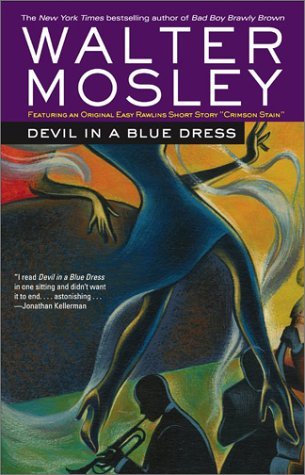
Walter Mosley's Devil in a Blue Dress is a text both indebted to and in conversation with Chandler. It takes place in 1940s Los Angeles, stars a hard-nosed, persistent and stubbornly moral protagonist who takes a punch better than he throws one, and centrally involves a femme fatale. But if Chandler's fiction is ultimately about the relationship between corruption and class division in 1940s Los Angeles, then Devil in a Blue Dress is about those same things refracted through the deleterious race relations of the time.
It's an important point of contrast with Chandler, not least because of Marlowe's ambivalence towards the African-Americans he encounters. But it also made me think about the contrast between that time and this one. Though American society has improved, racism-wise, in any number of meaningful ways, Mosley makes the implicit point that in other ways things have gotten worse. Rawlins' LA is a place of economic opportunity, where manufacturing jobs are plentiful and social mobility is possible even for the city's downtrodden. Compare that with American inner cities of today--disproportionate populated by ethnic and racial minorities, and where jobs and opportunity are scarce--and today doesn't look so hot. In that sense, Devil in a Blue Dress is also thematically focused on a death of a specifically black version of the American Dream, which emerged in the immediate post-war days and closed sometime after "white flight" (i.e. re-segregation), de-industrialization and the crack epidemic gutted the American inner city during the 1970s and 1980s.
Howvever, though Devil in a Blue Dress addresses some weighty issues, it never feels heavy. Easy Rawlins is a likable rogue, a borderline drunk and a working stiff who has issues with his boss (who, for the record, is kinda racist). He's a homeowner and proud of it, but also has a problem--if he can't pay the mortgage, the bank will foreclose, and, well, he just told his racist boss where to shove it. Along comes Joppy, an ex-boxer turned speakeasy proprietor who might just have a line on some work for Easy. An old associate, DeWitt Albright, is looking for a white girl who was last seen in Watts. Joppy tells Easy it will be a cakewalk, but Easy has a bad feeling about Albright. But as it turns out, that bad feeling is only the tip of the iceberg...
Devil in a Blue Dress is a smart and perceptive novel whose social commentary blends into the background and never gets in the way of the fun. I certainly enjoyed reading it. At the same time, it does feel like Mosley is still working through the formula here. There are too many murders and, well, too many characters--many of which never really get much in the way of development. As a result, a couple major elements of the plot feel forced. Incidentally, the paperback version I bought also includes a short story, "Crimson Stain," which was written a number of years later and, perhaps uncoincidentally, feels a lot more sophisticated. But if that's what I have to look forward to with this series, then sign me up for the whole thing.
The Math
Baseline Assessment: 7/10
Bonuses: +1 for doing social commentary the right way; +1 for bringing race into a literary conversation with Chandler;
Penalties: -1 for excess characters; -1 for "huh?" moments.
Nerd Coefficient: 7/10. "A mostly enjoyable experience."
***
POSTED BY: The G--purveyor of nerdliness, genre fanatic and Nerds of a
Feather founder/administrator (2012).
Reference: Mosley, Walter. Devil in a Blue Dress [Washington Square Press, (1990) 2002]
I once said that the hardest reviews to write are of the books you love the most. But I was wrong--the hardest reviews to write are of the books that feel the most important. And Robert Jackson Bennett's genre-busting novel City of Stairs is a must-read for anyone who cares about fantasy fiction. Why? Because fantasy is, far more than its cousin science fiction, slave to its conventions; few works genuinely challenge those conventions as dramatically or effectively as City of Stairs. And for that alone, you should read this novel.
But it also happens to be a really good story. City of Stairs takes place in the city of Bulikov, which was once the capital of "the Continent," a large landmass made up of multiple, vaguely Slavic societies, who at one point united to conquer the known world. They were able to do so because the gods (or "Divinities") favored them and empowered them with powerful, reality-bending magics. Until, that is, the day when a leader--called the Kaj--rose from the subjegated, vaguely South Asian Saypuri. With a terrible (and largely unexplained weapon), the Kaj and his army killed the Divinities, which instantly destroyed everything that depended upon their magic (include the actual buildings people lived and worked in). Vast destruction followed. Now the Saypuri have subjugated the Continent, maintaining Their hegemony through technological superiority and the banning of both magical artifacts and open discussion of the Continent's magical past.
City of Stairs centers, superficially at least, on the murder of Efrem Pangyui, a Saypuri scholar engaging in research on the Continent's magical past--the exact thing Continentals cannot do themselves. Enter Shara Thivani, a Saypuri agent and friend of the murdered Pangyui, who is determined to find his killers. She is joined by Sigrud, a massive Dreyling who acts as her muscle and advisor--think Sigurd/Siegfriend mixed with Beowulf, but updated for the video game set. We learn that resentment of Saypuri repression runs deep, and that a committed group of Continentals are ready to use violence in order to restore the Continent to its former glory. But that's not all they find...
City of Stairs covers the basics of genre storytelling effectively. The plot is fast-paced and engrossing, the characters deep and well-rounded and there's a good mix of investigation, action and contemplation. The narrative structure is complex but not gimmicky, with Bennett weaving Shara's and Sigrud's backstories, as well as the political history of Continent and Saypur, into the foregrounded mystery without infodumping (i.e. the bane of my literary existence). And genre readers will delight in Sigrud, who may be a millennia-old trope, but somehow manages to feel fresh and exciting. The scene where he fights the sea monster is just...wow. Simply put, City of Stairs is on one level a fun book that can appeal to a broad cross-section of fantasy readers. But it's much, much more than that.
Fantasy is, like the romance novel or police procedural, a fundamentally conventional genre, with all its attendant sub-genres defined by laundry-lists of expected ways of doing things. And if something unconventional comes around, given that it's sufficiently popular, it simply spawns a new convention. So it's unexpected and delightful to read a novel that simply refuses to be categorized: it's epic but not medieval, so it's not epic fantasy; there are cars but no guns, so it's not flintlock fantasy; there are dirigibles but no Victorianisms, so it's not steampunk; it takes place in one city but in a second world, so it's not urban fantasy; etc. Instead it's a world where magic and technology coexist, where technologies from various historical time-periods coexist, where architecture is central to the story being told and where no place or people is based off of English or Anglophone archetypes.
Of course, whenever breaking with fantasy convention comes up in the discourse, the argument breaks down like this:
A: Why is fantasy so damned conventional/risk-averse? B: "Because REALISM." A: "If there are dragons and/or wizards, 'realism' is already out the window." B: "Yes, but if everything is unrealistic, readers won't have anything to hold on to." A: "That's what I call 'a lack of imagination.'" B: "Boo 'message-fiction!'"
Now, I read (and enjoy) a lot of conventional fantasy, but eh...I find the lack of boundary-pushing more than a little frustrating. Still, the argument that messages or agenda can overshadow fundamentals has some merit, in the sense that they shouldn't but they can. So it's notable that City of Stairs breaks fundamentally with convention in ways that never feel less than wholly intuitive, fully realized and deeply integrated into the DNA of the novel. Everything is internalized into character perspective, nothing is infodumped and the result is a rich, vibrant and incredibly exciting fantasy world like no other I've ever encountered.
City of Stairs is also a fundamentally political novel, but one that eschews clear metaphor for more ambiguous explorations. Some reviewers (for example Nisi Shawl) have situated City of Stairs within postcolonial discourses, in the sense that it presents a world at least partially defined by historical oppression of dark-skinned peoples (the Saypuri) by light-skinned peoples (the Continentals). But II don't think that's quite what Bennett is getting it. Though the historical oppression of Saypur is quite disturbing, Saypur is now the colonial overlord, and book takes place in what is in essence a captive city. Indeed, over time Shara grows more and more troubled by the colonial regime she represents--even as she works to stop those who would seek to restore the old order. The effect is to argue that oppression is simply what power differentials lead to, and to argue that such behavior is unacceptable regardless of whether it is justified in terms of "divine right," historical grievance or material "superiority."
Yet this also leads the reader to focus on Bennett's cultural choices. The Continentals are pseuso-Slavic, the Saypuris pseudo-South Asian--but why? It's refreshing to read a fantasy novel where the default categories are neither pseudo-Anglophone nor pseudo-Celtic, but where the subjects are not exoticized either. At the same time, considering how little these cultural choices mattered, I was never clear why anyone needed a pseudo-Slavic or pseudo-Sanskrit name to begin with--or, for that matter, a pseudo-Angophone or pseudo-Celtic one. (Sigrud is a different story, of course, but the Dreylings are the cultural group with with the least impact on the narrative.) The effect isn't bad, per se; rather, it just feels underdeveloped.
Finally, the one negative--the ending. I won't spoil it, and I'll note that it isn't all bad, but it nevertheless felt a bit too network TV for a novel that was HBO-plus 95% of the way to the finish line. Regardless, City of Stairs
is a dazzling, sophisticated and thoroughly
modern fantasy, and stands in contrast to the staid medievalisms that dominate
the genre. Imagine China Mieville and George R. R. Martin stuck in an elevator,
with only a laptop to keep them company, and you’re almost there. It is a monumental work of fantasy that does more to push the genre forward than anything I've read in years, and will likely go down as the best fantasy novel of 2014. Robert
Jackson Bennett is a name to remember and a talent to behold.
The Math
Baseline Assessment: 9/10
Bonuses: +1 for best world-building ever; +1 for smartly ambiguous political allegory; +1 for Sigrud!
Penalties: -1 for unclear reasons for cultural choices; -1 for ending disappointment.
Nerd Coefficient: 10/10. "A true game-changer."
***
POSTED BY: The G--purveyor of nerdliness, genre fanatic and Nerds of a
Feather founder/administrator (2012).
Reference: Bennett, Robert Jackson. City of Stairs [Broadway Books, 2014]
We all knew this was a problem, but the good folks at Lee & Low Books have visualized it for us. And making matters worse, of the 8/100 films with a non-white protagonist, 6 featured Will Smith.
Charming Sleaze and Cybernetics in a Middle Eastern Setting
I grew up in the 80s and 90s, so it's no surprise that my vision of what science fiction is and can do is shaped, in part, by what dominated the genre during those years--namely, hard SF and cyberpunk. But whereas hard SF remains a vital and active sub-genre, cyberpunk has atrophied. The reasons are not hard to discern. Though hard SF can be parochial and tropey, the basic template of "science-y science fiction with a strong emphasis on science and strict adherence to scientific plausibility" is flexible enough to move with the times. Cyberpunk is more of a one-note symphony: hacker-y/transhuman-y types navigate treacherous near-future world where corporations are really, really powerful. And the presence of actual hacker-y/transhuman-y/corporate-y stuff all around us means that cyberpunk gets dated much more quickly than books about terraforming Mars.
That doesn't mean cyperpunk is gone; rather, it lives on in the ever-popular dystopias of YA fiction and in literary heroes like Lisbeth Salander, who Stieg Larsson basically ripped out of a Bruce Sterling novel. And there are plenty of in-genre legatees, like Lauren Beukes, who might not write cuberpunk per se, but nevertheless owe a lot to it. But now us children of the 80s and 90s are of the age when nostalgia for that teenage "sensawunda" beckons. Sometimes the urge is simply too strong to ignore.
Usually when that happens, I turn back to William Gibson--still the best writer and singular visionary of the cyberpunk movement, in my humble opinion. This time, however, I wanted to read someone new, and the prime candidates were Pat Cadigan and George Alec Effinger. I still plan to read Cadigan sometime this year, but I already had When Gravity Fails, and the prospect of reading science fiction set in the Middle East (but which reputedly did not exoticize or Orientalize its subjects) appealed. So I chose that.
When Gravity Fails falls on the transhuman-y side of cyberpunk, and has very little to do with computers--a fact that serves its durability well. People can get cybernetic implants that can bestow skills, like being able to speak a foreign language, or personality traits--including those of figures from literature, history and popular culture. It's the first book of a trilogy starring Marid Audran, a streetwise hustler in the Budayeen--a lurid, rough-and-tumble place full of prostitutes, barkeeps, petty criminals and, well, tourists. The story itself is kind of forgettable (Marid tries to find a pair of killers with the personalities of James Bond and an infamous serial killer), but it's good enough, and has a
neat, hardboiled feel throughout.
The real star, though, is the Budayeen and its
colorful cast of characters. It is, in essence, a cross between pre-war Beirut and New Orleans--specifically the French Quarter, where Effinger apparently spent some time. Most characters we meet in the Budayeen live on the margins of society, and interestingly, are transgender.
It's worth lingering on this point for a bit. We are currently in the midst of a broad conversation about the normativity of binary gender in SF, for example in Alex Dally MacFarlane's column for Tor.com. When Gravity Fails presents a view of how gender might work in the near future that, I suspect, has been deeply influential on a number of writers. But it doesn't really present an alternative to binary modes of thinking on gender. Rather, it presents how binary conceptions of gender might work in a context where switching is relatively easy, but in which many social norms remain deeply conservative. The switching itself becomes normative, but the in-between state (as far as sexual organs are concerned) remains taboo. Throughout the book there are subtle, pejorative references to pre- or non-op transgender persons, called "debs," from both the "real" men and women (the term used in the book) and post-op transgender men and women.
So this probably wouldn't pass the "MacFarlane Test," were she ever to develop one in her column, as When Gravity Fails does not present a view of non-binary gender that extrapolates beyond 2014 norms. However, I read it as Effinger creating an internally consistent mode of thinking about gender in a near-future setting that incorporates plausible prejudices (since people always do seem to have prejudices). It is as if to say that the ready availability and apparent ease of medical procedures for switching sex doesn't necessarily imply the dissolution of binary gender norm, but may instead simply reformulate or recontextualize them--perhaps even, in some social respects, reinforcing or reproducing the binarism in the process. While that's an interesting prospect, it's unfortunate that we never get a view of all this from a "deb's" perspective, as there are no significant "deb" characters. Instead we're just presented with casual bigotry as part of the backdrop. I would have preferred if Effinger had handled this differently.
Effinger's treatment of his Arab and Muslim subjects--and of Islam--is another notable feature of the book. The crude stereotypes of the post-9/11 zeitgeist are refreshingly absent, and in their place, stress on often neglected elements of ethnic and religious custom in the Middle East: hospitality, complex modes of address, the strategic use of flattery and so forth. The close quarters coexistence of "sin" and "faith" in a Middle Eastern city may surprise readers whose view of Islam is largely informed by Western caricatures and the crude, violent extremism of groups like ISIS. Effinger's Muslim characters, by contrast, tend to have a complex, fluid relationship to their faith--not uncommon in real-world analogues to the Budayeen. Some are deeply religious, others are not, but even the ones who are work to negotiate strictures of faith with the practical realities of daily life.
Nor is religion treated with the disdain common in science fiction, where it is often framed as "superstition" or "anacrhonism." Marid, we are told, is not a religious man. But as he falls deeper into danger, he begins to reflect on his long-neglected faith. It gives him a degree of comfort and psychological protection, as it does for so many the world over. Effinger isn't endorsing a religious viewpoint or narrative, but rather portraying religion and religious people in a way that feels authentic and humanized and suitable for the near-future world he has constructed.
I also give Effinger major kudos for setting the book outside the West and not treating his subjects like objects. Though Effinger isn't an insider (and since I'm not either, I can't vouch for his attention to detail), everyone feels complex, three-dimensional and believable. And almost everyone is sympathetic in at least some regard. If you're going to write about something you didn't grow up with and don't claim as your own, then this is the kind of approach that will set you apart from the glut of exoticizing cultural appropriation--not to mention the offensive stereotype-mongering that dominate portrayals of Arabs and Muslims in Western literature and entertainment media.
The book's problems are relatively smaller, but still notable. As mentioned above, the plot isn't very well developed or well paced. That doesn't ruin the experience, but it could have been better than it was. And there are moments where the colorfulness of the Budayeen and its residents gets to be a bit too much. Incidentally, this is also a problem I identified with Daniel Woodrell's Bayou Trilogy--which, science fictional elements notwithstanding, is quite similar in tone and theme to When Gravity Fails.
The Math
Baseline Assessment: 8/10
Bonuses: +1 for presenting an unforgettable and thought-provoking world; +1 for the generally sensitive, nuanced and sympathetic portrayal of Arabs, Muslims and religious people.
Penalties: -1 for lack of "deb" perspectives undercutting significance of gender schema; -1 for missed opportunities on plot and pacing.
Nerd Coefficient: 8/10."Well worth your time and attention."
***
POSTED BY: The G--purveyor of nerdliness, genre fanatic and Nerds of a
Feather founder/administrator (2012).
If you follow SF/F fandom on twitter, you are no doubt aware of the imbroglio surrounding the submissions guidelines for the anthology World Encounters (current version, cached version), which has been called out as offensive. I'm willing to give the editor the benefit of the doubt as far as intentions go--I mean, why else create an anthology called World Encounters? But I agree that there is some deeply problematic language used in the text--not to mention a boatload of Othering and cultural essentialism/reductionism.
But rather than linger on that, I thought I'd just rewrite the guidelines so that they convey the same meaning I *think* the editor intended them to, but in such a way as to avoid said problematic language, Othering and cultural essentialism/reductionism. Basically everything else I edited out is superfluous or redundant--sorry, that's just the copyeditor in me. Also, please keep in mind I'm not writing my own guidelines here, but interpreting someone else's. Major changes are in italics:
DESCRIPTION: An anthology of culture clashes between aliens and people
of Earth’s various cultures as they encounter each other--on Earth or beyond. Stories can be told from alien or earthling points of view.
Stories should not all revolve around Western earthlings. They can take place on Earth, on other planets, or in space. Not all stories need to center on conflict between
aliens and Earth--they could, for example, be working together to
overcome a common obstacle. Not all the aliens have to be sentient creatures or at least sentient creatures as we understand them.
The goal is to feature stories from both Western and non-Western writers, and from both established and up-and-coming writers. I will therefore be limiting the
number of Western and established writers included to be sure we get those outside
voices. Unfortunately, English translation is not in the budget.
I would also like to get a balance in terms of POV; however, please note that I value authenticity of voice first and foremost--so please write about what you know. If you have little knowledge about, say, Japanese culture, this will be evident in the writing--and may inadvertently cause offense to readers. Do not write stereotypes.
Please keep it PG,
as we’d like this to be a collection parents and kids can read and
discuss to learn and encourage interest in SF and world cultures. Please limit swearing and cursing, as well as graphic sex or violence.
Also please do not submit stories that are overly partisan in their politics. I want readers to engage with a diversity of worldviews
and cultures but not in a potentially off-putting way.
Must be willing to respect the editor’s editing requests.
Crunchy Bits:
Word Counts: 3000-7000 words
Pay rate: $.06/word
Formatting: Submit in RTF format, single spaced, double space between
paragraphs, no indentations. Italics for italics, underline for
underline, bold for bold.
Publication in Late Summer/Fall of 2015 (TBD further)
Does that work better? I think it does.
In the end, I see this is an instructive example--many of the things that cause offense are not designed to do so, but rather do so because we human beings don't always think of the same things as other human beings, or lend them the same credence.
True, it sucks to to be told you wrote something offensive, and because you know exactly what your intentions were, there's an urge to circle the wagons. But I think that's the wrong approach, and is ultimately self-defeating. I certainly hope that if I write something and am told it's offensive, that I'll take the time to listen and learn from that criticism. It might not sink in right away--nobody's perfect, after all. But a simple affirmation that you are listening and learning can go a long way, and serves everyone best in the end--yourself included. Because then no one can doubt your good intentions.