- Reviews
- _Book reviews
- _Film and TV Reviews
- _Game Reviews
- _Thursday Morning Superhero
- _Short Fiction Reviews
- Lists
- _New Books Spotlight
- _6 Books Posts
- _We Rank 'Ems
- Features
- _Interviews and Blogtables
- _Talking About Books
- _The Hugo Awards
- _Mini-Projects
- Projects
- _Nerds on Tour (2020)
- _The Hugo Initiative (2019)
- _Feminist Futures (2018)
- _Dystopian Visions (2017)
- Meet the Flock
- Review Policy
- Home
Showing posts with label genre. Show all posts
Friday, November 11, 2016
Flock Together
A couple of weeks ago on this site, a few of us got to talk about diversity in genre fiction. In the climate we find ourselves in this week, affirming that embrace of diversity seems particularly important.
We don't really address electoral politics on this site, but certainly a couple of elections in the United Kingdom and United States have touched on an ongoing discussion within genre circles — that of increasing diversity and the response to it.
There are so, so many reasons why genre fiction, movies, comics are great. As much as going to a made-up world can be an escape (and it certainly can be!) from the one we live in — which is often scary and confusing, hurtful and unfair — genre stories, regardless of medium, can be an invaluable lens through which to look at and understand our own, real world and our lives in it. For me, Slaughterhouse-Five, about a man who comes "unstuck in time," forever changed the way I exist in the world.
But beyond that, it can give us a community. Fandoms built around genres, or shows, or movies have given people real and virtual communities around the world. If you're a guy who's terrified of letting anyone in your small town know you like My Little Pony, you can commune with people across the country who are just as passionate about it as you are, and won't judge you for digging it. I can tell you that, for me, lining up in a queue that stretched down the block and around the corner to see Bubba Ho-Tep let me know that I may be weird, but I was not alone in wanting to see a movie where old Elvis fights an ancient mummy who sucks souls out of retirees' butts. And this site, and our team of multi-national writers, only exists because we all geek out over genre stories, comics, games, what-have-you.
Speculative fiction can give us community, and it can give us a voice. If you have a story to tell, I want to affirm that it matters. It may not be good...I mean, you might not be a very good storyteller. Most people aren't. But that doesn't mean your story doesn't matter. Are you struggling with your identity? Tell your story. Are you excited by things that blow up? Tell your story. Do you feel like you don't fit in? Tell your story. Do you feel like your way of life is disappearing and you don't know what the future looks like? Tell your story. Are you scared? Tell your story. Because you are not alone in any of those things, and if you put your characters in a spaceship, or on another planet, or give them a magic staff, we'll read that shit. And other people who want to write the same kind of stuff will be your beta readers and give you notes for no other reason than we are nerds of a feather.
And finally, these stories can give us hope. There's a lot of dystopian sci-fi and grimdark fantasy, and that all has its place. But there is also the aspirational. There is Star Trek and there are visions of worlds and lands and times that have solved the problems we are still grappling with. These stories can give us visions of better worlds that we can strive to make ours look like. And that's not nothing.
A lot of people are worried right now. I'm worried. I feel like I'm outside, looking in at something I don't understand at all. But I'm a nerd, and that means I've got experience with this feeling. It's different this time, I won't pretend it isn't, but I know that I'm not alone, and you are not alone, and we may not be able to protect each other all the time, but we can embrace each other, and that's not nothing, either.
Besides, if "normal" is what we've seen in these elections, give me different.
Posted by Vance K, cult film reviewer and co-editor of nerds of a feather, flock together since 2012. Folk singer and Emmy award-winning producer.
Labels:
fantasy,
genre,
Sci-fi,
social issues,
unity
Wednesday, April 8, 2015
PERSPECTIVES III: "What is Science Fiction? Or, Hell, What is Genre?"
Welcome to Perspectives III, which is not only a companion, but a response to Blogtable III.
Here’s how it works: an editoral, opinion piece or critical essay written by an external blogger, critic, journalist or creative person is presented by a regular contributor to nerds of a feather, flock together; it is then answered by three other regular 'nerds of a feather, flock together' contributors. Crucially, each respondent will also respond to each preceding respondent. This episode's cast o' characters:
The G (Respondent #1)
The G is founder and co-editor of ‘nerds of a feather, flock together’, which covers SF/F, crime fiction, comics, cult films and video games. He moonlights as an academic.
Vance K (Respondent #2)
Vance is the co-editor and usually cult-film reviewer for ‘nerds of a feather, flock together.’ He records loud folk songs under the name Sci-Fi Romance, and writes and directs things for a living.
English Scribbler (Respondent #3)
Our resident Londoner, English Scribbler gets to see all the BBC shows before any of the other contributors, and lets us know about it whenever it best pleases him.
The discussion around the question of "Defining Science Fiction" and the insightful but wildly different responses that made up our Blogtable III simply had too many facets to be left to a single post. So in this installment of Perspectives, the nerds of a feather respondents will begin directly from the comments of Blogtable participants Ian Sales, Aliette de Bodard, and Paul Kincaid.
The G
All three discussants in this month’s Blogtable offered compelling visions of what, if anything, makes science fiction science fictional. Paul Kincaid contends that “science fiction” is more attitude or approach than genre, rendering its boundaries inherently subjective--a position that grows more attractive as one explores the permeable boundaries demarcating science fiction (by any definition) from fantasy, horror and mimetic fiction. Ian Sales also believes science fiction is defined primarily by attitude or approach, and not by its tropes (spaceships, robots, etc.) or the supposed “hardness” of its science; rather, he argues that for something to be truly science fictional, it must be grounded in a rational or scientific worldview. Though generally accepting of this framework, Aliette de Bodard makes the important point that defining science fiction strictly in relation to science or a scientific worldview embeds certain normativities (often Western-biased) in the discourse, which can be off-putting or exclusionary to those raised outside the West--or, indeed, those raised inside the West but outside the strict rationalism that pervades its urban intellectual enclaves.
While I see much value in all three contributions, my own feelings are somewhat distinct from each. For me, at least, science fiction denotes something very specific. More to the point, what makes a story science fictional is the degree to which it explores what life would be like and what kinds of stories could be told if certain variables were altered from the present or any historical state, provided that the alterations are scientifically plausible.
Now what I mean by “scientifically plausible” is in need of clarification. First, “science” includes a whole lot more than just the physical sciences (physics, chemistry, biology, cybernetics, etc.). It also includes the social and behavioral sciences (sociology, anthropology, economics, political science, psychology, etc.). Second, plausible does not mean “adhering closely to the stable of scientific facts we possess at this moment,” but rather “adhering to the much broader category of scientific theorization we possess at this moment, or reasonable extrapolations from that theorization.”
I think this is a reasonably broad definition, and casts a fairly broad net across genre. Take Iain M. Banks’ Culture novels, in which technology has progressed to such a point as to be nearly magical. Some might conclude that these books, like other space operas (e.g. Star Wars), aren’t really science fictional. But, from my perspective, they are. After all, the fundamental preoccupation of the series is to speculate on what life would be like and what stories could be told if a society progressed to the point where scarcity no longer existed, while bordering any number of societies in which scarcity was still very much the norm. Or take John Brunner’s Stand on Zanzibar, an almost disturbingly prescient novel that involves very little technological or physical-scientific speculation. But it is sociologically speculative, and thus — in my view — very clearly science fictional.
Wait...what about stuff like Dune? That’s kind of science fictional by your definition, but also kind of fantastic too….
Thank you for bringing that up, disembodied rhetorical voice. And to answer your question, I’d suggest that any definition of what science fiction “is” or “is not” should adopt the logic of correlation rather than causation. Or, to put it another way, even as we look to set boundaries, we should reject the idea that those boundaries are hard or immutable. Categories are useful sorting mechanisms, but only if one recognizes that the boundaries are fuzzy and permeable, and that lots of stuff fits in the in-between spaces. And that’s a good thing. Rules are made to be broken, after all.
So is Dune science fiction? I’d argue it’s closer to fantasy. However, I’m inclined to put it in one of those interstitial spaces, and to say while it’s not strictly speaking science fiction, it does have elements of science fiction.
Okay, fine. But what about spaceships, robots and laser guns? Isn’t that what science fiction is really about?
Ian makes the point that science fiction should not be defined by its tropes. I agree, as you can surely tell, but given that these tropes create certain expectations and provide certain parameters that most readers (and consumers of related media) use for sorting, it doesn’t make sense to dismiss the idea that they are meaningful. They clearly are, and to many people. Thus I’d suggest that this is what we have the alternate term “sci-fi” for — not to use as a synonym or shorthand for science fiction, but to denote the broader category of works that deploy these tropes. The categories “science fiction” and “sci-fi” overlap, to be sure, but strike me as both distinct and helpful in distinctive ways.
To illustrate, consider space opera. Some clearly counts as science fiction according to the scheme I’ve laid out — Banks’ Culture series, for one, but also Revelation Space (Alastair Reynolds), Downbelow Station (C. J. Cherryh), Leviathan Wakes (James S. A. Corey) and Fallen Dragon (Peter F. Hamilton). On the other hand you have Star Wars or Hidden Empire (Kevin J. Anderson), which don’t really fit the parameters. Actually, they strike me more as fantasy-in-space. At the same time, they all would fit within the broader category of sci-fi.
So that’s pretty much how I see things -- for now at least. Over to you, Vance.
Vance
I come to the idea of genre from a very different angle than the other voices in this conversation, I think. As a musician and film writer, genre is for me and has always been a marketing discussion. I love the comments of all of the people who have weighed in on this topic, and find Paul’s observation that he can nod in agreement with both Ian and Aliette’s positions (even while they’re saying different, somewhat contradictory things) particularly resonant. The reason why such a thing is possible, in this case, is that in a linguistic sense the word genre is almost utterly useless.
Take for instance Paul’s suggestion that the “more generally accepted” definition of genre is a characterization of story in which we know the basic structure. First, more accepted by whom? Writers? Critics? Academics? Readers? Publishing house marketing departments? Bookstores (long may they live)? In this space, guest contributor Peter Higgins argued compellingly that there was no such thing as a book that belonged to only a single genre.
I would argue as a creator that a structural pattern or framework has nothing whatsoever to do with genre. Wikipedia defines bildungsroman as a genre, sure, but how is that a helpful categorization tool when one may come of age on the farm, on a space station, in an underwater colony, in a World War I trench, in any country on Earth, or within any other of countless locales or situations? That’s structure. In the same way that an Intro/Verse/Chorus/Verse/Chorus/ Bridge/Chorus song structure tells you nothing of the “genre” of that song. Carly Rae Jepsen has written those songs, and so has the Polish death metal band Vader. So have I.
When I was writing (unproduced) screenplays for studios and what-have-you, the genre conversation was pretty damn short and uncomplicated. It was a comedy, drama, thriller, romcom, horror, sci-fi, maybe adventure. That’s about it. Very few mysteries, very few romances, very few heists. I was writing comedies, so during development hell larger winds would blow through the culture, and maybe the “R-rated comedy” would wax and the “family comedy” would wane, and suddenly I was being asked to get a lot more balls jokes into certain scripts. But they were still comedies and were still going to be sold accordingly. You know, if they had ever gotten shot. Metal is infamous for its myriad sub-genres, but most people still agree on something being either metal or not. That classification is much more at the band-level, though, rather than the individual song.
All this is why I love the notion of “sci-fi” that The G has proposed above. The idea of macro-genres like that seems to me to have far more value to anyone who’s got skin in the game, either as a fan, a creator, or a business. We can all argue over drinks about sub-genres, but under the communal umbrella of understanding that we’re all sci-fi fans. I will quibble with The G’s reading of Aliette’s point about people being excluded. If we’re defining genres, we certainly have to draw lines. But I read Aliette’s comments to be more about not allowing the lack of a shared language become a barrier to genre inclusion, rather than as a rejection of using science or a scientific worldview as a liminal criteria. Look at that -- I used a fancy academic word! I think science or a scientific worldview has to be part of any definition or science fiction, although I’d broaden it to include civilizations in which scientific capabilities or understanding are sufficiently different from our own as to be a signature trait for a reader.
So in a language where the word “genre” no longer has any linguistic value whatsoever because it can mean almost anything (how can “crime” be a genre in any meaningful way when Michael Clayton, Unforgiven, Snatch, and the legend of Prometheus all revolve around crimes?), I think that relying on a marketing understanding isn’t such a bad guidepost. I mean, that’s what we’re after anyway, right? As ardent fans, we want to know which shelf at the video store (long may they live) or bookstore is most likely to scratch the itch we have for new stories and adventures that push our buttons or help us cope or make us feel at home.
(Incidentally, when I put out the first Sci-Fi Romance album, reviewers called it “alt-folk” which had no meaning whatsoever to most casual fans I actually spoke with, so when I got blank stares, I said “We sound like that time Johnny Cash covered Soundgarden.” The most common response I got then was, “Whoa. Johnny Cash covered Soundgarden?” You're damn right he did.)
English Scribbler
The downright terror I feel in any attempt to follow such eloquent and erudite voices as the excellent ones in our Blogtable, and my esteemed editors above, with these feeble scribbles is perhaps suitably akin to what many an aspiring science-fiction author must feel as they stare at the proverbial carte blanche. However, attempt I shall.
Vance makes the point that genre to him is a bracketing exercise based in post-creative marketing, and I agree as far as that goes. I would argue in fact that science fiction writing deals far less in genre-aspiring or group mentality than music or film often does. I've seen enough gigs and worked for enough directors to see a lifetime of eager yet deluded would-be imitation. Sir, you will never be Mike Leigh, and you lads will never be Joy Division, but his point stands. All these media are afflicted by post-creation external attempts to pigeon-hole or make them ‘fit’ a genre for easy consumption.
However, Ian Sales makes a valid argument for the idea of SF being a distinct mode for which certain boundary values apply, the transgression of which makes a proud genre merely a mask to wear, "a box of tropes" to play with. So is genre, as such, the chicken or the egg, creatively? Is SF something that writing falls in into, or takes advantage of, or is it a labelling exercise that is an after-thought to a writer's intention? Asimov called science fiction “that branch of literature which is concerned with the impact of scientific advance upon human beings”. On that basis, by the very move to concern themselves in writing with this impact, is a writer thereby determining to be a Science Fiction Writer, or just wandering into the woods of the genre by coincidence? And does intention matter, or only outcome?
One of my very favourite novels of the last two years is Lagoon by Nnedi Okorafor. A Nigerian-origin American, she has written eloquently about the lack of creation of and interest in African-made science fiction, and so her attempts to tell very sci-fi tales set very much in and on the continent are therefore bold and refreshing. She has specifically attempted a genre for a definite, and political purpose, and is therefore pigeon-holing herself intentionally; however, this is not a reductive venture, and she uses Lagoon as a funnel to explore far more than alien invasion plot devices. So she may have then found her work marketed as ‘African fiction’ or ‘magic-realism’, but it would remain in her eyes as science fiction and those that read it would hopefully see that too.
My other stand-out science fiction novel read recently was Michael J Sullivan’s Hollow World. He himself frequently described it as science-fantasy, while many reviews saw it as a foray by a fantasy writer into science fiction. Time-travel, post-humans, dystopia/utopia = science fiction, surely? Where does fantasy start in science fiction? Is Star Wars fantasy using science fiction elements, and The Matrix sci-fi using fantasy elements? Does it matter?
Both the above novels are remarkable for me because they cover ideas, subjects and emotional themes that I find attractive, but they work because they happen to be great stories, beautifully told, and if there is an element to both I could describe as key to my enjoyment it would be originality. So I’m not responding to the same flavour, the same feel, every time. I’m no longer the child who would happily guzzle horror after horror, sword-fantasy after sword-fantasy, space opera after space opera, with little desire for variety, beyond the desire to never be bored.
Professor H. Bruce Franklin was perhaps not the first to do so, but he very neatly described the term science fiction by stating, “On one side lies fantasy, the realm of the impossible. On the other side lie all the forms of fiction that purport to represent the actual, whether past or present. Science fiction's domain is the possible.” This is at odds with what I thought s.f. meant as a child. I had through naivety and cultural osmosis defined it mentally as fictional science-based plots — i.e. time-travel, alien life, thinking robots — and so saw it a world of joyful fantasy. I never read Dan Dare Pilot of The Future concerned by how its 50s origin dated its view of space travel or the surface of Venus. I never cared how Dune reflected medieval royal politics. I just wanted to leap onboard a mind adventure.
Perhaps, then, despite my admiration and frequent agreement with all the preceding opinions, it is maybe arrogant yet honest to concede that the only opinion that matters to me is the eight year old who thinks “oh cool this cover has an alien AND a robot on it!!” If that is science fiction, great; but it doesn’t matter to the child. If the tale then transgresses genre, does that impress the young reader because it furthers the life of the genre or because it keeps things original and fresh after the 17 previous space robot novels she/he read? If the science of the robot is hard, does that matter to them unless ‘hard’ means ‘dry and dull’? This questions remain, I think unanswered at the end of all this wonderful debate. Yet in the mind of the child, they are irrelevant to a pure fascination with the fantastically impossible-possibilities of a story that happens to be science fiction. In the same way as chocolate cereals remain on our market shelves due to the raw demand of the clear-minded youth, I hope science fiction long remains on the bookstore shelf.
***
Posted by Vance K, who already told you plenty up there at the top. Nerds of a feather co-editor since 2012.
Here’s how it works: an editoral, opinion piece or critical essay written by an external blogger, critic, journalist or creative person is presented by a regular contributor to nerds of a feather, flock together; it is then answered by three other regular 'nerds of a feather, flock together' contributors. Crucially, each respondent will also respond to each preceding respondent. This episode's cast o' characters:
The G (Respondent #1)
The G is founder and co-editor of ‘nerds of a feather, flock together’, which covers SF/F, crime fiction, comics, cult films and video games. He moonlights as an academic.
Vance K (Respondent #2)
Vance is the co-editor and usually cult-film reviewer for ‘nerds of a feather, flock together.’ He records loud folk songs under the name Sci-Fi Romance, and writes and directs things for a living.
English Scribbler (Respondent #3)
Our resident Londoner, English Scribbler gets to see all the BBC shows before any of the other contributors, and lets us know about it whenever it best pleases him.
EPISODE 3: In which three nerds of a feather debate what it is that makes science fiction a coherent genre, and if it can even be considered that...
The discussion around the question of "Defining Science Fiction" and the insightful but wildly different responses that made up our Blogtable III simply had too many facets to be left to a single post. So in this installment of Perspectives, the nerds of a feather respondents will begin directly from the comments of Blogtable participants Ian Sales, Aliette de Bodard, and Paul Kincaid.
The G
All three discussants in this month’s Blogtable offered compelling visions of what, if anything, makes science fiction science fictional. Paul Kincaid contends that “science fiction” is more attitude or approach than genre, rendering its boundaries inherently subjective--a position that grows more attractive as one explores the permeable boundaries demarcating science fiction (by any definition) from fantasy, horror and mimetic fiction. Ian Sales also believes science fiction is defined primarily by attitude or approach, and not by its tropes (spaceships, robots, etc.) or the supposed “hardness” of its science; rather, he argues that for something to be truly science fictional, it must be grounded in a rational or scientific worldview. Though generally accepting of this framework, Aliette de Bodard makes the important point that defining science fiction strictly in relation to science or a scientific worldview embeds certain normativities (often Western-biased) in the discourse, which can be off-putting or exclusionary to those raised outside the West--or, indeed, those raised inside the West but outside the strict rationalism that pervades its urban intellectual enclaves.
While I see much value in all three contributions, my own feelings are somewhat distinct from each. For me, at least, science fiction denotes something very specific. More to the point, what makes a story science fictional is the degree to which it explores what life would be like and what kinds of stories could be told if certain variables were altered from the present or any historical state, provided that the alterations are scientifically plausible.
Now what I mean by “scientifically plausible” is in need of clarification. First, “science” includes a whole lot more than just the physical sciences (physics, chemistry, biology, cybernetics, etc.). It also includes the social and behavioral sciences (sociology, anthropology, economics, political science, psychology, etc.). Second, plausible does not mean “adhering closely to the stable of scientific facts we possess at this moment,” but rather “adhering to the much broader category of scientific theorization we possess at this moment, or reasonable extrapolations from that theorization.”
I think this is a reasonably broad definition, and casts a fairly broad net across genre. Take Iain M. Banks’ Culture novels, in which technology has progressed to such a point as to be nearly magical. Some might conclude that these books, like other space operas (e.g. Star Wars), aren’t really science fictional. But, from my perspective, they are. After all, the fundamental preoccupation of the series is to speculate on what life would be like and what stories could be told if a society progressed to the point where scarcity no longer existed, while bordering any number of societies in which scarcity was still very much the norm. Or take John Brunner’s Stand on Zanzibar, an almost disturbingly prescient novel that involves very little technological or physical-scientific speculation. But it is sociologically speculative, and thus — in my view — very clearly science fictional.
Wait...what about stuff like Dune? That’s kind of science fictional by your definition, but also kind of fantastic too….
Thank you for bringing that up, disembodied rhetorical voice. And to answer your question, I’d suggest that any definition of what science fiction “is” or “is not” should adopt the logic of correlation rather than causation. Or, to put it another way, even as we look to set boundaries, we should reject the idea that those boundaries are hard or immutable. Categories are useful sorting mechanisms, but only if one recognizes that the boundaries are fuzzy and permeable, and that lots of stuff fits in the in-between spaces. And that’s a good thing. Rules are made to be broken, after all.
So is Dune science fiction? I’d argue it’s closer to fantasy. However, I’m inclined to put it in one of those interstitial spaces, and to say while it’s not strictly speaking science fiction, it does have elements of science fiction.
Okay, fine. But what about spaceships, robots and laser guns? Isn’t that what science fiction is really about?
Ian makes the point that science fiction should not be defined by its tropes. I agree, as you can surely tell, but given that these tropes create certain expectations and provide certain parameters that most readers (and consumers of related media) use for sorting, it doesn’t make sense to dismiss the idea that they are meaningful. They clearly are, and to many people. Thus I’d suggest that this is what we have the alternate term “sci-fi” for — not to use as a synonym or shorthand for science fiction, but to denote the broader category of works that deploy these tropes. The categories “science fiction” and “sci-fi” overlap, to be sure, but strike me as both distinct and helpful in distinctive ways.
To illustrate, consider space opera. Some clearly counts as science fiction according to the scheme I’ve laid out — Banks’ Culture series, for one, but also Revelation Space (Alastair Reynolds), Downbelow Station (C. J. Cherryh), Leviathan Wakes (James S. A. Corey) and Fallen Dragon (Peter F. Hamilton). On the other hand you have Star Wars or Hidden Empire (Kevin J. Anderson), which don’t really fit the parameters. Actually, they strike me more as fantasy-in-space. At the same time, they all would fit within the broader category of sci-fi.
So that’s pretty much how I see things -- for now at least. Over to you, Vance.
Vance
I come to the idea of genre from a very different angle than the other voices in this conversation, I think. As a musician and film writer, genre is for me and has always been a marketing discussion. I love the comments of all of the people who have weighed in on this topic, and find Paul’s observation that he can nod in agreement with both Ian and Aliette’s positions (even while they’re saying different, somewhat contradictory things) particularly resonant. The reason why such a thing is possible, in this case, is that in a linguistic sense the word genre is almost utterly useless.
Take for instance Paul’s suggestion that the “more generally accepted” definition of genre is a characterization of story in which we know the basic structure. First, more accepted by whom? Writers? Critics? Academics? Readers? Publishing house marketing departments? Bookstores (long may they live)? In this space, guest contributor Peter Higgins argued compellingly that there was no such thing as a book that belonged to only a single genre.
![]() |
| Call me maybe. Or I kill you! |
When I was writing (unproduced) screenplays for studios and what-have-you, the genre conversation was pretty damn short and uncomplicated. It was a comedy, drama, thriller, romcom, horror, sci-fi, maybe adventure. That’s about it. Very few mysteries, very few romances, very few heists. I was writing comedies, so during development hell larger winds would blow through the culture, and maybe the “R-rated comedy” would wax and the “family comedy” would wane, and suddenly I was being asked to get a lot more balls jokes into certain scripts. But they were still comedies and were still going to be sold accordingly. You know, if they had ever gotten shot. Metal is infamous for its myriad sub-genres, but most people still agree on something being either metal or not. That classification is much more at the band-level, though, rather than the individual song.
All this is why I love the notion of “sci-fi” that The G has proposed above. The idea of macro-genres like that seems to me to have far more value to anyone who’s got skin in the game, either as a fan, a creator, or a business. We can all argue over drinks about sub-genres, but under the communal umbrella of understanding that we’re all sci-fi fans. I will quibble with The G’s reading of Aliette’s point about people being excluded. If we’re defining genres, we certainly have to draw lines. But I read Aliette’s comments to be more about not allowing the lack of a shared language become a barrier to genre inclusion, rather than as a rejection of using science or a scientific worldview as a liminal criteria. Look at that -- I used a fancy academic word! I think science or a scientific worldview has to be part of any definition or science fiction, although I’d broaden it to include civilizations in which scientific capabilities or understanding are sufficiently different from our own as to be a signature trait for a reader.
So in a language where the word “genre” no longer has any linguistic value whatsoever because it can mean almost anything (how can “crime” be a genre in any meaningful way when Michael Clayton, Unforgiven, Snatch, and the legend of Prometheus all revolve around crimes?), I think that relying on a marketing understanding isn’t such a bad guidepost. I mean, that’s what we’re after anyway, right? As ardent fans, we want to know which shelf at the video store (long may they live) or bookstore is most likely to scratch the itch we have for new stories and adventures that push our buttons or help us cope or make us feel at home.
(Incidentally, when I put out the first Sci-Fi Romance album, reviewers called it “alt-folk” which had no meaning whatsoever to most casual fans I actually spoke with, so when I got blank stares, I said “We sound like that time Johnny Cash covered Soundgarden.” The most common response I got then was, “Whoa. Johnny Cash covered Soundgarden?” You're damn right he did.)
English Scribbler
The downright terror I feel in any attempt to follow such eloquent and erudite voices as the excellent ones in our Blogtable, and my esteemed editors above, with these feeble scribbles is perhaps suitably akin to what many an aspiring science-fiction author must feel as they stare at the proverbial carte blanche. However, attempt I shall.
Vance makes the point that genre to him is a bracketing exercise based in post-creative marketing, and I agree as far as that goes. I would argue in fact that science fiction writing deals far less in genre-aspiring or group mentality than music or film often does. I've seen enough gigs and worked for enough directors to see a lifetime of eager yet deluded would-be imitation. Sir, you will never be Mike Leigh, and you lads will never be Joy Division, but his point stands. All these media are afflicted by post-creation external attempts to pigeon-hole or make them ‘fit’ a genre for easy consumption.
However, Ian Sales makes a valid argument for the idea of SF being a distinct mode for which certain boundary values apply, the transgression of which makes a proud genre merely a mask to wear, "a box of tropes" to play with. So is genre, as such, the chicken or the egg, creatively? Is SF something that writing falls in into, or takes advantage of, or is it a labelling exercise that is an after-thought to a writer's intention? Asimov called science fiction “that branch of literature which is concerned with the impact of scientific advance upon human beings”. On that basis, by the very move to concern themselves in writing with this impact, is a writer thereby determining to be a Science Fiction Writer, or just wandering into the woods of the genre by coincidence? And does intention matter, or only outcome?
One of my very favourite novels of the last two years is Lagoon by Nnedi Okorafor. A Nigerian-origin American, she has written eloquently about the lack of creation of and interest in African-made science fiction, and so her attempts to tell very sci-fi tales set very much in and on the continent are therefore bold and refreshing. She has specifically attempted a genre for a definite, and political purpose, and is therefore pigeon-holing herself intentionally; however, this is not a reductive venture, and she uses Lagoon as a funnel to explore far more than alien invasion plot devices. So she may have then found her work marketed as ‘African fiction’ or ‘magic-realism’, but it would remain in her eyes as science fiction and those that read it would hopefully see that too.
My other stand-out science fiction novel read recently was Michael J Sullivan’s Hollow World. He himself frequently described it as science-fantasy, while many reviews saw it as a foray by a fantasy writer into science fiction. Time-travel, post-humans, dystopia/utopia = science fiction, surely? Where does fantasy start in science fiction? Is Star Wars fantasy using science fiction elements, and The Matrix sci-fi using fantasy elements? Does it matter?
Both the above novels are remarkable for me because they cover ideas, subjects and emotional themes that I find attractive, but they work because they happen to be great stories, beautifully told, and if there is an element to both I could describe as key to my enjoyment it would be originality. So I’m not responding to the same flavour, the same feel, every time. I’m no longer the child who would happily guzzle horror after horror, sword-fantasy after sword-fantasy, space opera after space opera, with little desire for variety, beyond the desire to never be bored.
Professor H. Bruce Franklin was perhaps not the first to do so, but he very neatly described the term science fiction by stating, “On one side lies fantasy, the realm of the impossible. On the other side lie all the forms of fiction that purport to represent the actual, whether past or present. Science fiction's domain is the possible.” This is at odds with what I thought s.f. meant as a child. I had through naivety and cultural osmosis defined it mentally as fictional science-based plots — i.e. time-travel, alien life, thinking robots — and so saw it a world of joyful fantasy. I never read Dan Dare Pilot of The Future concerned by how its 50s origin dated its view of space travel or the surface of Venus. I never cared how Dune reflected medieval royal politics. I just wanted to leap onboard a mind adventure.
Perhaps, then, despite my admiration and frequent agreement with all the preceding opinions, it is maybe arrogant yet honest to concede that the only opinion that matters to me is the eight year old who thinks “oh cool this cover has an alien AND a robot on it!!” If that is science fiction, great; but it doesn’t matter to the child. If the tale then transgresses genre, does that impress the young reader because it furthers the life of the genre or because it keeps things original and fresh after the 17 previous space robot novels she/he read? If the science of the robot is hard, does that matter to them unless ‘hard’ means ‘dry and dull’? This questions remain, I think unanswered at the end of all this wonderful debate. Yet in the mind of the child, they are irrelevant to a pure fascination with the fantastically impossible-possibilities of a story that happens to be science fiction. In the same way as chocolate cereals remain on our market shelves due to the raw demand of the clear-minded youth, I hope science fiction long remains on the bookstore shelf.
***
Posted by Vance K, who already told you plenty up there at the top. Nerds of a feather co-editor since 2012.
Monday, April 21, 2014
Execution--A Post in 3 Acts
Act 1
I tend to binge read fantasy. Until age 16 I couldn’t get enough of the stuff—from the gateway grub of David Eddings and Dragonlance to higher-grade fare from LeGuin, Kurtz, Leiber and Zimmer Bradley. I read countless Tolkein clones, until Tad Williams’ excellent Memory, Sorrow and Thorn had the last word in that conversation. I even read six or seven Wheel of Time books, ultimately concluding that it should have been a trilogy.
Then I discovered literary fiction.
I credit/blame a forward-thinking high school English
program for my conversion from fantasy. We read Raymond Carver and William
Faulker, Toni Morrison and Tim O’Brien. We even read Jesus’ Son by Denis
Johnson—the one about heroin addicts. These books were beautiful, powerful and
unflinching, the kind of books that grab you by the shirt and say: “look around
you, this is the world you live in.” Fantasy seemed childish, trite and
unsophisticated in comparison. My genre consumption shifted towards science fiction, which seemed (as it often does) the more serious half of SFF. I dove into the mind-altering depths of the New Wave, devouring the work of J. G. Ballard, Thomas M. Disch, Samuel Delany and Philip K. Dick. Ursula LeGuin was a carryover, of course, though by now I'd graduated from Earthsea to Hainish. I returned to the classic science fiction I'd first discoverded as a child, finding that some (e.g. The Stars My Destination) stood up to the test of time while others (e.g. Foundation) did not. I continued to avoid fantasy like the plague.
Enter Jemmy, now a fellow Nerd of a Feather but at the time
a friend and co-worker. At lunch we’d head off to one of the many bookstores in
walking distance from our office, gravitating to the science fiction and
fantasy aisles. Inevitably our conversation would turn to the tragic fact that
I’d never read anything by Octavia Butler or George R. R. Martin, and how this
needed to be corrected as soon as humanly possible. I bought copies of Parable
of the Talent/Sower and Lilith’s Brood, and loved them all. But I couldn’t bring myself to do the
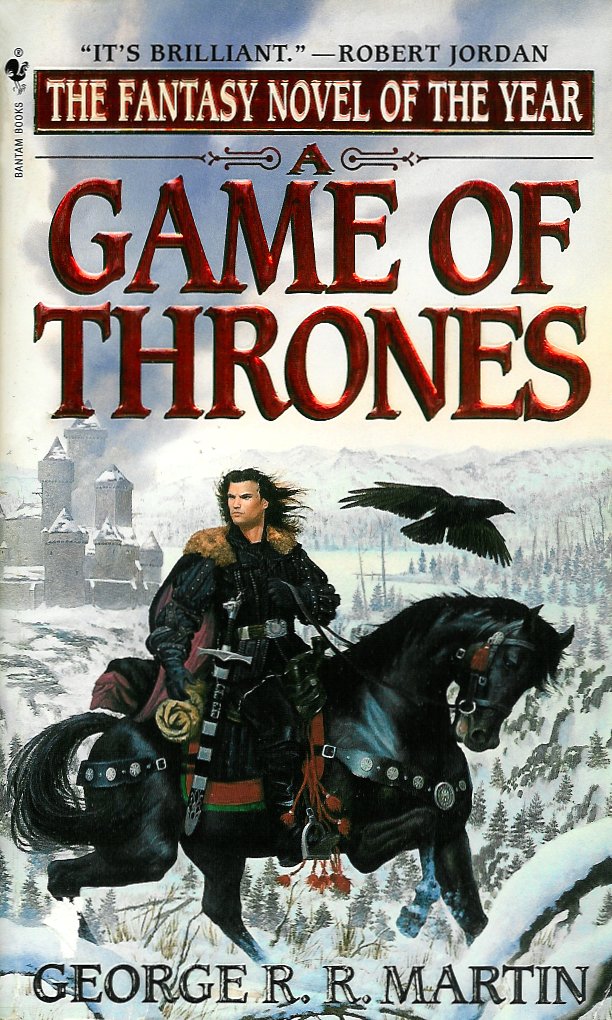
same for A Game of Thrones--it was fantasy, after all.
Then one day, Jemmy up and bought me a copy, casually
informing me that I no longer had any excuse for not reading it. Still I hemmed;
I hawed; I resisted. Until one night I just sort of picked the damned thing
up—and never looked back.
A Game of Thrones wasn’t a perfect book, but it was a gripping political thriller high
on intrigue and low on magic. I blasted through the even better sequels, A
Clash of Kings and A Storm of Swords, eventually moving on to the not-good
fourth and fifth volumes. Again I concluded that an overlong fantasy series
should have been a trilogy, though it didn’t bother me much this time. The
bleak perspective resonated with many of the things I saw going in our world—a
feeling punctuated by the early 2000s zeitgeist of ethnic cleansing, terrorism
and “enhanced interrogation techniques.”
From there I moved on to the other luminaries of gritty
fantasy: Joe Abercrombie, Glen Cook, KJ Parker, Gene Wolfe. I ate the stuff up,
and reveled in the visceral thrills of fantasy that walked in the shadows and
probed the darkest recesses of the human soul.
Only, after a while, the gritty stuff started to get
repetitive too. Formulaic, even.
My frustrations with fantasy resurfaced. I’d already had it
with pig farmers fulfilling prophesies, “noble savage” elves and all the other
clichés and tropes of the neo-Tolkein canon. I make an exception for Andrzej
Sapkowski, because he, well, subverts everything. But exceptions—or more
accurately, the fact that they are
exceptions—can prove the rule, so to speak.
But now even gritty fantasy, once a refuge from
the neo-Tolkeinic morass, proved equally capable of being cheap, generic and
derivative. Worse, there appeared to be an arms race of sorts in the works. I still wanted my fantasy to explore the darker recesses of the human experiences, but I wanted it to mean something. I
certainly didn’t want or need anyone to amp up the grit-tay just to out-do the last guy. And I'd had it with offhand rapeyness and tortureporn serving no purpose
other than to announce the grimmmmmm darrrrrkess of a fantasy world.
I began to think about the things I wanted to see more of in
fantasy. First on the list was more fantasy that, like recent work by
Elizabeth Bear, NK Jemisin, Saladin Ahmed, Scott Lynch, Doug Hulick and Django Wexler, leaves
the crowded shores of pseudo-medieval Europe (or more accurately,
pseudo-medieval Britain and Ireland) for different spatial, cultural and
temporal planes. The world was a big place and history is full of rich veins of
inspiration. I didn't want anyone to be lame and appropriative, but I did want
more fantasy authors to discover the rest of the world, and to explore time
periods on either side of the Middle Ages.
I wanted novel geographies, topographies and physical environments.
I wanted more experimentation with (or at least problematizing of) social relations. And I wanted authors to spend more time exploring consequences, intended
and unintended, of human action arising from relatable, understandable
motivations. The best fantasy already does at least some of these things, but
there’s still so much ground to cover.
I began to wish authors would go back to the actual medieval
and Renaissance periods in order to develop more sophisticated models of
religion. Religion in fantasy, after all, tends to come in two flavors: literal
and cynical. Gods are either actually walking the land and doing things (mostly
bad) or are totems every intelligent character understands to be superstition
and little else. But religion is often experienced as a lived reality: no gods
walking the earth, but life lived as if they might as well be. This idea was very
interesting to me—and another under-tapped vein that could be utilized to great effect.
I grew certain that new and better ideas could save fantasy.
Act 2
I really wanted to love Glenda Larke’s new book, The Lascar’s Dagger, because it hits on so many of these things. It draws inspiration from the mercantilist period, when the Dutch and British East India Companies competed for spices and slowly committed resources to colonial ventures they couldn’t afford (which enticed the Dutch and British governments to intervene and outright conquer much of Asia, the beginning of a much more expansive and destructive phase of international colonialism).
It features a novel, polar geography, where the overland
route to the Va-Cherished lands (i.e. alt-Christendom) pass through the North Pole.
Trade is dominated by the Pashali, who have mastodons, but the enterprising
merchants of Lowmeer would like very much to cut out the middle man. Discovery
of the sea-route to the Spicerie (i.e. the alt-Malay Archipelago) also uncovers
magical riches to be exploited. Larke thus invites us to consider the history
of colonialism as it might have played out if magic had been involved—a
fascinating idea that she makes good use of throughout the book.
On a personal level, I absolutely love that Larke develops
characters based on the Malay world (an area near and dear to my heart) and
does so in a generally classy and respectful way. Oh, and did I mention that religion
is embedded into the very fabric of everyday life—even for the educated elites?
Yes, The Lascar’s Dagger is certainly full of good ideas.
Yet as sophisticated as the book can be on an ideals level,
it is let down by the kind of cardboard characterization outsiders, with some
justification, associate with the fantasy genre. There is never any doubt who
is good and who is “evil.” There is never any internal conflict, really, even
when we are told there is. Everyone simply does the right thing, or the wrong
thing, because they are the type of person who does the right thing or the
wrong thing.
And for a novel written by a woman whose characters
explicitly question the patriarchy of their social environments, the female
characters are surprisingly unlikable—from the narcissistic and shallow
Princess Mathilda to the always-grumpy Sorrel Redwing and annoyingly coy Pontifect. This struck me as odd.
Act 3
Reading The Lascar’s Dagger reminded me of a conversation
script that most science fiction fans have witnessed or been a part of at some
point in their lives. You know the one:
Science fiction aficionado gets into conversation with nose-thumbing type. Nose-thumbing type thumbs nose at science fiction, at which point science fiction aficionado convinces nose-thumbing type to read a cherished classic. Nose-thumbing type comes back to science fiction aficionado and says: “I’m sorry, but I just couldn’t get past the stilted dialogue, poor characterization and so forth.” Science fiction aficionado then pleads with nose-thumbing type—“yes, but it’s the ideas that make this book special.”
This is a common approach to genre—that bad writing is
tolerable as long as the concepts are good. And most people just accept it--not only fans and readers, but authors and critics as well. Too often, when we discuss, debate and argue a book's merits, we fixate on the conceptual matter. Did it say something meaningful? Did it try something new? Did it meet or fail to meet a bar of acceptability as far as philosophy and social vision go?
These are important questions--important to me as well as to others. But fixating on ideas can overshadow equally important questions on fundamentals. Ideas, simply put, are just not enough—no matter how thought provoking they are. And by defining SF/F as "ideas fiction," we conspire to keep it in its literary ghetto. Really good SF/F, and by "good" I mean something of cultural impact and lasting value, is not born of vision alone, but through the execution of that vision.
In the end, this is what makes The Lascar’s Dagger so frustrating to me. I wanted to love this book—I still want to love
this book, and in some respects I do love this book. After all, the ideas
really are really, really good. Unfortunately, the fundamentals aren't.
Look, not all authors are Pynchon and not every book needs to be Gravity's Rainbow. But as much as we, the consumers, could have asked for more, someone on the production side could have recognized the seed of a great novel in this passable one, and nurtured it so it could flower into the thing it clearly wants to be. Justin Landon has recently called attention to this as a general problem facing genre publishing—and the experience of The Lascar’s Dagger really put that into perspective. There are a lot of writers out there with one half of the equation down pat, but who need more and better guidance to unlock their full potential. This is what traditional publishing is supposed to bring to the table.
Why isn't this happening? Like most problems in a capitalist economy, it boils down to issues of supply and demand. The business model of traditional publishing, you could say, is like diamond mining: you extract as much carbon as you can and hope you get enough diamonds in the process to make the venture worthwhile. Cash-strapped publishers just aren't going to invest the time and money raising the diamonds to carbon ratio unless they feel it's either: a) necessary to their survival; or b) a conduit to greater revenue and profitability. Because the crisis in publishing is long-term, incentives to boost revenue by bringing more quantity to market faster wins out over incentives to raise quality--a slower process with less-certain results.
Now, you may ask yourself why I'm being so negative. Here's why: I have dedicated a lot of time and emotional commitment to fantasy, science fiction and traditional publishing. I believe in fantasy and science fiction, just as I believe in traditional publishing. It is my firmly-held opinion that traditional publishing is, and will remain, the most consistent and efficient route to quality product. I've come to know good, hardworking people at Orbit, Tor/Forge, Solaris, Jo Fletcher and the rest of the specialty imprints. I think they are awesome and do awesome things. And I've read a lot of really high-quality books they've brought to market.
But this isn't the '90s anymore, and even if the crisis is long-term, it's very real. If traditional genre publishers are going to hold position and even grow in this era of crowdfunding, self-publishing and the return of the small press, they will need to assert their role as developers of talent--mentors and coaches who can consistently turn promising into good, and good into great. They will need to take potentially diamondiferous material like The Lascar's Dagger and turn them into brilliant gemstones. This is how traditional genre publishing will survive, and even prosper, in the new literary economy. That's good for everyone.
Labels:
books,
fantasy,
genre,
Hugos,
publishing,
science fiction
Monday, March 10, 2014
GUEST POST: Is There Such A Thing As A Book That Belongs To Only One Genre? by Peter Higgins
Is There Such A Thing As A Book That Belongs To Only One Genre?
My reading hinterland is haunted by lost genres. Kinds of book I once loved to read, whose memory is still warm, but whose moment has passed. The young adult space opera. The Cold War spy story. The epic adventure quest with a largely adult readership where all the characters are talking animals. They sold in millions once, and not so long ago, but they’ve largely fallen out of print. You can still write books like that but publishers rarely touch them. Their time has gone.
When a genre becomes massively popular it seems to prepare the way for its own demise. It booms and multiplies for a while because the unique pleasure it gives strikes a chord at a moment in history. It works again and again, and people go back for more and more of the same, until the formula becomes so well defined, so clear-cut and repeatable, so good at delivering one particular kind of pleasure, that you look for nothing else there. Read one, you’ve read them all. And then the world moves on and readers look for new pleasures.
I wish this didn’t happen, this tendency to put stories into genre boxes which then get more and more constrained until the pleasure they give is suffocated. For me, books aren’t like that, not really. For me, fiction isn’t fractal.
A fractal pattern is always the same: look at it whole, and it’s one thing; magnify a tiny part, and it’s still the same thing. But the way I see it, books aren’t like this: no book belongs so thoroughly to one genre that it’s the same all through and doesn’t draw in other genres as well. Look inside any work of fiction and you'll find lots of genres, shifting and shimmering, nested one inside another, claiming your attention, now one, now another.
Ambitious writers have come back to this idea from time to time ever since. T S Eliot in The Waste Land
Here’s an example of the kind of thing I mean:
A year past her emergence into society, with no suitors in sight, Alise had resigned herself for the role of maiden aunt. She played the harp, tatted excellent lace, was very good at puddings, and even had selected a suitably whimsical hobby.
This reads like something you might find in a 19th century novel. Not Jane Austen – Jane Austen characters aren’t good at puddings – but Little Women, maybe. Yet here’s the next sentence:
Long before Tintaglia had jolted her dreams, she’d become a student of dragon lore, with a strong secondary knowledge of Elderlings.
It’s from Chapter 3 of Robin Hobb’s The Dragon Keeper: Book One of The Rain Wild Chronicles
This is great non-fractal genre writing, but I think all books live like this. In Ark, Stephen Baxter kicks a slow time on the generation starship into new life by shifting into murder mystery mode for a while. In The Sea, The Sea
Characters that breathe the air of only one genre struggle to come alive, but let them open windows into other genres - even one-phrase micro-genres - and they're the more vivid for it. If a genre gives a unique pleasure, a unique insight, then letting in other genres enriches the mix. That way, genres can morph and grow, absorbing other ways of writing and new ideas. Robin Hobb takes epic fantasy in one direction, other writers take it into harsher, grittier territories. And when a popular genre’s moment in the sun passes, it gets absorbed back into the inexhaustible well of story possibility, with all the promise and potential it ever had, waiting to be used again.
I think this process of absorption, morphing and re-use is at work everywhere in works of fiction, at every level. I’d go so far as to say that, though some books foreground the technique and others don’t, it’s universal. Look at a page, a paragraph, in any book and, if you want to, you can see flashes of other genres living there: as a turn of phrase, a way of handling point of view, an echo, a single word. They’re open windows. Breaths of different air.
And maybe someone’s out there now, breathing dark and gritty new life into a book with talking animals. Maybe it already exists and I haven’t found it yet. I hope so.
Labels:
books,
fantasy,
genre,
guest post,
Peter Higgins,
science fiction
Subscribe to:
Posts (Atom)