Showing posts with label flintlock fantasy. Show all posts

Friday, July 5, 2024

Book Review: The Price of Redemption by Shawn Carpenter

The Price of Redemption attempts to do, not always successfully, with magic and sorcery what Naomi Novik’s Temeraire’s dragons did with the Napoleonic War

Flintlock fantasy, or gunpowder fantasy, tends to run from the invention of firearms up until the end of the Napoleonic Wars. From the first flintlocks and matchlocks, up until the brilliance of Napoleonic warfare, there is an ever widening appetite for having guns AND magic in a secondary world fantasy. Often, this sort of fantasy leans heavily on various nations having clear analogues to our history and leaning on the history and cultures of the evoked real-world nations to help worldbuild.

And so we come to Shawn Carpenter’s The Price of Redemption.

Albion [Read: Great Britain] and Ardain [Read: France] are locked in a dueling combat for control over the high seas. Ardain in general is not doing well; it is suffering under a new Theocracy [Read: The French Revolution Terror], which is hunting aristocrats, particularly aristocrats who are mages. It's conflict on the high seas. The Ardain don't yet seen to have a Napoleon type, but they definitely are in mortal strife with Albion. But as this is early in the Terror, there are plenty of Ardainians who are running from the bloody-mindedness of the new regime.

Enter Enid. End is a noblewoman fleeing the Theocracy. In the course of that, her ship, pursued by the Theocracy, is captured by a small Albionian ship, the Alarum, headed by its acting captain, Lieutenant Rue Nath. Having lost his shipboard mage in the struggle against the Theocracy ship, Nath offers Enid a provisional position as a replacement shipboard mage, and so a tenuous alliance is formed between Albionian and Artagny, ship officer and noblewoman mage. And thus begin their adventures and struggles against enemies and rivals both foreign and domestic.

The novel takes a good while to find its footing. It starts off with a lot of granular detail as to the life and nature of being on board a ship in our equivalent of the turn of the 19th century. I think the novel bogs down, quite frankly, in the author’s delight to present us everything, and since Enid knows very little about living and working and life on board a seagoing vessel, and she is one of our viewpoint characters, we can and do get a large and sometimes not well integrated wealth of information. And for a while, Enid doesn’t quite breathe as much as she should as a character. She feels much more like a plot device.

For example, right in the first chapter, she is described as engaging in a magical duel with a sorcerer on the Theocracy ship pursuing her, but the magical duel is described in such a spartan and brief way that it is a case of blink and you miss it. Enid has some secrets, but the novel seems awfully reluctant to actually show any of them for quite some time, focusing far more on life in terms of things going on the ship instead. (There is also an extensive appendix at the end of the book with even more nautical and naval terms.)

The novel also seems to forget some things, or not realize them, only belatedly coming back to them. Just what the role of language is in this society was unclear, and for about half the book, it seemed that Ardain and Albion spoke the same language, which felt like a mistake and misstep in worldbuilding that the novel later corrects and seems to remember. I am thus also not convinced that the analogue history here works as smoothly as it might, and it feels more of a case of “spot the analogue” for fair stretches of the book. (Oh here is France, here is Spain, here is Gibraltar...) So for much of the first half, the book mostly feels like an expy of other authors rather than Carpenter’s own voice.

However, the novel slowly does find its feet, or gets into smoother waters, to continue the analogy. There are some interesting facets and aspects to the magic system; and Enid’s own backstory, once we get a real sense of it, is moving and striking, but I’d argue it should have come far earlier in the book. It’s welcome when we do get it. There are good action sequences, and there is a proper conflict where we DO get to see Enid perform her magic in a vivid and well described manner. It didn’t erase the memory of the poorly described duel, but it did help reestablish and fully establish her as a competent character.

When it comes to Nath and his crew, and the more mundane aspects of their conflicts, that is well written. We get a number of set piece conflicts that really evoke and invoke the best of authors such as Patrick O’Brian, who is the clear and present model for Carpenter’s work. If the thrill and thunder of ships trading cannon fire gets your blood pulsing, this novel definitely delivers on it. There is, as the novel progresses, a fair amount revolving around the scheming, politics and even backstabbing that goes on in the naval service around promotions and commands, and that, too, is O’Brian all the way. But this, put together with the magic system, often feel like they are from two different books.

The novel also takes about two thirds before it decides to break away from the analogue worldbuilding and come up with something new and novel that doesn't have an obvious analogue to our world. The Darghaur might seem like an analogue of Vikings... but it is clear that they are in fact definitely not human at all. They sail barges, use strange firearms, deploy odd magic and are frankly terrifying. Given how I had been nodding along with everything in the novel by this point, the Darghaur also feel like they come from yet another book.

In the end, that is what I am going to come down on. The Price of Redemption has a lot of things going for it, but they aren’t always harnessed properly or efficiently, or quite as a cohesive whole. There are a lot of worldbuilding elements here, but they sometimes come across in a blunt manner rather than being folded into the narrative. Our characterization of not only Enid but Rath as well really takes a back seat and takes time to come out. There are some interesting aspects to both their backstories, but it can be a slog to get to. There is also possibly the beginnings of a same-sex relationship with Enid and a naval officer—and the book is good about making a world far more enlightened about the role of women in society than its late-18th-century counterpart, but again, it doesn’t feel cohesive. The book does improve as it goes on, which gives one hope that subsequent volumes will be stronger, but for me, this first volume was rather rough.

The Price of Redemption, ultimately, is a book that is less than the sum of its parts.

Highlights:

  • Interesting pieces of worldbuilding
  • Strong resonances with O’Brian, Forrester and allied authors
Reference: Carpenter, Shawn. The Price of Redemption [Saga Press, 2024].

POSTED BY: Paul Weimer. Ubiquitous in Shadow, but I’m just this guy, you know? @princejvstin.

Wednesday, June 21, 2017

Microreview [book]: The Guns Above, by Robyn Bennis

Pure flintlock awesomeness!


I adored this novel. The Guns Above has heart and gumption and sass and a brilliant leader in Captain Josette Dupre.

I went into The Guns Above not knowing much outside of flintlock + airship + military. Now, I want all things Dupre! Basically, The Guns Above reads like the first episode in a series you wish you could binge watch all weekend.

Garnia is at war with Vinzhalia over the territory of Quah. Garnia has been at war for generations, so long that many have lost sight of the real reasons they are even fighting beyond the pride of winning.

Recently promoted Senior Lieutenant Josette Dupre is made captain of the airship Mistral, a new and untested design, due to unwittingly making a splash in the newspapers after a particularly epic air battle where Dupre and a sergeant are the only survivors and managed to help turn the tide for the infantry on the ground.  The Aerial Signal Corps is often mocked by the regular army and Dupre's headlines make an enemy of General Lord Fieren, the army's commander.

Aside from the insult of an airship taking the battlefield glory, a woman gaining all the recognition is too much for Lord Fieren. Giving Dupre command of the Mistral, a chasseur class warship built to withstand cannon recoil, Fieren hopes to prove her unfit and unworthy of all the praise. He even goes so far as to plant his nephew, Lord Bernat Manatio Jebrit Aoue Hinkal, a spoiled, flirtatious aristocrat, as an observer (read spy) to report directly to him on Dupre's actions.

We enter the story mid-war right after a very recent battle where Dupre has little time to do much else other than dust herself off after waking in the hospital before having to report to Lord Fieren for what she fears will be her end. Instead she finds her new found newspaper fame has earned her a Royal promotion to Senior Lieutenant, a rank never before held by a woman. Dupre engages Sergeant Jutes, the other survivor from the now infamous crash, to help her take the Mistral in the air.

Dupre lives and breathes all things airship. With a a mere touch she knows what her ship is telling her even before her crew can call it out. Her expertise is unparalleled but being the first woman to have earned the rank of Senior Lieutenant ever as well as being the first woman given an airship command, she has a lot resting on her shoulders to prove to her crew and fellow airship captains.

Despite Lord Hinkal's privileged, and very sheltered, status he does eventually worm his way into the heart of the Mistral's crew. He is a pompous man and we see him towing the line on every possible stereotype for women serving in the military and in command. But Dupre's skill and courage prove to Hinkal she's more than worthy.

The back-and-forth between Hinkal and Dupre are a vital pulse point within the novel. We see Dupre having to suffer the uppity aristocratic attitude in stride as he is a civilian and she is under orders from Lord Fieren to give him unrestricted access. By turn we also see Hinkal getting to experience life outside his normal cushy digs for the first time. Both are incredibly witty with razor-sharp wit causing many humorous exchanges where I found myself laughing out loud.

What I love most about the relationship forming between Hinkal and Dupre is that Bennis leaves it at a friendship level. There isn't the weight of potential romance hanging in the air. We get to see characters flourishing in their element as individuals and as part of a crew. It was refreshing.

More than anything else, The Guns Above is a supreme adventure story. I mean, Bennis has put epic naval battles in the air, talk about taking it up a notch or four. In the sea, if there was a man overboard, there might still be a chance to pick them back up. In the air, a man overboard pretty much means certain death. The battle scenes, even smaller ones, are thrilling and I couldn't help but hold my breath.

Bennis hits it out of the park with this series opener and I can't wait for the next installment. I am thrilled to have Robyn Bennis joining the flintlock adventure ranks.


The Math:
Baseline Assessment: 8/10  

Bonuses: +1 for amazing lead character

Penalties:  N/A  

Nerd Coefficient: 9/10 - This book is pure flintlock awesomeness! 

Our scoring system explained.


*** 

POSTED BY: Shana DuBois--extreme bibliophile and seeker of raindrops.
Reference: Bennis, Robyn. The Guns Above [Tor, 2017]

Friday, February 19, 2016

Microreview [book]: The Bands of Mourning, by Brandon Sanderson

The ultimate chimera, this book is a surpassquel: a sequel that surpasses the original!


[Buy it here, or elsewhere, but whatever you do, be sure to read it!]

I’d thought it was just a myth, a story told to children before life beat all the creativity and optimism out of them. There’s no such thing as a surpassquel! How could there be? If the original sets out the narrative boundaries of the story, all subsequent iterations of the story must almost inevitably exist only within the confines of those boundaries. To put it mathematically, sequels are asymptotic—they can approach, but never hope to surpass, the greatness of the original. Plus, on the practical side, authors, for obvious reasons, tend to lead with their best foot forward, so to speak, and as a consequence, it’s exceedingly unlikely that an author would intentionally save his or her best idea for installment six—if the first effort doesn’t catch on, there won’t be any more, after all.

To bring the conversation back (or forward?) to Brandon "Branderson" Sanderson’s Mistborn series, I had even less reason to hope, since after the original Mistborn trilogy, centered around the peerless Vin, books four and five, while interesting and plenty entertaining, didn’t have quite the sparkle of the Vin era. Why hold out any hope that Branderson would find authorial magic on his third attempt at the Wax + Wayne (or wax and wane? Yin and yang?) formula?

Yet somehow…Branderson managed it. And I think I’ve figured out how.

I can’t say much without potentially spoiling the surprise, and in fact that’s part of the reason this sixth book in the Mistverse is so scintillatingly good: it’s basically a detective novel, full of twists and turns galore. But that’s not the main reason. You see, I had always thought the Wax&Wayne stories were especially unlikely to reach surpassquel status, because even within the diegesis, the mythology of Vin et al continues to overshadow the present. Kelsier has become the center of a vaguely Christian religion, while other characters we came to love in the first trilogy are similarly venerated, their real motivations poorly understood under the terrible weight of mythology.

It was an interesting decision for Branderson to let the original series loom so definitively over later stories set in the same world, but it was also, I reasoned, a brave/foolhardy one, since how can we admire this new cast of characters/situations if we—and they themselves!—know they are in every way inferior to the original band of heroes? Why, it would be almost as though someone made a fantastic trilogy of movies about a story of considerable pathos and gravitas, then decided to follow it with another trilogy set in the same world, but with waaaay less at stake, and try to pass it off as equally awe-inspiring (yes, I’m talking about you, Peter Jackson!).  

But in The Bands of Mourning, Branderson has delivered a masterstroke (of the metaphorical pen) showing why this mythological feedback loop can work: 1) he’s found a way to connect the latter-day heroes with the legendary figures of the past, and 2) he’s also exploring, far more dramatically than ever before in the Mistverse, the potential that Allomancy itself might soon be superseded by technological progress…yet also showing how nope, Allomancers will continue to thrive with each new innovation. This sort of myth + technology mash-up felt less successful in the first two Wax and Wayne volumes, but here, it strikes just the right tone.

All in all, it is my considered opinion that The Bands of Mourning is Branderson’s finest work in the Mistborn series—and in fact, his finest work, period!


The Math

Objective Assessment: 7/10

Bonuses: +1 for finding a way to bring the past into the present—and keep both past and present relevant despite the encroaching future; +1 for crafting an excellent mystery

Penalties: none!

Nerd coefficient: 9/10 “Very high quality—a standout in the series, and the genre itself.”

[“What? Only a 9/10, and after such a glowing review?” –some reader
“Ah, but a 9/10 is as rare as a chimera here at Nerds of a Feather…see for yourself!" –me]

***

POSTED BY: Zhaoyun, long on a heretofore quixotic quest to find a surpassquel and regular contributor at Nerds of a Feather since 2013.

REFERENCE: Sanderson, Brandon. The Bands of Mourning. Tor: (January) 2016.

Tuesday, January 5, 2016

Microreview [book]: The Price of Valor by Django Wexler

The price of revolution.


I'm a big fan of Wexler's flintlock fantasy series, The Shadow Campaigns. The first volume, The Thousand Names, was a revelation--marked by great characters, memorable action scenes and incredible attention to detail with regards the tactics and daily lives of modern-era soldiers. The Shadow Throne, which shifted focus from the colony of far-flung colony of Kandahar to the Vordanai metropole, was both highly entertaining and thoughtful. Yet it seemed to lack the tightness and singularity of focus that made The Thousand Names stand out from the glut of new fantasy releases. I am happy to say that The Price of Valor represents not only a return to form, but a leveling up.

The Price of Valor is, in essence, a continuation of The Shadow Throne--to a far greater degree than The Shadow Throne is a continuation of The Thousand Names. Winter has been promoted to colonel and is in charge of the Girl's Own, a female brigade serving in the army of military genius Janus bet Vhalnich, which is currently facing the combined armies of Borel, Hamvelt and Mursk--all followers of the Sworn Church and enemies of the revolutionary Vordanai government. Marcus d'Ivoire, meanwhile, has been left in Vordan City to keep track of a deteriorating political situation, in which a cabal of Jacobins has re-formed Orlanko's terror state under new auspices. As in Revolutionary France, this Directorate and its paranoid-obsessive leader Maurisk now seek to "purify" the revolutionary state of its "internal enemies," which seem destined to include Queen Raesinia, Janus and his lieutenants, Winter and Marcus.

Making matters worse, the secretive Priests of the Black, who are religiopolitical extremists of the first order, have sent several operatives--each possessing a magic-generating demon--to recover the eponymous Thousand Names, a repository of magic-generating demons itself, including the demon-eating Infernivore that possessed Winter at the end of The Thousand Names. And they have brought Maurisk, who heads the militant Directorate that rules Vordan, into their cabal. If they succeed, there will be no force in the world that can stop them.

Here's the thing: while The Price of Valor is not perfect, it belongs to a very small category of books that I just can't put down. While this might not seem like a big deal to some of you, consider that I have trouble doing anything for more than an hour--even the most compulsive of activities, like playing video games. This is why I read fewer books than many of my fellow bloggers. But this one...every chapter urges you forward--"just a few more pages," you say! Then before you know it the clock reads 3am and even if you'd like to keep going, you do have to get up at 6.

I also greatly appreciated the political nuance on display as Wexler turns his attention from the injustices that lead to revolution to the question of how revolutions come off the rails. In this case,   Wexler lets the reader contemplate whether Vordan would have been better off with Orlanko in power and the Thousand Names safely in Kandahar than with Maurisk and the Thousand Names in play.

The gender politics were another high point for me. Vordan (and its neighboring societies) are strongly patriarchal, as one would expect from a world modeled after Europe of the late 18th and early 19th centuries. But even though various characters assume that this is the natural order of things, political events are challenging and even upending deeply-embedded norms--and especially in the military. I look forward to seeing where Wexler takes things from here.

Politics aside, the book is also just quality fantasy. There's ample magic and action, strong world building and two memorable, relatable protagonists in Winter and Marcus. And the Penitent Damned are great villains. My only issues relate to two of the secondary characters, namely, Janus (the mercurial genius) and Mad Jane (Winter's fiery, red-haired lover). Janus' ability to think several steps beyond anyone else, to the point where he must be able to predict outcomes of dumb luck, strains the imagination. Meanwhile, Jane is just whiney and annoying--a far cry from her (rather more satisfying) portrayal in The Shadow Throne. She's a drag on the story, frankly, and I hope Wexler finds a new way to utilize her going forward.

But these are relatively small quibbles. The Price of Valor is a clever, well-written and highly addictive novel, and easily the best in the series so far.


The Math

Baseline Assessment: 8/10.

Bonuses: +1 for smart, sophisticated politics; +1 for keeping me up at night.

Penalties: -1 for Janus and Jane issues.

Nerd Coefficient: 9/10. "Very high quality/standout in its category."


***

POSTED BY: The G--purveyor of nerdliness, genre fanatic and Nerds of a
Feather founder/administrator, since 2012.


Reference: Wexler, Django. The Price of Valor [Roc, 2015].  

Monday, November 10, 2014

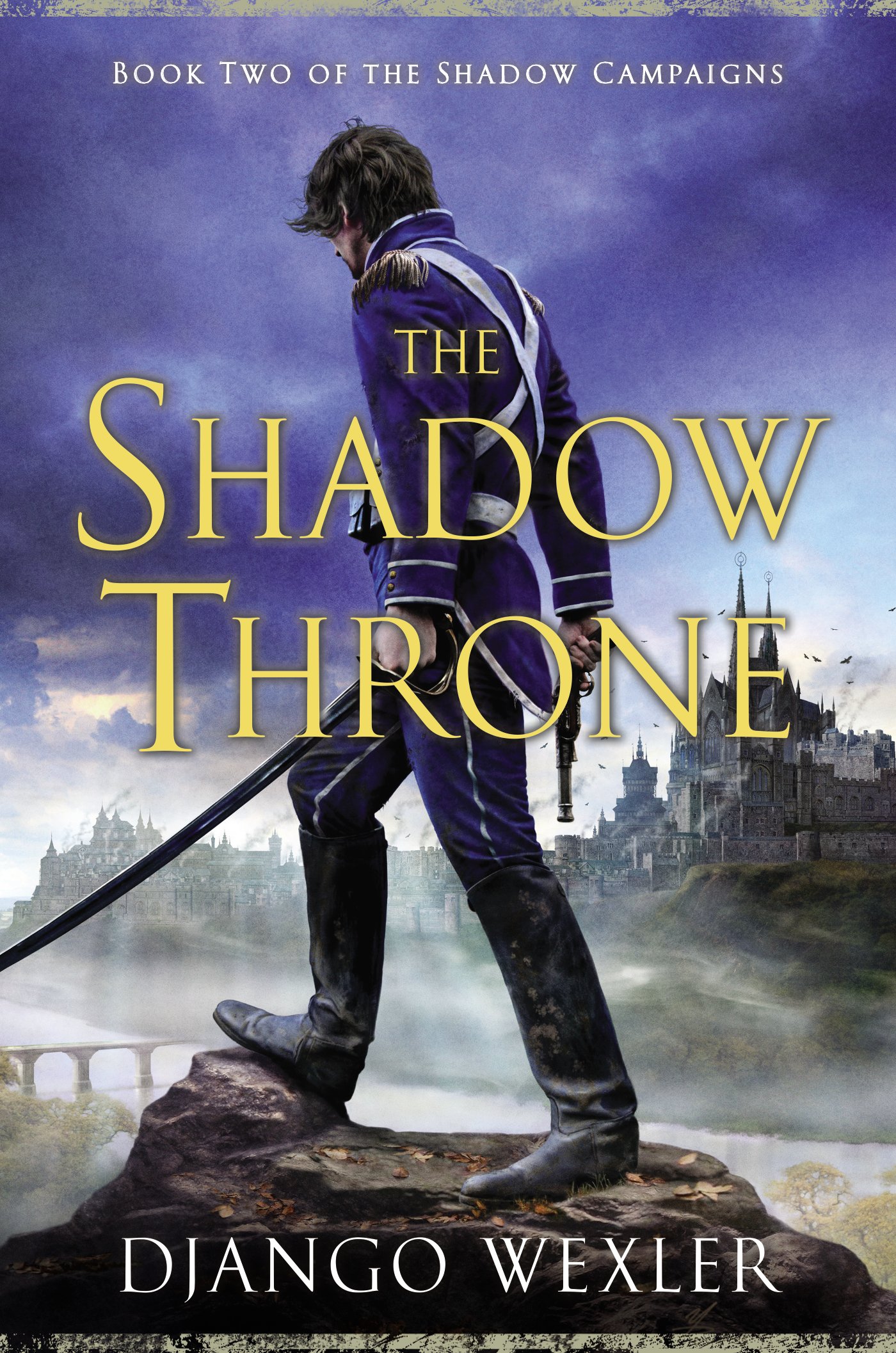
Microreview [book]: The Shadow Throne by Django Wexler

Embracing the messiness.


Django Wexler's The Thousand Names was one of my favorite books of 2013. It struck me as an unusually tight, character-based fantasy novel that mined its early modern source material effectively, while featuring some of the best battle sequences this side of the Blackwater. And it's a book that has, over time, grown in my estimation. So if you haven't read it, stop reading, go to your favorite store (or digital store) and get a copy. Then start reading this review again when you're done--I wouldn't want to spoil the fun for you, after all.

The Shadow Throne leaves the campaign trail for the messier world of political upheaval. Captain Marcus d"Ivoire and Lieutenant Winter Ihrenglass accompany the mercurial Colonel Janus bet Vhalnich on a fast ship to the Vordanai capital, where the king's death is imminent. His daughter, Raesinia Orboan, is widely viewed as weak, and Janus fears she will fall under the spell of Duke Orlanko, head of Vordan's feared secret police. As we found out toward the end of The Thousand Names, Orlanko is in league with the Sworn Church and its demon-carriers. Making matters worse, he has used instruments at his disposal to house one of the magical-ability granting demons within the princess herself--a secret that, if let out, would destroy her. But Janus also knows this, and is determined to stop Orlanko's power play at all costs.

Raesenia, meanwhile, is not the weak-willed pawn everyone seems to assume she is. Her inner demon has granted her the power of physical regeneration, which she uses to escape the palace by night (along with a super spy sidekick, of course). From there she assumes the identity of a student radical and leads a cabal of agitators in a bid to create a counterweight to Orlanko.

While the political opposition grows in power and popularity, a parallel set of developments emerge on the docks, where the lower classes are organizing behind "Mad Jane," a charismatic leader taking a stand against the oppressive practice of tax farming, i.e. the giving out of taxation permits to foreign agents from neighboring Borel (so that Orlanko and the crown can pay off their debts without dipping into state treasures). These two budding opposition movements--one bourgeois and intellectual, the other proletarian and tough--come together on one fateful night, after which nothing will be the same.

If this feels like a departure from The Thousand Names, that's because it is. And, to be honest, there were moments when I missed the set-piece battles and fighting person camaraderie that made the first book such a winner. Particularly at the beginning, The Shadow Throne shows symptoms of "bridging chapter syndrome." Pacing is an issue early on, while several plot devices that are telegraphed as "very important" early on disappear as the book progresses (though one or two promise to return in book three).

These are things I normally complain about, but here's the thing--ultimately they don't matter. Why? Because whatever faults this sequel has, they are more than compensated for by the things it does well. And not just well, but uniquely well.

Wexler has created a political environment largely based on Europe's modern-era revolutions. The greatest echo is of the French, but there are shades of the Russian and English in there, as well as of the failed revolutions of 1848. As someone who has read widely on the historical source material, I was happy to see that, while Wexler takes understandable liberties with history (this is fiction, after all, and fantasy fiction at that), he keeps things messy in the way this kind of setting should be messy. 1789 was, after all, the moment when representative government changed from a theoretical abstraction or "that thing the Americans are struggling to build way over there," to "that thing everyone will eventually want for themselves." And it's the birth moment of nationalism* too, that point after which subjects became citizens, states were reframed as birthrights and "birthright" cleft of its rigid caste privileges and given over to "the people." These birthing processes were messy and often very ugly; Wexler edits some of the ugliest bits out, but leaves most intact. 

Possibly coming in the next volume.
And Wexler gets extra kudos for not eliding the questions of class that emerged alongside this transformation. The student-led uprising, which seeks to re-establish the Deputies-General (re: a more parliamentary version of the French Estates General), is a deeply fragmented but ultimately bourgeois-intellectual movement. While it seeks to assert the "authority of the people" over the monarchy and nobility, it also defines "the interests of the people" in decidedly bourgeois terms, and treats the proletarian dockworkers movement, which aligns behind the noble Vhalnich, with deep trepidation. In French history, this rift fed into the generations-long seesaw between bourgeois republicans and the commoners aligned behind the Bonaparte family. Similar dynamics, Wexler suggests, may rear their head later in the series.

There are a number of other things I greatly appreciated about this book, not least of which is the writing itself. As in The Thousand Names, Wexler's prose is neat and unpretentious, satisfied to settle into the background, where complex character construction and thematic elucidation take place. I also enjoyed the fact that, outside Orlanko, there aren't really any "villains"--just competing interests and flawed decisions. It's hard to make that work, but Wexler does it well.

I did, however, want to see more of Orlanko himself. We are told he's hated and feared, but we don't ever really get to see it in action. Though the few scenes he's in do tantalize with potential, he's mostly relegated to the background, and I guess I'm just saying I wish there was a little more foregrounding of his character. Janus presents a different problem. He's a memorable and well-developed character--the high achieving savant whose methods are as opaque as his motives. At the same time, he's a bit too clever, like MacGuyver but with strategy instead of ordinary household items.

These are fairly minor issues, though. All in all, The Shadow Throne is an inventive, exciting and fun fantasy novel that can be read as a straight adventure but has additional value for history buffs and those who want deeper politics in their fantasy novels. Oh, and if you were hoping for more of Wexler's super well-rendered battles? There just so happens to be a real doozy at the end. Now, when does book three come out?

*Patriotism and ethnocentrism existed before 1789, but nationalism is a distinctly modern phenomenon born of the French Revolution.


The Math

Baseline Assessment: 8/10

Bonuses: +1 for utilizing a historian's view of politics (i.e. it's messy); +1 for the subtle and effective class narrative.

Penalties: -1 for moar Orlanko plz; -1 for plotting/pacing issues early on.

Nerd Coefficient: 8/10


***

POSTED BY: The G--purveyor of nerdliness, genre fanatic and Nerds of a
Feather founder/administrator (2012).


Reference: Wexler, Django. The Shadow Throne [Roc, 2014]

Monday, August 5, 2013

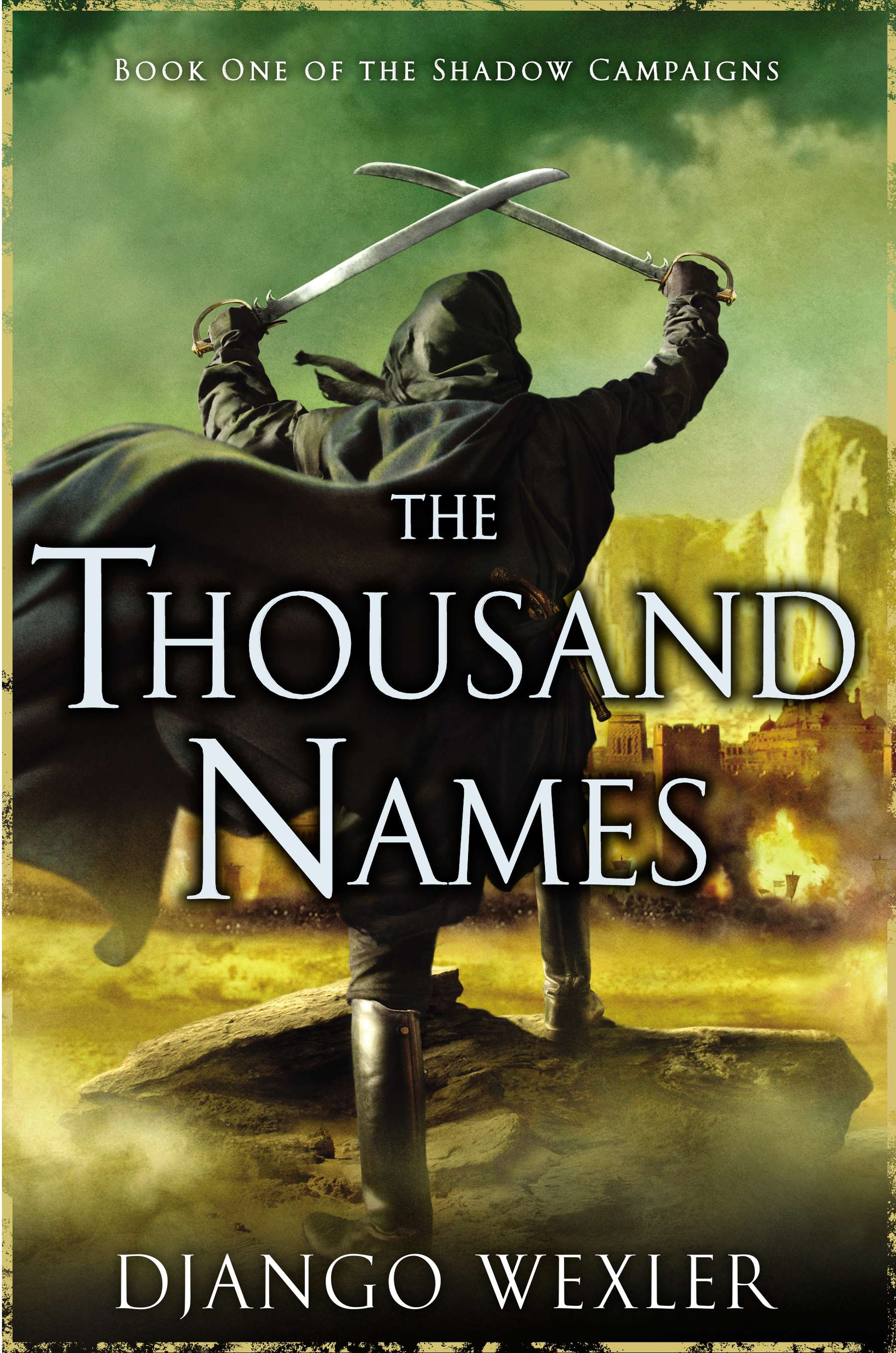
Microreview [book]: The Thousand Names by Django Wexler

Wexler, Django. The Thousand Names [ROC, 2013]


The Meat

Flintlock fantasy is a term you hear a lot these days. The basic formula is fairly simple: take musket-era Europe as your source material, add some magic and voila! Doing it well, of course, is another beast entirely. But it's easy to see what the attraction is--after all, early modern Europe was a time and place of great social transformation. Feudalism was on the wane, to be replaced by the modern state (and then, later, the nation-state). Capitalism was in its emergent phase, stimulating a major round of urbanization. European navies (and private companies) sailed the world in search of gold, land and spices--usually to the detriment of the people they found there. And then there were the firearms that so completely upended military relations--the muskets that killed off the cavalry charge and the canons that made castle walls obsolete. Yes, it was a time of change--big change--and periods of upheaval are good springboards for fiction.

Django Wexler's The Thousand Names takes place in Khandar, a colonial dominion of the Kingdom of Vordan. Khandar is loosely based on Egypt, though a version of Egypt that never experienced the transitions to Christianity and Islam. Vordan is a sort of France-meets-England-meets-Germany. Its dominant religion is alt-Christianity, and specifically the alt-Protestantism of the Free Church. For members of the Colonial Army, Khandar is a sort of hardship posting--a place they send you when you've done something wrong, or a place you go to when you are trying to escape something. The two protagonists of the book, Captain Marcus d'Ivoire and Ranker-turned-Sergeant Winter Ihernglass, are of the latter persuasion. So it stands to reason that when a fanatical religious cult stages a rebellion against the colonial dominion, Marcus and Winter are among the few Colonials who aren't in a rush to get the fuck out of Dodge.

Despite the hopes and expectations of most of the other soldiers, though, Vordan has little intention to leave Khandar to the Khandarai. Rather, the home country sends Colonel Janus bet Vhalnich--a reputed military genius--at the head of a smallish force, charged with retaking Khandar and putting its "rightful" ruler, the recently deposed Prince Exopter, back on the Vermillion Throne. Janus is indeed a military genius, but one playing a long-game opaque to even his most trusted of confidants....

As you can probably tell, The Thousand Names is a work of military fantasy, and as such, should appeal to anyone with interests that run in that direction. It helps that Wexler is clearly well-read on both early modern tactics and the daily life of soldiers: Marcus and Winter face any number of realistic obstacles--environmental, tactical, supply or moral oriented--as well as significantly different types of opponents, from a loose and untrained but large irregular army to a Vordanai-trained force to Bedouin-style guerillas. Every battle teeters on the edge of disaster and is positively dripping with tension.

As the book progresses, Wexler seeds a second plot related to Vordan's attempted reconquest, or rather, a crosscutting narrative that reconfigures our understandings of what is at stake. This is where the magic comes in, and for the most part it's nicely done. There's an appealing air of mystery to everything, and there are hints at a broader political struggle enveloping all sorts of powerful actors from beyond Khandar's borders. Wexler tantalizes the reader with just enough information to make the wait for book #2 unbearable.

Wexler also does a good job with his two protagonists. Marcus is a pragmatic figure, one who has gained the Colonel's confidence but still has that of the fighting men. Winter, it turns out, is a woman disguised as a man--someone who joined the Colonial forces and faced down the constant fear of discovery as a means to escape captivity in a Dickensian workhouse. Both are believable, relatable and have an appealing depth to them. Many of the side characters, though, feel a bit two-dimensional. Janus, for example, is a bit theatrical for my tastes, while Winter's nemesis and former commanding officer Sergeant Davis will seem familiar to anyone who's watched their share of Popeye cartoons. Then there's Jen Alhundt, the minion of (nefarious) Duke Orlanko posing as an innocuous civilian observer to the campaign. The problem, of course, is that we know from the outset that she's a minion of (nefarious) Duke Orlando, making her protestations of innocuity rather difficult to believe--yet believed they are.

A second concern centers on the portrayal of colonialism. While reading, I periodically found myself questioning why Vordan is even in Khandar. After all, European colonialists were always after something, and usually something material--gold, slaves, land, spices, trade routes, etc. But there don't appear to be any colonial economic institutions to exploit the natives with, nor any ventures or entrepreneurs to do the exploiting. Instead, there's an unpopular prince backed by a lackluster force of foreign soldiers. Is the venture purely power political? If so, in relation to whom or what rival force? There *is* a possible answer alluded to towards the end of the book, but it's really an underlying conspiracy--a truth beneath the accepted truth. For that to really work, though, we still need that accepted truth, and the fact is that we don't really get it.

The lack of attention to the economic or political bases for colonialism strikes me as a missed opportunity. As is, we don't get enough of a sense of how colonialism is experienced by the colonized, outside a few short chapters from the perspective of Khandarai elites, nor how the Old Colonials really feel about the Khandarai. Marcus and Winter, as two unsually thoughtful individuals who share a sensitivity to Khandar and the Khandarai lacking in most of their peers, would seem to be perfect conduits for exploration of such ideas--even if in an offhand way. I wanted to see more interplay between colonizer and colonized, and to watch Marcus and Winter come to grips with their ambivalence for the colonial enterprise that nevertheless saved them from their own personal hells. If Wexler returns to Khandar in subsequent volumes, I'd love to see him tackle some of these issues more directly.

On balance, though, there's much more to applaud than criticize about The Thousand Names. Wexler has written a smart and engaging novel that's well-paced, nicely detailed and full of memorable scenes. If you're new to flintlock fantasy, then you would do well to start here.

The Math

Baseline Assessment: 8/10

Bonuses: +1 for the rich treatment of military subjects; +1 for the exquisitely rendered battle scenes.

Penalties: -1 for the Jen Alhundt believability gap; -1 for missed opportunities to explore colonialism.

Nerd Coefficient: 8/10. "Well worth your time and attention."