Showing posts with label Solaris. Show all posts

Thursday, March 7, 2024

Review: Spaceman

Adam Sandler takes a turn as a serious and sad astronaut in this film that feels like the offspring of Project Hail Mary and Solaris.


Despite that hooky opener you just read, Spaceman, the latest Netflix sci-fi venture, is based not on Andy Weir's Project Hail Mary (which also features a lonely astronaut befriending a kind space arachnid) but on Czech author Jaroslav Kalfař's 2017 Spaceman of Bohemia.

The film follows Jakub, an astronaut on a solitary mission to study a remote space cloud. It's unclear when the movie takes place, though based on the technology, it seems like an alternate future where despite deep space missions, all-white sterile nanotechnology and shiny flat screens never emerge. The spaceship is full of chunky manual buttons, rotating switches, and heavy machinery, all in the nondescript, waiting-room beige, mint green, and burnt ochre colors of the 1970s.

This design decision makes sense when you learn that the director, Johan Renck, was also responsible for the muted greens and blues of Soviet-era Russia in HBO's Chernobyl.


Jakub, alone and lonely in the vastness of space, senses something is wrong with his relationship with his wife. Indeed, she records a Dear John letter down on Earth hoping to end things, but the space agency doesn't let it go through. Instead, he hears absolutely nothing from her for days on end, and like any of us who get ghosted, starts to slowly unravel mentally. 

Following in the hallowed footsteps of other Men Who Are Sad About Things In Space, Jakub wallows. And wallows. (See also: Interstellar,  Ad AstraSolaris).

And then, enter Hanuš — a sentient spider being who happened to be passing by. Drawn, he states, by Jakub's loneliness. Hanuš's presence is incredibly soothing, voiced with effortless aplomb by Paul Dano. His epithet for Jakub is "skinny human," and it's like a mantra. 

Hanuš is interested in his human friend's emotional turmoil, and the middle chunk of the film is essentially a psychoanalysis session. The spider can replay memories like a movie, probing deeper regardless of Jakub's protestations and unwillingness to revisit scenes from his life with Lenka, played by Carey Mulligan (She's made a career out of nailing the unhappy wife character longing for a different life).

The question one faces while watching is: Is this real? Or is Hanuš a vehicle for Jakub to work out his emotions? I'd like to think that it's real. But that's what makes it fun, seeing him veer off into near insanity with his space spider therapist.

Speaking of Solaris, you can't watch Spaceman without acknowledging its influence. It's like trying to listen to The Strokes or Interpol without hearing the Velvet Underground underneath everything. From the achingly sparse world and glacial pace to the Soviet-inspired production, Spaceman cribs a lot from Solaris, Andrei Tarkovsky's epic about space, memories, and whether you can really know someone. 


At the end of the day, Spaceman didn't do much that hasn't been done before, but I found the performances moving — including Adam Sandler's! However,  I will admit that every 15 minutes or so, he'd float by in zero-G in basketball shorts and I'd think "Oh weird, it's Adam Sandler being serious in space". My favorite Letterboxed reviews just consisted of one word: Intersandlar.  

I like a slow and thoughtful space movie, though. Gattaca is one of my all-time favorites. Spaceman is worth a watch if you want to be space emo for a little bit. It does the soul good. 

--

The Math


Baseline Score: 7/10


Bonuses: The retrofuturistic Soviet-era production design is gorgeous; Isabella Rossellini as a military space commander is perfection and a wonderful surprise.

Penalties: Some folks will not be able to handle an Adam Sandler non-comedic portrayal. Also, the ending is sentimental and rushed.


POSTED BY: Haley Zapal, new NoaF contributor and lawyer-turned-copywriter living in Atlanta, Georgia. A co-host of Hugo Award-winning podcast Hugo, Girl!, she posts on Instagram as @cestlahaley. She loves nautical fiction, growing c

Tuesday, October 9, 2018

Microreview [book]: Infinity's End, by Jonathan Strahan (editor)

Infinity's End is a fitting and excellent way to close the book on a solid anthology series.


I asked the writers creating new stories for this book to try to open up the solar system, to look again at its vastness, its incredible scale, and at how humanity in different ways might fit successfully and happily into its nooks and crannies. - Jonathan Strahan, "Introduction"
One thing that helps to center my reading of one of Jonathan Strahan's Infinity anthologies is what he has to say in the introduction. I take the stories as they come and as they are, but that introduction discussing the central idea of the anthology and the intended perspective Strahan was looking to achieve is vital to how I view the overall success of the anthology.

As with previous volumes in Strahan's Infinity Project, Infinity's End is a fine anthology of science fictional short stories with a couple of standouts, one or two that just don't work for me for whatever reason, and the rest are just good stories that collectively build a solid anthology that may not be fully spectacular but still consistently enjoyable.

Before getting into the stuff that I liked, I'd like to quickly hit on the two stories that didn't work for me. Or, quite possibly, I didn't work for the stories. Lavie Tidhar is a renowned writer, critically acclaimed. I've come to realize that for not any particular flaw in the fiction or the writing of Lavie Tidhar, that I'm just not the right reader for Tidhar's work. I just so consistently bounce off of Tidhar's work that there's nothing really that "Talking to Ghosts at the Edge of the World" can do for me as a reader. It's an interesting thing, though, to come to the realization that I'm just not the audience rather than it's the story.

Likewise, "A Portrait of Salai" was not to my taste. Hannu Rajaneimi definitely stretches the idea of getting into the nooks and crannies of the universe - it's an odd story that talks about "earth like planets" and dyson spheres, but almost seems to be taking place on a super small scale (or, alternately, on a super large scale that dwarfs imagination. Honestly, I can't tell). There's a symphony built from throwing comets at a planet. "A Portrait of Salai" most effectively hits the scope of what Strahan is looking for while simultaneously not being one of the strongest stories in the anthology. Unlike with Lavie Tidhar, I'm not familiar with the work of Hannu Rajaneimi -  I'm aware of it and recognize the acclaim his novels have received, but I haven't read him before.

Much more positively, one of my favorite stories in Infinity's End is Seanan McGuire's "Swear Not by the Moon". It's the dual story of the rise of a woman named Wendy May, a woman so wealthy that she bought a moon with the goal of terraforming it into something habitable and a tourist attraction, along with the story of a family visiting Titan. The success of the story isn't so much the pushing forward of the "present" as it is the somewhat more didactic Wendy May sections. It's just so fascinating and scratched an itch that I didn't realize I had.

Other stories feature such oddities of a velociraptor investigating a murder (Justina Robson's "Foxy and Tiggs" and trust me, this is a futuristic story), one set so far in the future the solar system is being used for tourism and humans are so long lived they are functionally immortal - this one is the sort of story I used to love and now comes across as more travelogue than story ("Death's Door, by Alastair Reynolds). There's a Quiet War story from Paul McAuley. Generally, I appreciated and enjoyed most of the stories in this anthology.

From Kristine Kathryn Rusch I'd like more stories of Colette, a super smart kid solving problems before the authorities. I'm always happy to read anything from Stephen Baxter and "Last Small Step" does not disappoint.

"Intervention" from Kelly Robson is all heart. It features a woman who self exiled herself from her Lunar base home because of the Lunar prejudices against children and especially creche born and those who want to care for them. Jules dedicated her life to raising children, being a creche mother. Generation after generation. "Intervention" is a deeply moving, powerful, and personal story. As meaningful as the work Jules has done for decades has been, the resentment and borderline hatred she feels for Luna still seeps through at the barest mention of the moon. It's great and I highly recommend it.

My absolute favorite story from Infinity's End is Linda Nagata's "Longing for Earth". It is simply a beautiful story of Hitoshi, one of the oldest humans in the universe, taking his one thousandth journey, a trek on another artificial world. "Longing for Earth" is not a travelogue, per se, but it is a gentle and peaceful story of one man's hopes and dreams and the peace of travel and exploration. It's a beautiful story and is one of my favorite stories in this anthology. I appreciated the internal conflict between family who has chosen to upload themselves to a Virtual Layer with those family members who have stayed behind in "The Temporal Layer", which is what we might consider "the real world" - except that both existences are equally real, they're just different. "Longing for Earth" is a true standout and the highlight of an already strong anthology.

I'm sad that Infinity's End is the purported final volume in Jonathan Strahan's Infinity Project of anthologies. The theme has always been loose, no matter what Strahan has stated in the introduction (and I'm not sure he'd truly disagree with me here). He's just looking for science fiction which stretches the bounds of humanity living in the wider universe. The success is that Strahan has a great idea for good stories and each of the Infinity Project anthologies hits the mark for top notch stories. While I hope that Strahan will revisit the Infinity brand again several years from now (and if so, the anthology should maybe be titled Infinity's Rebirth), Infinity's End is a fitting and excellent way to close the book on a solid anthology series. Reading each volume and reading Infinity's End has been a delight.


The Math

Baseline Assessment: 7/10

Bonuses: +1 for the soaring heights of Linda Nagata's "Longing for Earth"

Penalties: -1 for the weirdness of "Kindred" (Peter Watts). You really need to know your Philip K. Dick to appreciate this one.

Nerd Coefficient: 7/10, "a mostly enjoyable experience" See more about our scoring system here.


POSTED BY: Joe Sherry - Co-editor of Nerds of a Feather, 2017 & 2018 Hugo Award Finalist for Best Fanzine. Minnesotan.

Wednesday, April 9, 2014

Microreview [book]: A Different Kingdom, by Paul Kearney

Kearney, Paul. A Different Kingdom. Solaris Books: 2014.
 

Or, What is Love?

 The Meat

 You know what's creepy? Male adolescent desire, that's what, and who it targets. Of course, one could argue that it's pretty indiscriminate, or rather un-discriminating, by its very nature, but surely even for oversexed teenaged boys there are people who should be off-limits.
   Enter Michael Fey, the aptly named wild boy of Ireland/the Wood, whose first experience of desire—for someone who, I would have thought, would be off-limits—triggers the strange, haunting journey of his life. Or at least, the half of his life that is interesting, namely the portion he spends outside of time in the eponymous 'different kingdom' of the Wood, a wild land full of wolves, goblins and fairy-folk (as well as human bands of hardened wanderers) aplenty, as well as the crusading Catholic priests and their knight protectors. This part of Kearney's tale is riveting, for the most part—we read in amazement of each new development or challenge facing Michael and his beloved Cat, and cheer them on when they set out on their impossible quest.
   Yet this brief synopsis has already hit upon the two main problems I had with Kearney's well-written and engaging book. Firstly, the story is told non-sequentially, jumping around in time and between the worlds but basically alternating between Michael in the 'real' world and the fairy-land—but I had no issue with this somewhat unconventional structure, only with the content of the portions about the real world. Michael is uninteresting, or rather, is interesting only in the strange world of the other side, where he is a great warrior in his prime, not an awkward boy of thirteen or, even worse, an awkward 'middle-aged' 28 year old. 


Problem number one: Michael turning from this...
...into this.

More importantly, he is accompanied by his great love, Cat, in the fairy world, and Cat is plenty interesting.
   
   And here we have problem number two: Cat and Michael are deeply in love, soul-mates really, and yet Cat is not the 'first love' to which I refer above for Michael, despite which fact she agrees to accompany him on his quest to find that other girl. My willing suspension of disbelief took a major hit at that point, and Cat ceased to be a fiery character with a genuine identity and became, instead, only a simulacra of what Michael wanted—a wild girl with the appearance of true spirit but one who secretly would follow him anywhere, even to rescue his other lost love! The story does eventually develop in such a way as perhaps to explain why she turned out to have less depth than the reader might have expected, but that too is a disappointing revelation given our certainty that the two are truly in love.
   What IS love (baby don't hurt me)? When we say something like 'unconditional love', do we really mean "Yes, I'll help you replace me with someone else that you love better?" My answer is "No", not because it's inconceivable a person could be this selfless but because Michael's very identity is bound up in this forbidden love story with the other girl, and why would a person with any depth find herself falling in love with a weirdo like him anyway? This is a million times more true in the real world, when he's apparently destined to be nothing but a big overweight smoking alcoholic loser. Even his decision to leave the wild wood and return 'home' seems odd, since it was such a fundamental part of his very nature to seek his first love; why would he ever give up, as (no spoiler here, really) we swiftly learn he must have given the sections devoted to his prematurely middle-aged twenty-eight year old self in our world?
   Parts of the story are extremely well-written, lyrical in their beauty, and despite being rather too long overall (in my opinion), I would still recommend this book, but with major reservations, as outlined above. You might want to skim over the 'real world' sections from the middle of the book on (the early ones are more interesting in that the separation between 'real' and 'fairy' is much more permeable when Michael is a boy), at least until the end, where the two worlds again seem to collide in a haunting, wistful conclusion. Call me a sucker poisoned by years of Hollywood romances, but I was really hoping less for wistfulness than for a genuine, worlds-can't-keep-us-apart love affair between Michael and Cat!

The Math

Baseline assessment: 7/10

Bonuses: +1 for the mesmerizing weirdness of the fairy-world

Penalties: -1 for the dismal drudgery of (Michael in) the real world, -1 for failing to develop Cat into a genuine alternative to the object of his forbidden love quest

Nerd coefficient: 6/10 "Still enjoyable, but the flaws are hard to ignore."


[Actually, a 6/10 ain't bad in our book!]

Brought to you by Zhaoyun, sf/f book and movie aficionado and main cast member of Nerds of a Feather since early 2013. 

Wednesday, February 5, 2014

A Tale of Two Solarises...or, Solarii?

In 1972, Russian director Andrei Tarkovsky released a nearly three-hour long film adaptation of Stanislav Lem's sci-fi novel Solaris. It is almost universally regarded as a masterpiece, and played continuously in the U.S.S.R. for 15 years. Thirty years after Tarkovsky's film was made, Steven Soderberg released a 90-minute long remake/re-adaptation of the book. It received an "F" CinemaScore, which asks moviegoers to grade the movie they just saw when they step out of the theater, and bombed. Soderberg and star George Clooney blamed the studio's marketing efforts. But not me.

I didn't know how I was going to tackle this post initially. The Russian version (which I'll refer to as Solyaris, which is probably pretentious, but which allows me to distinguish between the two) had been on my must-see list for a while, but I hadn't gotten to it until last week. When I told a friend how much I'd liked it, he said "That Clooney movie?" and was surprised to hear there had been an original. So I figured maybe I'd review both movies. But while some people surely esteem Soderberg's movie, in my mind there really is no comparison between the two. That got me wondering why, and clued me in on how to write about these films.

Both films tell the story of a doctor, Kris Kelvin, sent to investigate whatever's going on aboard the manned space station orbiting the water planet Solaris. Kelvin leaves behind a largely isolated life on Earth, where several years earlier his wife had killed herself. When he arrives at the Solaris station, Kelvin finds his contact dead (also via suicide), and the other two inhabitants of the station very cagey, even belligerent. But mysteriously, Kelvin soon starts seeing people that shouldn't be there, too, and his dead wife quickly puts in an appearance. What does this mean? Is it really his wife? Do people go to Solaris when they die? Has the planet made a facsimile based on Kelvin's memories? What the hell is going on? Kelvin, his wife, and crewmates must wrestle with ideas of loss, regret, memory, what it means to be human, and our place in the universe. Heady stuff. Good sci-fi stuff.

Solyaris is an Ingmar Bergman movie set in space. It is slow, yet thought-provoking and gripping. But though it tells the same story (albeit almost entirely in closeups) there is literally nothing for me to recommend about Solaris. I thought a lot about the "Why?" and I believe it's because Tarkovsky's film has a lived-in, frumpy quality that makes it extraordinarily human. Soderberg's on the other hand, is a visually sterile minefield of emotion, where the characters plunge from one high-octane emotional moment to the next from the second Kelvin steps onto the station. And I don't think that's how we work. The same story's being told in the two films, with almost the exact same story beats, but Tarkovsky's cast of odd-looking Soviets (excepting Natalya Bondarchuk, who is stunning) deadpan even the strangest of occurrences while Soderberg's cast is all stand-offs, yelling, and unnecessary physical tics.

Explaining the reasons for these differences is beside the point, really, because I believe there's an invaluable lesson here about what makes compelling science-fiction. In Solaris, we get LOTS of emotion. We load up on flashbacks, dream sequences, and re-enactments of Oscar-caliber relationship and family drama (prompting the original novel's author to write "to my best knowledge, the book was not dedicated to erotic problems of people in outer space...This is why the book was entitled Solaris and not Love in Outer Space). Solyaris gives us none of that — it is enough to know that Kelvin was married, his wife killed herself, and he remains haunted by it. So while emotional coherence is certainly critical, it's not the melodrama that is necessarily gripping, nor the big sci-fi ideas, because there isn't a ton of science in either version. I believe there's something fundamental that Solyaris captures about a human's ability to adapt, to habituate to even the most absurd situations, to maintain a sense of humor and wonder, and to strive for a better solution to the problems we face. For the scientist Gordon in Solaris it's all about the humans "winning," which plays as stunningly absurd. For the crew in Solyaris, the two options on the table are the two options that are always on the table when it comes to human conflict: violence, or communication. Space doesn't feel new to these guys. They seem like human beings, who happen to be in space. For the crew in Solaris everything is shocking, everything is urgent, and everything is done at a fever-pitch. We can't live like that in real life, and we don't.

We adapt. It's what we do, and it's recognizable. So if I were giving advice to any sci-fi writers out there, I'd say make your characters a little frumpier, leave the beds unmade, throw some rust on your fancy space-machines, and look for the basic warts-and-all humanity that allows us to see our own messy lives in the world we're being invited to visit.

Published by: Vance K, resident cult-film aficionado, unapologetic lover of terrible movies, and Nerds of a Feather contributor since 2012.

Monday, September 2, 2013

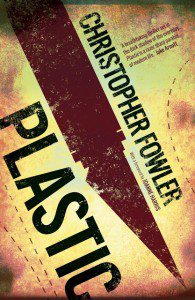
Guest Microreview [book]: Plastic by Christopher Fowler

Fowler, Christopher. Plastic [Solaris, 2013]


The Meat

A strange one, this. A forward by Joanne Harris tells us the book was finished over 8 years ago but has remained unpublished til now, a favourite amongst publishing staff but being a woman's story written by a man, lacking the selling power of being by female author apparently. Hmm. That never stopped George Eliot, though... Wait...

Anyway, an odd way to preface the book (although there is also much expertly-summated dissection of the themes and details of the book... something I should learn something from...) given Fowler actually is already the successful author of dozens of books and short stories. The Bryant and May detective series has many fans, and he has written fun-sounding titles under the excellent Solaris imprint like Hell Train, which is on my list. He has even had one novel turned into a 1992 film starring MacGyver (or Stargate Jack, as readers here may know him better as..?) a as crazy builder for cripes' sake. I want to write a book that ends up as a film with MacGyver in it. That no one has heard of.

So I wondered what had held Plastic back. And as I began reading the novel proper, my confusion continued, for each turned page brought enjoyably fresh and compelling descriptions of a life in stasis from our narrator June, who has trapped herself in a suburban prison largely of her own design, with only her shopping addiction to keep her company.

Now, before you all fall asleep, this IS a violent, twisted thriller. It all starts with June telling us she is as good as dead, covered in blood and the captive of a menacing thug. There is also a scalpel on the cover. Clear signs. But Fowler then has June guide us, involvingly, through her life choices, her mental state and her marriage collapse, and for quite a while, before the plot that takes her to the bloody doom she greets us with begins to kick in.

And it's these early moments I enjoyed the most. There is a knowing humour yet also a keen eye for emotional realities in Plastic's descriptions of June and her world. It's also a landscape I'm more than familiar with, having grown up largely in the same bland and soulless London suburbs that Bowie and no doubt Fowler escaped but June slowly faded away in. Not exactly standard Feather reading material. But a nice bit of kitchen sink realism just makes those aliens and dragons all the more exciting, right..?

It's when the novel tries itself to be exciting and a little less downbeat, a little more fantastical (although no dragons, just to be clear), that its hold on my affections started to slip. Our narrator has the idiosyncratic voice of the unusual, quirky character behind it.


Yet I just couldn't buy into her as a real breathing person who would act how she acts over the crazed weekend she finds herself in. Not quite 30, full of knowledge and intelligence but supposedly naive and downtrodden, she nevertheless makes random, dumb decisions and yet with a boldness that belies that innocence. That does, now I read it back, seem like a recipe for an interesting, complex and less-cliched character than most thrillers have. But somehow she annoyed me, like when a dull character in a bad film keeps making dumb choices -

And she annoyed me in a place I know very well. Lambeth, in central London, right on the river. It's there that lies a friend-of-friend's plush flat (I'll be damned if I'll use the A word!) that June is handily asked to house-sit the very weekend she has to be out of the house that her now-ex is selling. And it's there that she stumbles across intrigue, weird neighbours, and murder. Murder most fouuuul.... So she responds to this by running aimlessly around the streets, which geographically barely clicked together for me as I place I lived in during the years the novel was written (not in a plush flat, I must add, for my street cred's sake). It's an area I like, despite its grim appearance and total lack of decent pubs. But it wasn't quite in these pages, it's fictional form didn't quite ring true.

There are some absorbing descriptions of the Thames, and Fowler nails the lonely and surreal desolation of a main city road at night. I was hopeful. I was enjoying myself. I wanted to uncover the mystery of the murder and I wanted June to survive despite her being annoying and knowing she would end up as she first appears, covered in blood. I really wanted to like this story.

But it just falls short as a thriller. The encounters June has inside and outside the apartment block (damn! failed!) stretched credibility, and when a violent attack happens at the petrol station (I'll be damned if I'll use the G word) and it barely registers as an event, well, I started to frown at the book like a date that has farted whilst revealing they love Celine Dion. By the time (spoilers) our hero is being chased by adult gangsters on skateboards through city traffic as a helicopter chases them both, I realised what was bugging me about the tale.

It is precisely Fowler's ability to involve you in the inner life of an everyday person, in an everyday setting, that makes his steering of that person and that world into ridiculous moments of action, interspersed with ridiculous behaviour by the hero, so unwelcome. I've read countless dumb 'airport' thrillers with unbelievable plots and lazy writing, but expected nothing more of them. The way Fowler can write makes this book different.

And so sadly I must report for the second time in a row that a book has disappointed me. But at least I finished this one. And I look forward to reading some of this writer's other works, for, despite the forward's protests, I sense the reason this one was unpublished for so long was because it simply isn't as good as his other stuff. Like Hell Train. That one sounds like a gas.

Damn.

The Math

Baseline assessment : 6/10

Bonuses: +1 for the idea; +1 for the narrative detail
Penalties: -1 for the execution; -1 for the action

Nerd Coefficient : 6/10

Friday, May 31, 2013

Guest Microreview [book]: The Good, The Bad and the Infernal by Guy Adams

Adams, Guy. The Good, the Bad and the Internal [Solaris, 2013]


The Meat

The idea of mixing up the era of Billy the Kid with fantasy is as old as, well, the Wild Wild West. But this, the first part of a trilogy, takes a fresh spin on it, and is a great adventure tale that manages to hold its fantastical premise together with some deft mixing of the daft and the sublime.

It spends much of its time introducing all the various characters, in disconnected sections, as they travel across America, fighting evil forces and each other - rather like Lord of the Rings, only without the annoying pipe music. We meet a fake preacher, a Victorian inventor, a team of monks, a gang of freaks and a gunslinger as old as the desert, amongst many others.

They all are for various reasons heading for a mythical town called Wormwood, which is claimed to be a way to enter Heaven without dying. It shimmers into sight every few centuries somewhere in the world before vanishing and leaving legend and rumour in its wake. This time it is scheduled for the American Wild West, just after the Civil War.

And it's a era that Adams is clearly in love with (as he admits in his humourous biog). Through his passionate descriptive detail, you can almost feel the sun and dust, and smell the sweat and blood. It's tremendous fun for any Spaghetti Western fan.

As well as the main ingredient of this setting, he stirs in some steampunk seasoning courtesy of the inventor, and a whole ladle of religious fantasy. What you end up with is a gumbo of the hardboiled universe of a Sergio Leone with the far-fetched but enjoyable action and horror of, say, a quirky mongrel of Bram Stoker's Dracula and Solomon Kane.

For, as they near the town, nature turns against them. In fact, it unleashes hell on them, and the novel heads towards more magical realms. Imagine a souped-up locomotive being chased by cyborg Indian warriors and hordes of bats, and you'll get the jist. However, whilst the mutant creatures and high-concept fight scenes are entertaining enough, they don't entirely convince as spectacle. Compared to the Spaghetti Westerns he loves, a gunfight just can't come across on the page quite so well as on the screen, although he makes an impressive attempt. Also, while the grim-faced and stone-hearted Western elements were believable to me, the monsters made out of glass and wood, or the swarms of killer bugs at times felt, well, a bit daft to be honest. I found myself occasionally wanting to see a film adaption instead, where I could stare passively at CGI nonsense whilst scoffing popcorn. But maybe I'm unfairly more forgiving of movies than books.

The dialogue and narration are superb. I love a good dark-hearted metaphor, and he these delivers in spades -

"It was the sort of smile an alligator wore when convinced its meat was just about rotten enough to chew". -

This and some intriguing conflicts between the key players kept me hooked through all the switches between stories and characters, and occasional slips in reality, grounding my mind in the hot plains and faded saloons.

Slight spoiler: this is only part one of three and is all about the journey to Wormwood. Part two is not out for a year so don't expect to be reading about the town just yet. The book ends on a fun climax, telling us the adventure has only just begun. Bring on part two next year, as this is darn good, rootin'-tootin', gun-slinging fun.

The Math

Baseline assessment : 7/10

Bonuses : +1 for reminding me how much I loved Clint Eastwood before he turned into a Romney-loving fool; +1 for juggling multiple storylines with aplomb; +1 for the phrase "He scratched at his face with a sound as rough as a gang of armadillos fucking".

Penalties: -1 for not quite handling the sudden lurches into fantasy convincingly; -1 for one of the character's names changing temporarily by mistake

Nerd Coefficient : 8/10. "Well worth your time and attention."

Friday, April 26, 2013

Microreview [book]: Gideon's Angel, by Clifford Beal


Or, Historical Fiction versus Historical Fiction


The Meat 

Would you say, reader, that you like history?  And if so, do you demand some sort of authenticity, some truthiness, from its depiction in fiction? In other words, when you read historical fiction, is it partly to learn something about the past?  Or is a historical setting more like a fancy suit that just makes everything in a story snazzier?

If you're a purist of the former outlook, that historical fiction must seek to teach the reader something of the past, you'll be disappointed by virtually every single historical fiction book in existence, since there are basically only two types of historical fiction authors out there: the career novelist and the career historian. No matter how intensely novelists research history, they've dedicated their life work to perfecting their writing, meaning they tend to apply a thin historical veneer to what is otherwise a simple story of love, revenge, or both. Conversely, historians busy themselves studying history, which leaves little time to burnish their fiction writing skills, and as a result their accounts tend to be weighed down with those giant cement shoes known as "too much detail about stuff no one cares about anymore" and "'character development? I can't do that—these are people from history!'". It's incredibly rare to find a novelist who possesses deep knowledge and understanding of history, or a historian with a gift for fiction writing (or in many cases, nonfiction writing too, sad to say).

Historical fiction, especially those works written by historians, also faces a fundamental problem: the past totally sucked.  No matter which time period a given story is set in, the world is almost certainly dirtier, crueler, more prejudiced, and less convenient than ours, whatever the current world's faults. I can hear, from among my audience of literally dozens, a chorus of gasps that I could prefer the current world to the glorious wonders of the past, but answer me this, you Gone with the Wind-loving romantics: can you honestly say, with a straight face, "yep, 1864 America was a great time to be alive!" Or perhaps you think wistfully of Qing-era China, but conveniently forget about foot-binding, the indiscriminate slaughter of civil wars, opium, or predatory Western imperialism. Or for lovers of English/French history, it's pretty hard to see in rosy hues the endless slaughter of, not only the enemy across the Channel, but also the people at home if they were not of that moment's favored religion, wouldn't you say?

Segway! Gideon's Angel is set in, if not really about, Cromwell's England. And after reading my ranting on historical fiction above, you're probably wondering by now which Clifford Beal is: a historian or a novelist. Nothing a Google search won't answer! Yet before you shake your heads in disgust at the effrontery of a novelist marinating his story in the fragrant juices of history, know this: just because a story is spray-painted with an old-looking patina doesn't mean it's a bad story. So if you are of the historical fiction camp—history as veneer—then Gideon's Angel is perfect for you. Because it's actually quite an entertaining romp, as such stories go.

Most historical fiction writers cannot resist the temptation to have their protagonists interact with the Great Men (or, all too infrequently, Women) of History, and Beal is no exception. Perhaps they hope to soak up some relevance for their stories via contact with well-known personages, but the trade-off is their depictions of ordinary life/people get the short stick. So, in Beal's Cromwellian England, our historical veneer consists of little nuggets like, say, pistols not firing correctly, the use of the word 'hanger' instead of more familiar latter-day terms like cutlass, or brief descriptions of the hearty fare in inns—good as far as they go, but few and far between. On the other hand, Beal does a fine job creating characters (Billy is especially good) we want to see through to the end of their adventure, though at times their motivations are inexplicable (why on earth would Richard join such a silly conspiracy, given his knowledge and skills?). But what if you are a serious student of history, and yearn to discover truths about the glorious past in each historical fiction volume you read? Then read a history book—you'll see just how scarce glory was in the past.

This is actually my one serious objection to Gideon's Angel, which purports to depict a period of history rife with religious and political intolerance but instead presents a rosy picture where in due course a Protestant Royalist joins forces with a Catholic swashbuckler (what 17th century tale is complete without an extended cameo from everyone's favorite musketeer?), a Spanish Jew, and a bunch of Republican Freemasons to take on the forces of Hell (literally) by casting Jewish prayer-spells in Hebrew that work for Christians too.  Is it exciting?  Absolutely! Might it give the casual reader the grossly mistaken impression that England at that time was an utopian paradise of tolerance where Jews and Christians of all types amiably agreed they were all servants of the same God and let's be BFF? You bet.


Beal's take on Europe's past: a land of live-and-let-live tolerance


Europe's actual past

The final verdict, then, is that Gideon's Angel is thoroughly entertaining, and well-crafted stylistically (though Beal does lay on the archaic vocabulary rather too thickly, I felt), but definitely falls into the historical fiction camp, which might be a problem for some readers—though, sadly, it's precisely those for whom it won't be a problem that this is a problem. I remember years back a rash of people basing their understanding of the Roman Empire on Gladiator—I only pray this book won't create a similar wave of 'experts' on Cromwell's world!  Just enjoy it for what it is: an entertaining sword and sorcery and sandals and demons and stuff story.


The Math

Objective quality: 6/10

Bonuses: +1 for good writing style and characters, especially Billy

Penalties: -1 for showing the past we wish existed instead of the one that actually did

Nerd coefficient: 6/10   "still enjoyable, but the flaws are hard to ignore"

[See explanation of our non-inflated scores here.]