Showing posts with label westerns. Show all posts

Friday, November 4, 2016

Westworld at Mid-Season

Too mysterious for its own good?

HBO's new series Westworld hit the mid-season mark this week, and it feels like there's enough there to finally talk about in terms other than wild internet fan theories.

If you haven't been watching, that's cool. I wanted to weigh in without spoilers, on what the show's actually doing (and maybe not doing), and if it's worth checking out. I remember seeing the original 1973 movie for the first time about five years ago, and I wasn't floored, but it was cool and it occurred to me that if I'd seen it when I was 12 or 13, it maybe would've been my favorite movie. It was a pretty straightforward wish-fulfillment sci-fi adventure. And hell, Westerns and robots? Man, sign me up.

HBO's new series is anything but straightforward — and that goes for both on- and off-screen aspects. I saw the first trailer for the show right after the 2016 Television Critics Association press tour, when HBO's president of programming was confronted with a series of questions about the pervasiveness of violence against women in its shows. Coupled with Emilia Clarke's repeated calls earlier this year to "Free the Penis" and get some more equitable nudity on Game of Thrones, this show is arriving at a moment where it's under the microscope right from the jump in a way previous HBO shows maybe haven't been. And the first Westworld trailer did nothing to assuage the violence-against-women accusations leveled in those TCA panels. Quite the opposite.


But what about the show? Well, that's where I'm a little bit at a loss how to talk about it. The long and short of the story is that there are a couple of guys visiting the futuristic resort of Westworld, where you can live out your fantasies (violent and sexual, mostly) with AIs that are indistinguishable from real people. The operators of the park start to notice something is wrong with a few of the units, and the signs point to a couple of them "waking up." Meanwhile, the guests in the park don't know any of this is going down, and one guest in particular, The Man in Black (Ed Harris, not Johnny Cash) has a secret mission he's on that no one else knows about. The pilot episode does the "alternate reality" bit to perfection, and I found myself caught up in the giddy feeling of "this would be so cool, to actually walk off a train in the Old West!" I'd like to think I wouldn't be as big an asshole as the guests on the show, but it seemed cool. But the storytelling is so oblique, so insistent that "there are lots of mysteries going on," that to be honest I didn't have much of a connection to anyone in that pilot episode, and if they hadn't, toward the end, gotten into the notion of these robots waking up, I don't think I would've stuck around for episode two.

But I did stick around. And this is where the internet comes into the story again. Because of that obliqueness in the storytelling, because there were clearly lots of different breadcrumb trails being laid out in different directions, but none of them explored in depth (yet), and because the internet abhors a wild-theories vacuum, we got a lot of real elaborate fan theories right from the start. My favorites are that the show is actually taking place in two distinct time periods, but I think subsequent episodes have ruled that out, for the most part. The issue for me is that I can't separate the experience of watching the show from its footprint in fandom. I keep looking for clues to an eventual, massive reversal, but it could very well be that the show is just weaving mysteries and moving linearly. It's kind of pissing me off, to tell you the truth, now that we're halfway through season one and I still basically know that the robots are waking up, but not anything else.

So there's that. And then in Episode 5 they did Free the Penis, but not as much as they freed the boobs again. Probably half the episode takes place during an orgy in a bordello, and I found myself right back to wondering if the purpose is just titillation, or... What are we doing here, guys? Are we really driving at insights into humanity and what consciousness means, or is that just a flimsy framework for showing gold-painted boobies?

But without equivocation, I can say that the performances are fantastic. Evan Rachel Wood and Thandie Newton both play strong, interesting characters, and their performances are truly kick-ass, especially considering how much of them they have to give while naked. Anthony Hopkins, Jeffrey Wright, and Ed Harris are all amazing. Even if I'm not sure that the ride is going somewhere I'm going to feel totally satisfied getting to, I'm happy to spend an hour a week watching these amazing performers.

Posted by Vance K - cult film reviewer and co-editor of nerds of a feather, flock together since 2012, musicians, and Emmy-winning producer.

Friday, November 22, 2013

Plants vs. Zombies 2: It's About Time


mobile fun for free!

Finally, the sequel to the wildly popular mobile favorite Plants vs. Zombies has come out. I think this solidifies PopCap as THE makers of the best mobile games available. Between Bejeweled, Peggle, and PvZ, they've made some of my favorite mobile titles and they definitely have more depth and better programming than 98% of the mobile games out there. While I've enjoyed Hill Climb Racer, Angry Birds, and Army of Darkness, no single developer has come up with as many quality games as PopCap. 

levels


There are three main levels in the game. The first is Ancient Egypt. Here the zombies are also mummies. If you're unfamiliar, you have to protect the home base, in this case a pyramid, from the oncoming undead. You choose the plants you're going to use in order to do so, then do your best to keep the mummy/zombies from making it into your pyramid to eat your brain. Each section has ten levels, starting with the Ancient Egyptian plane. Once you've completed the ten levels, you have to go back and win ten stars to move on to the next level, Pirate Bay, by re-playing enough of the first ten levels to win stars. Once you've collected ten stars, you can use a stargate to transport through time and space to the next plane and fight zombie pirates. 


The second level is Pirate Bay. As you can see, the zombies in this group of levels is made up of pirates (Didn't see that one coming, did you?). Unlike the previous levels, the planting grid isn't complete. There are planks that allow zombies to walk up to your plants. They also attack by swinging from ropes or being shot out of cannons across the water areas. They are easily repelled using something akin to jumping beans. These plants are shown here second to the bottom on the left with a cost of 50 sun points. They're very handy when repelling water-crossing enemies, but they quickly fall asleep after doing so and are extremely easy to eat. 


Finally, there's the Wild West group of levels. Along with upgraded plants that you earn along the way, these levels have train tracks that allow to you move a single, or sometimes multiple plants up and down the screen. This allows you to take care of different levels of zombie outlaws as they come along instead of being stuck in a single grid square watching those darn undead walk right past your three-headed pod shooter. This level also brings with it a new slew of enemies, including one old timer who clearly worked in a mine in his living years. This piece of maddening programming genius jumps the entire board, then returns to eat your precious plants from behind. I know he's why they created the two-headed plant, but the plant was  generally just so ineffective that I essentially chalked his kills up as a loss and shot the bastard from behind after he started to move back to their side of the board. 

the perfect segue


That's the perfect lead-in to discuss the various characters in this mobile masterpiece. First, we'll start with the plants. 

the plants


The plants are your friends. These are all that is stopping those blood-thirsty undead from chowing down on your medulla oblongata. Each has a special form of attack and their own advantages and disadvantages. They start out at a low price and you are able to open up more as you go along. For example, the first of the three plants above costs 150 sun points (you either collect these as they fall from the sky or make your own using sunflowers) and can punch zombies both in front and behind. However, he is limited to the single blocks on either side. The next plant fires boomerangs, or at least what appear to be boomerangs. It costs 175 sun points and doesn't pack much punch, but his attacks can reach enemies completely across the board. Finally, the coconut cannon is a whopping 400 sun points, but his attack will wipe just about anything it hits on the board. 


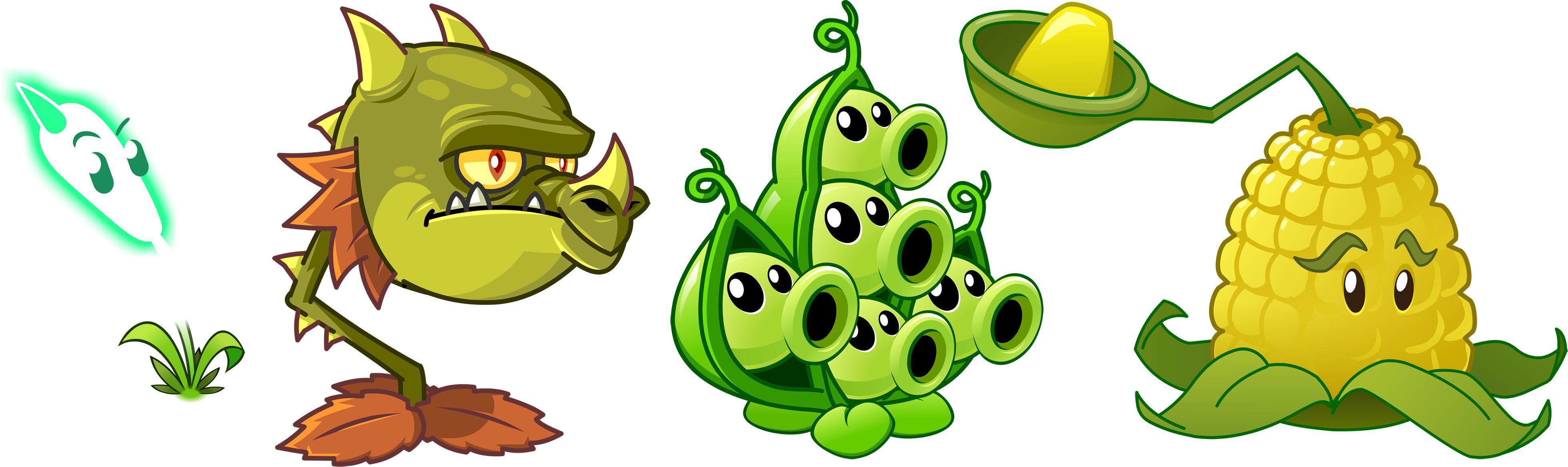
This next crop of plants was probably the most useful. The first is a fire breathing cousin of the venus flytrap. His fireballs spread three blocks wide and traveled two blocks ahead, giving his damaging flames a wide swath of destruction. The second is an artistic rendering of the pod shooters. These came in four forms. The first shoots a single pod, the second two, the third three, and the fourth fires a single pod in both directions, in front and behind. The third plant is obviously a corn cob. He fires a randomly selected piece of corn or pad of butter. The butter was particularly useful as it causes the zombies to pause for a brief moment until all of the butter has melted from their faces. It cost 100 sun points. The fire breather was 150. The pod shooters cost 100 points per pod, so the double-shooter cost 200, the triple shooter 300, and so forth. There are other plants available including a land mine and the aforementioned sunflower, but this gives you a general idea of what's out there. 

the zombies


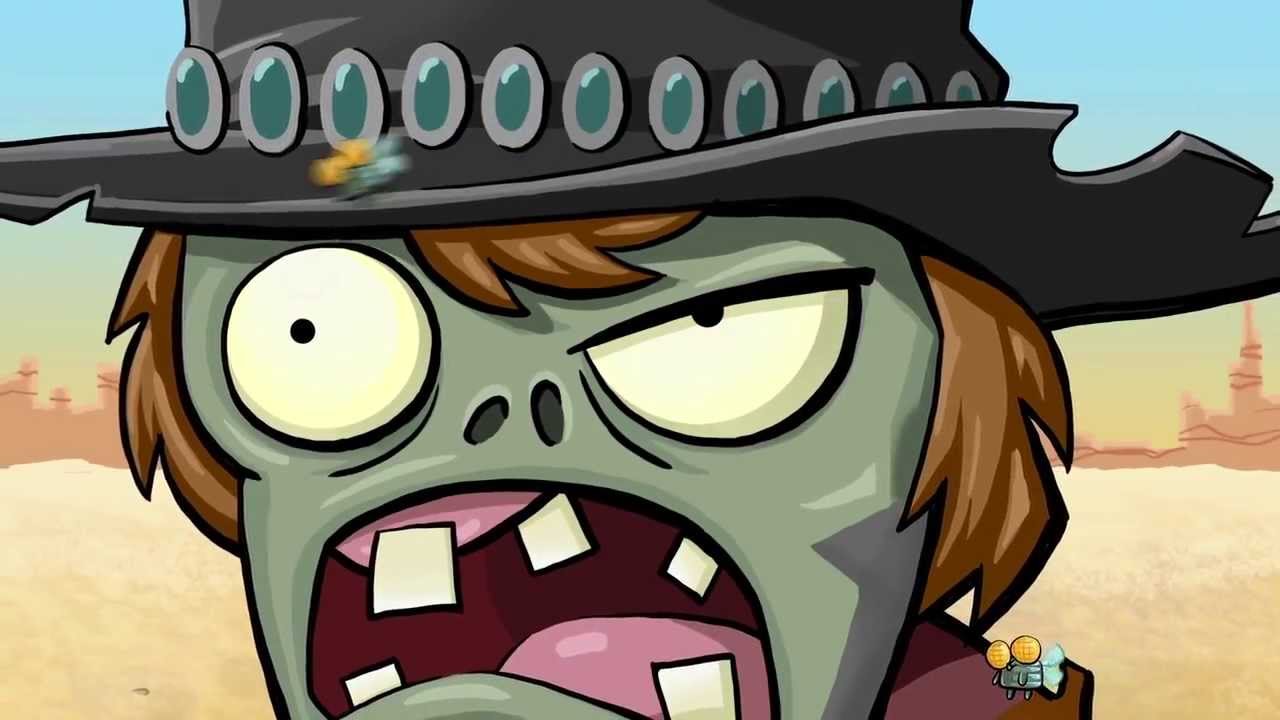
Just like the plants, the zombies come in many forms. The first pictured above is the standard mummy, easy to kill and fairly slow on the approach. The one pictured next was the bane of my existence in the Ancient Egyptian levels. He uses his wand to suck up sun points as they fall from the sky or are created by your sunflowers. He starts sucking sun as soon as he steps on the board so it was necessary to have a long distance weapon like the pod shooter or corn cob to take him out quickly before he could steal too many of your precious sun points (which were used to buy more flowers). The next two come from the Pirate Bay level. The first wasn't so annoying on his own, but he was able to send out his pet parrot to eat your plants without so much as a "thank you." Again, it is useful to have a long distance plant to take this annoying fellow out as quickly as possible before his bird could do too much damage to the carefully constructed plant formation you have been creating. Although the punching plant (as I called it) is able to destroy the bird, not much else can stop it from chowing down on your sunflowers or other vital plant friends. Finally, there's the standard pirate zombie. He is the Pirate Bay equivalent to the first mummy. Slow and fairly weak, although when attacking in groups he and his cohorts could be quite annoying. 


The Wild West zombies presents its own set of issues, but I think Pirate Bay was probably my favorite level. At one point, cannons come out and fire midget zombies at your side of the map. Those little guys made the funniest noise and, although they were extremely annoying, they were also a source of never-ending laughter for yours truly. 

special gameplay


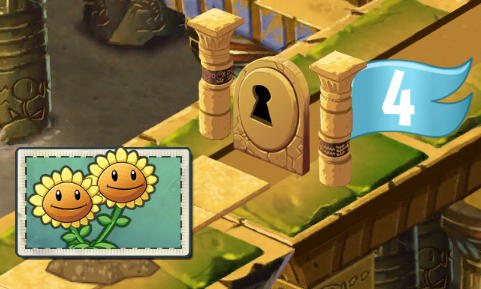
Not only were there the standard levels described above, but you could access special areas by collecting (or buying) keys. These would open up entirely new areas of the maps that had levels with specific requirements. For example, one level chooses which of the plants you could use by bringing them up a conveyer belt system on the left-hand side of the screen. You are normally allowed to pick six plants for each level, but in these special levels you had to take what you were given. Sometimes this proved to be quite useful, while others it gave the gamer a challenge that bordered on headache. 


The player moves from level to level via stargates. You can clearly see the star here that took you from Ancient Egypt to Pirate Bay. While I wouldn't exactly call it replay-ability, you were pretty much forced to go back and replay levels in order to earn stars and open the stargates. I found this mildly annoying at points because certain requirements were laid down before a level was begun. If you failed to meet these requirements (kill 15 zombies in 30 seconds or only use 12 plants), you failed to earn the subsequent star. While I don't necessarily care for linear games, being forced to go back and replay nearly every level in order to progress was a bit of an annoyance. If there was one drawback to the game, this was it. I would have preferred to have the game move in a linear fashion and offer bonuses for replaying certain levels. Don't get me wrong, you were richly rewarded for completing the levels while following the requirements. Still, forced replay isn't really my cup of tea. I like to have the option to replay a particularly fun level rather than being forced to do so in order to progress. However, it is what it is and I managed to amass enough stars to make it through all three levels without paying for the pleasure. 

closing arguments


PopCap has done it again. They managed to create a game that is fun for all ages, addictive, and original. If you are looking for the next gaming app to add to your handheld device or iPad, this is it. While they didn't really break any new ground as there are a plethora of tower defense games out there (the format seems to work well on controller-less devices), this is definitely one of the best. If you're as tired of Angry Birds as I am and Peggle is wearing thin after your thousandth hour, give this one a look. It's free both in the iTunes store and on Android phones, so you won't blow your load on a game that doesn't turn out to be all that you'd hoped. Instead, they operate on the much maligned pay-to-play system where the game is beatable without spending money, but there are plenty of opportunities for you to make it easier on yourself by dropping a buck or two on keys, stars, or special plants. I refuse to take part in this game structure for the most part, just on general principle. That said, there were lots of times I REALLY wanted to throw a few bucks at it in order to make the game easier. However, it isn't necessary to complete the game and you can play it successfully either way. All in all, Plants vs. Zombies 2: It's About Time was a joy to play and just challenging enough to keep me coming back. I highly recommend you give it a shot and see if it's up your alley. 

the math

Objective Score: 8/10

Bonuses: +1 for the leveling system that kept me coming back for more. It makes you want to keep playing to open up new and more powerful flowers with which to dispatch the undead.

Penalties: -1 for forced replay of completed levels. Once I've beaten a level I'm ready to move on. I don't want to have to go back and beat the same level again, this time with more stipulations on how I finish the task. 

Nerd Coefficient: 8/10. Well worth your time and attention. 

Friday, May 31, 2013

Guest Microreview [book]: The Good, The Bad and the Infernal by Guy Adams

Adams, Guy. The Good, the Bad and the Internal [Solaris, 2013]


The Meat

The idea of mixing up the era of Billy the Kid with fantasy is as old as, well, the Wild Wild West. But this, the first part of a trilogy, takes a fresh spin on it, and is a great adventure tale that manages to hold its fantastical premise together with some deft mixing of the daft and the sublime.

It spends much of its time introducing all the various characters, in disconnected sections, as they travel across America, fighting evil forces and each other - rather like Lord of the Rings, only without the annoying pipe music. We meet a fake preacher, a Victorian inventor, a team of monks, a gang of freaks and a gunslinger as old as the desert, amongst many others.

They all are for various reasons heading for a mythical town called Wormwood, which is claimed to be a way to enter Heaven without dying. It shimmers into sight every few centuries somewhere in the world before vanishing and leaving legend and rumour in its wake. This time it is scheduled for the American Wild West, just after the Civil War.

And it's a era that Adams is clearly in love with (as he admits in his humourous biog). Through his passionate descriptive detail, you can almost feel the sun and dust, and smell the sweat and blood. It's tremendous fun for any Spaghetti Western fan.

As well as the main ingredient of this setting, he stirs in some steampunk seasoning courtesy of the inventor, and a whole ladle of religious fantasy. What you end up with is a gumbo of the hardboiled universe of a Sergio Leone with the far-fetched but enjoyable action and horror of, say, a quirky mongrel of Bram Stoker's Dracula and Solomon Kane.

For, as they near the town, nature turns against them. In fact, it unleashes hell on them, and the novel heads towards more magical realms. Imagine a souped-up locomotive being chased by cyborg Indian warriors and hordes of bats, and you'll get the jist. However, whilst the mutant creatures and high-concept fight scenes are entertaining enough, they don't entirely convince as spectacle. Compared to the Spaghetti Westerns he loves, a gunfight just can't come across on the page quite so well as on the screen, although he makes an impressive attempt. Also, while the grim-faced and stone-hearted Western elements were believable to me, the monsters made out of glass and wood, or the swarms of killer bugs at times felt, well, a bit daft to be honest. I found myself occasionally wanting to see a film adaption instead, where I could stare passively at CGI nonsense whilst scoffing popcorn. But maybe I'm unfairly more forgiving of movies than books.

The dialogue and narration are superb. I love a good dark-hearted metaphor, and he these delivers in spades -

"It was the sort of smile an alligator wore when convinced its meat was just about rotten enough to chew". -

This and some intriguing conflicts between the key players kept me hooked through all the switches between stories and characters, and occasional slips in reality, grounding my mind in the hot plains and faded saloons.

Slight spoiler: this is only part one of three and is all about the journey to Wormwood. Part two is not out for a year so don't expect to be reading about the town just yet. The book ends on a fun climax, telling us the adventure has only just begun. Bring on part two next year, as this is darn good, rootin'-tootin', gun-slinging fun.

The Math

Baseline assessment : 7/10

Bonuses : +1 for reminding me how much I loved Clint Eastwood before he turned into a Romney-loving fool; +1 for juggling multiple storylines with aplomb; +1 for the phrase "He scratched at his face with a sound as rough as a gang of armadillos fucking".

Penalties: -1 for not quite handling the sudden lurches into fantasy convincingly; -1 for one of the character's names changing temporarily by mistake

Nerd Coefficient : 8/10. "Well worth your time and attention."

Tuesday, May 14, 2013

Spurs to Spandex: Why Westerns Died and Superheroes Fly

In his only DVD commentary, which accompanies his 1950 movie Winchester '73, Jimmy Stewart was asked about the enduring popularity of Westerns. In his own words, Stewart answered that he believed the Western was the essential version of the American identity, that it totally encapsulates the pull-yourself-up-by-your-bootstraps, hard-work-makes-anything-possible American ethos. He believed that to this day we had maintained a frontier mentality, and in retelling the story of the United States' westward expansion we continued to tell stories that spoke meaningfully to our present-day lives. And for that reason, screen legend Jimmy Stewart felt the Western would remain enduringly popular for as long as people made movies.

Sorry, Jimmy.
Jimmy Stewart
"Well, this is what I think of YOU!"
For the last decade or more, there's been a new sheriff in town, and he wears spandex instead of spurs. And he can usually fly. And more often than not, he's super-well coiffed and bullets pretty much just bounce off of him. Because he's a superhero. I believe this shift in the genre balance is more meaningful than just a simple evolution of tastes. First, I think Hollywood has yet to understand (but is starting to) that "Superhero" has become an actual genre, and with that comes a tremendous degree of latitude that film executives are still unwilling to exploit, but that a market exists for. But second, and more importantly, I think this evolution in genre preference is actually a response to a much larger cultural shift that has changed the fundamental definition of what it means to be an American.
Captain America
"Pretty sure I'm still what it means to be American, bud."
In many ways, Westerns and Superhero Movies are identical. They are both action/adventure-oriented stories that 1) celebrate the "individual" as a type/archetype, 2) exist in a reality outside of the audience's own (past/future/alternate present) and so are essentially fantasies, and 3) are primarily concerned with the intersection of violence and power. While some movies are overtly and explicitly concerned with that question (The Man Who Shot Liberty Valance and Spider-Man, for instance), both genres are fundamentally undergirded by the push-pull between violence and power. In the Western, it's your outlaws and scheming land-grabbers pitted against the homesteader or lawman, and both sides are pretty much outfitted with the same gear -- your six-shooter and Henry rifle, or something similar. For Superhero Movies, it is generally the massive, superhuman power of the hero pitted against either the massive, superhuman power or the mechanical product of the massive, superhuman brain of the villain. It's the same struggle, but played out with different toys against a different backdrop. Both sides possess the tools of violence, but the struggle is between whether to use those tools for good or ill.

In the 21st century, then, we prefer our stories about outliers caught up in the battle between good and evil to be clothed in more capes and fewer chaps. More explosions, fewer horses. More stardust, less, well, actual dust. A quick look at BoxOfficeMojo bears this out. The box office-tracking site lists 55 Superhero Movies released since January 1, 2000, and only 32 Westerns in the same time period. That's not a tremendous difference, but take a look at the highest-grossing Western of all time, Dances with Wolves (yep, really), and its lifetime theatrical gross of $184 million. BoxOfficeMojo lists 18 Superhero Movies that have all eclipsed Wolves, all but one of which have come out in the last decade. Dances with Wolves came out 23 years ago. Even adjusted for inflation, there are at least seven Superhero Movies released since Wolves that have left it well in the dust.

If this is the case, if Superhero Movies have established themselves as their own genre and have taken the place of the Western, what does that mean for filmmakers and fans? A lot, naturally, but until the people who greenlight movies are hip to this transformation, we're not going to see much innovation. We can look at the incredible breadth of stories Westerns provided as a possible indicator of things to come. Tables were turned, where we began to see antiheroes and were asked to invest in the story from the "bad guy's" perspective, we saw stories of smaller lives touched by much larger struggles playing out around them, allegories for cultural and religious struggles, broken people forced into the hero mold and asked to do something beyond themselves, fringe voices telling familiar stories in entirely different ways, comedies, etc.

"But wait!" you may be saying, "We've already seen all of that in Superhero Movies!" Right. Because a genre establishes a set of tropes and the storyteller's creativity rearranges those pieces into something new within familiar boundaries. It's what allows audiences to experience something new while also getting exactly what they expected. The hang-up right now is the familiar fear-based decision-making process inside of Hollywood. Until a broader way of looking at this type of movie takes hold, the response you're most likely to get to a new idea (especially if it doesn't involve a pre-existing character, like, say, Stretch Armstrong...or Aquaman) is "Well, didn't such-and-such movie already do that?" I've run into this both as a writer and working in studio development. One case in particular involved a superhero comedy script that a manager sat on because somebody "already did a superhero comedy and it tanked," only to have the script for Kick-Ass come along a few months later and step into that gap.

Is it possible that a Superhero genre isn't large or diverse enough to contain that many stories, though? No. We have 80 years of superhero comics that refute that pretty definitively. Like anything, the quality of the storytelling will usually win out, especially as the market becomes more mature. I do not believe it can become saturated in any real sense, but expectations have to be adjusted. Not every movie with a cape or a costume will make $100 million. Chronicle didn't cost much, didn't have a huge marketing push, but it gave audiences a new twist and did well, despite not coming from a pre-existing property. With successes like that, and with the emergence of independent filmmakers stepping into the waters with films like the little-seen Super, I expect Hollywood will begin experimenting a little more, inasmuch as it ever really allows experimentation.

Why this surge in superhero popularity? After all, we've had superheroes in comic books since the 1930s, and superheroes like Flash Gordon in films since about the same time, but they never enjoyed the same broad-based appeal that they're seeing now. Imagine walking into Bob Evans' office at Paramount in 1972 and pitching The Avengers why don't you? I'll argue that this new swell in popularity is because the Superhero story, much more than the Western, has become the quintessential American story for today's audience. This is the genre -- for all of its fantasy -- that speaks most directly to our lives today.
The Avengers Godfather
"They're going to make him some shawarma he can't refuse."
It comes down to how we answer one, giant question: What really is the American Dream? As far back as Fitzgerald, we pretty much knew it wasn't simply amassing great gobs of money (although a few years after Gatsby we'd face a long American Nightmare when great gobs of money suddenly evaporated, and then we'd do it all over again 90 years later). The Declaration of Independence outlines the familiar "life, liberty, and the pursuit of happiness," where the emphasis is on one's ability to pursue something that might make them happy without facing barriers based on race, creed, or color. We've done a pretty shaky job of that in the last 250 years, though, and these days people have pretty much figured that out. If that version of the American Dream has become so mist-enshrouded and distant that it may as well be a literal dream for all but a very few Americans, then what has taken its place? Hard work doesn't pay off like it used to. Many of the hardest working people in this country can barely keep a roof over their heads, and people who have played by the rules and "done everything right" can find themselves out of work for years and unable to repay medical or student loan debts.

Superheroes tend to have a couple of things in common: they exist in a primarily urban landscape, and they believe in magic. Just like their audiences. As a culture, we are far more likely to believe in magic today than in hard work, and not without reason. Sut Jhally, one of the foremost media scholars in the U.S., really doesn't like advertising. In Advertising and the End of the World he argues persuasively that the entire consumerist model is based on a belief in the magically transformative abilities of products. Listen up, guys, drinking poor, mass-produced beer will make beautiful women attracted to you. Buying this or that article of clothing or car will make your sad, dull life exciting and fresh! This bottle of household cleaner will unleash a muscular bald man who will scrub your floors! You get it, you've seen TV.

But reality has begun to approximate this magical aspect of our daily narrative. Peter Parker, Steve Rogers, Harry Potter, Carrie Underwood, Jennifer Hudson, Snooki, and all of the Kardashians share one thing in common: they were unknown, regular people who had something inside of them just waiting to be discovered and exploited on a larger stage. They were destined for greatness. We watch reality TV and Superhero Movies wishing that someone would see past our own humble situations, recognize our latent talent or nobility, and lift us out of our everyday lives. I mean, tell me that there's no magic in a world where a woman can make a sex tape with a mediocre rapper and then become so much more famous than that rapper that the entire rest of her family becomes famous. Tell me that's not magic.
This one. This one is like, the most famous one ever.
I don't think there's an antidote to this type of thinking, any more than there was an antidote to the glorification of a genocidal period of national history. In time, we become more educated, we perceive more of reality, or different aspects of it, and these observations inform our view of ourselves, both individually and collectively. We then seek out stories that speak to us. Today, and for some unknown period of time stretching out ahead of us, those stories will involve gods and goddesses...er, I mean knights, er...cowboys and Indians?

Oh, right. Superheroes.

There is probably a much better, longer, and more fully researched and articulated version of this idea that I could've written if I'd had a bunch of time, but you do what you can.