Showing posts with label ken macleod. Show all posts

Tuesday, August 27, 2024

Cool Books I Read While I Was Too Overwhelmed To Review

You want reviews? I've got reviews! Small ones!

Back in February, I rounded up some recent-ish books that I received review copies of, and read, but couldn't find the time or headspace to review at the time. Well, surprise! There were more books that I still hadn't got around to reviewing! This is the second round of clearing the decks for me, inspired in no small part by all the great reviewers and creators I got to hang out with at Glasgow Worldcon. Let's get back into it:

The Last Hero by Linden A. Lewis wraps up the trilogy that began with The First Sister, and it's a book that particularly deserves attention for anyone looking for more books in the vein of Emily Tesh's Hugo winning Some Desperate Glory. While Lewis' trilogy doesn't have that book's 90 degree plot swerves, it offers a much deeper look at what radicalisation and deprogramming look like when the bullets are actually flying, and we get to watch the young protagonists from across different factions—the fundamentalist Geans, the caste-based Icarii and the marginalised Asters—grapple with what is expected of them within their respective systems, and the price of trying to overthrow them. Add in some great bits of worldbuilding and a hefty dose of character gender feelings, and you've got a trilogy well worth checking out.

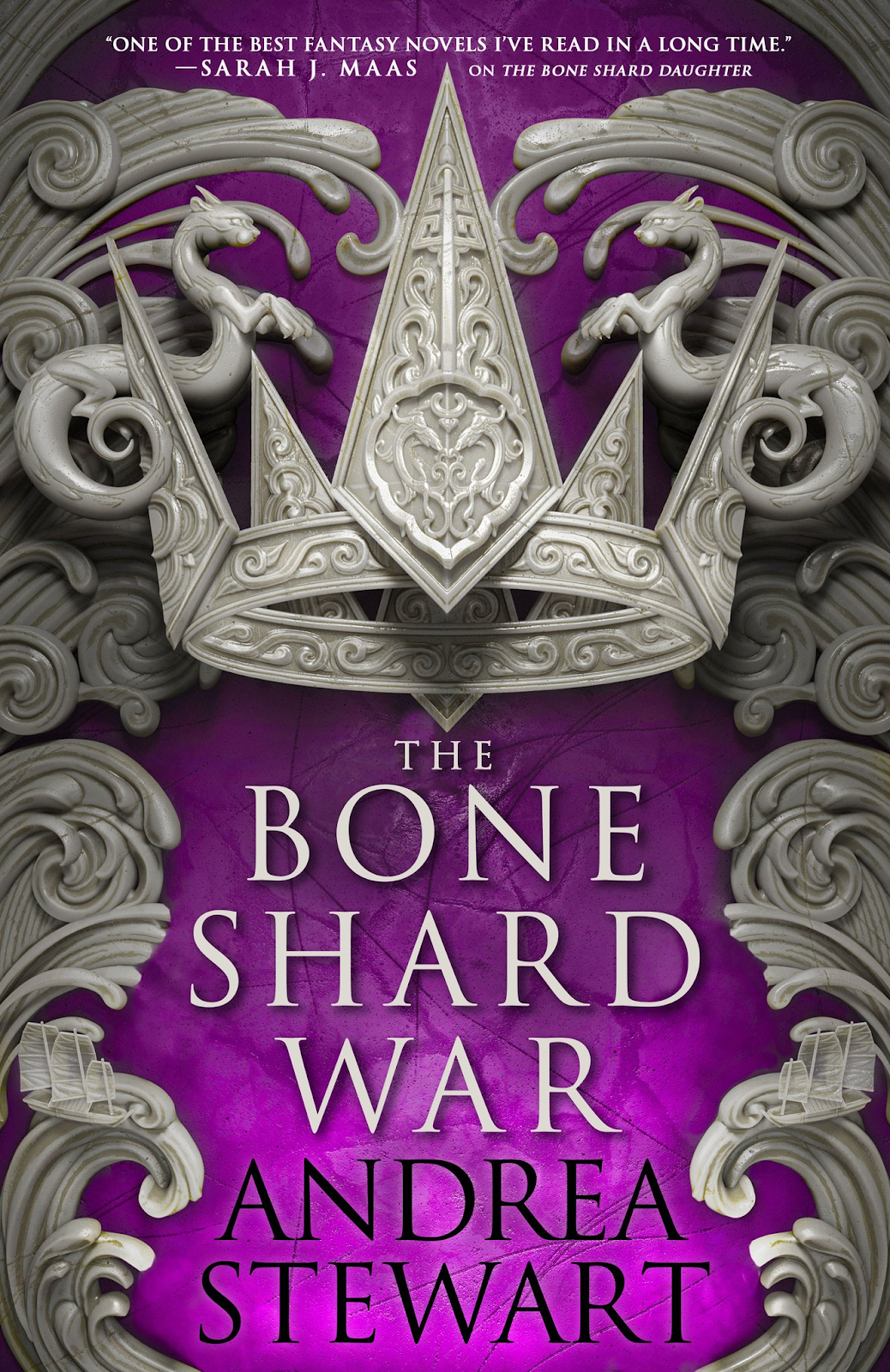
The Bone Shard War by Andrea Stewart also closes out a trilogy (the Drowning Empire) about exploitation and the cost of change, and especially grapples with the question of who ends up on top when said exploitative system is overthrown. It is also, deliciously, about earnest but silly youths in love, who are being kept apart and even forced into betrayals! At this end of the Drowning Empire, the brutally high cost of bone shard magic isn't as viscerally present, and that feels like a bit of a loss despite the emergence of new magics and the rediscovery of how this world functions, and (relatedly) what those cute animal companions that the main characters picked up have been about this whole time. While it has its ups and downs, this is a cool trilogy by an author I hope to see even better things from in future.

Book three, but not a series ender, The Mystery of Dunvegan Castle by T.L. Huchu is part of the Edinburgh Nights series, and while I'll forgive this year's Hugo voters for not putting it on the best series ballot, my patience on that front is not endless (nor will the series be). These books are the chronicles of Ropa Moyo, a highly motivated Zimbabwean-Scottish teenager who is offered entry to a prestigious occult library... as an unpaid intern. This time, Ropa's aspirations and hustle come fully up against the barriers placed in her way, and this series does a great job of showing how institutional racism and classism are perpetuated not just by bigots in the institution, but by people who limit their allyship or try to offer "meritocratic" entry points rather than fighting the corner for marginalised people. It's an interesting shift for Ropa—who, to this point, has been a bit naive about her circumstances and whether she can just push through them—and it makes me even more eager to see what book 4 brings.

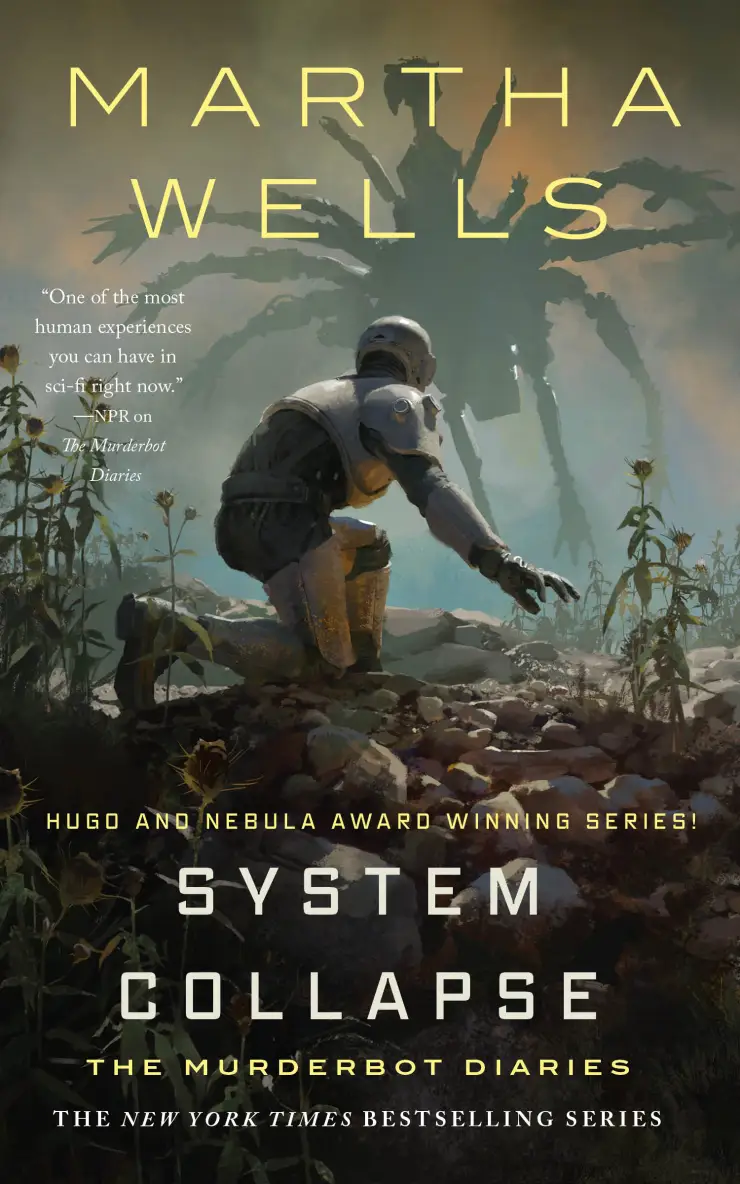
System Collapse by Martha Wells. The second Murderbot novel feels structurally closer to the novellas than the previous Murderbot novel, and at this point the recommendation is "if you like Murderbot, you'll like this Murderbot." Unlike the rather static-feeling Fugitive Telemetry, System Collapse does push things onwards from Network Effect in an interesting way, both literally (conflict de-escalation through documentaries!) and in Murderbot's character development and how it narrates its story. We quickly learn that Murderbot is not working at full capacity, and that it is keeping something from us about how this happened, and while the reader is used to the quirks and selectiveness of Murderbot's narration, this withheld information immediately puts the reader off balance, adding an extra layer of tension to both the conflicts and the crew relationships that are both staples of this series. Of course Murderbot and friends save the day with the power of love and justice—not that Murderbot itself puts it quite that way.

The Ten Percent Thief by Lavanya Lakshminarayan wasn't a Subjective Chaos Award winner this year, but it was an interesting addition to a stacked ballot. This mosaic novel, centred around a future Bangalore now known as Apex City, shows us the ins and outs of a society where citizens are constantly tested against the "Bell Curve". The city's residents are constantly striving - through conspicuous displays of capitalist productivity - to be promoted to the super-privileged ten percent, and to avoid deportation outside the city to join the "Analogs", who are treated as sub-human and denied basic ameneties by a city that nevertheless relies on them for its continuation. Through the novel, we see both confident Virtuals and those barely clinging on inside the system, as new technologies create further alienation; we also see, though not with as much depth as I would like, the way in which Analogs are organising themselves to resist and overthrow their oppressors. It didn't add up as well as I wanted it to, but there's a lot going on here for readers to enjoy, especially if you like Black Mirror-esque technological absurdities and the overthrow of transparent dystopias.

Untethered Sky by Fonda Lee was just beneath the Hugo finalist cut-off this year, and it's a very well-crafted fantasy novella: Ester's story has a strong thread of revenge, but there's also more going on: her progressing in her vocation as a rukher to a roc named Zahra, the relationships she builds with her comrades (and her bird), and the strains of being part of a military campaign whose political and propaganda motives seem at odds with actually making the Kingdom safer. Untethered Sky does suffer from the "author of incredible thing (Green Bone Saga) goes on to write pretty good thing" but it works great. 

The Lies of the Ajungo by Moses Ose Utomi is an incredible book, and somehow it's not on the Hugo longlist, but it is on the Ignyte novella shortlist so we can celebrate that recognition at least! The best thing about this story is its worldbuilding, which feels like it's come straight out of a fable: the protagonist comes from the "City of Lies," which has made the terrible bargain to cut the tongue out of every adult resident in return for an annual allocation of water from the Ajungo. This, of course, means that its residents can no longer tell their own story, and that their own history is now in the hands of their oppressors. When almost-13-year-old Tutu leaves the city in search of water to save his mother, he somehow avoids the disappearance that has befallen every other child who has left, and instead he finds out the truth behind the Ajungo's conquests and where his city falls within it. Amazing stuff.

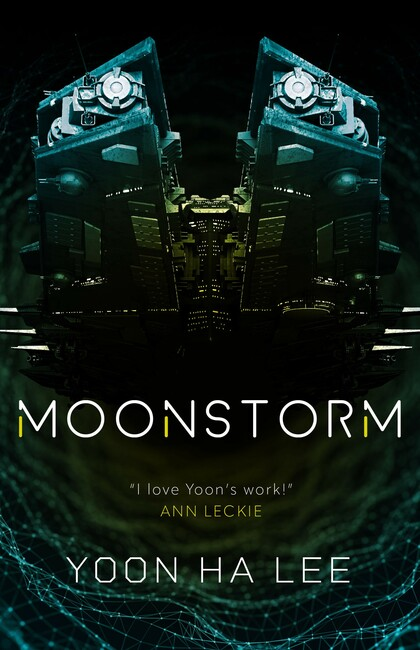
Finally, Earth-space adventure Beyond the Hallowed Sky by Ken MacLeod, fantasy adventure The Wolf of Oren-Yaro by K.S. Villoso, and mecha-YA Moonstorm by Yoon Ha Lee are all series openers which fall into the "fun, but probably not reading on" category for me—a category which I need to be more firm in maintaining, as the list of books gets bigger and my time on this Earth grows shorter (fatalistic? me?) I did enjoy MacLeod's speculation of near-future superpower blocs, especially the split between Anglophone death capitalism and optimistic-but-also-vaguely-sinister European socialism; and The Wolf of Oren-Yaro did not disappoint with its main character's Bitch Queen credentials, but had me shrugging at its relative cliffhanger ending rather than rushing to download the second book. Moonstorm, I am simply not the target audience for, and that's OK! I think this is a great contender for the Lodestar list, especially since books by authors who have also been nominated for adult SFF do very well there, and I hope that this story of giant robots, terrible empires, friendships, rivalries and betrayals IN SPACE finds each and every one of its people.


Adri, Nerds of a Feather co-editor, is a semi-aquatic migratory mammal most often found in the UK. She has many opinions about SFF books, and is also partial to gaming, baking, interacting with dogs, and Asian-style karaoke. Find her on Bluesky at adrijjy.bsky.social.

Friday, December 17, 2021

Microreview [book]: Beyond the Hallowed Sky by Ken MacLeod

The start of a new series by Ken MacLeod, in a future where aliens, secret FTL travel, and time travel may all shake the future of humanity.

Lakshmi Nayak has a problem. She lives as a student in 2067 London, part of the Alliance, one of the two major world powers. And she has just received an envelope with equations on it. Equations that don’t just imply, but baldly state that faster than light travel is possible.  And the equations, oddly enough are in her own handwriting.  But aliens don’t exist, except for things like microbes in the atmosphere of Venus. What Lakshmi doesn’t realize is that a secret program of FTL travel has existed for decades. And Aliens? Well, they exist too. Lakshmi’s equations may yet destroy a delicate balance of power, and help awaken contact with aliens who have been around a very long time indeed...

Lakshmi’s story is the main thread in Ken MacLeod’s Beyond the Hallowed Sky, first in his projected Lightspeed Trilogy.

Faster than Light Travel, for those SFF readers who haven’t thought about it, and it takes a knowledge of relativity to really grasp it, points directly to the potential for time travel and causality violation. There are NO privileged frames in reference in Einstein’s relativity, and one can arrange a situation where a FTL spaceship can see the arrival of a signal going at lightspeed before it was ever sent...and even stop the signal they saw being sent from actually ever being sent! Whoops. 

So you can see why Lakshmi is a little shaken to have received a message from her future self, providing equations for a faster than light drive. Worse, its not a prank, not a hoax, and the equations are right. This revelation leads Lakshmi to defect to a power smaller than the UK-US alliance, or the Co-Ord of Russia and China, a power that could very well use a FTL drive to play catch up--the Union, as embodied and lead by the Republic of Scotland.

MacLeod is hardly content with casualty violation in a novel, readers of his previous works will be expecting lots more to stir this pot, and so he delivers. FTL is not new in fact, and in fact the two major powers have secretly had it for decades (and once Lakshmi publishes her paper, that secret is perished). The Union has a station in the atmosphere of Venus (which now that the Alliance and Co-Ord have revealed FTL travel, feels like a sideshow--but, really will turn out to be anything but).  And then there is the exoplanet of Apis, which delightfully puns on several levels for reasons I will let the reader discover. Apis has evidence of alien materials...aliens fittingly (a la the Fermi Paradox) called Fermis.  It is in fact a shakeup of the humans on Apis’ relationship to the Fermis that provides, along with Lakshmi’s plot, that provides the impetus for the plot.

And it is a rich future, 50 years hence, that MacLeod offers us. In many ways, it is a relatively optimistic future--not a pollyannaish, mind, this world has had scars of the last 50 years, and yes, climate change is definitely a thing, but it is a world that has gone through a lot. With just a line, such as “America is a democracy again”, MacLeod lets the reader a bit into the future that has happened, and lets us as a reader fill in the gaps where it is not plot-relevant. The tripartite “”Cold Revolution” (more of a Pournellean Co-Dominium) of thie late 21st century gets much more fleshing out, and while we do not see anything from the Co-Ord point of view, we definitely get to see what life in 2080 is like for those in the Alliance, one of the two major powers, and in the Union, as seen in Scotland, seeing what a second rung power is trying to do in competing with its larger brethren. And then there is MacLeod’s depiction of the hellish Venus (and the station hanging in its atmosphere) and even more to the point, the alien planet of Apis. If anything, the politics and setup of Apis were, for me, just a little bit underwritten--I wanted even more before things start going sideways and we are off and running.

In general, Beyond the Hallowed Sky reminded me, oddly enough, of some of the work of Ian Sales’, particularly The Eye With Which The Universe Beholds Itself   which also features secret FTL travel, and extrasolar exploration, and the anthology he edited, Aphrodite Terra: Stories About Venus. Sales is a very different, and even more spare writer in some ways, but I kept thinking of Sales’ work as the stories on Apis and on Venus continued to unfold. 

To bring this story to life, Macleod provides a large cast across Scotland, Venus and Apis. Lakshmi, the aforementioned genius who apparently has violated causality. John Grant, who takes a picture of an Alliance submarine that vanishes into Cherekov light, and gets tied into a project to turn Lakshmi’s equations into reality... Francesca Milloy has ambitions regarding her equipment’s ability to walk around the deadly surface of Venus for extended periods. And Dr Hazledine, stumbling into alien contact on Apis that will upset many applecarts.

Interestingly, for me, anyway, the two most intriguing characters among the cast that MacLeod presents here are not human at all. One is Marcus Owen, who is a robot. Marcus’ arrival on the Venus station sets off a whole cascade of consequences. Marcus is officially a diplomatic attache, but everyone knows that he is a spy. But what are his goals? What Marcus winds up doing and the path he winds up going down is one of the more delightful subplots in the novel, and robot or not, Marcus is often a surprising character. The other character may not be technically a character, per se, and that is Iskander, the Union’s AI. In addition to providing information to various characters, Iskander also definitely has a personality all of its own, and clearly an agenda, too. The love-hate relationship that some of the characters have with Iskander feels like a descendant version of how some people consider search engines and allied tools, today. And given how things play out in the novel, I look forward to how Iskander evolves in the next book in the series.

And that does bring me to the last point. Yes, this is the first book in a trilogy. It does nicely stand alone as that first book, providing enough of an offramp that readers will be satisfied, I believe, with how the novel ends. The plotlines of this book resolved satisfactorily and people who just want to read one Ken MacLeod novel, perhaps, this would be a good place to start. For those intrigued by the world and questions the novel raises, like me, I look forward to seeing how MacLeod continues to develop this world and setup.


The Math

Baseline Score: 7/10

Bonuses: +1 for a very intriguing setup.

+1 for making this accessible as the first book in a series you can stop, if you wish, here.

Penalties: -1  Some of the worldbuilding, given that setup, could have been fleshed out a bit more.

 Nerd Coefficient: 8/10

 Reference: MacLeod, Ken. Beyond the Hallowed Sky (Orbit UK, 2021)

POSTED BY: Paul Weimer. Ubiquitous in Shadow, but I’m just this guy, you know? @princejvstin.