Tuesday, September 19, 2023

Review [Video Game]: Stray Gods

 A decision based story game with a musical twist, and one that manages to charm, despite its shortness.


The first game from new studio Summerfall Studio, co-founded by David Gaider of BioWare fame, Stray Gods is a narrative/choice-based game with a musical twist. You play as Grace, newly-made Muse, as she is pulled into the world of the Greek gods living in secret in her city, and attempts to solve a murder in the one week she's given before the trial that will accuse her of it. It's a short game, heavily focussed on the characters and their interactions and choices, rather than anything approaching an RPG (despite the "roleplaying" in its tagline). Its key distinguishing feature however - and the other part of the tagline - does not mislead. It absolutely is a musical.

Grace's power, she soon discovers, is that she can cause the people around her to burst into song and reveal what's going on in their minds and hearts... and possibly nudge it in the direction she wants it to go. She uses this power to help her solve the murder, as she meets new people who have no reason to tell her the truth about anything, and needs to get them to spill their souls as soon as possible (guitar riffs optional).

Which, frankly, is more justification than you get for the songs in most musicals, so it was nice to get that actual tie in for the premise. But I'll come back to the music in a moment.

In terms of gameplay, it's a pretty short story-based murder mystery plot - probably around 10 hours of gametime in total, if that - I burned through it in only a couple of sessions. That being said, it doesn't feel insubstantial, for all the brevity. The game is divided into three acts, and further into obvious episodes/chapters of events, and each smaller part feels like it pulls its weight in terms of furthering the story or giving you more information about the world or the characters - there's not a lot to it but it squeezes as much as it can out of those parts, and leaves it feeling greater than the sum. I definitely didn't feel shortchanged for my purchasing it.

It's also extremely replayable - at the beginning of the game, you choose a dominant personality trait (charming, badass or clever), and you can choose to follow the conversation choices this leads you to through the story, giving you three different moods to your gameplay, which mostly lead you to similar places, but with very different levels of information, as well as extremely different tones, to take you through the story. I followed mostly blue on my first play, and seeing the information subsequently available on a red play gave me quite a lot of background info that I'd just not had access to, as well as substantially different endings for some of the characters. But you don't have to - it's also possible to mix and match, to find the route through that sits better with how you want to play. But there's a benefit to consistency - which again, we'll come back to when we discuss the music.

There are also four potential romance options, and while they do each tend to synthesise better with one of the personality traits (Persephone is generally found with the badass conversation options), you don't have to bend to that. You have flexibility to pick the route you want, with the person you want, except for a few very specific choices, and those choices are pretty clearly marked out - if you want to romance Apollo, you probably need to take him along to help you through the events of the story, for instance.

The romances are all pretty different in terms of their personalities - you have an angry, vengeful Persephone, who is frankly one of the best iterations of the figure that I've seen in any recent media, a slightly skeevy, mischievous and cunning but also incredibly smooth Pan, your entirely unsubtly pining long-time best friend and all round myth-nerd Freddie, and the saddest boy in the world, Apollo. Who you choose to romance will also affect what information you get, both about the murder and about the world and characters around you, though it doesn't have an enormous impact in terms of what individual scenes you get and the conversations you have, so you don't ever really feel like your romance choice has cut you off from things you might have wanted to know.


No he does not appear to know how to button up a shirt

But you might feel cut off from the music - because each romance option has their own unique song sung with the protagonist, and a reprise at the end of the story if relevant. And it's here that I think there's a lot of the compelling content for each of the threads - the music for the romances is completely different, and sets a lot of the tone for that character's motivations, their feelings and how they relate to your protagonist. Where Apollo's is a much-needed jolt of optimism to chase away his melancholy, Persephone's is far more confrontational and teasing. Who you choose will have an impact - a big one - on the music you get at a few of the key scenes.

But then, so do all your choices. The personality traits aren't just about how you approach conversations in the game - they're also how you approach songs, and form the core of what's so interesting and unique about this game. They each correspond to a broad musical style, and if you want a consistent album of music at the end of it, you want to keep picking your chosen colour and stick with it - broadly speaking, green tends to the melodic and emotional, red to the rock and the beat, and blue to a strangely jaunty selection of songs. And so even at points in the game where you're accessing broadly the same content, by making those choices, it sounds totally different - not just the tune, but the lyrics and sometimes the graphics change to suit the mood of the music.

So if you replay it, you've essentially got three variables to mess around with, to make a whole new piece of media around your story, and that's before you start making a truly individualised medley. Summerfall have, very sensibly, made all three colours available as an individual album, as well as a purple version with the instrumental and less changeable songs, so if you want to spend several hours comparing them and crafting your perfect experience, you very much can.

Is it worth doing that? Well, mostly. There are some absolute banger songs in the game, especially at some of the key dramatic moments - the opening song Adrift is hauntingly beautiful, no matter which route you end up choosing. However, if you're not a particular fan of the type of musical show where the dialogue devolves into speak-singing at every turn, some of the tracks will turn you off completely. There's also something of a mixed bag of vocal abilities amongst the cast. I have absolutely no concerns about Anthony Rapp's voice - frankly, he needed more singing time - but Felicia Day is, while an excellent voice actor, certainly not the strongest voice in the chorus, so to speak. Especially when the voice acting is generally such a strong part of the production - and it really is, there are some very well played dramatic moments, and one character who occasionally gave me chills when they spoke - it feels a shame that the singing just sometimes lets the whole thing down. And this is all coming from someone with... mixed abilities at musical appreciation at best. I suspect someone with a good ear and a lot of musical experience might find more to criticise in the singing.

Erika Ishii's Hermes is an adorable little dork
Likewise, there are some other audio mishaps. Chief among them, the volume is incredibly inconsistent. You might be set perfectly for a song, and then you break for dialogue and suddenly it feels like Pan is shouting at you, then you turn around and he's whispering. It breaks the flow and immersion somewhat to be constantly fiddling with the settings to try to get it right. There are also occasional moments where the audio and subtitles just aren't well aligned.

But... it's easy to forgive these sins, if you're sold on the heart of the story, and especially the characters, as I was. Even the ones who don't get a lot of screentime, like Hermes and Eros, are well done, and their voice actors have put a lot into making them instantly individual, putting what little gametime they have to the fullest use possible. 

Meanwhile Abubakar Salim's Eros is both second saddest boy in the world and an absolute sweetheart

The game keeps the cast pretty small, so you can get as much time with the key characters as possible, and while it sometimes makes "crowd" scenes feel sparsely populated, it was a good choice for the length of game we have.

It also helps that the writers have definitely treated the mythological origins of the story more as a jumping off point than an unchangeable gospel. As well as the badass Persephone we need and deserve, they've definitely been willing to play around with the backstories of some of the other characters as needed to suit the game they're trying to make... all while still giving us occasional flashes of clearly quite in-depth research behind the scenes. This flexibility also carries through in their interpretation of the powers they've given their gods, and gives us a more seamlessly modern looking cast while sidestepping any discussions that might have - in however much good or bad faith - about the "authenticity" to history of their looks. And in playing flexibly with the source material, they give us a finished product that feels far more urban fantasy than anything else, just one with a Greek mythology flavouring.

Compared to the more interesting parts of story and song, the art direction is a much more minimalistic one - the cartoonish style is simple and fades into the background, while being well done at every step. Especially in character design, it really does its job, but the animation is basic, letting you focus instead on the song and story. Everyone is instantly recognisable, but their individuality comes in the base design, rather than in how they move and interact - the game revolves primarily around still shots, rather than dynamic scenes, letting the singing do the talking instead.

All in all, it's a competently built short game, tightly focussed around the innovative musical idea at its core. There are some issues with the execution, especially for those more likely to be turned off by occasionally iffy musical moments, but if you're willing to buy into the story and the heart of the game, it becomes easy to forgive the missteps. And they've fundamentally made a game where it's easy to do just that. In a perfect world, it might be longer, more substantial, more expansive. But what we have is a replayable, relistenable delight, that will leave you humming tunes for days after you've finished playing.

--

The Math

Highlights: Genuinely innovative core concept, cute art, high replayability

Nerd Coefficient: 8/10

Reference: Stray Gods [Summerfall Games, 2023]

POSTED BY: Roseanna Pendlebury, the humble servant of a very loud cat. @chloroform_tea

Monday, September 18, 2023

Microreview: The Infernal Riddle of Thomas Peach, by Jas Treadwell

A masterclass in rendering magic from the mundane, with the help of lively typography and footnotes


Cover design and illustration by Natalie Chen

This book is one of the most entertaining tales I have read in a very, very long time—and made so solely by the narrative voice. I know it’s traditional in reviews to begin with a quick description of plot or premise, but I also like to start with the things a book does best, and in this book, that is the narrative voice. And when I say ‘narrative voice’, I don’t mean the breezy, sarcastic, quippy cynicsm that so often passes for any ‘narrative voice’ that manages to evince more personality than a default prose.1 No, our narrator here is an educated, prickly, effusive fellow, who cannot write a sentence without using both italics and CAPITALS to emphasize his point, which he makes in long, involved, verbose profusions of loquacity that surely, in a less confident pen, would pall; but in a storyteller with as much to say as the necromantic historian (as our narrator terms himself, for he holds the power in his words to RAISE THE DEAD) serves to hold the reader’s attention in a sort of dizzied fascination; for whomst amongst ust can resist such a waterfall of vocabulary?

He holds strong opinions about literature, history, grammar. He flatters his reader in the main text, and picks fights in the footnotes.2 He is repeatedly fascinated by the modern technology of chapter breaks, and their magical capacity to jump over time and space: ‘We thumb our nose at those unities proclaimed by old Aristotle,’ he explains, ‘for any law of art held in disdain by the GENIUS OF SHAKESPEAR, compels no obedience of ours’ (pg. 35). He makes extreme use of footnotes to hold forth his views on the cruelty of Job’s God, or the social currents among books; to explain a literary allusion that he fears his reader might have missed (‘… the fire which burns hottest, is soonest exhausted, and now no body remembers Werter and his sorrows. – Hence our foot-note. – You understand, reader, we ornament our pages thus, for your sake, not our own’ (pg 223).) He serves notice that a particular element of the story is going to prove important, and then when, later, its importance emerges, to remind his reader that such an eventuality was indeed foreshadowed back on pg. 159.

But, you may be asking yourself, what is this story, which contains such foreshadowing, such allusive richness, such bold disregard for Aristotelian unity?

Well, we have our titular Mr Thomas Peach: educated, gentlemanly, and moderate in his tastes; master of a small household, consisting of himself, his ailing wife, a housekeeper, a stableboy, and a housemaid. In every respect he has built a life for himself that is above reproach, attracts no notice, and fits harmlessly into the retiring country life of rural 18th century Somersetshire. Such seclusion is vitally necessary for the comfort of his poor wife, who can bear no disturbance, no noise, no visitors, no conversation with any but himself. So very retiring and secluded is his poor wife, that many wonder whether she exists at all, or is there some deeper mystery at hand? (Yes, there is some deeper mystery at hand, but it’s not all that mysterious. You’ll figure it out, I’m sure, within a few chapters, even without the narrator’s rhetorical winks, nudges, and elbows to your ribs.)

But, for all that Mr Peach is our purported hero, the real thrust of the story is carried by an entirely separate set of characters, whose dramas he interacts with more as witness than as participant. Chief among them is Miss Clarissa Riddle, an orphan, who has been raised by a wealthy gentleman, ‘in imitation of the most exquisite pattern of feminine virtue which history, philosophy, or literature affords’ (pg 53). In this case, that pattern is the heroine of Samuel Richardson’s Clarissa (hence Miss Riddle’s name), and if you have ever read much 18th century fiction blathering on about female virtue, you’ll not be surprised to learn that Miss Riddle begins to resent her treatment. Violently.

Various eventualities eventuate: Accusations of madness; a rather unfortunate hysteria about marauding ‘gypsies’; secret societies and subterfuge; disinheritance; assassins; schemes and plots for the acquisition of money; unwanted marriages; murder; arson; surprisingly skillful blank verse—actually, this all sounds rather lively as I list these plot elements here. But they’re also all rather mundane, which, given the rhetorical nudges and hints and suggestions and eventual revelation that—I promise you, this is not a spoiler---our Mr Peach is a sorcerer, seems unsatisfying.

Indeed, the most striking part of the book, is that there is an entirely mundane explanation for just about every event that occurs. Our faithful narrator attempts to dissuade us from such a mindset. ‘Reader,’ he says, in response to a skepticism he attributes to us, ‘We beg you, be neither intemperate, nor hasty in your judgement. Remain patient—as we have urged you—And, observe’ (pg. 186). Yet, faithful and patient as I was, I could not help but observe that the only events that seem unassailably supernatural occur solely in the presence of Mr Peach. And, as a friend tells him, these may well be the imaginings of a grieving mind. The other occurances, as occult as they may seem in our narrator’s eyes, can be interpreted equally well as the rather hotheaded, passionate imaginings of some hotheaded, passionate people. It is perhaps not an accident that young Jem, the stable boy, in falling victim to the romantic charms of Goethe, illustrates how easy it is to import the fanciful imaginings of one’s fiction into the mundanity of one’s life.

I wonder whether that is, at its heart, what Jas Treadwell is doing with this book. Was it magic? Was it mundane? Does it matter? Our opinionated, prolix, and larger-than-life narrator repeatedly presents himself as a sorcerer of sorts—a necromantic historian, you may recall. Whatever magic Thomas Peach is capable of working, or imagining himself to be working, it is no less enchanting than the magic of skillful storytelling, however mundane the story may be.


1 I mean no offense to any breezy, sarcastic, quippy cynicism. I enjoy that too. But it is rather common, you must admit.
2 Regarding whether a river can flow ‘above’ a town: ‘My learned sir, if you have stood on the bank of some gentle stream, and observed the effortless and unhurried windings of its passage between yourself and those far-off hills, whence it descends; and have never felt the water’ss seduction, which seems irresistibly to lead you towards those sylvan heights!—then, sir, your soul is no better than a dry and shrivelled nut, and we leave you to the satisfactions of your quibbles and cavils. – You shall die, sir, and come to dust, as we shall; but we think our existence will have been worth the living. – Good day, sir’ (pgs 411-412).

Highlights

Nerd coefficient: 9/10 very high quality/standout in its category

  • Narrative voice bulging with personality and opinion

  • Murder, arson, alarums and excursions and REVENGE

  • Lively typography

CLARA COHEN lives in Scotland in a creaky old building with pipes for gas lighting still lurking under her floorboards. She is an experimental linguist by profession, and calligrapher and Islamic geometric artist by vocation. During figure skating season she does blather on a bit about figure skating. She is on Mastodon at wandering.shop/@ergative.

References:  

Treadwell, Jas. The Infernal Riddle of Thomas Peach [Hodder and Stoughton, 2021].


Review: Lord of a Shattered Land by Howard Andrew Jones

A story that uses the story of a famous general in history and fuses it with sword and sorcery landscape, worldbuilding, and writing style.

Hannibal. 

You know the name, even if you don't know much about Roman history. Hannibal, the Carthaginian. Hannibal, the terrible foe of Rome. Hannibal, the guy who brought elephants over the Alps!  

Hannibal's story is one of ultimate failure, however. He could not beat Rome, for reasons that are complex and debated to this day. It is his afterlife that is far less known. You know that Hannibal and the rest of Carthage were beaten. And then? Probably if you are not a history nerd, you haven't thought much about it. But Hannibal had a 20 year tragic afterlife after his final defeat, one that marked him working with Rome's enemies, wandering the Mediterranean, and ultimately drinking poison to avoid capture by the Romans.

Howard Andrew Jones uses the story of his Hannibal-like figure, Hanuvar, and what happens to him after the fall of his Carthage, here Volanus, in Lord of a Shattered Land. Jones uses the afterlife of Hannibal and imagines it going very differently, in a Classical-era type Mediterranean world that is clearly inspired by ours (as given by the map).

Jones tells Hanuvar's story in an episodic format, picking up his survival of the fall of Volanus, and having a series of adventures across the land. The chapters, especially in the early portion of the volume, feel like a "fix-up" of previously published short stories. Each of the early chapters is a self contained story in a progression, that refer to previous stories and adventures, but very much are stand alone units. I imagine Jones could read from any of the early chapters in a reading at a con successfully as a result. And having this episodic feel gives the early chapters of the book the same feel as a set of Conan stories, or stories of Fafhrd and the Grey Mouser

This goes to the sword and sorcery mode of this book. What Jones has done is create a Classical-era Mediterranean environment as a sword and sorcery world, dropped a Rome and Carthage into it, and made the fallen Hannibal into his hero.  

The world itself. Sure the Dervans are Rome, Volanus was Carthage, there are indications of cognates of the Celts, and Egypt, and the map supports all this. But there are differences here. Jones is most definitely not doing a beat-for-beat look at the history of Rome and Carthage. 

First up, this Rome is not a Republic, but rather it is an Empire with an Emperor. We never go anyway near the heart of the Empire, never meet the Emperor, but it is clear that this is not the Republic of the Punic Wars, although the transition is said to have been relatively recent. In addition, there were just two wars against Carthage in this timeline, not three. 

I can see why he did all this. Consider this history nugget from our own timeline: After Hannibal was defeated and Carthage lost, Carthage was NOT destroyed. In fact, it lasted a good 70 years or so longer, until a Roman senator started the famous "Carthage must be destroyed" war drum, and it was then, against a weak Carthage that stood no chance, that Carthage was finally conquered and destroyed. 

So I am okay with the "changes" (sic) that Jones has made to Roman history. He is going by what makes for a world that makes for the kind of story he wants to tell, but I am curious as to how his alt-Rome got this way and why it went on this "accelerated" path toward an autocratic Empire. 

But let's go deeper. This is definitely a sword and sorcery world rather than just a reskinned alternate Classical-era Mediterranean.  And it is not a high magic world like, for example, Cass Morris' Aven. Magic is relatively rare, not well understood, and always dangerous. There are genii loci, local powers, dark magicians, and dread creatures. It's a world where such creatures and powers are in the out of way places, the mysterious islands, the isolated valleys, the hidden locales of the world. Given Hanuvar and his quest and where it leads him, it is understandable he would wind up in such places, frequently. Lord of a Shattered Land is a novel where the vignettes, the stories often have that sorcery along with the sword, make up much of his adventures. 

The choice of hero finally really should be highlighted here and on a couple of levels. Hanuvar is a character that is relatively uncommon in sword and sorcery. Hanuvar is a fallen hero, an older man, one with a daughter, one that, for a while anyway, his enemies think is very safely dead. He is a father, and would be a father to his shattered and enslaved nation, and this is the throughline that runs through the book. Hanuvar seeks freedom for his people. Moving Hanuvar to the time of the destruction of his Carthage and the killing of many and the enslavement of the remainder gives Hanuvar a clear story and a clear goal. And it is a personal story. He had left his city for many years, did not get to see his daughter, and the fate of his daughter - dead, captured, something else, is a throughline in the book for him. He is a very upright and moral character. He is not a man seeking to topple the Deruvan Empire. He is not seeking to kill every Deruvan he comes across. He is seeking to free the remnants of his people, find his daughter, and lead them to freedom. This gives our hero a moral core, makes him a clear protagonist, and leads us to root for him.

In real ways this is refreshing. Hanuvar can be bloody minded and ruthless in his methods, but he is a very moral and upright person. With a fair chunk of the realms of fantasy under the seemingly permanent penumbra of Grimdark, Hanuvar stands out in very stark, and very welcome, relief.

And the stories within the novel are brisk, energetic, aerobic and are ultimately page turners. It is sword and sorcery in the classic style, so the worldbuilding is teased out here and there, the action described strongly (and sometimes rather viscerally). It is an exemplar of a mode of fantasy that, again, is a bit out of fashion in much writing today. Even as this is the first book in a series, this is not, as much as I love it, big phat epic fantasy where walls of words and worlds are the rule of the day. As the novel progresses, the events of previous stories do build up an edifice of a narrative, but there is overall a pleasing leanness to the way that Jones has written Hanuvar's story. 

Needless to say, given the size and enormity of Hanuvar's quest, he does not succeed in his quest by the end of the book. But this is where the episodic nature of the book really works in its favor. You can read this book and get a good single volume, multiple short story look at the life of a strong and well defined character.  I suspect though that, like me, if you have followed Hanuvar to the end of this book, you might be very interested in the continuance of his adventures and his quest.

--

The Math

Highlights:

  • delenda est? Hanuvar has no time for rest!
  • Sword and sorcery really works in an alt-Mediterranean environment

Nerd Coefficient: 8/10

Reference: Jones, Howard Andrew Jones, Lord of a Shattered Land, [Baen, 2023]

POSTED BY: Paul Weimer. Ubiquitous in Shadow, but I’m just this guy, you know? @princejvstin.


Friday, September 15, 2023

Recap — Ahsoka Episode 5: Shadow Warrior

Episode 5 will of Ahsoka will go down as one of the all-time great pieces of Star Wars content. 


Here we are — Ahsoka and Anakin, meeting in the World Between Worlds. Master and Padawan, separated by decades and a legacy of shame. What is there to say?

Turns out, a lot — though it will take the form of (imaginary?) time travel to enable Anakin teach Ahsoka her final lesson (since she left the Order before becoming a Jedi Knight). 

Also, Hayden Christiansen is KILLING it as Clone Wars Anakin! He didn't voice the animated character, but damn if doesn't replicate nearly perfectly.

But first, is the World Between Worlds real? Who can say! Is Anakin a mirage? We don't know! But he serves to help heal Ahsoka in this episode, and that's all that really matters. 

These Two Were Children

Anakin presents Ahsoka with a choice: to live, or to die. To help illustrate this, the two time travel back to the start of the Clone Wars, when Ahsoka was 14 and Anakin was 19. They were thrust into a galactic civil war, both teens trying to make sense of everything. 


Seeing Anakin de-aged and Ahsoka portrayed by a literal child really drives home the severity (and absurdity!) of their situation. It was easy while watching the Clone Wars to forget about this — cartoons by their nature are generally more light-hearted than their live-action counterparts.

But watching a young Ahsoka deal with the ravages of war and death was heartbreaking. (Thank God Filoni didn't put this young actress in a skimpy tube top, too). 

What Was Wrong With The Jedi?!

Lots of people talk shit about the Jedi, but I've seen myself as a Jedi Order apologist for a while. I respect their position, their way of life. But this episode really drives home how messed up the Jedi became towards the end of the prequels. Anakin himself states that they're no longer peacekeepers — they're now warriors.


But who appoints teenagers as generals in an army, no matter how skilled in the force they may be?
Watching Ahsoka as a teen really shows how unfair this was to everyone involved. — to the clones, to the Jedi, to all of the innocent bystanders across the galaxy. Palpatine really orchestrated a number on the entire galaxy. 

I know lots of people get tired of the Skywalker saga, but seeing it through Ahsoka's eyes invigorates it, and shows just how multifaceted Anakin's downfall truly was. Yes, the clunky dialogue and silly CGI give the prequels a bad name, but the story is truly Shakespearean. There's a reason these stories are still being made 50 years later.

Hera Still Searches

Hera, Jacen, and Carson's X-wing squad arrive too late, and they find no trace of where Ahsoka or Sabine went — or even if they're together, as a despondent Huyang remarks. Hera spends the episode convincing Carson to not give up quite yet as they make endless patrols and sweeps of the sea. 

But! Her son is the offspring of a Jedi (they finally mention Kanan!), and he eventually starts hearing lightsaber hums intermixed with the sound of the sea. This gives them the heart to continue searching, and with good reason — Ahsoka is out there and still alive. 

Unfortunately, the New Republic fleet enters the system, and it's time to distract them.


Choosing Not to Give In

Ahsoka has been struggling for years because of her connection to Anakin — as his only Padawan, she feels responsible for (or at the very least, adjacent to) his fall to the dark side. 


As they duel, he gives her the choice to give in to her anger and revenge — this, it seems, is her ultimate test. Briefly, her eyes turn red and Sith...

But she chooses not to give in to hate, fear, and anger. She succeeds where he failed, and will live to see another day.

She chooses life. 

It's no surprise that when she is fished out of the inky black drink on Seatos by the X-Wing marine rescue squad, she will eventually return as... Ahsoka the White.

We're Going A-Whaling!

With the map destroyed, the only way for Ahsoka to get to the next galaxy over to find Thrawn and Ezra is to hitch a ride with the Purgills. You read that right. Ahsoka steps outside her ship (she's gettting really good at this) and approaches the largest creature — then flies straight into its mouth.

(As an aside, I've been an avid Moby Dick lover for years, and I'm not going to lie, I found myself fantasizing about a space book of roving Purgill hunters. 10/10 would read!)


We can only assume that she's reaching out with the force to the creature and confirming the coordinates, but when Huyang asks her if she's sure, she says hell no!

But she's trying — and is ready to go find her friend.

________________________________________________________________

The Math

Baseline score: 9


Bonuses: +3 De-aged Anakin! Young Padawan Ahsoka! Purgill pod!

Penalties: -1 Non-Clone Wars fans won't be as moved, but they'll still understand why this episode is a big deal.

Nerd coefficient: +1 million This was literally our glimpse into a live-action Clone Wars.

Gonk droid count: Nary a one. That's okay, though.


POSTED BY: Haley Zapal, NoaF contributor and lawyer-turned-copywriter living in Atlanta, Georgia. A co-host of Hugo-nominated podcast Hugo, Girl!, she posts on Instagram as @cestlahaley. She loves nautical fiction, Vidalia onions, and growing corn and giving them pun names like Anacorn Skywalker. 

Thursday, September 14, 2023

Game Review: Outer Wilds

Developing bad habits around black holes and other fun adventures.


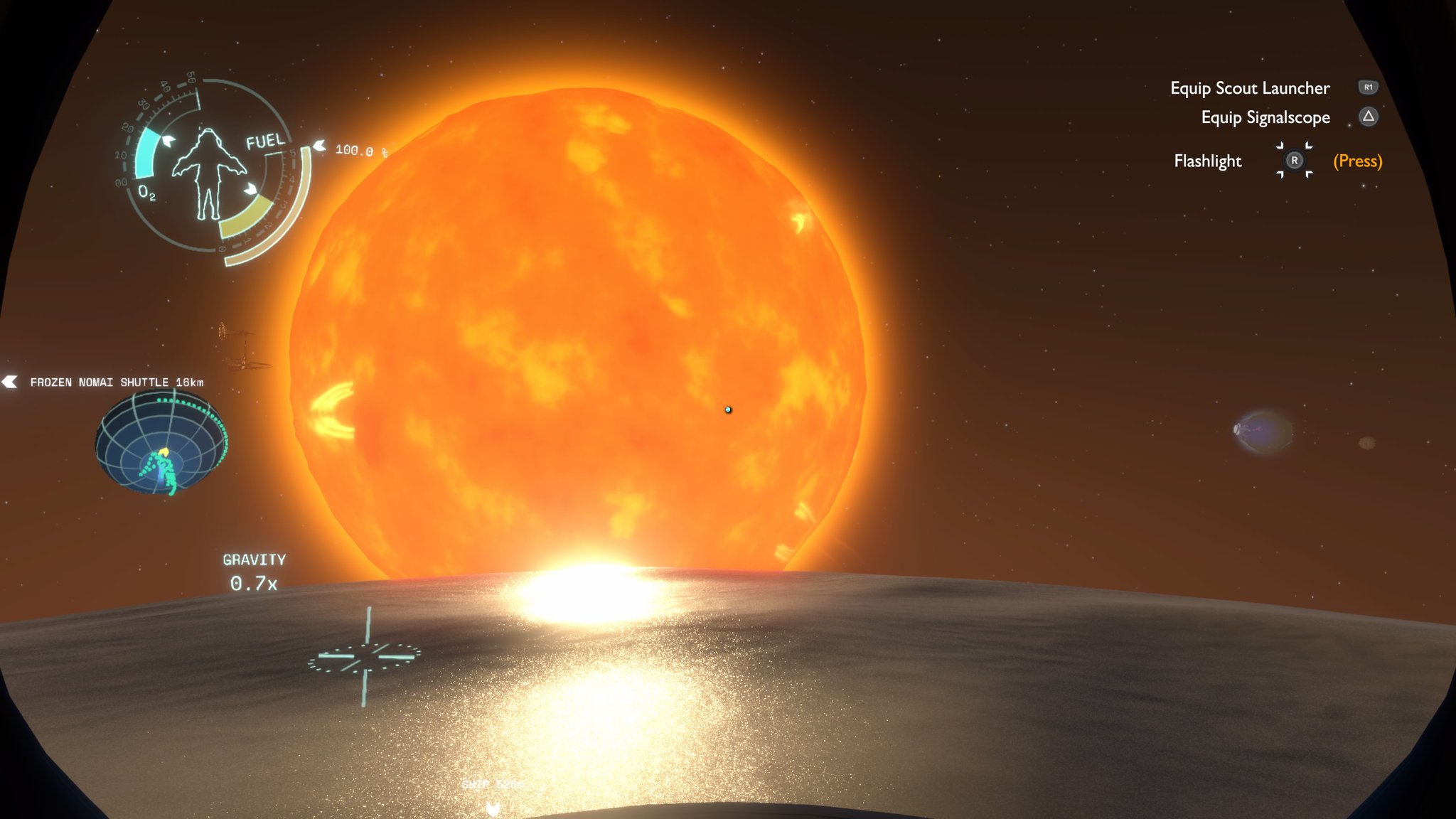
Though Outer Wilds is not the big space exploration game on the scene today, it is nonetheless an indie title of note that recently caught my attention. Released in early 2019, Outer Wilds has made a name for itself as the premier title from studio Mobius Digital, published by the narrative-centric indie publisher Annapurna Interactive. Outer Wilds is a spacefaring adventure that puts the player at the center of a mystery in a small solar system. With only twenty-two minutes until the sun explodes, the player is stuck in a repeated loop to discover what’s going on and why.

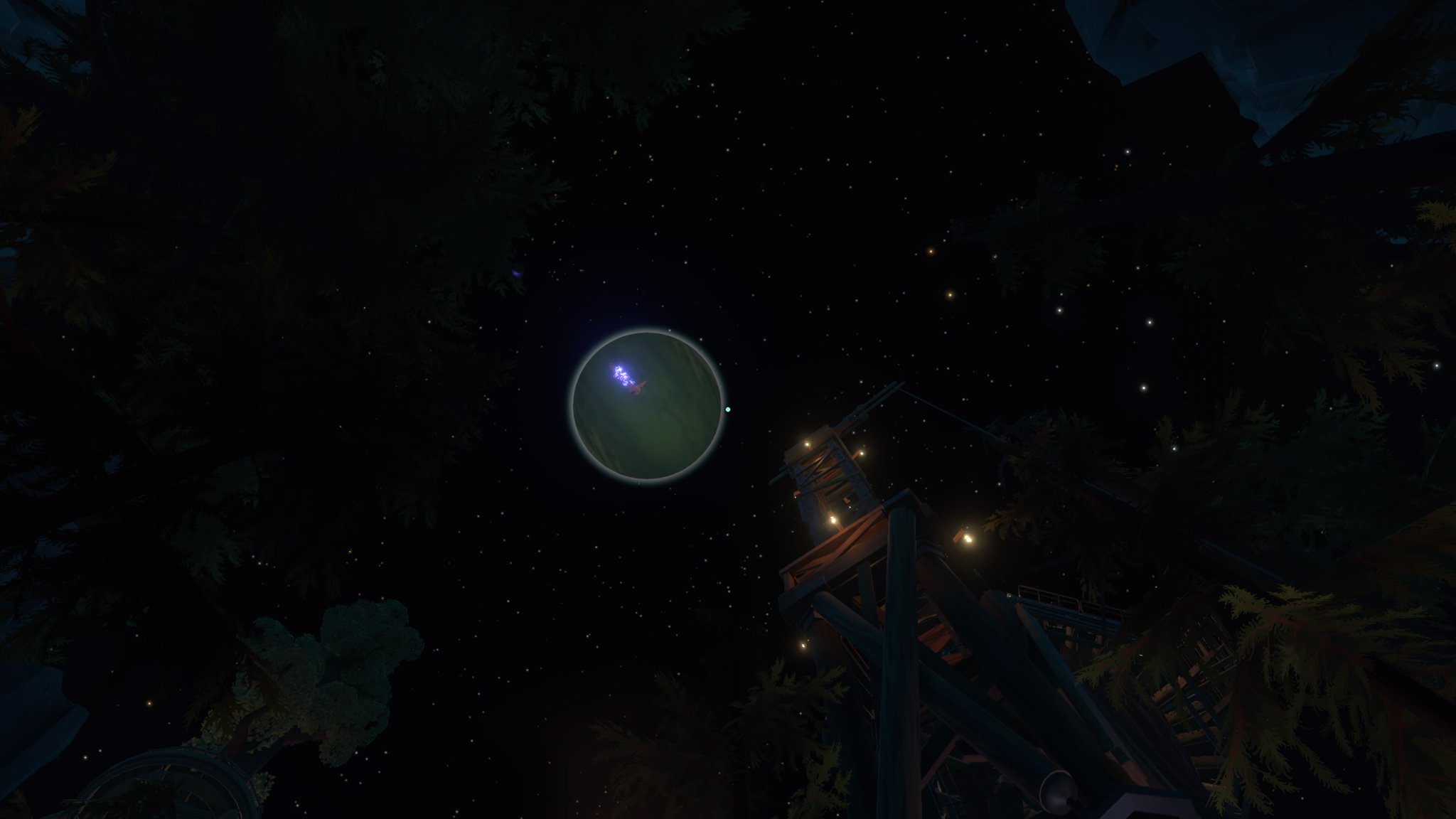
As you take your first gasping breath on Timber Hearth, you see the gas giant—Giant’s Deep far above, hovering in space. You notice a small purple explosion propel a piece of something out into space. If you play this game prepare to see this scene a lot, as this is how every time loop starts. It ends when the player dies, either self-inflicted or by the explosion of the sun. But somewhere in between is where the magic happens. The game draws some inspiration from rogue-likes, forcing you to use the knowledge of the world to advance further in each subsequent loop. With an untraditional approach to storytelling, Outer Wilds cements itself as an inspiration for developers to take risks, even at the expense of traditional rewards and potential player enjoyment.


Outer Wilds walks an interesting line, at times I was enamored with the exploration and discovery, at others I was completely frustrated with the mechanics and lack of rewards. I would sometimes go multiple loops without finding anything of note to record in my ship’s log (the only thing that gets saved between loops). There were times I found myself putting the game down for days due to poor in-game time management options and a lack of meaningful advances. Some discoveries—necessary for advancement—I found completely by accident at a very specific time within a time loop. It made me wonder if I would have found said thing otherwise.

Some puzzles feel clever and rewarding while others are simply frustrating. Once I learned to play around with the time within a loop, things became more clear. But then I was subject to the terrible waiting system and unfortunate control scheme that hampered the game for me. Outer Wilds is meant to be a spacefaring game, but it isn't a sim. So why are the controls so wonky? By trying to fight with acceleration, gravity, inertia, etc., I lose some of the enjoyment of exploration. And good luck with using auto-pilot, sometimes it flies you directly into the sun or allows your ship to be sucked into the gravitation pull of another planet. After finding myself stranded in space a dozen times, the waiting game became old quite quickly.

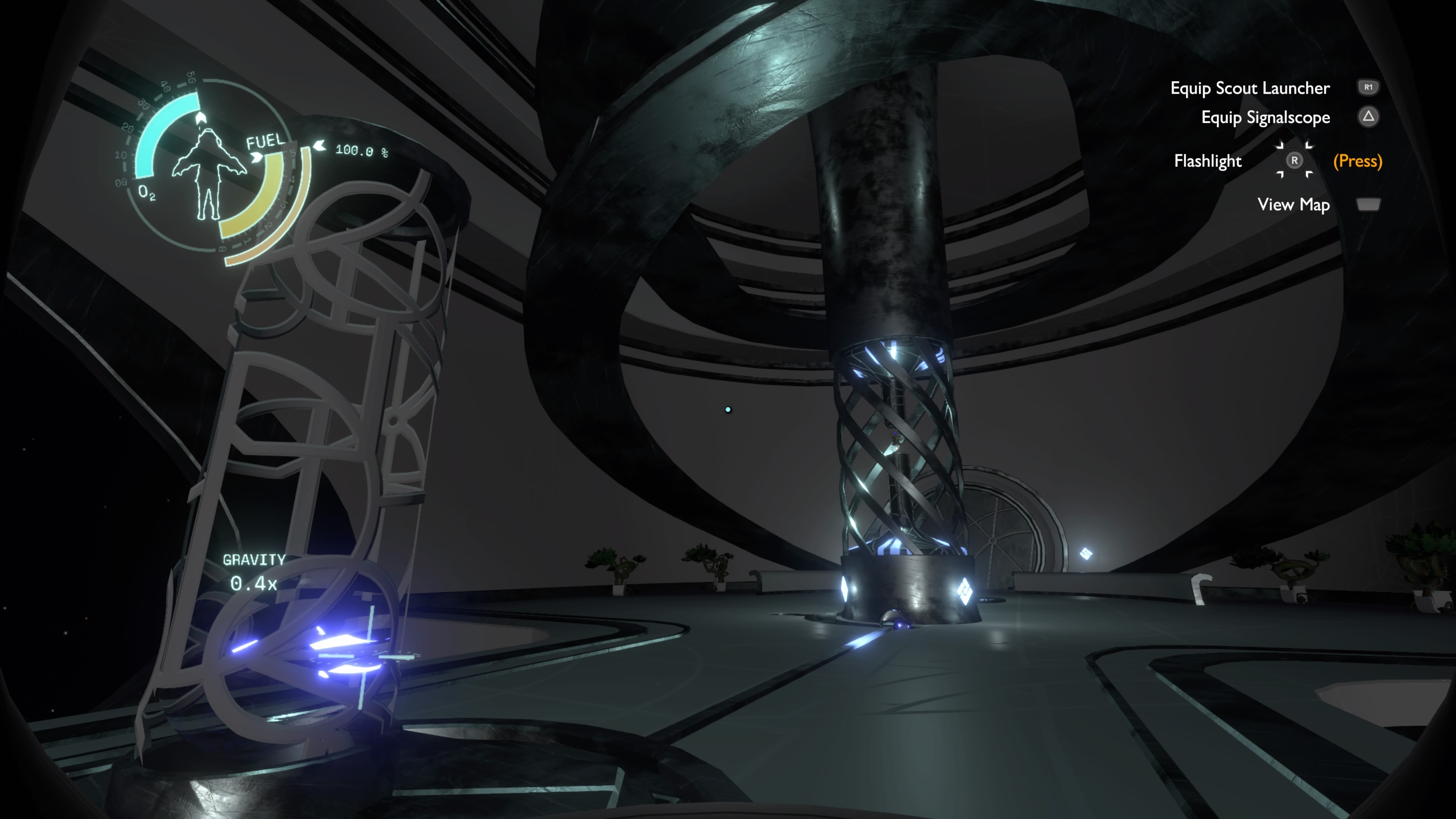
Despite the sometimes cumbersome controls and unpleasant waiting I had to endure, Outer Wilds exudes significant charm. From the unique planets to the Outer Wilds Venture tune that hums in your head even once you’ve exited the game, the game has many memorable traits. Discovering the unique properties of each planet was a delight. A black hole in the middle of a hollow planet? Count me in (except for when I fell into it for the twentieth time). Each body in the solar system—whether it be a moon, planet, or comet—has some sort of history attached to it, and stumbling upon something can be quite satisfying. More so if it was difficult to reach. The Nomai space predecessors left quite a bit of information behind, but it’s the sweet, human-like recorded interactions that made me smile. Little nuggets like these are scattered all over the solar system.

Outer Wilds is an odd paradox, it feels huge due to its nature as a space exploration game, but at the same time creates a coziness within its confines. Some places are mostly barren, while others have tons to explore, but at any point, you can equip your singalscope and listen to a fellow member of the Outer Wilds Venture play the theme song on their chosen instrument. So even after getting sucked into a black hole and getting thrown into deep space, you can find the music thousands of kilometers away and you’ll never feel alone.


It was difficult to decide how Outer Wilds made me feel as a whole. I don’t normally put a game down never to pick it back up, but there were moments where I considered doing just that. There were also times that I stayed up late into the night trying to discover more hidden messages from the Nomai. Though I found some frustrations with the game, when the credits rolled I was satisfied with the final message and many of the decisions that the developers over at Mobius Digital implemented. Outer Wilds takes many risks, and while some don’t pay off, the ones that do make this a venture worth taking. The game may not be perfect, but it is memorable. I recommend it to anyone who likes space travel and discovery sprinkled with a little charm. Just try not to get stuck in outer space too often.


The Math

Objective Assessment: 8/10

Bonus: +1 for unique storytelling method. +1 for satisfying space discoveries.

Penalties: -1 for wonky controls that don't ever feel great. -1 for poor waiting options. -1 for progression/reward imbalances.

Nerd Coefficient: 7/10

Posted by: Joe DelFranco - Fiction writer and lover of most things video games. On most days you can find him writing at his favorite spot in the little state of Rhode Island.

Wednesday, September 13, 2023

Lindsay, Leckie, and LeGuin: A century of pronouns and gender in SFF


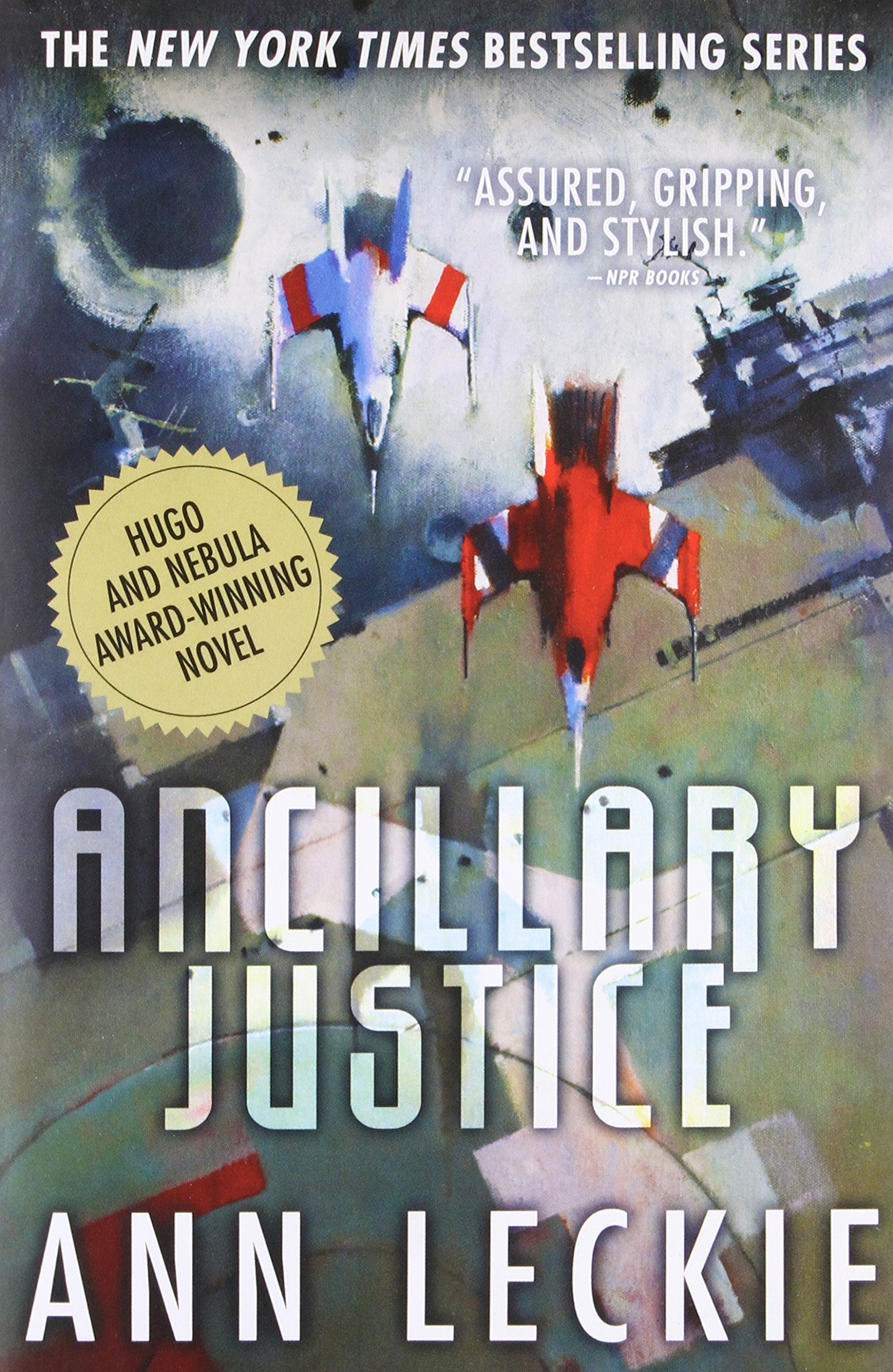
Ann Leckie’s Imperial Radch series burst upon the SFF world in 2013, drawing notice for (among other things) its linguistic worldbuilding. The Imperial Radch, the central power of the series, speaks a language that lacks any gender distinction in the pronouns. Linguistically, this feature in itself is hardly unusual. There are many languages spoken today (on Earth) that do not distinguish gender in their pronoun systems, ranging from Imbabura Quichua in Ecuador (pai), to Finnish (hän), to 252 other languages listed in the World Atlas of Language Structures as lacking all gender distinctions in their pronoun system (Siewierska, 2013).1  

No, what made the Radchaai gender invariance striking was that Leckie chose to render that single, gender-neutral pronoun in English as she. And since the narrator, Breq, is Radchaai, every character in the book is rendered as she, regardless of their own individual gender identity. Furthermore, in a nod to the Sapir-Whorf hypothesis, speakers of Radchaai struggle to recognize gender as a property of humans.2 When Breq is forced to use gendered pronouns in other languages, she3 often resorts to guessing, based on what she knows of that culture’s arbitrary and idiosyncratic cues, and hoping she got it right. To Breq, categorizing humans as one gender or another is as pointless as many English speakers find categorizing inanimate nouns. In Spanish, key is feminine and bridge is masculine. In German it is the reverse, and what is more, girl is neuter. Bantu languages distinguish as many as ten, fifteen, even twenty different categories, at which point even the most classical grammarian gives up on the idea of sex-based gender terms and just calls them ‘noun classes’ (Marten 2021). Surely, thinks many an English-speaker, this grammatical ornamentation is an entirely unnecessary and frivolous complication. Likewise, to Breq, pronouns and gender. 

But Leckie is not the first person to employ pronouns as a tool of linguistic world-building. Indeed, she is only the latest in a long series of SFF authors who have departed from English language pronoun conventions to enrich their creations. And by tracing the strategies these authors have used throughout the years, we can also trace the concerns of the time in which those authors were writing, both on the macro level of decades and generations, and also on the micro-level of years that separate a book and its sequel. 
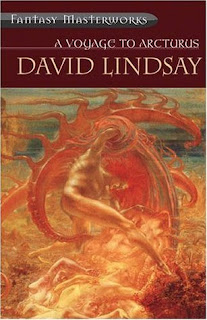
If we start our historical journey at a nice round centuryish ago, we discover that the neopronouns ae/aer are not, in fact, terribly neo. They were first introduced in 1920 by David Lindsay in his novel A Voyage to Arcturus, to describe the phaens:

[T]his person, although clearly a human being, was neither man nor woman, nor anything between the two, but was unmistakably of a third positive sex, which was remarkable to behold and difficult to understand. In order to translate into words the sexual impression produced in Maskull’s mind by the stranger’s physical aspect, it is necessary to coin a new pronoun, for none in earthly use would be applicable. Instead of “he,” “she,” or “it,” therefore “ae” will be used.

Note that the link between sex and gender is taken for granted. The need for a new pronoun has nothing to do with social self-presentation in the phaens, and everything to sex and procreation:

He found himself incapable of grasping at first why the bodily peculiarities of this being should strike him as springing from sex, and not from race, and yet there was no doubt about the fact itself. Body, face, and eyes were absolutely neither male nor female, but something quite different. Just as one can distinguish a man from a woman at the first glance by some indefinable difference of expression and atmospheres altogether apart from the contour of the figure, so the stranger was separated in appearance from both. As with men and women, the whole person expressed a latent sensuality, which gave body and face alike their peculiar character.... Maskull decided that it was love—but what love—love for whom? It was neither the shame-carrying passion of a male, nor the deep-rooted instinct of a female to obey her destiny. It was as real and irresistible as these, but quite different.4

Now, to be sure, Lindsay’s brainchild is hardly a masterpiece of progressive foresight. In 1920, it was an uphill battle to suggest that male passion need not be shameful; that female sexual pleasure need not stem from a biological urge to “obey her destiny,” and Lindsay was evidently not interested in fighting that battle. But he could at least suggest that it was possible for people to land in a third box—even if you had to go to Arcturus to find them.

If we jump forward half a century, to 1968, Ursula LeGuin continued this conversation about gender in The Left Hand of Darkness, and it’s quite striking to compare the choices Lindsay made with LeGuin’s decisions. Some of the contrasts are simply related to differences in world-building. Where Lindsay’s phaens have all the sexual organs, perpetually in abundance, LeGuin’s Gethenians have none of them, most of the time. Only when they enter the biological state known as kemmer once a month do they develop sexual characteristics, becoming either male or female, and possessed of an incredibly strong sexual drive. When kemmer ends, the Gethenian reverts to androgyny until the next month, when they may develop an entirely different set of sexual characteristics from before.

All or nothing, fixed or shifting, genders that don’t obey the male/female binary will run up against the question of pronouns. Lindsay, as we have seen, invented completely new ones. Intriguingly, although you’d imagine LeGuin’s readership in the 1960s would be willing to match Lindsay’s in their appetite for adventurous pronouns, LeGuin herself was more linguistically conservative. She decided to stick with the ‘gender neutral’ pronoun he/him/his in all contexts, defending this choice in an essay written from 1976: 

I call Gethenians “he” because I utterly refuse to mangle English by inventing a pronoun for “he/she” “He” is the generic pronoun in English, dammit. (I envy the Japanese, who, I am told, do have a he/she pronoun.) But I do not consider this really very important.

Yet ten years later, in 1989, LeGuin revisited that essay,5 and describes how she changed her mind entirely not too long after such a breezy dismissal of the importance of pronouns: 

This “utter refusal” ... collapsed, utterly, within a couple of years more. I still dislike invented pronouns, but now dislike them less than the so-called generic pronoun he/him/his, which does in fact exclude women from discourse; and which was an invention of male grammarians, for until the sixteenth century the English generic singular pronoun was they/them/their, as it still is in English and American colloquial speech. It should be restored to the written language, and let the pedants and pundits squeak and gibber in the streets. 

Despite its grammatical conventionality, The Left Hand of Darkness is a much more thoughtful meditation on gender and society than A Voyage to Arcturus. Part of that is that it’s just a better book. But it’s also a book written in a society that had moved on in which conversations about gender it’s willing to engage in. Linguists in the 1960s and 1970s were engaging in lively discussions about how sexism is encoded in language,6 and whether he truly is as neutral and generic as people (like LeGuin in the 1960s) like to claim.7 In this context, LeGuin’s Gethenians don’t just represent a wonky biology that requires a matching pronoun. If they did, then their pronouns would have to change every time they enter and exit kemmer. No, the Gethenians allow LeGuin to explore the idea that gender need not dictate one’s role and recognized capacities. That gender is not, in fact, a necessary part of society. 

Yet, like Lindsay, LeGuin was still controlled by the idea that sexual identity directly affects personality. Because, as we learn in Chapter 7, “the sexual impulse is tremendously strong in [kemmer], controlling the entire personality, subjecting all other drives to its imperative.” For all that the Gethenians are not sexual or gendered most of the time, the fact remains that when they acquire sexual organs, sex becomes dominant in defining their identity.

Furthermore, for all her progressive thoughtfulness, LeGuin still catered to a default male perspective. Beyond the decision to use default ‘he’ for Gethenians, she also presented the world of Gethen through the perspective of Genly Ai, a visitor whose own biology has fixed his gender as biologically male (a property that the Gethenians view as a bit perverse, to see a human who is perpetually and continuously a sexual being). And as the perpetually sexual and perpetually male Genly Ai grows closer to his Gethenian companion Estraven, who—if not always male—was always coded with male pronouns, we find that LeGuin also catered to a default heterosexual perspective. A certain amount of rhetorical gymnastics are used to sidestep the queer potential growing in the nascent intimacy and eventual sexual attraction between them.  (LeGuin does say, in the same essay where she revisits her pronoun decisions, that she also regrets this knee-jerk assumption in her worldbuilding. Her views changed remarkably in the space of that decade.) Indeed, more generally on Gethen, a committed couple will match their biological sex 50% of the time they enter kemmer, and yet when Gethenians are in kemmer, they only ever choose heterosexual partners. Once again, sexual attraction and sexual identity cannot be separated from procreation, even on Gethen.

Jump forward another half century, and we have in Ann Leckie’s Imperial Radch books another set of perspectives separated by a decade. The originally Ancillary series came out in 2013, and her most recent installment in that universe, Translation State, came out just this year, in 2023 (reviewed (by me!) on Nerds Of a Feather here). And once again, we can trace developments in social concerns about gender by looking at the differences between Leckie in 2013, and Leckie this year.

From the beginning, Leckie was not so considerate of the default male, default het, default binary conventions as LeGuin was. Indeed, she is downright provocative.8  Rather than treading a truly neutral path with default they, as LeGuin later wished she had done, Leckie builds a world where the default coding is female. Although superficially this decision had the same effect as LeGuin’s genderless society with default male coding—the same pronoun for everyone!—its impact was very different. Not only was the male perspective entirely erased, but the Radch isn’t like Gethen, where everyone is by default sexless. In the Radch, people still have sexual organs in profusion. Those organs are simply uncoded by gender. And that idea made a vocal, active subgroup of science fiction readers extremely uncomfortable. The very idea of it! People with the same plumbing doing things, cats and dogs living together, mass hysteria

What the original Ancillary books did not do, however (or not much), was touch on questions of gender identity or trans issues. How could they? Gender isn’t a thing in the Radch. Everyone is she. It’s as impossible to misgender someone within the Radch as it is for a 21st century human, whose culture simply does not recognize the concept of questors, to misquestor another 21st century human. 

I don’t know whether Leckie was deliberately side-stepping the issue, as LeGuin did on Gethen, or whether she merely overlooked it. Breq observes in Ancillary Justice that ‘the cues meant to distinguish gender changed from place to place, sometimes radically, and rarely made much sense to me’ (pg 3). This recognition that gender can be arbitrary certainly leaves open the possibility of transgender people outside the Radch. Yet, later, in a rather entertaining sequence in Ancillary Sword, we learn about the historical tendency of an annexed system, the Athoeki, to make ‘a division between people with penises and people without’ (pg 84), which is agreed among the Radchaai to be parochial and bizarre. Of course, there are more than just the Athoeki outside the Radch, but it is striking that one of the most in-depth discussions about gender-having, non-Radch is still explicitly linking gender to biology. 

Within the original Ancillary trilogy, it seems, Leckie was primarily interested in exploring what happens when gender and biological distinctions are both removed entirely from society. She wasn’t quite yet ready to explore what happens when they’re still present, but delinked in the way that is necessary for building a trans-inclusive society. 

And this decision is understandable, given the publication date of 2013 for Ancillary Justice. In 2013 society was not talking about trans rights the way it was talking about gender roles. 2013 was a lot longer ago, culturally, than it feels to middle aged ladies like me. Gay marriage in the US was not legal. J. K. Rowling had not yet alienated her readership with her anti-trans views. Trans people existed,9 but trans equality was not yet in the public spotlight the way it is now. Politicians were much more het10 up about which adults got to marry than about which people were allowed which kind of medical care. Forget banning gender-affirming surgery and hormone therapy—abortion was still legal in 2013. In 2013, only a decade ago, the dominant gender-related questions still centered on male-female binary oppositions. Sheryl Sandburg published Lean In in 2013. Remember Lean In? It’s the book that suggested that workplace sexism could be fixed if only women changed their behavior.
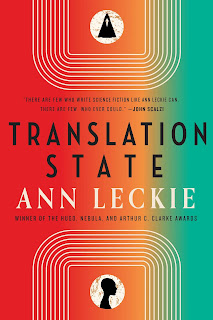
By 2023, however, trans rights have become a rallying cry for the progressive left (and a target of hate for the reactionary right), and Leckie has expanded the world of the Radch to address it in a fascinatingly deft way in her new book Translation State. Because, although the Radchaai do not distinguish gender in their pronouns, there are cultures around the Radch that do. The Athoeki of ten years ago stuck with a traditional Earthlike male/female-style binary, but in Translation State Leckie has introduced other cultures that have finally, fully delinked gender and sex, allowing more than just male-female binaries, and respecting people’s own choices about which gender category they use. 

And when these people interact with the Radchaai, they get misgendered. Unlike Breq, who at least makes an effort to guess at what the correct gender coding might be, most other Radchaai don’t even bother. In Translation State, when a Radchaai official is explicitly and repeatedly corrected, she waves it off with a disdainful ‘Whatever. Anyway . . .’ 

This is not, in the world of the book, any kind of transphobia at work. To be transphobic, you must believe that gender is immutable; to believe that gender is immutable you must know what gender is, and the Radch are entirely blind to it. Rather, in the world of the book, this attitude is a reflection of the political dominance of the Radchaai, and their refusal to recognize cultural traditions that they do not posess themselves. This is an American asking a colleague whether they have plans for Easter Break, assuming that of course the colleague is Christian. This is a bathroom technology engineer assuming that of course all hands look like white hands, resulting in automatic soap dispensers refusing to dispense soap for people of color. It is cultural imperialism behind these misgenderings, not transphobia.

And yet—and yet and yet and yet. Even though the Radchaai can’t see gender, it’s hard not to read the repeated misgenderings as transphobia. It feels oddly reminiscent of white people who insist that they ‘don’t see color’ and then proceed to indulge in all sorts of racial microaggressions. 

The insidiousness of this transphobic flavor to the Radchaai is characteristic of Leckie's deft touch. She never has the broader conversation explicitly with her readers. Her books are never about gender and pronouns, not the way that LeGuin’s work was, or even the bits dealing with the Phaens in Lindsay’s work. Leckie doesn’t have her characters discuss gender and pronouns explicitly. She doesn’t use them as mouthpieces, having them speechify her worldview, engage with each other to present The Gender Issue. Indeed, the books are very straightforwardly discussions of the consequences of cultural dominance and imperialism. But by simply presenting the treatment of gender and pronouns as she does, with their transphobic resonances, she forces the readers to have the conversation with themselves.

In the Ancillary books, Leckie also forced people to confront gender relations without ever explicitly discussing them, simply through the nature of the Radchaai’s pronoun system. This was an an important conversation in 2013. And now, Leckie is forcing people to confront transphobia and gender identity without ever explicitly discussing it, again, simply through the nature of the Radchaai’s pronoun system. In the space of a decade, the same linguistic worldbuilding has been repurposed to engage with the evolution of ongoing issues, without ever making those issues the focus of the book. It’s more elegant than Lindsay—no surprise there—but I’d argue it’s also more elegant than LeGuin. It’s all rather quite brilliant, actually.

——

1 This number is an order of magnitude more frequent than the other possible systems of pronoun gender expression listed. Although WALS is not an exhaustive inventory of all languages, it is constructed with a particular eye toward representing the range and scope of diversity across human languages (Comrie et al 2013), and so I’m inclined to believe that non-gendered pronoun systems may well be the rule, rather than the exception, to human language grammars.
2 Earthling speakers of Quichua and Finnish and 252 other languages do not have this problem.
3 Breq’s own relation to gender is not quite the same as other Radchaais’, because she is not a human. Rather, Breq’s body is one of many biological avatars of a spaceship’s AI, which controls many human bodies as extensions of her own consciousness. I use ‘she’ here simply because it’s what Breq would use for herself.
4 This sequence goes on quite a bit, with a lot of rather quite rude remarks demands on the part of Maskull, who says things like, ‘Never mind that. It is your sex that interests me. How do you satisfy your desires?’ At least buy the nice phaen a drink first!
5 If you have read The Left Hand of Darkness, I highly, highly recommend reading this revisitation. It’s called ‘Is Gender Necessary: Redux’, and it is formatted in two columns, with the original text on the left, and LeGuin’s revisions and annotations about how her thinking has shifted in the intervening years on the right. It is effectively a three-way conversation between LeGuin-in-1968, LeGuin-in-1976, and LeGuin-in-1989. One LeGuin is brilliant; three LeGuins are triply so. See references for link.
6 For a very accessible example of one such discussion, see ‘Language and Woman’s Place’, by Robin Lakeoff, 1973, link in references. She even talks about the use of ‘he’ as the neutral, unmarked pronoun for mixed groups.
7 I’m reminded here of a line from James H White’s ‘Sector General’ stories, originally written in the 1960s and 1970s, which offers an interesting perspective on the universal use of he: ‘. . . When O’Mara became quiet and polite and not at all sarcastic, when he began treating a person as a patient rather than a colleague in other words, that person was in trouble up to his or its neck.’ His or its. Not His, hers, or its, but his or its. Clearly, ‘his’ can’t be truly a gender neutral universal pronoun, or else it would have included aliens who individually would take ‘its’. And since this book is wildly misogynistic in many, many other ways (oh, good gravy, far too many ways to remain within the scope of a footnote), I think it’s unlikely that White intended for ‘his’ to mean ‘his or her’ the way grammarians intended. ‘His’ meant ‘his’. Women need not apply.
8 She is not the first to be deliberately provocative, of course. Samuel R Delaney springs to mind as a writer who made a point of pushing all sorts of boundaries with respect to gender identity and sexuality a generation before Leckie. But Delaney was not representative of the SFF reading public’s preferences. Indeed, his willingness to push boundaries cost him publishing contracts with Bantam when he explicitly included the AIDS epidemic in his Nevèrÿon books in the 1980s (Lucas 2023). He would not spring to mind so easily if he were not so exceptional in his work, if he were not an exception to a more general tendency.
9 Trans people have always existed.
10 Get it? Get it?

——

References

Comrie, Bernard, Matthew S. Dryer, David Gil, and Martin Haspelmath. 2013. Introduction.In: Dryer, Matthew S. & Haspelmath, Martin (eds.) WALS Online (v2020.3) [2013]. https://doi.org/10.5281/zenodo.7385533 (Available online at http://wals.info/chapter/44, accessed on 14 July 2023).

Lakoff, Robin, 'Language and the Woman's Place'. Language in Society 2(1). [Cambridge University Press 1973]. (Available online at https://web.stanford.edu/class/linguist156/Lakoff_1973.pdf, accessed 2 September 2023).

Leckie, Ann, Ancillary Justice. [Orbit 2013].

Leckie, Ann, Ancillary Sword. [Orbit 2014].

Leckie, Ann, Ancillary Mercy. [Orbit 2015].

Leckie, Ann, Translation State. [Orbit 2023].

LeGuin, Ursula K., The Left Hand of Darkness. [Ace Books 1969].

LeGuin, Ursula K., Is Gender Necessary? Redux. In: Dancing at the Edge of the World: Thoughts on Words, Women, Places. [Grove Press 1989]. Available online at https://americanfuturesiup.files.wordpress.com/2013/01/is-gender-necessary.pdf, accessed 2 September 2023].

Lindsay, David, A Voyage to Arcturus. [Methuen & Co., Ltd 1920].

Lucas, Julian, How Samuel R. Delany Reimagined Sci-Fi, Sex, and the City. [The New Yorker, 10 July 2023](Available online at https://www.newyorker.com/magazine/2023/07/10/samuel-r-delany-profile, accessed on 2 September 2023).

Marten, Lutz, 'Noun Classes and Plurality in Bantu Languages', in Patricia Cabredo Hofherr, and Jenny Doetjes (eds), The Oxford Handbook of Grammatical Number, [Oxford Handbooks, 2021]. (Available online at https://doi.org/10.1093/oxfordhb/9780198795858.013.26, accessed 16 July 2023).

Sandberg, Cheryl, Lean In: Women, Work, and the Will to Lead. [Knopf 2013].

Siewierska, Anna, Gender Distinctions in Independent Personal Pronouns. In: Dryer, Matthew S. & Haspelmath, Martin (eds.) WALS Online (v2020.3) [2013].  https://doi.org/10.5281/zenodo.7385533 (Available online at http://wals.info/chapter/44, accessed on 14 July 2023).

White, James H., Beginning Operations. [Tom Doherty Associates, 2001].

CLARA COHEN lives in Scotland in a creaky old building with pipes for gas lighting still lurking under her floorboards. She is an experimental linguist by profession, and calligrapher and Islamic geometric artist by vocation. During figure skating season she does blather on a bit about figure skating. She is on Mastodon at wandering.shop/@ergative.
Adri and Joe Read the Hugos: Short Story


Adri
: So, how about those Hugos?

We’re starting with short story, which is unusual for us, and it also gives us a chance to dive into the category with the most Chinese works. All of these have been provided in translation, with two stories translated by humans (Regina Kanyu Wang’s Zhurong on Mars is translated by S. Qiouyi Lu and Ren Qing’s Resurrection is translated by Blake Stone Banks) and The White Cliff and On the Razor’s Edge translated by machine. Muddying the waters slightly, Resurrection is eligible on the basis of its translation being published in 2022, not the original story which was published in 2020. So we have three stories where the “definitive” text is in English, and three in Chinese, but both of us have read them all in English. Which immediately makes prose comparisons difficult, but at least we’ve been able to appreciate the whole ballot, for a given value of the word “appreciate”.

It’s also a great ballot for Hugo firsts - of the authors here, I’m pretty sure that only John Wiswell is a repeat nominee.

Joe: You are absolutely right, Wiswell is the only prior nominee. He was previously on the ballot in 2021 for the short story “Open House on Haunted Hill” and again last year for the novelette “That Story Isn’t the Story”. I feel like I’m a bit late on the John Wiswell train because I’ve been hearing great things about his fiction even before he really broke out a couple of years ago - but everything I’ve read from him has been absolutely top notch and “D.I.Y.” is no exception.

It’s not 100% my favorite Wiswell, but I think what works for me is the tone. I think “D.I.Y.” has something of what I think you’ll argue about when we get to Best Novel and Legends & Lattes - which is this really smooth tone that even in light of potentially serious subjects it reads really smooth and suggests that stuff is easier than it is (Legends & Lattes is a different conversation, of course) - but even though the water crisis of “D.I.Y.” and what is functionally a corporation only doing what is most profitable for the least good rather than what is less (but still) profitable for the most good - this is serious stuff, but Wiswell has a very light touch.

Adri: I wish I liked D.I.Y. more than I do, but I struggled with it on two levels. First, sadly, the more of Wiswell’s writing I read, the less I get on with his prose - everything seems to come in the same functional-but-not-spectacular conversational style, and there are some really weird word choices in here (one teen calling another a “chonky boi” as if he’s a large cat rather than a human being) that I didn’t really… get. Clearly I’m in a minority here, but this is increasingly not the kind of genre work that gets me excited.

Second, while I love the premise of this story - it’s great to see someone taking aim at the “some children are very, very special and get to go to special magic schools” concept - I found the execution quite shallow, especially since this is practically the only climate fiction on the Hugo ballot this year. The protagonists face hardship and discrimination, but the story shies away for showing that in any more direct way than having one of the kids refused a scholarship by a snooty wizard. There’s no weight behind the climate catastrophe, so the protagonists’ achievements in solving problems doesn’t land nearly as effectively as it should. Perhaps that’s the point, and it’s not the kind of story that’s “supposed” to hit hard, but there’s nothing else here that makes me go “oh this is why this story is more than just a cute diversion, awesome”. Alas.

Joe: Before we get to “Rabbit Test” from Samantha Mills, which - spoilers - is my favorite story (such as the word favorite can apply to that story and how hard it hits) on the ballot, let’s talk about the four Chinese language stories.

As you said, we’re reading these in translation and two of those translations were done by machine - so we really can’t have a true sense of how the stories would present to a native speaking audience and what could be said to be lost in translation. It’s impossible to know, but I’m rather happy that I have this opportunity to experience them at all and that the writers / publishers took the time to translate their work for us the English language fans.

Adri: We’ll never experience how well these works land in Chinese, so even for the human translated works I’m going to avoid talking too much about prose here, except to say that you can totally tell that one story was translated by an accomplished author in aer own right, a second was translated by a person going for maximum accuracy, and the others were translated by computers.

But there’s no getting around it: there are things here that sure didn’t land well with me. I want to start at the lowest point of my reading: “On the Razor’s Edge” by Jiang Bo. Either there’s a significant satirical edge getting lost in translation here, or we have a story on the ballot that would have been right at home in the Puppy era of short fiction nominees if it weren’t for its stridently pro-CCP protagonist. This is a space rescue, in which two astronauts aboard the Chinese space station receive a distress call from the ISS and are given permission by the appropriate committee to stage a daring rescue. The ISS astronauts are all Americans, foolishly still working aboard their crumbling station, and while most of the text focuses on the action of the rescue (a sort of mini-The Martian, complete with Andy Weir levels of geopolitical nuance), we do get to spend an infuriating amount of time helpless, passive female astronaut who spends the entire rescue weeping and being told what to do by men.

I’ve read a previous story of Jiang Bo’s as well: “Starship: Library” appears in translation in the Sinopticon anthology, and has an active, competent woman as its protagonist, so I can only hope that that story is a better indicator of the work he’s put out over a 20 year career. “Starship: Library” also has an edge of gentle humour, which adds to my hope that something is getting lost in translation, and this isn’t just a straight up “strong, patriotic man rescues helpless woman in space” throwback.

Joe: Now that we’re getting into it, “On the Razor’s Edge” is one of my problems (if that’s what I want to call it) with some of the Chinese language work on this year’s ballot. You say “Puppy Era” and you’re not completely wrong, but what I think of instead is that “On the Razor’s Edge” is one of several 1950’s-esque science fiction stories on the ballot.

I wish that someone could brain dump the last five years of Chinese science fiction into my head complete with the working knowledge of novels and the significant short fiction and the scope of what is on the ballots for the Galaxy and Chinese Nebula Awards. Just so I could know how representative “On the Razor’s Edge” and the other works on the ballot are.

There is a particular formality to the writing or to the translation that really feels like science fiction from another era. It’s not Asimov, per se, but it’s what you think about when you think about Asimov - the taking of an idea and playing with it, but doing so in fairly basic and straight forward terms. That’s what “On the Razor’s Edge” does for me and

That formality is also present in “Resurrection”, which I’ll admit doesn’t quite like a 1950’s American science fiction story, but it does have that weird formality to the writing (or translation) that doesn’t really work for me. But with that said. I think “Resurrection” may also be one of the most Chinese stories on the ballot in this category, at least in the idea that it relies more on a Chinese culture than an American one (or, presumably, a British one).

Adri: Resurrection is an intriguing idea: a synthetic version of a woman’s son is delivered to her upon her son’s death, and she has to make her peace with his loss while dealing with this weird, temporary technology and the unwanted attention it brings. But there was a lot hanging around in the margins of the actual story that I was more interested in than, say, the paragraph-long musings of the synthetic corpse about the infinite potential subdivisions of time. For a story that’s very grounded in a mother-son relationship, it’s hard to really grasp either the emotions of the characters or what either of them think about the repressive bureaucracy that resurrected Xinguang and what its agents might be trying to achieve. The effect left the story feeling somewhat hollow to me, and on a first reading I struggled to grasp the weight of the mother’s actions at the end and what her rebellion means in a wider sense.

Joe: It was a really cool idea, but I have it ranked last on my ballot - though I could easily swap spots between “Resurrection” and “The White Cliff” if it came to it.

Adri: I got on better with The White Cliff, and I’d love to see it get a proper translation, because I’d like to see how the story’s midway reveal works with intentional language, and what it intended to be obvious before the turning point. Like Resurrection, this is also a piece about the relationship between a parent and child, with a woman providing medical care for her terminally ill father. The technological innovation here isn’t mind-blowing, and there’s a lot left unexplored in terms of the ethics of use: the story seems to imply there’s a genuine answer to the question “what’s the most effective way to say goodbye to a dying loved one”, which I think is a non-starter. Still, I liked the imagery a lot and I felt a much stronger emotional connection to An and Yanli than to Xinguang and his mother in “Resurrection”.

Joe: Maybe it was the lack of proper translation for “The White Cliff”, as you said. It was deeply emotional but I think the translation held it back and kept me at a bit of a distance and kept the story from fully landing. As with all of the stories, I wanted to appreciate “The White Cliff” and I would love to know if it’s translation, storytelling, or cultural differences that is holding me back. The thing is - I’m a huge softie and stories that have those moments with parents and children and dealing with grief and letting go and acceptance really, really tend to work for me - even if just in the moment of catharsis, and usually it’s enough to overcome and flaws I found in a story. Here it wasn’t.

My favorite of the translated Chinese language stories is “Zhurong on Mars”, which is a fairly straight forward sentient AI / colonization story that reads like something I’ve seen before and I enjoyed it then and I enjoyed it now. I’m a basic science fiction sometimes and if there ever was a “core genre”, which is an entirely different conversation, “Zhurong on Mars” is straight up core genre.

Adri: This was also my favourite of the translated stories: as you say, it’s an idea that feels quite well trodden, but I liked the imagery and characterisation a lot and I think the way it handles self-actualisation and purpose in an emerging consciousness kept me firmly engaged. It still wouldn’t rate among my favourite stories of the year - there’s too much ponderous technological musing and not enough weird shit for me - but this story still spoke to me , and Regina Kanyu Wang is even more firmly on my radar now as an author to watch.

Which brings us, I think, to our joint favourite story: Rabbit Test by Samantha Mills. Do you want to kick off with your thoughts on this one?

Joe: I mentioned earlier that “Rabbit Test” was my favorite story on the ballot, though I’ll also note that the word “favorite” here is doing some work because it’s a really tough story to sit through.

It’s topical as hell, at least in the United States. I’m fairly US-centric when it comes to understanding what’s going on in other countries, but with the overturning of Roe v Wade last year and the end of a federally protected right to have an abortion this is something that’s been on my mind as it has with so many Americans (and likely others around the world, though I don’t want to assume that other people think about the United States nearly as often as folks who live here do).

The titular rabbit test was, somewhat to my surprise, a real thing and that makes sense, because of course women would want to know if they were pregnant as early as they could. I’m sure that’s common knowledge for people who aren’t me. As Mills wrote “all of those people just wanted to know, so they could plan either way. Because—” But, this isn’t a historical story about pregnancy tests. It’s a story of bodily autonomy, of government and societal control, of the fight to *choose* that has always been going on and maybe always will?

“Rabbit Test” jumps between times in glimpses and microstories within the macro story and it hits brutally hard. It’s not just the story Mills is telling, which is vital and immediate and important, it’s the power with which she tells it and even as the story ends it isn’t really over because it can’t be.
“It is 2084 and she is crying, “Our grandmothers fought so hard for this.”

It is 2206 and she is crying, “Our grandmothers fought so hard for this.”

It is 1878 and Madame Restell is bleeding to death in her bathtub rather than submit to another trial. It is 1821 and Asenath Smith is fleeing town in disgrace. It is 1972 and seven of the women of Jane have just been arrested in a raid. It is 2086 and Grace’s medical record has been officially upgraded to that most precarious of categories: potential to become pregnant.

It is 2022 and it isn’t over.

It is 2022 and it is never over.”
I certainly haven’t read most of the notable stories published last year but I have a difficult time imagining there are many that will have the impact and power of “Rabbit Test”

Adri: I have similar feelings about Rabbit Test: while it’s certainly very grounded in the Roe repeal and events in the USA, abortion rights are a pretty universal issue and threats to them are depressingly topical in a lot of places beyond America. As you say, this is a difficult story to “enjoy” in the traditional sense, but it’s extremely evocative and, while the central story takes a specific perspective, the “surrounding” stories brings out the multiplicity of experiences with pregnancy that vary by gender, race, class and family circumstances. It’s one of those rare short stories that felt like a shoo-in to me from the moment I read it (the buzz about it beforehand on social media helped), and it’s the absolute stand out for this category to me.

Joe: I agree. From my perspective, “Rabbit Test” is truly the class of the field here. The other stories are generally good to very good and we disagree on which are which, but “Rabbit Test” stands out as something special.

Do you have any final thoughts? Otherwise, I think we’re about ready to throw down and argue about the Best Novel finalists. I know we have some significant disagreements there.

Adri: Let’s do it!