Tuesday, June 20, 2023

6 Books with Beth Cato


Nebula Award-nominated Beth Cato is the author of A Thousand Recipes for Revenge from 47North (out June 1, 2023) plus two fantasy series from Harper Voyager. She’s a Hanford, California native who now wanders in far distant realms, usually with one or two cats in close orbit. Follow her at BethCato.com and on Twitter at @BethCato.

Today she tells us about her Six Books.

1. What book are you currently reading?

I've just completed a hard push through the Nebula finalist works (whew!), and I'm rewarding myself by reading through an advance copy of a middle grade book, A Sky Full of Song by Susan Lynn Meyer. Fun fact: when I was young, I was obsessed with Laura Ingalls Wilder's books and read almost every other juvenile-category Old West-set book I could find. This book adds a wonderful new perspective to the old pioneer tales by following a young girl, Shoshana, who leaves Ukraine with her Jewish family and settles in North Dakota in 1905. The book is cozy and yet also heartbreaking as it deftly handles the racism of the period. I wish I could give this book to my 11-year-old self, as I grew up Protestant and pretty sheltered. This book would've opened my eyes in a lot of ways.


2. What upcoming book are you really excited about?

I have a galley of J.R. Dawson's The First Bright Thing that I'm desperate to get to. I mean, come on--a magical circus, time travel, post-World War I America? That so sounds like my kind of thing,


3. Is there a book you’re currently itching to re-read?

Oh gosh, my to-read pile is massive. I feel like the main things I re-read these days are research books when I need to glean new details. I do have a goal to read at least one 'classic' book each month, though, and as part of that, I've been rereading some books that I loved as a kid--things like Island of the Blue Dolphins and Jane Eyre. Coming up, I'd love to revisit more of Marguerite Henry's horse books. I've reread King of the Wind (my absolute favorite) a few times as an adult, but not Misty of Chincoteague. I own many of those books as library discards from my hometown.


4. How about a book that you love and wish that you yourself had written?

The Sparrow by Mary Doria Russell. That book devastated and enlightened me in turns. Such brilliant science fiction.


5. What’s one book, which you read as a child or a young adult, that holds a special place in your heart?

Just one? Okay, a major book for me was Carbonel, the King of Cats by Barbara Sleigh. It's a chapter book first published in the 1950s, and incredibly British. It follows a girl, Rosemary, who ends up involved with a witch and her familiar, Carbonel. The book is cozy and fun, and has great illustrations. I probably checked it out from my hometown library dozens of times as I grew up. As an adult, I hunted down an early edition of the book as well as a recent reprint. I've always had a thing for talking animals, especially cats, and this book really set a standard for me. I don't recommend the sequels, though.


6. And speaking of that, what’s your latest book, and why is it awesome?

A Thousand Recipes for Revenge is about food magic, musketeers, and meddlesome gods! It's set in a fresh fantasy world inspired by 16th and 17th century France. There's political drama, swashbuckling action, and LOTS of food, including my beloved cheese. I've had people ask me if there are actual recipes for revenge included, to which I'll say that there are many riffs on period recipes. It's up to you if revenge is the intent.


Thank you, Beth!

POSTED BY: Paul Weimer. Ubiquitous in Shadow, but I’m just this guy, you know? @princejvstin.

Monday, June 19, 2023

Review: Underland by Maxime J. Durand

A cosmic horror setting without cosmic horror characters is a brilliant combination

You may remember that in 2007, Brandon Sanderson wrote that magic in fantasy stories should have logical rules that make sense, and later, in 2012, N. K. Jemisin wrote that the whole point of fantasy stories is that magic exists beyond all logic and sense. With all due respect to the inimitable quadruple-Hugo-and-quadruple-Locus winner, on this specific topic of fantasy literature the esteemed Ms. Jemisin is totally wrong and Mr. Sanderson is totally right. Magic is more interesting (rather, it's only interesting) when it has rules. And one demonstration of the wonders that can result from a strictly systematic magic system is Maxime J. Durand's dark fantasy novel Underland.

Originally posted as a web serial, Underland follows the quest of multiclass summoner/necromancer Valdemar to find a new world for humankind. Centuries ago, an evil moon blocked out the sun, dooming the world to the terrors of the night. Suddenly overwhelmed by unimaginable monstrosities, civilization quickly collapsed, and humans migrated to underground caverns where they'd be safe from the cold and the ghosts that roam the dead surface. Once resettled, humans discovered the magical potential in their own blood, and used it to rebuild a semblance of the stability they had before. Today the human territories are under the absolute rule of Dark Lords, immensely powerful mages with debatably compatible agendas. But other creatures already lived in the Underland before humans arrived, and some aren't willing to be nice neighbors. To be fair, too often humans haven't shown the noblest behavior toward other sentient creatures. What looks like peace conceals numerous tensions that may snap at any time.

But the worries don't stop at the mundane. In their study of magic, some have unwisely contacted extraplanar powers that can't be trusted, much less controlled. Such spells have been declared illegal, but that hasn't stopped the proliferation of clandestine cults that seek an escape from life underground. One cult in particular involved an entire family, the Verneys, who were exterminated by an order of knights dedicated to keeping those mysterious entities from invading the living world. The only survivor from the Verney family was Valdemar, back then a child, who now secretly experiments with planar travel to find a more inhabitable place for humankind to move to. Suspected of trying to continue his criminal family's loathsome rituals, he's been put under arrest, but one of the Dark Lords has taken an interest in his abnormally strong magical skills and has offered him the tools to finish his research... at an unspecified price.

Web serials are usually friendly bedfellows with fanfiction, and Underland unapologetically bears the marks of its self-published origins. The novel is evidently shaped by Dungeons and Dragons: its setting brings to mind the classic Underdark expansions; it is populated by the usual suspects—dark elves, dark dwarves, troglodytes, golems, and liches; some of the extraplanar locations namedropped in the text resemble those used in the game; and the plot is punctuated by quests, side quests, and downtime training. The rest of the worldbuilding samples liberally from Gnosticism, Kabbalah, and the Lovecraftian corpus to depict a setting precariously enveloped by unsuspected powers that are just one wrong incantation away from crossing into material reality.

The prose in Underland is effective at setting a macabre tone. Consider this chapter opening:

He dreamed of rats that night. They crawled in a grotesque pit dug in black oily stone, squeaking and gnawing on the flesh of the innocent.

The author knew to keep the alluring aesthetic of cosmic horror without the worst ingredient of cosmic horror, which is its attitude. This is a world of gory witchcraft, unnatural transformations, painful rituals, obscene ruins, threatening dreams, widespread pestilence, boiling blood, imprisoned demons, moldy tunnels, abhorrent experiments, and costly secrets. And yet, the author is deliberate in his selection of focus characters. Even though the book's setting has all the recognizable signs of cosmic horror, its characters are very emphatically not cosmic horror characters. Even though nothing more than a thin veil separates visible reality from tenebrous chaos, the mages we meet in this novel don't adopt the attitude of helpless desperation that is so annoying in traditional cosmic horror. They don't believe that the hidden forces that control the universe are beyond human comprehension; they don't accept the eternal superiority of the ancient gods; they don't fear the mysterious; they don't tremble in awe at the unearthly. It's like walking through the tired grimness of Black Mirror and finding Ted Lasso living there. With a beautiful, admirable ethos of humanism, these characters approach the unknown and make it known. Instead of submitting to the supernatural, they study it, find its practical applications, deduce its laws. These mages may be gifted with fantastical powers, but their sharpest tool is human reason.

And here we arrive at the greatest pleasure of reading Underland: watching our protagonist use creatively the rules of magic to make up combinations of spells that are wholly surprising yet follow logically from the established facts. It's an irresistible type of nerdy catnip to inhabit the inner thoughts of a smart hero as he reasons his way out of impossible plights. Either with inventive solutions born from a desperate moment of improvisation, or with procedures coldly planned with meticulous care, Valdemar is an inspiring hero who understands the unlimited power of lifelong learning.

His impressive talents notwithstanding, Valdemar is far from a perfect person. The execution of his entire family has stunted his ability to form connections to other people, and in some scenes his unconventional moral intuitions come off as appallingly heartless. At the same time that he makes progress in the challenging techniques of advanced sorcery, he undergoes an equally strenous education in interpersonal contact. It has a moving effect to watch this formidable spellcaster, who is no stranger to commanding demons and transmuting his blood into an interdimensional portal, discover for the first time the simple joy of making true friends who support his dreams without judgment.

Although the text always highlights the moral questions where Valdemar's position has defects, it's worth noting that, as a whole, the society of Underland rests on some surprising assumptions that go against the grain of what fantasy literature has usually considered acceptable. In Underland, to seek immortality is not viewed as inherently evil. Multiple methods exist to cheat death, including soul receptacles, mechanical bodies, youth potions, and even undeath, which causes no scandal. It's actually taken for granted that everyone who can afford it will resort to one of these methods, and that it would be inexcusably foolish not to. This is another manifestation of the novel's underlying humanism: just as mystery is the enemy, and thus shall be overcome, death is the enemy, and shall likewise be overcome.

Underland is the first part of a duology that continues in Underland 2. The reader must be warned that this novel ends in a cliffhanger, but what a howling hell of a cliffhanger it is. Now, it may be argued against this choice of ending, and against the novel in its entirety, that the author relies too much on the fact that Lovecraft's œuvre has become public domain, and such an accusation wouldn't be without merit. The reader may also feel distracted by the repeated appearance of narrative conventions inherited from Dungeons and Dragons, which carry unwelcome baggage in the form of bioessentialism, territorial expansionism, and unquestioned monarchism.

Once these missteps are admitted, there remains plenty to enjoy in Underland. Its unusual treatment of the aesthetic of cosmic horror is a refreshing change of direction from the undue reverence that puny mortals are typically expected to profess for the darkness. Even in the deepest bowels of the earth, the undying flame of human reason lights the way.


Nerd Coefficient: 7/10.

POSTED BY: Arturo Serrano, multiclass Trekkie/Whovian/Moonie/Miraculer, accumulating experience points for still more obsessions.

Reference: Durand, Maxime J. Underland [Podium Publishing, 2022].

The Wheel of Time Reread: The Fires of Heaven

Welcome back, dear readers, to The Wheel of Time Reread. Today we’re going to talk about The Fires of Heaven, a novel of which I remembered far less than I expected, especially in comparison to how much I clearly remembered the events of the first four books. Midway through, I had several moments of asking myself “is this the book where X happens?” and then continuing on as if I can see the threads of the story leading to where I think they are going to go.

It’s worth noting, I think, that I’ve been in a fairly significant (for me) reading funk the last few months and I really don’t know why or quite how to kick myself out of it. I’m still reading, that’s a core part of my identity, but I’m only finishing between 4 and 7 books a month. I know that’s a lot for some, but it’s fairly small by my standards. Maybe I’m picking the wrong books at the wrong time for the wrong reasons, but even books I expect to love are a struggle right now.

What hasn’t been a struggle, though, is reading The Fires of Heaven. This book has been a compulsive joy.
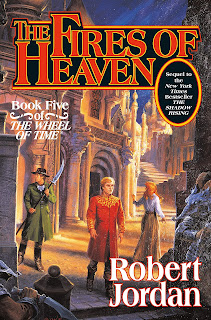
It also occurs to me that this could be the final time I read The Wheel of Time. At most, I have one more re-read in me in a couple of decades when I’m retired, imprinting myself into a reading chair, and feeling nostalgic. I had a birthday earlier this year and I’m feeling a little nostalgic as it is, which probably explains why I have this urge to re-read Dragon Prince, Deryni, Recluse, Pern, Crystal Singer, Riftwar, and pretty much everything else I read as a teenager. I’m having a moment, which is as good of a bad segue as I am likely to get to roll us into a discussion of the book.

There will be spoilers for everything. You have been warned.

The core storyline of The Wheel of Time is Rand Al’Thor marching ever closer to his Final Battle against The Dark One. It is almost never the most interesting storyline in any of the novels. Everything revolves around Rand, but he is the cipher being pushed and pulled while digging in his heels until he is ready to make whatever move he thinks will get him closer to uniting the world behind his banner and against the Dark One.

It’s sometimes easy to forget that Rand is all of twenty years old - though he, perhaps moreso than Perrin and Mat, argue like the very young adult that he is. Rand’s maturity is hard won, and - as we will see deeper in series - becomes coldly dictatorial.

I’m also not sure what it says that a lot of what I appreciate in The Wheel of Time is when the story steps away from Rand - though there is also a distinct lack of Perrin in this novel. So really what I appreciate is Mat, once he starts on the path The Fires of Heaven sets him on and the story of the Super Girls.

For example, I note the increasing maturity of Egwene after having trained under the Aiel Wise Ones, which sets up my favorite storyline in the series a bit earlier than I had anticipated. She’s now acting and speaking with a sense of authority, even to her friends and in particular not when speaking to the Wise Ones (nothing will give her that authority as a student). It’s a character beat that is so strong in Knife of Dreams, but it begins here.

Nynaeve had her Crowing Moment of Awesomeness in the previous book, The Shadow Rising, when she straight up beat and captured Moghedien, one of the Forsaken. In The Fires of Heaven, Nynaeve is caught by Moghedien and this time isn’t able to take down a Forsaken - because apparently they are really freaking strong and skilled at using their powers. The end result is that Moghedien almost dies of an arrow to the chest and Birgitte is ripped from the World of Dreams and, rather than being born out into the world as a baby, is dropped into the world with all of her knowledge and bonded as Elayne’s Warder so that Birgitte can survive.
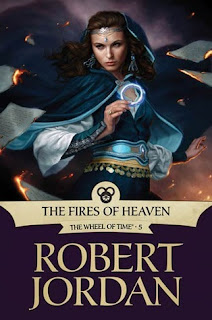
Speaking of Birgitte, we haven’t talked much about her at all beyond a quick mention after the last book - but in Randland (for lack of a better term) - there have been heroes throughout the ages who are born again and again and are heroic again and again to the point that - if you remember the Horn of Valere from The Great Hunt - can be called back to fight in the Last Battle (or anytime the horn is blown). Birgitte is one of those heroes who….live, again for lack of a better term, in “The World of Dreams” until she is next born out into the world to grow up into another hero - but now she’s live an in color and with full knowledge of who she was and is. It’s a fascinating idea and in this book and beyond, it really really works.

Late in the novel Nynaeve and Elayne make it to Salidar where the rebel Aes Sedai are (remember the coup in the White Tower?) and after meeting up with Siuan Sanche and Leane (former Amyrlin and her Keeper, both deposed and stilled / cut off from the magic) Nynaeve immediately starts thinking “i can heal stilling” - which is a perfectly normal thing for Nynaeve to think and a completely bug nuts insane thing for anyone else in the world to truly comprehend because it is Just Not Done.

There’s probably a phrase for this in fiction and there is certainly something to be said for learning the the traditions of a place and rising up through the ranks and gain power and enacting change that way (it’s the entire basis for Seth Dickinson’s Masquerade / Traitor Baru Cormorant series) - but it is also a lot of fun when these less trained but incredibly talented and determined young people just come up with answers and paths and solutions because they don’t know they can’t. Of course, they’re also not exactly making friends and influencing people at the same time - but hey, the Last Battle is coming and we use capital letters when we talk about it so sometimes change is necessary.

The Fires of Heaven is the book where a lot of things happen, and by that I mean this is the book where I am continually surprised that a particular thing occurred here.

*This is the book where Masema (remember him from The Great Hunt?) becomes The Prophet, thus beginning one of my least favorite storylines in the entire series. Seriously. Fuck that guy.

*This is the book where **** kills Asmodean, which sparked YEARS of theories and arguments on various message boards and cheerful avoidance of the answer by Robert Jordan himself until it was finally and officially revealed in The Towers of Midnight and was ultimately a bit anticlimactic but what else can years of speculation result in.

*This is the book where Mat gets his moment when the memories of past generals pushes him to get his Band of the Red Hand, taking over a partial battalion mixed with soldiers from Tear and Cairein. There is a moment where he glances at a map and instantly comes up with pretty much the same battle plan that Lan and another general had already worked out and which all leads into what is generally a fun storyline of Mat becoming one of the Great Generals of the era.

*This is the book where we get a much stronger bleed through of Lews Therin into Rand’s head and we get Rand talking to / arguing with his past life. I believe this began in the previous novel but now Rand is noticeably nervous about it.

*Finally, This is the book in which Moiraine has her own crowning moment of awesomeness in a fight against Lanfear. I spent most of the novel wondering if this was that book, because that’s something I remember happening, and Moiraine spends the entire novel with a frantic sense of urgency that she needs to teach Rand everything she can to prepare him - almost as if she knows (and she may, having gone through the ter’angeal rings assuming it’s not the other doorway) that her time is short. But she doesn’t know how to say it or may be something she can’t say.

But then when it actually happens it is not actually a real crowning moment of awesomeness, rather more of a resigned charge of desperation in how it plays out when Moiraine and Lan are each tossed to the side and Lanfear is working on crushing Rand when she (Lanfear) realizes that she will never have him and that was the only thing holding her back from truly going after Rand - the thought that she could turn him to love her and serve by her side - but somewhen Lanfear had been told that Rand / Lews Therin had been with another woman - and Lanfear is incandescent with fury about Aviendha.

The result of that is the Resigned Charge of Desperation has Moiraine taking out Lanfear and pushing both of them through one of the special ter’angreal doorways which severs Moiraine and Lan’s warder bond and the assumption that Moiraine is dead - though I’m pretty sure I wondered for the rest of the series if she was really dead. When future books start reincarnating some of the bad guys and we never see Moraine’s body, maybe she is only Mostly Dead as Miracle Max once said.

Well, that’s it. Thank you for continuing on this journey back through The Wheel of Time with me.

Next up, The Lord of Chaos, in which things happen (probably). Plus: Rand in a box, magical healing, dueling Amyrlins (but not really), an epic battle, bonus Forsaken, a queen in hiding, black towers, and the return of Perrin.


Previous Re-reads
The Eye of the World
The Great Hunt
The Dragon Reborn
The Shadow Rising


Joe Sherry - Co-editor of Nerds of a Feather, Hugo Award Winner. Minnesotan. He / Him

Friday, June 16, 2023

Review: Infinity Gate by M.R. Carey

Tapping into the Multiversal zeitgeist with a braided story of the fall of a transdimensional civilization, as seen from the view of characters outside of it as well as within it.


Hadiz Tambuwal has a problem. A lot of problems, actually. Her world, which may be a close cognate to ours in a near future mode, is in a bad way, especially in her home of Lagos, Nigeria. Environmental degradation, resource shortages, climate change, wars and worse have made her Earth a dead man walking. Chance, luck and scientific research allow her to find the way to travel to other worlds. Many of these worlds seem empty, a perfect chance for resources and space.  But her own Earth may be doomed and it may be too late for it, but not too late for other Earths, or for Hadiz to stumble upon an multiversal civilization, the Pandominion.

Her story turns out to be the story of the Pandominion and its war against an equally impressive multiversal entity, the Ansurrection, in M R Carey’s Infinity Gate.

Never for lacking ambition in previous works, Carey’s Infinity Gate aims for the biggest of canvases and yet tries to humanize its characters and the viewpoints through which we see that canvas and understand, grok and come to terms with the interdimensional conflict that Carey sets up in the novel. Starting off small with someone outside of the Pandominion is a classic move, but Carey eschews the more well worn path here. That would be of course for Hadiz to stumble upon the Pandominion and give us and her a view of it as she becomes incorporated into its civilization, structure, and society, Introduce us to the Pandominion from an outsider’s perspective and let us understand an interdimensional civilization from the perspective of someone new to it.

Carey does do this, but through an intermediary and another character entirely, and not without dropping us into the Pandominion first.  The next character up on the docket is from a world almost next door to Hadiz’s.  It’s not quite as dire a situation as Hadiz’s, but from his perspective, his life is pretty rotten.Dire enough that when he is offered a chance, a hope and an offer from Hadiz, he tries to take advantage of it...and propels him right into the Pandominion. It is there that we met a suite of characters, all of whom start as central and functioning members of the society, giving us a variety of views of the Pandominion. 

In getting those views of the Pandominion, we get to see what a multiversal society really means in terms of technology, in terms of society and terms of logistics. The Pandominion is no utopia, that is make absolutely clear. Even before the multiversal war, it is clear there are some very dark corners to the Pandominion and to support a multiversal society and hegemony necessarily means a rather large military apparatus and a “logic of empire”. How the Pandominion reacts to their discovery of Hadiz Tambuwal and her discovery of the Empire, as well as the Pandominion’s almost comical and farcical falling into conflict with the Ansurrection are cynical and dark and show the dangers of too-powerful societies. 

Even as that on the other hand, the Pandominion is a large and diverse society. It is one where ape-descended humanoids are the minority, Carey is not sanguine about the idea of humans or human like humanoids being the ones to make a multiversal civilization. This gives us a variety of different kinds of bipedal intelligent sapients, and Carey seems to take the view that intelligent life could have arisen from a variety of mammals. Or at least, in the “multiversal region” that the Pandominion, this is true. The Ansurrection, the other ..is different. 

In the course of the burgeoning conflict between the Pandominion and the Ansurrection, the characters of the society themselves, including the much put upon rabbit-descended Topaz Tourmaline Five Hills, are introduced in their context, and then have their lives taken away from them by choice, chance and war. There is a real sense of the problems of war and how capricious and soul-destroying it really is, especially for Tourmaline. A chance friendship, a change in society, and soon she is on the run, and with the thinnest of reeds and threads to follow in trying to be true to herself and those she cares about. 

The novel does go into detail on Carey’s multiversal theory on how the multiverse works in this verse, how the stepping technology works, and what the structure of the universe is like. There can be a “too fine split” to the idea of Many World Hypothesis universes epitomized in the Larry Niven story “All the Myriad Ways”. In Carey’s verse, while there are some universes that are relatively close to each other in terms of points of divergence, in general. Carey prefers that worlds generally have more significant differences between worlds. Carey is not interested in a multiverse of worlds that turn on for want of a Nail, but rather more divergent and substantive changes. 

But this gives Carey an opportunity to show that with some of the same basic parameters, things can harmonize even if they don’t rhyme. His point about the Lagoon and seacoast where Lagos in our world is being a place that a city is always going to wind up being no matter the species or the political conditions is an interesting bit of geographic speculation. Is that true? Are there places that, thanks to geography are always going to be places where you find an important city?  I am not sure. Istanbul/Constantinople for example, was a backwater town until Constantine in the 4th century, you’d think such an important place would have had an important city for longer.  Or the city of Antioch, an amazing hub for routes from the sea and across the land in several directions. An important city location for thousands of years...until it wasn’t. It’s a fun question worth thinking about in any case. There is a real sense of place to Carey’s different varieties of Lagos that we see throughout the novel. 

I am deliberately leaving out an important character in all this, one for the reader to discover, That character is introduced, and then seemingly fades into the background, but turns out to be far more important than one imagines. Given that this is the first in a series and given other revelations in the book, I suspect that the character I am deliberately eliding the identity of will be ever more important to the progression of the war. There is a looking backwards feel to the novel, the framing device and interstitial materials and point of view comments make the broad outlines of the fate of the Pandominion absolutely clear. That’s not the mystery and what drives me as a reader in this novel. It is the exploration of a society that is based on multiversal power and technology and what happens when that society  There is a logic to multiversal societies and the use of a multiverse that makes me think of some hinted aspects in Stross’ Merchant Princes saga, the ending of Pohl’s The Coming of the Quantum Cats and, also, Pratchett and Baxter’s Long Earth saga. It is this latter series, as well as the general “Multiversal moment” that genre fiction seems to be going through that this series. There appears to be a less hopeful tone to Infinity Gate, however, than that series, at least as currently seen, and seen through the framing device. 

Is Infinity Gate worth it in the end? It’s the first in a series, and its the biggest possible canvas that Carey is using to tell this story. Multiversal stories are not easy, Multiversal novels harder, and when it comes to a series, that’s a true balancing act. Carey has set up the world here so that some of the possible pitfalls and tension denying issues with multiverses are less present, and seems reliant on giving the reader enough hook on knowing the lines of how this is going to go to draw readers to find out what is going to happen to the Pandominion and the characters from it, within it and from outside of it. Carey’s strengths as a writer are considerable and I look forward to where the story goes from here.

Highlights:

  • Multiverse!
  • Interesting speculations on societies and Empire
Nerd Coefficient: 8/10

Reference:
 Carey, M.R, Infinity Gate, [Orbit, 2023]

POSTED BY: Paul Weimer. Ubiquitous in Shadow, but I’m just this guy, you know? @princejvstin.

Thursday, June 15, 2023

Microreview [Video Game]: Horizon Call of the Mountain by Guerrilla Games and Firesprite Games

Worth the climb.


Using Guerrilla Games’ newer Horizon IP, Firesprite Games and Guerrilla have created a title to showcase Sony’s new PlayStation VR2 headset. While Call of the Mountain does its best to incorporate many of the elements of the main series, it’s a different adventure from those massive experiences provided by Guerrilla’s primary studio. Those expecting a huge open world may be disappointed, so go in with an open mind and enjoy the view. 

Call of the Mountain moves along at a significantly slower pace than one would expect of a Horizon game. A lot of it comes from the necessity of avoiding motion sickness from the VR player, but more importantly, it’s a different genre of game. Where the main games are open-world games with a heavy focus on combat, traversal, and lore, Call of the Mountain is a climbing simulator with some combat occasionally sprinkled in. And while the shift is significant for those who love the main games, know that care was given to ensure that the franchise’s aesthetic is respected.

You play Ryas, an ex-shadow Carja who has been recruited by Blameless Marad to discover the whereabouts of Urid—Ryas’s older and more accomplished brother. The story in Call of the Mountain is unfortunately trite, despite the main games’ focus on originality. The redemption story arc is predictable from the moment you find yourself trapped on a boat, bound at the wrists. And though I wished it would get better, it never does. It isn't bad, just uninspired. Easy to follow, but without depth. Though Forbidden West had some shortcomings in the story department (compared to Zero Dawn), it still had some depth and even a few surprises. Call of the Mountain sacrifices that to focus on gameplay and immersion…


And on that front, it mostly succeeds. The world is beautifully detailed, creating an engaging experience that frequently makes you pause to take in the views. It’s difficult to accurately paint a picture with the screenshots provided because this game is played in virtual reality, so every photo I took doesn't take into account my entire periphery. You may see a beautiful set of waterfalls in one of the pictures, but what you don’t see is that I’m hanging off the side of a mountain, or dangling hundreds of feet up in the air from a tree branch. All of these things work in tandem to ensure the player is constantly in the experience. Since the game needs to be rendered twice (once for each eye), and since each screen is close to the eye, it's easier to see the slight pixelation of the game leading to a bit of the classic VR screen door effect. Regardless, the game looks amazing and is lush and detailed. Every so often I would run into an imperfection in the geometry which seemed rather jarring. When in first person, these things stick out significantly, creating more of a hit to immersion than if in a regular video game. Thankfully these occurrences were few and didn’t hamper the entire experience.

The broad vistas in the photos I took are but a few examples of how much of a showcase this game is for the PSVR 2. The game pays respect to the lore and infrastructure of the series, but it also represents its famous machines with precision. Watchers, stormbirds, scrappers, bellowbacks, and thunderjaws all make an appearance and move pretty similar to what you would find in the main games. As Ryas, you will encounter these machines in arena-type settings. You can’t move freely as you could otherwise, but you fight in a circle on the rim around a battle spot as machines come at you. You fight with one of two weapons, one of which is the bow. To reach behind your shoulder, retrieve an arrow, nock, draw, aim, and shoot helps offset the simplification of the game’s combat. It is immensely satisfying to land critical shots with the bow, even if there is some aim assist present, it still feels like you're a bit of a professional hunter. Though sometimes it’s difficult to track enemies when seated (as that’s how I played most of the game), I imagine it’s easier when in a standing position. If you have the space/option, I would recommend playing the game with as much space as possible.


The main gameplay mechanic—climbing—is implemented incredibly well and creates a sense of accomplishment when conquering a legendary climb. I found myself frequently hanging hundreds to thousands of feet in the air, or clutching to the side of a metal devil only to look over and glimpse out at the world beyond, then I’d look back and continue my climb to the top. It was a refreshing experience that only worked because the climbing felt good. Make no mistake, it's not perfect, but it works well. Occasionally I would reach for my pickaxe behind my shoulder, and my avatar’s hands would grab a ledge instead, or sometimes my character would grab something I had no intention of holding on to, and it would shift my view and slightly disorient me. When these things happened most of the time, I realized it was because I was being hasty, but sometimes it was simply the geometry and gameplay that worked against me. That said, I was never barred from progression, these were just simple hiccups that I would figure out quickly and move forward.

For those curious about motion sickness, fear not! I can’t guarantee this game won't make you feel queasy, but Guerrilla and Firesprite implemented a lot of options to assuage any possible motion sickness. I originally had the “smooth movement” setting on, but found after an hour of gameplay that my stomach started feeling off (I tried twice for science, just to make sure it wasn’t what I had for dinner that made me feel weird). I switched the setting to have my character’s horizontal vision move in fifteen-percent increments and boom, my queasiness was gone. This made the entire experience not only more enjoyable but playable for longer periods.

One of the Playstation VR 2’s newer features is added in Call of the Mountain, even if it is only used to navigate menus; eye tracking. This feature works incredibly well, too well in fact. When in the main menu or navigating dialogue, whatever you look at becomes highlighted, then you can select what you wish with the “X" button. In one instance I was looking at the option to leave a conversation, and right before I was about to confirm, I looked to the left at a dialogue option (one I’d already listened to) and pressed the button. I had to listen to it again. This was my fault of course, but it was impressive the eye-tracking was so quick that it moved before I could press the button. I was more careful with the menus from then on. Also, as a side note, this feature can be turned off if you wish for traditional menu selection options.


Though it has no bearing on actual gameplay or story elements, being able to pick up random elects in the environment like a pair of calipers, a sledgehammer, or an ale tankard is extremely satisfying. Something about the tactile feel of picking something up and being able to move it around in a three-dimensional space adds a bit more immersion to the game.

Another fun addition is crafting (which can be turned off if you don’t enjoy that aspect of gameplay). It is implemented in only a few areas of the game, when you craft your arrows and when you craft climbing tools. Manually picking up parts of a tool and putting them together, then tying them with rope is satisfying. Likewise, placing an arrowhead, fuse canister, and feather together to craft arrows is a satisfying mechanic that I enjoyed throughout the game. I like the feel of doing these things with my hands, and considering the game isn’t very long, these things don’t overstay their welcome.


Horizon Call of the Mountain doesn’t quite live up to the main games, but it succeeds in the places where it needs to. The climbing is engaging, and at times, mesmerizing thanks to the gorgeous views. The combat is fun, and the tactile feel of the bow remains engaging throughout. Though the story and characters fall short of what I expect of a Horizon game the overall package is still worthwhile. And once you’ve finished the main quest, there is a fun challenge arena to complete that tests your ability with a bow and your ability to climb. If you buy a PSVR2, this game will complement your collection.

The Math

Objective Assessment: 7/10

Bonus: +1 for satisfying tactile gameplay. +1 for gorgeous vistas.

Penalties: -1 for bland story. -1 for some technical gameplay hiccups.

Nerd Coefficient: 7/10

Posted by: Joe DelFranco - Fiction writer and lover of most things video games. On most days you can find him writing at his favorite spot in the little state of Rhode Island.

Wednesday, June 14, 2023

The Transformers franchise hasn't learned the lessons from Bumblebee

Rise of the Beasts has interesting layers of subtext, but doesn't use or develop them in an interesting way

Dear Hasbro, next time you make a movie that cheers for the United States, try not to send the message that one needs to heroically save from annihilation every planet in the universe before one can get basic health care coverage. Not a good look.

After the much needed, much welcome course correction seen in 2018's spinoff/prequel Bumblebee, it's clear that Hasbro didn't learn the lesson from the experience, to wit: keep the film as far from Michael Bay's hands as possible. Compared to Bumblebee, the production of prequel/sequel/crossover Transformers: Rise of the Beasts had substantially more creative input from Bay, and it shows: once again, the big robots look so devoid of color that the eye strains to tell apart who's punching whom; once again, the U.S. military is uncritically celebrated; once again, the jokes go for the crassest common denominator; once again, the story fails to be about something. Bay's artistic vision is things go boom, and we should never have let him train our brains to expect only that. Bumblebee had the good sense to use the military as a minor antagonist; this entry backtracks so hard that it makes the protagonist a former soldier whose only contribution to the heroes' victory is his army training.

Rise of the Beasts noticeably struggles to become more than things go boom. The thematic content of the Autobots' eternal quest for survival acquires a different meaning when the movie is handed to a Black director who gives most of the prominent roles to Black actors and Black voice actors. And the first bit of information one needs to keep in mind to properly analyze this movie is how Black audiences have historically responded to the Transformers franchise. In case you didn't know, Optimus Prime (along with many other nonhuman characters in pop culture) is perceived as Black. The ethnicity of his voice actor is not the point; it's, as far as I've been able to understand it, more of a vibe. The character's values and personality and relationships with other characters are felt by Black audiences as having the specific contour of how Black people experience the world. With this reading of nonhuman characters, Black viewers have found a way to resist their invisibilization by recognizing themselves in works of art not explicitly made with them in mind.

This context gives added meaning to key scenes in the plot of Rise of the Beasts. The cathartic moment of realization at the end of the second act has Optimus Prime admitting that his zeal in defending his people clashed with the human protagonist's similar mission, and they should have forged a bond of solidarity instead of seeing their struggles as mutually exclusive. Now, it's one thing to hear a robot speak of his duty to defend his people and the need for solidarity; it's another thing to hear a Black character say it. Instead of the military commander of previous entries, here Prime is recast as a caretaker of refugees. In the Transformers mythos, the Autobots are usually a persecuted class, happy to mind their own business until the Predacons show up to conquer everything. The movie mirrors their situation in the human characters, who are established in early scenes as targets of racial discrimination. Those scenes aren't exactly subtle or insightful in their portrayal of 1990s racial relations, but they serve their purpose.

However, there are other moments where the script seems to lash out at its own message. In blatant reference to criticism of previous Transformers movies, a robot character is given a Spanish accent and a whole portion of dialogue is spent commenting on that fact. One can almost feel Michael Bay snatching the camera to aim it at his face and scream at the viewers, "No, what I did with Skids and Mudflap is totally not racist. Look, I'm doing it again, and the characters say it's all right." The symbolic weight of the movie's choice of final battlefield is also wasted: the brief remark that an Indigenous temple was supplanted by a Spanish temple could have been used as a stepping point for larger questions of conquest, resilience, and coexistence. Instead, our all-American heroes, fresh from leaving their lives marked by exclusion and inequality, casually intrude into the sovereign airspace of a Third World country to wreck its archaeological sites in the name of helping refugees return to their home, because what's thematic consistency?

Rise of the Beasts falls apart because its plotlines pull in opposite directions. The introduction of the Maximals as exemplifying a more harmonious relationship with humanity seems to point toward a deeper exploration of the theme of coexistence, but the film only pays quick lip service to that idea before the mandatory digital bloodbath begins. For all that the Maximals were positioned as the selling point of the story, they don't rise above plot device status. Although Optimus Primal is as thoughtful and kind as in the Beast Wars cartoon and its underappreciated sequel Beast Machines, the rest of his team is just decoration. Cheetor and Rhinox barely speak any lines, and we never get to know them as characters. More damningly, the Maximals only have about a minute of blurry screen time in their transformed bodies, which is supposed to be the whole point of making a movie about shapechanging robots.

You've seen this plot before. In order to summon the all-devouring Dormammu Unicron to our world, evil murderer Enchantress Scourge prepares a ritual with the pieces of the Mother Boxes Transwarp Key. To stop him, the Elves and Dwarves Autobots and Maximals must set aside their differences and work together, building up to a confusing maelstrom of computer models punching waves of disposable minions. After the end (because this movie has three endings), some enigmatic character comes out of nowhere to set up the Dark Universe Hasbro Cinematic Universe, because everything these days has to connect to other milkable IP. It's an insult to the audience, a punishment to the eyes, and a waste of everyone's time.


Nerd Coefficient: 4/10.

POSTED BY: Arturo Serrano, multiclass Trekkie/Whovian/Moonie/Miraculer, accumulating experience points for still more obsessions.

Tuesday, June 13, 2023

6 Books with Stephen Aryan

Credit David James Coxsell
Stephen Aryan was born in Iran, and raised in Whitley Bay, on the north east coast of the UK. He is the author of the critically acclaimed Quest for Heroes duology as well as the Age of Darkness and Age of Dread trilogies. His debut, Battlemage, was a finalist for the David Gemmell Morningstar Award, and won the inaugural Hellfest Inferno Award. He has previously written for Tor.com. 

Today he tells us about his Six Books.

1. What book are you currently reading?

The Helm of Midnight by Marina Lostetter


2. What upcoming book are you really excited about?

A House with Good Bones by Ursula Vernon


3. Is there a book you're currently itching to re-read?

When We Were Animals by Joshua Gaylord


4.  A book that you love and wish that you yourself had written.

Dune by Frank Herbert


5. What's one book, which you read as a child or a young adult, that holds a special place in your heart?

Dragons of Autumn Twilight by Margaret Weis and Tracy Hickman. It was the start of realising what fantasy could be. Weis and Hickman had a big influence on me as a younger reader.


6. And speaking of that, what's your latest book, and why is it awesome?

The Judas Blossom, is book 1 of a new trilogy called, The Nightingale and the Falcon. It's set in 13th century Persia and it is historical fantasy. It's set in an era when the Mongol Empire covered a massive portion of the world and their goal was to conquer the rest. The story is about a rebellion in Persia, one of many nations that have already been conquered by the Mongols. It's about fighting back against a more power enemy and finding a way to tear it apart from the inside.


Thanks. Stephen!

POSTED BY: Paul Weimer. Ubiquitous in Shadow, but I’m just this guy, you know? @princejvstin.