Thursday, February 16, 2023

Microreview[Novel]: Bitter Medicine by Mia Tsai

 An interesting setting full of promise that never quite settles on which of two sorts of story it wants to be, and so never quite manages to be either of them.
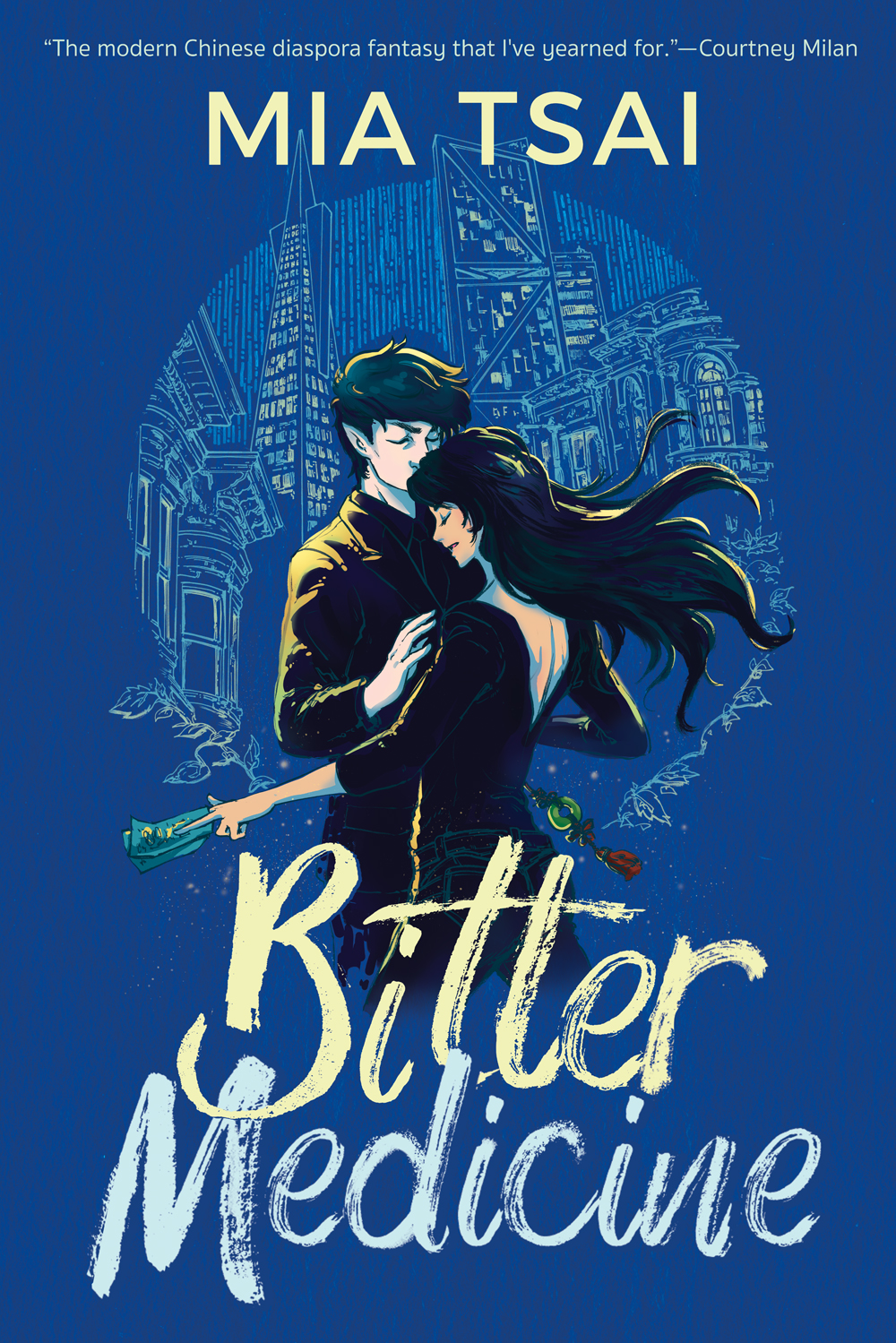

Is this an urban fantasy adventure story of fairies and magic and longstanding oppressive interpersonal relationships? Or is this a romance where a female main character who has suppressed her own wants, desires and even her very self for years to protect those dearest to her finally finds something for herself (and it just so happens to be an extremely hot guy)?

Er... sort of yes to both. But also sort of no?

In short, Bitter Medicine is a book that hasn't really figured out what it wants to be, and so persists in trying to be both things at once, which has never ever gone wrong in the history of books, as everyone knows, and definitely won't result in narrative whiplash for the reader as the plot swings wildly from side to side and trope to trope. Which is a shame, because when it's not doing that, there's a lot of good stuff in there, but it's either hidden or overridden or contradicted or sometimes just entirely elbowed out of the way for the sake of this strange chimera tone that we have going on.

The story follows Elle, a descendent of Shennong, the god of medicine, who is hiding out in mediocrity in order to protect her brother (and herself) from the attentions of the rest of their family, particularly their other brother, after some magical shenanigans some years previously. She's an incredibly talented magic user, but in order to keep herself on the dl, she is only classified as middle ranking in the magical agency she works for, so can only do a limited range of crafting to fill this niche. However, whenever Luc, the extremely hot and entirely mysterious guy who also works for the agency in an unspecified role, comes in to buy her crafts, she can't help but tweak them a bit to make them work better for him. And of course, that sort of thing can't go unnoticed forever. When Luc realises what Elle is capable of, she's catapulted back into the world of... well of interacting with literally anyone ever, and has to deal with the long-hidden tribulations of her family, as well as her feelings for Luc and her place in the world as it is now.

All of which is really fun, if not exactly groundbreaking stuff. However, the plot of her being found out, having to protect her brother still, use her magic and do adventurous hijinks, as well as discovering Luc's place in the agency they both work for, and deal with some of his own history and adventures, all settles very squarely into your usual urban fantasy romp. There are fights, escapes, escapades, magic to be uncovered, a whole world of hidden magic that mortals can't see to learn about. Meanwhile, the parts of the plot that centre on Elle's history, her feelings and relationships with her family, and her feelings about Luc (as well as his own feelings about himself, her and how he lives his life) feel, tonally, like a cosy but slightly angsty romance. It's not a subtle difference either - it genuinely feels like you're reading two different books smushed together. And in some cases, this could result in something new and interesting in unique... but in this case, what it mostly feels like is that both halves end up missing parts of what they need to make them whole, which is just unsatisfying.

The biggest loss, from my perspective, is in the worldbuilding. For the type of urban fantasy romp we get here, the creation of a world of hidden magic, and an agency controlling how it is used, by whom, and who does what, would be a huge part of the appeal. Rivers of London and Neverwhere work so well in part because we get that fascinating insight into these worlds that are imagined alongside or underneath our own, just hidden from view. They are an opportunity to wonder and imagine what else there could be around us. Urban fantasy, on the whole, is an incredibly setting driven subgenre, after all. But Tsai seems to have just left huge chunks of this out. We never really get a coherent sense of what Roland & Riddle does, or how it makes money, or how it came about, or what it's exactly for. Instead, it exists around the edges, to give us a reason Elle is restricted to less extravagant magics than she's capable of, to give Luc a shitty boss to be beholden to, to give him a job that overwhelms his life, and to give the two of them a reason to have met. But beyond that, we get no sense of scope, no idea what position Roland & Riddle occupies in the wider world. Is everyone magical in some way beholden to it? Or is it a small few? Who pays them? What for? We see missions and rules, but we see no real purpose behind them, and it leaves things feeling scrappy and thrown together, and very much like the setting is only there to support the plot at critical moments. There's no underlying coherence to it, and that feels like an enormous loss.

And it goes deeper than that. We get hints of what these magical people are - some of them are elves, for instance, and elves are somehow different to humans (despite looking similar). And these are different again from people with a godly ancestor. But none of this is every really explained in a wider way, nor do we really get enough in context of the story to put it all together ourselves. There's just... a lot of stuff lying about.

Which makes space for the romance narrative. While urban fantasy stories do often have a romance component to them, the one in Bitter Medicine feels tonally and qualitatively different - and more substantial - than is often the case, and far more like a romance story in its own right. More of a The Midnight Bargain or The Very Secret Society of Irregular Witches style, where the common plot beats and flow of the story move differently and have different focuses than your typical urban fantasy. Critically - character development and relationships work differently. But Bitter Medicine manages to short us out on a lot of the character work I'd expect to see in those type of stories - we get a lot of information on Elle's backstory by the end, but we don't get as much of a sense of who she is currently, and doubly, quadruply so for everyone else in the story. Her brother has such an interesting core idea, and could have been a great character, but is reduced to one, maybe two traits. Likewise her best friend Lira seems to have a lot going on... we just never see it.

But hey, we get some really, really long sex scenes to make up for it, so that's... something?

That being said, there are some good parts. The fusion of different bits of folklore from different parts of the world to create the setting, when we see it, is far more interesting than is often the case for these types of stories. Likewise, the magic system (such as we see it), is unusual, and I would have loved to see more. We also get a much better told and nuanced view of the ties that bind us to family, and the tension between the duty one might owe to one's relatives vs to oneself, and how that might bring pain and difficult decisions. Elle is someone with a difficult family but whose situation is genuinely understandable in its difficulty - where often we see the protagonist dither over what feels to the reader like a very simple good/bad dichotomy.

Equally, for all that the intimate scenes, when they happen, are stretched out somewhat longer than their benefit to progressing the story truly warrants, there are nods within them to making things a bit more real, a bit more natural (condoms rarely turn up in books I read, sex scenes or no, and it was a good surprise to see one turn up here). Things aren't film-smooth and perfect, in a way that feels refreshing to read, especially in a setting with characters set up to be so flawed. This isn't, alas, universally true for the scenes, and there are bits that made me a little dubious, but in general, it was nice to see those scenes approached at least in part a bit more relatably.

That being said, this could not really make up for the flaws elsewhere. The attempted blending of two types of story - especially when, as happens here, the both parts are mostly quite tropey and traditional for their subgenre - has not particularly succeeded, and left us with an unsatisfying whole, made all the more so by those moments of interest or innovation. The two halves of the story have ultimately very different end goals, and so it feels like the book has two endings in order to give us both sets of resolution. This has a somewhat stilting effect on the pacing, as an unfortunate coda to the issues we see throughout the book. The world was interesting, the ideas potentially likewise, but it would have been nice to see more of them in a more coherent and pared down narrative, rather than having to watch the two different parts fight each other for page space.

--

The Math

Baseline Assessment: 5/10

Bonuses: +1 for genuinely tense and conflicting family conflict

Penalties: -1 for incoherent worldbuilding, -1 for constant tonal whiplash

Nerd Coefficient: 4/10

Reference:  Mia Tsai, Bitter Medicine [Tachyon, 2023]

POSTED BY: Roseanna Pendlebury, the humble servant of a very loud cat. @chloroform_tea

Wednesday, February 15, 2023

Review: Valentine by Jodi McAlister

Valentine remains one of Australia's most underrated YA fantasies.


It's crunch time for me as the deadline for judging the Aurealis Awards rapidly looms. Since I was unable to figure out how to squeeze one more thing into my already crammed reading schedule, I thought I would offer this old review of mine on a book I consider to be one of Australia's most underrated YA fantasy novels. I've added a few extra thoughts here and there.

Pearl is one of four children in her town born on Valentine's Day. One of them is a changeling, but not even the Unseelie fae hunting them know which one of them it is.

This was definitely a case of "right book, right time" for me. I'd meant to review something else, but it was clear from the first page that we weren't going to get along. Since I had a Monsterhearts game coming up, I thought I'd give Valentine a go instead. It turned out to be the perfect mood-setter.

But I think I was always going to love this book. As I've mentioned before, I was a huge fan of Holly Black's Tithe, and Valentine hits many of the same buttons. The book starts off with a strange event -- a black horse mysteriously showing up at a party -- and things get stranger around Pearl. If you like your faeries with teeth, this is definitely a book to check out. It makes use of some of the less commonly known or used pieces of faerie lore, such as elflocks, though it doesn't always play them straight.

Pearl isn't stupid and recognises something weird is going on, though she sometimes wavers in that belief. She's a relatable character in many ways, taking her responsibilities seriously and angsting over what other people think of her. She's brave and loyal, while also being afraid and, at times, hypocritical. She neglects her best friend but doesn't hesitate to put herself in danger for the people she cares about.

The book is told in first person and is lightly sprinkled with pop-culture references and text speak. This is not going to suit everyone. I thought it contributed to making Pearl's voice a strong one. The reference to the eternal conundrum of Sherlock vs Elementary made me smile. Facebook also plays a role in the plot as a way the characters keep in contact. Valentine embraces the modern era, rather than trying to work around it.

Of course, this may work less well from the perspective of 2023. After all, who uses Facebook anymore? Certainly not teenagers like Pearl and her friends. The drawback with incorporating current trends in technology, social media and pop culture is that it serves to date the book, and sometimes quite rapidly (my goodness, how the world has changed since 2017). This may not be a problem for older audiences, but may make it a little less accessible or appealing to the target audience.

One thing that never gets old for me is a good enemies-to-lovers story (or at least an on-page relationship that starts out in antagonism). It's clear from the outset that Finn isn't as disdainful of Pearl as she is of him, though that doesn't prevent him from expressing anger and irritation towards her where it's warranted. Watching Pearl's opinion of him grow and improve was a delight.

Not everyone is going to like the ending, particularly since it deviates from certain genre expectations, but I found it a mature change. In fact, the series as a whole handles consent in a pretty healthy way, making it easy for me to recommend.

The story is also set in Australia, which results in some subtle cultural shifts. The common US stereotypes of jocks, nerds and goths are absent. Instead, there are some distinctly Australian elements, like school captains and Pearl's job as a lifeguard at the local pool.

Overall, I found Valentine a fresh and intelligent take on faerie YA urban fantasy and one very appropriate to the current season.


The Math

Baseline Assessment: 8 /10

Bonuses: +1 for fairies with teeth, + 1 for mature handling of consent

Penalties: -1 for dated use of pop culture and social media

Nerd Coefficient: 9/10


POSTED BY: Elizabeth Fitzgerald, a writer, binge reader, tabletop gamer & tea addict. @elizabeth_fitz@wandering.shop


References

McAlister, Jodi. Valentine. (Penguin Teen Australia, 2017)

Black, Holly. Tithe. (Simon Pulse, 2002)

Tuesday, February 14, 2023

Review: The First Binding by R R Virdi

 R R Virdi’s The First Binding is a sprawling, extensive epic fantasy that investigates the power of stories by focusing on the life of an old storyteller with some rather unusual and rare gifts.


---

Ari has seen much in his life, and has a long and troubled past. Although he was once famous, once infamous, he is content now to be mostly a traveling, itinerant storyteller. Sure, he has a fraction of the gifts, the power he once wielded, but now they are (mostly) just for tavern tricks to help tell his stories to earn room, board and a bit of coin in the inns and hostels he visits on his wanderings. When he meets Eloine, a singer on the run with secrets of his own, he starts telling his very epic life’s story to her.

Ari’s story begins in The First Binding, a novel by R.R. Virdi

With that last line, I want to not bury the lede here and go for clarity here right from the first. While this is an 800 page epic fantasy (quite a jump up in size from the usual lengths Virdi works with), it really only covers a portion of Ari’s story and life, and the novel ends on a cliffhanger. If you’re good with those, please continue to read and listen to MY tale, MY story of how I came to engage with this book.  Are you seated comfortably?  Let’s begin.

Virdi takes the tack of starting with an old main character who spends most of the book in telling his story to the aforementioned Eloine, while in the midst of his own mission. At the Three Tales Tavern in Karchetta, Ari is looking for a story, an important story, a mythic story. One might say that the search for this story, and stories like it are his purpose, his life’s work, even as he is The Storyteller. People who are the definitive article of something, as Doctor Who tells us, are people who really should be respected, even if they are on the other side of the prime of their power and life (or so it seems). 

The telling of Ari’s life to Eloine, once it gets going, has a structure that while Virdi might be aiming for Schezerade (and hits the mark I do think), but more contemporaneously, I was thinking of one of the dialogues in Douglas Hofstadter’s Godel Escher Bach. In one of the dialogues between Achilles and the Tortoise, the two characters read a story about themselves, and in the middle of that story, the characters start reading another story altogether, “going down one story”.  This sort of nesting stories allows the stories to comment on each other, comment on the action, illuminate the characters and sometimes leave the reader wondering at just what level we are and where the narrative is at any particular moment on a particular level¹

And indeed, this is the central axis on which the novel really works. We have present day Ari searching for a particular story. As the narrative of his early life unfolds as he tells it to Eloine, we find elements from that story reflected, refracted and commenting on the present day Ari.  A formative character in his early life is a Storyteller with the same binding gift. Part of his early life was living in a theater, and so he learned a love of the craft of story telling and performance that he uses in the present day. His time as a Sparrow, in a thieves gang, helps inform not only the present, but later on in the backstory when he finally achieves his ambition to attend a school to learn magic, Binding, for real. 

There is a real variety and path to Ari’s life that spools out over the course of the book. Virdi has carefully and craftily constructed a life for Ari that takes the form of several different kinds of stories, forming portions of a complex present day person’s background, skills, and outlook. It also allows this big epic fantasy novel about stories and the power of stories to play with kinds of stories within its narrative. A story about young and growing up in the interstices of a theater?  A story about a street rat (or more properly) Sparrow? A ‘magic school’ drama? We get all three of these at length, providing the foundations to the character. 

The Storyteller himself when he is telling short tales in the narrative, is at his heart a performer, going back to his theater days. The book takes pains to frame and show how Ari tells his stories, immersing the reader into the experience of the stories (which run toward the mythic) as well as the stories themselves. In Dungeons and Dragons terms, Ari is definitely a bard, but one that does not rely on music, but rather on how he speaks to convey his stories.  

This comes to an interesting contrast with Eloine, who is much more of a mysterious character (we get some short stuff from her point of view, but she is deliberately cast as a mystery). She definitely is a singer, and tells the short tales we hear from her in a musical tradition, contrasting nicely with Ari. We don’t quite get enough of her storytelling to really make a fix on different *ways* to tell stories, but perhaps that is for a future volume, as well as clearing up the mystery about her.² But we get a lot about the roots of the world in the stories they tell.

As you can guess, this also means there is also a lot of the worldbuilding that is done in backstories and the stories that are told in the main narrative and deeper down in the backstories, particularly with the Binding magic system. We see Ari use it in the present, but it is a slow, revealed process in the backstory as to how it actually functions and what it can do, what it cannot do, and what are the costs. The costs are quite important and are a central concern especially in the “magic school” portion of the novel. But that reflects and makes clear a couple of things that we see in the top level “present day” story, once again showing the skillful communication between story levels that Virdi attempts here. 

When not actually playing with stories and tropes of stories, there is some fascinating worldbuilding going on. Virdi has good and interesting ideas about levels of society, commerce, finance, trade and travel, and he has clearly put in a lot of thought in making his world hang together. Entrepots and mountain schools,dark alleyways and high courts, this is a world that richly comes to life and presents a vividly presented world. For all of its length, there is a fair amount of action, and dialogue and depth , the page count is not due to walls of words, but rather the size and scope of the stories.

I should emphasize that the stories told and the storyteller himself are in a very oral tradition and are stories that feel like they are meant to be heard. (this also ties into the spoken word form of much of the magic of the book). A different kind of magic and main character might have led this book to have footnotes a plenty ³ but this is a very oral book. Not only the rhythms of the stories told directly, but the rest of the narrative has that oral story feel to it. I would want to listen to a sample first, and it would be a very long book, but I think this book has the potential to be quite the audiobook. 

This book, by reading circumstance, came on the heels of reading Genevieve Cogman’s recent and latest Invisible Library novel, The Untold Story and the resonances between the two books were constantly in my mind as I read The First Binding. Both novels have Storytellers who are the Definite Article as their title, although here he is the main character and in Cogman’s work, she is merely a secondary character.  Both novels work strongly on the power of story and how stories can shape people’s lives, culture, and even the fabric of reality itself. Where they differ is that Irene is caught within stories, whereas Ari is trying to shape the story in a fashion that Irene might consider very Fey. 

The narrative stops at not only a propitious moment in the main storyline, but at a watershed in the backstory as well. I do feel of a  couple of minds about this. It’s an effective story technique, to get the reader to go to the next book, to be eager to find out what happens to Ari, in the present, and to reveal more of the backstory in his telling of tales. It also is somewhat frustrating given the structure of the novel. Having the cliffhanger in the present is a proud and clever technique, and our narrator and hero has been left quite in a predicament.  The (not even) half finished backstory, though, feels like an itch here--there are aspects to the character that we still don’t quite get and understand because their backstory is incomplete. Given the size of the novel (and presumably sequels), it is an opportunity and a risk to have a lot of this dangling that will hopefully be resolved in a second book.


The Math

Baseline Assessment:7/10

 Bonuses: +1  for strong resonant themes and exploring the ideas of Story and what it means

+1 for a richly detailed world

 Penalties: -1 Even given the size of the book, the story of Ari is very incompelete, which may frustrate some readers

 Nerd Coefficient: 8/10

 Reference: Virdi, R R, The First Binding [Tor, 2022]

 POSTED BY: Paul Weimer. Ubiquitous in Shadow, but I’m just this guy, you know? @princejvstin.


¹If you prefer a cinematic allusion, take a look at the use of level of Dreams in the movie INCEPTION

²While the back matter talks about the “Princess I loved” (who never appears in this book), this book makes it clear that Ari of any age is pretty clueless around women. Time and again, he fails to understand them and his relationship to them and vice versa. It’s obliviousness, not misogyny, thankfully, and it is rather funny. 

³The Jenn Lyons Name of Kings series comes to mind. 

Monday, February 13, 2023

The October Daye Reread: The Winter Long

Welcome back, dear readers. We’ve had a bit of an unintended pause in the October Daye Reread. I was distracted by the publication of Book 16: Be the Serpent, in which Big Things occur and a lot of exposition is dropped with a double helping of murder (or, maybe it’s the other way around) and some days it’s tough to focus because, well, *waves hand at the world*. Despite that, I’m glad to be back and I hope that you’re excited to rejoin me on this re-read.

Today we’re going to revisit the eighth novel in Seanan McGuire’s October Daye series: The Winter Long. We are now exactly halfway through the (thus far) published books. Eight down, eight to go. Thinking about Be the Serpent and the major revelations that occurred in that book, The Winter Long fits a pattern that Seanan McGuire set up from the start and which I noted when writing about Late Eclipses. Every third book is “an emotional pivot point” but every fourth book is a “WHAM”, which is something I thought about earlier in the series but didn’t when I stepped into The Winter Long.

AFTER reading The Winter Long, however….oh, yes, This book is a WHAM.


We assume you’ve been reading along with us because this will be rife with spoilers for past books and likely also for future books. Actually, absolutely for future books, including Be the Serpent. You have been warned.
"Simon chuckled. For some reason it didn’t sound mocking: it was more self-loathing, the laughter of a man who had looked upon his life and found very little to be proud of.”
Simon Torquill has been Toby’s Big Bad lingering in the background of the series thus far. He turned her into a fish and left her in a pond for fourteen years. Simon was October’s original boogeyman. He’s the one who broke Rayselline. He’s been behind even more. With Oleander now out of the picture, Simon is the twisted evil made all the worse by being the brother of her liege, Sylvester.

The Winter Long isn’t Simon’s redemption story, that so weirdly happens later and it’s still something I’m wrapping my head around (spoilers, through the course of this series Seanan McGuire manages to rehabilitate Simon far more than one would possibly expect to the point that Simon is actually sympathetic), but what occurs in this novel is the explanation that Simon wasn’t actually a Big Bad. He was a mini-boss. Defeat Simon and there’s something much, much bigger waiting behind him and THAT boss has been pulling the strings all along.

The Winter Long reveals that Eira Rosynhwyr is the Big Bad of the series, and even light of Be the Serpent’s Reveal (capital letters, told you there would be spoilers) of Titania’s return and who *she* was all along (which should make Titania the really real Big Bad, but it still feels like Eira is in light of how that novel ended). Seeds were planted earlier, but it begins here. Eira becomes She Who Must Not Be Named. Back to Eira a bit later.

All Toby truly wants is truth and honesty from her friends and family, as well as some of the peace and quiet that she is likely never going to get until the series ends (and maybe not even then the way McGuire keeps escalating) - but following the Sylvester’s betrayal of Toby in the last book by not respecting her wishes, there are secrets Sylvester is holding deeply because of promises that he has had made to others and he will hold to those promises no matter the cost to his relationship with Toby - which honestly is a damn shame because he clearly loves Toby almost as much as his actual daughter and he is gradually letting that all slip away.
“I won’t claim to have never lied to you, but I have not lied to you since we decided to try taking this relationship seriously,” he said quietly. “I love you. Lying to you would be a mistreatment of what that love means.”

I laughed, a cold, jagged sound. “None of the other people who say they love me seem to feel that way.”

“Then they are not very good at loving,” he said.
-Tybalt, following Sylvester’s emotional betrayal of Toby’s trust.

Late in the novel she describes Sylvester as getting a 100 as a liege but falling down as a friend, which he refuses to atone for in any manner, which is probably the truest cause of the rift.. Early Sylvester says it is due to promises to Amandine, but late he doesn’t even bother to explain himself, going so far as to say that he doesn’t feel the need, which is hella rude.

There are SO MANY revelations in The Winter Long and they all have different moments of paying off throughout the series.

”No, that would be easier,” said the Luidaeg. “You have a sister, and she hasn’t been elf-shot,although whether she’s alive or not is anyone’s guess. Her name is August. She’s been missing for over a hundred years, which means the only way your mother can divorce Simon is to admit August is dead. Until that happens, August has a say in the separation.”

The important part here is not the existence of August, though, yes, but that the children have a say in family divorces. This will come up later and is emotionally important.

There’s also a reminder that the Luidaeg is the truly frightening thing. She has a rant, which is really well done. But there’s a line that comes after that only really makes sense later in the novel - it’s the Luidaeg telling Toby that the thing she should be afraid of isn’t her it’s Eira, except she can’t say it but she’s getting Toby out of the way.

In this book we learn that Eira was the Firstborn who set the humans on the Roane to slaughter them and take their skins (thus becoming the selkies) - and also that Titania bound the Luidaeg to always tell the truth and to help any who ask - which set her on the past to becoming the sea witch. Eira has also been laying groundwork to have more pieces in play since she maneuvered getting Quentin to Shadowed Hills - which is a thing that happened. But basically, what we’re learning here is that Eira is behind EVERYTHING.

But speaking of Eira, the biggest revelation of The Winter Long is that Eira - Firstborn Eira - was actually Evening Winterrose - onetime friend and ally of Toby and who, as far as we knew, died in Rosemary and Rue - the first book of the series. Turns out that’s not the case.

There are more hints about things that the Luidaeg can’t talk about - but this is where we get more that Toby’s heritage is different than she might have thought. Not so much that her father isn’t who she thought - but Amandine is the daughter of Oberon, which makes her Firstborn - but, she is NOT the daughter or Titania or Maeve. So - who?

Luideag uses a (magical) key and asks for her mother’s (Maeve)’s help and GETS IT. The first real hint that Oberon, Titania, and Maeve may be in reach. Maeve NEEDS to come back, especially in light of the rest of the series still coming. But, because of this bit in The Winter Long, Toby will recognize Maeve’s magic when she does. As with so many little things throughout the series, that’ll be important.

That, I think, is what I appreciate most about re-reading October Daye. Each book is a delight on its own, but it is those little moments that only seem minorly significant the first time through but pay off with so much depth on the re-read. Seanan McGuire has been seeding the entire series with so many little bits that are absolutely intentional but which seem like almost throw away bits. Every one of them pay off, and the ones that haven’t absolutely will. And I look forward to rediscovering which other moments will be important again.

Open roads and kind fires, my friends.


Joe Sherry - Co-editor of Nerds of a Feather, Hugo Award Winner. Minnesotan. He / Him

Friday, February 10, 2023

Microreview[Novella]: Arch-Conspirator by Veronica Roth

 An attempt to take the story of Antigone and reinvent it in a dystopian future that fails to understand the core appeal of the original story.


Arch-Conspirator tells the story of Antigone, a play written in the 5th century BCE by Sophocles, an Athenian tragedian, as the third of his Theban plays. It follows on from Oedipus Tyrannus and Oedipus at Colonus, in the latter of which Oedipus has died and his daughters are returning to their home in Thebes, only after reassurance from Theseus that their father has received the appropriate burial rites. Which leads us into the key drama of Antigone - her brothers are dead, and she wishes to ensure that Polynices receives a respectable burial, just as Eteocles already has, and against the wishes of the men in power. It is a play about how some duties, some actions, weigh more heavily than simple laws, and the lengths to which we should go, in the face of overwhelming opposition, to do right. But it is also about how two people can have entirely different senses of justice, and for a large portion in the early part of the play, Kreon, Antigone's antagonist, has just as much reason to believe he has right on his side as she does. It is only once a revelation is provided that the gods concur with Antigone that he strays from righteous action (however lacking in mercy or compassion) into tyranny, and everything falls apart. Part of its enduring popularity - it is constantly restaged to this day - is that the themes are ones which really transcend the setting and can be endlessly reapplied to different contexts without losing their impact or emotional resonance.

And so, enter Veronica Roth, who has taken this play, and turned it into a novella set in a dystopian future. It's a world that has been wracked by unspecified horrors that have left much of it an irradiated wasteland. In this world, birth rates are waning, and so women are valued, protected and stifled because of their precious ability to bear children - they are reduced to walking wombs. It is also a harsh autocracy, with Kreon at the top controlling the city, and one in which, at death, everyone's gametes are gathered by a weird gizmo to be stored in an enduring catalogue of genes for... reasons. It's something that happens to all of the dead, regardless of their actions in life, and is a fundamental of their society.

As I imagine you can already see, we have the key ingredients here for a pretty faithful reimagining of the Greek setting - you have a single, oppressed, female figure standing alone in support of a core tenet of their society in the face of a tyrannical leader. Easy peasy, right?

And yet, Roth manages to get it so, so wrong.

Somehow, this manages to be both an incredibly beat for beat retelling of Antigone's story - to the extent that it will bore people who like their myths more... reimagined - and also full of weird little changes that will annoy anyone who just wants this story told as is. But more than that, it gives us nearly all of the plot beats of the original, but without any of the necessary connective tissue to hold it together and to really sell the emotion that is so fundamental to this story.

Some of this is because it is, quite simply, too short. I rarely think books ought to be in a different format than they are, but this absolutely needed to be a novel, not a novella. It feels rushed at every point, and especially at the end, and what has most been gutted out of it is the work that might have gone into developing the characters. Which is sorely needed.

As it stands, the characters have no chemistry, and barely any personality. They are reduced to their simplest iterations, with none of the nuance that could make them so fascinating to watch. Kreon, for example, is simply a man with too much power, using it wrongly. And while this is certainly part of his personality in the original text, it's not nearly all of it. His core problem is that he starts off with a... if not reasonable, then understandable point of view. He's punishing a traitor, in the hope of dissuading future dissent and finally getting some damn peace in his city. His abiding sin is that he cannot turn from his path, even when he is reliably informed that the gods are very much not on his side - he, and by extension, his city and those around him, suffer because of his hubris. I mean, it's a Greek tragedy, after all. But Roth's Kreon has none of this - he is simply a bad man who has power over a lot of people, using it badly. Frankly, you struggle to see how he got into this position at all. The man has no sense, no reason, and a total black hole where charisma might be, especially after his perspective chapter which has some of the dullest prose you may ever see.

Other characters are similarly poor - you get almost nothing of Ismene, except when needed for the plot to counter Antigone, and because she's had none of the buildup, her filling that role makes almost no sense. Likewise, Haemon, Kreon's son and Antigone's betrothed, barely turns up until suddenly, he's incredibly import, and everything just escalates wildly.

Which is another issue with the story - the pacing is all over the place. There never seems to be any buildup to what happens, the story just throws events up here and there, sometimes to the point where I found myself flipping back a few pages to figure out - did that really just happen? Where did that come from? Roth somehow manages to neither show, nor tell, only vaguely reference after the fact.

And so, when you get to some of the critical moments, they lack the emotional weight they ought to bear because we're just not ready for them. Antigone, in her original play, gets an absolutely glorious speech before Kreon and the people of the city, and absolute crowd-pleaser and a joy to listen to... and while she does get a speech in the novella it's somewhat stilted, abbreviated and above all, just not very good. You don't come out of it believing that anyone will have been made to think by it, and it's over before it can really sink its teeth into anything significant. It just feels there because, to be an Antigone retelling, she needs a speech and well, here you go. Tick that off the list.

But that trial is played to be a major pivot point in the plot - as it is in the play - and so you find yourself at odds with the story's own perception of itself as you read it, especially if you're familiar with the plot its harking back to.

And this is possibly the core of my problem with this story. Myth retellings, or reimaginings, necessarily exist in conversation with their original. They have to choose how they present that conversation to the reader - is it a reliable narration or not, is it a distant reimagining, told and retold and changed in the telling? But there's always that kernel of the original at the core, and for me, good retellings preserve a strand of the spirit of the original, or a reflection on what that original could have been or meant, even as they change potentially an enormous amount around it. But Roth... isn't in conversation with Antigone. Or if she is, she's not doing much talking. Instead, we get... essentially the SparkNotes of the story with a bit of SF flavour around the edges.

And maybe that would be fine, or good enough, if the SF flavour had been well-developed or interesting or novel, but it's not. Like much about this story, it could have very much done with some extra fleshing out, not so much in the facts and details, but in the emotionality of it, the context, the grounding of what's going on. We know the facts - we know about gendered oppression and the hardship of the world, the riots and the radiation - but we don't know how this is part of the texture of that world. Everything exists to serve its purpose to the strict centre of the story, and anything that might be flavour or atmosphere or simply there to bed us into things has been stripped out. So, again, it felt far, far too short. It's a rare book that could stand a few more heavy-handed paragraphs of exposition by a side character, but this is perhaps one of them. When this is your core - and nearly your only - point of difference with the myth you're retelling, surely then you need to make this the star of the show? Yes, it's exactly the Antigone you know, but hey, it's in a dystopian wasteland, so let's see how that affects things! And it's not. 

I say "nearly" only - there are a few deviations from the original plot, but they are few, mostly at the end, and seem not to serve anything but muddling any themes the story felt like it had. The tragedic elements are undermined, the pathos cut short, some of the characters robbed of their potential emotive force, and you're left wondering - what did I get out of this?

Or indeed, why was this written at all?

Which is always the problem with retellings - what does this bring to the story that we can't get from the original? Maybe the answer is "it's now a really compelling novel instead of a really compelling play". Maybe the answer is "putting it in space changes EVERYTHING" or "it's being used as a way of highlighting some very modern problems" or "finding a resonance with something that you might not have considered". There are lots of ways retellings can be done that say something fun or interesting or meaningful. At the moment, the one being chosen is mostly "but make it feminist" which is, y'know, fine. But when you take a play like Antigone, which I would argue is about as feminist as many of the modern ones, whose idea of feminism seems to be "give it a female protagonist", already... you need something better than that. It needs to be good, or interesting, or insightful, and Arch-Conspirator is none of those things.

And so it's a disappointment of a book, when it could have been at least moderately interesting. The critical sell of Antigone as a play is that Antigone is a complex figure who gets some absolutely banging speeches and appeals to very fundamental ideas of morality and duty and the debts we owe one another even into death that are more core than law, they're religion and just being human. She may not be likeable, but you have to respect that she is both brave and probably right, as well as being in just a really horrible situation. If you make the fundamental ideas that she's arguing about a bit less graspable, you risk losing the sympathy, and then if you don't develop her personality, you lose the sympathy the audience might give her, and if you then don't give her banging speeches, what even is her point? Roth has made Antigone drab, and denuded it of the meaning it already had, let alone reinvigorate it with any new ones.

--

The Math

Baseline Assessment: 4/10

Bonuses: 

Penalties: -1 for complete absence of gutpunch speeches

Nerd Coefficient: 3/10

Reference: Veronica Roth, Arch-Conspirator [Titan Books Ltd, 2023]

POSTED BY: Roseanna Pendlebury, the humble servant of a very loud cat. @chloroform_tea

Thursday, February 9, 2023

Questing in Shorts: February 2023

The calendar might say 2023 already (how!?) but as far as my short fiction reading is concerned, it's still very much a time for 2022, with lots of things to catch up on and enjoy in advance of Hugo nominations. Let's dive straight into some of the fun stuff I've been reading over the past couple of weeks:

Escape Artists October - December 2022

I'm not a big audio listener, but since Escape Artists have started offering review e-books of the original fiction from the network's five audio fiction podcasts (Escape Pod, Podcastle, Pseudopod, Cast of Wonders and Catscast) I've been making the effort to both read and listen to stories, sometimes at the same time. For those just tuning in, I have two PSAs. First, these podcasts do a great mixture of both original and reprint fiction ("reprint" here usually meaning these are still the first audio versions of the stories), so unless you are specifically reading for awards consideration I don't recommend limiting yourself to their original fiction only. Serial audio versions of stories like Meg Elison's "The Pill" (on Escape Pod) and Caroline M. Yoachim's "Colours of the Immortal Palette" (Podcastle) are particularly worth your time.

Second, even if you're a mostly adult fiction reader, do not sleep on Cast of Wonders. This YA zine publishes some seriously powerful original stories covering the gamut of speculative fiction. Beverly Aarons' "Gone Red" (Episode 513) is a strong piece of dystopian fiction, taking what might in other hands have been a dated premise (city districts assigned colours based on inhabitants' moods, used by a universal surveillance algorithm to distribute resources) and using it to tell a timely story about how societies blame and dehumanise the poor for their own impoverishment. "A Full Set of Specials" by Marguerite Sheffer (Episode 512) tackles a similar subject from a very different angle, telling the story of a nail salon where a down-on-her-luck customer is given a free magical manicure, lifting her up just enough to allow her to break the cycles holding her back. And "The Cat of Lin Villa" by Megan Chee (516) is a delightful story about a cat who wants to hang out with their friends and also wants their friends to be happy - one of those being much more difficult than the other.

Elsewhere in the Escaposphere, you'll want to check out "A Shoreline of Oil And Infinity" by Renan Bernado (Escape Pod 863) for a story of separated siblings on a future polluted shore and "The Bone Pickers" by Kelsey Hutton (PodCastle 761) for an utterly grief infused tale of two indigenous women surviving in the wreckage of colonisation and environmental collapse. As a horror zine, you'd expect Pseudopod to deliver on its Halloween offerings and it totally does: there's "Trickin'" by Nicole Givens Kurtz (Pseudopod 835), which revels in the monstrous joy of its protagonist on Halloween night, and Alasdair Stuart's "The 2022 Halloween Parade" (Pseudopod 836), full of figures you won't recognise but who will nevertheless feel strangely, eerily familiar. Go forth and treat your ears!

FIYAH Issue 24: Horrors & Hauntings

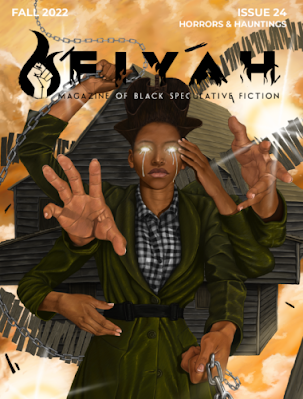
Continuing the belated Halloween Theme (it's nearly October!), FIYAH's 24th issue is long and it is good. "Girl Eats Girl" by Gnesis Villar kicks off with an emotionally charged sort-of friendship by two Black latinx teen girls trying to survive both their white town and the creatures living in the forest - which seem intent on changing at least one of them. Eden Royce is always a great name to see in a table of contents, and "Sugar Honey Iced Tea" is a fantastically creepy story about coming into work on a Saturday because the mediocre man who got promoted above you hasn't done his job properly. "Old Solomon's Eyes" features two plucky youths trying to negotiate with a demon who has taken up residence near their village, as the adults around them attempt less successful methods to deal with it. I love how this story plays with the morality of its characters, making both the inaction and the overreactions from various segments of the community seem damaging and the demon's perspective seem nearly sympathetic, while also coming down firmly on the side of "negotiating with demons is terrifying and tricky".

The final three stories all deal with family trauma in some way, like Tobi Ogirundan's story of two brothers and a terrifying childhood incident "In The Smile Place". "Chrysalis" by Aimee Campbell features a young person trying to break free of a family curse which has transformed their home into the lair of a spiderlike creature who claims each member of their family as its own as they come of age.  The horror here is claustrophobic and visceral, and it pairs compellingly with "Blooms of Sorrow" by Amanda Helms, in which a family garden becomes a hungry burial ground for all kinds of familial pain, from an abusive former husband to a daughter's struggle with untreated endometriosis. Both of these final stories offer some level of catharsis to their protagonists, which stops them from tipping over into pure hopelessness - so it's not all creepy doom and gloom. Read your FIYAH subscriptions, everyone.

Strange Horizons

I tend to read Strange Horizons fiction in no particular order, all at once, so the following are going to be from all over their 2022 publication list, but let's try some thematic association for this recommendation journey:

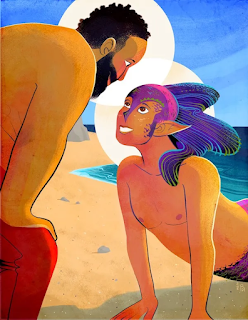
Artwork for "Intimacies"
by Dominique Ramsey
Start under the water, with "Intimacies" by Filip Hajdar DrnovÅ¡ek Zorko, in which a hippocampus-merman and a widowed human overcome their respective cultural limitations and taboos to build an unusual family together. I love mer stories (pour one out for Mermaids Monthly, the best year-long magazine project a girl could hope for) and it's always nice when the differences in living circumstances are treated as something to be adapted to, rather than an insurmountable grounds for tragedy. Underwater tragedy is also great though, and the cyclical central tragedy of "Sister, Silkie, Siren, Shark" by Ariel Marken Jack is so painfully well-realised that it will probably make you scream into your hand. The story of a group of sisters who, like their mothers before them, are forced to give up their silike skins when they are sold to the men who come to their island, it traces out the things they are told at each stage of their lives to perpetuate a toxic cycle, and the moment at which they choose to break it.
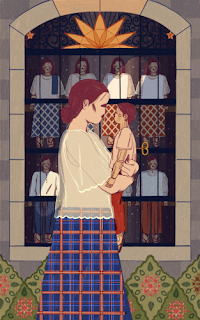
Artwork for "Clockwork Bayani"
(SEA special issue) by Gianne
Encarnacion


When you're finished crying from that depiction of matrilineal trauma, treat yourself to "Mother Hunger" by Mary Maxfield, which starts with a somewhat whimsical premise where daughters are assigned their mothers as teenagers and need to care for them until they get mothers of their own, and turns it into one long gut-wrench of a story about failures of care and community for a daughterless woman whose mother takes absolutely everything she can provide and more. After that, you'll probably be both hungry and in need of some lighter storytelling, so it'll be time to slip into the Southeast Asian issue with "Wok Hei St" by Guan Un, a heist where the steak could not be higher (because you're tossing it! in your wok! ...I'll get me coat). Stay in Southeast Asia to read... well, read all of it, but for the purposes of this recommendation journey, go with "Lay My Stomach On Your Scales" by Wen-yi Lee, with its story of teenage body awkwardness featuring a manananggal and the girl who has stolen her hands. Finally, finish off with another heartwarming spooky tale with "Embroidery of a Bird's Heart" by Nelly Geraldine García-Rosas, about a daughter whose ghostly grandmother comes over for lunch and guides her through a change of her own.

Questing Elsewhere

I'm tired of difficult stories about reproductive justice, because I'm tired of how much they hurt and how we still need them so badly. "Rabbit Test" by Samantha Mills (Uncanny Magazine Issue 49) hurts, and is badly needed, featuring the cyclical struggle for control over women's bodies with a focus on a future where intrusive surveillance is the norm. Make time for it.

While you're following the Strange Horizons recommendation trail above, you could take a left turn at Wok Hei St and go instead to Giganotosaurus' "Begging the Moon" by Eli Brown, the story of a woman sourcing ingredients for tom yam gung nam for a gang lord's birthday in a border city full of refugees and cut off from surrounding countries. It's thematically powerful, and making food the central driver adds a little touch of levity while bringing the city of Diyu to life.

Finally, I don't normally talk about the to-read pile in this column but two recent acquisitions demand to be mentioned. First, We're Here: The Best Queer Speculative Fiction 2021 (edited by Charles Payseur and L.D. Lewis) has a table of contents that easily lives up to its 2020 predecessor; starting with "The Captain and the Quartermaster", an outstanding and heartbreaking tale by 2020 co-editor C.L. Clark, is a great touch. Second, Song of the Mango and Other New Myths by Vida Cruz-Borja has a beautiful cover and a whole lot of stories I'm excited to dive into, alongside some of my existing favourites by the author (like the titular "Song of the Mango", which previously appeared in the "Beyond the Line of Tree" chapbook.

Will 2023 be a year of returning to more regular columns? I hope so! For now, happy reading and I'll see you when Hugo nominations open.


Wednesday, February 8, 2023

Review: The Book of Dreams by Jack Vance

Kirth Gersen faces the most dangerous and mercurial of his adversaries in the finale to the Demon Princes series

Through the first four volumes of Vance’s Demon Princes series, we have followed the career and evolution of Kirth Gersen, from a bit of a hardscrabble searcher of the men who destroyed his world, through becoming rich, powerful, wealthy and facing ever more dangerous opposition in the more dangerous of the Demon Princes¹. Now, in The Book of Dreams, he faces Howard Alan Treesong. Like his compatriots, Treesong is a driven individual, and his past is the key to understanding him and defeating him.


That past turns out to be the titular Book of Dreams. In the course of the book, even with his money and power and influence, Gersen has a difficult time in pinning down Treesong, who proves in the course of this novel to be the most elusive of the Demon Princes.  Treesong survives more attempts for Gersen to confront and finish him than any of his other opposition. It is not until Gersen gets a hold of the Book that he finally has a lever to finally draw Treesong into a vulnerable position.  Treesong is perhaps this series’ Joker, unpredictable yet methodical, inconsistent, and yet having wide range plans and the will and ability to carry them out, forceful and yet vulnerable in certain spots. He is more complicated than any of the other Demon Princes and that makes him a fascinating antagonist, all the way to the final confrontation.

The details of that final confrontation are something that I go back and forth on discussing, because it is amazingly spoilery on the one hand, and on the other hand, there is a lot to unpack in it. I will come at parts of this obliquely. In the course of the novel, Gersen does meet another woman associated with the Demon Prince whom he makes his ally--Alice Wroke. Alice is at first working at purposes with the Demon Prince, for good reasons, which Kirth manages to alleviate in the course of his pursuit of Howard. She is of a like bird and mind to Kirth, and joins in on the quest to defeat Howard, culminating in their final showdown. That final showdown is a far more complicated affair than even the convoluted endings these books sometimes have, but Alice’s passion for revenge is a match for Kirth’s². And both are left with a sense of loss at the end once that vengeance, that product is done. Unlike the other women of the series, Alice is very much in the same position as Kirth by the end of the book and series. 

But let me talk about The Book of Dreams, which is one of the most fascinating creations of the entire Demon Princes saga, and what it says about Treesong, Vance and his oeuvre. The book cold opens with an excerpt from the Book of Dreams, even before introducing the customary opening where we get a bit about the newest Demon Prince opposition of the novel. We get these excerpts, mysteriously, until it becomes clear that the author of this book is none other than Treesong himself. And Kirth’s acquisition of it is absolutely vital to understanding Treesong and then moving him into defeat.

So what does it say about him? 

The Book of Dreams is a sort of fantasy dream world that Treesong has created, and, it is clear, is a part of his fractured and broken psyche. Treesong, it turns out, inhabits this inner world of the book in a way that really becomes clear in retrospect looking over the novel, but the hints of the book give clues to it. The color coded paladin knights, with different aspects, personalities and abilities, are not quite different personalities within Treesong, but they are much like those writers who can have conversations with their created characters in their head and interrogate them. For all being Treesong’s companions in arms, they really do range in what they are like and perhaps can be thought to cover a wide range of what such paladin knights might be like in a fantasy setting, all the basic types arranged here. This gives a kaleidoscope-like feel to the Book of Dreams, and thus to Treesong. 

It is an extension and a larger version of one of the themes throughout the Demon Princes series, and that is, for Gersen to defeat each one, he has to “understand who is going to kill”. This is not something he starts the series with in The Star King, he is frustrated at having to go through “the process” with Malagate. Gersen has to understand his motivations (however inhuman) in order to get into a position to defeat him. Kokor Hekkus was faced down by completing the machine he himself craved to have on his home planet of Thamber, fulfilling his ambition to put him in a position to corner him. Viole Faluche, Gersen has to range from Earth all the way to the titular Palace of Love and confront Faluche’s own passions and desires in a place of his making in order to be able to overcome him. The titular The Face, Lens Larque, is a chameleon trickster character that Gersen has a devil of a time pinning him down, but it’s a more straightforward result than the other novels. We don’t get quite into Larque’s head as much as the other novels, although we do see the culture he is from and how that shaped him as a person and as a  Demon Prince.

But, again, for all of these master criminals, Treesong is definitely the most dangerous even if not quite the most directly ambitious. That honor would go to Larque of The Face, in light of his schemes for political and social power within the human Oikumene. In the end, the five Demon Princes and their meeting (as described across the volumes) feels a bit like the Adam West Batman movie, where a bunch of Gotham supervillains get together to plot evil (in this case the Mount Pleasant raid) but they are a motley lot.  Treesong is the Joker, as previously described. Larque is probably the Penguin, interested in power.  Faluche is a genderflipped Catwoman, full of passion. This means that the Riddler, the last of the Batman villains in that movie is either Malagate or Hekkus, and given the gadgetry and engineering and design aspects of Hekkus and his schemes, the wheels within wheels, I think Hekkus is the Riddler. This leaves poor Attel Malagate out in the cold. If I had to pick a Batman villain for him that was not in the movie, then, I am going to go with Clayface.The mimicking of DNA by the Star Kings, a power Clayface often has in the comics and other media, make him a good matchup. 

 And what of Scroll from the Ninth Dimension, the serial contained with the volumes of the Demon Princes?  I can say that Marmaduke, too, comes to a conclusion and a satisfactory one at that. This novel, more than the others has a particular resonance between the Scroll and the main text, as the Book of Dreams inner landscape has a resonance and similarity, world to world. The fantastic worlds of Jack Vance, the fantasy magical side of his writing, has always been a seed within the science fiction of the Demon Princes verse, showing that space opera, too, can contain magic.  But the aforedescribed Book of Dreams is itself a fantasy verse, and so in the novel, we have in effect, two fantasy verses in conversation with each other, across the space opera verse of the novel. You can see it is this sort of thing that writers like Gene Wolfe would pick up and run with. The shadow of Vance is long and deep within the SFF community.  

The Demon Princes is a series that Vance abandoned for many years, only to finally to return to it and with this volume, complete it. Is it the highest form of Vance’s writing? No, frankly he has more mythic and epic work in his oeuvre. But it is in the way his most wide ranging in terms of geography, giving us culture after culture, planet after planet. In reading this, long ago and now, I dreamed of visiting endless worlds and societies unfamiliar with my own, the experiences Gersen has in running down the Demon Princes gives him a wide range of human experiences, and for the readers, we see many ways of *being* human. It thus remains one of *my* favorite series and I hope the new audio editions entice more readers into Vance’s worlds.


The Math

Baseline Assessment: 7/10

Bonuses: +1 for effective use of try-fail cycles as Gersen faces his last, strongest opponent.

+1 for very clever use of the titular book as a psychological tool to deepen the main antagonist, more than any of the other Demon Princes

Penalties: -1 The actual denouement is a bit disappointing. To say more would be very spoilery

Nerd Coefficient: 8/10

Reference: Vance, Jack The Book of Dreams [Spatterlight Press Audio Edition 2022]

POSTED BY: Paul Weimer. Ubiquitous in Shadow, but I’m just this guy, you know? @princejvstin. 

¹It is interesting and says a lot about Vance that the first of the Demon Princes Gersen faces,Attel Malagate , in The Star King, is the only inhuman one, and in the end, the least challenging opponent. Gersen as constituted in the first novel would not have stood much chance against the later Demon Princes, and I am pretty sure Treesong would have defeated the earlier version of Gersen quite easily. 

² Does this make Alice, in fact, Harley Quinn?  The Harley Quinn of the animated series, who has definitively thrown over "Mister J" would approve of Alice's revenge on Treesong, I am sure.