Thursday, December 16, 2021

Microreview [Book]: A Marvellous Light by Freya Marske

A queer fantasy romance set in a magical version of Edwardian England, where an obscure branch of the civil service liaises with a secret world of magicians.
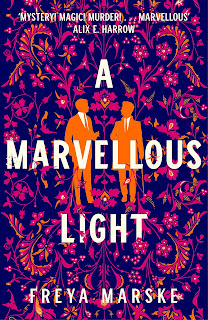
Cover artist: Will Staehle

The novel follows Sir Robert Blyth, a baronet in reduced circumstances, whose posting to a small parliamentary liaison role that no one has ever heard of leaves him not only discovering the magical counterpart to his own society, but trying to solve the mystery of his predecessor’s untimely disappearance. Unfortunately, the only help he seems to have in either of these things comes from his rather frosty magician opposite number, Edwin Courcey, and a helpful secretary somewhat dubious of his capabilities. Blyth and Courcey must work together, however distasteful the proposition seems, to navigate mysterious attacks, strange paperwork, unexpected visions and a hostile hedge maze, and possibly save every magician in England.

If I had to describe this novel in one word, it would be “delightful”. It’s a novel that, primarily, lives or dies on how much you like the two viewpoint characters, and Marske has made them both so absolutely charming in their different ways that I couldn’t help but be sucked in. Is it evident from the moment they meet that they’re going to fall in love? Entirely! Is this in any way a hindrance to enjoying watching it unfold? Only if you don’t like mutual pining.

In Blyth, Marske gives us a himbo hero, all kind heart and big fists, determined to be a good person, in spite of his upbringing by political, image-obsessed parents. He’s the face, for the most part, of the benevolent side of Edwardian England’s gentry. Someone for whom life has, up to now, always been easy and whose name alone does half the talking for him, and who thus has a blithely generous attitude to everyone he meets, at least until experience proves otherwise.

Courcey meanwhile, though in a semi-separate society to Blyth, has grown up dismissed by everyone who knows him for his weak magical talent, bullied by his family and derided for his bookish passions and personal reserve. He’s distrustful, inward focussed and wary of those he meets, ever expecting them to turn on him as he’s been taught everyone will.

Neither of them are stunningly original characters, nor is pairing them up romantically a masterstroke of invention, but they both manage to spring out of the page as rounded, believable people pretty much from the start, and that’s what sells the whole thing.

That, and Marske’s commendably light touch approach to the Edwardian setting. It would be very easy, with a novel like this, to go all in on the petticoats and manners, and throw everything at it in the name of worldbuilding, but she doesn’t – because she doesn’t need to. It’s an era many of us now have convenient short hand for, from novels and films from Sherlock Holmes to Jeeves and Wooster, and so we only need the outlines to understand the whole drawing. It’s not totally sparse – Marske spends plenty of time describing the specifics of certain places, or people’s dress when it matters – but she doesn’t labour the point where it’s not needed and this leaves her space to spend on both characters and plot, which lets the story feel pacey and driven. But it doesn’t overburden us, or fall to the risk of excessive twee that lurks whenever anyone writes about the Victorians or Edwardians.

It does however, also leave space for plenty of smut. Which wouldn’t be a problem, except that, in a couple of instances, I’m a little bit dubious about her grasp of… ahem… male anatomy. There’s a passage early on in which a character’s “lips and cock twitch in unison” when skimming a salacious novel, which was a mental image I’m really not sure I needed. Is it egregious? No. It’s nowhere near the equivalent of a male-written female character breasting boobily down the stairs. But it did cause me to pause, reflect, and wonder if I’d misread it. Nor is it incessant - there are only a few moments like that, here and there throughout the book – and so it is easy enough to ignore after the initial confusion. But it’s a strange contrast to how well-drawn everything else is.

Her light touch also carries through to her writing of character chemistry and the development of relationships. Especially in a novel leaning into the manners and aristocracy side of Edwardian, there would be a certain amount of emotional whiplash if any personal relationships progressed with much speed at all. And so the key high point of the romance writing, for me, is the mutual pining between Courcey and Blyth, building slowly through the book. Marske makes it impossible to imagine anything happening quickly in that relationship, in her world-building and in the personalities of her characters, and so leaves the reader balancing in wanting it all to continue to be drawn out, even as they yell “now kiss!” at the page.

We don’t learn a great deal about her magical society through the course of the story, it’s true, but I honestly think this is a boon, not a burden. There are no obvious unbound threads of questions that underpin how this specific novel hangs together, and she’s left space for revelations in the sequels (as I believe this is intended to be a trilogy). She’s given us enough for the story to work, and for none of the plot revelations to feel pulled out of hat, but as with how she portrays the time period, she’s not overburdened the reader with things that obscure the true focus of the book – the inner thoughts of the two viewpoints, and their burgeoning relationship. She’s left me wanting to learn more about her society, it’s true, but not feeling short-changed by what I’ve been given.

All in all, it’s an absolute cupcake of a book. It’s not a big, substantial meal that’ll leave you pondering it for days afterwards, but it cuts out any risk of it being too sickly sweet by being small, perfectly formed and… well… delightful. I'll take ten.

The Math

Baseline Assessment: 7/10.

Bonuses: +1 for instantly lovable characters

+1 for queer historical fiction, of which we always need more 

Penalties: -1 for somewhat implausible depictions of penis behaviour

Nerd Coefficient: 8/10 well worth your time and attention

Reference: A Marvellous Light Freya Marske [Pan Macmillan, 2021]

POSTED BY: Roseanna Pendlebury, the humble servant of a very loud cat. @chloroform_tea


Monday, December 13, 2021

6 Books with Jacey Bedford


 Jacey Bedford is a British writer of science fiction and historical fantasy. She is published by DAW in the USA. Her Psi-Tech and Rowankind trilogies are out now. Her new book, The Amber Crown, is out in January 2022. Her short stories have appeared in anthologies and magazines on both sides of the Atlantic, and have been translated into Estonian, Galician, Catalan and Polish. In another life she was a singer with vocal trio, Artisan, and once sang live on BBC Radio4 accompanied by the Doctor (Who?) playing spoons. 

Today she tells us about her Six Books


1. What book are you currently reading?

I'm in the middle of reading Saving Time by Jodi Taylor. It's the third book in her Time Police series, which in itself is a spin off from her fabulous Chronicles of St Mary's.


 2. What upcoming book are you really excited about?


The two I was waiting for dropped together a couple of days ago, giving me the delightful dilemma of which one to read first. The first is the aforementioned Saving Time, and the second is T. Kingfisher's Paladin's Hope, which is the third book in her Saint of Steel series, set in the same world as her Clocktaur Wars books. (T. Kingfisher is the adult pen name of well loved children's author Ursula Vernon.) The next book I've pre-ordered is A Catalogue of Catastrophe: Chronicles of St Mary's 13 by Jodi Taylor. Any new book in the St Mary's sequence is a buy-on-sight for me. Also Risen: The final Alex Verus Novel is due soon. I'm looking forward to discovering how Benedict Jacka ends the series.


3. Is there a book you’re currently itching to re-read?


Oh, so many books and so little time. If I had all the time in the world I would love to read my way through all of Lois McMaster Bujold's bibliography, especially her Vorkosiverse books. I also had a sudden yen to re-read Peter O'Donnell's Modesty Blaise novels which I haven't looked at for decades. 


 4. A book that you love and wish that you yourself had written.

That's easy – Lois McMaster Bujold's Curse of Chalion. She's so very good at plot and setting… but best of all, character. Her protagonist, Cazaril used to be a bright young thing, a spectacular soldier with a dazzling career ahead of him, but he was betrayed and sold to the galleys. Now he's free and trying to walk back to the only place he remembers as being a refuge. He's a broken man with damaged hands and a back ropey with scars from the lash. He's no longer a flashy swordsman, but he's clever, kind, and steadfast, and willing to put his life on the line for those he cares about. He never once considers that he's the hero of the piece – which of course makes him doubly attractive. Yes, OK, I admit it, I'm a little bit in love with Caz.


 5. What’s one book, which you read as a child or a young adult, that has had a lasting influence on your writing?

There's a little known British children's author called Monica Edwards who was writing from the late 1940s to the late 1960s. Her Romney Marsh books are gentle adventures featuring four children in an idyllic coastal village full of ponies and boats, and populated with great characters. Unlike a lot of children's books of the era, she doesn't get rid of the parents or sideline the adults. The children grow up as the series progresses until two of them recognise that they are perhaps more than just good friends. That comes about halfway through the series and the book in which it happens is No Going Back, my favourite. I stole two of Ms Edwards' adult characters and mushed them into one for a character in my Rowankind trilogy. Hookey Garrity, barely reformed pirate and sometime sidekick to my heroine, Ross (Rossalinde) Tremayne, has aspects of both Hookey Galley and Jim Decks who feature throughout the Romney Marsh books. Hookey Galley is always a bit sinister and Jim Decks is an incorrigible rogue. It's a good combination.

6.  And speaking of that, what’s your latest book, and why is it awesome? 

My upcoming book The Amber Crown is due out on 11th January 2022. It's another historical fantasy, but this time a standalone, not the beginning of another trilogy. It's set in an analogue of the Baltic States around the middle of the 1600s, though I've seriously messed around with real history. It starts with the aftermath of the assassination of the king and features three main characters. Valdas is the bodyguard who was in the wrong place at the wrong time and failed in his duty to protect the king. Mirza is a Landstrider witch who can cross into the spirit world. She is given a task by the ghost of the dead king and must keep Valdas on track because he's deaf to the ethereal. Lind is the clever assassin who caused the whole sorry mess in the first place. He's got more hangups than a wardrobe full of coats and until he gets over his traumatic past he'll never be able to move forward. The three stories are separate to begin with and gradually converge. The usurper king is driving up taxes and heading for a war on two fronts which he cannot win. Only Valdas, Mirza and Lind can right the wrong and save the country, but there's a dark and powerful magic force rising against them in the capital. I really enjoyed writing this mixture of politics and magic, so I hope people will enjoy reading it.

Thank you, Jacey!

POSTED BY: Paul Weimer. Ubiquitous in Shadow, but I’m just this guy, you know? @princejvstin.


Speculative Noir with Valeria Vitale and Djibril Al-Ayad

Today we're joined by Valeria Vitale and Djibril al-Ayad, co-editors of the forthcoming Noir issue from The Future Fire (TFF). For those who aren't familiar, TFF is a quarterly zine focusing on "social political and speculative cyberfiction": we are big fans of their short fiction and previous anthologies!. Their noir anthology is currently open to submissions, and we've taken the opportunity to ask Valeria and Djibril a little about speculative noir, what it means and where we see it in genre today.

NoaF: Hello! Can you start by telling us about yourselves?


Valeria: I am a researcher by day, currently spending my time looking at old maps and discovering what they can tell us about the moment in time and space they captured. By night, I’m an avid reader and spectator, wannabe writer, and, thanks to Djibril who introduced me to The Future Fire (TFF), enthusiastic editor of speculative fiction. I always liked genre and speculative fiction, in particular noir, horror, and gothic, both on page and on screen. But these, and perhaps noir in particular, are probably the genres that are most often ridden with ugly tropes and stereotypes, to the point that the annoyance (when not sheer rage) cancels out some of the enjoyment. I am very excited to see a sort of renaissance of horror with a lot of new, diverse authors using this genre to tell very poignant and relevant stories. But noir… noir seems to be left behind. And after complaining once more about how difficult it is to find a noir story that is not obnoxious, Djibril and I decided to do what editors do: we will ourselves publish the kind of stories that we, and hopefully many others, will love to read! That’s how the call for TFF Noir came to be.

Djibril: I am the co-founder and current editor-in-chief of TFF, an online magazine of social-political and progressive SFF. In my day job I alternate between being a futurist and a historian, and in the tiny amount of free time I manage to squeeze between wage-laboring and editing scifi, my interests include ancient and modern languages and the history of magic and the occult. We’ve published half a dozen short story anthologies with Futurefire.net Publishing (the press behind TFF), most of them with guest co-editors, and they’ve all helped us to branch out in new directions and to new audiences and collaborators. Without this sort of collaboration I don’t think we would be still publishing after 16 years of this.


NoaF: Let’s start with the basics: What is noir? Is it a trope, an aesthetic, a genre, or something else (or all of the above)?


Valeria: It is all of the above and more. It is definitely a genre that has its own tropes and aesthetics and canon and recognised classics and masters, in literature, cinema, as well as visual arts. However, defining it unequivocally can be challenging, and people may not agree on a clear cut definition. Do we need some sort of investigation to take place in order to call a story noir? Or is it more about the atmosphere, or even those trite clichés that many noir consumers both hate and love? Personally, I’d say it is more about the aesthetic, and possibly even the feeling it generates in readers or spectators.


NoaF: What about when we talk about SFF noir? What does noir bring to speculative fiction that makes those stories great?

Art by Pear Nuallak 2020


Djibril: When you look at the mix of tropes and aesthetics in Noir that Valeria mentioned, including and especially those we want to subvert or surpass, a lot of these are things that we see in one or another flavour of speculative fiction already: cyberpunk, dystopian, low fantasy, and especially in the underdogs or antiheroes of socio-political or “soft” SF. By mixing the tropes, aesthetics and sheer pulpiness of genres such as space opera, magical fantasy or horror with the gritty, transgressive, unfinished feel of some of the best Noir, we can combine in the most emphatic way those things that make Genre (capitalization sic) the powerful art-form that it is: unapologetic love of story, freedom to cross boundaries and break rules, inventiveness and blending the point of the game rather than side tricks. This can also, although doesn’t have to, allow the story to be deeply political—in the sense that all art is political, but it’s of course not all progressive.


Valeria: One thing that I love in Noir is how it brings the spotlight on unusual characters, on those who live on the margins. Before becoming a banalisation of the anti-hero, noir stories were about the people who, for one reason or another, didn’t fit in: women too independent to get married, journalists who are not for sale, the small and the powerless whom no one notices but who notice everything. The genre had all the right cards to become the most subversive, progressive, anti establishment genre ever. It didn’t, but I think it’s not too late.


NoaF: Some well-known SFF subgenres, like cyberpunk, are already strongly linked to noir, especially in film - but I get the impression there are plenty of works drawing from noir that we - and the creators - might not recognise! Are there any “stealthy” noir trends you notice in fiction?


Valeria: Surely there is a strong, and fertile, connection with other subgenres that has been going on for a long time. I’m not sure I can identify an actual growing trend towards noir, though, unless you count the proliferation of re-writing of classic stories with one of the characters becoming a detective, from Jane Austen to Dante! Maybe something that I think comes from classic noir and that I see more and more often in SFF is a kind of sense of dread, almost doom. The idea that we are powerless in the face of events such as climate change, the dictatorship of super corporations, the corruption of politicians is definitely something that is familiar to noir readers and that I feel can be detected more and more often in SFF stories. However, this component of the noir aesthetic is exactly one of the things that we would like to challenge, in making the genre more progressive. I’m not saying that noir stories should leave behind their signature existential dread and feeling of looming injustice, but that this should be seen as a trigger to start fighting back, instead of a descent into nihilism.


Djibril: Yes exactly—playing with genres and boundaries as well as expectations and clichés helps to make us aware of these trends, focus on the harm or good they do, and try to make this better. Being political is all about being purposeful and mindful in how you choose and navigate your genres.


NoaF: When we think about old-school noir, we’re likely to call up images of lone wolf white male detectives encountering hypersexualised femme fatales and perhaps some female victims along the way. How does noir in 2021 look beyond those stereotypes, and subvert these tired expectations?


Djibril: I think the simplest answer is, again, by consciously deciding what to publish, by which authors, for what sort of audience, and with what experiences and worldviews informing the story. You’re less likely to see femme fatales, little sisters, and victims always through the male gaze with a better representation of women authors. And you get stories that not only avoid basic racism, homophobia and other bigotries, but also bring the worldviews of real marginalised demographics into play (rather than a shallow “colorblindness” or invisibility) when you have QPOC (e.g.) involved in writing, reading, illustrating, commissioning, editing and all other stages of the publication process.


NoaF: Finally, let’s have a recommendation question. What works - new or old - should we check out to get our appetite for noir fiction going?

Valeria: One of my very favourite noirs is The Blank Wall, written by Elisabeth Sanxay Holding, considered an extraordinary talent by Chandler himself, but who, being a woman, struggled even to find a publisher. The story is very, very noir, and yet the protagonist is possibly the least noir character you can imagine: a quiet 1950s American housewife. Not only is it an excellent story, full of suspense and strong emotions, but it also offers a disquieting view into the life of women in those years, and how little they were in charge of their own lives. The noir trilogy by Nicola Griffith, featuring detective Aud Torvingen, is another very good choice, with all the darkness, sadness, and fist fights that we enjoy in noir, but where the disillusioned detective is a woman. She is also queer and, quite rightly, no big deal is made of it. In the past years, Noir has been often associated to quite ugly xenophobic stereotypes, portraying shady characters and mobs often as belonging to ethnic minorities. But a growing strand of noir authors had already started twenty years ago to bend the tropes to talk about the struggles of these minorities and how a life of denied opportunities and second class treatments made them more vulnerable to crime and oppression. Walter Mosley is possibly the best example of using Noir to tackle racial stereotypes, if you have not read Devil in a Blue Dress, do yourself a favour and get hold of it! But there are many others, like Henry Chang or Jérémie Guez, for example, who explore the mixed loyalties and complex identities of second generation immigrants. A very interesting contemporary author is Megan Abbot, her short novel Queenpin is a literary jewel that elegantly subverts all stereotypes while remaining a model noir story. She has tried more recently to move noir away from its worn settings of rainy, neon-lit metropolis and has experimented with very unusual contexts, like American high schools and cheerleading squads.


Djibril: If we want to go into speculative noir for a moment, I very much enjoyed Rosa Montero’s Tears in Rain, a deliberate (and unconcealed) riff off the replicant characters in Bladerunner, which uses the conceit and setting to address exclusion and bigotry and the rise of opportunistic political demagogy. Ayize Jama-Everett’s Liminal People trilogy, in contrast, takes the well-worn crossover of superhero and noir genres and smelts it (along with sprinklings of myth, horror and social realism) in a crucible of explosive violence and fury, into a multicultural and progressive story. Elements of this crossover and energy appear in Walter Mosley’s Futureland collection, Daniel José Older’s original Salsa Noctura stories, a lot of Lavie Tidhar (including the subversively optimistic Central Station), and a few more of our favourite authors.

Valeria: Oh! Talking of contaminations and unusual contexts—if like me you are curious about noir crossing paths with magic and the supernatural, I quite enjoyed Zoo City by Lauren Beukes. We could go on for days, but I better stop here!


NoaF: Thank you so much! How can authors get in touch with you for the upcoming anthology?


Djibril: The main message to authors is to follow the guidelines in the TFF-Noir CFS, and also not to self-reject. If you think your story might be a fit but it’s unusual in some way, no need to ask for permission, just send it in and let us decide! We want to read everything! But if you do want to get in touch, please feel free to email at the fiction address with a query, or ping me on Twitter (although we’ll probably say the same thing there) with any questions. We’re looking forward to see your work!


NoaF: Thank you, Djibril and Valeria!


Friday, December 10, 2021

Microreview: Seven Deaths of an Empire by G R Matthews

 G R Matthews Seven Deaths of an Empire features the story of a magician, a general, and a Roman Empire like polity on the edge of a precipice after an Emperor's Death.


General Bordan has a problem. The Emperor has just died, fighting in the borderlands of the Empire. The remaining  members of the imperial family are under stress, the nobles of the Empire are circling and the church is also scheming. Bordan is loyal to an Empire that is not at a moment of strength. In fact, it is a crossroads, if not a precipice.

Apprentice Kyron has a problem, too. He’s out in those borderlands and has been chosen, along with his magical master and an honor guard of troops to bring back the body of the Emperor back to the capital. It’s going to be a rather dangerous journey through country that is supposedly loyal to the Empire, but perhaps not quite as loyal as it might be.  And in this Empire, possession of the body of the Emperor is much more than nine tenths of the law...

It is the stories of Bordan and Kyron that are at the center of G R Matthews Seven Deaths of an Empire. 

The worldbuilding of the novel attracted me right off. The titular Empire is very explicitly modeled on the Roman Empire in some of the gross and small details alike. Legions and pugios, an Empire pushing into the woods against barbarians, these large scale details are reminiscent of a still growing Roman Empire. As I read further and on, I saw the differences that Matthews layered into his empire. First off, and most importantly for the plot, there is magic. Magic is an art in the empire that has taken a shellacking as of late (for reasons to be discussed shortly), but one of our two main characters, Kyron, is a magician in training and so through him we get the throughline of understanding the role of magic in the empire and more pertinently in the army as well. We get a good look at the role of combat magic, and it is vividly and excitingly described and executed, all the more so because Kyron is NOT a master and is often fumbling his way through it all.  

The other major difference though between the Roman Empire and the Empire of this novel is the rule and role of religion. In our own real Roman Empire, Rome was a medley of faiths and gods and beliefs in a quite bewildering variety. The ancient Roman customs had been fused to the Greek Olympian deities, but then there were traditions such as Household Gods, Vestal Virgins, and other local beliefs. And then, given that Rome was an empire, and a polyglot one at that, Rome imported Gods and cults from Britain, Asia Minor, Germany and beyond. Before the rise of Christianity (itself once just one cult imported in), religion was one of the most complicated things in the Roman Empire.  Matthews eschews that in his book, and deviates perhaps the most from his Roman Empire model. His religion, the Cult of the Eternal Fire, is instead modeled on an Inquisition-era Christianity, and is intolerant of not only any other expression of religion, but magic as well.  This inquisition is growing in political strength and power and has ideas of its own how the Empire should go forward.

For all of this grand worldbuilding, however, and large scale canvas, the twin entwined stories that Matthews seeks to tell here are surprisingly intimate and small scale. The focus of events in the alternating chapters of both Kyron and Bordan do contain battles, political intrigues, sharp events and a turn the page sort of flow, but the scope of the events on the page are narrow, giving us a chance to see both men in full measure and they stand above and beyond all of the other characters and settings. It seems almost deliberate, then that many of the details we see are strangely generic. This is a book where there are meals and dinners, but the fruits are not described in the detail in, say, a L.E. Modesitt book. Too, a lot of locations have a level of description that is fine, but there is a lack of place names for many of them. This does have the effect of blurring a lot of that and focusing on the main plot and the characters.


The plotting, intrigue and adventure of the story of Bordan and Kyron is where the novel truly shines. There is an additional strand at the beginning of each chapter, a short paragraph starting with 10 years ago, and slowly approaching the present. It's an excellent way to slowly tease out a backstory for Kyron that would otherwise be presented in an indigestible lump, and it helps keep the story flowing and letting the reader knit the story of Kyron together. 


Beyond that, Kyron’s relationship with his master, Padarn, and with Emlyn, the local guide and warrior woman who is tasked with protecting him, provide further fleshing out and color for Kyron.  While Padarn does come off a lot like a more generic master of magic, Emlyn is a more complicated figure. She is not a romantic figure (I was waiting for that cliche and it did not occur) but rather her story and how it relates to Kyron, and the legions tie in and make real and personal the themes of imperialism that are more at a remove in Bordan’s section.  Even more than Bordan, you see, Kyron  is really the protagonist and hero of the story but given his relationship with Bordan, and the importance of Bordan makes this novel complete. I can imagine a novel where everything is from Kyron’s point of view, a much bloodier and narrowly focused book. I think it could work. 

But Bordan’s story at the center of the empire, seeing the political machinations first hand, provides balance to Kyron’s story of fighting through the wilderness. While it is equal in the number of chapters, it feels just a little colder than Kyron’s story, but it is essential to understand the rot coming at the heart of the Empire. Kyron, through Emlyn, can see the problems of Empire on the ground, but Bordan, as he fights and fights to keep the Empire together, shows just how rotten it is, and provides a line to his characterization that is not complex but straight and clear. Is it a good thing to fight for an institution that is rotten at its core--so much so that Bordan cannot but help see it? Is the Empire worth saving, or are the titular Seven Deaths merely the prelude to dissolution?  There are no easy answers here in Matthews book, and the themes of imperialism, power, succession and right action resonate throughout its pages.

The novel is the first in a series, I look forward to what Matthews does in subsequent volumes, but I do hope the aforementioned genericity of details might be changed to something more vivid in them.

---

The Math

Baseline Assessment: 6/10

Bonuses : +1 for a strong pair of protagonists.

+1 for a good exploration of the theme of Imperialism in a non medieval European based fantasy setting.

Penalties: -1 Some missed opportunities in description and detail

Nerd Coefficient: 7/10

 POSTED BY: Paul Weimer. Ubiquitous in Shadow, but I’m just this guy, you know? @princejvstin.

Reference: Matthews, G R ,Seven Deaths of an Empire ,[Rebellion Publishing, 2021]


Thursday, December 9, 2021

After 'Doctor Who Flux', we can't wait for Chris Chibnall to go away

It is regrettable that the momentous era of the first female Doctor was paired to a writer of so limited talents

It can't be disputed by now: Chris Chibnall is not a good writer, and he has done harm to Doctor Who. His first episode as new showrunner, The Woman Who Fell to Earth, appeared very promising on first watch, but it hid many of the writing vices that would explode into full form in Flux: a forgettable villain with more makeup than personality (first Tim Shaw, now Swarm), random dead extras we don't get to know or care about (first Asha, now the entire universe), a clever winning plan done entirely offscreen (first hiding Tim Shaw's bombs inside himself, now hiding some Mouri inside a Passenger), the ethical mess of having the Doctor kill villains with their own weapons (first tricking Tim Shaw into detonating himself, now leaving the Sontaran fleet exposed to the Flux), a world-shattering cliffhanger that gets immediately reversed (first stranding the Doctor and her companions in empty space, now turning the Doctor into a Weeping Angel), and a key plotline deliberately kept hanging to tease the next episode (first figuring out where the TARDIS went, now hiding the Doctor's memories). Chibnall clearly knows the tricks of the writing craft, but he just throws them onto the screen, trusting that they'll sustain the story on their own, without giving due thought to what the story is saying or what possible interpretations they open themselves to. It's all gimmick with no clear artistic intention.

To understand how Chibnall's approach to storytelling works, let's examine how he has developed his signature contribution to Doctor Who: the Timeless Child plotline. It was seeded all the way back in The Ghost Monument, with no payoff until another mention in Spyfall part 2, an entire season later. The effect of the long wait was to lessen the impact of what was ultimately just another tease (Chibnall has a tendency to prolong mysteries beyond the audience's ability to care). Then, in The Timeless Children, we were subjected to a mammoth infodump that would have worked better if it had been gradually revealed across the season (as Chibnall himself did in Fugitive of the Judoon, which introduced a gigantic reveal with barely any explanation, and it worked phenomenally as a clue to bigger secrets).

After The Timeless Children, there was heavy discussion online about whether the Doctor's retconned origin ended up enhancing or diminishing the character. On one hand, there was new space left open to explore entire lifetimes' worth of backstory; on the other hand, the Doctor's relationship to the Time Lords was reversed from free-spirited rebel to exploited lab rat. What the Doctor herself thought of it all, however, was left unsaid. This is a frustratingly isolated Doctor, who treats her friends like she doesn't fully trust them. This choice is partly excusable; humans can't possibly comprehend what multiple lives mean to Time Lords. However, the Master's destruction of Gallifrey robs the Doctor of any equals she might turn to for support. So this Doctor turns inward, keeping her feelings bottled up, and we can only guess what's going on in her head. Not that she detaches herself from the plot: a lot of actions continue to come from the Doctor, but they don't reveal how her character has been affected by the truth about her past. It's like having her not know who she is anymore requires that we don't either.

Just before the end of the Moffat era, I wrote that Doctor Who worked best when it followed a season-long theme that you could discern in each episode upon rewatch. This style of writing was noticeable since the Davies era. Chibnall has only a superficial understanding of season-long themes; his style is to plant a question in the premiere and do nothing with it until it pops out ot nowhere in the finale.

Perhaps in an attempt to overcorrect his bad habits, Chibnall designed Flux as an interesting narrative experiment that made numerous promises and failed to deliver on all of them. In fact, one of the most painful things about the clumsy pacing of Flux is that much of it could have been fixed simply by rearranging scenes. In The Halloween Apocalypse, Vinder and Swarm didn't need to appear until the end of the episode, while Claire Brown, Joseph Williamson and the Sontarans didn't need to appear at all. Even worse, the character of Diane is set up for a nonsensical arc. Even though her abduction into a Passenger gives her the crucial information to save (what little remains of) the universe in The Vanquishers, that requires her to be put in pause for five episodes, and there wasn't any logical in-universe reason for Azure to singularly target her in the first place. Chibnall likes the feeling of thrill and drama, but hasn't learned how to deliver them, so he smothers his scripts under dozens of layers with the semblance of thrill and drama. Especially in Flux, he seems to have confused foreshadowing with foregrounding. The Sontarans have nothing to do in the premiere, but we see them here because they'll matter later. Diane is of no consequence to the plot for five entire episodes, but we see her here because she'll matter later. In fact, the entire characters of Swarm and Azure didn't need to be positioned as the season's big baddies; they didn't hold any personal significance to the Doctor anyway and they had minuscule impact in the story overall. What we get in The Halloween Apocalypse is an overbloated and confusing avalanche, and even that doesn't come close to how badly Chibnall will later jump between a hundred different subplots in The Vanquishers.

Untangled into a coherent form, Flux goes like this: panicked that the Doctor has finally found out (i.e. been lectured by the Master for an entire episode) about her true past, the hidden Time Lord organization known as Division releases their ancient enemy Swarm, who can finally execute his old plan to sabotage the Mouri priests that keep Time captive, unleashing the Flux, a destructive wave of antimatter that is expanding across the universe. What Swarm wants from the Flux is to win an ancestral war between Time and Space. What Division wants from the Flux is to put an end to this universe, collect the insurance money, and move across the void to the next universe. But before the Doctor can deal with any of this, she's dragged into successive skirmishes with a Lupari, the Sontarans, the Weeping Angels, and the Sontarans (again), because the incalculable devastation brought by the Flux has moved many to seek refuge and many others to fight over what remains. How will the Doctor save the day?

Well, she doesn't. The ending of Doctor Who Flux is a gigantic defeat for the Doctor: Division is still out there, the universe is still gone except for Earth, her adoptive mother Tecteun is killed before being able to give any substantial answers, her new friend Dan has lost his girlfriend (and his house), her other new friend Professor Jericho is killed in battle, her other other new friend Karvanista has become the last of his species, and her other other other new friend Vinder will raise a child in an empty universe. The only thing the Doctor wins is a record of her past lives, but she won't look at them. They're stamped with a big tag that says TO BE CONTINUED... and we're left to wonder what this all was for.

This is not to say that our heroes can't have losses. It's possible to make an interesting story that ends in defeat. But the cost in Flux is an emotionally empty story. Gone is the joy of exploring the universe, the optimism in the face of disaster, the repudiation of violence as a solution, the burning compassion of one who has witnessed suffering for a dozen lives.

One fundamental problem is that the Chibnall era has a very confused moral compass. The Doctor goes out of her way to ensure Earth is spared from the Flux, but she doesn't make the same effort for the millions of galaxies being swallowed across the universe. When it becomes clear that Earth is the only safe place left standing, the Doctor's priority is not to gather the survivors from all the other dead planets, but to close off access to Earth because she takes it for granted that the refugees will be hostile. When confronted with Tecteun, the Doctor complains of the potential life she was removed from, but doesn't seem to think the repeated torture she underwent is worth mentioning. When the Sontarans orchestrate the genocide of the Cybermen and the Daleks, the Doctor's response is to let it happen and then orchestrate the genocide of the Sontarans (no, it's not OK to mass murder evil species, not the least because there's no such thing as an evil species).

This is not a hopeful Doctor Who. This is not an inspiring, or exciting, or thought-provoking, or even entertaining Doctor Who. The literal end of the universe amounts to a passing inconvenience that leaves no mark on the characters, and we don't see the Doctor evolve as a result of this experience. There's endless frantic action, endless plot bunnies multiplying out of control, endless casualties, and, in typical Chibnall fashion, endless monologues, and it all lands with a resounding meh. What we can tell about Chibnall as a writer is that he loves to build puzzles, the more intricate the better, but his sense of aesthetic satisfaction only extends to showing off how the edges of the pieces fit together, and doesn't care about what the full picture means. His writing-as-puzzle approach means that events, motifs and twists are shoehorned into place just because the plot requires them to be there and not because of any authentic choice by the characters. He wants the effect of the audience's excitement without understanding what causes excitement.

We'll have to be patient. Russell T. Davies will be back soon enough. Choosing him is a signal that the BBC is aware of the damage done by Chibnall, which is why they went for the least risky option. We only have three more episodes left to endure.


The Math

Baseline Assessment: 5/10.

Bonuses: +2 for introducing several fascinating concepts (a war between Time and Space, a villain who thinks nothing of erasing an universe and starting over, a network of underground tunnels with connections all over space and time, a species of intelligent dogs sworn to the protection of humans).

Penalties: −1 for sweeping the story's obvious repercussions under the rug (the universe is now an empty, dead void, and a practically infinite number of people have died, but it's all OK because Earth survived), −1 for the kitchen-sink-in-a-cement-mixer plot, −1 for the ongoing disservice to Yaz's character.

Nerd Coefficient: 4/10.

POSTED BY: Arturo Serrano, multiclass Trekkie/Whovian/Moonie/Miraculer, accumulating experience points for still more obsessions.

Wednesday, December 8, 2021

Contributor Profile: Elizabeth Fitzgerald

Today, we're welcoming the third of our new contributors to the flock: Elizabeth Fitzgerald!

Elizabeth Fitzgerald is a freelance editor and owner of Earl Grey Editing. An unabashed roleplayer and reader of romance, her weaknesses are books, loose-leaf tea and silly dogs. She tweets @elizabeth_fitz.


NAME: Elizabeth Fitzgerald

SECRET UNDISCLOSED LOCATION: A eucalyptus forest defended by drop bears.

NERD SPECIALIZATION(S): Australian speculative fiction (I’m working up to including Aotearoa)

MY PET PEEVES IN NERD-DOM ARE: “Seasonal” release dates, reading lists or challenges (there are people living in the southern hemisphere, you know). Speculative fiction people dunking on romance like it’s the Genre Wars (if you’re going to try it, be prepared. Those romance fans do not mess around).


VAMPIRES, WEREWOLVES, ZOMBIES, ALIENS OR ROBOTS: Vampires. I’m generally allergic to zombies unless it’s Mira Grant. A definite yes on aliens or robots if it’s Becky Chambers.

RIGHT NOW I'M READING: Scar Tissue and Other Stories by Narrelle M. Harris and Stories of Your Life and Others by Ted Chiang (I swear I don’t usually read this many short stories)

...AND A COUPLE BOOKS I RECENTLY FINISHED ARE: Harrow the Ninth by Tamsyn Muir, Rosewater by Tade Thompson and A Night to Surrender by Tessa Dare.


NEXT TWO ON QUEUE ARE: A Song of Flight by Juliet Marillier and Hyperbole and a Half by Allie Brosh

WHEN THE WEATHER SUCKS OUTSIDE I'M MOST LIKELY TO BE... camped out on the couch with a cup of tea, a blanket, a pair of dogs and a good book.


MY FAVORITE SUPERHERO AND SUPER-VILLAIN ARE:  Joey aka Solar from Tansy Rayner Roberts’ Cookie-Cutter Superhero series (although I’m also quite partial to Ms Marvel). There seriously needs to be some more memorable super-villains in books (and on the whole, let’s be real).


IF I WERE A SUPERHERO/VILLAIN, MY POWER WOULD BE: Administration a la Myfanwy Thomas in The Rook by Daniel O’Malley.

THE BEST COMIC FILM OF THE PAST 5 YEARS IS: I do not watch enough film to be able make any claims about what’s best (seriously, there are far too many books to read), but I loved the recent live-action adaptations of Ruroni Kenshin.

THE WORST COMIC FILM OF THE PAST 5 YEARS IS: Captain America: Civil War

I JUST WATCHED Dune AND IT WAS AWESOME: Dune. Yes, the character development wasn’t the best, and there were definitely some issues. But I loved some of the design elements and my goodness it was pretty.


I JUST WATCHED ... AND IT WAS TERRIBLE. I do not have the patience to watch terrible things.


EVERYONE SHOULD SEE ... BEFORE IT'S TOO LATE, If I’m hearing about it, it’s definitely too late.


BEST SCIENCE/SPECULATIVE FICTION SHOW OF THE PAST 10 YEARS: Cleverman. Indigenous Australia does superheroes.


NAME A BOOK  YOU *NEED* A MOVIE OF (OR VICE VERSA): Since we’re on the theme of superheroes, I’d love to see a movie adaptation of Ambelin Kwaymullina’s series The Tribe. X-Men style YA superheroes in (a distantly) post-apocalyptic Australia.


Welcome, Elizabeth!


Microreview [Video Game]: Disco Elysium: The Final Cut by ZA/UM


Come for the murder, stay for the communism


Imagine being such a disaster of a human being that you forget your entire identity after a multi-day, substance-fueled escapade. Your quarters are in a disastrous state; furniture broken and scattered, booze bottles and drug paraphernalia blanket the floor, the window shattered and letting the brisk March air invade the room. Upon waking, you discover that you're a detective and you came here with a mystery to solve. A murder to be precise.

Without a badge to figure out who you are or a gun to defend yourself, you must rely on your inner monologue and your partner, Kim Kitsuragi, to discover the truth of what has transpired in Martinaise. Do you indulge in the yearning for one more hit of your preferred substance or do you go clean? Do you let the voices in your head dictate your choices or do you ignore them? Do you side with the capitalists or the socialists? Or do you go all the way left or right and become a communist or a fascist? These are a fraction of the options given to the player throughout their experience in Revachol, where playing honestly reveals not only the kind of detective you become but what kind of person you are as well.


Disco Elysium
is a game rife with story and lore that requires all of the player’s attention. The game is not to be played without the player’s complete and total focus. This could be a criticism of the game’s breadth of exposition that assaults the player at every corner, but can also be a praise of ZA/UM, the developers behind this in-depth storytelling triumph. I would not recommend this game to someone desiring a story to be hand-fed to them. While the developer has carefully crafted a game that demands total player engagement, the reward is more than worth the focus asked of the player.

One of the most important decisions is offered to the player before the game begins: What kind of detective do you want to be? Allocating skill points at the introduction will determine your character’s deductive and physical capability throughout the rest of the game. There are four abilities: Intelligence, Psyche, Physique, and Motorics. Each ability governs a set of six skills. Distributing points heavily into the Intelligence and Motorics abilities will see your character become a highly intelligent detective in tune with his reflexes, though lacking in his social capabilities (a la Sherlock Holmes). Invest into Psyche and Physique and become a rather dumb, but intuitive, brawny detective who beats up those he can't charm into giving him answers.

Disco Elysium is a pen-and-paper RPG-cum-video game that leans heavily into its world history to immerse the player in the war-torn former capital city of Revachol. This information can come across as a barrage of information, making the player unsure of what is useful and what isn't (especially if one invests heavily in the encyclopedia skill). But that’s part of the magic of Disco Elysium; Do you use this robust, though sometimes irrelevant, information in conversation and risk everyone thinking you’re a weirdo, or do you ignore it and stick with your line of questioning and miss out on some hilarious, though possibly useful, dialogue? Every choice has the chance to affect the main character’s health or morale. Depleting either will result in a game over and a load of a previous save, contributing more weight to each decision, though the game does give the player considerable opportunity to ensure that doesn't occur through the many easily attainable healing items in the game.

To elevate the narrative, Disco Elysium: The Final Cut includes excellent voice acting. Each character and internal voice is well cast and injects additional depth into an already well-written story. From the ill-tempered street rat, Cuno, to the mild-mannered washerwoman in the fishing village, every personality is unique and their voices remove the characters from the confines of the screen and bring them out into the world. In the hands of ZA/UM, they become memorable, living, breathing characters.

The abstract expressionist art style is unique, beautiful, dark, and messy; perfectly complementing the narrative. At any moment, a screen capture could provide an expressionist painting worth putting a frame around to be hung on a wall. ZA/UM knocked it out of the park.

I won't lie, I spent most of the game walking around with a plastic bag in one hand, gathering every bottle I could find so that I could recycle them to buy meds to help offset any bad decisions I made (and I made many). In the other hand, I held a multi-tool for cracking open anything that stood in my way. Considering the multi-tool was massive and orange, and the plastic bag was bright yellow, my character must have been quite the sight to any NPC. In addition to usable items, each piece of equipped clothing affects the detective you wish to be. Want to be a tough guy detective? Wear a muscle shirt under that cloak. Switching clothing before making a dialogue choice is an effective strategy when trying to pass a check. ZA/UM made most checks available to try again after the player increased certain skills, so the fear of missing out is heavily negated.


Throughout my time with Disco Elysium, I ran into a few glitches. There were dialogue choices that wouldn't select, one specific set of open stairs that refused me entrance for quite some time (which made me think I was doing something wrong), and music and sound effects would frequently cut out when I walked along the western coast of the waterfront district. At one point I couldn't load my most recent save file. Luckily the game autosaves frequently, though I lost about a half-hour of gameplay. These issues, along with the initially slow pacing of the story, didn’t hamper the overall experience much, though they were notable issues that briefly removed me from an otherwise incredibly immersive game.

Minor issues aside, Disco Elysium The Final Cut is a triumph in immersive storytelling. With a unique and engrossing setting, an intriguing premise, a great accompanying soundtrack, and a cast of meticulously-crafted contrasting personalities, the game secures itself as one of the best RPGs of the last decade. Disco Elysium asks the player one major question: What kind of detective do you want to be? It then proceeds to give you the tools you need to live that fantasy, grisly as it may be.


The Math

Objective Assessment: 9/10

Bonus: +1 for making the player feel like they've been placed in the shoes of a detective down on his luck, then giving them the option to do something about it (or not).

Penalties: -1 for multiple technical issues.

Nerd Coefficient: 9/10

Posted by: Joe DelFranco - Fiction writer and lover of most things video games. On most days you can find him writing at his favorite spot in the little state of Rhode Island.