Tuesday, November 7, 2017

The Lost World of Hawkins, Indiana


Someone on my Facebook feed posted a really interesting article on Stranger Things and the enduring pop cultural appeal of '80s nostalgia. Unfortunately I can't find it now, but one of the more notable tidbits was the observation that the current wave of '80s nostalgia, which traces back to the late '90s, has now been around almost twice as long as the '80s themselves.

In truth, it's phased in and out, but never gone away. Now, in 2017, it is in full bloom: we've gotten a remake of It, a sequel to Blade Runner, an '80s themed entry in the Thor movie franchise and, most importantly, a second season of Netflix's unabashedly nostalgic sci-fi horror show, Stranger Things. Meanwhile, synthwave--the overtly retro '80s music that I make (shameless plug)--is more popular and visible than ever.

I've long wondered why I'm so attracted to '80s nostalgia, why I've always been attracted to it, but also why I'm so particularly attracted to it now. The simple answer is that I grew up in the '80s, but that's only part of the story. I was a teenager in the '90s, so you might think I'd be nostalgic for that cultural moment. I probably will be at some point, but I'm not right now, not really. So there's clearly more going on there, and I suspect that's the case for most people. What follows is an attempt to make sense of it all, with special reference to Stranger Things.


An Evolving Aesthetic

In 1997, VH1 debuted what would become its signature program in the post-video age: Behind the Music. Though not limited to '80s musicians, episodes that featured that decade's more ridiculous figures were instant hits. In 2002, VH1 adapted the British program I Love the '80s, which surveyed the decade's pop culture landscape a year at a time. (I Love the 70s and I Love the 90s followed soon thereafter.)


These programming decisions both reflected and contributed to the wave of nostalgia for '80s pop culture that, according to Simon Reynolds, cast its shadow over the entire decade. Indeed, if you look at independent music in the early '00s, it's positively drenched in the stuff: from the "punk funk" aesthetics of LCD Soundsystem, Franz Ferdinand and Datarock to the new wave revivalism of Ladytron, Fisherspooner and Scissor Sisters. And it wasn't limited to music either. The cult TV show Freaks and Geeks (1999-2000) was, in a sense, the Stranger Things of its day. And Napoleon Dynamite (2004), though not technically set in the 1980s, had a distinctly '80s nostalgic aesthetic. So why does the current round of '80s nostalgia feel different?

In 2005, VH1's Michael Hirschorn had this to say about the '00s wave of '80s nostalgia:

[It] applies to a specific kind of Gen X, self-mocking, slightly ironic thing. For this group of people, you can't give them straight nostalgia of the sort of baby- boomer, "everything was wonderful and great when we were kids" feel. People Gen X and younger know that things weren't that great. We never thought that Motley Crue was saving the world. We identify with them passionately, but with a certain wink.

The ironic take still holds, to a degree, but it's never been the only thing going. Revivalists from the ''00s, such as Daft Punk and Ariel Pink, described their approach in decided unironic terms, as less an attempt to recapture a specific sound (with the addition of a wink and a nudge) as to recapture the "blissfully indiscriminate" way in which music was consumed at that time, something that evaporated with the decline of radio and MTV's switch to scripted programming. And if anything, the current wave of retro enthusiasm feels much less ironic and much more earnest than it did in the '00s.

There are plenty of haters, who dismiss the current wave of '80s nostalgia as insipid or emblematic of cultural exhaustion (for example, here and here). But I think those people vastly miss the point, namely, that '80s nostalgia in 2017 is purposive, and says more about where we are today than it does about the moment it portrays. And nowhere is that more apparent than in the lost world of Hawkins, Indiana.


The Lost World of Hawkins, Indiana


When I first starting watching Stranger Things, I was struck by how familiar Hawkins, Indiana felt. I grew up in a place more or less like that, an old Northeastern mill town. It was a twenty minute drive from a small city, and just under an hour from a big one. But it was also a self-contained universe. Most people worked in factories, making calculators, school uniforms or costume jewelry. Others worked in supporting industries--one friend's father owned a small metal treating company, which served the factories. There was a vibrant main street, and a great diner that got so packed on Sundays you could think the whole town was there. There was little crime, and it felt like everyone was looking out for everyone else. It was the kind of place where you knew the police and firefighters by name. The real locals, by which I mean those with roots in the community, probably knew them all from school or little league.

A lot has changed since then. Most of the factories have closed, with the work they once did (and the work that supported them) outsourced to cheaper labor markets. Main Street, like so many across the US, is a dilapidated shadow of its former self. The town as a whole is still okay--its proximity to the aforementioned cities meant it was able to transition from a place that made things to a commuter suburb. And the diner's still there. Many factory towns have not been so lucky.

But when I see the town of Hawkins, Indiana, it feels like I'm looking back at the place I grew up in, as it once was, but which no longer exists in the same form. This feels important. Stranger Things isn't just a celebration of pop culture from a previous moment, but a window into a lost world--one where things that have become deeply uncertain are rendered certain again.

The appeal of peeking into this world makes a lot of sense when you consider the political trend, both in the US and globally, toward economic populism. Strikingly, this trend is evident across the political spectrum, though it manifests differently on each end. Both sets of populists want to turn back the clock on several decades of globalization, outsourcing and the financialization of the economy. They just apportion blame differently. Left wing populists are angry over the dissolution of what George Packer calls "the Roosevelt Republic," a 50-year period of state-regulated economic security and egalitarianism, which was broken up in wake of late '70s stagflation to encourage faster growth, which in turn has disproportionately benefitted the richest of the rich. Right wing populists, by contrast, blame mass immigration for driving down wages and labor unions for driving out the factory owners. Both blame free trade for making it cheaper to build things abroad, though left wing populists also stress its negative effects on emerging markets.

The window to Hawkins shows a place where none of these things have happened yet. Though deregulation was already well underway by 1983 (when season one of Stranger Things takes place), the effects were not yet evident. We are looking at a place that hasn't experienced the financial crises of 1987, 2000 and 2008 or the cancerous spread of Walmart--a place where economic security and a middle class standard of living are still assumed. I imagine that most people who watch Stranger Things, regardless of their politics, find this comforting.

Another aspect of Hawkins that strikes me is its whiteness. I don't mean that in strictly racial terms; after all, Lucas is black, as are some other town residents. Rather, I mean it in cultural terms. No one in the town listens to hip-hop, funk or r&b, just rock and country. Aside from this season two's California transplants, no one seems to come from anywhere except Hawkins. There are no immigrants. There doesn't even appear to be a Chinese restaurant.

I also recognize this aspect of Hawkins from my own childhood, when we had to drive to the city for decent Chinese, or to the big city for Thai. That started the change in the '90s, when the area grew more diverse. In 1983, it wasn't very diverse at all. As part of a multilingual household and with an immigrant mother, I was basically the diversity.

This is not something I'm nostalgic for. Even at a young age, I found the hegemony of the monoculture oppressive. The '90s felt like an awakening to the world, with all the promise that entails. I am decidedly not nostalgic for the days when everyone died where they were born.

But I'm sure other people are. In 2016, pundits spoke at length about economic anxieties related to uneven globalization, but surveys have shown that more people have what you might call cultural anxieties. In extreme form, these manifest as racism, xenophobia and other exclusionary ideas that divide people into categories and then rank them by acceptability. More often, though, it isn't so much about accepting people from other backgrounds as accepting other cultural practices as valid and normal. It is possible, from this view, to accept individual people who look different as long as they don't act different. As long as they don't challenge the hegemony of the monoculture.

It would not surprise me to find out that some people are attracted to this element of Hawkins, Indiana, and more specifically, its portrayal of a world before multiculturalism and a time when the myth of strict assimilation still ruled supreme. Hawkins, one could argue, is a utopia for the culturally anxious, a place where the few non-white residents are perfectly comfortable within the monoculture, which in turn makes everyone perfectly comfortable with them. Put another way, Hawkins is exactly what people mean when they use "I don't see color." It means, "I don't want to think about difference."

I don't fault the Duffer Brothers for portraying Hawkins this way. Not everything has to center race, and I appreciate the fact that Lucas is treated as just another kid by everyone in the town. But as I examine my own feelings for this show, and for the place and time it portrays, I have to be honest about what I'm looking at, and how that makes me feel. Stranger Things is portraying my own lost world accurately, but there are things you lose and wish you could get back, and other things that are better left in the past.


The Lost World of Personhood Beyond Politics


Yet there are plenty of things I do wish we could go back to. Among those, the days when political identities were not so much a defining feature of your personhood as an element of color. Now, politics have always mattered, as have political disagreements. I remember the strong differences of opinion in the '80s: on welfare and taxes, on nuclear weapons and the threat of mutually assured destruction and so forth. But life was not as polarized as it is now. My dad and my friend's dad used to joke on election day that they were canceling out each other's votes. Can you imagine that now--not only saying it, but saying it to a friend and both of you thinking it's funny?

The shift in attitudes is widespread. As Pew noted in a 2014 report:

The overall share of Americans who express consistently conservative or consistently liberal opinions has doubled over the past two decades from 10% to 21%. And ideological thinking is now much more closely aligned with partisanship than in the past. As a result, ideological overlap between the two parties has diminished: Today, 92% of Republicans are to the right of the median Democrat, and 94% of Democrats are to the left of the median Republican.
Partisan animosity has increased substantially over the same period. In each party, the share with a highly negative view of the opposing party has more than doubled since 1994. Most of these intense partisans believe the opposing party’s policies “are so misguided that they threaten the nation’s well-being.”

The causes of this effect are multiple. Partisan gerrymandering has disincentivized median voter strategies, while unlimited campaign financing means politicians are more beholden to the wishes of individual donors than their districts. Concurrently, the decline of the newspaper and rise of both shrill partisan media and social media all contribute to the emergence of parallel echo chambers, which generate internal solidarity and views of the other as intrinsically threatening. What political polarization has done, then, is transform every political disagreement into a zero sum game, when in past days it might not have been treated as such.

You might be wondering where I'm going with all this; Hawkins, after all, is not a political world. In the series, the only political markers in the town are a solitary Reagan/Bush '84 sign on Mike's yard, as well as his father's bland statement to the men in black, "we're all patriots here." But that's exactly the point. We know very little about anyone's politics--no one even talks about it. So instead we form our opinions on the goodness of people through other means. And that's when it struck me: can you imagine deciding whether you think someone is a good person or not without knowing their political worldview? This was possible at one time, but it feels weird and alien now.

Some issues bely compromise--of that there can be no doubt. But today it often feels like everyone is fighting everyone on everything, and are so hideously polarized that they can't even think of the other side as equally human. Hawkins provides a comforting antidote to that paradigm, a glimpse back to a moment when people weren't as likely to other the political other. We don't know who Hopper or Joyce vote for; all we know is that they do right by people.


The Lost World of Childhood


Most strikingly, Stranger Things captures the freedom accorded to children in days past, and the lack of freedom accorded today.

I'm a parent now, and I'm clear-eyed about of how different it is to raise a child now compared to when I was a kid. Some things have improved--there's much more awareness of bullying, for example, and parents (dads especially) are a lot more involved in day-to-day child rearing than they once were. And, as mentioned above, I see immense value in exposing children to different cultures--something much easier to do now than before, especially if you live in a Hawkins. But I do lament the fact that my kids don't have the freedom I had as a child. The freedom to roam, explore and learn by doing.

Partly that's because I no longer live in a Hawkins. Since college, I've chosen to live in big cities. I've chosen that path on purpose; I find them more stimulating and exciting. But big cities come with crime and traffic, and their populations are transient. There is more to worry about, and fewer people around who you can trust implicitly. It is not possible to simply let your kid roam free at a young age the way you can in a small town. If you did, someone might even report you to the police.

But it's also cultural--not in the sense of ethnic or religious culture, but the prevalent culture of the moment. The zeitgeist. In many countries, the US included, the lives of children are increasingly structured. As journalist Hanna Rosin writes:

I used to puzzle over a particular statistic that routinely comes up in articles about time use: even though women work vastly more hours now than they did in the 1970s, mothers—and fathers—of all income levels spend much more time with their children than they used to. This seemed impossible to me until recently, when I began to think about my own life. My mother didn’t work all that much when I was younger, but she didn’t spend vast amounts of time with me, either. She didn’t arrange my playdates or drive me to swimming lessons or introduce me to cool music she liked. On weekdays after school she just expected me to show up for dinner; on weekends I barely saw her at all. I, on the other hand, might easily spend every waking Saturday hour with one if not all three of my children, taking one to a soccer game, the second to a theater program, the third to a friend’s house, or just hanging out with them at home. When my daughter was about 10, my husband suddenly realized that in her whole life, she had probably not spent more than 10 minutes unsupervised by an adult. Not 10 minutes in 10 years.
It’s hard to absorb how much childhood norms have shifted in just one generation. Actions that would have been considered paranoid in the ’70s—walking third-graders to school, forbidding your kid to play ball in the street, going down the slide with your child in your lap—are now routine. In fact, they are the markers of good, responsible parenting. One very thorough study of “children’s independent mobility,” conducted in urban, suburban, and rural neighborhoods in the U.K., shows that in 1971, 80 percent of third-graders walked to school alone. By 1990, that measure had dropped to 9 percent, and now it’s even lower. When you ask parents why they are more protective than their parents were, they might answer that the world is more dangerous than it was when they were growing up. But this isn’t true, or at least not in the way that we think. For example, parents now routinely tell their children never to talk to strangers, even though all available evidence suggests that children have about the same (very slim) chance of being abducted by a stranger as they did a generation ago. Maybe the real question is, how did these fears come to have such a hold over us? And what have our children lost—and gained—as we’ve succumbed to them?

Rosin presents a theory of how this happened: the largely irrational fear of child abduction, combined with well-intentioned attempts to reduce the risks children face in their daily lives (for example, a largely ineffective campaign to reduce playground accidents). The end result is a safer, though in some ways less stimulating environment. Hawkins, by contrast, is a place where kids still roam free and only go home for meals. In so doing, it shines a light on all our misgivings with overprotective helicopter parenting in 2017. 

You may or may not buy Rosin's argument; I do, at least in the abstract. I see my own childhood in a place like Hawkins and lament that my kids may never experience those endless days spent on bikes, exploring in the woods or climbing around house construction sites. All done as a matter of course, of course--as long as we were home for dinner. But in practice I find it very hard to let go in that way. Clearly, so does Rosin, and I assume this is true for many parents who grew up the way I did but now find the world changed around them. We appreciate the things that have changed for the better, but we mourn the loss of things we once took for granted. And so, we look through the window into the lost world of Hawkins, Indiana, a place we can see but not touch. 


Endless '80s


Stranger Things exemplifies the purposive dimensions of '80s nostalgia in 2017. But how long can it last? By all rights it shouldn't have lasted this long. Only, rather than fade away, it appears to have metastasized. 

The fact is we are no longer locked into pop culture moments the way we once were. Recall that the '80s themselves were nostalgic for both the '50s and '60s, embodied in everything from The Stray Cats to The Wonder Years. Stranger Things is, itself, an homage to the way these earlier decades were reinterpreted in the '80s, through the form of the late '50s/early '60s monster movie that's really about fear of communism or McCarthyism. And then there's Steve's haircut:


The genius of the '80s was to mash its nostalgias up with a heady dose of futurism and neon. At a time when the future is scary as shit, the dead futures of past times can be comforting, even when they themselves are reimaginings of even older futures. Meanwhile, the microgenrefication of music and other entertainment media mean that popular culture can sustain all nostalgias at any given moment. Plus there's the fact that a lot of retro stuff is actually pretty creative. Synthwave, for example: this isn't '80s music made today, but rather a modern style of music that draws as much on incidental soundtrack and corporate music as it does on pop or indie stuff.

Or compare the pastiche of references in Stranger Things to those in Ernest Cline's 2011 novel Ready Player One. The references never overwhelm the narrative in Stranger Things, nor are they ever made explicit. In other words, if you haven't seen ET, Poltergeist or Aliens, you won't know the winks and nudges are there. Rather, they are window dressing on what is, at its center, a compelling human drama. Ready Player One, by contrast, hits you over the head with its unending stream of '80s references--delivered through a series of encyclopedia-style infodumps that are as jarring as they are unsubtle. Now, I realize that Ready Player One has its legion of fans; but I've tried to read it twice and in found myself unable to suspend disbelief. With Stranger Things, by contrast, I practically live in Hawkins for each 45 minute episode.

All this is a longwinded way of saying that, while it's possible that '80s nostalgia will recede from popular view, I don't see it going away. Not as long as we still dream of lost worlds.


***

POSTED BY: The G--purveyor of nerdliness, genre fanatic and Nerds of a
Feather founder/administrator, since 2012. 


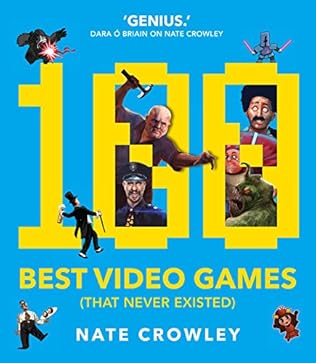
Microreview [book]: 100 Best Video Games (That Never Existed) by Nate Crowley

book cover of 100 Best Video Games

When Nate Crowley tweeted that he’d come up with an imaginary videogame for every like that the tweet received, he probably didn’t realize quite what an undertaking he was in for. I was one of the people who hit like on that tweet and watched as he slowly amassed a gigantic list of game titles that never were. So I was quite excited to see the resulting book that came out of this. 100 Best Video Games (That Never Existed) takes the idea and runs with it. Making summaries of the games (in a review-like structure) alongside date of release, company, and pictures from the games.

Some of the games take punny titles (like Moulin Luge) and go pretty much where you expect them to, while others such as Thomas the War Engine actually feel (if in a hilarious way) like they could be games (where getting dark reworkings is often a go-to tactic). Smaller sections within have themes and lead to some of the better jokes: such as Jurassic Park Accountant being one of the Film and TV Tie-In Games.

The book has a lot of charm and a good sense of playfulness running throughout. I also enjoyed how the pics from the game very clearly matched certain styles and eras of games. However, as with any book like this, it’s not one you’ll read straight through, but moreso find yourself wanting to randomly browse through it and read the occasional entry for the title that jumps out to you. While most of the game names are fun, oftentimes the summary hammers the joke home a little too hard.

The exception to that is my favorite of the games, Bread: The Game, in which the endless onslaught of puns were not only impressive (who knew there were so many bread puns possible) but also overstayed the joke so much that it circled around to being really funny again.

Ultimately, this is enjoyable and a strangely good idea to me, but it’s something that makes a good gift for the gamer or pun-lover in your friend group while anyone who doesn’t fall strongly into those two groups probably won’t find much to enjoy.

The Math

Baseline Assessment: 6/10


Bonuses: +1 for some very good puns, +1 for the artwork

Penalties: -1 for jokes feeling tired in some places, -1 for repetitiveness


Nerd Coefficient: 6/10 "
still enjoyable, but the flaws are hard to ignore"

***

POSTED BY: Chloe, speculative fiction fan in all forms, monster theorist, and Nerds of a Feather blogger since 2016.

Monday, November 6, 2017

NERD MUSIC: P.O.S.

I'm a casual fan of hip-hop, so I'm not going to pretend I can speak intelligently about trends or comparisons or whatnot, but one of my favorite artists working today is P.O.S., from the Minnesota hip-hop collective Doomtree (which is a phrase you've heard many times if you're a listener of the podcasts 99% Invisible or What Trump Can Teach Us About Con Law.

My favorite hip-hop album of all-time is still Deltron 3030 (whose sequel I reviewed here when that came out), but P.O.S.'s sophomore album Never Better may be number two on my list. I've spent nearly a decade playing guitar and singing in my current band, but I started out as a drummer, and in my heart, I'll always be a drummer. The massive, drum-forward production on Never Better continues to do that drummer's heart inside me a ton of good. The beats across the entire P.O.S. discography are big and catchy, and each album has something of a signature. The layered percussion throughout Never Better, the liberal use of Kaoss Pads on We Don't Even Live Here, and the melodic character and standout guest vocal appearances on his latest, Chill, Dummy.


The musical imagination across these records is at times jaw-dropping. At least once on each of these albums, I've grabbed somebody close to me and literally told them they had to come listen to this thing. My favorite example from Chill, Dummy, is the song "Thieves/Kings," which did it to me twice. The first time comes when P.O.S. gets so emotional on the track that he loses the chorus and has to just drop out to regain his composure — I realize this could either be legitimate or solid acting, but it carries a ton of emotional weight, all the same. Coming out of that moment the track goes into a sung guitar solo. That probably sounds laaaaame, but it's amazingly executed. There's heavy distortion on the vocal, which is either vocoded with a guitar or tracked alongside...it doesn't matter. It just sounds fantastic, and it's something I've never heard before.


Now, to circle back to the "nerd" part of "nerd music," just in case being vouched for by Roman Mars, ringleader of beautiful nerds everywhere, isn't quite selling you, then check out this partial list of lyrical references that I'm aware of:
  • one of my favorite Mitch Hedberg stand-up bits
  • Saved by the Bell
  • Fugazi
  • NOFX
  • They Live
  • A Crispin/Danny/Savion Glover cycle
  • actually name-checking Roman Mars
  • Geroge Orwell ("The doublespeak is legit / "Stand up for yourself, you worthless piece of shit!")
Beyond the musical imagination, the sense of humor, and the fact that a lot of the lyrics feel like one of my friends from high school or college suddenly got damn good at rapping and put a bunch of stuff we liked into hip hop songs, these are records with a political and social conscience. I have to admit that one reason why I never got as into hip hop as I might otherwise have are the lyrical tropes of misogyny, sexual conquest or prowess, and an emphasis on violence that run throughout a lot of the work that I've been exposed to. That stuff is absent here. In fact, many tracks seem to winkingly flout those expectations or stereotypical obsessions with what is sometimes called toxic masculinity ("Who's the best in the world?! / I don't know...you?") P.O.S. isn't about telling you he's the best rapper out there...he lets his records speak for him, and he does it with a nod to the nerdy, and nerd-adjacent, like me.

Buy Links

Never Better (Amazon, iTunes)
We Don't Even Live Here (Amazon, iTunes)
Chill, Dummy (Amazon, iTunes)

Stream Links
Never Better (Spotify)
We Don't Even Live Here (Spotify)
Chill, Dummy (Spotify)


Posted by Vance K — cult film reviewer and co-editor of nerds of a feather, flock together since 2012, musician, and Emmy Award-winning producer.

Friday, November 3, 2017

6 Books with Tim Pratt


Tim Pratt is the author of over 20 novels, most recently space opera The Wrong Stars, first in the Axiom series. His short stories have appeared in The Best American Short Stories, The Year's Best Fantasy, The Mammoth Book of Best New Horror, and other nice places. He's a Hugo Award winner for short fiction, and has been a finalist for World Fantasy, Sturgeon, Stoker, Mythopoeic, and Nebula Awards, among others. He's a senior editor at Locus magazine, and lives in Berkeley CA with his family. Every month he writes a new story for his Patreon supporters at www.patreon.com/timpratt

Today he shares his 6 books with us....


1. What book are you currently reading?

I'm halfway through Strange Weather, Joe Hill's new collection of novellas. I've been a fan of Joe's work since his collection 20th Century Ghosts came out in 2005 from a small British press (I was one of the first people in the US to review it), and it's been great to see him go from one success to another in the years since. His novels are great too, but I think he's underappreciated as a short fiction writer, and I'm glad he's got a new showcase for that kind of work.


2. What upcoming book you are really excited about?

Oh, loads. Looking forward to the new James S.A. Corey novel Persepolis Rising, because I love The Expanse series. There's a new Jack Reacher novel by Lee Child coming, and that's one of my favorite read-in-one-sitting thriller series. Kim Newman has a new Anno Dracula book on the horizon too. In non-series books I'm super excited for Molly Tanzer's Creatures of Will and Temper, which I understand is basically a twist on The Picture of Dorian Gray with lesbians and swordfighting.


3. Is there a book you're currently itching to re-read?

I have an urge to re-read Connie Willis's To Say Nothing of the Dog, but of course first I have to re-read her earlier Doomsday Book (which To Say Nothing of the Dog is sorta kinda a sequel to), and re-read Jerome K. Jerome's classic 1889 fictionalized travelogue Three Men in a Boat (To Say Nothing of the Dog), which Willis's book is partly an homage to. I think that will be my Christmas reading.


4. How about a book you've changed your mind about over time--either positively or negatively?

There are lots of books I read and loved as a kid that might not hold up to re-reading, but I try to avoid putting that to the test, and just cherish the memories instead.


5. What's one book, which you read as a child or young adult, that has had a lasting influence on your writing?

Are All the Giants Dead? by Mary Norton, a classic of children's literature about a boy from our world who travels to the realm of fairy tales, except it's a lot weirder than that sounds. I used to copy the exquisite Brian Froud illustrations when I was learning to draw, and I still often think of scenes and moments from the book. I'm looking forward to nudging my own son toward reading it.


6. And speaking of that, what's *your* latest book, and why is it awesome?

My new book The Wrong Stars is out November 7 from Angry Robot! It's space opera adventure with weird aliens and bizarre technology and harrowing threats and banter and kissing, first in the Axiom series (but it tells a standalone story). I've been publishing fantasy novels for a dozen years, but this is my first foray into spaceships-and-planets science fiction, and I'm super excited to be launching off in a new direction.


POSTED BY: Joe Sherry - Co-editor of Nerds of a Feather, 2017 Hugo Award Finalist for Best Fanzine. Writer / Editor of the mostly defunct Adventures in Reading since 2004. Minnesotan.  

Thursday, November 2, 2017

Thursday Morning Superhero

With the Secret Empire event behind us Steve Rogers is back behind Captain America's shield. While I enjoyed the twist of him working with Hydra, I feel Marvel is sending a signal with this week's issue that they are moving forward with a new chapter. I don't know if that has anything to do with Mark Waid's return to the series, but it feels like an olive branch has been extended to "fans" who haven't been reading as of late.


Pick of the Week:
Paper Girls #17 - Thanks to the friendly teachings of Charlotte, the girls finally learn some key facts about the mess they have found themselves in and the readers can rejoice. While it isn't clear why they were selected and what their role will be, they are in the middle of a time war called The Battle of the Ages. After the invention of time travel men called the old-timers vowed to stop anyone trying to interfere with the past or peacefully explore it. Not everyone agrees with this notion, hence the conflict, giant robots, weird aliens, etc. The question remains whether or not the girls should trust Charlotte and the information she keeps on hear orange iMac. Love the nostalgia in this series and really like how we are starting to see the bigger picture. While there is still a lot to unfold, a big weight is lifted for readers of this series and it has me really excited about this series again.

The Rest:
Darth Vader #7 - Now that Darth Vader is in charge of the Inquisitors, the hunt for the few remaining Jedi is in full swing. Sadly Jocasta Nu, the librarian of the Jedi, has been given extra attention. Without spoiling anything, the Emperor has a special plan for her and one that requires Vader's direct attention. One of the tidbits I really enjoyed in this issue is that Vader considers the Inquisitors weak and pathetic due to their lives as former Jedi. He considers their teachings to be a great weakness, but feels he can change them through the force. Even the Emperor considers them severely flawed and is clearly using them solely for his own gains. Charles Soule is doing a wonderful job with this series and it remains one of my top books.

Captain America #695 - It has been a long time since Captain America wielded the shield and a long time since I have read a Mark Waid title. This isn't intentional as he is one of my favorite authors, but something that hit me when I decided to return to this series. Waid pairs up with Chris Samnee for this issue, a one-shot that highlights what Captain America stands for and the importance of helping those in need. A nice touching issue that will move us past the "evil" Captain America who was a sleeper Hydra Agent. I admittedly enjoyed that twist, but am happy to see a return to roots.


POSTED BY MIKE N. aka Victor Domashev -- comic guy, proudly raising nerdy kids, and Nerds of a Feather contributor since 2012.

Wednesday, November 1, 2017

MAPPING SHORT SF/F: Part 2: Fun Short SFF

Fun. For some people, fun evokes childhood and a certain kind of carefree energy. For others, it means something more like excitement and adventure and novelty. Mapping fun short SFF is something of a challenge, not because I cannot point to works that I’d consider fun, but because fun is a weirdly nebulous term that, like most things, I probably define oddly in terms of genre. But, as that what I’m seeking to do in this series, I’ll do my best.

To me, fun as a genre operates a lot like horror does. It’s not so much about elements of world building or how the piece conveys message. It’s not about theme or about any one style. When I say it operates a lot like horror, what I mean is that they both are built around a feeling. Horror as a genre is defined (or at least I define it) by its ability to evoke fear and unease in the reader. Whether the story seeks to do that through gore or violence, or through atmosphere and suspense, doesn’t matter so much, because it’s all horror. Similarly, for a story to be fun, it has to be about evoking an emotion. Instead of fear, though, I’d say that fun is about joy. To me, fun SFF stories are those that seek to make the reader feel joyous. Which, given the times, is both an incredibly difficult and important mission.


Now, I’ll start with the bad news. Fun seems like a rather difficult genre to pin down, and also a difficult one to market. I know that there is an assumption that some people have when they see the word fun it means easy or simple or...not important or impacting. There aren’t to my knowledge too many venues that specialize in fun SFF, though there have been a few that have tried. First and foremost, Mothership Zeta did an excellent job of exploring what fun SFF could look like. Released as a non-podcast branch of the Escape Artists, Mothership Zeta released a number of issues bursting with stories of all sorts of short SFF, all with the editorial intent to explore the intersection of speculative fiction and fun. And it did so with stories that were romantic, stories that were gripping, stories that were suspenseful and epic. There was a huge range of stories that the publication looked at, and a huge range of subgenres represented. I loved the publication, and while sadly it is on indefinite hiatus, it remains the sole “pro-level” publication I can think of that so intensely pursued fun as its goal.


Similarly, The Sockdolager had a focus on stories “that are fun to read.” So from an editorial level, The Sockdolager was looking to push stories that were fun, what flowed quickly and left the reader feeling invigorated and joyful. Which, again, doesn’t mean that they were only happy stories, or that they were without violence or meaning. My favorite horror story of 2016, “Butter-Daughters” by Nin Harris, came out at The Sockdolager, and it’s loads of fun as well as intensely creepy. It perhaps didn’t range quite so widely as Mothership Zeta in terms of pacing, preferring (in my opinion) rather fast-moving and punchy stories instead of more romantic or slower narratives, but I can safely say that the publication was always rather fun to read. It’s another publication, though, that has sadly closed its doors, and together with Mothership Zeta it makes the number of publications specifically interested in fun SFF...well, kinda slim.

That’s not to say that there’s no fun to be had. The other Escape Artists podcasts, especially Cast of Wonders, has a rather fun feel to them. Now, here’s where I have to slow down a little and say that it’s often the case that YA SFF or SFF geared toward younger audiences does often lean a bit more in the fun direction than does more “mainstream” SFF. There are reasons for this and not reasons I feel like going into here in great depth but, well...

MINI-RANT: There’s a whole long discussion that we could have about aesthetics and fun and art. Within SFF this is a very tangled and complex web, because genre work is often dismissed as fluff or without literary merit or escapist drivel or...all that. And in counter to that, there is a lot of SFF that brings in traditions that are more associated with literary fiction (and defining that would be another exercise is pain), by which I mean short fiction that is often considered for the highest awards for literature. There are also camps, though, that resist this effort to make SFF “more literary” or “more artistic,” not because they believe that SFF (and all genres, really) are already artistic and worthy of discussion and examination of art without shaming people’s tastes or preferences, but because they condemn “literary” fiction and “artful” fiction as pretentious and dull. So suffice it to say that we’re into some heady waters here. I do not believe that being fun makes a work suddenly not adult or not artistic (and again, not that I’d ever argue YA isn’t artistic, either). But I do recognize that YA and fun intersect or perhaps are allowed and expected to intersect more frequently than “mainstream” SFF and fun, so for those hungry for fun SFF, checking out the YA publications (Cast of Wonders and Cicada specifically), might yield some fruitful searches.
Similarly, checking out where SFF intersects with other genres often leads to finding a bit more freedom with regards to fun. While it ran, Urban Fantasy Magazine had a number of fun stories, and those looking for where SFF and romance intersect can find a whole slew of fun SFF stories that deal with relationships and spaceships, magic, and monsters. Indeed, for those looking for fun queer stories, checking out small queer presses (like Lethe, Circlet, Less Than Three, Dreamspinner, JMS, & more) can lead to finding fun SFF that gets pushed to the margins because it contains fun queer relationships, and these can come in all levels of heat (from lots of sex! to no sex at all to everything in between). Admittedly, finding short fiction of this sort normally requires searching for anthologies (of which there are many), or else shopping the individual ebooks of shorter works (which can be difficult when comparing it to the “mostly free” stuff that dominates “mainstream” SFF). It also means that you might end up putting down money for something you don’t much care for, and especially for those for whom money is tight, this can be a real barrier to getting at fun stories.

But FUN! Let's get back to what's out there. Though the number of fun-specific venues has decreased, that doesn’t mean that there aren’t publications that regularly put out really fun stories. I want to highlight three more that spring to mind as being good places to start. The first is Fireside Fiction. Especially at the flash fiction length, it often has joyfully fun stories, like "A Silhouette Against Armageddon" by John Wiswell and “Feeding Mr. Whiskers” by Dawn Bonnano. The publication definitely trades in darker and denser works as well, but fans of fun will be well served keeping an eye out for their weekly releases.


Secondly, The Book Smugglers put out some amazingly fun stories, both shorter stories to read for free as part of their yearly themes (this year was Gods & Monsters) and for their longer work such as the Novella Initiative. Again, some of their work does drive very dark, but there's a charming quality to so much of it and lots of it is just amazingly fun. Go read Hurricane Heels by Isabel Yap, which is at times intense and at times rather violent but which is all about friendship and hope and joy. There's "Superior" by Jessica Lack and "Avi Cantor Has Six Months To Live" by Sacha Lamb and just so many stellar stories that center heart and fun. The publication doesn't tend to put a huge amount, but they're growing, and they're definitely one of my go-to sources for fun.

Thirdly, Daily Science Fiction is also well worth checking out. Given how much they put out, perhaps it’s not surprising that they hit the “fun zone” often enough, but I think overall the driving aesthetic of the publication leans more towards the fast and fun. These are pieces that are meant to be read almost every day, and as such they often act as little rays of sunshine to lift the spirits and inspire a push toward freedom and joy. There's a lot to sift through, but you'll find a lot of treasure if you give it a go.

I could go on with publications that often have some fun stories but I would challenge readers that if they want fun it’s often to go straight to the source, and perhaps track down your favorite writer of fun SFF and see if they have a Patreon. As this skirts around most gate-keeping in SFF, it’s often a place where authors can explore joyous stories without the crushing question of “can I sell this” or, if they’ve tried and failed to sell it, “what the fuck do I do with this now.” I can personally recommend the Patreons of Rose Lemberg, Merc Rustad, and Bogi Takács, where I’ve read recent fun SFF such as Lemberg's “The Splendid Goat Adventure” and Rustad's “Just Like Mombeast Used to Make.” The Patreon of Lethe Press also offers levels of support that include short stories, many of which are fun (and very queer). Obviously not all the content is going to be fun, but in my experience so far Patreon is a place that creators go to put up the stories they want to tell that they might not think will please “mainstream” venues. These works are often a bit freer, a bit looser, and a bit more fun than you might find elsewhere, so my advice is that if you find a piece that you love and is fun and want more, track the author down and see if they offer more like it through a Patreon.

Unfortunately, I think a lot of my advice is going to run along similar lines. Namely, that because fun SFF is something that is often viewed as...less marketable, I guess, it’s not often something publications take as many chances on (at least at the short fiction level). Which means that the costs of finding it are often passed down to the fans. It’s out there. There’s the Unidentified Funny Objects series of anthologies which are loads of fun and funny to boot, but these are not things that you’ll get access to for free. Patreons, small presses, anthologies...at least at the short fiction level most of the more reliable sources of fun require a monetary investment. The good news is that there is a lot out there to support, and that your support can make a huge difference for people trying to do more with fun SFF. The bad news is that it can feel like fun SFF (and especially fun SFF that crosses other boundaries, like allowing marginalized character to just be happy and have adventures) isn’t incredibly welcome. It’s a complex conversation that SFF is having with itself and with the larger writing landscape, and one that continues to be tricky to navigate. In the wake of that conversation, the map of fun short SFF has some noticeable holes, gaps, and ruts. It doesn’t mean you can’t find what you’re looking for, just that it’s not the easiest of tasks, made more difficult by some recent closings of publications. But hey, some might rise to take their places, or they might even rise from the dead. There’s always hope, and where there’s hope, there’s often fun.

So thank you all for joining me on this first cartographic adventure! If you want to help determine what continent of short SFF I’ll be trying to map next, find me on Twitter and vote in my poll (closes date). Cheers!

[For those looking for the previous Mapping Short SFF installment, check it out here: A Key to the Kingdom]

---

POSTED BY: Charles, avid reader, reviewer, and sometimes writer of speculative fiction. Contributor to Nerds of a Feather since 2014.

Tuesday, October 31, 2017

Fright vs. Fright: The House of Seven Gables

Fright vs. Fright is a series of comparisons between classic horror films and the lesser-known works that inspired them, or subsequent remakes that stand on their own merits.

The Film: Twice-Told Tales (1963)

The Plot: Twice-Told Tales is an anthology film, like many that were produced around the same time period, including Tales of Terror and Dr. Terror's House of Horrors. In this case, each of the three stories are inspired by the writing of Nathaniel Hawthorne. although only one of them actually comes from Hawthorne's short-story collection of the same name. The longest of the three, and most elaborate, is "The House of Seven Gables." In it, Gerald Pyncheon returns to his family home with his new bride Alice in order to try to find a treasure rumored to have been hidden when the house was constructed. But that construction wound up with the house falling under the curse of its maker, since Pyncheon's ancestor decided to accuse the architect, Matthew Maule, of witchcraft rather than pay him. Now, Alice begins seeing visions of Matthew and feeling drawn to Jonathan Maule, Matthew's descendant. All the while, Gerald's sister Hannah keeps reminding Gerald that he shouldn't have come back, since all Pyncheon men are cursed to die "with blood on their lips." And a painting of the first Pyncheon hanging on the wall in the study keeps bleeding from the mouth, and Gerald's drinking water keeps turning to blood. Just in case he didn't believe in spook-stuff. When Gerald thinks he's finally onto the treasure, he gets a little bloodthirsty (in the more traditional sense), and it becomes less and less certain that anybody will get out of this mess alive.

The Good, The Bad, The Indifferent: Twice-Told Tales is one of my favorite Vincent Price movies, and one I come back to almost every year around Halloween. The first two stories — "Dr. Heidigger's Experiment" and "Rappaccini's Daughter" — both have a lot of pathos and interesting twists, after a fashion. But "The House of Seven Gables" is all mustache-twirling scheming and ghost retribution. It amplifies the supernatural elements hinted at in the original story, and is short enough that in stripping away almost all but those elements, it's just Code-Era Hollywood gory fun. I'm wracking my brain to find something negative to say about it, but if you like this kind of thing, it's pretty great. But it is very much this early-60s horror vibe and not much else, so if that's not your bag, you'll probably be left flat.

Based On: The House of Seven Gables (1940)

How It Stacks Up: Watching this movie was kind of a joy. I realize that both versions share the same source material, so the 1963 version isn't directly inspired by the 1940 version, but that both of them feature Vincent Price in the lead, in two different roles, in two very different films made over 20 years apart was a lot of fun to see. This 1940 version hews much more closely to the source material, and any trace of the supernatural is circumstantial at best. Hawthorne was vexed by his family's involvement in the Salem Witch Trials two centuries earlier, and so his characters need not turn to the supernatural to do evil (even if they do invoke it for personal gain). There's no blood, really, and no horror, come to that, apart from how basely a man may treat his (literal) brother in the name of greed, so this film falls much more in line with films like the subsequent Portrait of Jennie or the Orson Welles/Joan Fontaine Jane Eyre (both the same decade), which you might call supernatural-adjacent, Old Hollywood romances.

Worth a Watch? Seeing Vincent Price play a romantic lead only two years after he made his first film is definitely worth a watch. It's not spooky, so maybe skip it for Halloween and go with Twice-Told Tales, but for sure put this one on your list for when that old-movie itch hits you.

Fun bit of connective tissue: Vincent Price, who featured last week in The Fly, brings us back to this film. So while it was completely unintentional, each of the films in this series has been connected by a performer. That we began and ended with Vincent is just icing on the cake.

Posted by Vance K — cult film reviewer and co-editor of nerds of a feather, flock together since 2012. Perennial watcher of dozens of horror movies each October. Does not live in a haunted house, despite what his son's friend thinks (look, kid, it was just the cats...).