Hi, folks. Vance here, one of the nerds of a feather co-editors. As Florida and Georgia now grapple with Hurricane Irma, the cleanup is beginning in Houston after the unprecedented flood waters brought about by Hurricane Harvey. This blog has a personal connection to Houston, as I and one of our other contributors are both originally from the city. We watched from a distance as our family and friends had to be evacuated, suffered catastrophic flood damage, and are now having to go back into their homes and strip them, in some cases, down to the timbers to try to save them.
I wanted to help, even if in some humble way, so I got my band into the studio at the end of last week and we recorded a version of the 1929 Delta Blues classic (more famously covered by Led Zeppelin) "When the Levee Breaks," and have released it as a fundraiser for Houston. If you'd like to pitch in to help the people (and pets) of Houston, we'll be donating everything we make from the song to the Houston Humane Society, and the Greater Houston Community Foundation Hurricane Harvey Relief Fund, which is run out of the mayor's office.
If you'd like to help out with the relief effort, I know there are lots of ways to do it, but I wanted to take a second to make you aware of this one, too. Help out for Hurricane Harvey relief, get a song as a thank you.
For more information on the song, or why we chose the charities we did, or how two cats inspired this whole process, you can read about that here.
Jonathan Strahan is a World Fantasy Award award-winning editor, anthologist, and podcaster. He has edited more than 70 books, is reviews editor for Locus, a consulting editor for Tor.com, and co-host and producer of the Hugo-nominated Coode Street Podcast. Today he shares his 6 books with us...
1. What book are you currently reading?
I’m currently reading the latest Tom Holt novel, The Management Style of the Supreme Beings, which is a lot of fun. It’s a satire on religion, and reminds me a lot of Jeremy Leven’s Satan, His Psychotherapy and Cure by the Unfortunate Dr. Kassler, J.S.P.S., which is a weird book I read years ago, and a bit of James Morrow’s Only Begotten Daughter, which I adore.
2. What upcoming book you are really excited about?
William Gibson’s Agency. I am always floored by Gibson’s work and I don’t think we’ve ever needed his worldview more than we do right now.
3. Is there a book you're currently itching to re-read?
Hmm. I don’t get to re-read much at all. You know how life is when you’re up to your neck in reading new stuff. There’s no time. But I’d love to re-read some Terry Pratchett. Possibly Guards, Guards! or Night Watch. Terrifyingly smart, funny, and also kind. Pratchett’s best books are always worth revisiting.
4. How about a book you've changed your mind about over time--either positively or negatively?
Hmm. Asimov’s Foundation. I loved it when I was young. Was sure it was going to be terrible to revisit when I was in my 20s, and found that it was actually surprisingly fresh and readable when I went back to it.
5. What's one book, which you read as a child or young adult, that has had a lasting influence on your editing?
One book? There are a couple, but probably the single most influential book on my editing was Michael Bishop’s superb 1984 anthology Light Years and Dark, which changed my reading, opened me up to new approaches and perspectives and introduced me to a whole pile of writers who have since become favourites. It’s the benchmark in the back of my mind every time I start work on a new book.
6. And speaking of that, what's *your* latest book, and why is it awesome?
Infinity Wars. It’s the latest in the Infinity series and, as the title suggests, this time it’s looking at war and conflict. It’s awesome because fifteen smart, talented people have produced incredible stories that give new perspectives on war and living through and beyond it. The stories are whipsmart and great stuff. Whether you loved Starship Troopers, The Forever War, or Miles Vorkosigan and Honor Harrington, there’s something for everyone.
POSTED
BY: Joe Sherry - Co-editor of Nerds of a Feather, 2017 Hugo Award
Finalist for Best Fanzine. Writer / Editor of the mostly defunct Adventures in Reading since 2004. Minnesotan.
Hi
everyone. Have we met? My name is Charles and I read a lot of short
SFF. I feel like every time I write that it should be read as if
opening an AA meeting. Because, well...I’m a bit of a
short-sff-aholic. It’s...well, something of a problem. But my
problem can be your gain! Because I find that what I hear most when
talking about short SFF as a field is that there’s Just. So. Much.
And there is! Far more than any one person can read. Which is only
really a problem if one just wanders in without a map. That’s where
I come in. In this series I want to start to map the short SFF field
with an eye toward giving readers the tools to find the stories
they’re most interested in reading, or to find new
publications/subgenres/authors that they might not have otherwise
tried.
Maps
are interesting things. On the one hand, they can firm up borders.
They can create walls. They can codify injustices. On the other hand,
they can be vital tools not only for not getting lost or getting to
where you want to go, but for knowing what’s out there. Maps can be
about setting expectations before pushing into the relative unknown.
Maps can also be about describing a lack, as oftentimes the vast
unmarked areas on maps are just as telling as the clear lines of
city, state, and country. And, of course, every map bears the marks
of its creator, is a text that tells a story. I cannot and will not
attempt to tell you that the maps I make will not reflect me and my
interpretation of what’s out there. I can only be as up front about
it as I can. I am a reader and writer of short SFF. I read widely,
and have published widely, and that will color how I think about and
how I reveal short SFF to you.
First
off, some definitions of terms. Because any map that’s useful is
going to have a key. Let’s get some essentials out of the way.
Short
SFF
- Any speculative fiction shorter than novel-length (flash, short
story, novelette, novella) as well as speculative poetry and
nonfiction.
But
wait, fuck, I did that thing where I defined something with a term
that probably also needs to be defined. So…
Speculative
fiction
- Fiction that requires
the writer to break one of the “rules” of accepted reality. Be it
magic, technology, alternate history—speculative fiction is about
asking “what if something
was different than we accept it to be?”
This
is, I grant you, a rather nebulous definition of speculative fiction
that is based not on a piece predicting technology or even being
“untrue.” To me, the sole thing a piece of speculative fiction
must do is break a rule that is considered
to be true
currently. Rules change. Technology changes. History changes. But if
the author is consciously breaking with how we conceive of and
organize the “real world,” then I consider what they are writing
to be speculative. Yes, this means my definition is based in some way
on the author, not the reader. Fight me.
But
with that out of the way, let me run down a few definitions that I
find helpful for more specific genres.
Fantasy
- Fiction where the “rules” broken concern magic or the
supernatural (also, loosely, variants to accepted history).
Science
Fiction
- Fiction where the “rules” broken concern technology or
extraterrestrial beings (also, loosely, depictions of the future).
Horror
- Not necessarily speculative but based on the feeling of fear evoked
in the reader. It becomes a qualifier of speculative fiction, though,
as in speculative horror, or SFF horror, which would be fiction that
breaks the “rules” of accepted reality and
focuses on the feeling of fear evoked in the reader, often in the
distance between accepted reality and the reality the work
introduces.
Obviously
those are the Big categories, sort of like the continents of short
SFF. I will typically be looking at things a bit more specific than
that, what most would consider subgenres. I’d actually list
speculative horror as a subgenre, and a particularly robust one, and
also the only subgenre of horror that I’ll probably be looking at
because it’s the overlap between Horror the genre and Speculative
Fiction the super-genre. And are you tired yet?
Anyway!
I just want to give you an idea of how I’m approaching the process
of map-making. I’m not incredibly interested in drawing lines
between “hard” science fiction and “soft” science fiction.
Really, the reasons I want to do this can be broken down thusly:
To
provide a tool for readers to break down short SFF into meaningful,
manageable chunks that will help them locate stories they will
hopefully love.
To
counter the narrative that short SFF is either too massive, too
disparate, or too opaque to be successfully navigated.
To
talk about short SFF, which is one of my great loves.
To
highlight publications, authors, and trends within short SFF.
That
is perhaps an ambitious list of goals for this series, but that’s
the aim. In my head each installment will explore a certain area of
short SFF, mapping it as thoroughly as possible (for me) in the
current landscape (with perhaps some notes as to the recent past). I
will provide links to examples of stories and publications and
resources I find helpful to mapping short SFF, and I will try to be
as open to feedback as possible. If you have suggestions on what
you’d most like to see, or particular kinds of short SFF you want
help finding more of, please sound off in the comments.
One
last thing before I close this down. People often come to me to ask
how to find stories. How to refine their search. While I hope to help
through this series, there are some tools that are available to you
right now, and I find that not everyone thinks of this when they’re
considering where to look as readers for particular
genres/styles/etc. Your best resource as a reader is…submissions
guidelines. Yes, they are written for writers, but if you want to
know what a publication is interested in, submissions guidelines are
where to look. Skip the About Us section of publications. Read what
they want. See if they have a diversity statement. Check to see what
other tactics they might have to encourage marginalized writers to
submit. This is a really easy “cheat” for readers to get a feel
for a publication without checking out reviews or reading sample
stories. And using a tool like The Submissions Grinder at Diabolical Plots allows you to search by genre, by length, by basically whatever
you want. It’s not what it was designed for, but it is amazing for
searching out venues and stories to read.
Plus,
well, all the short fiction reviewers out there. There are many. I
will do a post specifically about reviews and reviewers at some point
but yeah, reviewers are a resource.
So
I hope you’ll find this series helpful. Cheers!
---
POSTED BY: Charles, avid reader, reviewer, and sometimes writer of speculative fiction. Contributor to Nerds of a Feather since 2014.
I felt a bit dirty as I paid for my comics this week and left the new issue of The Walking Dead on the shelf. I started reading the series with some of the trades, but switched to single issues when I caught up sometime in 2011. I have been a loyal reader for six years, but feel that I need to take a step back and take a break from Rick and focus on other titles. I am not saying that it has overstayed its welcome, but I worry that if I don't take a break it is a title I am going to no longer enjoy. I have grand plans for starting at the beginning again soon and hope that I will have a better appreciation for where things are if I return to where it all began.
Pick of the Week: All New Guardians of the Galaxy #9 - Gerry Duggan hits us with an emotional Guardians issue this week. Rocket and Groot went to collect the credits for their last heist, only to be ambushed by a mysterious figure dressed like Death. One of the most endearing aspects of the Guardians, in my opinion, is the connection that the reader has to the characters and the connection the characters have with each other. While I admit that I haven't read a ton of Guardians comics, Duggan does an exceptional job of bringing that raw emotion to the page. While I am not sure what the final twist in this book implies, I am definitely tuning in to the next issue to learn what really happened to Groot and who this mysterious Gardner is. I picked up this book on a slow week to check it out and it has quickly become one of my favorite ongoing titles that I am currently reading.
The Rest: Daredevil #26 - Part one of "The Land of the Blind" is a doozy of an issue! We learn that Daredevil is still feeling guilty over the fate of Blindspot, and is currently assisting on the turf that Blindspot used to protect. A mysterious message turns up inviting Daredevil to China at the request of his old partner. Weary it may be a trap, Daredevil makes the trip and is ambushed by the Hand. While pretty formulaic, I welcome the legal break we seem to be in store for and look forward to some good old fashioned action. There are mysterious powers and beings in play and I am excited to see what Charles Soule has planned for the man without fear.
Star Wars Adventures #1 - I'm not sure how IDW has the licence to write Star Wars comics, but I am pleasantly surprised with this incredibly fun debut. Aimed for a younger audience than the Marvel books, Star Wars Adventures features two short stories that are both very enjoyable. The first is part one of a bigger series that focuses on the life of Rey when she was a scrapper on Jakku. The second is a one-off story that centers around Obi-Wan during the Clone Wars. Both are lighthearted, entertaining, and highly recommended for Star Wars fans both young and old. I definitely am looking forward to sharing my copy with my kids.
Lark's Killer #2 - The second issue of Bill Willingham's new comic continued the story of Lark, a runaway who found her self transported into a fantasy land after a shoplifting attempt at Walgreens went awry. In the first issue she narrowly escaped a group that was trying to kill her, and in this issue we learn a bit more about Frogbarding, the sell sword who accepted her offer of one dollar to escort her out of the town of Mercy Rock. Willingham taught us a bit more about this world of his and that the governor is using ghost holes, portals between worlds, for some nefarious purpose. Whatever brought Lark to this land, she poses a serious threat to his ultimate plan and he plans on killing her and anyone she interacts with.
POSTED BY MIKE N. aka Victor Domashev -- comic guy, proudly raising nerdy kids, and Nerds of a Feather contributor since 2012.
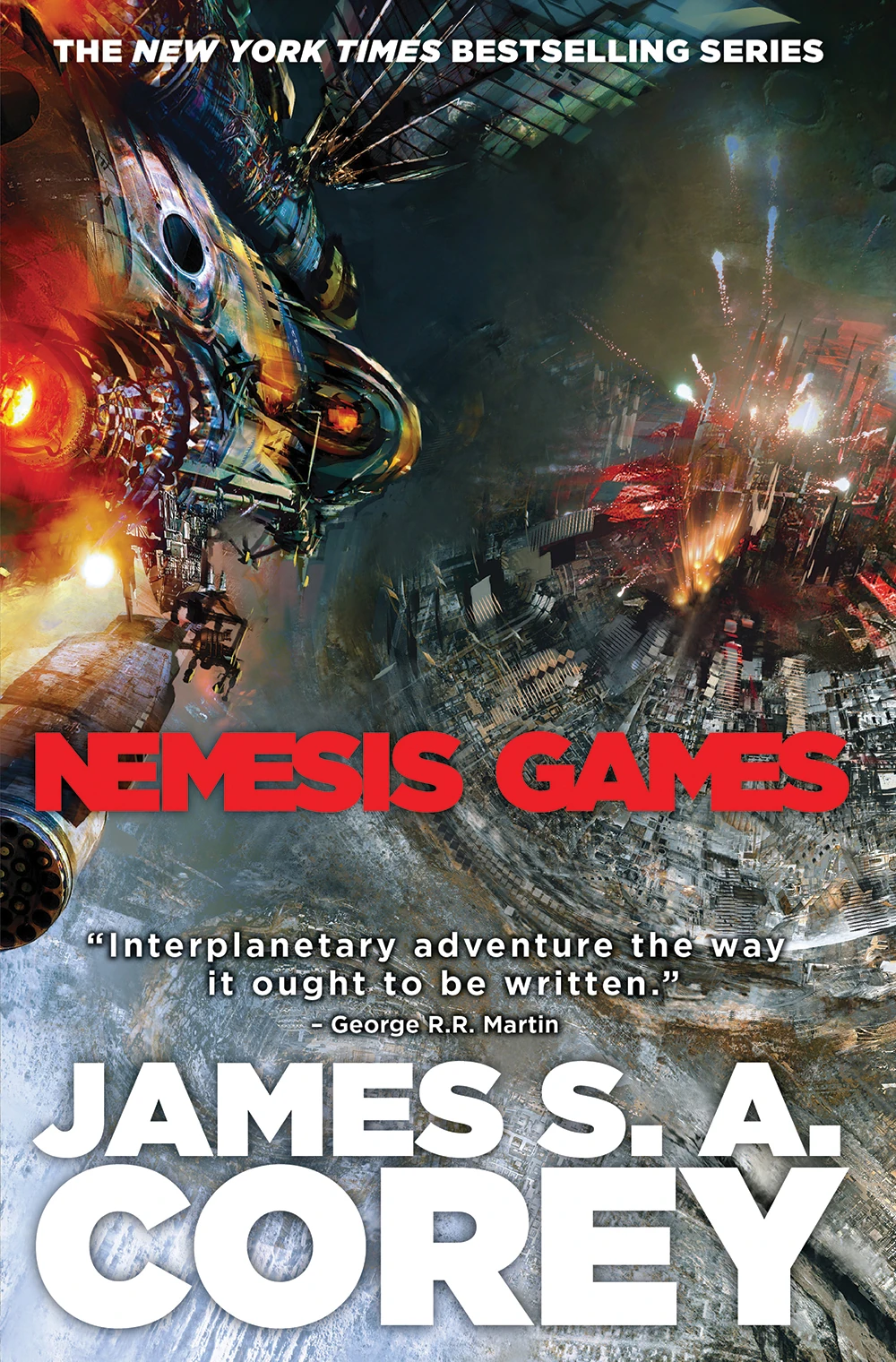
Since there was a bit too much familiarity about the crew of
the Roci by book four—a sense that if they pooled their efforts they could
somehow triumph against any obstacle, even an alien one—it seemed the series
was building to a problem serious enough to jeopardize the synergistic
relationship the four had. Sure enough, Nemesis Games almost immediately sends
all four main crew members off on disparate quests, with little chance to
affect each others’ situations.
This sort of ‘scattered to the ends of the earth solar
system’ setup entails some risks. Since we have grown accustomed to having the
Roci’s crew (not to mention the Roci herself, practically a fifth main cast
member at this point) demonstrate the importance of interpersonal relations by
solving every problem together, how will the story proceed if we, the readers,
are denied the pleasure of seeing them work together (and denied any meaningful
glimpse of the Roci, out of commission temporarily due to damage sustained in
Cibola Burn)?
I’m pleased to say that the authors of The Expanse did a
masterful job of what is essentially back-story exposition (no easy task to
avoid the typical sort of “You know I don’t like snakes…(and I'm saying this now because lots of snakes are in the near future)” clumsiness, but they managed it!), giving
us a major glimpse into everyone’s past (well, everyone but Holden). We learn,
in essence, some of the key reasons such a skilled group were on the Canterbury
in the first place: what they were running from, and why. Since the core
relationship on the Rocinante is the one between Holden and (Naomi) Nagata, it
is only fitting that it is this romance which is most directly imperiled by the
reemergence of these shady pasts.
All this might sound pretty small-time—the ghosts of the
main characters’ misdeeds rearing their ugly heads might be scary to those
individuals, but it would hardly measure up to the sort of civilization-ending
threat these four (+ the Roci) have faced previously. At the risk of being
terribly mysterious (thank you, The Sphinx from Mystery Men!), I’ll say only that the stakes
turn out to be all too high, the threat all too dire. Just when we thought the
worst that was in store was the addition of new crew members to the Roci, and
the risk that both the diegetic dynamic and the reader’s appreciation for the
tight-knit crew of four could be shaken, we discover that the true danger is to
the core of human civilization itself!
Does the "Holden+Nagata, Alex and Amos too" dynamic survive this
dire challenge? Is this, in fact, the best Expanse book yet? (Given The G's almost visceral dislike for the first book in the series, one could optimistically say that it must be getting better overall!) You’ll just have to read it to find out! (Alternatively, you
could check out my forthcoming review of book six, Babylon’s Ashes—check back here on NOAF soonish!)
The Math:
Objective Assessment: 7/10
Bonuses: +1 for masterful exposition, without a single “But
you KNOW I can’t eat strawberries!” ham-fisted foreshadowing, +1 for
successfully upping the ante—with a vengeance!
Penalties: -1 for describing Nagata’s protracted ordeal in what struck
me as a conspicuously pseudo-scientific manner (in essence, hit stuff with a
wrench after a serious physical injury/setback, but still get one’s message
through without being “permanently damaged”, to quote Vader)
Funny how main characters seem to survive just about anything, eh Naomi? Keep swimming around unprotected in deep space--I'm sure everything will work out!
Nerd coefficient: 8/10 “A bit of alright”, as the
Australians say!
***
[Puzzled by our scoring system? Learn why 8/10 is an
exceedingly high score here.]
Reference: Abraham, Daniel and Ty Frank. Nemesis Games. Orbit, 2016.
All the comments and opinions written here are solely
Zhaoyun’s, longtime lover of space opera and fantasy literature and reviewer
for Nerds of a Feather since 2013, and should not necessarily be taken to
represent all Nerd-kind.
7 Wonders Duel by Repos Production - My wife was kind enough to get me this game as a Christmas gift even though she had no intention of playing it with me. I was worried that it might be a bit too much for my 10 year old son, but after playing it I was amazed at how slick this game is and how it streamlines the decision making process. 7 Wonders Duel attempts to provide a two-player experience based on the mega-hit card drafting game 7 Wonders. You are competing with a rival city to develop as much as you can over three ages. You are working towards the construction of wonders, while also cultivating a quality of life for your residents with a solid military, investment in the arts, and others. Turns are quick and simply and involve taking a card from the available area, and either purchasing it and building it in your city or cashing it in for gold. In addition to maintaining your city and working towards your wonders, you have to keep an eye on the military balance between your city and your opponents. While I wasn't blown away in my first play through, I immediately wanted to play again to mix things up. It was quick to learn, quick to setup, and offered multiple strategies on the path to victory. Definitely happy to have this in my collection and cannot wait to play it again.
Dastardly Dirigibles by Fireside Games - This is a game all about building your own steampunk blimp in order to score the most points. Game play is extremely simple and this game makes a good filler game or one to play with non-gamer or younger players. The twist in Dastardly Dirigibles is that when you build on your airship, your opponents must build the same part if possible. This can take away from their bonus or potentially provide a bigger bonus depending on the suit. There are few "event" type cards that mix things up a bit more, but in the end this game is extremely light and quite a bit of fun. I don't imagine it will hit my table a ton, but it will be a game that pops out from time to time depending on the group. One nice thing about each round is that you get to marvel at everyone's dirigibles as the game includes some pretty cool art.
POSTED BY MIKE N. aka Victor Domashev -- comic guy, proudly raising nerdy kids, and Nerds of a Feather contributor since 2012.
[Warning: spoilers everywhere]
I'll admit I'm not the biggest fan of HBO's Game of Thrones. I'd read the first four A Song of Ice and Fire books twice by the time the show debuted in 2011, and have strong, positive feelings about the first three. I love the characters, the meticulous detail that George R. R. Martin put into world building, and the lore. And of course on top of that, the books are impossible to put down. I spent many a night prying my eyes open by sheer force of will, determined to find out what happened next.
Then came the show, which in its first season seemed like a near perfect distillation of A Game of Thrones. The actors embodied the characters they played; the sets brought Westeros to life; and the lore--it was there too. I was beyond excited for Season 2, when the show would move on to the events portrayed in my favorite of the books, A Clash of Kings.
Only, I found myself slowly falling out of love with the show. You see, it's impossible to capture all the detail of a 700+ page book in a 10-episode season, and that was doubly true once the scale of the drama shifted from the closed-door intrigues of A Game of Thrones to the cross-continental wars of A Clash of Kings. So the writers and producers had to pick and choose what they would bring to screen, as well as take some shortcuts. All quite understandable, really.
Unfortunately, they chose to emphasize what are to me the most problematic and least attractive elements of the books, namely, their excess of cruelty and sexual violence. And the show didn't *just* emphasize these elements; it made them more central, upfront and over-the-top. Meanwhile, I was getting less of the things that made reading the books a magical experience for me--less than I wanted, at least.
At the same time, the source material was still really good, so despite having issues with the show, I was still getting a visually arresting, immersive television adaptation of books I really liked. Thus I could hold out hope that show might actually fix A Feast for Crows and A Dance with Dragons, the latter of which I found simultaneously tedious and splatterpornographic.
I would be disappointed, as the show retained most of the tedium and, once again, chose to amplify the splatterporn. The worst came in Season 5, which lingered on some of the most agonizingly boring storylines in A Feast for Crows (e.g. the sparrows, Dorne) and then chose to depart from the books in order to burn a child alive at the stake. That was it for me. I was done.
Only, then Season 7 rolled around--the first that would not have Martin's novels as a guide.* And given that we're still waiting for The Winds of Winter, six years after A Dance with Dragons, there's a good chance that the book series will never be done. So for those of us who've invested a lot of time and thought into the story, this may be the only form of closure we ever get. I decided to catch up with Season 6--which was very good at points, and not very good at others. But I was excited again, more than I had been since the start of Season 2.
[*The show moves past the books midway through Season 6, to be precise.]
So how was Season 7? To quote...
"It Was the Best of Times...
Season 7 is, in a word, campy. But don't take that the wrong way--campy can be great too. And this season was gratifying in a lot of ways.
To begin, I appreciated the shift in how the show treats sexual relationships. Both Game of Thrones and A Song of Ice and Fire are very rapey. The books feature more rape than the show, while the show makes up for that by making every rape graphic and in-your-face rather than, say, a reference within in conversation. The low point, for me, was Sansa's rape by Ramsey in Season 5 (which, one notes, is not in the books). Season 7 stops using rape as a go-to device to illustrate how grim and dark this world is. And as far as I'm concerned, that's a very positive development.
But that's not all. Season 7 also allows its characters genuinely romantic moments, so much that the contrast with previous seasons is immediately striking (Jon's doomed relationship with Ygritte notwithstanding). And somehow, among all the things that don't make sense about Season 7 (more on that later), the budding romance between Jon and Danaerys does--on a personal level, at least.
I also appreciated the renewed focus on action. One thing Martin does exquisitely well, and which has also translated well in the TV adaption, is maneuvering chess pieces to build tension and momentum toward rare but superbly-rendered set-piece action scenes. Well, the first 3 books/4 seasons of the show do that at least. In truth, the maneuvering got really wearying in A Feast For Crows/A Dance with Dragons, as well as in Seasons 5 and 6 of the show, where it essentially became an exercise in wheel spinning. So it was nice to see the producers de-emphasize intrigue in favor of more action. That's what the series needs at this point. Even Euron Greyjoy, that most ridiculous and cartoonish of characters, stops talking long enough to give us an epic sea battle.
Trogdor!!!!! I mean...Drogon!!!!!
Also welcome, while Season 7 contains a lot of violence, it doesn't linger on moments of cruelty like the show has previously, to ever-diminishing effect. That breaks the cycle of always needing to go further, from rape to torture to castration to child sacrifice. Instead, we get dragons burninating the countryside--a moment we've all been waiting for. Hell, I don't even think I'd mind if the rest of the show was just Danaerys engulfing the show's many villains in flames. Especially Euron. That guy's annoying as shit.
If that means Game of Thrones feels a bit more like an Arnold Schwarzenegger film, and a bit less like I-Claudius-with-extra-splatter, then that's okay in my book. Oh, and Littlefinger getting punked by badass sisters Sansa and Arya? That was a lot of fun.
...it was the Blurst of Times."
As much fun as Season 7 is, it's also littered with incongruities, plot holes and absurd narrative devices. Readers/viewers who have invested a lot of time and energy into the story may be on board with the shift in tone (emphasis on may), but most I've spoken to are frustrated with the decline in plotting.
The most obvious sign is the emergence of teleportation in Westeros. Armies traverse land or sea in hours rather than days or weeks, while ravens deliver messages instantaneously--from the northernmost to southernmost points of the Seven Kingdoms, no less. I get that the writers need to speed things up, but this strains credulity.
Worse, in my opinion, is the revelation that Jon isn't just the child of Lyanna Stark and Rhaegar Targaryen, but the legitimate heir to the throne. Because apparently the High Septon annulled Rhaegar's marriage to Princess Elia Martell--for reasons unknown and despite their having multiple children--and simply didn't bother to tell anyone about it. Oh, and Jon's real name, Aegon Targaryen, is already the name of Rhaegar's other son.
WTF is this garbage
This isn't just implausible, though it is certainly that. Rather, it's the show reverting to that hoariest of hoary fantasy tropes: the proverbial pig farmer who turns out to the the prophesied one, which in turn allows him to ascend to the throne and marry the princess without upsetting the precious class hierarchies of medieval pseudo-Europe.
In doing so, the show violates a core tenet of Martin's novels: that the true heroes are not the obvious heirs, but rather the outsiders and castaways. Not Ned, Robb, Stannis, Viserys or Jaime, but Jon, Arya, Davos, Danaerys and Tyrion. (Also Sansa, but only after circumstances force her to shed her insider status.) The pig-farmer-to-prince trope does away with that by telling us that, appearances notwithstanding, the outsider was in fact never an outsider at all. It's corny, and actually kind of fucked up when you think about it. To be a hero, you have to be born with a hero's blood in your veins. I have a very hard time imagining that Martin signed off on this one; it feels like an innovation born of convenience by people who are now adrift at sea without the sage as their navigator.
The absolute worst thing about Season 7, though, is Jon's ill-fated quest to bag a wight. Why does he do this? To convince Cersei, the entirely self-interested and wholly dishonest usurper of the throne, to join up in the fight against the Night King and his army of undead warriors. This is, prima facie, a bad idea because, as I mentioned, you simply cannot trust Cersei to do anything but look out for herself. It is also a baffling idea because, as we see in Episode 4, Cersei no longer has an army to offer.
Even if Jon doesn't get this at first, you'd think that someone would tell him. Danaerys, for example, who crushed the Lannister army and executed its Warden of the South (and his heir). Or Tyrion, who watched it happen and is allegedly a pretty smart fellow.
The smart play, of course, would have been to occupy Highgarden. It is the breadbasket of Westeros, its castle is currently unoccupied, and the one-time army of occupation done got burninated. Cersei's ability to raise another army, and keep it loyal over time, is predicated entirely on her access to the riches of Highgarden.
But no! Instead Jon, one of the two most important figures in the fight against either Cersei Lannister or the Night King, traipses off north of the wall with a motley crew of other important figures in order to bag the wight, only to attract literally the whole army of the dead. So what do they do? They call Danaerys via insta-raven, who shows up with all her dragons. The Night King throws an ice spear through Viserion, who then becomes a fucking badass ice dragon. And at the end of the season closer, Viserion the Ice Dragon burninates (freezinates?) the Wall.
Cool, but...
The emergence of an ice dragon in and of itself is not surprising--Martin did wrote a novel called The Ice Dragon, after all. But it only happens, in the show, because Jon starts acting a careless idiot, risking everything for nothing, when he could have risked far less for much more. Now, thanks to his stupidity, the wall is toast, the Army of the Dead is on the march and the Night King has a fucking ice dragon.
This is a hallmark of bad writing, to the point where it has a name (coined by SF writer James Blish, no less): the idiot plot. It's clear, in my eyes at least, that the writers are now just looking for the fastest way to get their ducks in a row. And in this case, the duck is a dragon on the other side of the wall.
Conclusion: Dumb Fun is Both Dumb and Fun
Summing up my feelings about Season 7 is basically a fight between heart (which likes it) and head (which does not). Heart wins out, in the end, for the simple reason that head's been increasingly lonely since the end of Season 1. Despite its many problems, Season 7 has a ton of gratifying fan moments, while (1) upping the action quota, (2) moving on from Dorne and the sparrows and (3) abandoning earlier seasons' obsession with sexual violence and cruelty all help transform the show into something I can just have fun with again, rather than endure for the sake of keeping up with things.
At the same time, it is dumb. At times it is very, very dumb. It's too bad the writers didn't have a full 10 episodes to work with, something that might have helped them get the Night King over the wall in a way that's more consistent with the spirit of Martin's books. Nonetheless, I'm glad I got back on board. Here's to Drogon and Rhaegal burninating the shit out of the Night King in 2019.
***
POSTED BY: The G--purveyor of nerdliness, genre fanatic and Nerds of a Feather founder/administrator, since 2012.