Friday, January 22, 2016

6 Books with Science Fiction Author Charlie Jane Anders


Charlie Jane Anders is the editor in chief of io9.com and the organizer of the Writers With Drinks reading series. Her stories have appeared in Asimov’s Science Fiction, The Magazine of Fantasy & Science Fiction, Tor.com, Lightspeed, Tin House, ZYZZYVA, and several anthologies. Her novelette “Six Months, Three Days” won a Hugo award.

Today she shares her "6 Books" with us...


1. What book are you currently reading?

I'm currently 2/3 of the way through Wake of Vultures with Lila Bowen, which is just an incredibly fun ride. It's a Western that feels exciting and brand new, and the plot twists keep coming at an amazing clip while the characters hook you. Nettie is a mixed-race girl who's kept as, basically, a slave on this broken-down old farm. Until she kills a vampire, steals his clothes, and escapes. Then she discovers she can see monsters all over the place. Great stuff.


2. What upcoming book are you really excited about?

I'm really thrilled there's a new Patricia McKillip novel coming at last, Kingfisher. She hasn't had a new book out in years, and her writing is so beautiful and vivid, and the story of a young man who rebels against his sorceress mother sounds incredible. I'm also very excited for The Everything Box by Richard Kadrey, which sounds like a real departure from his Sandman Slim series, but equally fun. And Manuel Gonzales, author of The Miniature Wife and Other Stories, is publishing his first novel, The Regional Office Is Under Attack!. It's about a team of female assassins who protect the world from supernatural threats, and I am IN.

 
3. Is there a book you're currently itching to re-read?

In the process of promoting All the Birds in the Sky, I keep talking up Doris Lessing in interviews, because her influence looms large in my novel. (Not that I'm remotely capable of living up to her astounding legacy, but more like I'm shamelessly pilfering.) And I'm realizing it's actually been years since I read any of her stuff. I really want to re-read The Golden Notebook, which had a profound impact on me when I was a teenager.


4. How about a book you've changed your mind about - either positively or negatively?

I'm racking my brains and can't really think of a good answer for this, sorry.


5. What's one book, which you read as a child or a young adult, that has had a lasting influence on your writing?

There are so many. I already mentioned Doris Lessing. Everything by Douglas Adams, Graham Greene, Iain M. Banks, Ursula K. Le Guin, and a few others. But there's one book about writing that had a massive impact on me: Writing Well by Donald Hall. He's an incredible poet, but his writing handbook is incredibly forthright and brutally honest about the difference between good and bad writing. He absolutely will not let you off the hook for any bullshit or self-deception, and he's merciless about dissecting the problems with weak prose.


6. And speaking of that, what's *your* latest book, and why is it awesome?

So glad you asked. All the Birds in the Sky is the story of two people who could have each been the hero of their own separate stories, but they don't necessarily seem like they belong in the same story together at first blush. Patricia is a witch who discovers she has magic powers as a little girl, and later goes to the school for the magically gifted. Laurence is a science genius who creates his own miniature time machine, and invents some truly odd gadgets like a sleepiness ray. They become friends in middle school, and deal with the horrors of adolescence and school bullying and various other nightmares, but there are bigger tests ahead, especially once they're grown up. And even as the book delves into the whole "magic versus science" thing, it's really about these two people trying to figure out who they are, and that question keeps bringing them back together. Even though they seem like they should have nothing in common. I don't know if my book is awesome, but it's definitely kind of different. I tried to follow Donald Hall's advice and keep my bullshit-meter turned up. I hope I succeeded.


POSTED BY: Joe Sherry - Writer / Editor at Adventures in Reading since 2004, Nerds of a Feather contributor since 2015. Minnesotan.

Thursday, January 21, 2016

Retrospective: David Bowie and the triumph of the alternative


Either too much or too little has been written about the musician, actor and visionary who died just over ten days ago. Depending on your opinion of course, the end to David Bowie's life has brought a range of reactions from 'oh no' to 'oh well', and nowhere has the 'oh no' reaction been louder than in the competing, untrustworthy bleatings of writers out in the press and online. This flood of response has been, in the UK, at least, possibly too much, resulting in my mind at least an odd diminishing of Bowie himself in the spotlight which feels so focused on the commentators themselves and how they feel. Granted, an unexpected event that touches so many takes a while to process, and there can be no denying the enormous popularity and influence of his work, and that should be fully acknowledged. Yet as these words being written now dare to join the carnival of grief, nostalgia and remembrance, my first thought isn't 'Everyone! I have something important to add!' but 'Should I even bother?'. We have all read and heard the hundreds of tributes - some beautiful, some educational... and some bandwagoning (fuck you, David Cameron). It would be a bit like spitting in the rain to just say 'We loved him too; can we join in the sadness festival?'. I also want to distance the man's work and his varied message from the celebrity, the Fame, the clamour of the gutter press. Yet, whilst not wishing to add to the chorus unnecessarily, we at Nerds of A Feather, Flock Together do want to show our huge appreciation for his work and mourn his passing. And, despite my cynical phrasing above, I as sole Brit on this blog am very proud and not a little nervous to take on the task. Please, please comment below critically because I don't think I've succeeded and your nuggets of Bowie connection will say far more than any generalised view can. But here I go nonetheless ...


As I was growing up, his smile, suit and dancing (and hair) make me think he was hosting a party I was too young to go to, and his music was too minor key to quite delight. Let's Dance and its other-worldly video was released while I lived off the road in Bromley where he spent most of his youth (the "jumping off point" of suburbia) and so I was particularly interested in him. Yet for every moment of instinctive joy in the "and if you say run" of that song there was the alienating wail of "put on your red shoes" and my brother and I felt our immature ears squirm. So, born in '76, I was slow to appreciate him, but once I did I realised his lyrics, his melodies, his rebellion and most of all his constant refusal to pander to the mainstream, the banal, had already become a part of me and how I saw the world. That process of falling in love with something (as opposed to someone) can be more gradual, and that often makes it more powerful. So, to share awkwardly my own 11th of January moment, I was driving to work with "Black Star" having been stuck in my head for three days straight, and so I put on the radio to change my ear-worm, at 7:08, the exact moment that BBC 6Music announced his death. The rest of my drive was dominated by shock and gentle tears as, turning from station to station (pun intended), his music seemed to float up from the speakers to the sky ( I also listened to traffic news and stopped for a coffee and Twix; let's not get too melodramatic, now).

One joyful aspect from the loss of someone who produced such a huge body of work is the opportunity and inspiration to revisit that work, or discover new sides to it. I had never got around to listening to the Heroes album properly, for instance, and hadn't given his early 90s albums much of a chance. My days since have been almost entirely full of his music and I've watched Merry Christmas Mr Lawrence and The Man Who Fell To Earth with fresh feeling, albeit one born from death.
One very sad aspect, meanwhile - and perhaps the key one - is of course that he was still producing, still writing, still singing and playing so well. Blackstar will now forever be seen through the biased prism of what happened two days after its release, but it is on any basis a complex and challenging experience, and in my opinion a clear proof of how we are robbed of more great work (unlike, say, Michael Jackson, arguably). I think it's 70% incredible and the rest is pretty damn good from someone in their late sixties who has been experimenting and innovating since the late sixties.
However, we scribblers on both sides of the Atlantic here want to celebrate him in particular for what he brought to the table in our corner of the universe. The left-field nature, the starry gazes and the individuality of the writers, filmmakers and artists often on the fringes, whom we all celebrate , and the genres we cover; all these in some fairly direct way link to what Bowie was preaching on alienation, transformation, discovery, fantasy and exploration of human life.


It would be all too easy to draw a lazy line in haste between some of the sci-fi space worlds we look at on the blog and his Life on Mars, Starman and Space Oddity. However there is no denying his appropriation of sci-fi and the era within which those pieces were composed. The Cold War loomed large, the 50s sci-fi of wonder and confidence, then horror and fear, mutating through the changes of the 60's and the rise of the counterculture and such writers as Ballard and Aldiss appearing in New Worlds and elsewhere, towards the 70s sci-fi films of, well, more fear, and the space programme was at its height. Indeed, Oddity was inspired by young Davie Jones's trip to see 2001 and was used by the BBC in its coverage of the first moon landing. The avowed bookworm and sci-fi fan who read Starman Jones as a child was throughout his life immersed in the writers we love at NOAF - always intrigued by the future as a way to escape our past and present, and always disturbed by how wrong the future could become. I do wish his 1984 musical had come to full fruition, for random example. What a lovely head-fuck that would have been. Lazarus, though, his parting stage gift, seems from what has been said, a worthy addition to his continued love affair with science fiction.

Despite some cocaine-led confusion and mania diluting his focus, Bowie was also perfectly positioned to warp the fading days of hippie fantasy and transcendental thought into the harsher political climate of the seventies and its subsequent darker look at humanity. 'Ziggy' and co were the ideal conduits for the confusion, paranoia and alienation of the time, as well as the hedonistic escapism which reached its zenith in some ways that decade. In addition, as his own escape to Berlin led to less character-based and more realistic, earthly lyricism, he was by then a world-famous emblem of counter-culture and transformative identity that he was easily morphed into the film actor Bowie even as he retreated from the spotlight in music. Often criticised as 'just playing himself' and credited as the very definition of pop starts failing as film stars, I and I think my colleagues here would firmly and passionately disagree. Watch his eyes and body in The Man..., watch the bubbling larva of emotion in that kiss in Merry Christmas... , look with clear, uncynical eyes at his dominance of the screen even when surrounded by Fraggle Rock  on acid in Labyrinth and his assured presence and frank sexuality in The Hunger and countless others. This was a fine (cracked) actor in full control of his performances.


He pushed (along with, let's be fair, countless other creative souls of the half-century he worked within) the doors open for musical, social, sexual, gender and racial revolutions (albeit with some missteps in the last three and he was no alien to some disgusting sexual and narcotic-inspired behaviour, as several articles have more than illuminated recently); revolutions that continue to allow many of the writers we celebrate to do what we cherish here on this site. He also raised a son - and read him Dick and Wyndam - who is already a great sci-fi director, and championed and in some cases produced many musicians whose own work have soundtracked many great genre works, particularly in the 1990s (Massive Attack and Trent Reznor spring to mind), when again he pre-dated the pre-millennial dread of others and enjoyed the slight return to cyberpunk with Outside . He was also the Devil for Neil Gaiman's Sandman comic; this alone would merit a tribute on this site! It will be a long while before another creative force can give such a lengthy and successful yet combative, and eccentric, creative sourcing to so many, and yet the very memorialising we do today will ensure new generations will be turned on and turned inside out by him, and this will feed back into literature, music and film over and over. Long live the cheeky boy from Brixton...


In my local park this week


Thursday Morning Superhero

It is a joyous week as it marks the impending return of Bruce Wayne to the cowl.  Scott Snyder's recent arc, featuring the brilliant Mr. Bloom, has restored my faith in Gotham and is only missing one thing, the real Batman.  Nothing against Commissioner Gordon, but it has been a bit rough with Mr. Wayne playing second fiddle to a Batman that struggled to provide Gotham the protection it needs. 


Pick of the Week:
Batman #48 - Featuring one of the best covers I have ever seen, this issue features the full wrath of Mr. Bloom.  He is a terrifying foe who is planting his seeds throughout Gotham.  While Gordon is doing a fine job filling in for Batman, but this is more than he can handle.  Greg Capullo absolutely knocks it out of the park in this issue.  The character design of Bloom's transformed seedlings are terribly interesting and horrifying.  I feel this arc has been almost as good as the Court of Owls and has me 100% back on board with the Bat.

The Rest:
Captain Marvel #1 - I haven't read a Captain Marvel book in quite some time and was pleasantly surprised with this reboot.  Carol Danvers is taking a new role in the protection of the earth and is heading to spend two years at a space station in an attempt to prevent threats before they even make it to earth.  The big change is that her new role is going to be more administrative in nature and her celebrity status doesn't sit well with the entire crew.  There is a good mix of drama from the politics aboard the space station and potential sabotage from someone on board.  Definitely an enjoyable first issue that will bring me back for #2.


Star Wars #15 - This week we are treated to a story from when Obi-Wan Kenobi was keeping watch over a young Luke on Tatooine.  Jason Aaron provided some quality fanboy service as we get to watch a young Luke flying through beggar's canyon, references to the impressive kill list that Obi-Wan has, and classic grumpy Uncle Owen.  I never really put two and two together, but it clicked when I saw the tension between Obi-Wan and Owen.  He blames Kenobi for what happened to Anakin and is afraid of what will happen to Luke if he learns of his past.  This series continues to impress and is a great filler for the recently delayed Episode VIII.


The Astonishing Ant-Man #4 - While I have not dabbled much in the Ant-Man comics, I decided to check this issue out because of a cameo from Paul Scheer.  What is Paul Scheer doing in a comic?  Apparently Mr. Scheer has been helping pen some Guardians comics and was a surprisingly good fit in this humorous book.   Much like the movie, this issue was very tongue-in-cheek and gave me a good chuckle.  In a bizarre take including a Rush Limbaugh-esque villain (a classic Nick Spencer tough), charity basketball, and a shady phone app, it serves as a means to bridge to the next arc which will involve Giant Man.  Not sure if I will check out the next issue, but this was a fun one.


POSTED BY MIKE N. aka Victor Domashev -- comic guy, proudly raising nerdy kids, and Nerds of a Feather contributor since 2012.  

Wednesday, January 20, 2016

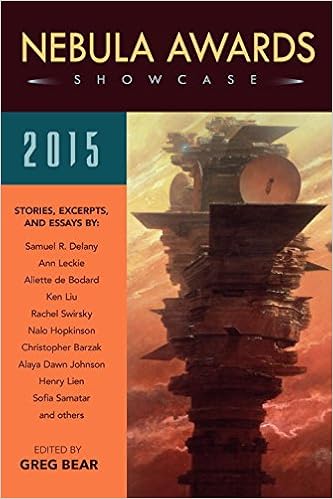
Review [book]: Nebula Awards Showcase 2015 edited by Greg Bear

Greg Bear, Nebula Awards Showcase 2015 [Pyr, 2015]


The Nebula Awards Showcase 2015, edited by Greg Bear, features some of the short stories, poems, and longer work excerpts selected for Nebula awards. The awards have been around for over six decades and, at this point are one of the most highly recognized and lauded in the SFF community. Included in the collection are such authors as Nalo Hopkinson, Sofia Samatar, Samuel R. Delany, and more. Admittedly, my expectations for the showcase were high.

And for the most part I was impressed: by the range of pieces included, the talent of the writers, and some particular standouts that floored me. Of the stories that I was most drawn to: each held an edge of melancholy that I only noticed upon rereading.

 One of these, Christopher Barzak’s “Paranormal Romance,” about a not-your-ordinary-witch who specializes in love magic and yet can’t seem to find this same ability for herself sounds like a clichéd premise. However, Barzak elevates it to a funny, sweet story which charmed me in a way that I don’t often expect fiction to; but, at its heart, it is also about loneliness and the feeling of not being able to connect.

Another, Sofia Samatar’s “Selkie Stories are for Losers,” also dealt with feelings of missed connection, loss, and the inability to fully voice what’s inside. In this piece, the narrator’s mother was a selkie who abandons her family upon the rediscovery of her skin. The metaphor behind this seems obvious, but it’s the way Samatar fills her narrator with the same problem on a human scale—not ever feeling entirely comfortable, or completely truthful, in her own skin—that makes the story’s emotional impact.

My favorite story, though, was the devastating “Alive, Alive, Oh,” by Sylvia Spruck Wrigley. I’d never heard of Wrigley before, but will seek out more of her work. The story, about a mother trapped on a research mission that her family can never return home from, is at once heartbreaking and beautifully imagined. As a story about the things we leave behind and the ways we desperately try to recapture them, it felt like a darker, more true, form of nostalgia—one with consequences.

However, remember how I said that I was for the “most part” impressed? I have to admit to feeling that several of the pieces fell flat for me. There also, other than the speculative nature of the pieces, was not much in a cohesive thread through the stories. While this seems like a consequence of it being an award showcase, I still feel like something like The Best New Horror collections still always feel fairly unified. And, of the pieces, I wasn’t particularly drawn to: I was most surprised by how much I didn’t particularly enjoy the Nebula’s short story winner—Rachel Swirsky’s “If You Were a Dinosaur, My Love.” While Swirsky’s writing has some lovely phrasing, the brevity and structure of the piece distanced me from the story’s emotional core—ending with the story feeling more maudlin than mind-blowing.

Overall, with some great pieces and some misses, it’s definitely worth a read as an example of the current state of SFF.


The Math

Baseline Assessment: 7/10

Bonuses: +1 for a really nice font (that I could not figure out the name of)

Penalties: -1 for hiding the poetry in the back, where I almost missed it thinking that it was not part of the main book

Nerd Coefficient: 7/10 "a mostly enjoyable experience"

***

POSTED BY: Chloe, speculative fiction fan in all forms, monster theorist, and Nerds of a Feather blogger since 2016.


Tuesday, January 19, 2016

Microreview [book]: The Magicians by Lev Grossman


Let me start by telling you what The Magicians is not. It is not ‘Harry Potter meets Narnia’ despite what nearly every description of the book states. In fact, if you could image the exact polar opposite of this, it would be a good place to start. The Magicians is the story of Quentin Coldwater, a privileged teenaged boy from Brooklyn who is incredibly smart (measured in mathematics) and who hates his life and everyone in it, except for Julia who he loves but hates because the love is unrequited. He loses himself in the seemingly childish fantasy series Fillory and Further where a family of British kids adventures in a magical land accessible from our world via ordinary furniture. Quentin’s plan to attend an Ivy League school is soon relinquished when he learns that yes, he’s a wizard Harry, and gains admittance Brakebills College for Medical Pedagogy in upstate New York. I hope he doesn’t wander into Camp Halfblood while he's there.

I’m sure you can see where the antonymous analogy originates. Quentin finds out he can do magic, goes to a school to learn magic, and is obsessed with pretty much Narnia (no denying that Fillory is a stand in for Narnia). But in reality, very little magical learning goes on at Brakebills - at least from the reader's perspective. All five (well, technically four) of Quentin’s years there are over by the midpoint of the book. We get to see a little bit of magical learning in the beginning, which consists mostly of finger contortions, but the majority of the time we readers spend at Brakebills involves Quentin’s relationships with others, namely Eliot, Janet, and Alice (and Josh and Penny too) and them all getting smashed and philosophizing in ways that only teenagers and twenty-somethings can.

And then there’s Fillory, which is real by the way. I think this statement is spoilery, but since it’s on the back of the book I’ll leave it here. And just like our time at Brakebills is pretty much the polar opposite of a reader’s time spent at Hogwarts (which was a detailed and lengthy magical education devoted to good hearted young souls overcoming adversity and evil), Fillory proper may be Narnia incarnate, but the story itself is the polar opposite of Narnia. Sure, the children get there via everyday objects, but they don’t just save the world and then reign happily every after. It's way more complicated than that.

First, lets get some technical things out of the way. I don't always comment on this type of stuff because I review a lot of advanced copies, but this book I purchased new and it was printed recently enough to have an awful SyFy pitch on the cover. I was surprised to find a fair amount of typographical errors (runonwordswithnospaces and capital letters Randomly in the middle of sentences) which were (was?) distracting. Also, the grammar is very awkward at times and I often found myself having to reread sentences. The problem is either inappropriately placed words with double meaning, or inappropriately placed comas, or both.

I think that the selective references to pop culture which include Harry Potter, Star Wars, Star Trek, and D&D are misplaced. And notice what is missing from the list? Narnia. You can’t create a metaphorical rebuttal of modern popular fantasy tropes and directly reference some but exclude others. Plus, this dates the work in a way that in twenty, thirty, or fifty years these references may no longer be meaningful and will distance the reader from the story.

Finally, the passage of time is rushed. Like I said earlier, the characters’ five-ish years of magical education zip by in the first half of the book. It doesn’t give them much chance to grow and I have a hard time imaging them as anything other than 17 year olds, when in reality they are in their early twenties by the end of the book.

Now, for the good stuff…It took me a while to commit to reading The Magicians because it has so many mixed reviews, as any foray through its Goodreads page will reveal. I'm glad I read it though, because personally, I loved this book. I was hooked within the first 20 pages when Quentin reveals his reason for loving Fillory. We know Fillory is not innovative or original, but that is its purpose here, to serve as a stand-in for the Narnias of our lives. Even as an (almost) adult, Q escapes to Fillory when he can’t deal with the real world, which is something I think we all can relate to. I don’t know about you, but I have spent many a day a Hogwarts for that very same reason.

Mostly, people don’t like The Magicians because the characters are miserable, ungrateful, unlikeable shitheads. This is true, but honestly, I find them to be some of the most relatable characters I’ve ever read about. I think some of those who have such an adverse reaction to Q and the other characters in this book may forget what its like to be a young adult (a real young adult, not a Katniss Everdeen young adult) or maybe had a positive teenage-hood (bah, as if). Really though, I think perhaps we all relate to these characters a little too well and some people don’t want to read about a character that represents the worst in them.

You see, Quentin really is a shit bag, and miserable and ungrateful and all that. But aren’t we all sometimes? It’s actually kind of scary how relatable I find him and I guess that means on some level I’m shit bag too. But, let they who have never questioned the futility of their efforts or existence and never engaged in unvirtuous behavior with complete disregard to the feelings of others cast the first stone. I think everyone has a little bit of hatred for Quentin because he represents that little piece of us we all wish didn’t exist. Yes, I know what it's like to be Quentin. But I also know what it's like to be Alice. And although we don’t necessarily gravitate toward SF/F for its realism, Quentin and his crew may be some of the most human characters I’ve read about in a long, long time.

Often we read SF/F and envy those with extraordinary powers and hero quests and we long for that sense of purpose within our selves, because in comparison our lives are piddly and meaningless. Some readers may not like that our heroes feel the same way. Its funny because I was recently chatting with The G about how The Brief and Wondrous Life of Oscar Wao by Junot Diaz was the only book I ever read that altered my emotions for the duration of the time spent reading it, even when I wasn’t actively reading. I was depressed that whole week and angry and bitter and I didn’t realize why until after I finished the book. To me, that is a sign of a truly good book. One that can evoke emotion that stays with you long after reading it. This is what The Magicians did to me. Maybe I just relate to Quentin on a level some others don’t, or maybe it’s his relationship with Alice that really gets me, I’m not sure.

This book is definitely for the existential fantasy reader. If you are looking for a hero’s romp, don’t look here. But if you are looking for a book that does a little something more with the genre and lives outside of the comfort zone, give The Magicians a try. I think it's quite fantastic.


The Math

Baseline Assessment: 6/10

Bonuses: +2 for how uncomfortably relatable Quentin is, +1 for everything about Eliot

Penalties: -1 for dating itself with select cultural references

Nerd Coefficient: 8/10 “well worth your time and attention”


-----
POSTED BY: Tia  Nerds of a Feather Contributor since 2014

REFERENCE: Grossman, Lev. The Magicians [Viking Press, 2009]

Friday, January 15, 2016

Microreview [comic]: Star Wars: Before the Awakening

Star Wars: exactly what it sounds like...


The best way I can describe Before the Awakening is a missed opportunity. It is a perfectly good read, entertaining enough as it takes the reader into the events shortly before The Force Awakens. After the unreadable mess that is Chuck Wendig's Aftermath, even passable is a huge upgrade for Star Wars literature.

The three vignettes are entertaining enough- Finn's in particular was quite fun, focusing on his training as a Stormtrooper, going into the connection he has with 'Slip' the trooper who dies in front of him and truly sets him on his path.

It goes a long way- sometimes, out of its way- to explain things we see in Episode VII-  where Rey learned to fly, learned to work on ships, and got her goggles. Which is fine and good, it just feels a little shoehorned in sometimes.

For that, though, Rey's story is certainly the best, and offers the most insight into her character. It is deeper than Finn or Poe's story, though Finn's tries- entirely too hard- to be personal. The problem with his story is that it tries far too hard to show how caring he is- aside from martial abilities (which have apparently evaporated by the events in the film), he is no Stormtrooper. In fact, that is an ongoing problem with all three- it works so very hard to have the characters be exactly as they are in the film, there is no actual development. There are events, to be sure, but they are just events. The characters don't advance as a result of them, they simply are.

The biggest missed opportunity, however, is one of the things I am quite sure the powers that be are working hard to avoid- politics. After being too heavy-handed with the prequels, I'm sure Disney & Company want to avoid complicating things too much, but I walked out of The Force Awakens with a lot of questions about the politics, and this book could have done so much to flesh out the political situation. Instead of focusing on what a soft touch Finn is, focus on First Order politics- or at least address them. Instead of focusing on what a bad ass Poe is, focus on the Republic and Resistance. Instead, the book just makes us really, really know that these are, in fact, the characters we see in the movie and little more.


The Math:

(Hooooo, boy, settle in and bring a calculator.)


Baseline: I want to give this a 6, but I think it is 5- completely middle of the road- problematic, but has redeeming qualities.

Bonuses:

Bonuses: +1 For not being first person. Lookin' at you, Wendig; +1 For also not being present tense. I actually want to give a thousand bonus points for this after Aftermath; +1 For being an overall fun, easy read.

Penalties: -1 For missing things about the setting & characters that would have been much more interesting; -1 for holy crap, I totally forgot to talk about this: In dialogue, numbers are all phonetic, e.g., BeeBee-Ate. Just... no.

Nerd Coefficient: 6/10. Still enjoyable, but the flaws are hard to ignore.

(For information on our ratings, and why six isn't a bad score, check out our policies)

-DESR

Dean is the author of the 3024AD series of science fiction stories (which should be on YOUR summer reading list). You can read his other ramblings and musings on a variety of topics (mostly writing) on his blog. When not holed up in his office
tweeting obnoxiously writing, he can be found watching or playing sports, or in his natural habitat of a bookstore.


Thursday, January 14, 2016

Thursday Morning Superhero

Robert Kirkman has been giving us thrills with The Walking Dead since 2003.  For over 12 years we have enjoyed reading about the adventures of Rick and company, yet somehow the title has remained fresh.  This week we celebrate the 150th issue of the groundbreaking title, and Kirkman has promised us in the past that the story is planned out for at least 50 more issues.  As a fan of the series, I look forward to where the next 50 issues will take us, but fear that Negan is going to play a major role in shaping the upcoming story.

 
Pick of the Week:

The Walking Dead #150 - It is hard to imagine that this series has reached its 150th issue.  It has had its share of ups and downs, but if this comic is an indication the series is in an upward trend.  I thought that Robert Kirkman has shown me all there is about Rick Grimes, but I was mistaken.  The Rick that we see in this issue is a return to his days as an unquestioned leader.  Thanks to the whispers in his ears from Negan, Rick has proven that he isn't soft and that he is ready to lead his group and take down the newest threat.  I fear for the new Rick.  I fear for anyone who heeds Negan's advice.  I am afraid.  

The Rest:

Birthright #13 - Sameal is not one to mess with.  Joshua Williamson treats us to an epic battle as Mikey attempts to kill all of the mages who have fled to earth.  In the last issue we were warned of how deadly Sameal is, but to see it on the pages was a joy.  Sameal's hesitation to kill Mikey and the Nevermind when given the change leads me to believe that there is hope of his redemption.  Meanwhile, Mikey's dad is officially bait and his mom has paired up with his pregnant girlfriend in an attempt to track him down.  Oh the drama!  


The Violent #2 - Things go from bad to worse for Mr. Turner.  When we last saw him, he left his daughter in the car to pick up a friend at the bar.  While his intentions were good, the optics were not.  He ended up getting busted by the police and has now had his daughter taken away.  To make matters even worse, his wife is missing and the police suspect he had something to do with it.  With nothing to lose, Turner turns to the one thing he knows well, violence.  In an aptly named comic, The Violent lives up to its name as Turner attempts to piece things together.  If you are looking for mystery noir, look no further than this title.


Captain America #5 - I continue to enjoy Nick Spencer's take on the new Captain America and the political undertones of the villains.  It seems like the Serpent Squad spends a lot of time watching Fox News and may end up in Oregon in an upcoming issue.  The latest issue introduces us to the new Falcon, who sports real wings as the result of forced genetic experimentation.  The new Falcon is a little rough around the edges, and I look forward to seeing this new duo in action.


POSTED BY MIKE N. aka Victor Domashev -- comic guy, proudly raising nerdy kids, and Nerds of a Feather contributor since 2012.