Tuesday, November 10, 2015

THE MONTHLY ROUND - A Taster's Guide to Speculative Short Fiction, 10/2015

Welcome, weary traveler of the SFF highways. Belly up to the bar and let your faithful storytender pour you something to take the edge off. The summer has certainly given up the ghost and we're in the heart of autumn now, and I have a full flight of stories that capture the taste of the season.

Let me tell you, October was a mad month for short SFF fiction, absolutely packed with stories. So many that I could easily have doubled the flight this month with superb fiction. But I restrained myself and have six longer works and three flash fiction stories to share, as usual. Some capitalize on the spookiness of a month anchored by Halloween while others focus on the human need for warmth amid the growing cold. Whatever the taste, the stories are poured and the fire is roaring. Cheers!

Tasting Flight - October 2015


Art by AJ Jones
"The Lord of Corrosion" by Lee Thomas (Nightmare #37)

With the feeling of being lost in the wood with someone slowly stalking you, "The Lord of Corrosion" by Lee Thomas is an Oktoberfest, the taste of falling leaves and crisp mornings and a sweetness that pervades despite the decay of the season. In the story Josh has lost his husband and now finds his daughter, Sofia, acting out in ways that don't make sense, and despite taking her to therapy no cause seems evident. Except that Sofia has an imaginary friend who is telling her things she doesn't want to hear, hateful things that make Josh question what he's willing to believe is real or not in order to protect his daughter. Tense and with a feel of rising danger, the story follows Josh as he searches out what might be happening and inadvertently stumbles onto an open secret both dark and damning. The story shows the rot at the center of small-town life, the corruption that allows true evil to live and carry on, that sees the voice of the old and awful finding purchase in the mouths of the young. It's a truly frightening story, leaving behind safety in favor of action, in favor of standing up to a force that seems impossibly strong. The character work is solid, the action disturbing and compelling, and the ending captures the twisted nature of hate so well, so frighteningly, that it's impossible to look away. Like an Oktoberfest, the story captures the feeling of the autumn, of decay, but instead of sinking into bitterness it rises, shakes off the death and decline and shows a sweetness, a care that is redemptive and powerful and incredibly good. 

"Blue Monday" by Laurie Penny (Terraform)

Cat videos. If this story was only cat videos I think I'd still like it, but it's not. About numbness and catharsis and pain in a world uninterested in being better, "Blue Monday" by Laurie Penny is an Irish coffee, an eye opener wrapped in a depressant, a modern necessity hiding a vice that is politely ignored because we all need to be braced to face the world. In the story, the main character works at a company that provides opiates for the masses in the form of cute pet videos, ways to numb the pain of living, of dealing with increasingly bleak realities. The main character doesn't feel, or professes not to, until she loses her girlfriend and left only with a cat she didn't want. A cat that mirrors her own sadness and despair at being alone, at being left by the only decent person either of them ever knew. Accidental internet celebrity kind of follows, but the story focuses on the hole left behind in the wake of the main character being left, with her growing realization that she cannot survive alone, or maybe that she can but doing so is hollow, is without comfort or meaning. Of course, the system that works to keep people going just enough to not kill themselves is the cloud under which the action of the story unfolds, and the main character slowly realizes that she does care, that she wants to care. The story's voice is brash and bracing, fun and funny in a way that assholes are, which is to say as long as they aren't pointed at you, and the that voice captures a mindset, a force in the world, one undercut by loss and longing. I was not expecting to be knocked back by a story about cat videos, but like a strong Irish coffee there's more to this story than meets the eye, and it's a journey worth taking to pierce through each layer.


Art by Shichigoro-Shingo
"And If the Body Were Not the Soul" by A.C. Wise (Clarkesworld #109)

Dark but with a lightness trapped within and a smooth sweetness that makes for the perfect thing to curl up with on a cold night, "And If the Body Were Not the Soul" by A.C. Wise is a cream stout, expertly balanced and incredibly drinkable. It introduces Ro, a woman repulsed by touch and yet yearning for contact, for understanding, for companionship. Companionship that her coworker, Audra, would like to provide but which Ro finds instead in a unlikely source, in an alien, one of many stuck in a small section of the city because the authorities don't want to deal with the implications they represent. Ro is one of the few to interact with the aliens, and with one, Xal, in particular, but Xal for one is tired to waiting for the government to decide what to do with his people and has started prompting confrontations in order to spur action. It's after one of these confrontations when, injured, Xal touches Ro, and it's nothing she ever expected. The story centers on Ro and her growing relationship with Xal but also her fear of hurting people, her feelings of inadequacy that she doesn't want touch. But the story navigates the landscape of consent and sensuality and resistance quite well, drawing Ro and Xal and Audra together even as it shows the growing realization that some things are not meant to be. The story mixes darkness with light light romance and a core of rebellion, resistance, and confirmation of self. Each character remains true to themselves, in need of no "fixing," and like a cream stout the story is one that leaves a sweet taste on the tongue and a warm feeling in the chest.


Art by Liam Quin
"The Librarian's Dilemma" by E. Saxey (Unlikely Story #12)

A story about the morality of stories, of books, and the morality of people, "The Librarian's Dilemma" by E. Saxey is a hard cider, the familiar comfort of apple cut with layers of depth that complicate the nostalgia evoked. The story is about libraries and librarians, as Jas is tasked with digitizing books, making them available to all. Jas lives for books, for libraries, and yet his job is complicated by the place he works at, a library that doesn't want people accessing the books within, that doesn't want the material being viewed. And for Jas this is a betrayal, because there are books in the collection that provide voice and history for those without them. But the story does not shy away from the importance and danger of books, books written to harm, to misinform, to act as propaganda. The library is both a resource and a wall against the idea in these books. Jas must approach the question of what is more important, access or protection, an idea made more difficult because some of the works deemed offensive are only so because of the politics held by the people doing the collecting. And through it all the story is about Jas being seduced by the prospect that the problem is easy (and also being seduced by a young man with motives all his own). There are choices that Jas makes that seem so clear only to be thrown into question, and one is never sure who is hero and who is villain, because each player, even Jas, believes themself doing the right thing, on the right side. It's a difficult story, in many ways a heartbreaking story for those who love books and have to see them in a new light. Like a hard cider, there is a twisting on something nostalgic, the magic of libraries, drawing down much deeper than expected, and resulting in something challenging but refreshing, crisp but biting, and still very good.


Art by Feliks Grzesiczek
"Geometries of Belonging" by Rose Lemberg (Beneath Ceaseless Skies #183)

A story about age and consent, about power and choice, about strength and healing, "Geometries of Belonging" by Rose Lemberg is a mulled wine, a drink best served hot with a dense rush of flavors and a comfort for cold autumn nights. Set in the same universe as "Grandmother-nai-Leylit's Cloth of the Winds" (which made the Round back in June), this story focuses on a very different set of characters, namely three-named Parét and his lord and partner. The story is about wounds old and new, and about preventing more of them from forming. It's about Parét facing not just his own past but looking to the future, past his pains and into a place where there is more work to be done, more wounds to be healed. The world itself is sick, and with war threatening there are plots and counterplots, ambitions and betrayals aplenty. The story is long but builds a world alive with history and with cultures mingling and clashing. There are languages of consent and violence that the story dances with, holds and spins and releases, and through it all Parét finds that despite his advancing age he still has things to learn, and that there are things that he will fight for, things worth doing violence over. It's a beautiful story, and lives and breathes through its characters, complex and damaged, all in need of healing and all either denying it or denying themselves. It's another story for the growing dark and the lingering cold, a way to banish the autumn and taste something of resilient strength in the spices and layers of red mulled wine. 


Art by Tommy Arnold
"Hold-Time Violations" by John Chu (Tor)

A story about fixing the laws of the universe and making some very difficult decisions, "Hold-Time Violations" by John Chu is an IPA, a bit brash and a bit bitter but with a punch that's unique and unforgettable. The action opens on Ellie, who is tasked by a rather overbearing sister to take on a quick job fixing the pipes of the universe. The world-building in the story is intense, almost too much to take in, but despite a somewhat steep learning curve the story moves quickly, fluidly, introducing the skunkworks, the plumbing of reality, basically, which connects the universe of the story to the universe above and below, the universes layered in an enormous loop, and the skunkworks defining the laws of each. Ellie is a builder, a fixer, and she's called in to get things running smoothly again after modifications have started throwing the laws of physics slightly out of whack. Together with her "cousin," Daniel, Ellie has to deal with fanatics devoted to the idea that the skunkworks shouldn't be touched even to be fixed and the lingering shadow that is the sickness and decline of her mother's health, who is a legend among builders and whose sickness Ellie doesn't want to face. The emotional beats of the story sync well with the action, with the tension and time limit that Ellie works under. For all that this story and setting deserve more room to breath, what's here is fresh and original, kinetic with a punch. Like an IPA, the first sip can be a little intimidating for those not used to the flavor, but the more you drink the more the story comes together into something fresh and rewarding, something worth savoring.

Shots


Art by Shade Tubor
"Love and Prejudice" by Amatesiro Dore (Omenana Issue X)

This story, about love overcoming familial restrictions and hesitation, is a Mother-in-Law, a mix of mostly bourbon with equal parts Cointreau, Maraschino, and bitters, garnished with a single, stemless cherry. The story looks a future where the love between two men is acceptable, but a marriage that isn't advantageous is not. With a certain comic flare the tale introduces a mother very concerned with her son's future, trying to arrange a match that fits more her financial ambitions for him rather than the desires of his heart. The story looks at the hypocrisy of restricting marriage to only "proper" matches, because marriages are almost always rebellions, are ways of declaring that love can overcome, that love is more important than a bank account or the right business connections (or what gender the people getting married are). It argues that caring for your child's future should be more about worrying for their happiness and letting them go where their hearts take them. For the mother of the story, it takes a confrontation with her own mother-in-law to remind her that people should be free to forge their own paths. The story is incredibly charming and, at times, laugh-out-loud funny. It shows the ridiculousness of limiting marriage beyond consent and the joy to be found with letting people be free to go where love takes them 


Art by Dario Bijelac
"White Elephant" by Shannon Peavey (Flash Fiction Online)

About the problems we carry with us and the certainty that other people have it easier, this story is, conveniently, a White Elephant, a mix of coconut run and creme de cacao over ice. In it, a woman goes a story where people go to swap. Not partners, though, but faults. Issues. In a guessing game where no one really wins, the woman gives away her rage, a rage that threatens her kids at times and which she is desperate to shed, but what she gets, though she expects it can't be nearly as bad as her anger, is only different. The story does an excellent job of capturing the way people yearn to be free of their demons, the way that we prioritize our problems, imagining that everyone else must have it better, that everyone else must because if they didn't how are they still standing? How can the world live with the pain that is carried in each one of us? The story offers no easy answers, a hope perhaps that, while not worse, certain things will be easier. But more than that, a slow realization that things might not get better, or that it takes something more than magic at a party. That the only to beat our problems is to change the system that causes them. It's a disturbing story, a sad and searching one, but a good one as well, sweet but with a touch of cold.

"Broken-Winged Love" by Naru Dames Sundar (Strange Horizons)

About the love, or maybe the lack of love, between mother and child (who are also dragons), this story is a Dragons Breath, a mix of half measures grenadine and cola with a full measure pure grain alcohol. The moment that the female dragon mates, she knows it is a mistake, that she does not love her child. When he born deformed, without the ability to fly, she is moved only to move away with him, to escape the ridicule of the other dragons, to seek out a place to live with her child in peace. And I love how the story complicates maternal love, not seeking to shame the dragon for her lack of affection, forcing her to love a child that was not her choice, who she never wanted. It does not make her wrong for, nor does it make the story about her finding a well of love within her, of coming around to the idea that this was a good thing after all. The story is about wounds that never really heal as much as it is also about some that do. It's moving and slow and tragic, for in it there are really only victims, victims trying to live and do the best they can by each other. And maybe that is a kind of love, but the story leaves it open, ends almost on a question, challenging the reader to accept without judgement the words of one mother about her son. There is a sweetness here, but one cut by a dark and bracing truth, one that hits right between the eyes.

--

POSTED BY: Charles, avid reader, reviewer, and sometimes writer of speculative fiction. Contributor to Nerds of a Feather since 2014.

Monday, November 9, 2015

Microre-review [book]: Ancillary Justice by Ann Leckie

Another Perspective on One Esk


Reading the title of this post, you may be asking yourself a few questions. Isn't a little late to review Ancillary Justice? Didn't The G already review Ancillary Justice when it was timely? What would be the point of issuing another review? All valid questions! The G absolutely did review Ancillary Justice when it was fresh, but he wasn't particularly impressed and passed on Ancillary Sword last year. However, (not to get too under the hood here) he offered up Ancillary Mercy and I happily accepted, but under the conditions that I could catch up first. We decided it wouldn't be a bad idea for me to re-review Ancillary Justice and issue a review for Ancillary Sword before we get to our review of Ancillary Mercy. So that's where we are today.

Ancillary Justice has been out for a couple years, and The G gave an excellent summary, so I won't retread that ground. Read The G's review. I did enjoy Ancillary Justice more than he did. It's a complex story in a big world, which we don't get enough of. It's got class struggle, xenophobia, questions of conscience and sentience, planet hopping, alien species, war, occupation, and more. It's all handled remarkably well, particularly for an author's debut.

There were very few moments when I felt like I should have a pen and diagrams to keep everything straight, because the characters and their actions spoke for themselves. I could recognize characters by what they did or how they spoke, which is something that many authors fail to pull off. There is a point maybe 1/3 into the story where two characters are having a discussion about an object of interest. This is where I was really hooked. It was a perfectly balanced suspenseful moment in which I wasn't sure what the outcome would be, but I couldn't stop reading until there was some resolution. All of this from a simple two character discussion.

There are mysteries in this world that don't get answered, but I can tell that there are answers somewhere. Maybe they're later in the series, or maybe they just don't get written down, but they exist. This is what makes the very abrupt and anti-climatic ending a big letdown. The conflict at the core of the novel is resolved (to a point), but it happens so fast and with a lot of hand-waving. It doesn't come as a surprise, because endings are hard for even seasoned authors to pull off, but it could've been better.

Ancillary Justice is a big, ambitious debut and Leckie made it all work, almost. It suffers a poor ending, but the preceding 3/4ths of the story are excellent sci-fi.

The Math

Baseline Assessment: 8/10

Bonuses: +1 making a space opera that feels properly big

Penalties: -1 couldn't stick the ending

Nerd Coefficient: 8/10 (well worth your time and attention)

***

POSTED BY: brian, sci-fi/fantasy/video game dork and contributor since 2014

Reference: Leckie, Ann. Ancillary Justice [Orbit, 2013] 

Friday, November 6, 2015

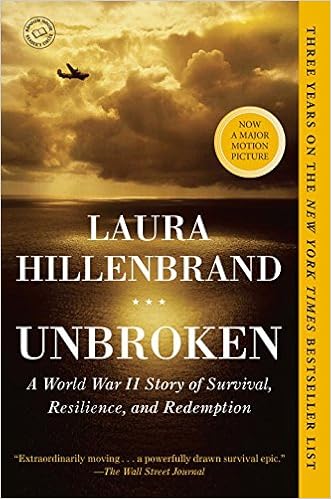
STRANGER THAN FICTION: Unbroken, by Laura Hillenbrand

Hillenbrand, Laura. Unbroken: A World War II Story of Survival, Resilience, and Redemption. Random House: 2010.


Here’s a typical-sounding tagline for a novel (make sure to read it in Movie Trailer Voice): “In a world where evil is ascendant, one man must rise to meet it. He must run faster, fight harder, and cling to life more fiercely than anyone has ever done before. The enemy may find him; they may knock him down, but never out. Through torments unimaginable, he remains…unbroken.”

A story with a blurb like that could be set almost anywhere, from grim fantasy to grim sci fi to grim urban fantasy to just grim. Even when we add details like the hero is a best-in-the-whole-world-level middle distance runner, had to survive on the open sea for like a gazillion days, and was captured by the enemy and then tormented by an almost shockingly evil jerkazoid, it still sounds super fictional. But here’s where things get really crazy: as literally all of you dear readers already know, Unbroken is a freakin’ true story!

Whaaaaat? Yes, that’s right: Louis Zamperini really was an Olympic competitor (and was close to a 4-minute mile!), crashed in his B-24 and, along with two companions (then one), he survived on a life raft for almost nine weeks as he drifted across half the Pacific, was captured by the Japanese and held as a POW for about three years, during which time he was brutally beaten and starved, at times nearly to death. But the best part is, with all that grim, we still get a novel-esque happy ending—he lived into his 90s!


You really have to read this guy’s life story to believe it. I haven’t seen the Angelina Jolie movie, partly because I’ve heard it was only so-so, but I’m glad the movie exists all the same, because unfortunately, we nerds (who read books) are still outnumbered by the vast, faceless hordes who only see the movie versions of things (I’m looking at you, millions of people who still haven’t read LOTR but “liked those Peter Jackson movies”!).  Read a book, you phonies J

This Stranger than Fiction message brought to you by Zhaoyun, who mostly reads and reviews *actual* fiction for Nerds of a Feather, and has done so since 2013.   


Thursday, November 5, 2015

Thursday Morning Superhero


The big news that I read today, was this great interview with Cullen Bunn by Multiversity Comics.  For whatever reason, I have been reflecting on the Sixth Gun recently, and I have mixed emotions knowing that the script for this series has reached its conclusion.  I still feel that the great comic series have a definitive beginning and end, and cannot wait to read the conclusion when the final arc, Boot Hill, drops.  It is going to be a long wait to find out what happens in the finale, but our journey begins in April and ends in June.  I cannot wait.


Pick of the Week:
Star Wars #11 - If any fan is having a hard time waiting for The Force Awakens, I suggest you start reading some comics.  This series has been the perfect cure for the pain that it is to wait for a movie that hopefully can live up to its trailer.  When we last left, Sana (Han's wife), Solo, and Leia were racing to save Luke from Grakkus the Hutt, who along with the help of the Gamemaster has Luke set to fight for his life for sport.  Chewbacca and C3P0 are already trying to help the young Jedi, but Dengar has other plans for Chewy.  This week we are treated to a Wookie fight, Luke taking on a half-beast, half-robot called Kongo the Disemboweler, and a secret plan from the Gamemaster that involves the Empire. This issue ended far too quickly.  Loving this series.

The Rest:
Paper Girls #2 - The mystery grows in the second issue of Paper Girls from Brian K. Vaughan.  We aren't given any more clues as to why mysterious creatures have descended to earth, but now in addition to the creepy dudes walking around we have pterodactyls to deal with.  At least that is what they look like to me.  Given what is happening outside, the girls agree to go to Mac's house and at least arm themselves with a gun.  This is when we learn that we may be dealing with the rapture, as Mac's dad vanished into thin air in his sleep.  Not sure what is happening, but I like it.


Nailbiter #17 - Is Agent Barker going down the dark path of other killers from Buckaroo?  What is Dr. Glory hiding and what is his role in this?  Despite learning about the caves, there is still a lot to uncover in Buckaroo.  On top of that, a Buckaroo native might be a serial killer that has been killing victims in Atlanta.  With the feds taking control of the Buckaroo investigation, Barker turns to the only person she can trust, Finch.  Looks like we are about to be treated to a new investigation to add a bit of flavor to the big picture.  The mystery grows and I am looking forward to where this is headed.


James Bond #1 - We are gifted this week with a Bond story penned by Warren Ellis.  We see a brutal side of Bond, as the issue opens with him seeking revenge for the death of 008.  With 008 out of the picture, Bond has to pick up additional cases as M searches for a replacement.  Ellis gives us a nice twist, as the political climate in the UK restricts travel with a weapon, and Bond is forced to travel to Berlin to investigate a new synthetic drug, unarmed.  Enjoyable debut that will appeal to both Bond and Ellis fans.  I am very curious to learn what Ellis has planned for 007.


POSTED BY MIKE N. aka Victor Domashev -- comic guy, proudly raising nerdy kids, and Nerds of a Feather contributor since 2012. 

Tuesday, November 3, 2015

Microreview [book]: Tawny Petticoats by Michael Swanwick (Rogues #5)

Fourth installment in the Rogues anthology edited by George R. R. Martin and Gardner Dozois


Well, with Tawny Petticoats, we now have 3 out of 5 stories in Rogues featuring female prostitution. But here, see, our female character isn’t really a prostitute, she just pretends to be one as a scam, something she tells our story’s protagonists while she is stripping down naked because that’s how Surplus and Darger conduct job interviews. But don’t worry, to the chagrin of the other applicants, the interviewers don’t molest the ladies. Getting tired of this? Me too. The theme of female prostitution and women as sex slaves runs rampant throughout the Rogues anthology, and I just don’t get why this pattern is emerging. It’s disconcerting, especially given the apparent respect many of these authors elicit.

Actually, I take that back, I do know why we have this pattern in Rogues. It seems that there is a large proportion of authors out there who don’t know how to make a female character “roguish” without focusing on sex. In the introduction, GRRM defines rogues as “scoundrels, con men, and scalawags. Ne’er-do-wells, thieves, cheats, and rascals. Bad boys and bad girls.” In the stories I’ve read so far, the “bad boys” are all of these things and more, but for the “bad girls,” the “bad” just relates to their sexuality in some way. This is extremely problematic. Not only does it pigeonhole female characters as sexual objects, but it perpetuates the notion rampant among American culture (at the least) that female sexuality is wrong. In fact, among the five stories I’ve read, the only author who doesn’t do this to a female character is Joe Abercrombie, all hail.

As editors, GRRM and Gardner Dozois should have picked up on this unsettling theme and done something about it. Frankly I am really disappointed. My original plan was to read through and review Rogues a story at a time, and then move on to Dangerous Women, but now I’m getting really sick of this pattern and can only imagine what atrocity Dangerous Women could hold. Yes, I finished Tawny Petticoats, even though I really didn't want to, and I will give Rogues one last chance. But with the next story that reduces women to sexual objects I’m done. I have far better things to read.

Anyway, putting this sexist culture of Tawny Petticoats aside, the story itself was fine. It was written well and was engaging. It follows Surplus and Darger, two of Swanwick’s popular characters as they attempt to work the black-money scam, a quite inventive scam if you ask me. The story takes place in alternate New Orleans, a city full of animals with human-like intelligence and zombies who are really just humans with no awareness.

Again, with the aforementioned degradation aside, most of the characters are fun and entertaining, and really pretty well developed considering the limited space, a feat that never fails to amaze me. There is quite a lot of infodumping as a character will take a page or two to explain how the zombies are made and unmade or the back story necessary to frame the black-money scam but it was all very well done and didn’t really bother me at all. Infodumping doesn’t always have to be a negative word.

However, there are just some things I can’t let go, and the reducing women to sexual objects thing is getting so old in this Rouges read through that with every story my tolerance gets shorter and shorter. I did not expect this at all. It really is a shame.

The Math

Objective Assessment: 6/10

Bonuses: +1 for creative world building

Penalties: -2 for the poor characterization of women

Nerd Coefficient: 5/10 -- [extremely] problematic, but has redeeming qualities


Up Next: Provenance by David W. Ball

-----
POSTED BY: Tia

Reference: Swanwick, Michael. Tawny Petticoats. From: Rogues, Eds. George R. R. Martin and Gardner Dozois [Bantam Spectra, 2014]

Monday, November 2, 2015

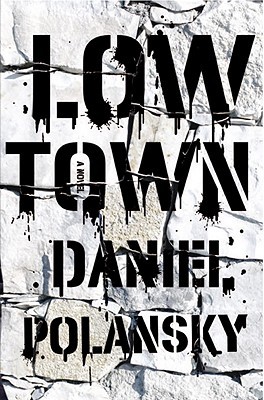
Microreview [book]: Low Town by Daniel Polansky

Grime, Crime and...Magic


Low Town is part of a new breed of fantasy: small-scale and urban in focus, and taking cues as much from crime fiction (and films) as in-genre classics. Some have used the term "fantasy noir," but I don't really see much connection to Thompson, Cain or Chandler. Rather, Low Town feels rooted in gangland fiction (and film), while also evoking science fictional takes on the grime and crime aesthetic. Scratch that--not gangland, per se, but the "street novel" (or film). And the British kind at that--think Irvine Welsh only not as funny, but with magic.

Low Town is named after the rough and tumble quarter of Rigus, which is the capital of a very powerful state. It's a place where most are poor or struggling, the state is mostly absent, and criminals abound. It's the place where, when the plague hit, it hit hardest. It tells the story of a man known only as the Warden. As a child he was orphaned by the plague, but was then taken in by a mercurial and benevolent sorcerer. He is a veteran of a nasty war against a rival state, and a disgraced former member of Rigus' feared secret police. Now he peddles drugs on the streets, and is a fearsome enough figure that he doesn't need or want an organization.

Though the Warden is a hard man to the core, he is neither sadistic nor nihilistic. He lives by a code, and tries to use violence only when it is the most efficient means to an end, or when the person really had it coming. And when children begin showing up dead on Low Town streets, you just know someone's going to pay.

The Warden is the primary reason why Low Town works so well. He's world-weary and jaded, but his reactions to things that happen around him are extremely relatable. That is to say, despite the exterior, this is, fundamentally, a person who cares about right and wrong--in the way most people care about right and wrong. It's flexible, when necessary, but there are lines you just don't cross. As a reader, you come to really care about what happens to him and the people he depends on.

The Warden's (and by extension the book's) moral compass makes me hesitant to lump Low Town in with the style of fantasy frequently referred to as "grimdark." Yes, it's gritty as hell, and pretty gory in spots. This is not a book for the feint of heart, and those who have tired of contemporary fantasy's fixation with ultraviolence should probably look elsewhere. At the same time, it isn't nihilistic, and it isn't terribly relativistic either. The Warden is a troubled, flawed man, but he actually has a pretty clear sense of right and wrong and does what he can, in his way, to make Low Town a better place to live. He doesn't always get it right--and makes some major errors, in fact. But he tries.

The other thing I loved about the book was its mood--dark, cold and foreboding. And the action scenes are just fantastic.

My one quip is that the plot, while serviceable, isn't all that well constructed. There's a mystery, but it's never quite clear why things happen the way they do, or why the Warden draws the conclusions he draws. This makes the big twist at the end kind of superfluous. Twists, after all, depend on the reader having certain assumptions; yet if the reader never quite develops them, what exactly is the twist doing?

Still, it hardly matters--this book is propelled by character and setting, and those are fantastically well rendered. I can't wait to read book #2.


The Math

Baseline Assessment: 8/10

Bonuses: +1 for the Warden, who is all kinds of awesome.

Penalties: -1 for a plot that doesn't quite work.

Nerd Coefficient: 8/10. "Well worth your time and attention."


***

POSTED BY: The G--purveyor of nerdliness, genre fanatic and Nerds of a
Feather founder/administrator (2012).
 

Friday, October 30, 2015

Microreview [TV / Film ] : Fear Itself


The disturbingly-talented young director Charlie Lyne has followed up his hypnotic and dizzying collage meditation of a film 'Beyond Clueless' with a similar yet even more powerful film. Fear Itself is again a narrated psychological poem over caramel-smooth editing of clips from film after film, some famous, some obscure. His first feature explored teen movies and this time, appropriately for Halloween week, he takes on the subject of horror movies.

However, and frustratingly for those without the access to it, it is a BBC 'iPlayer' exclusive - part of a new wave of programming commissioned just to seen on their UK-only on-demand service. Do look into ways to see this though, as it is a treasure of art and of genre-love.

The director describes the idea best himself on the BBC site. He says: “I got about 20 minutes into the first feature-length commission from BBC iPlayer, Adam Curtis’s Bitter Lake, before I started fidgeting with excitement about what an incredible platform it had become for weird and wonderful art - art that wouldn’t quite fit anywhere else. About a month later I somehow found myself beginning work on Fear Itself, the second feature-length commission from BBC iPlayer. No pressure then. The last six months have been a whirlwind of experimentation, discovery and occasional terror, attempting to make a film that both evokes and scrutinises the effects of horror cinema at the same time. I’m thrilled (and more than a little anxious) to be releasing the film into the wilds of the internet, where it can finally be scrutinised in its own right.”

Narrated by Amy E. Watson, a Scottish-Canadian actor, she plays the voice of a young woman who from the start has clearly suffered an "accident" or mentally-scarring experience of some kind. She explains how she has taken to watching scary films, night after night, and begins to calmly criticise them for their ability and intention to push our psychic buttons. Even as she becomes used to the scare tactics, she never loses the realisation of feeling manipulated, and of still helplessly jumping in surprise, or feeling the cold chill of dread. While her own mystery is never really resolved, her dreamy, wandering, near-poetical ruminations on cinema and more so on fear itself (see what I did there...?) allow Lyne a wobbly, fractured template on which to bind an endless flow of mainly silent clips from horror cinema's greatest moments.


Some clips were familiar to me but a delightfully high percentage of the footage and the films it is from were new to my eyes, and like a more 'standard' documentary on film, it inspires you to seek out the films in question (although I often find the clips give a false impression of a better film than really exists, misleading like a slick trailer can also do). Don't Look Now, Peeping Tom, The Exorcist, Psycho, Ringu (probably still my all-time favourite), and other classics feature, but also more cult greats, like Tetsuo, Scanners, Altered States, Lost Highway, La Casa Dalle Finestre Che Ridono,  and films I have never heard of before, all merge into one long trip of a montage. Also included are films that one wouldn't label 'horror' at all, like Alive, Enduring Love (one of my favourite scenes in all literature, and then cinema, plus - Bond in glasses!) and Gravity (bloody spoiler alert in that case - thanks Lyne for ruining the ending for me!) but help serve the script's thoughts on human fear and terror.

After a while (the film is almost 90 minutes long), the script and Watson's childlike gentle voice begins to tire, and I found myself watching this over four separate sessions. Yet I'm sure with a free evening on the sofa and a box of Colorado special cigarettes, a full immersion would be far more powerful.  Another criticism is the occasionally too-literal moments of narration that caused the wrong kind of laughter from me ("The last time I felt that kind of fear, I was watching a film with Liv Tyler in it" - The Strangers is a pretty good film but, jeez that is a bit crap). Some of the clips, shorn of the deeper meaning of the film they are from, just amused and interested me, like when one is in a cool bar or club (well, I imagine - I haven't been to one for a while!) and there is some cult film on in the background. But freed perhaps of the restrictions of being broadcast on the main network, Lyne also includes some truly gruesome body horror, and some very unsettling sequences. Along with the overall hypnotic power of the quiet, clam narration, I found myself lost in its web, and thinking myself about fear and how true terror works in my own mind. As such, this manages to be one of the most bleakly disturbing pieces of TV I have seen in a long time, and can there be any higher praise in the days leading up to All Hallow's Eve...?

The Math:

Objective assessment : 8/10

Bonuses : +1 for making me want to seek out new films that I never knew existed
Penalties: -1 for the occasional mask-slip of the narration, which can never hope to keep its spell over 90 minutes

Nerd Coefficient : 8/10 "totally worth your time and attention"

posted by English Scribbler, scream queen and contributor since 2013