Friday, July 10, 2015

Summer Reading List 2015 - brian

Summer doesn't mean much to me anymore, besides the changing of the seasons. I work a corporate job, so my hours don't change, and neither does my workload. No more time to read, but also no less time to read. And when it's actually nice out (and not as rainy as it's been in my part of the world), I might actually do less reading because I'm out running or riding my motorcycle. But the heat and summer travel does give me some opportunities to grind through some books, so here are a few what I'm looking forward to!

1. Dark Orbit by Carolyn Ives Gilman

This one is cheating. I'm actually halfway through it. Review is incoming. But it initially interested me because I'm into sci-fi, space exploration, and alien worlds.


2. Blindsight by Peter Watts

Surely you've read my review of Echopraxia by now. I absolutely must go back and read Blindsight.


3. Reaper's Gale by Steven Erikson

Er, uh, yeah. I've been reading the Malazan series for probably eight years now, and I'm still not done. I'm kind of a slow reader, and I took several breaks between books and during them to read something else. Not that I'm not enjoying them! They're rather good! But they're enormous. So maybe this summer, I might finish Reaper's Gale, and then I'll be one book closer to the end.


And hey, what would a summer reading list from brian be without summer video games?

1. The Talos Principle

Stay with me here: a first person puzzle game, in the vein of Portal, made by Croteam, the same people who made the Serious Sam games. I can't think of two things less alike than Portal and Serious Sam. However, it got a lot of positive reviews and I did love Serious Sam.

2. Apotheon

Stylish, Greek mythology themed metroidvania. I'm a huge fan of the metroidvania genre and I picked up Apotheon during GOG.com's summer sale. Though I've seen reviews that say it's got a few flaws, I'm very much looking forward to it.


3. Terra Nova: Strike Force Centauri

This is a classic that I never got to play. I got into Looking Glass Studios around System Shock 2, which was a little beyond when Terra Nova was easy to find. I wasn't even really aware of it until much later. But good news! It's been re-released on GOG.com, so I grabbed it! Though I don't exactly have the highest hopes, I love mech suit type games, and it kind of sounds like it takes an Armor approach to mech warfare. There's a great retrospective at Rock, Paper, Shotgun.


***

POSTED BY: brian, sci-fi/fantasy/video game dork and contributor since 2014

Thursday, July 9, 2015

Thursday Morning Superhero: SDCC Games Edition

San Diego Comic Con has something for all fandoms, and with the rise in table top gaming it is no surprise that the games programming has seen recent growth.  This year the games are taking over the Manchester Grand Hyatt and include a massive gaming library, a full schedule of tournaments, and offer a nice break from the madness of the convention center.  You can look at the entire schedule and check it out for yourself.  Today I am going to highlight 3 publishers that you should check out while you are in San Diego.
IDW Games - IDW Games, who have brought us the delightful Machi Koro, The X-Files, Tammany Hall and many others, are going to have fresh copies of the new Chew card game for sale at SDCC.  Based on the comic from John Layman, players in chew need to use their cibopath skills to solve crimes faster than their opponents.  Chew is a light, enjoyable experience that really embraces the bizarre theme of Chew.  As a nice bonus, the fans who are lucky enough to purchase Chew at SDCC will get an exclusive chog pack.  They also recently announced they have the rights to make a series of games based on Powers, so I am hoping they have some more insight about how they can bring Brian Michael Bendis and Michael Avon Oeming's world to the table.  An announcement of another Locke and Key game would be welcome as well.


Steve Jackson Games -  A quick glance at the SDCC schedule will let you know that SJ Games is up to its normal shenanigans for what should be another fun filled convention.  There are multiple Munchkin tournaments and various opportunities to learn how to play some of its dice games.  I am excited to finally play Mars Attacks: The Dice Game.  If most of your time at SDCC is spent in line you might as well make the most of it.  I have Munchkin Loot Letter and Zombie Dice packed and ready to play.  I think Mars Attacks: The Dice Game will be my newest addition to pass the time with my fellow nerd.  Much more entertaining and social then staring at a phone screen.


Mayfair Games - Mayfair Games might be my favorite publisher to visit at a convention.  I am always greeted with a smile, a massive gaming library and I am taken to my happy place (this usually involves some sort of gaming).  Mayfair Games puts on some of the best events at Gen Con, has hosted its own Catan Con, and should provide some of the best gaming breaks to con goers in San Diego.  Whether you are playing Catan, Catan Jr. (my wife's favorite version), or trying something new, Mayfair Games will have something that will tickle your fancy.  My new personal favorite from Mayfair is Hot Tin Roof.

 POSTED BY MIKE N. aka Victor Domashev -- comic guy, proudly raising nerdy kids, and Nerds of a Feather contributor since 2012. 


Wednesday, July 8, 2015

Microreview [TV] : a return to Jonathan Strange and Mr Norrell - series (2015)

Spoilers, including how they spoilt the recipe 


From the rare advantage of having already seen the whole series here in the U.K. and knowing BBC America is only 4/7 of the way through, I don't wish to say stop watching an absorbing and largely wonderful effort of filmmaking, but I do wish to highlight where in many ways the story has gone not-so-right for me. So if you wish to remain blissfully ignorant of both spoilers and my negative outlook on life generally then I suggest you skip this page for now at least. However you may return (oh, you'll be back! they always come back! sob... ) once the viewing experience is over, because I would love to discuss in the comments below with you all about how you found it and whether regardless of the flaws it is simply good to have some fantasy of depth and complexity on the small screen. For despite the issues described below, it's not everyday TV channels decide to have a seven-part Georgian magic series. Georgian zombie series, sure. Georgian magic, not so much...

Perhaps I'm wrong about the series. Perhaps I'm too fickle and transient in my affections, and can't stay loyal to something for all its flaws. Yet whilst initially I was truly bewitched by this BBC adaptation of the monolithically-long novel, and in admiration for how it was capturing a sprawling narrative concisely without losing complexity, I started to sense the, well, magic fading significantly in the hurried, frantic last two episodes of this splendid adaption, and here I think is the main reason why - the very complexity meant that despite seven hours of material, so much was left skin-deep. And I'm not pulling the usual act of the grumpy book-fan too-harshly judging the film version. Honestly, the book is too damn long and too big to lug my copy around so remains only partially read, and whilst I like what I read a great deal,  I don't see it as perfection as many do, nor have the fervent love of someone who has more dedication and upper body strength to lift the damned thing.

After my glowing review from watching the first two episodes, the narrative settled too quickly into an endgame. Strange and Norrell were apart and at odds just as we had got to know a little of them together, and Norrell was retired to a secondary position, stood back, often silent, often inactive, whilst Strange ran off with the passion and plot. This is a fundamental issue in terms of the drama for me. Two good characters portrayed by two excellent actors, yet the one so vividly drawn with compassion and humour early on is turned into a frustrating and one-note cypher that doesn't make sense. The nub of their relationship is that Norrell arrogantly wants magic back in England within formal constraints of his own choosing and against the wild will of the masses, whereas the more innocent yet more generous Strange wants to leap unchecked into the experience and not contain the wonder of practising magic. For a while, as the latter is swept away in popular use in the war against Napoleon and we are treated to battlefield spectacles and tensions in Portugal and Belgium, Norrell remains a comprehendible dove to the hawk of Strange, yet we begin to lose sight of him emotionally and are asked to side heavily with both his rival and with Childermass, the character I perhaps like the most here, played superbly throughout by Enzo Cilenti. Maybe my biggest problem is a failure to understand the motivation behind Childermass's loyalty to his master, and to clarify why Norrell seems to know so much about how magic went wrong in the past and so why he fears its misuse so much today, and yet reneges on that fear in his conjuring of a fairy himself. This early action, to get the fairy (portrayed with constant simmering glee and mannered menace by Marc Warren) to bring back Lady Pole, results in the entire arc of the plot, and ultimately (seriously guys - spoilers !) dooms him and Strange and brings pain and misery and death to others. But neither Norrell's surely-present guilt nor his inability or disinterest to manage the situation were satisfactorily explained to me at least, and in this absence my frustrations grew, out of seeing the very characters I loved act in unconvincing and veiled ways. Why can't he aid Strange and why is he so fearful? It's something vital to the whole structure and is left sorely invisible.

So the complexity of that motivation, impossible to display in a few minutes of film, is perhaps a consequence of the original tale, and not of the telling by screenwriter Peter Harness and director Toby Haynes, but the emphasis they place on some moments and dismissal of others (due in large part I'm sure to a lack of time) exacerbates the problem. Strange is shown with detail and lingering shots of his emotional world, and Norrell is kept an enigma without and Norrell is kept an enigma without enough attention to his plight. As they finally come back into conflict, the younger man remains who we are asked to see things with, and the man we were originally siding with back in episode one is shown largely only refusing to answer questions, staring coldly and silently, or dismissing away Childermass's appeals for common sense action in favour of the unconvincing schemer Lascelles (in Norrell's trust of this clearly untrustworthy chancer, we lose our respect for Norrell's intelligence and experience, which is fine, but we don't see why he is so keen to side with Lascelles throughout). I was delighted by the early scenes with Norrell, but saw his arc a failure of the narrative - you can't have an unexplained mystery around a character's action left unexplained when that is the cause of the whole storyline onwards.

So, you're back from the dead but mad and I'm not going to get the guy I hired to do this back in and go 'Oi, what the hell? Explain how you did this and sort this shit out'. No I'll just look concerned but refuse to wear a wig in Parliament to show how relatable I am while Norrell sends you off to a house in Yorkshire randomly run by Secundus and his mate

Whilst Norrell frustrated, then, Strange got all the emotional involvement and the dramatic action, and while there was never enough time to truly capture the love story with his wife, their moments worked well and both Bertie Carvel and Charlotte Riley shine throughout. However my second big issue, after the double-blow of Norrell's unexplained conjuring and then emotional disconnectedness, is how the act of magic is shown, and the bulk of spellwork rests with Carvel's Strange. I just didn't quite buy it, frankly, and at times the vague hands in the air with some non-sync muttering seemed silly and not unlike how X-Men get to just randomly do stuff , 'cos, you know, they just can (that's right, I'm looking at you, Storm). I never understood why Strange had the ability and not others, and why he had reached his thirties without any inkling of his power at all, nor why in a country previously full of magic why no other Stranges came out of the woodwork again in all the time of the story before the final hint of magic to come. For a word said about 500 times an episode, 'magic' wasn't logical in its use nor consistent in its power. We get treated to ghost ships and zombies and mud fists and other shows of power early on but then at the end no-one seems capable of very much - their powers don't grow and Strange's desire to go mad to unlock the ability to see fairies seems small and fiddly after all the epic efforts. So , yes, the magic isn't convincing nor magical enough and often is reduced to people holding their hands out like they should be shouting 'KAZAM!!'


All these moans and many more besides wouldn't matter too much if the emotional pay-off in the finale worked, but it doesn't, not entirely. As Strange cheesily appears in a fountain to say farewell, I wanted his wife to say, "Okay, what the hell is going on and what happened? No, really, stop going on about not having much time to chat like you're in a phone booth with only one coin and explain yourself", as instead I saw them all politely accept their unexplained fate. And while it was gratifying to see Childermass in control and get the last word, along with my other favourite character Segundus, that final scene felt rushed and too much was left unsaid. Now, in both cases, I'm not asking for some Murder She Wrote summing-up with everyone gathered in the drawing room, but some more exchanges of people demanding explanations and answers would have rung truer to reality and allowed some closure on events. While it's true that the novelist Clarke intends a sequel, it took her a decade over a decade ago to produce the first, so we aren't talking Potter or Thrones levels of production and therefore leaving an unsatisfying tangle of loose ends is in my mind no way to send punters home happy.

Still, that there internet seems to tell me most people (well, TV critics)  are happy. I arrogantly think a part of that is the blind eagerness to enjoy something and find triumph in partial success as it makes better copy that the tangental whining of, say, oh, me. However, while ratings here in Britain have slumped it does seem to be hailed as a triumph. I must emphasise how my views on the awesome performances (too many to mention, but both actors for Lady Pole and Vinculus deserve a special nod), the wonderful cinematography and effects, and the editing are still very positive, and the plot with its urgent promise of a resolution pulled my interest forward eagerly to each new instalment. But the three areas above hung over like an ever-more-weighty cloak and stopped me from feeling the true exhilaration of fantasy drama done well. However, the mere fact that I'm revisiting it here, and watched it all, and have so many feelings, proves the success of it in large part. I would love to know what you all thought. 

Baseline Assessment : 5/10

Bonuses : +1 for the performances ; +1 for the writing and direction's sheer feat of even getting the story on screen; +2 for the fascinating character of Stephen Black; +3 for Childermass

Penalites : -1 for the fundamental flaws in the ending ; -2 for failing to follow-through on Stephen Black and reducing him to a background figure; -3 for the Raven King failing to deliver on arrival

Nerd Coefficient : 6/10 still enjoyable but its flaws are hard to ignore

Written by English Scribbler, who would like more fantasy on television so these stories can have more time and money - this could have been told over three series. He would also like more words for 'but', 'yet' and 'however' because he had to use them far too much here. Oh, 'nevertheless', damn. Forgot about that one...

Tuesday, July 7, 2015

THE MONTHLY ROUND - A Taster's Guide to Speculative Short Fiction, 06/2015

Welcome back. 

Let me tell you, June was a crazy month for short fiction. It has caused me to break my unofficial rule of featuring only one story from a publication per month. This month's special issue of Lightspeed, Queer's Destroy Science Fiction, was so packed with fiction (over twenty original stories) that I had to double-dip. That said, it was a great month everywhere, and it was very difficult to pick favorites from across the various publications.


I think I have cultivated a fitting tasting experience, though, starting with a story that shows that violence isn't the only way to tell a damn fine story and moving all the way to magical toilets. Like I said, this was a crazy month. So get comfortable and prepare your palate for a stunning tour of the tastes June had to offer.

Tasting Flight - June 2015

"Forestspirit, Forestspirit" by Bogi Takács (Clarkesworld #105)


Art by Liu Junwei
Telling a story of a former soldier turned guardian of a forest fighting off residential developers led by a faceless AI, "Forestspirit, Forestspirit" by Bogi Takács is a brown ale, a breath of earth with a sweetness that contrasts its dark color. It follows a shapeshifter who fought in a great war that is now over and who has retreated from others, preferring the infinite splendor of the forest. Only one day a child approaches, seeking their aid. What follows is a delightful twist on a number of rather tired tropes, not forcing the former soldier to fall back into the same patterns of violence while also giving nice complication to the threat to the forest. Because instead of showing a greedy bureaucrat hungry for profit, the reasons for the development are neutral, without malice. I'm pretty sure that there's a Rambo movie that's a lot like the basic hook of this story (or I might be making that up), but this story does a great job of showing that violence doesn't have to be the answer. The stakes are just as high, the tension just as real, but there is no blood shed, no oaths broken. Most stories that feature similar dynamics (the former soldier) show the futility of giving of violence, but this story reveled in the beauty of such a change. In true shapeshifter fashion, they were not limited by the past, by what they were before. They changed, and found a new (and better) way. Like a smooth brown ale, the story captures that feeling of harmony despite defying expectations.


"Nothing is Pixels Here" by K.M. Szpara (Lightspeed #60)

Art by Elizabeth Leggett
A gripping and visceral story of a man coming to terms with his perceptions of reality, "Nothing is Pixels Here" is a rye IPA, bitter and fast out the gate but something that settles nicely, that grows more complicated the more you have. In the story, Ash is dissatisfied with his life, which has been spent in a virtual environment since a very young age. He enjoys his relationship with his partner, Zane, but something seems missing. When he convinces Zane to try living out in the non-virtual world, though, Ash finds out that there his body does not reflect who he is. His "real" body is one that does not match his mind's perception of himself. Which prompts him to reevaluate his entire life, his priorities, his plans. It's an amazing punch the story delivers, something that surprised me when I was reading it. The prose is tactile, sensual, and powerful, and the ending is incredibly poignant, with Ash and Zane understanding finally that what is real and what is false is not based on what is computer generated or not, but rather on what feels right. In true rye IPA fashion, it leaves the reader slightly numb but ready to laugh or cry.

"Button Witch" by Jane Lindskold (Urban Fantasy #8)

When a young woman finds herself paralyzed by doubt, on the cusp of entering into a professional and creative life she's not sure she belongs in, she seeks out a magical solution in "Button Witch" by Jane Lindskold, which goes down like a raspberry sparkling ale, sweet and vibrant and uplifting. Penn, an aspiring composer, finds that she hesitates from entering into the important competitions that could secure her future. She doesn't feel special enough, doesn't feel skilled enough. So she follows a magical trail from her hobby of button collecting and seeks out a witch that can grant wishes. It's a difficult journey, and even as she succeeds she faces setbacks and complications. But still she presses on, in the end getting what she wanted but something else as well. Confidence. In the end the story becomes about Penn discovering that she had the skill and power inside her all along, and just needed to realize it. And as corny as I have made that sound, it is fun and unique, the quest and buttons giving the story a charm that just won't quit. With a strong message of not self-rejecting, it manages to be fun and fresh and refreshing, just like a raspberry sparkling ale.

"In the Rustle of Pages" by Cassandra Khaw (Shimmer #25)

Art by Sandro Castelli
Revealing a world where most people turn into buildings when they die, actual monuments to their accomplishments, "In the Rustle of Pages" by Cassandra Khaw is a Petite Sirah, a dark red wine with a spicy dryness to it. It focuses on Li Jing, an elderly woman who is immune to the disease that transforms people into architecture. Her husband, though, the man as devoted to her as she is to him, is dying from it. They both know this, and yet while Li Jing will be left behind, she has a gift, the ability to help her husband shape what he will become. He wants to be a bookstore, a place for Li Jing to run and work out of. Entering into the spoil their plans, though, is their family, who want to "help" by putting Li Jing's husband into a home. Discarding their ability to make their own decisions just because they are old, they try to force them apart, but Li Jing isn't about to let that happen. Her journey is the affirmation that the aged are not incompetent, and should be allowed to steer their own lives, even when it is inconvenient for their younger relatives. What results is emotional and tragic and might have made me tear up a bit. So it makes a perfect Petite Sirah, a fine drink for sobbing into while contemplating mortality.

"Grandmother-nai-Leylit's Cloth of Winds" by Rose Lemberg (Beneath Ceasless Skies #175)


Art by Julie Dillon
A story featuring a young woman who thinks she's comfortable defying cultural expectations having to confront her own ignorance, "Grandmother-nai-Leylit's Cloth of Winds" by Rose Lemberg is a hopped wheat beer, the color of the desert with a dry bitterness yielding to the flavor of the hearth. Aviya grows up without magic in a society that views such lack as pitiable, deficient. And yet she yearns to be a trader, to go out with her friend and lover and discover new stories and experiences. Together with her sibling, a child unable to speak and whose gendered is forced upon them based on the customs of the city they live in. Aviya wants escape from a place she doesn't feel very connected to, and yet she has internalized so much of the prejudices of where she grew that when she is faced with her own grandparent's declaration that he is actually Aviya's grandfather instead of her grandmother, Aviya does not react well. It's an incredibly complex story, but it reads with an effortless grace, with a rich and building style that confronts Aviya with her prejudices and pushes her to examine why she doesn't want to accept her grandfather. It's well done and strong, layers of meaning overlapping and enhancing the world-building, which is amazing. Like a hopped wheat, it provides an arresting flavor that begs to be examined and reexamined.

"Waters of Versailles" by Kelly Robson (Tor.com)

Art by Kathleen Jennings
About a man trying to rise in the court of Louis IV at the height of French debauchery, "Waters of Versailles" is a flute of champagne (or maybe a few), light and bubbly until you realize that you've had more than you thought and find yourself confessing your life story to complete strangers (or getting into sword fights with a platoon of royal guards). Sylvain is a soldier-turned-courtier who has devised a way to run plumbing through Versailles, giving the fabulously wealthy access to new kinds of thrones. Even as he rises in the court, however, he finds himself more and more dissatisfied with life, more annoyed at the lengths he must go to for the sake of his reputation. Running under this is the secret to his success, a young water creature capable of controlling the flow through the pipes, who has the form of a young girl and who Sylvain exploits for his own gain. Slowly the rift inside of Sylvain, between the part of him desperate for attention and fame and betterment and the part of him wanting to be loved for who he is, becomes too wide to be contained, and everything comes to a dramatic head. The story is the longest I read this month, but well worth the time to see it all the way through to its satisfying conclusion. Like champagne, the story rewards sticking around for the long haul, after a few bottles are empty, when the truth finally starts flowing out.  


Shots


"Marcie's Waffles Are the Best in Town" by Sunil Patel (Flash Fiction Online)


Art by Dario Bijelac
About a woman living in isolation, a mother hoping for the return of her daughter, this story is a Maple Syrup, a mix of equal parts spiced rum and butterscotch schnapps. The story centers on a diner that is always closed to the outside, always open from the inside. A place where the horrors of the post-apocalyptic world outside doesn't enter in, where Marcie, the main character, keeps everything at bay will sheer force of grump. But at her core is also a gaping hole, a wound from where her daughter left her, and while she keeps letting other young women in, girls who remind her of her daughter, Marcie remains closed to the outside, to truth and to emotions and to everything else. And while the world is waiting outside, while there is a chance for her to make connections and leave behind the loathing and bitterness and fear, Marcie remains closed and isolated, alone in almost every sense, thorny and unwilling to face her own situation. It's a tragic story, heavy and dense and with a hint of sweetness cut but a strong punch. Plus, it features a helluva plate of waffles, which means it's perfect as a Maple Syrup.

"Letter From an Artist to a Thousand Future Versions of Her Wife" by JY Yang (Lightspeed #60)


A woman's final words to the wife that is now forever separated by the gulf of space and time, this story is a Time Warp, one part Grand Marnier to three parts rum with a bit of Grenadine and a splash of lime juice. It's a drink both sweet and sour with a depth that peels away the years, just as the story does an excellent job of traversing the nearly immeasurable distances that separate these two women to bring an intimate vision of their relationship, a touching final declaration across the void that while the will never exchange whispered promises every again, that their love is no less real, and that no matter how far humanity travels from Earth, no matter how different humanity looks in the face of interstellar travel, that what makes them all human is sent along with them, that love and quiet resolve. It's a powerful story, full of kick and with an edge that brought tears to my eyes. For these two women, there is no going back, but what they had will never fade, no matter how far those words trail into the cosmos. Like a Time Warp, they are ageless and profound.


"More Fire Than Earth" by Dr. R. Abdulrehman (Omenana #3)


About a man, half jinn, who finds himself abandoned followed a failed attempt at intimacy, this story is cinnamon whiskey over ice, a rush of hot sweetness that the ice cannot contain, that only dilutes the drink as it melts. The story features a strong sense of loss, of yearning, featuring the main character who is caught somewhere between worlds, between wanting and having and taking. As part jinn his fire is too hot, and when his passions rise they are too much for human lovers. It is who and what he is, and yet the human part of him wants nothing more than human affection, human love. He is trapped by his heritage but also special because of it, unsure how to express himself as a member of both worlds, of both experiences. Unwilling to be callous and violent like his mother, he wonders what that leaves him with, and it gives the story a searching quality, a range as he remembers his distant past and his very recent past with a woman who could not stay. Like the cinnamon whiskey melting the ice around it, he is left as something different than the full fury of fire, but something still possessed of a heat, of a strength that can at times be too much to handle.

Friday, July 3, 2015

Summer Reading List 2015 - Vance

I find myself in one of the most creatively busy periods of my life at the moment (scoring a film, finishing an album, writing, blogging, repairing the house, and also, the kids are out of school), so the approach I've taken to my summer reading is one that will hopefully allow me to bite things off in pieces, and keep from getting bogged down. Nabokov's Pale Fire was on my reading list last summer, for instance, but I'm still working on that one because it is both densely written and a physically demanding book to read. You have to have two bookmarks, for instance. So biting that one off was a mistake I'm trying not to replicate.

To that end, I'm eyeing short story collections and things that are easily sub-divided. Off we go...

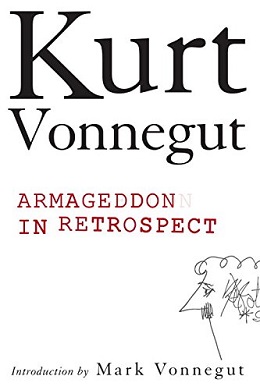
1. Armageddon in Retrospect by Kurt Vonnegut

I'm not entirely sure why I haven't picked this one up sooner. I am, after all, the guy who ranked all of Vonnegut's novels in a way that met with far less derision than when I tried to rank the Harry Potter movies or those times I tried to let readers rank sci-fi TV shows and movies. These stories deal chiefly with war, and while I rarely love Vonnegut's short stories in the way I love his novels and autobiographical writings, they are always artfully crafted and engaging. I do feel a little strange about this collection being published posthumously and kicking off a series of posthumous story collections, since Vonnegut expressed during his life that A Man Without a Country was intended to be his final work, but his son Mark was involved in this collection and wrote a lengthy introduction, and I guess that's just what people do when famous artists die. Ask Johnny Cash.

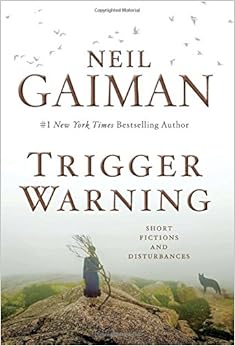
2. Trigger Warning by Neil Gaiman

Neil Gaiman's just one of those cats who make our time here a little better. His tongue-in-cheek short story Shoggoth's Old Peculiar, in which a lone American tourist on a walking tour of the English coastline stumbles into a town populated by acolytes of Cthulhu, is one of my favorites, and I have been very proud of my children's fondness for Coraline and Fortunately, the Milk. I picked up Trigger Warning when it was released earlier this year, and can't wait to dive in. This is a collection of stories written over, broadly, the last decade or so, so concurrent with The Ocean at the End of the Lane, which I consider if not a masterpiece, certainly a near masterpiece.


3. The Sandman Library, Vol. 8-10 by Neil Gaiman

The presence of both of these Gaiman works on this list is a coincidence. I shamefacedly admit that I never read the entire arc of Sandman, so I started anew last year with the first issue, thanks to the wonderful "Graphic Novels for Adults" section at my local library. Now only three volumes remain. I'm pretty sure the spoiler statute of limitations runs out somewhere before 20 years, but nobody spoil it for me, kay?

One thing I have enjoyed very much in these editions under the "Sandman Library" banner is reading the introductions by other writers, and how they chronicle in part the legitimization of comics and graphic novels as a literary medium, It's been said over and over that nobody had ever seen anything like Gaiman's work on Sandman before these stories were published, and it's neat to read about an entire medium in its ascendancy, written by different voices, and as it was happening, from the locus of the stories that prompted that shift.

4. What If? by Randall Munroe

I'm so excited about this book.

xkcd cartoonist and one-time NASA roboticist (is that a word? anyhoo, "dude who built robots") attempted to provide serious scientific answers to absurd questions like "What would happen if you hit a baseball traveling at 90% the speed of light?" or "If every person on Earth aimed a laser pointer at the moon at the same time, would it change color?" I happen to love science, while simultaneously being very bad at it, and I love dumb stuff. So this juxtaposition of really smart, rigorous thinking applied to really dumb "Did that just come out of my mouth?" types of questions seems right up my alley.

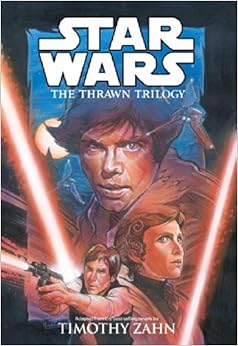
5. Star Wars: The Thrawn Trilogy (Graphic Novel) by Timothy Zahn

I confess I never got into the Extended Universe, and certainly not the way my wife has. But she and everybody I know who is into it has told me that Timothy Zahn's Thrawn Trilogy is the crowning work of the EU. But once again fearing a repeat of the ongoing Pale Fire debacle, I'm just being realistic when I say I can't commit myself to a three-book cycle anytime soon. So good news for me that the graphic novel adaptation of the trilogy is back in print. I think The G read it back in the day, but I tracked down a copy at the really big comics shop near me (sorry, Comics vs. Toys. I feel like I cheated on you!) and intend to knock this out after I finish Sandman.


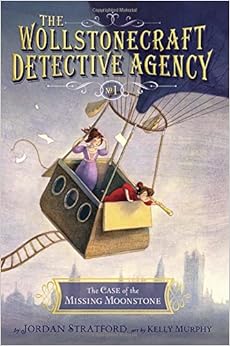
6. The Wollstonecraft Detective Agency Book 1: The Case of the Missing Moonstone by Jordan Stratford

It's not for me, I promise. I read to my kids at night, and as they've gotten a little older, we've gotten to tackle more complex books. We've done The Hobbit, we've done The Phantom Tollbooth, a bunch of Roald Dahl, and even The Adventures of Tom Sawyer. Know what all those books have in common? They're about boys doing cool stuff. As it happens, girls do cool stuff just as well as boys, and this is a lesson I want to impart upon my kids. Enter Jordan Stratford, and his amazing "what-if" scenario: what if, as children, Mary Wollstonecraft (later Shelley, who invented science fiction) and Ada Byron (later Lovelace, who invented computer programming) had known each other...and solved mysteries. I'll be...ahem, my kids...will be all over this, and I expect the wait for Book 2 will be a difficult one.

Posted by Vance K -- cult film reviewer and co-editor of nerds of a feather, flock together since 2012, and doing his best to instill a love of the odd and mysterious in smaller versions of himself since before that.

Thursday, July 2, 2015

Thursday Morning Superhero: My SDCC Schedule

It boggles my mind that San Diego Comic Con is only one week away.  While there are a lot of loose ends I need to tie up before my trip, I am feeling more excited about my annual excursion with each passing hour.  SDCC has released its full schedule and I thought I would share my plans with you.  I have not finalized all of my press requests and plans always change, but here is my day-by-day breakdown of what I hope to do.  If you happen to see me, please say hello!


Wednesday:
4:00pm - My SDCC adventure is going to begin with a taping of Conan.  Conan is taking over Comic Con, and thanks to the kindness of the SDCC Community, I am going to attend his first taping.  Guests Elijah Wood and Chris Hardwick are sure to entertain and I am extremely excited about being fortunate enough to attend.

7:00pm - In what has become an annual tradition, I will once again be attending Hop Con.  I have attended each event with my brother and it is hard to top enjoying delicious Stone beer and listening to Wil Wheaton and crew celebrate what it is to be a nerd.   From the atmosphere, to the gourmet spread, and topped with exclusive beer, I can't think of a better way to celebrate a week of fun.

 Thursday:
12:30pm - I may actually get to sleep in one day!  I am also excited because the first panel I attend is one of my must see panels of the entire convention.  Return to Gravity Falls in 6A.  Creator and actor Alex Hirsch leads this panel after the shocking conclusion of Season 2.  My wife and I describe this show as Twin Peaks for kids and is our family's favorite television show.

2:00pm - Next on the list is Image Comics: Where Creators own the Mainstream in 23ABC.   Image Comics has quite a few panels throughout the con, and this one features Michael Moreci and Chip Zdarsky in addition to some other great guests.  There is something special about creator owned content and it is a big reason why Image has been growing so fast.

3:30pm - In keeping with a comic book theme, I am going to mosey on over to Robert Kirkman's Skybound Entertainment Celebrates Five Years in 6BCF.  Kirkman has done a masterful job with Skybound and it will be great to get the latest on The Walking Dead, Outcast, and get a sneak peak at its first feature length film, AIR.

6:00pm - Ending on a bit of a lighter note, I will venture outside of the convention center over to the Indigo Ballroom for Comedy Central: Drunk History and Another Period.  I look forward to hearing some behind the scenes tales from Drunk History and hearing from the amazing cast of Another Period.  Another Period is a faux reality show set in the turn of the century.  It follows the hijinks of the deplorable Bellacourt sisters and the cast includes Michael Ian Black, Jason Ritter, David Wain, Natasha Leggero, Riki Lindhome, and more.

Friday:
7:00am - I will be up early in the morning to attend the Star Wars Fan Breakfast.  I had a blast last year and enjoyed a quiet breakfast with a group of like minded individuals.

9:30am - Friday is my Hobbit day, as I will be having second breakfast that I am not sure how much I can disclose about.  Hopefully when this is happening we can get #SecretBreakfast trending.

12:00pm - While I have been unable to attend in previous years, I have always wanted to attend the MattyPalooza panel in 25ABC.  I will give it a legitimate try this year as I learn about the many lines that Mattel offers.  I have heard good things about this panel and want to experience it at some point.

2:15pm - I am a fan of Phillip K. Dick, which is why I am stoked to attend the Amazon: Man in the High Castle panel in 6A.  This is the highlight of my Friday and I am looking forward to learning what Amazon has planned for this beloved book.   The panel features executive producer Frank Spotnitz, producers David Zucker, and Isa Dick Hackett, and numerous cast members.  Should be informative and hopefully let us know the show is in good hands.

4:00pm - Following this I am going to be part of history at IDW: The Best Panel in recorded History in Room 4.  While I am excited about the shocking announcements, I am most pumped to hear what John Layman has to say.  The creator of Chew is one of the most interesting individuals in the industry and it should be very entertaining.  Throw in Gabriel Rodriguez and you have me hooked.

7:00pm - While there are other panels I would like to see, I am going to take a short break before going to Funko Fun Days.  The good folk at Funko have promised a bigger and better event and I can't wait to see what changes they made.  One of my top highlights from last year, I am really looking forward to my return visit.

Saturday:
10:00am - Assuming that Con fatigue hasn't kicked it too bad, I am going to start my Saturday at the The Last Man on Earth panel in the Indigo Ballroom.  Featuring the lovely Kristen Schaal and creator Will Forte, I look forward to see what the plans are to follow-up the highly successful first season.

11:15am - This one is going to be cutting it close, but if I can manage to make it to 6DE I am going to attend the New DC Universe: Batman: Are you Ready? panel featuring Scott Snyder and Greg Capullo.  I have really enjoyed Snyder and Capullo's Batman run and look forward to hearing what is in store for the Dark Knight.

3:00pm - Following a quick break and a bite to eat, I will venture over to 6DE for the Outcast TV Series: A First Look with Robert Kirkman panel.  Following the success of The Walking Dead television show, it isn't surprising that he was quick to land a deal for Outcast.  I have high hopes for this one and look forward to a sneak peek.

4:15pm - My son would be upset with me if I didn't see what was happening in room 6A for the LEGO Marvel's Avengers: From Silver Screen to Videogame Console panel.  Including a special appearance from Stan Lee, attendees will see gameplay from the new LEGO game set to debut this winter featuring scenes from Avengers: Age of Ultron.  We are a big LEGO gaming family and I look forward to seeing what is next from TT Games.

Sunday:
10:00am - Tears will be shed as fans celebrate the genius behind Phineas and Ferb in the Last Day of Summer: TV Guide Magazine's Farewell to Phineas and Ferb in 6BCF.  A staple in our household, Phineas and Ferb is one of those rare shows that is truly entertaining for both kids and parents.  I am sad to see it end, but happy that summer vacation lasted over 200 days! 

11:15am - Looks like I can stay in my seat and hang out in 6BCF a bit longer to watch the World Premiere of LEGO DC Comics Super Heroes: Justice League: Attack of the Legion of Doom panel.  This one is pretty self explanatory, but promises some surprise guests.  Should be fun and it allows me to taunt my son when I get home.  Hooray!

1:00pm - Sticking with the LEGO theme, I will then venture over to 7AB to attend the LEGO Ninjago panel for the second year in-a-row.  It was a lot of fun last year and my son really enjoyed the inside scoop I was able to provide.  Looking forward to more of the same this year.

Sadly this is where my SDCC adventure will end.  Looking above it sounds like my plate is full, and this doesn't even include floor time, off-site events, and some press events I am really looking forward to.  As much as I would love to attend some of the panels in Hall H, I am getting too old to hang out in line with these kids today.  Feel free to comment on what panels you are attending or anything that you thought I missed.  Cheers!

 POSTED BY MIKE N. aka Victor Domashev -- comic guy, proudly raising nerdy kids, and Nerds of a Feather contributor since 2012. 


Wednesday, July 1, 2015

Microreview [video game]: The Witcher 3: Wild Hunt

Following the Path


The Witcher 3 is great, and you should play it immediately.

The Witcher 3 follows closely after the events of The Witcher 2: Assassin of Kings. Geralt is a witcher (not a witch, or witch-hunter), a human transformed by mutagens and trained to kill monsters that prey on common people. He has recovered his lost memory and is on the search for his love, the sorceress Yennefer. He finds Yennefer in the service of Emhyr var Emreis, the emperor of Nilfgaard. Emreis has a mission for them: to find his daughter (and Geralt's adopted daughter) Ciri. Ciri has been missing for a long time, but Emreis's intelligence has spotted her in the conflicted lands of Velen, Novigrad, and Skellige. Ciri is thought to be pursued by the Wild Hunt, a mythical group of spectral riders that bring death everywhere they go. Geralt goes out in search of Ciri and the hunt begins.

If you've never played a Witcher game, the most obvious comparison is to a third-person Skyrim. It's a huge, third-person action RPG with a single character focus. You're not an avatar of yourself, but Geralt. Geralt has a voice, and history, but his conduct is largely up to the player. Dialog options aren't restricted to "saint" or "asshole" but several shades in between. Sometimes you can use witcher magic to manipulate conversations, but (in contrast to previous games) this sometimes backfires. Geralt can freely summon a horse, and fast travel is available at semi-regular intervals throughout the world. The main quest is not time-limited, so you're free to pursue side quests, witcher contracts (monster hunts), and play mini-games. Areas are not auto-leveled to provide a particular challenge and it's not difficult to wander into a fight you're not ready for, which gives exploration an appealing degree of danger. The quests in the game are helpfully labeled with a suggested player level, which I found to be mostly accurate to the degree of challenge I expected.

If you played The Witcher 2 (and you should, it's amazing), then you're likely pretty familiar with how to play The Witcher 3. It still has two swords, heavy and light attacks, potions, throwables, and magical signs. It has, however, been thoroughly tweaked to make the gameplay a little smoother. Melee attacks are not as easily interrupted. Potions are brewed once (after recipe and ingredients have been found) and then they stay in limited quantities in your inventory and auto-refill with every rest period. Potions don't last as long as they used to, so they're more freely chugged during combat. There are no knives to throw, but they've been replaced with a crossbow and bombs auto-refill like the potions do. The axii sign (mind control) actually works outside of dialog in The Witcher 3 to stun enemies, and yrden (magical trap) is less of an instant stun and more of an area-of-effect debuff zone. The availability of traps is far, far lower in The Witcher 3, which is great news if you're still having nightmares about that trap-filled jungle outside of Flotsam. You can freely dodge, block, and parry without worrying about a stamina meter. Signs require a recharge time per casting, but it can be sped up with character development. Overall, some of the rough corners of The Witcher 2's main combat loop have been smoothed over in positive ways.

Beyond the mechanics of the gameplay, this is very much an evolution of The Witcher games of the past. No easy choices, and very few of them shake out entirely from the start. You find out hours later how your choices have affected the world. It doesn't only affect characters either, as the actual world of The Witcher 3 changes. Not in huge ways, but little details such as seeing more soldiers in the streets, or different background conversations as the game progresses.

Quest design is incredible. The main story has a few interesting turns, but some of the side quests almost overshadow it. It felt like the designers got to where most video games would end a quest line, and decided to continue it for a few more beats. Of all the many, many quests I completed, I only ran into one that got stuck on a bug, and even that quest could be completed in another way due to its design. Even beyond quests, the landscape is littered with stuff to do, like destroy monster nests, find hidden treasures, and liberate areas from bandits. There's a CCG-ish mini game called Gwent that some people are huge fans of. I'm not one of them, but I appreciate it for doing something other than simple dice poker. Secondary quests include Gwent, fist fighting tournaments (like those in The Witcher 2), and horse racing. The amount of stuff to do in the game easily rivals or surpasses the largest RPGs.

There is also a huge amount of little details that The Witcher 3 gets right, where most games do not. There is no unspoken dialog. Every conversation is voiced. Even though the world is absolutely enormous, the parts of it all seem unique and different. Where most games this big might feel like they've been cut and paste together, the world of The Witcher 3 feels crafted. Every piece of equipment changes Geralt's look with very few palette swaps. Cutscenes are all rendered in-game, so every Geralt looks like your Geralt. If you're riding your horse, you can hold down the run button and the horse will (mostly intelligently) follow the trail you're on. It's all of these little touches that add up to The Witcher 3 being an amazingly immersive experience. There's very little in the game that pulls you out of its world.

If I had to make one complaint about the game, it's that the crafted narrative experience comes at the expense of having a character that represents the player. Playing the whole game as Geralt simply isn't going to appeal to every single person, and it doesn't have to, but it limits the audience. Your Geralt probably differs from mine in many ways, but we're both still playing as Geralt, not some representation of ourselves. It's a downside to the improved narrative you get from playing a single character. When you're playing a character, you can't play as yourself. Compared its modern RPG contemporaries, such as Pillars of Eternity, Dragon Age, or Skyrim, this makes The Witcher 3 rather limited in choice of player representation.

But if you're into Geralt, this is the best Witcher game yet. It's an enormous open world that is fun to explore and live in for the many, many hours you'll spend in it. It's an extremely immersive game that sends The Witcher series out on a very high note.

The Math

Baseline Assessment: 10/10

Bonuses: It's an amazing video game.

Penalties: -1 unless you're not into playing as Geralt. Then it's an excellent game that might not be for everyone.

Nerd Coefficient: 9/10 (very high quality/standout in its category)

***

BONUS MICRO-MICROREVIEWS

The Witcher 3 Free DLC

In the time since release, CD Projekt RED have released 10 pieces of free DLC, two pieces every two weeks since release. These pieces of DLC are truly DLC sized additions consisting of three quests, two sets of armor, two alternate costumes, an alternate set of art for Gwent cards, alternate hair and beard styles, and a new crossbow set. They are mostly minor additions, but the quests add more time and are of a quality consistent with the rest of the game. One of the new quests alone (a scavenger hunt) added another two hours to my time.

The new stuff, however, blends in so well with the rest of the game that it might be hard to locate new quests or items without some directions. Contrary to Elder Scrolls fashion, the new items are not accompanied by quests or mysteriously delivered notes, and the quests must be stumbled upon like any other quest. If you're just trying to check out the new stuff, it would behoove you to find a wiki page or forum post from someone who can tell you where to find the new stuff so you're not sifting through a sea of stuff you already know about.

They're nice bonuses that will give me a reason to fire the game up again when the rest are released. I am very much looking forward to the more substantial expansions that are planned for the game. 


The World of the Witcher [book]

I'm a sucker for video game art books. The World of the Witcher is, specifically, an art book for the video game series and not necessarily the book series. It's heavy on finished art and lore, but doesn't pull back the curtain much on concepts or designs, and the lore won't tell you much that you won't already know from playing the games. It's weighty and well-built, but not mindblowing.

***

POSTED BY: brian, sci-fi/fantasy/video game dork and contributor since 2014

Reference: CD Projekt RED. The Witcher 3: Wild Hunt [CD Projekt RED, 2015]
Reference: CD Projekt RED. The World of the Witcher [Dark Horse Books, 2015]